



Abstract
In this article, we highlight an underappreciated individual difference: structure building. Structure building is integral to many everyday activities and involves creating coherent mental representations of conversations, texts, pictorial stories, and other events. People vary in this ability in a way not generally captured by other better known concepts and individual difference measures. Individuals with lower structure-building ability consistently perform worse on a range of comprehension and learning measures than do individuals with higher structure-building ability, both in the laboratory and in the classroom. Problems include a range of comprehension processes, including encoding factual content, inhibiting irrelevant information, and constructing a cohesive situation model of a text or conversation. Despite these problems, recent research is encouraging in that techniques to improve the learning outcomes for low-ability structure builders have been identified. We argue that the accumulated research warrants the recognition of structure building as an important individual difference in cognitive functioning and that additional theoretical work is needed to understand the underpinnings of structure-building deficits.
Keywords
One of the biggest mysteries of cognition involves understanding individual differences in performance. That is, although the field has a good understanding of the basics of processes such as perceiving, remembering, and comprehending, among others, we have much less of a sense of how such abilities vary across people and how such variations affect performance on a wide range of tasks. Working memory is a major exception; it can be measured reliably and predicts individual differences in a wide range of skills and abilities (Conway et al., 2005). However, from an educational standpoint, working memory may not be an ideal target because it is still not clear whether this is a trainable individual ability (Shipstead et al., 2012) and, if so, whether the benefits last over time and/or transfer across tasks (Melby-Lervåg et al., 2016; Melby-Lervåg & Hulme, 2013). In this article, we highlight an underappreciated individual difference, structure building (Gernsbacher, 1990), that is measurable, consistently related to learning in the laboratory and authentic educational settings, and potentially trainable, albeit not well known outside of the text-processing literature. We explain what structure building is, how to measure it, and how it relates to learning and comprehension (both in the lab and the classroom). We describe briefly how structure building differs from other better known concepts and measures and review studies that illuminate the component processes that challenge low-ability structure builders. We then discuss the implications for interventions. We close by identifying open theoretical issues and discussing the potential of this construct for fruitful educational application.
Structure building is the creation of coherent mental representations of concepts, conversations, texts, and other events and is integral to many everyday activities, such as reading a novel or story (Gernsbacher et al., 1990; Graesser, 1975; Stine-Morrow et al., 2004), watching a picture story (e.g., Baggot, 1975), listening to a lecture (Bui & McDaniel, 2015), attending a work meeting, or engaging in conversation. In these situations, the goal is typically not to memorize what one reads, sees, or hears but rather to extract the gist and understand the “who/what/when/where/why” of a particular narrative or event. Gernsbacher (1990) proposed that there are fundamental individual differences in people’s structure-building ability. She argued that some people—high-ability structure builders—routinely extract coherent mental structures of the narrative events they encounter (texts, conversations, pictorial stories). In contrast, other people—low-ability structure builders—routinely extract fragmented and less cohesive mental structures of the narrative events they encounter.
Despite the potential theoretical and practical importance of this proposed individual difference, structure building has received relatively little empirical attention outside of the text-processing literature since it appeared nearly 3 decades ago (e.g., Gernsbacher et al., 1990). In the past 15 years, however, we have embarked on a series of studies to (a) establish the range of materials and learning environments in which individual differences in structure building can have an impact, (b) illuminate the representational and comprehension shortcomings of low-ability structure builders, and (c) develop interventions to improve comprehension and learning for less able structure builders. In this article, we draw on this research to highlight and integrate the progress on these significant issues and argue that structure building is a critically important individual difference.
Assessing Structure Building
Structure-building ability is assessed with the Multi-Media Comprehension Battery (MMCB; Gernsbacher & Varner, 1988). This assessment is highly reliable (α = .987; Gernsbacher et al., 1990). Capturing the theoretical premise that structure-building ability is general across linguistic and nonlinguistic media, the MMCB presents simple stories in print, aurally, and in pictures. Like fables, each story conveys a moral. In the original version, participants are presented with six stories (two self-paced written stories, two experimenter-paced aural stories, and two self-paced pictorial stories; for more details about the battery and its administration, see the Appendix in Gernsbacher & Faust, 1991 1 ). Participants then answer short-answer questions (scored on a three-point scale) that focus on both specific details and broader concepts from the stories. Test scores across the different media are highly correlated (r = .72–.92), and a principal component analysis revealed that one factor underlies performance in all modalities (Gernsbacher et al., 1990; Gernsbacher et al. also noted correspondences between listening and reading using other assessments). Accordingly, subsequent studies typically assessed structure building with one modality (either printed text or pictorial narratives; e.g., Maki & Maki, 2002; McDaniel et al., 2002).
In particular, most of these studies assessed structure building using a modified version of the MMCB, in which participants are presented with four stories, shown line by line with one paragraph per slide, in a self-paced fashion. Once participants finish each story, the story is removed from view, and participants answer 12 multiple-choice questions about it before proceeding to the next story. The resultant scores can range from 0 to 48. Some researchers have treated structure-building ability continuously, whereas others have preselected subjects who score below 32 or above 36 to indicate low-ability and high-ability structure builders, respectively (Callender & McDaniel, 2007; Martin et al., 2016; McDaniel et al., 2002). (A natural question is the extent to which structure-building ability, as assessed by the MMCB, is concordant with reading ability as assessed by standard indices such as the Nelson-Denny Reading Test. We address that question in a later section; to preview, the overlap is modest.)
Figure 1 shows how several samples of individuals vary in their scores on the text version of the MMCB. This variability is evident in a sample from a midsize 4-year public university (Washburn University) and even within relatively homogeneous samples from highly selective private universities (Washington University in St. Louis, Duke University). The pattern is similar in a sample of high school students from excellent school districts in North Carolina as well as in the general population (as measured in a sample of Amazon Mechanical Turk workers). Thus, structure building is an ability that varies widely.
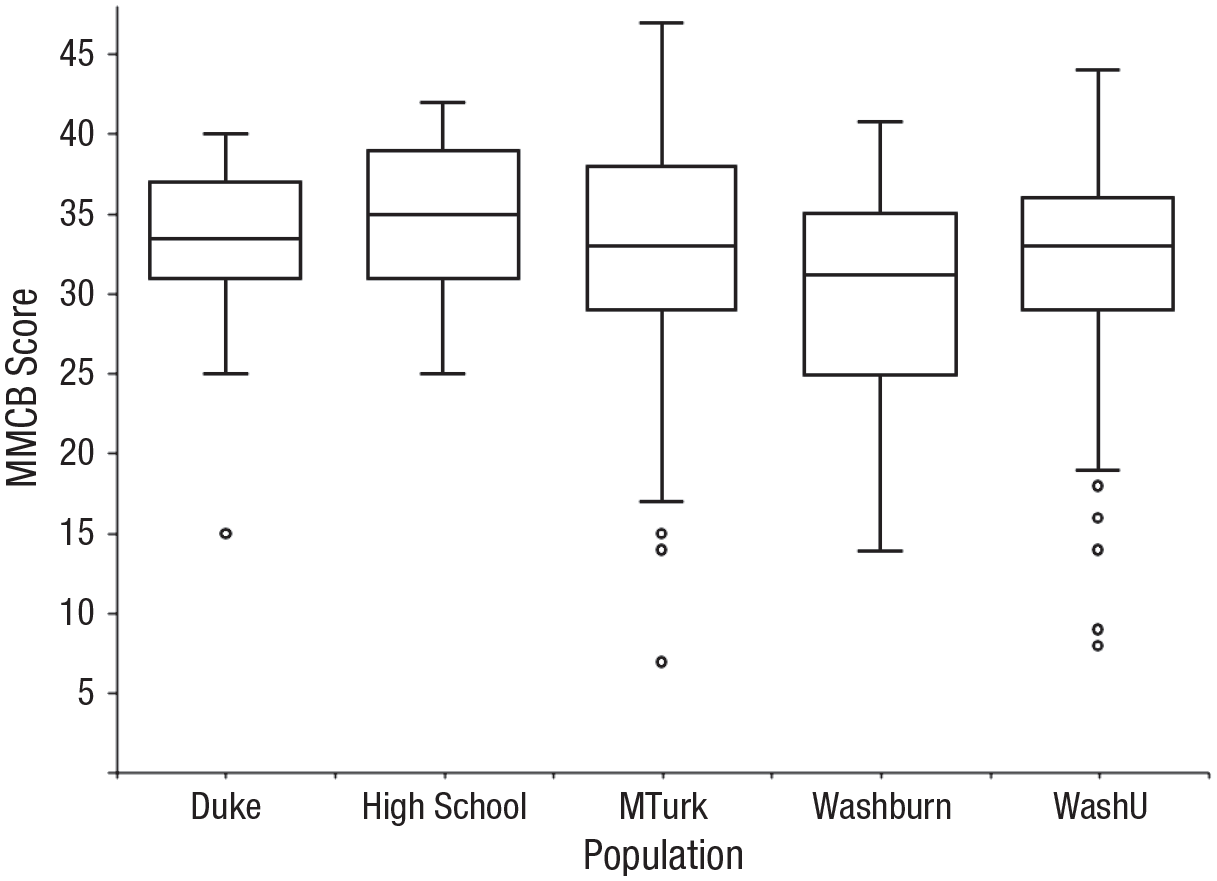
Distribution of Multi-Media Comprehension Battery (MMCB) scores across five samples: Duke University students (n = 70), high schoolers in North Carolina (n = 31), Amazon Mechanical Turk workers (n = 191), Washburn University students (n = 55), and Washington University in St. Louis students (n = 100). Scores on the y-axis represent raw scores on the MMCB (total possible range: 0–48). The horizontal line in each box represents the median. The top and bottom of each box represents the top and bottom, respectively, of the interquartile range (IQR). The whiskers represent 1.5 times the IQR, and the circles represent outliers.
Structure Building Matters
To highlight the strong relationship between structure building and learning, we begin with an illustrative example from Lin et al. (2018). In one experiment (n = 134), students read and studied a passage on either biological anthropology or geology, completed the written version of the MMCB, and then answered multiple-choice and short-answer questions about the studied passage. The multiple-choice questions focused on details from the passage. For instance, an example multiple-choice question for the geology passage was as follows: What can a paleoanthropologist assess using carbon-dating techniques? a. Shell, charcoal, and tuff b. Charcoal, shell, and peat c. Ash, peat, and bone d. Peat, wood, and ash e. Bone, tuff, and charcoal
The short-answer questions focused on students’ understanding and integration of concepts. An example of this type of question (for the geology passage) was as follows: A scientist used fluorine absorption dating to discover a certain material’s relative age compared to all the other local fossils. The scientist later used another dating technique to find the absolute age of this material. The material was determined to be 1,500 years old. a) What absolute dating technique did the scientist use? Explain. b) What could the material be? Explain.
Students’ structure-building ability (as captured in their MMCB scores) predicted their performance on both the multiple-choice (η2 = .076; medium-sized effect) and short answer (η2 = .099; medium-sized effect) questions. This relationship between learners’ structure-building ability and test performance held regardless of how students studied the text: without specific instruction (a free-study condition), with experimenter-provided flashcards, or with student-generated flashcards. These findings underscore the importance of structure-building ability when learning authentic classroom materials and with a variety of study strategies.
Low-ability structure building is associated with deficits in learning and retention across a wide range of topics (for a comprehensive summary, see Table 1), including astronomy (Arnold et al., 2017, 2021), biology (Gouravajhala, 2018), biological anthropology and geology (Lin et al., 2018), geography (McDaniel et al., 2002, Experiment 2b), biological and abnormal psychology (Callender & McDaniel, 2009, Experiment 4), and mechanics (brakes and pumps; Bui & McDaniel, 2015; Martin et al., 2016; St. Hilaire et al., 2019). The effects are not limited to short texts but also occur when the goal is learning entire textbook chapters (Callender & McDaniel, 2007; Callender & McDaniel, 2009, Experiment 4; Gouravajhala, 2018). A strong narrative structure is clearly not a prerequisite for revealing learning and retention differences as a function of structure-building ability. MMCB scores predict learning of textbook selections that Coh-Metrix analyses (Graesser et al., 2004) confirmed were extremely low in narrativity (10th and 6th percentile for biological anthropology and geology, respectively; Lin et al., 2018).
Studies Investigating a Relationship Between Structure-Building Ability and Learning: Methodological Features and Effect Sizes

Note: Effect sizes are typically amplified in extreme-groups designs relative to continuous-variable designs (Preacher et al., 2005).
Structure building also predicts learning and comprehension across a range of procedural variations. Although most experiments measure comprehension of print materials, structure building also predicts comprehension when students listen to a passage from an audio book while taking notes (Bui & McDaniel, 2015) and when texts are degraded (scrambled or missing letters; McDaniel et al., 2002, Experiment 2b). Structure-building scores predict long-term learning, as measured days later in laboratory experiments (Arnold et al., 2017, 2021; Callender & McDaniel, 2009) or weeks later in a classroom setting (Maki & Maki, 2002). It does not matter whether structure building is measured with an extreme-groups design (Arnold et al., 2021, Experiment 1; Callender & McDaniel, 2009; Martin et al., 2016) or treated continuously (Arnold et al., 2017; Arnold et al., 2021, Experiment 2; Bui & McDaniel; Lin et al., 2018); it still predicts comprehension. In sum, at least 12 laboratory studies (or experiments) with a variety of materials and study (or reading) procedures have examined the extent to which individual differences in structure building are associated with learning and memory. The results are clear and consistent in study after study: Low-ability structure builders learn and remember less than do more able structure builders (see Table 1). These deficits are robust and often yield large effect sizes.
Because much learning requires integrating material from multiple experiences, a critical test of structure building is whether it predicts performance in the classroom across modalities. That is, the same topic is often covered in a lecture, a textbook assignment, and in a recitation section. Learning should not involve creating separate representations for each of these experiences. Rather, a coherent and complete understanding would entail extracting an integrated mental representation (structure) across sources (and modalities) that also captures the somewhat nonoverlapping subcontent separately gleaned from each experience. Moreover, a successful learner must build his or her mental structures over time (on the order of days or weeks), not just across different sources. Accordingly, one might expect that skill in structure building would be a crucial component of successful classroom learning.
Two studies found the predicted positive relationship between structure-building ability and classroom success: MMCB scores predicted exam performance in two sections of an introductory psychology course (Maki & Maki, 2002) and final course grades in undergraduate introductory psychology and biology classes (Arnold et al., 2016). In the latter study, researchers collected high school grade point averages (GPAs) and SAT scores (from a subset of students in the psychology course), as well as scores on the Biology Concept Inventory and the Lawson’s Classroom Test for Scientific Reasoning (from a subset of students in the biology course). Differences in structure-building ability predicted final grades in both introductory psychology and biology even after taking the other standard predictors into account—an impressive feat given that high school GPA and SAT scores are “gold standard” predictors of success in college. Therefore, these studies show that individual differences in structure building predict learning outcomes in university courses, at least courses at the introductory level. The implication is that structure building is a general skill that holds importance for learning and understanding complex material in authentic learning environments.
What Structure Building Is Not
Many factors predict learning and comprehension. Thus, in this section we briefly reassure the reader that structure building is not a familiar ability with a new name. Our goal here is not to comprehensively cover all of the research on these other measures and concepts but rather to underscore that structure building captures something different from these more familiar measures.
First, it is important to note that structure building is not the same as story comprehension, a concern that might arise given that both the structure-building assessment (MMCB) and much of the initial elegant work on structure building measured understanding of simple stories (e.g., Gernsbacher et al., 1990). To be clear, the concern is not that the general goals and processes of comprehension are unique to stories. Rather, from many perspectives, stories (and more generally event-based texts) afford specific and potent processes 2 that expository texts do not; for example, two influential comprehension models are based on theoretical components that apply only to event-based texts: the causal-network model (Trabasso et al., 1989) and the event-indexing model (Zwaan et al., 1995; Zwaan & Radvansky, 1998; for an excellent overview, see McNamara & Magliano, 2009). In particular, extensive theoretical and empirical research has identified unique aspects of stories’ contents and structures that facilitate the construction of well-organized representations (e.g., Fletcher & Bloom, 1988; Graesser et al., 1980; Mandler & Johnson, 1977; Schank & Abelson, 1977; Thorndyke, 1977; Trabasso & van den Broek, 1985; van Dijk, 1980; van Dijk & Kintsch, 1983). Thus, one concern is that structure building is primarily capturing participants’ ability to use and build on story-specific features (for more details, see note 2).
Even if individual differences in structure building primarily reflected unique aspects of story comprehension (e.g., noticing and exploiting causal relations, acquiring or activating story grammars), this individual difference would not be less interesting, but its theoretical reach would be more limited. The evidence reviewed in the previous section, however, makes clear that structure-building ability predicts comprehension and learning of expository texts that are not in story format. For example, after reading technical passages, less able structure builders recall less content, correctly answer fewer multiple-choice questions (regardless of whether they test retention or require inferences), and solve fewer short-answer application questions that require fixing or diagnosing problems than do more able structure builders (Martin et al., 2016; St. Hilaire et al., 2019; for many more examples, see Table 1).
Second, structure-building ability, as assessed by the MMCB, is not synonymous with general reading ability as indexed by existing standardized indices such as the Nelson-Denny Reading Test (Brown et al., 1993). Reading comprehension must certainly involve structure building, but the MMCB and Nelson-Denny Reading Test scores should not be highly correlated if these tests emphasize somewhat different skills. In line with this expectation, the two measures are moderately correlated, r = .46 (Maki et al., 1994) and r = .28 (A. A. Callender, personal communication, April 5, 2018), respectively; that is, a standard reading-ability measure captured no more than 21% of the variance in the MMCB (Maki et al., 1994).
Further evidence for the difference between the two measures comes from findings that extra time benefits struggling readers on standard reading tests such as the Nelson-Denny Reading Test but not on the structure-building measure (MMCB). That is, unlike the MMCB, most reading measures are timed tests and accordingly emphasize the efficiency of low-level reading processes such as word-decoding (for the Nelson-Denny Reading Test, see Mason, 1978; Petros et al., 1990; for a broader discussion of this and other differences across reading measures, see Callender & McDaniel, 2007). Struggling readers improve and comprehend more when they are given additional time (Baldwin et al., 1989; Jensen, 1998), and consequently these readers later recall as much of both narrative and expository passages as do readers who score high on the Nelson-Denny Reading Test (McDaniel et al., 2002, Experiments 1a and 1b). In contrast, unlimited reading time does not alleviate the problems of low-ability structure builders; they still recall about 40% less of the same narratives and expository passages than observed for high-ability structure builders (McDaniel et al., Experiments 2a and 2b). Because the way readers recall a text is theorized to reflect the cohesiveness of their representations (Kintsch & van Dijk, 1978), these patterns suggest that readers who score low on the Nelson-Denny Reading Test (but not low-ability structure builders) are capable of extracting coherent and complete representations but require more time to do so.
Relating structure building to other known predictors of learning
ACT and SAT
It is not surprising that MMCB scores correlate with selected standardized test scores given that reading comprehension is required for success in school (Arnold et al., 2016). However, these correlations are relatively low: MMCB scores correlate weakly with SAT verbal scores (r = .16) and not at all with ACT English scores (r = .01; Gouravajhala, 2018) or SAT writing scores (r = .028; Arnold et al., 2017). More critically, MMCB scores explain additional variance in course grades beyond that predicted by high school GPA and SAT scores (two very significant predictors; Arnold et al., 2016). Further, MMCB explains variance in performance on multiple-choice and problem-solving tests on an astronomy text, but SAT writing scores do not (Arnold et al., 2017).
Working memory
One might assume that effective structure building is highly dependent on working memory capacity. The idea is that more concepts (propositions) can be coactivated (Kintsch & van Dijk, 1978) with greater working memory capacity, and more resources are available to construct connections among those concepts (see Wiley et al., 2011). Existing evidence suggests, however, that working memory and structure building are moderately related at best. For example, Arnold et al. (2017) reported that when MMCB, working memory, and SAT scores were simultaneously entered into a regression, only MMCB scores emerged as a significant predictor of learning. Figure 2a drills down into those data, 3 showing the relationship between standardized MMCB scores and an averaged working memory score (collapsing over standardized Reading Span [RSpan] and Operation Span [OSpan] scores 4 ). There was essentially no correlation between the standardized MMCB scores and the working memory composite scores (r = .14). Likewise, in another study with more than 100 participants, Gouravajhala (2018) 5 found only a small association between working memory (as measured by an average score of standardized OSpan and RSpan scores) and standardized MMCB scores (r = .14; see Fig. 2b). Thus, MMCB scores are weakly related to performance on working memory tests and should not be considered a stand-in for working memory.
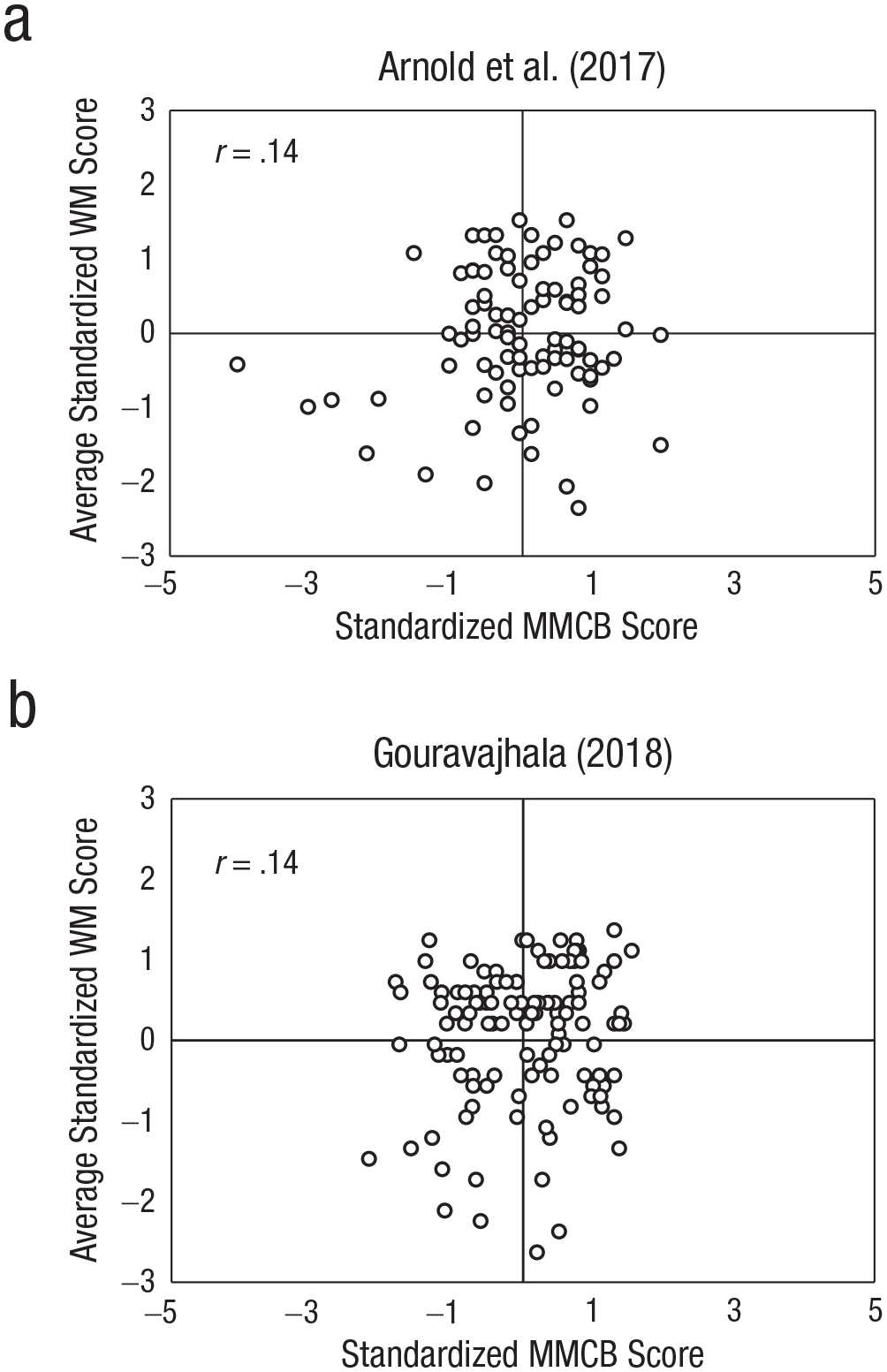
Scatterplots of the relationship between Standardized Multi-Media Comprehension Battery (MMCB) scores and average working memory (WM) composite scores (standardized Reading Span averaged with standardized Operation Span). Data are from (a) Arnold et al. (2017) and (b) Gouravajhala (2018).
Processes Underlying Structure-Building Deficits
Given that structure-building ability predicts comprehension and learning across a variety of materials and educational settings, it is important to understand why low-ability structure builders struggle. To do so, we draw on the above findings as well as additional studies to develop a more complete and nuanced description of the component processes impaired in low-ability structure builders. In these sections, our discussions focus primarily on text-processing, reflecting the available literature. In doing so we occasionally use text-specific terms, but it is important to note that the findings and theoretical implications discussed should extend to the comprehension of nonlinguistic inputs. Such an extension would be in line with the central tenet of the structure-building framework, but direct confirmation of that assumption awaits future empirical work. Here, we examine the possibility of deficits in (a) encoding and remembering incoming information, (b) identifying the main points of a text, (c) activating and applying prior knowledge, (d) inhibiting irrelevant knowledge, and (e) connecting ideas across the text.
Memory deficits for factual content
At least some information from the to-be-comprehended source (be it a text, video, or other type of event) must be stored in memory to provide the foundation for one’s mental model. In the original structure-building framework, this basic information was represented as memory nodes (Gernsbacher, 1990). However, because a prominent text-processing model (we provide more information on this model below) more frequently formalizes the basic elements of meaning as propositions (Kintsch, 1974, 1988; Kintsch & van Dijk, 1978; Schmalhofer et al., 2002), we adopt that term here. To determine whether a text’s propositions are stored in memory, the standard approach is to test recognition of explicitly stated propositions from the text (e.g., Masson & Sala, 1978; Mayer & Gallini, 1990; Perrig & Kintsch, 1985; Sachs, 1967). The idea is that propositions will be recognized if they are stored in memory, given that recognition tests (as opposed to free recall) minimize retrieval demands (Einstein & Hunt, 1980; McDaniel & Masson, 1977).
In brief, the data suggest that low-ability structure builders are less likely to recognize verbatim propositions from texts. For example, in one study participants were tested on their memories for the contents of relatively long texts (e.g., on the order of 2,600–3,200 words, i.e., 16 pages or longer) that were adapted from psychology textbook chapters. For example, readers were asked to answer the question “Hairstyles, dress, and social customs are examples of: (a) culture, (b) groupthink, (c) attractiveness, (d) social conformity” to measure whether this idea unit about culture was stored in memory. Regardless of whether the chapter was read once or twice, performance on the multiple-choice questions was positively associated with higher structure-building ability (Callender & McDaniel, 2009, Experiment 4, continuous-variable analysis). A study using an extreme-groups design provides a sense of how robust this encoding deficit is: Low-ability structure builders answered only 52% of questions correctly, whereas high-ability structure builders answered 80% of questions correctly (Callender & McDaniel, 2007). Low-ability structure builders show similar deficits in recognizing verbatim text content even when the tested passages are much shorter. For example, when asked to recognize a concept from each of the eight paragraphs from a mechanics text (“Which of the following 4 options is not a component of a disk brake”), low-ability structure builders were significantly impaired (proportion correct: M = .68) relative to high-ability structure builders (proportion correct: M = .81), a result with a large effect size (d = .83; Martin et al., 2016). Converging results come from studies that treat structure building as a continuous variable; structure building is negatively related to recognition of the content of relatively short texts (800–900 words) on geology and biological anthropology (Lin et al., 2018) and astronomy (Arnold et al., 2017).
In sum, less able structure builders consistently recognize less factual information from texts than do more able structure builders, regardless of text length or topic. This finding highlights the need to provide learning support to less able structure builders (a point we return to later) and signals a critical theoretical implication: Less able structure builders do not sufficiently encode the propositional information stated in the text. That is, less able structure builders struggle to store the propositions that are the foundation for building mental structures. A memory deficit for basic to-be-learned information could underlie many of the learning deficits documented for less able structure builders, instead of or in addition to problems with the coherence of the structures built (cf. Gernsbacher, 1990; Gernsbacher et al., 1990). At the very least, it appears that less able structure builders are plagued by deficits not only in constructing coherent mental structures but also in encoding incoming information.
Deficits in identifying main points
Encoding propositions is a necessary but insufficient step toward comprehending and remembering a text. The construction of coherent mental structures presumably depends, at least in part, on being able to identify the main points of a text and to relate subordinate material to these main points (Kintsch & van Dijk, 1978; Lorch et al., 1993). One possibility is that low-ability structure builders struggle to distinguish main ideas from less important ones compared with high-ability structure builders. This hypothesis is not highlighted in the existing structure-building model (e.g., Gernsbacher et al., 1990; Gernsbacher & Faust, 1991) and thus has received little attention; however, it is an intriguing idea given the larger literature about summarization and learning (for a brief review, see Dunlosky et al., 2013). Summarization entails many processes, including but not limited to identifying the main points of a text, and summaries that are successful in capturing important ideas are associated with more learning (Dyer et al., 1979) and better mental models (Garner, 1982).
To our knowledge, only one study has investigated whether there is a relationship between a reader’s ability to identify important ideas and his or her structure-building performance (Gouravajhala, 2018). Participants read a biology textbook chapter entitled “Evolution and Natural Selection” (Phelan, 2009); 2 days later readers received a list of 39 ideas from the chapter and were instructed to mark the ones that they considered to be the most important ideas (no limits were placed on the number of ideas that could be marked). The list contained both important ideas (e.g., “fitness depends on an organism’s reproductive success compared with other organisms in the population”) and unimportant ideas (“the name of Darwin’s ship was the HMS Beagle”). Biology instructors independently identified 10 ideas as the most important ones; intriguingly, these ideas were more likely to be endorsed by high-ability structure builders than by those with low ability, as assessed using a discriminability index (d′; standardized important points minus standardized unimportant points). At the same time, structure building did not significantly predict the total number of ideas endorsed. That is, low-ability structure builders were not endorsing more ideas as important; they were less likely to identify the actual main ideas as being important. Moreover, participants were neither enrolled in nor had completed a biology or evolution course, and these patterns remained after factoring in participants’ self-reported ratings of prior familiarity with the topics, indicating that the results were not simply a by-product of some individuals having more knowledge of the material. Of course, a single study is not conclusive (e.g., the problem identifying main ideas could indicate a problem with one’s mental model rather than indicating on-line comprehension processes), but the study does suggest that it is worth investigating the hypothesis that structure-building problems may in part derive from a difficulty in identifying main ideas.
Deficits in activating and applying prior knowledge
Knowledge is required for structure building (e.g., for a construction-integration model of text comprehension, see Kintsch, 1988); readers must activate prior knowledge and inhibit irrelevant information as they create representations of a text. Without adequate prior knowledge, irrelevant information is not adequately deactivated (McNamara & McDaniel, 2004; for further discussion, see McNamara & Magliano, 2009), thereby potentially stimulating the formation of many fragmented structures (Gernsbacher, 1990). Accordingly, different degrees of prior knowledge may contribute to individual differences in structure building (McNamara, 1997; McNamara & Magliano, 2009).
It may also not be enough to have knowledge stored in memory; knowledge must be activated to support the construction of a coherent mental representation. Gouravajhala et al. (2021) 6 examined these ideas in a sample of 105 students from two universities (one more selective than the other, with the idea that the two groups would differ in how much they knew). Prior knowledge was quantified with two measures: a vocabulary test and a general-knowledge assessment that probed one’s knowledge of geographical, historical, literary, and scientific facts. Knowledge activation was assessed via an error-detection task in which students reading stories were asked to press a key when they read anything that contradicted the true state of the world (Marsh & Fazio, 2006; Umanath & Marsh, 2012). The stories made both neutral references to the world (e.g., “paddling around the largest ocean”) as well as incorrect ones (e.g., “paddling around the largest ocean, the Atlantic”). Only the general-knowledge measures significantly correlated with structure-building ability (MMCB scores; r = .28 for general knowledge and r = .38 for vocabulary). The knowledge-activation index (performance on error detection) correlated slightly but not significantly with structure-building ability (r = .18; p < .08). These patterns are in line with the idea that structure-building ability may rely somewhat on available prior knowledge.
Inhibitory deficits
As noted in the last section, learners must also deactivate irrelevant information, and crucial for our purposes is that several studies show that less able structure builders are slower to inhibit the irrelevant meanings of words. For instance, in one task participants read sentences such as “He dug with a spade” and decided whether a probe word fit in the sentence. The probe word tapped a meaning different from the one implied in the sentence (e.g., “ACE”). Low-ability structure builders were slower to reject the related but irrelevant probe words compared with more able structure builders (Gernsbacher et al., 1990, Experiment 4; for a similar task and findings, see also Gernsbacher & Faust, 1991). In a converging cross-modality task, participants saw pictures with words superimposed on them (e.g., the word “RAIN” might be superimposed on a line drawing of a hand) and were instructed to ignore the words; each was followed by a picture slide, and participants judged whether the two pictures were related. On some trials the to-be-judged picture was related to the to-be-ignored word (e.g., a picture of an umbrella). Low-ability structure builders took longer to reject this picture and label it as unrelated to the prior picture (e.g., the hand; Gernsbacher & Faust, 1991, Experiment 3). A similar effect was found when participants were instructed to ignore the pictures on the context slide and instead judge whether a word probe was related to the word superimposed on the picture. These and similar results suggest that low-ability structure builders are deficient in inhibiting irrelevant meanings of incoming information, which is problematic because successful comprehension requires that “irrelevant or inappropriate information must not affect ongoing processes; it must be efficiently suppressed” (Gernsbacher & Faust, 1991, p. 247).
To our knowledge, published research has generally not built on this rich set of initial findings. However, a recent study pursued the idea that compromised structure-building ability is related to inhibitory deficits. In a continuous-measure design, Gouravajhala et al. (2021) assessed three indices of inhibitory control: the irrelevant-word-meaning task from Gernsbacher’s paradigm (Gernsbacher et al., 1990; Gernsbacher & Faust, 1991), Stroop interference, and flanker interference. Regression analyses indicated that performance on the flanker task, but not the other tasks, 7 was associated with structure-building ability (increased flanker interference was associated with lower structure-building scores), and this relation persisted when scores on measures of prior knowledge and indices of connection-making (described below) were taken into account.
Making connections
One might posit that structure building is basically the skill of connecting ideas and building relations across patterns of information. To test this hypothesis, Gouravajhala et al. (2021) administered the MMCB and assessed three measures of subjects’ abilities to make connections across concepts. In the first assessment, an analogies task (GRE General Test; Educational Testing Service, Princeton, NJ), subjects discerned the critical relation in each of a series of base pairs (e.g., “rare : common”) and then selected the pair (out of four multiple-choice options) reflecting the same kind of relation (e.g., “old : new”). Prior research has suggested that completing analogies can benefit the comprehension of biological and statistical concepts and serve as a building block for cognition in development (Carey & Gelman, 1991; Goswami, 1996; Newby et al., 1995; Quilici & Mayer, 1996). The second measure was the Raven’s Progressive Matrices test (Arthur & Day, 1994), which requires subjects to decide which of several choices (patterns) complete a matrix conveying a relational pattern. A well-validated measure of fluid intelligence and cognitive functioning, the Raven’s Progressive Matrices test has also been shown to be highly correlated with verbal learning tasks (Tamez et al., 2008; Williams & Pearlberg, 2006). The third measure was the remote-associates task (Mednick, 1962), in which participants read three-word triads and generate a linking word for each triad (e.g., “sweet” is the best response to “tooth,” “potato,” and “heart”).
Performance on the Raven’s Progressive Matrices test (r = .38) and the remote-associates task (r = .43)—but not the analogies task—significantly correlated with MMCB scores (written version). Multiple-regression models showed that prior knowledge predicted MMCB scores (as indexed by vocabulary but not the general-knowledge index), but this relationship disappeared once scores on the Raven’s Progressive Matrices test and remote-associates task were entered into the model (both of which were significant predictors). These patterns show that the ability to draw connections and discover relations is an important component of structure building. Of course, both of these tasks are also correlated with prior knowledge measures, and thus prior knowledge may contribute to several levels of structure building (i.e., deactivating irrelevant information, drawing connections; cf. McNamara & Magliano, 2009). These interpretations clearly await more in-depth investigations.
Theoretical Implications
Identifying structure building as a predictive individual difference raises the question of how structure-building ability relates to the construction of representational structures. Addressing this issue is complicated by the long-standing and vigorous theoretical debate regarding the nature of the representations that are constructed during comprehension. At present, there is a lack of consensus and continuing debate (McNamara & Magliano, 2009), and it is beyond the scope of this article to consider all of the various competing theoretical positions.
For an initial theoretical treatment, we situated our analysis of individual differences within Kintsch’s influential model of text-processing (Kintsch, 1988; Kintsch & van Dijk, 1978; van Dijk & Kintsch, 1983). Several reasons compelled our choice of this particular model. First, the model specifies several parallel representational structures (as is generally embraced by the field; McNamara & Magliano, 2009; see also Zwaan & Radvansky, 1998), which allows the possibility for a more nuanced specification of the representational outcomes of individual differences in structure building compared with models embracing one representational level. Second, the model has stimulated research that aligns particular behavioral measures with each representational structure. Third, the model is an influential benchmark theory that has provided the foundation for several competing models, thereby providing some commonality across a range of specific theoretical perspectives (although not all). Finally, the Kintsch model can be instantiated in a computational model (see, e.g., Schmalhofer et al., 2002), providing a formal basis for (future) work attempting to characterize how individual differences in structure building affect processing and representations (McNamara, 1997). Although the Kintsch model focuses on text comprehension, this choice of model does not limit the reach of structure building to reading. That is, the seminal structure-building framework was explicitly intended to encompass processes general to many modalities; we used the Kintsch framework because it is the most developed, not because it involves reading.
In the Kintsch model, understanding involves constructing two parallel mental structures. The first is a coherent, interrelated network of the propositions stated in the text as well as those inferred from the text (the text-based representation). The second is a mental representation of the larger event or action described in the text. This representation might capture the overarching activity described (e.g., doing laundry rather than the individual steps of the process; Bransford & Johnson, 1972), a character’s path through a physical setting (e.g., Bower & Morrow, 1980; Morrow et al., 1987), or how interacting mechanical parts support a device’s function (e.g., Mayer & Gallini, 1990). This representational structure has been termed a “mental model” (Johnson-Laird, 1980) or “situation model” (Kintsch, 1988; Perrig & Kintsch, 1985; Schmalhofer et al., 2002). Theoretically, individual differences in structure building could affect the coherence of the text-based representation or the quality of the situation model, or both. We examine these possibilities next.
Text-based representations
Free recall is typically used to gauge the coherence of text-based representations (for an example of this approach, see Kintsch & van Dijk, 1978). The idea is that a tightly interconnected network of propositions provides an organizational structure for recalling information; the more coherent the text-based representation, the more that will be recalled. Accordingly, if structure-building ability is related to the construction of a coherent text-based representation, it should also be associated with greater recall. Below we review the evidence supporting this prediction.
Across studies and a number of procedural variations, higher structure-building ability is associated with greater recall of a text. Figure 3, for example, shows that this pattern holds when participants initially recall a technical mechanics text (with high-ability structure builders recalling almost 40% more) and even after receiving a chance to restudy the passage before recalling again (Martin et al., 2016). As would be expected, final recall was higher than initial free recall, but if anything, the low-ability structure builders were at even more of a disadvantage when recalling for the second time. Arnold et al. (2017) found similar results when participants were instructed to either perform recall or write an essay about an astronomy text. Participants’ written protocols (free recall or essays) were scored for the number of content words (nouns, action verbs, and adjectives from the text) included. Structure-building ability was significantly related to the number of content words retrieved (semipartial r = .51), whereas neither working memory nor writing ability were. It is clear that these studies must be considered preliminary; firm conclusions await additional research, ideally using a range of texts and converging measures to gauge the coherence of the text-based representations constructed as a function of structure-building ability.

Mean proportion recalled on initial and final recall tests, presented separately for low- and high-ability structure builders. The error bars denote ±1 SE. Data are from Martin et al. (2016).
Several of the processes described earlier may explain why low-ability structure builders have less coherent text-based representations. For example, insufficient encoding is likely involved, given that it stands to reason that connecting ideas across an event requires one to remember the preceding parts of the event (be it a text, lecture, film, or picture story). Likewise, if a reader fails to identify the main points, the coherence of the text-based representation arguably could be compromised. A key process in constructing a coherent text-based representation is maintaining activation of important points (propositions) in working memory because the important points have a higher likelihood of argument overlap with incoming propositions than do subordinate points (failure to establish argument overlap between newly input propositions and those held in working memory penalizes the free recall of texts, presumably because the coherence of the text-based representation suffers; see Britton & Gülgöz, 1991). If the main points are not identified, it is less likely that they will be kept active in working memory to anchor the construction of a coherent text-based representation. Inhibitory deficits might also impair the coherence of a reader’s text base. Less facile inhibition of irrelevant meanings of words (reviewed in the previous section) could produce inappropriate or failed argument overlap. Beyond text comprehension, inhibiting irrelevant pictorial material, which is associated with less able structure builders (Gernsbacher & Faust, 1991), could be important in structuring pictorial events.
Finally, it is less clear how differences in prior knowledge and making connections would contribute to problems with the text model; knowledge is typically considered more essential to the construction of situation-model representations (Kintsch, 1988; McNamara & Magliano, 2009). Making connections is arguably a strategic, skilled process, and constructing causal connections in stories is likely one such strategic process. However, for expository texts (as used in nearly all studies of individual differences in structure building and text recall; see Table 1), making connections involves noticing argument overlap, which is presumably a straightforward and noncomplex process (essentially a matching process) that most, if not all, comprehenders presumably accomplish.
Situation-model representations
Coherent mental/situation models theoretically represent an overarching understanding of the referent of the text or situation—for example, the layout of a town or how the components of a pump work together. These representations—the constructed mental models—allow the comprehender to reason and make inferences. For instance, a mental model of a town allows one to infer where two buildings are relative to one another, even if this information was never explicitly learned (Perrig & Kintsch, 1985). Likewise, a coherent mental model of a brake allows one to troubleshoot the problem when a brake fails (Mayer & Gallini, 1990). We note that a rich and active body of work concerns the representational nature of mental models. Theoretical positions can include representations with static and dynamic dimensions (e.g., Copeland et al., 2006), multilayered structures (e.g., temporal, causal, and spatial layers; Zwaan et al., 1995), and representations embodied in the perceptual-motor system (e.g., Barsalou, 1999, 2009; Glenberg, 1997). Even the assumption that the representations are “stored” in memory has been extended; a mental model may be simulated in real time and thus be influenced by the current context (Barsalou, 2009). However, a common theme is that accurate mental models represent a coherent understanding of the event (text, film, picture story) from which accurate inferencing, reasoning, prediction, and problem-solving can be supported. Thus, our analysis below is agnostic regarding the specifics of these various theoretical positions. We believe that it would be premature to take a stance in light of the absence of agreement concerning this issue and the surprisingly limited work on this issue with regard to structure building. Our approach focuses on outcome measures that are used to generally characterize the quality and coherence of the mental model.
The ability to draw inferences is a common way to quantify the quality of a mental model (e.g., see Mayer & Gallini, 1990; Perrig & Kintsch, 1985). For example, one’s mental model of brakes could be probed with the following multiple-choice question: “Your fancy new car includes both an antilock brake system and a traction control system. After owning the car for a few months you realize that your brakes are still working but neither of these systems seems to be functioning. Failure of which of the following components is most likely to cause this problem?” (Mayer & Gallini, 1990). In the same vein, short-answer questions that require explanation or problem-solving also probe whether a reader has a coherent mental model (e.g., Mayer & Gallini, 1990). For both types of questions, structure-building ability is related to performance, suggesting that the quality of one’s mental model varies as a function of individual differences in structure building. For example, less able structure builders were substantially less accurate (proportion correct: M = .45) when making inferences about the mechanics of brakes and pumps than were more able structure builders (proportion correct: M = .73), a difference that represented a large effect size (d = 1.16; Martin et al., 2016). The same pattern held with problem-solving questions (d = 0.80) and when the passages were presented aurally rather than read (Bui & McDaniel, 2015). Similar results were obtained with astronomy passages as well (Arnold et al., 2021). Combined, these findings provide much needed support for the theoretical premise that low-ability structure builders construct fragmented mental representations of connected discourse.
Whereas past work has treated inferences as an indicator of mental-model quality, a formal modeling technique (Pathfinder modeling) provides an externalization of learners’ mental models (Schvaneveldt, 1990). Pathfinder modeling calculates the semantic proximity of concepts in a text on the basis of relatedness ratings provided by experts and participants (for an application successfully illuminating the structure of the mental representations derived from less well-written and better written versions of the same didactic text, see Britton & Gülgöz, 1991). Gouravajhala (2018) used this technique to provide converging evidence that structure-building scores predict differences in the structures of the mental representations. Her participants read part of a biology textbook chapter (Phelan, 2009) and then provided relatedness ratings for all pairwise combinations of 10 important terms from the reading (e.g., “heritability” and “allele frequency”). Each pair was rated on a five-point Likert scale (1 = highly unrelated, 5 = highly related). Two PhD biology instructors completed the same task. Pathfinder was then used to determine the proximity of concepts on the basis of relatedness ratings and create a proximity matrix for each participant and expert on the basis of those ratings (following common practice, the experts’ matrices were combined into an average expert matrix). Each matrix was then reflected in a network structure in which each node represents a main term and the lines reflect connections between those terms. Physically closer nodes are more similar in the semantic space, such that, for example, concepts given a rating of 5 appear closer together in the network structure than concepts given a rating of 3 (Goldsmith et al., 1991). See Figure 4 for example networks.
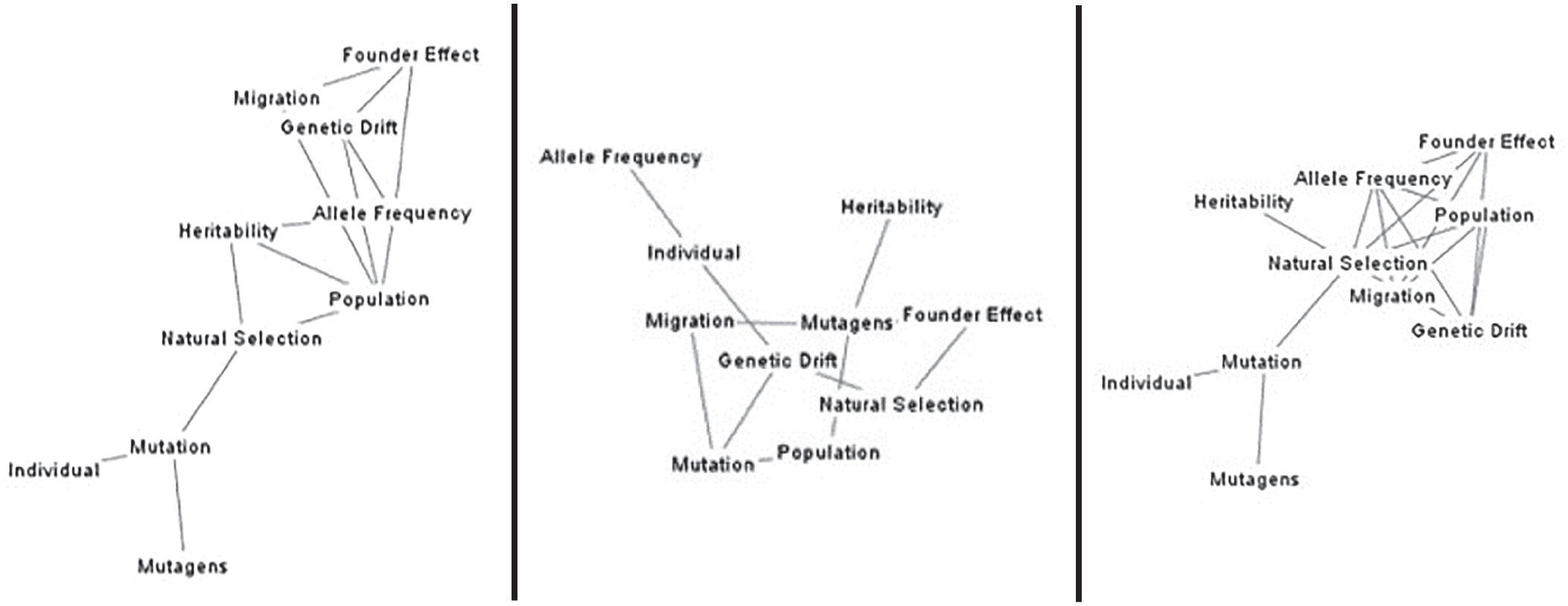
Example networks. The median expert network is shown on the left, an example of a low-similarity network (i.e., similarity to the expert) from a low-ability structure builder (Multi-Media Comprehension Battery [MMCB] score = 26) is shown in the middle, and an example of a relatively similar network (i.e., similarity to the expert) from a high-ability structure builder (MMCB score = 42) is shown on the right (from Gouravajhala, 2018).
The accuracy of the students’ representational structures was quantified by comparing them to the median expert network; crucially, accuracy was significantly related to structure-building ability. In other words, students with lower structure-building ability created mental models that aligned less well with the expert representations. For instance, the experts’ network relates the key terms “mutation,” “individual,” and “mutagens” in a cluster, and that cluster is in turn linked to “heritability” and “population” through the concept “natural selection” (see Fig. 4, left). By comparison, the sample model from a low-ability structure builder shown in the center of Figure 4 fails to directly relate “mutation” to “individual” and “mutagen” and also fails to cluster them as a structure. By sharp contrast, the sample model from a high-ability structure builder (Fig. 4, right) overlaps tightly with the expert model: The terms “mutation,” “individual,” and “mutagens” are a related cluster that links to “natural selection,” which itself is related to “heritability” and “population.”
These findings are striking for two reasons. First, it is the first report to directly reveal differences in the quality of mental models as a function of structure-building ability. Second, the implications are exciting because the particular index used (measuring the similarity of a representation to that of experts) is one that predicts an extremely important learning outcome in other studies: the degree to which students master content in academic courses such as statistics (Goldsmith et al., 1991), chemistry Neiles et al. (2016), and physics (Stoen et al., 2020). Thus, the results provide initial evidence that low-ability structure builders’ deficiencies in constructing coherent, accurate representations may significantly undermine their ability to adequately grasp academic content conveyed in course lectures (cf. Bui & McDaniel, 2015) and textbooks.
There are two clear candidate processes for why less able structure builders might struggle to construct coherent, rich mental models. First, as mentioned in the preceding section, prior knowledge and its activation are essential to the construction of mental (situation) models (McNamara & Magliano, 2009). Accordingly, if less able structure builders know less, or are less likely to activate their knowledge, their mental models would necessarily be less rich and accurate. Second, connecting ideas and relating them across incoming information is fundamental to constructing cohesive and accurate mental models (e.g., Graesser et al., 1994). Theories differ in whether they emphasize explanative connections (e.g., Graesser et al., 1994; Magliano et al., 1999; Singer & Richards, 2005) or causal connections (e.g., Trabasso et al., 1989), but regardless of the particular nature of the connections, difficulty connecting events, ideas, characters and their goals, pictorial events, and so on would likely result in less coherent and accurate mental models.
Other deficits associated with lower structure-building ability may also have implications for the extraction of a coherent mental model, although these ideas have not been empirically tested. For example, inhibitory deficits could interfere with the construction of a coherent mental model, as Gernsbacher (1990) posited. Inhibitory failures would cause learners to inappropriately create new structures, obviating the construction of a single coherent representational structure. Likewise, a difficulty in identifying the main or important points of an event could reduce the accuracy or cohesiveness of less able structure builders’ mental models, given that mental models capture the important points. For instance, Mayer and Gallini (1990) reported that recall of explanative (important) idea units increased 2- to 7-fold for a condition in which accurate “mental-model” construction was facilitated by providing an illustrative schematic relative to the control-text condition. Critically, the mental-model condition did not improve recall of other factual idea units. In contrast, encoding deficits are less likely to matter for the construction of mental models, so long as the main points are encoded (a failure to encode less central material would be unlikely to affect the quality of the mental model constructed). This idea awaits further research.
Aids That Improve Learning Outcomes for Less Able Structure Builders
Low-ability structure builders exhibit ubiquitous comprehension and learning deficits, underscoring the need for techniques to improve their learning outcomes. Although work on this front is in its infancy, the available findings provide insights into the kinds of support that could improve their learning outcomes. Most of the research to date has focused on testing existing interventions (e.g., embedded questions) that past work suggests would alleviate one or more of the processing deficits outlined earlier (i.e., encoding and remembering incoming information, identifying the main points of a text, activating and applying prior knowledge, inhibiting irrelevant knowledge, connecting ideas across a text). An alternate approach would be to target and train particular processes rather than leveraging existing structural support, but training would likely require a time commitment (as opposed to the relatively immediate support provided by interventions such as embedded questions). Any process-specific training would also need to address whether the processes could be trained independently or whether they would need to be trained in a particular order. Although there are no direct data on this issue, researchers have demonstrated that there are successes in training individual processes (e.g., activation and application of prior knowledge, main-idea identification; McNamara, 2004; Ritchie, 1985), suggesting that the order may be less important than the total skill set. Process-specific interventions await further research; the initial evidence currently suggests that embedded questions, exercises that require reorganization, and diagrams illustrating relations all have the potential to help low-ability structure builders, likely supporting multiple key processes.
Embedded questions
Much research has examined whether embedding questions into texts improves learning (for a review, see Hamaker, 1986). Perhaps because of mixed results, interest in embedded questions has waned over time. However, embedded questions have great potential when low-ability structure builders are considered because answering embedded questions stimulates readers to review key ideas and concepts. In other words, embedded questions are a promising tool for supporting low-ability structure builders’ encoding of the targeted concepts.
Callender and McDaniel (2007) reported strong support for this possibility. Learners read a 16-page social-psychology chapter with eight embedded questions. For example, readers answered the question “What is a scapegoat?” after reading about the concept; they could refer back to the earlier text when answering. As shown in Table 2, answering embedded questions improved low-ability structure builders’ performance almost to the level of high-ability structure builders. This benefit extended to test questions that were related to the targeted concepts but not to completely unrelated test questions (Table 2). The same patterns were observed on short-answer test questions that required learners to apply their knowledge (“There are many presidential candidates campaigning to be elected. What is a correspondent inference, and can one be drawn about someone when looking at their behavior on the campaign trail?”). By contrast, high-ability structure builders, who were already performing at a high level, did not profit from the embedded questions. Thus, embedded questions may be best viewed as a potential support for less able structure builders as opposed to a general learning adjunct.
Mean Performance on Multiple-Choice and Application Questions by Ability and Question Type in Callender and McDaniel (2007)
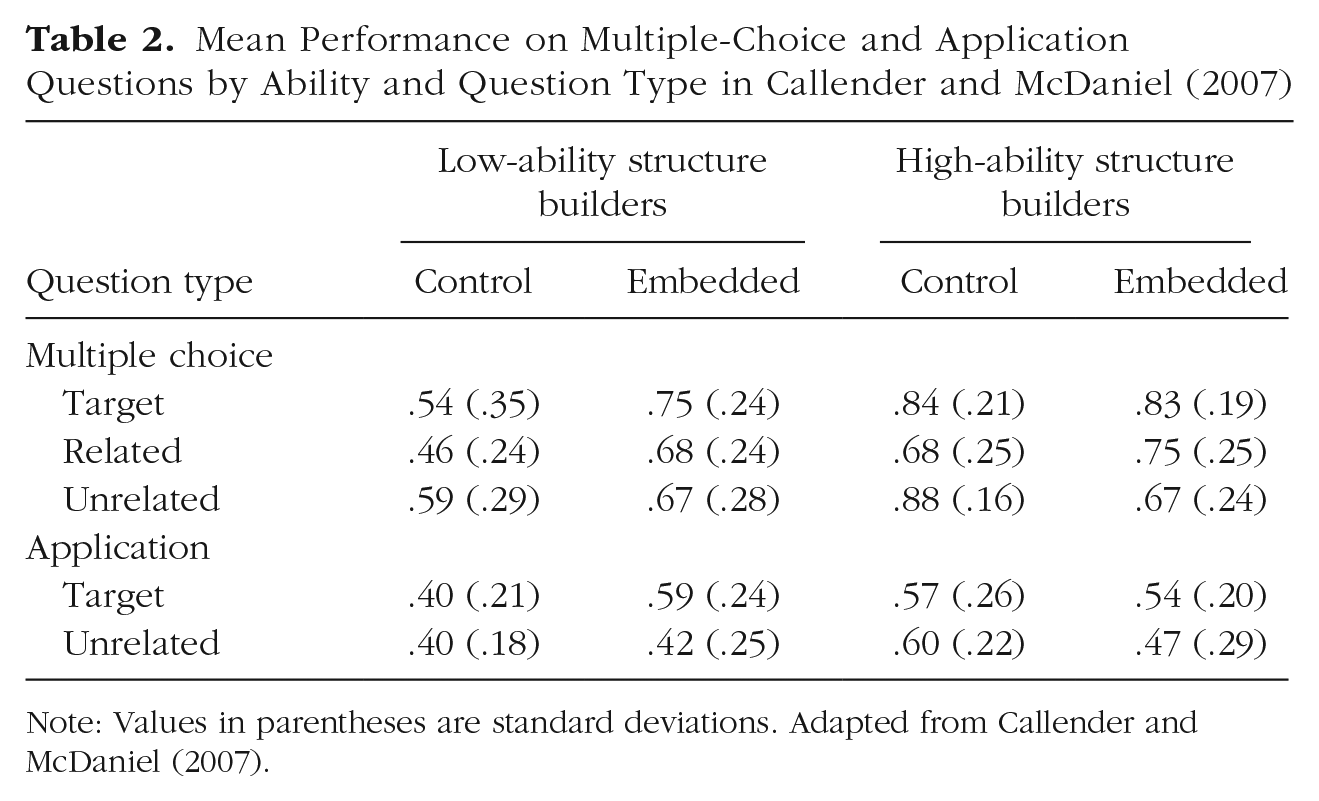
Note: Values in parentheses are standard deviations. Adapted from Callender and McDaniel (2007).
Embedded questions most likely improve encoding of targeted concepts for the low-ability structure builders (i.e., to address their insufficient encoding), but they may also provide anchors for constructing more unified representations (Callender & McDaniel, 2007). That is, embedded questions may alert less able structure builders to the main points of the passage and foster inhibition of irrelevant information. Evidence for these possibilities requires further work.
The type of embedded questions likely has implications for how and whether they support less able structure builders. For example, Callender and McDaniel (2007) included embedded questions designed to activate prior knowledge (explanative questions); however, these questions improved the performance of high-ability structure builders rather than low-ability structure builders—perhaps because the high-ability structure builders had more knowledge stored in memory to activate (as suggested earlier in this article).
Callender and McDaniel (2007) used questions that targeted single concepts, which are unlikely to encourage connections across concepts. Another type of question might be able to do so, however, as suggested by a study on integrative prequestions (St. Hilaire et al., 2019, Experiment 2). Prequestions differ from embedded questions in that they are provided before reading along with the instruction to look for the answers while reading. All participants benefited in a study that used integrative prequestions (e.g., “What is the primary difference between mechanical brakes and hydraulic brakes?”), including those at the lower end of the structure-building spectrum (St. Hilaire et al., 2019, Experiment 2). Thus, these types of questions may help low-ability structure builders forge connections across concepts.
Organizational support
Because low-ability structure builders construct less well-organized representations than those of high-ability structure builders, they should benefit from techniques that encourage them to organize the concepts, facts, or events in a text, conversation, lecture, or other event. In an initial experiment supporting this prediction, some readers read traditional texts whereas others were given the same texts but with the sentences in the wrong order. These readers had to reorder the sentences to create a text that made sense (Einstein et al., 1990; McDaniel et al., 1986). Both low- and high-ability structure builders successfully reordered the scrambled sentences (the technique would not be expected to help learning otherwise). Low-ability structure builders who unscrambled the text recalled significantly more of it than did low-ability structure builders who read the intact text. This effect held for narrative passages and didactic texts (McDaniel et al., 2002, Experiments 2a and 2b, respectively). Given that greater recall is considered to be a marker of a more coherent representation, the results imply that low-ability structure builders can improve the coherence of their mental structures with appropriate intervention.
Of course, educators are unlikely to embrace the use of scrambled texts, even if they do promote organization. More practical and typical would be to encourage learners to create outlines for organizing the concepts covered in lectures or assigned readings (Miyatsu et al., 2018). In general, outlining produces effects that are similar to those produced by reordering scrambled sentences in terms of benefits in recalling a text (Einstein et al., 1990). Accordingly, Bui and McDaniel (2015) examined whether low-ability structure builders benefited from using an outline to guide note-taking during a lecture on mechanics (brakes and pumps). In one condition, students received skeletal outlines to support their note-taking; the outline provided the main ideas and the important subtopics subsumed beneath each. In the control condition, learners took notes without any external support.
Across all levels of structure building, participants remembered more of the lecture if they had received the outlines to guide their note-taking. Although the outlines did not selectively benefit those at the lower structure-building levels, receiving an outline did nevertheless benefit them. In contrast, low-ability structure builders did not show any benefits from the outlines when taking a problem-solving test that required making inferences. The outline apparently promoted effective construction of the discourse-level (text-level) representation and did not extend to the coherence of the low-ability structure builders’ situational model (for additional discussion, see Bui & McDaniel, 2015). Consideration of participants’ notes support this interpretation. Low-ability structure builders in the outline condition no longer had to identify the main ideas and recorded significantly more ideas from the lecture in their notes (the idea units in the outline were not included in this total). Presumably recording an idea in one’s notes enhanced its memorability, thus attenuating less able structure builders’ deficit in encoding.
The content of the notes also implied that outlining stimulated connections across ideas, creating a cause-and-effect chain of how brakes and pumps worked. The subset of the ideas (from the lecture) that captured this content was significantly more prominent in notes when the outline was provided than when it was not. However, the cause-and-effect content in the outline condition was still significantly less prominent than it was in a condition that fostered construction of a better mental model for less able structure builders (described in the next section). This finding is in line with the above conclusion regarding limited benefits of outlining for mental-model constructions for low-ability structure builders. Whether the outline alleviated other processing deficits for low-ability structure builders is less certain: The outline theoretically might have assisted less able structure builders in inhibiting irrelevant information. The outline would not necessarily have promoted increased activation of prior knowledge because the outline was tied directly to the structure of the text.
Another promising technique for assisting low-ability structure builders in encoding relationships among ideas is to provide them with flashcards that focus on integrating to-be-learned information. For instance, a flashcard with the question “How are isotopes and half-life related?” requires learners to integrate and relate two concepts described in a biological-anthropology chapter (Lin et al., 2018) compared with more traditional flashcards that test the definition of a single term or a specific detail about a concept. Lin et al. (2018, Experiment 2) found that the conceptual flashcards produced better performance on short-answer questions that required relating information across the passage (compare-contrast, describe a process, or application) than did “detail” flashcards. This effect was observed primarily at the lower levels of structure-building ability. Studying with “integrative” flashcards helped low-ability structure builders to connect ideas in the event. Given the known benefits of retrieval practice (McDaniel et al., 2007), flashcards also likely enhanced encoding, but that benefit was not documented in the Lin et al. study because in that study there was no control group. Finally, we note that it is unknown whether conceptual flashcards would assist with activating prior knowledge and that it is unlikely that they would help with inhibitory deficits. These initial studies show much promise in identifying and developing techniques that can assist low-ability structure builders in constructing more coherent interconnections and organization of didactic discourse, which in turn supports better learning outcomes.
Schematic diagrams and mental models
Understanding technical material is difficult but can be made easier with the provision of schematic diagrams. For example, a text on the mechanics of pumps is easier to read and understand when accompanied by a diagram that illustrates the pump’s parts and their movements and also shows how function emerges (Mayer & Gallini, 1990). Does this pattern hold across structure-building ability? The study on outlining described earlier (Bui & McDaniel, 2015) included a condition in which learners who were listening to (and taking notes on) a “lecture” on brakes and pumps received a schematic diagram. These participants later answered short-answer questions requiring them to explain or solve problems about brakes and pumps. The results were dramatic. As Figure 5 shows, providing the schematic diagram during note-taking substantially improved later problem-solving performance (short-answer questions) for the lower structure-ability end of the spectrum relative to note-taking with or without a provided outline. Moreover, receiving the schematic diagram completely eliminated differences in performance as a function of structure-building ability (a similar pattern was obtained for free-recall performance). This initial finding shows that with appropriate assistance, low-ability structure builders can perform as well on challenging problem-solving questions as high-ability structure builders, implying that they are not incapable of constructing coherent mental models from challenging didactic text. This result clearly opens up important educational possibilities.
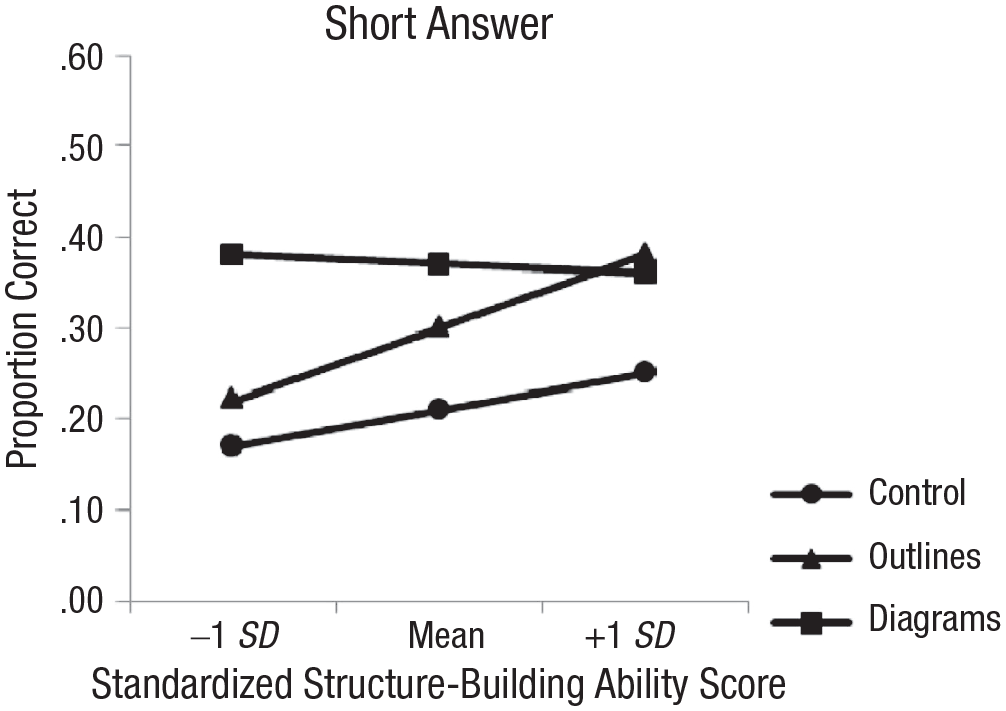
Proportion of correct answers on the short-answer test as a function of structure-building ability, presented separately by learning-aid condition. Reprinted with permission from Journal of Applied Research in Memory and Cognition, Vol. 4, Bui, D. C., & McDaniel, M. A., Enhancing learning during lecture note-taking using outlines and illustrative diagrams, pp. 129–135. Copyright © 2015 Elsevier.
The content of participants’ notes suggested that the schematic diagram focused learners on the causal connections key to understanding how the mechanical devices worked: The steps of the cause-and-effect chain were significantly more prominent in the notes taken when the schematic diagram was present than when it was absent (i.e., relative to the outline and control conditions). The implication is that the schematic diagram helped less able structure builders to make the critical causal connections necessary for an accurate mental model. The schematic diagram also identified the main points with regard to how the mechanical devices worked, removing that burden from the low-ability structure builders and potentially assisting with the inhibition of irrelevant information (but as discussed above this possibility awaits more direct evidence). Finally, for completeness we note that it is not clear whether the schematic diagrams helped less able structure builders activate prior knowledge.
Theoretical postscript about improving learning of low-ability structure builders
A key theoretical assumption in the seminal structure-building model is that a central impairment of less able structure builders is a deficiency in inhibiting irrelevant information (Gernsbacher, 1990; Gernsbacher & Faust, 1991). As a consequence, low-ability structure builders theoretically construct more substructures at the expense of creating an overarching coherent representational structure. Although this account did not preclude other deficiencies (others were not explicitly identified or examined), theoretically an inhibitory deficiency could be foundational to less able structure builders’ poor comprehension and memory of complex events. However, some of the findings reviewed in this section do not converge with the possibility that a deficient inhibitory mechanism solely underlies poor structure building. One finding is that low-ability structure builders but not high-ability structure builders benefited (in free recall of the text) from processing a narrative in which they had to construct the narrative from randomly ordered sentences relative to reading the intact narrative (McDaniel et al., 2002, Experiment 2a). Indeed, the random-text condition showed a dramatic effect: Low-ability structure builders approached the relatively high free-recall levels for the narrative displayed by high-ability structure builders. It seems reasonable to expect that many possible inferences would be generated when trying to piece together a narrative from randomly ordered sentences, a number of which would certainly be irrelevant. If low-ability structure builders are challenged by inhibiting irrelevant information, then unscrambling a scrambled text would likely be overwhelming for low-ability structure builders. Instead, it seems that low-ability structure builders can create coherent structures if the processing task directly demands it.
More generally, if low-ability structure building resulted solely from an inhibitory deficit, it would be difficult to remediate. Contrary to this expectation, as just reviewed, multiple techniques improve low-ability structure builders’ learning and retention: embedded questions (Callender & McDaniel, 2007), outlines and schematic illustrations (Bui & McDaniel, 2015), and conceptual flashcards (Lin et al., 2018, Experiment 2). It is unclear how these techniques would moderate or overcome inhibitory deficiencies. We hasten to acknowledge that further research is needed to guide a more definitive understanding of the key components underlying individual differences in structure building. Further research could potentially illuminate a broader range of techniques for overcoming the learning deficits exhibited by low-ability structure builders.
Summary and Conclusions
Differences in comprehension skill are well established (e.g., McNamara & Magliano, 2009). The current article highlights a particular individual difference—structure building (Gernsbacher, 1990)—that seems to capture unique aspects not reflected in standard comprehension tests and does not seem to represent general verbal or cognitive ability. Over the past 20 years, researchers (e.g., Maki & Maki, 2002; St. Hilaire et al., 2019) have consistently revealed the striking importance of this individual difference in learning and retention of texts, lectures, and classroom materials. Indeed, in every study examining individual differences in structure building of which we are aware, there is a relation between structure-building ability and comprehension, retention, and transfer performances (see Table 1). Structure building likely involves multiple cognitive processes, including basic comprehension processes such as encoding the key ideas (propositions) that make up the event, connecting and relating those ideas, and inhibiting irrelevant information. We now have initial evidence that structure building predicts the alignment of a learner’s representational structure with an expert ideal. Accordingly, this individual difference has the potential to be a powerful tool for identifying and characterizing individuals who, although they may display high verbal scores on standardized tests, may be at risk when digesting, synthesizing, and integrating information.
The work considered in this article significantly extends the initial investigations of individual differences in structure building (e.g., Gernsbacher & Faust, 1991). This earlier research primarily examined single sentences and pictures, using reaction time as a focal measure or relatively short stories constructed for experimental purposes. As just noted, the newer work has considerably expanded the scope of findings to a range of naturalistic texts (and lectures), to learning in the classroom, and to a variety of learning outcome measures. From a theoretical perspective, the initial focus was that low-ability structure builders struggled to inhibit irrelevant information, leading them to construct more substructures instead of an overarching coherent representational structure. There is evidence to support an inhibitory deficit; however, the results reviewed here suggest that low-ability structure builders struggle in other ways as well. This is good news from a practical stance; it might be difficult to improve performance if a basic inhibitory deficit were the sole mediator for low-ability structure building. In contrast, recent work suggests successes in designing practical interventions that scaffold and stimulate improvements in comprehension and learning for less able structure builders (e.g., Bui & McDaniel, 2015; Callender & McDaniel, 2007; Liu et al., 2018).
In conclusion, we believe that the accumulated research warrants the recognition of structure building as an important individual difference in cognitive functioning. This recognition will be fruitful for stimulating additional theoretical work on the underpinnings of low-ability structure building and for guiding applied work on identifying less able students and designing interventions to assist them.
