




Abstract
In the face of a slow and inadequate global response to anthropogenic climate change, scholars and journalists frequently claim that human psychology is not designed or evolved to solve the problem, and they highlight a range of “psychological barriers” to climate action. Here, we critically examine this claim and the evidence on which it is based. We identify four key problems with attributing climate inaction to “human nature” or evolved psychological barriers: (a) It minimizes variability within and between populations; (b) it oversimplifies psychological research and its implications for policy; (c) it frames responsibility for climate change in terms of the individual at the expense of the role of other aspects of culture, including institutional actors; and (d) it rationalizes inaction. For these reasons, the message from social scientists must be clear—humans’ current collective failure to tackle climate change on the scale required cannot be explained as a product of a universal and fixed human nature because it is a fundamentally cultural phenomenon, reflecting culturally evolved values, norms, institutions, and technologies that can and must change rapidly.
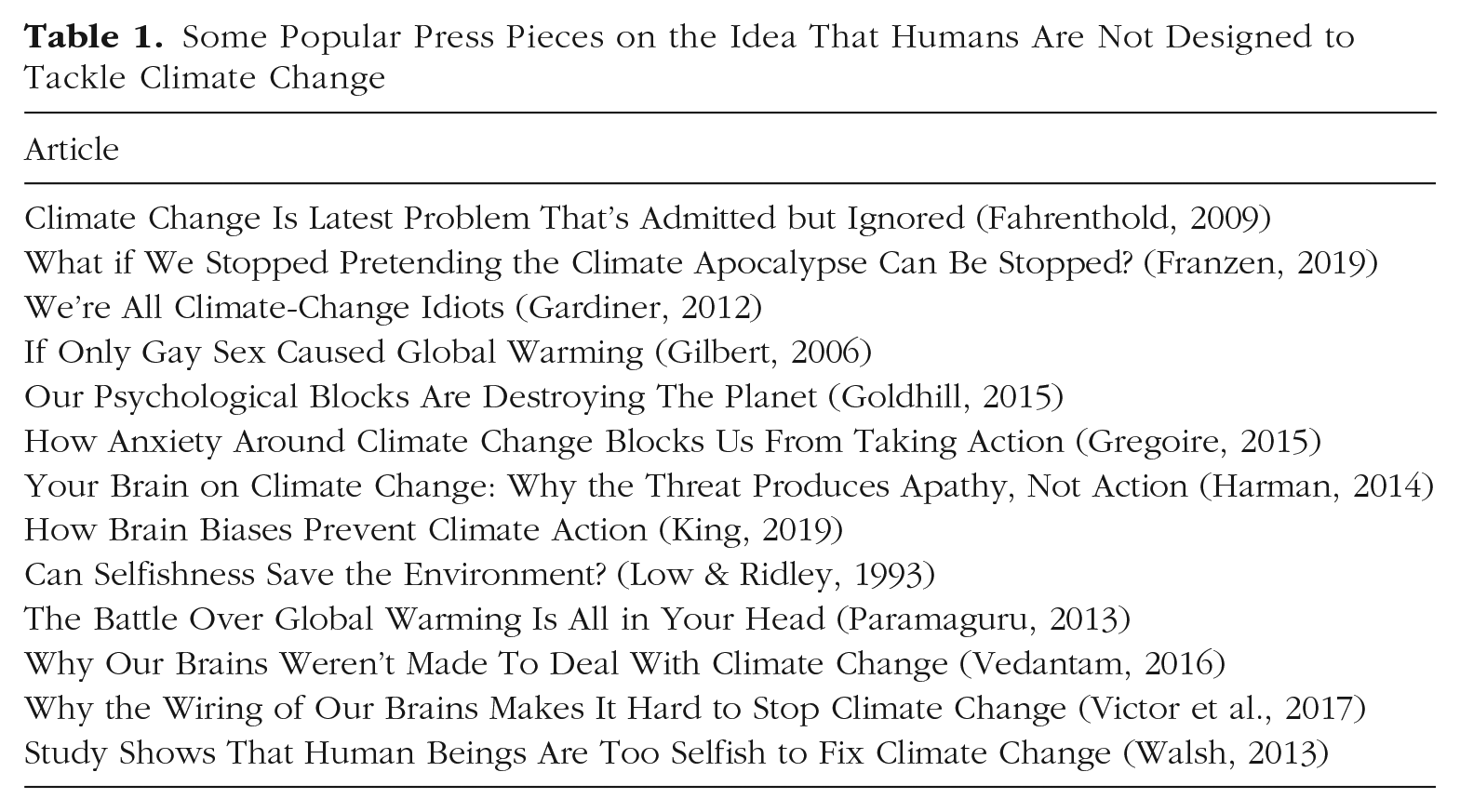
With the help of numerous high-profile media outlets, social scientists have for years popularized the notion that humans are not designed to solve climate change. In his 2006 Los Angeles Times opinion piece, psychologist and best-selling author Dan Gilbert argued that Americans are less worried about anthropogenic climate change than terrorism because the human brain did not evolve to respond to threats like global warming (Gilbert, 2006). A 2009 Washington Post article begins, “To a psychologist, climate change looks as if it was designed to be ignored” (Fahrenthold, 2009). In a 2012 article titled “We’re all climate change idiots,” The New York Times quoted Anthony Leiserowitz, director of the Yale Project on Climate Change Communication: “You almost couldn’t design a problem that is a worse fit with our underlying psychology” (Gardiner, 2012). Similar claims have appeared repeatedly in the media over the past decade (for some other examples, see Table 1), from TIME Magazine’s headline “Study shows that human beings are too selfish to fix climate change” (Walsh, 2013) to writer Jonathan Franzen’s 2019 essay in The New Yorker titled “What if we stopped pretending?” in which he asserted that a “climate apocalypse” is the inevitable consequence of “human nature.”
Some Popular Press Pieces on the Idea That Humans Are Not Designed to Tackle Climate Change
Claims that a failure to make the collective changes necessary to solve environmental issues such as climate change is part of human nature have not been restricted to the popular press. For example, almost a quarter of a century ago, M. Wilson et al. (1998) wrote that both the theory and the available data on human behavior support the thesis that Homo sapiens is not by nature a conservationist, and hence that recognizing environmental problems, deploring them, and gaining sophisticated understanding of their sources in our actions, may still not be enough to motivate the behavioral changes required to rectify them. (p. 502)
Gifford (2011), writing in American Psychologist, cites the “ancient brain” and its concerns with humans’ “immediate band, immediate dangers, exploitable resources, and the present time,” as well as the fact that it “has not evolved much in thousands of years,” as not “naturally consistent with being concerned, in the 21st century, about global climate change, which is slow, usually distant, and unrelated to the present welfare of our selves and our significant others” (p. 291). And Van Vugt et al. (2014) claim in Social Issues and Policy Review that “Our minds are not designed to respond to environmental problems when such problems are distant, global, and presented in abstract terms” (p. 23).
Much of this work (which largely originates in North America, although several proponents are based in the United Kingdom and Europe) is grounded in a conceptualization of the human mind as a collection of putative psychological “barriers,” “biases,” or “challenges” that thwart climate action. Table 2 lists at least 25 such features from a selection of articles published over the past 2 decades. Although far from comprehensive, this sample gives an indication of the range of psychological processes that have been identified. The most commonly cited barriers include the human propensity to discount events that are remote in time and space, problems perceiving slow, “insensible” changes, and conflict between self-interest and the common good. However, appeals to psychological barriers to climate action span the full gamut of human psychology, from the tendency to conform to social norms (Asch, 1956), to moral tribalism (Markowitz & Shariff, 2012), denial (Baumeister et al., 1998), habit (Wood & Rünger, 2016), excessive optimism (Sharot, 2011), rebound effects (Wegner et al., 1987), tokenism (Laws, 1975), the fundamental attribution error (Ross, 1977), prospect theory (Kahneman & Tversky, 1979), and excessive faith in the supernatural or technological fixes (e.g., Clark et al., 2016).
Proposed Psychological Barriers to Solving Climate Change and Other Environmental Problems and the Articles That Mention Them

Few social scientists would claim that “psychological barriers” are insurmountable, that the species is outright incapable of mitigating dangerous climate change, or that there are not other important structural barriers to overcome—many researchers in the area are indeed careful to note these provisos. Moreover, there is clearly value in psychological research seeking to understand how different people perceive, process, and act on the many challenges that climate change presents. Nevertheless, we believe headlines, quotes, and articles like those cited above ultimately promote a reading of the psychological evidence that essentializes humans’ lack of progress, either explicitly as a product of universal human nature or implicitly by portraying the human mind as a collection of evolved psychological barriers to climate action. Such arguments are not new, having been circulated for more than 2 decades, and some might claim that time has only strengthened the case—what better demonstration of the inadequacies of human psychology in the face of climate change than decades of increasing greenhouse gas emissions? However, we are concerned that essentializing climate inaction in this way not only misrepresents psychological research and theory but also frames the climate-policy narrative in a way that may itself be a potential barrier to tackling climate change.
Four Problems With Research That Essentializes Climate Inaction
Minimizing variation within and between populations
When social scientists or science communicators claim or imply that humans’ collective failure to tackle climate change on the scale required is a natural outcome of human psychology, they ignore or minimize variation in psychological responses to the problem. Often proposed psychological barriers are referred to as “universal” or are described as a trait of humanity or “Homo sapiens.” Hence Gilbert says that “the human brain evolved to respond to . . . features that terrorism has and that global warming lacks” (Gilbert, 2006, para. 3). More often the simple collective “we” is used: “we overestimate threats that are less likely but easier to remember, like terrorism, and underestimate more complex threats, like climate change” (King, 2019, para. 7). Who is the “we” the research references? U.S. citizens? The Anglophone middle class? Westerners? The implication is that it applies to all humans, but the way people respond to the threat of climate change varies profoundly within and between human populations around the globe.
A 2019 Pew Research global survey found that although 59% of the U.S. population (i.e., most of the population) rated climate change as a major threat, this number ranged from 38% in Israel to 86% and 90% in South Korea and Greece, respectively (Poushter & Huang, 2019). And although U.S. respondents were indeed more likely to rank ISIS (62%) and cyberattacks from other countries (74%) as major threats, climate change was the top-ranked threat in most nations surveyed (Poushter & Huang, 2019). Even within a population like that in the United States, a focus on average levels of concern about climate change masks very high within-population variability across demographics, social identity, and values. For example, a 2015 Pew Research survey found that although 68% of U.S. Democrats believe climate change is a very serious threat, that number falls to 20% among Republicans (Poushter & Huang, 2019).
Setting aside the fact that, if anything, these survey results seem to suggest most people do in fact care more about climate change than terrorism, they serve to highlight three realities that are critical to effectively tackling climate change but are lost in essentialist explanations. First, there is no universal human response to climate change. This applies to “higher level” beliefs about the realities of climate change such as those expressed above, but even “lower level” cognitive processes identified as barriers to climate change in Table 2—such as temporal discounting, risk perception, self-interest, moral reasoning, and motivation to conform—can operate very differently between populations (Henrich et al., 2010). Variation of this kind renders the concept of a universal human nature highly problematic in general (Buller, 2005) but particularly so when applied to a complex, sociocultural phenomenon such as responding to climate change.
Second, cultural institutions, norms, values, and beliefs are enormously important determinants of individual responses to climate change. When 68% of Democrats but only 20% of Republicans say they see climate change as a serious threat, this suggests that any barriers that exist are, for example, aspects of political ideology, not human nature. Cross-cultural work has demonstrated that, around the globe, democratic values and, particularly in the West, worldview and political ideology are among the most powerful and consistent predictors of climate change concern (Dunlap et al., 2016; Hornsey et al., 2016; Lewis et al., 2019). Other powerful cultural factors include level of education and, in Europe and Latin America, understanding of climate change (Lee et al., 2015).
Third, if the U.S. population, in which much research into the psychology of climate change has been located, is less concerned about the problem than most of the world (Poushter & Huang, 2019; Stokes et al., 2015), it is a particularly misleading source of data for general claims about the likely “human” response. This is just one example of a broader problem in the field of psychology (and other social science disciplines), which has relied primarily on WEIRD (Western, educated, industrialized, rich, democratic) subjects, who are outliers on many psychological metrics and therefore a poor proxy for general claims about human psychology (Henrich et al., 2010). Of course, this does not mean that work on the psychology of climate change in the United States is not valuable. On the contrary, given U.S. geopolitical power and contributions to global emissions, U.S.-based research is of critical importance. However, the value of this work lies in showing the contextual nature of why many U.S. institutions, leaders, and citizens continue to oppose meaningful climate action, not as the basis for essentialist explanations for inaction.
Oversimplifying psychological research and its implications for policy
When scholars or journalists identify broadly specified features of human psychology (e.g., future discounting or the fundamental attribution error) as barriers to climate action, they risk (a) oversimplifying the link between current psychological evidence and effective collective action and (b) producing false confidence in the relative efficacy of possible strategies to address climate change. The utility of identifying evolved psychological barriers to climate action has frequently been presented as allowing humans to recognize and understand their cognitive limits and thereby design strategies to overcome them (e.g., Gifford, 2011; Griskevicius et al., 2012; Johnson & Levin, 2009; Ross et al., 2016; Van Vugt et al., 2014). For example, if human psychology is less sensitive to threats distant in time and space, action should be motivated by highlighting how tackling climate change can provide benefits in the here and now (Griskevicius et al., 2012; Leiserowitz, 2007; Leviston et al., 2014; Moser, 2010; van der Linden et al., 2015; Weber, 2006). If it is difficult to perceive slow, insensible changes in a complex and uncertain climate system, then immediately perceptible changes and simple cause-and-effect relationships should be emphasized (Leviston et al., 2014; Weber, 2006). If individuals are more motivated by self-interest and nepotism than the common good, then communicators need to appeal more to the interests of individuals and their kin (Griskevicius et al., 2012; Van Vugt et al., 2014).
Such recommendations point to apparently simple solutions grounded in humans’ evolutionary history, but the link between the commonly cited psychological barriers in humans and climate action at scale is rarely straightforward. For example, the human tendency to discount potential threats that are remote in time and space is among the most widely cited barriers to tackling climate change (Table 2). In response, it has been suggested that climate action be promoted by highlighting the proximal consequences of climate change in the here and now (Griskevicius et al., 2012; Leiserowitz, 2007; Leviston et al., 2014; Moser, 2010; van der Linden et al., 2015; Weber, 2006). However, research indicates mixed effects of “proximizing” climate change in this way (Böhm & Pfister, 2005; Brügger et al., 2015; Gattig & Hendrickx, 2007). Some studies find a positive relationship between perceived proximity and willingness to act (Scannell & Gifford, 2013; Spence et al., 2011), but others find no relationship or the opposite effect (e.g., Shwom et al., 2008; Spence et al., 2012). A review of the research by Brügger et al. (2015) found that the relationship between perceived proximity of climate change and motivation to act was complex and depended upon many factors, including how individuals valued the resources in question and how they felt about the ease and efficacy of possible actions available to them. Conceptualizing these effects of psychological distance on threat salience as a barrier to tackling climate change directs attention away from the complex and sometimes unexpected ways that elements of human psychology interact with one another and with the culture and environment. In addition, it overshadows what may be a powerful weapon in the fight against climate change—the ability to imagine scenarios in distant times and places (Suddendorf, 2013) or as Gilbert (2006) acknowledged (but did not emphasize), an “ability to duck that which is not yet coming” (para. 11).
Similar caveats apply to other proposed psychological barriers to climate action. Although it is true that self-interest presents a challenge for social dilemmas such as climate change that involve collective responsibility, simplistic appeals to self-interest can backfire by inhibiting intrinsic values (e.g., to protect the planet) in favor of extrinsic values (e.g., to save money; Brown & Kasser, 2005; Evans et al., 2013; Markowitz & Shariff, 2012). Moreover, people can and frequently do cooperate to solve social dilemmas (Fehr & Fischbacher, 2003; Ostrom, 1990), and their ability to do so is a hallmark of the species (Tomasello et al., 2012). Likewise, presenting the low salience of slow, insensible changes as a barrier to climate action implies that tangible climate outcomes ought to be emphasized rather than things that cannot be seen or felt directly. But things that cannot be seen or felt are among the most salient of human concerns (e.g., religion).
Indeed, many aspects of human psychology are flexible and contingent enough that they can be conceived as either a barrier or bridge to tackling climate change. Uncertainty about the future can make room for complacency or denial and reduce motivation (Gifford, 2011; Markowitz & Shariff, 2012) but can also promote a conservative approach to avoid risk of loss (Wade-Benzoni et al., 2008). Social conformity and the desire for status can work against climate action (Sturman et al., 2016) or in favor of action (Griskevicius et al., 2010; McDonald & Crandall, 2015). An “optimism bias” can make people foolishly hopeful and complacent (Gifford, 2011; Johnson & Levin, 2009), but hope can equally motivate action in the face of all odds (Bury et al., 2019; Scheier et al., 1986). Religion and the promise of salvation can be a distraction (Eckberg & Blocker, 1989) or a call to arms (Pope Francis, 2015).
Whether a cognitive process (Table 2) constitutes a barrier is frequently contingent on structural and cultural context. In some cases this is obvious—for example, belief in supernatural salvation or lack of trust in scientists are inherently cultural phenomena. In other cases, a barrier exists, but framing it as a cognitive process underemphasizes the role of structural and cultural factors. For example, cognitive dissonance and system justification (i.e., an orientation to defend the status quo) may lead to climate change skepticism in societies where the status quo results in high per capita emissions (Feygina et al., 2010). Understanding the cognitive processes that lead some people to defend the current unsustainable system is therefore an important area of research in psychology. But it seems blinkered to us to locate the barrier in the cognitive processes themselves (cognitive dissonance or defense of the status quo) separate from and ahead of the cultural values, norms, and incentives in which they operate. Even small shifts in framing with respect to values can turn system justification into a desire to defend the current way of life in the face of an environmental threat (Feygina et al., 2010).
Framing climate change as an individual moral dilemma
A focus on psychological barriers and human nature frames responsibility for climate change in terms of individual actions. Some work in this area has been careful to acknowledge the role of higher level institutional and structural factors (e.g., Gifford, 2011; Johnson & Levin, 2009; Swim et al., 2009) and has noted that solutions at higher levels need to consider individual psychology to garner support from political leaders and their constituents (Clayton et al., 2015; Swim et al., 2009). Nevertheless, explaining climate inaction as a product of psychological barriers present in all humans requires that responsibility for climate change be viewed through the lens of individual actions rather through the cultures and behavior of powerful corporations, governments, and other institutions. For example, research can examine the fit between climate change and the human moral judgment system without considering the structural and policy issues that give rise to moral dilemmas in the first place (e.g., Markowitz & Shariff, 2012). Others conceive of structural barriers primarily with regard to individual action. For instance, Gifford (2011) compares action on climate to problems such as smoking and wearing safety belts (there are possible overlaps, but there are also fundamental differences, particularly in the degree to which those problems are collective or “threshold” social dilemmas that require a minimum amount of cooperation among a certain percentage of actors to achieve success). This focus on the individual level tracks a broader pattern in mainstream psychology, which has long been criticized for underemphasizing the role of higher level cultural and social structures (Reicher, 2004) and is itself the product of a long cultural tradition of individualism in the West (Schulz et al., 2019).
In addition, research on individual psychology has tended to focus on household consumers (e.g., Swim et al., 2009, 2011) or some representative sample from the citizenry. Far less attention has been paid by psychologists in particular to the psychological traits of powerful actors, including politicians, corporate executives, and prominent climate contrarians (e.g., Jacquet, 2017). What, for example, are the prominent psychological differences between former ExxonMobil CEO Lee Raymond, who ramped up the company’s opposition to climate-change policy and research (including a large-scale climate-change-denial campaign) and former BP CEO John Browne, who publicly accepted climate science and decided against making political donations to counter climate action in the United States (Coll, 2012)?
By focusing on household consumers, research about psychological barriers to climate change naturally invites recommendations for “nudges” (Sunstein & Thaler, 2008) or “behavioral wedges” (Dietz et al., 2009). Much has been made of recent work applying insight about human cognition to design individual behavior change interventions that promote public goods. The widely praised Behavioural Insights Team or “Nudge unit” in the United Kingdom, for example, has produced measurable outcomes in areas as diverse as promoting healthy eating (Halpern, 2016) and increasing tax compliance (Hallsworth et al., 2017). However, results from behavior-change interventions targeting more complex, large-scale collective action problems such as energy systems and climate change are less obvious. A review of attempts to change behavior related to home energy use, for example, found average gains of just 1% to 3% (RAND Europe, 2012). These gains are far short of the transformative level of change required (e.g., Díaz et al., 2019; Intergovernmental Panel on Climate Change, 2018; C. Wilson, 2015).
Rationalizing inaction
Finally, the idea that humans were not designed to solve climate change risks rationalizing inaction. There is a long history of appeals to human nature or similar biological arguments to justify the status quo and deny the potential for social change. Socially sanctioned slavery, racism, sexism, and discrimination for sexual orientation all used appeals to biological innateness as justification. Some researchers suggested (and still do) that the gender gap in certain fields, including mathematics, existed because men are better spatial thinkers than women. Yet the gender gap between girls and boys on math tests disappears in more gender-equal cultures (Guiso et al., 2008). We are not suggesting that those researching and reporting on the psychology of climate change are intentionally misinterpreting the psychological evidence to preserve the status quo. But there is an obvious relationship between psychological claims and social arrangements.
Perhaps most concerning is the possibility that essentializing climate inaction creates a false perception that a failure to act is not only natural but inevitable. In the past 2 years, high-profile articles such as Jem Bendell’s “Deep Adaptation: a Map for Navigating Climate Tragedy” (Bendell, 2018), Catherine Ingram’s long form essay “Facing Extinction” (Ingram, 2019), and Jonathan Franzen’s piece in The New Yorker “What If We Stopped Pretending” (Franzen, 2019) have presented a deeply pessimistic reading of humans’ psychology and capacity to act. When reviewing humanity’s progress to date, Franzen (2019) writes that “Psychologically, this denial makes sense” (para. 5) and goes on to “apply the constraints of human psychology” (para. 9) to generate dystopian predictions for the future. Ingram (2019) states that “being concerned about climate change does not come naturally to us” (para. 25) before summarizing psychologist Dan Gilbert’s (2006) Los Angeles Times article on the topic. These influential pieces illustrate how the notion that humans are not designed to solve climate change can be and is already being used to justify climate change fatalism.
Setting aside claims that dangerous climate change is outright inevitable, attributing a lack of progress on climate change globally to human nature or psychological barriers can still be taken to imply that inaction is natural (and hence morally acceptable) or “normal” human behavior. Arguments that in their inaction on climate change, people “are being both rational and consistent with their evolutionary past” (Low & Ridley, 1993, para. 57) or that “it’s unfair to expect people . . . to do this kind of decision making, because we’re not wired for that” (Elke Weber, then professor of management and psychology at Columbia University, as quoted in Harman, 2014, para. 14) risk giving moral license to inaction and the inaction of political leaders. Likewise, newspaper headlines claiming that “we are all climate change idiots,” “too selfish to fix climate change,” or “not made to deal with climate change” can create a perceived norm of apathy and inaction that becomes self-fulfilling. Research has shown similar unintended consequences when people are made aware of gender stereotyping and implicit bias, demonstrating that such effects are possible and may, in fact, be a more general problem for applied psychology. For example, people are less judgmental of and less willing to punish discrimination when it is presented as being due to automatic “implicit” processes and are more likely to express gender stereotypes and behave in stereotype-consistent ways themselves when they are made aware of the prevalence of gender stereotyping in the population (Duguid & Thomas-Hunt, 2015).
Claims that normalize climate inaction and apathy are all the more problematic because they are at odds with reality. A 2019 Pew Research survey showed more than two thirds (67%) of people around the globe consider climate change a “major threat,” and this percentage appears to be rising sharply in many countries (up from 56% in 2013), including in the United States, where the figure is now 59% (Poushter & Huang, 2019). A more recent 2020 survey has shown that even as Europe was reeling from the impacts of COVID-19, Europeans still rated climate change a greater threat to their countries than the pandemic (Poushter & Huang, 2020). Surveys also show meaningful and ambitious policies such as a global carbon tax are politically tenable and have majority support across countries (e.g., Carattini et al., 2019). Beyond the survey data, declarations of climate emergencies by governments, councils, and universities around the world (Climate Emergency Declaration and Mobilisation in Action, 2020) and global events such as the School Strike for Climate, led by younger members of society (e.g., Greta Thunberg) further undermine the claim that climate action is part of human nature.
Conclusion
Psychological research is necessary to understand variation in climate-change-related beliefs and behaviors around the globe and must continue to inform how we communicate climate change to various audiences (Berentson-Shaw, 2018; Díaz et al., 2019; Swim et al., 2009). However, social scientists and science communicators must actively challenge the idea that “the human mind” is a collection of psychological barriers to climate action or that any current failure to address climate change is due to the way evolution designed the human brain. As we have outlined, essentializing climate inaction in this way is wrong and dangerous—wrong because it misrepresents current psychological research and theory, and dangerous because it may itself be a potential barrier to tackling climate change.
Instead, we call on researchers in this area to more actively acknowledge and emphasize the substantial individual and cultural variation in responses to climate change and be realistic about the generalizability of findings, particularly those from WEIRD populations often living in countries with extremely powerful institutional actors resistant to climate policy. In addition, we need to work much harder to communicate that the most tractable barriers to tackling climate change are not found in human biology, but in human culture (Beddoe et al., 2009; Díaz et al., 2019).
Although psychology shapes the political landscape in important ways (Claessens et al., 2020), current institutions and policies are not biologically determined, no matter how “natural” they seem. Politics around the globe has, for example, become dominated by a neoliberal worldview that is not an inevitable by-product of psychology but reflects a cultural tradition of ideas and institutions that rose to prominence in the second half of the 20th century (Harvey, 2007). There is a much broader body of psychological research that can help people step outside this cultural matrix and understand how culture shapes climate action. This includes work on the factors that gave rise to Western norms of self-interest (Miller, 2001) and individualism (Beddoe et al., 2009; Schulz et al., 2019); how ideology and moral tribalism (Claessens et al., 2020; Jacquet et al., 2014; Markowitz & Shariff, 2012), media (Eveland & Cooper, 2013; Feldman et al., 2012), and online networks (Guilbeault et al., 2018; Stewart et al., 2019) influence climate change discourse; how culture trumps the individual conscience (Cohn et al., 2014); the role of self-conscious emotions, social exposure, and reputation (e.g., Jacquet, 2017; Jacquet & Jamieson, 2016); people’s relationship to “the economy” and curing their obsession with economic growth (e.g., Hickel, 2019); how wealthy elites and corporate lobbying can sway decision makers and public opinion (Farrell, 2016; Gilens & Page, 2014; Leonard, 2019); and how new technologies and cultural norms can be harnessed to change the way people eat (Willett et al., 2019), travel (e.g., Higham et al., 2016), work (e.g., Dwelly & Lake, 2008), and recreate (Hall & Higham, 2005).
Of course, there is a sense in which humans did not evolve to solve climate change, just as they did not evolve to read, sit at desks all day, live in cities, scuba dive, or promote gender equality. Culture allowed for these behaviors. At the same time, humans are not not evolved to deal with climate change. The psychological features that have made humans uniquely able to cause this problem also make them uniquely capable of solving it. We are not the only ones to acknowledge this (e.g., Grinspoon, 2015; Paramaguru, 2013). As Jamieson (2014) noted, “Ultimately, the failure to take action on climate change rests with our institutions of decision-making, not on our ways of knowing” (p. 81). It is time to challenge the idea that humans are not designed to solve climate change and instead identify the cultural shifts required to ensure action.
