



Abstract
We propose a behavioral-science approach to sexual assault on college campuses. In this framework, people commit assault when aspects of the immediate situation trigger certain psychological states. No set of mental processes or situational configurations is a precise predictor of assault. Instead, the interaction between mental processes and situational configurations predicts when sexual assault is more or less likely to occur. We begin with an illustrative story to show how a behavioral-science approach is relevant to sexual assault. Next, we map out a framework that suggests how behavioral theories of situations and mental processes have been or could be used to describe, predict, and develop ideas for the reduction of sexual assault. Relevant situational configurations include geographical configurations, local situational and informational cues, and situation-based power. Theories of mental processes include person perception, social norms, moral reasoning, and goals. Our framework can be used to demonstrate how “good” people can commit assault and how individuals can and will refrain from assault within institutions with a “bad” record. Compared with previous theories of sexual assault, a behavioral-science framework offers unique understanding and generative methods for addressing sexual assault on college campuses.
To introduce our behavioral-science framework for understanding sexual assault on college campuses, we first tell a (fictional) story. The story illustrates a few of the situations in which two college students might find themselves, as well as the mental processes triggered by each of these particular situations and interactions.
A Story
Consider the following scenario. Darren and Alysha have just met and are both dancing at an off-campus party. Alysha decides to return home. Darren has been dancing with Alysha all night in front of his friends, who remind Darren, “You’ve been stressed. You need to have a good time.” Darren decides to walk Alysha home to see what she will say at the door. Darren walks with her down a well-lit street toward her dormitory. Getting to Alysha’s door requires that the two enter her dormitory building, which has long hallways with doors that swing shut and automatically lock, leaving hallways quiet and empty. When they reach the door, Darren gently pressures Alysha to let him come into her room, using jokes and promises that he will help her to procrastinate on preparing for tomorrow’s early class. Alysha initially refuses but then relents after an awkward 5-min conversation. They go into her room.
What happens next? A behavioral-science approach brings to light factors that contribute to whether an assault might happen in Alysha’s room. Specifically, we can analyze the contextual configurations and mental processes that interact with one another in each of the three situations mentioned in this scenario: the party, the walk home, and the dormitory. Each situation activated and suppressed particular mental processes, such as perceptions of social norms and social scripts, goals, perceptions of others, and moral reasoning. Each situation’s social and even physical configuration magnified or suppressed these types of mental processes. Note that because of their different social positions in each of the situations, Darren’s and Alysha’s mental processes may be affected differently by the same situation.
Party
At the party, Darren may be focused on a prescriptive social norm (Cialdini & Goldstein, 2004), endorsed by his friends, that he is expected to “hook up” or have a sexual encounter with Alysha. Recall that his friends expressed to Darren some expectation that he should “have a good time.” If the group of friends does not explicitly discuss what this entails, Darren might infer that having a good time means hooking up and having sex instead of other behaviors such as dancing and flirting (Wade, 2017). This interpretation may be top of mind, given that salient people in his social network endorse this behavior (Paluck et al., 2016). From Alysha’s perspective, leaving the party with a male peer is a behavior that may conform to a descriptive norm on campus, in which couples who leave parties together are doing so in order to hook up. She may thus harbor concerns about leaving with Darren, if this is not what she intends.
Imagine instead that inaccurate perceptions of the normativity of sexual activity have been corrected. Indeed, perceived peer attitudes predict individual rape-supportive attitudes (Bellis et al., 2020; Swartout, 2013) and serve as a risk factor for sexual-assault perpetration (Loh et al., 2005), and diverse, dense networks of peers buffer against this risk (Kaczkowski et al., 2017). Moreover, men and women each tend to overestimate the other’s comfort levels; students think other students are more comfortable hooking up than they really are (Reiber & Garcia, 2010; for an in-depth treatment, see Wade, 2017). Actively correcting descriptive norms could reduce ambiguity about normative behavior and move students’ behavior toward the true norm (Prentice & Miller, 1993).
Walk home
In plain view of other people as they walk home, Alysha might still be concerned that people imagine she is leaving the party to hook up with Darren, but she is less likely to be concerned about the possibility of sexual assault. Certain “scripts” or stereotypes of sexual assault state that sexual assault happens in dark alleys with strangers (Peterson & Muehlenhard, 2011). Thus, Alysha may not harbor any serious concerns about Darren’s intentions and future behavior, given that the street situation does not match her scripts about a dangerous one. For his part, the well-lit street and the presence of strangers may create a feeling of observability, which can activate Darren’s ideas about his “ought self” (Duval & Wicklund, 1972). The “ought self” activation may bring to mind the importance of Darren’s trustworthy persona and of Alysha’s identity as a valued member of the campus community. At a minimum, Darren now sees Alysha’s entire physical self in the light, instead of the glimpses of her partially obstructed face or body parts afforded on the party dance floor. A broader view of this person helps to humanize her (Gray et al., 2011; Looser & Wheatley, 2010) as opposed to seeing her more as a sexualized object (Szymanski et al., 2011).
Now imagine that Darren and Alysha are walking home from a party that affords Darren and other men at the party a degree of situational power—that is, power derived from that particular situation that endures for the time period spent in that particular context. A party might afford a man situational power (e.g., when the man—or his friends—controls who is admitted into the party or when the party is far away from where others live and require attendees to drive a car to attend and to rely on someone to take them home if they consume alcohol). Situational power enhances a person’s pursuit of focal goals (Guinote, 2017) and approach motivation (Keltner et al., 2003). Both of these effects of situational power could result in Darren increasing the intensity of his efforts to go home with Alysha. Research supports the prediction that situational power increases the likelihood of sexual harassment (Pryor et al., 1995), especially among men with chronically low power (Williams et al., 2017). As an additional example, on dates when men exert situational power by paying all of the date’s expenses, research finds an increased risk of sexual aggression on the date (Muelenhard & Linton, 1987).
Dormitory
When Darren and Alysha arrive in her dorm, Darren may feel he is no longer being monitored or observed, which may prompt a move away from his ideal or “ought” self (Duval & Wicklund, 1972). Darren may be generally vulnerable to overperceiving Alysha’s interest in him (Abbey, 1982; Abbey et al., 2000; Perilloux et al., 2012), which can be exacerbated by alcohol (Abbey et al., 2000), sexual arousal (Bouffard & Miller, 2014), or both (Gilmore et al., 2013; George & Norris, 1991). More specifically, by dint of having arrived at her door, theories of goal pursuit would predict that Darren has perceived the decision of whether to initiate sexual contact as having been made, causing him to shift into an implemental mindset (vs. a deliberative one; Gollwitzer, 2012). In an implemental mindset, individuals tend to ignore cues that suggest that the goal should be abandoned (Büttner et al., 2014; Gollwitzer & Bayer, 1999). This can explain why Darren continues to pressure Alysha for several awkward minutes; he has failed to recognize her polite refusals.
For her part, Alysha has no access to Darren’s mindset and is unlikely to realize he has mentally advanced beyond a deliberation phase to an implementation one. Alysha may be in a state of cognitive load (Lin et al., 2010), because she is maintaining a conversation with Darren all while juggling multiple possible interpretations of the situation and attempting to represent Darren’s mental state (which can help her predict his next actions) in her own mind. On the one hand, Alysha could interpret her situation as safe and socially prescribed, because she has followed a script used by her peers and perhaps even taught by the university. In this “safety” script, women keep themselves both safe and socially respectable by leaving parties early, without being too drunk, and asking someone to walk them home. On the other hand, Alysha could feel uncertain about her safety, because she is wondering what being alone in her dorm might signal to Darren. As she considers interpretations, Alysha may feel she has to follow yet another script in her conversation with Darren—a “politeness script” of gratitude in which women are expected to desire and thank men for walking them home (Armstrong et al., 2006). The tax on Alysha’s cognitive resources (Bonnefon et al., 2011) as she balances all of these considerations may lead to decisions that she would initially not judge to be in her best interest (Mullainathan & Shafir, 2013). If at a certain point Alysha decides that she needs to decline an offer of sex from Darren, her strategy may also progress to one in which she attempts to decline while maintaining face for Darren, a known conversational regularity with additional cognitive demands (Brown & Levinson, 1987).
Now imagine that instead of walking Alysha to her dormitory, Darren and Alysha had an additional common social space to go to after the party (that is not a bedroom). In our own qualitative research with undergraduate students, we learned that the physical configuration of their dormitories has a large impact. Specifically, doors automatically swing shut (for fire safety reasons), which can make it appear that students are completely alone in their dorms with no one to turn to for help if needed. Moreover, when additional social spaces are bedrooms, beds may activate particular affordances—mental representations of the uses of objects in the environment (Gibson, 1977)—related to sexual activities that other social spaces would not. Research at Columbia University recently found convergent evidence (Hirsch et al., 2018; Hirsch & Khan, 2020), and the university administration has introduced additional on-campus social spaces with the intent of reducing sexual assault.
Three things our story omits
Identities
In this brief story, we did not include more details about Alysha and Darren’s identities, which significantly affect how they feel about themselves, about the other person, and how they read the situation (Goff et al., 2008; Kang & Bodenhausen, 2015; Purdie-Vaughns & Eibach, 2008). Race, class, perceived sexual orientation, and other identities magnify or change which norms are evoked, people’s ability to humanize the other, their sense of moral self and obligations, their perception of the safety or danger of the situation, which situations they are likely to find themselves in, whether they receive help in the moment, and more (e.g., Ford & Soto-Marquez, 2016; Katz et al., 2017; for a review see Moylan & Javorka, 2020). All of these processes can increase or decrease the likelihood of assault.
Alcohol
Alcohol is also intentionally omitted from this story. Alcohol use (both more generally and in the immediate situation) and the expectations of how it affects behavior are known significant risk factors for sexual assault in the general population (for a review, see Lorenz & Ullman, 2016, and Abbey et al., 2001; Brecklin & Ullman, 2010; George, 2019; Mellins et al., 2017; for a specific discussion of perpetration, see Brecklin & Ullman, 2001, 2002; and for expected effects on behavior, see George et al., 2000; Untied et al., 2013), although it may be the broader high-risk situation rather than the alcohol itself that is responsible in the immediate sense, and the relationship is sometimes not observed (Ullman, 2003). There is extensive research on the role that alcohol plays in sexual assault on college campuses (e.g., Adams-Curtis, & Forbes, 2004; Bellis et al., 2020; Krebs et al., 2007; Ullman et al., 1999a, 1999b; Walsh et al., 2021). Alcohol consumption is comorbid with both sexual-assault perpetration (Abbey et al., 2000; Ullman et al., 1999a) and victimization (Bird et al., 2016; Ford, 2017; Walsh et al., 2020). We seek to highlight other important causal factors in sexual assault that have received less attention. Here, we also wish to briefly highlight to researchers the personal and situational factors that alcohol is likely to exacerbate. It is likely that alcohol interacts in important and interesting ways with the psychological processes we describe (e.g., for effects of alcohol on perceptions of sexual interest, see Abbey et al., 2000; Abbey et al., 1996; Jacques-Tiurra et al., 2007; George et al., 1988; for emotion regulation, see Davis et al., 2020; for self-justification, see George & Marlatt, 1986; Koss & Cleveland, 1997; and for labeling of sexual victimization, Orchowski et al., 2013). We especially welcome future work that examines these interactions. (It is also interesting to think about how alcohol affects cognition and motivation more broadly [see Sevincer et al., 2012; Steele & Josephs, 1990; Wade, 2017] and as it relates to sexual assault [see Davis et al., 2007; George et al., 2000; Taylor & Chermack, 1993].)
Our interest in pursuing more research on other personal and situational factors is informed by the behavioral-science perspective and by our qualitative research with sexual-assault peer counselors who are themselves college students. They expressed to us that efforts to reduce sexual violence by reducing alcohol consumption on campus were frustrating for them for a few reasons. Specifically, centering conversations around alcohol consumption elicited defensiveness from their peers or even closed off conversations about reducing sexual violence entirely. In other words, this focus squandered opportunities to reach fellow students who did not want to reduce their drinking but who may have been open to other messages about reducing sexual violence. In addition, it was clear that the sexual-assault peer counselors themselves sometimes partake in the drinking culture on campus and were not personally invested in reducing alcohol consumption. Viewed through a behavioral-science lens, these peer counselors were describing strong motivational and normative forces that would weaken the power of any alcohol-focused intervention to reduce sexual violence in this particular setting. If the students who were already working to reduce sexual violence on this campus were not on board with a focus on reducing alcohol consumption, then it is difficult to imagine the intervention catching on in a meaningful way with their fellow students.
The ending
Our story ends at the door because our theoretical framework is not one that can predict with certainty the occurrence of a particular assault. Rather, it describes situations in which sexual activity without mutual consent is more or less likely. Stated more specifically, this detailed examination of a brief time period in which two students interact during and after a party demonstrates how situations trigger various social norms, goals, and identity concerns. This interaction can increase or decrease the chances that one of two individuals will push the other into sexual activity without consent. Our story purposefully unfolded across three locations to highlight how situations change processes and interaction—but also to imply how situations may be changed. We can think about how proximate aspects of the situation, such as the lighting (dark vs. well-lit streets), the configuration of social spaces (individual bedrooms vs. shared social space), and social norms (e.g., norms about how much sexual activity is expected or what it means to walk someone home) activate mental processes and activate the potential for some behaviors over others.
A behavioral-science approach
How can we understand and prevent a problem as multifaceted as sexual assault? This essay offers a behavioral-science approach to the questions of sexual assault understanding and prevention on college campuses. A behavioral-science approach to sexual assault focuses on the behaviors involved, specifically when, for whom, and in what contexts sexual-assault behaviors occur. A behavioral framework lends itself to novel interventions in part by clarifying the “diagnosis” (Datta & Mullainathan, 2014) of the most powerful proximate causes of sexual assault, which can then be targeted and shifted by interventions. In our opening example, these are behaviors such as dancing at a party, walking someone home, and hanging out in a dorm room at night—all situations already highlighted as important for understanding the social factors surrounding campus sexual assault (Armstong et al., 2006). Our aim here is to focus on these behaviors with an eye for revealing the multiple existing psychological theories that are relevant to the topic. Psychological theories allow for analysis of aspects of the situation, the individual, and the relationship between the two. Thus, rather than providing a unified theory of sexual assault, a behavioral-science approach provides a framework for identifying relevant theories that can help answer specific questions of interest, such as: “Why are the rates of sexual assault so high at a school during this time period?” or “What kind of intervention could make a difference in this particular institution?” By bringing relevant psychological theories to bear on behaviorally focused questions, a behavioral-science approach can lead to a discovery of interactions among well-established psychological theories and can stimulate the development of new scientifically informed interventions. With our behavioral-science approach to sexual assault, we aim to invite more psychologists into the study of sexual assault on college campuses, operationalize a behavioral-science approach to sexual assault on college campuses, and outline a case study for a kind of brainstorming technique that could be used to analyze a number of policy-relevant behavioral issues.
Start with a problem
First, what is the problem of sexual assault? Sexual assault is a term used to refer to any sexual activity involving a person who does not provide consent or cannot provide consent (because of alcohol, drugs, or other causes of incapacitation; Ortiz & Shafer, 2018). Women between the ages of 18 and 25 are at greatest risk for being sexually assaulted (Sinozich & Langton, 2014). Among women enrolled in an undergraduate institution, between 20% and 25% are expected to experience sexual assault (Krebs et al., 2016). 1 The prevalence of sexual assault on college campuses threatens the safety, success, and overall well-being of a substantial proportion of all college students. For example, women who are sexually assaulted are more likely to drop classes, to move residences, to seek psychological counseling (Krebs et al., 2007), and to experience higher academic stress and lower commitment to their school and schoolwork (Banyard et al., 2020).
Focus on a particular setting
In this article, we focus on the college setting for a few reasons. First, there is accumulating data describing undergraduates’ subjective experience of consent and assault (e.g., Hirsch et al., 2018; Hirsch & Khan, 2020). A well-defined context allows for the examination of recurring characteristics of situations in which assault has occurred. Indeed, research has investigated some situational features of college bar and party culture that make sexual assault more likely. In particular, freshman and sophomore students are at particular risk at college parties (Cranney, 2015), and sorority (vs. nonsorority) women (Copenhaver & Grauerholz, 1991) are at particular risk when they attend parties at fraternities, although the mere presence of fraternities on campus does not appear to be a risk factor (Cass, 2007; Moylan & Javorka, 2020; Stotzer & MacCartney, 2016). Fraternity members report engaging in more sexually coercive acts than nonfraternity members, and fraternity parties that (a) separate men and women, (b) provide only unsanitary women’s restrooms (Boswell & Spade, 1996), and (c) have high levels of group-identity norms and secrecy (Martin, 2016; Smith & Freyd, 2014) are associated with elevated rates of sexual assault. Other rape-permissive, situational aspects of college party culture include extreme expectations of male bonding (Sanday, 1990)—such as expectations of bragging about sexual encounters the next morning (Boswell & Space, 1996; Martin, 2016; Smith & Freyd, 2014)—and potentially athletics, though results are mixed (Crosset et al., 1995; Ford & Soto-Marquez, 2016; Martin, 2016; McCray, 2015; Moylan & Javorka, 2020; Murnen & Kohlman, 2007). Note that rates of reported assaults are particularly high on Saturdays in which Division 1 football games are played at home (vs. away-game days and no-game days; Lindo et al., 2018). In addition, the conversations surrounding sexual assault and harassment more generally have historical roots in scholarly and activist work done on college campuses (Felton, 2018). We use the college context to construct a theory-driven behavioral analysis of campus sexual assault, suggesting diagnoses of the problem and new avenues to intervention. Finally, we also focus on campus sexual assault with the aim of galvanizing academic psychologists, who develop their theories and conduct most of their studies within the very population that is plagued by this problem.
Generate relevant individual and situational factors to the problem
In the next section, and in Figure 1, we lay out a behavioral-science framework for sexual assault. The framework is organized according to central themes in psychology regarding situational configurations and mental processes that guide behavior, and, as we suggest here, that could increase or decrease the chances of sexual assault.
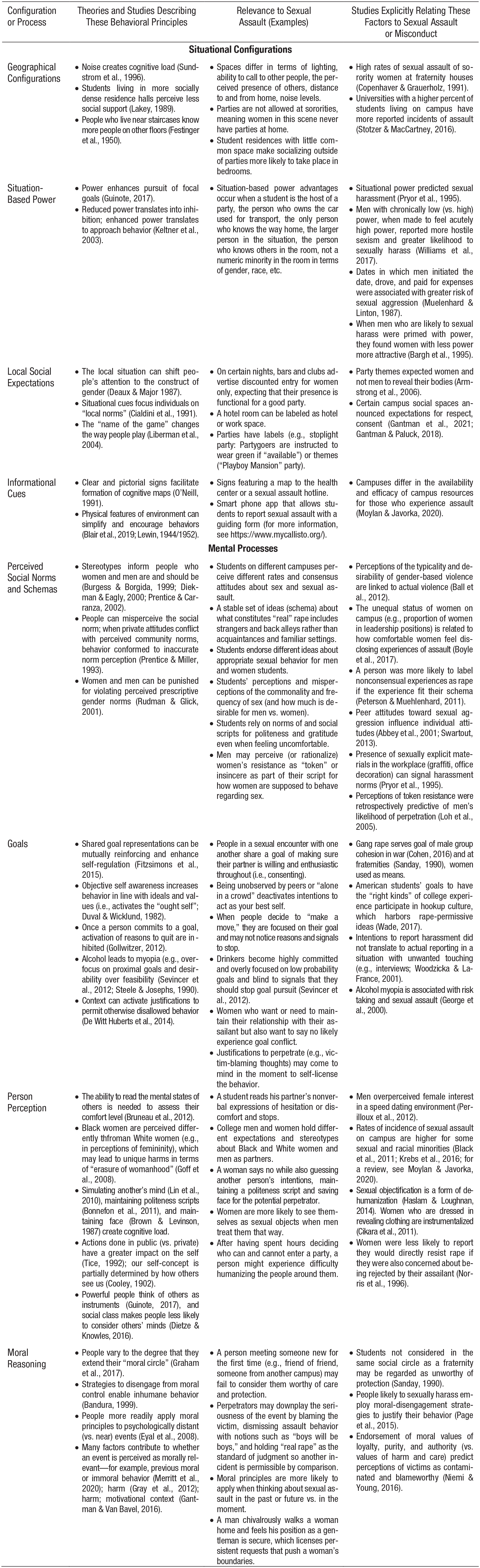
A Behavioral-Science Framework for Understanding Campus Sexual Assault
Our main goal for this article is to inspire more psychological researchers to be involved in the study of sexual assault on college campuses. We hope that Figure 1 can serve as a prompt to encourage researchers not only to see how broad swaths of basic psychological science are particularly promising areas for understanding sexual assault on campus but also to deepen their understanding of their own theories.
To compose Figure 1, we surveyed the sexual-assault literature and identified the factors highlighted in this body of research that directly relate to central themes and research areas in psychology. By highlighting these fundamental areas of research, such as theories of motivation and goals, social norms, person perception, morality, and situational influences, the figure demonstrates how basic theory and research can be used to understand and potentially design interventions to decrease sexual assault on campuses. The rightmost column in the figure highlights some of the extant work on sexual assault, and much of it demonstrates how research in the domain of sexual assault can build and test general theory in psychology. For example, Williams et al. (2017) found that men with chronically low power express greater likelihood to harass when they find themselves in a situation of high power. This research expands on the intrapersonal dynamics of power through the lens of research on sexual assault. Likewise, Niemi and Young (2016) provided novel insights about how moral values relate to our judgments of victimhood by bringing key themes from the sexual assault literature into the conversation. Finally, Woodzicka and LaFrance’s (2001) work on the gap between how people think they will react to unwanted touching (by reporting) and how they actually act (freezing, nervous laughter) provided evidence cited by research on more generalized topics, from affective forecasting (Wilson & Gilbert, 2003) to stereotyping, prejudice, and intersectionality (Dovidio et al., 2010; Major et al., 2002; Purdie-Greenaway & Eibach, 2008).
One of the most fundamental proposals of social psychology and behavioral science is that situational factors and person-centered factors are both important for behavior, especially when they interact. Thus, the figure is organized into situational and person-centered thematic research concerns. When identifying literal and figurative situational arrangements known to interact with the selected psychological phenomena of motivation, norms, and the like, we sought to illustrate key situational considerations in behavioral science such as geographical configurations, situation-based power, and local social expectations.
These themes do not fall into perfectly carved boundaries. For example, situational power affects goal pursuit (Guinote, 2017; Keltner et al., 2003), and the sexual objectification of women’s bodies lies at the intersection of person perception and moral psychology (Cikara et al., 2011; Gray et al., 2011; Haslam & Loughnan, 2014). More research is needed to look at how these themes interact, and these points of interaction may even be among the most productive methods for discovering novel powerful interventions and testing theory.
A Review of Interactive Individual and Situational Factors
Rather than advance a single new theory or update an older one, in this article we start with a problem, focus on its behavioral context and manifestations, and aim to solve it by bringing together theories relevant to these contexts and behaviors. This constitutes our behavioral-science approach. By beginning with a social problem to solve, we have the opportunity to integrate theories, contribute to the creation of a cumulative science, and evaluate theoretical claims on the basis of the solutions they can generate. In Figure 1, which represents our behavioral framework, we have brought together myriad theoretical perspectives on the person and the situation, which, separately and together, have some predictive power for understanding the incidence of sexual assault. This may be the first time that some of these theories have sat side by side in a framework.
Figure 1 organizes our behavioral-science framework for sexual assault by (a) situational configurations that trigger (b) mental processes, the combination of which makes sexual assault more or less likely to occur. We specifically outline how each specified situational configuration and mental process relates to the issue of sexual assault. In the adjoining column, we present how these principles have been previously studied in psychology. In the final column, we cite research directly investigating the situational configuration or mental process in the domain of sexual assault. We hope that psychologists will be able to look at Figure 1, identify areas related to their own expertise, and find novel avenues to extend and test their own theories in the domain of sexual assault, thus taking a behavioral-science approach.
Situational configurations
The category “situational configurations” is meant to be taken literally and figuratively—this is a category of ways to describe physical spaces such as the party, street, and dormitory described in our opening example. As psychologists, we cherish the idea that the “situation matters,” and yet too often the situation is reduced to one factor that is manipulated by the experimenter. Psychological theory asserts that aspects of the environment shape our mental processes, but theoretical projects often skip a description of the physical environment in service of describing individuals’ perceptions of their situation. This common approach misses an appreciation of how the physical space matters for these perceptions in the first place. Previous attempts to build a descriptive framework of situations has paradoxically focused on patterns of interpersonal interactions that come to characterize the situation rather than the physical attributes of the situation itself (e.g., situations featuring independence, mutual partner control, joint control, and the like; Kelley et al., 2003). Our framework seeks out objective properties of the situations that may trigger mental processes likely associated with sexual assault, as well as some of the social characteristics of situations. We thus organize the category “situational configurations” into geographic configurations, situationally determined power, local social expectations, and informational cues. As illustrated in our opening example with Darren and Alysha, by geographical arrangements we mean, for example, the presence or absence of communal space in a residence; by situationally determined power we mean, for example, the capacity to decide who can enter a party. We also include local social expectations, by which we mean, for example, the theme of a party; and by informational cues, we mean cues such as signage pointing individuals to sexual assault resources.
Mental processes
The category “mental processes” contains a list more familiar to research psychologists. It is a collection of psychological constructs, each described by a number of theories that describe and make predictions about these constructs. Although some have been applied to the study of sexual assault, others have not but are likely very relevant to explaining particular situation-based perceptions and motivations that result in sexual assault. We list the following constructs as mental processes: social norms (specifically perceptions of what behaviors are typical or desirable), goals (e.g., consent as a shared goal representation), person perception (e.g., a partner’s behavior can shape perceptions of self), and moral reasoning (e.g., disengaging from the moral implications of one’s own behavior).
How to use Figure 1
There are many ways to use this figure. Research psychologists in particular may want to examine the list of relevant mental processes and focus on those for which they have particular expertise. In the third column (“Relevance to sexual assault”), there are examples of how areas of expertise have or have not already been applied to the problem of sexual assault. This third column provides the most promising place to look for crossover between general principles in psychology and connections to understanding sexual assault. Finally, the rightmost column provides examples of research already done in this area and can provide an entry point to existing literature.
If you are a practitioner seeking to innovate on preventative or interventionist techniques for sexual assault, we suggest that you look at the section on situational configurations to see which situations resemble the context or groups of contexts you hope to address. What mental processes are potentially sparked by these situations? What can the theoretical and empirical literatures tell you about how to reshape these mental processes and behaviors by reshaping the situation? Finally, if you are interested in some of the promising work that investigates sexual assault using relevant variables from a behavioral-science perspective, we recommend paying special attention the rightmost column. We encourage collaborations between psychologist and behavioral scientists to help you to design and to evaluate interventions that are suited for the contexts you seek to address.
Conclusion
With this article, we aim to demonstrate and operationalize a behavioral-science framework for understanding sexual assault, one that integrates the theoretical landscape in psychology. We believe that our review showcases the unique power of behavioral science to tackle this complex and urgent societal problem. Undoubtedly our list of mental processes and situational configurations is not exhaustive, but we understand it as an important project of behavioral science to combine and juxtapose perspectives to account for more variance in total—and more accuracy in behavioral prediction. Time will tell whether we have created a predictive and generative framework as we collect more evidence on interventions to reduce sexual assault.
We see many advantages to this approach from a theoretical standpoint. First, a behavioral-science framework ties multiple psychological processes together. We highlight how the same situation may trigger different mental processes for two people and how different situations may trigger similar mental processes. Furthermore, by combining multiple theoretical perspectives, we invite researchers to consider how their own theoretical perspective relates. In this way, we hope to maximize the likelihood that we find which theories and which connections among those theories are the most consequential for describing assault patterns and finding the best targets for intervention. Finally, we hope that our behavioral-science approach is a useful metatheoretical tool as well. We began with a social problem, examined the situation, and brought multiple psychological theories to bear on it. At the very least, we believe this same approach can be easily applied to workplace harassment and misconduct (for a behavioral-science approach to gender-based violence in fragile and conflict states, see Annan et al., 2021).
Of course, by beginning with a problem, this work is aimed toward generating solutions. At the moment, we do not feel that the science is available to proscribe new behavioral interventions that we expect to work. We lay out this framework as a call for researchers to accumulate more data in a principled and programmatic manner and as a way toward designing new interventions that are mindful of these behavioral regularities.
We see distinct advantages of the behavioral-science approach. Indebted to feminist thought and activism that was imported into the social sciences (e.g., Brownmiller, 1975; Combahee River Collective, 1977; Crawford & Unger, 1997; Dworkin, 1987; Mackinnon, 1979), intervention-oriented theories and models for understanding sexual assault have grown under the clinical and life-span perspectives (e.g., Malamuth & Hald, 2017) and under the broad umbrella of cultural or ecological approaches (e.g., Armstrong et al., 2006; Banyard, 2011; Heise, 1998; Moylan & Javorka, 2020). Our approach is not meant to supplant these models but to serve as a complement. A behavioral-science approach invites scholars to examine the immediate situation with careful attention to immediate motivational and normative forces that could facilitate or block the effects of an intervention. Other approaches tend to focus more on individual traits (Briere & Malamuth, 1983; Kosson et al., 1997; Lisak, 2011; Lisak & Ivan, 1995; Lisak & Miller, 2002; Ouimette, 1997; Prentky & Knight, 1991; Scully, 1988) or broader societal forces (Armstrong et al., 2006; Banyard, 2011; Casey & Lindhorst, 2009; Heise, 1998; Moylan & Javorka, 2020). The behavioral-science approach focuses on changing the immediate situation and aims to harness preexisting momentum for positive change, whether that momentum is from people, their immediate situation, or the product of the two.
Although this article cannot end on a series of intervention recommendations, we believe that a behavioral-science approach can generate context-sensitive and testable interventions that may differ from other approaches. For example, clinical and life-span models focus on perpetrator characteristics, whereas ecological or cultural models recommend a wide range of activities, a behavioral-science model suggests a very targeted and tailored approach for different contexts within university settings that respond to particular situations and the people in those settings.
We have taken our own advice, and from conversations with students, we have already heard of novel interventions worthy of study at the level of both physical configurations and mental processes. As mentioned above, a change could be made to the physical spaces on campus, such as common social spaces for students that are not bedrooms (Hirsch et al., 2018; Hirsch & Khan, 2020). In terms of mental processes, we can target how students perceive the issue of consent on campus. In our own recent work, we conducted two behaviorally driven field experimental interventions to bring consent to the forefront of students’ minds during campus parties. The students generated their own intervention—to have students read aloud a definition of consent before entering a party—and we conducted experiments with students and their institutions to understand and evaluate this practice. Our evidence suggests that the very same wording of a definition of consent may be received differently in different social spaces, even in a seemingly homogeneous campus environment (Gantman et al., in prep; Gantman & Paluck, 2018).
This article is an operationalization of a behavioral-science approach to reducing sexual assault on campus; that is to say, it is based on the idea of the power of the situation and the mental processes triggered by that situation. This move, to use the power of the situation in analyzing the social problem of sexual assault, holds a great deal of power. For example, legal discourse about responsibility for sexual assault is heavily focused on individuals; legal procedures often invite a character witness to testify on behalf of the perpetrator or against the victim. Depositions in support of the alleged perpetrator emphasize his role as a good community member or “good kid” on the basis of the implicit assumption that only “bad people” commit rape (Krakauer, 2015), thereby acquitting those who do not fit the idea of a “real” rapist. The behavioral-science approach emphasizes the irrelevance of this logic, by highlighting the power of the situation over individuals. In other words, “good” people commit sexual assault, and individuals can and will refrain from assault within culturally “bad” institutions. A behavioral-science approach to campus sexual assault halts the essentializing of perpetrators and institutions as “bad” (Gantman & Paluck, in press), and brings back to the fore a central theme of social psychology—the power of the situation (Milgram, 1963) and the banality of evil (Arendt, 1963).
Footnotes
Acknowledgements
We are grateful to members of the Paluck Lab for feedback on earlier drafts and to the Sexual Harassment/Assault Advising, Resources, and Education (SHARE) peers who participated in our focus group. We also thank Nirupika Sharma for help with editing.
Transparency
Action Editor: June Gruber
Editor: Laura A. King
Author Contributions
A. P. Gantman and E. L. Paluck contributed equally to this work. Both authors approved the final manuscript for submission.
