



Abstract
Psychologists use the term racial microaggressions to describe subtle forms of everyday racial incivility and discrimination reported by members of historically underrepresented groups. Growing evidence links self-reported experiences of racial microaggressions to health. Drawing on life-course perspectives on stress, biopsychosocial models of racism, and daily-process research, I propose a conceptual framework for investigating daily stress processes (e.g., reactivity, recovery, appraisal, coping), cumulative stressor exposures (e.g., race-related traumas, major life events, nonevents, chronic stressors), and social structural factors (e.g., institutions, social roles, statuses) that may affect the experience of racial microaggressions in everyday life. An underlying assumption is that microaggressions are dynamic in character, can vary across individuals, and are shaped by the interplay of stressor exposures across multiple timescales and levels of analysis. The article concludes by inviting researchers to use methods that account for dynamic features of everyday racialized experiences, giving sufficient attention to process, person, and context.
The chief vehicle for proracist behaviors are microaggressions. These are subtle, stunning, often automatic, and non-verbal exchanges which are “put downs” of blacks by offenders. The offensive mechanisms used against blacks often are innocuous. The cumulative weight of their never-ending burden is the major ingredient in black-white interactions.
Psychological research on microaggressions and their consequences has burgeoned over the past decade. This research has moved in many directions and has spanned multiple spheres of social and personal life, including race, gender, sexual orientation, disability, and religion (Sue & Spanierman, 2020). First introduced by Chester Pierce in 1970, the term “microaggressions” was used to refer to subtle everyday experiences of racism directed toward African Americans. Explicitly linking microaggressions to racism, Pierce (1974) maintained that microaggressions were “the major vehicle for racism in this country . . . offenses done to blacks by whites in this sort of never-ending way” (p. 515). Over the ensuing decades, Pierce’s seminal contributions have animated scholarly recognition of the withering effects of racism in daily life. Examples can be found in Essed’s (1991) writings on everyday racism and Bonilla-Silva’s (1997) theorizing on the covert manifestations of structural racism; in Williams’s (1997) investigations of everyday discrimination and Harrell’s (2000) conceptualization of racism microstressors; in Solórzano and colleagues’ (2000) case studies of campus racial climate; in James’s (1994) “John Henryism hypothesis” and William Smith’s (2004) account of “racial battle fatigue”; and, more recently, in Sue and colleagues’ (2007) taxonomy of racial microaggressions.
In this article, I present a general orienting framework for studying everyday racial microaggressions, 1 provide an outline for the kinds of data that are needed to establish an evidentiary basis for the framework, and suggest some promising lines of further inquiry. Two key assumptions underlie the proposed framework. One is that the diverse factors that converge in experiences of microaggression are interrelated. Among these factors are the hierarchical arrangement of social statuses that entail inequalities in the distribution of opportunity, power, and prestige; the eventful and chronic stressors to which people are exposed; and the adaptive resources they can mobilize in response to life stress. A second assumption is that links that make up the chain of relationships connecting microaggressions to health are dynamic in character, such that a change in one link can induce changes in other links, thereby catalyzing chains of effect. A key implication is that microaggressions are not mere discrete occurrences that exist in isolation but rather are woven with the many factors that over time moor the lives of individuals with the least privileged statuses to the larger social structures of which they are a part (Embrick et al., 2017).
Why Study Racial Microaggressions?
Beyond overt forms of racism, researchers argue that subtle and contemporary forms of racial incivility and discrimination (microaggressions) are also important sources of stress for racial and ethnic minorities (Sue et al., 2007; Wong et al., 2014). 2 A meta-analysis by Lui and Quezada (2018) involving more than 18,000 participants found a robust, modest association (r = .20) between microaggressions and psychological-adjustment outcomes (e.g., internalizing problems, stress, negative affect). Notably, these correlation estimates are comparable in magnitude to the correlation estimates found in studies linking overt forms of discrimination to physical health outcomes (see Lui & Quezada, 2018; Pascoe & Smart Richman, 2009).
A defining characteristic of racial-microaggression experiences is that they are inherently dynamic phenomena, surfacing and receding in combination with other stressors of daily life. According to Pierce (1974), “one must not look for the gross and obvious. The subtle, cumulative miniassault is the substance of today’s racism” (p. 516). More recent theoretical formulations have situated racial microaggressions as “unconscious and subtle” (Solórzano et al., 2000, p. 60) or “brief and commonplace” (Sue et al., 2007, p. 273), experiences that Harrell (2000) suggested “are a central part of understanding the dynamics of racism in contemporary society” (p. 45). 3 Taken together, these observations highlight an important point about the experiential reality of microaggressions: The historical and cultural context of prejudice and discrimination is crucial for a full understanding of the impact of microaggressions in everyday life (Embrick et al., 2017; Kraus & Park, 2017; M. T. Williams, 2020a). As Sue and Spanierman (2020) note, “racial microaggressions are commonplace and make sense only in a world rife with institutional inequities grounded in the cultural superiority of the dominant group” (p. 9).
Drawing on scholarly writings (see Pierce et al., 1978; Solórzano et al., 2000) and prior empirical research (Dovidio & Gaertner, 1996; Steele et al., 2002), Sue, Capodilupo, et al. (2007) proposed a theoretical taxonomy of racial microaggressions. In its expanded form, the taxonomy includes three broad classifications—microassaults (explicit racial derogation, such as referring to African Americans as “colored”), microinvalidations (actions that nullify the experiential reality of racial minorities, such as regarding Asian Americans as perpetual foreigners), and microinsults (subtle behaviors or communication styles that debase or minimize an individual’s racial heritage, such as assuming that all Latinos/Latinas are undocumented or “illegal” immigrants). The effects of everyday microaggressions are theorized to be transmitted through institutional policies that reinforce inequitable systems (e.g., in housing, employment, earnings, health care, criminal justice) that in turn affect the life outcomes of racialized individuals (Sue et al., 2019; Sue & Spanierman, 2020). Thus, studying the manifestation and impact of racial microaggressions is relevant to clarifying the dynamics through which racial inequalities in society are produced and reproduced in everyday life through systemic or structural racism (Neblett, 2019; D. R. Williams, Lawrence, & Davis, 2019).
Despite theoretical formulations of microaggressions as unfolding processes (Sue et al., 2007), much remains to be learned about how and why microaggressions matter for health and well-being. Commenting on the state of microaggression research, Ong and Burrow (2017) noted that empirical investigations continue to lag behind theoretical writings and that there are relatively few “intensive longitudinal studies that assess the psychological dynamics of peoples’ everyday lives” (p. 173).
The question addressed by a between-persons comparison is whether people who, on average, experience more microaggressions also experience poorer adjustment outcomes (e.g., negative and positive affect, depression and anxiety symptoms). Quite different questions include: How are microaggressions and adjustment outcomes patterned in everyday life? Do people report poorer adjustment outcomes on occasions when microaggressions are experienced? Do daily microaggressions affect emotions beyond the day of their occurrence? Do certain emotions or symptoms co-occur on days when microaggressions are reported? These are fundamentally intraindividual (within-persons) questions that can be addressed only by studying individuals intensively over time. That microaggressions and psychological distress are positively correlated across individuals has no bearing on these questions. To better understand racial-microaggression processes, we must examine them as they unfold.
The Daily-Process Paradigm
The conception of microaggressions as an unfolding dynamic process necessitates research designs that combine idiographic methods (patterns of variability and change within individuals) and nomothetic methods (patterns of differences between individuals). This hybrid approach is exemplified in the daily-process paradigm, which uses intensive longitudinal methods (e.g., experience sampling, daily diary assessments) to examine snapshots of people’s everyday experiences (Affleck et al., 1999; Tennen & Affleck, 2002). In particular, daily-process designs allow researchers to (a) capture microaggression experiences closer to their real-time occurrence; (b) track changes in rapidly fluctuating processes, such as emotions and physical symptoms, proximate to their actual moments of change; (c) preserve temporal sequences, thereby strengthening causal inferences; and (d) minimize retrospection bias, thereby overcoming some of the methodological shortcomings of cross-sectional studies (Ong & Burrow, 2017; Tennen & Affleck, 2002).
The theoretical significance of daily-process designs is highlighted by studies that evaluate process-oriented models of race-related stress and adaptational outcomes. In an early attempt to examine these issues, Ong et al. (2009) surveyed a sample of African American doctoral students and graduates for 2 weeks. An examination of daily reports revealed greater reports of psychological distress on days characterized by increased racial discrimination. Subsequent studies that used daily-process measures of racial microaggressions and/or discrimination have found similar patterns of within-persons association in samples of Black/African American (Seaton & Zeiders, 2021; Swim et al., 2003), Asian American (Ong & Burrow, 2017), and Latino (Torres & Ong, 2010) college students and Black (Seaton & Douglass, 2014), Latin American, and Asian (Huynh & Fuligni, 2010) adolescents. The scope of these investigations offers critical insights into daily processes that simply could not be detected by conventional cross-sectional designs.
Racial Microaggressions and the Stress Process: A New Vista for Psychological Science?
In the remainder of this article, I discuss several promising methodological and conceptual approaches for advancing racial-microaggression research. I argue that the phenomena of microaggressions is best understood as a process that is shaped across time by the interplay of personal and contextual factors. Drawing on life-course perspectives on stress, biopsychosocial models of racism, and daily-process research, I propose a conceptual framework for studying everyday racial microaggressions. Much of this framework is organized around the conceptual underpinnings of the stress process (Pearlin et al., 1981), the major components of which are stressors, resources, and outcomes. This integrative framework (see Fig. 1) takes a multilevel approach and is influenced by the following theoretical perspectives: Clark and colleagues’ biopsychosocial model of racism (Clark et al., 1999), Sue and colleagues’ taxonomy of racial microaggressions (Sue et al., 2007), Smith’s concept of racial battle fatigue (Smith et al., 2011), Geronimus’s “weathering hypothesis” (Geronimus, 1992), Harrell’s multidimensional conceptualization of racism-related stress (Harrell, 2000), Pearlin’s “stress-proliferation” construct (Pearlin et al., 1997), Wheaton’s conceptualization of the “stress continuum” (Wheaton, 1994), and Bolger and Zuckerman’s personality and daily-stress model (Bolger & Zuckerman, 1995). The current framework integrates ideas from these conceptual traditions and extends beyond them by situating racial microaggressions and daily experiences in intraindividual, social, and structural contexts.
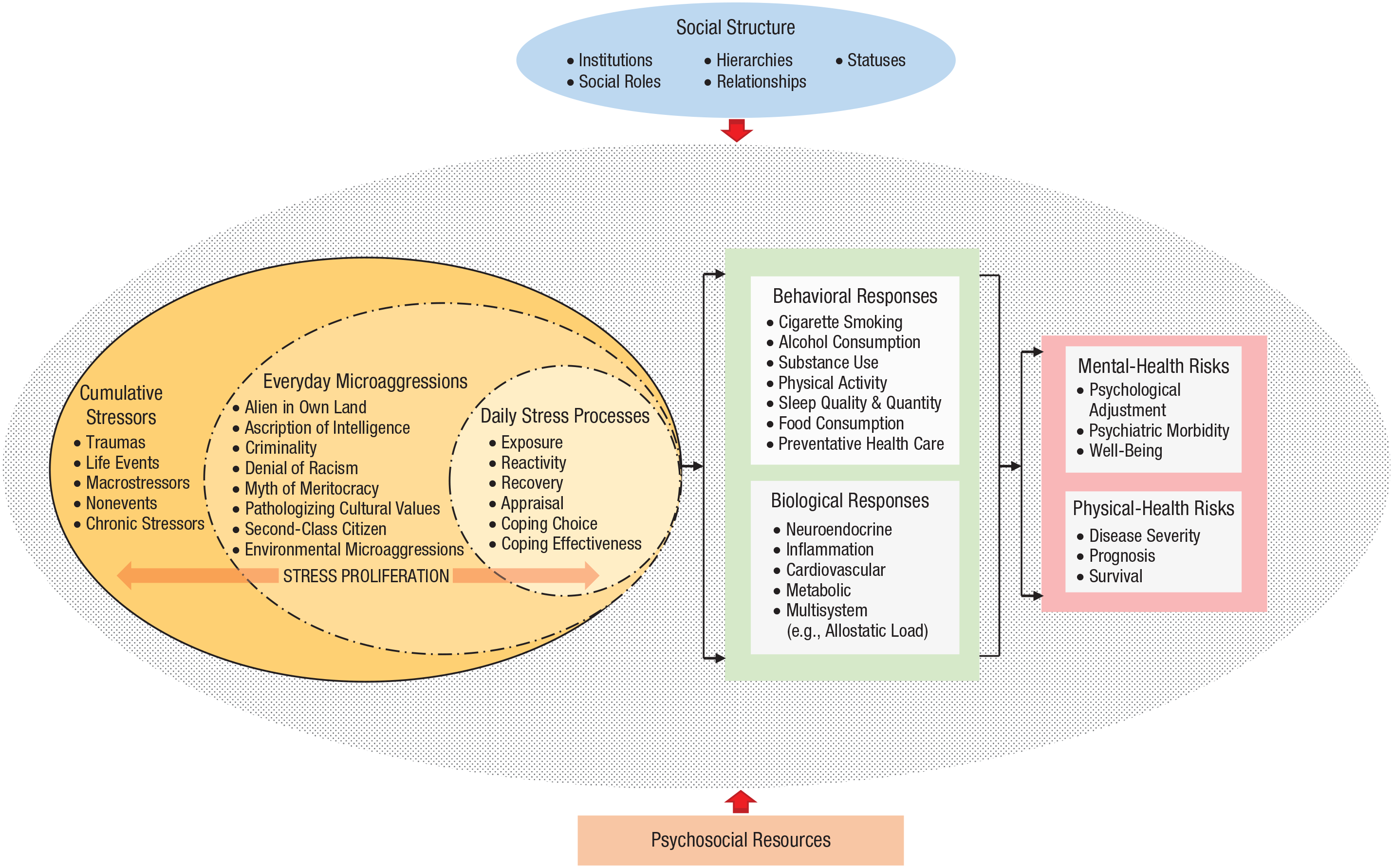
A conceptual framework for understanding everyday microaggressions. The red double arrow signifies the reciprocal causal flow involved in each juncture of the stress continuum.
Capturing daily microaggression processes
A driving element of the stress process (Pearlin et al., 1981) involves stressors, which refer to events or conditions that impose demands on the adaptive capacity of individuals. Although stressors may take a variety of forms, including major life events and chronic strains (Pearlin, 1995), in this section I focus on emerging evidence from daily-process studies of stress and affective dynamics and their implications for generating novel predictions of and explanations for everyday microaggression experiences. As indicated in Figure 1, daily-stress processes are hypothesized to represent the nexus of input, where conditions external to the individual (e.g., cumulative stressors, structural inequalities) “get under the skin” to drive health inequalities and disease. Prominent among these processes are individual differences in people’s exposure and reactivity to daily microaggressions, the speed with which they recover from microaggression experiences, their appraisals of those experiences, and the coping strategies they choose and the effectiveness of those strategies.
Differential exposure and reactivity
Bolger and Schilling (1991) identified two fundamental ways in which daily stressors can influence health: exposure and reactivity. Exposure refers to the extent to which a person is likely to encounter a stressful event. Reactivity is the extent to which a person is likely to show concurrent psychological or physical reactions to a stressful event. Scores of daily-process studies have examined the role of personality in differential exposure and reactivity to daily stressors (Almeida, 2005; Bolger & Zuckerman, 1995; Gunthert et al., 1999; Mroczek & Almeida, 2004; Suls et al., 1998). Far fewer studies have probed the occurrence of daily microaggressions and their relationship to emotional and physical functioning (Burrow & Ong, 2010; Ong, Burrow, et al., 2013; Ong, Cerrada, et al., 2017). Further, in virtually all of these studies, exposure and reactivity processes have been conceptualized as criterion variables to be predicted (moderated) by individual differences, such as personality (Bolger & Zuckerman, 1995), racial identity (Burrow & Ong, 2010), and vigilance for discrimination or stigma consciousness (Ong, Cerrada, et al., 2017).
By contrast, more recent daily-process studies have conceptualized exposure and reactivity as predictor variables. These studies demonstrate that greater daily stressor exposure and reactivity forecast later depressive symptoms (Cohen et al., 2005) and depressive disorders (Charles et al., 2013), higher levels of inflammation (Sin et al., 2015), poorer sleep (Ong, Exner-Cortens, et al., 2013), and early mortality (Mroczek et al., 2015; Stanton et al., 2019).
Ong and Burrow (2018) extended this research by examining individual differences in affective reactivity to daily discrimination—operationalized as changes in positive and negative affect in response to daily racial discrimination—as a risk factor for subsequent depression in African Americans. They found that heightened affective reactivity (i.e., either greater increases in negative affect or decreases in positive affect) in the context of daily racial discrimination predicted elevated depressive symptoms 1 year later. These findings not only demonstrate the unique contribution of daily-process studies to our understanding of depression vulnerability in African Americans but also underscore how daily study designs can be incorporated into longitudinal studies, thereby offering unique opportunities for testing theory-driven models of microaggressions and health now in the literature (Lui & Quezada, 2018; Sue et al., 2007; Wong et al., 2014).
Differential recovery
Recovery is the extent to which a person is likely to show lingering psychological or physical reactions to a stressful event. Leading models of stress emphasize how slow or prolonged stress responses can create excessive wear and tear over time on biological health via allostatic load (McEwen, 1998; McEwen & Stellar, 1993). Geronimus (1992) proposed the weathering hypothesis, according to which Black Americans experience early health deterioration as a consequence of the cumulative stress of living in a race-conscious society that stigmatizes and disadvantages them. Ong, Burrow, et al. (2013) demonstrated that relationships between racial microaggressions and well-being were not limited to concurrent (same-day) effects but extended to influence each other 1 day later. In one of the few studies to examine the relationship between microaggressions and physiological processes, Zeiders et al. (2018) provided important insights into the dynamics of microaggression experiences that give rise to changes in diurnal cortisol. Zeiders et al. found that on weeks of greater microaggressions, African American and Latino youths evidenced greater overall cortisol output and cortisol-awakening responses the subsequent week, consistent with findings from studies that used traditional measures of racial discrimination (see Korous et al., 2017).
Researchers have examined stress-related effects that continue past initial reactivity and their links to physical health. Such effects are illustrated in a study by Leger et al. (2018). Using a daily-burst design (i.e., 8-day diary study nested within a 10-year longitudinal study design), they demonstrated that lingering negative affect in response to daily stressors was associated with greater numbers of chronic conditions and worse functional limitations 10 years later. Does a similar process drive maladaptation to everyday microaggressions, such that failure to recover from these daily experiences is a risk factor for later health? What is the relative importance of reactivity and recovery processes in the context of everyday adjustment to microaggressions? To date, no study has systematically examined these questions.
Differential appraisal
Differential appraisal, a fourth daily process, refers to the likelihood that a person will construe an event as stressful. Appraisal processes play a critical role in shaping physiological response to stress. Considerable empirical evidence indicates that appraisal dimensions involving threats to safety, lack of controllability, and negative social evaluation are reliably associated with biological dysregulation (see Epel et al., 2018; Segerstrom & Miller, 2004). The importance of appraisal is particularly relevant in the wake of recent critiques of the microaggression literature (Lilienfeld, 2017a, 2017b, 2020). Here, two points deserve comment. First, as noted, stigma consciousness or the tendency to expect to be racially stereotyped by others can shape perceptions of daily racial microaggressions and magnify its effects on health. For example, findings from a daily diary study of Asian Americans revealed that as participants’ levels of stigma consciousness increased, so did their tendency to experience diminished sleep quality and shorter sleep on nights after they reported more microaggressions (Ong, Cerrada, et al., 2017). Second, although these findings do provide some corroborating evidence that psychological appraisals—especially discrimination-related vigilance—may increase individuals’ reactivity to daily microaggression experiences, it is not at all clear that it is through such daily experiences that the effects of habitual appraisals and dispositions are revealed. Sticking with our example, it is possible that stigma consciousness may affect how people react to daily microaggressions; certain people may habitually appraise microaggression experiences as more harmful and threatening than others. Alternatively, stigma consciousness may lead to maladaptive outcomes through a mechanism unrelated to daily events; that is, stigma consciousness may have an endogenous or direct effect on well-being.
Despite the current attention to subjective appraisals of microaggressions (Haidt, 2017; Lilienfeld, 2017b), the relative importance of daily microaggression processes (e.g., exposure, reactivity) in linking trait-like appraisals (e.g., vigilance for discrimination) to daily adjustment has not been established. This is an important area of research given that subjective appraisals are malleable and have been suggested as potential targets for intervention to improve affective responses to social stress (Jamieson et al., 2018).
Coping choice and effectiveness
In addition to differential appraisal, individual differences in coping behavior may also influence daily adaptational processes. Indeed, prominent models of stress and coping maintain that the evaluation of stressful life events depends on individuals’ appraisals of both the event and their coping resources (Lazarus & Folkman, 1984). Bolger and Zuckerman (1995) distinguished coping choice from coping effectiveness. Coping choice refers to the strategies people choose in dealing with stressful experiences, whereas coping effectiveness refers to the extent to which those strategies reduce maladaptive outcomes after stressful events.
Likewise, the concept of coping has received attention in the microaggression literature (Lui & Quezada, 2018; Wong et al., 2014). For example, Torres et al. (2010) found that for African American college students, engagement in active coping behaviors (e.g., planning, problem solving) was protective in the context of racial-microaggression experiences, especially those involving ascriptions of intelligence or having one’s ability underestimated. Likewise, Sanchez and colleagues (2018) found that engagement coping strategies (e.g., problem solving, cognitive restructuring, social support) were beneficial for Asian American and Latino/Latina American college students’ mental health in the face of racial and ethnic microaggressions. Further, DeLapp and Williams (2019) reviewed the coping literature and identified preventative or proactive coping as an understudied coping approach within the context of racial discrimination.
Although many investigators interested in stress and coping have turned to daily-process designs (Tennen & Affleck, 1996, 2002), little research to date has used daily-process methods to examine coping and racial microaggressions (but see Hoggard et al., 2012). Such studies would have both theoretical and practical significance. Theoretically, studying coping and microaggressions as they unfold in daily life would reveal which coping strategies people adopt to cope with everyday microaggressions and the resulting effects on adaptational outcomes. Practically, findings from microaggression studies that include daily-process measures of coping could critically inform intervention programs. Should these programs (a) teach individuals to avoid microaggressions, (b) teach individuals to cope with them more effectively, or (c) emphasize strategies that are not directly tied to stressful situations (e.g., exercise, guided imagery, mindfulness meditation)? Do all coping strategies show consistency across different types of microaggressions (e.g., second-class citizenship, ascription of intelligence, invisibility)? To the extent that people are more variable than consistent across situations in their coping strategies, how should intervention programs be designed to account for this variability? Without examining coping as a daily process, one cannot begin to address these central questions.
Daily microaggressions and the structure of affective experience
Before leaving the discussion of microaggressions as a daily process, it should be noted that the degree of independence between positive- and negative-affect states remains an area of research interest and debate. Some investigators have argued that positive and negative affect are best represented as separate dimensions; others have argued that they vary along a single bipolar continuum (for a review, see Reich et al., 2003). The dynamic model of affect (DMA) proposed by Zautra et al. (2001) posits that the distinction between positive and negative affect becomes less clear during times of stress. In contrast to other models of stress and coping, which view emotional adaptation entirely in terms of regulating psychological distress, the DMA takes into account both positive and negative affect in the stress process. The model predicts that positive and negative affect are relatively independent under ordinary circumstances, whereas during stressful situations an inverse correlation between positive and negative affect increases sharply.
There are several theoretical implications of the DMA for microaggression research. Perhaps the most fundamental implication is the idea that a person’s level of stress should not be ignored when assessing daily affective states (Ong, Zautra, & Finan, 2017). This idea further implies that the degree of relationship between positive and negative affect (i.e., emotional complexity) may vary depending on information-processing demands, including the degree of microaggression-related stress that the individual is under at the time of assessment. A related implication is that at least two dimensions are needed to fully classify human emotions—one that assesses the level of negative affect and accompanying motivations and another that gauges the extent of positive affect and accompanying approach processes. Although including within- and between-persons context effects will make analytic models more complicated, it seems clear that such sources of variance require greater empirical attention in future microaggression research (Ong & Burrow, 2017).
Daily racial microaggressions and the stress continuum
A fundamental issue to consider at this point is, what are the life course and structural oigins of daily racial microaggressions. A large body of research in sociology attests to the influence of stratified social systems in structuring people’s everyday experiences (see Aneshensel et al., 2013; Avison et al., 2010). From this perspective, daily microaggressions and their consequences are not mere happenings or isolated events but circumstances of daily life that surface within a context of stressor constellations and disadvantaged statuses (e.g., subordinate occupational status) that are coextensive over the life course. I refer to these collectively as cumulative stressors. Following the work of Wheaton (1994), Figure 1 shows the incorporation of stressors that vary in discreetness (e.g., traumas and chronic stressors).
Traumas
Traumas are distinguished from other events by their suddenness, magnitude, and potential for life-threatening harm and injury. These events occupy the discrete end of the stress continuum (Wheaton, 1994) and can occur at any point in the life course. Among the traumas closely linked to race are those that are brought on by exposure and reexposure to the stress of racism (Carter, 2007). Comas-Díaz et al. (2019) defined racial trauma as events of danger related to real or perceived experiences of racial discrimination. These include threats of harm and injury, humiliating and shaming events, and witnessing harm to other POCI [people of color and Indigenous individuals] due to real or perceived racism. (p. 1)
Experiences of racial trauma (direct or vicarious) are often varied and heterogenous across socially marginalized groups. This is illustrated in an early case study by Loo (1994) that accounts in disturbing detail the heightened sense of “double assault” experienced by a 45-year-old Chinese American Vietnam veteran: I am a sitting duck. Since everyone was in a combat mode, I was threatened by death from all sides—the enemy and my own fellow GIs. I had to be more vigilant than white or Black soldiers because American soldiers were conditioned to respond to anybody Oriental-looking with animosity and hatred. The philosophy was: kill anyone with slant eyes, hate slant eyes. (pp. 645–646)
Subsequent empirical work by Loo and colleagues (2001) found that exposure to race-related stressors in the military and in war zones was a stronger predictor of symptoms of posttraumatic stress disorder (PTSD) than combat exposure or military rank.
Chavez-Dueñas et al. (2019) documented the manifold traumatic stressors (e.g., extortion, rape, kidnapping, racism, deportation, family separation) that Latino/Latina immigrants to the United States are at risk of experiencing throughout the immigration process. The collective impact of these traumatic events is most keenly felt by children. As Chavez-Dueñas et al. (2019) poignantly observed, “among Latinx children of parents who have been detained or deported, significantly higher externalizing behavior and posttraumatic stress disorder (PTSD) symptoms have been reported by parents and clinicians, compared with children of parents without prior contact with immigration enforcement” (p. 54).
Some traumas are so profoundly destructive and outside the range of usual human experience that they are considered sui generis and thus accorded separate status as stressors. Foremost among these are historical traumas, which are defined as collective injuries and unresolved grief experienced by Indigenous people and cultural groups over time and across generations (Mohatt et al., 2014). The transgenerational impact of historical trauma can be seen among descendants of diverse communities, including American Indians and the heritage of cultural genocide (Brave Heart & DeBruyn, 1998), Mexican Americans and the legacy of anti-immigrant animus (Estrada, 2009), African Americans and the lasting impact of segregation (Massey & Denton, 1993), Japanese Americans after internment (Nagata, 1993), and Vietnamese Americans after refugee resettlement (Zhou & Bankston, 1998). These examples give voice to a crucial point: Persistent disparities in rates of morbidity and mortality—among groups whose statuses yield the least power, privilege, and prestige—may be moored to instances of personal and historic trauma that endure within and across generations.
Life events
Distinguished from traumatic events are untoward life events that are acute (time-limited) and episodic (identifiable onset) in nature. Among the life events that illuminate the enduring connections between social conditions and individual health are those that are patterned by race and ethnicity. A stunning example comes from the work of Umberson and colleagues (2017), who documented disparities between Black and White Americans in the extent and timing of life-course exposure to the death of family members in the United States. Using data from the National Longitudinal Study of Youth and the Health and Retirement Study, the researchers found that relative to White Americans, Black Americans were “more likely to experience the death of mothers, fathers, siblings, spouses, and children and to experience multiple family member deaths. Moreover, racial differences in exposure to deaths of mothers, fathers, and siblings appear early in childhood” (p. 917).
Beyond racial disparities in life events are those eventful stressors that are uniquely borne out of racism and discrimination. As D. R. Williams and colleagues have so clearly demonstrated in their explication of racism as a stressor (Clark et al., 1999; Forman et al., 1997; Kessler et al., 1999), relative to non-Hispanic White Americans, racial minorities in the United States consistently report more experiences of lifetime discrimination (e.g., being unfairly prevented from moving into a neighborhood) at every level of age, gender, and socioeconomic status (SES). Moreover, lifetime exposure to racism and discrimination is associated with broad-based morbidity and mortality (Ong & Williams, 2019; D. R. Williams, Lawrence, Davis, & Vu, 2019; D. R. Williams & Mohammed, 2013).
Macrostressors
Occurring above the level of the individual are large-scale events, or macrostressors, that have reverberating effects, such as economic recessions, natural disasters, and terrorist attacks (Wheaton, 1994). The health effects of macrostressors can be seen in a dramatic study of birth outcomes before and after the terrorist attacks of September 11, 2001. Lauderdale (2006) examined birth records for all births in California during the 6 months after September 2001 and compared these records with records from 1 year earlier. The study found the incidence of preterm birth and low birth weight was substantially elevated among Arab American women 6 months after 9/11, but no increase was seen for other ethnic groups. As Williams and Mohammed (2009) suggested, “macro-stressors that are ostensibly unrelated to race or ethnicity can be racialized in ways that can generate increased discrimination for socially stigmatized groups” (p. 30).
There is evidence that highly publicized race-related events can predict changes in health. For example, in a 2006 case that was widely covered by the media, a Black woman accused White male members of the Duke University men’s lacrosse team of rape and violence. Richman and Jonassaint (2008) found that in the wake of the alleged incident, Black college students had higher and more sustained cortisol levels during a laboratory stress task compared with participants who completed the laboratory stress task before the alleged incident. Although no data are yet available, it is possible that the police killing of George Floyd, an unarmed Black man—whose death sparked an upwelling of protest and discontent over police violence (see Bor et al., 2018; Harderman et al., 2020)—could engender similar effects.
Nonevents
Although individuals are profoundly influenced by what they experience, it is reasonable to assume that they are also affected by what they do not experience. Stress researchers use the term nonevents to refer to anticipated events or experiences that do not come to pass, such as being unable to have children when children are desired or not finding a marital partner. Gersten et al. (1974) define a nonevent as an “event that is desired or anticipated and does not occur. . . . Alternatively, a nonevent could be seen as something desirable which does not occur when its occurrence is normative for people of a certain group” (p. 89). For Wheaton (1994), nonevents occupy an ambiguous middle ground on the stress continuum between time-limited “eventful” stressors (e.g., retirement) on the one hand and more continuous chronic stressors (e.g., infertility) on the other.
Although scientific interest in nonevents is not new (e.g., Wheaton, 1994, 2010), only a handful of studies have examined the psychological effects of unfulfilled expectations or goal strivings in samples of racial and ethnic minorities. Using data from the U.S. National Longitudinal Survey of Youth (1974–1994), Mossakowski (2011) found that achieving a lower level of education than expected, becoming a parent unexpectedly, and being out of the labor force unexpectedly between the ages of 19 and 27 presaged higher levels of depressive symptoms between the ages of 29 and 37 among Black, Hispanic, and White respondents. Sellers and Neighbors (2008) used data from the National Survey of Black Americans (1987–1992) and found that goal-striving stress, defined as the discrepancy between expectations and achievements, was associated with lower levels of happiness, life satisfaction, self-esteem, and higher levels of psychological distress. More research incorporating prospective designs, longitudinal data, and control groups (Lucas, 2007) is needed before firm conclusions can be drawn about the role of nonevents as a key source of stress in the lives of individuals from diverse racial and ethnic backgrounds.
To date, research on nonevents has largely focused on the nonoccurrence of expected and desired events. However, it is plausible that nonevents that are expected but undesired are also related to individual well-being. Although much research has sought to assess self-reported experiences of discrimination (Lewis et al., 2015), no empirical attention to date has been given to capturing discriminatory events that are expected but never occur (see D. R. Williams et al., 2003). It is possible that such violations in expectation might be experienced as stress relief in some individuals, especially those who may show sustained vigilance around discrimination (Lewis et al., 2015). Overall, a closer consideration of research at the interface of discrimination, nonevents, and ethnic and racial disparities in mental health is warranted.
Chronic stressors
A final class of stressors referred to as chronic stressors, represent unresolved problems, conflicts, and hardships that people face in their daily lives. Unlike eventful stressors that have clear temporal origins, chronic stressors tend to be recurrent, surfacing within major social roles (e.g., work, friendship, marriage, or parenthood) that are themselves enduring (Pearlin, 1995). In addition to role-based stressors, Pearlin and Skaff (1996) distinguished between chronic stressors that are encountered on a daily basis (quotidian strains) from those that cut across multiple roles (ambient strains).
Among the chronic stressors that are likely to be repeatedly experienced across multiple contexts (e.g., education, housing, medical care, justice system) over the life course are discriminatory experiences based on race and ethnicity (D. R. Williams & Mohammed, 2013; D. R. Williams et al., 2003). Although quotidian and ambient strains are captured in traditional self-report measures of discrimination, such as the Everyday Discrimination Scale (D. R. Williams et al., 1997) and the Major Experiences of Discrimination Questionnaire (D. R. Williams et al., 2008), these measures are typically included in studies to assess their unique explanatory utility in the prediction of health. Less common are studies that seek to account for the diverse ways in which ambient and quotidian stressors act in concert to produce undesirable outcomes. Are the effects of major experiences of racial discrimination indirect, operating through day-to-day experiences of discrimination (Ong et al., 2009)? Do major and everyday experiences of discrimination converge in the production of stress, each providing meaning and context for the other (Serido et al., 2004; see also M. T. Williams, 2020a)? Pursuing these questions may lead to important insights into how racial inequalities stemming from repeated exposure to discrimination may come to be reproduced.
Stress proliferation
As the preceding discussion suggests, different types of stressors can be arrayed along a stress continuum from discrete traumatic events to continuous chronic stressors (Wheaton, 1994). Of course, stressors rarely, if ever, occur in isolation; more often, stressors surface as constellations of multiple stressors that merge and blend with one another over time (Pearlin, 1995). It is this tendency of stressors to multiply and create other stressors that provides ballast for the construct of stress proliferation (Pearlin, 1995; Pearlin et al., 1997). This expansion of stressors is portrayed in Figure 1 by the red double arrow, which signifies the reciprocal causal flow involved in each juncture of the stress continuum. Thus, one event may lead to another, as when the demands of caregiving lead to problems at work (Pearlin et al., 1997), when involuntary job loss results in marital conflict (Price, 1992), or when divorce necessitates a residential move (Booth & Amato, 1993).
Ong and colleagues (2009) tested the hypothesis that stress proliferation is a critical but overlooked mechanism underlying the expansion of chronic racial discrimination. Using a daily-process design, they found two pathways of stress proliferation (daily discrimination and negative events) that serve to link chronic discrimination to daily distress. These findings have important implications for future microaggression research. First, they demonstrate that stress proliferation is a major mechanism through which chronic racial discrimination contributes to broad-based mental health. The findings from this work call attention to the array of multiple daily racial (microaggressions) and nonracial stressors to which racial and ethnic minorities may be exposed and the potential for such proliferated stressors to “spill over” (Wethington, 2000) and contaminate daily well-being.
Beyond providing a mechanistic account for robust associations between self-reported experiences of discrimination and health (D. R. Williams et al., 2003), the concept of stress proliferation has implications for research that seeks to consider the role of protective factors (see Neblett et al., 2012). Much of this work has focused on the moderating effects of psychosocial resources (e.g., racial and ethnic identity) on outcomes. However, as the foregoing discussion shows, psychosocial resources may also have indirect effects by limiting the expansion of proliferated stressors (Fig. 1). This conceptualization of the stress process suggests ways of evaluating hypothesized protective effects that are currently understudied.
The structural origins of stress
The structural origins of stress in social inequality have been discussed extensively by Aneshensel (1992), Pearlin (1995), Turner et al. (1995), and Thoits (2010). A general point that can be drawn from this rich sociological work is that differences in stressor exposure are rooted in the various social structures in which individuals are embedded. As portrayed in Figure 1, the most encompassing of these structures is found in social institutions and their arrangements of hierarchies, statuses, roles, and relationships. Furthermore, to the extent that these structural arrangements embody the unequal distribution of resources and opportunities, they are what Link and Phelan (1995) described as the “fundamental cause” of health inequalities in disease.
As originally formulated, fundamental-cause theory sought to explain enduring associations between SES and health inequalities (Link & Phelan, 1995, 2010). A key implication of this theory is that health inequalities persist and are reproduced across time via enduring inequalities in knowledge, money, power, and prestige. In the context of flexible resources, power is the ability to exert control and influence over others. Prestige is the regard or esteem attached to a person or social group (Link et al., 2008). Access to and deployment of these health-enhancing resources, according to the theory, allow individuals and groups to avoid risks for morbidity and mortality. In an ingenious test of the theory, Phelan et al. (2004) identified a condition in which the advantages of higher SES could not be used to prolong life and derived the following hypothesis: To the extent that SES is critical to extending life, SES gradients in mortality should be weaker for less preventable causes of death—for which there are no known preventions or cures. In results consistent with predictions derived from the fundamental cause explanation, Phelan and colleagues found that the SES–mortality association was significantly stronger for highly preventable causes of death than for less preventable causes of death.
Systemic racism as a fundamental cause
In 1997, D. R. Williams argued that racism should be recognized alongside SES as a root cause of racial differences in health. Extending this idea, Phelan and Link (2015) proposed a set of processes linking racism to health inequalities. In advancing racism as fundamental cause, they posit that systemic racism embodies a set of flexible race-related resources (i.e., nonoccupational prestige and power, beneficial social connections, and freedom to control one’s life circumstances) that benefit Whites. 4 These resources are transmitted over time via multiple replacement mechanisms (e.g., slavery and disenfranchisement, racial violence, legal and covert segregation and discrimination, implicit stereotypes). The flexibility of these resources, in turn, is predicted to cause racial differences in health and mortality independent of SES (Phelan & Link, 2015).
Considering fundamental causes of health inequalities from the perspective of race leads to several health-policy implications. Chief among these implications is where to direct resources to address health inequalities. As Phelan and Link (2015) concluded: If the distinctive features of a fundamental cause that reproduce inequalities over time characterize SES but not racism, then persistent racial differences in health should be addressed by breaking the link between race and SES. If, however, racism has the distinctive features of a fundamental cause independent of SES, then persistent racial differences in health cannot be remedied solely by reducing socioeconomic differences between black and white Americans. Even if such SES differences were eliminated, racial differences in health would persist. In this case, racial differences in health would have to be addressed like a fundamental cause, reducing racism itself. Our review suggests that such is the case. (p. 325)
If racism is a fundamental cause of racial health disparities, how might exposure to racism be reduced, and its negative health effects ameliorated, through societal intervention (D. R. Williams, Lawrence, & Davis, 2019)? How should strategies to reduce racism be distinguished from those aimed at enhancing racial equity or promoting antiracism (Roberts & Rizzo, 2021)? The answers to these questions await further investigation and research.
Underlying mechanisms
Finally, in addition to tracing the antecedents of racial microaggressions, the conceptual model outlined in Figure 1 suggests a number of distal mechanisms and outcomes by which to extend future work. This is indicated by the arrows from daily stress processes (represented by dashed ovals) to behavioral and biological responses and from behavioral and biological responses to mental and physical health risks (represented by rectangles). Thus, daily microaggressions are hypothesized to influence mental and physical health risks via multiple behavioral (e.g., smoking, alcohol consumption, substance use, physical activity, sleep) and biological (e.g., neuroendocrine, inflammation, cardiovascular) pathways (Fig. 1). Support for these pathways in studies of discrimination and health has been reviewed by D. R. Williams, Lawrence, Davis, and Vu (2019), Paradies et al. (2015), Goosby et al. (2018), Korous et al. (2017), Cuevas et al. (2020), and others. Although it is plausible that the mechanisms found to link discrimination to health may play similar roles in racial microaggressions, the evidence to date includes few formal tests of these mechanistic hypotheses.
Conclusion
Psychological scientists have an intellectual stake in the study of everyday racial incivilities or microaggressions. A psychological conception of microaggressions brings researchers closer to the real world of individuals’ daily lives (Ong & Burrow, 2017). The conceptual framework proposed in this article prompts us to explore this dynamic. The challenge before us is to assess the potential of microaggressions as a bridging concept across multiple levels of analysis, from daily processes to social structure. From a psychological perspective, developing and refining microaggressions as a dynamic process is crucial and remains a key challenge to advancing the concept and its application.
Following the publication of Sue’s (2010) canonical text, Microaggressions in Everyday Life, the term “microaggressions” has entered the popular lexicon. In his critique, Lilienfeld (2017a) raised a number of concerns regarding the scientific status of microaggression research and training programs. In response, some researchers have argued for greater qualitative investigations that capture the interiority of socially devalued groups (Sue, 2017), as well as intervention efforts to reduce the commission of microaggressions and their invidious effects on mental health (M. T. Williams, 2020a, 2020b). Others have argued that engaging in critical microaggression dialogue in professional and public settings demands social action—praxis—that is grounded ab initio in the perspectives of marginalized groups and communities (Huber & Solorzano, 2018; Sue et al., 2009).
Although I am in accord with these points, in this article I have argued for an integrative psychological science of racial microaggressions, one that contextualizes day-to-day experiences with adequate analysis—giving sufficient attention to process, person, and context. As psychological scientists, we ought not to lose sight of these enveloping influences whose interconnections are often hidden and not easily discernible from the outside. The time for such inquiry is at hand.
Footnotes
Acknowledgements
I gratefully acknowledge the helpful comments provided by Anthony Burrow, Adolfo Cuevas, Matthew Miller, Lucas Torres, and David R. Williams. This work also benefited from the critical insights of Scott O. Lilienfeld.
Transparency
Action Editor: Monnica T. Williams
Editor: Laura A. King
