




Abstract
In a 2011 article in this journal entitled “Whites See Racism as a Zero-Sum Game That They Are Now Losing” (Perspectives on Psychological Science, 6, 215–218), Norton and Sommers assessed Black and White Americans’ perceptions of anti-Black and anti-White bias across the previous 6 decades—from the 1950s to the 2000s. They presented two key findings: White (but not Black) respondents perceived decreases in anti-Black bias to be associated with increases in anti-White bias, signaling the perception that racism is a zero-sum game; White respondents rated anti-White bias as more pronounced than anti-Black bias in the 2000s, signaling the perception that they were losing the zero-sum game. We collected new data to examine whether the key findings would be evident nearly a decade later and whether political ideology would moderate perceptions. Liberal, moderate, and conservative White (but not Black) Americans alike believed that racism is a zero-sum game. Liberal White Americans saw racism as a zero-sum game they were winning by a lot, moderate White Americans saw it as a game they were winning by only a little, and conservative White Americans saw it as a game they were losing. This work has clear implications for public policy and behavioral science and lays the groundwork for future research that examines to what extent racial differences in perceptions of racism by political ideology are changing over time.
Barack Obama, a multiracial (Black/White) Democrat, was elected president of the United States in 2008. Many claimed that Obama’s election heralded the arrival of a “postracial” society in America (e.g., Schorr, 2008) despite Black Americans experiencing worse outcomes than White Americans in domains ranging from education and socioeconomic outcomes to police treatment and health (e.g., EdBuild, 2019; Edwards et al., 2019; Gawthrop, 2022; McIntosh et al., 2020). It was in this context that Norton and Sommers (2011) surveyed a national sample of Black and White Americans to assess their perceptions of anti-Black and anti-White bias across the previous 6 decades—from the 1950s to the 2000s. They presented two key findings: White (but not Black) respondents perceived racism as a zero-sum game in which decreases in anti-Black bias were associated with increases in anti-White bias; White respondents rated anti-White bias as more pronounced than anti-Black bias in the 2000s, suggesting they thought the zero-sum game was one they were losing.
Subsequent research has corroborated this zero-sum view. White Americans consistently underestimate the Black–White wealth gap (Kraus et al., 2020) and tend to identify perceived gains by Black people as a threat to their status (Dover et al., 2016). In fact, many White people see themselves as members of an oppressed racial group (King, 2015). In addition, when growing racial diversity is highlighted, White people tend to predict that discrimination against White people will increase in the future while discrimination against minorities will decrease (Craig & Richeson, 2017).
Five years after Norton and Sommers (2011) documented zero-sum perceptions of bias in White Americans, Donald Trump, a White Republican, was elected president. Trump promised to fight for the “forgotten Americans” (Cowie, 2016), primarily conservative White voters who experienced economic stress after the Great Recession from 2007 to 2009 and felt disempowered by the growing representation of minority groups (Abramowitz & McCoy, 2019; Blackall, 2020). Trump’s election victory suggests that many White Americans (and White conservatives in particular) still feel disadvantaged.
Importantly, political polarization in racial attitudes may be changing over time. For example, the Republican presidential candidate was more strongly associated with racial resentment in 2016, when Trump was elected, compared with both 2008 and 2012, when Obama was elected (Tesler, 2016). More broadly, according to Pew Research Center (2017), since about 2010, the proportion of Democrats who say that racial discrimination is the reason why many Black people cannot get ahead has increased, whereas the proportion of Republicans who say this has remained steady. Likewise, nationally representative polling indicates “widening partisan gaps in perceptions of discrimination against many groups” (Pew Research Center, 2019).
In the wake of the shift from the presidential administration of Obama to that of Trump and evidence of increasing political polarization in attitudes about racial discrimination in the United States, we replicated Norton and Sommers’s (2011) method with the goal of examining whether their two key findings were still evident almost a decade later in new participants: Do White (but not Black) Americans continue to view racism as a zero-sum game, whereby gains for Black people necessarily come at the expense of White people? And do White Americans continue to believe that racism against White people is now more pronounced than racism against Black people? We also introduced a new variable not included by Norton and Sommers (2011): respondents’ political attitudes. This allowed us to see how endorsing liberal, moderate, or conservative political ideology moderates White Americans’ views of racism as a zero-sum game and the extent to which they believe White people are winning or losing.
We conducted two studies. 1 The first was an initial, small-scale replication focusing on White participants recruited from Amazon Mechanical Turk (N = 235) in April 2018. The method and results of the small-scale replication are presented in the Supplemental Material available online.
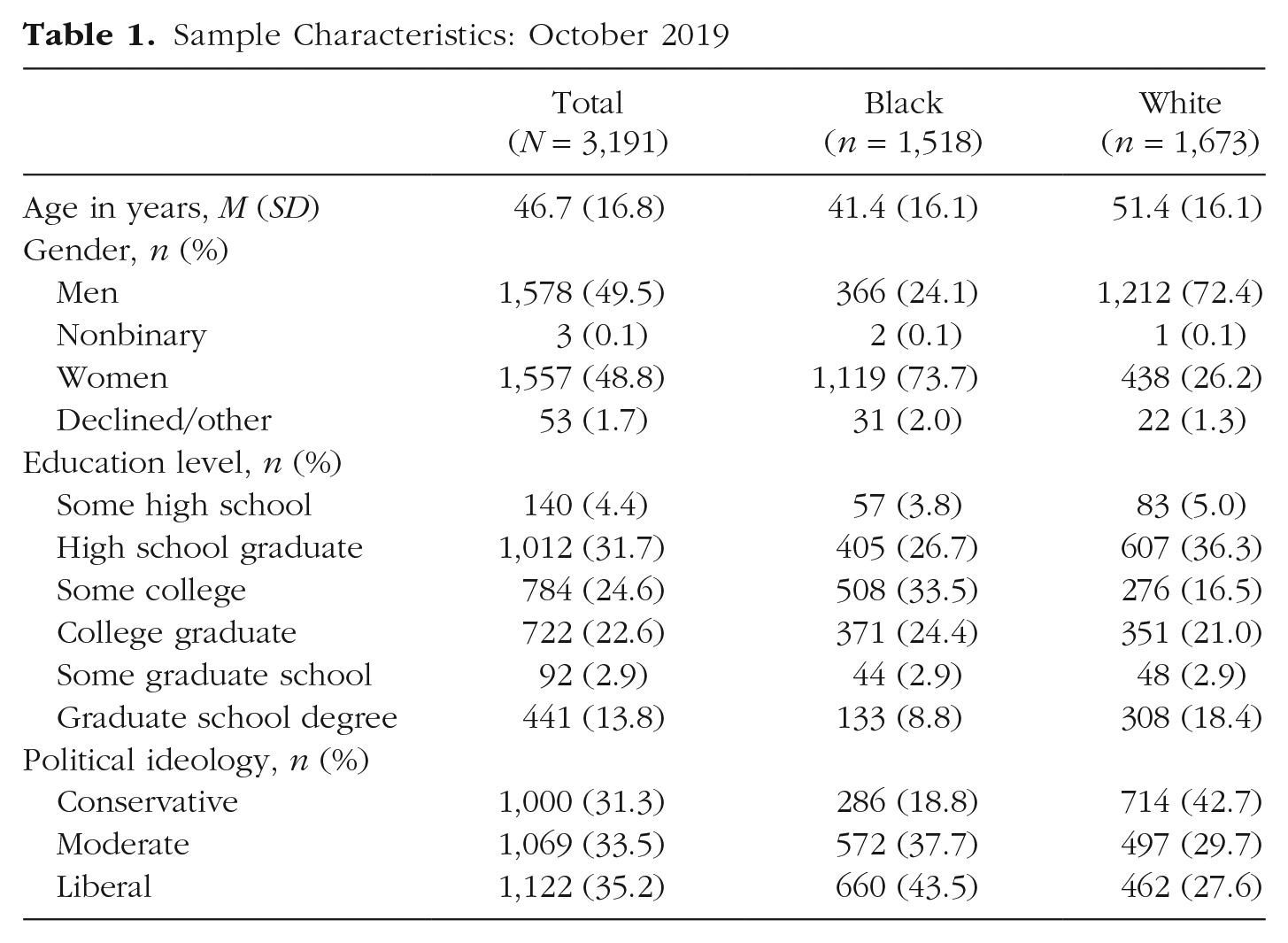
The second was a large-scale study in October 2019 presented below. For the large-scale study, we recruited 4,000 participants via a Qualtrics panel (2,000 Black participants and 2,000 White participants, otherwise representative of the U.S. population with respect to age, gender, and education). 2 After preregistered exclusions, 3 the final sample consisted of 3,191 participants. We present sample characteristics (age, gender, education level, and political ideology by race/ethnicity) in Table 1. Materials, data, and code are available on OSF at https://osf.io/4hbrg.
Sample Characteristics: October 2019
We used a 2 (participant race: Black, White) × 2 (target race: Black, White) × 7 (decade: 1950s, 1960s, 1970s, 1980s, 1990s, 2000s, 2010s) × 3 (participant political ideology: liberal, moderate, conservative) mixed factorial design to evaluate perceptions of anti-Black and anti-White bias. Participant race and political ideology were between-subjects participant variables; target race and decade were within-subjects manipulated variables. Participants indicated to what extent they thought Black and White Americans, in counterbalanced order, were the target of discrimination (1 = not at all to 10 = very much) in each of the past 7 decades. After completing these perceived bias measures, participants reported their political ideology, 4 race, education, and age. The results from Norton and Sommers (2011) and the current sample are graphed in Figure 1.
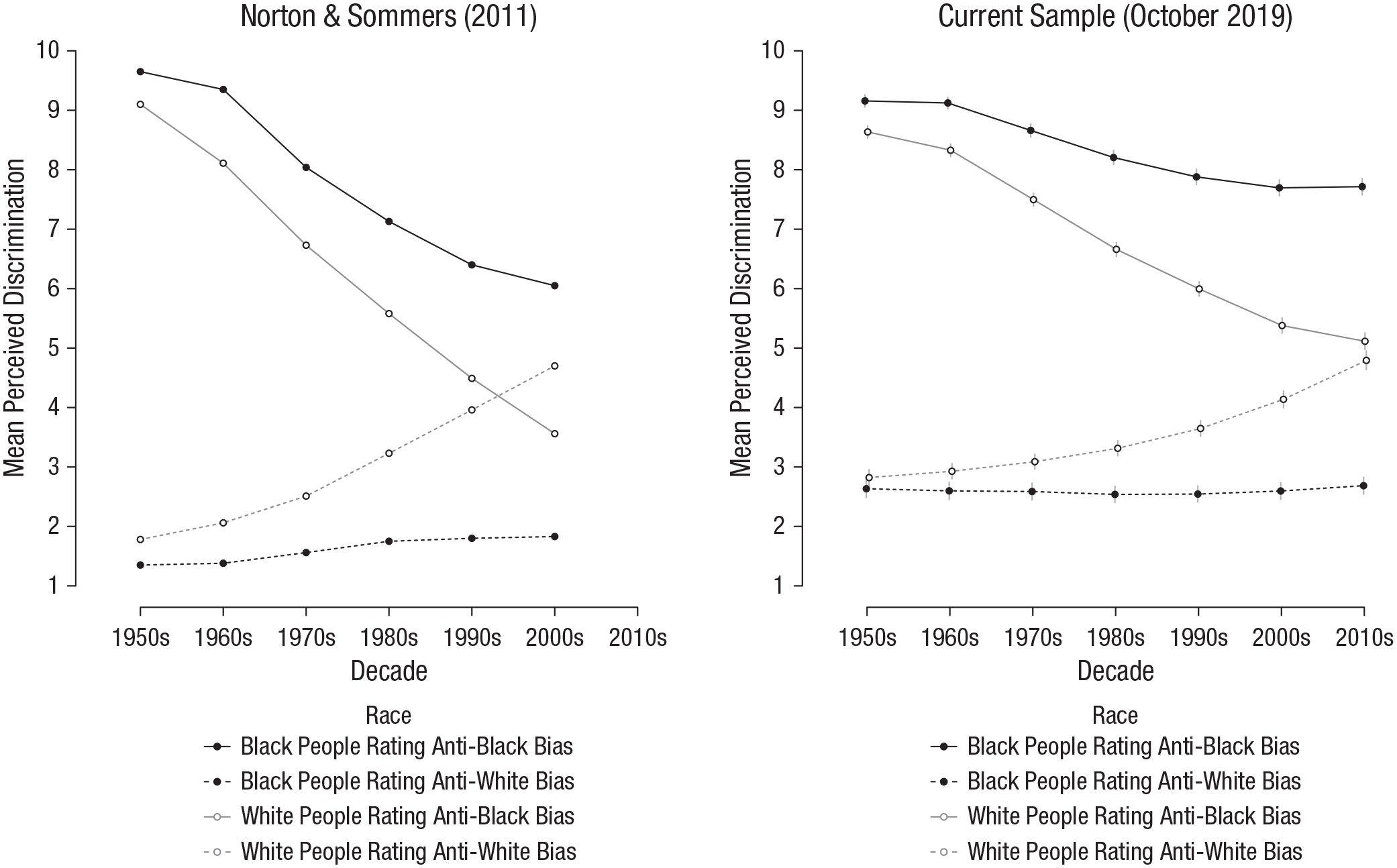
Discrimination against Black targets (solid lines) and White targets (dashed lines) perceived by Black participants (black lines with filled black circles) and White participants (gray lines with empty gray circles) by decade. The panel on the left shows results from Norton and Sommers (2011); there are no values for the 2010s because participants did not rate discrimination in that decade. The panel on the right shows our results from October 2019; error bars reflect 95% confidence intervals.
Do White (but Not Black) Americans Continue to Perceive Racism as a Zero-Sum Game? Yes
White Americans in 2019 believed that gains for Black people necessarily come at the expense of losses for White people, as shown in Figure 1 and consistent with Norton and Sommers (2011). Specifically, White participants believed that anti-Black bias decreased steeply from the 1950s to the 2010s and that anti-White bias increased nearly as steeply from the 1950s to the 2010s. Black participants believed that anti-Black bias decreased modestly from the 1950s to the 2010s but that anti-White bias was steadily low from the 1950s to the 2010s. 5
The difference between anti-Black and anti-White bias was consistently larger for Black participants than for White participants. Black participants endorsed a very large anti-Black versus anti-White difference in the 1950s, Hedges’s g = 2.57, 95% confidence interval (CI) = [2.41, 2.74], that was still quite large in the 2010s, Hedges’s g = 1.81, 95% CI = [1.69, 1.92]. 6 White participants, on the other hand, endorsed a very large difference in the 1950s, Hedges’s g = 2.32, 95% CI = [2.18, 2.46], that shrank to a negligible difference in the 2010s, Hedges’s g = 0.10, 95% CI = [0.03, 0.17].
Ratings of perceived bias against Black and White Americans were negatively associated within each decade for White but not Black participants. 7 For White participants, higher scores for anti-Black bias were modestly associated with lower scores for anti-White bias from the 1950s, b = −0.08, 95% CI = [−0.12, −0.05], to the 1980s, b = −0.05, 95% CI = [−0.08, −0.02]. The magnitude of this association increased from the 1990s, b = −0.10, 95% CI = [−0.13, −0.07], to the 2000s, b = −0.17, 95% CI = [−0.2, −0.14], and reached a peak in the 2010s, b = −0.22, 95% CI = [−0.24, −0.19]. For Black participants, the associations between anti-Black bias and anti-White bias hovered near zero in all decades. For example, the association was b = −0.03, 95% CI = [−0.07, 0.01], in the 1950s, and b = 0.01, 95% CI = [−0.02, 0.03], in the 2010s.
Finally, the association between perceived change in anti-Black bias from 1950 to 2010 (2010s minus 1950s) and perceived change in anti-White bias over the same time frame differed by participant race. 8 For White participants, larger perceived decreases in anti-Black bias were associated with larger perceived increases in anti-White bias, b = −0.23, 95% CI = [−0.27, −0.18]. For Black participants, the association between change in anti-Black bias and change in anti-White bias was near zero, b = 0.02, 95% CI = [−0.03, 0.07].
Collectively, these results demonstrate that, in 2019, White people continued to view racism as a zero-sum game, as they did in 2011. But, unlike in the work of Norton and Sommers (2011), White people saw the zero-sum game as one they were winning by a little, not losing. As in our small-scale study in April 2018, a fuller understanding required considering political ideology as a moderator.
Do White (but Not Black) Liberal, Moderate, and Conservative Americans Perceive Racism as a Zero-Sum Game? Yes. For White Conservatives, It’s a Game They Are Now Losing
As shown in Figure 2, White participants—liberals, moderates, and conservatives alike—believed in 2019 that gains for Black people necessarily come at the expense of losses for White people. Specifically, regardless of political ideology, White participants believed that decreases in anti-Black bias were mirrored by increases in anti-White bias. However, only White conservatives (n = 714) believed that anti-White bias exceeded anti-Black bias in the 2010s, Hedges’s g = −0.47, 95% CI = [−0.58, −0.36]. White liberals (n = 462) believed that anti-Black bias exceeded anti-White bias by a lot in the 2010s, Hedges’s g = 0.86, 95% CI = [0.71, 1.01]; White moderates (n = 497) did too but only by a little, Hedges’s g = 0.23, 95% CI = [0.10, 0.36]. 9
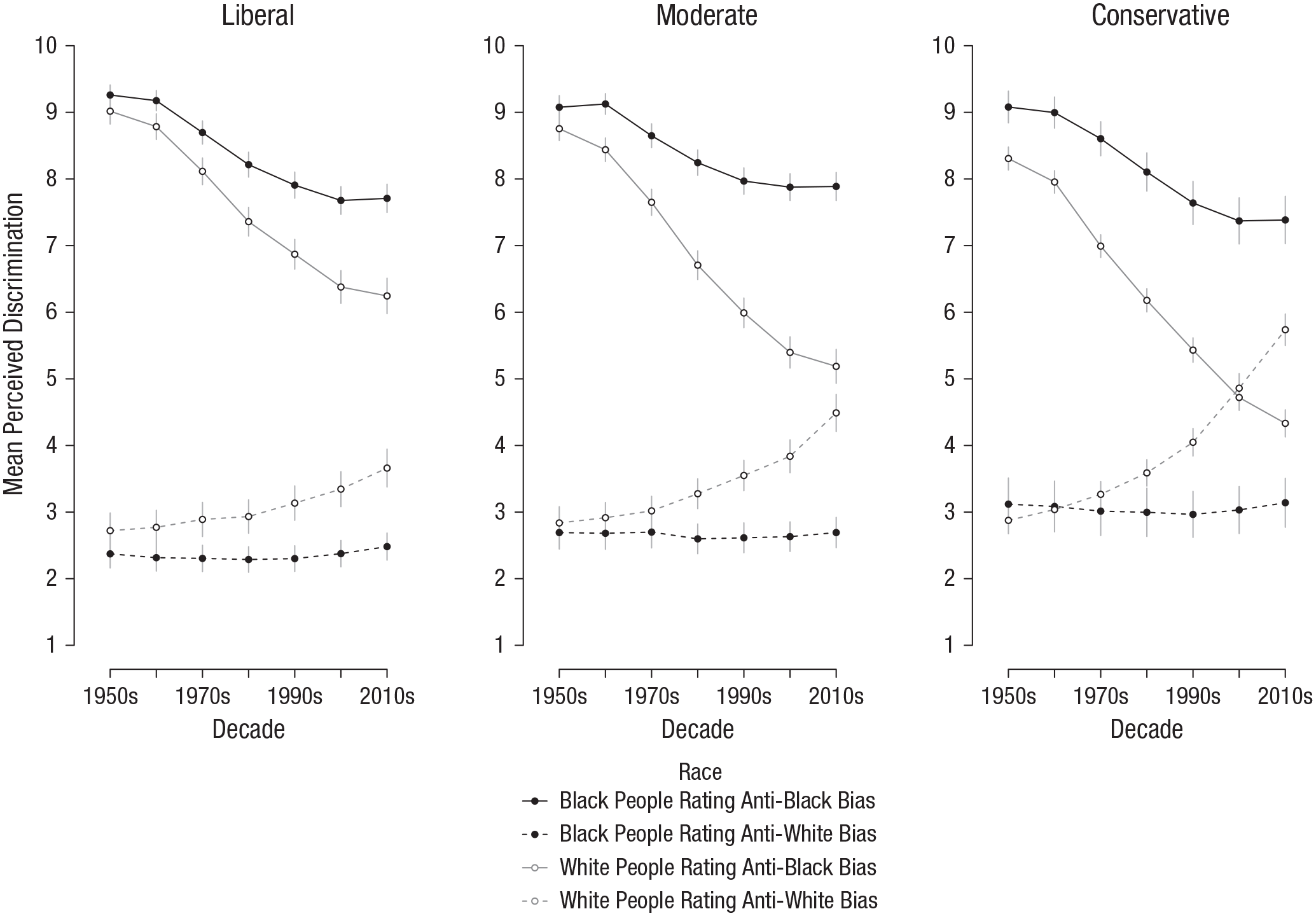
Discrimination against Black targets (solid lines) and White targets (dashed lines) perceived by Black participants (black lines with filled black circles) and White participants (gray lines with empty gray circles) by decade in October 2019. Panels depict results for liberals (left), moderates (middle), and conservatives (right). Error bars reflect 95% confidence intervals.
Black participants—liberals, moderates, and conservatives—did not demonstrate zero-sum thinking; all three groups believed that decreases in anti-Black bias were paired with steady low levels of anti-White bias. Moreover, regardless of political ideology, Black participants believed that anti-Black bias exceeded anti-White bias in all decades, including the 2010s. In the 2010s, that effect was very large for Black liberals (n = 660), Hedges’s g = 1.92, 95% CI = [1.74, 2.11], and Black moderates (n = 572), Hedges’s g = 1.94, 95% CI = [1.73, 2.14], and smaller but still very large for Black conservatives (n = 286), Hedges’s g = 1.36, 95% CI = [1.14, 1.58].
As shown in Figure 3, ratings of perceived bias against Black and White Americans were negatively associated for White participants in at least a few decades for all three ideology groups. 10 Negative associations were most consistent among White conservatives and strongest in the most recent decades. But even White liberals exhibited negative associations in the three most recent decades. For Black participants, the associations between anti-Black bias and anti-White bias hovered near zero in nearly all decades regardless of political ideology.

Associations between anti-Black bias (x-axis) and anti-White bias (y-axis) by participant race (straight black lines for Black participants and straight gray lines for White participants) in October 2019. Panels depict results for 7 decades from the 1950s (left) to the 2010s (right) and three political-ideology groups: liberals (top row), moderates (middle row), and conservatives (bottom row). Curved lines surrounding each association are 95% confidence bands. Asterisks (black for Black participants and gray for White participants) indicate that the 95% confidence interval for the association excludes zero.
Finally, the association between perceived change in anti-Black bias from 1950 to 2010 (2010s minus 1950s) and perceived change in anti-White bias over the same time frame was not significantly moderated by participant race and political-ideology group. 11 For White liberals, b = −0.14, 95% CI = [−0.22, −0.06], White moderates, b = −0.18, 95% CI = [−0.26, −0.10], and White conservatives, b = −0.25, 95% CI = [−0.31, −0.18], larger perceived decreases in anti-Black bias were associated with larger perceived increases in anti-White bias. For Black liberals, b = 0.04, 95% CI = [−0.04, 0.12], Black moderates, b = 0.03, 95% CI = [−0.05, 0.12], and Black conservatives, b = −0.04, 95% CI = [−0.14, 0.06], the association between change in anti-Black bias and change in anti-White bias was near zero.
Collectively, these results demonstrate that, in 2019, liberal, moderate, and conservative White people continued to view racism as a zero-sum game. White liberals saw it as a game they were still winning by a lot, White moderates saw it as a game they were still winning by a little, and White conservatives saw this as a zero-sum game they were now losing by a little.
Conclusions
Our results suggest that zero-sum thinking about racism pervades the entire political ideological spectrum among White Americans; even liberal White Americans believe that gains for Black people mean losses for White people. However, views of whether and by how much White people are seen as now winning or losing the zero-sum game vary by political ideology. Liberal, moderate, and conservative White Americans agree that White people were winning the zero-sum racism game in the past. They disagree on the outcome more recently; in the most recent decade, liberal White Americans see it as a game they are still winning by a lot, moderate White Americans see it as a game they are still winning but by a little, and conservative White Americans see racism as a zero-sum game they are now losing by a little.
Win or lose, why do White Americans, even liberal White Americans, view racism as a zero-sum game? The zero-sum pattern may be a logical consequence of structural racism, “racial practices that reproduce racial inequality in contemporary America [that] (1) are increasingly covert, (2) are embedded in normal operations of institutions, (3) avoid direct racial terminology, and (4) are invisible to most Whites” (Bonilla-Silva, 1997, p. 476). Racial progress by Black Americans may signal deviation from normal operations of American institutions, which is perceived as a threat to White Americans that motivates them to reassert cultural dominance (Wilkins et al., 2022).
That the zero-sum pattern was most pronounced among conservative White participants is not surprising. Work by Wilkins and Kaiser (2014) suggested that White people are more apt to perceive anti-White bias when they believe both that there has been a lot of racial progress and that the system is fair and that everyone can get ahead with hard work. Compared with Democrats, Republicans—who typically endorse conservative ideology—generally believe that America has made more racial progress (Horowitz et al., 2019). Furthermore, conservatism is correlated with economic-system justification, the meritocratic belief that economic outcomes reflect individual efforts, not systemic advantage (Jost et al., 2017). Conservatism is also correlated with symbolic racism, a blend of antipathy toward Black people and the sense that Black people violate cherished American values (Henry & Sears, 2002).
One striking similarity between Norton and Sommers (2011) and the current work is that White participants perceived racial inequity to be lowest (or reversed) in whatever was the most recent decade (i.e., in the 2010s for the current work and in the 2000s for Norton & Sommers, 2011). This pattern was most pronounced among those identifying as politically conservative. Thus, White participants—especially conservative White participants—perceive racial inequity to be more a relic of history than a problem in present-day society. This view of racial inequity as a problem that has been solved—a perception often magnified by political viewpoint—may help explain slow progress toward racial equity despite evidence of persisting inequity (e.g., racial economic inequality; Kraus et al., 2019).
Consider, for example, the 2013 decision by the conservative-majority U.S. Supreme Court regarding preclearance provisions of the Voting Rights Act. 12 Although Chief Justice Roberts (nominated by a Republican president) acknowledged that the Voting Rights Act “has proved immensely successful at redressing racial discrimination and integrating the voting process” (Shelby County v. Holder, 2013, p. 548), he also wrote, “Our country has changed,” suggesting that some of the specific protections required by the Voting Rights Act were no longer necessary (Shelby County v. Holder, 2013, p. 557).
By contrast, in the dissenting opinion, Justice Ginsburg (nominated by a Democratic president) wrote, “Throwing out preclearance when it has worked and is continuing to work to stop discriminatory changes is like throwing away your umbrella in a rainstorm because you are not getting wet” (Shelby County v. Holder, 2013, p. 590). In the years since this ruling, numerous states in the United States have passed measures that restrict access to voting (American Civil Liberties Union, 2021). Better understanding differing perceptions of discrimination as a function of political ideology thus has clear practical importance.
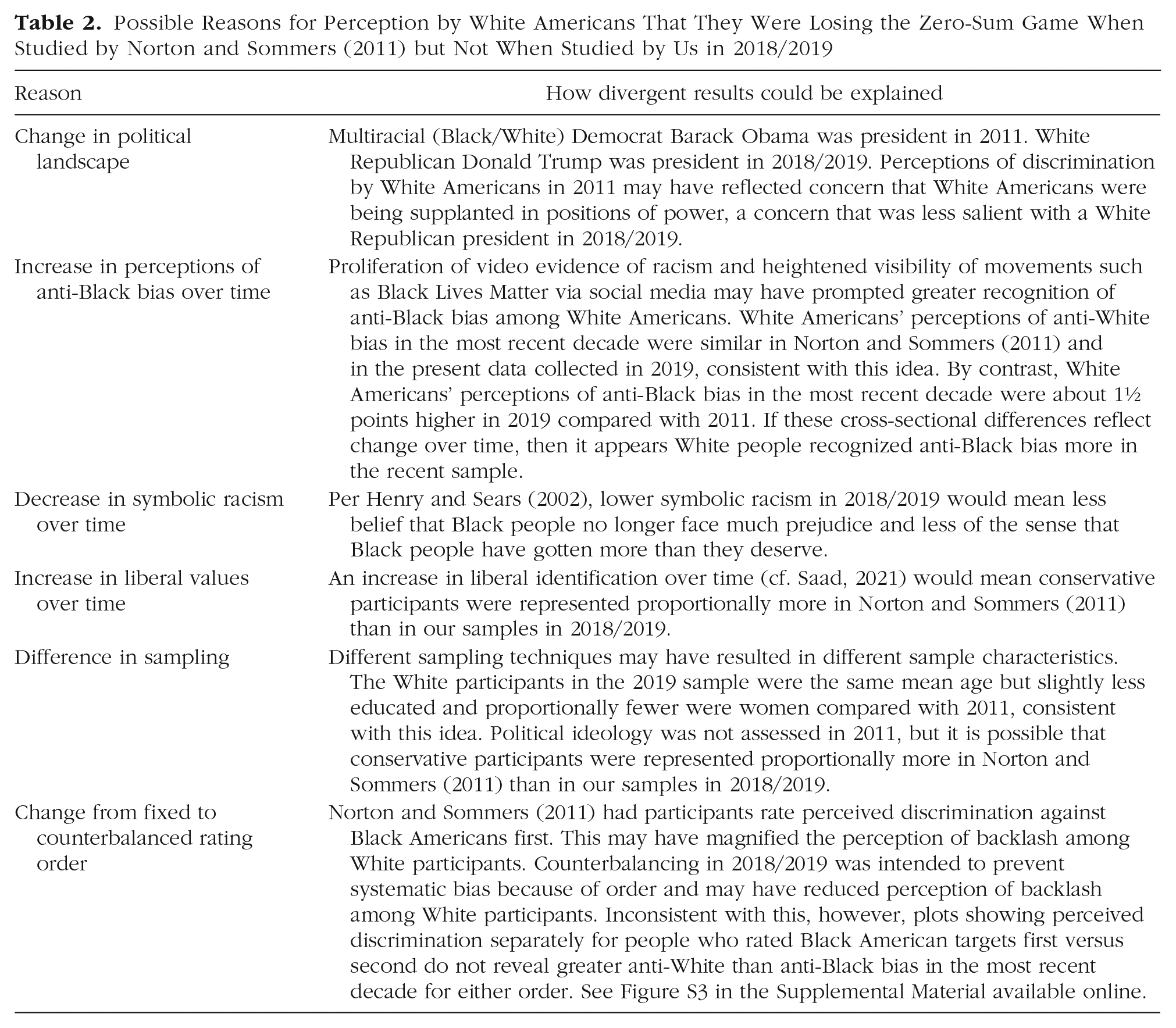
One striking difference between Norton and Sommers (2011) and our work is that the White participants in our work overall did not perceive racism to be a zero-sum game they are now losing; only those endorsing conservative ideology perceived racism as such. Why? We summarize several potential explanations in Table 2. Some explanations hinge on the idea that a critical variable may have changed between 2011 and 2018/2019. For example, with a multiracial president in office in 2011, White Americans’ perceptions of discrimination may have reflected their concern of being supplanted in positions of power, a concern that was less salient with a White Republican president in office in 2018/2019. In addition (or instead), perceptions of anti-Black bias may have changed over time, perhaps because of the proliferation of video evidence of racism (e.g., cellphone or bodycam footage of police brutality) and heightened visibility of movements such as Black Lives Matter via social media (Auxier, 2020). Other explanations hinge on methodological differences between the studies.
Possible Reasons for Perception by White Americans That They Were Losing the Zero-Sum Game When Studied by Norton and Sommers (2011) but Not When Studied by Us in 2018/2019
Common to almost all potential explanations is a need for future research because our data do not afford definitive conclusions. Thus, we hope the current work inspires future research that explains why only conservative White Americans believe White people are losing the zero-sum game when it comes to racism. Longitudinal studies could reveal to what extent zero-sum thinking precedes and/or reflects political and racial events and attitudes over time. Experimental studies could reveal whether manipulations of political and racial attitudes (e.g., asking conservative participants to reflect on their political values) are sufficient to cause shifts in zero-sum thinking.
Future work should also consider individual-difference variables of interest. For example, Wilkins and colleagues (2015) suggested it would be fruitful to measure global zero-sum beliefs that gains for one group represent losses for another. They found, for example, that men who endorse higher levels of zero-sum beliefs are more likely than men who endorse lower levels of zero-sum beliefs to think that declines in antifemale bias over the decades are in lockstep with increases in antimale bias and that men are losing this zero-sum gender-bias game in the most recent decade. Global zero-sum beliefs may partially or fully explain conservative White Americans’ view that racism is a game they are now losing.
Norton and Sommers (2011) concluded by stating:
In sum, our findings situate specific claims of persecution by White Americans in a broader belief in a new, generalized anti-White bias. That Whites now believe that anti-White bias is more prevalent than anti-Black bias has clear implications for public policy debates and behavioral science research in the years to come (p. 217).
Our current results qualify this specific claim to be more narrowly restricted to White Americans who identify as conservative. Importantly, liberal, moderate, and conservative White Americans alike believe that racism is a zero-sum game with gains for Black people meaning losses for White people. Liberal White Americans see racism as a zero-sum game they are winning by a lot, moderate White Americans see it as a game they are winning by only a little, and conservative White Americans see it as a game they are losing. Liberal, moderate, and conservative Black Americans continue not to see racism as a zero-sum game at all. Thus, perceptions of discrimination based on intersecting racial and political identities will remain important considerations for public policy and social science into future decades.
Supplemental Material
sj-docx-1-pps-10.1177_17456916221082111 – Supplemental material for White (but Not Black) Americans Continue to See Racism as a Zero-Sum Game; White Conservatives (but Not Moderates or Liberals) See Themselves as Losing
Supplemental material, sj-docx-1-pps-10.1177_17456916221082111 for White (but Not Black) Americans Continue to See Racism as a Zero-Sum Game; White Conservatives (but Not Moderates or Liberals) See Themselves as Losing by Raea Rasmussen, David E. Levari, Muna Akhtar, Chelsea S. Crittle, Megan Gately, Jeremy Pagan, Andrea Brennen, Dylan Cashman, Alia N. Wulff, Michael I. Norton, Samuel R. Sommers and Heather L. Urry in Perspectives on Psychological Science
Footnotes
Acknowledgements
We used the Tufts University High Performance Compute Cluster (https://it.tufts.edu/high-performance-computing) for some analyses reported in this article. We preregistered our studies on OSF. The preregistration for the initial small-scale study in April 2018 is available at https://osf.io/bgc94. The preregistration for the large-scale study in October 2019 is available at  .
.
Transparency
Action Editor: Joshua Hicks
Editor: Laura A. King
Author Contributions
For author contributions according to the Contributor Roles Taxonomy, see the Supplemental Material available online.
Notes
References
Supplementary Material
Please find the following supplemental material available below.
For Open Access articles published under a Creative Commons License, all supplemental material carries the same license as the article it is associated with.
For non-Open Access articles published, all supplemental material carries a non-exclusive license, and permission requests for re-use of supplemental material or any part of supplemental material shall be sent directly to the copyright owner as specified in the copyright notice associated with the article.
