



Abstract
Medical representatives are a key component of the marketing strategies used to convince physicians to prescribe targeted drugs. The perspectives of medical representatives on the extent and composition of pharmaceutical promotion techniques has been neglected in previous studies. An in-depth interview technique was used to gain a better understanding of the current drug promotion techniques used in Yemen. The seven major themes identified, and explored, in this study of pharmaceutical promotion techniques were educational materials, free samples, symposia and other scientific meetings, invitations, gifts and incentives and commercial offers. Respondents were generally altruistic concerning the patient and were fully conscious of the unethical activities pertaining to drug promotion. They highlighted the need to observe professional ethics, enact laws and establish policies that would sanitise current practice. Free medical samples, bonuses and commissions play a large role in promoting pharmaceutical products. Governments should establish laws, ethics and policies for drug promotion.
Introduction
The last two decades have witnessed a rapid expansion in the number and variety of alliances between the medical profession and the pharmaceutical industry. Many of these alliances are necessary and inevitable, often delivering substantial benefits in therapeutics, education and research. 1 However, the potential for the relationship to also undermine the interests of the profession, patients and the public alike has generated considerable public and professional unease. 2 Marketing costs exceed 30% of revenues in the pharmaceutical industry, with over 90% of the effort aimed at physicians. 3 It has been estimated that $8000 to $13,000 is spent per year on each physician. More than $11 billion is spent each year by pharmaceutical companies in promotion and marketing, $5 billion of which goes to sales representatives. 4
The Yemen pharmaceutical market is an open market overseen by the Supreme Board of Drug and Medical Appliances (SBDMA). The number of local pharmaceutical manufacturers increased from one to nine (increase = 800%). Local manufacturers only account for a small proportion (6.85% in 2006 and 10.8% in 2010) of the total market, whereas imported medicines via private sector agents cover most of the needs of the country (around 85%). The number of registered foreign pharmaceutical companies (originating from 69 countries) has increased from 243 to 490 (increase = 101%) and the number of registered medicines has reached 12,596. The pharmaceutical market size is estimated to be worth US$ 297 million in 2010, compared to US$ 70 million in 2000 (compound annual growth rate: 17.42%). 5 One significant consequence of this increase in the number of pharmaceutical companies, and available drugs, is that it results in increased competition between drug companies. This increases the need for intensive marketing and promotional activities.
Medical representatives (MRs) are in a fast-paced industry where representatives spend most of their working day on the road, trying to increase visibility and awareness of their company's products. They visit doctors, hospitals and pharmacies to meet with medical professionals and convince them that their products are superior to the competitors. The ultimate goal is to generate increased sales. Information such as this is not the only stock for trade by drug representatives: they also provide gifts, food and other inducements to convince doctors to prescribe their drug. 6 MRs are also a key component of the marketing strategies employed by pharmaceutical companies, in that they are the primary link between the company and the physician. Previous studies 7 – 9 have focused on describing the materials distributed to physicians by pharmaceutical companies, or used indirect methods such as examining students’ exposure to drug promotional activities. Other studies 10 – 13 have assessed the interactions of healthcare professionals with pharmaceutical industry representatives and the types of gifts that they received.
Although aspects of the promotional activities of pharmaceutical companies have been discussed to a certain extent, as above by examining the relationship of pharmaceutical companies and doctors, the perspective of the MRs has been neglected. Thus, this study focused on MRs or sales representatives (SRs). Research on this subject is not only almost not existent in Yemen but in other countries as well. 14 There have been several studies conducted among physicians. However, of the marketing approaches, pharmaceutical sales representatives constitute one of the most expensive and extensively used methods of providing information to physicians.
In order to bridge the gap in research, and to gain an in-depth understanding of the nature and extent of drug promotion techniques that are frequently being used by medical representatives (MRs) in Yemen and their relationship with physicians from the viewpoint of medical representatives, a study was conducted using a qualitative approach. A qualitative approach was adopted because it allows a flexible exploration of respondents’ attitudes and experiences. The objectives of this study were to ascertain the extent and composition of drug promotion techniques that are used by MRs in Yemen and their relationship with physicians from the viewpoint of MRs.
Methods
An in-depth interview technique was used in this study. An interview guide was developed through a review of the literature and consultations with a selected cohort of MRs and experienced researchers in the area of drug promotion. The interview guide was tested in three pilot interviews with MRs who were not included in the final qualitative sampling frame. This study was conducted in Sana’a (the capital city of Yemen), between October 2008 and December 2008. The MRs were invited to a suitable and convenient place to conduct the interview, such as a restaurant. Interviews were conducted with an appropriate sample of MRs until saturation was reached. Companies were categorised based on their country of origin, as well as whether they were multinational (original) producers or generic (non-original) producers. The interviews focused on the following issues: composition of pharmaceutical marketing techniques, their appropriateness for physicians and what was actively sought by doctors from drug companies, the type of interaction between MRs and physicians, and the types of pharmaceutical marketing techniques frequency used in clinics, private and public hospitals. Appropriate probing questions were used when necessary. To draw out more complete ideas from the participants, they were given the freedom to express additional views on the topic at the end of the interview sessions. The protocol of this study was approved by the ethics committee of the Ministry of Health and Population (MOHP), Yemen. Each interview took approximately 25 to 35 minutes. All interviews were recorded with the permission of the interviewees. The transcribed interviews (transcripts) were subsequently analysed using ‘framework’, an established manual method of qualitative data analysis. Transcripts were analysed in accordance with the sociological phenomenological approach of Schutz, in order to capture the essence of current drug promotion techniques from the perspective of MRs. 15 The interviews were analysed in order to discern significant meaning units of ideas and aspects of drug promotion techniques, which were marked in the text. These were grouped and then brought together in categories. Themes were identified from several thorough readings of all the transcripts by the researcher and verified independently by a person with cognate experience in qualitative research (a faculty member). Thematic content analysis with systematic and comprehensive coding was first employed to identify categories of drug promotion techniques. Discrepancies were discussed with the study supervisor before final categorisation and conceptualisation was agreed. The identified themes were verified by discussion among all the researchers. This study was conducted in Arabic language, so the results of the study were translated in English. After that, the translation of the results was confirmed by another translator who is familiar with the two languages.
Results
Demographic characteristic of the participants
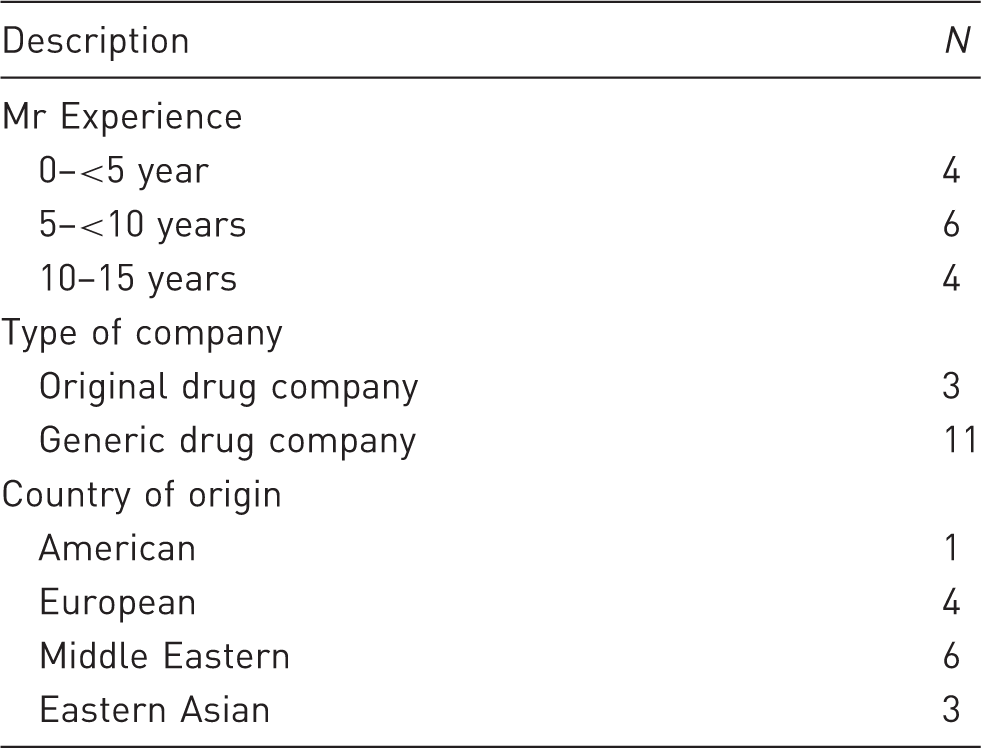
More than two third of MRs interviewed were highly experienced, ranging from 5 to 15 years working in the field of drug promotion. They represented most of the companies operating in Yemen. Despite the MRs interviewed having general belief that potential ethical conflicts exist in current pharmaceutical promotion activities in Yemen, more than two thirds of them did not have knowledge of any code of conduct. Among four respondents who had knowledge about code and conduct, one had a copy of the Middle East Africa code of pharmaceutical promotional practices.
Thematic content analysis of the interviews identified eight major promotional themes: educational materials, office gifts, free samples, symposia and other scientific meetings, invitations, gifts and incentives, clinical practice aids and commercial offers.
Use of educational materials as a drug promotion technique
MRs were asked about the use of educational materials and scientific information for drug promotion to physicians. There were mixed reactions among respondents on this issue. Some informants believed that the use of educational materials or scientific brochures is not an effective strategy for persuading physicians to prescribe their products, especially for local companies.
‘You give a brochure to a doctor and during the visit you also provide him with some necessary information about the product’ (MR1) ‘As for the scientific techniques, we usually use them among the doctors who are interested in this aspect. These techniques include distributing journals, bulletins, brochures, scientific reference books, scientific conferences, presentations and seminars’ (MR2) ‘A brochure is usually neglected. You give a brochure to a doctor who, in turn, puts it in his drawer and never looks at it again (of course not all doctors). You usually provide the doctors with the scientific information in the first meeting along with the brochure. The doctor’s prescription does not usually depend on it. Rarely scientific meetings are held with the doctor in case of big original drugs companies’ (MR11)
Provision of free medical samples
Informants generally believed that the use of free medical samples plays a large role as a means to promote pharmaceutical products and that physicians usually perceive this as an unprecedented opportunity for financial gains. The majority of interviewees agreed that the samples were not just used as a means for introducing a new product or for scientific values, but most physicians sell them out for their own benefit. Accepting samples has a profound effect on doctors’ attitudes towards a company’s products and on their prescribing patterns. The main reason identified as a factor encouraging these attitudes among doctors was low salaries and wages, especially in government settings.
‘Some doctors consider these samples as part of their own income. They uses it for themselves and for their family members when necessary in order to save some money instead of buying these medications. Or they sell the samples to pharmacies and consequently get some money. This, in turn, makes an additional source of income to the doctor’ (MR3) ‘Doctors immediately sell them to pharmacies. They don’t give the samples to poor people or even try them out to examine their effects on the patients. They have become an additional source of income to satisfy the needs of the doctor’ (MR4)
Respondents highlighted the nature of the packaging and quantities of free medical samples used for drug promotion nowadays. They also discussed the diverse attitudes of physicians, as well as the importance of supplying the right amount of free medical samples.
‘Nowadays, samples rarely differ from the real products. In the past, samples used to be reduced and sealed by the company’s stamp and not to be sold. This has changed and the companies rarely make use of such samples and samples have become like other products in the market. Doctors can also benefit from these samples. Doctors now reject any reduced samples because they gain no benefit from them’ (MR4) ‘Some doctors get angry if you give them a sealed sample or when given reduced samples giving the impression that he would sell it to pharmacies’(MR10)
The role of organising symposia and other scientific meetings in drug promotion
MRs interviewed believed that organising scientific meetings and symposia are also techniques used for promotional activities and the marketing of new or existing products. Respondents felt that the companies did organise seminars and conferences for scientific reasons but also sponsored physicians to attend local and international conferences as a form of enticement.
‘Holding seminar events and lectures about the company and the products to be promoted is one of our strategies’ (MR1) ‘Special invitations for meals are arranged in which one, two, or three doctors are invited by a company to deal with them individually. They come only for the meal and no other activity is made. This is just to build or strengthen the relationship with the intended doctors. There are some companies which make use of some gathering events. For example, when doctors gather to attend a scientific conference or to participate in the doctors’ syndicate elections. These companies invite the participants for a meal and distributes gifts/presents to all the participants at the same time instead of inviting them individually’ (MR4)
Strategies employed to strengthen relationships between prescriber and company
Different types of invitations, such as private invitations for meals, entertainment, travels and hotel reservations are offered to physicians by MRs. The informants believed that this is one of the most widely used and accepted means of product promotion. However, there were mixed reactions among the respondents. Some believed that this technique does not work with senior physicians.
‘Special invitations for meals are arranged in which one, two or three doctors are invited by a company to deal with them individually. They come only for the meal and no other activity is made. This is just to build or strengthen the relationship with the intended doctors’ (MR4) ‘A doctor in his clinic is just like a king in his palace. So when you take him out, no more psychological or social barriers exist. If you invite him for a meal out, you can deal/negotiate with him more smoothly. If the doctor is so passionate or romantic, you can also invite his wife with him’ (MR8)
The role of gift and incentive provision in drug promotion activity
Informants were questioned about the use of gifts and other incentives as a marketing strategy and results show that they use varying types of gifts and varying means for offering them. Most informants believed that it is lawful to offer incentives to physicians who support their products, either in monetary terms or otherwise. However, there was a divergence of opinion on using predetermined or conditional incentives. The gifts and incentives used ranged from low-cost items to very expensive ones, sometimes depending on signed agreements between the MR and the physician.
‘Supporting a doctor usually comes according to his need or request. It can be something like attending a conference in a foreign or Arab country; a complete conference at the expense of the company and some may ask for pocket money; some want to buy some furniture for their clinics or for any other thing; recreation local or international travelling’(MR11)
Informants were asked about the use of promotional gifts in drugs promotion and marketing. MRs believed that different types of gifts and presents are offered to physicians as a means for promoting the sale and marketing of drug products.
‘A TV set can be given as a gift, sometimes’ (MR3) ‘When a doctor prescribes my product to earn 5–6 million YR, I can, in return, buy him an ECG machine which costs 500000 YR. I can, also, give this amount of money to him in cash so that he can spend it the way he likes’ (MR9) ‘The profit aspect depends primarily on the product you are promoting. If the products were expensive, you negotiate with the doctor so as to supply particular quantities of those products (about 300–500 packets) to a particular pharmacy in return of something like recreation travel tickets to a particular country’ (MR2) ‘Certainly, there are conditional gifts. A doctor might be given a laptop, a PC or sometimes a car under the condition of prescribing a particular quantity of a product/medicine’ (MR4) ‘Gifts are of two types. As for the international companies they already have started using codes of conduct. They have all signed this code and are bound by it. This is because some companies used to give big gifts to doctors. According to the new regulations, these gifts shouldn’t exceed the value of $10’ (MR7) ‘Promotional means such as office gifts are employed. A lot of things such presents/gifts of different kinds such as pens, diaries, notebooks, envelops, and other materials with the product and the company’s title on them. There are other things like desktop accessories and posters which are also used in the promotion process.’ (MR12)
Provision of commercial offers
Informants in this study highlighted that bonuses and commissions are also offered as a means to persuade clinicians and doctors to prescribe the products of a particular company. They generally believed that this strategy is effective in promoting drug products and increasing the volume of sales.
‘Bonus and commissions are widely used because they can be more effective and more influential than other promotion techniques. This also depends on the company and its products’ (MR4) ‘Offers can be made on such basis as giving a doctor a certain percentage as bonus and for big quantities I give him some equipment or a discount. I can also give him an additional free product beside my main product. This is so effective especially with private clinical centres and hospitals’ (MR6)
Personal views on current pharmaceutical promotion practices in Yemen
MRs interviewed gave their insights into current pharmaceutical promotion activities in Yemen, particularly in relation to professional ethics and morals, as well as relevant laws and policies. Respondents were generally altruistic towards patients and were fully conscious of the unethical activities pertaining to drug promotion. They highlighted the need to observe professional ethics, enact laws and establish policies that will sanitise the current practice.
‘Frankly speaking, as a representative you feel that the situation is disastrous and the only victim is the patient. The benefit goes to primarily the company and secondly to the doctor. Unfortunately, in Yemen, all the participants work dirty. Either original or non-original/generic companies. They all work dirty. Of course original companies are forced to work dirty because of the competitive rivalry’ (MR11) ‘I think the Ministry of Health needs to reconsider the affairs of drug promotion. This is because we have new companies emerging to the market everyday and new products are registered everyday though many alternatives are available. It can be accepted from the point of view of creating competition but our local market cannot afford all this much of products and companies. Competition causes pressure on doctors, on patients and it has become a kind of bargain instead of its being a medical profession / career’ (MR12) ‘This issue needs to have great efforts to rearrange the conditions of the drug promotion in Yemen because it is highly competitive and that the laws and ethics are lost in the absence of control points on companies and promotional work. In addition, there is a lack of control of the Ministry of Health’ (MR4) ‘I hope that there will be a legitimate for the drug promotional policy in Yemen and I also hope that the MOHP, NOG and Civil organization to play a great role in legitimating the profession like those in the Gulf area and the rest of the world that would protect the professions, doctors and patients as well as the pharmacists’ (MR5)
Discussion
The eight major themes identified in this study can be categorised into two major domains: pharmaceutical promotion techniques and current pharmaceutical promotion practice in Yemen from viewpoint of MRs.
The informants generally believed that the pharmaceutical promotion techniques that are used in the field depend on many factors. A physician’s response to each technique, the promotion strategy of a company and their type of products, products life cycle stages, product price and the degree of competition in the market, are some of the factors that can greatly influence drug promotion strategies. In addition, the characteristics of the MR in terms of sales skills, performance, level of education and moral values can also play a role in the selection of promotion techniques.
Furthermore, there were mixed reactions among respondents on different pharmaceutical promotion techniques. Informants generally viewed promotion techniques from two perspectives: scientific approaches which include visits to a doctor, symposia and other scientific meetings, distribution of educational materials, free samples, office gifts, and non-scientific approaches, in terms of financial relationships, which include invitations, gifts and incentives, and commercial offers.
The findings of the current study also suggested that there are mixed reactions towards utilisation of scientific approaches in the marketing of pharmaceutical products to physicians, with reactions varying from one respondent to another. In this study, we found that these variations stem from the type of pharmaceutical company, principally multinational (original) versus generic drug companies. Informants representing multinational companies agreed that they widely utilised scientific approaches in promoting products to physicians. They agreed that the scientific technique was an effective means of promotion among physicians who were interested in this aspect, particularly in case of new products, and at times depending on the hierarchy of the physician in the institution. Conversely, respondents representing the generic companies seldom used this technique. This finding could be explained from the perspective of the novelty of scientific information related to the product. The multinational innovating company, having a novel product and still in control of its patent, has new scientific knowledge and information to disseminate through publications, conferences and symposia. However, MRs from generic companies were not in favour of using scientific techniques. One of the reasons may be due to a lack of original scientific information concerning their products. Except for international conferences used for targeting physicians who support the companies product, most of the informants downplayed the importance of using scientific techniques versus none scientific techniques. Most MRs stated that the majority of physicians preferred financial promotion methods.
Informants generally believed that the use of free medical samples plays a large role as a means to promote pharmaceutical products. Currently in Yemen, there is no specific legislation on drug promotion activities and there are no controls on the distribution of free samples. The companies usually provide free medical samples in large quantities, rendering the samples vulnerable to resale by the physician as an additional source of income. This is because the samples are not differentiated from drug products that are intended to be sold. Informants mentioned that the majority of physicians prefer these kind of samples and that they sometimes rejected reduced samples, samples that are sealed with the company’s stamp or samples tagged as ‘not to be sold’. Although some respondents believed that free samples fall within the domain of scientific methods of drug promotion, others held the view that the free samples have become a means of financial incentive and therefore should be regarded as a non-scientific method of drug promotion.
Limitations
The main limitation of this study is inherent to the use of the qualitative methodology. Qualitative studies are always limited by their generalisability. This study was based on a limited sample of qualitative face to face interviews with Yemeni MRs in Sana’a, but the use of the qualitative methodology is the best approach in order to explore issues of interest in depth prior to engaging in large quantitative-based studies.
Conclusion
Promotion techniques used by MR were widely and deeply integrated into company marketing objectives and the needs and requests of physicians. Most MRs interviewed did not have knowledge of any code of conduct, and they used different promotional techniques depending on company strategy, their own judgment and or skills, and pressures from physicians.
Free medical samples, bonuses and commissions play a large role in promoting pharmaceutical products. Governments should establish laws, ethics and policies for drug promotion to enable monitoring and encourage compliance by pharmaceutical companies, and their MRs, to a code of conduct and ethical marketing practices.
Footnotes
Acknowledgment
The study was supported by Ministry of public health and population Yemen as Student Scholarship.
Funding
This research received no specific grant from any funding agency in the public, commercial or not-for-profit sectors.
Conflict of interest
The authors declare that they do not have any conflicts of interest.
Author's Biographies
Mahmoud Abdullah Al-Areefi is a doctoral candidate in the Discipline of Social and Administrative Pharmacy, School of Pharmaceutical Sciences, Universiti Sains Malaysia. His research interests are in the area of public health, health policy and social & administrative pharmacy with a special focus on pharmaceutical promotion.
Mohamed Azmi Hassali (PhD) is an Associate Professor and currently heading the Discipline of Social and Administrative Pharmacy, School of Pharmaceutical Sciences, Universiti Sains Malaysia. His current research interests are in the area of ‘Social Pharmacy’ especially related to issues on quality use of medicines in healthcare system.
Mohamed Izham B Mohamed Ibrahim is a Professor of Social and Administrative Pharmacy, and the Associate Dean for Research and Graduate Studies Affairs at College of Pharmacy, Qatar University. His research interests and expertise are in Pharmaceutical Policy & Supply Management, Pharmacoeconomics, Pharmacoepidemiology, Socio-behavioural Aspects of Pharmacy, and Pharmacy Management & Marketing.