




Abstract
There is a lack of scientific evidence on the impact of a biomedical industry on the surrounding economy. The assessment of this issue would allow policy makers to identify the impact on production, local employment and wages in addition to public sector costs. With this aim, the paper evaluates the socio-economic impact of a medical devices firm’s decision to set up its manufacturing plants in Italy, i.e. the effect of industrial activity on employment, earnings and output, using information on production processes to derive the associated interactions with suppliers for the primary industry and secondary industries. Besides being amongst the major contributors of health outcomes, medical technology manufacturers provide additional benefits to public sector and to the economy as a whole. This suggests that a broad perspective needs to be endorsed by policy makers when deciding about the introduction of new technologies in the healthcare sector in order to achieve optimal outcomes for society as a whole.
Keywords
Introduction
Arguably, medical technology has a range of social and economic benefits. It enables people to live healthier, more active and possibly productive lives. It also contributes to the productivity of healthcare systems, and to efficient, cost-effective and sustainable service delivery. Moreover, it contributes to economic growth and job creation.
The global market for medical devices is valued at US$308 billion in 2012 and is forecast to be worth over US$349 billion by 2016. 1 Almost three fourths of global medical devices sales revenue come from sales in the US (41%) and Europe (29.5% in Western Europe, 4.6% in Eastern Europe). 2 In terms of employment, the medical technology industry employs 500,000 people in Europe, 3 while more than 400,000 people are directly employed in the US, with total direct and indirect employment exceeding two million. 4
The economic and labour impact of the medical device industry exceeds the direct effects on employment, earnings and output in the regional or state economy in which it is located. The medical technology industry can generate multiplier effects on the rest of economy that include both indirect effects on other local industries through the purchases of inputs and the induced effects on other industries from the local consumption spending of workers and owners. The knowledge of the magnitude of these multiplier effects is crucial for evaluating the industry’s contributions to the overall economy.
The socio-economic impact of a firm’s decision to set up its manufacturing plants in a given area has been the subject of study in tourism, manufacturing and service industries. 5 Typically, the object of study is the effect of industrial activity on employment, earnings and output, using information on production processes to derive the associated interactions with suppliers for the primary industry and secondary industries. This is commonly done within the framework of input-output analysis, which constitutes a snapshot of the state of inter-industry transactions of goods and services in the local economy at a particular point in time. The method is based on the use of input-output tables that show, for each industry, the amount and value of inputs (e.g. labour, materials, energy) purchased from other industries and of outputs sold to other industries.
Estimates of US medical device industry multiplier effect
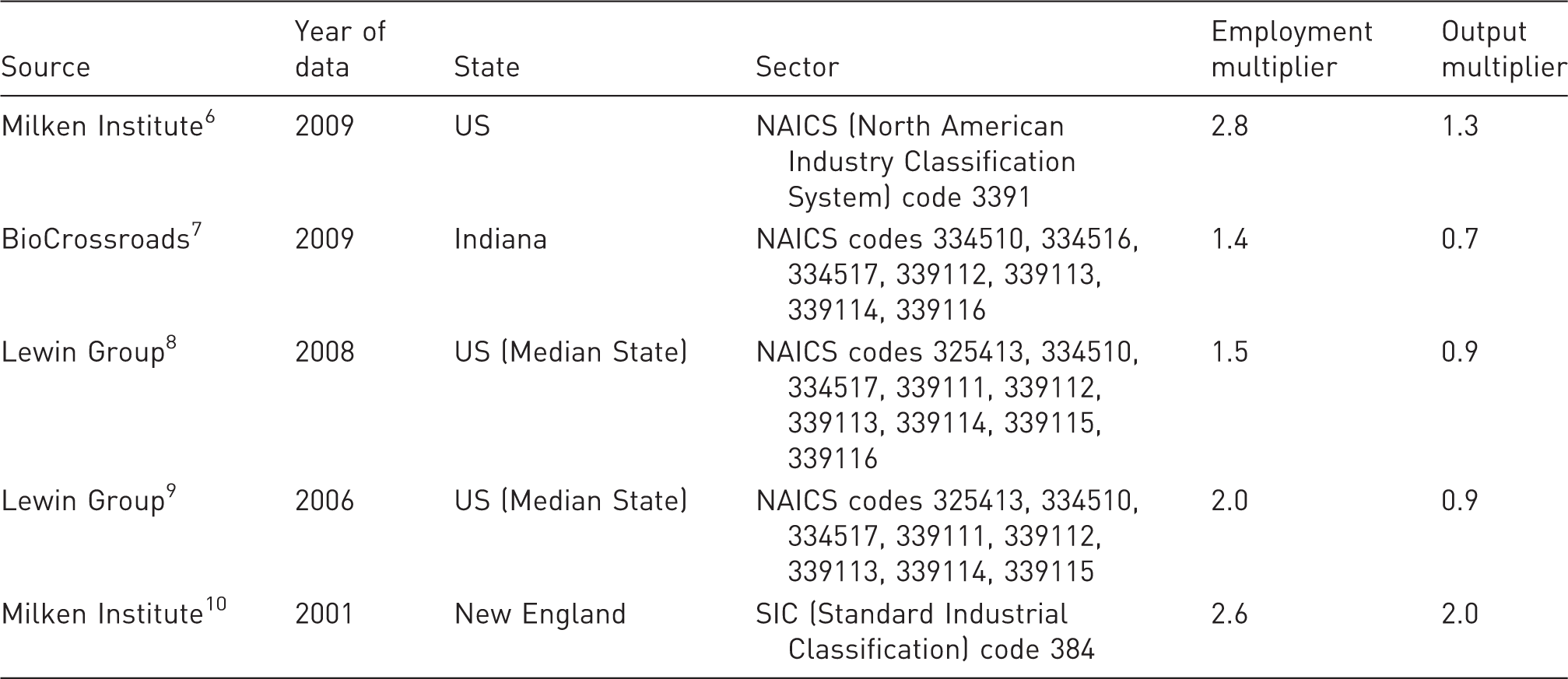
It is worth noting that the interpretation of multiplier analysis should consider several issues that could impact the results. 11 First, the multipliers can vary widely by geographic area dimension, being higher for industries located in large urban areas, because most of the suppliers stay within the area. Smaller, rural areas generally have lower multipliers, because industries must purchase their inputs from outside the area. For the same reason, national multipliers are usually larger than state multipliers. Moreover, multiplier analysis is based on the assumption of fixed trading patterns, which means that each industry buys supplies from local and outside industries in fixed proportions, and suppliers’ production automatically changes with production in the purchasing industry. For example, if an industry doubles the production, its use of each input also doubles. As a consequence, multipliers estimates will be realistic only if local industries will be able to increase their production to supply the requests. As a result, multipliers usually overstate indirect impacts. In addition, the definition of sectors varies between studies and this may impact the comparison of the results.
Further evidence shows that in the majority of US states wages for medical technology industry jobs are above the state average earnings in private sector primarily because the industry requires a highly skilled and educated workforce,8,9 and the wage premium paid by medical technology industry is estimated to be equal to 40%. 4
With the exception of the above-mentioned reports, none of which focuses on the European context, there is a lack of scientific evidence on the impact of a medical device company on the surrounding economy. The assessment of this issue would allow policy makers to identify the impact on production, local employment and wages in addition to public sector costs. The objective of this study was to fill this gap by estimating the impact of prosthetic heart valves production in Italy on the regional and national economy. The study estimated the direct contribution to the local and regional economy through employment and employees’ remuneration and the indirect impact on suppliers’ sales and employment. Furthermore, it estimated the multiplier effect on employment and sales. The measures for economic impact are defined as in the standard multiplier analysis. Nevertheless, the methodology adopted here differs in that primary data directly collected were used instead of regional input-output tables.
The paper is organised as follows. The conceptual framework of economic effects by a medical device industry is presented first. After the description of the methodology adopted to estimate the economic contribution, the results of the analysis are presented. The discussion of the implications of the findings ends up the paper, particularly in relation to the cost to the Italian taxpayer of healthcare services associated with use of prosthetic heart valves made in Italy.
The economic contribution of medical devices industry
The literature highlights that the medical technology industry has a strong and positive impact on the economies of states through employment, payrolls and sales.7-10,12 The impact consists of three general types, which are schematically portrayed in Figure 1. The ‘direct’ impacts of the industry relate to immediate employment, payroll and sales. ‘Indirect’ impacts are generated when companies purchase inputs to the medical device production (i.e., various goods and services) in the state or local area of production and the suppliers in turn hire and pay staff. These purchases generate further purchases from other businesses that again undertake further hires. In addition, employment and wages in the supplier industries ripples throughout the local economy leading to a cycle of ‘induced’ beneficial impacts that arises as medical devices workforce and families spend their incomes on consumer goods and services, which generates yet further hiring and payrolls primarily in the retail sector. These effects are repeated, although at a fraction of the original impact.
Economic benefits of medical device industry.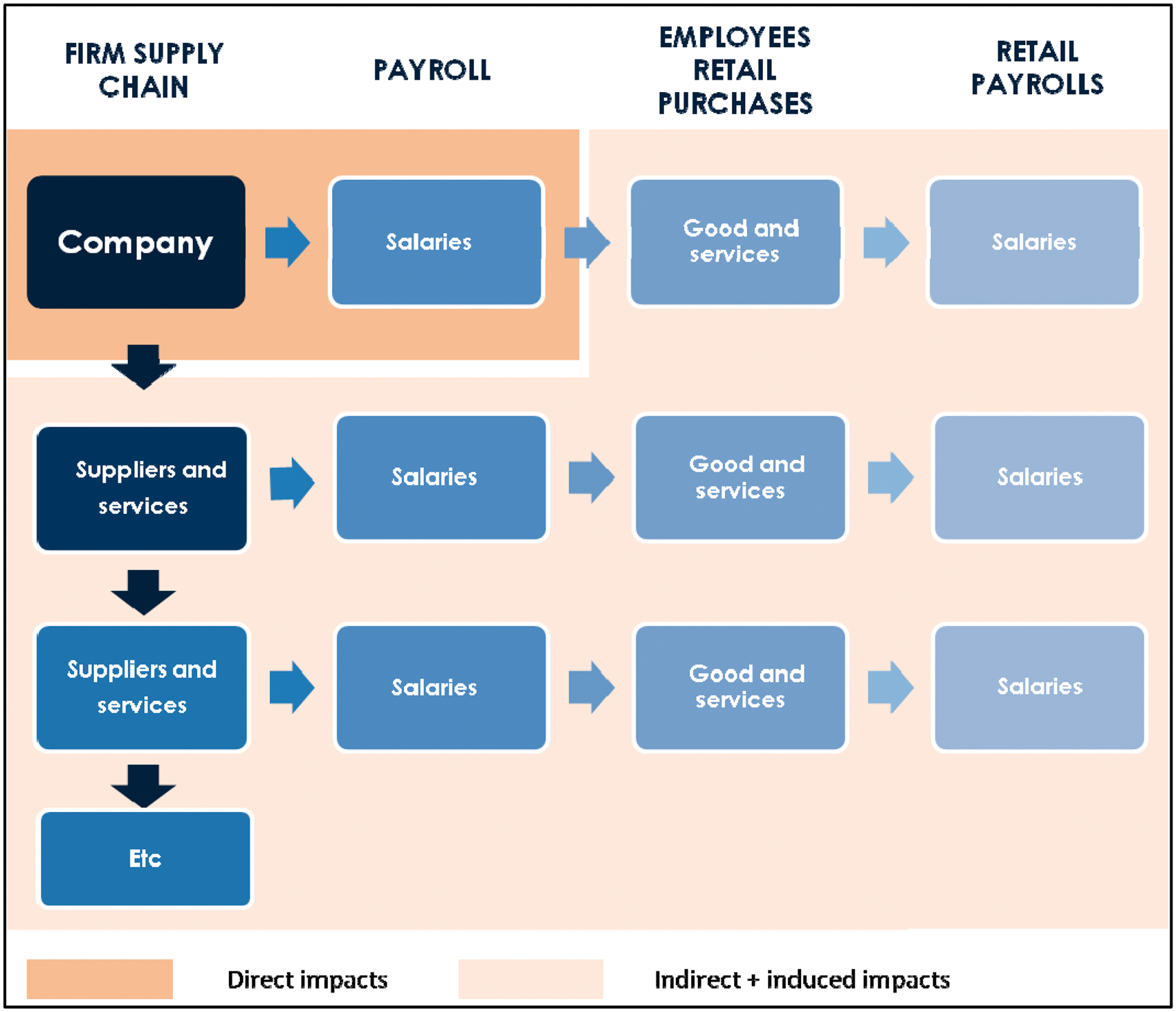
Methodology
This paper focuses on a multinational company that produces prosthetic heart valves in Italy and estimates its economic contribution to the Italian economy, differentiating between direct, indirect and multiplier effect. Estimates are computed for employment, payrolls, taxes and sales.
Direct impacts on regional economy
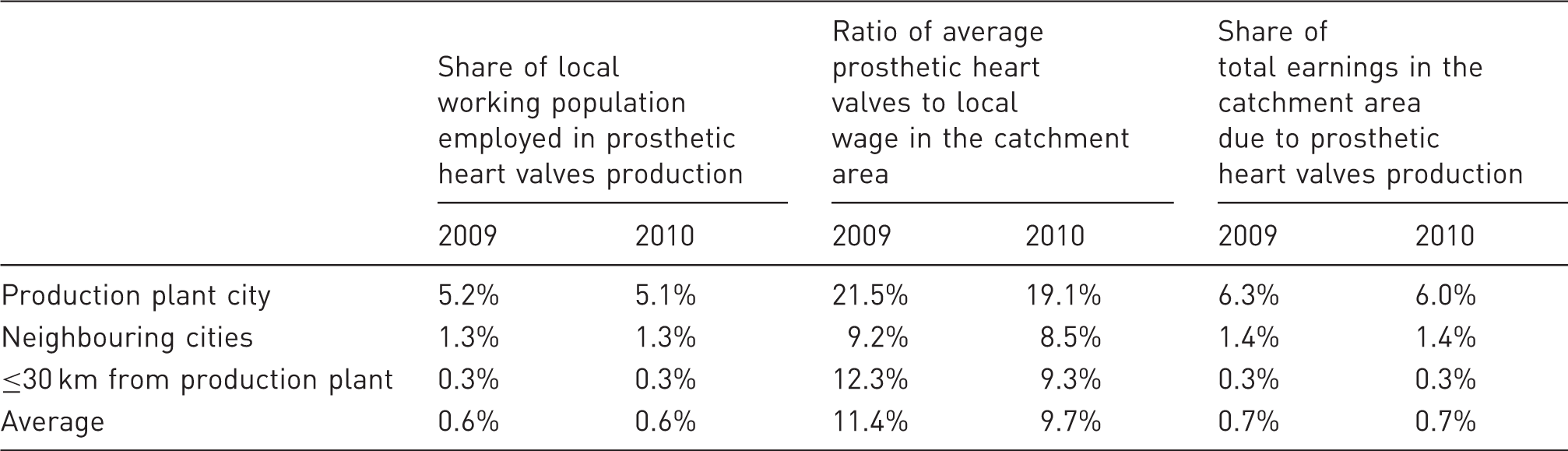
The first step to analyse the company’s impact on the local employment was to define a catchment area around the production plant. The catchment area included all the municipalities within a 30-km radius of the plant. This distance was chosen in order to include the municipalities where 75% of company’s workforce lives. Cities within the catchment area were further classified in production plant city, neighbouring cities and other cities less than 30 km away from the production plant. Distances have been calculated from website www.viamichelin.it that provides road and motorways and the distances to cities around the factory. In case of more than one route to the city, the shortest has been selected. Detailed information on the place of residence of the company’s employees was obtained by the company. For each place of residence, the following information was collected: resident population (source ISTAT website www.demo.istat.it), the number of persons with fiscal declaration of paid employment and the total Individual Income Tax (IRPEF: Imposta sui Redditi delle Persone Fisiche) (source website www.comuni-italiani.it, which publishes official data from the Italian Ministry of Economy and Finance) in 2009 and 2010. Thus, the company’s contribution to local employment was measured in terms of the:
– Share of local working population employed in prosthetic heart valves production, defined as the share of company’s employees to the total number of workers in the catchment area – Ratio of average prosthetic heart valves to local wage in the catchment area, defined as the share of employees’ average salary to average salary in the catchment area – Share of total earnings in the catchment area due to prosthetic heart valves production, defined as the share of employees’ wages to total IRPEF declared in the catchment area.
Information on taxes paid by the company includes Corporate Income Tax (IRES: Imposta sul Reddito delle Società) and Regional Business Tax (IRAP: Imposta Regionale sulle Attività Produttive) and was provided by the company. (In Italy corporate profits are subject to two taxes: IRES, a state tax levied on income earned, and IRAP, a regional tax levied on the value of production generated in each tax period by subjects engaged in business activities.) Since the establishment is a multinational company with plenty of legal entities located in different countries, the transfer pricing of prosthetic heart valves among the different legal entities might have an impact on taxes paid, thus influencing the results of the study.
How the company’s economic impact is multiplied
Indirect impacts are generated when the company purchases locally (i.e., in the region of the production plant) and in Italy the inputs for production and the suppliers in turn hire and pay staff (represented under Firm Supply Chain in Figure 1). The analysis considers the effect up to the first step down in the company’s supply chain, without considering the effect of employees’ consumption activities (i.e., induced effects represented by horizontal effects in Figure 1).
Classification of suppliers according to relation to prosthetic heart valves manufacturing process

The analysis estimated the share of company’s supplies in the total sales of its suppliers in the region of production and the rest of Italy. In order to capture a meaningful measure of impact, this is split between suppliers whose activities are connected to the production process of prosthetic heart valves and other suppliers, as the former are more likely to be those for whom the company’s activities are critical. Using information on employment and sales by those suppliers included in the ORBIS database, the company’s impact on suppliers’ sales and employment is computed as follows:
– Impact on sales =
– Impact on employment =
Suppliers’ workforce has been imputed by assuming that the proportion of company’s impact on sales is equal to the proportion of suppliers’ employment that is dependent on prosthetic heart valves-related purchasing orders.
In addition, the same logic is applied to imputing tax revenue generated indirectly through suppliers’ sales to the company. Thus,
– Impact on tax revenue =
In order to present the results in a comparable light to those of previous studies,6–10 the multiplier effect for sales and employment has been calculated. We computed the so called Type I multipliers, that capture only direct and indirect effects, ignoring the induced effects. The value of a Type I multiplier is calculated by dividing the sum of direct and indirect effects by the direct effects:

The sales multiplier is defined by the formula:
– Sales multiplier =
– Employment multiplier =
which represents the total sales associated with one euro of the company’s sales. Similarly

which represents the total number of jobs associated with each employee of the company.
As a sensitivity analysis, we used two alternative definitions of the sales and employment multiplier: one where all supply sales (and imputed employment) are accounted for and another where only production-related supplier sales (and their imputed employment) to the company are accounted for. These represent alternative scenarios of the effect of a marginal increase of prosthetic heart valves production on the Italian economy, an optimistic and a conservative case, respectively.
Results
Direct impacts on regional economy
Summary characteristics of the company’s workforce
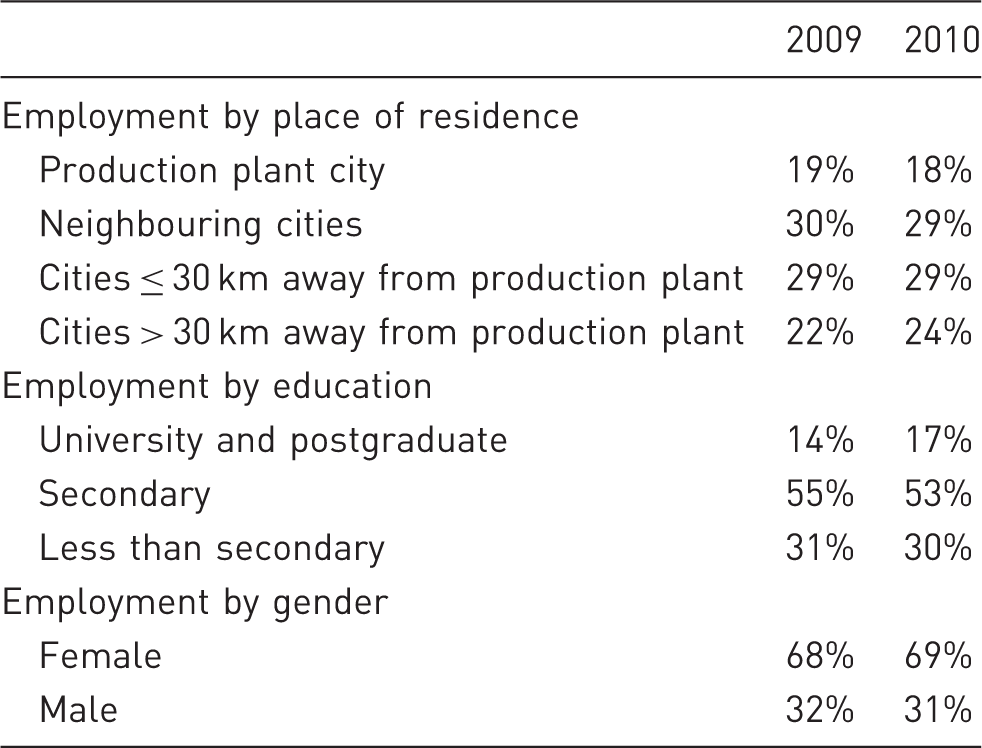
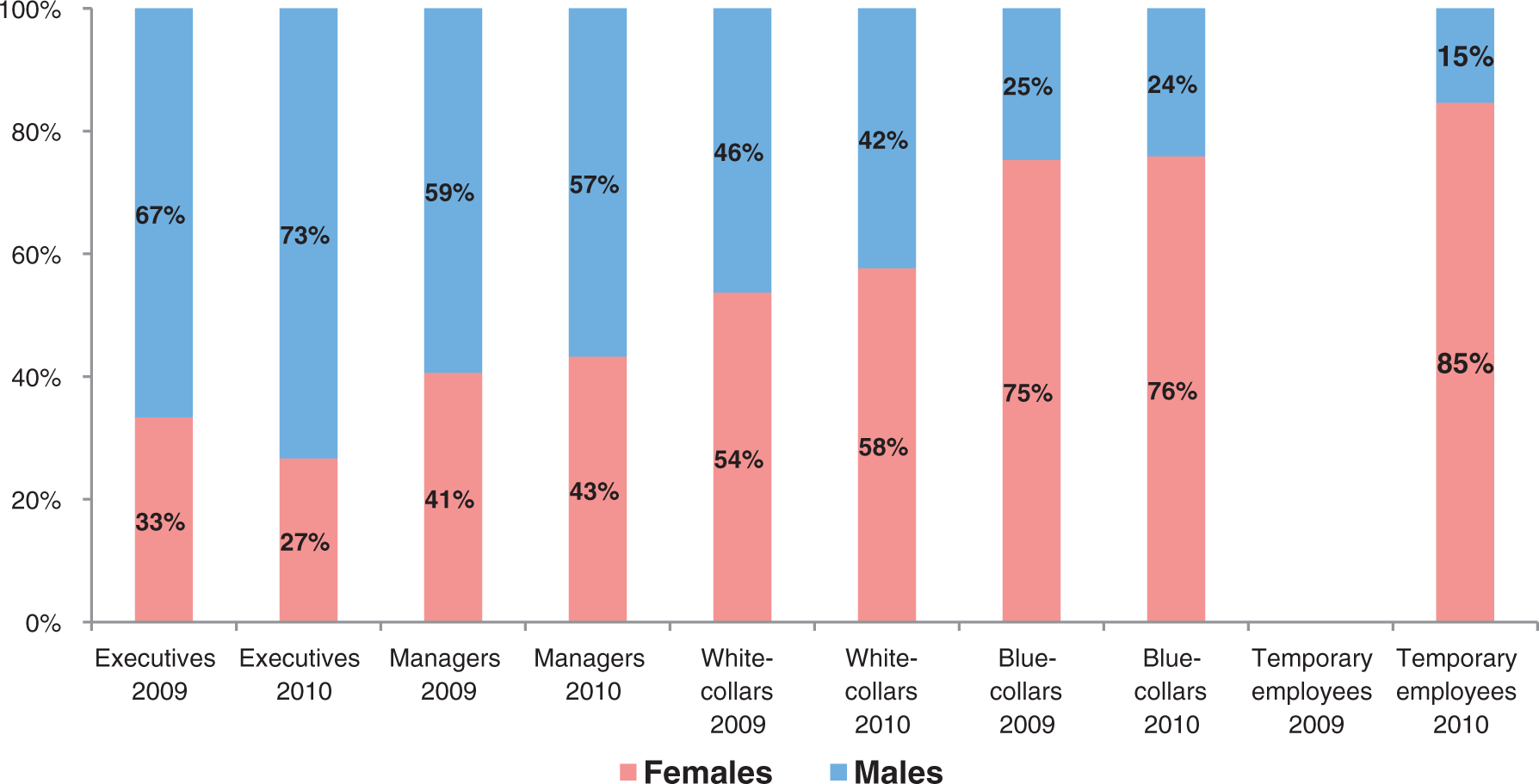
A closer look at the gender ratio of jobs in the company reveals that the bias may not be solely because of clustering of women around the lower paid jobs in the company. Although the bias is driven by the gender ratio among employees with secondary school education or less (73% female), among those with higher education the gender ratio is around a 50:50 split (46% and 51% female in 2009 and 2010; Figure 2). Gender ratios by position in the company, the most meaningful measure of gender bias, are still higher that the regional average manufacturing female share of 24% for 2009, with 33% and 27% of executive positions and 40% and 43% of managerial positions being held by women in 2009 and 2010 (Figure 3). In this regard, the results of an independent research study ranking 1076 Italian companies with at least 100 employees located in the company’s region by the extent of female representation in managerial jobs puts the company in the top three companies.
13
Employee gender ratios by level of education. Employee gender ratios by position.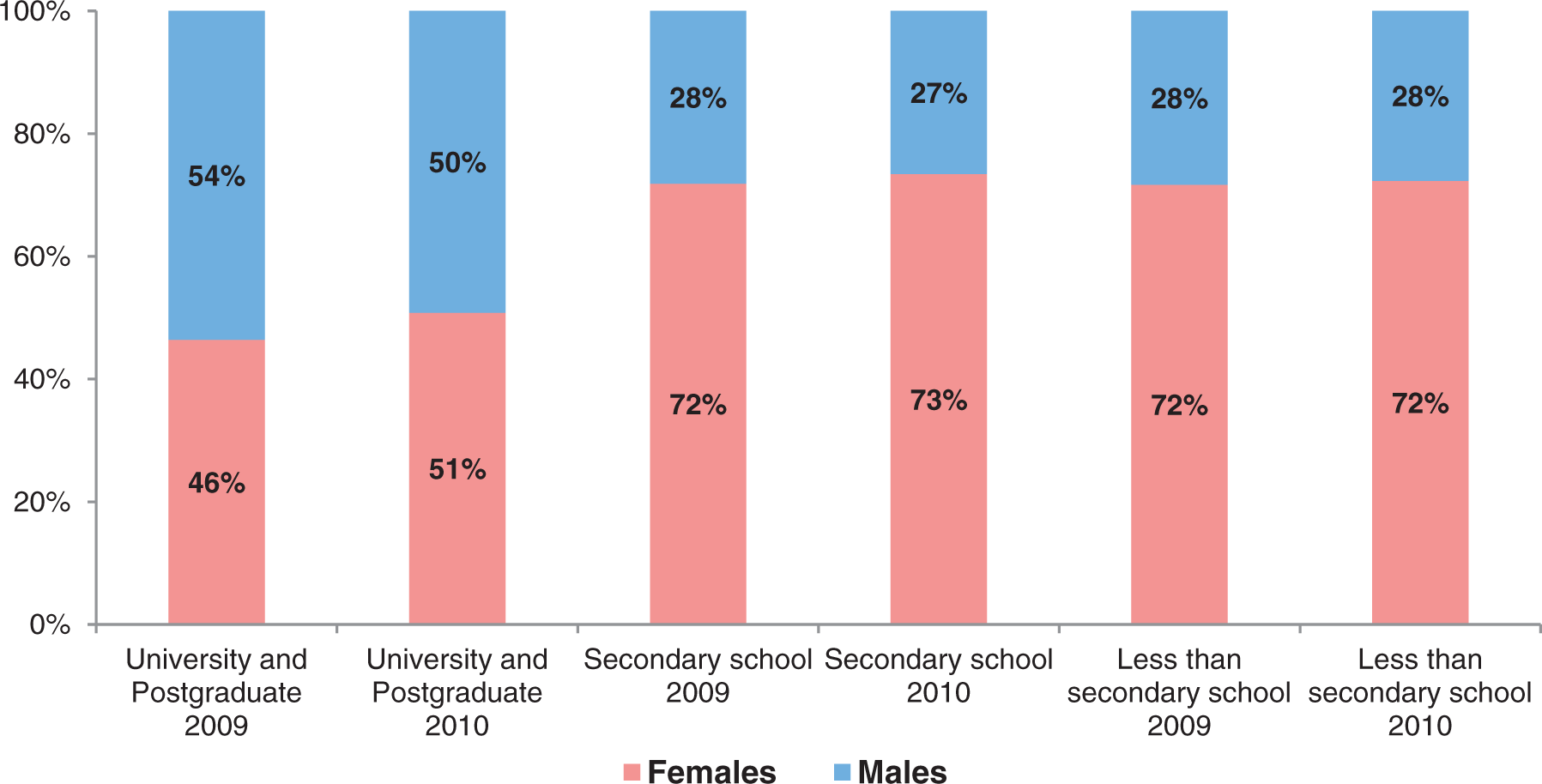
Company’s contribution through local employment
In addition, the amount of taxes paid both by the company and by its employees represents a contribution to the public sector of the economy. The amount of this, presented below, is particularly relevant since it may be thought of as an offset to the cost of providing public services, such as the Italian National Health Service, a consumer of prosthetic heart valves made in Italy.
Indirect and multiplier effect
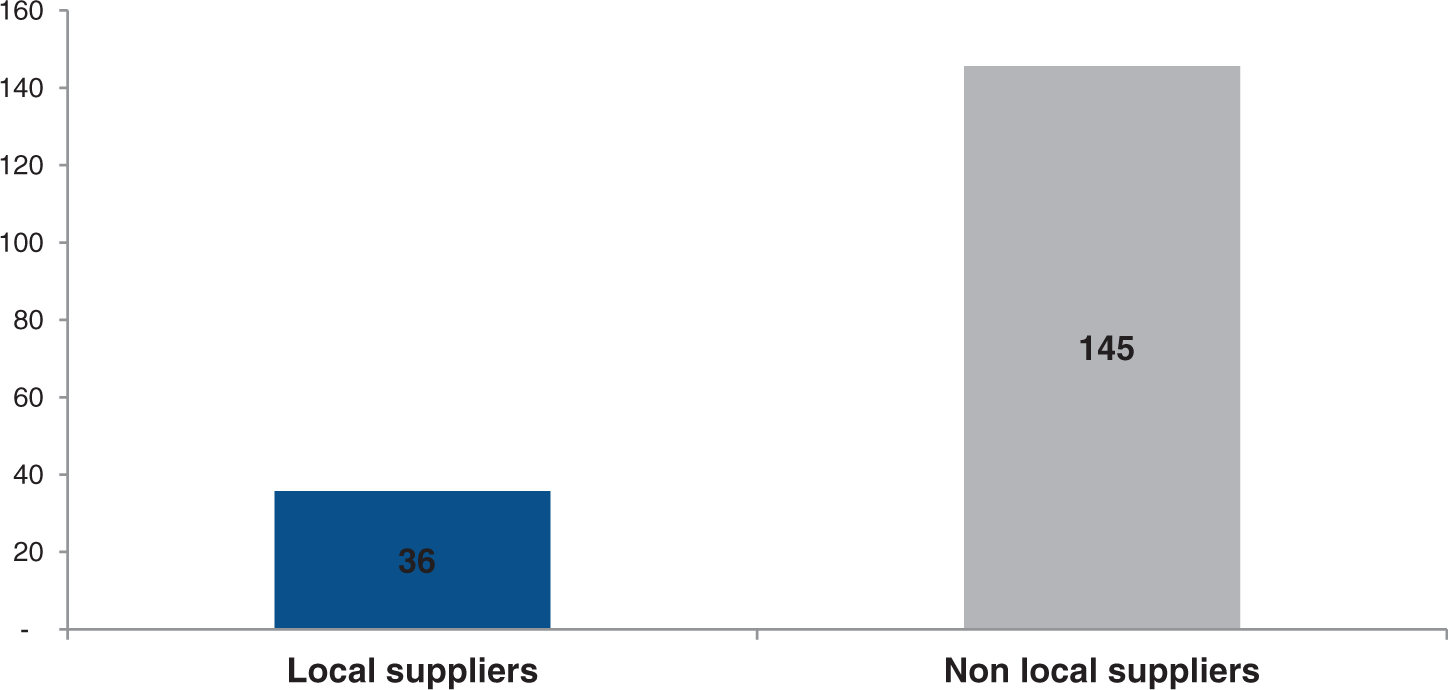
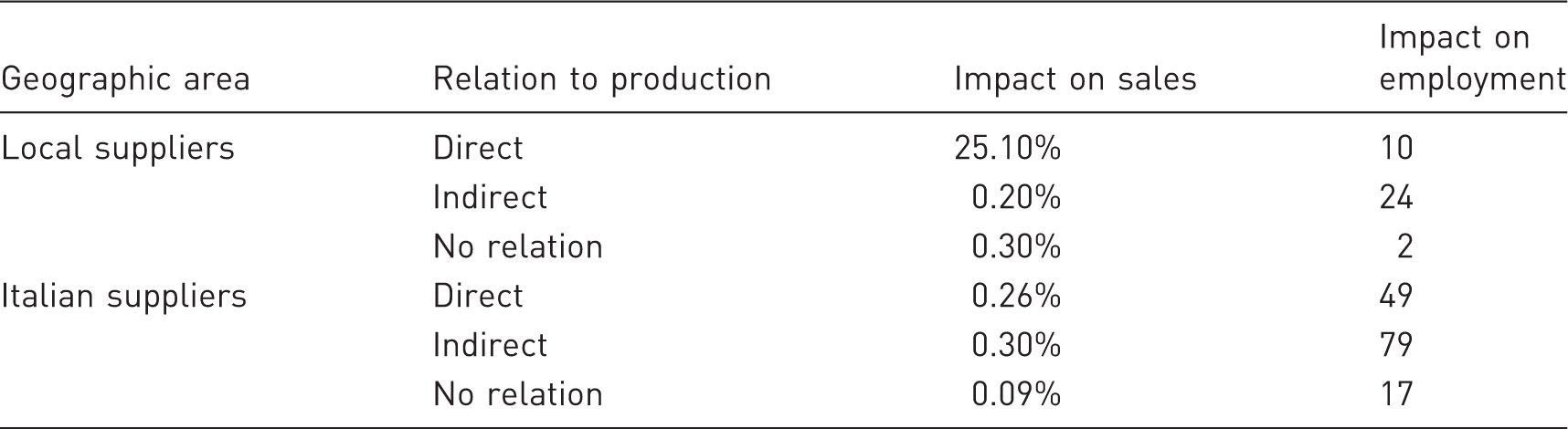
Italian suppliers’ sales to the manufacturing company accounted for 0.19% of their revenue in 2009. When applying those proportions to their total employment in those years, the imputed employment was 181.
Figure 4 presents the impact on company’s suppliers by distinguishing between local (i.e., Italian suppliers located in the production plant’s region) and non-local Italian-based suppliers in 2009. Overall supplies to the company represent 0.34% of total annual sales by local suppliers and half that share for non-local Italian suppliers. Assuming that the proportion of sales to the company in the suppliers’ total sales is equal to the contribution of the former to the latter’s total employment, one in every four jobs connected to prosthetic heart valves production activities is held locally (see Figure 5).
Impact on suppliers’ sales (2009). Impact on suppliers’ employment (2009).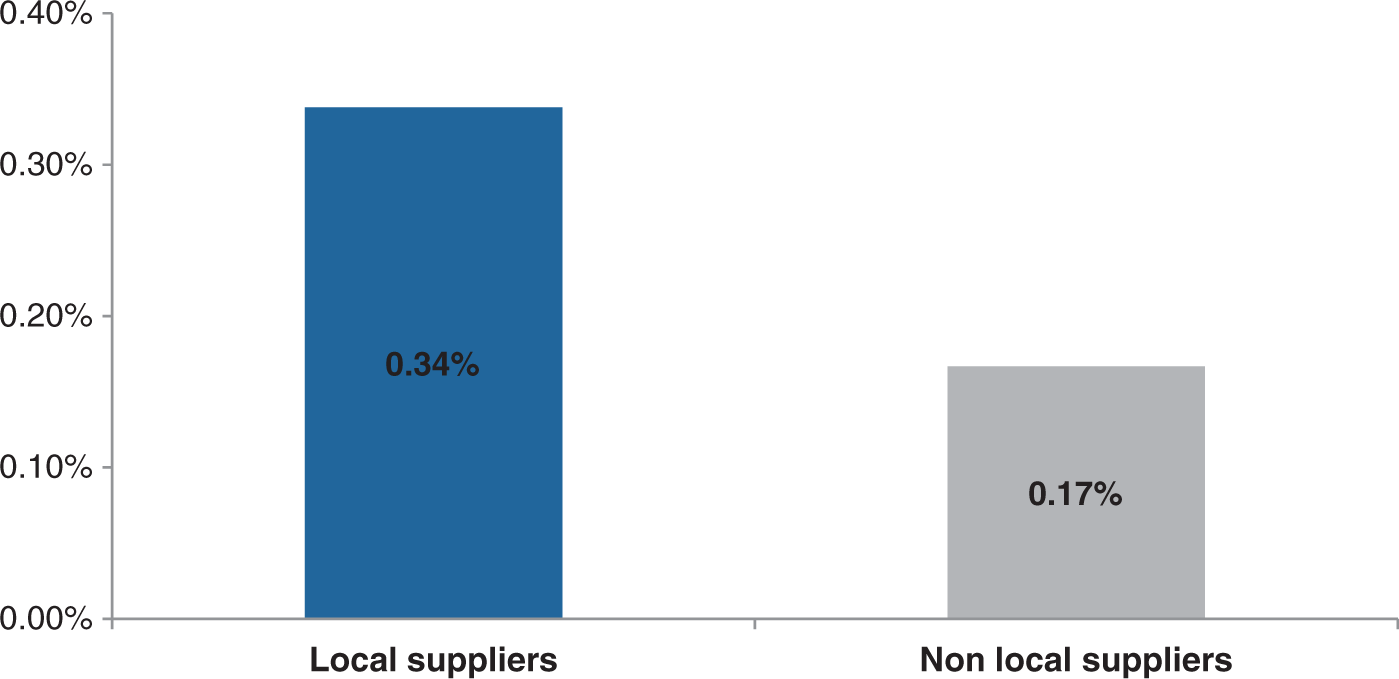
Impact on suppliers’ sales and employment by relation to heart valves manufacture
In the optimistic case, when all supply sales are assumed to expand or contract with the company’s prosthetic heart valves production, the sales multiplier in 2009 and 2010 was 1.26 and 1.30, respectively (Figure 6). This means that the company’s relationship with the local economy is such that each additional euro company’s sales has a multiplicative effect that supports suppliers’ sales in the measure of 30 eurocents. Alternatively, if only production-related supplies output is affected by heart valves production, the sales multiplier for 2010 is 1.07 (Figure 7). The sales multiplier estimated in this study is consistent with the results by the Milken Institute on US medical devices industry in 2009,
6
while it is lower than that of New England that was estimated to be equal to 1.43 in 2001.
10
Multiplier effect on Italian suppliers’ sales. Multiplier effect on Italian suppliers’ sales by relation to manufacture (2010).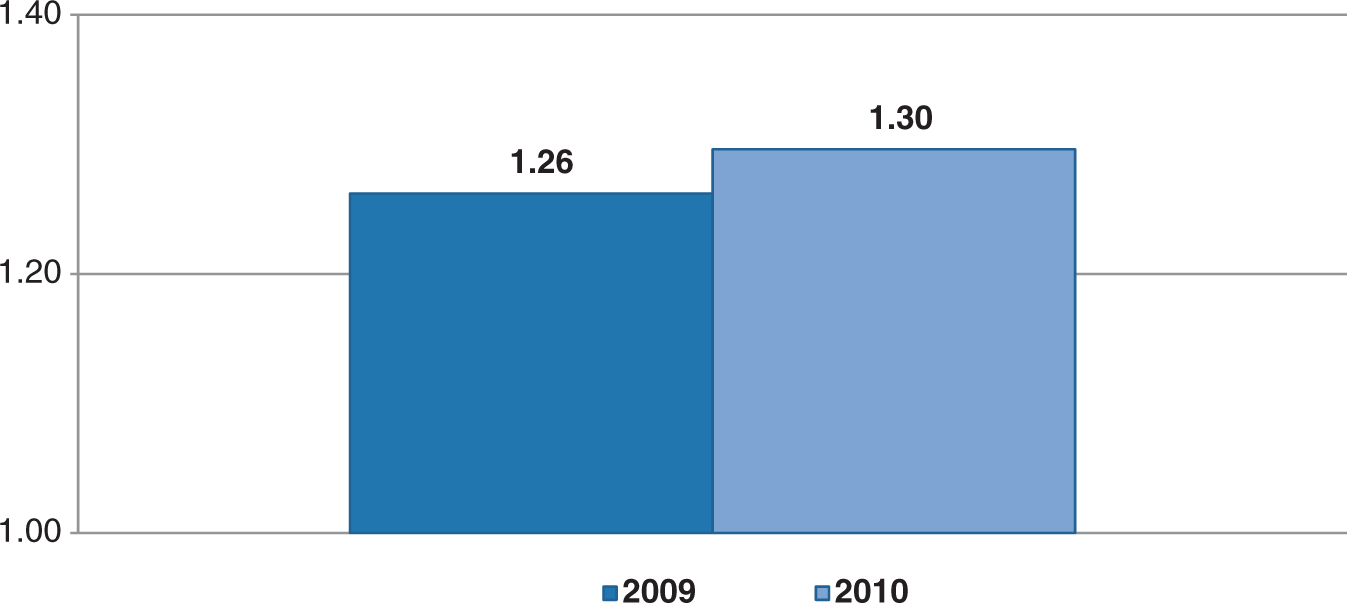

To calculate employment multiplier effects, we employed the data for 2009, the latest year for which we had information on suppliers’ workforce in ORBIS.
In the optimistic case, when all suppliers’ employees are assumed to expand or contract with the company’s prosthetic heart valves production, the employment multiplier in 2009 was 1.26. This means that for every four jobs created in the company, at least one person is employed to supply it. Alternatively, if only the production-related supplier’s workforce is affected by heart valves production, the employment multiplier for 2009 is 1.08 (Figure 8). These results are lower than those achieved by previous studies.
Multiplier effect on Italian suppliers’ sales by relation to manufacture (2010).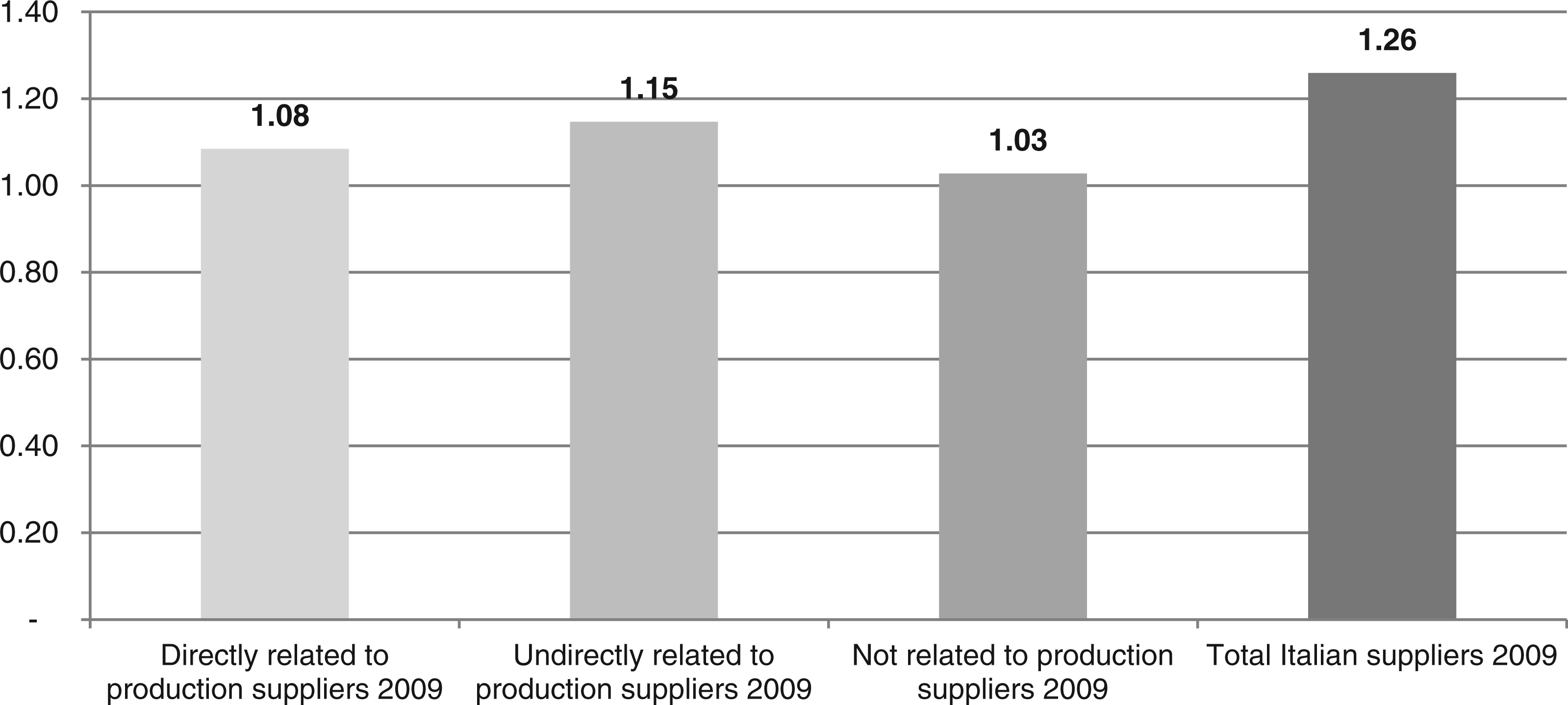
The indirect impact generated through purchases from suppliers is expected to generate tax revenue. If such revenue is generated in the same proportion as the share of the company prosthetic heart valves’ purchases in total suppliers’ sales, the amount in tax generated indirectly by the company in 2009 amounts to €219,000, evenly divided between local (€111,000) and non-local suppliers (€108,000). The main feature in the imputed generated tax revenue through local and non-local purchases by the company lies in the predominantly local source of revenue among suppliers indirectly related to production and the non-local origin of the bulk of revenue from suppliers unrelated to production (Figure 9).
Effect through suppliers’ taxes paid (€).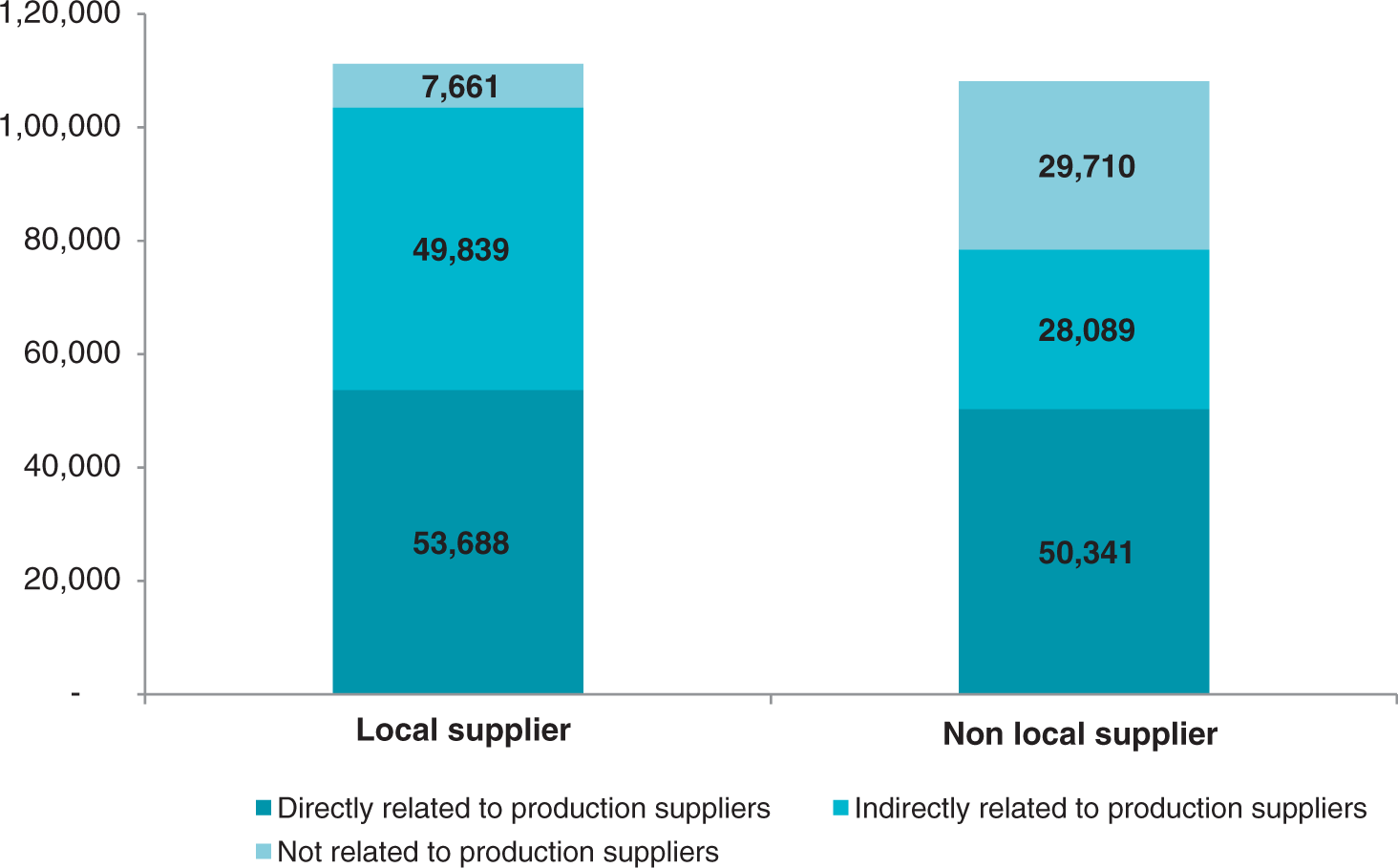
Turning to the company, the costs of labour accounted for 37% of company’s global sales in both years (see Figure 10), with half of that share constituted by disposable income (18% of sales), with other salary costs including personal (3%) and company’s (9–10%) contributions to pensions. Purchases from suppliers made up another third of total sales and a third remained for the company. Income taxes paid by employees were almost 6.5 times the amount of taxes paid by the company for each respective year, for a combined tax share in total sales of 9% in each year. Tax revenue generated by the company and its workforce represent a contribution to the Italian economy: for every euro of sales of prosthetic heart valve made in Italy, 9 eurocents are given back to the state by the company. It is worth underlining that the taxes paid by the company in the period were below what would be normal due to the company’s recent organisational changes so that multiplier is expected to be lower.
Distribution of total company revenue by category of expenditure.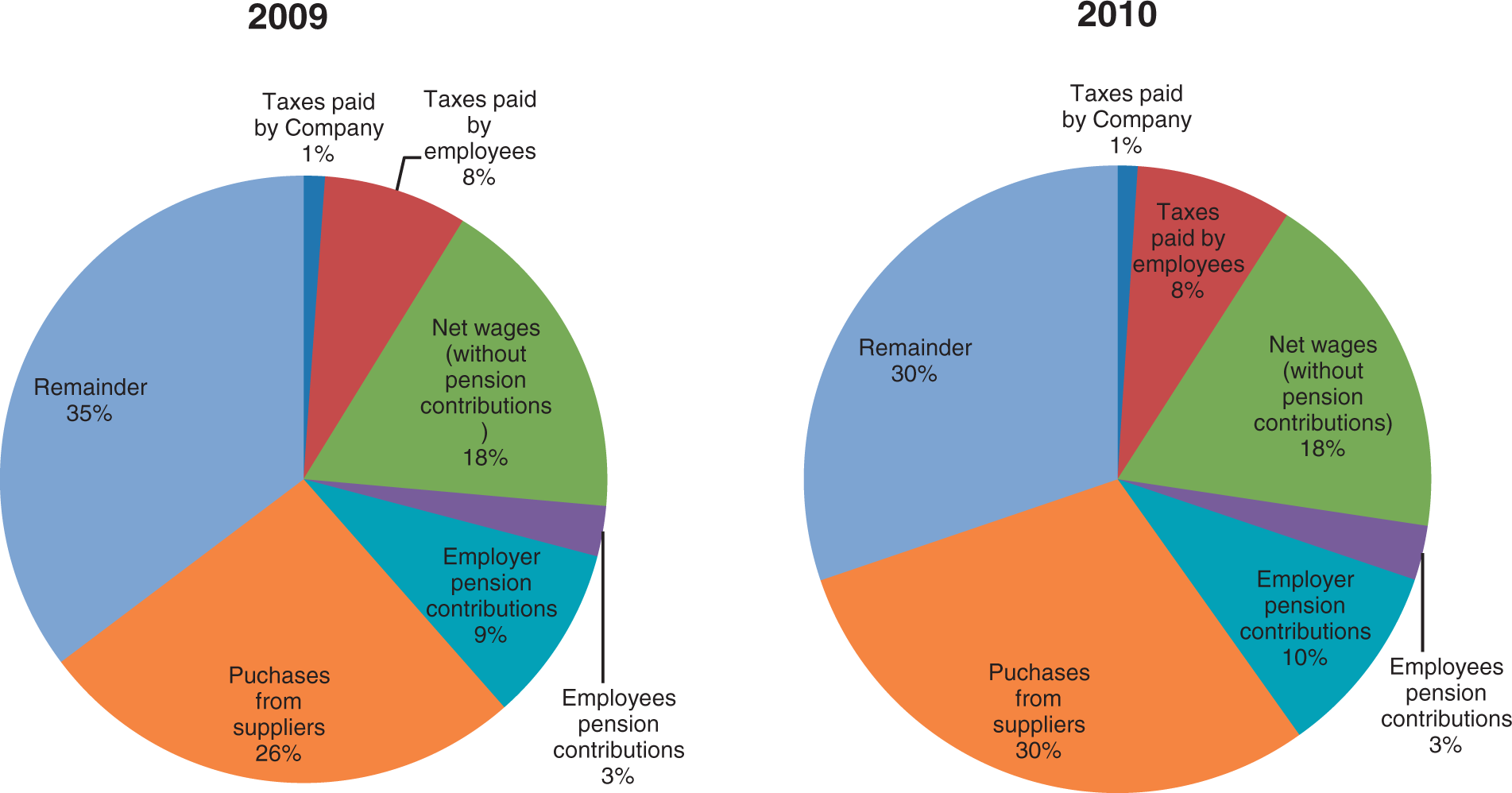
To calculate tax multiplier effects, including the effect on the company’s suppliers’ own, imputed tax payments, we employed the data for 2009, the latest year for which we had tax information on suppliers in ORBIS.
Taxes directly and indirectly generated by the company
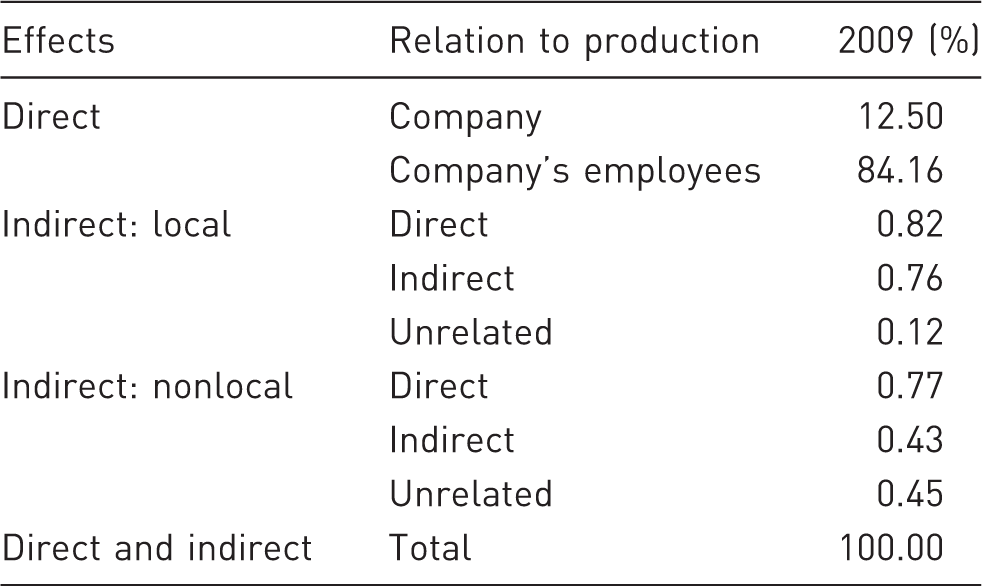
Discussion
This paper estimated the economic contribution to Italian economy of an Italian multinational producer of prosthetic heart valves. On the basis of the most recent available figures at the province level (ISTAT 2011), the value added by the company in 2009 and 2010 represents 0.82% of the GDP of the whole province where the production plant is located. The company accomplishes this by employing a workforce primarily drawn from the city where the plant is located and its surroundings, contributing an estimated 6% share of total earnings of the city’s workforce.
Further, it is estimated that for every €100 worth of sales of prosthetic heart valves produced in Italy, there is an additional €30 of additional sales generated in supplies to the company. This estimate is however an underestimate as it does not include any indirect economic activity generated by the company other than its purchase of supplies and the associated employment of labour inputs by its suppliers. Thus, any further rounds of indirect effects from transactions between intermediate producers and their suppliers ultimately servicing the production of supplies destined for the company are not accounted for, since tracing the whole supply chain is not feasible. Furthermore, induced employees’ consumption of goods has not been considered.
Moreover, it is estimated that for every 4 jobs created by prosthetic heart valves production in Italy, at least one job is created the first step down in the company’s supply chain. These results are lower than those achieved by previous studies. The difference may be partially explained by the different estimation methods: first, American studies compute the multipliers using input-output models that provide a statistical depiction of the inter-industry linkages and consider all industries in the economy, while the authors consider the multiplier effect due to only the first step down in the company’s supply chain; second, the present analysis accounts only for indirect impacts while previous studies consider also induced effects. Furthermore, the employment multiplier is based on information in ORBIS, which is missing for some suppliers. For all these reasons, the effect estimated in this study is underestimated by definition.
More than one third of the revenue generated by prosthetic heart valves production has gone to the remuneration of labour inputs (37% of total sales), half of which was disposable income (18%), and would therefore contribute to overall economy activity in the same period, while the rest would be income taxes (8%) and pension contributions by employees (3%) and employer (9–10%). Taxes paid by the company amounted to 1%.
In addition to the economic benefits generated by the company from the perspective of society in general, the study findings have implications for the company’s value from the perspective of the taxpayer. As a matter of fact, for biomedical products in a public healthcare system, the value added by local industry has an offsetting effect on the costs to taxpayers of such products through the additional taxes paid by staff employed in their production and the expansion of the fiscal base associated with the multiplier effect. Thus, the net cost to the public purse of medical devices produced domestically is less than their list or purchasing price and, in the existing competitive international market, lower than that of imported devices. In particular, it is estimated that taxes paid by the company and by its employees account, respectively, for 1% and 8% of company’s global sales. This means that, for every euro of sales of prosthetic heart valves made in Italy, the government gets back 9 eurocents.
Replication of the methods used for the current study to analyse the activities of other companies, especially in other manufacturing sectors, is warranted. The results of such study would provide a more complete picture of the scale of contribution of the company studied in this project relative to other companies and sectors.
A similar study has been recently undertaken by Ethan B Kapstein on the economic contribution of Coca-Cola to national economies. 14 The results showed that the company is a major contributor to local communities and highlighted the substantial economic effect generated by the taxes and the business in the value chain. In UK at the end of 2011, Coca-Cola employed over 4600 people and paid salaries, benefits and taxes. The large majority (95%) of the company’s suppliers are based in Great Britain, thus emphasising the importance of local suppliers to the company’s business as well as its role in supporting and sustaining jobs across the supply chain. The research showed that for every job created by the company, a further six are directly generated in the supply chain. The same study showed that in Italy the added value by Coca-Cola to the national economy is equivalent to 0.21% of GDP in 2010. This study came in the midst of a national debate initiated by the Italian Ministry of Health who recently proposed to over-tax carbonated beverages to contrast the escalation of over-weight and obesity in the country.
A further development of these studies would be needed – possibly covering different manufacturing sectors – especially for the medical technology (drugs and devices) industries manufacturing products that, besides contributing to national economies, improve populations’ health status and quality of life. A broader perspective by policy makers when assessment of medical technologies is at stake should consider the whole range of benefits brought about by medical technologies: health outcomes (i.e. life years saved, QALYs) and the economic return on other public sectors (e.g. pension system) as well as on the whole economy. In times of economic crisis and stagnation when investments in R&D are threatened by cost containment measures, silos mentality and budgeting are something we cannot afford any longer.
Footnotes
Funding
This work was supported by an unrestricted grant by Sorin Group.
Conflict of interest
The authors declare that there are no conflicts of interest.