




Abstract
Although healthcare professionals have done much to take advantage of social media for healthcare purposes, few empirical studies have investigated such practices. It is not known whether hospitals are using social media mainly as a marketing tool or as a way to friend, listen to, and interact with their visitors. Through a content analysis of 23,300 posts/tweets on 172 US hospitals’ Facebook and Twitter pages in a systematic probability sample, this study found that the flow of information on hospital Facebook pages, and especially Twitter pages, is dominantly one-way; nevertheless, hospitals, especially larger hospitals, have made great effort to interact with their Facebook visitors while marketing themselves, though such interaction is minimal. The study also found that it is very important for hospitals to encourage a large visitor base on Facebook because the more visitors a hospital attracts to its Facebook page, the more ‘Likes’ and posts the hospital will attract, the more people will comment on the hospital posts, and the more the hospital will get recommended. The comparison between the traffic on Facebook and on Twitter demonstrates that using social media as a two-way communication channel seems to be much more effective for hospitals to connect to their visitors than using them as a one-way marketing tool.
Introduction
Although healthcare professionals have done much to use social media for healthcare purposes, few empirical studies can be found that investigate how social media have been used in the healthcare context, as several authors have acknowledged.1–3 To what extent have US hospitals used social media to connect to patients? a Are hospitals using social media mainly as a marketing tool or as a way to friend, listen to, and interact with their visitors? Answers to these questions are not readily available. This study aims to provide such answers.
Using social media has become a formidable trend since the late 2000s. For instance, as of April 2012, Facebook had 900 million active users. 4 As of March 2012, Twitter was estimated to have 100 million active users. 5 Researchers estimate that by 2015, more than three billion people will own social media accounts. 6
In the healthcare context, however, for both users and healthcare providers, social media are still relatively underused though users have a high expectation for such new tools to be used in healthcare. On the users’ end, 16% of Americans have used social sites as sources of healthcare information, according to National Research Corp., a healthcare research company based in Lincoln, Neb. 7 YouGov found that one in four consumers expected to connect with a hospital via social media at some point; 57% of consumers said that a hospital’s use of social media would likely have a strong impact on whether they chose to use that hospital’s services; 81% of consumers felt that a strong social media presence indicates that a hospital’s clinical functions are more cutting-edge. 8
By December 2012, out of 5754 US hospitals, 9 1229 (21%) had at least one social media account, and 12% of all US hospitals had both Facebook and Twitter accounts. 10 Thielst reported that 87% of respondents in a 2011 Health Leaders Media Council survey said they viewed consumer use of social media as very positive or positive for their healthcare organization; nevertheless, 18% admitted that their efforts had no social media component, and 43% committed less than 10% of their marketing efforts to social media elements; unfortunately, only 28% planned to use social media and networking sites for online communication and interaction with e-patients. In short, there is much room for development in healthcare social media. 11 Arthur Slutsky, vice president of research at St Michael’s Hospital, said, ‘We don’t know how social media like Twitter, Facebook, and YouTube will end up impacting health, but if we want to reach the current generation, we have to get into the game’ (p.1680). 12
Among the healthcare IT/marketing professionals, there are roughly two camps of opinions regarding how healthcare systems should take advantage of social media. Quite several authors believed that healthcare providers are essentially using social media to disseminate information to consumers as a means of marketing, advertising, and fundraising; through social media, healthcare companies promote their products and services, communicate their mission and vision, describe the services they offer, provide health education, and encourage philanthropy.13–15 In short, for many hospitals, these authors believed, the use of social media is dominantly one-way. In an editorial in the Hospice Management Advisor magazine, the editor mentioned five types of postings on the magazine’s social media sites, including promoting fundraising, workshops, etc.; nowhere, however, did the article mention any posting that attempted to interact with users. 16 Dolan reported on two similar studies by two different groups of authors from 2010 and from 2011. 17 He noticed that more doctors began to use social media either professionally or personally. However, ‘one thing that hasn’t changed during those 18 months is the lack of patient–physician communication on social media’. 17 The most active use by far is physician-to-physician interaction, which usually takes place in closed physician communities, said Nancy Fabozzi, healthcare market research and competitive intelligence specialist with Frost & Sullivan. 17 Many healthcare professionals are afraid of getting into legal or ethical quagmires when interacting with patients.18–20 Twaddell said, ‘In my opinion, healthcare providers should not use SM [social media] tools to communicate with patients. Tools such as Facebook, Twitter, and MySpace are intended for peer interaction, not for professional relationships… I don’t believe that SM interactions with our patients is in anyone’s best interest’ (p.7). 21
On the other hand, viewing social media as only another output channel perpetuates the top-down communication approach and ignores the communication that occurs between individuals, independent of the organization, as Thackeray and Neiger have said. 22 Thackeray et al. called on practitioners to ‘realize social media’s untapped potential by incorporating it as part of the larger social marketing strategy’ (p.165). 23 National Health Information, LLC, refers to social media opportunities as ‘Health 2.0’ and sees social media as empowering, engaging, and educating both healthcare consumers and providers. 24 Family physician Ted Eytan based in Washington, DC, said that Web 2.0 ‘is all about listening’. 25 Boyer concurs: ‘It’s dangerous—and inaccurate—to view social media as another way to broadcast one-way messages to the community. Marketers who see social media as a way to talk at, not with, their followers are not fully engaging them… The last thing patients want when following a hospital on social media is marketing’ (p.36). 26 Boyer believes that a hospital’s social media pages should be patient-centered. ‘Social media tools should not be used to simply broadcast messages about quality awards, surgical robots, and great doctors. Instead, focus on building honest and authentic conversations’ (p.38). 26 From a practitioner’s perspective, Verkamp wrote: ‘In my experience, consumers are no longer trusting of advertising and don’t want to be marketed to. Today, only 14 percent of people trust advertising compared with 78 percent who trust recommendations and referrals. We want to be engaged, build relationships, make companies earn our trust and hear our friends’ and families’ reviews’ (p.47). 27 In a similar vein, Garven wrote, ‘Social media is a dialogue, not a one-way ad campaign that screams ACT NOW!’. 28 Long was more specific by saying that no more than 20% of posts should be selling or marketing. 29 Many other authors share such views.30–32
These two camps of opinions constitute a test to the social exchange theory, proposed by Homans. 33 In a nutshell, the theory posits, from the social psychological and sociological perspective, that different forces in a society are involved in negotiated exchanges to come up with social change and social stability. The two parties compare between or among the alternatives the costs, such as time, money, and effort, against rewards, such as fun, friendship, social support, and companionship. The goal is to minimize costs and maximize rewards. The theory argues that people calculate the overall worth of a particular relationship by subtracting its costs from the rewards it provides. 34 The guiding force of interpersonal relationships is the advancement of both parties’ self-interest, Roloff said. 35 As a result, the worth of a relationship influences the outcome of a relationship and the wishes of the people in a relationship to continue or terminate the relationship. A positive relationship is derived when rewards outweigh costs; a negative relationship happens when the costs are greater than the benefits.
Different philosophies would naturally bring out hospitals’ different social exchanges when using social media in relation to their users. So far, no empirical research has been found on how hospitals have used social media to connect to their patients. Conducting some research and providing answers to previously mentioned questions could help inform healthcare providers about what has been achieved and what is lacking. This study will provide meaningful guidance to the healthcare industry in terms of further development of social media for healthcare.
Literature review
The definition of social media is still in a state of flux. A common understanding is that social media constitute user-generated communication over the Internet and imply active interactivity among participants. 36 Eckler et al. believe that social media involve two primary actions: socialization and sharing. 37 Gartner’s Anthony Bradley defined social media as an online environment established for the purpose of mass collaboration. 38 When asked to describe ‘social health’, EmpowHER President and COO Thom Brodeur said: ‘At EmpowHER, we describe Social Health as a 21st century movement where health care practitioners and providers, health and wellness brands, and consumers are coming together using social media tools and social networking platforms to improve health, change, and save lives. We define Social Health as health and wellness by the people, for the people.’ 38 Chou et al. 39 categorized social media into three categories: social networking, blogging, and online support groups. They found that social networking received the most utilization (23% of Internet users) followed by blogging (7%) and online support groups (5%). 39
In healthcare journals today, there are many expert opinions regarding social media, but there are extremely few empirical studies that support opinions with data. The following three cited studies are somewhat related to this study.
Chou et al. attempted to identify the characteristics of social media users by examining the data from the 2007 iteration of the Health Information National Trends Study (HINTS, N = 7674). 39 HINTS was a nationally representative cross-sectional survey on health-related communication trends and practices. The study found that social media were penetrating the US population independent of education, race/ethnicity, or healthcare access; however, the absolute proportion of the social media population was still low (5% participated in an online support group, 7% reported blogging, and 23% used a social networking site). It was found that younger people tended to use social media more frequently. The current study focused only on social networking sites simply because such sites have attracted the most participants, as found in the Chou et al.’s 2009 study. 39
Jent et al. 40 examined the prevalence with which healthcare providers used social media, especially in clinical practice, and their decision-making process after accessing patient information from social media. The authors surveyed pediatric faculty and trainees from a medical school who were provided a social media Web site history form and seven fictional social media site adolescent profile vignettes that depicted concerning information. Participants rated their personal use and beliefs about social media sites and reported how they would respond if they had obtained concerning information about an adolescent patient from his or her public social media Web site profile. The study found that healthcare providers generally believed it not to be an invasion of privacy to conduct an Internet/social media site search of someone they know; however, no faculty endorsed a history of conducting searches for patients. Faculty and trainees also differed in how they would respond to adolescent profile information on social media sites – a fact that suggests, according to the authors, that specific guidelines regarding the role of social media in clinical practice are necessary.
From the users’ perspective, Stroever et al. 41 conducted a study to determine the value of using social media to communicate child health information to low-income parents, predominantly Hispanic parents. The authors recruited participants through homogeneous, purposeful sampling by using standard recruitment guidelines and conducted four focus groups for participants to talk about their willingness to use social media as a health information resource. The qualitative data show that lack of time and credibility were the primary objections parents cited in using social media to obtain information about their children’s health. Participants preferred to obtain health information face-to-face from someone they trusted.
While these studies have provided insights into the usage of social media in the healthcare context, none of the research methods used in these studies can apply to the current study, which focused on social media usage on the organizational level (hospitals) instead of on the personal level (physicians). In addition, the research foci of the above studies are drastically different. The research approach of the current study is different as well. This study will contribute to the current healthcare social media literature by investigating US hospitals’ social media usage to find a national pattern.
Methodology
This study aimed to answer two research questions:
To what extent US hospitals have used social media to connect to patients? Are hospitals using social media mainly as a marketing tool or as a way to friend, listen to, and interact with their visitors?
Through content analysis, the study intended to find out whether hospitals and their social media users were engaged in meaningful conversations and whether the two parties had aligned interests. To answer these questions, the two most popular social media sites, Facebook.com and Twitter.com, were selected.
On Facebook, the following facets of information were examined:
the number of users who are following a hospital’s Facebook page, the visitors’ levels of engagement in interacting with their hospitals on Facebook, and the alignment between the foci of visitors’ posts and hospitals’ posts.
What is missing on Facebook is the visitors’ information. On Twitter, however, based on the face value of user icons, their names, and profile descriptions, the authors could determine whether the visitors were organizations or individuals. Finding such a fact can help us understand whether hospitals’ inclinations on Twitter were to market themselves or to take care of those individuals who need healthcare assistance. Therefore, the following facets of information from hospitals’ Twitter pages were examined:
Who are the dominant followers of hospital Twitter pages, organizations or individuals? Whom are hospitals following, organizations or individuals? Are the foci of visitors’ posts and hospitals’ posts aligned?
Such examinations on both social media sites can help answer the two research questions.
To determine the conversation content both on Facebook and on Twitter, the authors conducted multiple pilot studies to finalize the categories both for Facebook posts and for Twitter tweets.
As of December 2012, there were 5,754 hospitals in the United States, and 700 of them had both a Facebook presence and a Twitter presence. This study focused only on these hospitals with double social media presence. b Roughly, one-fourth of these 700 hospitals were sampled. In total, 172 hospitals’ Facebook and Twitter sites were examined. Since the volume of posts was huge, the authors examined 25 most recent posts from each hospital and the same number of posts from their visitors along with each side’s comments and replies in the 172 hospitals on Facebook. The most recent 50 tweets on Twitter for each hospital were also examined. In total, 23,300 posts on Facebook and tweets on Twitter were coded.
Two coders went through a training session and coded together 40 Facebook pages and Twitter pages not in the sample until the intercoder reliability represented by Scott’s Pi values between the two coders on major measures reached 0.8 or above on average. Then one coder coded all the pages.
Since many of the data collected both from Facebook and from Twitter contained high variances and were highly skewed, medians, instead of means, were used to show typical situations in most of the descriptive statistics. To make it easy to show a pattern of correlation between the hospital size and some of the dependent variables, the data were made ordinal for those independent and dependent variables. As a result, Kendall’s tau-b was used to seek correlation since both independent and dependent variables were ordinal.
Findings
As of December 2012, US hospital Facebook pages brought a median of 1,531 visitors and 1,371 likes. In comparison, the median number of visitors to US hospital Twitter pages was 949, and median number of ‘retweets’ and ‘favorites’, which are equivalent to likes on Facebook, was only five. Hospitals had significantly more followers on Facebook than on Twitter (t = 5.05, df = 126, p < 0.001), and visitors felt more emotionally close to their hospitals on Facebook than on Twitter (t = 4.8, df = 169, p < 0.001).
On Facebook, the authors coded the most recent 25 fresh posts by the fans plus their comments on hospital posts. The fans’ median number of posts was 34; the median number of posts by hospitals was 30. The difference was insignificant. On Twitter, hospitals sent out a median number of 25 tweets, but followers sent a median of only one tweet; a paired-samples t-test shows that the difference was salient (t = 48, df = 171, p < 0.001). Facebook visitors posted significantly more than Twitter visitors tweeted (t = 9.5, df = 168, p < 0.001).
To put these numbers in context, here is the big picture. On Facebook, visitors’ engagement can be logically scaled into the following categories: (1) Visited hospital Facebook page, (2) Liked hospital Facebook page, (3) Liked or shared specific hospital posts, (4) Posted messages and (5) Recommended the hospital Facebook page. Visiting a Facebook page is the lowest level of engagement, as anyone can randomly visit a page. Visitors may or may not ‘like’ the page. Some of these visitors may stay to read the hospitals posts and decide to like some of the posts. Then some of the visitors may care to post messages on the page. Finally, after interacting with the hospital via its Facebook page, some visitors may walk an extra mile to recommend the hospital. All such visitor activities leave an observable trace on a hospital’s Facebook page with collectable data. The gradation of the scale can clearly tell the visitors’ level of engagement on a hospital’s Facebook page. When the medians of these five levels of engagement are compared (Figure 1), it is immediately clear that the overwhelming number of visitors did nothing more than visiting (1531) and liking (1371) a hospital Facebook page, and extremely few visitors cared to like specific hospital posts (137), post messages on the page (34) or recommend the page (4). However, when each left category is correlated with each of the right categories,
c
all correlations are significant (p < 0.001). In other words, in this scale, the higher values on the left levels tended to bring significantly higher values on the right levels (all these t-tests were at the p < 0.001 level). For example, if a hospital’s Facebook page has many likes, this page tends to attract more likes for hospital posts, more visitor posts, and more visitor recommendations.
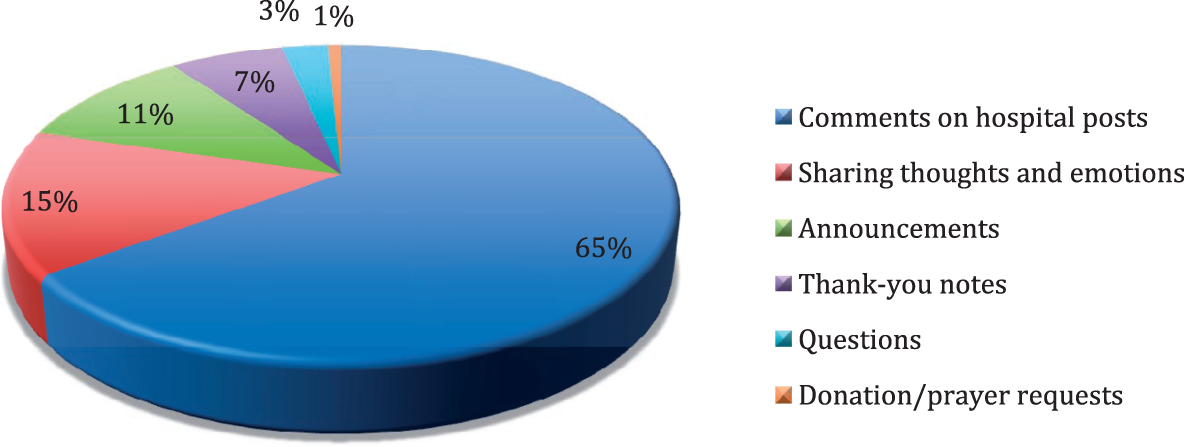
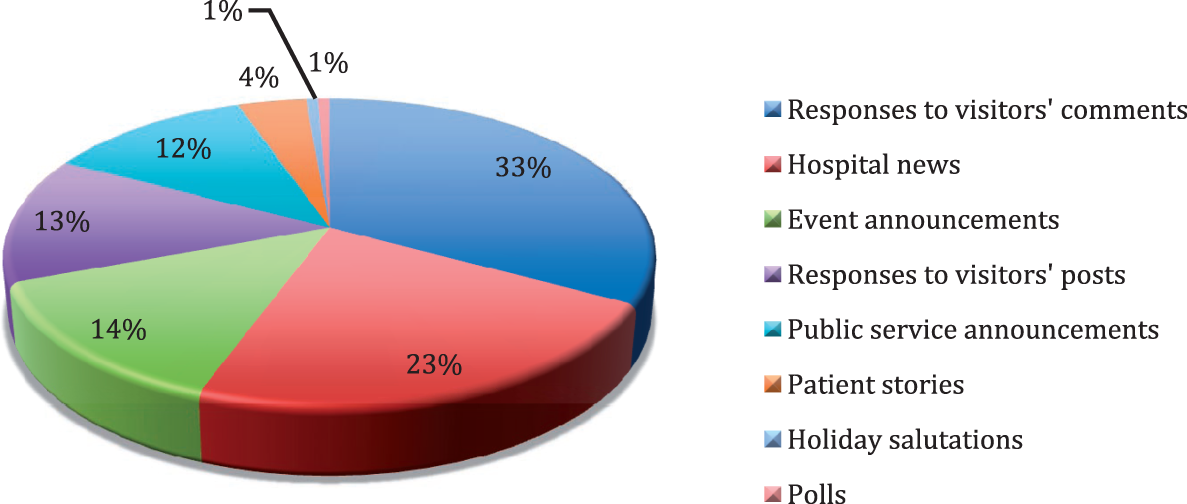
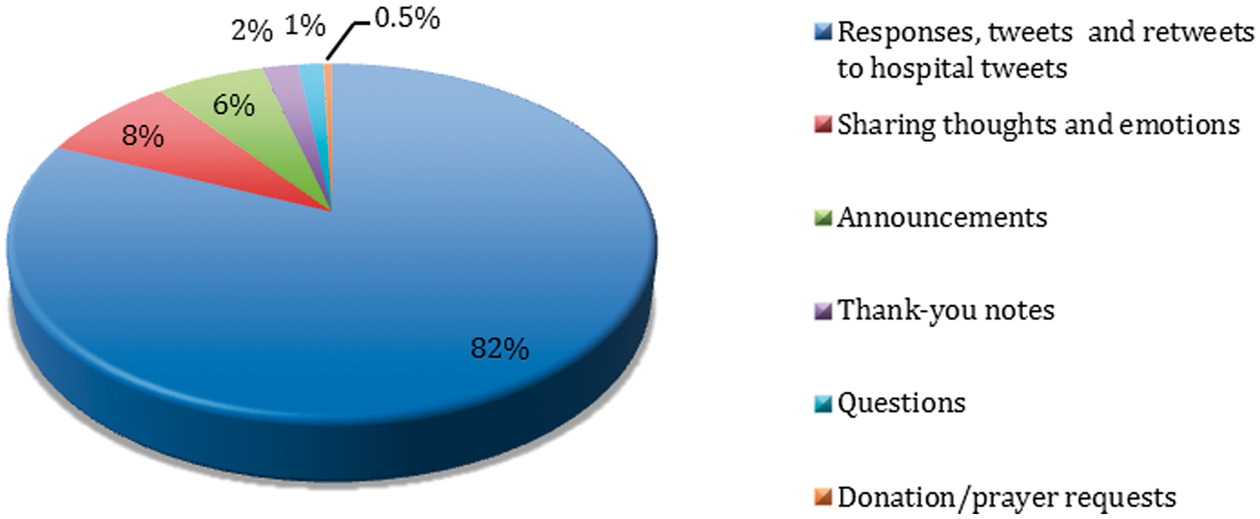
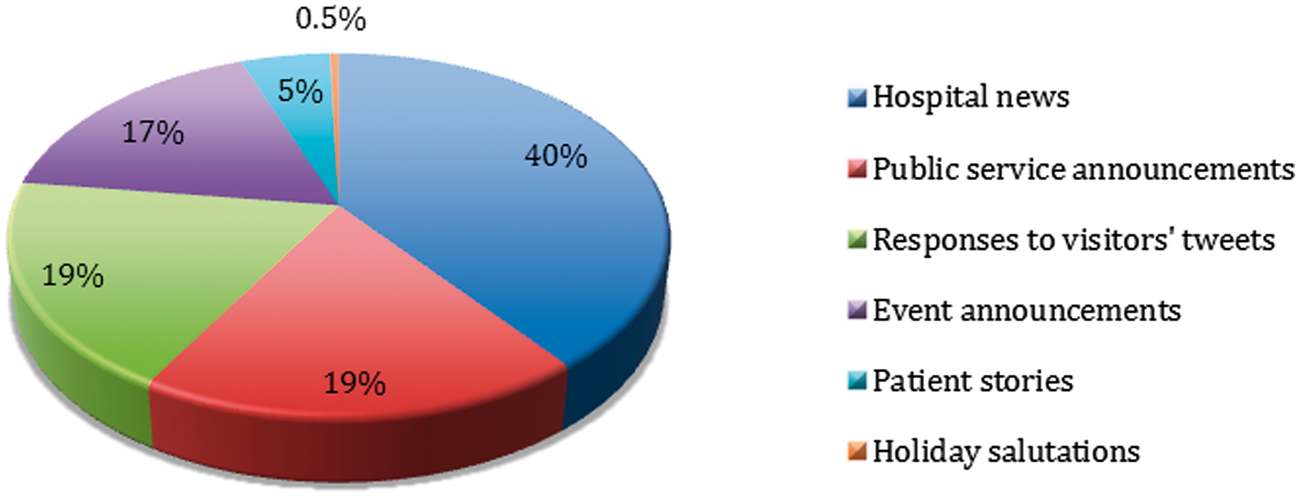
Visitors’ levels of engagement on US hospitals’ Facebook pages. Visitors’ input on US hospitals’ Facebook pages. US hospitals’ interaction with their Facebook visitors. Visitors’ input on US hospitals’ Twitter pages. US hospitals' interaction with their Twitter visitors.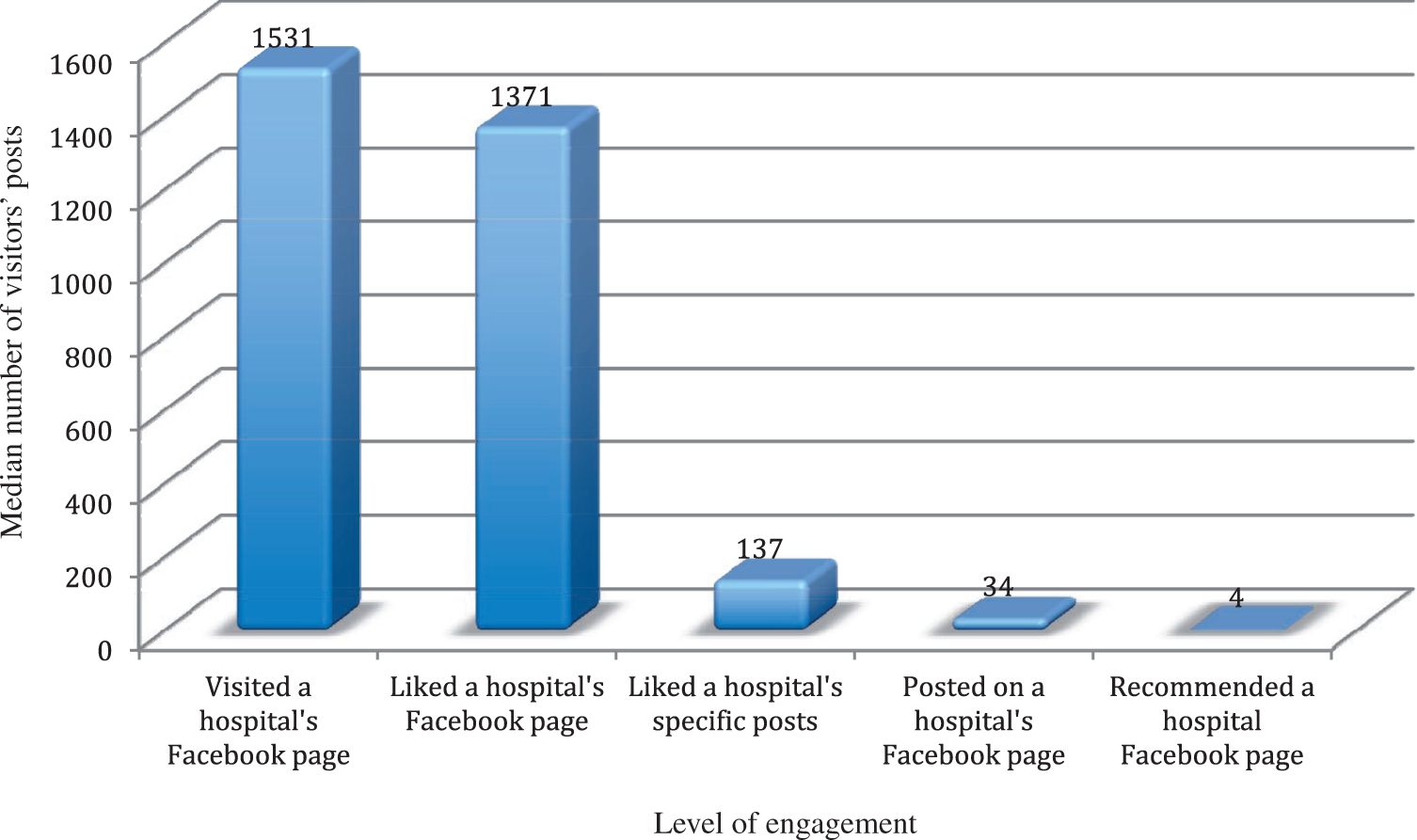
Twitter presented a different picture of hospital followers’ engagement. On Twitter, many businesses followed hospitals. Based on the name, identity photo by the name, and the short bio of a follower, it could be determined whether the follower was a business or a private individual who was interested in the information on the hospital Twitter page. Roughly equal numbers of businesses (25.04) and private individuals (24.13) followed hospitals; a paired-samples t-test showed no significant difference. On the other hand, hospitals followed drastically fewer other entities (median = 263) than the followers to the hospitals (median = 949); hospitals followed significantly more businesses (median = 28.41) than private individuals (median = 15.65) (t = 8.4, df = 170, p < 0.001).
Correlation between hospital size and visitors’ engagement on hospital Facebook pages and Twitter pages using Kendall’s tau-b a
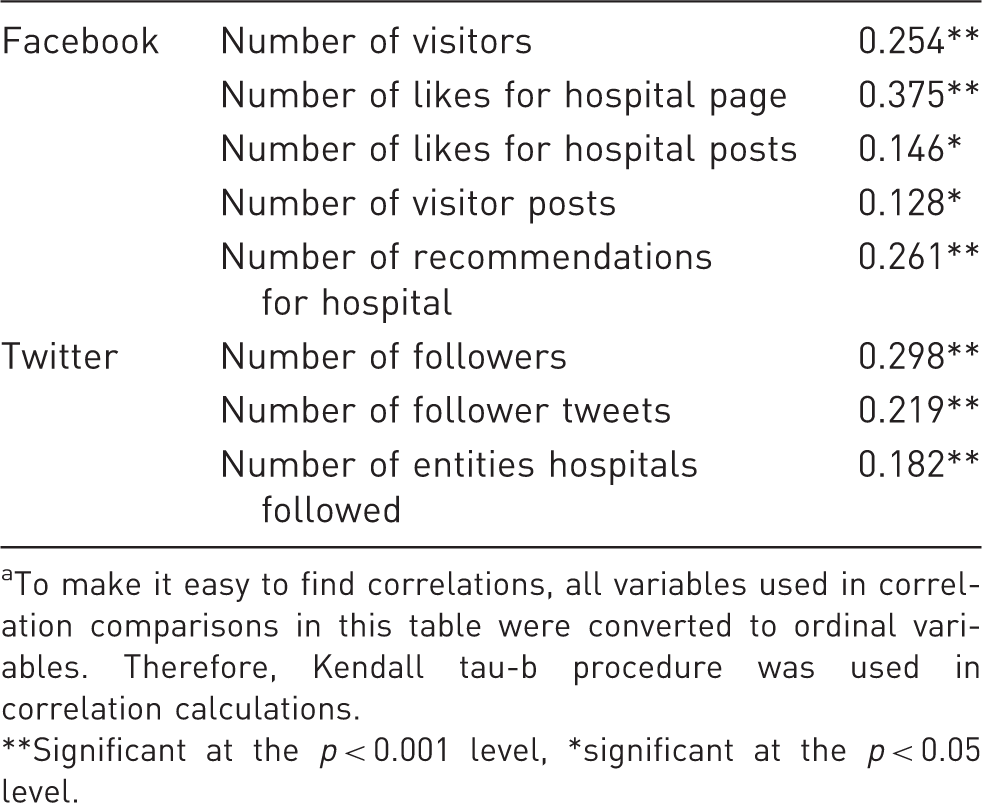
To make it easy to find correlations, all variables used in correlation comparisons in this table were converted to ordinal variables. Therefore, Kendall tau-b procedure was used in correlation calculations.
Significant at the p < 0.001 level, *significant at the p < 0.05 level.
When hospitals and visitors did interact on social media, did they really care about each other’s issues reflected in their posts and did they have the same concerns? Figure 2 shows that, when visitors visited a hospital Facebook page, most of the time (65%), they were commenting on the hospital’s posts. They sometimes also shared their thoughts and expressed their emotions (15%) and occasionally made some announcements to peers (11%). Other kinds of posts, such as thank-you notes, questions to the hospital, and donation and prayer requests were rare. On the other hand, Figure 3 shows that, while ‘hospital news’, ‘event announcements’, ‘patient stories’, and ‘holiday salutations’ constitute a solid part of hospitals’ marketing efforts (42%), hospitals did make great efforts to respond to their visitors’ comments and also to respond to their posts (46%).
Twitter usage demonstrates a different picture from that of Facebook. On Twitter, visitors to hospital pages were dominantly ‘favoriting’ and ‘retweeting’ their hospitals’ tweets (82%) and occasionally tweeted their thoughts and emotions (8%) or tweeted announcements (6%) (Figure 4). This result is very much like that of Facebook. Hospitals on Twitter, on the other hand, spent most of their time marketing themselves by spreading hospital news (40%) and making public service announcements (19%); responding to visitors’ tweets was placed at a lower priority (19%) (Figure 5).
Discussion and conclusions
The findings above have provided abundant evidence for answering the two research questions in this study.
To what extent US hospitals have used social media to connect to patients?
Today, social media users’ engagement on hospital social media pages is largely superficial and minimal as less than 3% of those who have visited a hospital Facebook page or even liked the hospital Facebook page care to comment on a hospital post or share thoughts or express emotions, and most of them simply press the Like button or just surf the page as passive information receivers. The flow of information is dominantly one-way on hospital Facebook pages. This situation is more prominent on Twitter.
The fact that median, instead of mean, has to be repeatedly used in this study to come up with typical measurements demonstrates that hospitals’ involvement on their social media sites drastically differs. Larger hospitals tend to be more active on their social media sites. Likewise, larger hospitals tend to attract more visitors, and visitors tend to be more active on larger hospitals’ social media sites. Smaller hospitals (below 600 beds, especially below 300 beds) should better take advantage of social media to connect to their social media visitors since these smaller hospitals constitute 75% of the US hospitals. Cindy Smith-Putnam, Executive Director of Business Development, Marketing & Community Relations at Eastern Idaho Regional Medical Center said: Hospitals lacking robust marketing and communications budgets may be MORE likely, not less likely, to consider technology investments a major priority. This is because compared to traditional communication channels (paid advertising, print publications, direct mail, etc.), Web sites and social media are relatively less expensive ways to interact with prospective consumers, with the added benefit of facilitating more two-way (rather than one-way) communication.
42
Are hospitals using social media mainly as a marketing tool or as a way to friend, listen to and interact with their visitors?
For those visitors to hospital Facebook pages who do care to interact with their hospitals, they have spent most of their time commenting on hospital posts. On the other hand, hospitals have made great effort to respond to the visitors’ posts and their comments while also trying to market themselves. The fact that hospitals and visitors have roughly equal number of posts implies close mutual following. In other words, hospitals highly value and participate in the interaction with their visitors on Facebook so long as the visitors care to genuinely interact with their hospitals.
Nevertheless, on Twitter, hospitals tend to prioritize marketing over taking care of their followers in two areas. First, hospitals tend to push out information instead of interacting with their followers; consequently, the followers’ interaction with their hospitals is minimal. Second, hospitals tend to follow businesses more than individuals even though roughly the same number of businesses and individuals follow hospitals. It is interesting to note that hospital Facebook pages have attracted significantly more visitors and visitors’ posts than hospitals’ Twitter pages do. Whether there is a causal relationship between hospitals’ tendency to market the hospitals themselves on Twitter and a low number of Twitter visitors is a topic for another study, but what is obvious from the findings is that visitors like their hospitals much more on Facebook than on Twitter. It seems fair to say that for hospitals to be proactive in interacting with their social media visitors is a must for maintaining a healthy relationship between the two. According to the social exchange theory, a healthy relationship between a hospital and its social media visitors will bring high rewards that will offset the visitors’ effort and time spent on the social media platforms, and such a relationship tends to last since it can satisfy both parties’ interests.
Hospitals’ performances on Facebook have clearly demonstrated that listening to and interacting with social media visitors is an effective way to engage the visitors. On the other hand, their marketing on Twitter has aroused much less visitors’ enthusiasm. Therefore, while hospitals are marketing themselves on social media, it is more important for them to use social media to listen to and interact with their visitors to show concerns and caring. Using social media as a two-way communication channel seems to be much more effective for hospitals in connecting to their visitors than using them as a one-way ‘Magic Bullet’. e
Although in-depth interaction between hospitals and their visitors is still rare, the findings show that it is very important for hospitals to encourage a large basis of visitors on Facebook because the more visitors a hospital attracts to its Facebook page, the more likes the hospital receives, the more posts the hospital will attract, the more people will comment on the hospital posts, and the more the hospital gets recommended. As Bennett argued, ‘When a (healthcare) practice is debating whether to engage in social media they should also estimate if they can afford not to be a part of the conversation’. 6
This study has its limitations. Whether hospitals’ efforts on social media can be effectively converted into cash flow is unknown and calls for another study. Content analysis used in this study cannot establish a causal relationship between hospitals’ marketing tendency and the number of visitors and visitors’ level of engagement on social media. To achieve that goal, an experiment is required. The study is not able to tell whether the difference between users’ engagement on Facebook and on Twitter results from Facebook’s better reputation or more years of presence than Twitter, the ways these two platforms are run, users’ overall preferences for Facebook, or the ways with which hospitals have used these two platforms. To determine that answer, case studies are needed. The study has not directly investigated users’ attitudes in using hospital social media, either. Systematic research regarding social media in the healthcare context is still in the infant stage though many healthcare professionals have social media accounts. There have been warnings from healthcare professionals regarding misuses of social media, but almost no empirical study has been conducted to show how to harness the power of social media. Therefore, more solid research regarding healthcare social media is needed in the years to come.
Footnotes
Notes
Acknowledgment
The authors would like to thank Mr Ed Bennett of University of Maryland Medical System for providing the list of the US hospitals that used social media and Miss Stephanie Huang from Rice University for proofreading this manuscript.
Funding
This research received no specific grant from any funding agency in the public, commercial, or not-for-profit sectors.
Conflict of interest
The authors declare that they do not have any conflicts of interest.