



Abstract
The purpose of the present study is to test the relationship between a pharmacist’s professionalism and helpfulness (as perceived by customers) as well as to determine the effect of these factors on customer loyalty. Consumers may tend to ask for pharmacists’ help in purchasing both prescription and over-the-counter drugs if they feel that pharmacists are willing to help. Also, customer relations with pharmacists and their loyalty to pharmacies may vary depending on customers’ age, gender, race, and income. To test these relationships, cross-sectional survey analysis was conducted, involving 332 randomly selected customers in the Midwest of the United States. As hypothesized, the results indicate that many customers consider the professional background of the pharmacist, including education and years of experience, when asking for advice on both over-the-counter and prescription drugs. Additionally, customers’ willingness to ask for help is positively related to pharmacists’ willingness to help customers. The results of structural equation modeling indicate that pharmacists’ helpfulness and professionalism have significant impact on customer loyalty. Age, gender, race, and income levels influence drug-purchasing behavior and loyalty to a pharmacy. The findings add to the literature by discovering customer feelings about a pharmacist’s helpfulness as related to professionalism. If the customer is satisfied with the assistance provided by the pharmacist, loyalty will naturally increase along sales, and pharmacy competitiveness strengthens.
Introduction
A pharmacy’s performance and sustainable success depend on its competitiveness and its ability to attract, retain, and please customers. Internet sales of prescription drugs are a rapidly growing business that threatens the current drugstore business model. Low-cost pharmacies such as mail-order or online pharmacies are steadily taking sales from community and institutional pharmacies (located in hospitals, etc.) and have had an increasingly negative impact on drugstore revenues. 1 Local pharmacies need a clearer understanding of this threat in order to make wise strategic decisions to satisfy customers. More effective customer–pharmacist relations may be the key in achieving and sustaining competitiveness.
There is no research that is solely focused on consumer behavior attributed to pharmacist helpfulness and professionalism. Pharmacist helpfulness and professionalism were investigated in the context and among many other variables. We think that customers who attribute a pharmacist’s helpfulness to the pharmacist’s professionalism are more loyal. Customer loyalty increases the switching costs of buyers. These costs may be more emotional than monetary. The customer–pharmacist relationship develops through advice and counseling. Advising and counseling services 2 in drugstores are widely practiced for prescription and over-the-counter (OTC) drugs. Various managerial models are used to enhance drugstore performance 3 ; however, they are not used widely and pharmacies experience difficulties in keeping their customers. The great advantage of drugstores is to be able to provide advising and counseling services that mail-order and online pharmacies cannot match. The increasing price sensitivity of customers makes them switch to alternative sellers. 4 If pharmacists can always recommend lower priced alternatives for higher priced brand-name prescription and OTC drugs, the pharmacy may become more attractive for price-sensitive customers. Then, their helpfulness is valued by wider groups of customers. It is imperative that pharmacists be professionals in their field, and customers often relate their professionalism 5 with their helpfulness. Helpfulness may provide an important measure of customer satisfaction. The level of confidence, technical expertise, and helpfulness of both the pharmacist and the staff is a key indicator of any pharmacy’s ability to preserve and develop its OTC business. 6
The current study utilizes a cross-sectional survey of randomly selected customers to determine their perception of pharmacists’ helpfulness as related to professionalism, including education and years of experience, that enhances customer satisfaction, customer loyalty, and drugstore competitiveness. Additionally, customers’ willingness to ask questions depends on pharmacists’ willingness to be helpful. This study also captures the demographic aspects of consumer and pharmacist relations. A five-point Likert scale was used to quantify respondent perceptions. Correlation, exploratory factor, regression, confirmatory factor analysis (CFA), independent-samples t-tests, and structural equation modeling (SEM) were conducted to conceptualize consumer perceptions. The results of the study and methodology may be utilized by both researchers in the field and pharmacies across the United States, the United Kingdom, and perhaps in other countries.
Theoretical framework and hypotheses
Customer loyalty is the most important advantage for a company that sells products and services. Loyal customers always return and buy preferred products and services. Their switching costs are high 7 and hurt their feelings and sometimes wallets. If switching to another provider or seller, customers may not receive better service or access better products. They are not satisfied because they receive lower quality service and products. They eventually return to their former service providers and sellers of goods and become more loyal customers. This theory applies to pharmacies too. To please customers, pharmacies must have professional pharmacists and staff who are very knowledgeable, caring, and helpful.
The professionalism of a pharmacist is important to provide quality counseling and advising to customers in purchasing both prescription and OTC drugs. Dimensions of professionalism involve structural and attitudinal components. 5 The structural dimensions of pharmacist professionalism are listed as (a) a distinct body of knowledge; (b) internal regulating capabilities; (c) extensive training and skill requirement; (d) a code of ethics; (d) service commitment; and (e) occupational autonomy. We develop this approach by investigating the relationship between customers’ sense of pharmacists’ professionalism in terms of their background (education and years of service) and customers’ perceptions of pharmacists’ helpfulness.
Customers perceive pharmacists’ professionalism when they receive counseling and advising services. Counseling services 2 in drugstores are common for both OTC and prescription drugs. The pharmacist’s professionalism and helpfulness should be measured by both prescription drug counseling and OTC drug advising. Some managerial models for running pharmacies 3 would help increase drugstore attractiveness because of extended services to consumers within the OTC drug aisles.
The deep economic recession, frozen household incomes, and unemployment make consumers more price sensitive 8 and seek alternatives not only for prescription drugs, but also for higher priced OTC drugs. Therefore, they more often seek a pharmacist’s counseling at drugstores. The counseling and advising are effective if consumers are able to purchase appropriate drugs that are effective in treating their condition. Therefore, they appreciate pharmacists’ professionalism and helpfulness. Generally, pharmacists’ helpfulness depends on their professionalism. If pharmacists provide counseling and advising, relying on the evidence-based medical guidelines, 9 then consumers recognize pharmacists’ helpfulness because of their professionalism. A new phenomenon is occurring in the United States. Physicians, pharmacists, and consumers create so-called medical homes in order to provide safe drugs and efficient patient care. 10 These programs address the challenges of medication therapy management at lower cost. For this reason, they should also consider more alternative medicines and treatment recommendations. Additionally, Walgreens is initiating various diagnostic testing services for customers.
An empirical investigation in the retail drugstore industry reveals that managers do not fully understand the needs and wants of their customers and that their customers are not as satisfied as the managers perceive them to be. 11 Ricks and Mardanov 4 investigated the impact of pharmacist and physician recommendations on the price-sensitive consumer’s behavior. According to this study, customers seek low-cost drugs and follow pharmacists’ recommendations on OTC and prescription drugs to reduce their costs.
The literature reveals that customer satisfaction with pharmacies depends on three essential factors: (1) attributes—assortment, variety, quality, brand characteristics, cleanliness, hours, and location; (2) transitory behavior—the price of items; and (3) assistance—including employee helpfulness. 11 There is no significant research on the helpfulness of pharmacists attributed by customers to their professionalism. Some trade magazines have published case studies of pharmacist helpfulness. Some aspects of the peer-reviewed article by Ellis and Marino 11 considered pharmacists’ helpfulness among other factors to explain customer satisfaction. Pharmacists’ helpfulness was one of the measurement items in the investigation of service quality in the recent article by Zhou et al. 12 Ricks and Mardanov 4 suggest that consumer-purchasing behavior depends on pharmacists’ recommendations (help—counseling and advising) regarding both prescription and OTC drugs.
This may be translated into the term “pharmacist helpfulness.” Pharmacists can be helpful on two occasions: one is to help customers choose the right OTC drugs to match their symptoms, and the second is to help in lowering costs for customers. This study focuses on the overall effect of both aspects of pharmacist helpfulness on such consumer behavior as loyalty.
If customers are willing to ask for help and pharmacists are willing to help, then the customers develop loyalty to the pharmacy. If customers are willing to ask for help and pharmacists are unable to help, then customer loyalty to that pharmacy diminishes if it existed at all.
Hypothesis 1a: A customer’s willingness to ask the pharmacist for help when purchasing prescription drugs will be positively related to the pharmacist’s helpfulness.
Hypothesis 1b: A customer’s willingness to ask the pharmacist for help when purchasing OTC drugs will be positively related to the pharmacist’s helpfulness.
Some customers do not rely on pharmacists’ help in purchasing OTC drugs and read instructions on the package label. Some others search the Internet for instructions. Some customers ask friends for advice. However, the most reliable source of information is the pharmacists in drugstores. Many customers seek advice from them in drugstores. Customers who are used to rely on pharmacists’ advice in purchasing prescription drugs almost always seek their help in purchasing OTC drugs and follow their recommendations. 4 It is also possible that customers who are used to rely on pharmacists’ suggestions in purchasing OTC drugs always seek advice on prescription drugs.
Hypothesis 2a: Customers who seek help on prescription drugs always seek pharmacists’ help on OTC drugs.
Hypothesis 2b: Customers who seek help from pharmacists on OTC drugs always listen to pharmacists’ advice on prescription drugs.
Customers who seek help on OTC drugs are interested in pharmacists’ professional background, education, and years of service when asking for and accepting advice. 13
This is especially true of older customers. When purchasing prescription drugs, customers take into consideration the pharmacist’s professional background based on the information available on the documents and professional certificates posted on the walls of the pharmacy. They also learn a pharmacists’ background from their long-term relationship and the quality of assistance they received in the past. Additionally, customers make judgments about the pharmacist based on their knowledge of his or her years of experience as well as their perception of the pharmacist’s confidence in counseling. Many customers attribute the quality of pharmacist counseling and advice to their education and tenure. Experienced pharmacists have a distinct body of knowledge about both prescription and OTC drugs, internal regulating capabilities, extensive training and skills, a code of ethics, service commitment, and occupational autonomy. 5
Hypothesis 3a: Customers who agree with pharmacists’ suggestions on the OTC drugs take into consideration the professional background of the pharmacist.
Hypothesis 3b: Customers who follow pharmacists’ advice on prescription drugs take into consideration their professional background.
We assume that older customers build closer relationships with pharmacists than younger customers do, simply because younger customers do not purchase prescription drugs frequently. Younger customers interact more with pharmacists on the purchase of OTC drugs because they can find effective treatment from OTC drugs due to their less serious conditions. We also suggest that higher income customers can interact with pharmacists more frequently than lower income customers because higher income customers can visit pharmacies more often. It may be true that customers of different racial groups have significant differences in their relationships with pharmacists in terms of asking for help, taking pharmacists’ suggestions on prescription and OTC drugs, and considering pharmacists’ professional background. We assume that female customers build closer relationships with pharmacists than male customers.
Hypothesis 4a: Older customers will be interacting with pharmacists more often than younger customers when purchasing prescription and OTC drugs.
Hypothesis 4b: Higher income customers will be interacting with pharmacists more often than lower income customers when purchasing prescription and OTC drugs.
Hypothesis 4c: Customers of different races have significant differences in their relationships with pharmacists.
Hypothesis 4d: Customers of different genders have significant differences in their relationships with pharmacists.
If customers make multiple visits to the pharmacy and do not switch to other pharmacies, this is an indication of their loyalty. This loyalty occurs if customers feel that the pharmacists are helpful and they trust pharmacists. 14 Pharmacists can be helpful if they have an appropriate background, including both education and experience, as well as are able to provide exceptional customer service together with their staff. We can measure customer loyalty based on customer perceptions of pharmacist helpfulness and professional background. These two factors should correlate. Customer demographics can significantly affect customer loyalty. Older customers may be more loyal than younger ones. High-income customers may express more loyalty than low-income customers. White customers may stay with the same pharmacy while minorities may switch pharmacies often. Male customers may stick with the same pharmacy while female customers switch to other pharmacies.
Hypothesis 5a: Customers’ perceptions of pharmacist helpfulness and professionalism will be significant determinants of customer loyalty.
Hypothesis 5b: The older the consumer, the greater the loyalty; the higher the income, the greater the loyalty; if there are more female customers, there is more loyalty; the higher the number of white customers, the higher the number of loyal customers.
Methods
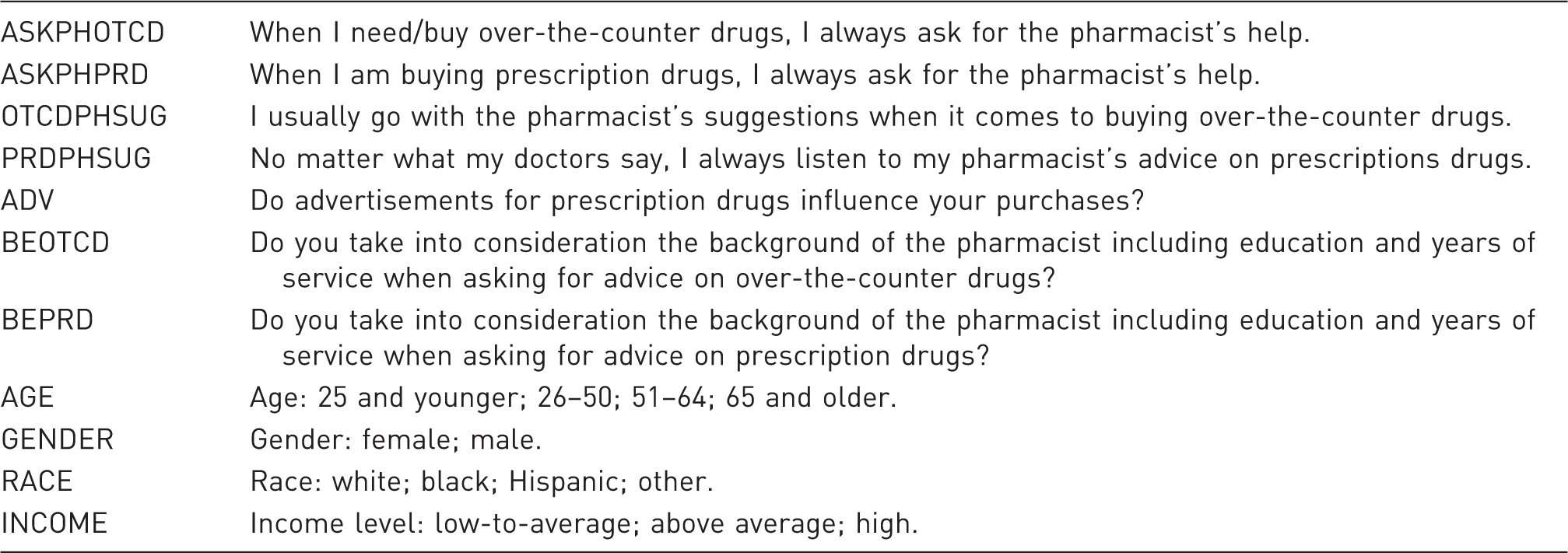
Variable/survey-item abbreviations
Correlations and their significance levels
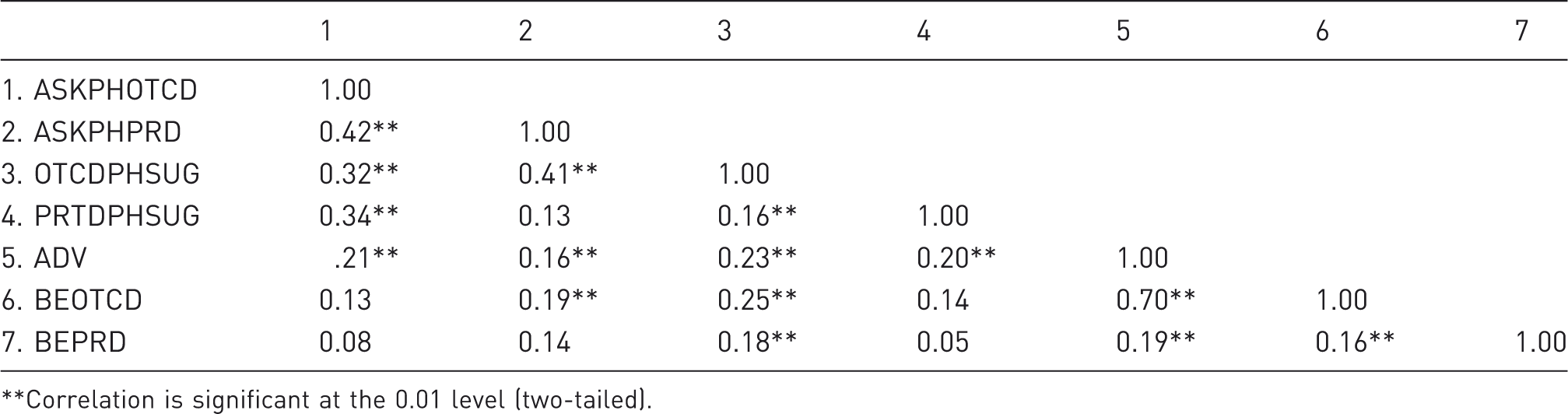
Correlation is significant at the 0.01 level (two-tailed).
The dependent variables are “Customers follow pharmacists’ advice on prescription drugs and perceive pharmacists as helpful” and “Customers take suggestions of pharmacists on OTC drugs and perceive pharmacists as helpful.” The independent variables are the willingness of customers to ask pharmacists for help on prescription and OTC drugs as well as their desire to take into consideration the professional background of the pharmacist, including education and years of service (i.e., their professionalism), when asking for advice on prescription drugs and taking suggestions regarding OTC drugs. Finally, customer loyalty was used as a dependent variable and pharmacist helpfulness and professional background were independent variables in SEM.
We also tested differences in behavior among age groups of 25 and under, 26–50, 51–64, and over 65 years old. Among age groups, 24.9% of respondents were 25 years old or younger, 31.5% were 26–50, 32.7% were 51–64, and 10.9% were 65 or older. Among the respondents, 53.3% were female customers and 46.7 were male customers. Among racial groups, white respondents were 86.0%, African American 5.9%, Hispanic 2.2%, and others 5.9%. Among respondents, 65.1% had low or average income in the region, 23.7% above-average income, and 11.2% high income.
Exploratory two-factor analysis revealed scale items that loaded heavily on those factors. Out of the seven items, three loaded on pharmacist helpfulness latent factor and two loaded on the pharmacist professionalism latent factor with scores over .70. Then those five items were used in a comparative fit index (CFA) to determine regression weights, covariances, correlations, and squared multiple correlations (R2) as well as model fit indices.
To examine the factor structure of study measures, we conducted a CFA of the latent constructs “HELPFULNESS” and “PROFESSIONALISM” in our model, including the manifest variables ASKPHOTCD, ASKPHPRD, OTCDPHSUG, BEOTCD, and BEPRD. A two-factor model, in which each scale indicated a distinct latent factor, fits the data well (CFA = .995, root mean square error approximation (RMSEA) = .04, standardized root mean square residual (SRMR) = .02, χ2[4] = 6.24, p = .182). To check for common method variance, 16 we tested a second model in which customer loyalty indicated one latent factor. The fit of this model was both poor (CFI = .66, RMSEA = 294, SRMR = .163, χ2[5] = 148.36) and significantly worse than the fit of the two-factor model (Δχ2[1] = 142.12, p < .01).
Analyses and results
The frequencies indicate that 52.9% of customers ask pharmacists for help when buying OTC drugs and 58.9% prescription drugs; 79.4% of customers follow pharmacists’ suggestions on OTC drug purchases, and 37.7% follow the physicians’ advice. Only 43.3% of customers indicate that advertisements influence their purchase of prescription drugs. In purchasing OTC drugs, 59.2% of customers take into account the professional background of the pharmacists while 64.8% consider pharmacists’ background and experience when purchasing prescription drugs.
Descriptive statistics (Table 2) indicate that customers ask pharmacists’ suggestions on OTC drugs (m = 3.33) more often than they ask for advice on prescription drugs (m = 2.36). Customers take into account pharmacists’ professional background and education more often when purchasing prescription drugs (m = 3.05) than OTC drugs (m = 2.90).
Customers’ willingness to consult the pharmacist when buying OTC drugs (Variable OTCDPHSUG in Table 2) is strongly and positively correlated with their willingness to ask about prescription drugs (Variable ASKPHPRD). These variables are also significantly and positively correlated with the advertisements for prescription drugs (Variable ADV). There is a lack of correlation between variable BEPRD and variable PRDPHSUG.
Multiple regression analysis: consumer reactions to pharmacist advice on prescription drugs and pharmacist suggestions on OTC drugs

The SEM (Figure 1) fits the data well (CFI = .99, RMSEA = .030, SRMR = .037, χ2[21] = 27.07). Pharmacist helpfulness (.56**) and professionalism (.42**) have significant impact on customer loyalty. Age (predominantly older consumers in the sample), race (predominantly white customers), and income (all of the respondents had average or higher income) have also significant and positive effect on customer loyalty. However, gender (predominantly female respondents) has significant negative impact on customer loyalty.
Structural equation modeling results: pharmacist professionalism, helpfulness, and customer loyalty linkage model. Unstandardized path coefficients (B) are reported, with standardized coefficients (β) in parentheses. Ovals and the circle represent latent variables; the boxes with rounded corners represent manifest variables and rectangles represent control variables. n = 332; *p < .05; **p < .01.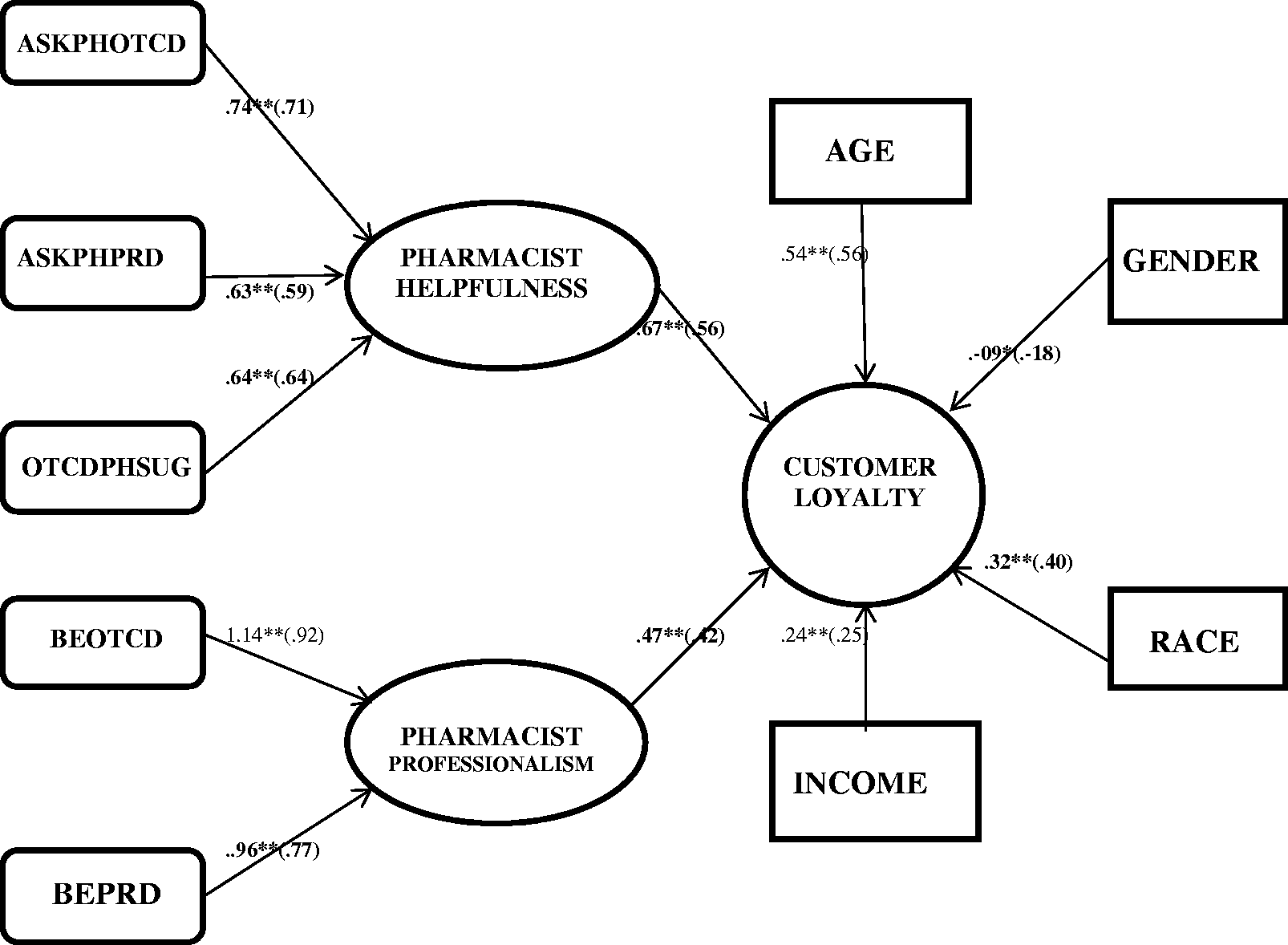
Mean differences and significance levels (equal variance not assumed)

p < .01; **p < .05; ***p < .01.
Customers feel that pharmacists will be helpful when they need advice on prescription drugs; therefore, their advice is accepted and affects consumers’ behavior in purchasing and using prescription drugs. Hypothesis 1a is supported because pharmacist helpfulness has a positive and significant coefficient at p < .01 (Table 3). Hypothesis 1b, stating that a customer’s feeling that pharmacists will be helpful when he or she needs recommendations on OTC drugs will be positively related to the pharmacists’ helpfulness, is also supported (p < .01) because customers indicate that when they ask for help, pharmacists are willing to make suggestions on OTC drugs.
Hypothesis 2a stating that customers who seek help on prescription drugs also always seek pharmacists’ help on OTC drugs, is supported because the customers’ seeking help for prescription drugs is correlated with their seeking help on OTC drugs. The correlation between these two variables is significant at p < .01 (Table 2). Hypothesis 2b, stating that customers who take suggestions from pharmacists on OTC drugs always listen to pharmacists’ advice on prescription drugs, is also supported because these two variables are correlated at p < .01 (Table 2).
Hypothesis 3a states that customers who agree with pharmacists’ suggestions on the OTC drugs take into consideration the professional background of the pharmacist, including education and years of service. Indeed, multiple regression at p < .01 confirms that customers take pharmacists’ suggestions on the OTC drugs, taking into consideration the background of the pharmacist including education and years of service (Table 2). The consumers’ acceptance of pharmacist’s suggestions on OTC drugs is correlated with their consideration of the pharmacist’s professional background at p < .01 (Table 2). Hypothesis 3a is supported. Hypothesis 3b, stating that customers take into consideration the professional background of the pharmacist including education and years of service when they listen to the pharmacist’s advice on prescription drugs, is not supported because these two variables are not correlated (Table 2). It is obvious that consumers follow their physician’s directions.
Hypothesis 4a, suggesting that older customers are willing to interact with pharmacists more often than younger customers, is supported in the age comparisons for 25 and 65 and older and 25–50 and 51 and older on almost all the manifest variables (Table 4). Customers who are in the age range 51–64 have significant differences in their behavior from customers who are 65 and older. Hypothesis 4b is partially supported because there is significant mean difference between customers with average and high income who seek pharmacists’ help more often when buying prescription drugs. There is no significant mean difference when buying OTC drugs (Table 4). Also, customers with low-to-average and above-average income have significant differences in their willingness to ask pharmacists for help on OTC drugs and to follow pharmacists’ suggestions on prescription drugs. Customers with above-average income ask for help on OTC drugs and follow advice on prescription drugs more often. Hypothesis 4c, stating that customers of different race have significant differences in their relationships with pharmacists, is supported in several comparisons (Table 4). White and black customers differ on prescription drugs and paying attention to pharmacists’ professional background. White customers are more interested in pharmacists’ help and accept their suggestions as well as pay attention to pharmacists’ professional background. White and Hispanic customers have differences in their willingness to ask for help on OTC and prescription drugs. Hypothesis 4d, stating that customers of different gender have significant differences in their relationships with pharmacists, is supported in one out of seven items in the questionnaire (Table 4). Thus, consumers of both genders have similar relationships with pharmacists in purchasing prescription and OTC drugs. There is a little support for Hypothesis 4d.
Hypothesis 5a suggests that pharmacist helpfulness and professionalism will be significant determinants of customer loyalty. The SEM indicates that the latent variables helpfulness and professionalism have significant coefficients in explaining customer loyalty at p < .01. The outcome variable helpfulness has a larger absolute value than the professionalism, indicating the importance of pharmacist helpfulness that ultimately will make customers loyal to the pharmacy. Hypothesis 5a is supported. Hypothesis 5b indicates that the older the consumer, the higher the loyalty; the higher the income, the higher the loyalty; where there are more female customers, there is more loyalty; the more white customers, the higher the loyalty. The SEM indicates that age has a significant effect on customer loyalty at p < .01. The number of older respondents was overwhelming. Gender has significant, but negative, impact on loyalty at p < .05. The sample has over 53% female customers and apparently they are not loyal to pharmacies. Race has positive and significant effect on customer loyalty at p < .01. The sample has over 85% white customers. Income level also has significant positive impact on loyalty. Most customers have average or above-average income. Hypothesis 5b is mainly supported.
Discussion
Competitiveness of any drugstore as of any other business depends on customer loyalty. Customer loyalty develops through efforts of pharmacies to be helpful. To be so, pharmacies must have knowledgeable pharmacists and staff. They have to have a great deal of competence and passion to serve mainly sick people who seek help in purchasing drugs. The results of the present study confirm that customer loyalty depends on two main factors: pharmacists’ helpfulness and professionalism. Previous research has indicated that consumers seek pharmacists’ help not only in purchasing prescription drugs (including low-cost prescription drugs) but also OTC drugs. 4 The present study advances the analysis of the concept of pharmacist helpfulness by relating it to pharmacist professionalism as perceived by consumers. Most of the 332 respondents suggest that they care about the pharmacist’s professionalism when seeking help on prescription and OTC drugs. The present study also relates pharmacists’ helpfulness to their willingness to answer customer questions and customers’ willingness to ask pharmacists questions and follow their recommendations. The study has also discovered that consumer–pharmacist relations and perceptions of pharmacist helpfulness and professionalism vary across age groups, genders, races, and income groups.
Applications of the research results
Relying on the findings of the present study, researchers will be able to consider in detail the determinants of customers’ perceptions of pharmacist helpfulness and professionalism and link these aggregate factors to customer satisfaction and loyalty. Research can replicate this study in other regions of the United States and other countries. Drugstore managers will be able to focus on the most critical issue in achieving and sustaining a competitive edge over other drugstores in the community. 17 The keys to success are to listen to customers, provide good advice on prescription drugs, and make evidence-based suggestions on OTC drugs. Training and retraining pharmacists and staff are vital in order to enhance their professionalism. The results of this study will be helpful for pharmacies in doing research to learn more about their customers’ reactions to pharmacist advice. Information about the purchasing behavior of customers of different ages, genders, income levels, and races is valuable.
Two market strategies are suggested by the demographic results. They are: (1) to work with female clients to gain their loyalty as they probably perceive that they are the primary drug purchasers and drug knowledge keepers within the family; and (2) to training all pharmacists on current skills in interacting with senior citizens who are the customers most likely to seek their advice and who are responsible for the highest volume of sales. These steps will help boost drugstore sales and competitiveness.
Limitations and future research
In the present study, we focused primarily on customers’ perceptions of pharmacists’ helpfulness as related to their professionalism in the Midwest of the United States—only one part of the country. Future research should investigate further the variable of pharmacist helpfulness, linking it to professionalism and customer loyalty and satisfaction in other regions of the United States and across the globe to capture the specifics of other regions. Such organizational practices as total quality management (TQM) practiced in Europe 18 should be the center of studies because TQM involves efforts to assure high quality of product and services that customers need to be satisfied and loyal. Additionally, employee job satisfaction is crucial because satisfied employees satisfy customers. It is important to continue research on pharmacist counseling services 2 that contribute to pharmacist helpfulness and facilitate attracting more customers and strengthening customer loyalty. Future research should emphasize managerial models 3 for running pharmacies that ultimately help increase sales and enhance drugstore competitiveness. More and more customers are becoming price sensitive, 4 and pharmacies should offer low-cost drug alternatives that may attract more customers. Pharmacists should be able to explain drug characteristics based on evidence. So, evidence-based marketing and counseling tools should be investigated extensively.
It is obvious that there are significant differences in habits of customers depending on gender, race, age, and income levels. Knowing this, pharmacists may use more effective tactics in approaching customer needs. Also, additional research on pharmacists’ helpfulness as positively and significantly correlated with the advertisements for drugs can increase market impact and the coordination of advertising.
Pharmacists should serve as patient advocates. In both community and hospital settings, they should screen for patient compliance with evidence-based medicine guidelines and recommend to patient or physician accordingly. 9 A new phenomenon is occurring in the United States. Physicians, pharmacists, and consumers create medical homes within the pharmacies in order to provide safe drugs and efficient patient care. 10 These programs address the challenges of medication therapy management at lower cost. For this reason, participants should consider more research as to how to advise about alternative medicines and treatment recommendations.
Conclusion
Community drugstores compete for customers in a limited number of neighborhoods, and only managerial and staff commitment to customers helps them gain customer loyalty. The main goal is to attract more customers by providing exceptional service and a great drug-purchasing experience. However, not every drugstore can earn customers’ loyalty because it requires a tremendous effort. Many customers are becoming price sensitive 19 and therefore pharmacies should make low-cost drug alternatives available to attract more customers. 4 Pharmacists should be able to explain drug characteristics based on evidence.
The structural equation modeling suggests that customer loyalty depends strongly on pharmacist helpfulness and professionalism as well as customer demographics. The results of this study indicate that customers’ willingness to ask for help from pharmacists on prescription and OTC drugs is positively related to the pharmacist’s helpfulness, which is contingent upon the pharmacist’s professionalism. 5 It also confirmed that a customer’s willingness to ask the pharmacist when he or she buys OTC drugs is strongly and positively correlated with his or her willingness to ask about prescription drugs, going with the pharmacist’s suggestions when it comes to buying both OTC and prescription drugs. This indicates that if pharmacists are helpful in giving advice on prescription drugs, customers may come back and ask for help on OTC drugs and vice versa. This communication helps build close relationships between customers and pharmacists and enhances customer loyalty. The results also indicate that customers care about pharmacists’ professionalism. This factor motivates customers to visit a particular drugstore repeatedly because they need the right advice on prescription drugs and suggestions on OTC drugs. The results show that there are significant differences in habits of customers depending on gender, race, age, and income levels. Knowing this, pharmacists may use the right tactics to address customer needs.
To gain more customers and increase sales, pharmacies and their pharmacists should serve as patient advocates. In both community and hospital settings, they should screen for patient compliance with evidence-based medicine guidelines and recommend to patient or physician accordingly. 9 In the United States, physicians, pharmacists, and consumers create medical homes in order to provide safe drugs and efficient patient care. 10
Footnotes
Funding
This research received no specific grant from any funding agency in the public, commercial, or not-for-profit sectors.
Conflicts of interest
None declared.