



Abstract
This paper examines factors which influence pharmaceutical representative visit recall and key-message recall, based on real surveys conducted with Romanian GPs and specialists. Four detailing key performance indicators (KPIs) (spontaneous visit recall – top of mind and total mentions, total visit recall and key-message recall) are examined against six possible factors: time, product type, therapy area, medical specialty, locality size and period of spontaneous recall. Significant influences come from the period when the projects were conducted (year, semester, series of semesters), product type (original vs. generic) and therapy area / medical specialty. The latter confirm empirical observations that some types of products do indeed have a higher promotional impact (originals, “specialized” products). The influence of time implies that the current practice of benchmarking against average KPIs of recent surveys is irrelevant: one can find better or worse results depending not as much on one’s own promotional performance at the time, but on which semester one compares against, as well as which particular surveys were conducted during that semester. Four models of logistic regression are proposed instead, incorporating the influence of semester and product type. To our knowledge, this is the first investigation of factors of influence on visit and message recall KPIs, offering the business environment a more relevant choice than traditional benchmarking and enabling academia to understand and quantify the factors which influence the impact of detailing.
Keywords
Introduction
Every year, pharmaceutical companies spend billions on detailing – company representatives visiting doctors to endorse company products. In fact, companies spend twice as much on marketing to physicians as they do on research and development. 1
Numerous researches study the influence of pharmaceutical detailing on doctors’ prescription behaviour. Norris et al. 2 provide an extensive work which examines this topic from three points of view, based on a large number of reviews of other published works; its level of detail makes it a recommended first read for an overall understanding of the issue.
The reason why this is a hot topic worldwide is that studies generally indicate an association between reliance on promotion and inappropriate prescribing practices. This is shown among specialists and general practitioners alike, even though doctors do not usually consider themselves influenced by detailing2,3 or may also take into account other factors when prescribing, such as the patient’s socioeconomic status. 4
Promotional expenditures are shown to have a small, adverse effect on GPs price sensitivity. 5 Other studies on GPs confirm the generally significant influence of promotion on prescription: the majority of qualitative6,7 and quantitative8–11 studies find that pharmaceutical detailing influences prescription habits, with particularities (e.g. stronger effect for only the first visit for a new product 9 or with a smaller impact than expected 10 ). However, we must note that a few qualitative 12 and quantitative 13 studies find no influence or find inconclusive results. 14
To summarize, maintaining a market share may depend on continued detailing visits and investments in visiting physicians do return to pharmaceutical companies as increased sales, even if the increase is modest after a point. 15
In the business environment, qualitative outcomes of detailing are measured by “visit and message recall” (VMR) surveys conducted with doctors reported as visited by pharmaceutical representatives. These are carried out by marketing research companies on behalf of pharmaceutical companies; results are confidential and, therefore, they have rarely if ever been reported in academia and business. However, they can help researchers understand whether some promotional activities are more memorable than others – as those are logically more likely to change prescription behaviour. This paper intends to fill the knowledge gap by identifying factors which influence the impact of detailing, measured by key performance indicators (KPIs) related to visit recall and key promotional messages recall, based on real-life Romanian experience.
The study uses real data collected by a marketing research company (hereafter named “Company”) in VMR surveys with Romanian GPs and specialists. Its two main purposes are:
(Q1) to identify factors of influence on VMR KPIs, and (Q2) to evaluate the relevance of current benchmarking practices (average KPI values obtained in recent surveys) based on results for Q1 and to investigate potential improvements.
The two points should interest the business and academic environment alike: the former can finally understand why and which visits have a better impact, while the latter can begin to examine the influence of detailing on prescribing practices in depth, starting from memorable visits and based on actual impact levels.
Methodology
Data set
The data set used in this study was collected by Company in VMR surveys between 2010 and 2012. Totally, 28 surveys were conducted with GPs (7481 complete cases) and 65 with specialists (5705 complete cases). They were treated as different samples, as the two are known to behave differently. Internal medicine was not included in the study, as empirical observations place their behaviour closer to GPs, but without sufficient evidence to consider them a homogenous group and without a large enough sample to conduct the analyses.
As a rule in consumer research, respondents are not interviewed if they have already participated in another survey in the past six months or a year. However, this is impossible in Romanian healthcare research, where the number of doctors in each specialty ranges from few hundreds in highly specialised areas to roughly 11,000 GPs, much smaller than consumer populations. Some doctors were re-contacted in different semesters for the surveys included here and, while this may induce a form of bias if occurring on a large scale, we estimate that it does not affect our results because these situations were less than 0.02% of each sample.
Outcome measures
Four promotional impact KPIs are typically used in business:
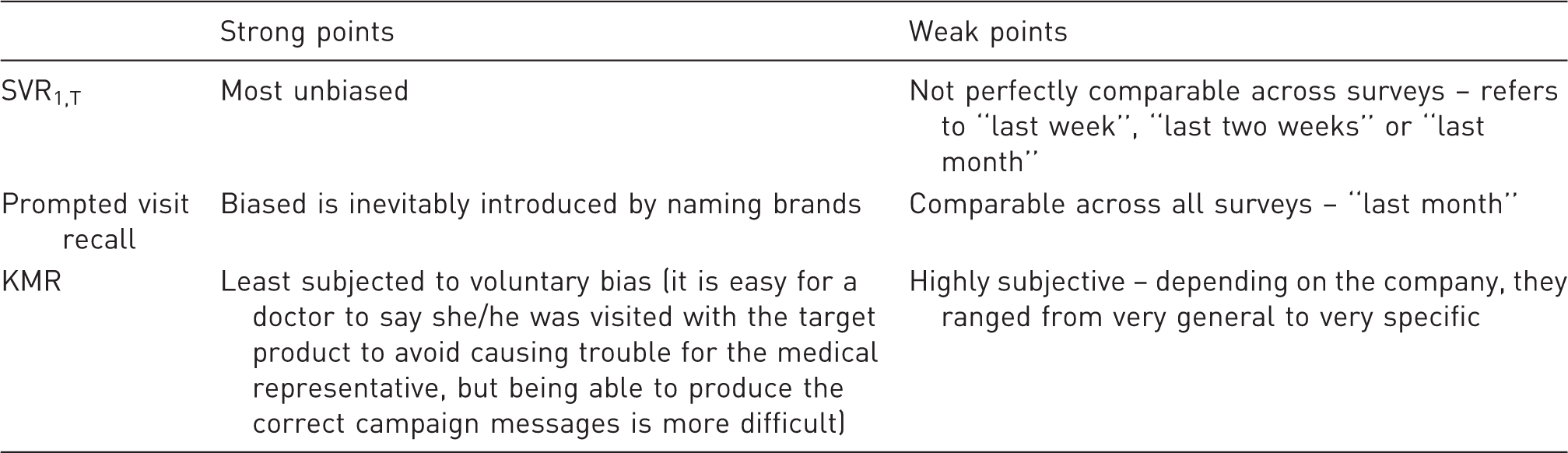
Spontaneous visit recall, top of mind (SVR1). Spontaneous visit recall, total mentions (SVRT). Total visit recall in the last month (spontaneous + prompted recall) (TVR). Key-message recall (KMR), considering only messages from the client’s promotional campaign, as validated by the client.
All KPIs are calculated relative to the number of doctors included in each survey, though the question regarding KMR is only addressed to doctors who remember the visit. Since only doctors reported as visited are contacted in VMR surveys, all of them are expected to remember the visit and messages (but this has never happened in practice and even comes as a curiosity for first-time VMR clients); failure to remember the visit is therefore equivalent to failure to remember the message.
Main strengths and weaknesses of VMR KPIs observed in practice
Factors of influence
The factors of influence considered in the study and their respective levels are:
Period of time when projects were conducted: year (2010, 2011, 2012), semester (S1, S2) or series of six semesters (2010 S1, 2010 S2, etc.). The semester is the most appropriate time unit, reflecting the two promotional cycles (spring/summer, autumn/winter); Product type: original, generic; a. Therapy area (topic) – for GPs and specialists, b. Medical specialty – specialists only; Locality size: capital city, university centres, other county capitals and other cities; Period of time asked spontaneously: a week, two weeks and one month.
For the business environment, a significant influence of the period of time when the projects were conducted implies that benchmarks at a particular point in time depend on which surveys were conducted in the past six months; therefore, the concept of benchmarking must be reconsidered from simply averaging recent results.
For the academic environment, a significant influence of the other factors implies that they should be taken into consideration when studying the impact of promotion on prescription habits.
Data analysis
KPIs were explored using descriptive statistics and were tested for significant associations with the factors using the Chi-squared test with Yates’ continuity correction and Cramer’s V coefficient.
The time factor was treated in terms of year, semester and series of semesters in order to observe potential trends in visit impact and to check whether significant relations between variables occur at random points in time (indicating no “real” significance) or persistently (indicating a “real” relation).
Analyses were performed using the R programming language. The data sets and descriptive statistics are not available for confidentiality reasons.
Findings
(Q1) Factors of influence on VMR KPIs
(1) Period of time when projects were conducted.
Testing for the significant influence of time (year, semester, series of semesters) on KPIs
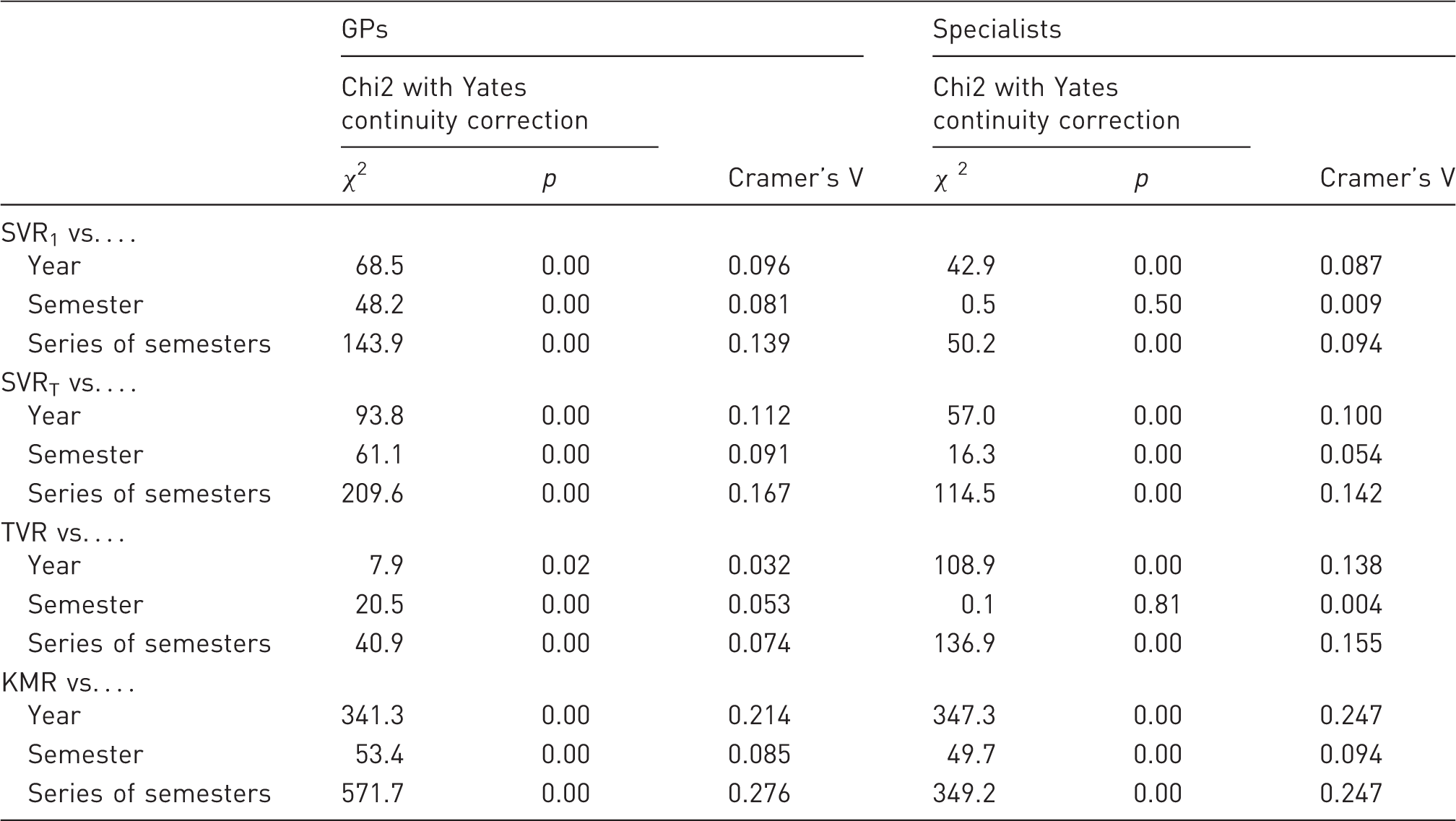
In the specialists sample, the year and series of semesters were significantly associated with all KPIs (p < 0.01). The influence of semesters is less obvious, only associated with SVRT and KMR. Again the clearest influence is that of the series of semesters, as a weak association with SVRT (0.142) and TVR (0.155) and moderately strong association with KMR (0.247).
Testing for significant factors of influence on KPIs – treating each semester as an individual sample a
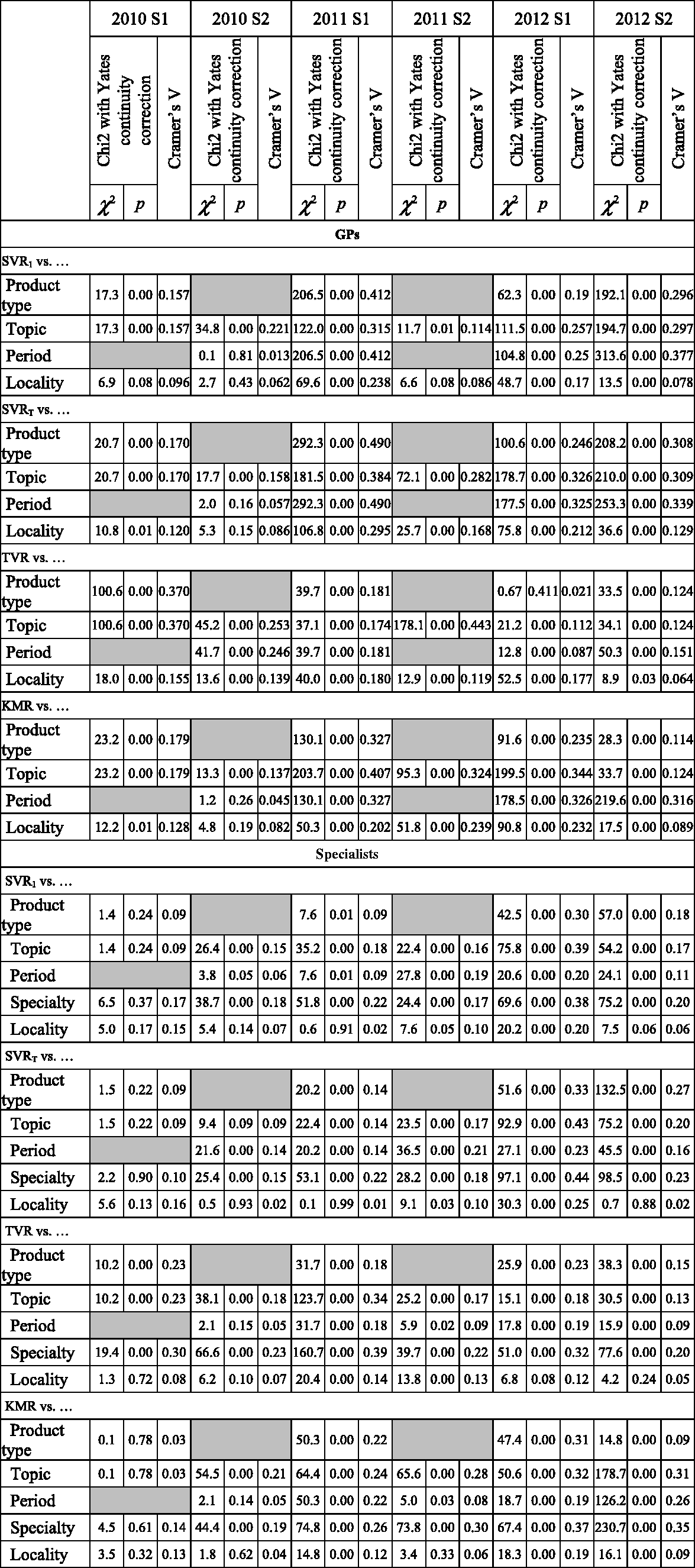

Some interactions were inapplicable, as the respective factors only had one level during particular semesters.
(2) Product type (original vs. generic).
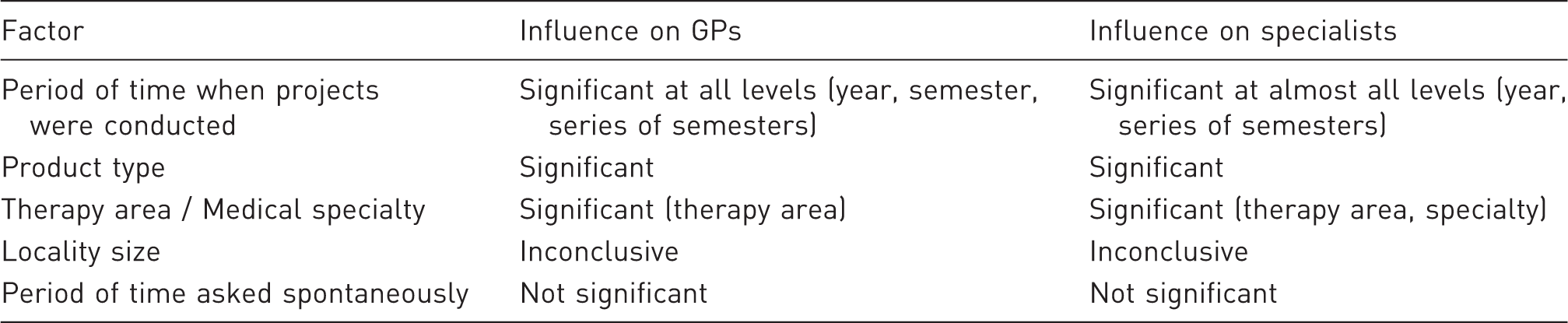
In GPs, with one exception, original products perform significantly better than generics in all indicators and all time points. The relation is persistently stronger in SVR than TVR, confirming that original products have a genuinely better impact on GPs than generics.
In specialists, only four semesters out of six can be tested for this factor and 2010 S1 behaves consistently different than the others in all KPIs except TVR (perhaps because it has the lowest sample, n = 219 – the second-lowest sample is n = 494 in 2012 S1). However, a generally significant effect of product type is confirmed in the remaining semesters.
This confirms empirical observations that original products have a higher promotional impact than generics. The result is not unexpected, as original products bring novelty elements in their respective therapy areas, always appreciated by doctors, while generics usually promote along the lines of “as efficient as the original molecule, but at a lower price”.
(3) Therapy area / Medical specialty.
GPs are targeted with products in most therapy areas because they are allowed to renew prescriptions from specialists. This presents the advantage of observing an unbiased influence of therapy area, because in specialists this factor may be confounded with that of the medical specialty itself – the two are not entirely overlapping though, as products in one therapy area can be presented to several medical specialties.
Significant interactions are seen between all KPIs and therapy areas in GPs. The effect suggests that more specialised, “heavier” products are more likely to be remembered than “lighter” ones. The strength of the relation is unclear though, as it varies even in similar therapy area mixes. For example, 2010 S2 and 2011 S1 cover the same three therapy areas, but Cramer’s V shows a stronger relation with TVR in 2010 S2 and with SVR and KMR in 2011 S2.
In specialists, with one exception, if a semester shows a significant effect of therapy area, then it also shows a significant effect of specialty, usually with a similar magnitude. The strength of the relation is again not clearly related to particular KPIs, the same as in GPs. However, more “specialised” products do not always perform better than “lighter” ones in specialists, which may be caused by the added effect of the medical specialty. The data set is not large enough to break down the sample into each medical specialty across each therapy area, but it is clear that the two factors have a significant effect on promotional impact, at least when taken individually.
Based on results in GPs, doctors seem more likely to pay attention to promotion of specialized products. This suggests a natural ordering of promotional activities in doctors’ minds, depending on the severity of the affection they treat – the more severe the indication (e.g. cardiology vs. digestive diseases), the more attentive they are likely to be when the pharmaceutical representative presents the product and therefore more likely to remember the visit.
(4) Locality size.
Locality size displays an unclear pattern. In GPs, it has a generally significant impact (p < 0.01) on all KPIs, but omits some semesters at random, while the influence on specialists is even harder to define. The magnitude of the effect (Cramer’s V) also varies wildly: within the same KPI, it shifts from 0.06 to 0.20 from one semester to the next in both samples. Given the unstable behaviour of these results, the influence of locality size is considered inconclusive for GPs and specialists alike.
(5) Period of time asked spontaneously.
This potential influence was addressed because the VMR surveys included in this research shifted from predominantly “last month” to “last week” or “last 2 weeks”. This was consciously devised because, in theory, doctors were supposed to remember something recent better than something distant.
This indicator shows the highest degree in variation. As observed in Table 4, GP results are comparable only in 2010 S2 – two periods of time asked spontaneously, both for original products – and they show no significant effect of period. The significant results in the other semesters may be attributed to the influence of product type and/or difference in sample sizes, which the Chi-squared test is sensitive to. In specialists, results are comparable in:
2010 S2 and 2011 S2, with different outcomes despite referring to the same two periods of time in original products and marginally in 2012 S2, which shows some imbalance of sample sizes (lowest is 68 and highest 296), potentially influencing the positive outcome. Examining the influence of the period of time asked spontaneously in GPs and specialists, considering the potential confounding factor product type and seeking comparable sample sizes in order to observe an unbiased result of the Chi2 test

Overall, there is not enough evidence to support that the period of time asked spontaneously has a significant influence on KPIs in either GPs or specialists. However, this influence should be studied further if comparable situations are found in practice.
While it seems logical for recent events to be remembered better, implications would actually be worrying for business practice: promotional impact would depend on something as small as the wording of a question and a researcher could significantly affect results simply by asking about the “wrong” period of time. It is therefore a relief that detailing impact does not appear to fade in a month and researchers can use all variants of the question without affecting the outcomes.
Summary of results: which factors have a significant impact on KPIs
(Q2) Alternatives to traditional benchmarks
The significant influence of time on KPIs suggests that traditional benchmarks (average values of recent surveys) are irrelevant in practice: companies conducting VMR in spring/summer will perhaps worry unnecessarily for a lower performance compared to the previous cycle, while companies conducting VMR in autumn/winter may congratulate themselves unduly for an apparently better impact.
Instead of referring only to the few surveys conducted in the previous semester, the data set can be treated as a whole to establish overall probabilities, also considering the factors of influence:
(a) What are the odds of GPs/specialists remembering detailing when prompted (given that they did not remember it spontaneously)? (b1) What are the odds of GPs/specialists remembering key promotional messages, given that they remembered the visit at least when prompted (not only spontaneously) (b2) What are the odds of GPs/specialists remembering key promotional messages, given that they remembered the visit spontaneously? Are there differences compared to (b1)? (c) What are the odds of GPs/specialists remembering detailing spontaneously?
KPIs were coded as binary variables, so logistic regression can answer these questions. GPs’ and specialists’ samples are treated separately, as in the previous section. Of the factors of influence, only product type and semester (S1, S2) can be used as predictor variables in order to develop a meaningful model for future usage. The year, series of semesters and therapy area/medical specialty are too specific, as they refer to times in the past or to only a part of all possible pathologies and specialties.
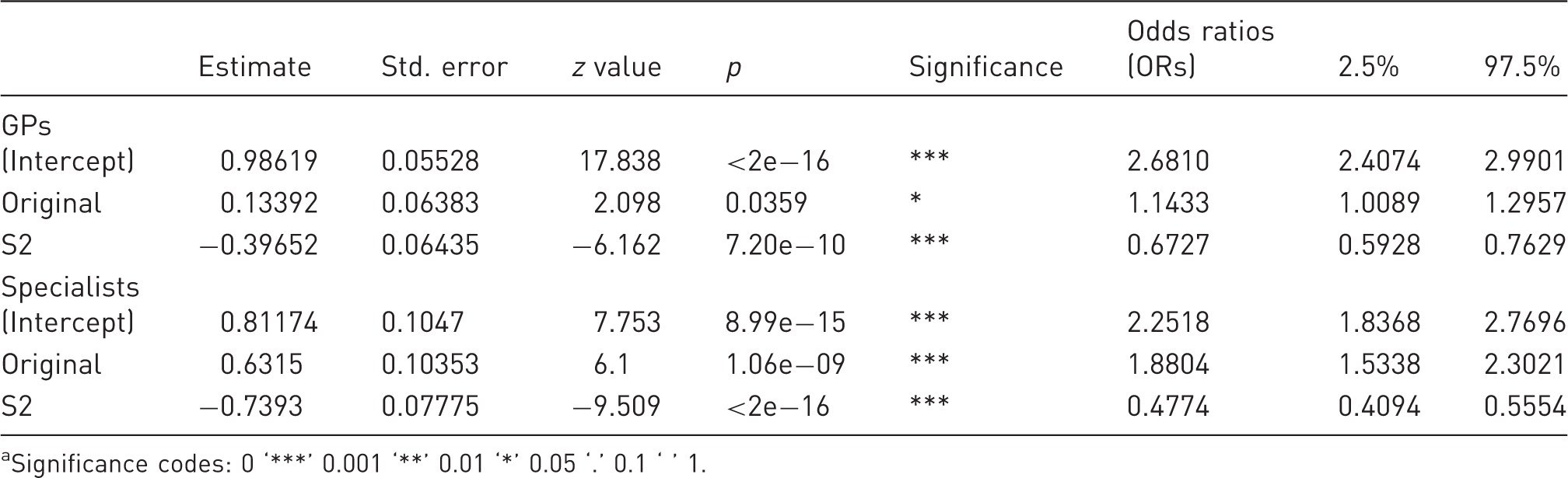
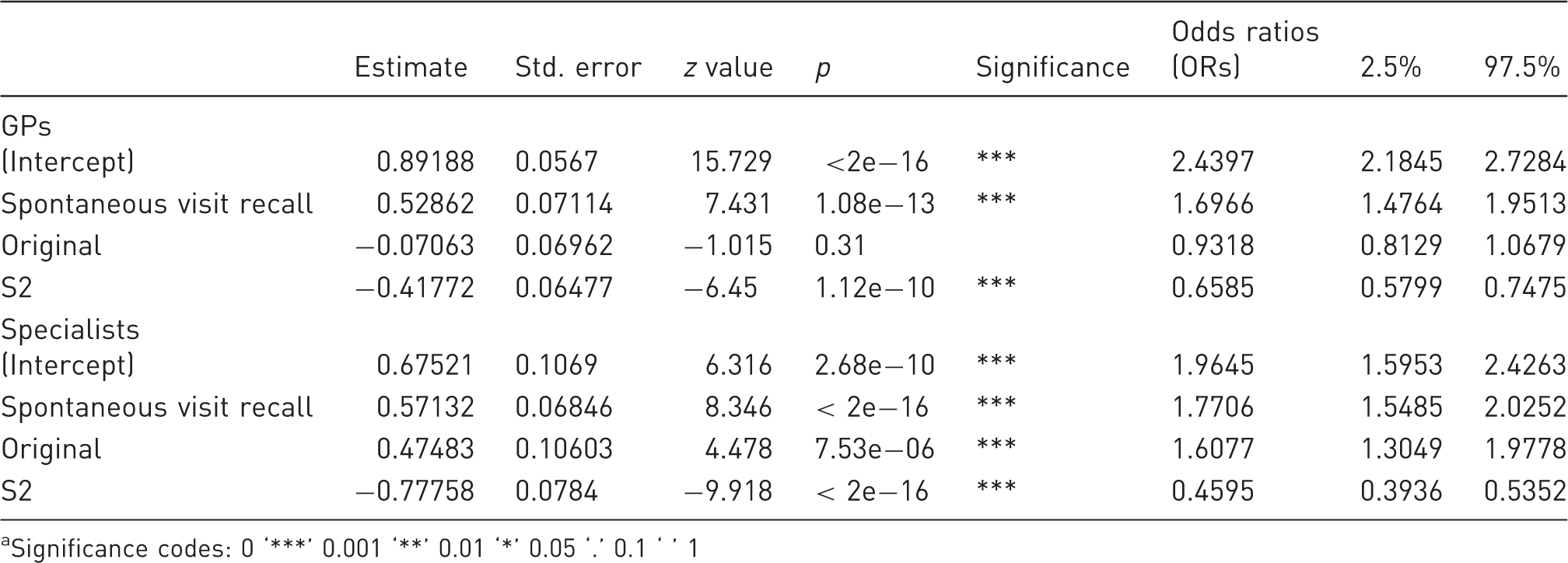
(a) Visit recall was prompted only for respondents who did not remember it spontaneously, therefore we used the data subset where SVRT = 0 (SVRT = 1 automatically implies TVR = 1, distorting results if included). Prompted visit recall was the response variable and product type and semester were used as predictor variables; the resulting models, detailed in Table 6, are: (b1) A regression model with KMR as response variable and product type and semester as predictor variables was applied to the data where TVRT = 1. The resulting models, which show the overall probability of remembering a campaign message, are detailed in Table 7: (b2) A regression model with KMR as response variable and SVRT, product type and semester as predictor variables was applied to the data where TVRT = 1. The resulting models, detailed in Table 8, are: Results of the regression model explaining prompted visit recall by product type and semester
a
Significance codes: 0 ‘***’ 0.001 ‘**’ 0.01 ‘*’ 0.05 ‘.’ 0.1 ‘ ’ 1.





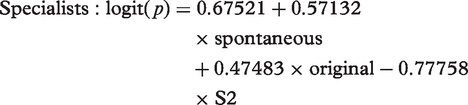

By holding product type and semester at a fixed value, the odds of remembering the message for spontaneous over prompted visit recall are 1.70 for GPs and 1.77 for specialists – in other words, the odds of doctors remembering the message are higher if they remember the visit spontaneously than prompted, by 70% in GPs and 77% in specialists. This research cannot reveal precisely what makes a visit interesting and memorable (though it suggests interesting messages may be a part of it), but if visits remembered spontaneously are more likely to be remembered by their promotional messages as well, it might follow that these are more likely to alter prescription behaviour.
(c) The last question is perhaps the most important of all – and the most difficult to answer, considering that of the four factors of influence only two can be used in a meaningful model.


Results of the regression model explaining message recall by product type and semester a
Significance codes: 0 ‘***’ 0.001 ‘**’ 0.01 ‘*’ 0.05 ‘.’ 0.1 ‘ ’ 1.
Results of the regression model explaining message recall by spontaneous visit recall, product type and semester a
Significance codes: 0 ‘***’ 0.001 ‘**’ 0.01 ‘*’ 0.05 ‘.’ 0.1 ‘ ’ 1
Results of the regression model explaining spontaneous visit recall by product type and semester a

Significance codes: 0 ‘***’ 0.001 ‘**’ 0.01 ‘*’ 0.05 ‘.’ 0.1 ‘ ’ 1.
Discussion
This study investigates factors which make some promotional visits to Romanian doctors more memorable than others:
Product type and therapy area / medical specialty show significant effects in GPs as well as specialists. These findings are consistent with empirical observations that original and more “specialised” products are remembered more than generics and “lighter” products, respectively. For business practice, it gives companies an objective expectation of their impact depending on which product they promote, at what time. For academia, these are objective factors that can be taken into account when studying the impact of detailing on prescription habits. Promotional impact is also influenced by the period of time when projects were conducted (year, semester, series of semesters). A higher promotional impact in the second semester (80% of which included studies conducted in November–December) suggests that Romanian drug promotion follows a seasonal pattern. This can be caused by a complex set of factors: on one hand, companies may be more likely to include VMR survey results in end-of-year evaluations and representative bonus schemes; on another, representatives themselves may be more likely to intensify their field activity knowing they would be evaluated through VMR or that VMR results would be presented and discussed at the next marketing/sales meeting. The influence of the series of semesters suggests that results on one point in time depend on the time itself – one may run across better or worse results depending simply on which other surveys were conducted recently, and in which semester they were conducted. This is also consistent with practical concerns: if a long-term VMR client who usually achieves high results decides to skip a semester or to conduct the study with another research agency, the appropriate benchmark will be affected. This situation has happened in practice, when a client achieving outstanding visit recall rates switched research provider. This was perhaps the first reason to ask the question behind this research: are we, practitioners, offering our clients truly reliable benchmarks knowing the influence that a single client can have on them?
The current business practice is to compare results with average KPIs of similar surveys no older than 6 months; however, we have seen that these are subjected to the “luck of the draw”, therefore companies need more reliable benchmarks to understand whether their performance is indeed improving or they have simply run across a favourable comparison term through no merit of their own. Instead of traditional benchmarks, KPIs were examined using logistic regression models on the entire relevant data sets. Product type and semester were included as predictor variables, but therapy area / medical specialty were omitted as they are too specific to generate useful models for future usage.
Turning regression model (c) into probabilities, different values can be computed for each product type and semester a
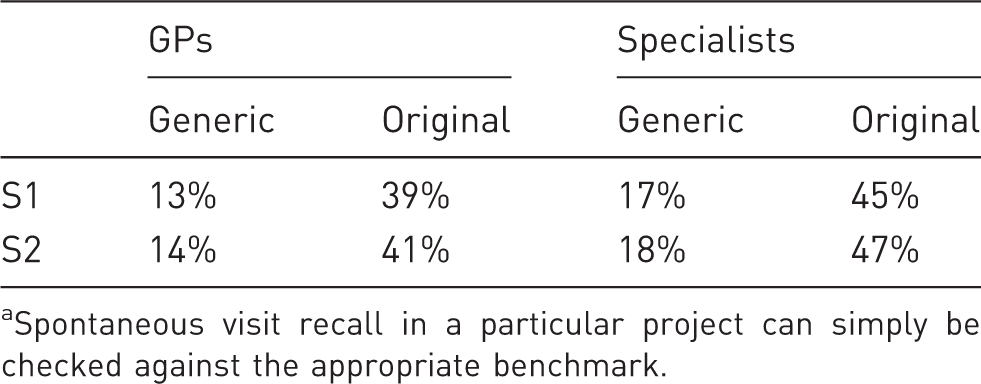
Spontaneous visit recall in a particular project can simply be checked against the appropriate benchmark.
However, as highlighted before, we recommend researchers to rely more on prompted/TVR and message recall evaluation options – models (a) and (b). The proposed SVR model is important for offering a better benchmark than averages and for being the first such option in lack of other research on this topic, but SVR is influenced by two other factors not included in the model and each project behaves wildly different from the next. The variability of this particular KPI suggests that further research is necessary to properly understand it.
Strengths
Real-life, large data set. Long-term historical data available. These two strengths are particularly important as the data collection time was significantly related to the outcomes, so each semester could be treated as an individual subsample while still retaining a reliable sample size. The selected surveys are comparable even in aspects such as the nature of detailing: product reinforcement rather than novelty/first-time presentation. This is important as novelty visits are empirically more likely to be remembered (altering KPIs), but product reinforcement is much more common in practice. Proposed regression models are an alternative to traditional benchmarking, eliminating the influence of some of the identified factors and using a more relevant comparison than recent surveys. They offer a relatively simple measure of expected VMR rates in a given product type and semester, useful in both business and academia.
Limitations
(1) An intrinsic limitation is the impossibility to ever study the full promotional impact: even if all research companies pool their data sets, some pharmaceutical companies would be missing for not having demanded such surveys. The measure of this error is impossible to determine, but may be important, especially as results depend on the surveys conducted at each point in time. (2) Although significant, the influence of therapy area / medical specialty was too specific to include in the regression models, which are meant for future usage rather than examining the past. This may particularly affect the SVR model. (3) Results may only describe the behaviour of Romanian doctors. Studies have shown differences in preferred information sources in several European countries
2
and doctors may react differently to detailing depending on how much they prefer it in general. Researchers in other countries are advised to check the factors revealed in this study on their own data sets.
Conclusions
This study relies on an extensive, real-life data set and shows that:
Results of VMR surveys depend on the projects conducted in each semester. For the business environment, it implies that benchmarking versus recent survey averages is an unreliable measure of one’s performance, since it depends on which pharmaceutical companies choose to conduct surveys at a particular time (also on which of these are won by the research company!). Other forms of benchmarking are necessary, like the proposed regression models, in particular models (a) and (b). Some categories of products do perform better in VMR surveys, for example originals, products in “specialised” therapy areas and promotional activities conducted in the second semester. It indicates that doctors actually perceive promotion differently depending on the product type, therapy area and moment of promotion; business and academia should use these criteria, incorporated into the regression models, to gain a realistic expectation of promotion impact of a given product at a given time. Also, doctors who remember visits spontaneously are more likely to remember promotional messages than those who remember visits only when prompted. This is an interesting result, suggesting that doctors who are more open to promotion (visits) may also be more receptive towards product messages. Academic research should examine whether these types of visits and product categories also have a higher impact on prescription habits. Some limitations of this research cannot be overcome because of the very nature of VMR surveys: at no point will all pharmaceutical companies conduct them – with the same company, so “full” promotional impact will never be known. However, this study is a first step into understanding factors which make some visits more memorable than others.
VMR surveys, although not easily accessible to the general public, can provide important insight into what makes some promotional activities more memorable than others. Results of this study can help academia examine the connection between memorable detailing – not just detailing in general – and changes in prescribing behaviour.
Finally, we understand that the topics examined in this study stand in the ethical shadow of marketing pharmaceutical products to doctors. Studies which show factors of influence on visit memorability should naturally be regarded with concern – after all, although disseminated in academia, there is no guarantee that business may not wish to profit from them to achieve higher detailing impact. We are therefore happy that this research will not help pharmaceutical companies in this direction, as the factors of influence are objective: product type, therapy area, medical specialty and which competitors conduct VMR at one time cannot be changed, while detailing only in the second semester to achieve a higher impact is an unrealistic marketing plan, more likely to damage product image and sales rather than improve them.
Footnotes
Conflict of interest
All data were collected by Company (author’s previous employer) on behalf of their respective customers. Analyses behind this article began in March 2013; all were run during author’s employment within Company, at the author’s initiative, separate from work duties and outside working hours. No data was removed from Company and no further analyses on the original data set were performed after leaving Company (18th October 2013), but the text was rewritten and refined after this date based on existing outcomes. An article outline was presented to Company management for review (April 2013), but by end of employment no formal position was made on its publication; for this reason, all identifying informations have been removed from the study to protect company identity.
Funding
This research received no specific grant from any funding agency in the public, commercial, or not-for-profit sectors.