



Abstract
The repercussions of product innovation crisis in big pharma drive the generic pharmaceutical industry to lower its dependence on original pharmaceutical industry. Moreover, an important change is happening in the classic model of R&D in pharmaceutical industry. How is generic industry coping with this evolution? This study aims to understand how generic firms orchestrate and promote innovation strategy in product portfolio, while ensuring the value creation for a sustainable presence on the market. A qualitative research methodology consisting of a literature review and several in-depth interviews with senior managers working in both the technological and business development areas were realized between 2011 and 2013. The results were analyzed by using Nvivo10 software. Our results show that switching to more investment in R&D is becoming a new marketing strategy in generic pharmaceutical industry. New organizational design of low risk innovation is emerging in the strategies of R&D model, the change is observed in: (1) form of the R&D organization, and (2) the tools for R&D, all aiming to capture the entire markets rather than following them. The classic product vision in generic pharmaceutical industry is evolving toward a new phase with regard to emerging marketing challenges and the demand for low risk innovation models. This implies using new technology platforms in drug delivery, to preserve a competing and sustainable market share.
Introduction
For years, generic manufacturers have done the things in a certain way, promoting their products with success. 1 Over the years, the innovation model in pharmaceutical industry has undergone several changes. Aside from innovation system, other major areas have changed. First of all the value network and collaboration, second the emergence of new players, especially smaller and medium-sized companies. Third, the business model concept has evolved from a single uniform model to a platform of models. The value proposition is no longer based on a single product aimed at very large markets but on providing services and solutions. The pharmaceutical industry is now looking to develop a care environment. This change in value proposition is shaping the whole new marketing strategies that have emerged from “radical innovation” crisis in big pharma.
The classic innovation engine, the R & D model, is historically known as the official model of innovation in a firm. 2 In the past, this model was widely used so successfully that today it is difficult to imagine an innovative firm without the classic R&D structure. Historically, R&D has been structured to support the blockbuster strategy. This meant very expensive R&D and standardized processes. 3
The current challenges of innovation in big pharma that is resulting in reduced number of blockbuster products are driving the industry into another edge of innovation design. 4 This is perhaps a creative crisis influencing positively the generic pharmaceutical industry.
The need for real change has emerged from the weak number of innovative products. In the last few years, many companies are criticized by shareholders, investors, and regulators for their drying pipelines. The lack of improvement in product pipeline shows that continuing to increase R&D spend will not eliminate the shortfall in product output nor will increase process efficiencies or organizational restructuring. The lack of results does suggest that the classic R&D may be approaching exhaustion. 5
This falling R&D productivity affects the sustainability of generics, because new product development and time to market issues in generic pharmaceutical industry is directly dependent on the productivity of the R&D based pharmaceutical industry, as it is the source of the future generic product portfolio. 6
It is possible that any firm and not only generic firm rarely innovate on their own but if generic companies restructure their product portfolio with a perspective of innovation-based success, they can operate within new innovation networks including research providers, customers, suppliers, and regulators. As a result of new collaborations, organizations, and management skills, significant success factors may contribute to competitiveness in turbulent markets where there are rapid changes in technologies. Successful generic pharmaceuticals must move away from the dominant designs and invest into not only new product but also new forms of organization.
These new forms are about new organizational methods that aim to reduce risk of failure; cost of production; and time to market, create, deliver, and capture value in a shorter time. 7 Organizational change may involve into more open innovation and give a more collaborative risk sharing and financial support.
Among the best proposed solutions to overcome innovation crisis, we can mention to “a best managerial model” as a solution to R&D managers who need to generate innovative treatments and get FDA approvals. Now more than ever, pharmaceutical companies need a new managerial model for overcoming challenges that often result in defeats. Focusing on efficient, low risk innovation is the best way to overcome sustainability challenges. 8
As for product innovation it is required to be cost effective and achieve to satisfy patient’s new needs, this may involve new challenges for the industry and require a reconfiguration of the costly R&D model. How can be innovative in a less risky and more effective way?
Some of the big generic pharmaceutical companies are stepping up their R&D efforts, having invested in many complex products, acquiring development and process skills, generic firms globally are looking to lower their dependence on original companies.6,9
Today, most of the pharmaceutical companies are struggling to find new ways to remain competitive and innovative. Regulatory issues are also challenging and play a decisive role.10,11
Though there is a sizeable generic opportunity in 2013–2015, several generic pharmaceutical companies are leveraging their main activities to focus more on innovation. 12 This way they can compete better on product quality rather than product price (so-called blue ocean strategy). 13
This upside potential may emerge from product strategy like differentiated generic products, launching into biosimilars, and drug repurposing.
This has been visible among companies such as Teva, which after the success of Copaxone, has increased efforts on basic research. 14
In this paper we analyze how integration into new R&D models can improve marketing strategy for generic companies, redefine the product innovation paradigm, and minimize the risk and the cost of production.
Methodology
Research data collection involved two forms of methodology: an extensive literature review and a qualitative analysis of in-depth interviews with senior pharmaceutical respondents.
Semistructured interviews
According to Labov and Fanshal, interview is a speech event. 15 There are three fundamental types of research interviews: structured, semistructured, and unstructured. Semistructured interviews consist of several key questions that help to define the areas to be explored, but also allows the interviewer or interviewee to diverge in order to pursue an idea or response in more detail. 16 This interview format is used most frequently in healthcare. “The flexibility of this approach, allows for the discovery or elaboration of information that is important to participants but may not have previously been thought of as pertinent by the research team.” 17
Our data were collected from semistructured interviews with pharmaceutical firms’ managers in European and US firms. These interviews offered the opportunity to ask experts about their views and experiences of the recent changes. Content analysis was carried out manually using Nvivo 10 software (it is the software that supports qualitative and mixed methods research. It lets you collect, organize, and analyze content from interviews, focus group discussions, surveys, audio).
Literature review
Other information was collected using the scientific databases and international journals specialized in management, strategy, and pharmaceutical innovation. We have also used the presentations of international conferences about generic pharmaceutical industry. In these academic articles, several solutions are proposed to cope with productivity crisis in pharmaceutical industry. 18 Some of these proposals focus on increasing the efficiency of corporate R&D, on collaborating with academic drug discovery centers, and the public–private partnerships. 18
There has been little investigation into ways in which changes in the marketing environment may change R&D incentives or how changes in the research environment might alter incentives for marketing. 19
According to Scherer, the link between gross profitability and pharmaceutical R&D spending that successful R&D leads to new products, which depending on the reception in the market can add great profits to the pharmaceutical firm. 20
However, applying these theories into generic pharmaceutical activities will need adaptation, a clear relevance between the current evolution and these observations can be observed.
Results
A picture of contemporary trends provides few managerial insights and methods for designing the new models. What kind of R&D models is required for generic pharmaceutical industry? This new model needs the capacity to manage to organize and to start the action despite uncertainties regarding economic interests. 21
Sorescu et al. find that (1) the majority of radical innovations come from a minority of firms, (2) firms with better marketing and technology support benefit more from radical innovations, and (3) firms that have a portfolio with greater depth and breadth obtain higher rewards from radical innovations.22,23
The innovation story in generic pharmaceutical industry is not new. Over the past few years, the growth of the generic API market has significantly influenced the API market of innovative pharmaceutical companies. Since risk minimizing is an important part of cost-effective strategies, generic pharmaceutical leaders are looking into new product pipeline collaborations, partnerships, and alliances as a solution to reduce the risks and costs. This can be a way to explore new alternatives to the classic costly R&D model. 6
The strategic challenges in evolving generic pharmaceutical industry should always consider the increasing competition pressure. This can drive the companies to differentiate not only in their products and business policy but also the way they define their business and promote their innovative products. They may create new markets, new demands, or aim emerging markets though the risk factors are high. Strategy may also find solutions for regulatory changes, customer changes, and other market access hurdles. Patent cliff arena, fierce price competition, and the additional factor of requiring “outcomes-based medicine” are putting extreme pressure on generic pharmaceutical industry.
Recent trends suggest that big generic firms are better suited to the operations required for clinical trials and marketing drugs, whereas small companies can explore niche areas with a strong science-based focus. 23 This issue requires further research in terms of research and external partnerships, and how this depends on the firm’s sustainability strategy.
Our research work has observed a need to change in R&D model because of marketing strategy. This is expected to be a new industry paradigm “New Pharma” with various new players who play differently. 10 The important thing is that this new industrial design within generic pharmaceutical can influence and lead new effective strategies to enable innovation in other market segments.
Innovation in technical development can also contribute to new therapeutic uses, patient compliance, and increase market access opportunities.24,25
Thus, the main results of our research are collected in Table 1, under this classification five major issues are focused in this article. Three issues are classified under two principal changes:
change in organizational form of innovation (financing, IP issues, etc.); the change in innovation tools and optimizing the results and efficiencies. The new R&D models in evolving generic pharma industry, some characteristics
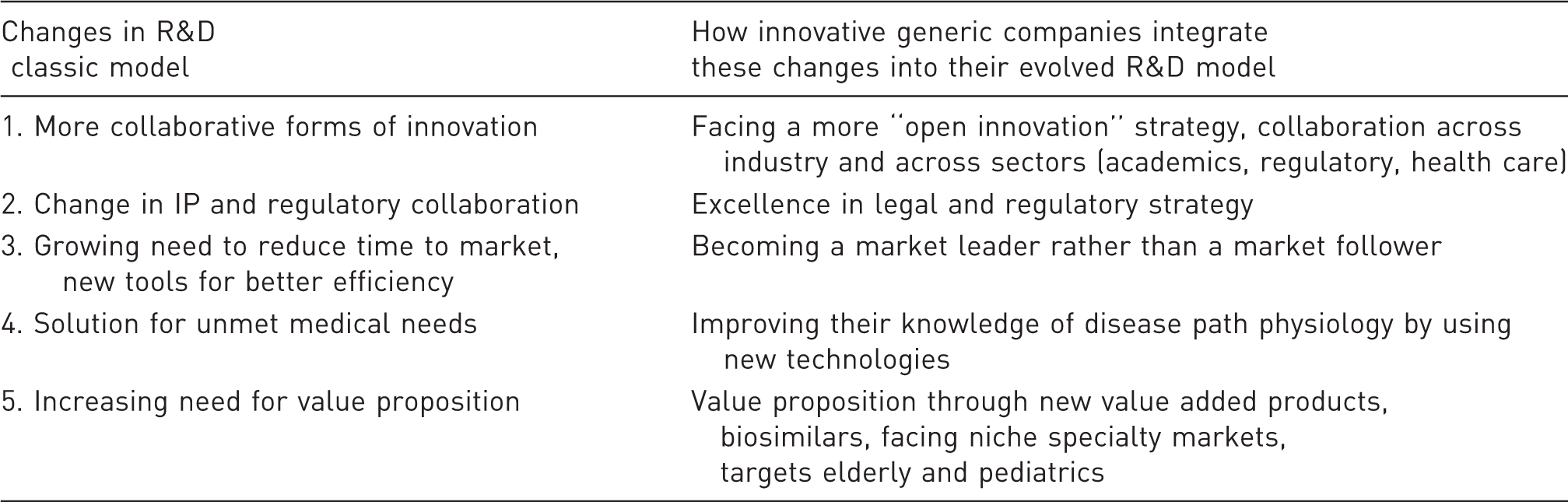
The results are explained according to the order presented in this table.
Switching to more “open innovation” models?
Traditionally, pharmaceutical R&D has two phases: product research and process development for production (Figure 1).
26
Process development occurs in parallel with the product development and is responsible for producing the compound in relatively large quantities, in pure form, at an economically feasible cost and by following all the regulatory requirements. Product development research has two distinct components: discovery and development. The discovery stage represents the innovative phase in the pharmaceutical product R&D.
The evolution of R&D model in generic industry – change is observed both in form and tools of innovating.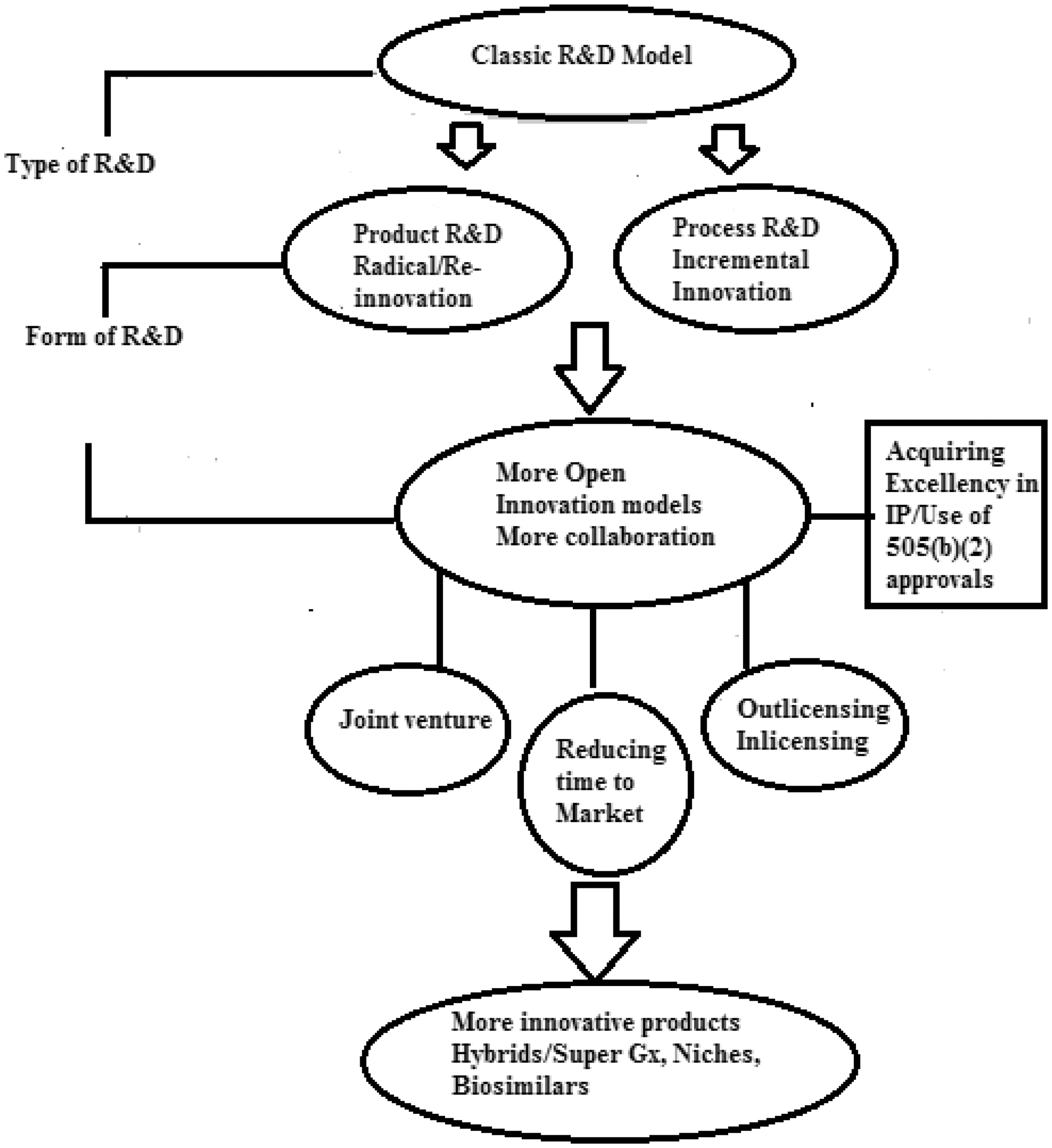
Figure 1 shows how innovation types and forms are divided into product, process, and their link to regulatory affairs. The regulatory pathway for innovative generics can therefore influence the innovative reorientation in this industry.
In search for alternative models, open innovation has been considered as a good candidate substitute, in which the drug discovery process evolves towards a collaborative process among various players.27,28 The key objective of open innovation is to lower the cost of drug discovery initiatives, with firms using external ideas and research to advance their own research and development. 29 There is the risk that companies might end up revealing more about their research than they had intended to share. In addition, such a model involves increased complexity in controlling innovation and regulating contributors. 30
Academic–business research collaboration (the capitalization of knowledge) can be a promising option in this way for many generic pharmaceutical companies and this can provide more creative solutions.
Generic pharmaceutical companies can face open innovation as a very possible alternative.
A pharma manager has said: “… This kind of model, involve ‘regenerating’ functions, renewals in competencies, creating new alliances and new interfaces between the existing functions” (pharma Manager USA 2013).
The need for regenerating R&D model and reducing risks is urgent; a successful strategy may consider the reconfiguration of its innovation model.
Collaborations, alliances and partnerships: risk sharing and increasing capacities
If size or capacity of an evolving generic company is limited but they aim to undertake a R&D model, external collaborations are the solution. These are between the company and stakeholders, including academic researchers, CROs, providers, and payers. Several examples show how effective external collaboration can broaden capabilities and insights:
External partners, such as CROs, can quickly add internal capabilities and provide access to expertise in, for example, best-in-class management of clinical studies. Academic collaborators can share insights from the latest scientific breakthroughs and make a wealth of external innovation available. Collaborative “open space” initiatives can enable experts to address specific questions or share insights.
31
Even if joint ventures are associated with more global innovation generation than other types of alliances,
32
industry research investments are risky and may be managed prudently on behalf of the stockholders.
33
Figure 2 shows that “change” in classic model of R&D is connected to business model requirements, managing system, and can be realized through change and improvement in the knowledge of disease, patients’ need and compliance, meeting cost-effective criteria of the payers, finding new regulatory pathways to find a faster way to market and to reduce costs.
The principal change Matrice, resulting from our research. Nvivo software is used to create this matrix.
Improve safety and risk management, acquiring IP and regulatory excellence
Generic pharmaceutical companies can use safety issue as competitive advantage in regulatory submission and even after the market entry. Safety monitoring is moving beyond traditional approaches to sophisticated methods that identify possible safety signals arising from rare adverse events. Furthermore, signals could be detected from a range of sources, for example, patient inquiries on Web sites and search engines. Online physician communities, electronic medical records, and consumer-generated media are also potential sources of early signals regarding safety issues and can provide data on the reach and reputation of different medicines.31,34
An early response to physician and patient sentiments could prevent regulatory and public relations hurdles.
However, harmonization is critical and is having a serious impact on drug development programs. These areas need review national governance, which is another important issue moving forward and impacts on many facets of the global pharmaceutical industry.
Trying to become a market leader not a market follower: Towards more data focused R&D, growing need to reduce time to market
Changing R&D models can be realized by several considerations. By applying data strategies to better inform decision making, innovation can be optimized by improving the efficiency of research and clinical trials, and building new tools for physicians, patients, insurers, and regulators to meet the promise of more individualized approaches. 34 Effectively utilizing these data will help pharmaceutical companies better identify new potential of drug candidates and develop them into effective, approved, and reimbursed medicines more quickly. This can meet their objective of reducing time to market. “… Scientific research is not the only way to higher research and development productivity, Attention to areas of product cost, time to market, lower risk and decision making can bring rewards” (Pharma manager US 2012).
Predictive modeling could help identify new potential/candidate molecules by relying on the diversity of available molecular and clinical data with a high probability of being successfully developed into new drugs.
Patients are identified to enroll in clinical trials based on more sources, for example, social media. Furthermore, the criteria for including patients in a trial could take significantly more factors (for instance genetic information) into account to target specific populations, thereby enabling trials that are smaller, shorter, less expensive, and more powerful. 35
Trials are monitored in real time to rapidly identify safety or operational signals requiring action to avoid significant and potentially costly issues such as adverse events.
Those innovative generic firms that are capable to undertake clinical trials can aim to improve the efficiency. A combination of new, smarter devices and fluid data exchange will enable improvements in clinical trial design and outcomes as well as greater efficiency. Clinical trials will become increasingly adaptable to react to drug safety signals seen only in small but identifiable subpopulations of patients. Examples of potential clinical-trial efficiency gains include the following:
Dynamic sample size estimation (or reestimation) and other protocol changes could enable rapid responses to emerging insights from the clinical data. Efficiency gains are achieved by enabling smaller trials for equivalent power or shortening the time necessary to expand a trial.
31
Adapting to differences in site patient-recruitment rates would allow a pharmaceutical company to address underdeveloped sites, bring new sites online if necessary, and increase recruiting from more successful sites. Increased use of electronic data capture could help in recording patient information in the provider’s electronic medical records. Using electronic medical records as the primary source for clinical-trial data rather than having a separate system could accelerate trials and reduce the likelihood of data errors caused by manual or duplicate entry.31,36 Next-generation remote monitoring of sites, enabled by real-time data access, could improve management and responses to issues that arise in trials.
31
We wanted to make discoveries at a higher rate and in a more predictable way, rather than just depending on the “eureka” moment, by promoting access to seemingly disparate but ultimately very relevant prior knowledge. Our platform was very well-suited for drug repositioning because it allowed us to look at the drug’s efficacy as well as the unwanted side effects… . (Pharma manager 2M US 2013)
A pharma manager noted that one of the issues that can arise is “repositioning” another hot subject that needs more investigation and attract more and more attention.
Our results can also give way to considerations about the need to improve the assessment of the clinical performance to improve the quality of clinical research. In addition, to speed up clinical trials and reduce their costs, IT-based interfacility networks shall be established and clinical trial document formats. IT-based networks shall be established and also standardization of clinical trial document formats may help to capture better results at shorter time.
New tools to satisfy unmet medical needs: Use of new discovery technologies
In general, pharmaceutical R&D must use advanced tools. These include new modeling techniques such as systems biology and high-speed data-production technologies, that is technologies that produce a lot of data quickly, for example, next-generation sequencing, which, within 18–24 months, will make it possible to sequence an entire human genome at a cost of roughly $100.31,37
The efficiency of new data and improved analytical techniques will promote future innovation and enrich the drug development pipeline. From an innovative standpoint, innovation is needed not only in the way we modulate a target, or what we measure, but also we need to improve our understanding of what really happens in a disease at the molecular level, and how we can translate it into a clinically objective against which we can propose another option.
There are numerous companies in this space, including some generics firms, who focus on technology platforms that offer broad application potential.
Some developments may contribute to better diagnostics and increasingly precised treatments. This can even become a part of the drug development process and would lead to new discovery technologies and analytical techniques.
Integrating large amounts of new data can also be used to test a pharmaceutical company’s analytical capabilities. For example, a company will need to connect patient genotypes to clinical-trial results to identify opportunities for improving the identification of responsive patients.31,38
Value proposition: To fit in value-based pricing systems, satisfying pharmacoeconomic considerations
A growing number of healthcare payers are now focusing on pharmacoeconomic performance of medicines. Extensive adoption of electronic medical records will give them the outcomes data they need to determine best medical practice. So innovative generic companies may have to prove that their medicines really work, provide value for money, and are better than alternative forms of intervention. 28 Pricing pressures resulting from healthcare reforms and changing market dynamics have largely offset the impact of expanding product portfolio and geographic footprint for many companies. Of the many generic market segments out there, companies that choose to compete in this space must first determine which segments to target. Each segment requires a different operational strategy and has different implications for revenues and profit margins. 39
Business leaders then need to identify which therapeutic areas to pursue. Examples include niche-based areas (such as oral steroids) and multispecialty coverage areas (such as cardiovascular drugs and antidiabetics).
Each generic segment requires a unique set of capabilities in R&D, manufacturing, and sales and marketing. The capabilities required to play in the branded and differentiated generic segments are similar to those needed for success in the big pharmaceutical arena. Thus, large pharmaceutical firms can leverage existing capabilities to enter these segments relatively quickly. On the other hand, the plain generic segments require capabilities that most big pharmaceutical firms do not have, such as an ability to develop many products quickly. Companies that decide to compete in these segments will need to ask whether they have the required capabilities and, if not, whether to acquire them through M&A or other means.
Discussion
The fast pace of change in markets, technology, and competition to present a cost-effective product40,41 is opening a new arena. In this new era, the ability of generic pharmaceutical firms to create new knowledge for innovation has become strategically important. Because of fewer number of blockbusters the generic pharmaceutical companies try to find an exit and save their sustainability by becoming less dependent to big pharma. This requires investment in R&D. The classic model is very costly, so the change in R&D model may aim to find and create new value without having to make “heavy investments.” Traditional boundaries and links need to be revisited and a new dynamic partnership across sectors can be established.
In terms of the regulatory function with change in R&D model, major changes to the current framework are required for the future. The generic pharmaceutical industry needs an increased focus on data and search for value in outcomes.
More use of effective data can be a source of valuable insights for R&D managers.
The switch to changing R&D models is also in response to the important shift in the way that governments and other payers define the value of new products.
Given the large investment and skill required in conducting clinical trials and evaluating clinical data for innovative therapies, generic companies have adopted a new approach, an easier one to leveraging innovation. Most of these innovations are based on the existing products where companies have made minor or important changes to improve patient compliance. This involves different drug delivery, manufacturing or formulation technology, or new therapeutic entities (NTEs) (known molecule that is formulated, delivered, or used in a novel way to address specific patient needs). Working with new technology platforms enables the generic pharmaceutical industry to enhance their capabilities. If these new technology platforms are not accessible by the company, then in-licensing allows to access novel technologies and may offer some cost efficiencies. However, in-licensing doesn’t eliminate the risk associated with drug development. To prepare for the post-2015 period, several generic companies are investing in niche therapies such as asthma/chronic obstructive pulmonary disease, or difficult to copy areas such as injectables, inhalers, transdermals, and topicals, which require investment in technology.41,42
Cases of successful generic companies that have restructured a modern R&D mode and have made it a successful business argument reveal how a significantly new model can help companies to outperform their competitors. Despite these benefits, explicit change into classic R&D model does not appear to be a very common approach in practice (at least not yet), but the need of change in this model is real and an increasing number of pharmaceutical companies, specially those generics companies switching into more innovative portfolios and some biotech companies attempt to adhere to more innovative models. 43
Conclusion
Even if the emerging markets are very attractive for generic firms, switching into more investment in R&D as a long run strategy can be considered as a modern business/marketing option.
Focusing on R&D provides value creation for many generic pharmaceutical firms. As competition in the pharmaceutical industry increases consumers become more selective and consequently they require better products/treatments. 44
Research and development may become the industry’s core value generator. Considering fast changes and progress in science and technology, it is clear that classic model will not fit Every Where. The essential change will be to new forms of collaborative R&D. All will design a faster time to market, better “patient compliance” as value proposition, aiming for game changing strategies. Those generic pharmaceutical companies who invest in changing form of R&D and use new tools and techniques aim to ensure their sustainability in a harsher competition environment.
Footnotes
Funding
This research received no specific grant from any funding agency in the public, commercial, or not-for-profit sectors.
Conflict of Interest
None declared.