



Abstract
Today, almost a century after gaining access to the country’s most prestigious secondary schools, determining the academic achievement of African Trinidadian students remains a challenge as neither Trinidad and Tobago’s Ministry of Education nor the Caribbean Examination Council, the regional agency responsible for administering standardized testing in the Caribbean, collect school data based on student ethnicity, race or socio-economic class. Public reporting is done at the aggregate student level and school reports for each examination subject are issued and are publicly available online. This article situates the education of African Trinidadians within the social and historical context of Trinidad and Tobago by first providing a brief overview of the history of education and cultural formation in the country since emancipation followed by a theoretical discussion which attempts to explain the educational achievement of African Trinidadians. A comparative look at the situation in Fiji and the way that affirmative action might address underachievement is also presented. The authors also call for the collection of empirical data on student ethnicity and socio-economic class in order to determine and address any educational disparities that may exist.
Introduction
In Trinidad and Tobago, all Form 5 (Grade 11) secondary school students are eligible to take the Caribbean Secondary Education Certificate (CSEC) examinations which certify them for work. Students intending to attend university go on to take the Caribbean Advanced Proficiency Examinations (CAPE). CSEC or CAPE school reports reveal a holistic system of reporting that consists of explaining the number and types of questions on the test and their organization by section. Although the reports explain how the units were answered overall by the students and shows whether or not the students had difficulty in answering the questions (CXC Country (T&T) Report, 2011), neither of the two reports provides any demographic details about the students taking the examination.
Researchers and educators wanting to speak to the examination performance of various ethnic or social class student groups have had to rely on unorthodox and informal methods such as the student’s surname to identify ethnicity. Others base their assumptions on the school which the student attends, as concentrated pockets of ethnic populations can be found in urban and rural areas in Trinidad and Tobago and may allow, some researchers contend, for a reasonable identification of student ethnicity or socio-economic class based on school attended. For example, Jules (1994) in her classic study found, using this approach, that students attending the prestige schools were mainly from families whose parents have overall higher occupational levels and greater education qualifications. Students attending the junior secondary and senior comprehensive schools, on the other hand, were more likely to come from families where the parents were employed in manual jobs and possessed lower levels of education (Brunton, 2002).
Jules (1994) also found that there was a pattern of student stratification across secondary schools in Trinidad. This finding is, in a limited way, corroborated by quantitative population census data. For example, according to the National Census Report Trinidad and Tobago, published by Caricom Capacity Development Program 2009, African Trinidadians make up more than half the population in the areas of San Juan/Laventille, and Port of Spain in the north -west of the country, and Point Fortin in the south, and over 94% of the population of the twin island of Tobago. On the other hand, the populations of Chaguanas in central Trinidad and Penal/Debe and Princes Town in the south are mainly Indian Trinidadians.
Using the surname as an ethnic identifier, anecdotal accounts and newspaper opinion articles in recent years confirm that, though individually, African Trinidadian students have performed well on the CSEC and CAPE examinations, there are concerns over the underperformance of the African students as a whole. The concern seems to centre on their ranking in relation to the other dominant ethnic group, the Indian Trinidadians, and particularly on the low number of the prestigious Trinidadian Island Scholarships based on the CAPE examination results awarded to students with African-sounding last names or with African phenotypic features. The opinions expressed in local newspapers, on mainstream radio programmes and in small-scale qualitative studies indicate the perception held by the public that the academic achievement of African Trinidadian students, specifically the male students, is low and with a disturbing trend towards mediocrity (Worrell and Noguera, 2011).
The persistent lack of reliable and valid quantitative data on the ethnicity or race of examinees has meant that research in this area has been limited and the perceptions unsubstantiated by research evidence. However, one popular but uncritical thesis is that African Trinidadians’ educational achievements continue to be seen to be the result of individual competence and generally not attributed to the African race/ethnicity variable. It is claimed that the historic processes that have led to the poor incorporation of this racial group into public institutions of the country, historically done through discrimination, cultural loss, family dislocation and alienation, continue to be perpetuated by the dominant sociopolitical class. These views, despite being unsubstantiated, have implications for the type of social justice that has been meted out in Trinidad and Tobago over the last 50 years post independence from Britain.
That these are tenable hypotheses is evidenced by some small-scale qualitative studies that have explored the attitudes and perceptions of Black education in Trinidad and Tobago. One such micro-study was that conducted by Worrell and Noguera (2011), who interviewed 22 high-school students from two secondary schools in the predominantly African Trinidadian-populated San Juan/Laventille region of Trinidad to find out their perceptions of the educational performance of African Trinidadian men and the possible reasons for this performance. In the structured interview, the participants in the study felt that African Trinidadian men were in a crisis situation and were not doing well academically. Although the majority of the participants believed that the school system treated African Trinidadian students fairly, about half the participants thought that African Trinidadian men faced unique challenges in the school system.
Critics use micro-studies such as these to blame family dislocation, the absence of family values and a more permissive African Trinidadian society for the perceived lack of academic achievement and the social decline of African Trinidadian youths particularly African Trinidadian males (The Trinidad Guardian, 2004). Online newspaper article comments place most of the blame on the breakdown of the family unit. Even popular calypsos, for example, ‘Little Black Boy’ by Gypsy (Winston Peters) in 1994, have had an opinion. Furthermore, reports of institutionalized racism against African Trinidadians have not been documented and instances of discriminatory practices in the schools remain anecdotal. A November Trinidad Express (2011) newspaper article, for example, reported that African Trinidadian students were banned from attending a local Hindu primary school by the school’s religious leaders who were also purported to have asked for the removal of African Trinidadian ministry–assigned teachers.
It is telling that one of the objectives of a quality education in Trinidad and Tobago’s strategic plan for education is to provide professional development for teachers, which would enable them to offer differentiated instruction that would meet the needs of diverse learners and enable opportunities for all to learn (Ministry of Education (MOE), 2012). However, meeting the needs of diverse learners can be difficult if the education system does not know who those learners are and where they are located in the hierarchy of academic performance. Census statistics from the Government of Trinidad and Tobago (Central Statistic Office, 2005) do provide some detailed income data based on ethnicity and race. Income data reported in the census tables show that there is little disparity between the income levels of African Trinidadians and Indian Trinidadians despite the latter population’s perceived greater academic success. African Trinidadians had an average gross monthly income of TT$3638 (US$567). In comparison, Indian Trinidadians had an average gross monthly income of TT$3658 (US$570). However, for the fourth largest of the ethnic groups, Mixed or Creole Trinidadians, the average household income was TT$3850 (US$600). The highest household income group was Whites with TT$12,622 (US$1975). These figures represent a limited snapshot of the economic status of African Trinidadians relative to the country’s other racial/ethnic groupings, and do not support the general perception that African Trinidadians are economically, and by correlation, educationally less successful than other ethnic populations.
Theoretical considerations
The notion of plural society was adopted by M.G. Smith from the work of the colonial administrator J.S. Furnivall (1939). Smith adapted the notion of a plural society to the Caribbean, and in its original formulation, it was conceived as one which comprised more than one social group with each practising fundamentally different cultural institutions (namely, patterns of mating and marriage, religion, language, value given to education, food and recreation). Given the cultural differences, such a society lacked a common set of values and was inherently unstable, which made force indispensable in the regulation of social relations (Smith, 1984).
The pluralist thesis was challenged by social scientists for its various conceptual, theoretical and empirical shortcomings including its failure to consider the processes of acculturation and inter-culturation at work in plural societies, the materialist structure of production and the role of external political and economic factors in explaining the nature and dynamics of Caribbean society. Although the critics saw the pluralist thesis as having no real explanatory power, most were, however, willing to acknowledge the attention it drew to the cultural and racial complexity of Caribbean societies like Trinidad and Tobago and the effort it represented to understand the Caribbean on its own terms (Craig, 1952).
By 1984, Smith had reformulated his original ideas in response to his many critics by introducing the idea of ‘differential incorporation’. This concept of social justice referred to a situation where a society’s racial/ethnic groups have an unequal access to resources in the public domain and to all activities or agencies such as schools regulated by the state, and their access to the public domain’s scarce goods is determined by how well they are incorporated into the society. ‘This situation may exist although de jure, they all might have equal access or be universally incorporated’ (Smith, 1984: 30). Cultural pluralism therefore encompasses a situation where social groups are differentially incorporated in the public domain only. Cultural differentiation and differential incorporation therefore are both necessary and sufficient conditions of cultural pluralism, that is, ‘class structures [the product of cultural differentiation] are subsumed within those wider racial and cultural divisions’ (Smith, 1984: 141). In the reformulation, Smith therefore merely reasserted the supremacy of race and ethnic divisions in explaining the structure and dynamics of Caribbean plural societies, which led critics like Rodman (1971) to conclude the ‘[this] still leaves pluralism as an inadequate theoretical construct’ (p. 41).
Offered in part as a reaction to Smith, the notion of creolization or creole society as developed by Brathwaite (1974) and Hezel’s (2005) notion of cultural loss remain two of the least considered and explored constructs in theorizing about the Caribbean. Hezel’s notion of cultural loss is that cultural survival is about being able to adapt to a changing environment. For example, Africans forcibly brought to Trinidad and noting their displacement and understanding that the culture they had brought was no longer to be fully a part of their existence, developed a culture that they would pass on to their descendants.
Brathwaite’s (1974) creolization, on the other hand, is a cultural process taking place within a continuum of space and time: ‘This process involved the sub-processes of acculturation which spoke to the process of absorption of one culture by another, while interculturation spoke to a more reciprocal activity, a process of intermixture and enrichment, each to each’ (p. 11). Creolization therefore described a multifaceted process occurring between the historically dominant and subordinate groups in the society and between subgroups themselves, thereby forging a common and collective societal bond or identity as Trinidadians (McCree, 2005). The underlying axiology of social justice of these latter two notions of cultural loss and creolization is consistent with Rawls’ (1972) difference principle, which is a principle of social justice that requires social and economic institutions to be arranged so as to benefit maximally the worse off in society.
These are the theoretical considerations which will inform the reading of the situating of African Trinidadians in education. In addition, it is argued that the perception of underachievement in the education of African Trinidadians serves to confirm further the epistemological autonomy of the variables race, class and culture as well as their interdependence in explaining social relations. It is also argued that one of the major attempts to reform the education system in the past in an effort to create a more socially just Trinidadian society has not being entirely successful because of the absence of a comprehensive assessment policy that would allow for the systematic collection of both tests and authentic demographic data that could be used in the creation of the more socially just Trinidadian society envisioned.
History of African Trinidadians’ education and cultural identity formation in Trinidad and Tobago
Trinidad and Tobago’s combined area is 5123 square kilometres, of which Tobago comprises 303.1 square kilometres. It was not until 1 January 1889 that Tobago joined with Trinidad to form the single colony of Trinidad and Tobago (Luke, 2007). The population of Trinidad and Tobago, obtained from the 2005 Population and Housing Census, consists of approximately 1,262,366 persons, up from 1,213,733 persons in 2000. This new count is in keeping with the trend of total population change for Trinidad and Tobago, which has shown an increase at each census since 1851. Trinidad and Tobago has a diverse racial and ethnic population which comprises descendants of immigrants who came to the country either as enslaved populations, indentured labourers or colonizers and who subsequently shaped the social structure of the land.
History tells us that Trinidad’s African population also includes descendants of free persons who migrated from Grenada, Barbados and St Vincent, while Tobago was a slave colony with the majority of the enslaved peoples coming directly from Africa. Currently in Trinidad and Tobago, there are people with backgrounds from Europe, Africa, Asia (mainly, Chinese and Indians), Syria and Lebanon as well as Caribs (descendants of the indigenous Amerindians). The Amerindians, made up of Caribs and Arawaks, were the original inhabitants of Trinidad (Luke, 2007).
In 1834, at the time of Emancipation, there were 20,000 slaves in Trinidad. The enslaved Africans came from a range of cultural, linguistic and religious backgrounds and primarily from West Africa. Also crucial in the 19th century was the migration of indentured Chinese and Indians (144,000 between 1845 and 1917) and indentured Portuguese. The indenture of Portuguese and Chinese groups was to supply plantation labour (Stewart, n.d.), and the Portuguese had been brought in to replace freed African slaves when the latter refused to accept low wages (Meighoo, 2008). In 1921, just 50.9% of Trinidad’s population were said to have Trinidad or Tobago nationality. Table 1 illustrates the population distribution by race in 1963 and 2006.
Population distribution by race.

By 2006, the two largest ethnic groups consisted of persons of East Indian and African descent, and accounted for about 40.0% and 37.5% of the resident population, respectively. The third largest group is that of mixed heritage (20.5%), while Whites comprise the smallest of the four dominant groups.
When one examines carefully the events leading up to Trinidad and Tobago becoming the modally segmented pluralist society 1 it is today (Campbell, 1992; Ryan, 1991; Smith, 1991), 2 and the perceived education status of the African Trinidadians in it, one is indeed struck by the combination of factors (colonization, genocide, slavery, indentured labour) that brought it about. Lord Harris, the Governor of Trinidad from 1846 to 1854, made this perceptive comment on Trinidad’s society after Emancipation – ‘a race has been freed, but a society has not been born’ (Harricharan, 1976: 2). Harricharan has suggested that it may have been at this juncture that the making of a 21st-century Trinidadian society had its origins. That is, in the generation post-emancipation, the society began to intensify the process of differentially incorporating the various population collectivities – White, Coloured, African and Indian – into a common society with the contours and tensions, politics and inequities we see in Trinidad today.
Smith (1991) has pointed out that populations incorporated by segments into a common society may, or may not, differ institutionally. The determinant, he claims, is the extent to which the segments to be incorporated have homogeneous institutions. Early efforts to create common institutional spaces in Trinidad, for example, laws, schools, good governance, politics, just labour practices and economic surplus, involved the incorporation of the country’s four major populations – African, Indian, Coloured and White. The evidence, however, suggests that the four groupings were not incorporated into the society on an equal footing and so did not equally enjoy direct and equitable access to common public domains such as schools, or to the privileges of society.
Initially, the White segment of the population was best incorporated and as a group had the most privileged access to the country’s public secondary schools, while the Africans and the Indians were the two most differentially incorporated segments. These two groups, though the most populous of the four groups, were initially the two weakest of the four populations especially in terms of organization, scope, resources and autonomy.
A lasting effect of the European planters’ use of indentured labour was its significant influence on the shape of social attitudes in colonial Trinidad and Tobago. The indentured Indian labourers were separated geographically and culturally from the enslaved African labour and this served to foster an atmosphere that perpetuated the negative stereotypes held by the English planters of both groups, and later, of the two groups of each other. The Africans were regarded as lazy, irresponsible and frivolous (Stewart, n.d.), while the Indians were said to be stingy, hard-working and compliant heathens.
The story of African Trinidadians, from post-emancipation to the present, has been one of both corporate building and corporate disintegration. It illustrates the response of African Trinidadians to both local and global external forces in their efforts to survive by inventing many of their private cultural institutions in order to pass these on to the next generation (Hezel, 2005). Ryan (1991) has argued that the White segment of the population dominated the local political landscape in Trinidad from pre-Emancipation up until 1956 primarily because they were the most organized of the four ethnic/racial segments. It was not until 1955, with the coming into being of the People’s National Movement (PNM), a political party that was organized, led (Dr Eric Williams was the first leader) and supported largely by the African segments of the population, together with political institutional changes such as universal suffrage, that the White segment was ousted from controlling some of the institutions in the public domain including the legislature, the economy and the schools (Baksh, 2005). By 1966, this shift in political power led to an increasing number of students (mainly Africans and Indians) being promoted annually from primary school to secondary school on the basis of the common entrance examinations, 3 up to 39,300 from the 14,300 figure in 1956. Table 2 shows the growing enrolment levels of students attending secondary school from 1952 to 1966. The number of secondary students more than tripled during that time period.
Students attending secondary school, 1952–1966.
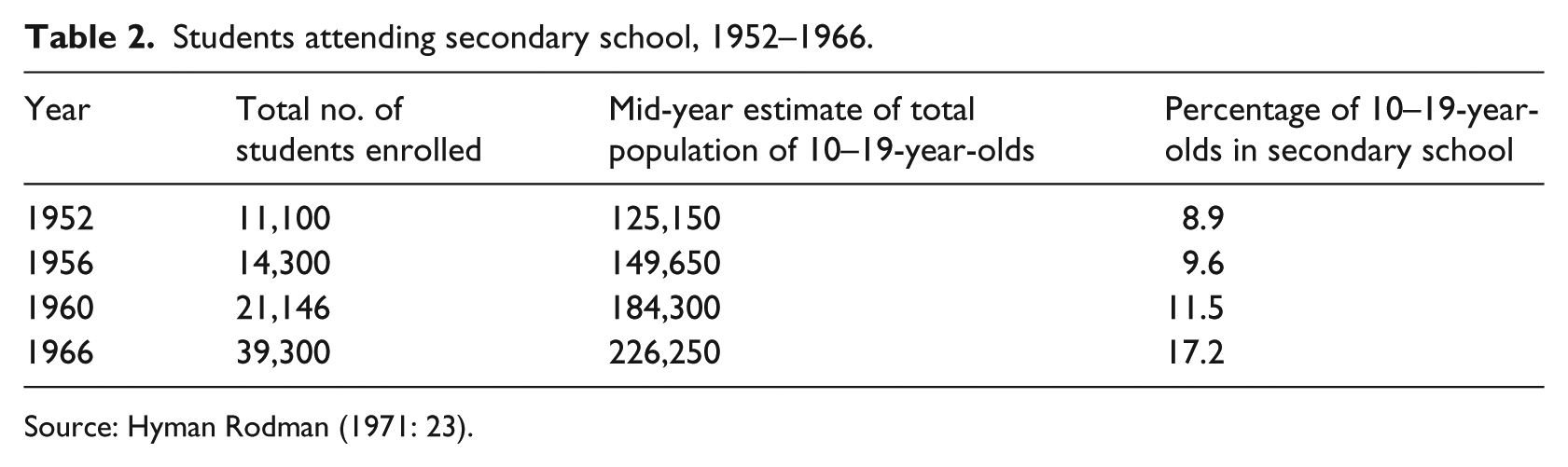
Source: Hyman Rodman (1971: 23).
The first wave of education reforms in Trinidad and Tobago was in response to this growing number of eligible high-school entrants and, understandably, the state’s response was to build more public secondary schools. But this expansion of secondary education was accompanied by a new unanticipated phenomenon: large failure rates in public secondary schools. As Campbell (1992: 106) points out,
By 1964 there had occurred a remarkable drop in the achievement of students in public secondary schools, judged by the convenient but inadequate measure of the GCE ‘O’ level and the Cambridge School Certificate examinations; in that year only 30.7 per cent passed, whereas in 1956–1960 the average annual rate of success was 73.8 per cent. In 1966 the rate of success was only 26.5 per cent.
This was the first early indication that the education reform efforts of simply building more schools to accommodate more students from the two most marginalized groups, the African and Indian Trinidadians, was not helping to create the type of just Trinidadian society envisioned, and that more authentic demographic data, especially as they related to quality and relevant education, were needed to effect maximally the country’s education reform plans. The history of the state’s refusal to grasp such opportunities forms a persistent theme in the education reform efforts which followed these humble efforts in the 1960s.
An early positive intervention project
Building secondary schools to create more access to secondary education for the African and Indian Trinidadian underclass student populations became one of the main foci for the PNM and was seen by the government as the first socially just response to the needs of the African and Indian Trinidadian populations. Major remnants of White domination could still be felt in the colonial style of education, with the emphasis on social elimination through a rigorous and rigid examination process. With the boom in oil prices in the 1970s, the country was in one of the best financial positions it had ever been in and thus able to fund its planned development programmes of creating a workforce that could participate maximally in the type of industrialized society that Trinidad was in the process of becoming. The country invested heavily in the construction of new secondary school buildings to accommodate the increasing numbers of African and Indian Trinidadian primary school leavers.
With increased access for the underserved African and Indian Trinidadian populations and the focus vis-a-vis quality and relevant education, the state embarked on building three types of secondary schools to accommodate the massive increase in new eligible secondary school entrants. These included 3-year junior schools, 7-year comprehensive schools and 5-year composite schools, and initiated a shift system (taking in two batches of students in a morning and an afternoon shift) in the 3-year junior schools. 3 Over the period 1970–1993, over 70 new sector government schools were added to an existing mix of about 15 high-performing prestige state and denominational secondary schools. These prestige schools, now numbering 42 (MOE, 2012), remain the standard against which secondary school education success in Trinidad and Tobago is measured as the educational performance of these schools on the high stakes examinations have continued at high pre-1960 levels.
Other waves of large failure rates surfaced following those of the 1960s when the early batches of the junior school graduates, having reached Form 5 in the senior comprehensive schools, took the ‘O’ level examination. Although the success rates in the ‘O’ levels improved in the 1970s to about 40%, up from the 26% of the 1960s, it was still well below societal expectations, as was reflected in the numerous letters to the public newspapers expressing the public’s disappointment with these results. The Caribbean Examination Council’s (CXC) examinations replaced the ‘O’ level examination in the 1980s and was a successful attempt to benchmark students’ learning against Caribbean vis-a-vis British standards. The Caribbean Advanced Proficiency Examination (CAPE) replaced the British GCE ‘A’ level examinations in 2006. Though there continues to be improvement in students’ performance on these high stakes examinations since 1966, there is still a wide disparity in the performance of students attending the new sector government schools populated by mostly lower-income African and Indian Trinidadian students, and those enrolled in the prestige state and denominational schools which comprise students from mostly middle- and upper-income households (Brunton, 2002). It is in these schools (with the exception of Bishops High School in Tobago) that there is a visible under-representation of African Trinidadian students. The 2005 national average for students passing five or more CSEC subjects was 60%, with the 42 prestige schools having an average pass rate of 98% (MOE, 2005). In the same year, one new sector school in Tobago where the student population is 100% African Trinidadian had an average pass rate of 34% (Tobago House of Assembly Report, 2005). It is the reporting of the results of these high stakes tests in this disaggregated form that is largely fuelling the perception of African Trinidadian students’ underachievement in education.
As noted earlier, one of the challenges facing education researchers in Trinidad and Tobago is in securing large-scale quantitative data on race and ethnicity. Researchers have tended to map schools to geographic communities and to link this to patterns of high-school selection, a phenomenon that has been used extensively in studies (De Lisle et al., 2008, 2009, 2010). The challenge, however, is to determine reasonable estimates of the ethnic composition of the prestige schools where there is no correlation between location and the race or ethnicity of the student population 4 since the students who attend these schools are the most successful in the public examinations.
What are the origins of these prestige secondary schools and how have they impacted on the perceived educational status of African Trinidadians? Secondary education provision became a factor in Trinidad immediately following Emancipation Day in 1834. Though emancipation of the African slaves in Trinidad marked the real beginning of popular education, this education was based on the English model. Getting the population to buy into this model was relatively easy as there was no alternative type of education, either indigenous or African, to pose resistance to this model. In the late 19th century, separate provision was made for two secondary schools for children of the White segment of the population primarily, ‘but including … privileged Coloreds of means and a sprinkling of Blacks mostly on scholarships’ (Campbell, 1992: 50). The main characteristics of this secondary education system were that it was separate from elementary school education and that it was meant largely for students ‘of a different race and color than those in the elementary schools’ (Campbell, 1992: 51). The two secondary schools were Queens Royal College (QRC) and St Mary’s College – College of the Immaculate Conception (CIC) established in 1859 and 1863, respectively, both all-boys’ schools. Whereas the elementary schools were intended for the children of the labouring masses, most of whom were from the African and Indian segments of the population, the two premier secondary schools, QRC and CIC, were expected to maintain the social distinctions which were being threatened at the top urban primary schools where access based on the principle of merit was perceived as being more equitable and socially just.
To the dominant White group, opening up a narrow channel of free access to the prestige secondary schools for a few African and Indian Trinidadians was a way of fostering the myth that the society was now completely open on the basis of merit, while maintaining their own positions at the top of the society. With time, more secondary schools based on these same principles of social justice were established and recognized, and increasing numbers of non-Whites entered these recognized secondary schools. In 1900, for example, the Canadian Presbyterian mission established a prestige boys’ school primarily for Indian boys (Naparima College) and in 1912, one primarily for Indian girls. In 1903, St Joseph’s Convent in Port of Spain, the oldest (founded in 1836) secondary school in the country and which catered only for girls, was recognized by the state as a school that could now compete with the other ‘recognized’ secondary schools for the prestigious Island Scholarships. Only secondary schools that were ‘recognized’ by the state could compete for Island Scholarships. By 1925, there were eight recognized secondary schools in the country including Bishops High School in Tobago which was the first all-African, co-educational prestige school to be established. The establishment of Bishops High School in Tobago was significant for two main reasons. First, it signalled to all four groups that the African Trinidadians had won a pyrrhic victory in the war against the White oligarchy for access to prestige schools. Second, and probably more significantly, it signalled that the White segment of the population ‘was not completely in control of the processes of social engineering [in the colony]’ (Campbell, 1992: 52).
But a socially just secondary education system required more than having sectors in the society having access to quality secondary schooling. The World Bank Support to Education Group (2012) in its recent Learning for All publication suggests that there are at least two other requirements, namely, having equitable levels of participation and having participated, enjoying equitable levels of success. In our context, equitable levels of participation would mean having a much greater number of African Trinidadian students actually enrolling in these prestige schools; and equitable levels of success would mean more African Trinidadians winning the Island Scholarships. Having gained access to quality education, other mechanisms had to be put in place other than the merit criteria to ensure that more African Trinidadians enrolled in these prestige schools. One such mechanism was the Concordat of 1960 which allowed government-assisted denominational secondary schools to select 20% of their entrants based on criteria other than merit, which included the religious affiliation of the entrant. Affirmative action of the form that operated in the United States in the last two decades of the 20th century had been suggested since the 1990s as another way forward to make the system more equitable, but discussions on this option petered out before any consensus was reached.
There is some urgency for the nation to revisit this latter discourse despite the challenges affirmative action continually faces in the United States. This is especially so since the anecdotal and newspaper records of African Trinidadian underachievement in education continue to suggest that even though many African Trinidadian students have access to, and participate at some level in the education processes in these prestige secondary schools, the perception is that they have not been enjoying the same level of success as other ethnic populations in the CAPE examinations or in the awarding of the prestigious Island Scholarships. The unavailability of data on the educational achievement of students on the basis of ethnicity makes this perception a difficult one to confirm or challenge.
A comparative look at educational disparities in Fiji
The phenomenon of ethnic disparity in educational attainment among populations in multiethnic societies is politically contentious. In Fiji, educational disparities between the Fijian and the Fijian Indian population has been termed the ‘Fijian education problem’ (Puamau, 2001; White, 2001). Fijian Indians achieve higher rates of secondary school completion, and matriculation and pass rates on external examinations than the indigenous Fijian population. In the 1960s, Fijian Indian enrolment in secondary school was twice that of Fijians and there were corresponding gaps in admission rates at tertiary institutions, in commerce and in the professions (White, 2003). These educational disparities have been attributed to the communal nature of Fijians and their hierarchical sociopolitical system.
Like Trinidad and Tobago, Fiji’s first schools were founded by European missionaries and the intent of its formal education system was converting the Fijians to Christianity. Mission schools faced a number of challenges including a lack of teachers and curriculum materials, inadequate facilities and the number of different dialects. The core curriculum consisted of religious studies along with arithmetic and personal hygiene. Despite this, the Wesleyan mission schools are credited with the high rates of literacy in the vernacular among Fijians and for providing the educational infrastructure for a central government that initially had limited involvement in the education of the Fijian and Fijian Indian populations. In the Catholic mission schools, the medium of instruction was English and these schools gained the reputation of having institutions that promoted ‘high educational standards catering to economically elite and urban students’ (White, 2003: 350).
Fiji, like other territories under British colonization, imported indentured labourers from India for the sugarcane plantations monopolized by the Australian-owned Colonial Sugar Refining Company (CSRC). Around 65,000 Indian labourers migrated under indentureship between 1879 and 1916. Conditions were brutal for men and women, though after their two 5-year periods of indenture, most of the Indians remained in Fiji. The missionaries who came to Fiji 160 years ago in 1835 failed to accept the traditional education system and instituted a programme of formal education with specially built institutions, trained teachers and a written curriculum. The missionaries made changes to the Fijian way of life, and this was the beginning of the loss of control of Fijians over their own traditional education systems.
Thus formal education began with the mission schools established by the Wesleyan missionaries Reverends William Cross and David Cargill in 1835 (Koya, 2010). After Fiji ceding to Great Britain in 1874, schooling in Fiji began under the first Education Ordnance, which led to the establishment of schools to educate European children. By the end of 1880, some schools had separate classes for indigenous Fijian children. It was only in 1917 that some Indian schools had been established, largely due to the efforts of the Indian communities.
During the period of indenture from 1879 to 1920, the Indian labourers were made wards of the (CSRC which was responsible for providing schooling for the children but which did little more than to create a ‘docile, loyal labour force’ (White, 2003: 353). After the system of indentureship was officially abolished in 1920, former indentured labourers migrated away from agriculture to urban areas for greater opportunities. In 1926, Hindi and Standard Fijian (Bauan) were added as languages of instruction. Fijian Indian education increased with support from Indian committee schools. By 1931, the government had assumed control of the mission schools, and this led to a decline in the number of schools from 1046 in 1909 to 24 Methodist primary schools in 1934. The colonial government at the time was not keen to be involved in education, seeing it as a private initiative though they did provide some funds to establish schools that had a specific purpose that met the interests of the government. Private schools flourished, supported by government funding, while the schools run by missionaries were supported by Christian missions and other religious and secular organizations.
In contrast to the Fijian mission schools, the Indian Methodist schools emphasized an English-language curriculum. Fijian Indians perceived that access to education was the key to the high social and economic status of Europeans in the region’s colonies and they sought the same for their children. It was also a way to remove the stigma of their indentureship. While Fijian Indians pursued a higher level of education, Fijian leaders believed that an education in agriculture was more suited to the indigenous population. In the early 1930s, the disparities in educational attainment among the different ethnic groups in Fiji were first noticed by Cecil Mann who was researching mission education at the request of the Methodist Missionary Society of Australasia. Mann found that European children in Fiji were the highest achievers while the Fijian Indian children’s results were superior to those of the Fijians. He attributed the disparities to social and economic constraints and to an inappropriate curriculum. A 1944 report purported that a factor in this difference was the level and quality of training of teachers in the Fijian Indian schools and the high standards of teaching demanded by Indian parents. The Fijian district schools, on the other hand, were deemed to be substandard in curriculum and teacher quality. Restrictions on Fijian migration imposed by Fijian leaders limited their educational advancement. Thus, as the number of secondary schools expanded in the urban areas, this was of little benefit to Fijians, 80% of whom lived in rural areas. Fijian Indians were less isolated from urban centres. This location, along with economic growth, led to the development of a Fijian Indian middle class who sought higher education and entry into professional training in areas of medicine, law and commerce. By 1959, Fijian Indian secondary school enrolment was almost four times that of Fijian secondary school enrolment though they represented 48% and 44% of the population, respectively.
Primary school enrolment increased in the decade beginning 1960 from 76,000 to 121,000, while secondary enrolments increased from 5400 to 16,000. These increases were due to both population increases and ‘rising social aspirations and employment opportunities’ (Kedrayate, 2001: 79). Following Fiji’s independence in 1970, the government oversaw the expansion of schools as it recognized the need for a skilled labour force. Despite education not being compulsory, there is universal access to education and a commitment to provide 12 years of education for those who want it.
The current emphasis on literacy and religious studies in the Christian church schools remains the same as during the early colonial period. Religious-based authorities with responsibility for a training institution have established language programmes that promote the language of their particular faith (Kamikamica, 1984). Approximately 13 religious organizations run private educational institutions with financial support from the government. Half of these institutions are Christian and half are based on the faith of the Indian population. The two main religions of the Indian population are Hinduism and Islam and the particular bias of each is reflected in the institutions’ programmes and curricula.
Affirmative action measures – addressing academic inequalities
Affirmative action is designed to give special support to disadvantaged members of a community, for example, by allowing them assisted access to enjoy life’s necessities such as education, housing and jobs. This may be thought of as rectifying past injustice, or as instrumental in removing historically entrenched inequities. Affirmative action is often viewed as controversial, however, since it appears to involve procedural injustices of its own (Chamberlain and Johnson, 2013).
To avoid being accused of the latter, the Trinidad and Tobago government has countenanced at least six affirmative action measures in the last decade designed to give special support to disadvantaged members of the school population of the country. These include efforts to formulate a Zoning System of Schooling whereby students would be assigned to schools in the education district in which they live; the infusion of a Peace Curriculum in Schools, which would empower students through peaceful means of conflict resolution; a single-sex secondary school pilot project by which 20 co-educational secondary schools would be converted over a 5-year period to 20 single-sex schools (10 all males and 10 all females); a concerted effort to fast-track the process of de-shifting secondary schooling by upgrading all 3-year Junior Secondary Schools operating the shift system to 5-year secondary schools; a comprehensive Information and Communication Technology (ICT) programme by which each secondary school student would be provided with a laptop computer; the Continuous Assessment Component (CAC) Project in which efforts are being made to elevate the status of the disciplines of Physical Education and Sports and the Visual and Performing Arts to the level of the external Secondary Entrance Assessment (SEA) certification along with the subjects of Language, Arts and Mathematics, upon which selection to high school is determined.
These affirmative action measures are intended to give special support to African Trinidadian students, some directly and others less so, in an effort to secure more places for them in the prestigious secondary schools of Trinidad and Tobago. For example, since many of these schools are in the urban and semi-urban areas of the country where the majority of the African Trinidadian population reside, a School Zoning Policy would create more opportunities for residents to attend them. Also, the Peace Curriculum would benefit African students attending those secondary schools where there have historically been a high number of incidents of student-on-student and student-on-teacher violence. The ICT project would provide laptop computers to low-income African secondary school students who may not have been able to secure this essential educational tool for learning in and outside of school.
Furthermore, de-shifting the secondary school system by upgrading all the remaining 3-year junior secondary Schools to 5-year high schools would ensure that more African Trinidadian students have access to universal secondary education and become eligible to compete for Island Scholarship awards in fifth and sixth forms. The CAC Project, by broadening the high-school selection criteria to include primary school performances in Physical Education and Sports and the Visual and Performing Arts, will provide more opportunities in which African Trinidadians can excel for the purposes of high-school selection, and which would arguably level the playing field to their advantage as their interest and successful participation in these two disciplines have historically been high.
Unfortunately, the Single-Sex Secondary School Pilot Project has been shelved, and the School Zoning and Peace Curriculum Projects are no longer a priority for MOE and have been given little attention, time or resources. The Secondary School De-Shifting Programme, however, was completed, and by 2005, the country had achieved Universal Secondary Education, a goal which ensures that there is a place in the secondary school system for every child who successfully completes primary schooling. The ICT Lap-Top Computer Project is in its fourth year whereby every student in Forms 1 to 4 (Grades 8–11) now have a laptop computer. The CAC Project which initially catered only to students in Standards 4 and 5 has now been expanded to the first 3 years of primary school – Years 1, 2, and Standard 1.
Preliminary reports from the MOE, though not peer reviewed, suggest that these affirmative action measures have been successful. For example, MOE statistics reveal an upward movement of the Academic Performance Indices (API) among primary schools, an annual increase in the performances of students on the SEA examinations, an increase in the number of students leaving high school with full certification, that is, passes in five CSEC subjects including Mathematics and English; an increase in the number of students eligible for the prestigious Island Scholarships (in 2013, for example, the awards list expanded from 355 recipients in 2012 to 450 in 2013); and more students, including African Trinidadians, moving into the tertiary education sector to pursue academic careers and university degrees.
Some of the challenges the affirmative action measures face include insufficient comprehensive strategic planning in the sense that the current planning cycle seems to correspond with the 5-year political cycle. In addition, there is insufficient attention being paid, and resources allocated, to the evaluation of these programmes. For example, the Single-Sex Pilot Project was scrapped before it had completed its cycle of implementation and before it had been critically and comprehensively evaluated for its successes or failures. Arguably, the most significant challenge is the unwillingness of policy makers to allow for the collection of demographic data, especially on race and ethnicity, which any such affirmative action measures would need for the analysis and identification of current specific problems upon which ameliorative measures could be formulated and implemented to ensure even greater successes in the future.
Affirmative action – Fiji
Many multiethnic societies attribute educational disparities in achievement to the differences in how groups approach, and the degree to which they value, education (White, 2001). As noted earlier, Western perspectives on the differential educational pattern among Fijians and Fijian Indians have defined it as the ‘Fijian education problem’ and have proceeded to link this difference to group behaviours arising from racial differences. The location of the rural Fijian populations and their distance from urban centres and thus to schools, capitals and markets are said to be contributing factors to this educational disparity. Their confinement to agriculture and villages are argued to have rendered them unprepared and untrained for employment and further education. Stereotypes also accrue to the differences in character between the two groups, with Fijians regarded as less motivated educationally, traditional, lacking in interest and with weaker parenting methods in contrast to the Fijian Indians who are regarded as hard-working, disciplined and ambitious. The communal label applied to Fijians, however, is seen as a positive characteristic by the Fijians in contrast to what they see as the greedy, individualistic behaviours of Fijian Indians (White, 2001).
White (2001) argues that groups with higher educational status, either because of social, economic or political historical factors, may come to see the pursuit and attainment of formal education as a means to upward mobility. Puamau (2001) acknowledges the social, political and psychological impact of colonization on Fiji. The discriminatory practices in education carried out by the colonial government stemmed from the fact that their main interest had been on educating European children in Fiji. The image of the Fijian as underachieving had been imposed upon them by the early Christian missionaries and the White community. In addition, Fijian Indians have bought into the perceptions held by the White community of both themselves and Fijians.
Affirmative action, as it is understood in Western terms of equality of opportunity and access to education and employment for indigenous groups, takes on a different perspective in Fiji (Puamau, 2001). This is because Fijians are not a minority population such as Maori in New Zealand or Aboriginals in Australia. In Fiji, the 2007 National Census showed a population of 827,900 comprising indigenous Fijian (57%) and Indo-Fijians (38%), with 5% being Pacific Islanders, local Asians and immigrant communities (Fiji Bureau of Statistics, 2008). In addition, Fijians have always held the political power since decolonization, except in 1999 when a largely Indian party won the general elections. Puamau (2001), however, sees affirmative action as once again colonizing the attitudes of Fijians (p. 116). She argues that one of the consequences of affirmative action programmes is that it reinforces ‘sociological arguments’ that blame the recipients for their educational failures and which gives non-indigenous communities the opportunity to level criticism against Fijians of unfair advantage. Puamau suggests changing the basis of affirmative action from being race based to class based. This, however, ignores the evident phenomenon of underachievement among Fijians and of the lower class status that results from this underachievement.
Discussion
The social and labour hierarchy that existed in Trinidad in the 19th century placed White plantation owners at the top, followed by the Africans in skilled manual labour and the East Indians in agriculture. This segmentation in the labour market influenced the extent to which these groups could develop their own ethnic and cultural standards, including values placed on education (Stewart, n.d.). Different images of inferiority were placed upon the African and Indian groups. Indians, however, were seen as having maintained their own culture, language and religion in contrast to the Africans who were forced to divest themselves, at least publicly, of their own traditions and to adopt the English language and European religions and customs. Educational achievements by African Trinidadians were seen to be based on the achievement of the individual and not ascribed to the African Trinidadian population as a whole or collectively. In addition, achievement for an African Trinidadian meant aspiring to those things held in high esteem by Europeans, which in the education context meant fighting for one of the limited spaces in a prestige secondary school. In contrast, achievement by Indian Trinidadians affirmed their identity as Indian and as belonging collectively to the Indian Trinidadian community rather than to the individual. This was reinforced by the Presbyterian missions who established prestige secondary schools specifically for Indian Trinidadians, a privilege not afforded to the African Trinidadian (Harricharan, 1976).
The loss of traditional culture is argued as an influencing factor in the educational status of African Trinidadians. However, it may be more accurate for this loss to be described as cultural severance as every attempt was made by the enslavers to sever Africans from their culture and to keep them separated from their cultural traditions. The evolution and progress of African Trinidadians’ culture can best be explained by considering Hezel’s (2005) argument – that cultural survival is about being able to adapt to a changing environment. Africans, forcibly brought to Trinidad, and noting their displacement, and understanding that the culture they had brought with them was no longer to be fully a part of their existence, developed a culture that they would pass on to their descendants. Culture, as Hezel said, is within people. So it was within the Africans, who had the capacity to change, alter and adapt their culture to the conditions which they now faced and who aspired to access the elite secondary schools established to serve the children of the White population. The choice that appeared to have been taken by African Trinidadians was to rise above the attempts by the colonizers to deny them the existence of an African identity in order to create a people without a culture. Although African Trinidadians’ identity had its origins in Africa, it has its present and future in the Caribbean.
Schools in colonial societies were part of the state’s ideal to establish social order based on a particular view of social justice, which in part was to indoctrinate into the colonized an acceptance of themselves as a subservient group to the dominant White population. Education was also intended to mentally inculcate in the colonized the idea that they rightly belonged to the working class and were to willingly and unquestionably hold only those positions on the lowest levels of society. This was done partly through the educational programmes and teaching methodologies used in the schools. This may account for the persistence of the British model of schooling in Trinidad and Tobago and for the continued use of high stakes testing (SEA, CSEC and CAPE) to perpetuate traditional social class segmentation of the Trinidadian society (Jules, 1994) and the notion that ‘going to school was better preparation for becoming a good worker than work itself’ (Cohen and Marvin, 1972: 372, cited in London, 2002).
In writing this article, discussion has focused on the analysis of the waves of secondary school education reforms (1960–present) that were intended to create a more socially just Trinidadian society. In attempting to situate African Trinidadians’ presence in the education system we acknowledge the earlier attempts to deny African peoples their culture and the discriminatory practices of the education system. The substandard education given to them had the potential to ensure their status at the bottom of the social and economic hierarchy and may be the source of the persistent public perception of their underachievement in education.
The lack of empirical data on ethnicity in school composition and student achievement does present a major challenge to the implementation of affirmative action measures in Trinidad and Tobago. Currently, as discussed earlier in this article, much of the evidence related to the issue of Black schooling in the region is anecdotal. The onus is on the political and educational system to create opportunities for the collection and analysis of meaningful data that will allow a scientific identification and analysis of the societal and generational problems facing African Trinidadian students in schools and in society. Programmes where affirmative action is incorporated can then be evaluated so that the results can properly reflect the participation and success of all students and specifically African Trinidadian students. Earlier also, this article discussed reports from the MOE that suggested the occurrence of higher API among the primary schools, improved SEA examinations and graduation certification and greater numbers of scholarship winners. Although these are areas where affirmative action can be effective and measurable, until we see the implementation of the basic indicators and performance measures necessary to track the impact of any ameliorative actions, we cannot speak to the specific success or failure of inclusivity with any authority. There is a need for a meeting of minds, mutual goals and collaborative work between political, educational, religious and other social agencies and stakeholders to push this agenda forward.
The attempts to address the gap between African Trinidadians and some of the other ethnic populations in Trinidad and Tobago need to be revisited and supported if the notion of social justice and equity is to be a reality and African Trinidadians are to disrupt the current discourse that perceives them as underachievers. However, the authors contend that despite these adverse conditions, many African Trinidadians have maintained a sense of pride and the resourcefulness to achieve academic and economic success, which could be further examined by an education assessment policy that allows for the systematic generation of both large-scale tests and demographic data.
Footnotes
Funding
This research received no specific grant from any funding agency in the public, commercial or not-for-profit sectors.