



Abstract
In recent years, many European education systems have embarked on a process of education policy and curriculum reform related to citizenship education. This article explores citizenship education reform in the context of Spain. It considers how and to what extent Spain’s 2006 citizenship education addressed issues of national and global citizenship, as well as cultural diversity and immigration. Against a typology of four distinct approaches to national and global citizenship education, including traditional, skills-based, values-based, and reflexive approaches, the article draws on qualitative content analysis of Spain’s recent Education for Citizenship and Human Rights curriculum and associated textbooks. Findings focus on themes of human rights, national and global citizenship, and cultural diversity and co-existence.
Introduction
Over the past decade, European education systems have been transforming as a result of global trends in immigration and continued European integration. With immigration, there has been a rapid increase in diversity within the European Union (EU)-28 societies, home to roughly 33 million people born outside of the EU (Eurostat, 2012). Some countries have been more affected than others, such as Spain, which is the second largest receiving country of immigrants in the EU with approximately 5.5 million foreigners (Eurostat, 2012). Meanwhile, trends in European integration, led by a range of EU aims and objectives linked to the EU’s Lisbon Agenda and the Bologna Process, have resulted in the Europeanization of education systems (Dale and Robertson, 2009). This societal diversity, along with the effects of European integration, offer valuable and necessary opportunities for young Spanish citizens to be reflective about the effects of global and European trends on their local community and everyday lives, and what it means to be a Spanish citizen in the global era.
Within the context of these changes and the demands they place on citizen formation, new citizenship education policies have been developed by national governments across Europe, aimed at integrating a diversifying citizenry into national and European societies. In post-Franco Spain, new citizenship education reform became a central element of the 2006 Law of Education (Ministerio de Educación y Ciencia (MEC), 2006), with the goal of fostering values of democratic co-existence, social cohesion, respect and tolerance of differences, equal opportunities, and an appreciation of ‘European values’. With this charge came a mandate for citizenship education to be taught as a compulsory subject both at primary and secondary education levels, a first of its kind in Spanish legislative history. Prior to this point, citizenship education, as a subject area, had not been included in the Spanish system. Although citizenship education in Spain has been broadly explored (see Collado and Atxurra, 2006; Hass and Issa, 2008; Jover, 2008), few studies have provided analysis of the curriculum and its contents, or explored the educational and curricular policy reform in light of larger frameworks of national and global citizenship.
The article draws on qualitative content analysis of curriculum and selected textbooks to explore the development, contents, and methodology of the Educación para la Ciudadanía y Derechos Humanos (‘Education for Citizenship and Human Rights’), a course officially adopted in Spain in 2006, and recently removed from curriculum with the 2013 legislation. Analysis focuses on three interrelated topics that made up the principal part of the curriculum: human rights, national and global citizenship, and cultural diversity and co-existence in a democratic society. This article explores how young people in post-Franco Spain were asked to think about Spanish national citizenship, with respect to the broader world. More specifically, the article investigates how, and to what extent, questions of national and global citizenship, as well as issues of cultural diversity and immigration, were presented to young people in Spain within citizenship education. As argued in this article, the 2006 citizenship education reform in Spain offered a rather narrow or thin focus, presenting ‘the global’ only as it relates to international declarations of human rights, and immigration as an external phenomenon, rather than considering it more critically and reflexively as part of local spaces and everyday life (Rizvi, 2009).
National and global citizenship education
Literature on approaches to citizenship education has been categorized in different ways, such as minimalist and maximalist approaches (McLaughlin, 1992); personally responsible, participatory, and justice-oriented approaches (Westheimer and Kahne, 2004); and traditional, classical, libertarian, post-modern, and communitarian approaches (Davies, 2006). Whereas a minimalist or a personally responsible approach to citizenship education might highlight civic roles and responsibilities of young people, a maximalist approach or justice-oriented approach to citizenship education aims not only to provide student with civic knowledge about their roles and responsibilities, but it also allows students to explore and evaluate alternatives. In addition, there is a large and growing body of literature, discussed below, which has focused on approaches to global citizenship education.
Building from Rizvi’s (2007, 2009) work, I highlight four different approaches to national and global citizenship education (traditional national citizenship education, skills-based global citizenship education, values-based global citizenship education, and reflexive global citizenship education). I discuss each in turn below, exploring their distinct purposes and pedagogical implications. Traditional approaches to national citizenship education have tended to focus on civic responsibilities, rights, and obligations considered key to the formation of explicitly national citizens. That is, citizenship of individuals is one of the basic characteristics of the nation-state (Meyer et al., 1997). As education systems served as primary institutions concerned with citizenship and citizen formation (Green, 1997), many countries focused their education systems on the creation of a national citizenry, leading with a focus on civic rights and responsibilities.
In the more traditional approach, state policies of citizenship education have embraced what Marshall (1964) described as three elements of citizenship (civil, political, and social). Together, these three elements compose of the rights deemed necessary for individual freedoms to be realized, including the security of each individual and their freedoms (speech, religion, equality before the law), the ability to participate in the political process of the nation-state, and access to economic welfare and societal resources, including health care, education, housing, and employment. Marshall’s descriptors of citizenship were largely confined only to the formation of national citizens and the ‘social contract’ between individual citizens and the state (Heyneman, 2002–2003). Described as a narrow or ‘minimalist’ form of citizenship education, traditional approaches often focus on the legal and political organization of the nation-state and the rights and obligations of citizens to these systems (McLaughlin, 1992).
The literature on global citizenship education has suggested that citizen formation is a complex, contextual, contested, and ‘profoundly spatial’ process (Mitchell, 2003: 388), no longer explicitly linked to the nation-state alone. Led by globalization, Europeanization, and the opening of new spaces and scales beyond the nation-state, citizen formation has become decoupled from the nation-state (Soysal, 1994). As the landscape for citizenship has shifted, so too must the frameworks for citizenship education. For example, as cultural and ethnic diversity within nation-states has continued to increase, there is a need to shift from strictly national to global forms of citizenship education (Banks, 2004). To that end, Osler and Starkey (2010) argued, ‘an effective education for our global age requires a cosmopolitan vision based on a shared understanding of human rights and an exploration of citizenship at all levels, from the local, encompassing the national, but extending to the global’ (p. 113). Support for infusing citizenship education with a more global outlook has led to a range of approaches, including skills-based, values-based, and reflexive global citizenship education (Rizvi, 2007).
A skills-based approach to global citizenship education is often deemed necessary for the global economy, which now requires greater flexibility, cultural sensitivity, and intercultural communication than ever before (Gardiner, 2006). Related to a skills-based approach to global citizenship education is a focus on global competency, which emphasizes teachable, measurable skills and a framework of individual characteristics and qualifications associated with success for an increasingly global world (Boix Mansilla and Jackson, 2009; Watkins and Cseh, 2009). More than a focus on how to feel or think about the world, the emphasis is also on how to behave and work in the global economy.
Distinct from the skills-based approach is a values-based approach to global citizenship education, which advocates a larger worldview of belonging to the global world. Noddings (2005), for example, advocated for ‘care’, placing emphasis on concepts of social justice, social and cultural diversity, protection of the earth and its resources, social responsibility, and peace, mutual respect, and community. Similarly, Nussbaum (2002) encouraged a cosmopolitan framework of learning, asking,
is it sufficient for [young people] to learn that they are above all citizens of the United States but they ought to respect the basic human rights of citizens of India, Bolivia, Nigeria, and Norway? Or should they—as I think—in addition to giving special attention to the history and current situation of their nation, learn a good deal more than they frequently do about the rest of the world in which they live, about India and Bolivia and Nigeria and Norway and their histories, problems, and comparative successes? (p. 6)
These perspectives are representative of the larger worldview of global interdependence that often underpins values-based approaches to global citizenship education.
Both the skills-based and values-based approaches to global citizenship education at times regard ‘the global’ as somewhat isolated from local and national citizenship. For example, the global world is framed as something to prepare citizens to successfully act and work in (e.g. skills-based approaches) or something to care about (e.g. values-based approaches). These approaches alone do not allow for some of the deep reflections and meaning-making about local-global interconnectedness that responsible and active citizenship in the global era demands. In Rizvi’s (2007, 2009) work, he has referred to a reflexive approach to global citizenship education, in which ‘the global’ is not an abstract concept existing separate from students’ everyday lives, but rather that local communities around the world are now more interdependent than ever before. A perspective on global interconnectivity involves a recognition of the fundamental shifts in the global circulation of capital, people, and ideas, implicating, albeit in asymmetrical ways, all parts of the world. Rizvi’s (2009) notion of cosmopolitanism
is not concerned with imparting knowledge and developing attitudes and skills for understanding other cultures per se but with helping students examine the ways in which global processes are creating conditions of economic and cultural exchange that are transforming our identities and communities; and that, unreflexively, we may be contributing to the production and reproduction of those conditions, through our uncritical acceptance of the dominant ways of thinking about global connectivity. (pp. 265–266)
‘The global’ is not a condition or a thing, which affects and transforms the lives of individuals. Rather, individual citizens are part and parcel of enacting the range of transformative economic, political, social, and cultural changes often associated with ‘the global’. Reflexivity here is the understanding and critical questioning of one’s own place within the world, not as isolated from broader global processes, but as implicit within those processes.
The focus on interconnectivity within the reflexive approach to global citizenship education repositions global issues as inextricably linked with citizens’ everyday lives, disrupting the dominance of strictly ‘national’ ways of thinking about citizenship. In other words, a reflexive approach to global citizenship education would reach beyond civic responsibilities, rights, and obligations, linked explicitly to the state; a list of citizenship and civic skills and competencies necessary for success in the global economy; or a set of affective characteristics associated with care about the broader global world. Instead, it might include critical reflection on issues and public debates in European and national spaces over nationalism, identity, citizenship, immigration, or to consider global acts of terrorism and violence, such as the train bombings in Madrid and London, in connection to local communities.
Drawing together the different approaches to global citizenship education described in the framework above, it is possible to encourage critical thinking about global–national–local interconnectivity (Rizvi, 2009), to construct a framework for cosmopolitan learning (Nussbaum, 2002; Noddings, 2005), and develop the skills necessary to live and work in the globalized economy (Gardiner, 2006; Boix Mansilla and Jackson, 2009). These approaches together represent the deepest form of global citizenship education. Students, for example, might be asked to consider the nature and impact of global problems, including poverty and immigration, with respect to their local community. The aim would be to create opportunities for students to develop not only the attitudes, values, and skills necessary to understand and act upon these issues, but also encourage deep reflective thinking about the nature of global processes with respect to local issues.
Against this framework, the intent of the article is to explore the key themes of Spain’s 2006 citizenship education reform, including human rights, national and global citizenship, and cultural diversity and co-existence in the global world. Within these themes, this article asks broader questions about whether and to what extent the rest of the world is framed for Spanish citizens, and at what level global interconnectivity and belonging is and should be taught?
Overview of citizenship education in Spain
Over the past two decades, a growing body of literature has focused on the development of European citizenship education (Keating et al., 2009). Among the key regional organizations involved in promoting European citizenship education are the EU, a highly significant policy actor in all matters of education policy within member state countries, and the Council of Europe. As described by Keating et al. (2009),
Although a less influential institution, the Council of Europe has also developed a range of educational policy platforms for its numerous and diverse member states, including human rights and intercultural education, the teaching of history, higher education and language policy, and education for democratic citizenship. (p. 147)
A tracing of the advancement of European citizenship education is beyond the scope of the article. It is, however, worth mentioning several Council of Europe initiatives and recommendations, as well as EU directives, in order to help frame some of the key dimensions of Spanish citizenship education reform.
In 2005, the Council of Europe implemented the ‘European Year of Citizenship through Education’, which aimed to build appreciation for education for democratic citizenship across Europe, connect policy and practice, develop partnerships and networks, and increase democratic learning to promote social cohesion (Kerr and Lopes, 2006). Based on the perceived success of the Year of Citizenship, the Council of Europe, in close cooperation with international organizations, aimed to make the key themes and initiatives of Year of Citizenship integral in education policies and practices in formal and non-formal educational systems in Europe. In 2010, the Council of Europe developed its Charter on Education for Democratic Citizenship and Human Rights. Although non-binding, the charter encourages teaching and learning practices and activities that promote values of democracy and human rights (Council of Europe, 2010). As stated in the charter, it is essential to develop knowledge, personal and social skills and understanding that reduce conflict, increase appreciation and understanding of the differences between faith and ethnic groups, build mutual respect for human dignity and shared values, encourage dialogue and promote non-violence in the resolution of problems and dispute. (Section II.5, F)
To implement these goals, the charter stipulated that member states include education for democracy and human rights in the curricula of formal primary and secondary schools.
There have also been several recent EU directives related to education and civic values. As one example, in March 2006, the European Parliament made its recommendation to the European Council for the inclusion of eight key competencies into European education systems. Among them were several competencies aligned with citizenship education, including social and civic competences (primarily focused on human rights) and cultural awareness and expression. An explicit focus on European citizenship is also included, largely framed as knowledge of the ‘the EU’s structures, main objectives and values … as well as an awareness of diversity and cultural identities in Europe’ (European Parliament, 2006: 17). As illustrated below in the findings, what is noteworthy is the emphasis on the rights and obligations of citizens in Europe to know and participate in the EU institutions. Little focus is given to any reflection on what it means to be a European citizen in a broader global world, to embrace a European identity, and who might be included or excluded in these constructions.
Within the broader regional context of increased consideration of citizenship education, Spain provides an interesting case of citizenship education reform. In the post-Franco era, Spanish citizenship education has been addressed in policy beginning with the Spanish Constitution of 1978, of which Article 27 stated ‘education shall be directed towards the full development of the human personality in respect for the democratic principles of co-existence and fundamental rights and freedoms’. Over the past three decades, the legislative focus on citizenship and citizenship education has become increasingly significant, culminating in the first official course in citizenship education in Spanish history (see Engel and Ortloff, 2009, for an overview of these shifts). Passed in May 2006, the Organic Law on Education (Ley Orgánica de Educación (LOE)) recognized education as a powerful mechanism for integrating values of equality, human rights, social cohesion, and respect for cultural diversity. In the Preamble of the LOE, education was linked to ‘the promotion of active citizenship, equal opportunities, and social cohesion’ (MEC, 2006: 17160). The two sets of aims included education for peace and human rights, and the rights and responsibilities of Spanish citizens.
Prior to the 2006 LOE, citizenship education was considered a cross-curricular theme (e.g. Education for Peace) or integrated into other subject areas, such as history. It also varied widely in how it was included into curriculum across the different regions (Hass and Issa, 2008). In contrast, the 2006 LOE included the compulsory, cross-curricular subject entitled Education for Citizenship and Human Rights (MEC, 2006: Article 24), to be taught both at the primary and secondary levels: 1 year in the final cycle of primary education, 1 of the first 3 years of secondary education (to be chosen by the autonomous communities), and 1 year in the last course of secondary education (4th cycle) and the first course of upper secondary education, entitled Ethic-Civic Education.
Its aims were to ensure that students possess skills, attitudes, and knowledge on citizenship rights and responsibilities, cultural diversity, and global social problems. These new aims continue to be debated across Spain. The LOE and, in particular, its inclusion of the new compulsory citizenship education was politicized, particularly on the teaching of religion (which was made elective) and the focus of ‘citizenship values’, which some political groups, and family and parent associations viewed as a shift away from moral Catholic values. Some Catholic, conservative groups and family associations opposed what was framed as a dominant focus on sexuality, and moral and sex education. There was also opposition to citizenship education being made a compulsory subject, interpreted as an imposition of particular values and judgments on student’s moral upbringing.
With the change of government in 2012, the newly appointed Minister of Education removed the mandatory citizenship education course, which was deemed to be indoctrination, and overly politicized, and replaced it with ‘Civic and Constitutional Education’, which is aimed at the constitution, rights and responsibilities of citizens, and key civic knowledge and information related to European institutions. Initiating the change, the Minister of Education, José Ignacio Wert, stated that the Education for Citizenship and Human Rights ‘went beyond what should belong to a true “civic formation” in accordance with the directories and guides formulated by the Council of Europe’ (as cited in http://www.lifesitenews.com/news/spains-new-government-to-eliminate-homosexualist-indoctrination-course/). While the changes have been supported by some of the more conservative parent and family groups, and members of the Popular Party, the shift to Civic and Constitutional Education has been criticized by members of the Socialist Party in Spain, as well as the European Commission (Vera, 2013). The 2006 and 2013 reforms related to citizenship education are suggestive of the complexity and the role of ideological difference underpinning the meaning of Spanish citizenship in the 21st century global world.
Methods
This article focuses on a case study of the 2006 Spanish citizenship education, drawing on analysis of curriculum and associated materials, including selected textbooks. In the analysis, two underlying assumptions about citizenship education and curriculum analysis are made: first, citizenship education is understood as representing one of the state’s most formal and direct mechanisms for shaping young people’s identities and communicating the core values of the national project. Second, in the case of citizenship education, the curriculum is assumed to be essential transmitters of the state’s official version of national citizenship. Therefore, the curriculum and associated materials used in citizenship education offer a rich source of data and a lens through which we can better understand representations of the national project to its citizens. Analysis of citizenship education is also significant for understanding representations of how the state aims to promote reflection about what it means to be a Spanish citizen within the broader global world. Textbook analysis also allows for an examination of citizenship for its normative impact, including how and to what extent particular civic issues and values are prioritized and what are excluded.
Findings in the study are based on qualitative content analysis of the official citizenship education curriculum. The focus is on compulsory lower secondary education (Educación Secundaria Obligatoria), ages 12–16 years. The Spanish education system involves shared responsibility between the national, sub-national, and local bodies. At the time of the 2006 citizenship education, the Ministry of Education, Culture, and Sport regulated a set of standards for 65% of the curriculum, with the remaining 35% left to the 17 autonomous communities. In this way, although the official curriculum in autonomous communities has a certain amount of homogeneity, particularly around objectives and attainment targets, there is variation in terms of content. Therefore, sources for curriculum in this study include the official documents of the Ministry of Education, Centre for Educational Research and Documentation (CIDE) developed curricular materials and teacher guides, curricular plans for all 17 autonomous communities, and Alzina (2008).
In order to connect the official curriculum with classroom teaching content, at each level of education, curricular plans are developed by teams of teachers. These plans include aims, content, and assessment targets. Once plans are developed, they are presented to the Teachers’ Senate, to teachers, parents, and students through the School Council, and supervised by the central Inspectorate (INCA, 2009). As the last phase of curriculum development, individual teachers have considerable autonomy, drawing up class programs in order the implement the curricular plan. The selection of textbooks in Spain is not prescribed by the central state. Rather, the autonomous communities organize a list of approved commercial textbooks, with ultimate selection made either by schools or teachers (INCA, 2009).
As a secondary source of data, two accessible textbooks, and associated curricular guidelines and classroom lesson plans were analyzed. The first textbook is Educación para la ciudadanía y los derechos humanos (‘Education for Citizenship and Human Rights’) (2007), published by McGraw-Hill. According to annual (2010–2011; 2011–2012) regional approved lists of textbooks, the book was approved for use in at least 12 regions, with the notable exceptions of autonomous communities that possess an independent language. The second textbook is also entitled Educación para la cuidadanía y los derechos humanos (‘Education for Citizenship and Human Rights’) (2007), published by Editorial SM and written by philosopher, José Antonio Marina. It has been considered one of the more Catholic friendly citizenship education textbooks and was on the approved list in the community of Madrid.
Analysis focused on discourses and methodologies of learning employed in the curriculum, associated classroom lesson plans, and textbooks. Led by the central purpose, which is to explore the representation of national and global citizenship in the 2006 Spanish citizenship education, I paid considerable attention to the construction and framing of discourses of Spanish national and global citizenship in the curriculum. I followed a similar pattern as Faas (2011), in which in the analysis of curriculum, I first explored the introduction of the curriculum and then examined the ways in which the main points of the introduction were reflected in the individual units of the curriculum, the classroom plan, and the points of evaluation. I then focused on an analysis of the format, structure, and sequence of the textbook, including the overall ‘organization of learning’ in light of the developed framework of approaches to national and global citizenship education. Questions for analysis looked at inclusion and omission of information, as well as questions aimed to capture the how and in what ways the textbooks represent national and global citizenship (Crismore, 1989). For example, key questions included: in what ways is Spanish citizenship represented in the broader global context? Are there themes of cultural diversity or immigration included and if so, how are questions of cultural diversity and immigration represented in terms of Spanish citizenship? Led by analysis driven from these questions, the remainder of the article presents findings around three central themes: human rights, national and global citizenship, and cultural diversity and co-existence in a democratic society.
Spanish citizenship in the global era
One of the central aims of the 2006 Spanish citizenship education reform was a reflection on global social problems. Yet, as further described below, the curriculum and corresponding textbooks tend to overlook some of the contemporary issues, challenges, and questions central to Spain and the broader European context, including nationalism, religion, and immigration. The predominant focus remains on ‘human rights’, presented solely in the form of international declarations that remain distant from citizens’ daily lives. This offers little opportunity for students to consider, for example, the growing cultural diversity within the Spanish society and its impact on their local community. By presenting global social problems in the form of select international declarations separate from everyday lives and local communities, it overlooks the opportunity to integrate the national space (Spain) into the broader world (Nussbaum, 2002; Rizvi, 2009). Furthermore, in the textbooks, the crucial link between immigration, global poverty, and the Spanish and European space remains unquestioned. Immigration is treated largely as a phenomenon that exists with no real connection to Spain. Both in the actual content and in what students are asked to do with the content, students are offered little to no opportunity for critically exploring national identity or broader notions of global citizenship. Although reflexivity is implicit as part of the rationale underlying the curriculum and one of the textbooks (Editorial SM), these issues are not present for critical consideration.
The new Spanish citizenship education was aimed at developing the ‘different forms of behavior that prepare individuals to participate in an efficient and constructive fashion in the social world … based upon concepts of democracy, citizenship, and human rights’ (McGraw-Hill curricular plan, p. 54; my translation). As stated in the official curriculum for Spanish citizenship education, contents of the curriculum are organized into five major topics, in which I draw out key emphases:
Common contents. Emphasis on skills, including analysis and critical reflection, dialogue and communication to reduce conflict, and forming opinions and judgments.
Interpersonal relations and participation. Stress on personal autonomy, gender equality, and prejudice (including racism, xenophobia, sexism, and homophobia).
Civic duties and rights. Frames rights through Universal Declaration of Human Rights (UDHR) and other international pacts, focus on diversity and women’s rights.
Democratic societies in the 21st century. Three major themes, including the function of the Spanish democratic society with emphasis on the institutions of the state, social and cultural diversity, and the rights and obligations of a citizen, including a focus on being a consumer and traffic accidents.
Citizenship in a global world: Global world is framed as an ‘unequal world in terms of wealth and poverty’ with a focus on feminization of poverty (Curricular plan, p. 11). This topic also explores major conflicts and the role of international organizations, and issues related to globalization and interdependence.
The textbooks organize these major topics differently. Table 1 below offers a brief overview of key characteristics of textbooks, including their organization, understanding of citizenship, and key aspects of the methodology used.
Contents and organization of textbooks.
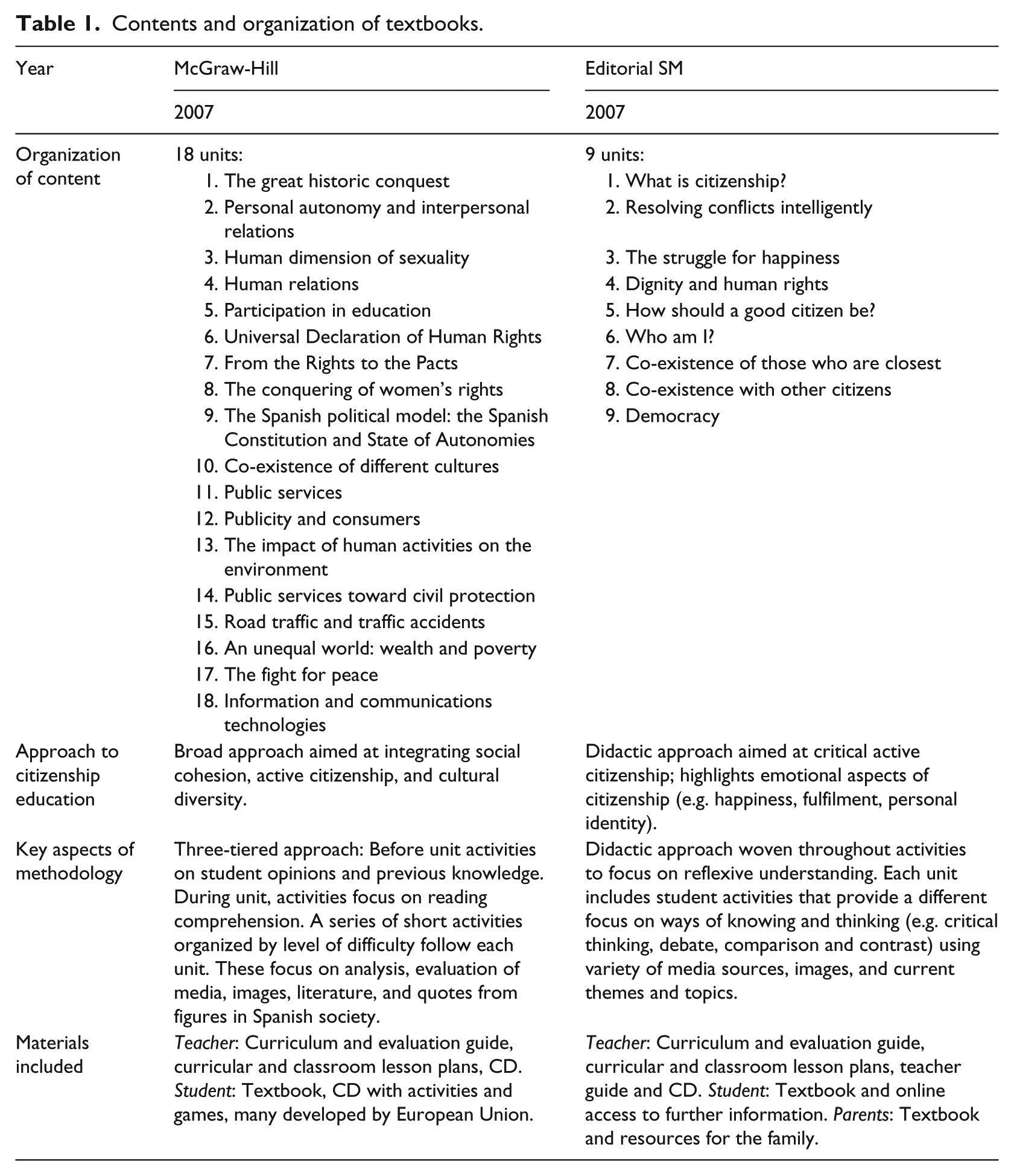
Although presented differently, both textbooks emphasize rights and obligations of citizens in democratic societies, and respect for diversity, linked to a framework of international human rights. For example, Editorial SM included units on dignity and human rights, co-existence, and democracy. McGraw-Hill focuses similarly on co-existence of diverse people and human rights.
In both the citizenship education curriculum and textbooks, there is a focus on student analysis, interpretation, and synthesis. One of the textbooks takes a didactic approach linking the individual with broader civic activities and duties (Editorial SM). In the other textbook, the engagement of students largely seems to revolve around reading comprehension, vocabulary, and the memorization of key historical or present day facts and figures (McGraw-Hill). For example, the three-tiered approach to student engagement and evaluation in the McGraw-Hill textbook organizes activities according to Bloom’s (1956) taxonomy of cognitive objectives: Knowledge, comprehension, application, analysis, synthesis, and evaluation. Each unit ends with activities geared at testing student’s knowledge using verbs, such as define, list, and recall. The final two to three activities deemed most difficult offer students the opportunity to critically reflect on current events, images, and debates, as evidenced by prompts such as ‘Critically analyze the following beliefs’, ‘Analyze and evaluate the following news stories’, and questions on a presentation of single images, including those focused on global poverty and warfare (McGraw-Hill).
Rather than being integrated in such a way that allows for student analysis and critical reflection, student evaluation and assessment in all 18 units are grouped according to the very order of Bloom’s taxonomy, rather than an integration of different cognitive skills. The final set of activities are organized and categorized from easiest to most difficult, leaving the more critical questions regarding citizenship and the place of Spain within the broader world as a ‘most difficult’ set of activities. As a result, opportunities for reflection may be isolated as more descriptive rote learning is prioritized. This can lead to the separation of student opinions from a broader understanding of values and attitudes presented, which as Hass and Issa (2008) argue, has the potential to lead to more simplistic interpretations of citizenship education. Ironically, given the rationale underlying the new citizenship education reform, this approach tends to also segregate some of the contemporary issues, challenges, and questions central to citizenship in the Spanish and European societies, such as debates over nationalism, religion, and immigration from the aims laid out in the official curriculum. The lack of opportunity to critically consider many of these questions of national citizenship is a reoccurring issue found in all three of the overlapping themes further developed below.
Human rights
Human rights are defined as a universal value essential to the fight against discrimination and the promotion of democratic co-existence and social justice critical to the creation of a productive and responsible citizenry (McGraw-Hill, Editorial SM). In the textbooks, human rights are largely understood through the 1948 United Nations UDHR, though often with an unclear narrative. In one of the textbooks, in a mere six pages, human rights is framed starting with the first proclamations of human rights appearing in the United States Declaration of Independence in 1776 and the injustices of the industrial revolution in Europe, and ending with a presentation of the individual articles of the UDHR (McGraw-Hill). As an illustration of this, social justice, as a central concept, is only defined in two short half-page segments: The first focuses on social justice as a concept derived from unequal work conditions during the first industrial revolution and the second, a list of four objectives of social justice, intended to improve conditions faced by the working class. Two images accompany the text, including one image depicting men, women, and children working in a factory setting and another of European revolutionaries of the 19th century. The core activities include reading comprehension, which asks students to learn key vocabulary, names, and dates. Rather than an opportunity to critically reflect on the concept of social justice or contemporary examples of injustice, the focus is largely on memorization of historical facts. Moreover, the chapter narrowly presents social justice as an economic issue through its concentration on working conditions in the 19th century. The result is a narrowly focused conception of social justice defined largely in economic terms, as opposed to the inclusion of a broader and more contemporary perspective of social justice that takes into account both structural inequalities and socio-cultural elements underlying marginalization.
The second textbook (Editorial SM) focuses one of its units on dignity and human rights. The textbook takes a broader perspective on social justice, linking it to dignity and respect for all as civic duties to be practiced at local, national, and global levels (presented as concentric circles). It draws on historical and sweeping examples of how citizens fought to abolish slavery, build democracy, and ensure women’s rights as examples of human rights and the quest for justice. It focuses on fundamental human rights, but also responsibilities and the need for societal norms. In each of the units, there is a focus on emotional development, which in the unit on dignity and human rights focuses on respect and authority. Each of the units ends with two exercises: one called ‘practical reason’, and the second asking students for more critical reflection. In the unit on human rights, for example, the focus is on dismantling prejudice and issues of violence, moving beyond the memorization of key facts. However, much like the other textbook, it too lacks lived and reflexive exercises that present young people with opportunities to explore the concept of human rights more deeply or critically as it relates to the global society.
Although in the curriculum, human rights are presented as a universal value to the construction of a global society, the curriculum materials offer limited opportunity for critical reflection on concepts or present day examples of discrimination, social justice, and global society. The broad historical overview of human rights presents a disjointed content, often appearing to isolate contemporary issues and challenges from the main content. For example, given the focus on conventions and declarations of human rights, it is noteworthy that the Council of Europe’s first convention, the European Convention on Human Rights (ECHR), which was ratified in Spain in 1979, is overlooked. A deeper, more reflexive form of global citizenship education might explore the ECHR and some of the profiled European Court on Human Rights cases in Spain as key and lived examples of human rights and citizenship (Council of Europe, 2014).
Moreover, the focus is predominantly on descriptive accounts of key proclamations and declarations, without the chance for deeper understanding or application of these declarations. Where there are opportunities for more critical thought, they appear as add-ons, rather than connected or integrated into the narrative of the textbooks. As a primary example, after a unit’s dominant focus on human rights and social justice as part of norms, declarations, and pacts throughout history, there appears a single image of a child soldier along with four questions geared toward students (McGraw-Hill). The inclusion of this activity is significant for two reasons. First, there is no connection between the image of the child soldier and the Convention on the Rights of the Child, including its key dimensions of dignity and equality of all citizens ‘as the foundation of freedom, justice and peace in the world’ (Office of the High Commissioner for Human Rights, Preamble, http://www.ohchr.org/en/professionalinterest/pages/crc.aspx). Second, the image and corresponding questions is part of an optional (and classified as one of the more difficult) student activities. The textbook offers little connection between the issue of conflict, child soldiers, and central themes of human rights and social justice in a global society. In fact, up until this point, global society is defined only in terms of inter-governmental organizations and in the text and images, the work of the United Nations on human rights.
Drawing on Rizvi’s (2009) notion of cosmopolitan learning, the predominant focus on human rights offers little opportunity for students to make connections with the rest of the world or better understand their place as citizens within a global context. Again pointing back to the organization and methodology of student assessments, by being labeled as ‘difficult’, this particular activity may be sacrificed in favor of the assessments focused on vocabulary, reading comprehension, and memorization of key dates and actors in the UDHR, possibly becoming further isolated in classrooms made up of younger students or students of perceived lower ability. Finally, in these examples, the textbooks in many cases utilize terms like global society, but seem to do so in a way that clearly delineates the foreign from home. This offers little opportunity to consider global interconnectivity and cosmopolitan learning that Rizvi (2009) argued was imperative for the global era.
National and global citizenship
In the textbooks, although terms like ‘global citizenship’, ‘global society’, and ‘respect for cultural diversity’ are frequently used, both the text and the images seem to suggest that ‘the global’ is equated to individuals and communities outside of the local and national space. However, linked to the above findings on civic and human rights and responsibilities, in the curriculum and in both textbooks, national citizenship remains limited to rights and obligations to the central state (Marshall, 1964). Questions of ‘who is a good citizen?’ are framed by the obligations and contributions of citizens to society, defined largely in national terms. The contributions of citizens to public services and the welfare state, the rights of consumers, responsible consumption, the obligations of drivers to follow road traffic rules and regulations, and co-existence are all exemplified as part of being a good national citizen.
This stands in contrast to one of the core objectives described in the official curriculum and both textbooks, which is to help student to be able to recognize themselves as members of a global community. Representations of the global community include, for example, international organizations, key international declarations and pacts on issues of human rights and environmental awareness, and inequality on a global scale (McGraw-Hill, Editorial SM). This gives the impression that ‘the global’ is foreign and separate from the life of the student, the school, and Spain. This absence of reflection on global–national–local interconnectivity (Rizvi, 2009) seems particularly problematic in a context of growing cultural diversification and European integration. Although the citizenship education curriculum and textbooks aim to include a multitude of perspectives, little to no voice is given, for example, to issues related to contemporary immigrants living in Spain. On this point, the focus on European integration deals largely with the key institutions that make up the EU. This aligns with more of a traditional form of citizenship education, which highlights government institutions and systems, and the rights and obligations of citizens to those institutions.
Furthermore, as described in the official curriculum, one of the main topics of citizenship education is ‘Citizenship in a global world’. The global world, in the McGraw-Hill textbook, is included as an explicit theme in several units, such as ‘The unequal world: Wealth and poverty’, and ‘Information and Communications Technology’, which offers students an understanding of globalization and economic power, and anti-globalization movements. In the former, the presentation of global poverty is presented as an issue without connection to student’s daily lives or the context of Spain, ironically ending up segregating the issue of global poverty. Moreover, through text and images about the feminization of poverty and the lack of access to education on a global scale, the impression is that these problems exist in isolation from Spain and Europe. Although the rationale underlying the curriculum and one of the textbooks (Editorial SM) seems to suggest reflexivity, the critical link between transnational migration, global poverty, and the impact of both in Spain and Europe remains largely overlooked. Furthermore, students are offered little to no opportunity for exploring questions of Spanish national identity or global citizenship.
Cultural diversity and co-existence
‘Co-existence of different cultures’ is a core focus of the curriculum and both textbooks. In McGraw-Hill, the four parts of this unit include: Culture, two concepts of culture (ethnocentrism and cultural relativism), cultural diversity, and the concept of multiculturalism. Cultural diversity is framed as a challenge to society and part of the rationale for co-existence. Noteworthy is the absence of any inclusion of immigration as a topic for consideration.
Even the didactic approach of Editorial SM frames co-existence in a democratic society first in terms of closest proximity and highlights the interpersonal features of co-existence, with little focus on co-existence beyond national boundaries. As a first step to co-existence on a broader level, students must begin thinking about family, friends, and community, and how they relate to personal identity (Editorial SM). This is not problematic in principle, reminiscent of Nussbaum’s (2002) notion of cosmopolitanism, which includes the varying scales of loyalty from the local to an ultimate connection to a global community of human beings. However, the textbook falls into a traditional pattern of focusing on co-existence at a family and community level, failing to make broader connections. These are exemplified in the inclusion of student evaluation and opportunities for reflection, which include: Point out ethnic components of friendship, explain the function of sexuality for human life, identify and explain characteristics of the family and how it has historically evolved, analyze the relationship between parents and children, identify rights and responsibilities of both, and analyze and identify the causes of communication problems (Editorial SM). Moreover, the portrayal of local, national, and global citizenship as concentric circles may highlight each as bound or nested scales, suggesting again that while students are learning about global citizenship, it is largely separate from everyday life.
Within the curriculum and textbooks, cultural diversity is conveyed largely through non-threatening ideas of global connections such as in relation to food, festivals and flags (Skelton et al., 2002), and a simplified perspective on co-existence. The portrayal of cultural diversity and co-existence in the Spanish nation is limited to local (family/community), sub-national, national, and to some extent Europe, with little focus on broader questions of global interconnectivity. In the materials, the space between ‘home’ and the foreign is occasionally expanded to the European and international level (through a focus on international pacts of human rights, United Nations, global poverty), but national boundaries remain ultimately unquestioned. In terms of global citizenship, the new citizenship education explores only international declarations and pacts, as well as includes images of the global as something ‘out there’. There is, for example, no mention of Roma and little attention to immigration into Spain. By limiting the focus to these spaces, it excludes the burgeoning non-European immigrant population and thus restricts any deeper understanding of citizenship in a global society.
Discussion/conclusion
This article focused on the development of Spanish citizenship education reform grounded in an analysis of curricular materials associated with the 2006 Law of Education’s ‘Education for Citizenship and Human Rights’. The inclusion of citizenship education at both primary and secondary levels illustrates a major shift in the framing of Spanish citizenship over the past three decades: From the more narrowly defined Castilian Spanish nationalism and Catholicism (the dominant focus throughout the Francoist era) toward an aim to develop Spain as a democratic and modern European state. Educators and policy-makers are increasingly confronted with changing notions of citizenship, from sub-national and national to European and global, and are tasked with how to make sense of complex issues of national and global citizenship, including cultural and linguistic diversity, and global social problems of poverty and immigration.
Key questions of belonging, identity, and responsibility, such as who we are, and to whom do we owe loyalty, seem critical in the 21st century, global world. What it means to be a Spanish citizen requires not only a thinking about traditional civic roles and responsibilities, but rather it necessitates a deeper, more reflexive approach, which might question and deepen the understanding about intersections between young people’s lives and the local, sub-national, national, European, and global societies. As analysis suggested, citizenship education reform in Spain aimed at critical engagement of students and educators in topics of global citizenship, cultural diversity, co-existence, and human rights. Yet, the constructed narrative of the curriculum and textbooks offers a rather minimalist perspective on citizenship, focused on civic responsibility and human rights in a narrow sense, excluding critical questions of national, European, and global citizenship; identity; immigration; complex issues of inclusion and exclusion; and global interconnectivity. The end result is a presentation of a rather shallow or thin perspective of what it means to be a Spanish citizen in the global era, in which students are not asked to think deeply or critically about the very global problems, such as immigration, global poverty, EU economic problems, that in many ways are reflected in their everyday lives.
With the change in Spanish government in 2012 and latest educational law (Ministry of Education, Culture and Sport (MECD), 2013), Education for Citizenship Education for Human Rights was replaced by a new course, Civic and Constitutional Education. The focus of the new citizenship education reform is on more traditional civic rights and responsibilities driven by the Spanish Constitution, as well as select Spanish and European institutions. The policy shift has been criticized by members of the European Commission, including the European Commissioner for Human Rights, for ‘diluting content that is so essential for students’ (Vera, 2013). Although the 2006 Education for Citizenship and Human Rights in some cases seems to be a missed opportunity for deeper and more reflective thinking about Spanish citizenship in a global world, the newest changes present what appears to be an even more minimalist approach to citizenship education.
In exploring citizenship education in the context of Spain, further research should examine and compare citizenship education within both the 2006 and 2013 reforms, perhaps drawing in a greater breadth of textbooks. Given the decentralized system of Spain, in which control over the selection of textbooks remains at the school level or with individual teachers, the selection of textbooks used in this article limits any conclusions about the ways in which teachers interact with this policy, curriculum, and textbooks (Osler, 2011). Moreover, as is the case with curriculum and textbook analysis, the study is unable to capture classroom implementation and agency of teachers (Osler, 2011), warranting further research on the ways in which teachers interpret and use these materials and textbooks. The study also signals that further research is needed on the representation of Europe and the EU across citizenship education and curriculum in Spain, as part of larger global trends in human rights education (Meyer et al., 2010) and cosmopolitan forms of citizenship education (Bromley, 2009).
Footnotes
Acknowledgements
The author would like to thank Samira Hull and Anna Wakulchik for their assistance with this research. The author would also like to thank James H Williams for his thoughful reviews of earlier drafts, and anonymous reviewers for their help with improving the chapter.
Funding
Funding for this study was provided by the Maria H Davis European Studies Endowment and the Institute of European, Russian, and Eurasian Studies, Elliott School of International Affairs, The George Washington University.