




Abstract
We present findings from the first wave of a longitudinal study of civic and political engagement among undergraduate students at a mid-sized university in the Midwestern United States. We find that high school experiences of civic learning are a significant predictor of three of our four measures of civic and political engagement, namely, the likelihood of contacting a public official, participating in a protest, and engaging in collective problem-solving. Online political engagement appears to partially mediate the relationship between high school civic learning and offline political engagement. In terms of the specific aspects of high school civic learning that may be most salient to adolescents, the classroom experience of ‘meeting people who make society better’ emerges as the strongest predictor of students’ civic engagement. These findings suggest that citizenship norms among young adults may be shifting to new forums of engagement rather than simply eroding, as some current literature suggests.
Recent studies of civic engagement have suggested an erosion of citizenship in American society, finding the younger generation lacking in citizenship values and behaviors (Macedo, 2005; Putnam, 2000; Twenge et al., 2012). Simply put, these studies suggest American democracy is in trouble and the current generation, known as ‘millennials’, is not up to the challenge of reversing the trend. Drawing on historical analyses and contemporary surveys, these scholars tell a story of loss, of a generation incapable of maintaining the civic culture of their parents, much less their grandparents. There is a pessimistic tone to much of this work; the forces producing this diminution of engagement are depicted as overwhelming the potential remedies.
Running counter to this strain within the literature, an alternative perspective focuses on how citizenship norms are changing rather than eroding. We approach our study from this second perspective. For a variety of social and economic reasons, American society is moving from citizenship norms that focus on duty and obedience to what Dalton (2009) calls ‘engaged citizenship’ norms that are more assertive and independent. We find that millennials, rather than merely disengaging, are instead being shaped by (and are shaping) new norms and striving to find their way as citizens driven by a new set of values. We conceptualize democratic citizenship not just as the act of voting, but rather as a way of life and philosophy of human relations (Dewey, 1916). This broader view of democracy comes naturally to millennial students, who do not consider themselves disengaged from civic life, even when their voter turnout is lower than the generations before them (Long, 2002).
In the 21st century, this new engagement has both in-person and online manifestations. Young people have experienced a revolution in their social and interactive worlds created by online experiences compared to the generation before them. With 88% of Americans owning cell phones, and almost half being smartphones that allow easy web browsing (Smith, 2012), these information and communication technologies have influenced how young people communicate and with whom they engage and interact (Bennett, 2008; Lenhart et al., 2010; Loader, 2007; Rheingold, 2008). Furthermore, Internet access and use has broadened in recent years. While socioeconomic status has traditionally been the major factor in determining who has Internet access (DiMaggio et al., 2001), recent studies have found a shift in these trends. In fact, low-income Black and Latino teens now access the Internet using mobile devices more than higher income White teens (Smith, 2010). A total of 73% of online American teenagers use social networking sites on a daily basis and those from lower income households (less than US$30,000) are more likely to use social networking sites than those from wealthier households (Lenhart et al., 2010).
How does increased online connectedness relate to civic engagement? Understanding changes in youth behavior patterns is important because these changes may influence their political engagement practices. Putnam (1995, 2000) suggests that technology is decreasing social interaction in general; yet Hampton and Wellman (2003) found that frequent social interaction is occurring with people who are not as close in physical proximity as with previous generations. Other studies have found that youth may feel additional pressure to adhere to the social norms of their peers because their actions on social networking sites are public (boyd, 2007), which also may be true for their political and civic engagement. Such findings suggest that interactions via social media may affect offline behavior (Yardi, 2009). For example, Kahne and Middaugh (2012) note that young people who take advantage of new forms of engagement, such as social media, are actually more likely to vote than those who do not. Levine (2013) holds a more mixed view of the potential for millennials to affect the public discourse. He sees the decline in conventional participation rates among the young, but concludes that they have a role to play in a reinvigorated civic life. The present study contributes to this body of research by providing empirical evidence of links between online technology use and civic engagement.
An additional component of millennials’ changing civic identities may be a new emphasis on civic education in elementary and secondary schools, as well as in higher education. The perception of eroding citizenship norms has led some to call for a renewed investment in civic learning opportunities (Youniss, 2011). Previous research suggests that classroom discussion of political issues can bolster civic knowledge (Torney-Purta et al., 2001), shape political attitudes (Hoskins et al., 2011; Torney-Purta, 2002), improve political efficacy (Beaumont, 2011), and increase students’ self-reported commitment to civic engagement (Kahne and Sporte, 2008). Our study extends the previous literature by connecting high school civic learning to civic and political behavior, as opposed to knowledge and intentions.
We examine four distinct indicators of civic and political engagement, including contacting a public official, participating in a protest, political canvassing, and engaging in collective problem-solving. Testing probit regression models, we find small yet significant associations of these activities with online engagement and previous high school civics coursework. These associations are particularly robust with regard to collective problem-solving, which was also the most frequently reported of our four indicators with 54% of the sample having engaged in collective problem-solving in the previous year.
Sample and methods
Data for this study come from the first wave of data of a longitudinal survey, collected in the summer of 2011. The sample comprised 1034 randomly selected incoming freshman undergraduates (half of the incoming class) from a mid-sized, private university in the Midwestern United States. The random sample of incoming freshman students was invited to participate in the survey through an invitation sent to their email addresses, prior to their matriculation at the university. The email contained a link to the online survey, which was accessible for approximately 4 weeks; 667 students completed the survey (a 65% response rate).
The survey instrument captured information regarding the students’ civic and political engagement, as well as features of their home and school environments that may foster such engagement. Survey items were selected from the Index of Civic and Political Engagement (Andolina et al., 2003), the National Civic and Political Engagement of Young People Survey (Portney and O’Leary, 2007), and a survey developed by the Consortium on Chicago School research (Kahne and Sporte, 2008). Additional questions captured the frequency and nature of students’ Internet use. With participants’ informed consent, we used student identification numbers to link our survey data to a host of variables provided by the university’s Office of Student Affairs, including gender, race and ethnicity, Scholastic Aptitude Test (SAT) scores, hometown, family income, parents’ education levels, and participants’ intended major and school within the university.
High school civics
Our measure of in-class civic learning in high school was adapted from Kahne and Sporte (2008). Using a 5-point Likert scale (1 = strongly disagree, 5 = strongly agree), participants answered seven questions about high school experiences that occurred ‘in at least one of [their] classes last year’. Based on exploratory factor analysis, we chose three of those items, which were aggregated into the civic learning index. Those three items were ‘I learned about things in society that need to be changed’, ‘I met people who work to make society better’, and ‘I learned about ways to improve my community’ (Cronbach’s alpha = .82).
General online activity
We created two indices reflecting general online activity, which we call ‘hanging out’ and ‘geeking out’ based on Ito et al. (2008). ‘Hanging out’ was the average of two variables measuring how often participants (1) ‘Check people’s status updates (like on a social networking site such as Facebook or Myspace)’ and (2) ‘Post your own status updates’. Response options ranged from 0 (‘never’) through 7 (‘constantly’), with a Cronbach’s alpha of .65 across the two items. We define ‘geeking out’ by measuring participants’ familiarity with four computer- or Internet-related concepts. These concepts were ‘tagging’, ‘malware’, ‘cache’, and ‘phishing’. Participants reported how much understanding they had of each concept, ranging from 1 (‘none’) to 5 (‘full’), with a Cronbach’s alpha of .83 across the four items.
Political engagement online
Political engagement online comprised the average of two standardized items: ‘Look for, read, or watch content about politics online’ and ‘Take part in discussions about politics online, for example by commenting on, responding to, forwarding, or posting such material’. Participants reported how often they engaged in these activities, ranging from 1 (‘never’) to 5 (‘daily’), with a Cronbach’s alpha of .66 across the two items.
Political voice
The dependent variables in our analyses are a series of measures of students’ offline political engagement, which we term ‘political voice’ following work by Andolina et al. (2003). Due to a relatively low intra-class correlation across these items (Cronbach’s alpha = .54), we chose to examine the items separately rather than combining them into an index. Participants were asked whether they had engaged in the following activities over the past year: (1) ‘Contacted or visited a public official—at any level of government—to express your opinion’, (2) ‘Taken part in a protest, march, or demonstration’, (3) ‘Worked as a canvasser—having gone door to door for a political or social group or candidate’, (4) ‘Signed an email petition about a social or political issue’, and (5) ‘Signed a written petition about a political or social issue’. Because online petitions would have been endogenous to online political engagement, we chose not to explore online petitions as a dependent variable. Likewise, due to the high correlation between online and written petitions, we have excluded written petitions from the present analysis. This left us with three dependent variables of interest pertaining to political voice: ‘contacted a public official’, ‘took part in a protest’, and ‘worked as a canvasser’.
In addition to the three selected questions regarding political voice, we were also interested in participants’ more general civic engagement. Again taken from Andolina et al. (2003), participants were asked to report whether or not in the past 12 months they had ‘worked together informally with someone or some group to solve a problem in the community where you live’. We refer to this item as ‘collective problem-solving’.
Analytic strategy
We begin by analyzing the measurement properties of our scales, computing a series of Cronbach’s alphas to determine whether to use aggregate measures for our key constructs. We then analyze descriptive statistics for the variables of interest, and compute simple differences in online engagement and previous high school civics experiences between those who did and did not participate in specific political and civic activities. Finally, we run a series of probit regression models predicting each of the four indicators of civic engagement, examining associations net of a robust set of control variables. While we make no claims of causal relationships via this analytic strategy, the significant relationships provide tentative evidence regarding key predictors of political and civic engagement among a recent sample of first-year college students.
Results
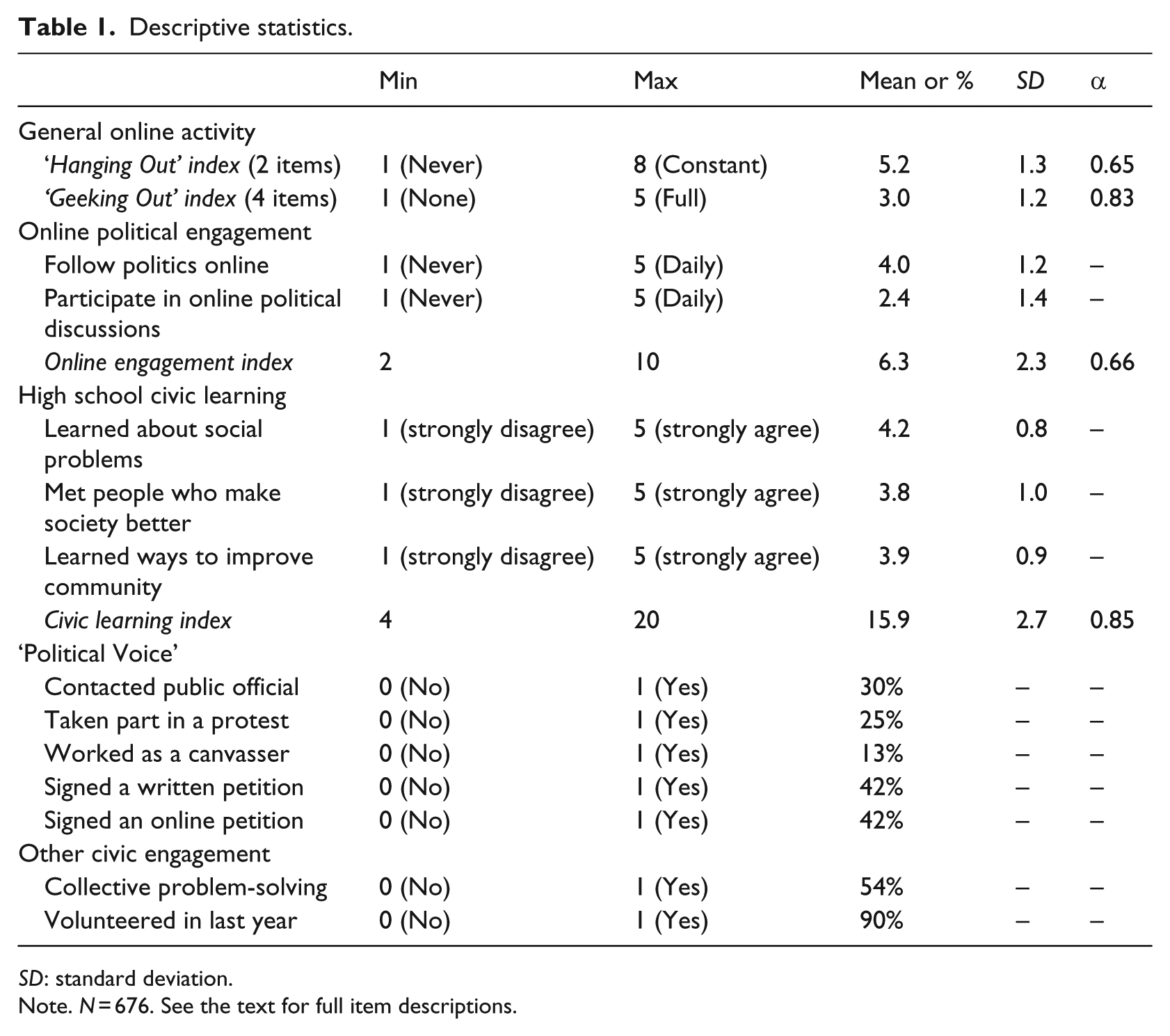
The descriptive statistics presented in Table 1 describe a cohort that is highly connected online and for whom volunteering is a normative experience. For instance, 89% of respondents reported spending time on social networking sites like Facebook or Myspace every day. In terms of volunteering, 90% of respondents reported engaging in some kind of volunteer work in the last year.
Descriptive statistics.
SD: standard deviation.
Note. N = 676. See the text for full item descriptions.
For high school civic learning and political voice, there was more variation within the sample. Regarding high school civics, the typical student ‘agreed’ or ‘strongly agreed’ that their high school coursework included a class in which they learned about social problems, met people who made society better, and so on. Yet across these items, ranked 1 (‘strongly disagree’) through 5 (‘strongly agree’), the standard deviation was typically about 0.9. Likewise, there was variation in terms of the extent to which students were engaging in offline and online political activity: 30% of the sample reported having contacted a public official, 25% reported having taken part in a protest, 13% reported having worked as a canvasser, 42% reported having signed a written petition, and 42% reported having signed an online petition. In terms of our measure of civic engagement, 54% reported having engaged in collective problem-solving.
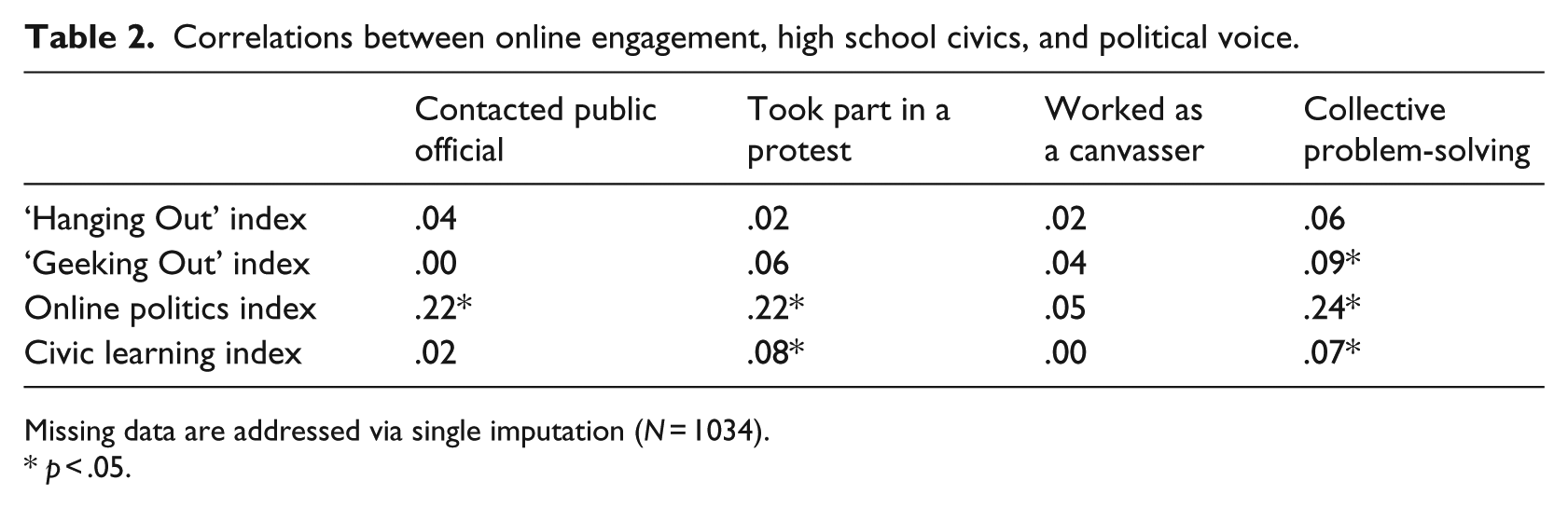
Table 2 presents simple bivariate correlations between our independent variables of interest (‘hanging out’ online, ‘geeking out’ online, online political engagement, and high school civic learning) and our dependent variables of interest (four measures of civic or political engagement). These correlations suggest very modest associations between these variables. Yet considering that the measures of civic and political engagement are all binary variables, the associations are nontrivial. Relatively strong associations were found between online political engagement and three out of the four measures of civic engagement (Table 2, Row 3, r = .20 to .24).
Correlations between online engagement, high school civics, and political voice.
Missing data are addressed via single imputation (N = 1034).
p < .05.
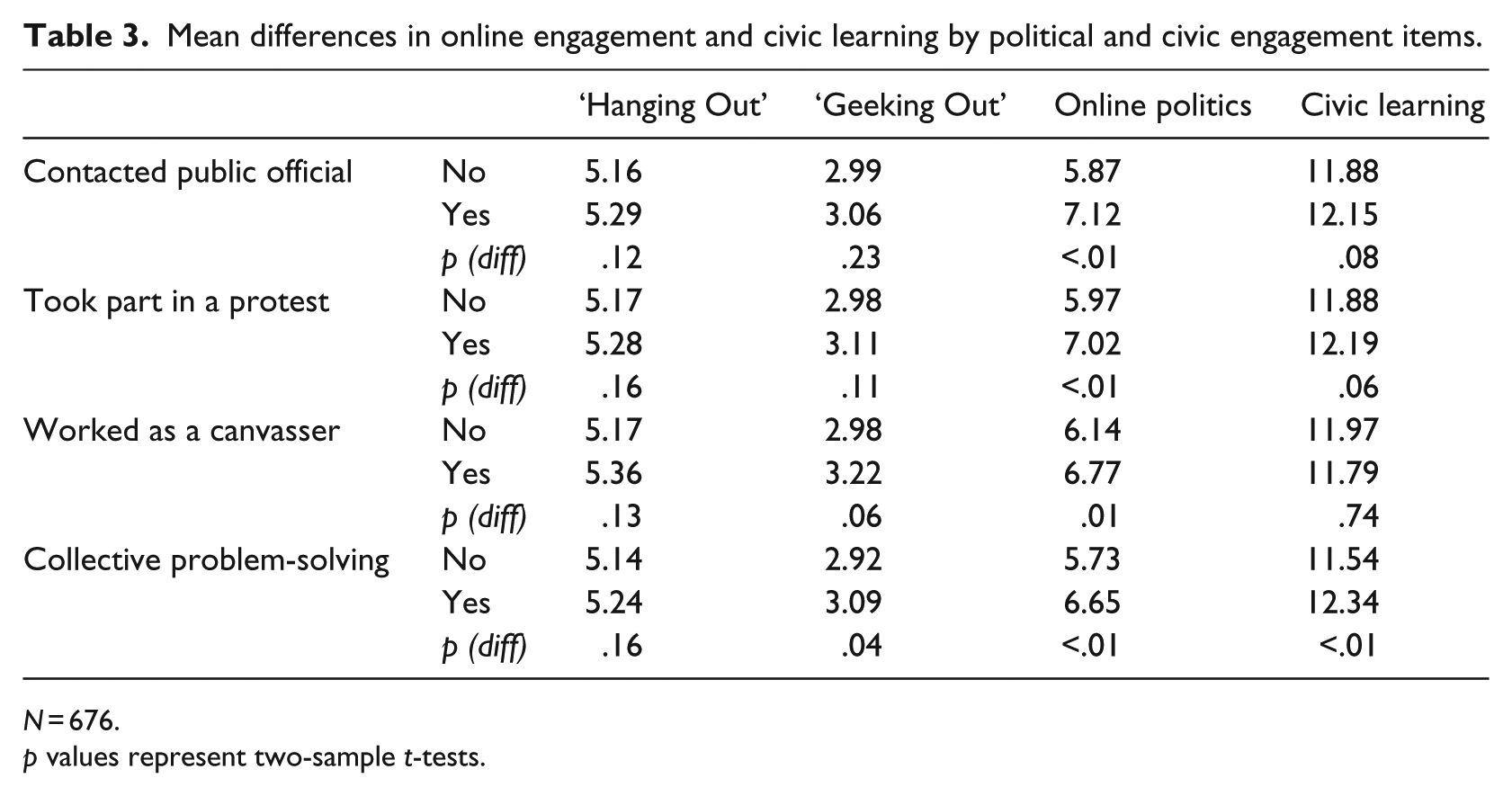
Table 3 presents mean differences in ‘hanging out’ online, ‘geeking out’ online, online political engagement, and high school civic learning by whether or not they endorsed the civic and political engagement items. Similar to the correlation findings, levels of ‘hanging out’ and ‘geeking out’ were comparable between those reporting political engagement and those not reporting political engagement. For the online political engagement index, students reporting offline political activities reported higher scores, suggesting that offline and online engagement activities might reinforce one another. Likewise, experiences of civic learning in high school were typically higher for students who were relatively politically active.
Mean differences in online engagement and civic learning by political and civic engagement items.
N = 676.
p values represent two-sample t-tests.
To provide a more stringent test of the bivariate associations reported above, we conducted probit regression models of each of the four measures of civic and political engagement (Table 4). As was the case in the correlation models, Models 1, 4, 7, and 10 suggest a weak, positive relationship between high school civic learning and civic and political engagement. The reported coefficients are marginal effects (MEs), interpreted as the percentage point increase in the dependent variable as a function of one standard deviation increase in the independent variable. For instance, the base rate of students having ‘engaged in collective problem-solving’ was 54%. Table 4, Model 10 suggests that among students one standard deviation above the average in terms of civic learning, we would expect 63% of them to report having engaged in collective problem-solving (p < .01).
Marginal effects from probit regressions of political engagement.

SD: standard deviation. DV: dependent variable.
X = set of additional covariates included in model. Missing data are multiply imputed (m = 20, N = 1034). ‘High School Civic Learning’ and ‘Online Political Engagement’ indices are standardized (mean = 0, SD = 1). ‘Background Controls’ are gender, race/ethnicity, whether a foreign student, SAT score, academic college, liberal political orientation (self and parents), parents’ income and education, and region of hometown.
p < .10; **p < .01.
The MEs from the first set of models begin to near statistical significance with the inclusion of a host of control variables (Models 2, 5, 8, and 11). For instance, Table 4, Model 2 suggests that—controlling for the respondent’s gender, race/ethnicity, status as an international student, SAT score, academic college within the university, self-reported political orientation (‘liberal’ vs ‘other’), parents’ political orientation (‘liberal’ vs ‘other’), parents’ education, parents’ income, and region of hometown—the ME of one standard deviation increase in civic learning is 0.03, or 3 percentage points (p < .10). Models 3, 6, 9, and 12 include online political engagement as an additional control variable. We staged in this variable to examine the possible mediating role of online engagement. Across the four dependent variables of interest, the MEs of high school learning generally appeared to be attenuated slightly with the inclusion of online political engagement, and online political engagement showed significant or near-significant associations with each of the four dependent variables.
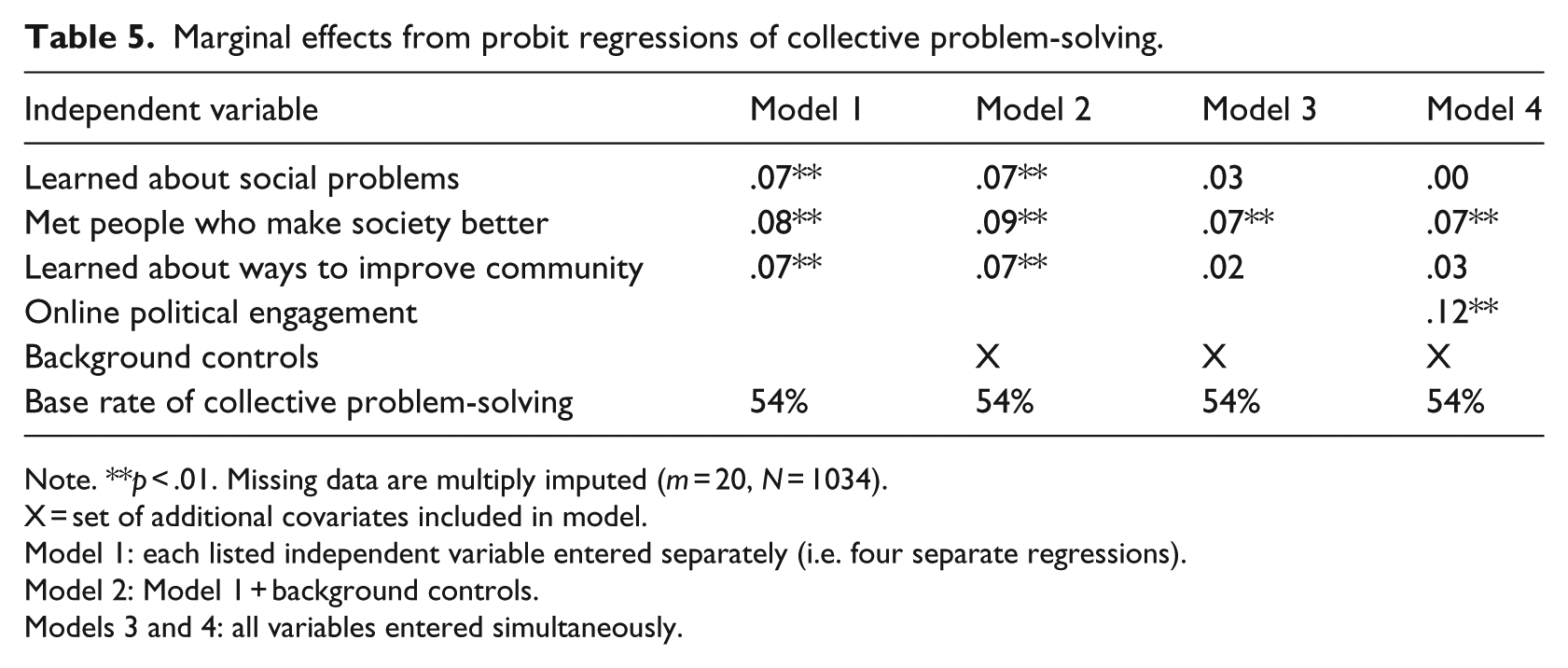
Across our dependent variables, the observed associations were strongest when predicting collective problem-solving. To further explore the mechanism by which high school learning might lead to collective problem-solving, we ran an additional set of probit models in which we decomposed the civic learning index into its three component items (Table 5). Model 1 represents bivariate associations from three separate probit models. In these models, three of the four measures of high school civic learning show significant associations with collective problem-solving; ‘teacher focused on issues I care about’ was the only aspect of high school civic learning that did not show a significant association with collective problem-solving. Model 2 presents the effects on Model 1 coefficients of adding our standard set of control variables, which once again do not attenuate the observed relationship between high school civic learning and civic and political engagement.
Marginal effects from probit regressions of collective problem-solving.
Note. **p < .01. Missing data are multiply imputed (m = 20, N = 1034).
X = set of additional covariates included in model.
Model 1: each listed independent variable entered separately (i.e. four separate regressions).
Model 2: Model 1 + background controls.
Models 3 and 4: all variables entered simultaneously.
Table 5, Model 3 includes all four measures of civic learning in the same probit regression. Students having ‘met people who make society better’ emerges as the most powerful predictor of collective problem-solving: one standard deviation increase in that variable was associated with a 7 percentage point increase in collective problem-solving. Finally, Model 4 is composed of the covariates from Model 3 along with the addition of ‘online political engagement’ as an additional control variable. In this model, both online political engagement (ME = .12, p < .01) and ‘met people who make society better’ (ME = .07, p < .01) were significantly associated with collective problem-solving, but online political engagement did not appear to play a mediating role.
Discussion
Our main findings were that (1) high school civic learning is a significant predictor of civic and political engagement, (2) online political engagement may partially mediate this relationship, and (3) in terms of the specific aspects of high school civic learning that may matter, ‘meeting people who make society better’ emerges as a particularly salient experience. Of course, these probit models do not allow us to identify a causal relationship between classroom learning and students’ engagement. The causal relationship, for instance, could have led from engagement to classroom experiences, if politically and civically engaged students sought out high school courses that would provide civic learning experiences. Moreover, our sample is derived from just one competitive, mid-sized university in the Midwestern United States, such that our results cannot generalize to college students more broadly. Nonetheless, the present findings suggest that further work on this question is warranted, which we hope to conduct in future research using a longitudinal extension of the data presented here.
Limitations notwithstanding, these findings suggest reason for some optimism regarding the potential for education to strengthen democracy. Thomas Bender (1993) argues that education’s connection to democracy ‘is about more than doing things It is about the work of academic professionals as active participants in and contributors to civic life, beyond and off their campuses. Such work is not only responsive, but also proactive; it is not only technical, but also social, cultural, and political; it is not only about identifying, framing, and solving problems, but also about creating public goods, furthering values and ideals, and building and exercising power to advance people’s self-interests and common interests, as well as larger public interests. (Bender, 1993: 10)
These themes are present in much of the literature on how institutions or schools must reinvigorate their democratic purpose (Beaumont, 2005; Bok, 2001; Boyte, 2009; Cohen and Eberly, 2005; Hollander and Hartley, 2009; Mathews, 2009). Our preliminary findings suggest that engaging directly with change agents, or ‘people who work to make society better’, may have been particularly inspiring for young people. Such social interactions could be classified as opportunities for social and political learning, where students are exposed to potential ways to make a difference. Beaumont (2011) finds that social learning about civic engagement increases political efficacy and agency. Although students felt that they had the ability to enact change through civic engagement as a result of social learning, Beaumont (2011) declares that such learning ‘opportunities remain rare on most high school and college campuses’. Based on our findings, we suggest that undergraduate campuses consider fostering relationships with others that make society better. These relationships may, in turn, have a dramatic effect on students’ view of civic engagement and political efficacy.
In general, much of the current literature on citizenship is driven by a retrospective perspective that focuses on what we have lost over the last 50 years. The measures we often use to study that citizenship are designed for a generation that was far more passive and duty-driven. By these measures, political involvement has indeed declined. Young people are not as involved as the 60s generation. Trust in government is at historic lows. This sense of decline is common in American history, as current situations often seem lacking in contradistinction to earlier times. One of the consequences of this negativity is the sense that the pursuit of social and political justice will be difficult if not impossible, if that pursuit depends on the young getting involved politically. Add to this literature the media’s focus on national gridlock and we are left with pessimism about our democracy.
Young adults, especially college age young adults, who were once seen as the vanguard in the pursuit of social and political justice, are now often characterized as callow and selfish: hardly the stuff of a movement for social change. The results we report here, while preliminary and partial, might give us the makings of another more optimistic perspective. Levine (2013) and Lewis (2014) have both used the concept of renewal to focus attention on universities and how they might enhance the citizenship skills of their students. However, the standard against which that renewal can and should take place has yet to be developed. Clearly that standard will focus on the extent to which the state and society can be described as just. As citizenship norms change and many in the United States see their civic responsibilities as global as well as national, the question of what are just international as well as national standards will become more important.
Technology, as we have discussed in this study, is also a large part of this changing civic landscape for the young. As children turn into adolescents, they have grown up as digital natives, reshaping the transition to adulthood. Finally, civics in high school has undergone a profound change. Gone are the days of constitution tests and reciting the Declaration of Independence. Service Learning has replaced the more standard fare and we know little about the positive side of these changes. One possibility is that while we may have lost some knowledge of our past, we may have gained respect for those who make a difference in their local communities. What we may be seeing is a modern ‘introjection’ where the local expert or hero serves as an object to emulate, with very positive consequences for the college student’s desire to engage himself or herself. The Internet allows for an online involvement that enhances the student’s commitment to civic renewal. This is of course speculative at this point, but our results suggest that a new set of norms are combining to reshape how college students become involved.
A number of critical questions on this topic deserve future study: Does civic education confer lasting effects, such that high school civic education continues to affect attitudes and behaviors over the entire life-course? Also, how might gender and socioeconomic factors moderate this relationship? Moreover, how does the quality and duration of engagement experiences impact long-term engagement? What sorts of engaged experiences are most effective at inspiring students to seek out other opportunities?
The particular significance of meeting change agents who ‘work to make society better’ could lie in the importance of role models for future career trajectories that involve public service. In the same way that young people are inspired by contact with professional athletes, doctors, or other role models, contact with engaged professionals might allow youth to envision a future for themselves and a meaningful outlet for their skills and talents in ways that more abstract learning may not. This finding suggests the importance of including contact with public sector practitioners in civic engagement curricula.
Our findings concerning online engagement are significant in terms of their relationship to existing literature and conventional wisdom about online engagement (sometimes termed ‘slacktivism’ in reference to the minimal effort involved; Christensen, 2011). The results of the current study indicate that, rather than substituting for offline engaged behaviors and providing a virtual outlet that replaces live action, online engagement activities at the very least correlate with offline engagement, and may even reinforce such engagement. These findings imply that online engagement is a tool that young people are employing to participate in and shape society, countering the bleak outlook that online engagement promotes disengagement.
In conclusion, we submit that millennials are looking for ways to express and refine the meaning of citizenship. Civil society is filled with opportunities, and we would like to see educational programming that connects students to these opportunities, preparing students both to enter the labor force and to participate in civil society. What tools do schools have to increase the citizenship skills of their students? How can these skills be transmitted to students? And perhaps most importantly, how can we inspire those students who are not drawn to civic engagement through family background and high school experiences to expand their experiences while at college? By connecting an understanding of the heavy influence of online experiences on adolescents with a new, broader model of citizenship and an appreciation for a more nuanced stance on democracy, we seek to identify ways to build citizenship skills as a normative part of the educational experience.
Footnotes
Funding
This research received no specific grant from any funding agency in the public, commercial, or not-for-profit sectors.