



Abstract
This article explores the possible affect schooling has on pupils’ orientations to cultural and national identity in Wales. The Curriculum Cymreig is a distinctive feature of the national curriculum of Wales that has important ramifications regarding the enactment of citizenship education in Welsh schools. Under this initiative, schools in Wales are required to incorporate Welsh themes, when appropriate, throughout all dimensions of the pupils’ schooling experience in order to instil within pupils a sense of community and belonging. Two of the primary goals of the Curriculum Cymreig are (1) to help pupils appreciate the distinctive quality of living and learning in Wales and (2) to help pupils develop their own sense of Welshness. Less than 40% of the pupils surveyed in our research agreed that school helped them appreciate living in Wales or develop their own sense of Welshness. These results call into question the effectiveness of the Curriculum Cymreig in meeting its goals and its role for promoting Welshness as a component of citizenship education in Wales. Recommendations in this article are made for the reconceptualisation of the philosophical rationale undergirding citizenship education in Wales for the development of a more critically oriented and socially just curriculum.
Introduction
The process of constructing and promoting national identity by states has been examined in both symbolic and actual terms. Anderson (1983) introduced the important concept of ‘imagined communities’, meaning that nations are envisioned, created and invented rather than fabricated. However, this is not to say that states do not employ literal measures in developing national identity. An interplay can exist at the borders of liminal discourses and practices of communities between a developed sense of a local person and place, and the centralised mechanism of the state, and this interplay can be enacted in various ways in both public and private spaces. The concept of an imagined community can perhaps be best understood through Gramsci’s concept of the ‘national popular will’ (Adamson, 1980). In considering an imagined community infused with a sense of cultural association grounded within the discourse of community and country, a national popular will can be described as a process whereby nationalism exists as a free-floating ideology. Adamson’s interpretation of Gramsci states that, as opposed to intellectuals serving the interests of capitalism, they could instead fulfil a unique role in creating a national popular collective will as a response to the domination of the current hegemonic block. Adamson’s argument has been situated within the context of Wales, with academics positing that intellectuals in Wales ‘… wield a remarkable influence by virtue of their position as producers of “knowledge” across a wide array of fields of endeavour’ (Fevre and Thompson, 1999: 16).
Therefore intellectuals’ efforts in analysing and producing literature, music and art, as well as their engagement with educational, political and philosophical questions, ‘have contributed much to the creation of the nation as an “imagined community”’ (Adamson, 1980.). As this argument suggests, the counter-hegemonic movement mounted by intellectuals in Wales, in conjunction with grass-roots movements, policy development and educational practice, has shifted from the ‘borders’ and gained its own role in the centralised discourse of the state regarding representations of Wales as a nation and Welshness as an expression of citizenship. This shift represents one of the many opportunities that exist within schooling to construct and promote national identity through curricular practices that can transcend localised orientations to community and citizenship into formal (authorised?) expressions of cultural and national identity by the state. Curricula are critical elements in producing/reproducing culture and, in effect, nationhood. For example, from 1775 to 1783, the American Revolution raged throughout the 13 colonies. As the early colonials entertained the notion of independence, they also illustrated a desire to break away from many of what they regarded were English ideologies and practices. Noah Webster, a pinnacle figure in early American education wrote, ‘For America in her infancy to adopt the maxims of the Old World would be to stamp the wrinkles of age upon the bloom of youth’ (Kaestle, 1983: 6). Webster argued for a new language for a new world, ‘Begin with the infant in his cradle … let the first word he lisps be “Washington”’ (Kaestle, 1983). This desire to not only shape the content of an American language but also its form, led Webster’s ‘Americanisation’ of English words. This ‘New World’ vocabulary was included in textbooks for children in early American schools and served as one of the many means in which the concept of an American nation was constructed through language and promoted through the medium of schooling.
Another example can be found in Welsh history. As a more robust system of schooling began to emerge in Wales in the 19th century, the power of schooling as a tool in managing and maintaining cultural identity was also realised. However, instead of using it to build a sense of nationality and belonging, it was intended to reduce difference and aid in cultural assimilation. William Williams, who instigated the infamous Reports of the Commissioners of Enquiry into the State of Education in Wales (often referred to as ‘The Blue Books’) that disparaged the religious and moral temper of the Welsh and berated the Welsh language, argued that ‘… education was a cheaper and easier way of creating an obedient population than the use of force’. He further argued that, ‘the moral power of the schoolmaster was a more economical and effectual instrument in governing this people than the bayonet’ (Roberts, 1998: 24). When considering the content of the report, which accurately depicted the appalling state of education in Wales, but also situated Welsh culture as the inferior ‘other’, Williams’ words reveal his belief in the power of schooling in promoting cultural norms and discourses of nation and identity. In both examples, concepts of citizenship were intrinsically woven into the curricular discourse of schooling. Even in the early stages of public- or state-run schooling, those concerned with nation-building recognised the influence education had over the production of knowledge, representation of culture and their relationship to producing a coherent narrative for, and concept of, a nation. In both instances above, curriculum and schooling were employed in shaping the character of a culture and nature of a nation, with the first scenario demonstrating resistance against external, cultural influences and the second cultural assimilation. In both examples, symbolic and practical action was expressed through curriculum development and implementation in deliberate and organised strategies in building a nation. Nation-building continues in contemporary education, but typically in less-ardent terms that stress community, collective association and political participation. In this regard, citizenship education (CE) continues to play a critical role in building and maintaining nation states and national and cultural identity.
This article explores the possible impact CE has on pupils’ orientations to cultural and national identity. Specifically, this study examines how the promotion and implementation of the Curriculum Cymreig in schools in Wales may affect pupils’ orientations to their appreciation of Wales and their sense of ‘Welshness’. Although the Curriculum Cymreig does not represent the entirety of CE in Wales, it is a distinctive element of the national and school curriculum in that it is designed to promote a sense of belonging and Welshness among students, as well as an appreciation for, and celebration of, the ‘distinctive quality of living and learning in Wales …’ (Awdurdod Cymwysterau, Cwricwlwm ac Asesu Cymru (ACCAC), 2003: 2). It is also intended to acquaint pupils with the processes of devolution and opportunities for pupils to become civically and politically active members of British, and specifically, Welsh society. For this study, two variables were derived from the goals of the Curriculum Cymreig described in Developing the Curriculum Cymreig (2003), the guidance document for educators in Wales produced by the Welsh government.
CE in the United Kingdom
CE, as a curricular subject, was introduced to schools in the United Kingdom in the early 1990s. In its earliest form, it existed as a cross-curricular theme touching upon multiple specific curriculum subjects, such as History and Geography (Daugherty and Jones, 1999). However, it was later endorsed as a statutory subject in England in September 2002 (Watson, 2004). In Wales, CE is not a stand-alone subject. Instead, it is delivered as a cross-curricular theme through Personal and Social Education (PSE), Education for Sustainable Development and Global Citizenship (ESDGC) and the Welsh Baccalaureate. Through a number of themes and key concepts, CE is an attempt to help pupils develop political literacy – meaning that they are able to recognise, comprehend and act on the characteristics of citizenship in their communities, the nation and even on a global scale. The motivation behind the introduction of CE in UK schools comes from concerns over young peoples’ attitudes towards civic and political participation and the desire to strengthen the public sphere through educating pupils in not only understanding how political processes work but also how to actively engage in those processes (Jowell and Park, 1998; Frazer, 1999).
In addition to the topics of civic and political participation that comprise much of what is regarded as CE are discourses of citizenship that promote a sense of collective identity and belonging that are not solely defined through civic and political involvement or activism. Within these curricular interventions are discussions of nation, identity and culture performed by a multiplicity of educational stakeholders including curriculum designers, teachers, pupils and parents, with each of these stakeholders contributing to how these discourses are shaped, promoted and interpreted. Likewise, the concepts of global citizenship and sustainable development have been introduced into the canon of CE that has been primarily oriented to discourses of national membership, identity and participation. The inclusion of a global and multicultural understanding of the qualities of citizenship – including civic, political and communal participation – has both broadened and enriched discussions of citizenship in schools, elevating the discourse of citizenship as a plural, multicultural and inclusive concept that extends beyond national borders and a singular and authentic national identity. In Wales, the interpretation of citizenship through the national curriculum emerges from the cross-curricular theme of ‘community understanding’ and emphasises ‘the role of community and culture, rather than civic society’ (Andrews and Mycock, 2007).
CE in Wales and the Curriculum Cymreig
The Education Reform Act of 1988 brought about the national curriculum of Wales. At the time, educational systems in England and Wales shared many commonalities, and the Education Reform Act of 1988 ensured that, to a degree, those similarities would continue to exist. In addition to the development of a national curriculum closely aligned to that of England, a competing campaign for a separation of English and Welsh approaches to schooling contributed to the development of a curricular initiative intended to reflect the cultural, social and historical features of Wales. In 1993, Awdurdod Cymwysterau, Cwricwlwm ac Asesu Cymru, (ACCAC) or Qualifications, Curriculum and Assessment Authority for Wales)) published Developing the Curriculum Cymreig, a guidance document for educators in Wales on how to differentiate the schooling experience in Wales by incorporating Welsh-oriented themes in pupils’ everyday school experience. The Curriculum Cymreig continued to be developed, with an update of Developing the Curriculum Cymreig being published in 2003. In 2012, another review of the Curriculum Cymreig took place to determine whether the Curriculum Cymreig should continue as a cross-curricular initiative, or whether it would be best implemented through the discipline of history. Recommendations from the review suggested the Curriculum Cymreig should be more clearly defined, and ‘this new definition be at the core of any future curriculum in Wales’ (ACCAC, 2003: 11).
In Wales, teachers can interpret and adapt their lessons in order to better contextualise and synthesise CE concepts, including elements specifically aligned to the Curriculum Cymreig, within their respective subjects. Although there are benefits to such a flexible approach, there are also disadvantages. Without the benefit of being established as a designated curricular subject, delivery of CE can encourage a ‘mile wide, inch deep’ approach to curriculum design and implementation. In some cases, teachers may attempt to spread concepts too broadly across their core subject areas. Alternatively, teachers may ‘cherry pick’ what they believe are crucial or relative concepts that fit well with other areas of their subject area, but that possibly lead to students struggling to construct a coherent cognitive understanding of how these privileged pieces of CE content fit together as a whole or in relation to their primary subject of study. In regard to the Curriculum Cymreig, a danger exists in teachers unintentionally promoting tokenised representations of Welsh culture and not being able to provide sufficient opportunities for pupils to reflexively think about their relationship to Welsh culture and identity.
CE is not constrained to a cross-curricular thematic approach in schools in Wales and teachers in PSE and ESDGC lessons do have the ability to design curricula treating CE as a discrete lesson topic, allowing a more in-depth study of citizenship. However, there are no statutory guidelines or assessments provided for such an approach. In both the approaches listed above, CE can be dominated by content regarding government organisation, processes and outcomes, with some discussion of public participation and responsibility, but relatively little discussion regarding ‘community understanding’ and culture. The Curriculum Cymreig is intended to address such gaps in CE by promoting the notion that culture and community are integral components of citizenship, and that ‘the statutory requirement for the Curriculum Cymreig is an essential part of the curriculum and ethos of all schools’ (ACCAC, 2003: 2). In other words, Welsh culture and Welshness should be a common feature of all schools in Wales, and more important, within each school a cultural awareness of Welshness should exist as an organisational and unifying philosophy amongst pupils, staff and the community served by the school. This cultural/community aspect of CE education in Wales is one of the features that makes CE in Wales distinct from that in England (Crick, 2000).
As a cultural initiative within the national curriculum for Wales, the Curriculum Cymreig is intended to promote both a sense of Welshness and belonging as an essential quality of Welsh schools. A critical analysis of the guidance supporting the implementation of the Curriculum Cymreig (Smith, 2010) suggests that the primary aim of the Curriculum Cymreig is the promulgation of a sense of nationhood that rejects Bhabha’s claim of the impossibility of the unity of a nation (Bhabha, 1990) and embraces an encompassing concept of community that more closely resembles Anderson’s concept of nation as an ‘imagined community’ (Anderson, 1983).
The Curriculum Cymreig implements a constructivist approach to orientating pupils to the discourse(s) of Welshness expressed through schooling, but provides little opportunity for pupils to engage in constructing nuanced understandings of the characteristics of social and cultural diversity in Wales, let alone critical investigations of political processes, participation or activism. Neither does it satisfactorily provide meaningful guidance regarding how teachers and pupils can engage in learning activities that encourage the celebration of the benefits of a plural and diverse understanding of Wales and Welshness. In short, the Curriculum Cymreig performs well as a cultural tool – as a vehicle specifically promoting a particular, historically oriented and traditional discourse of Welshness, but it does not perform well as a multicultural or critically oriented curriculum. Instead, it demonstrates how curricular treatments of citizenship can become enmeshed with broader attempts to promote commonality in ‘culture and history’ rather than providing pupils and teachers with opportunities to engage in dialectical investigations of the multiplicity of connections between cultural, national and personal identity and citizenship and the responsibilities and duties of living as a citizen in a community. (Andrews & Mycock, 2007)
Furthermore, Andrews and Lewis (2000) suggest that, along with the difficulties of promoting a cross-curricular representation of Welshness, the Curriculum Cymreig is situated within a ‘cultural citizenship’ framework that traditionally privileges the legitimacy of a nation and its membership upon concepts of ‘language, religion, bloodline or some other form of traditional practice’ – criteria often derived from the demands made by ‘ethnic or cultural nationalists’ (p. 2). In addition, the privileging of cultural citizenship in the curriculum leaves little room for discussions of political participation, and more important, how cultural, political, social and economic factors interact in the social milieu of pupils’ lives. Three areas of conflict have been identified within the development and implementation of CE in Wales, and these suggest the origins of the potentially problematic features of the Curriculum Cymreig (Bennell et al., 2011). The first area addresses the conflict between local and global citizenship. In other words, how does curriculum address the tension between responsibilities to the local community in contrast to those of the global community? The second involves tensions between theoretical orientations to citizenship – such as communitarianism and cosmopolitanism and how varying theoretical orientations to citizenship contribute to the complexity of curriculum, culture and national identity. Finally, the third area centres on the lack of a ‘clearly defined, commonly shared, sense of what it means to be a citizen’ (p. 88). This insight into the complexity of CE curriculum development highlights the theoretical acumen required by curricular theorists (which naturally include teachers) in order to expose and address potential problems and shortcomings that can undermine its educational impact on pupils. In addition, it brings to mind questions as to how the current policy for implementing and assessing the Curriculum Cymreig addresses these needs.
Along with its shortcomings, the Curriculum Cymreig also adds a distinctive quality to CE in Wales, particularly with its emphasis on culture and community. In Developing the Curriculum Cymreig, a number of case studies are presented to teachers to demonstrate how a Curriculum Cymreig can be implemented and performed in school. The case studies mirrored the efforts of the National Assembly for Wales in the publication A Culture in Common in which they promoted particular, commonsensical discourses of Wales and Welshness. Allard (2007) suggested these descriptions of Wales and Welshness interjected an ‘imagined diversity’ into conversations of Welshness. Nonetheless, components of Welsh culture, such as the Welsh language, feature prominently in the guidance, as well as the geography of Wales and its history. In many of the examples, pupils attended and participated in cultural events such as Eisteddfodau (performance festivals conducted entirely in the Welsh language) and agricultural shows. They travelled to locations such as Cardiff, the capital of Wales and historical sites such as Blaenavon, the industrial centre of Wales in the late 19th and early 20th century. They also visited popular holiday destinations including Llandudno and Llangrannog. In the case studies presented, teachers, when applicable, described how the Curriculum Cymreig they implemented contributed to students’ appreciation of Wales, the development of their sense of Welshness and their understanding of the political nature and processes of a devolving Welsh government. The ability to craft a locally produced curriculum existing outside the reach of standardised assessments and unconstrained by over-prescribed standards and measures of educational authorities outside of the school community can provide a reflexive and relevant type of schooling that is responsive to the needs of pupils as they explore and develop their orientation to citizenship and culture in Wales.
Over a decade has passed since the last publication of Developing the Curriculum Cymreig, and schools in Wales have had time to refine, redefine or even disregard its guidance. A number of studies have investigated relationships between educational initiatives and various social movements and interests in Wales (Phillips, 1996; Jones, 2006), characterisations of CE in the United Kingdom (Arthur et al., 2008) and representations of national identity and diversity among pupils in Wales and in the United Kingdom in general (Williams, 2003; Scourfield and Davies, 2005; Murphy and Laugharne, 2011; Keating and Benton, 2013; Uberoi and Modood, 2013), but there is little in regard to what pupils believe the impact of schooling might have in their orientation to, and association with, cultural and national identity. Therefore, in an attempt to investigate a small area of such a large task, the purpose of this study is to determine whether pupils in Wales believe schooling affects their orientations to Wales and Welshness.
The research
This research is part of a larger, multi-cohort longitudinal study following children and young people attending 13 secondary and 16 primary schools across Wales and is funded by Higher Education Funding Council for Wales (HEFCW). The cohorts in the study comprise Year 2, Year 6, Year 8 and Year 10 pupils attending schools in urban, semi-urban and rural locations. Quantitative data were collected in this research through the distribution of self-completion surveys.
Sample
The sample discussed in this article comprises 849 secondary school respondents, including 412 Year 8 (ages 12-13) and 437 Year 10 (ages 14-15) pupils. Purposeful sampling was used with the intention to create a representation of the diversity of Wales’ social, cultural and geographical landscape. As a result, the sample includes pupils attending schools in the following counties in Wales: Anglesey, Cardiff, Carmarthenshire, Ceredigion, Gwynedd, Powys, Swansea and Rhondda Cynon Taff. These schools feature Welsh medium, English medium and bilingual forms of instruction and possess varying degrees of ethnic and socio-economic characteristics. Of the pupils in our sample, 420 (49.5%) were male and 429 (50.5%) were female. In terms of ethnic diversity, 752 (88.6%) were self-identified as White, 11 (1.3%) as Black, 37 (4.4%) as mixed, 39 (4.6%) as Asian and 10 (1.2%) as Other. In regard to national identity, the following aggregate groups were created from the pupils’ responses: British 136 (16.7%), English 118 (14.5%), non-British 42 (5.2%), Welsh 480 (59%) and Welsh + X (e.g. Welsh and another nationality) 38 (4.7%).
Data collection
The data were collected using HTML-based self-completion surveys distributed to pupils on tablet computers. The constructs used in the survey were an aggregation of questions taken from the Millennium Cohort Study (MCS), the Avon Longitudinal Study of Parents and Children (ALSPAC) and original questions developed by the researchers. A pilot test involving non-participant students with similar characteristics to the pupils in the study was conducted providing important feedback regarding the formatting of the survey, the usability and durability of the tablets and the general design of the questions included in the survey. After the pilot test and modifications to the survey were completed, the researchers began visiting schools and distributing the surveys to the pupils in the sample. Once the respondents completed the survey, the data were stored locally on the devices and then uploaded to an online database via the Internet. At the end of each data collection period, the responses were uploaded to an online server and the data stored on the tablets were removed. The data were then downloaded from the online server and imported into an SPSS database for analysis. Occasionally, pupils were asked to complete hard-copy versions of the survey. The data from these surveys were then entered into the existing SPSS database by the researcher.
Variables
The survey contained a number of constructs relating to various dimension of pupils’ lives and schooling experiences. However, I only address the constructs relevant to the topic of this article. As mentioned previously, the following three variables were derived from the goals described in Developing the Curriculum Cymreig, they are as follows: (1) schools helps me appreciate living in Wales and (2) school helps me develop my own sense of Welshness. I refer to these variables as Curriculum Cymreig Constructs (CCC) in this article.
Qualitative data collection
The qualitative data in this study were collected through interviews with head teachers and through the review of school prospectuses and inspection reports. The purpose of the analysis of the interviews and school documents was to better understand how the Curriculum Cymreig was interpreted and implemented by the head teachers, as well as how the policy was evaluated by school inspectors. These data helped frame and contextualise my interpretation of the quantitative data.
Findings
Frequency and crosstab analyses were conducted on 838 responses to the CCC included in the survey. Interpretations of these analyses are provided below (Table 1).
Year 8 and Year 10 pupils’ responses (n = 838).

The results in Table 1 show less than 40% of pupils agree school helps them appreciate living in Wales or to develop their own sense of Welshness. As the respondents represented varying age, linguistic, social and cultural groups, crosstab analyses were used to identify possible relationships between these groups and the questions. One of the most important differences identified was between the Year 8 and Year 10 pupils’ responses to the CCC. These findings are presented below in Figure 1.
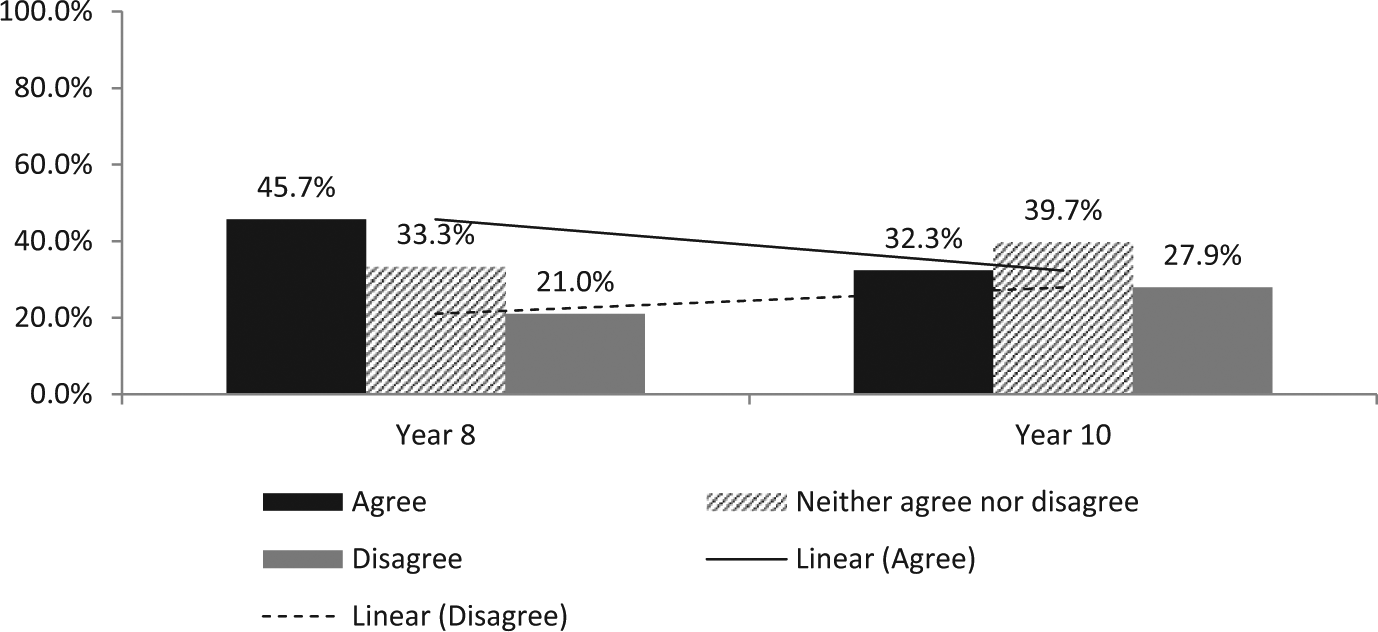
Responses to school helps me appreciate living in Wales (n = 838).
Figure 1 illustrates a possible relationship between pupils’ orientation to the CCC and their advancement through school. It is important to note that the responses represented in this graph are not from the same pupils at different years in their academic career, but rather individual sets of Year 8 and Year 10 pupils. A crosstab analysis of the data was conducted to compare the responses to the question ‘school helps me appreciate living in Wales’ from Year 8 and Year 10 pupils. The results of this analysis were significant (χ2 = 16.064, p < 0.000) and demonstrated that Year 8 pupils are more likely to agree, and less likely to disagree, than their Year 10 counterparts.
A crosstab analysis of the responses to the question ‘school helps me develop my own sense of Welshness’ from Year 8 and Year 10 pupils was also significant (χ2 = 11.825, p < 0.003) (Figure 2). As per the previous question regarding school helping them appreciate living in Wales, Year 8 pupils were more likely to agree that school helps them develop their own sense of Welshness, and less likely to disagree, than their Year 10 counterparts.

Responses to school helps me develop my own sense of Welshness (n = 838).
A crosstab analysis was also conducted comparing pupils’ responses to the CCC and their national identity (Figure 3). Pupils open-ended responses stating their nationality were organised into the following groups: British (131), English Only (117), Non-British (41), Welsh Only (473) and Welsh + X (which includes Welsh and another national identity. There were a total of 39 responses in this category). Of the original responses, two pupils provided ‘Scottish’ as their national identity. For the purpose of conducting this analysis, those responses were not included.

School helps me develop my own sense of Welshness distributed by National Identity (n = 801).
While an analysis of responses to ‘school helps me to appreciate living in Wales’ did not provide significant results, an analysis of ‘school helps me to develop my own sense of Welshness’ did (χ2 = 21.537, p < 0.006). Interestingly, while Welsh pupils did agree more often that school helped them develop their own sense of Welshness, the response rate was still not in the majority.
A crosstab analysis comparing pupils’ responses to their self-identified level of fluency in Welsh and the CCC was also conducted (Figure 4). In describing their level of fluency in Cymraeg (The Welsh language), the pupils could choose from the following options:
(More fluent) I speak Welsh fluently.
(More fluent) I can speak a lot in Welsh, but I’m not fluent.
(Less fluent) I can speak a few words and phrases in Welsh.
(Less fluent) I cannot speak Welsh.
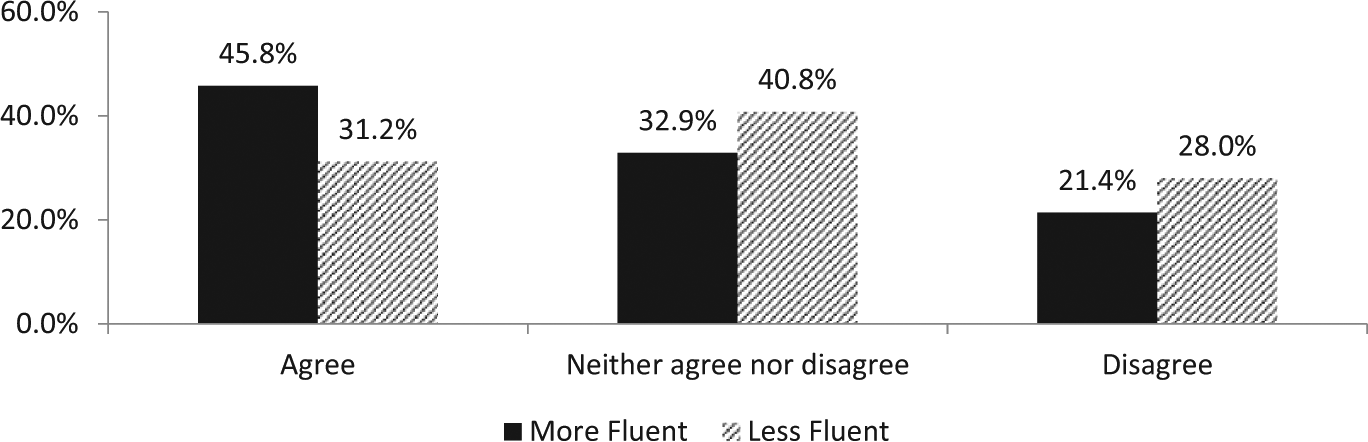
School helps me appreciate living in Wales by Fluency in Welsh (n = 838).
These responses were organised into the following groups: more fluent and less fluent. In the Figure above (Figure 4), pupils in the more fluent category were more likely to agree that school helped them appreciate living in Wales than pupils in the less fluent category. The results were significant (χ2 = 28.767, p < 0.000).
Similar to the results presented in Figure 4, pupils in the more fluent category were also more likely to agree that school helped them develop their own sense of Welshness than pupils in the less fluent category (Figure 5). The results were also statistically significant (χ2 = 65.779, p < 0.000).
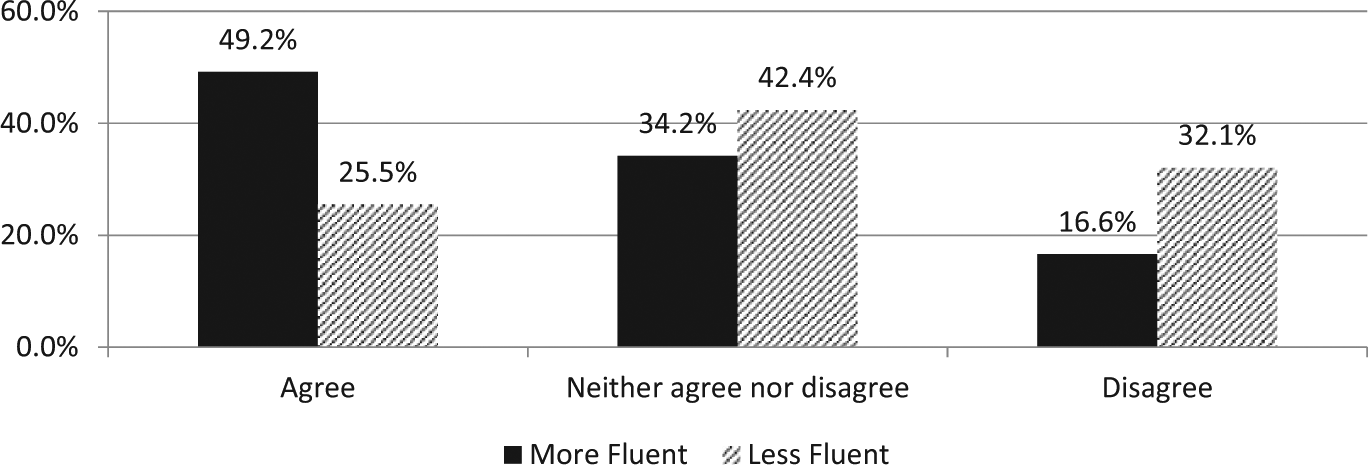
School helps me develop my own sense of Welshness (n = 838).
Discussion
As illustrated above, less than 40% of pupils in schools in Wales feel that school helps them appreciate living in Wales or to develop their own sense of Welshness. When looking at particular groups within the sample, Year 8 pupils and pupils with higher levels of fluency in Welsh are more likely to agree with these statements. Pupils who self-identified as possessing a Welsh national identity are more likely to agree that schooling helps them develop their own sense of Welshness. Another crosstab analysis of pupils’ responses organised by ethnicity also produced interesting and statistically significant results, suggesting that schools in Wales underserve ethnic minority pupils in regard to the variables discussed here. However, since the implications of those results exceed the scope of this article, they are not included in this discussion.
These questions only address a fraction of how schooling, and in particular, curricular initiatives in CE may affect pupils’ orientations to Wales and Welshness, but they still raise important questions regarding the philosophy, aims and impact of the Curriculum Cymreig. In isolating two of the primary goals of the Curriculum Cymreig and situating them as measures to evaluate pupils’ beliefs about school and how they construct feelings of affiliation and cultural and national identity, I hoped to provide an insight into the efficacy of the curriculum and its effect on pupils’ lives. If the development of national identity, and positive orientations and affiliations with Wales, is an important enough matter to require its own form of curricular intervention, then close attention must be paid to not only its development and implementation but also assessments of its impact set against the aims and goals provided in the guidance document.
In consideration of the results presented in this article, questions arise as to why do less than 40% of the pupils surveyed agree that schooling positively impacts their orientation to Wales and sense of national identity? Why are Year 8 pupils more likely to agree to these statements than their Year 10 counterparts, and perhaps more important, since Developing the Curriculum Cymreig states the Curriculum Cymreig should provide pupils with a ‘knowledge of contemporary Wales as a country of pluralities’ (ACCAC, 2003: 54), why do ethnic minority pupils and those less fluent in the Welsh language not demonstrate a stronger association with Wales and Welshness than illustrated in this study?
In addition to the data collected through surveying pupils, interviews were conducted with head teachers in 13 secondary and 16 primary schools, and these data give insight into the answers for the questions listed above. An analysis of the prospectuses of the secondary schools included in the study reveals that while the schools include a Welsh language policy, none of the documents specifically mention the Curriculum Cymreig. None of the prospectuses utilise language in the promotion of a Welsh cultural context beyond the inclusion of the Welsh language in lessons and daily activities as school. The school web sites also had no reference to a Curriculum Cymreig apart from the schools’ Welsh language policy.
In interviews with the head teachers, each head teacher said their school had a formal Curriculum Cymreig policy. When asked how well the policy was implemented in their school, the majority of head teachers believed their school implemented a Curriculum Cymreig well, with a minority suggesting their implementation could be improved. Overwhelmingly, the rationale head teachers used in describing the success of their Curriculum Cymreig were primarily dependent on the use of the Welsh language at school. For example, in the following passage, a head teacher in rural mid-Wales describes how his school implements a Curriculum Cymreig: We have ten incidental Welsh words and we are trying to get staff up to 20. We have English speaking teachers who will always put ‘gwaith dosbarth’ (class work) and the month in class, and they use Welsh stampers like ‘da iawn’ (very good). It’s at that level really, we have bilingual assemblies, we have Welsh medium in school and that helps, Welsh language tutoring groups.
A head teacher in a coastal area of mid-Wales indicated that although the school has a Curriculum Cymreig policy, it needed improvement. Like the head teacher above, his interpretation of a healthy Curriculum Cymreig, and indeed, a Welsh ethos, is entirely dependent on language use: It’s something we need to work on, our Welsh ethos. Many pupils feel Welsh is less important and… some pupils enjoy Welsh. About 50 of our pupils are Welsh first language standard. So what we are doing next September is to introduce more Welsh Medium teaching.
He continued to describe what he felt was the character of the school in terms of the Welsh language and how that disposition affects the implementation of a Curriculum Cymreig: It’s not the badge that we wear. In none of the terms I used to discuss this school did I say bilingual. If you went to other schools in this area, they would talk about bilingualism. We could do more, but are kind of naturally, what we are. The nature of the school is a natural expression of the adults and the children that are in this school, and the nice thing about that is there is no politics at all whatsoever, it doesn’t matter who can/can’t speak Welsh, where they come from, how many generations have been in Wales, none of those things are coming through at all.
Like all the secondary schools in this study, the Curriculum Cymreig is only understood as a language policy, and in this particular school, the attitudes towards Welsh language use minimalise the degree to which a Curriculum Cymreig can be enacted. When asked about addressing Welsh culture rather than simply Welsh language, the head teacher began to address cultural observances in the school, but his response rapidly strayed from the topic of Cymreig (Welsh culture) back to Cymraeg: We celebrate St David’s day. We do more with Welsh Medium assemblies and Welsh Medium registrations, but I’m not in the game of forcing anyone to speak Welsh. You just have to encourage it and explain why it’s important for them to keep those skills.
Another head teacher at rural mid-Wales near the English border demonstrates a broader understanding of the Curriculum Cymreig by saying ‘It’s not just the language issue, I think being Welsh is more than about the language, it’s about the identity’. However, when asked how his school enacts a Curriculum Cymreig, he also emphasises Welsh language use: The pupils always write the date in Welsh. There is Welsh written in every lesson, it’s small, but everybody does it. It’s in the pupils’ planner.
Its clear tensions exist within schools at the intersection of curriculum and culture, but also at the convergence of national policy and local practice. In schools in Wales, those tensions emerge from a variety of sources such as traditional uses and attitudes towards the Welsh language, themes of nationalism and the conceptualisation and implementation at both a national and local scale of Welsh educational policy. For example, the head teacher of the rural school near the English border describes the tensions arising from Estyn inspections and teachers’ attitudes towards implementing a Curriculum Cymreig: It’s the big criticism of the inspectors – the argument about consistency of staff who do it enthusiastic and lovingly, staff who do it begrudgingly and some choose to ignore it. And then, of course, if they ignore it and are told to do it, they do it begrudgingly and the possibly minimum.
In the Estyn inspection reports for the schools in this study, references to a Curriculum Cymreig were made, comprising language similar to that of the head teachers. Welsh language use was emphasised over a Welsh culture or ethos (although some references to these concepts were mentioned). In regard to primary schools, inspection reports were more likely to mention Welsh culture, but the language of the inspectors was primarily concerned with Welsh language use. The responses of head teachers at the primary schools in our study were also concerned with Welsh language use, but they expanded their interpretation of the Curriculum Cymreig to include learning experiences that acknowledged Welsh culture within the school and community, as well as a desire to create and promote a Welsh ethos. For example, a head teacher at a primary school in South-East valleys described the enactment of a Curriculum Cymreig at her school in regard to both Welsh language and ethos: We are really lucky in this school because a lot of our staff have a really good knowledge of Welsh as a second language. We also have third party support for Welsh language. We also have a strong Welsh ethos here. Our year 5 children are studying ‘black gold’, they’re doing lots of things with mining, etc …
The ‘black gold’ studied by Year 5 pupils is of course coal, and in this valley school, the curriculum tapped into local histories and traditions involving the legacy of mining. During the time this interview was held, a number of local communities were observing the commemoration of a major mining disaster, and the pupils from this school were involved in research projects, performances and visits to historical sites on mining in the valleys as part of that observation.
The head teacher of a primary school in mid-Wales also discussed a Welsh ethos in his description of the Curriculum Cymreig activities at his school: In the past, there has not been a huge focus on Welsh and the Curriculum Cymreig within the school, it’s been there and they’ve paid lip service to it. So, it’s a case now of trying to lift that. A Welsh ethos is not accessible to the extent that I would like to see. You can’t talk about Welsh culture without first talking about the Eisteddfod, we held our first one last year – there had never been a school eisteddfod prior to that; so many wanted to take part that it took all day.
The head teacher of a primary school in a coastal area of mid-Wales described the Curriculum Cymreig at his school as … an attitude that is taught through all the subjects. Yes, it’s being aware, both consciously and subconsciously, that we are a school in Wales and a Welsh community – I say that as someone who is not Welsh, but the children understand that. This is where we are, this is the community in which we are, this is a community school and therefore we must meet the needs of this community – the global community as well, but first this community.
In Cardiff, a head teacher of a primary school with a multiculturally diverse population responded that I’m confident that every aspect of the Curriculum will have a Welsh take on it. I’m passionate about living in Cardiff and taking our children out and about. It’s the capital city of Wales and it’s got fantastic facilities for all citizens – not just a few, and many of our children wouldn’t have the opportunity to go to the Senydd (Senate) or Millennium Centre if it wasn’t for school.
In this study, less than 40% of the pupils surveyed believed schooling positively impacted their orientation to Wales and Welshness. The interpretation of the Curriculum Cymreig policy by primary and secondary schools in this study can provide insight as to why so few pupils feel that schooling helps them appreciate Wales and develop their own sense of Welshness. While Welsh language use was regularly mentioned in school documents and interviews, primary schools were more likely to display Welsh flags, red dragons, daffodils and other traditional representations of Welsh culture. These activities can be interpreted as tokenistic appeals to an ‘authentic’ Welshness, but they also demonstrate a consideration of Welshness outside the limits of Welsh language use, incorporating simple representations of Welshness for young pupils in an attempt to create an atmosphere of Welshness that can nourish a sense of place with pupils. The secondary schools typically had less representations of Welshness, with the most common item on display being the Welsh flag.
My analysis of school documents and interview data reveals that head teachers and staff of both primary and secondary schools interpret the Curriculum Cymreig policy too narrowly, focusing on either red dragons and daffodils or Welsh language use rather than larger discussions of how pupils can think about culture and understand its role in their lives. The reasons for this failure to accommodate a more philosophical approach to culture and curriculum are manifold. For example, the guidance for teachers in regard to develop a Curriculum Cymreig fails to address theoretical discussions of culture and how teachers can address such concerns in their classrooms. Instead, the guidance focuses primarily on providing opportunities for pupils to experience authentically ‘Welsh’ activities and traditions (Smith, 2010). The interview data demonstrate schools’ concern with pupils’ academic achievement based on exam results and school inspections, and that this emphasis can dominate educational practice, limiting opportunities to discuss concerns that are not specifically assessed or measured. Finally, CE and discussions of the cultural dimensions of citizenship in Wales are relegated to PSE and ESDGC classes, which often become ‘catch-all’ courses that fail to accommodate in-depth and robust discussions of the content at hand.
Overall, primary schools in this study demonstrated a greater concern in performing a Curriculum Cymreig and enacting it as much more of a school-wide approach that promoted a Welsh ethos and not just a language policy. In many cases, the Curriculum Cymreig was perceived as an element of schooling through which pupils could become aware of their cultural and communal associations in addition to their learning activities. In addition, the head teachers of primary schools were also less likely to frame the enactment of a Curriculum Cymreig solely within the language of Estyn (the education and training inspectorate for Wales) inspections and policy, while the head teachers of the secondary schools regularly referenced Estyn inspections and reports.
The broader, more-accessible interpretation of the Curriculum Cymreig in primary schools and its outward expression in the classrooms and corridors, could help explain why Year 8 pupils are more likely to feel that school positively impacts their appreciation of Wales and sense of Welshness. In secondary schools, the interpretation of the Curriculum Cymreig is situated almost entirely within the context of Welsh language use and meeting the criteria of Estyn inspections. This means-end approach to curriculum implementation fails to engage pupils and teachers alike. As a result, within secondary schools, the emphasis on academic outcomes and qualifications over-shadows concerns for the promotion of a Welsh ethos, and mandating that teachers squeeze a Welsh dimension into their regular lesson plans is an ineffective method for pupils to explore their associations with Wales or think about how they construct their own sense of cultural identity. After 2 years of secondary school, Year 10 pupils may not believe that school positively affects their appreciation of Wales and sense of Welshness because the degree to which schools address these issues is greatly compromised.
As evidenced through interview data and school documents, school Welsh language policies dominate conversations of curriculum and culture in Wales. Literacy in Cymraeg is a distinctive feature of Welsh education and a socially, culturally and politically important policy concern. However, the primacy of literacy in Welsh dominates other Welsh culture concerns and shapes the way in which head teachers and their staff understand and enact curriculum. In this study, pupils who were more fluent in Welsh agreed that school helped them appreciate living in Wales and develop their own sense of Welshness far more than pupils who were less fluent. Apart from the important role language plays in cultural identity, concerns over ‘Cymraeg’ (Welsh language) far outweigh curricular conversations of ‘Cymreig’ (Welsh culture). Pupils’ learning experiences in schools in Wales are intersected by Welsh language policy, and in regard to the cultural dimension of CE, these concerns dominate discussions of what it is to be Welsh and what that might mean in regard to pupils’ concerns of their cultural and national identity, and conceptions of what it means to be a citizen in Wales.
Finally, in regard to Welshness and ethnicity, apart from the challenges ethnic minority pupils face in schools in Wales, there simply are not enough discussions regarding how to create a more inclusive and accessible Welshness for these pupils. Of the 838 pupils participating in this study, 96 were self-identified as non-White. The pupils attend schools dominated by Whiteness and constructions of Welshness emerging from within and without that context. In the interviews held for this study, only two head teachers mentioned how measures were taken to help non-White pupils and pupils born outside of Wales to engage in Welshness at their schools. Unsurprisingly, these schools possess large numbers of ethnic minority pupils. However, non-White pupils and pupils born outside of Wales can be found in nearly all the schools participating in this study. The lack of discussion of ethnic minorities and Welshness corresponds to the absence of such concerns from the guidance outlining the Curriculum Cymreig. In this document, general rhetoric is employed in discussing a plural and multicultural Wales, but apart from an example in Religious Education lessons, none of the case studies presented provided serious guidance for teachers on how to transcend constructions of a white, Welsh Welshness into a more accurate and relevant multicultural understanding of the complexities of Wales’ history and culture (Smith, 2010). If national guidance does not contain viable strategies for multicultural CE that can be implemented in schools, the likelihood of such activities being taken in schools in Wales is greatly reduced.
Recommendations
Curriculum and ideology are intricately entwined (Apple, 1979). The onto-epistemological considerations of curricular development, along with political ideologies and discourses of power, course through educational aims and influence practices implemented to attain them have been scrutinised and critiqued by scholars concerned with schooling existing as a critical practice that informs and promotes human emancipation (Giroux, 1981; Aronowitz and Giroux, 1985; Aronowitz et al., 1993; Gillborn, 2006; Giroux, 2010a).
In theorising the potential of the Curriculum Cymreig, I consider how a critical conceptualisation of a culturally relevant curriculum initiative might help pupils in Wales to attain a more robust understanding of the plurality of Wales and greater association with Welshness through the development of their critical literacy (Freire, 1985; Bates, 2006; Freire, 2000; Apple, 2008; Giroux, 2010b, 2011, 2012). Specifically, I turn to Giroux’s discussion of critical theory and three modes of rationality regularly present in models of CE curricula – the Technical, Hermeneutic and Emancipatory (Giroux, 1980). Giroux describes the connection between models of citizenship transmission in CE curricula and technical rationale, stating that knowledge is ‘fixed and unchanging in the sense that its form, structure, and underlying normative assumptions appear to be universalized beyond the realm of historical contingency or critical analysis’ (p. 337). In short, the transmission of knowledge of citizenship is natural, objective and not necessarily subject to critique or review. Furthermore, it privileges a less-complicated social landscape that downplays conflict and ‘neither recognizes or responds to social and structural dysfunctions’ (p. 338).
Unlike models of citizenship transmission, Giroux (1980) states CE curricula that fall under a hermeneutic rationality stress ‘negotiation, participation and the importance of values in CE’ (p. 342) and place a strong emphasis on ‘social construction rather than the imposed nature of the classroom’ (p. 343) which provide meaningful interactions with the meaning and purpose of CE. Such an approach transcends models of citizenship transmission and can promote pluralistic definitions of citizenship. However, while CE curricula established within a hermeneutic rationality accommodate subjective and relativistic forms of knowledge, Giroux (1980) asserts it is exactly these notions of knowledge that weaken its epistemological foundation by not providing opportunities for historical analysis or platforms for critique: Thus, by reducing power and democratic action to the level of an epistemology that supports form of subjective idealism, the reflective inquiry approach emerges as a one-sided theory of CE which has ‘miraculously’ abstracted its social epistemology from such troublesome concepts as ideology, power, struggle and oppression. (p. 343)
In short, hermeneutic rationale rejects objectivism, but it fails to develop an analysis that leads to ‘an open, self-critical community of inquiring citizens’ (Giroux, 1980: 346). In both modes of rationality, the socialisation of pupils to dominant ideologies and normative values is enhanced by a form of schooling established on epistemological positions that do not accommodate or promote ‘negotiated outcomes and critical thinking’ (Giroux, 1980: 345).
Emancipatory rationality attempts to address hermeneutic interests in order to explore how such interests place ‘specific limitations and constraints upon human thought and action’ (Giroux, 1980: 346). This process is established upon the principles of critique and praxis. In other words, emancipatory rationality informs critical reflection and knowledge construction and is concerned with demystifying ideology that prevents a critique of the ‘political, social and economic contradictions’ (Freire, 2000: 35) that exist in our daily lives. Giroux further discusses two educational traditions informed by an emancipatory rationality: political economy and culturalist positions. The political economy position is oriented to how macrostructural relationships organise and reproduce class relations. Culturalists are oriented to the ‘experiences of subjects and how notions of consciousness, ideology and power enter into the way human beings constitute their day-to-day lives’ (Giroux, 1980: 348). The underlying assumption of emancipatory rationality that informs these positions puts forward the process of social reproduction as the primary organising factor for schooling. In other words, schooling acts as a mediator between pupils and their social relations, orienting them to regard the dominancy of certain groups and structures as naturally occurring components of social life (Apple, 1979; Bourdieu and Passeron, 1990; Bernstein, 2003).
As mentioned above, the Curriculum Cymreig is situated within a cultural citizenship framework that promotes an understanding of citizenship as a cultural association derived from essentially Welsh characteristics such as language use and bloodline. Such an approach fits well into a theory of social and cultural reproduction in that it operationalises a technical rationale in promoting and normalising discourses of Welshness as an objective characteristic – a naturally occurring, a priori position suggesting a ‘true’ or ‘innate’ Welshness inhabiting various positions of power that infuse social structures and inform traditional practices. From these negotiations of power and position, derivative forms of Welshness are generated and organised into hierarchies of Welshness experienced by pupils, with pupils who inhabit non-regular orientations to dominate discourses of Welshness experiencing greater levels of disassociation with Welshness and Wales. It is possible that the variations in the data presented here are an indicator of such reproductions of Welshness. For example, pupils having non-white ethnic backgrounds regularly express negative interpretations of school’s impact on their associations with Wales, while white pupils and pupils fluent in the Welsh language report the opposite. For each of the CCC, Year 8 pupils agreed more often than Year 10 pupils. Perhaps, in addition to the points raised earlier, this is a result of pupils naively participating in a curriculum that does not accommodate critical enquiry and reflection, which is not a surprise since these pupils attend schools in which teachers are not prepared to encourage and facilitate discussions of culture and inclusion (Rapoport, 2010; Philpott and Dagenais, 2011). The technical rationale organising the Curriculum Cymreig offers an objective form of Welshness that pupils who have not yet developed robust forms of critique accept as a ‘complete story’, a commonsensical representation of Wales and Welshness that is both simple and natural.
Conclusion
The Curriculum Cymreig is promoted as a constructivist curriculum (Smith, 2010) in that it claims to provide pupils opportunities to engage in learning experiences intended to help them develop their own sense of Welshness and social interaction within their communities. While, as part of a larger discussion of citizenship and community, it is concerned with how pupils in Wales are introduced to discussions of civic life and democratic living, as a curricular initiative its theoretical foundations do not allow for pupils to consider the social, political and economic factors that intersect and shape orientations to cultural identity and citizenship. Giroux (1980) stresses that the governance of individuals’ socialisation is managed through macro level economic and political structures, and that through acquiring an awareness of the nature of such governance and ‘the potential for acting upon it’ (p. 347), individuals can perceive the factors organising their orientation to the world, formulate more socially just and inclusive alternatives and bring about change informed from those critically informed, reflective processes. With the implementation of CE in schools comes the necessity for educators and policy makers to incorporate more distinct, child-oriented forms of democracy and democratic education (Koshmanova, 2006; Maitles and Deuchar, 2006). If CE in Wales is to include a curricular initiative designed to promote Welshness and celebrate the diversity of life in Wales, it should also include opportunities for teachers and pupils to critically engage in dialectical discussions of identity, self and other – including discussions about nationalism rather than simply learning activities that promote it (McDonough and Andrée-Anne, 2013) as well as the social, political and economic forces that vie for position in our pupils are oriented to citizenship and participation in the public sphere.
Footnotes
Acknowledgements
This paper is based on research supported by the Wales Institute of Social & Economic Research, Data & Methods (WISERD). WISERD is a collaborative venture between the Universities of Aberystwyth, Bangor, Cardiff, South Wales and Swansea. The research that this publication relates to was undertaken through WISERD Education and was funded by HEFCW (Higher Education Funding Council for Wales). Kimberley Horton, Kathryn Sharp and Kevin Smith assisted in the collection of data. The analysis was supported by a volunteer work placement with WISERD Education.