




Abstract
Universities have become increasingly interested in incorporating civic engagement into undergraduate education with the goal of enhancing leadership skills and creating socially responsible global citizens. What is unclear is which educational experiences are most effective in achieving this goal. In this study, we seek to determine the impact of three types of educational experiences—curricular civic engagement, extra-curricular civic engagement, and participation in a living-learning community on social responsibility and political engagement (two components of civic engagement) attitudes and behaviors. Using a survey of 1240 undergraduates, our findings indicate that while all three types of experiences are positively related to civic engagement attitudes and behaviors, extra-curricular civic engagement has the most impact. Furthermore, student civic engagement attitudes are already relatively high; so instructors should focus on behaviors. The greatest potential for growth is in political engagement behaviors. We identify what this means for higher education and how implementations in the university can lead to increases in aggregate student development.
Keywords
Introduction
Universities have become increasingly interested in incorporating civic engagement into undergraduate education (Calleson et al., 2005; Dote et al., 2006; Harkavy and Puckett, 1994; O’Meara and Rice, 2005; Sandmann et al., 2009), with the goal of enhancing leadership skills and creating socially responsible global citizens (Caulfield and Woods, 2013). Beyond enhancing civic skills, teaching active citizenship may promote social cohesion between different ethnic and cultural groups (Birdwell et al., 2013). With numerous studies demonstrating the value of service-learning and civic engagement for student development, associations and governmental entities like the Carnegie Foundation for Advancement in Teaching (CFAT National Advisory Council, 2014), the American Association of State Colleges and Universities (AASCU) (2014), Association of American Colleges & Universities (AACU) (2014), and the US Department of Education (2014) have expressed interest in the expansion of and research on effective practices to engagement.
Researchers argue that both curricular and extra-curricular civic engagement opportunities should be designed to build on students’ previous experiences to connect them to their new environment, develop links between knowledge and practice, and foster post-graduate civic engagement behaviors (Bringle et al., 2011). What is unclear is which educational experiences are most effective in achieving this goal. For instance, Hunter and Brisbin (2000) argue that while ‘many authors claim participating in service learning can lead students to better understand and practice democratic and civic values, few detailed evaluations of the effect of service on students’ political behavior and attitudes have been published’ (p. 6). A central goal of research, thus, should be to determine what types of educational experiences influence attitudes and behaviors related to civic engagement and to what degree.
This task is complicated by the lack of consensus on a precise definition of civic engagement (Adler and Goggin, 2005; Cress et al., 2010; Gibson, 2001). Given this lack of consensus, Adler and Goggin (2005) opt for a broad approach arguing that civic engagement ‘describes how an active citizen participates in the life of a community in order to improve conditions for others or help to shape the community’s future’ (Adler and Goggin, 2005). Unfortunately, this inclusive definition is not precise enough to provide the basis for a direct evaluation of civic engagement. For this reason, we use measurable attitudes and behaviors related to the categories of social responsibility and political engagement, two components considered to be part of civic engagement.
In this study, we seek to determine the impact of three types of educational experiences—curricular civic engagement, extra-curricular civic engagement, and participation in a learning community—on civic engagement. To do so, we measure their impact on attitudes and behaviors related to political engagement and social responsibility. We use a number of statistical approaches to explore the direct and indirect influences university-associated civic engagement has on these two dimensions. We also acknowledge that civic engagement attitudes and behaviors are influenced by a series of individual and social characteristics that are time or order dependent. We control for other variables that we have reason to believe might impact these attitudes and behaviors.
Background framework
Civic engagement experiences in higher education
Curricular civic engagement
Much has been written about the importance of civic engagement as a classroom implementation. 1 The majority of this work is concerned with pedagogical techniques and best practices (see, for example, Bringle and Hatcher, 2009, 2011; Bringle and Steinberg, 2010; Bringle et al., 2011; Krause, 2005; Rheingold, 2008; Syvertsen, 2008). However, the criticisms of curricular approaches have been numerous. Based on an assessment of five campuses, Ostrander (2004) argues that the institution of civic engagement cannot simply be a curricular exercise, but must exist and be thoroughly integrated into all facets of the university for optimal student development. Additionally, Saltmarsh (2005) asserts that while civic engagement demanded in the classroom may spur instantaneous behavioral changes, it may not create a framework to continually model and reform engagement, and that it must be woven into the fabric of the individual’s life if it is likely to have a minimal lasting impact. These criticisms of curricular civic engagement highlight the need for expansive inquiry into the aggregate trends and the legacy impact of curricular civic engagement.
Living-learning community participation
Living-learning communities are environments where students actively engage in learning together with shared classes, study space, and so on. These communities are often associated with a shared interest among students such as major, career track, demographic, or cultural value. The living-learning community implies that students share both classroom and living space. Living-learning communities have been shown to have numerous positive effects on students including greater social interaction, higher graduation rates, and greater increases in critical thinking and reading comprehension. This speaks to the philosophy behind a living-learning community, which strives to extend learning beyond the classroom (Pike et al., 1997). Given that living-learning communities have such a positive effect on broad student development, it is reasonable to assume that this would transfer to broader civic engagement attitudes and behaviors. However, scholars have not specifically tested this hypothesis.
Extra-curricular civic engagement
In addition to being exposed to civic engagement inside the classroom and in living-learning communities, during their college or university experience many students also participate in extra-curricular activities that involve civic engagement. The difference between extra-curricular university-associated civic engagement activities and those of classroom or living-learning communities is that student participation is more likely to be completely voluntary and to reflect student preferences. Because of the voluntary nature of the experience, we expect that extra-curricular civic engagement will have a greater impact when compared to classroom-implemented civic engagement or participation in a living-learning community.
Control variables: additional factors that influence civic engagement attitudes and behaviors
Pre-college engagement
Prior to coming to college, most students are actively engaged in civic engagement activities or volunteer work, which may or may not be curriculum based (i.e. may not be service learning). Of students who are planning to attend college, 76% are engaged in civic engagement or volunteer activities, a trend that has steadily increased over the past 20 years (Dote et al., 2006). Much of this increase may be due to competitive college application requirements, since volunteer rates plunge to 30% as students enter college, a rate that still remains above the national average of 28.5% (Dote et al., 2006). The link between youth and adult civic engagement is well established. For instance, Youniss et al. (1997) tracked student civic engagement for 15 years to assess the influence of youth civic engagement on adult engagement; they found that youth engagement was predictive of adult engagement specifically in regard to political involvement (i.e. voting) and organizational volunteer behavior. Similar to the results found by Youniss et al. (1997), we expect pre-college engagement to have a postive influence on civic engagement attitudes and behaviors at the college level.
Family socialization
Much has been written about civic engagement as a learned behavior that begins well before an individual enters college (see, for example, Andolina et al., 2003; Egerton, 2002; Sanchez-Jankowski, 2002). For instance, Andolina et al. (2003) demonstrate that habits formed in the home are key predictors of future civic engagement. This means that having parents who are civically engaged and promote civic engagement in the home is more likely to produce children who are also engaged. Additionally, they note that engagement lessons and opportunities at school are also important predictors that may heighten or dampen habits formed in the home. Family socialization may also have a negative influence in youth civic engagement. Less-engaged families are likely to produce less-engaged kids, and Alesina and Giuliano (2011) found that individuals who rely fully on the family for all needs are less likely to be politically active or socially engaged. Similar to pre-college engagement, we expect family socialization to influence collegiate civic engagement and overall attitudes and behaviors, where those who come from families who have been civically engaged will hold greater favor toward civic engagement and be more likely to be engaged.
Demographic characteristics
We also expect our selected demographic indicators to have unique impacts on attitudes and behaviors for both components of civic engagement, social responsibility and political engagement. We have chosen to explore four demographic characteristics that we apply to both categories. Our demographic indicators are sex, race, political orientation, and religion.
Sex
A recent report from the Bureau of Labor Statistics (2013) shows women (29.5%) report volunteering (social responsibility) more often than men (23.2%), a trend seen across various ages, education levels, and demographic characteristics. This report is consistent with numerous studies (Gillespie and King, 1985; Themudo, 2009). Although it has long been held that women are less interested in politics (Berelson et al., 1954), a recent study of 18 advanced Western democracies reveals that women are more likely to have voted and participated in ‘private’ activism, while men are more likely to engage in direct participation such as being involved in a political party (Coffé and Bolzendahl, 2010). The gender (sex) gap in political participation is often considered as a socialized state, where parental influence and socioeconomic factors contribute to the variance in participation between men and women (Clark and Clark, 1986). Based on previous studies, it is likely that women will hold higher civic engagement attitudes and report more involvement.
Race
Race has also received attention in relation to our two categories. The Bureau of Labor Statistics reports that Whites have the highest volunteer rates (27.8%), followed by Blacks (21.1%), Asians (19.6%), and Hispanics (15.2%) (Bureau of Labor Statistics, 2013). Although scholars have argued that among many factors, children of Whites are more likely to have a parent who regularly volunteers, modeling engagement behavior, the theoretical and social justifications have received limited attention (Flanagan and Faison, 2001; Schultz, 2006). Additionally, numerous studies have explored racial differences in political participation where participation by people of color is often lower than Whites (J. E. Leighley and Vedlitz, 1999). Scholars have found that this difference can largely be explained by how empowered or represented people of color feel in a particular community (Bobo and Gilliam, 1990). Much of the current work has taken a community-level approach to look at the prevailing dynamics that drive of hinder participation (see, for example, Austin et al., 2012; Hardy-Fanta, 2011). We expect that race will have an influence on pre-college volunteerism, parent civic engagement behavior, and subsequent civic engagement attitude and behavior across both categories: social responsibility and political engagement.
Strength of political identity
To our knowledge, there is no literature to suggest that political orientation will have an influence on social responsibility or political engagement. However, there is a significant body of literature that implies that strength of party identification is important in developing social identity (Fowler and Kam, 2007) and increasing mobilization (Caldeira et al., 1990; J. Leighley, 1996), which both contribute to political participation. This means that those who have a strong political identity are more likely to be engaged in politics. Additionally, there is some literature to suggest that liberals value social services more than conservatives, but this may not hold true for behaviors (see, for example, Feldman et al., 2007; Jost et al., 2003; Lakoff, 2010), and they may rely on different sets of morals and values to make determinations about civic opportunities (see, for example, Graham et al., 2009). It is likely that those who identify more consistently with a party or have a greater party affiliation will be more likely to be politically engaged and hold a greater attitude regarding the importance of politics. It is also likely, given the literature around social services and political ideology, that liberals will hold more favorable attitudes about social responsibility and these attitudes are likely to translate into affiliated behaviors.
Religion
Much of the literature suggests that religion is positively related to civic engagement attitudes and behaviors (Lewis et al., 2012, 2013). For instance, Johnston (2013) found that religious affiliation (specifically Christian denominations) provides a social environment where volunteerism is encouraged and where opportunities are numerous. Additionally, being a member of a congregation may influence social awareness resulting in greater political participation. Specifically, the interaction between race and religion has been explored with scholars finding that participation in church activities is positively related to political participation for African-Americans, and that this effect was greater for men (Robnett and Bany, 2011). For our analysis, we assume that religion may impact the selection of a college experience, with individuals interested in social service and helping more likely to seek experiences where civic engagement is a consistent priority.
Data
Site selection
Our study site is Michigan State University (MSU). MSU (2014) is a land-grant public research university with 49,343 students in the fall of 2013, of which 37,988 were undergraduates. MSU is the ideal location to conduct this study for four reasons. First, the key to the mission of the university is a focus on service-learning and civic engagement to prepare students to contribute fully to society as globally engaged citizen leaders (Simon, 2008). Second, to facilitate engagement opportunities, MSU established the Center for Service-Learning and Civic Engagement (CSLCE), which helps instructors identify and provide meaningful engagement experiences for their students. Third, MSU is a large institution that has several levels of embedded civic engagement structures including classroom initiatives, living-learning communities, and university-associated activities, and so comparisons across various types of university-affiliated engagement programs are easy to conduct. Finally, MSU has three degree-granting residential colleges—the Residential College in Arts and Humanities (arts and humanities), James Madison College (JMC; politics, law, and social issues), and Lyman Briggs College (LBC; natural science)—as well as seven additional living-learning communities that cater to specific majors or academic interests.
A survey was distributed to all MSU undergraduates in the spring of 2013. 2 Students were recruited through the university email system. The survey contained 86 question sequences (164 total questions), allowing for both quantitative and qualitative assessment. As an incentive, a drawing was held for eight US$25 gift certificates, offered to students who completed the survey. The collection of data for the drawing was disassociated with the survey instrument. The survey was conducted during spring semester so that all students would have participated in at least one semester of college prior to taking the survey. A total of 1797 students completed the survey. Due to missing data on a number of items, the final sample we use for this study is 1240. Only a subset of questions from the survey is used in this particular analysis.
Measurement
Dependent variables
Attitude: social responsibility and political engagement
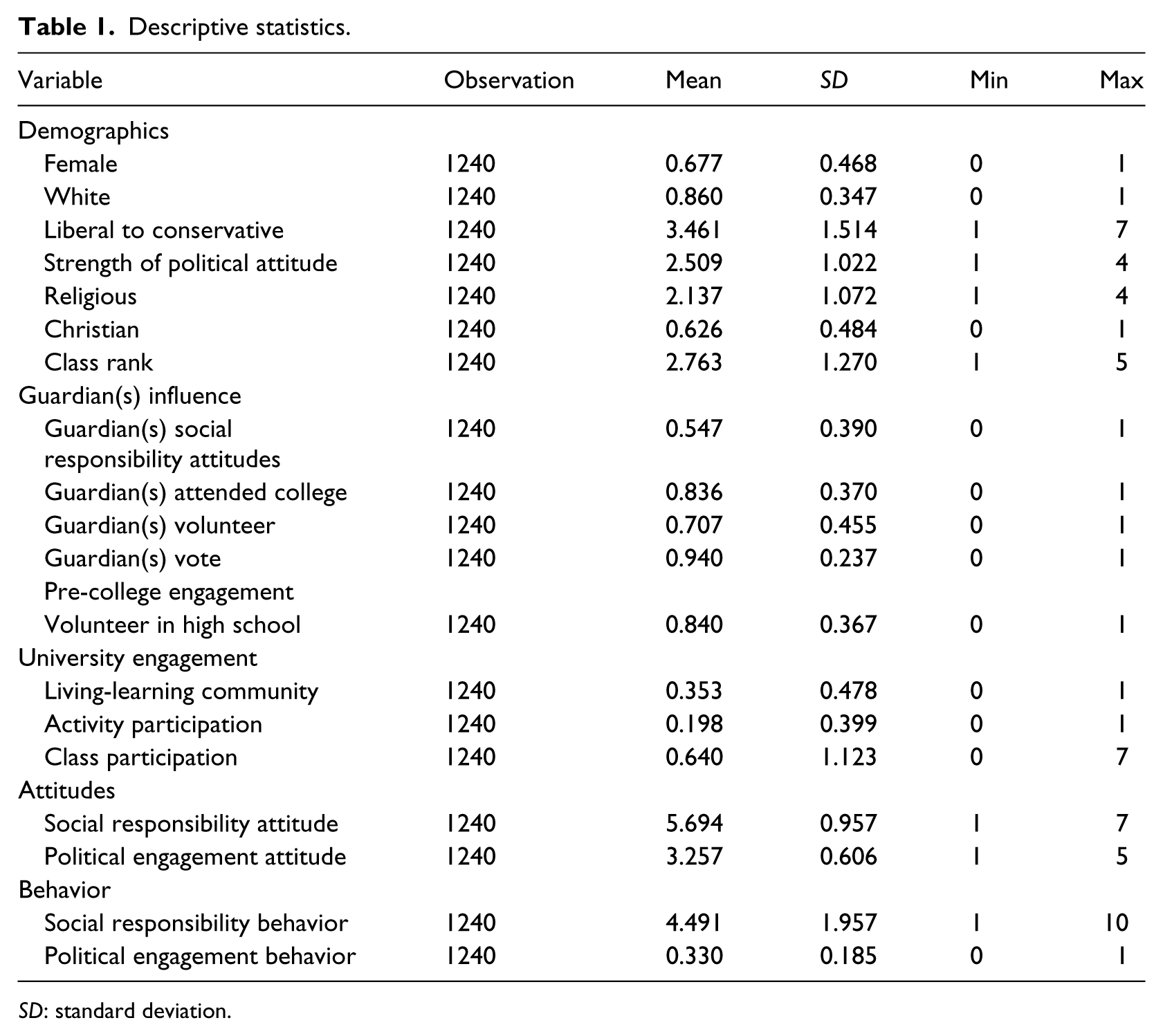
We measure students’ social responsibility attitudes using the ‘values’ component of the Volunteer Function Inventory (VFI) (Clary and Snyder, 1999; Clary et al., 1998; Stukas et al., 1999). 3 This measure is based off of five questions, which assess whether individuals value volunteerism and civic engagement. The five questions combine to produce a Cronbach’s alpha statistic of 0.895. The combined scale ranges from 1 to 7, with higher numbers indicating more value for volunteerism and civic engagement. The mean is 5.694, which indicates that on average students in our sample are well above midrange in valuing volunteerism and community engagement.
Our political engagement attitude variable is based on 11 combined items that produce a Cronbach’s alpha statistic of 0.801. The questions are drawn from the General Social Survey (NORC, 2014). This sequence of items is not about orientation (liberal or conservative) or identity (Democrat or Republican), but about political attitude. The variable assesses how much value an individual places on politics and political systems for engagement. Questions included an assessment of understanding, and interest in and control over the political system as well as a measure of sense of how important the political system is. On average, students score above average (3.257) on a 5-point attitude scale that ranges from ‘strongly disagree’ to ‘strongly agree’. Higher values indicate that individual places greater value in the political system.
Behavior: social responsibility and political engagement
As a social responsibility behavior measure, we assess how often an individual has volunteered in the past year, excluding ‘required’ 4 volunteer work. We gave students 10 categories 5 to select from. On average, students report volunteering ‘several times a year’ to ‘once a month’.
Our political behavior variable is a combination of three distinct types of political activism as discussed by Pattie et al. (2003): individual political activism, contact political activism, and collective political activism. Combined, these three categories (18 questions total) reflect broad political behavior; the variable has a Cronbach’s alpha of 0.789. While on average students’ political engagement attitudes are high, their political engagement behavior is relatively low. On average (0.330), students participate in only a third of the political behaviors listed, which include items such as voting, signing a petition, donating money, posting political information to a forum, wearing a campaign badge, contacting political officials, joining an organization, participating in public demonstrations, and attending political meetings.
Independent variables
Curricular civic engagement
We asked students how many courses they had participated in that had a civic engagement or service-learning component. About 35% (35.2) had taken at least one course. We assume a foundational level of implementation across all courses, as MSU requires all instructors to contact the CSLCE if they are going to implement a civic engagement or service-learning component in the classroom.
Living-learning community participation
As noted above, MSU has numerous types of learning communities. We are specifically interested in how participation in a living-learning community influences civic engagement attitudes and behaviors. Our category includes students involved in the Academic Scholars Program (ASP), Arabic Language Program, Drew Scholars Program, Multi-Racial Unity Living Experience, Residential Experience for Spartan Engineers, the Residential Initiative for the Study of the Environment (RISE), the Honors College, the Residential College for the Arts and Humanities (RCAH), LBC, and JMC. About 35.3% of our sample indicated they had participated in a living-learning community.
Extra-curricular civic engagement
Students were asked if they have participated in an extra-curricular program (fellowship, student group, campus organization, church group, etc.) that had a civic engagement or service-learning component. About 20% (19.8) indicated participation.
Control variables
Demographics
Sex 6 is measured in two categories: male and female. Nearly 68% 7 of our sample is identified as female (N = 839), while 32% (N = 402) as male. This is slightly more than the student population in the fall of 2013, which was 50% female (MSU, 2014). Race was collected on five primary categories of race: Asian, Black/African American, Latino/Hispanic, Native American/Alaska Native, and White. Additionally, we had an ‘Other (please specify)’ category. Our categories were not mutually exclusive. However, due to the limited number of non-White student responses in our sample, we have constricted the categories to White (N = 1069, 86%) and non-White (N = 171, 14%). Our percentage of non-White students is slightly lower than the population in the fall of 2013 (69% White, 31% non-White). Political ideology was measured on a seven-point scale from liberal to conservative. Political orientation was measured on a similar seven-point scale from ‘strong Democrat’ to ‘strong Republican’. We then recoded political orientation based on the strength of political identity, since we are not interested in orientation but rather in strength. This created a 4-point scale of increasing strength. The average was 2.5 out of 4 on our scale. Religiousness was measured on a four-point scale including ‘not religious’ (36.7%), ‘slightly religious’ (20.6%), ‘moderately religious’ (27.9%), and ‘very religious’ (14.8%). The university does not maintain statistics for religiosity, political orientation, or political ideology. Census categories were used to identify religious or spiritual orientation. Due to the low numbers across a collection of categories, we have condensed this variable into Christian (62.6%) and non-Christian (37.4%). Additionally, we control for class rank, as we assume that older students have had more opportunities in the university to be engaged. Rank can also be used to control for developmental differences among students at different levels of education, similar to an age variable.
Family (guardian(s)) socialization and pre-college volunteer engagement
We include three guardian(s) socialization variables in each model. First, we created a guardian civic engagement attitude scale based on three questions that asked students if their guardian(s) values volunteer work encourages them to volunteer and if they have volunteered with their guardians. Combined, these three questions produce a Cronbach’s alpha 8 coefficient of 0.716. Second, we include a variable to measure guardian(s) education. We asked students if one or both of their guardians had completed a college degree. Finally, we include variables to assess guardian(s) political engagement behavior and social responsibility behavior. For our political engagement model, we include a variable that assesses whether the guardian(s) voted in the last presidential election. Roughly 94% indicated that at least one guardian had voted in the recent election. Additionally, we asked students if their guardian(s) volunteer. In our social responsibility model, we include a variable to assess if guardian(s) volunteer. Roughly 70% indicated that at least one of their guardian(s) volunteers. 9 Finally, we asked students if they had engaged in volunteer work while in high school, and 84% indicated they had engaged in volunteer work. We did not measure time spent or the type of activity for pre-college engagement.
Methods
We use a triangulation of statistical techniques: confirmatory factor analysis (component of structural equation modeling), structural equation modeling, and multi-level modeling. Confirmatory factor analysis is used to identify fit statistics (Cronbach’s alphas) for our latent variables. Structural equation modeling is employed to assess the theoretical framework, which is contingent on direct and indirect relationships between variables, and multi-level modeling is used as a test for student selection bias into specific learning communities.
We should expect students who are inherently interested in volunteerism and political action to be more likely to choose to be part of a living-learning community that has a social responsibility or political focus. This reality introduces a strong selection bias for an analysis of the effects of living-learning communities on social and political attitudes and behaviors. To account for this selection bias, we ran multi-level models that allow us to test for contextual effects (being a part of a living-learning community) by identifying the distribution of variance between individual characteristics and community characteristics. This model allows us to control for the selection bias by identifying the effects of being part of a living-learning community above and beyond the effects that individuals’ personal characteristics have on their attitudes and behaviors. For purposes of space, we do not report the models for this analysis. In each case where we note significant findings for living-learning communities, the multi-level model showed that participating in a living-learning community has an independent impact on attitudes/behavior that is not accounted for by individual characteristics. All models were developed in Stata© 12. We report Cronbach’s alphas for all latent variables, coefficients, and fit statistics. Our descriptive statistics are reported in Table 1.
Descriptive statistics.
SD: standard deviation.
Results
We execute two theoretically driven structural equation models (SEMs), one for social responsibility and one for political engagement. We outline the results from these models followed by the fit indices 10 to demonstrate that our models are considered appropriate across various tests.
Social responsibility (attitudes and behaviors)
Social responsibility attitudes
First, we identify how our three main independent variables (living-learning community participation, curriculum civic engagement, and extra-curricular civic engagement) influence social responsibility attitudes. We find that participation in a living-learning community has no effect on social responsibility attitudes, nor does participation in a course that requires civic engagement. These findings are not surprising given that social responsibility attitudes are on average relatively high (mean 5.694, range 1–7), leaving little room for aggregate attitude growth. In contrast, engaging in an extra-curricular activity that includes civic engagement is associated with positive attitudinal changes.
Although we are less interested in our demographic indicators, we find that on average women, liberals, those with a stronger political party identification, individuals who are religious, and those with more education have stronger social responsibility attitudes. Additionally, it is no surprise that having high school volunteer experience and living in a family that demonstrates volunteer behavior both positively influence attitude formation.
Social responsibility behavior
As expected, our target-independent variables have more significant effects on social responsibility behavior. This is likely due to lower average (mean 4.491, range 1–10) social responsibility behavior, which signals greater room for student development. All three of our target variables are significant and positive, demonstrating that participating in a living-learning community, curricular civic engagement, and extra-curricular civic engagement all increase social responsibility behaviors. Of our three variables, participating in extra-curricular activities is the only variable that had an influence on both attitudes and behaviors.
Nearly the same demographic indicators that influence social attitudes are significant for behavior, except for the fact that the strength of political identification is no longer significant, nor is a respondent’s guardian(s) social responsibility attitude. Interestingly, as parental volunteer behavior increases, students’ social responsibility behaviors decrease. The direct and indirect influences of parental civic engagement on student engagement should be further explored.
Political engagement (attitudes and behaviors)
Political engagement attitude
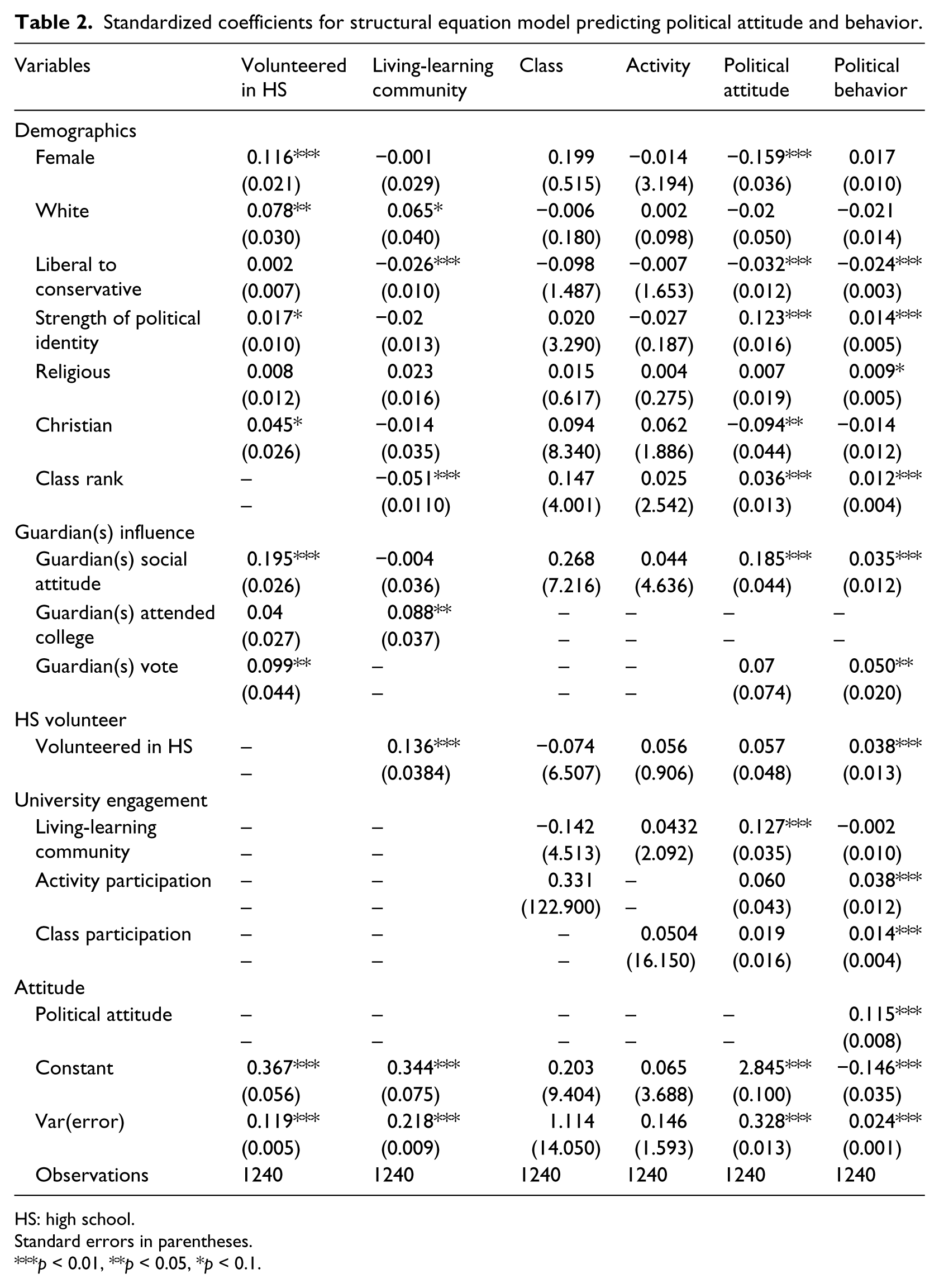
As with social responsibility attitudes, political engagement attitudes are also high (mean 3.257, range 1.455–4.909), which again leaves little room for aggregate growth. Because of this, however, significance in any of our three variables is more interesting. Of the three independent variables, participation in a living-learning community is significantly related to political engagement attitudes, which means that even with relatively high average attitudes, participation in a living-learning community leads to an increase in political engagement attitude.
Our control variables demonstrate that women are less likely to consider political engagement important, and as class rank increases, political engagement attitude increases. The lack of interest by women is not surprising, as this is well documented in the literature, but it does remain a concern for universities. However, this is less of a concern when we look at behavior and see no difference between men and women, indicating that while women may perceive the importance of politics as lower, they are just as likely as men to be engaged. Additionally, Christians have lower political engagement attitudes when compared to non-Christians and conservatives report lower political engagement attitudes when compared to liberals.
Political engagement behavior
As with social responsibility, participating in extra-curricular civic engagement has a significant positive effect on political engagement behavior as does participating in classes that require civic engagement. However, engaging in a living-learning community has no impact on political behavior. Interestingly, there is much room for improvement in political engagement among university students. On average, students score low on the political behavior scale (mean 0.330, range 0–.944). This means that out of the standard political engagement behaviors often reported, on average, students participate in roughly 33%.
Our control variables are slightly different from what we observe for political engagement attitudes. While women are less likely to consider political engagement important, they are equally likely to be engaged in political behaviors. Conservatives are less likely to be engaged, while those who identified as religious are more likely to be engaged. It should be noted that the differences between liberals and conservatives may be indicative of MSU, and/or the region’s or state’s political climate; this is something that should be investigated further in future studies. The strength of political party identification, whether Democratic or Republican, has a positive effect on political behavior. As with political engagement attitudes, pre-collegiate family socialization and behavior are important. As guardian(s) civic engagement attitudes and voting behaviors increase, so too do students’ political engagement. This is consistent with literature, which supports the notion that political engagement is a learned behavior. High school volunteerism also has a direct, positive effect, likely because it gives students an introduction to a variety of political engagement opportunities.
SEM fit statistics
For our social responsibility model, the chi-square is 12.487 (p = 0.086), which is not significant, indicating a good fit. Our root mean squared error of approximation (RMSEA) is 0.025, which is below the ideal of 0.05, and the pclose is 0.969, both indicating that we have a ‘close-fitting’ model with limited specification errors (see, for example, MacCallum et al., 1996). Additionally, the comparative fix index (CFI) is 0.993, well above 0.9, indicating a good fit and the Tucker–Lewis Index (TLI) is 0.928 also above 0.9, indicating a good fit. Finally, our standardized root mean squared residual (SRMSR) is 0.008, which is below the ideal 0.08 cut point, also suggesting a good fit (see, for example, Hu and Bentler, 1999).
For our political engagement model, the chi-square is 11.048 (p = 0.137), RMSEA is 0.022, the pclose is 0.982, CFI is 0.996, TLI is 0.954, and the SRMSR is 0.008. Similar to our first model, these indicators demonstrate good fit. We report our SEM models in Tables 2 and 3.
Standardized coefficients for structural equation model predicting political attitude and behavior.
HS: high school.
Standard errors in parentheses.
p < 0.01, **p < 0.05, *p < 0.1.
Standardized coefficients for structural equation model predicting social attitude and behavior.

HS: high school.
Standard errors in parentheses.
p < 0.01; **p < 0.05; *p < 0.1.
Discussion and conclusion
While colleges and universities have increasingly identified developing socially responsible and engaged citizens as an important student development goal, it has been unclear what types of educational experiences are most effective at achieving it. A central goal of our research was to determine what types of educational experiences influence civic engagement attitudes and behaviors among college students. In particular, we wanted to look at three types of educational experiences that have been promoted as means to achieve this end: curricular civic engagement, extra-curricular civic engagement, and participation in living-learning communities. In the absence of a consensus definition, in this study, we use attitudes and behaviors related to social responsibility and political engagement as surrogate measures for civic engagement; while they may not completely capture all of civic engagement, they constitute significant components of it and thus provide important measures. We begin this section with some good news for faculty members and university administrators regarding the impact of university-associated civic engagement experiences on student civic engagement attitudes and behaviors; next we identify two places where instructors and administrators can have the greatest effect on civic engagement attitudes and behaviors. Finally, we conclude our article with recommendations for future development.
Our results show that curricular civic engagement, extra-curricular civic engagement, and participation in a living-learning community all have an independent positive influence on attitudes and behaviors related to either social responsibility or political engagement. This should be good news to faculty and administrators for two reasons. First, it shows that higher education can contribute to the goal of developing more civically engaged citizens, and that it can do so through a variety of means. Second, it confirms that particular efforts to achieve the goal, such as the expansion of civic engagement courses and living-learning programs, are at least modestly effective. However, our results also indicate that while all three types of educational experiences have a positive impact, participation in extra-curricular civic engagement activities has the greatest impact on attitudes and behaviors related to civic engagement. The reasons for this are unclear, but it might have to do with the voluntary nature of these experiences and the effect that it has on encouraging student agency. Regardless of the reason, the finding suggests that if the goal is to develop civically engaged students, then colleges and universities might find more success by promoting extra-curricular activities rather than by increasing the number of courses that require service-learning or civic engagement. As we discussed previously, behaviors are learned, so having older students and faculty members model civic engagement behaviors outside of the classroom may be more beneficial than forced engagement. Beyond promoting extra-curricular civic engagement, instructors can also mentor students in the classroom by focusing on areas where student development is likely.
Our findings indicate two key opportunities for instructors seeking to promote student development related to civic engagement: (1) instructors should focus on the development of civic engagement behaviors, since attitudes related to both social responsibility and political engagement are already high and (2) instructors should pay particular attention to student political engagement behavior, since there is a larger gap between attitudes and behaviors in this component of civic engagement than with social responsibility. We explore these suggestions below.
Attitudes do not always translate into behaviors. This is abundantly clear from our findings, which demonstrate that attitudes in both social responsibility and political engagement are already high, while behaviors are modestly low in comparison. So there is little room for growth in attitudes, but there is room for behavioral change. There are a number of theoretical reasons for this disjuncture. For instance, students may value engagement, but have limited time because of class and work obligations. Additionally, awareness of opportunities, lack of transportation, and weather may also pose barriers. 11 While we should not focus our instruction on changing attitudes, we can consider how to mitigate barriers to engagement, hopefully altering behaviors.
The opportunities to influence student behavior relative to social responsibility appear to be relatively modest. To assess student social responsibility behavior, we identified how often students engage in volunteer work that is not required. We found that on average students volunteer ‘several times a year’ to ‘once a month’. This means that students are already engaged in the community independent of required experiences. This is not surprising, given that many students volunteer before entering college. While this is good news, it suggests that the potential for further growth is limited and would be unlikely to occur even with the expansion of university programming. Realistically, growth would mean that on average students would be engaged in nonrequired volunteer work ‘several times a month’ to ‘weekly’. Perhaps, the focus of student development should be on promoting consistent volunteer engagement to emphasize responsibility and highlight long-term trends of engagement.
The story is quite different in regard to political engagement. On average, the students in our sample participated in only a third of political engagement activities listed in our survey, suggesting that the greatest opportunity for student development in regard to civic engagement is in political engagement behavior. Similar to social responsibility participation, we gather that many factors contribute to the discrepancy between high political engagement attitudes and low political engagement participation including time constraints. However, we want to consider the fact that political engagement behaviors are often ‘learned’ and that many engagement behaviors are not being taught, at least not in the classroom. For instance, instructors could provide students with opportunities to write a letter to a local, state, or national representative about an issue they are particularly interested in. Students could also be encouraged to attend a town hall meeting or other political engagement forum. Some of these components are normal parts of policy analysis courses, where participation in coordinated political activities leads to an increase in student’s perceptions that they are competent to perform future political engagement activities (see, for example, Rocha, 2000). While these activities are not likely to be normal components of all courses, they could be included when appropriate. Additionally, modeling behavior is important, so if we (as instructors) demonstrate how we are politically engaged in communities, our students will likely take notice.
However, increasing political engagement discussion and encouraging student political engagement creates a wealth of challenges for instructors. For instance, many instructors may feel ill prepared to address conflicts or nervous about employment repercussions should challenges arise. In higher education, questions about liberal bias always arise, and for this reason, many instructors shy away from promoting politics in their classrooms. So, while they may discuss issues and the political process, they do so from a scholarly platform with limited discussion about individual engagement opportunities. This reduces risk, but also limits opportunities for student development. So, we must begin to ask ourselves some key questions. For instance, how do instructors promote political engagement without promoting a partisan agenda? How do instructors handle ‘hard’ topics like gay marriage in the classroom, encouraging political engagement while also promoting a safe space for all students to feel heard and respected? These are all challenging questions that we need to consider. Literature suggests that political participation in the classroom can be increased by encouraging alternative discussions about nontraditional engagement or discursive engagement (see, for example, Waldner and Dobratz, 2013). For instance, Waldner and Dobratz (2013) focused their attention on graffiti as a political statement. An expansion of similar tactics or alternative tactics may prove fruitful to increase student civic engagement participation.
Our study suggests that colleges and universities can develop civic engagement attitudes and behaviors in students by providing curricular, extra-curricular, and living-learning opportunities for students. However, to be maximally effective, they should focus on those strategies that promise the most potential for student growth. More specifically they should promote extra-curricular activities that involve civic engagement and focus instruction on developing civic engagement behaviors as opposed to attitudes.
Footnotes
Funding
The authors were supported in part by a small grant from Michigan State University Residential College of the Arts and Humanities. Cameron T. Whitley was supported in part by the Michigan State University Residential College of the Arts of Humanities Graduate Student Scholar Fellowship.