



Abstract
As schools are increasingly expected to develop their students’ political and social engagement in order to promote good citizenship, they are struggling to define what good citizenship is. In this article, we put forward a way of formulating perspectives on citizenship that specifies the normative aspects of good citizenship in a systematic manner. In doing so, we distinguish between citizenship education goals which are generally shared and citizenship education goals that are often disputed. Subsequently, an exploratory data analysis is conducted to investigate to which degree educational level in current Western European educational systems is associated with outcomes regarding these consensus and contested citizenship education goals. The findings provide support for our hypothesis that educational level is predominantly associated with general democratic citizenship outcomes, rather than with outcomes that are emphasized by more specific, but contested citizenship perspectives.
Keywords
Introduction
Expansion of mass education over the last century has led to a nearly universal reach of formal education, in one form or another (Meyer et al., 1992). Schools are among the most important public institutions that prepare children and adolescents for their functioning in further education, on the labor market and in democratic society. But while schools have a long history of giving form and substance to the first two tasks, the role they are expected to perform in the preparation of students as citizens in democratic societies is relatively new (Organisation for Economic Co-operation and Development (OECD), 2007). Moreover, the discussion on which citizenship goals to pursue is politically charged, due to the normativity that is inherent in the different conceptions of good citizenship. Some authors even argue that the notion of good citizenship is essentially contested (Osborne, 2000; Van Gunsteren, 1998). This leads to either rather general conceptualizations of citizenship education which almost everyone can agree on or to very specific interpretations from a particular point of view which are more frequently disputed. In the maze of different and sometimes divergent interpretations of good citizenship schools must find their way in accordance with their own philosophical foundation and value orientation.
Although schools are given much room with regard to citizenship education, we consider the current situation as problematic due to the demands it places on teachers’ professionalism. Professional autonomy presupposes that the professional has received sufficient training to make high-quality autonomous decisions. Notwithstanding the compulsory character of citizenship education in many countries around the world (Euridyce, 2012), a majority of teachers did not receive any training to teach citizenship education (Barr et al., 2015; Chin and Barber, 2010; Euridyce, 2012; Thornberg, 2008; Willemse et al., 2008) and, as a consequence, they do not feel confident about teaching it or struggle with how to establish citizenship education practices (Akar, 2012; Cassidy et al., 2014; Chin and Barber, 2010; Oulton et al., 2004).
This holds in particular for the normative aspect of citizenship. For example, in a small-scale qualitative study on ethnically diverse classes in the Netherlands, most teachers indicated that they do not feel sufficiently equipped to discuss sensitive topics related to issues of (in)equality and social justice with their students in ethnically mixed classrooms (Radstake and Leeman, 2010). A survey study on citizenship education in England (Oulton et al., 2004) shows that the majority of teachers in both primary and secondary education report not having received formal training to teach controversial issues, with a substantial part indicating that they do not feel well prepared to teach controversial issues. Importantly, approximately a quarter of the surveyed teachers indicate that changing pupils’ values is not important or should not be a learning outcome, even though virtually all perspectives on citizenship education view the promotion of democratic values as essential. Apparently, these teachers prefer taking a neutral or non-normative position.
School-wide policies on citizenship education are also rather general and appear to seek common ground. For instance, the majority of Dutch schools have formulated a perspective on citizenship education, but these typically allude to general democratic goals, such as promoting democratic norms and values, social competence, and tolerance for diversity. Many schools do not formulate more concrete citizenship education goals and fail to implement their citizenship education in a systematic manner as a result (Inspectorate of Education, 2013). This lack of concrete goals may stem from the rather abstract level at which citizenship education is typically conceived, as well as a lack of information on more specific conceptualizations of citizenship from which schools can make their own, educated choice. Currently, teachers across Europe mention normative and political citizenship aims—such as anti-racism and political engagement development goals—least frequently as important citizenship goals (Kerr et al., 2010). A relatively abstract, limited notion of citizenship may underlie the observed lack of confidence of teachers and may lead to a social, apolitical view of citizenship that excludes critical thinking and discussion of controversial issues (Davies, 2006; Patterson et al., 2012).
The goal of this article is to provide a more systematic and explicit way of formulating a vision on citizenship education that distinguishes between general democratic (consensus) citizenship goals and more specific (contested) citizenship goals. Subsequently, the relation between educational level and citizenship attitudes corresponding to these two types of citizenship goals will be empirically explored in five Western European countries. This analysis will investigate the hypothesis that education in these countries is more strongly associated with general, consensus citizenship goals, rather than with more specific, contested citizenship goals.
Theoretical background
An important feature of democracy is that there is room for various citizenship conceptualizations and practices. This characteristic defines important aspects of a community’s or society’s civic culture and is echoed in the educational literature on citizenship education where authors take divergent and sometimes even opposite standpoints on the desirability of certain citizenship education goals. While some authors argue in particular in favor of promoting autonomy-enhancing and critical thinking competences in students, others emphasize instilling a sense of obedience in students and a focus on functioning in a socially accepted and responsible manner within a given community (see for an overview Kohn, 1997; Veugelers, 2011; Westheimer, 2008; Westheimer and Kahne, 2004). A more systematic framework for identifying citizenship education goals can be provided based on political theory. Specifically, it can provide guidance on the competences students ought to be equipped with for participating in their communities and society at large. In this section, we disentangle the various views on communities and the role members of these communities are expected to perform, thereby identifying the central citizenship goals for four political theoretical perspectives. We will first discuss which citizenship goals are relatively uncontested, and then proceed to discuss political theoretical perspectives which illustrate a way of selecting more contested, yet more specific citizenship goals that may be pursued through education.
Democratic citizenship goals
A fair amount of consensus exists between various political theories with regard to the promotion of democratic citizenship. As such, these consensus citizenship goals can serve as common ground. To stimulate or sustain democracy, societies cannot depend on the existence of democratic institutions alone. A democracy is defined by its practices as much as its principles: principles are most effective when supported and practiced by all citizens. According to various authors, a society therefore needs certain values and norms to be shared among its citizens for it to be truly democratic (e.g. Barber, 1984; Kymlicka, 1999). The following citizenship goals are among those commonly understood to be important for the democratic functioning of society.
First, democratic interaction between individuals that are different from one another in one or multiple ways is aided by tolerance of diversity. In addition to general attitudes of tolerance and civility, conflicts based on cultural, ethnic, socio-economic or religious differences are better dealt with when a country and its citizens support equal rights for all fellow citizens (Barber, 1984; Galston, 2001; Kymlicka, 1999; Van Gunsteren, 1998). Second, democratic interaction is further facilitated if the manner in which individuals seek to resolve conflicts in personal, public and political affairs is nonviolent. Such a democratic way of life is dependent on support of democratic principles and practices (Galston, 2001). Finally, civic engagement in the form of volunteering is held to be essential for the political and social vitality of a democratic society as it promotes informal ties between members of different groups, opportunities for cooperative interaction and interpersonal trust (Almond and Verba, 1963; Putnam, 2001).
Political theory and specific, contested citizenship goals
The aforementioned general citizenship goals are typically safeguarded or implied by democratic constitutions. While they are also shared by most political theories, the various political theories add and emphasize their own specific values and orientations. Following Miller (2000), we discuss four well-defined political theories that specify citizenship goals on the basis of their views on the social nature of man and the ordering of social relations. 1 These political theories are liberal individualism, liberal communitarianism, egalitarian communitarianism and conservative communitarianism. Although a great number of variations exist within all four schools of political theory, we have attempted to characterize these political theories in a general manner. As such, these summaries do not do justice to the richness of positions and nuances within every theoretical school, but nevertheless serve the purposes of this article.
Liberal individualism
Liberal-individualistic political theory views the social nature of man as one in which individuals are independent, freely choosing individuals capable of forming their own beliefs, desires and intentions. With regard to the ordering of social relations, liberal-individualistic theoreticians stress the importance of democratic processes, democratic attitudes and critical reflection, but do not take an explicit position on how social relations should be ordered. For example, Gutmann (1995, 1999) emphasizes the need for conscious social reproduction, a process in which society’s members consciously choose their way of living, rather than merely accepting current norms, values and traditions.
With regard to citizenship goals, authors within liberal political theory stress the importance of personal autonomy, knowledge of individual freedom rights and conscious social reproduction (Callan, 1997; Gutmann, 1999). Common individual citizenship goals are critical reflection, perspective taking ability, knowledge about different conceptions of the good life, moral reasoning skills, and knowledge and respect for individual rights (e.g. freedom of speech, freedom of conscience, full suffrage and equality of rights) (Callan, 1997; Gutmann, 1999).
Liberal communitarianism
Liberal communitarians (Kymlicka, 1989; Raz, 1986) agree that no single model or principle can define what the conception of the good life should be for all individuals. Rather, they believe there are many valuable ways of life that individuals may choose to pursue. In addition, they hold that the choice for any way of life should be an autonomous choice, made after conscious reflection on alternatives, rather than as a result of social inducement (Miller, 2000).
According to Miller (2000), they share these convictions with liberal individualists, but believe that communities are important as they provide autonomy-supporting practices and institutions. As such, they emphasize the importance of communities for the development of personal autonomy. Their main critique on traditional liberal individualism is that individuals do not develop autonomy nor function in isolation of others (i.e. are not unencumbered selves). Moreover, they claim that being able to freely choose to enter or leave different communities increases freedom of choice and opportunity for reflection on different ways of life. As such, they hold that having a number of different communities with low barriers to entry and exit is essential for the development of individual autonomy (Miller, 2000). With regard to individual citizenship education goals, liberal communitarians find the same goals desirable as liberal individualists, however, as the main distinction between liberal individualists and liberal communitarians lies in which ordering of social relations they advocate.
Egalitarian communitarianism
Egalitarian communitarians (Miller, 2000; Walzer, 1984) view the social nature of man as one that strives for recognition from others, valuing autonomy but in an egalitarian manner: individuals choosing a way of life together by means of critical reflection on what they value and the way of life they have in common. With regard to the ordering of social relations, egalitarian communitarians strive for communities in which members enjoy equality of status. Moreover, they strive for active and collective self-determination of the communities’ way of life, rather than conforming to existing norms and tradition. In addition to the various different egalitarian communities that may exist within a society, egalitarian communitarians stress the importance of an inclusive political community that is able to combat between-group inequalities in life chances.
The main citizenship goals advocated by egalitarian communitarianism are individual autonomy, the development of egalitarian attitudes, the ability to critically reflect on society (both individually and with others), and the ability to discuss and cooperate.
Conservative communitarianism
Compared with other forms of communitarianism or liberal individualism, conservative communitarians view the social nature of man as one that makes individuals rather dependent on others for their social and moral functioning, both as children and adults. As such, they emphasize the role of the community as a source of authority (Miller, 2000). Such a community would be unifying its members, by promoting a common language, shared associations, traditions and history. As such, conservative communitarians see the nation-state as the basis for political order and would thus favor a careful approach toward immigration, as substantial immigration without sufficient assimilation may weaken adherence to existence values, traditions and norms, and hence the common culture supporting the nation-state. Conservative communitarians view the community as providing a common morality; some would not object to a marginalization of minority values by the existing, dominant social order (Scruton, 1996). Furthermore, the community would preferably be hard to leave, as the individual is viewed as being dependent on the community. Accordingly, the preferred attitude of the individual would be one of willing obedience to the community (see Miller, 2000).
According to conservative communitarianism, important individual citizenship goals are acquisition of knowledge of traditions, instilling respect for tradition, identification with and recognition of the authority of the community. In addition, as conservative communitarian principles delineate not one but rather a range of possible communities, a variety of citizenship goals that cater to the specific community’s interests can be conceived as desirable from this perspective. Education would serve as a means of transmitting the traditional cultural identity to new generations. For an overview of these characteristics and those of the other aforementioned political theories, see Table 1.
Overview of the discussed political theories as defined by Miller (2000).

The present study
As schools are challenged by the normative aspects of citizenship, a systematic approach on formulating citizenship education goals offers several advantages. First, it is explicit on two normative elements that are either implicitly or explicitly assumed in every view on good citizenship: the social nature of man and the preferred social ordering of relations. When these assumptions are made explicit, one can scrutinize whether they are jointly consistent and coherent from a theoretical perspective. Second, the distinguished perspectives allow schools to identify more specific citizenship education goals.
In sum, liberal individualism and liberal communitarianism mainly differ on their assumptions with regard to the optimal social environment for the development of the individual, both find personal autonomy and a positive attitude toward freedom crucial. As such, they cannot be distinguished on the individual citizenship education goals they favor, although these two perspectives take different positions on the role communities play with regard to the formation of good citizens. Egalitarian communitarians distinguish themselves from these liberal political theories by putting additional emphasis on the presumed strength of an egalitarian community. Importantly, to establish and maintain a community in which individuals enjoy equal political status, an egalitarian attitude is required, ad minimum. Finally, conservative communitarianism proposes an encompassing type of community, in which community members have knowledge of and protect community customs and values, while being in willing obedience to the authority of the community.
The aim of the following exploratory analysis is to investigate whether outcomes that serve these specific, more contested citizenship goals advocated by the aforementioned perspectives are less strongly associated with education than outcomes serving more general democratic citizenship goals. As general, democratic citizenship goals enjoy a higher degree of consensus, it can be assumed that they are easier to transfer, whereas transfer of contested citizenship goals would require more explicit discussion and effort from schools. In our study, we explore these relationships in five Western European countries. As schools do not seem optimally equipped to deal with the normative nature of citizenship, the following hypothesis will be tested: educational systems display stronger associations with general democratic citizenship outcomes that enjoy a fair degree of consensus than with more specific and often contested citizenship outcomes. For each of the consensus and contested citizenship perspectives, a number of corresponding citizenship outcomes will be described in the next section.
Methods
Sample
The 2008 European Value Survey (EVS, 2011) dataset is used for all analyses. 2 The analyses were performed on data from five Western European countries: the Netherlands, Belgium, Germany, Sweden, and Finland. These countries share similar socio-economic profiles as measured by their Gini-coefficients and gross domestic product (GDP) per capita (The World Bank, 2014), exhibit established democracies (based on Inglehart, 1997) and score relatively high on child well-being (Currie et al., 2012). A total of 2781 respondents were included in the analyses. As the effects of educational level cannot be assumed to be identical across countries due to differences between educational systems and cultural differences, we have conducted separate analyses for every country included.
Analyses
Ordinary least squares regression and logistic regression analyses are conducted to explore to what degree educational level influences general democratic citizenship outcomes and specific citizenship outcomes put forward by the four aforementioned political theories. We assume that if education yields citizenship outcomes, a lengthier exposure to the education system shall result in larger citizenship outcomes for citizenship goals that are implicitly or explicitly stimulated in education. For logistic regressions, the marginal effects are reported as it allows for comparing the effects of educational level on different social outcomes. We attempt to improve causality by means of instrumental variable regression analysis (see Appendix 1). We have chosen to report the standard regression results, because the instrumental variable regression approach requires that good instrument variables affect the predictor variable (educational level) but not the response variable (indicators of civic engagement and citizenship). Given that the available instruments (social origin) are likely also directly influential on the outcome variables, standard regression techniques are preferred. We cannot make strict causal claims regarding the relationship between educational level and citizenship outcomes.
Independent variable
The independent variable Educational Level consists of four levels that indicate the highest level of education achieved by the respondents. The four levels are primary education or less, lower secondary education, upper secondary education, and tertiary education, based on the ISCED-97 one-digit classification system as employed in the EVS 2008 (EVS, 2011).
Control variables
To exclude variance caused by other factors than educational level, we control for religiosity, ethnicity, age, gender, whether the respondent discussed politics with her of his parents, the occupational status of the parents and the educational level of the parents.
Religiosity is measured by the question ‘Are you a religious person?’ with answer options ‘Yes’, ‘No, I’m not a religious person’ and ‘No, I am a convinced atheist’. The latter two answers were coded as 0, the first as 1.
Ethnicity is scored 1 if the respondent has indicated being born or having one or more parents that were born outside the nation in which the survey was conducted, indicating first- and second-generation immigrants, and 0 if none of these situations apply.
Political Discussion with Parents is constructed by calculating the maximum the respondents has reported to questions asking to what degree he or she discussed politics with her or his parents when about 14 years old on a 4-point scale with 0 indicating no political discussion.
Occupational Status of Parents is measured by the International Socio-Economic Index of Occupational Status (ISEI) score of the father of the respondent, or mother of the respondent if the respondent lived only with her/his mother at the age of 14 (Ganzeboom and Treiman, 1996).
Educational Level of Parents is given by the reported ISCED-97 one-digit classification score of the mother of the respondent or the father of the respondent, if the respondent lived only with a father at the age of 14.
Dependent variables: general democratic citizenship outcomes
Support for equal rights is measured by the items ‘Jobs are scarce: give men priority’, ‘Jobs are scarce: give [nationality] priority’, with 0 indicating disagreement and 1 indicating agreement. Tolerance of diversity is measured by tolerance of neighbors that differ in terms of religion, sexual preference, ethnicity or nationality (with 0 indicating no intolerance of any group, 6 indicating intolerance of all groups), and the item ‘Should children be taught to be tolerant at home?’, with 0 indicating disagreement and 1 indicating agreement.
Democratic attitudes are measured by the items Intention to Vote (0 indicating no intention, 1 indicating intention), agreement to the statements It is good to have a democracy and Democracy is the best political system (1 indicating a lack of favorable attitude, 4 indicating a favorable attitude), the extent to which respondents are Willing to engage in political action (a score of 1 indicating having never having engaged in political action nor having any intention to engage in political action, 15 indicating have participated in various types of political action) and the scale Interest in Politics (1 indicating no or low interest in politics, 5 indicating high interest in politics). 3 The latter scale consists of the items ‘How often do you follow politics in the media?’, ‘Are you interested in politics?’, ‘How important is politics in your life?’ and ‘How often do you discuss politics with friends?’ Internal consistency of Interest in Politics is acceptable at a Cronbach’s alpha score of 0.73.
Civic engagement is measured by Volunteering, with 0 indicating no volunteering activity and 1 indicating volunteering activity in one or more of the following groups: welfare organizations, religious organizations, trade unions, cultural organizations, political parties or groups, local community action groups, environmental groups, professional associations, youth work, sport/recreation groups, women’s groups, peace movement or voluntary health organizations, following Ruiter and De Graaf (2006). Volunteering activity is here defined as having done unpaid work for one of these associations.
Dependent variables: specific, contested citizenship outcomes
The following EVS 2008 variables allow for an exploratory investigation that shows to which degree educational level is associated with social outcomes that serve specific, contested citizenship goals. Liberal individualism and liberal communitarianism emphasize the value of autonomy and freedom. The degree to which a respondent has a favorable attitude toward autonomy or Independence is measured by the question ‘Should children be taught independence at home?’
The relative preference of a respondent for Freedom or Equality is measured by the question ‘What do you find more important: freedom or equality?’ An egalitarian attitude is one of the central citizenship goals of egalitarian communitarianism. Hence, this item gives an indication of the degree to which educational level is associated with either liberal or egalitarian attitudes. The variable Job: Equal Treatment indicates the degree to which one has egalitarian attitudes, as measured by the (dis)agreement to the statement ‘I find it important in a job that people are treated equally’.
A central citizenship goal for conservative communitarianism would be obedience to the social structure one is part of. Therefore, the effect of education on support for obedient attitudes is measured by the variable Obedience, as indicated by agreement to the statement ‘Should children be taught obedience at home?’. In addition, the aforementioned support for independence is analyzed, as this represents that opposite of obedience. In addition, conservative communitarianism puts a strong emphasis on the unity of the community, as measured in traditions and customs, among other things. This citizenship outcome is measured by the attitude indicated by the answer to the question ‘Should immigrants be free to keep their own traditions or should they adopt the traditions of [country]?’.
All of the aforementioned items are measured dichotomously, with 0 indicating disagreement and 1 indicating agreement, except for the latter question, which is measured on a 10-point scale, with a score of 10 indicating complete agreement with regard to whether immigrants should adopt the traditions of the country in which the survey was taken and 0 indicating complete disagreement.
Results
Educational level and citizenship outcomes in Western European countries
General democratic citizenship outcomes
Most countries included in the current study show a similar profile for identified citizenship outcomes; a profile that indicates that educational level is associated with higher interest in politics, higher support for a democratic political system, higher support for equal rights for immigrants on the labor market and a higher intention to vote (see Tables 2 and 3). A smaller number of countries show an association between educational level and increased self-reported tolerance, volunteering, higher support for gender equality on the labor market, higher willingness to engage in political action and more tolerance of neighbors that belong to sexual minority, religious or ethnic groups.
OLS regression analysis of effects of Educational Level on general democratic citizenship outcomes.

Source: EVS 2008.
Standard errors in parentheses. Control variables included are as follows: Religiosity, Ethnicity, Political Discussion with Parents, Occupational Status of Parents, and Educational Level of Parents.
p < 0.05, **p < 0.01, ***p < 0.001.
Marginal effects logistic regression analysis of effects of Educational Level on general democratic citizenship outcomes.
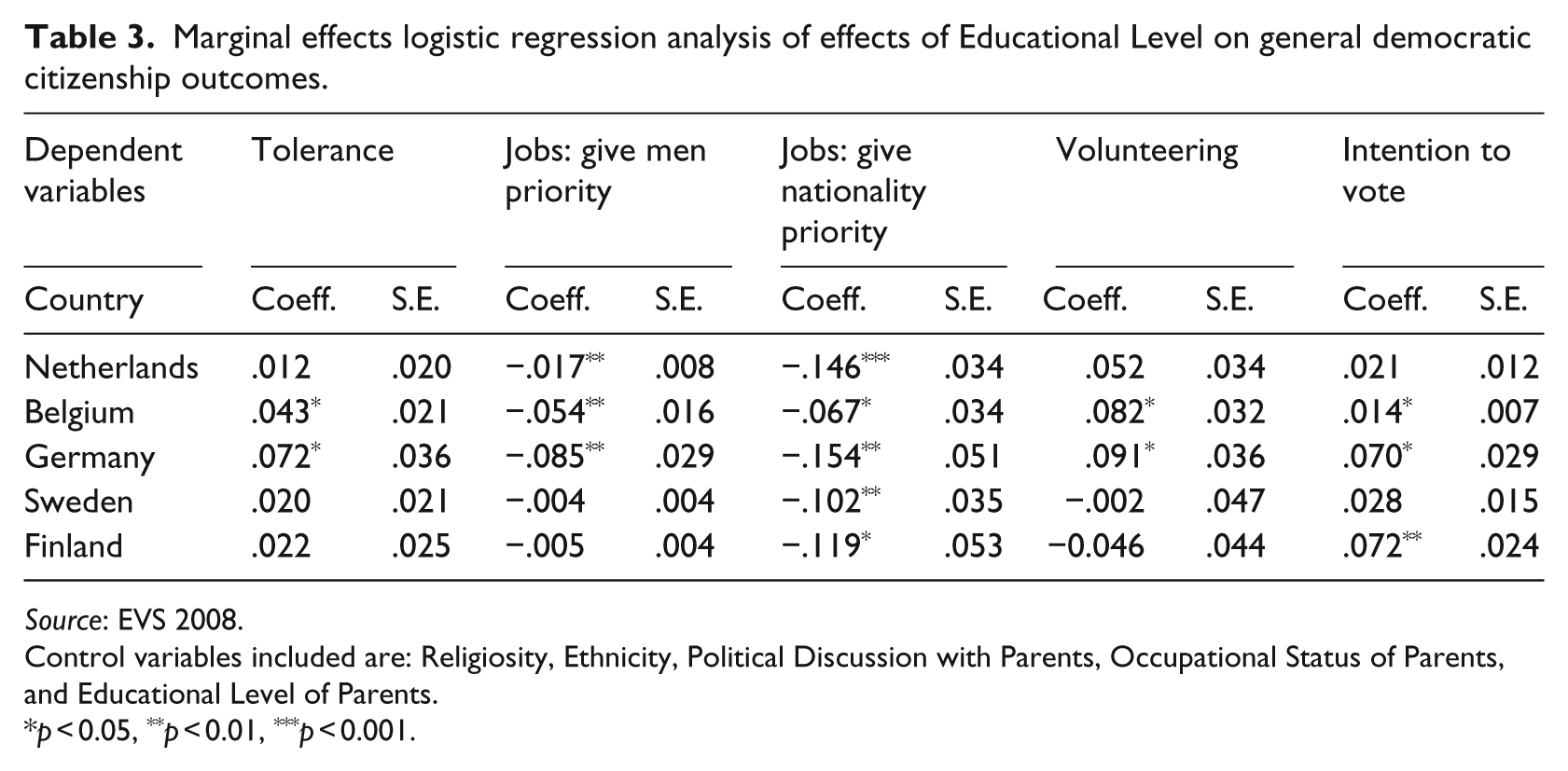
Source: EVS 2008.
Control variables included are: Religiosity, Ethnicity, Political Discussion with Parents, Occupational Status of Parents, and Educational Level of Parents.
p < 0.05, **p < 0.01, ***p < 0.001.
Educational Level is least associated with democratic citizenship outcomes in Sweden and Finland. Democratic citizenship outcomes related to tolerance show no significant correlation with Educational Level in both countries. Interestingly, predominantly those democratic citizenship outcomes that relate to democracy as a political system rather than a way of life are found to be significant.
Contested citizenship outcomes derived from political theory
The majority of the specific citizenship outcomes derived from political theories are not significantly associated with educational level (see Table 4). Exceptions are attitudes toward obedience (negatively associated with educational level in Belgium and the Netherlands), attitudes favoring freedom over equality (positively associated with educational level in the Netherlands) and the importance of equal treatment in a job (negatively associated with educational level in the Netherlands and Sweden).
Marginal effects logistic regression analysis of effects of Educational Level on specific citizenship outcomes derived from political theories.

Source: EVS 2008.
For the dependent variable Equality/Freedom, equality = 0 and freedom = 1. Control variables included are: Religiosity, Ethnicity, Political Discussion with Parents, Occupational Status of Parents, and Educational Level of Parents.
p < 0.05, **p < 0.01, ***p < 0.001.
With regard to the stances respondents have on integration, the conservative communitarian orientation emphasizes assimilation over allowing immigrants to maintain their customs and traditions. In all but one of the countries, no significant correlation between educational level and such stances toward immigration exists. Only in the Dutch sample, a significant negative correlation between educational level and a conservative communitarian orientation toward integration is present (β = −0.248, S.E. = 0.123 at p = 0.044).
Discussion
Policymakers are increasingly expecting schools to shape students’ citizenship. Yet, primarily general, broadly shared conceptualizations of what it means to be a good citizen in democratic society have been put forward by policymakers, allowing schools to further refine their notion of good citizenship as deemed appropriate. Previous research suggests that schools find it hard to deal with this task, in particular due to the normative nature of citizenship. The importance of specifying concrete citizenship goals based on a clear definition of what good citizenship entails cannot be understated, however. In order to yield optimal results, schools and teachers should be able to design citizenship education in alignment with their philosophical and value orientation, while also preparing students for a role in society at large. In this article, we have illustrated a way of formulating more precise perspectives on good citizenship that specifies the normative aspects of citizenship in a systematic manner and allows for the assessment of theoretical consistency, based on political theory (Miller, 2000). Moreover, we have empirically explored to what extent education is associated with different types of citizenship outcomes.
In our study, we have made a distinction between democratic citizenship goals that are commonly shared and specific citizenship goals derived from political theory, which are often disputed. While the promotion of general democratic citizenship goals is surrounded by a relatively high degree of consensus, such consensus exists to a much lesser extent with regard to specific citizenship goals suggested by the various political theories. Yet, substantial value can be derived from these political theories, as they can offer richer accounts of what it means to be a good citizen. As such, they can serve as theoretical instruments that suggest specific citizenship goals in a systematic manner, by basing citizenship education on explicit assumptions and preferences regarding both the social nature of man and the ordering of social relations. In addition, being explicit about these two elements allows for internal coherency and compatibility checks, as for a given ordering of social relations individuals need certain knowledge, skills and attitudes for the ordering to be stimulated or sustained. For example, a political theory that assumes man to be highly dependent on social relationships for moral decision-making will emphasize the importance of communities, as strong communities would provide necessary support to individuals. Similarly, an egalitarian community might not be sustained if new members are not socialized to have egalitarian attitudes. Despite the overlap in citizenship goals advocated by the political perspectives (i.e. the general democratic citizenship goals), they exhibit clear differences in orientation and as such can serve as a useful theoretical framework to base the selection of more specific citizenship education goals on.
The findings of our exploratory data analysis provide support for our hypothesis that educational level is predominantly associated with general democratic citizenship outcomes, rather than outcomes that are prominent in more specific, but contested citizenship perspectives. The democratic citizenship outcomes of education that are most universally correlated with educational level across the selected countries are democratic attitudes and support for equal rights of women and immigrants on the labor market.
For the specific citizenship outcomes emphasized by the various political theories, it appears that educational level only has a modest positive effect on the liberal outcome of having a favorable attitude toward freedom in the Netherlands, but no significant effect on the attitude toward independence in any of the selected countries. Interestingly, educational level appears to have modest negative effects on respective egalitarian and conservative communitarian outcomes such as the ascribed importance to equal treatment in a job and a favorable attitude toward obedience in some countries included here. Importantly, the majority of the specific citizenship outcomes corresponding to specific, contested citizenship goals are not associated with educational level. This is in line with our hypothesis, as suggested by the indications from previous research that schools find it hard to deal with the normative nature of citizenship education.
In all countries, educational level is significantly correlated with a number of general democratic citizenship outcomes. The general democratic citizenship outcomes most often associated with educational level among countries are in political interest and positive attitudes toward democracy. Although Sweden and Finland display somewhat different profiles from Belgium, Germany and the Netherlands, findings are similar across countries, with few specific citizenship outcomes derived from political theory being associated with educational level. Only one specific citizenship outcomes is associated with educational level in more than two countries: instilling a sense of obedience in children, which is negatively associated with educational level in Germany, Belgium and the Netherlands.
The current study encountered a number of limitations. First of all, while educational level can be used as a proxy for education in general, given the additional years participants have spent in the education systems, it remains an imperfect indicator for assessing the influence of education. In addition, the correlational design of our study warrants careful interpretation with regard to the causal nature of the relationships. We have attempted to further investigate causality by conducting instrument variable analyses (see Appendix 1). The results of the instrument variable analyses display a similar overall profile for the various outcomes. Nevertheless, more extensive, longitudinal research would be required to further improve causal inference, explore reciprocal relationships and investigate whether any differences between countries aspects can be explained by differences in educational goals, educational system characteristics or culture. Finally, many measures used here are self-reported. Especially with regard to attitudes, the associations between educational level and citizenship outcomes might be influenced by differences in individual reference frames or social desirability bias, respectively (Schwarz, 2007).
As democratic societies continue to be challenged by a variety of social and citizenship issues, carefully defining what good citizenship is and how education may contribute to the formation of good citizens remains of crucial importance. The contested nature of specific conceptions of citizenship should not dampen the discussion among education professionals, academics and policy makers; rather, it should invite them to sharpen their beliefs and practices. However, as most democratic governments restrain themselves in providing specific conceptions of good citizenship for schools, schools should similarly allow students to discover and develop their own norms and values. In addition to offering citizenship education that includes consensus goals, they may let students experience different contested conceptions of good citizenship, so that students are enabled to gain an understanding of the variety of citizenship practices present in society on the basis of which they would be able to make an informed choice. Such an indirect approach to citizenship education also appears more effective than direct approaches in which students are merely instructed to follow certain rules and norms, without shaping and reflecting on these matters themselves (Geboers et al., 2013; SCDRD, 2010). While combining a school’s own perspective on good citizenship with preparing students for a role in a world characterized by a plurality of citizenship perspectives and practices certainly requires effort, we consider this more desirable than leaving normative aspects of citizenship education implicit, as the latter approach risks educational efforts to be insufficiently focused and reflected upon by schools, students, parents and societal stakeholders alike. As some schools indicate that they do not always feel adequately equipped in these matters, the burden may be lightened through national facilitation and interschool cooperation. By putting forward a systematic procedure for defining and selecting citizenship goals, we intend to contribute to the conceptual clarity of citizenship education and strengthen the empirical basis for further discussion, needed to reach clear and practical perspectives on citizenship education for both common and specific citizenship goals.
Footnotes
Appendix 1
Declaration of Conflicting Interests
The author(s) declared no potential conflicts of interest with respect to the research, authorship, and/or publication of this article.
Funding
The author(s) disclosed receipt of the following financial support for the research, authorship, and/or publication of this article: The authors received financial support by the Dutch Inspectorate of Education for the research on which this article is based.