



Abstract
The Prevent strategy at UK universities is designed to reduce the possibility of university students becoming radicalised and so working against them supporting or directly engaging in terrorist activities. In this study, we were concerned to reflect on our reading of some relevant literature by exploring the views of a sample of British Muslim students regarding Prevent and, in particular, its impact on their sense of personal and national identities as British Muslims. Nine British Muslim undergraduate students completed an online questionnaire. We discuss findings suggesting that there is limited general understanding and negative characterisations of Prevent, with perceptions of this policy being ineffective and inappropriate for higher education contexts. We suggest that more work is needed to develop relevant educational initiatives in the development of a tolerant society and that there is potential in discourse analysis to help reveal further insights into Muslim students’ identities.
Introduction
The UK Government’s Prevent Strategy, as outlined in the Counter-Terrorism and Security Act 2015 and subsequent official guidance on its implementation (Department for Education (DfE), 2015a, 2015b; Higher Education Funding Council for Education (HEFCE), 2015), is designed to undermine the process by which individuals become drawn into carrying out acts of terrorism. The implementation of this strategy became a legal duty for UK universities in September 2015. In this article, we consider issues arising from a review of literature, describe and discuss the methods we used to gather and analyse data from a small sample of respondents based in universities and develop an argument about Prevent. We argue that our respondents have a negative reaction to Prevent – that educational initiatives congruent with the academic environment of a university are needed to help develop further understanding and that research informed by discourse analysis would be useful.
Reviewing the literature relevant to Prevent and higher education
Our work emerged from discussions between the authors of this article, some of whom had already undertaken a review for a related piece of work (Szczepek Reed et al., 2017). For this article, we built on the searches we had previously undertaken and reviewed rigorously articles in academic journals, policy statements and media reports in which the following terms and words were highlighted: Prevent, Islam, Muslim, identity, Prevent, higher education, students, terrorism and fundamental British values. As such, we do not claim to have completed a formal and exhaustive comprehensive literature review, but we do see our dynamic approach as being appropriate in a fast changing context for capturing some of the themes relevant to our small-scale empirical work. On the basis of our reading, we explore in this section of the article issues to do with the focus in Prevent on the supposed connection between terrorism and Muslims, the appropriateness of this initiative in academically focused higher education institutions, the characterisation of Prevent as a matter centrally concerned with pastoral care, the effectiveness of Prevent and the relationship between Prevent and fundamental British values.
Conflating terrorism and Islam
While references to terrorism are contextualised widely across the full range of possible settings, whether it be the far-right, the far-left, pro-racist, anti-racist, animal rights, anti-hunting and anti-abortion, there is little doubt that the main focus of Prevent concerns Islamic State of Iraq and the Levant (ISIS) and has its origins in the London Bombings in July 2011 and the rise of ISIS (also referred to as DEASH), primarily in Syria and Iraq, and acts of terrorism in the European Union (EU), including Paris in November 2015 and Brussels in March 2016 (Warren, 2016). The wider context for this work includes recognition of the recent increase in the Muslim population of the United Kingdom (to approximately 3 million) with commonly held inaccurate views that the size of the community is much larger (Gani, 2015). The Muslim community is frequently the subject of high-profile media attention involving, for example, the so-called Trojan Horse affair in Birmingham in which it has been alleged that activity inappropriate for British democracy was occurring in schools (Arthur, 2015). In this context, Muslims studying at UK universities have particular concerns that it is their behaviour that is primarily being monitored by Prevent. It is interesting to note here that the revised guidance produced by the Committee of University Chairs (2016) has a section on frequently asked questions concerning the implementation of Prevent, of which the first question is, ‘Is this an anti-Muslim agenda’ (p. 2). While the advice given to universities is to ‘avoid a specific focus on any one particular group’, the fact that this question is posed is itself a reflection of the assumption made by many that the Prevent would not exist if it were not for the need to respond to terrorist activities perpetrated in the name of Islam. The choice of ‘anti-Muslim’ in the question is surprising as it focuses on the prejudicial quality of Prevent.
Prevent and the implications for those located in institutions dedicated to academic enquiry
Within Universities, much of the discussion about Prevent has centred on whether it curtails free speech and whether it constrains academic enquiry. These concerns have been taken up by many university students and academic staff who have argued that Prevent is not fit for purpose and should be revised or withdrawn (Cram, 2016; Furedi, 2016; Sabir, 2016). A campaign entitled ‘Students not Suspects’ has argued strongly that Prevent not only fuels Islamophobia but also actually institutionalises it (Afzal, 2016; Students not Suspects, 2016).
Durodie (2016) has expressed concerns regarding the Prevent strategy within the context of students at university, in terms of how it deals with freedom of expression within academia. He argues that a narrative has been developed that inflammatory rhetoric may have a dangerous impact on suggestible students. He argues that in the wake of the Charlie Hebdo massacre in Paris in 2015, the UK Government needed to be seen to be doing something about the way in which some university campuses were providing a forum within which those advocating extremist behaviour could do so unchallenged. This led to universities, as part of the Prevent strategy, being required to show how outside speakers were vetted and how the content of potentially controversial talks would be monitored (e.g. by ensuring that the person chairing the meeting would intervene if needed and/or requiring that the outside speaker would need to agree to their talk audio-recorded). He argued that such compliance to risk-management measures may promote a climate of distrust concerning University Muslim Societies.
The extension of risk management to block access to certain (most often jihadist) websites has also been seen by some as a threat to academic freedom, and some cases have been cited of research students being questioned about their use of books or web-based material on terrorism, which was subsequently identified as being for legitimate academic study. Durodie (2016) has argued that, taken together, there is a real danger, that in managing risk, as required by the Prevent strategy, a climate of mutual suspicion and distrust is being fostered.
Prevent as pastoral care
Official documentation and training courses concerning the Prevent Strategy in Higher Education have emphasised that Prevent is primarily about the pastoral care of university students. Its main aim is to block the process through which exposure to radical and extremist narratives that incite terrorist activity can lead to an individual engaging in terrorism.
At university level, Prevent has three main elements: (1) ensuring that speakers on campus do not incite terrorism, (2) ensuring that students (and staff) on campus cannot use the university networked computer system to access websites that incite terrorism and (3) ensuring that any behaviour by a student (or member of staff) that raises a serious concern that they may be on the path towards terrorism should receive pastoral support from university staff (or other agencies) to stop the process developing further or indeed to reverse it through de-radicalisation mentoring.
The notion that the Prevent strategy should be seen as a form of pastoral care has meant that a number of practitioners, particularly social workers, youth workers, counsellors, health workers and teachers, working in the area of child protection and safeguarding have discussed the extent to which the Prevent strategy aligns with their professional practice (e.g. Stevenson, 2015). While practitioners with expertise in safeguarding children operate within well-established frameworks for their practice, the idea that safeguarding vulnerable British Muslim university students from radicalisation can be incorporated under the same general umbrella raises a range of problematic issues.
For example, Coppock and McGovern (2014) have been very critical of how the notion of ‘psychological vulnerability’ has been applied to young British Muslims. They are particularly concerned about how a narrative has been developed and promulgated based on a link between ‘risky Muslim identities’ and terrorism. The overwhelming proportion (ca. 90%) of referrals of individuals who are seen as being, possibly, on the pathway to radicalisation are Muslim, and this may seem unfair to many.
The potential for Prevent to be effective
The Prevent strategy has been widely critiqued in terms of whether it can be effective or, even worse, be counter-productive (Saeed and Johnson, 2016). For example, it may make Muslims at university feel isolated and under suspicion, it may inhibit legitimate free speech and drive the consideration and discussion of extremist narratives off-campus and it may create a climate within which data gathering about individuals can be misused and have undesirable consequences. A number of EU documents have been helpful in identifying the pitfalls that need to be recognised and avoided by recognising the complexities involved in dealing with the pathway from radicalisation to terrorism (European Commission, 2014; Organization for Security and Co-operation in Europe (OSCE), 2014).
A similar argument is developed by Sieckelinck et al. (2015) in calling for an education-based rather than a security-based approach to dealing with radicalisation. Their argument is that in the early stages of radicalisation, we are dealing with the development of ideals held by young Muslims concerning their identity and the search for a better life and a better world. The global jihad is endorsed by its advocates as a way out of the mess that many young Muslims find themselves in – it is the route to a better way of living for themselves and for their fellow Muslims. Once we view radicalisation as involving a battle for ideas, it becomes evident that young Muslims need to be able to discuss such ideas within an educational setting. In a university context, this is in line with the frequently expressed view that the best way to deal with extremist ideologies is to confront them through open debate and discussion, rather than to deny them a platform, which would simply allow extremist ideologies to be advocated in private settings off-campus where debate and discussion were not possible. Richardson (2016) has been particularly critical of the conveyor belt theory of terrorism that leads from an initial interest in considering a radical viewpoint at its beginning to the engagement in terrorist activity at its end. He argues that the notion that there are a number of identifiable steps that lead from one end to the other and that each step can be viewed by Prevent as a cause for concern is fundamentally flawed and is not supported by research evidence. Thomas (2016) makes the point that the Prevent programme seems to view the involvement of young British Muslims in terrorism as a disease that can be caught and portrays the process that leads to terrorism as essentially one that involves manipulation and exploitation and which emphasises the need to disrupt this process through surveillance and interference. In contrast, Thomas argues that what is really needed is education for individual and collective youth resilience against terrorist ideologies through a human rights–based approach to citizenship education. As such, it seems that the fundamental ideas and methods associated with Prevent do not seem to be those that at least some feel will contribute to the defeat of terrorism.
British values, citizenship and national identity
What do the above points mean about the fundamental matters of British values? In the guidelines concerning Prevent, the form of extremism that is identified as being of prime concern is described as behaviour which seeks to undermine the British values of toleration and respect for different faiths, democracy, the rule of law and individual liberty. Moreover, the reaction to the July 2011 bombing in London was intensified by the fact that the bombers were British citizens.
It is evident, however, that the description of British values used in the Prevent strategy has been problematic. For example, Ofsted (2016) in its report of the implementation of Prevent in the further education (FE) sector has noted that staff knowledge and understanding of how to promote British value needed improvement. Moreover, Osler (2016) has argued that the apparent tension between Islam and so-called British values has had numerous consequences for how students may be identified as vulnerable to radicalisation.
In a review of research on how British Muslim students view their identity as both Muslim and British, Gilby et al. (2011) reported that the overwhelming majority of British Muslim university students have no problem in describing themselves as both British and Muslim. However, they also report that British Muslim students are a diverse community and that they differ in the extent to which they identify with Ummah (the worldwide community of Muslims) and how they view, and contest, the use of terms such as extremism and radicalisation when these are applied to the Muslim community in the United Kingdom.
A study by Ali (2014) looked at how Muslim undergraduate students in the United States view their identity. This study was based on life history interviews with 24 Muslim students studying at four higher education institutions in Southern California. The key theme evident from these interviews was that these students felt that the public portrayal of Muslims, particular in the media, focused on Muslims as an undifferentiated group who were capable of acts of terrorism in support of their faith. This was underpinned by a view of Muslims as ‘pre-modern’ in outlook and values, specifically as anti-rational; socially, culturally and politically backward; and holding to strongly gendered stereotypes where men are dominant and women are subjugated. Often, in these public portrayals, no distinction was made between American Muslims and the worldwide community of Muslims. Ali reported that these students were concerned that such public portrayals made other students view them as ‘the other’, emphasised an ‘us and them’ dichotomy, and moreover made other students fearful and distrustful of them. In the British context, Richardson (2016) argues that one aspect of Prevent that has caused a great deal of confusion and distrust has been the accusation that it is policing Britishness. Richardson raises a fundamental issue here: to what extent does being a UK citizen imply the adoption of British values and British behaviour, and to what extent does any deviation from this by a British Muslim indicate the individual is vulnerable to radicalisation? Moreover, to what extent do we expect ‘a good citizen’ (Muslim or non-Muslim) to alert the appropriate authorities about any such concerns? Our understanding of the interface between Prevent and notions of Citizenship has been under-theorised and deserves much more attention.
We thus need to consider how the social, political and educational context concerning the constructs about Muslims can inform of our understanding of the possible impact of the Prevent strategy on the perceptions held by British Muslim university students’ sense of personal and national identity.
Design of the study
The aim of this study is to explore the perceptions of a sample of British Muslim university students concerning Prevent and its impact on their sense of personal and national identity. The study seeks to address the following four research questions:
To what extent are the students aware of the government’s Prevent strategy?
How do the students think the Prevent strategy will impact their experience of higher education?
What do these students think about the Prevent strategy and its effectiveness in combating terrorism?
Has the Prevent strategy had any influence on their sense of personal and national identity?
A questionnaire was designed drawing on the recent research literature (e.g. Durodie, 2016; Saeed and Johnson, 2016; Thomas, 2016). The questionnaire comprised two questions which asked students to rate their agreement on a 5-point Likert scale with a number of statements (see Tables 1 and 2) and 12 open-ended questions, which required the students to report their views on aspects of the four research questions. An online version of the questionnaire was created, and an invitation to complete the questionnaire was sent to potential participants together with a link to the questionnaire so that it could be completed online.
Do you think Prevent is a useful approach to dealing with terrorism?.

SA: strongly agree; A: agree; N: no opinion/not applicable; D: disagree; SD: strongly disagree.
How much do you agree or disagree with the following statements?.
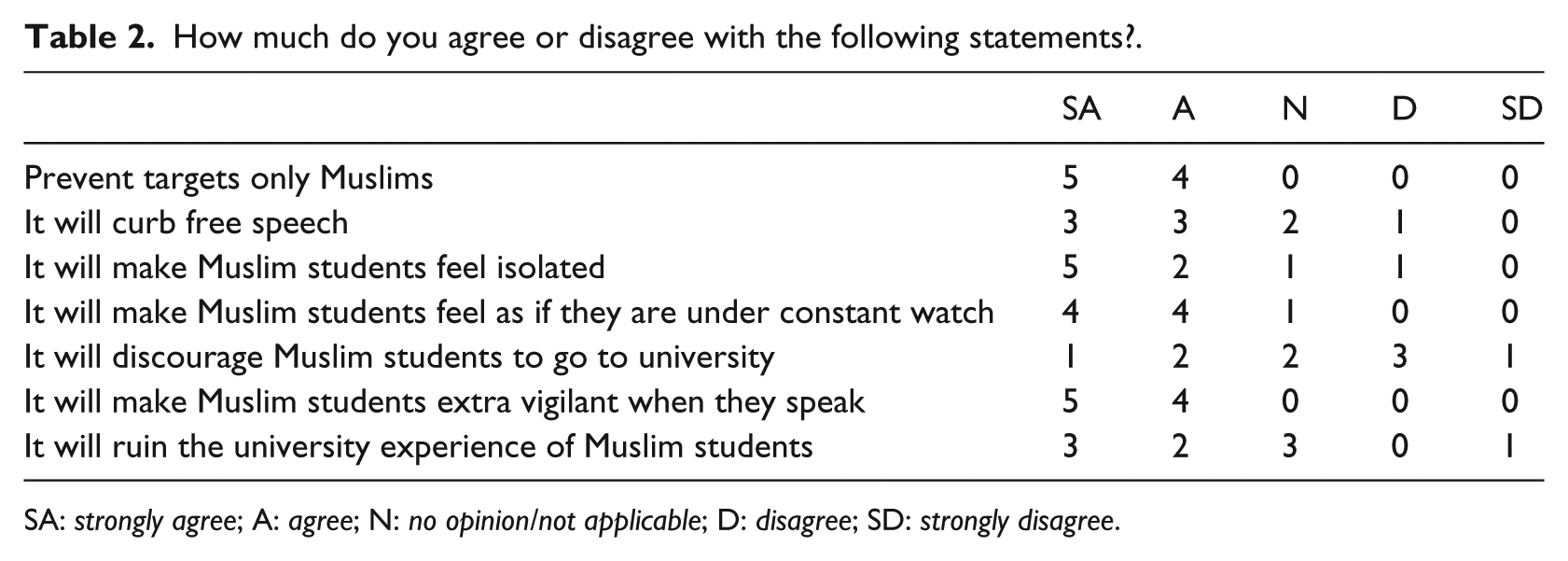
SA: strongly agree; A: agree; N: no opinion/not applicable; D: disagree; SD: strongly disagree.
We were, in part, exploring in this project the possibility of developing insights into respondents’ views by paying attention to their use of language. In describing relevant language features, a discourse analytical approach was used following established notions of social construction (Berger and Luckmann, 1967) as methodologically enacted through discourse analysis (e.g. Gee, 1999) and, more recently, discourse studies (Angermuller et al., 2014). In this approach, language is considered to be the primary vehicle by which meaning, and thus experienced reality, is established: ‘Language orders our perceptions … and can be used to construct and create … diverse social worlds’ (Potter and Wetherell, 1987: 1). As a result, texts are treated as practices by which their producers (speakers, writers) collaboratively shape the world together with their interactants (listeners, readers).
Our invitation to participants (including the link to the online survey) was sent to contacts at several universities in England who were asked to forward it to members of the Islamic Society at their university. The first page of the questionnaire included the following statement: ‘Please only complete this questionnaire if you are a UK citizen and would describe yourself as a British Muslim’. An 8-week period was allowed for the collection of data. During this period, nine completed questionnaires were received.
Our work raised significant issues about the ways in which research may be conducted. Our ethical procedures included a commitment to anonymity, to the declaration of the requirement for us to disclose information if legally obliged to do so and to highlight the distinction between this academic work about Prevent and the development or implementation of Prevent itself. As part of the research design, the electronic identifier of those who completed each questionnaire was blocked so that we would have no way of knowing at which university each of the respondents was based. It would have been interesting to know more about the number and type of the universities in which respondents were based. There may have been interesting points, for example, about those universities where the ethnic/religious population was more obviously varied than in other universities.
We were surprised and somewhat disappointed by the limited response. Our small sample size (25 people opened the online questionnaire and only 9 completed it) could be due to many factors, including ‘research/feedback’ fatigue, the wording of the questions and so on. But we should also consider that the length of time taken to achieve ethical approval meant that the questionnaire was distributed later than originally planned and perhaps not at an optimum point for data collection.
We, of course, accept the need in such a controversial field to act with extreme caution. We should not be naïve in our discussion of ethical matters. It is, of course, possible that some of those who opened the questionnaire and perhaps even those who completed it might have not been members of the target group (indeed, it is possible that the project may have been monitored by various groups including those with security responsibilities). More straightforwardly, however, some potential respondents may have been put off by our detailed, explicit declarations regarding our legal responsibilities about disclosure. We informed respondents that
Please note that if in reply to an open-ended question you disclose information where we are under a legal duty to pass the information on, we will refer this matter to the appropriate university authority, although we will not know who has submitted this information.
One Muslim student in the researchers’ university suggested that our response rate could have been expected in the light of such a warning.
Our original plans to conduct interviews with a small sample could not take place as we did not know and could not trace who submitted each questionnaire. While fully accepting the need for professionalism, we note that this project has allowed us to reflect on the possibilities and limitations of researching important and sensitive matters at a time when increasingly rigorous ethical procedures are required. We may be facing a situation in which those challenges that are most pressing are least researched. The likelihood of policy and practice being based on misunderstandings needs to be recognised.
Presentation of results and initial analysis
All nine respondents were undergraduates.
Students’ understanding of Prevent
In response to an open-ended question on their understanding of Prevent, all nine students displayed a general understanding of Prevent. They emphasised that it was designed to prevent radicalisation and extremism. No one used the word ‘terrorism’ in their reply. This is interesting, in that it suggests that they are aware that Prevent focuses on a pathway that may lead to extremism and radicalisation, prior to the point at which a person directly supports or engages in terrorism itself. One student, however, added that the real agenda of Prevent was to
dismantle the religious and true Islam and favour the watered down form of Islam that is agreeable to secular and western liberal ideology.
The issue of understanding the nature of the problems that Prevent is designed to address is crucial. Some historians (e.g. Cesarani, 2016) point to the problems that emerge from the toleration of injustice. Crick (2000), the architect of modern citizenship education, made a point of emphasising the potentially negatively framed and limited acceptance implied by use of the word ‘toleration’ rather than ‘respect’. These matters are essentially connected to characterisations of procedural values. In other words, the underlying ideas of a social action such as a government policy are given meaning in the form of the transaction that follows. It is this integrated approach of substance and procedure that requires investigation if we are to know what really is meant by ‘toleration’, ‘terrorism’ or any complex and contested linguistically framed idea. At the moment, our limited data set suggests that much more work is needed to ensure widespread and complex understanding of Prevent and the problems it seeks to address.
The usefulness and effectiveness of Prevent
The ratings of the nine students to statements on the usefulness of Prevent in dealing with terrorism are shown in Table 1. No student agreed it was effective or will ensure that students are not radicalised. The majority suggested that Prevent does not understand the root causes of terrorism and that more effective strategies could be used. Our findings suggest that the increasing number of voices raised against the idea that Prevent is useful or effective should be heeded (e.g. Saeed and Johnson, 2016). There was some limited agreement that blocking access to certain websites and vetting speakers was effective.
In response to an open-ended question on the effectiveness of Prevent, a number of critical comments were made. There was a general feeling that Prevent encourages a suspicion of young Muslims and Islamophobia and that it is clearly focused on Muslims, and not, as stated by the government, on a broad range of groups that might be involved in terrorism. As one student put it,
Prevent is going about things the wrong way. They need to consult with more Muslims and put in place positive methods of showing students moderate Islam, instead of carrying out a Muslim witch-hunt of sorts and limiting freedom of speech. Also, it so obviously only targets Muslims that for it to state otherwise is laughable. Perhaps also it should look to explain why groups like ISIS are politically motivated with a penchant for violence rather than having anything to do with true Islam.
The impact of Prevent on British Muslim students
These criticisms above are echoed in the ratings of the nine students to the statements shown in Table 2.
As can be seen, there are concerns that Prevent will ruin the university experience of Muslim students, make them feel more isolated and become extra vigilant about what they say and may even discourage Muslims from going to university. In the open-ended question which followed, a number of points were made about the unfair targeting of those with no association with terrorism. As one student put it,
The attitude of suspicion towards Muslims means that we are guilty before proved innocent, and a simple misunderstanding on our part/misstep is enough for Prevent to take disproportionate action.
The students were more specifically asked in an open-ended question to comment on the type of behaviour that might be a serious cause for concern. The responses here were quite varied and included
viewing terrorist sites saying things that are obviously very anti-West talking about controversial topics, i.e. ISIS, Israel/Palestine.
Our results suggest that the concern that has been raised in the literature (e.g. Afzal, 2016) about the possibility of isolating some students in an unreasonable manner is occurring.
Tackling extremism
The students were asked in an open-ended question to comment on how universities can best tackle the problem of extremism. The general theme of the responses was to understand the root causes of terrorism, combat stereotypes and discredit extremist groups. As one student put it,
Learn the causes, get more Muslims involved in the committee, discredit the extremist groups, explain how they came about and why they do not represent Islam, give students other avenues for pursuing Islamic activities i.e. Masjid volunteering, talking to non-Muslims about what Islam is.
One student, however, thought ‘it’s not the universities’ job to get involved’.
The points raised earlier in this article about the challenges of introducing Prevent into a context supposedly devoted to open academic enquiry are supported by our data (Durodie, 2016). The students were also asked in an open-ended question to comment on whether Prevent might create problems for all students, not just those of a Muslim background. Most of the students were concerned that it could create divisions between Muslims and Non-Muslims, and a general fear of expressing one’s views when discussing controversial issues.
Identity as a British Muslim
The students were asked in an open-ended question to comment on whether Prevent had impacted how they see their identity as a British Muslim. Most felt that it had no negative effect; one student felt it had enhanced their identity. One student felt it required Muslims to be more careful in how they are perceived:
Yes, have to be careful with the image we show of ourselves, have to be sure that no misunderstanding can occur.
The point made earlier about the challenges of Prevent in relation to fundamental British values is reinforced here (Richardson, 2016).
The students were also asked in open-ended questions what languages other than English they spoke, whether being able to speak another language may have affected their thinking about their identity and how they were viewed by other students. Seven of the students spoke another language. The most common languages spoken were Arabic (three cases) and Urdu (two cases). Most students felt that speaking another language had no effect on how they viewed their identity or how others viewed them. In some cases, the effect on themselves was positive in giving them a wider perspective, but in some cases it was viewed negatively, in making you feel you don’t belong. One student put it thus:
Depending on the person (how bigoted they are) I would think they would start to see me more as the other and not quite ‘one of us’. But this would be subconscious and not very deep.
The students were also asked in an open-ended question whether Prevent made them feel they did not belong in Britain. Three said Yes, and two students said No. Four students also added comments on this, which focused on the way Prevent has led to Muslims feeling that they are an isolated group who are being monitored. One student put it thus:
I am British and therefore have as much right to be here as anyone else. The idea behind Prevent might have at one point been relevant and useful but has now become something people use to single out people with a difference in opinion to the traditional white Briton.
A final question asked for any other comments. Three students added a final comment. One student described Prevent as ‘institutionally racist’. The two other students pointed to the need for it to be developed and improved – one student putting it thus:
It’s been poorly carried out (as usual for government schemes). Reinvent it and make it more positive and it might actually achieve its aims.
Use of language
An analysis of the discursive practices used by the students in their responses to the open-ended questions allowed some insight into the way stances towards Prevent were being constructed linguistically.
When referring to key concepts, some questionnaire respondents frequently used the same phraseology that is common among non-Muslim media and politicians, such as war metaphors (‘combat’, ‘fight’), and terminology such as ‘radicalisation’ and ‘extremism’:
They try and combat the radicalisation of young Muslims. Aims to prevent young Muslims entering and being encouraged to join extremist groups, such as ISIS. … it’s meant to prevent radicalisation.
Interestingly, one respondent used the term ‘moderate Islam’:
Prevent is going about things the wrong way. They need to consult with more Muslims and put in place positive methods of showing students
According to Manzoor (2015), the term ‘moderate Islam’ is not one that is frequently used in the Muslim community, but has instead been coined by non-Muslim politicians who may conflate religious commitment with inappropriate politically motivated activity. Respondents’ use of reference forms reveals how they choose to position themselves ideologically, that is, as aligning themselves with established narratives or distancing themselves from them. It also shows their embeddedness in the existing media discourse. In using the existing political terminology, the above respondents align on a conceptual level with the authors of Prevent, even if the content of the strategy is being assessed critically. By displaying commonality – a shared language, shared concepts and shared underlying values – these respondents establish a seemingly mutual basis from which they argue against certain aspects of Prevent. This can be seen explicitly in the following quote, where the government’s own terminology is used in an argument against itself:
To judge the prevent agenda by the government’s own standards, it’s intolerant, Islamaphobic [sic] and restricts freedom of speech. …
Other respondents refrain from the established political and media discourse and instead use language that confidently establishes an oppositional stance:
dismantle the religious and true Islam and favour the watered down form of Islam that is agreeable to secular and western liberal ideology.
Or,
I am a practising and strong Muslim who follows Islam in the pure sense. Which prevent targets and this is a top down legislation so it is pure institutional racism.
In contrast to those comments that terminologically align with Prevent but criticise the way it is being implemented, this stance establishes a fundamental conflict with Prevent’s assumptions and objectives.
Related to the way issues and concepts are being referred to is the degree of expressed sentiment over core aspects of Prevent. The majority of respondents refrained from strong affective commitments to their statements and maintained a non-evaluative stance even when expressing an opinion. This is interesting given that the issue at hand is discussed with considerable emotion in the media and given that the sentiments expressed are clearly strong. In adopting a measured stance, and in doing so in combination with the above-mentioned use of established Prevent terminology, respondents positioned themselves in an objective commentator role. In doing so, they adopted the stance of the reasonable non-extremist – a stance which arguably is aligned with the aims of Prevent, but which is being criticised on the content level of the responses. Some respondents did use affect-laden language such as ‘watered down’, ‘witch-hunt’, ‘laughable’, ‘intolerant’, ‘bigoted’, ‘ridiculous’ and ‘institutionally racist’. Again, this use of language presented a stance that was fundamentally and subjectively in conflict with Prevent, rather than being objectively critical.
Conclusion
The findings indicate that the British Muslim students in this small and non-representative sample have a number of concerns regarding Prevent. Our respondents consider that Prevent may have a negative impact on how British Muslim students feel about themselves and how they think others may view them. The size of our sample is too small to allow for generalisable empirical analyses, and as such, we will in this final section of the article briefly discuss issues that strike us as being potentially significant and may be of interest for the development of future work.
In bringing together our literature review with our empirical data, we wish to highlight several issues. There are perceptions in the literature that Prevent is being characterised as something that is centrally about Muslims who, as a group, are more likely than others to commit terrorist acts. Members of our sample have a general understanding of Prevent, see it being about radicalisation and reject any suggestion that Islam is a threat. There is agreement across our sample that Prevent is not effective and is counter-productive. Indeed, it seems to have the potential in their view to go against the essential nature of higher education as an arena for academic enquiry, to damage their position as students in that context and does not contribute to their pastoral care. In approaches to tackling extremism, they are in favour of educational rather than security-based approaches, and the effect of Prevent seems to make them less likely to see themselves as British (with perhaps a consequent rejection of the official approach to fundamental British values, if not to what those values mean in a more inclusively oriented characterisation). Our analysis of data suggests that discourse analysis may be a fruitful approach to research.
Our initial analysis has given us the opportunity to think about not just what respondents reported but how their language use allowed them to position themselves more strategically in relation to Prevent. Some students’ responses accepted the underlying assumptions of Prevent and by extension, of the survey, aligned linguistically and conceptually with both. This did not stop them from being very critical; however, they did so by accommodating to the government’s and the media’s discursive practices with regard to terminology and non-affective language use. Others defied these rules and established an alternative discourse fundamentally opposed to the premises of Prevent and any underlying assumptions. Close attention to the discourse employed by all of those involved in these sensitive discussions allows a much more detailed understanding of the stances and stance-taking strategies that exist. There are also issues for discussion concerning the use of the language of the survey questions. Francis et al. (2009) (as well as many others) argue that language is vital for identity. We would argue that our use of English in our research instrument is appropriate in that we wanted a sample of British Muslim university students. But we are aware that this might not be a sufficiently accessible or fine-grained approach. We would be interested to gather data from British Muslims who are speakers of a variety of languages and to explore through careful consideration of a range of issues (e.g. translation, Piazzoli, 2015) what ideas are being expressed. There are here substantive issues about the connections between identities and language and methodological issues about how data are collected and analysed in a diverse society.
Given the above challenges, it would be encouraging if we were to be able to point to positive developments in education that would allow people to better understand and to act to achieve the good society. There are certainly very complex matters to consider as to whether education about contemporary matters should be cognitive as well as affective, individually as well as collectively oriented and critically or conservatively positioned. Unfortunately, and despite the large body of research and inspection evidence from schools about the value of citizenship education (e.g. Ofsted, 2013; Whiteley, 2014), there is currently something of a vacuum in educational policy and practice about educating people for understanding and action. In the context of higher education, our small-scale research seems to suggest that there is little taking place other than an attempt to stop (or prevent) bad things happening by drawing negative attention to a group whose members do not see themselves as being guilty of what is feared. There is the opportunity for things to be much more positively and professionally developed. Our sample did not refer to issues about de-radicalisation perhaps signalling implicitly that there is some educational space here and most of our sample seemed to be keen to see Prevent being improved and becoming more effective, rather than seeing it as a strategy that should be abandoned. We are tempted to conclude that education is perhaps a better way forward than ‘prevent(ion)’.
Footnotes
Declaration of Conflicting Interests
The author(s) declared no potential conflicts of interest with respect to the research, authorship, and/or publication of this article.
Funding
The author(s) received no financial support for the research, authorship and/or publication of this article.