



Abstract
The question of developing educational policies that involve training people to be capable of critical reflection and skilled in approaching the discussion-debate binomial, with the overall goal of achieving learning which is of a transformative kind, is currently embraced by the transdisciplinary paradigm known as Global Citizenship Education. This qualitative study investigates the impact of protest or topical songs released in response to the Iraq War on a cohort of university students and explores whether these songs could be useful in Global Citizenship Education. The results of the study emphasize the value of these types of songs as triggers for transformative learning, because, independently of respective national educational policies or the possible influence of the mass and digital media, these songs were shown to tap into an underlying set of universal values, rights and attitudes among citizens that drive the need for Global Citizenship Education design and evaluation.
Keywords
Introduction
The anti-war song during the 2003 Iraq War: a review of the bibliography
Wars of the 20th century, especially those since the 1960s, were accompanied by an amalgam of songs whose lyrical content responded to a political and social commitment, with its core being to take sides in the conflict. The 2003 Iraq War was no exception. There was a resurgence of anti-war protest music as indicated in Table 1, ranging from hip hop to folk rock. Eminem’s ‘Mosh’ (2004) and Billy Bragg’s ‘The Price of Oil’ (2002) are an indication of these different musical genres.
Song list.

Source: US Billboard Hot 100, the UK’s official Top 40 singles charts, the US Billboard Modern Rock Tracks chart; and the US Billboard Bubbling Under R&B Hip-Hop Singles.
However, the proliferation of this musical typology was limited and furthermore, given the changes in the political climate and the corporate landscape of the culture industries, […] country anthems supporting military action as the appropriate response to the 9/11 attacks have overwhelmed more critical voices in rock and rap that challenged this course of action. (Garofalo, 2013: 24)
The limited exposure given to these types of songs may have hampered their social impact. However, other possible contributing factors are covered by the literature, including the marginalization of dissenting voices in mainstream media (Kumar, 2006; Adolphson, 2014); artist self-censorship in the post-9/11 era (Scherzinger and Smith, 2007; Garofalo, 2013); radio deregulation and consolidation (Garofalo, 2013); and the move to online distribution of anti-war songs (Smith-Said, 2006). Several scholars have approached the issue of how popular music and political thought and action have been historically linked and music’s capacity to create a political response (Kizer, 1983; Street, 2012). Anti-war sentiment and its corresponding music have also received considerable scholarly attention, contributing an accurate vision of the role and nature of protest music during the Iraq War from both a sociological and comparative perspective (Pieslak, 2007; Rodnitsky, 2010; Rosenberg, 2013; Weinstein, 2017).
A synthesis of the aforementioned bibliography leads to the conclusion that a combination of the factors cited may have delimited the variety of protest music heard by society in general, and the American public in particular, given the United States’ lead role in the 2003 Iraq War. In this context, the media, and particularly the audio-visual media, played an important role because widespread dissemination of expressions of dissent did not occur and therefore there was no possible connection between these artistic expressions of anti-war sentiment and the public. Although Green Day’s ‘American Idiot’ album (pop punk) was a memorable expression of anti-war sentiment, the album’s value as a trigger for critical reflection and debate on such global issues is not known. Indeed, the problem this study addresses is that present-day listener reactions to these types of songs are unknown as well as whether the content of these songs could be useful from an educational perspective.
The use of topical or protest songs as a pedagogical tool has been discussed by several scholars, particularly in the teaching of social justice and civil rights modules in history classes (Banks, 2003; Butler, 2003; Stone, 2004); and in ethics classes (O’Mathúna, 2008). However, there is a scarcity of research which actually ‘takes account of listeners’ own experiences and perspectives with regard to popular music’ (Williams 2001: 223–224).
Research problem and literature
The research approach taken in this study is rooted in the current theoretical reference point known as Global Citizenship (GCED), which seeks to realize a wide range of learning outcomes that have the following aims: ‘Empower individuals to reflect critically on the legacies and processes of their cultures, to imagine different futures and to take responsibility for decisions and actions’ (Andreotti, 2014: 29). In a similar vein, VanderDussen Toukan (2018) explains that GCED’s goals include learning about global themes, structures and systems; ‘world-minded’ identity and membership; rights and responsibilities in a global context; diversity of beliefs and values; critical civic literacy capacities; managing and understanding conflict; considerations of privilege, power, equity and social justice; and finally, social action. (p. 2)
An effective GCED pedagogy is one that encourages students to challenge assumptions related to inequality and social injustice and facilitates transformative learning. Transformative learning involves a change in the structure of assumptions or the ‘frame of reference’ that students use to understand their experiences (Mezirow, 1997). This change, as previously mentioned, requires critical reflection, which ‘is the means by which we work through beliefs and assumptions, assessing their validity in the light of new experiences or knowledge, considering their sources, and examining underlying premises’ (Cranton, 2002: 65). Thus, the hypothesis of this study is that the protest song can serve as a trigger to stimulate critical reflection and discussion-debate on a specific topic in a classroom or group setting.
The overall objective of this study is to investigate the importance and value that a cohort of university students attributes to protest songs that deal with the 2003 Iraq War. The students were from the 2016–2017 academic year and were aged 19 to 21 years. There has been no study to date that tackles anti–Iraq War music from this perspective.
Method
A qualitative, exploratory and descriptive method was adopted, using the semi-structured interview technique. It involved qualitative research through structured focus groups, which enabled underlying information to surface which would have otherwise been difficult to access (Duggleby, 2005; Briggs, 2008; Vromen et al., 2015).
Students aged 19 to 21 years were approached personally and emails were sent to a list of 50 potential participants, explaining the topic in general terms and informing them that there would be an audio recording of the discussion. The final number of volunteers was 24 and three focus groups were formed. They received no financial incentive for their participation.
The rationale for selecting this age group was motivated by the fact that they did not live through this war as adults and therefore any possible bias arising from the influence of the mass media’s coverage of this war on the general public would be less likely. The participants were in their first years of primary education at the outbreak of the Iraq War and they would not have paid much attention to mass media; ergo its influence on them in terms of forging pro-war or anti-war sentiment is likely to have been minimal.
The focus groups took place in January 2017 at the Faculty of Education-University of Alicante, a Spanish public research university, which has a significant intake of Erasmus and bilingual Spanish/English students. Focus groups 1 and 2 lasted approximately 1.5 hours. Group 3 lasted approximately 2 hours as both music videos were analysed.
Three researchers were involved in the fieldwork and each took turns at being the moderator while the other two researchers observed and took notes on the discussion. Initially, the moderator explored the cohort’s perception of the importance of anti-war music. Subsequently, the respective songs were played according to preference (Table 2) and the lyrics were circulated after an initial open-ended question asking for their immediate reaction to the song. The following issues were covered: the song’s message and what it made them think and feel. The focus group discussions were recorded and transcribed in their entirety. To guarantee the quality of the data, the technique of researcher triangulation was used for the subsequent selection of extracts, their analysis and classification (Patton, 1990).
Composition criteria of the focus groups.
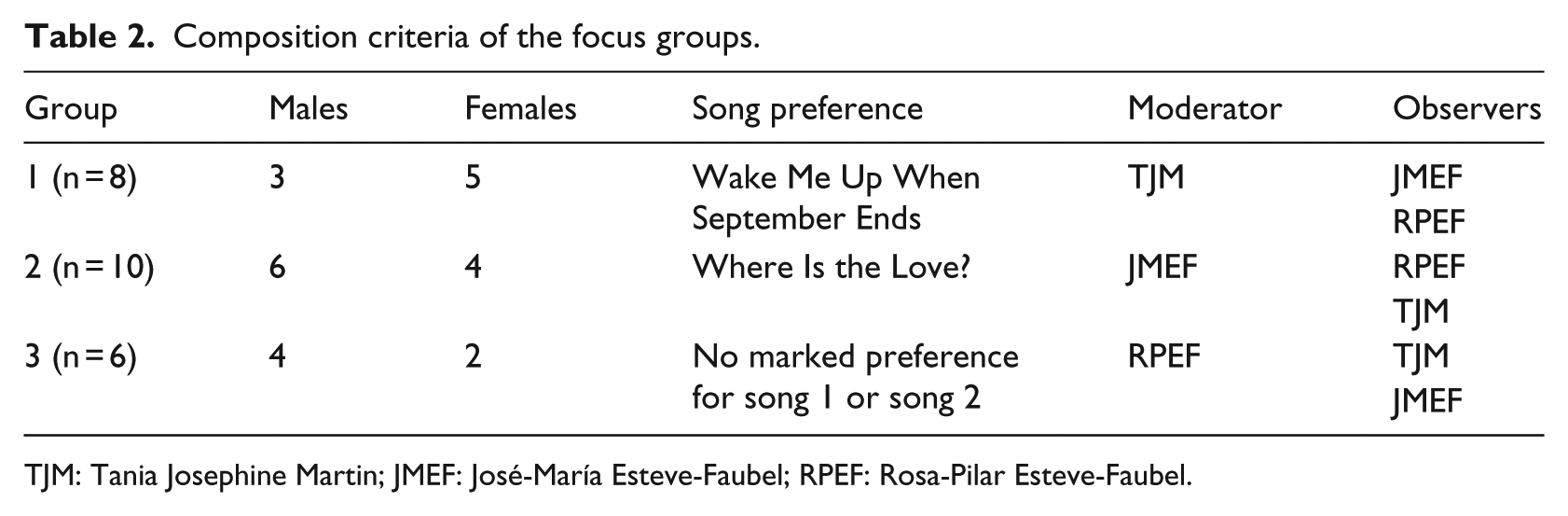
TJM: Tania Josephine Martin; JMEF: José-María Esteve-Faubel; RPEF: Rosa-Pilar Esteve-Faubel.
The results of this study are presented by quoting fragments from the focus group discussions and at the end of each exemplar quote the following participant identity code was devised: Participant (P) Nº 1 … 10; followed by M (male) or F (female); group Nº 1, 2 or 3; and finally nationality, USA, ES (Spain), UK, IRL (Ireland), SA (South Africa). However, in line with Vromen et al. (2015), no individuals are identified in Tables 4 and 5 but the group number is included at the end of each exemplar quote.
Four consecutive stages were developed to carry out the study: (1) selection of songs in accordance with the criteria set out below, (2) Development of fieldwork, (3) Classification and (4) Study. The following criteria were used to select the song list reproduced in Table 1.
The song release date had to be during the Iraq War era, namely, after March 2003.
A song and /or its music video had to make a reference, explicit or implicit, to the Iraq War or war.
The songs needed to meet at least one of the five criteria in Kizer’s (1983) definition of protest songs as
(1) expressions of discontent or dissent which imply or assert a need for a change; (2) may represent the attitudes of one individual or a collection of individuals, such as members of a special interest group; (3) may be adapted by and utilized as ideological statements of a social movement, whether originally written for that purpose or not, and then the original composer no longer dominates as the message source; (4)may inspire the creation of other rhetorical messages; (5) may serve to stimulate thought, reinforce, or modify attitudes. (p. 4)
4. It was agreed that the anti-war songs should represent a variety of musical styles regardless of commercial success in the charts; for example, ‘Hero of War’ has had 30 million views on YouTube since its release date.
5. The inclusion of anti-war songs that appeared in the major US and UK charts during the Iraq War era.
At a preliminary meeting, the participants were asked to state which songs they were familiar with from the list, followed by which one they preferred. They were also asked how they knew the song, that is, YouTube, Spotify, radio and so on.
The participants were assigned to groups based on their song preference (Table 2). Group 1 watched the music video of ‘Wake Me Up When September Ends’ (song 1), and Group 2 watched the music video of ‘Where Is the Love?’ (song 2); whereas Group 3 watched both music videos as participants in this group showed no marked preference for either song.
Before the set date of the focus groups, the researchers met twice to analyse the themes arising from both the lyrics and the audio-visual representation of song 1 and song 2 and reached an agreement on the benchmark categories (Table 3), with the checkmarks indicating relevance to the respective songs.
Benchmark categories.
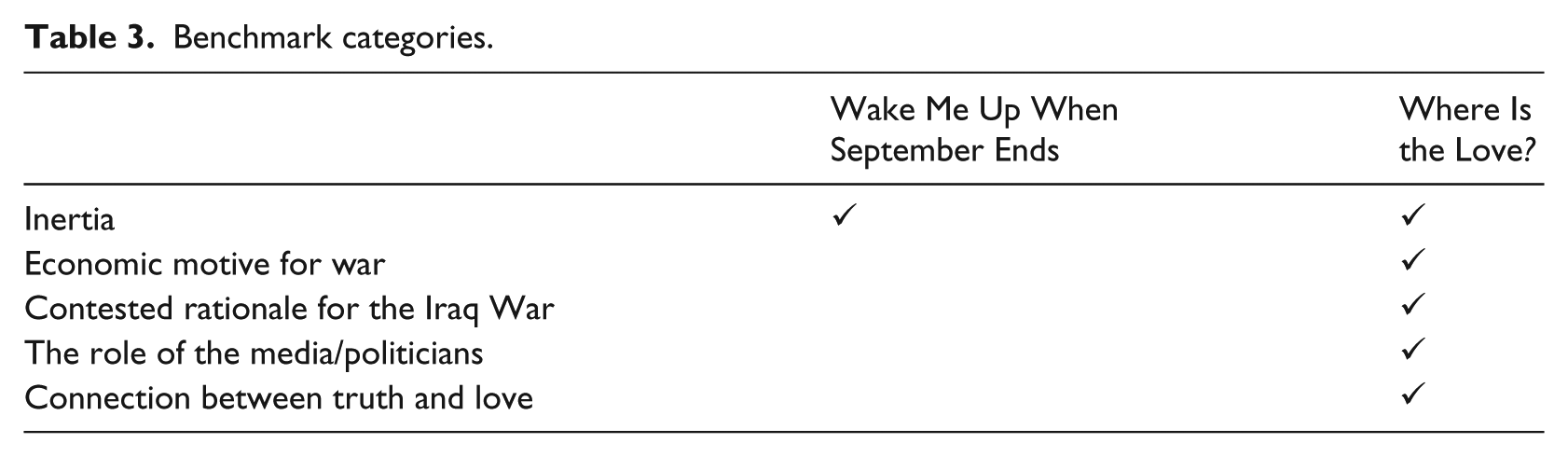
Once the interviews were transcribed, the analysis-study phase followed. The initial stage involved the simplification of the information, which comprised the following: extraction of the themes arising out of the data by identifying key words; editing of exhaustive categories, involving not only a consideration of the benchmark categories in Table 3, but also the inclusion of the new categories that were defined during the analysis of the focus group data. For the new categories, a distinction was made between adjacent categories, which included relevant themes although they were not specifically linked to the lyrics or video; and affective categories, which included themes which were expressions of sentiment that were permitted to surface during the focus group discussion.
The data collected were allocated equally among the researchers for analysis and thereafter, each researcher proposed a codification of the significant themes. To streamline the process, after each researcher had analysed their share of extracts from the transcripts, the results were shared, and 96% agreement was reached on how to initially categorize the data.
In accordance with the overall objective of the study, the analysis phase consisted of meeting the following further objectives:
Investigating the perception of the significance of anti-war songs in the 21st century.
Extracting the emergent themes from the participants’ interpretation of song 1 and song 2 and distinguishing the themes that could be grouped under the benchmark categories from the new themes that emerged, for which new categories were agreed on by the researchers, namely, adjacent or affective categories.
Results
The analysis-study phase indicated no differences between the responses of males or females, or between the different nationalities represented by the participants. Furthermore, a distinctive preference for either song 1 or song 2 did not influence the data that emerged. This was corroborated by the analysis of the data from group 3, which served as a control group, given that participants in group 3 had declared no marked preference for either song and watched both music videos. Therefore, the results are presented in a single scheme, which incorporated the results of all three groups with supporting exemplar quotations.
Constituting each group on the basis of song familiarity and preference avoided the difficulty involved in participants having to remember an unfamiliar song and assimilate and analyse its content after only one music video viewing. All participants had heard the songs through both traditional and digital media: Spotify, YouTube and radio, such as the national Top 40 radio station, known as Los Cuarenta Principales (Spain).
In response to the first objective set out in the analysis phase, questions were asked to elicit opinions on the importance of anti-war music in the 21st century and the use of military action to resolve conflict. The question Do you think anti-war protest music is important in the 21st century? produced responses indicating the cohort’s perception that anti-war music shapes the way we think and unites people under a common cause. There was also a statement about the responsibility musicians have because they reach out to all generations and a perception that creativity in music is unconstrained whereas journalism is less free.
The highlights relating to the aforementioned themes are transcribed below: P6M/G2SA: ‘Yes, it’s important for change, social and political. In the 21st Century, music more than ever forms our mind and it’s surrounding us wherever we go’. P4M/G3IRL: ‘Yes, musicians have a responsibility; they speak to multiple generations’. P7F/G2ES: ‘Music follows you and influences you unconsciously. It’s important and always will be; it influences you and what you say; the way you think about war or whatever, like anti-austerity’. P5M/G3UK: ‘Music’s a pedestal from which to speak to all generations and express anti-war feelings’. P4F/G2ESUK: ‘Musicians speak through their creativity. Music’s a vehicle; journalism is controlled. Speaking through creativity is very important’. P3M/G1USA: ‘Music has the power to bring people together to feel something against war or whatever’.
When asked their opinion on using military action to resolve conflict, all three groups overwhelmingly felt that dialogue was more useful than military action, although each group acknowledged that sometimes military action was necessary, especially when national security was threatened.
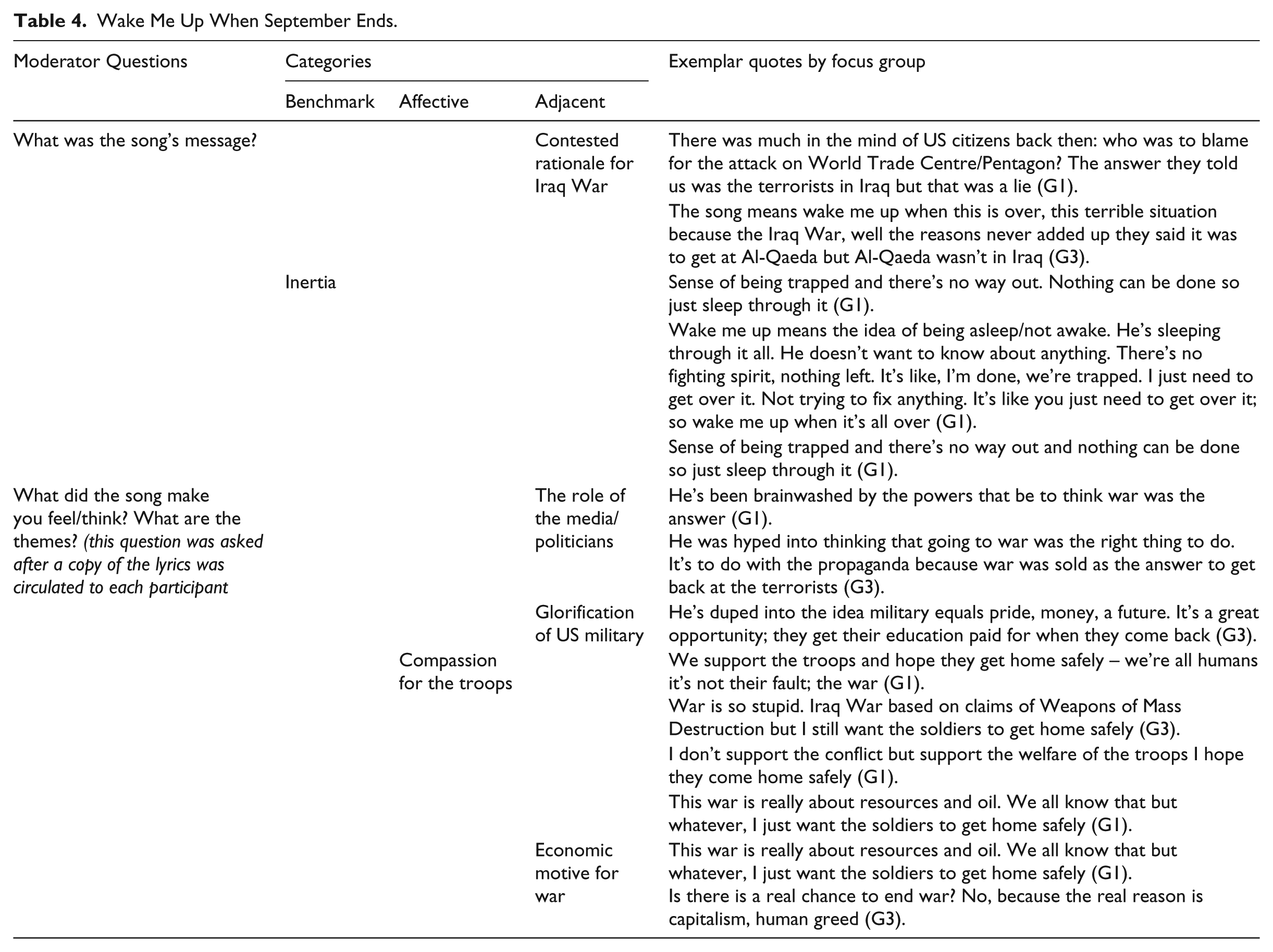
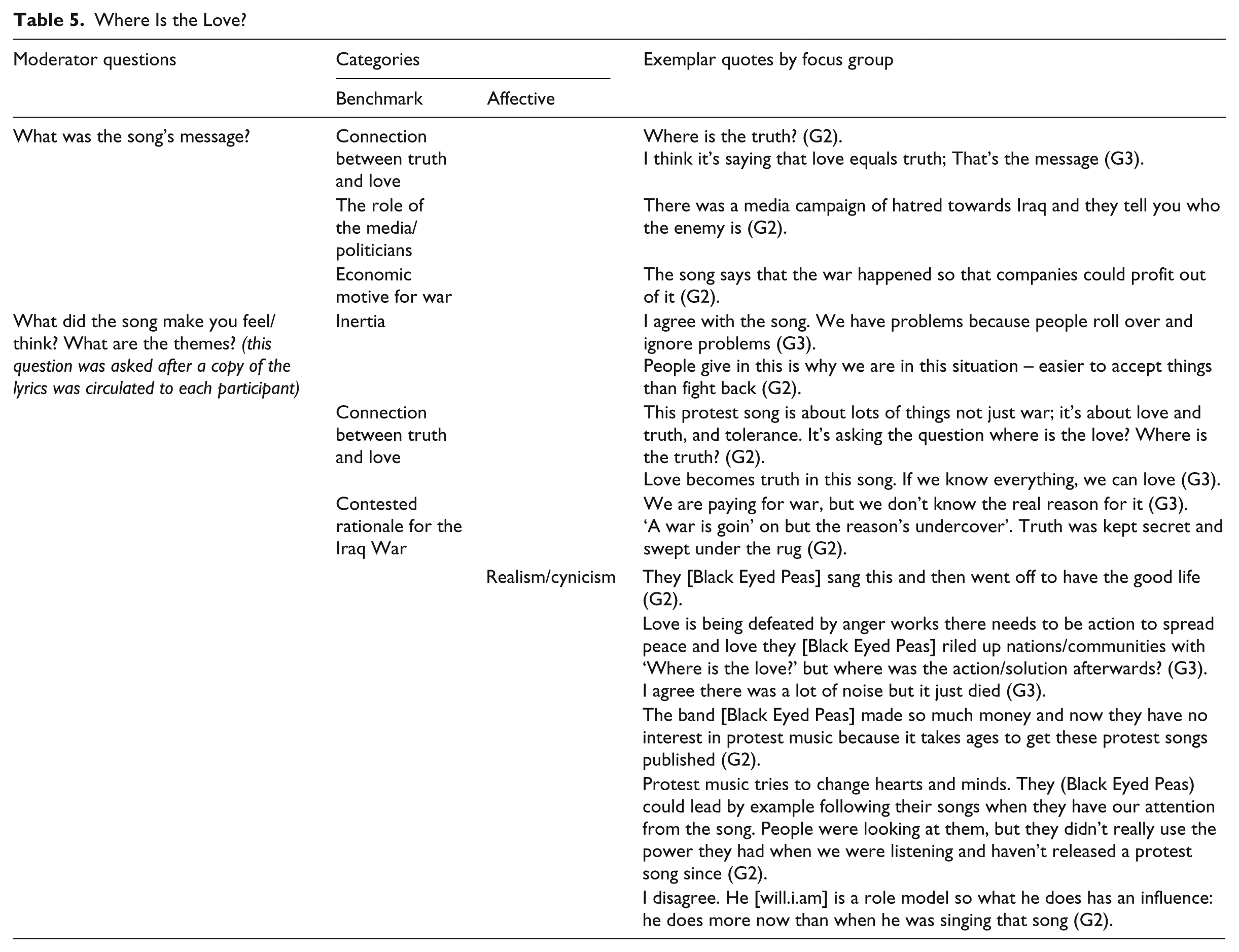
The second objective of the analysis phase strategies is presented in Tables 4 (song 1) and 5 (song 2)
Wake Me Up When September Ends.
Where Is the Love?
Discussion
The results of this study concur with the hypothesis that topical or protest songs stimulate critical reflection and debate in a classroom or group setting. The key finding in response to the first objective of the analysis phase of the study – investigating perceptions of the significance of anti-war songs in the 21st century – was that anti-war songs were perceived by the cohort to be important because they can influence thoughts and galvanize people.
Several themes emerged in reaction to both song 1 and song 2. These themes included a strong conviction about the contested rational for the Iraq War but at the same time a marked feeling of compassion emerged towards the troops serving in Iraq. There was also a widely held view that the media were effective in advancing the official pro–Iraq War stance. Other themes included the following: glorification of the US military; economic motive for the war; a sense of inertia; and a cynical reaction concerning the genuine commitment of musicians to bring about change.
The emergent thematic categories suggest that the participants were engaged and therefore, in line with the hypothesis, topical or protest songs were shown to be a useful tool for triggering critical reflection and discussion-debate. This type of participatory pedagogy prevents the reinforcing of stereotypes and encourages a more critical global citizenship education. (Bourn, 2008; Andreotti, 2014; Brown, 2017). Furthermore, the existence of a considerable degree of content in the adjacent and affective thematic categories underscores the ability of protest or topical songs to stimulate discussion in a group or classroom setting but for this to occur, the educator needs to open up spaces where opinions can be exchanged freely (Andreotti, 2014).
In fact, the conclusions of a recent study conducted by Brown (2017: 14) among non-governmental organization (NGO) practitioners in the United Kingdom and Spain supports Mezirow’s (1998) claim that educators facilitate transformative learning through a process of awareness, reflection, dialogue and action. Brown’s study concludes that GCED can provide opportunities for aspects of transformative learning to occur by opening spaces for dialogue through participative pedagogies. Furthermore, Brown’s (2017) study concludes that … there is support for the idea that developing awareness of tacit assumptions and finding a space in which to connect with others to reflect and discuss injustices provides opportunities to consider appropriate responses and create networks, which may lead to social change. (p. 14)
Anti-war songs in the 21st century
According to the cohort in this study, anti-war songs were perceived to be important because protest songs can influence thoughts, unite people under a common cause and bring about change. This emergent theme is supported in the literature by Knupp (1981), Mondak (1988) and Kizer (1983) who argues that music ‘is a facile tool for proclaiming the negative, raising consciousness … enlisting support and inspiring followers’ (p. 8). Thus, listening to protest or topical songs in a group or classroom setting stimulates critical reflection and may inspire social action, one of the identified goals of critical GCED (Andreotti, 2014; UNESCO, 2015; VanderDussen Toukan, 2018).
The emergent theme that musicians have a social responsibility because of the influence they exert on their audiences indicates a connection to Shultz’s (2007) transformationalism approach to GCED, which suggests that all citizens are connected through a ‘common humanity, a shared environment and shared interests and activities’ (p. 249).
Another finding was the perception that creativity in music was perceived to be unrestrained, whereas journalism was less free, according to P4F/G2ESUK. This statement suggests an awareness of the well-documented marginalization of voices that were opposed to the Iraq War by mainstream media, especially at the early stages of the war (Aday et al., 2005; Kumar, 2006; Goddard et al., 2008).
The contested rationale for the Iraq War
One of the key emergent categories that indicated critical reflection was the contested rationale for the Iraq War. This theme does not emerge explicitly in the lyrics or the music video of song 1 ‘Wake Me Up When September Ends’, but it was an adjacent category that emerged during the process of reflection on and discussion of the song’s message that was triggered by the scenes depicted in the video. The narrative followed the story of a young man who enlisted in the US army. There were subsequent battle scenes in Iraq and a suggestion at the end that he was killed in action, leaving behind his heartbroken girlfriend.
In the case of song 2, ‘Where Is the Love?’, both groups also identified the explicit lyrics that refer to the contested rationale for the war in Iraq. This thematic category was a Benchmark category – ‘there’s a war goin’ on and the reason’s undercover.
The cohort demonstrated a strong conviction that the Iraq War was started for reasons other than the claims made by the Bush Administration, although they were not able to verify where this conviction came from. It is possible that as the participants were growing up, they were exposed to the heavy media coverage of the findings of a report from the Joint Senate Select Committee on Intelligence, which critically evaluated the Bush Administration’s reasons for going to war in Iraq (Morigi, 2008).
Both songs clearly provided an engaging way to revisit a historical event and this pedagogical approach represents a means by which younger generations can remember and reflect on the issues surrounding the 2003 Iraq War.
Role of the media/politicians in promoting the rationale for the Iraq War was a benchmark category applicable to song 2 with most participants signalling the rhetorical question ‘where is the truth?’ However, in song 1 this theme emerged as an adjacent category in the context of the discussion about the reasons why the young man in the music video decides to enlist. Several participants suggested (Table 4) that he was persuaded to join for both personal as well as patriotic reasons based on the post-9/11 quest to hunt down the terrorists who attacked the Twin Towers and the Pentagon. These suggestions can be validated by the work of scholars such as Kellner (2004), who contends that ‘mainstream US corporate media, especially broadcasting, have become instruments of propaganda for the Bush administration and the Pentagon during spectacles of terrorism and war’ (p. 41). However, not all media was a voice for the Pentagon and the Bush Administration. Journalists and editors of some media outlets did allow voices of dissent into stories from the outset of the Iraq War (Harp et al., 2010).
A case study among 11-year-olds in Scotland produced similar critical reflections relating to the rationale for the Iraq War as presented by the mainstream media at the time. The study supports the importance of stimulating debate on controversial issues in a classroom setting. In this case, pupils were encouraged to bring in news stories of interest and the teacher would encourage discussion, openness and debate on controversial issues, which included the Iraq War. The main conclusion was that their reflective comments about the underlying causes of the war were illustrating their ability to engage in a critical approach to the evidence presented via the mass media. These pupils appeared to have a strong concern for human dignity, equality, and the need to resolve conflict diplomatically. (Maitles and Deuchar, 2006: 257)
The value of these types of participatory pedagogies is that they enable a more open and objective reflection on events, which advances the goals of a more critical GCED, as argued by previously cited authors such as Andreotti (2014) and VanderDussen Toukan (2018)
Empathy and compassion for the troops
Compassion for the troops in Iraq and a desire for their welfare and safety was a strong theme that surfaced in reaction to song 1. Although the moderators probed to explore the root of this sentiment, it was not possible to ascertain with certainty what evoked these feelings in the participants. Thus, despite the cohort’s strong resentment of the Iraq War, there were no negative feelings or criticism towards the military service personnel in Iraq. Indeed, after the first participant expressed the view that the war was not the fault of the soldiers there was a unanimous concern expressed for their safety and welfare. A study conducted by Imber and Fraser (2011) among young British people indicated high levels of support and respect for Remembrance Day events, which honour the soldiers that have fallen in battle. This affective reaction suggests, in line with Shultz’s transformationalism approach to GCED, that ‘Wake Me Up When September Ends’ enabled the cohort to connect through a sense of common humanity with the troops, who were perceived to be merely doing a job and were not the instigators of this war.
Other studies have affirmed that certain pedagogical approaches – empathetic listening and dialogue (Wix and John-Steiner, 2008) as well as exposure and openness to alternative perspectives (Mezirow, 2000) – play an important role in promoting good practices in GCED. This was clearly observed during the focus group discussion in relation to the theme compassion for the troops. The cohort was empathetic towards the young man’s reason for enlisting in the US army despite having reacted strongly when expressing their convictions on the contested rationale for the war, displaying an ability to critically reflect and then articulate these different and contrasting perspectives on the Iraq War. Furthermore, transformative learning was observed, as after the first participant expressed compassion for the troops in Iraq, explaining their reasoning, the rest of the group began to express the same sentiment by the end of the discussion.
The Glorification of the US military was an adjacent category and it surfaced in groups discussing song 1. There was a general view among the cohort that joining the military is often a means by which young people with scant resources are provided with status, prestige and a future as their college education is fully funded by the military. This rationale is corroborated by a study conducted by Sackett and Mavor (2003), and Kleykamp (2006) whose study concluded that ‘voluntary military enlistment during wartime is associated with college aspirations, lower socioeconomic status, and living in an area with a high military presence’ (p. 272).
The economic motive for war
In the economic motive for war category, participants expressed the view that the Iraq War was waged for economic interests, namely the control of resources and oil. However, the opinion was intuitive, rather than supported by evidence or facts. When the moderators probed, the result was ‘everyone knows that’ and general statements emerged about the inevitability of war because some participants contended that war is caused by capitalism and greed. Jhaveri (2004) also observed that the link between the Iraq War and oil was intuitively felt by demonstrators against the Iraq War, many of whom were carrying banners with the slogan ‘no blood for oil’.
The economic motive for war category is a further example of how critical reflection may be approached and encouraged in a classroom setting. In this case, students would need to research and substantiate the claim that the Iraq War was solely driven by economic motives. This could be set, for example, as an essay or debate topic for the next class.
Inertia: a critical reaction
Inertia was a category applicable to both songs. The title of song 1, ‘Wake Me Up When September Ends’, was interpreted by several participants to mean a sense of sluggishness and inactivity brought on by a desire to sleep through tough times – war or disaster– and wake up when it is over. There was also a sense of feeling trapped, with no possible solution. In song 2 both groups agreed that one of the themes was that not protesting and ‘turning the other cheek’ (in the words of song 2) creates more problems.
The emotionally charged and critical tone in which participants were observed talking about the themes grouped under the inertia category would seem to suggest, in line with studies carried out by Briggs (2008) and Henn et al. (2005) that young people are very interested in political issues and want to be politically engaged, although they display a certain cynicism towards and frustration with traditional or formal politics. This positive attitude towards activism is one of the key goals of GCED but connecting with others is the first step towards realizing it. It stimulates awareness of and reflection on injustices, provides opportunities to consider responses and may lead to social change (Brown, 2017: 14). However, any reflection on injustices should include thinking about the broader context of how justice is defined and the challenges inherent in making difficult decisions under pressure. Students would need to be encouraged to reflect critically on the historical context in which decisions are taken about going to war to fully comprehend such decisions and, thereby, have a more balanced assessment of what shaped the course of past events.
The power of musicians to bring about change: a cynical reaction
A cynical reaction regarding the real power of musicians to bring about change was an emergent theme applicable to both groups that watched the music video of song 2. Both groups concluded that if solutions are not found and action is not taken by people, nothing in fact changes. Many participants adopted a cynical tone towards the Black Eyed Peas. The only exception was one participant who disagreed with the consensus. The band had a number 1 hit with ‘Where Is the Love?’ in the UK singles charts in 2003, but it was their last protest song according to several participants and the impact they made was short lived, creating a flurry, in their opinion, and little else. Thus, the cohort recognized that ultimately to bring about change action must come from people acting towards the common goal of rejecting ‘anger works’ and spreading ‘peace and love’ – expressions taken from Table 5, under the category realism/cynicism. This attitude coincides with the end goal of GCED, namely social action, as argued by Brown (2017), Andreotti (2014) and Mezirow (1998). Indeed, a comparative study of three UNESCO documents that make recommendations for GCED highlights that UNESCO (2015) ‘describes and provides age-appropriate guidelines for three domains of action: actions that can be taken alone or together, responsible behaviour and local engagement’. (VanderDussen Toukan, 2018: 7)
The strengths of the study lie in the method and triangulation techniques used to analyse the data as well as the observation of the focus groups. The method maximized the accuracy of the analysis strategies and provided a means by which to minimize researcher bias given that three researchers were involved in analysing the opinions of students. However, it is not possible to eliminate bias completely from this type of study, although it may be mitigated through researcher triangulation, because when analysing the opinions of students, it is important to acknowledge the potential influence of the media and/or their personal beliefs. Moreover, researchers may be similarly biased, so the process of having reached 96% agreement among the researchers permitted some degree of objectivity in the analysis of the results. Finally, no previous studies have investigated attitudes to anti–Iraq war music among a cohort of university students and therefore this study could serve as the basis for future research.
Despite the existence of other anti-war songs from the Iraq era which may have had more powerful lyrics in terms of inciting anti-war sentiment, the songs that were selected for analysis were those that were both familiar to and preferred by the participants. As explained in the method, our rationale was that a familiar song would make assimilation and analysis easier after only one music video viewing. Forming the groups on the basis of the song preference criteria was also important because any criticism that may have emerged from the participants’ evaluation of the song could not be attributable to their dislike of the song. Finally, the participants chose songs that were both popular and had commercial success. Both reached the top 10 in the US Billboard Hot 100 and the UK Top 40 singles chart, in 2005 (‘Wake Me Up When September Ends’) and 2003 (‘Where Is the Love?’).
Conclusion
A ‘catalyst for transformation’ (Cranton, 2002: 66) could be a single event or series of events or even exposure to a different perspective but for critical reflection to follow in an educational setting, a participatory pedagogy is necessary because it creates a trusting social context that opens up a space for reflective discussion. In the case studied, viewing music videos of topical or protest songs served as a catalyst for critical reflection in a group setting. Both songs formed part of the cohort’s cultural background and therefore were appreciated. They served as a trigger for discussion-debate and the evolution of thought. This was clearly demonstrated by the ability with which the cohort reconciled their strong convictions about the contested rationale for the Iraq War with an equally strong sense of natural compassion towards the troops and civilians caught up in the armed conflict. The result of this process led to transformative learning, which is the ultimate goal of GCED.
Footnotes
Declaration of Conflicting Interests
The author(s) declared no potential conflicts of interest with respect to the research, authorship and/or publication of this article.
Funding
The author(s) received no financial support for the research, authorship, and/or publication of this article.
