




Abstract
The Scandinavian countries currently face their largest ever wave of immigration. The immigration wave increases the need for immigrants to learn the host language to be able to participate in work life and become a citizen of the host country. Yet, the language training programmes – ‘Swedish for Immigrants’ in Sweden have come under great criticism for inefficiency. But now, surveys have been carried out with the adult immigrants taking part in the language training programmes. Consequently, the purpose of the present study is to identify predictors of adult immigrant students’ attitudes towards language learning at the training programmes in Sweden. Using survey data collected from adult immigrants participating in the language training programmes, we conduct a series of ordinary least squares regressions. We report that the majority of immigrant students are satisfied with the language programmes. Our findings indicate that satisfaction seems to be due to variables such as level of education, age at arrival, and language exposure through social networks but not to socioeconomic status or sex.
Introduction
Never before have so many refugees migrated to the Scandinavian countries. As more refugees arrive, there is a growing need to successfully integrate them into society. The key to integration comes from participation in work life. Getting a job requires one to learn the values, customs and laws of the host country. The possibility for immigrants to get a ‘white collar job’ in the host country depends on various individual and contextual factors. A critical component of newcomers’ possibility to enter the labour market in the host country is their skills in the new language (Dustmann and Fabbri, 2003; Evans, 1987). In Sweden, newly arrived immigrants are offered extensive language training programmes. The idea of the Swedish model for host language training programmes is that intensive language training is necessary to participate in the work force.
In pursuit of participation in language training programmes and correspondingly in work force, the immigrants are granted a number of rights. First is the set of rights to housing, employment, good knowledge of Swedish language and civic participation. Another set of rights forbid any discrimination based on ethnicity or religion (Berhanu, 2011). These policies were established by the Swedish parliament in 1997, stating that integration into the Swedish society should be based on ethnic and cultural diversity as well as mutual respect and tolerance (Regeringens skrivelse (Written Communication for the Government), 2001).
However, the efficiency of language training programmes has been criticized in the public discourse in Sweden (Carlson, 2002; Lindberg and Sandwall, 2007; Roth, 1998; Shaswar, 2014; Zachrisson, 2014). Nevertheless, little to nothing is known about how refugees themselves experience the efficiency of language training programmes and to what degree language training programmes supply them with necessary language skills to enter the labour market. Refugees are a heterogeneous group because refugees vary with respect to level of Education, age, family situation and social class. Currently, our knowledge about how these factors influence immigrants’ perceptions of the efficiency of the language training programmes and chances to enter the labour market has not been sufficiently studied.
Consequently, the overall aim is to identify predictors of adult immigrant students’ attitudes towards language learning at the training programmes. More specifically, the research questions guiding the study are as follows:
To what extent do sociodemographic predictors (sex, socioeconomic status and level of education) impact attitudes towards language among adult immigrants in language training?
To what extent does age at arrival impact attitudes towards language training among adult immigrants in language training?
To what extent does language exposure factor (friends, in associations and neighbours) impact attitudes towards language among adult immigrants in language training?
To what extent does the teacher factor (engaging and humorous) impact attitudes towards language among adult immigrants in language training?
The disposition of the article is as follows. In the next session, we discuss our conceptual framework and anchor our concepts within the current research. Next, we discuss our survey data and the methods for measuring of our concepts (scaling and factor analysis). Finally, we present the results using descriptive statistics, t tests, ordinary least squares (OLS) regression. We conclude with a discussion on the plausible explanations for our findings and discuss how our findings can be positioned within the current research on adult immigrants’ integration and language learning.
Conceptual framework and literature review
We begin by describing key variables for learning the host language: level of education (‘human capital’), exposure to host language through social capital, age of arrival and the teacher.
According to Chiswick and Miller (1995), the acquisition of language skills in one’s mother tongue seems almost effortless when a person is young; it occurs naturally through interactions with family, teachers, neighbours and friends. In contrast, learning a second language requires effort as well as determination. Chiswick and Miller (1995) claim that an important factor for efficiency in the second language is exposure to the language in order to be an efficient speaker. Efficiency of the host language depends on factors such as age at arrival, linguistic distance, and level of education (Cummins, 1981; Martinovic et al., 2009).
Neither the immigrant nor the host society can control for all these factors, for instance, linguistic distance – meaning that it is more difficult to learn Swedish if you speak Arabic or Somali since Arabic and Somali do not belong to the same language family as Swedish (Adamuti-Trache, 2012; Hull and Schultz, 2001; Piekkari et al., 2005; Selmer and Lauring, 2015). Highly educated immigrants are most affected by lack of language skills since many of them are qualified in occupations that require language skills in the host language (Adamuti-Trache, 2012). There is, as Adamuti-Trache (2012) demonstrates, a pressure for immigrants and the host society to find ways to improve newly arrived immigrants’ language fluency, highly educated as well as lower educated, by engaging them in language training programmes. However, not only Swedish language training programmes but also such programmes in other countries have been criticized. Norton (1997) reports of language learners who, although they attended courses to improve their skills, ended up being dissatisfied because the teachers’ methods did not match their needs (Christophersen et al., 2011; Dörnyei, 2003; Elstad et al., 2013). The teacher factor has remained fairly unexplored in prior research. Although scholars have addressed the engagement among adult language teachers, these studies used the reports of the teachers and not the adult students. Thus, teachers may be highly engaged but we do not know if that matters for the immigrant student.
Another factor of importance in learning the host language is the immigrants’ ability in developing networks–such as making new friends outside one’s own group. Then they get more possibilities to practice the host language and learn about the host culture (MacIntyre et al., 2001; Yashima et al., 2004). Lancee (2008) has demonstrated that there is a significant relationship between language proficiency and ‘social capital’. Boyd and Cao (2009) found that participation in ethnic associations is lower for immigrants who are less proficient in the host language. The literature review has demonstrated that adult immigrants’ exposure to the host language is important for language efficiency. By communicating with neighbours, employers, and colleagues, immigrants not only get a growing language competence but also a cultural competence. This sort of informal language learning, together with the language training centre’s formal language learning, increases immigrants’ ability to fully participate in Sweden’s everyday experience (Carlson, 2002; Sandwall, 2013; Shaswar, 2014; Zachrisson, 2014). Therefore, one question is what predicts immigrants’ attitude towards Swedish language training. Another question is how attitudes towards language learning can promote opportunities for language training.
This process which Putman (2000) calls ‘bridging social capital’ is a prerequisite for integration into the host society. Although there is a substantial amount of research available on immigrants and the labour market, little effort has been made to identify what predictors (independent variables) can explain adult immigrants in language training (see, for example, Woll and Miller, 1987, for a bibliography; Beaudoin and Thorson, 2004; Halse, 2013). Consequently, the first contribution of this study is to identify predictors that can help us to explain adult immigrants’ attitudes towards host language training. The second contribution of the present study is to advance the current state of knowledge on immigrants’ attitude towards Swedish language training by modelling how demographic variables (sex, education, age of arrival), language exposure factors, and the teacher factor impact attitude towards Swedish language training for immigrants.
Method
In this section, we will present how the participants were sampled. Thereafter, we will discuss the variables used in the study, which were derived from the survey. Finally, we will discuss the strategies used for the data analysis.
Sampling
The sample consists of 187 adult students participating in a language training programme at a facility called Swedish For Immigrants (SFI). The SFI programme is flexible and organized to facilitate the combination of SFI studies and employment, work placement, or other education. The programme is state-funded, but it is the responsibility of the different municipalities to provide SFI as part of the municipal adult education programme or to commission private tutors. Since the 1990s, the number of participants in language training has increased, and in 2017, there were more than 163,175 students enrolled in the SFI programme. Most of the students speak Arabic at SFI and their ethnic origins can be traced back to Iraq, Somali, and Syria. Moreover, the majority of the students are between 25 and 39 years old. There are more women than men in immigrant language training programmes (The Swedish National Agency for Education on SFI, 2018).
The sampling followed a non-random most similar design. All participants shared a similar challenge of having to learn a new language in order to enter the labour market.
The vast majority of the participants were refugees from Syria, Somali land and Iran/Iraq. However, we do not have an estimate of the specific ethnic origin of the immigrants. Several of the participants were illiterate, and consequently, we consider the sample to represent a ‘hard to reach population’. Such language issues make it difficult to sample them in conventional household surveys. Although surveys can be translated into the native tongue, we still face the problem if the participants are illiterate and thus cannot read the items. Another issue is whether the participants have the same cultural comprehension of the survey items. For example, if you have never completed a survey before you may experience difficulties comprehending the meaning for the sematic differentials (e.g. adequate/inadequate on our 1–7 rating scales). Accordingly, the issues of comprehension problems may contribute to systematic response biases in the coefficient and intercepts. To overcome these issues, our strategy was to administrate surveys with the aid of interpreters fluent in the participant’s native tongue that could translate and facilitate interpretation all survey items on site.
Measurement
We included three demographic variables: socioeconomic status, sex and years of education. Sex was measured by a dummy variable coded 1 for male and 0 for female since we wanted to control for sex differences. The variables for socioeconomic status (participants’ occupation in the home country) were classified using the ‘The European Socio-economic Classification’ that uses a four-classes scheme: salariat, intermediate, working class and unemployed (Rose and Harrison, 2007). We chose this scheme since we had a small sample size. Examples of salariat in our sample include lawyers, teachers, social workers, civil and professional engineers. Common to these occupations is high autonomy, high skills, and non-routine jobs. Examples of intermediate in our sample include clerks, self-employed hairdressers, barbers, bakers and farmers. Common to these occupations is high autonomy. Examples of working class in our sample include miners, truck drivers, janitors and construction workers. Common to these occupations is low autonomy, low skills and routine jobs. Examples of unemployed in our sample include housewives and students, thus people in an uncertain social and economic position.
We imagined that one year of education may have an additive impact on attitudes towards learning, so we logged the measure. We took the natural log (log) of years of education. For example, the log of 5, 10 and 15 years of education is approximately 1.6, 2.3 and 2.7. The purpose of taking the log is that large differences in jumps of education smooth out and diminish the importance of a single year of education but increase the importance of larger differences.
The next measure was age of arrival to Sweden that we calculated by subtracting the length of stay from age (age minus length of stay). See Table 1.
Descriptive statistics including mean, proportions, standard deviations, minimum and maximum.
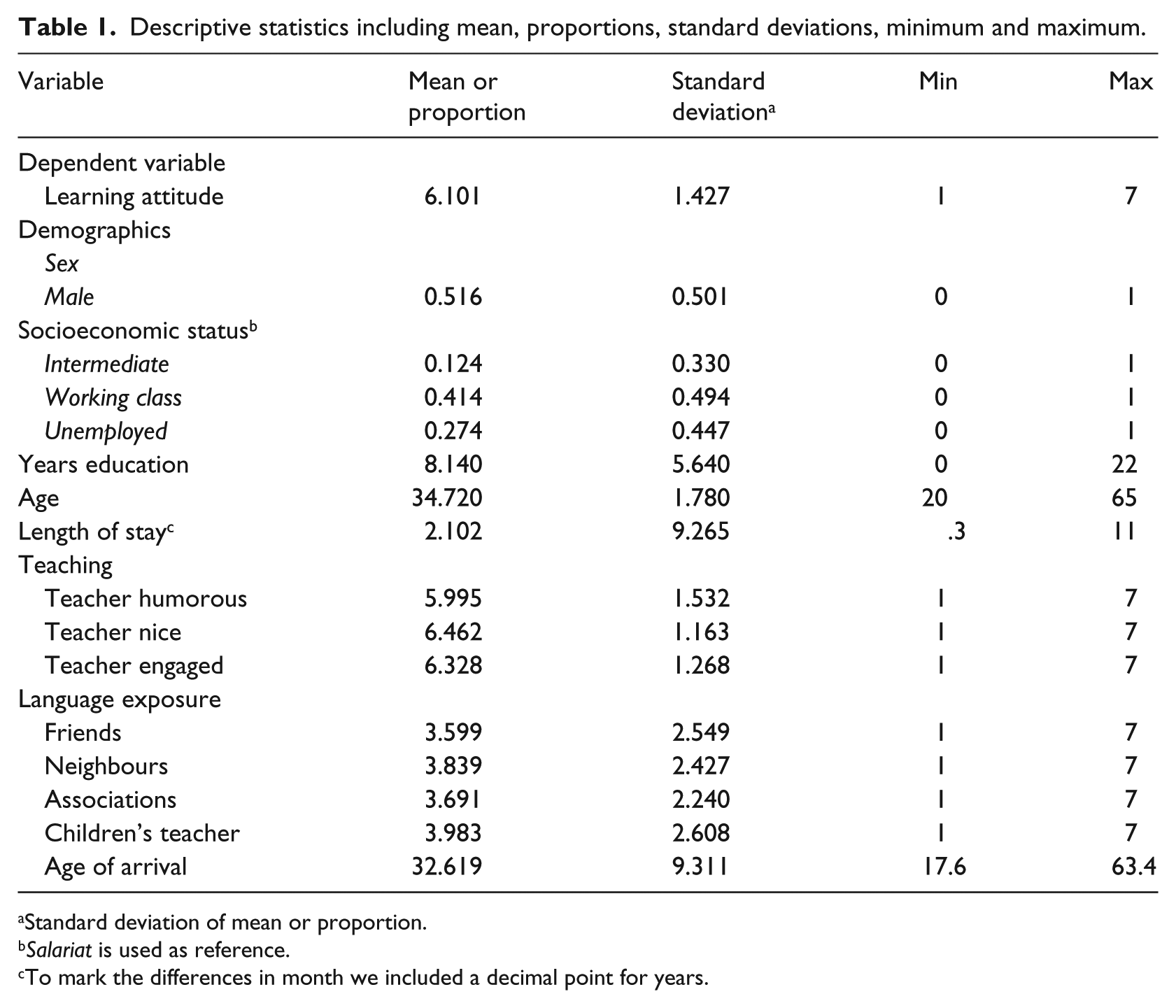
Standard deviation of mean or proportion.
Salariat is used as reference.
To mark the differences in month we included a decimal point for years.
To develop a measure of teacher factor and the exposure to language factor we conducted a factor analysis to validate the measure of our concept. The first factor consisted of four items asking the participants to what extent they got exposure to language with friends, neighbours, in associations or with their children’s teachers: (1) During leisure time, how often do you speak Swedish with your friends? (2) During leisure time, how often do you speak Swedish with your neighbours? (3) During leisure time, how often do you speak Swedish with your children’s teacher? and (4) During leisure time, how often do you speak Swedish when attending association meetings? The second factor consisted of three items asking participants to what extent their teachers were nice, engaged or had a sense of humour: (1) I like to study at the Language training centre since the teacher is nice, (2) I like to study at the Language training centre since the teacher is engaged, and (3) I like to study at the Language training centre since the teacher has a good portion of humour. The survey items were measured on a semantic differential scale ranging from 1 to 7. The differentials were always and never.
Education was measured using the self-reported number of years in education. We used maximum likelihood estimation and varimax rotation. We intentionally avoided using principal component analysis because such a method should be used for dimension reduction and not factor extraction (Pedhazur and Schmelkin, 2013). In Table 2, we present the rotated factor solution of the two factors. The Language Exposure Factor explains 55% and Teacher Factor explains 45% of the common variance. Both factors have Cronbach’s alpha of .80 indicating a further support for the measurement of the factors.
Rotated factor solution.

Rotated factor solution using varimax and maximum likelihood. Blanks represent an absolute loading of < .3).
To make the factors more interpretable, we standardized the factors and computed the z-score and compute the z-score
Results
The first step of the analysis was to compare group differences between females and males and their attitudes to learning. Most students report a high satisfaction with their language learning at the training programme, that is, 6.1 points on average on 7-point scale. Thus, the variable is highly skewed. If we conduct a bootstrapped t test for sex differences, these turn out to be not significant with a low effect size (t = 1.640, N.S., d = .24).
The second step of the analysis was to run a linear regression model. Because our dependent variables were skewed, we used the re-sampling technique of bootstrapping. Bootstrapping takes proportions of the sample and re-samples them for (in our case) 1000 replications. Such procedure counteracts the problem of having non-normally distributed residuals as it approximates a larger sample.
In the first model, we conducted OLS-regression and did enter the sociodemographic variables first to answer our first research question (see Table 3). That is because we wanted to see the effect of the demographic before adding variables that change during the language training. To evaluate the effect size we included both the r-square for the proportional reduction of error. Our first fully specified model yields

There β are the coefficients for the intercept and slope indexed i for individuals with a error term of ε. It turns out both sex and socioeconomic statuses were not statistically significant from zero. The results only confirm our prior analysis showing that although sex and socioeconomic status are theoretically important variables, they are not explaining much of the variance in attitudes towards learning. By contrast, education decreases immigrants’ attitudes towards language learning. For instance, a 20%, 40%, 60% or 80% increase in education would decrease the attitudes towards language learning by.26, .31, .36 and .40 points rounding to two decimals points. As the scale of learning attitudes ranges from 1 to 7, we interpret the effect as present but seemingly small in size. Overall, the model explains only 5% of the variance.
Ordinary least square regression for attitudes towards learning. Demographic and contextual variables used as predictors.
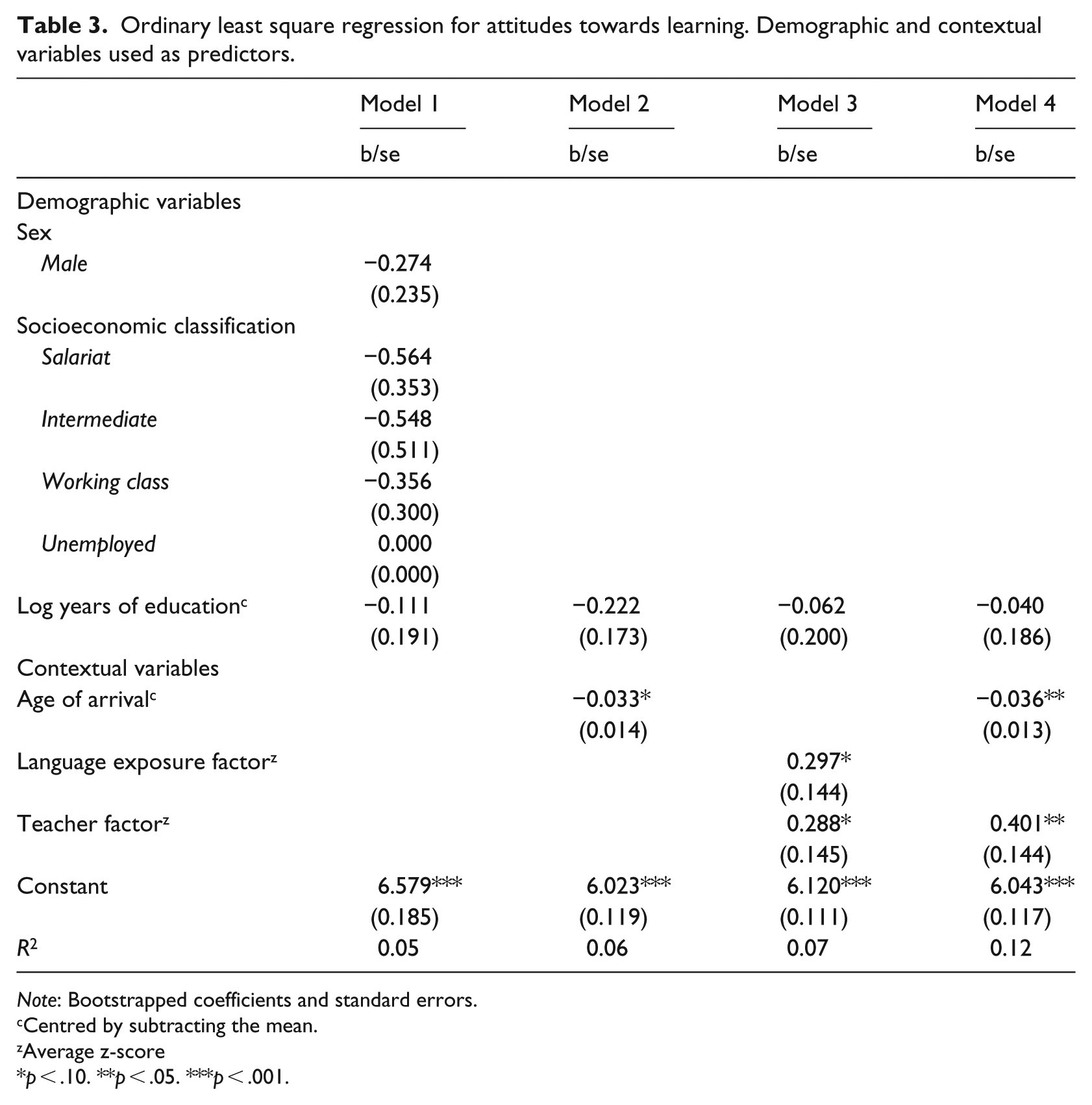
Note: Bootstrapped coefficients and standard errors.
Centred by subtracting the mean.
Average z-score
p < .10. **p < .05. ***p < .001.
In the second model in Table 3, we dropped predictors (variables) that were not statistically significantly different from zero but added age of arrival. Age of arrival have been cited as a critical variable in prior research and was important to answer our second research question

In our model, age of arrival is statistically significant from zero. More specifically, the older you are when you arrive to the new country, the more dissatisfied you are towards language learning. Moreover, the more years you have lived in the host country, the more dissatisfied (negative) towards language learning. The effect cancels out the negative effect of education. However, we do not see the same effect namely that the later age of arrival means a decrease in attitudes towards language learning. The mean age of arrival was 32 years with a standard deviation of 9 years. The minimum age of arrival was around 17 years, whereas the maximum was around 63 years with a range of 46. Consequently, we wanted to know the effect of a 10-year increase. Thus, a 10-year, 20-year, 30-year and 40-year increase in age of arrival would be expected to decrease attitude towards learning by 0.33, 0.66, 0.99 and 1.32, respectively, on the 7-point scale, holding education at its expected value.
In the third model, we added years of education, language exposure and teaching. The third model corresponds to the third and fourth research questions. We did not include age of arrival to avoid problems of co-linearity between age of arrival and language exposure. Co-linearity is fairly logical because the more time you have been in the country, the more opportunities you may have

In the third model, we added back the education variable. But the variable remains not statistically significant from zero. However, exposure to language is statistically significant. Thus, on average a standard deviation increase of 2.45 points would be expected to increase attitudes towards learning by approximately 0.30 points, holding all other values at their expected value. Moreover, we observe that the teacher factor is statistically significant. On average, a standard deviation increase of 1.32 points would be expected to increase attitudes towards learning by approximately .29 points, holding all other values at their expected value. Thus, we can conclude that while prior models have indicated decreasing effects, the third model includes increasing effects.
In the fourth and final model, we dropped the exposure variable and added age of arrival back in. The model corresponds to the second and fourth research questions

We observe that the log of years of education remains not statistically significant from zero. However, both the age of arrival and the teacher factor remains statistically significant. On average a standard deviation increase of 1.32 points in the teacher factor would be expected to increase attitudes towards learning by approximately .40 points. Furthermore, a 10-year, 20-year, 30-year and 40-year increase in age of arrival would be expected to decrease attitudes towards learning by 0.36, 0.72, 1.08 and 1.44, respectively, on the 7-point scale, holding education at its expected value.
The fourth model increased the r-square somewhat to 12% of explained variance in attitudes towards learning. Thus, the fourth model makes the strongest of all the models. But the effect size is still low due to the large error, leaving much unexplained variance left (Table 3).
Conclusion
Currently, the number of immigrants arriving in Europe in general has grown exponentially. To become a citizen in the host country, immigrants need a job. In countries such as Sweden, the path to a job comes from learning the language because Swedish employers tend to favour language skills above other skills such as level of education (Sandwall, 2013; Shaswar, 2014; Zachrisson, 2014). Thus, adult immigrant students are expected to learn the host language by participating in language training programmes. But the effectiveness of these programmes have come to be seriously questioned in the public discourse. Consequently, in the present study, the overall aim was to identify predictors revolving around adult immigrant students’ attitude towards language learning at the training programmes. In our study, we asked four questions:
To what extent do sociodemographic predictors impact attitudes towards language among adult immigrants in language training?
To what extent does age of arrival impact attitudes towards language training among adult immigrants in language training?
To what extent does language exposure factor impact attitudes towards language among adult immigrants in language training?
To what extent does the teacher factor impact attitudes towards language among adult immigrants in language training?
To answer our first research question: We found that neither socioeconomic status nor sex of the adult immigrant student did matter statistically. However, in agreement with prior research, we found that the level of education did matter statistically. The higher the level of education, the more dissatisfied the student becomes with the language learning. One explanation may be that highly educated immigrant students get frustrated because they have earned education credentials in the home country that have no value in the host country. Another explanation may be that the students have high expectations on the pacing and instructional materials of the teaching and feel that the training is progressing too slowly with too small incremental challenges (cf. Adamuti-Trache, 2012).
To answer our second research question: We found that age of arrival did statistically matter for the attitudes towards language learning. The later the age of arrival, the less satisfied the students were with their language learning. One explanation may be that learning a language becomes progressively more difficult as one gets older. Thus, arriving at a late stage of one’s life, the immigrant student may struggle seriously with learning the vocabulary, grammar and comprehension (cf. Chiswick and Miller, 1995; Cummins, 1981). Another explanation may be that arriving at a late age makes it more difficult to get exposure to the host language, as making new friends becomes more difficult with age. For example, imagine making new friends when arriving at age 60 in a country with a language that you have no prior exposure to.
To answer our third research question: We found that exposure to language did matter statistically. The more exposure from friends, neighbours, in associations, or with their children’s teacher the more satisfied the students were with their language training. The result indicates that there are factors that do impact the language learning that are outside of the control of the language training programme. Accordingly, we find support for prior research. The explanation here is that social capital functions to ‘bridge’ contacts between immigrants and the host country. Such contacts outside of school become critical to support the language learning at the training programme as one gets more host language exposure (cf. Adamuti-Trache, 2012; MacIntyre et al., 2001; Yashima et al., 2004).
To answer our fourth research question: We found that the teacher factor did matter statistically. The more engaged, humorous and nice the teachers were the more satisfied the students were with their language learning. Although prior research suggests that teachers’ methods may not be appropriate for the students’ language learning, the teacher may have other important functions. One explanation may be that a teacher who is engaged and has a sense of humour may be important to lighten the mood and increase the morale of the students (cf. Christophersen et al., 2011; Dörnyei, 2003; Elstad et al., 2013; Zachrisson, 2014). As such, the students may use the teacher as a model for their own language learning. As we showed, the effect of the teacher seems to cancel out the negative effect of education. Thus, our results show that teachers can make a difference. At the same time, we acknowledge that there are factors outside of teachers’ control as previously mentioned, such as age of arrival and exposure to host language (Putnam, 2000).
Our study contributes to predicting the attitudes towards language learning among adult immigrant students. Although the efficiency of language programmes has been questioned, we find that the students report a satisfaction with their learning (cf. Shaswar, 2014; Zachrisson, 2014). Learning the language is critical for getting a job. We contribute by showing how predictors may be found both outside of the control of the training programmes, such as level of education, age of arrival and language exposure. In addition, we find that factors that are within the control of the language training programmes matter, such as the teacher’s character.
Footnotes
Declaration of Conflicting Interests
The author(s) declared no potential conflicts of interest with respect to the research, authorship, and/or publication of this article.
Funding
The author(s) received no financial support for the research, authorship and/or publication of this article.