




Abstract
Political education in school is aimed at preparing adolescents for their role as citizens, which comprises political participation as well as political knowledge. While it is generally agreed that basic knowledge about politics is a prerequisite to participation, the specific link between knowledge and participation is left unclear in normative theories of democracy and didactic approaches of political education. A study with 1324 German ninth graders tries to clarify the relationship between the two constructs. The findings show a positive effect from knowledge to the expressed willingness to participate in politics in the future. But against the expectations, already performed political participation does not increase knowledge about politics. Furthermore, girls and pupils with migration background show less knowledge and express less willingness to participate.
Keywords
Rationale and aims of the study
In terms of its overall contribution to school-level education, political education is often considered to promote active citizenship and political participation. ‘Active citizenship has attracted considerable interest from researchers and commentators in recent years’ (Kerr and Cleaver, 2004: 34). Many previous studies have also considered whether knowledge is required for political participation (Delli Carpini and Keeter, 1996; Torney-Purta et al., 2001; Solhaug, 2006; Kerr et al., 2010). Such participation is nevertheless influenced not only by knowledge but also by individuals’ opinions, convictions, self-conceptions and political interests. If participation is the ‘elixir of life for democracy’ (Van Deth, 2014: 350), this confronts political education with the question of the relation between political participation and knowledge acquisition.
In German political education didactics, the importance of politics teaching for political participation has been a subject of discussion since the 1970s. There is therefore an established tradition of regarding political action and knowledge dissemination as a central aim of such teaching. As with all aims, however, this one is tied to a range of normative expectations. On one hand, we have seen the continual revival of the myth of the active citizen. From this perspective, the task of politics classes is to prepare pupils for their role as citizens in a democracy that demands participation from all. At the same time, it is assumed that the decision to take an active part in elections, demonstrations or party-related activities lies solely with each pupil.
Both the political sciences and political education didactics therefore emphasise the importance of knowledge and participation. In doing so, they nonetheless reveal a range of normative expectations. Empirically, the two disciplines tread their own paths. Since a central task of politics lessons in Germany is to facilitate the acquisition of knowledge, the present study focusses on the manner in which such knowledge acquisition is influenced by pupils’ participation experience and their willingness to participate in political activities. The following section thus first delineates the theoretical background to the constructs of ‘participation’ and ‘knowledge’ examined in the study. This theoretical background is formed primarily by the model of political competence developed by Detjen et al. (2012). The third section then describes the current state of research in the area, and derives the questions and hypotheses that are to be investigated in the study. The fourth section discusses the methodology employed, before the fifth section presents our results on the relationship between the above constructs. Here we show whether the assumptions concerning participation in political cultural research and political education didactics are relevant where knowledge acquisition is concerned. Finally, the article closes with a discussion of the results and a consideration of the future outlook.
Theoretical background
In Germany, discussions on competence and knowledge have now been underway for over 10 years. Teacher training for politics teachers is oriented around domain-specific competence models. As an academic discipline, political education didactics is concerned with both the theoretical foundations of the psychological concept of competence and its empirical evaluation. To describe the manner in which school pupils process the political world, political education didactics needs to rely on certain underlying assumptions. The requisite ontological assumptions can be borrowed here from cognitive information processing theory. In the latter, ‘cognitive processes are divided up into individual steps in which an abstract quantity, namely information, is processed’ (Anderson, 2000). Visual and verbal information is represented and processed in the mind, thus giving rise to mental representations. What such theory tells us is that information and experiences come to be increasingly intertwined in structures (or cognitive maps) that are similar in all human brains.
Such goal-directed information processing can be fleshed out via the concept of competence that is manifested and thereby operationalised in the performance of classroom activities. The notion of competence should therefore not be confused with the kind of human qualities considered by pedagogical theory. Competence can be learned (Hartig and Klieme, 2006: 130). It is a context-specific, cognitive performance disposition that is oriented towards the understanding of its own presentation in the relevant teaching material. The tasks involved in politics classes are relatively similar to the situations encountered in real political life. Classroom problems have to be resolved in a context-specific manner, using political terminology. Learning and applying the political terminology required to address domain-specific questions therefore constitutes a key component of school-level political competence.
Political competence (see Figure 1) determines the general cognitive demands that are to be placed on pupils in political education classes. One of the tasks of political education didactics is to establish and introduce political terminology in a manner appropriate for the relevant audience. For the politics classroom, it has elaborated a conceptual space comprises interrelated concepts that can be linked to one another in ever different ways. Ideally, then, the learning process will activate and continually expand these concepts in pupils’ minds.

Model of political competence (Detjen et al., 2012: 15).
On the theoretical model of political competence elaborated by Weißeno et al. (2010) and Detjen et al. (2012), 30 subject concepts expound the knowledge that pupils are expected to acquire in politics lessons (democracy, European actors, European integration, freedom, peace, justice, separation of powers, equality, human rights, interest groups, international relations, conflict, legitimacy, power, mass media, market, human dignity, sustainability, public sphere, public goods, opposition, parliament, parties, constitutional state, government, representation, security, welfare state, state, elections). In addition, numerous constitutive terms are assigned to each of these subject concepts. Altogether, the model lists about 230 terms. What this indicates is that these subject and constitutive concepts do not represent isolated units of knowledge, but rather form a political knowledge net.
Addressee-specific content knowledge plays a key role in linking the different cognitive competence dimensions. In politics classes, pupils have to set out from the insights reached in the political sciences and assess their internal structure and limitations when debating (i.e. displaying a capacity for political action) and making political judgements (Manzel and Weißeno, 2017: 70). Performance in the three cognitive performance dispositions (subject knowledge, political debating and political judgement) are therefore influenced by the fourth dimension of the competence model, attitudes and motivations. The exact extent of this influence is also the object of the present study (Manzel and Weißeno, 2017: 77).
With this link between participation experience and willingness to participate, we begin to touch upon the theory of planned behaviour. The latter assumes that one’s previous experience of participation will influence one’s future willingness to participate (Ajzen, 1991). The theory is based on the idea that human beings are subjectively rational and that they systematically use the information available to them. Nevertheless, this information is not always correct or complete and therefore incorporates individual attitudes about the matter in question. Behaviour, meanwhile, is considered to be determined by behavioural intentions. These include motivational factors that determine how far people are prepared to exert themselves (Ajzen, 1993: 48). Behaviour is exhibited in relation to a goal, in a particular context and at a particular time. The action in question determines the behaviour that will ensue. Research in political sciences often draws on the resource model of political participation (Brady et al., 1995; Verba et al., 1995). Resources here may include income, personal time, education, knowledge, certain skills and social capital.
To describe aspects of the socioeconomic factors at issue here, we can draw on Bourdieu’s (1982) theory of cultural capital that constitutes one aspect of familial cultural praxis. Should parents possess adequate cultural capital, we can assume that they will be in a position to communicate complex political knowledge to their children. A large number of books can be considered an indicator of a supportive familial environment in which education is highly valued.
Where gender-specific differences are concerned, these may variously be explained via socialisation theory or via structural or biological approaches. Socialisation according to gender roles has been seen to disadvantage girls with respect to political knowledge (Vollmar, 2012; for an alternative view, see Goetzmann, 2017). More broadly, there is much to suggest that gender-specific disparities in the educational sphere are primarily the result of socialisation processes. In addition, a more recent psychological treatment (Steele, 1997) has shown that stereotype activation has different consequences for girls and boys. While performance-related stereotypes for girls are negative (a stereotype threat), for boys, they are positive (a stereotype lift). Thus, if girls are expected to perform poorly in political activities, their performance will be worse than in a situation where the stereotype threat is lacking (Ihme and Tausendpfund, 2017: 41).
The current state of research
Where knowledge, political participation, gender and migration background are concerned, we can note the following recent research findings. Studies concerning school-level political knowledge have repeatedly shown that pupils with a migration background tend to know less than other pupils (Goll et al., 2010; Weisseno and Eck, 2012; Weißeno and Eck, 2013; Abs and Hahn-Laudenberg, 2017; Goetzmann, 2017; Hahn-Laudenberg, 2017; Landwehr, 2017). In the present study, we also expect this to be the case. Where gender is concerned, the majority of studies have observed no difference between the political knowledge of boys and girls. Among adults, by contrast, political science studies have repeatedly found the contrary to be the case (Barabas et al., 2014). Here we nonetheless do not expect gender to have any effect on knowledge.
In recent international school assessment studies (Programme for International Student Assessment (PISA), Progress in Reading Literacy Study (PIRLS), Trends in International Mathematics and Science Study (TIMSS)), which have employed far more indicators, it has been shown that pupils’ socioeconomic and cultural milieus exert an influence on their competence development (Baumert and Maaz, 2006; Bonsen et al., 2008).
In Germany in particular, a clear connection has been drawn between social background and disciplinary performance (Oesterreich, 2002; Ehmke and Baumert, 2007; OECD, 2014), which as a result of the pupils’ composition in different classes has led to the ‘cumulative privileging or disadvantaging’ of pupils (Baumert et al., 2006: 97).
While members of older generations and first-generation migrants (who were born outside of Germany) were more strongly connected to their country of origin, the political interests and engagement of younger generations were oriented more strongly towards Germany (cf. Weidacher, 2000). A more recent Dutch study also indicated a lower willingness to participate in political activities among adolescents with a migration background (Skład et al., 2017). In the present study, we therefore expect that pupils with a migration background will have less experience of political participation and will be less willing to participate than their fellow pupils.
In the field of political cultural studies, it is assumed that women seldom participate in political activities and know less about politics due to the gender roles assigned through the socialisation process and the associated stereotype threat (Gabriel, 2013). Studies with school pupils that have controlled for knowledge do not present a consistent picture here (Weißeno and Landwehr, 2017, 2018). Among school pupils, then, the relation between gender and political participation remains an open question. Since the results of studies on adults cannot simply be assumed to hold for adolescents, we assume here that there will be no difference between girls and boys with respect to political participation.
A further open question is whether political participation contributes to the development of school-level political knowledge. Thus far, there has been no empirical proof of this in the school context and at the classroom level (Biedermann, 2006: 386). In a 2017 study with 14-year olds at a German Realschule (comprehensive school), Weißeno and Landwehr found that pupils’ participation experience still had an effect on their willingness to participate after controlling for knowledge. Contrary to their expectations, however, participation experience was not found to have a notable effect on knowledge. Landwehr (2017: 255) found participation to have no effect on political knowledge and knowledge to have a slight effect on willingness to participate among 15- to 16-year olds in German Realschulen and Gymnasialschulen (grammar schools). In a slightly later study by Weißeno and Landwehr (2018: 185), political knowledge was observed to have a far stronger effect on pupils’ willingness to participate. One potential cause of this divergence may be the different ages of the pupils in the two studies.
Formulating the research questions
The study seeks to investigate the nature of the relationship between political participation and knowledge. Our key research questions are therefore Does participation experience have an effect on knowledge? Does knowledge have an effect on pupils’ willingness to participate? In addition, we shall consider how strongly the constructs cohere with one another.
On the basis of the above theoretical assumptions and prior studies on the background variables of gender, migration background and cultural capital, we can now formulate the following study hypotheses:
Political knowledge exerts a positive influence on pupils’ willingness to participate.
Participation experience has a positive effect on pupils’ willingness to participate and their knowledge.
Girls do not know any less about politics than boys and do not exhibit any less participation experience or willingness to participate.
The cultural capital of the family home has a positive effect on knowledge and participation.
A migration background has a negative effect on pupils’ political knowledge and participation.
Methodology
The above subject knowledge and political participation constructs may vary from person to person and could be explored in more detail by drawing finer conceptual distinctions. Our measurements were derived using a cognitive performance test, in combination with a set of items on the other constructs. The validity of the data collection was ensured by separately assessing each of the constructs. This also made it possible to investigate the relationships between them and their individual tendencies and preconditions.
The sample
To answer our research questions, we conducted a written, cross-sectional survey with 1324 ninth-grade pupils from Realschulen in Baden-Württemberg. The pupils were drawn from 25 schools and 63 classes. At the time of the survey, the pupils were aged between 13 and 18 years, with an average age of 14.6 years. The ratio of boys to girls was almost equal, at 51.8% to 48.2%. Measured in terms of the country of birth of the pupils and their parents, just under a third (32.7%) had a migration background.
Instruments
The written survey was conducted using a standardised questionnaire exclusively comprises closed items. To assess pupils’ willingness to participate, we used items from the ICCS 2009 questionnaire (Question 32; Schulz et al., 2011: 189ff), with appropriate modifications for the German context. These items also formed the basis of the ICCS 2016 study (Abs and Hahn-Laudenberg, 2017). The general introductory question was ‘In the following, you will find a number of ways in which adults can take an active part in political life. In your opinion, what do you think you will do when you are an adult?’ Possible answers here included ‘Vote in federal elections’. Pupils were asked to rank the various items on a 4-point Likert-type scale from ‘definitely’ to ‘definitely not’. The items pertaining to participation experience were drawn from the Bund–Länder–Kommission programme entitled ‘Learning and Living Democracy’ (Abs et al., 2007: 53–54). After the introductory question, ‘What have you done so far?’, pupils were presented with a list of participation forms, such as, ‘Joined a political group/organisation’ and asked to respond to these items with Yes or No.
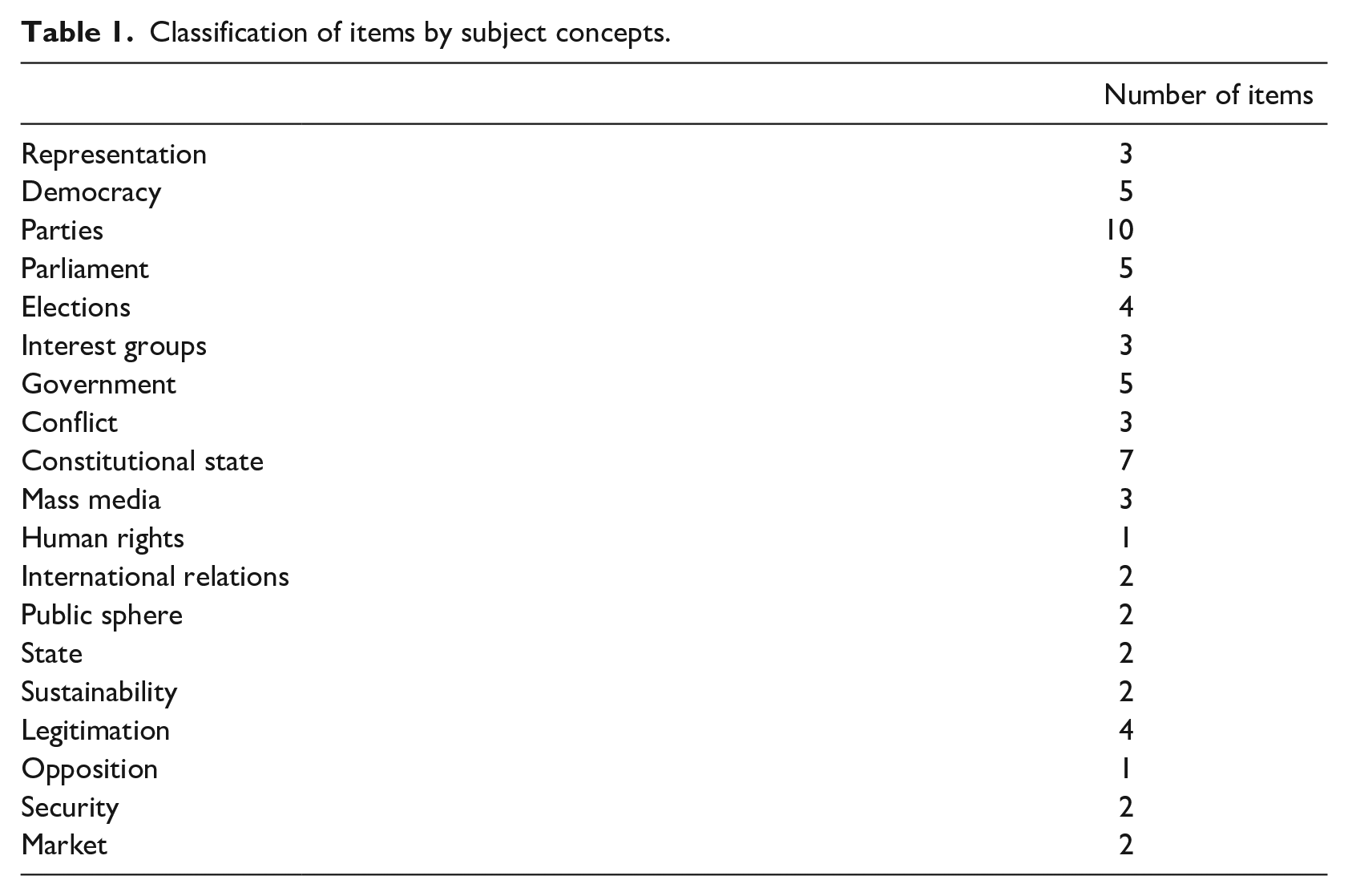
The items pertaining to political knowledge were drawn from other studies, making a pilot study unnecessary. They were compiled from the POWIS study (Goll et al., 2010) and Hahn-Laudenberg (2017). Each item usually contained several subject concepts or several constitutive terms belonging to different subject concepts (see Table 1). Interconnections between the subject concepts thereby came to be established over the course of the test. The table shows that a lot of concepts and constitutive terms are processed into the wording of the items.
Classification of items by subject concepts.
The items were presented as multiple-choice questions with one right answer each time and two distractors. One question on the subject concept of ‘democracy’ asked, for example, Which of the following actions is harmful to democracy? a) when opposing sides argue in the Bundestag, b) when a newspaper criticises the government, c) when the president of the German Farmers’ Union calls for more money for agriculture, or d) when a member of parliament accepts a luxury cruise as a gift from a company?
The validity of the knowledge test was assessed using pupils’ basic cognitive skills and their grades in politics classes, German and mathematics. The cognitive ability test (CAT) measures various aspects of cognitive ability used in school-level learning at different ages (Pauen et al., 2007: 11). In our study, we employed the two sub-scales of the CAT (Heller and Perleth, 2000) dealing with figural analogies (N1 and N2). Together, these total 50 multiple-choice questions. In the present study, we assume there will be a weak to moderate relationship between pupils’ basic cognitive skills and their political knowledge, since these are two different constructs. To confirm the test’s criterion validity, the correlation between pupils’ politics grades and their political knowledge should be negative (due to the coding from 1 (very good) to 6 (unsatisfactory)) and stronger than the correlations with their grades in the other two disciplines.
Pupils’ grades in politics classes, German and mathematics were self-reported. The data on the background variables of gender and migration background were also self-reported and dichotomously coded. The data on the third background variable of cultural capital were gathered using the PISA 2009 question concerning the number of books in the household. Pupils were able to choose from six answer categories (Hertel et al., 2014: 35).
Descriptive analysis
To ensure measurement invariance between the different groups in the sample, the items in our knowledge test were checked for differential item functioning (DIF). When working with knowledge items, it is particularly important to know whether these are equally difficult for different groups. Where item difficulty varies between groups with the same personal abilities, there will be uniform DIF. In such cases, test fairness will be lacking (Embretson and Reise, 2000).
In the present study, DIF was assessed for the traits of gender, migration background and German as the language spoken at home. In ConQuest (Adams et al., 2015), individual models were specified in which the knowledge test as a whole was assumed to be fair and deviations between the difficulty of individual items for different sub-groups were calculated. For all but one of the items, only small deviations were observed in item difficulty between the focal groups (female, having a migration background and speaking a language other than German at home) and the reference groups. Following Jordan (2014: 94), we observed a DIF value of ⩾.50. Item 3 exhibits an estimated deviation of –.256 and thus a DIF value of –.512 for the migration background trait.
To assess the validity of the knowledge test, we calculated the correlations between pupils’ political knowledge and their basic figural cognitive abilities, as well as their school grades in political lessons, German and mathematics. At r = .342*** (*p < .05. **p < .01. ***p < .001), the correlation (r) between political knowledge and basic cognitive abilities (CAT; Rasch-scaled) conformed to our expectations. The moderate correlation with the CAT indicates that the test constitutes a valid assessment of political knowledge. In the field of political education didactics, Richter (2015: 45) reached similar results with year four pupils. Richter’s study observed a manifest correlation of r = .245***. In the field of chemistry didactics, a study by Klos et al. (2008: 312ff.) likewise observed only a moderate correlation of r = .263*** between basic cognitive abilities and natural-scientific working methods, thus indicating that these constructs are empirically separable.
In the present study, a correlation of r = –.252*** was observed between pupils’ grades in politics and their political knowledge. This is comparable with the correlations observed between pupils’ grades and the results in the competence tests in other social sciences (such as history; cf. Trautwein et al., 2017: 107). The Teacher Empowerment to Educate Students to Become Active European Citizens (TEESAEC) study, for example, observed a correlation between political knowledge and pupils’ grades of ρ = –.206*** in the pre-test and ρ = –.225*** in the post-test (Spearman’s Rho; Weißeno and Eck, 2013: 58). In Hahn-Laudenberg’s (2017: 221) study, a similar correlation of r = –.24*** was observed. As expected, the correlations we observed between pupils’ political knowledge and their German and mathematics grades were weaker, at r = –.170*** and r = –.155***, respectively. This external criterion thus provides a further indication of the validity of the political knowledge test.
To assess the validity of the content of the knowledge test, an expert review was conducted. Here, it was essential to ensure the appropriateness of the questions with respect to the school curriculum and thus their reproducibility in all of Germany’s federal states. To this end, they were presented to 16 experts. In light of the significant agreement between the experts consulted, the review process confirmed the curricular validity of the test. The test questions concern appropriate curriculum content.
The pupils’ political knowledge test scores were item response theory (IRT) scaled with ConQuest (Adams et al., 2015) using the dichotomous Rasch model. For a test containing 18 items, its score reliability of weighted likelihood estimates (WLE) PSR = .669 is acceptable (De Ayala, 2009). All 18 items had a discrimination index of ⩾.3, which can be classified as good (OECD, 2014). Overall, the test therefore had a measurement variance of .737. The individual model parameters exhibited good fitness values of .93 ⩽ (weighted) MNSQ ⩾ 1.08 (OECD, 2014). The Wright map in Figure 2 shows that the items are well-balanced with respect to their difficulty. Fitness values were also calculated using a two-parameter model in Mplus (Muthén and Muthén, 1998–2017), and likewise found to be good (χ²(135) 231.194, p = .0, RMSEA = .023, CFI = .941, TLI = .933). To determine individual personal ability (level of knowledge), WLE were calculated and used for the further analysis.
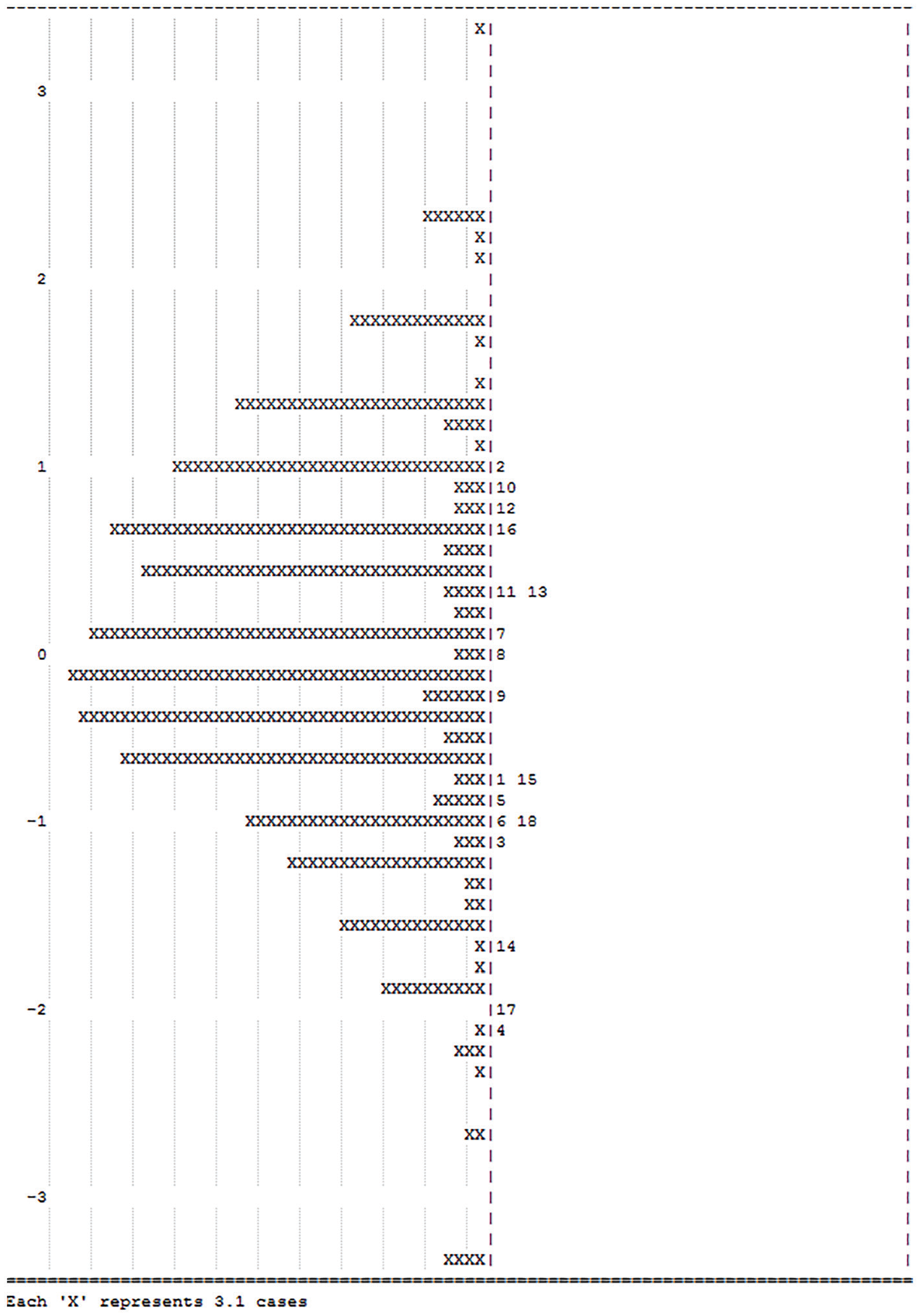
Wright map knowledge test (ConQuest).
Our hypotheses were tested in Mplus using structural equation models. In addition, we controlled for the background variables of gender, migration background and cultural capital. Due to the nesting of pupils in classes, we were confronted with a hierarchical data structure. In the present study, we responded to this problem of a hierarchical data structure by selecting the Mplus analysis option Type = Complex, along with the cluster variables class and the weighted least square mean and variance (WLSMV) estimator.
Results
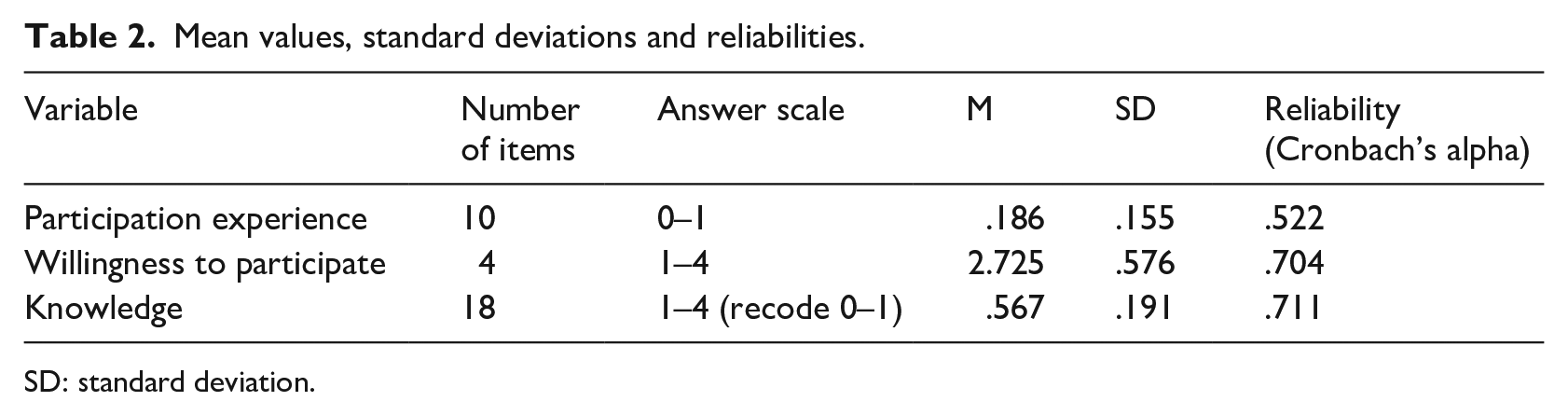
Table 2 presents the descriptive results gathered with our study instruments. Where participation experience is concerned, the low mean of M = .186, with a standard deviation (SD) = .155, shows that the pupils have thus far participated very little in political activities. The percentage of pupils who answered Yes to at least one item on the scale was 80.5%. Girls exhibit a higher level of participation experience, at 85.7%, compared with 75.7% for boys. This is reflected in the mean values of M = .202 for girls and M = .171 for boys. At the level of the individual items, girls prove to have more experience than boys in 8 out of 10 items. Boys are slightly ahead in two items. Performance was less strong on items concerned with specifically political activities than on those concerned with school council activities or social engagement. At α = .522, the reliability of the participation experience scale is not satisfactory. By contrast, the measurement model exhibits very good fitness values of χ²(35) 54.139, p < .05, RMSEA = .02, CFI = .968, TLI = .959.
Mean values, standard deviations and reliabilities.
SD: standard deviation.
Pupils’ willingness to participate is generally positive, with a mean of M = 2.678 and a standard deviation of SD = .625. Reliability is acceptable, at α = .704. The fitness of the measurement model is very good, at χ²(2) 3.647, p > .05, RMSEA = .025, CFI = .999, TLI = .998. On average, 56.7% of the 18 items in the knowledge test were answered correctly, with a standard deviation of SD = .191. The reliability of the scale is acceptable, at α = .711.
The structural equation model shown in exhibits good fitness values of χ²(124) 185.537, p ⩽ .01, RMSEA = .019, CFI = .975, TLI = .970 (see Figure 3).
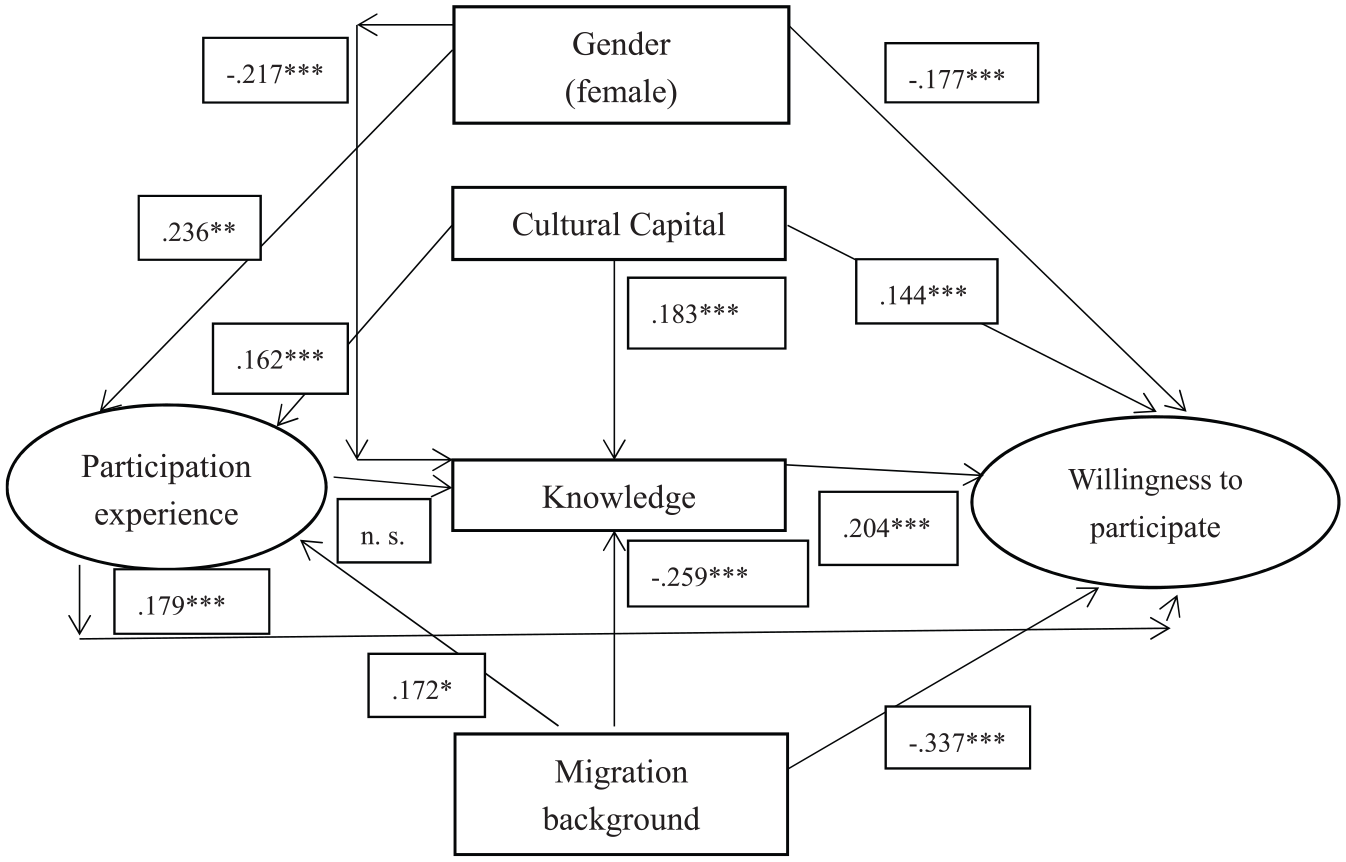
Path analysis of the relationships between political participation, the background variables and political knowledge.
After controlling for political knowledge, participation experience has a positive effect on pupils’ willingness to participate. Contrary to our expectations, participation experience has no influence on political knowledge. Those who are already politically active and thus also wish to participate in future do not thereby have more knowledge than others. Political knowledge has a small positive effect on pupils’ willingness to participate. Those who know more about politics generally also show more willingness to participate.
Where the background variables are concerned, we can observe that girls have less political knowledge than boys and express less willingness to participate in political activities, even though they have more participation experience. Pupils with a migration background tend to have less political knowledge and less willingness to participate than those without a migration background. The small positive effect on participation experience is only significant at a level of α ⩽ .05 and therefore barely susceptible to interpretation. Cultural capital, as measured by the number of books in the family home, has a positive effect on political knowledge and on both of the participation constructs, in accordance with our expectations.
When the structural equation model is run separately for the sub-groups of girls and boys, a more nuanced picture emerges. The effect of participation experience on willingness to participate then proves to be positive for boys only (β = .294***); for girls, there is no significant effect. The effect of political knowledge on willingness to participate is slightly higher for boys (β = .238***) than for girls (β = .163**). It is also interesting to note that the positive effect of migration background on willingness to participate in Figure 3 is now no longer significant for either girls or boys. Furthermore, the effect of migration background on political knowledge differs for the two genders, with a small negative effect for boys (β = –.187*) and a moderate negative effect for girls (β = –.339***). Political knowledge among girls with a migration background is therefore particularly low.
Discussion
In general, the present study has shown that it is possible to meaningfully test political knowledge (as defined by the model of political competence (Detjen et al., 2012)) via 18 test questions. The political vocabulary contained in the model allows for both a nuanced description of political events and a reliable and valid assessment of pupils’ knowledge. The psychometric quality of the items is satisfactory. In future, however, it would be desirable to include a greater number of difficult items, to better represent the higher ability levels. In sum, however, the study represents a successful example of a theory-led and empirically realised assessment of school pupils’ political competence.
As in Weißeno and Landwehr (2018: 186), we might draw here upon Ajzen’s (1991) theory of planned behaviour, according to which past behaviour can be invoked to predict future behaviour. With our girls, however, prior participation was observed to have no significant effect on their future willingness to participate. Prudence is nonetheless required here, insofar as the pupils had little experience of political participation outside the school environment. Furthermore, while participation experience among boys did have an effect on their future willingness to participate, as in previous studies, it did not have an effect on their political knowledge. After controlling for motivational constructs, Landwehr’s (2017: 255) study found that participation experience did not have an effect on either political knowledge or willingness to participate. The effect only remained when modelling exclusively for participation experience with knowledge and willingness to participate.
If pupils’ educational levels are taken as a proxy for knowledge, the resource model of political participation suggests that knowledge should have an effect on willingness to participate (Verba et al., 1995). That the resource model is concerned with educational level rather than knowledge would seem irrelevant here. The hypothesised effect was confirmed in the present study, as in Landwehr (2017) and Oberle and Forstmann (2015: 77f). Where political participation is concerned, however, the rather limited effects observed here suggest that it would be unwise to place great expectations on politics classes, since it remains open how many pupils will later become politically active.
Since participation experience has no effect on pupils’ political knowledge, it should not necessarily be assumed that political participation can help to explain classroom performance at either a theoretical or empirical level. One question that is important to address here is the comparability of the constructs analysed in the relevant studies, since these may operationalise participation experience in different ways. On account of the low number of participants with participation experience in our study, the robustness of the data may also constitute a further limiting effect. The reliability of the scale itself was already not wholly satisfactory. The item set would then seem to leave room for improvement. However, the various studies jointly build up an overall argumentative picture, since they do not diverge with respect to the relationship between participation experience and knowledge.
The question of the influence of gender presents a further interpretative problem. While the majority of studies show that girls have at least as much political knowledge as boys, the present study was unable to confirm this. After controlling for the participation variables, girls were observed to know less than boys (as in Oberle and Forstmann, 2015: 77). The fact that in spite of their lower willingness to participate they nonetheless had more participation experience is surprising, and could indicate the influence of additional motivational characteristics. It would also be important to examine the possibility that, in light of their age, the pupils do not have a fixed attitude about political participation, yet consistently made positive statements about their willingness to participate, in accordance with their teachers’ perceived wishes.
The fact that children with a migration background show less willingness to participate requires further background research. It would be important to know, for example, if they show less willingness because they are not German citizens and are therefore unable to vote in German elections, or for other reasons. What is needed here are indications of the source of their lack of desire and willingness to participate. Pupils with a migration background also performed less well on the knowledge test. The lower scores received by girls with a migration background require particular explanation. In light of the inconsistent research on gender differences to date, this result is surprising and needs to be investigated more thoroughly.
Outlook
Our study suggests that the normative expectations placed on participation in political education didactics are likely too high. Where political participation is concerned, debates in Germany (and elsewhere) tend to be driven by convictions. Our results show that participation in adolescence is not widespread and that the assumptions of political education didactics here cannot be confirmed. On account of a lack of opportunities for political participation, the pupils clearly have not developed any pattern of participation. Thus far, the expectations placed on participation cannot be considered to serve, result from or support the learning process. The specific task of political education thus needs to be refined.
Even though the competence test was successful, this by itself is not sufficient to improve the quality of political education. Where the focus of such education is concerned, time will tell whether there will be a successful implementation of a competence-oriented approach based on the model of political competence. Aside from isolated individual initiatives, such an implementation is not currently on the table. It still lacks acceptance, since the education ministers of the various German states have thus far not prioritised performance comparisons for political education. There is currently no incentive for change. And in the absence of appropriate reforms to education and further education policies, the results of empirical studies will be negligible. This is true even though learning performance in political education classes has thus far been unsatisfactory. This state of affairs can only be remedied in the long term.
