




Abstract
This article synthesizes pedagogical principles for supporting youth climate action from across local (Ontario) and global literature. It also seeks out stories of Indigenous youth engaging in climate action in distinct ways—highlighting examples from Sioux (of Standing Rock) and Inuit youth. The authors propose the Pedagogical Principles for Supporting Climate Action curriculum analysis schema before using it to examine the Ontario citizenship framework. The findings reveal how the curriculum segment in its current form is incongruent with the pedagogical principles of supporting youth climate action. The authors articulate both immediate and urgent curriculum revisions that are necessary for supporting youth in socially just climate action—with a call for immediate revisions that include a shift toward centering Indigenous knowledges, integrating climate justice and upholding relationality to the land and all that it sustains.
Keywords
Introduction and context
In Ontario, Canada, where we are located, teachers across all subject areas are expected to ‘prepare students with the knowledge, skills, perspectives, and practices they need to be environmentally responsible citizens’ (Ontario Ministry of Education, 2009: 6). In this regard, all teachers are environmental educators. Likewise, according to the Ontario curriculum learning expectations, all Social Studies and Canadian and World Studies (this includes Politics/Civics, Geography, History, Economics, and Law) teachers are citizenship educators (Ontario Ministry of Education, 2018), with citizenship education being upheld as ‘an important facet of students’ overall education’ (Ontario Ministry of Education, 2018: 9). It is a pressing responsibility to be an environmental and citizenship educator at a time when the unprecedented consequences of human actions are evident in Earth’s geological record (McCarthy et al., 2023), and climate change is ubiquitous (McGregor et al., 2024). What this article brings to the fore is that teachers are asked to confront climate crisis as environmental and citizenship educators; we cannot ignore the centrality of climate and the call for action. Therefore, teachers require multiple supports—among them are lesson ideas, strategies for handling eco-anxiety, and administrative support for teaching outside as they engage with the ‘super wicked problem’ that is climate crisis (Levin et al., 2012: 124). And, many teachers are still learners themselves in the area of environmental education, as they are with climate crisis education, which is conceptualized by some as a worthy separate discipline in itself (Eilam, 2022).
Another reason environmental and citizenship education are bound together (Kissling et al., 2018), is that our response to climate crisis must involve an intersecting range of socio-political actions—climate action—in multiple spheres of influence (family, neighborhood, community, sub-national, national, international). Research that identifies effective pedagogical principles for supporting climate action, and clarity surrounding how these principles map onto the current curriculum—in this case, Ontario’s—is urgently needed (Alvey, 2020). In this article, we present a set of pedagogical principles for supporting climate action in schools and propose a schema for analyzing citizenship education curricula. We demonstrate the application of our schema by analyzing the Ontario Citizenship Education Framework and its frontmatter (Ontario Ministry of Education, 2018: 10). This allows us to consider to what extent this curricular guideline offers openings and supports, or what we are calling ‘touchpoints’, for learning outcomes related to climate action.
Our premise is that while curriculum reform—a potentially longer-term project—is important, we must also work within the current system in the short-term. Thus, we ask, how can Ontario teachers better leverage existing curriculum to prepare learners for the contexts and opportunities they now encounter, and can become part of, as members of various communities navigating environmental and climate uncertainty? Field et al. (2023) point out that Ontario includes 60 climate change-related curriculum expectations in Social Studies courses across the grade levels, in comparison to 42 expectations in the sciences. This is a greater proportion of expectations found in Social Studies than found in many other Canadian jurisdictions. Yet, determining how to leverage these expectations for both citizenship and climate action outcomes remains the duty of educators who are left to navigate the crisis with few sporadic supports, as Ontario’s track record with implementing environmental education demonstrates (Pedretti et al., 2012; Tan and Pedretti, 2010). As Field et al. (2023) argue, ‘there is a need for policy directives to guide school boards and schools on responding to the climate crisis and specifically addressing how climate change education should be integrated into teaching through providing frameworks’ (p. 169).
Due to a scarcity of literature at the intersection of citizenship education and the climate action dimension of environmental education here in Ontario, or across Canada, we have turned to the field of global citizenship education, where the call for immediate and drastic changes to education is loud and clear (Pashby et al., 2021). For example, Khoo and Jorgensen’s (2021) article responds to Pashby et al.’s (2021) invitation for critical conversations at the intersection of global citizenship education and education for sustainable development, in order to gesture beyond current practice. They suggest the fields of global citizenship education and education for sustainable development, ‘may need to transgress the individualism and separateness implied by the autonomous space of liberal education and to begin to engage with different, action-oriented and collective subjectivities’ (Khoo and Jorgensen, 2021: 472). Instead, Khoo and Jorgensen (2021) emphasize the need for collaborative education and knowledge creation in situated contexts, valuing alternative forms of education that challenge assumptions about who or what is an educator, what constitutes an educational setting, and what contributes to decolonial practice. Alternative, here, refers to ways of educating that honor and strive to uphold holistic ways of being, decentering prominent neo-liberal enactments of education that are economy-driven, focused on human exceptionalism, and over-emphasize individualism (Hyslop-Margison and Sears, 2006; Kwauk and Casey, 2022). We bring this call to our context in Ontario, where we consider how existing curriculum supports climate action, and at the same time honors alternative ways of knowing, being, and relating. We believe that citizenship education has the potential—and the responsibility—to encourage climate action using approaches that uphold different ways of living on the planet, honor wisdom from Indigenous peoples (and other historically marginalized groups), who have been engaging in climate action for decades, long before the global North has paid attention (Khoo and Jorgensen, 2021).
We write from the overlapping traditional territories of the Huron-Wendat, Anishinaabe and Haudenosaunee nations. We acknowledge that many Indigenous peoples have lived, and continue to live, in ways that honor relationships with the natural world and that are centered on environmental sustainability, holism, and place-based knowledge systems (Makondo and Thomas, 2018). Whyte (2020) reminds us that Anishinaabe peoples carry stories of extreme weather, environmental change, migration across ecosystems, and humans’ influence on regions through fire, trade, and other collective action, and that these stories embody a philosophy centered on the most essential aspect of climate action—relationality. Existing citizenship literature omits the storied wisdom that Whyte ascribes to the Anishinaabe peoples, along with wisdom held by other Indigenous groups who have been active in discussions on climate change and injustice since at least the 1990s (Whyte, 2020). And, as our ensuing analysis points out, the Ontario citizenship framework itself disregards Indigenous knowledge systems, their experiences living in relation with the land, and their perspectives on citizenship, which are underrepresented or completely absent (Menzies et al., 2022; Sabzalian, 2019). To move toward addressing this underrepresentation in our methodology, we deliberately sought scholarship that highlights ways that Indigenous youth engage as citizens in climate action. We focus on two storylines in particular—a young land defender of Standing Rock leading a protest against a pipeline, and Inuit youth’s adaptive responses to accelerated changes in climate conditions—to provide snapshots of the distinct ways Indigenous youth engage in climate action. These stories and perspectives drawn from the literature inform our analysis schema.
Conceptions of citizenship
The dominant conception of citizenship upheld in Ontario’s curriculum affects the extent to which it can better facilitate climate action pathways. Many ideological layers frame citizenship curriculum (Broom and Evans, 2015), and the notion of good citizenship remains a contested topic (Broom, 2020; Davis and Startup, 2021; Sears and Hughes, 1996). The predominant political and ideological meaning of citizenship in Ontario curriculum, consistent over the last 20 years, is individualistic (Butler and Milley, 2020). Kennelly and Llewellyn’s (2009) study on language in civic learning texts, including Ontario’s civics curriculum, revealed neoliberal conceptions of citizenship, wherein the ideal citizen is an active, law-abiding person who makes individualized choices. Similar ideologies are found across the global education community as well (Khoo and Jorgensen, 2021; Kwauk and Casey, 2022). An education rooted in neoliberal, capitalist, and patriarchal values ‘posits learners as separate from the non-human world, and positions them to go on to control, dominate, and exploit that world as adults’ (Kwauk and Casey, 2022: 10). Conceptions of citizenship that extend from these ideologies may be incongruent with ecologically and socially-informed climate action. A socially just climate action might promote values such as communal being, belonging, listening, connectivity, and awareness of metaphysical relations, among other things. Forms of Indigenous citizenship and nationhood that vary from settler colonial forms would be present, rather than being left out of citizenship education as they often are (Castro and Knowles, 2017; Sabzalian and Shear, 2018). Recognizing these significant limitations of the Ontario Citizenship Education Framework as it stands, we turn to literature on supporting youth climate action to identify what can be done under the current curricular conditions.
Literature review
Literature search strategy
We reviewed literature on what motivates and increases youth engagement in taking climate action. In the literature review and pedagogical principles sections of the paper, we use the term youth to refer to the learning audience, as most literature in climate action uses this term, given it is frequently focused in spaces beyond the school setting. For the curriculum analysis, we shift to using the term students to reflect the language used in the curriculum and to denote the teacher-student relationship. We are not suggesting that youth are the only humans who need to be taking climate action, but because teachers are generally concerned with youth, we use it to narrow our focus. Through this emphasis we are not absolving older generations for their responsibility to participate in climate action. We limited our search to literature published between 2017 and 2023 to ensure that the articles reflected the culture and attitudes of current youth. Youth climate action is a quickly evolving research area, so we kept our timeframe narrow and recent. Our literature review responded to the question, what does the empirical and theoretical literature in education research say about how to encourage youth to participate in climate action? We conducted an electronic search of the literature published using Education Source, Academic Search Complete, and OMNI (our local academic search platform). When searching for articles, we used variations and truncations of the following keywords: climate activism (climate action, environmental activism, climate change, and climate strike), youth (adolescence, student, teen, young people, children), participation (engagement, agency, mobilization, role, contribution, voice, involvement), and school (citizenship education, civic education, social studies, curriculum, education, pedagogy, k-12). To expand further, we purposefully searched Environmental Education Research and Journal of Sustainability Education because of their specific focus on the educational context and to ensure that we collected any relevant work in at least two of the top journals that appeared in our initial search results. We then reviewed the articles, selecting those that held a connection to action in response to the climate crisis. For example, we eliminated articles that discussed perspectives on the importance of nature, unless they were connected to climate action. We also excluded articles that related to young children (e.g. preschool age) but included articles that focused on the undergraduate level. Although we are looking for the confluence of climate action and citizenship education, in the review that follows we are frequently referring to ‘Environmental Education (EE)’ as the context of our focus for consistency’s sake, and because EE is the umbrella term that has usually housed climate crisis education in curriculum, school subjects, and research, to date.
Our initial search identified 132 articles. We used forward snowballing to search references of literature that we collected for relevant articles (Wohlin, 2014). Overall, we included 41 peer reviewed journal articles that were relevant to encouraging youth participation in climate action. We then deliberately searched for scholarship featuring Indigenous perspectives in youth climate action, given the limited literature that was captured in our initial search. To do so, we extended the time frame of the literature review for Indigenous perspectives back 5 years to 2012, and considered other source types (e.g. magazine articles). We also adjusted the search terms to include, for example, land defender and water defender which are terms increasingly used by Indigenous environmental activists in North America and beyond. From the review, we used an inductive approach to elicit the major themes: a need for new and radical modes of education; increased momentum in youth-led activism; the critical intersection of climate justice and social justice; the presence of both teachers’ and learners’ complex emotions about climate crisis; and, different orientations to knowledge that influence how teachers and learners talk about climate crisis and define their response. We drew on the supporting literature to offer thematic synthesis. We then examined these themes to glean pedagogical principles that may better contribute to encouraging youth climate action.
Theme in the literature 1: New and radical modes of education for climate action
Many EE scholars urge urgent action in response to climate crisis and agree that education can play a significant role in supporting impactful responses (Catanzaro and Collin, 2023). Yet, Kwauk and Casey (2022) state, ‘it’s not just any kind of education that we should be aiming for, but rather a certain kind that rejects human exceptionalism and the dominant development paradigm of unfettered growth’ (p. 11). Kwauk and Casey (2022) point out that much of EE is ‘individualistic, one-directional, and transmissive rather than collective, interactive, and transformative’ (p. 12). There is growing awareness that current approaches to EE (e.g. emphasizing individual actions, prioritizing knowledge acquisition, conceiving of climate crisis as a standalone issue) are insufficient for encouraging participation in climate action and instead perpetuate the status quo (Fagan, 2017; Khoo and Jorgensen, 2021; Rousell and Cutter-Mackenzie-Knowles, 2019). Approaches that normalize living in climate crisis undermine efforts to encourage youth to take urgent and united action (Kessler, 2021; Luís et al., 2018; Patki, 2018; Stevenson et al., 2018, 2019).
Rousell and Cutter-Mackenzie-Knowles’s (2019) systematic review of EE literature in an international context revealed that the prominent ways of educating youth about climate change remain ‘top-down’ and science-focused across formal educational spaces (p. 202). Because EE is predominately embedded in science curricula, important political, social, cultural, and economic interrelated issues are left unexamined (Karsgaard and Davidson, 2023). Rousell and Cutter-Mackenzie-Knowles’s (2019) call for the development of new modes of EE ‘open to radical and visionary alternatives for the future’ (p. 203). They advocate for EE that centers activism, social and political intervention, and citizen science, recognizing the significant potential contributions of youth to climate action.
Pedagogical principle 1: View youth as both educators and learners
We have distilled the theme of new and radical modes of education from the literature into the pedagogical principle: view youth as both educators and learners. This moves away from top-down teaching that emphasizes knowledge transmission, where adults and experts are authorities over learning. Instead, youth-centered approaches encourage youth to share their knowledge, while also seeking it from different knowledges sources, to include teachers, local community members, and activists (Bowman and Germaine, 2022; Karsgaard and Davidson, 2023; Pickering et al., 2022). Educators can encourage knowledge seeking and sharing through activities such as posting on social media platforms, creating and displaying artistic expressions, or presenting at youth-led conferences. By acknowledging their multi-faceted roles as educators and learners, youth are actively engaged in climate communication and may experience educators and other community leaders as their allies (Pihkala, 2020).
Theme in the literature 2: An increase in youth-led activism for climate and social justice
The literature promotes a view of youth as active citizens who are contributing, and capable, change agents. In the absence of satisfactory and proportionate political responses to climate change, youth-led activism has been on the rise since 2018 (Catanzaro and Collin, 2023; Karsgaard and Davidson, 2023). Youth climate activists call attention to the absurdity of learning skills in school that will be useless on a planet that is destined for ecological demise (Kwauk and Casey, 2022). Greta Thunberg’s School Strikes 4 Climate movement embodies political action in response to the climate crisis (Haugestad et al., 2021; Sabherwal et al., 2021). Her calls to action, and those of activists such as Xiye Bastida, Vic Barrett, and Leah Namugerwe, for example, continue to shape the growing global movement—expanding to an estimated 14 million protestors, with strikes still ongoing today (Catanzaro and Collin, 2023). Although Thunberg’s direct action is often credited as the impetus for young peoples’ global movement against climate change, her protests extend from a legacy of activism around the world. The legacy includes long standing efforts by young people in the global South, including Indigenous activists calling out environmental harm that continues through colonial and capitalist systems (Curnow and Helferty, 2018; Gilliam, 2021; Nissen et al., 2021).
The literature documents that youth strikes serve to imagine a better society (Bowman and Germaine, 2022) and take leadership and initiative with respect to climate action (Holdsworth, 2019). Young climate justice activists across the globe are raising awareness of the heightened effect of climate crisis on racialized communities, pointing out how social justice and climate change are inseparable social, political, and economic issues (Flanagan et al., 2021). These diverse activists highlight that climate crisis and social inequality are caused by the same driving force—colonial violence and domination (Barrett, 2019; Mackay et al., 2020; earthday.org, 2019; Sterling, 2019). The activists make visible that the communities most vulnerable to climate crisis are not those who were, or are, most complicit in causing it (Kluttz and Walter, 2018; O’Brien et al., 2018). Their activism is often intergenerational, supported by their families and integrated within their communities, revealing the collective quality of meaningful climate action (Mackay et al., 2020). Other forms of youth activism include letter writing campaigns (Zummo et al., 2020), building social media communities (Wielk and Standlee, 2021), signing petitions (Mohd Hed and Grasso, 2020), and boycotting products (Ting and Wan Ahmad, 2022). When engaging as activists, youth move beyond learning about civic life—and instead engage in it, calling out systemic injustices (Holdsworth, 2019; Karsgaard and Davidson, 2023). A study conducted by Haugestad et al. (2021) examining the motivations behind youth participation in climate strikes found that a sense of responsibility and shared sense of collective identity were elements that encouraged participation in climate action. The study found that young peoples’ decisions to participate in the School Strikes were most often influenced by their politicized social identity, perceptions of environmental threat, and a sense of shared responsibility, which was expressed as collective guilt.
Pedagogical principle 2: Integrate climate justice
From the second theme in the literature, youth activists taking meaningful action, we distilled two pedagogical principles: integrate climate justice across all EE topics (discussed here); and, emphasize collective action (see next paragraph). Climate activists, especially those from racialized communities, point to the inseparability of social justice and climate action. More specifically, as outlined in Bartlett et al.’s (2022) study regarding undergraduate students’ self-efficacy in climate action, it is recommended that teachers draw on a climate justice frame that integrates awareness of how climate change disproportionately impacts poor, vulnerable, and racialized peoples, and calls for equitable solutions. The authors also advocate for expanding youth’s empathy and social responsibility to encourage engagement, as well as providing authentic opportunities for young people to participate in climate justice action with the broader community. Responding to climate change simultaneously requires social reform, reflection on positionality, and questioning of values embedded in power structures that drive inequality and cause environmental harm (Do Thi and Dombroski, 2022).
Pedagogical principle 3: emphasize collective action
Several scholars advocate for explicitly addressing the role of collective action in formal curriculum (Fagan, 2017; Jorgenson et al., 2019). Emphasizing individualistic responses to climate change, such as recycling, plastic use, or diet choices, overlooks the capacity of youth to take action in unison with others for significant change (Fagan, 2017; Karsgaard and Davidson, 2023; Khoo and Jorgensen, 2021). Explicitly discussing collective action in the classroom builds on youth’s current work and showcases how it can be used as a powerful force in climate action.
Theme in the literature 3: Presence of complex emotions
Increasingly, research emphasizes the importance of tending to the affective dimensions when engaging in climate education (Rooney-Varga et al., 2018; Siegner and Stapert, 2020). Karsgaard and Davidson’s (2023) study with 99 international youth from 13 different countries demonstrates that educators need to provide space for youth to process their emotional responses to climate change. Their participants expressed many emotions, such as fear, grief, and hope when discussing climate change, with shame and despair being among the emotions most frequently named. The authors noted that positive reappraisal—that is, acknowledging the seriousness of the situation while cultivating hope—was one way to encourage adaptive responses to climate change. This point is echoed by others (Pihkala, 2020; Zummo et al., 2020). Akiva et al. (2017) suggest that educators create environments where heightened feelings of belonging, competence, connectedness, mattering, and well-being are deliberately fostered, given these elements can help build confidence necessary for acting. Pihkala (2020) goes further by encouraging educators to not only develop organizational and peer supports to help students experience the complex emotions associated with climate crisis, but also to tend to and process their own. Teachers and learners benefit from supportive environments where emotions can be discussed and deliberated through creative activities (Pihkala, 2020). Nairn (2019) identifies several conditions that help young activists cultivate hope: emphasizing that climate change is a collective problem; becoming part of the collective action, developing connections with the global movement; and, engaging in conversations about climate change on a regular basis. Holistic EE that acknowledges complex emotions should offer time for reflection that invites an examination of positionality, context, emotions, and experience (Karsgaard and Davidson, 2023).
Pedagogical principle 4: Tend to affective dimensions
Recognizing the presence of distress, worry, and concern (Ramadan et al., 2023) in climate change education, tending to the emotional landscape of both teachers and learners is an essential pedagogical principle (Pihkala, 2020; Verlie et al., 2021). Students and teachers require proactive and responsive space, tools, and supports, to process their multiple complex emotions. When emotions like despair and anger are acknowledged and tended to, they can lead to adaptive responses to climate change including climate action. Conversely, when they are repressed or ignored, they can lead to inaction or denial—and can exacerbate other daily stressors that affect wellbeing and quality of life (Reyes et al., 2021).
Theme in the literature 4: Orientations to knowledge
Monroe et al.’s (2019) review of literature on climate change education revealed that it is important for young people to be equipped with knowledge that is both relevant to their lives and meaningful (Zummo et al., 2020). Similarly, Kessler’s (2021) study concluded that concern for climate change and readiness to act was heightened when young people had increased civic knowledge coupled with a sense of trust in their schools. Whereas research has focused on youth content knowledge surrounding climate change (Busch et al., 2019; Monroe et al., 2019), it does not necessarily hold that knowledge is required for action, nor that knowledge will necessarily lead to climate action (Bartlett et al., 2022; Mackay et al., 2020).
Neo-liberal and colonial approaches to EE may posit education as a process where youth acquire environmental or scientific knowledge and tools to equip them for the future, to the exclusion of their capacities in the present (Bowman and Germaine, 2022; Wynes and Nicholas, 2017). Other EE scholars advocate for pedagogies that draw on many ways of teaching about climate crisis, including weaving key issues with ‘narratives of hope and opportunity’ (Mackay et al., 2020: 2), introducing trusted messengers on climate crisis (Rooney-Varga et al., 2018), and engaging in experiential and place-based learning (Bartlett et al., 2022; Mackay et al., 2020). Research calls for communicating with trusted community members, developing closer relations with local ecosystems, and experiential learning on the land.
Pedagogical principle 5: Situate learning within the community
Young people are encouraged to act when they experience learning that draws on wisdom from trusted people, and develop relationships with the ecosystems to which they belong. When students participate in collaborative learning that includes engagement with the broader community as well as participatory knowledge production, they are integrated in problem solving and develop a sense of belonging (Field, 2017; Mackay et al., 2020). Krasny and DuBois (2019) propose community-based learning that connects the environmental and social components of climate mitigation to motivate and encourage climate action.
Theme in the literature 5: Indigenous youth action
Scholarship regarding Indigenous youth environmental and climate action emphasizes the significance of young people acting in connection with their family and community for greater impact (Mackay et al., 2020). Some consider activism as a way of life, as they continue to face and counteract oppression (Spinner-Halev, 2012). Examples of Indigenous young peoples’ activism include participation in protest walks, such as in the walk to resist a nuclear waste storage facility in Northern Saskatchewan communities (Briarpatch, 2012), or Autumn Peltier’s fight for clean drinking water in Wiikwemkoong First Nation in Ontario (CBC Kids News, 2020). We delve into two additional examples here to demonstrate the range of Indigenous youth contributions to environmental and climate action: the Oceti Sakowing water defenders and Inuit responses to accelerated climate change.
Weston (2017), of Standing Rock Sioux, tells the story of how the young people of Standing Rock, Cheyenne River, and their sister Tribes among the Oceti Sakowin (Seven Council Fires) protested the Dakota Access Pipeline, which posed a great threat to drinking water in their communities. Weston (2017) explains that young people were defending lands where ‘innumerable generations of our ancestors have been born along our rivers and the delicate network of watersheds veining the vast prairie expanses of our homelands’ (p. 1). For Bobbi Jean Three Legs from Wakpala, the young person who organized the ‘Run for Your Life’ protest, her motivation to protect drinking water was rooted in the land itself. To support her activism, an uncle organized a powwow and blanket ceremony to raise funds so that Bobbi could hold her run, telling her ‘Just go. Let the people know what’s happening, and they’ll join you. They’ll come to support us’ (Weston, 2017: 1). The young people and their families continue to fight to preserve clean water for present and future generations. This vignette reveals the people of Standing Rock and Seven Council Fires’ communal movement to defend the environment, for which they feel deeply responsible, and highlights the efforts of young people from multiple Indigenous nations in taking collective action.
Young people from Northern Inuit communities also engage in climate action, but of a different sort, in contexts experiencing more rapid changes in climate conditions that have many direct implications (Downing and Cuerrier, 2011; MacDonald et al., 2015). These changes include variance in migration patterns of species, changes in ice patterns, and other environmental changes (Tam et al., 2013). In a qualitative study involving youth across five coastal communities in Nunatsiavut, Inuit youth shared how they act in response to these climate changes to protect their mental health and wellbeing. Their responses to climate change included: deliberately being on the land; connecting to Inuit culture; upholding strong communities; and, being in relationships with family and friends (MacDonald et al., 2015). For Inuit youth, climate uncertainty calls for an inward turn toward care and paying attention to the land, strengthening culture, community, and relationships. This study reveals a different way of taking meaningful action in climate crisis that may not appear like political action or mitigation efforts seen elsewhere, but nevertheless contribute to youth adaptation strategies and quality of life.
Pedagogical principle 6: Invite Indigenous perspectives & knowledges
From these stories, we distil the pedagogical principle of inviting Indigenous perspectives and knowledges into citizenship education and climate action. The two examples highlight some ways Indigenous peoples have engaged, and continue to engage, in environmental protection and climate action. Together, they reveal deep connections to the land, water, ice, and to the ancestors who lived in those homelands since time immemorial (Kress and Horn-Miller, 2023). While there is no singular Indigenous way of relating to the land (Tuck et al., 2014), a common thread for many Indigenous communities is that ‘[r]elationships to land are familial, intimate, intergenerational, and instructive’ (p. 10). Making space for Indigenous knowledges and perspectives in learning opportunities means teachers respectfully inviting community-recognized knowledge holders, Elders, and guest speakers to class, or taking their class out on the land. Teachers can also seek to supplement their learning materials with credible, Indigenous-authored texts, films, forms of art, or other sources. The goal is to facilitate local ecological knowledge sharing, collaborative and decolonizing environmental protection, and climate action responsive to Indigenous stewardship and sovereignty (Kress and Horn-Miller, 2023).
Curriculum analysis
Guiding questions
Following our review of the literature and corresponding synthesis of pedagogical principles for climate action, we developed guiding questions to use in the examination of the Ontario Citizenship Education Framework. Each of the six pedagogical principles led to one analysis question (see Table 1), which forms the Pedagogical Principles Curriculum Analysis Schema. Each question varies slightly from the principle to operationalize it in our analysis. We needed to first understand if and how the curriculum represents a principle or concept within it, and then examine how the curriculum allows for and/or constrains that principle, or sub-concept. The structure of these questions is informed by Critical Discourse Analysis (CDA), meaning we worded the questions in ways that would help illuminate power relations embedded in the curriculum discourse (Kennelly and Llewellyn, 2009). The structure of the questions demonstrates the analytic complexity, whereas the principles are intended to be simpler to grasp at a glance.
Pedagogical principles curriculum analysis schema.
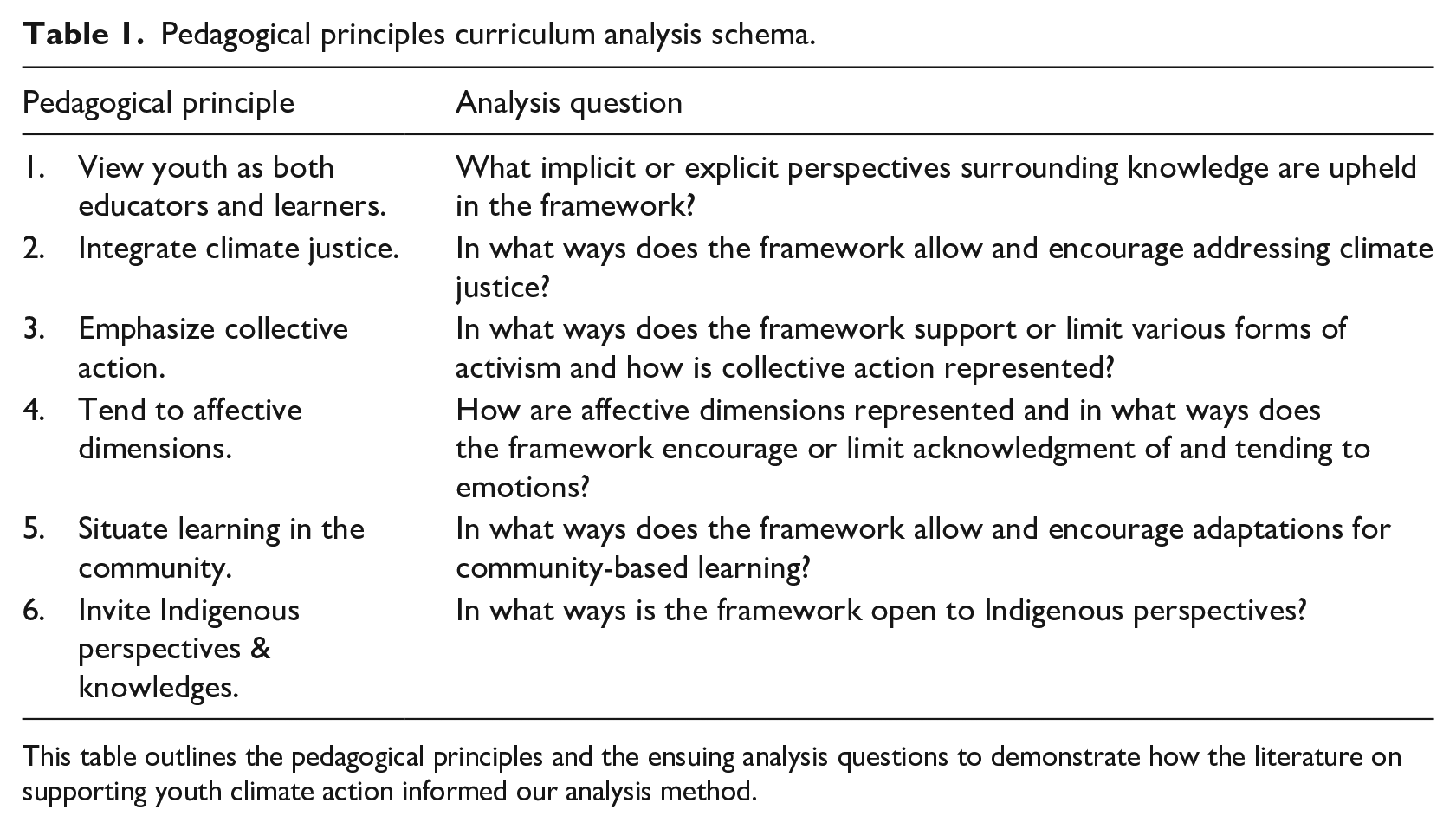
This table outlines the pedagogical principles and the ensuing analysis questions to demonstrate how the literature on supporting youth climate action informed our analysis method.
The Ontario citizenship education framework
We analyzed both the citizenship education frontmatter (approximately 350 words) and the Citizenship Education Framework, which we refer to together as the ‘curriculum segment’ (Ontario Ministry of Education, 2018). The frontmatter narrates the organization of the diagram (Figure 1) and explains that students learn about what it means to be an active, responsible citizen in the classroom and community and that education provides ‘ways in which young people are prepared and consequently ready and able to undertake their roles as citizens’ (Fraillon and Schulz, 2008 as cited in Ontario Ministry of Education, 2018: 9).

Ontario citizenship education framework. The above image is of ‘The Citizenship Education Framework’, reproduced from Ontario Curriculum, Grades 9 and 10: Canadian World Studies (2018). © King’s Printer for Ontario. Reproduced with permission. The Ontario Citizenship Education Framework is found in the Ontario Social Studies curriculum for grades 1–6, the History and Geography curriculum for grades 7 and 8, and the Canadian World Studies (Geography, History, and Civics) curriculum for grades 9 and 10.
Methodology
Our analysis followed Inquiry-Based Curriculum (IBC) method, drawing on aspects of Critical Discourse Analysis (CDA) to develop the analytic questions and to determine in what ways the segment is commensurate or incongruent with the pedagogical principles devised from the literature. Our analysis encompassed four main steps: (1) deriving our inquiry questions from each pedagogical principle culled from the literature (discussed in the previous section); (2) analyzing the curriculum segment to find evidence of the concept (direct, indirect, or related); (3) making a judgment on what degree of evidence was present; and (4) formulating conclusions. The first author functioned as the lead analyzer, and the second author served as the reviewer, ensuring the analysis was thorough and rigorous, and reviewing the claims made in the initial analysis.
Findings
The findings indicate that the curriculum segment is generally incommensurate with the pedagogical principles for supporting climate action. This judgment, in the case of each principle, was made by the first author and reviewed by the second author. Principles were labeled ‘no evidence’ if no direct, indirect, or related concepts could be found or interpreted in the segment. Principles were labeled ‘limited’ if indirect concepts or connections could be interpreted from the content in the segment. One principle was labeled ‘some evidence’ because a direct and explicit connection could be made to a concept included in the segment. Notably absent from the curriculum segment were references to the environment, climate crisis, or the Earth. However, we found some evidence of the pedagogical principle of situating learning within the community within the framework. We suggest this evidence provides the best opportunity for teachers to connect their climate action activities to the Citizenship Education Framework in its current form (see Table 2). In this section, we present the findings of the analysis and discuss the evidence of potential touchpoints.
Mapping the Ontario citizenship education framework to the pedagogical principles for climate action.
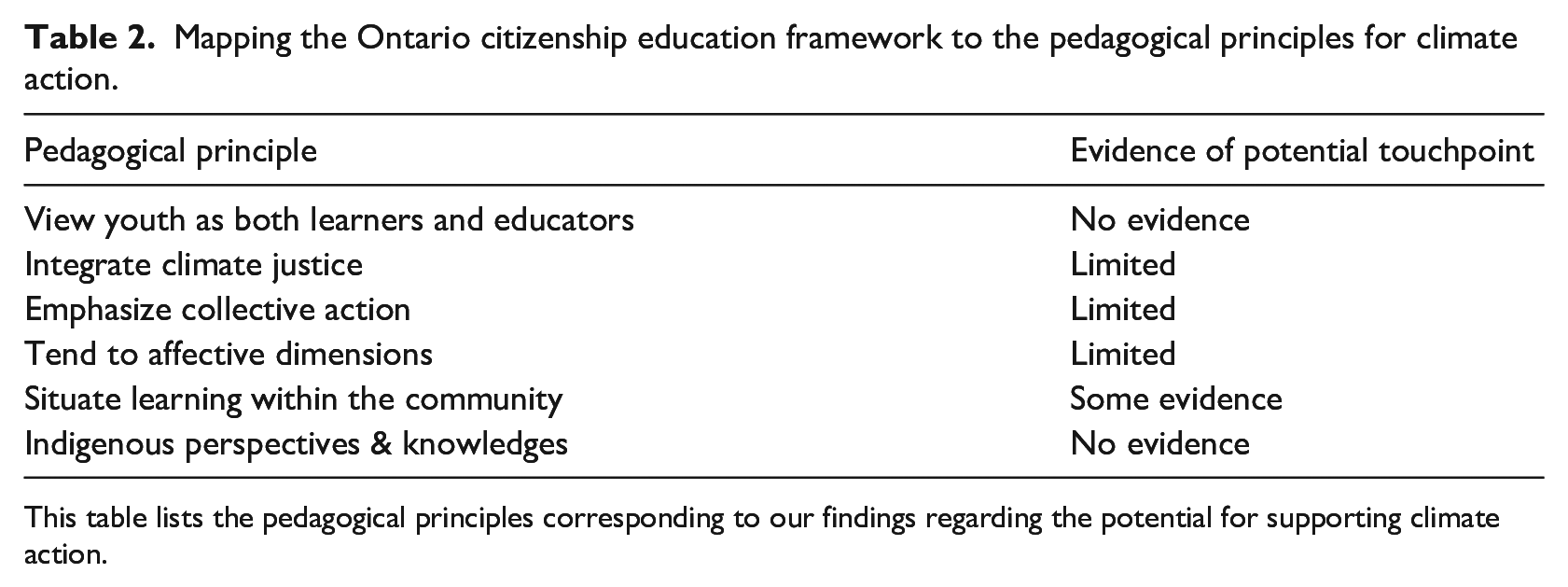
This table lists the pedagogical principles corresponding to our findings regarding the potential for supporting climate action.
View youth as both learners and educators
The analysis revealed that youth are not positioned in the curriculum segment as both learners and educators, nor conceived as citizens capable of co-producing knowledge with the teacher. Instead, the frontmatter of the framework presents knowledge solely as something that students acquire and then apply. In the opening sentences, the curriculum expectation states: ‘students develop skills, knowledge and understanding, and attitudes that will serve them both inside and outside the classroom’ (Ontario Ministry of Education, 2018: 9). The expectation conceptualizes the student as one who will ‘develop’, without any acknowledgment of the skills, knowledge, or understanding that the student may already hold. When read holistically, the framework identifies several areas where students are expected to develop understanding and build their knowledge. It does not acknowledge the student’s capacity to participate in knowledge production or share wisdom and knowledge they learn and may contribute from their own life experiences, which is recommended in much of the scholarship (e.g. Bowman and Germaine, 2022; Karsgaard and Davidson, 2023; Pickering et al., 2022).
Integrate climate justice
There are limited potential touchpoints for supporting climate justice in the framework. There are no aspects of the curriculum segment that explicitly encourage environmental protection or climate justice, demonstrated through the absence of topics related to social reform or questioning of values embedded in power structures, which drive inequality and environmental harm, as identified as important in the literature (Do Thi and Dombroski, 2022).
Some aspects of the framework offer indirect openings for teachers to map their citizenship or environmental teaching onto supporting youth climate justice action. In the framework itself, the section labeled ‘Identity’ (p. 10) highlights the significance of students holding ‘a sense of personal identity as a member of various communities’ (p. 10). The section provides an opening for encouraging students to reflect on their positionalities. Notably, the framework also holds the words ‘interconnectedness’ and ‘relationships’ (p. 10). This could be interpreted by a teacher as an opportunity to discuss the interconnected nature of human existence with the ecosystems on which we depend, to raise social justice issues, and then to encourage action as a member of a community. The emphasis on relationships could be leveraged by a teacher to examine relationships between people groups, and consider how these relationships are unbalanced, in ways that require action. These potential touchpoints, however, are limited because they are single words, without any further contextualization, leaving them open to the teacher’s individual interest in, and knowledge of, taking action for climate justice.
Emphasize collective action
Collective action is not well represented in the curriculum segment, as the actions associated with citizenship are framed as located with the individual. References to collaboration in citizenship are still individualistic in nature, such as suggesting students ‘adopt leadership roles in their community’ and ‘investigate controversial issues’ (Ontario Ministry of Education, 2018: 10). The curriculum segment does, however, acknowledge that students inhabit many diverse communities and that ‘ultimately, they are all citizens of the global community’ (Ontario Ministry of Education, 2018: 9). In describing students as already part of the global community, and highlighting that they could adopt leadership roles, the curriculum signals potential for encouraging students to engage in movements that depend on collective considerations and coordinated actions. Concepts in the center of the framework, such as ‘participate in their community’ and ‘demonstrate collaborative, innovative problem solving’ (Ontario Ministry of Education, 2018: 10) similarly offer limited potential touchpoints for teachers to emphasize collective action.
Tend to affective dimensions
There are a few words that appear in the segment that may be perceived as related to emotions, such as ‘empathy’, ‘respect’, and ‘interconnectedness’ (Ontario Ministry of Education, 2018: 10). However, there are no statements that encourage the acknowledgment of emotions, nor are there any signals to indicate that emotions form an important part of motivation to engage in civic action. While the curriculum framework posits that students will ‘demonstrate self-respect, as well as respect and empathy for others’ (Ontario Ministry of Education, 2018: 10), these keywords and relational processes are not supported by nurturing emotional learning. This is an area where the framework could be expanded to emphasize tending to emotions and feelings about the self, in relation to one’s ecological situatedness, or in relation to climate crisis.
Situate learning in community
One area of clear potential to situate learning in community is evidenced in multiple references to the word community. In the citizenship illustration, the ‘Identity’ element is explained as ‘a sense of personal identity as a member of various communities’ (Ontario Ministry of Education, 2018: 10). The statement reads that students are expected to ‘Identify and develop their sense of connectedness to local, national, and global communities’ (p. 10). The word community is also present on its own, in the inner-most circle. The term’s presence in the framework indicates that it is valued in relation to citizenship and there is potential for the framework to be expanded. Despite the positioning of community as valuable, the framework stops short of encouraging learning-in-community. The framework could be extended in this regard and even acknowledge the potential of participatory knowledge production to encourage authentic climate action while fostering belonging.
Further evidence from the framework includes a call to ‘work in a collaborative and critically thoughtful manner’ (Ontario Ministry of Education, 2018: 10) and activities associated with voice, lead, and investigate are emphasized. However, the words listen and mentorship are notably absent, and those skills might support community-engaged learning. In the frontmatter, teachers are advised that students are to be given ‘opportunities to learn about what it means to be a responsible, active citizen in the community of the classroom and the diverse communities to which they belong within and outside the school’ (Ontario Ministry of Education, 2018: 9). This recognition that students are part of various communities could be expanded to include community-based learning in relation to being an active citizen in community.
Invite Indigenous perspectives & knowledges
The Citizenship Education Framework does not acknowledge or invite Indigenous knowledges or perspectives, nor embed values that might be associated with some Indigenous community values. For example, Nicole Bell, an Anishnaabe scholar who founded a cultural school in eastern Ontario, bases programing on seven original teachings (love, honesty, truth, respect, bravery, wisdom, and humility) and 12 standards originally outlined by Hampton (1995), including: spirituality, service, diversity, culture, tradition, respect, history, relentlessness, vitality, conflict, place, and transformation (Bell, 2013). One can imagine how pursuit of these standards could constitute a textured conception of citizenship that is locally-responsive and Indigenous-informed, but few of these concepts are to be found in the Ontario Citizenship Education Framework. Whereas the curriculum (Ontario Ministry of Education, 2018) emphasizes citizens who are responsible and active (p. 9), there is no gesture toward the notion of humility and place in community, associated with Indigenous perspectives on citizenship. The curriculum excludes mention of human citizenship in relation to other beings and species with whom we share ecosystems and are interdependent. The concepts of stewardship and reciprocity are present in the framework, but the likelihood that they would be interpreted through an Indigenous knowledge or value base is very low when Indigenous acknowledgment is otherwise absent.
Touchpoints for teachers and calls for curricular revisions
The Ontario Citizenship Education Framework, which guides the integration of citizenship outcomes across grade levels and in multiple subject areas in Ontario schools, is incommensurate with the pedagogical principles for encouraging youth climate action as found in the literature. From a content point of view, the environment and climate are entirely absent from the documents. With respect to pedagogy, the touchpoints we identified—ways in which the existing curriculum might be viewed as making space for youth climate action in teaching—are very thin, and essentially dependent on the interpretation of a motivated teacher who may be actively looking for ways to justify their pre-existing interest in engaging youth in climate action. To conclude, we offer one suggestion for teachers working within the existing curriculum and then we propose major curricular adaptations to better align the Citizenship Framework with Ontario’s own vision of ‘environmentally responsible citizens’ (Ontario Ministry of Education, 2009: 6) in addition to the deeper need to encourage climate action.
For teachers seeking ways to support climate action through the Ontario Citizenship Education Framework, we suggest they place an emphasis on situating learning in the community. The current framework expresses a commitment to foster students’ understanding of themselves as belonging to various communities. Teachers may extend the emphasis on identifying with community into learning in community, by situating the learning directly in the community and inviting environmental experts, scientists, political leaders, activists, or Indigenous knowledge keepers into the classroom. An example of a relevant learning activity is inviting students to write letters to their municipality about setting carbon goals, based on local energy sources and uses. This offers students authentic opportunities to engage with and see themselves as members of the community. It facilitates knowledge sharing between students and community members and community members and students. This knowledge sharing also serves to uphold the learner’s dual role as learner and educator. This kind of teaching and learning can begin immediately and requires no policy changes at the provincial level, only coordination, partnership and support at the local level. Education researchers could become involved in guiding, supporting, and evaluating citizenship-focused youth climate action alongside students and their teachers. The schema we provide here offers a means to examine such curriculum through research.
Given the urgency and ubiquity of climate crisis, ideally in the short-term the Ontario Ministry of Education would issue assertive curriculum guidance regarding climate topics, interdependency among humans and ecosystems, youth engagement in action, and holistic wellbeing in the face of uncertainty. Such curricular revisions would incorporate all six pedagogical principles for supporting climate action: view youth as both learners and educators; integrate climate justice; emphasize collective action; tend to affective dimensions; situate learning within the community and invite Indigenous perspectives & knowledges. In consultation with relevant parties, we recommend a reframing of the definition of citizenship toward one that engenders relationships with the land and accounts for its wellbeing and all the life it sustains (Sabzalian, 2019). Providing an opening toward a multitude of ways of knowing, relating to, and being on the earth (Berkes, 2009) will set the conditions for sustainable climate action. Both the invitation of Indigenous perspectives and knowledges, and the integration of climate justice, require immediate curricular revision.
Reframing youth as both learners and educators, explicitly emphasizing collective action, and attending to affective dimensions would also be transformative by providing a curricular opening toward alternative ways of knowing, and shifting the implicit message about how we relate to other beings, as well as to ourselves. This relational shift is foundational for supporting climate action, and to uphold Ontario’s goal of educating ‘environmentally responsible citizens’ (Ontario Ministry of Education, 2009: 6), amidst rapidly changing environmental conditions. Further, the pedagogical principles we identified in the literature could be used in other subject areas, as well as in curricula developed or adapted for other jurisdictions, to illuminate and strengthen the intersection of citizenship, environmental education, and youth involvement in climate justice initiatives. Recognizing that some citizenship and environmental educators are attending to these learning outcomes using whatever curricular touchpoints or pedagogical guidance they can find, more holistic, consistent, and explicit supports for all teachers to enhance human-environmental relationality in their classrooms is warranted. This call to integrate a climate turn in Ontario citizenship education seeks to urgently foster stronger relationships among youth, with their communities, with the land and other species, and with their emotional landscape as they encounter ecological precarity.
Footnotes
Declaration of conflicting interests
The author(s) declared no potential conflicts of interest with respect to the research, authorship, and/or publication of this article.
Funding
The author(s) received no financial support for the research, authorship, and/or publication of this article.
