



Abstract
This article considers the several animated interviews made by Bob Sabiston between 1997 and 2007, and the implications of considering these films as documentaries. The author argues that the films are liminal, discursive texts that negotiate tensions between reality and make-believe, observation and interpretation, and presence and absence. Textual analysis of the short films in question demonstrates an aesthetic presentation that confirms their documentary status at the same time as exploiting the expressionistic potential of Rotoshop. The nature of Rotoshop also emphasizes the absence of the physical body of the interviewee, replacing it with an excessively present style of animation. Other conventional markers of documentary authenticity and evidence, such as the visual index, are also absent in these films. These absences, coupled with the presence of an aesthetically liminal style of animation infer a pleasurably complex and challenging epistemological and phenomenological viewing experience.
Bob Sabiston is perhaps best known for his work on Richard Linklater’s animated films Waking Life (2001) and A Scanner Darkly (2006). These two commercially-released feature films have exposed a broad audience to Sabiston’s Rotoshop animation, with its characteristic undulating lines and distinctive style that can look at once both hand-drawn and photorealistic. 1 Rotoshop was, however, first used by Sabiston to animate talking-head interviews and, since the software’s debut in 1997, he has continued to use Rotoshop in this way. This article examines the several animated interviews made by Sabiston and the implications of considering these films as documentaries. In particular, I argue that the films are liminal, discursive texts that negotiate tensions between reality and make-believe, observation and interpretation, and presence and absence.
Rotoshop interviews
Sabiston developed Rotoshop in the 1990s and first used it in 1997 to make a 90-second short for an MTV competition. Inspired by Nick Park’s animation of ‘real people’ in the Creature Comforts series (1989 onwards), Sabiston wanted to ‘capture something [he] liked about people’s personalities’. 2 After filming interviews with people in Austin, Texas, Sabiston looked for a computer program that would allow him to trace on top of frames of video footage. When his search proved futile he developed the software himself. The interpolation process, Sabiston’s hi-tech answer to the in-betweening of traditional hand-drawn cel animation, evolved when he realized the tracing process would go more quickly if he did not have to painstakingly draw all the lines that barely changed between frames. Instead he programmed the software to best guess the movement between key frames based on information it had already been given. When he was awarded second place in the competition, Sabiston persuaded MTV to pay him to develop the Rotoshop software and animation process. He subsequently moved to New York City and produced for the cable channel 25 30-second animated films, collectively known as Project Incognito, based on interview footage of people talking on random topics.
Between 1997 and 2007, Sabiston and colleagues at his Austin-based company, Flat Black Films, produced four further Rotoshopped short-interview documentaries. Roadhead (1998) and Grasshopper (2003) have a similar premise to Project Incognito and feature interviews with subjects the filmmakers meet in public places. Snack and Drink (1999) and The Even More Fun Trip (2007) document two encounters between the filmmakers and Ryan Power, a young man with autism. The aesthetics of Rotoshop, while recognizable across the five films, change considerably in the decade between Project Incognito and The Even More Fun Trip. The former displays a clean, simple, monochrome style, featuring characters drawn in black outline on a white background (see Figure 1). By 2007, the software had developed to allow use of colour, fill and shadow to create a more detailed and, relatively, photorealistic representation of the interview scene (Figure 2).
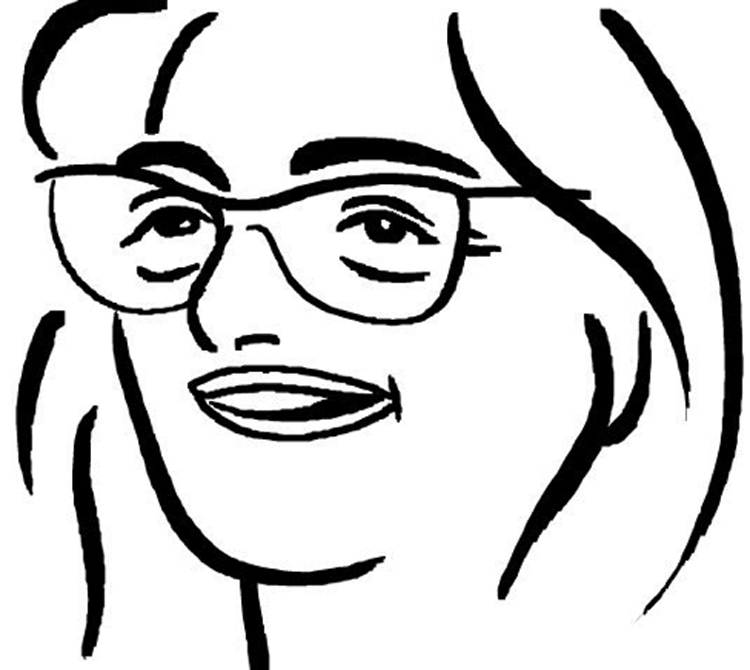
Simple black and white outline of an interviewee in Project Incognito. © 1997 Flat Black Films.
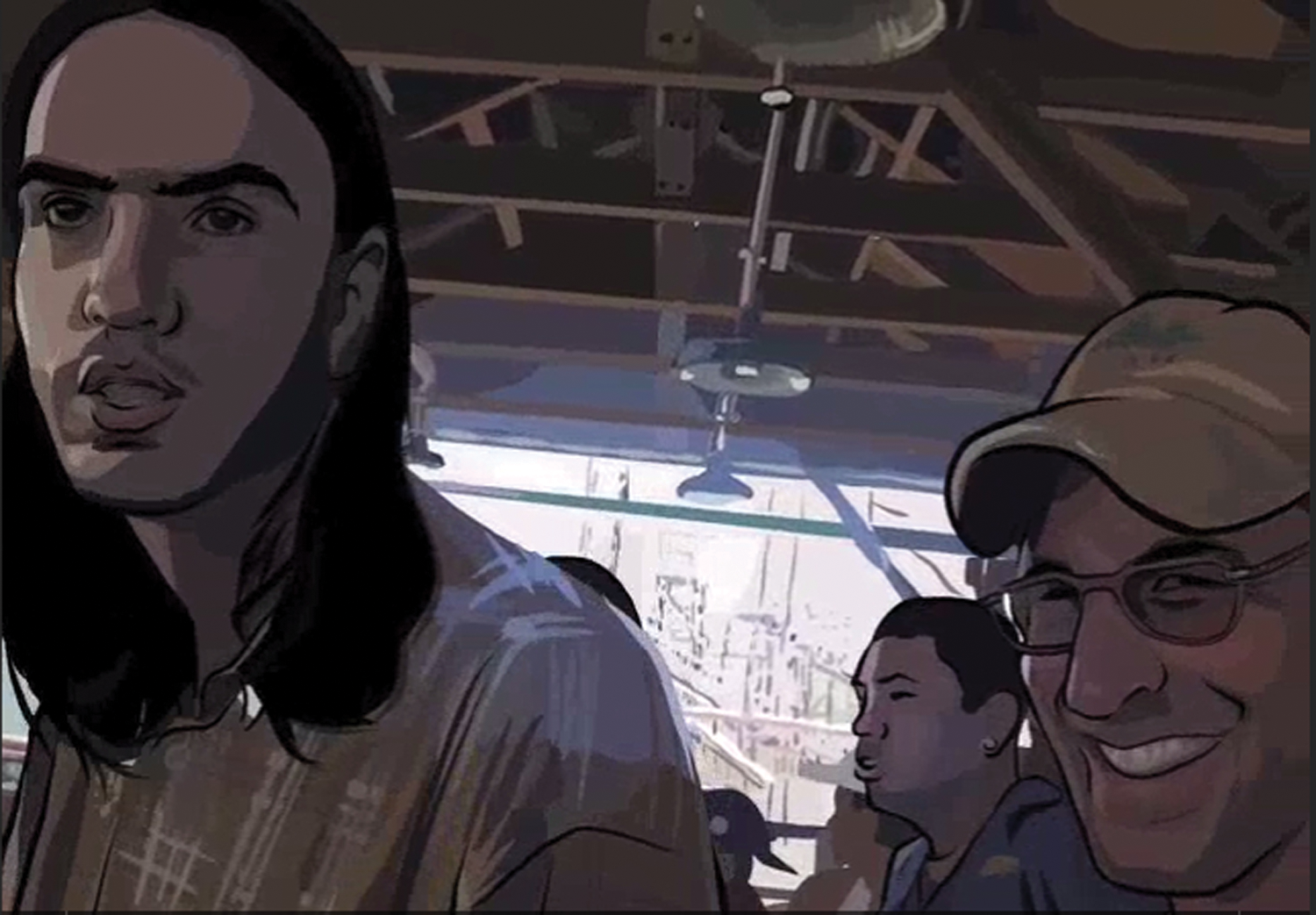
Moments of photorealism in The Even More Fun Trip. © 2007 Flat Black Films.
Absence and excess in animated documentary
Animated documentaries have existed since the earliest days of motion pictures. In 1918, pioneer American animator Winsor McCay sought to reconstruct the 1915 sinking of the British ocean liner the Lusitania by German submarines. McCay’s The Sinking of the Lusitania used 25,000 drawings to evoke a newsreel style in what was the first non-fiction animation to be released commercially and shown to the general public. 3 In the intervening years, animation has frequently been used to re-tell real-life events and experiences, and also as a tool of clarification, explanation and emphasis within live-action documentary. In particular, the last 25 years have witnessed a boom in the production of animated documentary, with animation being applied to subjects as varied as prehistoric life, mental health issues and the retrieval of suppressed memory. 4 Much of the recent wave of animated documentaries combines animated visuals with an interview soundtrack of documentary subjects talking about their lives and experiences. 5 Sabiston’s shorts exemplify interview documentaries in which the filmmakers choose to reconstruct the interview scene, albeit with varying degrees of artistic licence, through animation.
Viewers of all animated documentaries find themselves in a strange epistemological and phenomenological position, of knowing that what they hear and see is at once a depiction of reality and a creation by the animator’s (digital, in Sabiston’s case) hand. The veneer of documentary-as- representation-of-reality is ruptured by animated imagery that is at once both more and less than we expect from a documentary. The live-action images that we have come to expect to see in a documentary, such as observational footage, talking-head interviews, and so on, are missing. In their place we see animated images that go beyond merely re-presenting reality with a style, materiality and presence that we must negotiate in our conception and understanding of the film. There is then, both an absence and excess in animated documentaries that must be contended by the viewer.
In animated interview documentaries this absence and excess manifests most acutely in the body of the interview subject. Bill Nichols (1993: 175) tells us that the knowledge we gain in interview documentaries is written on the body. He claims we learn as much from what we see as from what we hear in interview documentaries when he says:
It is not simply the knowledge possessed by witnesses and experts that needs to be conveyed through their speech, but also the unspoken knowledge that needs to be conveyed by the body itself.
Similarly, Michael Renov (2004: 127) discusses the power of the testimony in Claude Lanzmann’s Shoah (1985) as coming from the body of the interviewee:
The kernel of trauma, buried and of the Real, erupts less as language, more as signs of bodily distress – grimacing, tears, the cessation of activity.
What Renov and Nichols draw our attention to is that the epistemology of testimony, at least in the case of audiovisual documentary, is not only entailed in the words of the speaker. Rather, it is how these words are delivered and, more specifically, the actions of the body and the gestures of human behaviour that betray the truth of the testimony. When the body of the interviewee is removed, and replaced by an animated image, the question remains as to how the epistemological contract with the documentary viewer is altered.
Roadhead, Sabiston’s second interview documentary, is a road movie of Sabiston’s drive home from New York to Austin after working on Project Incognito. With his travelling companion and producer Tommy Pallotta, he stops off in cities along the way and interviews the people he meets. Once Sabiston returned to Austin with the video footage he animated the material along with 13 others, mostly volunteers. 6 In a style familiar from Project Incognito, we are shown the interviewees in black outline on a white background. Each interviewee is drawn by three or four different artists, 7 something that is apparent from the first interview, with ‘Colleen’ (Washington, DC). Very quickly, the initial clear outline and contours of her face give way to a Picasso-esque rendering that fractures her visage into disconnected lines and accentuated features (see Figure 3). While the distinctions in style may not always be extreme, it is easy to tell when we have switched from one animator’s work to another, and this prevails through the three subsequent animated interview shorts, all of which are animated by Sabiston in collaboration with a number of others. 8 Roadhead, as with all of the interview shorts, is not just a representation of reality, but also a multiple-authored interpretation of it.
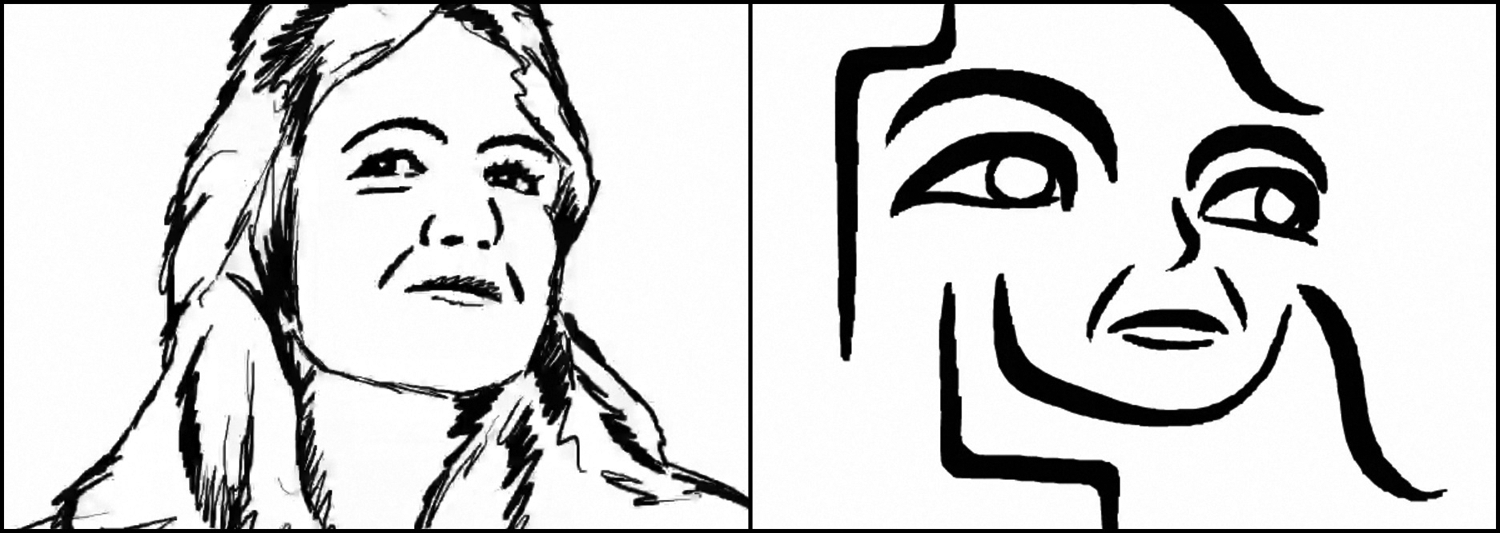
Two interpretations of ‘Colleen’ in Roadhead. © 1998 Flat Black Films.
The presence of interpretation is emphasized in the way the interviewees’ words are reflected in the animation. When Elton (Athens, Georgia) explains that he’s only met seven other Eltons and they were ‘all pretty old’, the body of this young man is animated as someone far more advanced in years, shrunken in relation to the size of Elton’s head and balancing its infirmness on a wooden cane. Similarly, the ‘mysticism’ of a tarot card reader (New Orleans) is accentuated by placing a turban on his head and giving him other stereotypical accoutrements of a fortune-teller such as a long curled moustache and pointy beard. The choice regarding which elements of the interview to highlight, and how to interpret those words in images, remains at the discretion of the individual animator.
In all of Sabiston’s interview shorts, the talking-head interview, a conventional representation of reality in documentary, is presented via animation that reveals the world of the interviewee channelled via the animator(s). So, while the viewer may learn something about, for example, Elton from Athens, Georgia, this must be interpreted via someone else’s, the animator’s, realization of reality. The visual and material style of the animation must be comprehended in order to comprehend the absent reality that is being represented. The viewer must not only distinguish the real world from the world of imagination (for example, discerning that, while Elton from Georgia existed, his body most likely did not morph in front of the camera into that of an old man), but also interpret reality via an animated construction that relays the gestures and physical behaviour, which according to Renov and Nichols are so essential to the transfer of knowledge in interview documentaries. Many of the details of facial gesture, however, especially the eyes, are lost via the animation process in Roadhead. In its place we have the gesture of the animator’s hand and the digital gestures of the Rotoshop software.
Animation and the uncanny presence of reality
A hiccough also occurs when reality ruptures the veneer of the make-believe world of animation. These moments occur when the suspension of disbelief required in viewing fictional animated stories is momentarily hijacked by a visual representation that is either too real, or not real enough, in its given context. These moments have been variously theorized, but are generally acknowledged as arising from a dissonance between viewing expectations and viewing experience as well as between what we know and what we feel while watching animation. This was observed by Eisenstein (1988: 55), when he marvels about Disney animation:
We know that they are … drawings, and not living beings We know that they are … projections of drawings on a screen We know that they are … ‘miracles’ and tricks of technology, that such beings don’t really exist But at the same time: We sense them as alive We sense them as moving, as active We sense them as existing and even thinking!
What Eisenstein points to with these comments is the epistemological–phenomenological dichotomy created by animation that occupies the liminal space between reality and make-believe.
The psychological concept of the uncanny has been applied from Freud’s psychoanalysis to animation, particularly in cases where animation contains elements of realism at odds with the diegetic world of the film. The uncanny, according to Freud (2003[1919]: 124), occurs when we experience something that is both familiar and unfamiliar, as indicated by the original German word, unheimlich, the opposite of heimlich or homely. The concept of the uncanny is frequently applied to animation, via the notion of the uncanny valley, to photorealistic CGI animation. 9 Here the uncanny arises in characters that look too human, yet not human enough. Whereas we might identify with an anthropomorphized animated animal because we focus on the aspects of the character that look human, such as facial features and expression, with animated human characters that look highly photorealistic we focus on the facial and other features that are not quite right. 10 These characters are both familiar and unfamiliar at the same time. So, somewhat paradoxically, talking cars are less troubling to us than very photorealistic computer-generated animated humans. It is for this reason that much was made of the failure of the motion capture film The Polar Express (2004, dir. Robert Zemeckis) being due to the lifeless eyes of the human characters, which made them seem ‘creepy’ (Bautista, 2004).
Aardman Animation’s David Sproxton (2008) has suggested that an uncanny oddness arises from traditionally rotoscoped images because they contain an excess of information due to the ability to too faithfully transcribe the movement and behaviour of a subject. He notes: ‘there [is] often too much detail in the movement – necessary for the human form to keep upright or to balance itself or simply idiosyncratic action.’ Similarly, Paul Ward (2004: 36) has noted that the historical discomfort with the rotoscoped image is due to the realness of the movement feeling out of place in a highly constructed, and often highly unrealistic, animated world. The very realistic, lifelike movement created via the Rotoscope becomes, following this argument, something that transgresses our (pre-)conception of animation, and something we cannot square with the style of the images and story we see on screen.
Vivian Sobchack (2006: 176) makes a similar suggestion regarding our perennial dissatisfaction with photorealistic CGI human characters. Discussing the 2001 film Final Fantasy: The Spirits Within, she proposes there is a disconnect between its narrative and its visual semiotics. That is, ‘the film attempts to achieve indexical, photorealistic “human characters” in a world that is emblematic, symbolic, irreal.’ She goes on to assert that the hyper-real characters on the one hand, and the fantastical storyline on the other, evoke from the viewer conflicting emotional and phenomenological responses. Whereas the eyes of the motion-captured CGI characters in The Polar Express are noticeable because they are lifeless, the characters in Final Fantasy are disturbing because they seem too real, and real in a way that is not justified by the film’s sci-fi fantasy narrative.
Sabiston’s five animated interviews also present the viewer with a complex epistemological/ phenomenological experience. This is evoked simply by the fact that these films are animated documentaries, and the tension between presence and absence that this entails; in particular, the absence of the body of the interviewee combined with the materiality of the Rotoshop style of animation. As a digital version of the Rotoscope, Rotoshop threatens the same response of the uncanny from viewers. While Rotoshop allows, as discussed earlier, for diverse artistic contributions from a team of animators, it also has the capacity for greater photorealism. This is particularly apparent in the two later films, Grasshopper and The Even More Fun Trip. The 14-minute long Grasshopper is an unedited interview in which ‘park-bench philosopher AJ Vadehra expounds on astrology and more productive avenues of contemplation’. 11 The film is animated using a consistent green-grey colour palette, compared to the vibrant psychedelia of Snack and Drink and the black-and-white figuration of Project Incognito and Roadhead. It also displays a depth of field comprised of planes of background, filling in the park behind Vadehra with trees, grass, people, and so on. This, combined with the use of shading on Vadehra’s features, creates an illusion of three-dimensionality not present in the previous films. Often, Vadehra’s features are clearly distinguishable and the shading and fill on his face realistically resemble the shadow and light that would have fallen on him in the park that day (see Figure 4). This photorealism is also apparent in The Even More Fun Trip, Sabiston’s second film featuring Ryan Power, in which Sabiston, Ryan and a group of friends visit a Texas theme park. Rotoshop animation is created by digitally tracing over previously filmed video footage, and in the final version only the animation remains. Due to the sense of depth and dimensionality in Grasshopper and The Even More Fun Trip, these films seem to carry the ghost of their original footage. There is a temptation to believe that if we could just peek behind the animation, or scrape back its layers, the filmed image would be there for us to view. There is, in these two films in particular, an uncanny sense of reality haunting the animated image.
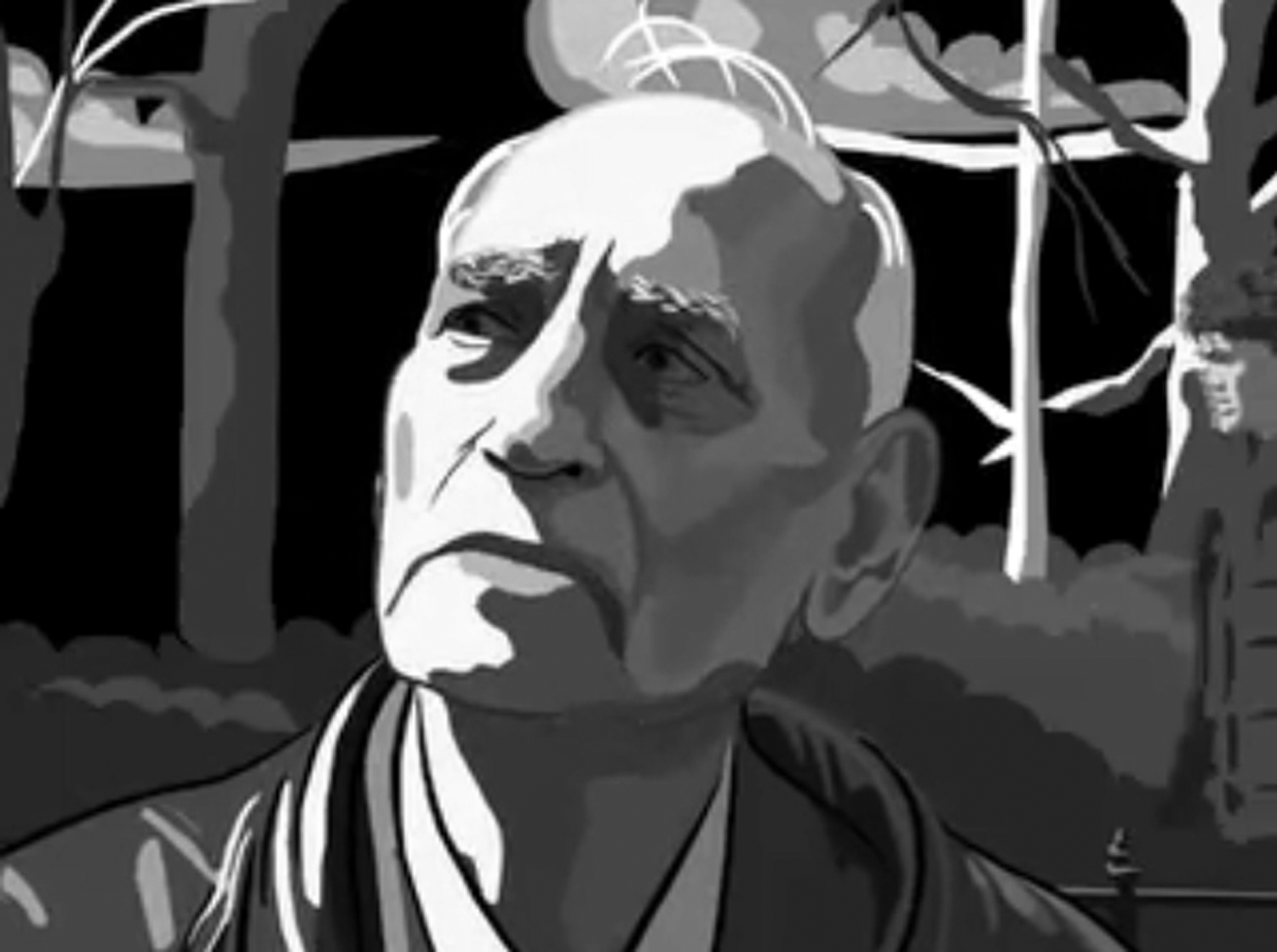
Shadow and fill create a sense of photorealism in Grasshopper. © 2003 Flat Black Films.
The signs of realism
I suggest the epistemological uncanniness of Sabiston’s animated interviews results in part because the fabric of Rotoshop is neither consistently emblematic nor indexical, to use Sobchack’s distinction in her discussion of Final Fantasy. Here she is alluding to Peircian semiotics, via Peter Wollen’s (1998) application to film, and the tripartite sign system of symbol (sign refers to original by virtue of convention), icon (sign resembles referent) and index (causal, physical relationship between sign and referent). If live-action film and photography hover around the index and icon camp of Peircian semiotics, animation is more on the side of icon and symbol. As Sobchack (2006: 176) puts it, all cinema is iconic, but ‘one of its poles – the indexical photograph or the symbolic emblem – usually tends to dominate’ (emphasis in original). So, while the animated image often resembles what it is referencing – Disney rabbits look like real rabbits, we recognize that Gromit is a dog and that Bart Simpson is a young boy – it also looks very different. It is from this difference that much of the pleasure of animation derives, be it aesthetic, comedic, ironic, or so on.
The sense of being able to peel back the surface of Rotoshopped animation to reveal the indexical image underneath occurs alongside moments that are on the other end of the spectrum, at the symbolic–emblematic pole. Sabiston’s third animated interview, Snack and Drink, is an animation of a short encounter between Sabiston, Pallotta and 13-year-old Ryan Power. Sabiston and Pallotta accompany Ryan on his routine trip from his apartment to the local 7-Eleven store to buy candy (a snack) and soda (a drink). The film is the first full-colour Rotoshop interview documentary and the palette is filled with bright, solid hues. In comparison to the black-and-white drawings in the earlier Project Incognito and Roadhead, Snack and Drink has a relatively higher degree of realism in its representation of the mobile interview scene. The previously white background is now filled in with the detail of trees, roads, cars and buildings as Ryan walks down the street. This adds a dimensionality to the space occupied by the interviewee that is absent in previous films and that will be further developed in Grasshopper and The Even More Fun Trip.
There is, however, an overriding sense of expressionism in Snack and Drink. 12 The style of animation constantly fluctuates, at times pared down to geometric shapes and primary colours. When Ryan is filling up his cup at the soda machine, a ritual that involves dispensing a small amount of each soft drink in turn until his cup is full, the individual drinks buttons are animated with arms, hands and eyes as they vie for his attention. During this sequence, which lasts for about a third of the film, the animation style changes approximately 30 times, to coincide with Ryan repetitiously hitting each button on the machine. The representations of Ryan switch from psychedelic to sober in a matter of seconds, from black and white to bright neon, and back again (see Figure 5).
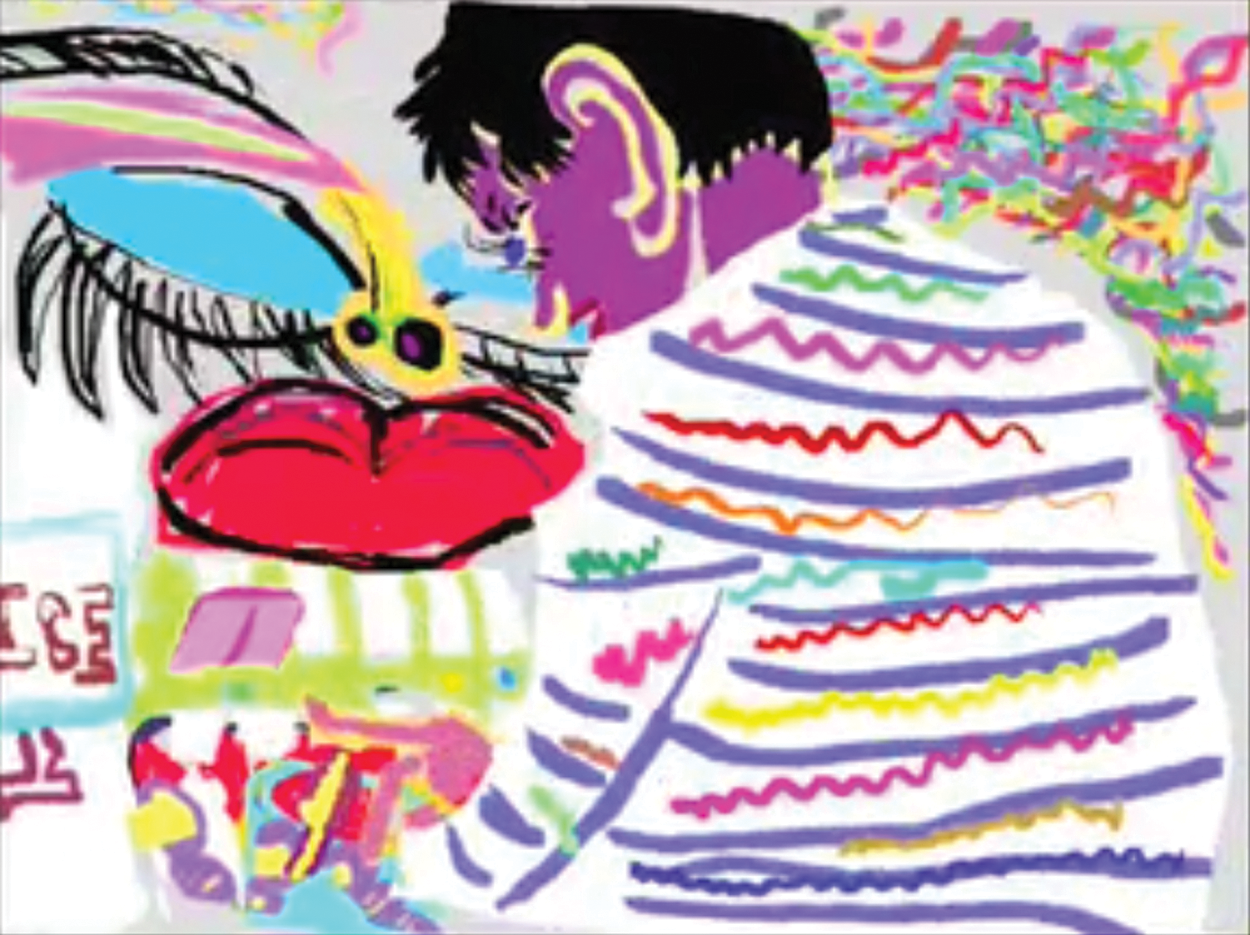
Ryan Power realized in dynamic colour in Snack and Drink. © 1999 Flat Black Films.
In Snack and Drink, the emblematic–symbolic pole dominates and we learn about Ryan through the soundtrack of his conversation with Sabiston, in tandem with the artistic expression and impression of the animated visuals. In particular, as Paul Ward (2006: 120) has noted, the drinks dispenser sequence is ‘an amusing and strangely touching visual rendering of just how obsessively focused an autistic person can be’. Sabiston is here using the animation to interpret Ryan’s experience of interacting with the world. We understand that the world, for Ryan, is a contrast between some things that intensely retain his focus and others that are noise or distractions. Rotoshop was used in Roadhead to more acutely interpret aspects of an interviewee’s physical presentation or what they said in their interview. In Snack and Drink, a style of animation that embraces the symbolic and emblematic becomes a means of drawing our attention to how Ryan interacts with the world and how this might differ from our own experience. Similarly, in The Even More Fun Trip the switch from the monochrome grey-beige colour palette of the car journey to the bright colours once the group reach the theme park visually echoes Ryan’s exhortation of ‘come on, let’s have some fun’.
The indexical sign has become both a talisman and an albatross around documentary’s neck. It lends it the weight of evidence, whilst at the same time restricting the perception of what a documentary should look like. The claim goes that documentaries can be evidence of events that occurred in the world because of the unique existential bond, as Peter Wollen (1998[1969]: 86) first described it, between film and object. This ‘indexical bond of photochemical and electronic images to that which they represent … provides endless fascination and a seemingly irrefutable guarantee of authenticity’ (Nichols, 1991: 150). Due to the causal link between image and original in photography and film, a spectator can reasonably assume that the existence of the image guarantees the existence of the original. Just as the bullet hole would not exist without the bullet, and the weather vane would not point in a certain direction without the force of the wind to push it there. However, unlike photography and film, these indexical signs do not resemble their originals. Whereas a photograph of me will look like me, at a certain point in time, a bullet hole does not look like a bullet and a weather vane does not resemble the wind. Indeed, it has often been pointed out that André Bazin, upon whose writing much of the theory of realism in cinema is based, made no claims as to the iconicity of a photographic image, or what it should look like. The image was reality for Bazin (2005[1976]: 14), ‘no matter how fuzzy, distorted, or discoloured’. Wollen (1998[1969]: 92) notes this in his observation that ‘realism, for Bazin, had little to do with mimesis … It was the existential bond between fact and image, world and film, which counted for most in Bazin’s aesthetic, rather than any quality of similitude or resemblance.’
The fact of the matter is, however, that because photographs and films do have an existential bond with reality (they are indexical signs) and because they also look like reality (they are iconic signs) the two things often become semiotically blurred. That is, we think that something has to look like reality in order to have an existential bond with it. Not only this, but there is a conflation of the evidential weight of indexicality and a certain style of filmic representation. Bazin’s theories of cinematic style are as widely read as his thoughts on the ontology of film, and while the two are connected they are often also conflated. Bazin (2005[1976]) extolled the virtues of non-interventionist filmmaking because these techniques, he argued, were best suited to the fundamental ontology of the cinematic form. Thus, he praises the long-take, deep-focus cinema of Orson Welles and William Wyler. He was also particularly in favour of Italian neorealism, which he called a ‘form of self-effacement before reality’ (p. 29). Conversely, he was critical of montage editing, which he called ‘anticinematic’ (p. 46), because it distracted from the reality in front of the camera. The power of the film image, for Bazin, arises from its ability to lay bare reality and this could best be done in a style that maintained the physical and spatial as it is in our own direct experience rather than the juxtaposition of shots that disrupt space and time.
In documentary, style and ontology are also conflated. Through the dominance of the observational style of filming, variously known as Direct Cinema, vérité and fly-on-the-wall, which has pervaded mainstream television and cinema documentary since the 1960s, comes the prejudice that for documentary to carry epistemological weight, for it to be able to claim to say anything about the real world, it has to look like reality. For indexical imagery to have evidential weight, it must look like reality re-presented with the minimum of intervention. The dominance of a certain style of documentary realism is demonstrated in its aping through mock-documentaries. With the intention of humour and satire (and occasionally to trick), mock-documentaries demonstrate how easy it is to fake the documentary codes of shaky camerawork, talking-head interviews, often grainy image quality and an observational style.
The documentary veracity of Sabiston’s interview shorts is confirmed, in part, through adhering to many of the codes of documentary realism. Interviews often start and finish abruptly, with some of the technical tasks of filmmaking appearing on screen or being heard on the soundtrack, and all of the films begin in media res. The camera is often shaky and the framing inconsistent. Roadhead and The Even More Fun Trip both begin in a car travelling down the highway, looking out of the windshield at the road ahead, halfway through a conversation between the passengers, which we hear off-screen. Grasshopper begins with the very last few seconds of a previous interviewee on-screen. This smiling woman laughs to the words ‘she is very wise’ heard from off-screen before Vadehra steps into frame and takes a seat on the park bench. A hand protrudes into the screen as another voice, also off-screen, says ‘… just going to clip this to your collar’ as Sabiston attaches a microphone to Vadehra’s coat. The interview context is similarly established in Roadhead. We see Colleen, the first interviewee, fumble over clipping her microphone to her collar. After introducing herself (‘ok … umm … my name is Colleen White … and I work at …’) she hesitates and asks for confirmation of the filmmakers’ intentions and Sabiston reassures her that she does not have to say exactly what she does for a living. In these films, we not only see interview documentaries, but also elements of their production, which works to authenticate them as documentaries.
Further authentication comes from the presence of the shaky and handheld camera, and the inconsistent, imperfect framing that results, familiar from observational documentary. When Sabiston and his friends arrive at Ryan’s house in The Even More Fun Trip, we see the front door from a low, canted angle, as if the camera is being held loosely down at the cameraman’s side. A sense of ‘being there’ is captured in the roller coaster sequence, in which we get a front row view, alongside Ryan, of the hair-raising swoops and drops of the ride. This sense is amplified by accompanying production sound of rushing wind and the yells of the roller coaster passengers. The sound in these films is significant as a confirmation of their documentary status. It often has a rough production aesthetic, which reminds us that this element of the film retains its indexical link with reality. Often the mix of different sound elements is slightly off, as in the fast-food restaurant sequence in The Even More Fun Trip, where the background noise of the music being played in the restaurant threatens the clarity of the dialogue. We often, also, have the sense of eavesdropping on a conversation that is not being spoken directly into the microphones. Many of the films begin and end this way and often the visuals cut out at the end of a film while the conversation continues. For example, in Snack and Drink, we can hear Sabiston talking to someone in Ryan’s apartment as the credits roll. The visual impression of filming-on-the-fly works in tandem with this happenstance sound recording. 13
Animation’s index
Animation, of course, is not an indexical sign in the way a filmed image is. Unlike live-action cinema, the iconicity of the animated image is not connected to indexicality. What we see in an animated image did not exist in front of the camera in that form. Cels, static puppets, paint and brushes, grains of sand, could not be mistaken for the animated films that they create. And in camera-less animation, such as the films of Len Lye and Norman McLaren, there exists no profilmic at all. That is not to say, however, that animation is not indexical. There is a causal process at play that results in the final animation. Drawn animation, for example, as Birgitta Hosea (2010: 363) has put it, bears ‘the trace of the presence of an artist’s body’.
Where hand-drawn animation may index the presence of the artist who drew it, there is an indexical relationship between a rotoscoped (and by extension, Rotoshopped) image and the original body, or object that was filmed and then traced. That is, there is a causal link between the original and the image. Even if this causality is one level further removed than the relationship between a film or photographic image and its subject, it remains true that were it not for the original filmed material, this particular Rotoshopped image would not exist. Furthermore, as Joanna Bouldin (2004) has suggested in her discussion of body politics in rotoscoped films, this type of animation gains ‘“body” by drawing on (and being drawn on) other bodies that boast more flesh and substance’ (p. 7) The ‘reality and materiality of an original body’ is transferred to the animation via the filmed image onto which the animation is traced (p. 13). The result is a style of animation that possesses an ‘ontological and phenomenological presence and thickness’, in that it physically bears a trace of the materiality of the original object or character that pervades the final animated version (p. 7). This creates a strange viewing experience, as we are aware of and must constantly negotiate the spectral presence of the physical body and the ontological status of the final product.
This negotiation is further heightened in Sabiston’s films by the often surreal and highly expressive nature of the animation style. The tangibility of the animated character is often at odds with their visual representation. Ryan’s hair cycles through a shock of fantastic colours in Snack and Drink. In Grasshopper, Vadehra periodically morphs into a Buddha-like version of himself, sitting in lotus position and floating several feet above his park bench. As in Roadhead, the depictions of Vadehra change often throughout the film and his face in particular is drawn in a variety of styles. This reminds us that these Rotoshop films are not merely a computer-generated product; they not only bear the trace of the original filmed material, but also the imprint of the animator’s hand. These films, then, are doubly indexed, pointing to the presence of the interviewee in front of the camera, and the presence of the artist in the process of translating the video image to animation. This indexicality, however, as with all indexical signs, emphasizes the absence of the original.
Conclusion
Bob Sabiston’s interview short films are liminal and discursive in a way that both challenges viewers and rewards them with an enhanced appreciation of the reality being depicted. The films’ aesthetic presentation confirms their documentary status at the same time as exploiting the expressionistic potential of Rotoshop. For example, while the indexical quality of the tracing process means Rotoshop can retain the look of the familiar documentary handheld camera, this animation technique also has the capacity to exacerbate the camera’s kineticism to the point of expressionism. The signature undulating and pulsating lines of Rotoshop are amplified when the camera moves. As such, the lines are relatively static in Grasshopper, where the camera holds a fixed frame on the interviewee. In Snack and Drink, however, the background is particularly labile, wafting around the frame in an often disconcerting way. As Ryan and Sabiston walk to the store, the suburban landscape around them seems to pulse rhythmically, causing a pickup truck parked at the curb to undulate as if standing on a bouncy castle. As Hosea (2010: 354) has noted, ‘the line is neither present in photo-real cinema nor in the world in front of the camera. It is a conceptual meta-object with no presence other than as an idea made graphic.’ The mobile lines of Rotoshop, which derive from the documentary code of handheld filming, remind us of its very drawn and animated nature.
In Rotoshopped interviews, the body of the interviewee is both absent and excessively present. The materiality of the original body is transferred to the image, through movement in particular. The use of fill, shadow and colour in Grasshopper and The Even More Fun Trip, in particular, lends the image a strong sense of resemblance and photorealism. However, the body is absent from the image and even if we could peel back the layers of animation, we would not find anything underneath. The interviewee’s body haunts the final image, constantly reminding us of its absence through its presence.
If we learn things from interview documentaries via the body of the interviewee, as suggested by Nichols and Renov, this epistemological contract is highly complex in Rotoshopped interviews. Not only is the body spectrally present, but we must also contend with an often expressionistic interpretation of the body and the world around it. There is the potential for this interpretation to enhance our understanding of the interviewee and their context. Most basically, it can illustrate words we hear on the soundtrack – such as Elton’s morphing into his aged self in Roadhead, and the realization of AJ Vadehra as a floating yogi in Grasshopper. A change of narrative tone can be reflected visually, as in The Even More Fun Trip when the world becomes bright and vibrant once Ryan enters the fun-filled world of the theme park. In Snack and Drink, the instability of the animated line and the use of colour and embellishment to highlight particular aspects of the environment offer an enhanced understanding of the world as Ryan experiences it. The traditional visual index of conventional documentary may be absent in these films, but this does not mean we not gain knowledge from these animated documentaries. Indeed, the very presence of the absent visual index and its substitution with animation that ranges from expressionistic to photorealistic has the potential to offer the viewer much insight into the world of the interviewee.
Footnotes
This research received no specific grant from any funding agency in the public, commercial, or not-for-profit sectors.