




Abstract
Though widely known for his contributions to instantaneous photography and studies of human and animal locomotion, the figure of Eadweard Muybridge was equally renowned during the final decades of the 19th century for his tours of the magic lantern circuit. At this time, the photographer entertained and educated audiences with a poly-generic, multi-media show alternating still views with animations produced through his projecting apparatus, the zoopraxiscope. This article examines the temporal and material dimensions of Muybridge’s lantern practice to demonstrate how it builds on 19th-century anxieties about changing epistemologies of vision and visuality, as well as time and temporality. As a dynamic process animating still images into motion, Muybridge treated animation as a palliative measure designed to bring his ungainly images of animals back into the realm of natural human vision. In so doing, he bred truth through illusion and helped prepare audiences for an emerging cinematic sensibility. By emphasizing the temporal dimensions of photographic indexicality, the author further argues that Muybridge’s endeavors amount to an archive of time, and that his lantern slides evince time made material. While the slides’ projection displayed a virtual immateriality, an examination of broken ones reveals that photographic beauty emerges from their ephemerality and fragility. The animating interchange between stillness and motion, between the material and the immaterial, functions as an indicator of the emergence of epistemic assumptions and anxieties about time and sight that took hold as cinema emerged.
Photography has given a material guise and body to time, which otherwise eludes our human grasp. (Carlo Rim, 1989: 38)
1 Time made (im)material
The shots of horses taken in mid-stride by the eccentric photographer Eadweard Muybridge between 1878 and 1879 and distributed widely throughout the United States and Western Europe as woodcut prints in periodicals, lithographs, and cartes-de-visite, as well as the aesthetic and epistemological anxieties they engendered in artistic and scientific circles, occupy a central place in histories of photography, chronophotography, and the cinema. Less well known, though partially highlighted by revisionist historians of the silent screen (Gunning, 2003: 227, 250–256; Herbert, 2004: 107–153; Musser, 1990: 48–53), were Muybridge’s tours as a magic lantern showman. Upon salon screens, before students at art institutes and professors at polytechnics, and along the Midway Plaisance at his Zoopraxographical Hall during Chicago’s 1893 World’s Fair, Muybridge projected scenes of animal locomotion in their consecutive phases as arrested by instantaneous photography and then thrust them into movement with the aid of his animating apparatus, the zoopraxiscope. Given Tom Gunning’s (2003: 223–224) cogent handling of Muybridge’s status as ‘father of the motion picture’, I have no wish to re-open debates as to the photographer’s cinematic paternity. Rather, this article will highlight the temporal and material dimensions of Muybridge’s photographic, lantern, and lecture practices in order to emphasize how the depiction of movement purportedly resolved the aesthetic and epistemological quandaries instigated by the photographer’s shocking images of animals in motion. By ‘stopping’ time upon his photographic plates and ‘starting’ it once again with the zoopraxiscope, Muybridge’s endeavors as an animator opened up the better to allay 19th-century anxieties about changing epistemologies of vision and visuality as well as time and temporality. As a dynamic process animating still images into motion, Muybridge treated animation as a palliative measure designed to bring his ungainly images of animals back into the realm of natural human vision. In so doing, he bred truth through illusion by equating vision with cognition and helped prepare his audiences for the spectacles the cinema would soon unleash.
Time, its representation and materialization, dominates both contemporary and historical discourse on photography and cinematography. As our epigraph from the noted French wit Carlo Rim (1989: 38) suggests, ‘photography has given material guise and body to time.’ Early photographic portraiture, as Walter Benjamin stresses, necessitated that the subject sat for prolonged periods of time to ensure a proper exposure upon insensitive plates. ‘The subject’, describes Benjamin (2005: 514), ‘grew into the picture, in the sharpest contrast with appearances in a snapshot.’ By organically fusing the sitting subject with the photographic apparatus, these auratic portraits, following André Bazin’s metaphoric terminology, embalmed time. ‘For the first time’, argues Bazin (1967: 15) of cinematography in a well-known passage, ‘the image of things is likewise the image of their duration, change mummified as it were’ (emphasis added). Despite the irreconcilable dualism between extended time exposures and instantaneous snapshots delineated by Thiery de Duve (1978) and addressed by Benjamin, we witness by virtue of the photograph’s status as an indexical sign that it captures and archives a portion of time, however short its duration may be. The mechanical reproducibility of images and the development of vast industries designed to facilitate their distribution partook of what Jean-Louis Comolli (1980: 122–123) vividly describes as a general ‘frenzy of the visible’ that pervaded the second half of the 19th century, a frenzy that amounted to an archive not just of the visible but also of the previously invisible, in particular the representation of time (Doane, 2002: 3).
Roland Barthes (1981), furthermore, places time at the center of his inquiries into photography. Camera Lucida, his final treatise on the subject, opens with an anecdote in which he ‘happens’ upon a photograph of Napoleon’s brother. His reaction: ‘I am looking at eyes that looked at the emperor’ (p. 3). The ‘evidentiary force’ of the photograph, its brute indexicality, which, for Barthes, signifies ‘this-has-been’, provides the viewing subject with a direct line-of-sight into the historical past, an umbilical cord of time (pp. 76–77, 88–89). First separating the photograph’s semiotic registers into the studium, which functions as the image’s culturally connoted message, and punctum, identified as that which ‘pricks’ or ‘wounds’ the subjective disposition of the beholder, Barthes subsequently draws our attention to photography’s temporal dimension and its mortal implications for the viewer (pp. 25–29). Writing of Alexander Gardner’s ‘Portrait of Lewis Payne’ (1895), Barthes ‘[observes] with horror an anterior future of which death is the stake … [The] photograph tells me death in the future’ (p. 96). Time, understood as an inscription of the past that foresees the future and generates a paradoxical past-presence before our eyes, emerges as the ultimate punctum.
The framework of photographic temporality that Barthes articulates points not only to the photograph’s ability to represent time but also to the material history of the photograph itself, a move that effectively doubles the image’s temporal valence. It depicts a portion of time, but also persists as a historical object in and of itself. This accounts for the ‘real unreality’ Barthes (1977) earlier observed in the photographic restructuring of space and time, understood as the ‘spatial immediacy’ of the photograph before the beholder and the ‘temporal anteriority’ of that which it depicts (p. 44, original emphasis). Thus, Bazin argues, the ‘ontological bond’ assured by photographic indexicality unleashed the object’s depiction as a second-order of reality. The image ‘freed’ that which it depicted ‘from the conditions of time and space’ such that ‘photography actually contributes something to the order of natural creation instead of providing a substitute for it’ (pp. 14–15). By emphasizing both the ‘psychological’ and material dimensions of photographic representation and perception, Bazin concludes, ‘[every] image is to be seen as an object and every object as an image’ (pp. 15–16).
Some time ago, while poring over the wealth of Muybridge materials held by the Iris and B. Gerald Cantor Center for Visual Arts at Stanford University, I ‘happened’ upon several photographic, glass magic lantern slides dating from the photographer’s first large-scale inquiry into animal locomotion. These experiments, begun in 1878 and lasting until 1882, were carried out with resources provided by Leland Stanford, railroad baron and horse breeder, at his Palo Alto, California stock farm. As archeological remainders of a past practice, the slides were proof positive of one of the key ways Muybridge related to the emergence of a nascent cinema: he was a traveling lantern lecturer known widely for his lectures, projections, and animations.
These slides are small, and appear in two sizes. Some, like the series ‘“Nimrod” Pacing’, depicting the silhouetted image of an ambling horse, measure 2.3 x 2.6 centimeters and were used to produce maquettes for zoopraxiscope discs (Figure 1). Others, however, are larger, designed not for zoopraxographic animation, but still projection. Slides showing Stanford’s horses, ‘Mahomet’, ‘Sallie Gardner’, and ‘Abe Edgington’, measure 5.4 x 7.6 centimeters. In contradistinction to the black silhouettes seen on the smaller slides, the larger slides reveal a visual richness, which can also be seen reproduced in the cartes-de-visite (Figure 2). In the ‘Mahomet’ slides, for example, we see, against a white background, upon which vertical lines and numbers demarcate analytical space and signify a scientific endeavor, a man upon a cantering horse. The slide itself is tinted light blue. The horse’s name, ‘Mahomet’, distinguishes the subject at the top, while a number orients the image within the series of the animal’s consecutive movements. The photographer’s claim to authorship – ‘Copyright 1878 by Muybridge’ – can be read along the bottom (Figure 3). Some of the slides have been framed and mounted for the purposes of contemporary exhibition, but others, like ‘Abe Edgington’, reveal a brittle, paper frame (Figure 4). Some, such as ‘Leland Stanford Jr. on his Pony “Gypsy”’, have shed this frame completely (Figure 5).

Eadweard Muybridge, ‘“Nimrod” Pacing’ (c. 1879). Maquette for a zoopraxiscope disc made of 21 collodion on glass positives, unpublished variant of plate 20 from ‘Attitudes of Animals in Motion’.Source: Iris & B. Gerald Cantor Center for Visual Arts at Stanford University; Stanford Family Collections.
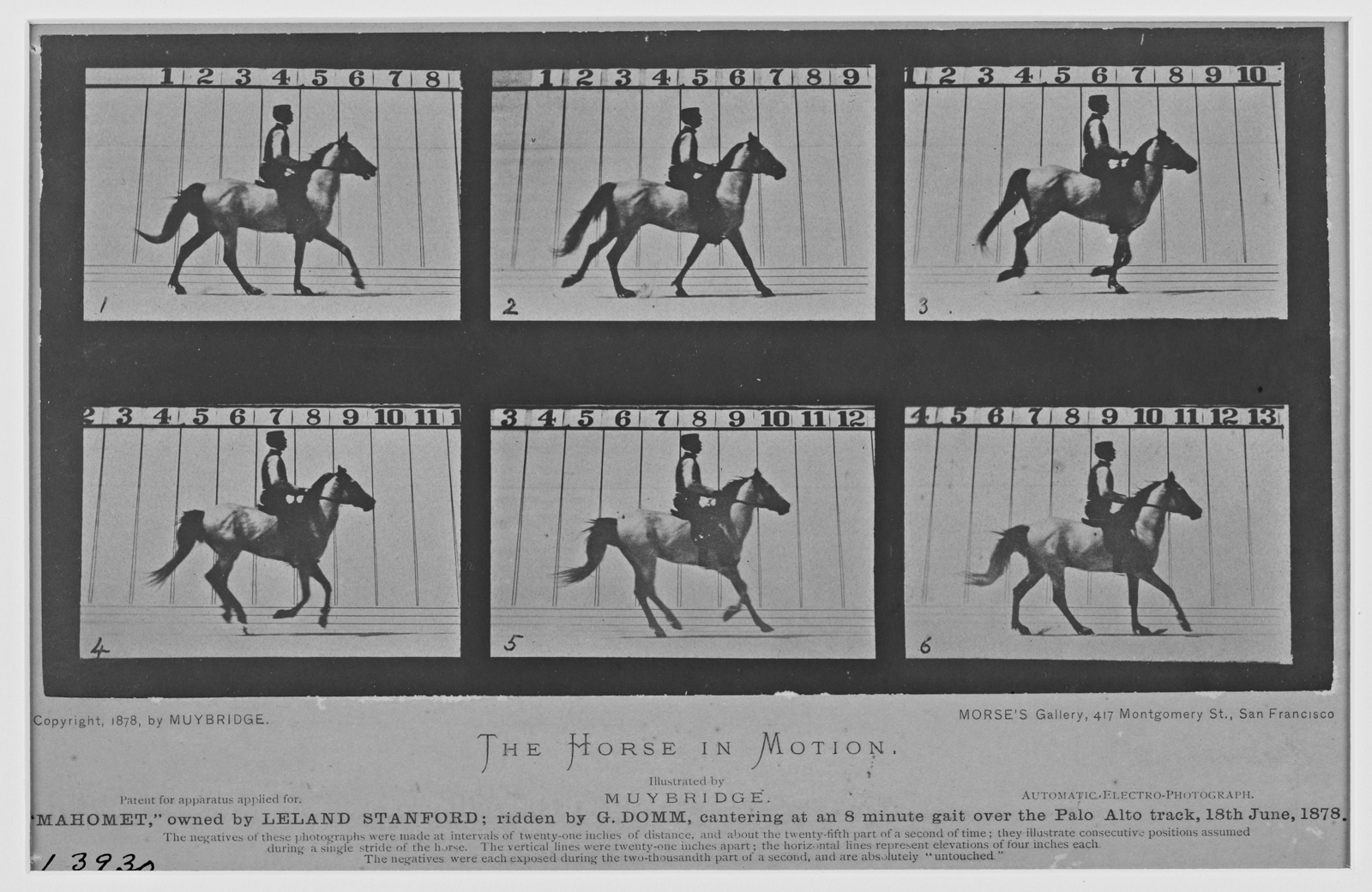
Eadweard Muybridge, ‘“Mahomet” Cantering at an 8 Minute Gait’ (1878). Albumen print, from the series ‘The Horse in Motion’.Source: Iris & B. Gerald Cantor Center for Visual Arts at Stanford University; Stanford Family Collections.
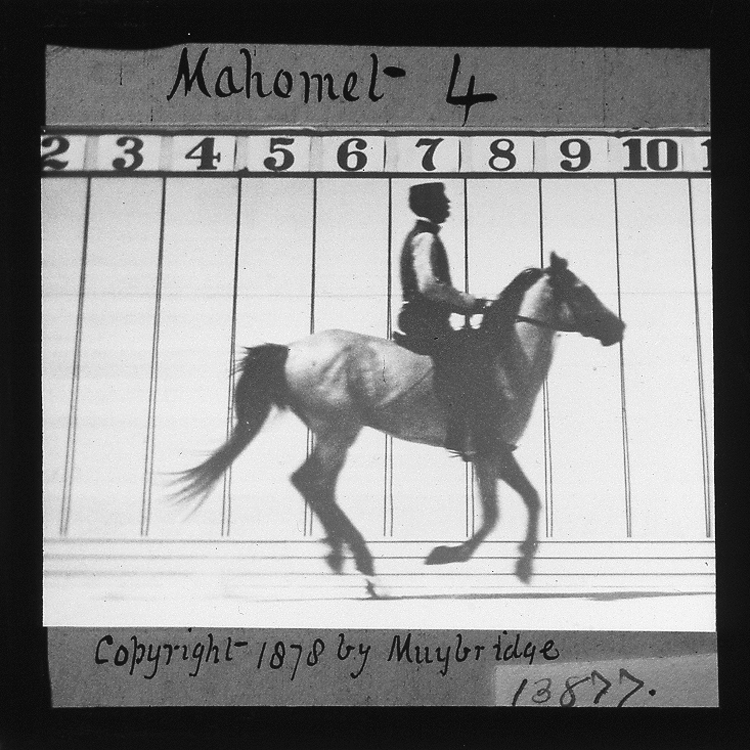
Eadweard Muybridge, ‘Mahomet 4’ (1878). Glass positive, collodion on glass lantern slide for ‘Attitudes of Animals in Motion’. Source: Iris & B. Gerald Cantor Center for Visual Arts at Stanford University; Stanford Family Collections.
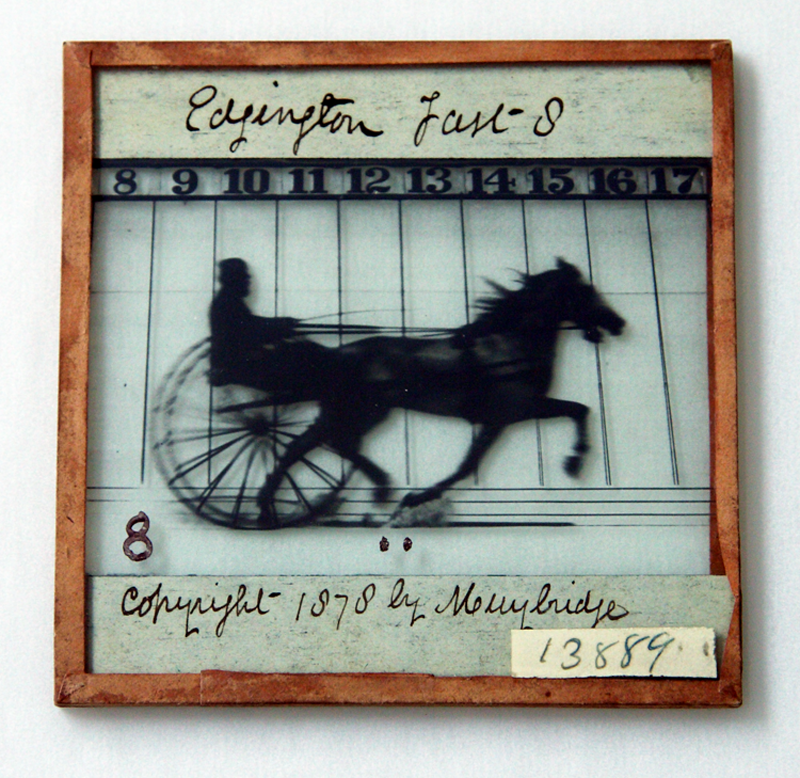
Eadweard Muybridge, ‘“Abe Edgington” Fast 8’ (1878). Glass positive, collodion on glass lantern slide for ‘Attitudes of Animals in Motion’. Source: Iris & B. Gerald Cantor Center for Visual Arts at Stanford University; Stanford Family Collections.

Eadweard Muybridge, ‘Leland Stanford Jr. on his Pony “Gypsy”’ (1879). Glass positive, collodion on glass lantern slide for ‘Attitudes of Animals in Motion.’ Source: Iris & B. Gerald Cantor Center for Visual Arts at Stanford University; Stanford Family Collections.
Though all the slides are photographic, made from collodion on glass positives, not all of them reproduce ‘photographs’. The larger slides provide a range of photographic records due to the insensitivity of the wet plates Muybridge continued to use at this juncture of his career. For example, the slides depicting ‘Sallie Gardner’ show the horse as an enhanced silhouette, but the image of its rider as well as the striking effect of the animal’s hooves kicking up lime along the raceway are clearly the product of unadulterated photographic indexicality (Figure 6). In the case of ‘Abe Edgington’, the photographer has clearly enhanced the image of the rider with the addition, Kevin MacDonnell (1972: 89) speculates, of mercuric chloride, though the horse remains untouched. Finally, the image of ‘Mahomet’ appears to be an untouched photograph of man and horse. The smaller slides, however, depict animals in motion as painted silhouettes based on Muybridge’s initial photographs. Indeed, throughout his career, Muybridge animated nothing but hand-painted approximations of his photographic records in both color and black-and-white (Herbert, 2004: 113–114).

Eadweard Muybridge, ‘“Sallie Gardner” Galloping 8’ (1878). Glass positive, collodion on glass lantern slide for ‘Attitudes of Animals in Motion’. Source: Iris & B. Gerald Cantor Center for Visual Arts at Stanford University; Stanford Family Collections.
In enhancing his images, Muybridge sought not to deceive astonished eyes, but to provide viewers with the clearest possible representations of the horse’s gait for pedagogical purposes. While it is possible that the range of inscriptions may be the result of wet collodion plates ‘far too slow to record anything but a silhouette’ (MacDonnell, 1972: 89), such enhancements, as well as recourse to the animation of painted zoopraxiscope discs, reveal Muybridge’s interstitial status as a man of science and art. 1 He practiced what Lorraine Daston and Peter Galison (2007) describe as ‘trained judgment’. In contradistinction to the emergent protocols of ‘mechanical objectivity’, which prevented any human intervention into the apparatus’s operations and produced images that were ‘too cluttered with incidental detail, compromised by artifacts, [and] useless for pedagogy’, practitioners of trained judgment did ‘not [hesitate] to enhance images … to highlight a pattern or delete an artifact’. Furthermore, they ‘professed themselves unable to distinguish between work and play – or, for that matter, between art and science’ (p. 46).
In what ways might we profitably situate Muybridge’s magic-lantern slides of prancing horses within the framework of photographic temporality and historicity articulated by Barthes and Bazin in their respective ways? The images Barthes chooses to discuss in Camera Lucida, for example, are by and large portraits of individuals and not instantaneous snapshots of animals. Furthermore, Barthes (1981: 32–34, 99–100) seems totally uninterested in the work of photographic ‘operators’ like Muybridge, who defied the laws of nature and surprised viewers with unbelievable images. Finally, given the mortal weight Barthes invests in his conceptualization of photographic temporality, what could possibly be the magic lantern slides’ punctum? To follow Bazin’s investment in photographic materiality – ‘[every] image is to be seen as an object and every object as an image’ – the punctum, in the eyes of this viewer, is the support, the glass, or the material base which enables the projection of a virtual image upon a screen so as to be viewed by an audience. The word ‘virtual’, Anne Friedberg (2006: 8–9) demonstrates, developed out of a long history encompassing philosophy and optics far beyond the limited purview of our contemporary understandings of the digital, and signifies ‘a substitute’ that doubles as the ‘immaterial proxy for the material’. If, as has been argued by a figure like the filmmaker and film theorist Hollis Frampton (1983), Muybridge’s endeavors emerged from a ‘restless … absorption in problems that have to do with what we call time’ (p. 74), and photography, following Rim, materializes time, then the lantern slide, as a photographic object – much like strips of celluloid and negative plates – evinces time made material, or Bazin’s object of the image. The projection of that slide’s image upon a screen, however, functions virtually as an ‘immateriality proxy’ for the materiality of the slide itself, the image, to follow Bazin once more, of the object.
What Barthes identifies as the photograph’s defining feature, ‘this-has-been’, shall become ‘this-was-shown’. Like the index of eyes that gazed upon the emperor, the lantern slide shows not so much what Muybridge held, but what audiences saw upon a screen, archiving experience. I imagine their gazes, watching the transformation of a graceless animal into a lively beast, while a large, bearded, impresario points with his stick and lectures away, alternating still images with illusionist animations. This interchange between stillness and motion, between the material and the immaterial, indicates how Muybridge’s practice as a lantern lecturer exploited projection and animation in order to reconcile the epistemological and aesthetic problems wrought by his photographs, and speaks equally to the ways in which assumptions about time and sight were reconfigured under the sign of an emerging cinema.
2 Animation’s palliative effect
Although the magic lantern had been a parlor toy of the ruling classes for nearly two centuries, the rise of the illustrated lecture as a form of popular entertainment, for both the bourgeoisie and the working poor, grew exponentially in the second half of the 19th century. With the development of the collodion process, showmen, like Muybridge, augmented or combined their initially painted images with photographic ones, ensuring the imprimatur of a more lifelike, detailed, and richly textured recording of reality. Moreover, the invention of lanterns capable of producing dissolving views enhanced their allure by providing simulated motion (Barber, 1993: 68). The mass production and wholesale distribution of slide sets and lectures engendered a growing body of professional and amateur lantern practices, which increasingly expanded from the 1870s and into the 1890s in the United States, England, and France. The most successful of these showmen were, unsurprisingly, the professionals, who toured the lecture circuit and charged considerable sums of money for their services. Professional lecturers, in contradistinction to those amateurs who might buy prefabricated materials, benefited from having direct contact with or intimate knowledge of their subjects. An amateur who purchased his slide set and lecture from a firm lacked the authority of having documented a phenomenon, as the case might be with a lecture of scientific stature. The same holds for lectures illustrating travel; no evidence exists that the lecturer once visited the locations described. However, as X Theodore Barber (1993: 70) argues, ‘the most highly regarded travel lecturers … had usually visited many, if not all, of the places about which they spoke.’
As both a purported man of science and noted traveler, Muybridge emerges directly from this milieu. His exotic travels to Guatemala, Alaska, the Pacific Northwest, and California’s Yosemite, as well as his putatively scientific photographic practices – the pretenses of which have been thoroughly dismantled by Marta Braun (1992: 228–262) – lent themselves to the lecture circuit as part of pre-existing genres that place him firmly within the tradition of the professional lecturer. During a period lasting nearly 20 years, beginning in 1878 and ending in 1897, Muybridge regularly provided audiences with illustrated lectures in both public and private venues on either side of the Atlantic. 2 While the photographer began his career by showing only still images from a biunial (twin-lensed) lantern, he later augmented this practice by combining a modified zoetrope, itself a modification of Plateau’s phenakistoscope, with a magic lantern, to build an animation device dubbed the ‘zoopraxiscope’, originally named ‘zoogyroscope’. 3 As a dynamic process transforming still images into those in motion, Muybridge treated his lectures as pedagogical experiences in which animation not only served to elaborate the lessons of what historical inquiries into the physiology of visual perception labeled ‘persistence of vision’ but also functioned as a palliative designed to return the ungainly and anxiety-inducing images of animals produced by chronophotography to the realms of natural human vision.
Muybridge delivered his earliest lectures in San Francisco and initially projected only still slides. Combining his images of animals in motion with pictures of exotic locales into a poly-generic presentation that educated and entertained reveals that Muybridge combined two of the most popular lecture genres: travel and science (Barber, 1993: 68; Sopocy, 1998: 297, fn 1). The differences between the image of a horse as apprehended by instantaneous photography and its conventional depiction in the history of art, however, constituted the core of these presentations. With his biunial lantern, Muybridge threw two opposing images onto a screen surface: a chronophotograph of the horse in motion and any number of paintings depicting the horse’s gait according to the customs of artistic convention. His spoken lectures compared and contrasted each picture, guiding the audience’s eye across the multiple images and drawing attention to the evident errors of conventional artistic depiction when set alongside his chronophotographic revelations (Haas, 1976: 116).
Muybridge’s images of animal locomotion caused as much anxiety as they did astonishment, re-weaving epistemology and aesthetics into a new frame of visibility by inducing untenable quandaries in the former for having undone the conventional wisdoms of the latter. Some critics, so astounded were they by what Muybridge’s photographs depicted, balked at the veracity of the horse’s positions upon their first publication. According to George E Waring, Jr (1882: 381) in the pages of The Century Magazine, adjectives such as ‘ludicrous’ and ‘impossible’ echoed throughout photographic and scientific communities. Others considered these images ugly precisely because they upended prevailing aesthetic conventions. ‘Even Messsonier’, declares Noël Burch (1990: 11)
the great equine painter, steeped in the codes of representation of academic painting thanks to which the West as a whole was persuaded of the phenomenal identity of a certain idealization of movement of the horse and Reality, refused … to believe in the authenticity of the documents Muybridge had published.
The problem, as De Duve (1978: 114–115) summarizes it, was
[whether] or not a horse should be depicted in the unexpected, yet ‘true’ postures that were revealed by the infallible eye of the camera, whether or not the artist – including the photographer when he strives for artistic recognition – should remain faithful to nature rather than interpret it.
To break free of these newly wrought torsions between photographic representation, embodied vision, and pictorial convention, many publications, following, no doubt, the prescriptions of what was then understood as ‘persistence of vision’, called for these images to be synthesized through animation in order to ascertain their verity. 4 ‘If the 10 stages in the stride of the racer could be as it were fused together’, wrote WB Tegetmeier, editor of the English outdoors magazine The Field, in June 1879, ‘so as to be seen in rapid succession the appearance of the horse in action should, if they are correct, be reproduced’ (quoted in Haas, 1976: 117).
By 4 May 1880, Muybridge debuted his scheme for animating his stills with the now legendary zoopraxiscope, described by its inventor as ‘the first apparatus ever used, or constructed, for synthetically demonstrating movements analytically photographed from life’ (Muybridge, 1957: 15). Some critics assailed the quality of these decidedly crude images. William H Rulofson, the photographer who, as part of the Bradley & Rulofson Gallery of Photographic Art in San Francisco, had once represented Muybridge, was particularly dismissive. Situating Muybridge within a general class of ‘photographic quacks vending their nostrums, deceiving the credulous, and defrauding the ignorant’, he concluded that
[the] result is, a number of diminutive silhouettes of the animal on and against a white ground and wall … Photographically speaking, it is ‘bosh;’ but then it amuses the ‘boys,’ and shows that a horse trots part of the time and ‘flies’ the rest, a fact of ‘utmost scientific importance’. Bosh again. (quoted in Hendricks, 1975: 109–110)
Most media outlets, however, spread enthusiastic, if not hyperbolic, reports. Tegetmeier, who had commissioned his own strips of Muybridge’s images for the praxinoscope, declared:
On revolving the instrument the dead grotesque figures that have been derided by so many as impossible absurdities, started into life, and such a perfect representation of a racehorse at full speed as was never before witnessed was immediately visible. (quoted in Herbert, 2004: 110)
The New York Times, re-publishing on 19 May 1880 a story originally printed in the 5 May edition of San Francisco Call, reported: ‘The camera used in taking these views caught the object and transferred it to the glass in the one-thousandth of a second – a degree of time that is difficult for the mind to comprehend’ (emphasis added). The newspaper, however, reported a particular keenness for the lifelike motion displayed through Muybridge’s animation apparatus, which overcame nearly incomprehensible temporal intervals by seeming to erase the differences between each image due to its unrelenting speed:
What attracted the most attention – in fact, aroused a profound flutter of enthusiasm from the audience, was the representation by aid of the zoogyroscope, of horses in motion … Nothing was wanting but the clatter of hoofs upon the turf and an occasional breath of steam from the nostrils to make the spectator believe that he had before him genuine flesh-and-blood steeds.
In this journalist’s sensationalism, Gunning (2003: 253–254) finds what Bazin identified as ‘the myth of total cinema’. He astutely argues, ‘the desire for the clatter of hoofs moves in another direction, [from science] toward a multisensual form of illusionistic entertainment – dare we say it – towards movies.’
By analytically breaking down animal locomotion into its component parts, instantaneous photography may very well have depicted the ‘impossible absurdities’ of the horse’s incomplete movements, but it lacked the sensation of movement. Yet recourse to animation, pursued independently by Tegetmeier’s functionaries, the American painter and arts instructor Thomas Eakins, and Muybridge himself, among others, reconciled this apparent quandary. As a writer for The Californian put it:
[when] first produced, these plates excited much skepticism and ridicule. Taken singly, they are entirely deficient in grace, and convey no impression of movement whatever; but when made to follow each other in rapid succession, by means of the zoogyroscope – a revolving disc, from which the impressions are projected upon a screen – the effect is so startling as to convince the most skeptical of the accuracy of the plates. (Anon, 1880: 89, emphasis added).
Waring (1882: 381), in turn, noted ‘[the] testimony of the zoetrope, and, later, of the zoepraxiscope [sic], has silenced all skepticism, and one can no longer hesitate to concede the truth and simplicity of what, at first, seemed complicated and absurd.’
By animating these images, believers and non-believers alike retroactively imbued Muybridge’s photographs with an epistemological claim to truth whose palliative effect was twofold. First, animation ensured the accuracy of the individual image since the fusion of motion would have been disrupted should any of the consecutive phases lack continuity. Animation reins the image’s ‘impossibility’ back into the realm of natural perception. Second, since audiences believe what they see when viewing the horse in motion through the zoopraxiscope, the chronophotograph loses its ugliness and reclaims its aesthetic status as ‘beautiful’. Both, finally, effect a fusion of vision and cognition that stamp the static and moving image as ‘real’, truthful depictions of how the horse ‘actually’ moves.
Muybridge’s practice of transforming still views into animated motion before astonished audiences as part of a pedagogical pursuit evinces a complicated play between stillness and motion. Ernst Weber, Muybridge’s lantern operator, described the process:
The operating was a very strenuous job, for between the moving photos Muybridge introduced a very large number of still photos, and these had to be put through at a very rapid rate. Muybridge during the show walked about the stage with a little steel ‘clicker’ in his hands and this he used as a signal when he wanted a slide changed. (quoted in Hendricks, 1975: 213, original emphasis)
His lecture, the vocal counterpoint to his visuals, underscores the still/moving dynamic in order to teach audiences about the zoopraxiscope’s operations and actively cultivate chronophotography’s epistemological truth claims. ‘When these photographs were first made’, reads his only published lecture,
some experts had doubts as to their accuracy. We have here a little instrument called the zoopraxiscope, with which we can throw the various positions in rapid succession on the same spot on the screen, and thus produce apparently real motion, and you will readily understand that if any of the positions were incorrect, it would upset the experiment altogether. (Muybridge in Hendricks, 1975: 236, emphasis added)
Though stressing their indexicality by declaring, ‘these pictures are entirely untouched; they are exactly as they were made in the camera; there is no interpolation by any artist, or any imagination’ (much as he did on the cartes-de-visite that carried sequential images of Stanford’s horses), we know that Muybridge projected only painted images (p. 238). The photographer first acknowledged that the photos were not believed, and then proceeded to explain the operations of his apparatus, emphasizing that the images must evince a sense of continuity in order to create the illusion of motion. Should continuity be broken, the projection could no longer sustain the illusion. Thus, Muybridge, by showing static lantern slides, and then images of motion produced through the zoopraxiscope, visualized and verbalized the dynamic dialectic between stillness and motion that enabled the illusion of apparent motion and provided his audiences with object lessons in the contemporary concept of ‘persistence of vision’. Animation retroactively reinforces the photographic index’s authoritative claims to truth. In other words, illusion breeds truth.
Muybridge’s text illustrates the tone his lectures took, and often reveals the sober affectation of an expert (Weber noted that he insisted on being announced as ‘Professor’). His text evinces the voice of an authority, attending in detail to differences between the gait as depicted by photography and painting. He underscored his professionalism by subtly interpolating slide changes into the lecture’s textual body, thereby facilitating synchronization between lecturer and lanternist that eluded many amateurs. Yet there are the occasional slips into the sensational, revealing the sometimes not-so-latent showman behind the professorial pose. ‘The next is a wild bull’, announces the text. ‘He was really wild enough for a Spanish bull fight; we had to build a long lane in order to get him to run straight and we had three or four men ready to catch him in case he should make for the cameras …’ (p. 239). His thrilling depictions of danger doubtlessly served to increase audience enjoyment, blur distinctions between entertainment and education, and cultivate a charming rapport between the lecturer and his public.
Though Muybridge toured the lecture circuit for nearly two decades, little evidence suggests he changed tactics. Based on reports from his earliest exhibitions in San Francisco, in which his photographs were compared to paintings, the title of his lectures in England, ‘The Science of Animal Locomotion and Its Relation to Design in Art’, and the fact that his book of 1893, Descriptive Zoopraxography, or The Science of Animal Locomotion Made Popular was a miserly edition of 1887’s Animal Locomotion: An Electro-photographic Investigation of Consecutive Phases of Animal Movements, it appears that Muybridge was content to recycle old material. Doubtless the lectures he gave at the Zoopraxographical Hall during the 1893 World’s Columbian Exhibition held in Chicago were restaged upon his final return to England before his retirement. As Robert Bartlett Haas (1976: 179) cannily put it, ‘[he] was offering old wine in new bottles, and it was relished by his audiences.’
With the literal invention of the cinema as we know it, in the form of the Lumière cinematograph, the days of the magic lantern started to wane, such that it disappeared almost completely as a form of popular entertainment by the dawn of the First World War (Crangle, 2001: 46). The first years of film production, however, show its absorption into the prevailing codes of magic lantern representation and exhibition before transforming into a cultural force all its own (Musser, 1990: 15). That a lantern legacy would surface in the work of English ‘pioneers’ such as George Albert Smith, Cecil Hepworth, or James Williamson, all of whom worked the lantern circuit before migrating to the cinema, should be unsurprising. Historians highlight the links between the magic lantern’s approach to narrative representation and the structuring of scenographic space by way of different shot angles and scales as well as a general sense of the camera’s ubiquity (Burch, 1990: 86–89; Musser, 1990: 34–38).
I would further suggest that we find a morphological remainder of lantern practices on display in the early cinema’s fondness for setting multiple images within a single tableau. Multi-image presentation in films such as Smith’s Santa Claus (1899), as well as Edwin Porter’s Jack and the Beanstalk (1902) (Figures 7 and 8) and Life of an American Fireman (1903) (Figure 9), the latter inspired by the lantern show, Bob the Fireman (Musser, 1991: 218), recall Muybridge’s use of the biunial lantern to project two (or more, depending on the lantern) images on screen to compare and contrast them. Interpolating such images within the frame creates spatiotemporal ambiguities that must be addressed by the presence of the lecturer, as would be the case with Santa Claus, in which it remains unclear whether the children dream Father Christmas’s descent or whether it unfolds as a parallel action. In Jack and the Beanstalk, the arrival of the fairy when Jack sleeps may manifest the contents of his dreams, but she may have also appeared quite literally in his bedroom. Later, at the top of the beanstalk, the fairy provides Jack with a veritable lantern lecture featuring a view of the giant’s castle. Finally, the opening tableau and inset that accompanies it in Life of an American Fireman recalls ambiguities not unlike Santa Claus. Does the fireman dream a vision of his family or have the filmmakers attempted to render two events concurrently?

Edwin S Porter, Jack and the Beanstalk (1902). Frame enlargement from Edison: The Invention of the Movies (Kino, 2005).

Edwin S. Porter, Jack and the Beanstalk (1902). Frame enlargement from Edison: The Invention of the Movies (Kino, 2005).

Edwin S. Porter, The Life of an American Fireman (1903). Frame enlargement from Edison: The Invention of the Movies (Kino, 2005).
Like Muybridge’s comparative analysis of two images upon a screen, part of the pleasures of the early cinema came from the dialogic exchange between lecturers and audiences, who together scanned the surface of these bisected screens as part of a dynamic viewing situation unfolding outside the bounds of a linear time that would be codified by the conventions of classical continuity. Muybridge’s showmanship does not necessarily reinforce his cinematic paternity, but his projection of two images simultaneously upon the screen surface, dynamic solicitation of the audience through his lectures, and pedagogical demonstration of the zoopraxiscope as a palliative device reveal some of the historical, morphological, aesthetic, and epistemological problems his magic lantern practice both opened up and addressed in the context of cinema’s emergence.
3 Archives of time
Muybridge’s technique of analytically decomposing animal and human locomotion into photographic fragments – temporal tesserae – reveals time to be the plastic, material substrate of the research and projection programs he pursued throughout his career. Spanning different geographies, subjects, and techniques for inscribing duration photographically, from his sublime, long-exposure waterfalls, described by Frampton (1983: 76) as possessing ‘not water itself, but the virtual volume it occupies during the whole time-interval of the exposure’, to his instantaneous snapshots of horses mid-stride, he boasted of having produced photographs ‘within the Arctic Circle and under the Equator, at an elevation of 10,000 feet and beneath the waters of our Bay, with exposures varying from 18 hours to less than the 2,000 part of a second’ (quoted in Hendricks, 1975: 110). The tens of thousands of images produced during exotic voyages and multi-year stays at Stanford’s stock-farm and at the University of Pennsylvania from 1883 to1885 amount to a veritable archive of time, to which the mammoth, 11-volume Animal Locomotion: An Electro-photographic Investigation of Consecutive Phases of Animal Movements, containing 781 plates and a total of 19,347 images, stands as testament.
The archival impulse to analyze, quantify, codify, and systematize – to order – the people, places, flora, and fauna of Northern and Central America, to visualize both their outward appearances and the otherwise invisible intricacies of their changes over time, is symptomatic of modernity’s rise and the logic of abstraction and instrumental reason that accompanied an increasingly industrialized capitalist economy. Central to this ‘general cultural imperative’, as Mary Ann Doane (2002: 3–4) describes it, was ‘the structuring of time and contingency’. In order to ensure the efficiency of a market economy, for example, in which people and goods needed to pass from one industrial center to another, from city to country and back, railway companies throughout Western Europe and the United States standardized time, undoing the individuated experience of local time, explains Wolfgang Schivelbusch (1977: 42–44). Increased mobility of goods and people reified the former and alienated the latter. Products transformed into the mystified commodities of the marketplace, usurped from their points of production and replanted anew at sites of consumption. Moneyed classes, who had experienced the transition from embodied, animal powered overland travel to new means of smooth, mechanized movement, lost claim to a vitalized subjectivity rooted in a more immediate experience of time and space (pp. 23, 36). As goods reified, newly alienated individuals experienced an existential objectification. ‘They were no longer travelers’, writes Schivelbusch, following John Ruskin. ‘[They] were human parcels who dispatched themselves to their destinations by means of the railway, arriving as they left, untouched by the space traversed’ (pp. 38–39). By breaking space and time into discrete units, both become abstract, disembodied representations no longer felt, but thought.
The dialectical exchange between stillness and movement exploited by Muybridge during his lectures as well as photography’s indexical bond with the phenomenal world, however, opens up spaces for chance, contingency, and kinesis, all of which might work to oppose or allay the anxieties emerging from the instrumentalization of everyday life. ‘The technological assurance of indexicality’, writes Doane (2002: 10), ‘is the guarantee of a privileged relation to chance and the contingent, whose lure would be the escape from the grasp of rationalization.’ As Muybridge’s photographs of Stanford’s horses demonstrate, the drive to analytically rationalize animal locomotion by decomposing it into its component stages resulted in images whose ‘absurd’ postures evidently defied the very rationality they’d hoped to evidence. This escape from rationalization manifested, in yet another particularly extreme form, as the scientific drive towards mechanical objectivity. Under such circumstances, scientists placed immense trust in the objective nature of photography and other implements of measure in order to suppress the subjective interpretation of data in favor of a restrained blind sight. The drawback, as became increasingly clear, were images distended with details both aberrant and incidental that obviated scientific representation’s explanatory, pedagogical functions (Daston and Galison, 2007: 42–43). Contingency offset abstraction by dialectically joining escape from the trappings of capitalist modernity with anxieties about its emergence. At the same time, contingency retained the possibilities chance posed for pleasure in the forms of various entertainments, Muybridge’s included.
Muybridge’s photographs initially produced epistemological anxieties in scientific and artistic circles owing to the lifelessness his images exuded. The trope of death, of life robbed of its anima, De Duve (1978: 116) argues, explains why instantaneous snapshots such as Muybridge’s ‘[appear] as abrupt, aggressive, and artificial, however convinced we might be of [their] realistic accuracy’. Yet when thrust into motion by the zoopraxiscope, these images, resurrected from photographic death, became instant sources of pleasure once thrust upon a screen. In spite of this, Laura Mulvey (2006: 15) hazards a warning against investing too greatly into these illusions of movement by likewise emphasizing the mortal differences between photography and cinematography. ‘The photographic freezing of reality’, she writes, ‘marks a transition from the animate to the inanimate, from life to death. The cinema reverses this process by means of an illusion that animates the inanimate frames of its origin.’ Muybridge obsessed over the narrative dimensions of his published photographic sequences and rearranged them to fulfill the mandate of an aesthetic vision (Braun, 1992: 254–256), imparting them with a semiotic elasticity subject to change, if not whim. The zoopraxiscope, however, bound his animations, much as the cinématographe and kinetoscopes to come, to the dictates of an uncompromising, linear trajectory that refused reversibility, no matter the diversity of images, artworks, or exotic locations on display during the total show. As the animating apparatus exploited the evident differences between its consecutive images of movement, it brought them back into the realm of embodied perception and allayed the very anxieties they initially generated. We witness in Muybridge’s movements from stillness to motion, from the material to the immaterial, the contours of a delicate epistemological frame through which an incipient cinema with its own ceaseless momentum of animated instants could be seen.
Muybridge’s atlases and stores of slides function as archival indices of photographic time. Yet, as mentioned earlier, his lantern slides evince the presence of a past practice, archiving not only the temporal duration of motion, but also the experience of watching these animals and humans come to life during the showman’s lecture. These are fragments representing time, both in their superficial content and their status as archeological remainders. Projected, the instant of a horse mid-stride becomes a virtual image, an image that is identical to its referent, and yet the immaterial embodiment of that referent. As a physical object, however, the slide, by virtue of the photographic process that inscribed it as an image upon glass, is evidence of time made material. Yet, the slide’s historical life extends far beyond its virtual, projected life, owing to its material durability. As such, it possesses multiple temporalities. It depicts a frozen instant, it evokes, pace Barthes, a past-presence, and its material existence is testament to its history. In other words, this slide is aging.
Among the many slides deposited at the Cantor are those that have partly fulfilled their entropic destinies. These are broken slides, shards of glass ready to quite literally ‘prick’ or ‘wound’ (Figures 10 and 11). Bazin, in his famous (1967) essay on photography, writes, ‘[photography] affects us like a phenomenon in nature, like a flower or snowflake whose vegetable or earthly origins are an inseparable part of their beauty’ (p. 13). Photographic beauty, in part, emerges from its very ephemerality. Like a snowflake that melts or a flower that wilts, the photograph fades, nitrate celluloid spontaneously combusts, and glass shatters. Muybridge and the chronophotographers, we are told, broke the linear continuity of time’s movement forward into basic, discontinuous units of analysis. Broken slides, however, can no longer be projected or animated, that is to say, re-animated, and contingency returns to fracture the contingent. Time is not broken. Time breaks.

Eadweard Muybridge, ‘Leland Stanford Jr. on his Pony “Gypsy”’ (1879). Fragments of glass positive, collodion on glass lantern slide for ‘Attitudes of Animals in Motion’. Source: Iris & B. Gerald Cantor Center for Visual Arts at Stanford University; Stanford Family Collections.

Eadweard Muybridge, ‘“Abe Edgington” Fast 8’ (1878). Fragment of glass positive, collodion on glass lantern slide for ‘Attitudes of Animals in Motion’. Source: Iris & B. Gerald Cantor Center for Visual Arts at Stanford University; Stanford Family Collections.
If something cannot decay, it can have no history. Broken, the lantern slide lives through history and continues to work on history, first as a literal fragment of itself, and second as a fragment of a fragment of tessellated time. These slides remind us of a lost world of projected experience, but they also speak to time’s inexorable momentum. To re-animate those shadows housed in these archives of time becomes the imperative of both the historian and the viewer.
Footnotes
Acknowledgements
I would like to thank Maria Gough as well as editors and anonymous readers at animation: an interdisciplinary journal for their feedback and support. I would also like to thank Allison Akbay, Mariko Chang, and Elizabeth Mitchell at the Iris and B. Gerald Cantor Center for Visual Arts, Stanford University, for their help in securing the images for this publication.
Funding
This research received no specific grant from any funding agency in the public, commercial, or not-for-profit sectors.