



Abstract
The ‘plasmatic’ world of Mickey Mouse famously enchanted everyone from small children to European filmmakers and philosophers in the late 1920s and 1930s, but Disney’s attempts to use media technology to envision the freedom of childhood imagination can be traced back to his first successful series, the Alice Comedies (1923–1927), which featured a live-action girl who navigated animated wonderlands in her dreams and her imagination. Like Lewis Carroll’s original character, Disney’s Alice acts as a conduit into an irrational and magical world – the opposite of rational life in modernity. For Disney, Alice provided a way to both tie his own cultural productions to a long tradition of beloved children’s literature, and present his own vision of an animated wonderland as coming from the innocent perspective of a little girl. At the series’ outset, Alice’s trips to Cartoonland were motivated by live-action framing stories that depicted children at play, inviting audiences young and old to escape to a world of childhood imagination. But Disney didn’t just depict an idealized childhood in live-action film; he also used animation to gesture toward the existence of a universal, unassailable imaginary space. This emphasis on the child’s perspective in rendering the relationship between real and animated space speaks to larger cultural concerns at the time surrounding early education, psychological development, and the importance of protecting childhood in an increasingly rationalized world. This article examines the way childhood play is figured in both live-action and animated space in the first series of Alice cartoons – as mimicry, as performance, and as transformation of ‘real’ space – in order to show that Disney’s early work owed much of its impact to the ability of media technology to represent an idealized version of children’s imaginative play, and to evoke childhood perception through the use of animation.
Keywords
Disney legend has it that ‘it all began with a mouse’, but in reality, it all began with a boundary-crossing girl. In his influential 1920 book Animated Cartoons: How They Are Made, Their Origin and Development, EG Lutz writes: The kind of stories … especially fitted for the screen are those of Lewis Carroll. His ‘Alice in Wonderland’ is a good example of the type of fanciful tale on the order of which animated cartoons could be made for children. And Sir John Tenniel’s interpretations of the characters seem to have been created especially for translation to the animated screen … An artist desiring to be the author of an animated story built on the model of Carroll’s classics would need a gleeful imagination and a turn for the fantastic. (pp. 245–247)
As Russell Merritt and JB Kaufman write in Walt in Wonderland (1993), Disney ‘relied heavily’ on this book from his earliest days working as a cartoonist and animator for a Kansas City advertising company: ‘The book was an indispensable guide … for the animation industry at large. Its influence on Disney during these years cannot be overestimated’ (p. 9). But Lutz’s recommendations merely reaffirmed the effectiveness of ideas and images that had already been circulating in popular culture: Alice was the gold standard for the representation of childhood and imaginary worlds.
Alice in Wonderland proved popular with filmmakers almost from the start, and with good reason. Victorian culture was invested in the idea that women and children had a mediumistic connection to a spiritual, irrational world, which had the potential to counter or ameliorate the experience of the dehumanizing, corrupting public sphere. Alice, the star of one of the most popular and lasting cultural texts of the 19th century, exemplified this role: her pre-adolescent innocence, combined with her high-spirited willingness to explore her imaginary world, made her the perfect representative of an idealized childhood, as well as a tabula rasa upon which adult readers coping with life in modernity could project their own desire to escape to another time and space. In 1903, Cecil Hepworth produced and directed the first cinematic version of Alice, which featured Georges Méliès-like special effects allowing Alice to shrink and grow before viewers’ eyes, and Alice was adapted several more times in the silent era, notably by Edison in 1910 and by journalist WW Young in 1915. Despite the fact that they used no drawn animation, these earliest Alice adaptations were steeped in popular discourse about modern life, not least because of their use of special effects, especially stop motion animation, to create magical spectacle and give objects and animals life and personality.
Truly, when discussing the ability of popular culture to transport us into other realms, take us out of the everyday, and remind us of the magic and wonder of childhood, one would be hard-pressed to come up with any text quite as influential as Carroll’s. Some come close; certainly L Frank Baum (1978: ix), whose The Wizard of Oz was a self-proclaimed effort to come up with a ‘modern fairy tale for children of the machine age’, demonstrated that there was great money to be had in the children’s culture industry, especially if one was adept at creating worlds that could sustain serial narratives (p. ix). And around the same time in Britain, JM Barrie took a similar idea – children traveling to a magical land – and transformed it into Peter Pan, a technologically innovative stage show with electrical fairies and cutting-edge wire effects. What all three of these early multi-platform popular culture successes had in common, of course, was their basic premise: a little girl, with or without helpers, crosses into and navigates an imaginary land. Alice has Wonderland, Dorothy has Oz, and though Peter Pan lends his name to the work’s title, Wendy, who decides to follow Peter to Neverland, provides the focus of the play and point of identification for the audience. Something in this narrative configuration spoke to audiences in the late 19th and early 20th centuries, and if an intrepid entertainer could translate it into contemporary terms, precedent suggested that fame and fortune would follow. In the 1920s, Walt Disney embraced this challenge.
While most people are familiar with Disney’s 1951 version of Alice in Wonderland, few are aware that his adventures with Alice began far earlier; in fact, Alice was instrumental in launching his career in animation. His earliest successful series of shorts, the hybrid live-action/animation Alice comedies, which Disney directed and produced, exemplify one of his greatest skills: the ability to give audiences entertainment that was familiar and comforting, yet new and exciting at the same time. This article explores how the young Walt Disney’s use of Alice – as a figure and as a narrative – along with his decision to combine live-action and animation accommodated a number of issues related to social and cultural change, especially pertaining to the relationships among media technologies, gender, and childhood. Emerging theories surrounding children’s play and its role in education figured into Disney’s cartoons, as did shifting images of femininity in US popular culture in the 1920s, from the Victorian legacy of the long-haired, white-garbed ‘Angel in the House’ to the rise of the spunky, materialist, fashion-conscious figure of the flapper. 1 Between 1923, when the Alice series started, and 1927, when it ended, the figure of Alice helped Disney adjust to new standards of femininity, realism, and commercialism, successfully courting the emotional and commercial investment of US and international audiences alike.
As the years went on, Disney refined his animated world, enhanced its realism, and populated it with myriad human and animal characters. But in those early years, even before he developed successful characters like Oswald the Lucky Rabbit and Mickey, he took pains to create a fully realized universe for them to inhabit. Key to the believability of that universe was an elusive sense of enchantment, which often seemed threatened by the mechanics of modern life. 2 Disney wielded Alice like a magic wand, imbuing the animated world he created through technology with the authenticity it needed to gain a life of its own in popular culture. Without Alice, who functioned as a historically significant character, as an image rich with references, and importantly, as a representative of childhood innocence and the transformative power of imagination, Disney’s body of work might have been something very different – perhaps not as successful with audiences, who rewarded Disney’s mix of live action and animated antics with box office success, or with artists and critics like Sergei Eisenstein and Walter Benjamin, who saw nothing short of the sublime in Disney’s paradoxical use of technology to produce irrational flights of fancy (see Benjamin, 2002: 344–413; Eisenstein, 1986). In short, Disney’s early interpretation of Alice in Wonderland opened the door to an animated realm made natural and universal by her presence, and his use of media technology helped persuade audiences to come along for the adventure.
Old and new
By the time young Walt Disney was searching for a new angle to sell in the increasingly competitive animation industry, the trope of cinema, and especially animation, as childhood world or dream, was already fully established, as was the combination of animation with live-action. However, if the live-action, animation and rotoscoped elements of series like the Fleischer Brothers’ Out of the Inkwell (1918–1929) functioned to establish the animated world as fantasy by using the aesthetic distinction as a reference point and emphasizing the author’s control (as in the trope of the ‘hand of the artist’, as defined by Donald Crafton, 1982: 298), with his combination of live-action and animation, Disney went in a different direction.
Even in the early days of his career, Disney showed an aptitude for combining new, increasingly realism-oriented technologies with appealing, familiar narratives. His earliest cartoons, the Laugh-O-Grams (1921–1922), were largely based on fairy tales – his first narrative cartoon was Little Red Riding Hood in 1922 – updated to appeal to modern audiences. But with Alice’s Wonderland, his next and far more ambitious project, Disney hired 4-year-old Virginia Davis to star as a live-action Alice in an animated Wonderland. Counting on the quality of this 12-minute film and his ability to self-promote, he headed to Hollywood.
In marketing his film, he struck a careful balance between comparing his work to established successes and touting its originality. In a letter to potential distributors, he wrote: We have just discovered something new and clever in animated cartoons … It is a clever combination of live characters and cartoons, not like Out of the Inkwell or Earl Hurd’s [Bobby Bumps cartoons], but of an entirely different nature, using a cast of live child actors who carry on their action on [sic] cartoon scenes with cartoon characters. (quoted in Crafton, 1982: 281)
This novelty convinced distributor Margaret Winkler, who represented Out of the Inkwell and Pat Sullivan and Otto Messmer’s Felix the Cat, of Disney’s potential as a filmmaker. Disney eventually made 57 Alice pictures of varying ratios of live-action to animation. In earlier cartoons such as Alice’s Day at Sea (1923), Alice’s Spooky Adventure (1924), and Alice’s Wild West Show (1924), a live-action framing story explains the girl’s entrance into Cartoonland – the cartoon might illustrate a story she is telling, or a dream after she falls asleep. Alice’s animated world is populated by talking animals, cartoonish violence (Alice, too, is subject to cartoon physics; when she falls off a building, she bounces back up), chase sequences, musical performances by and for animal crowds, and narrow escapes from danger.
But the technologically innovative twist on previous animated series was only part of the story. Steven Watts (1997) writes that Disney’s desire to mediate ‘between modernism and realism, art and commerce, aesthetics and entertainment, elitism and populism’ (p. 105) resulted in ‘an attractive aesthetic hybrid’ (p. 104) This hybrid, or ‘sentimental modernism’, as Watts defines it, relied upon two main principles: that the ‘real and the unreal’ (even in an entirely animated film) had to coexist in the same frame, strengthening and giving meaning to each other; and secondly, that the use of nostalgic tropes related to Victorianism – what Watts describes as ‘an exaggerated sentimentality, clearly defined moralism, [and] disarming cuteness’ – would authorize and mitigate the kind of artistic, experimental world-building that Sergei Eisenstein and other filmmakers and theorists would later find so appealing (p. 104). In short, Disney’s approach was basically a dialectical one: he invoked old narratives, images and tropes, while using newer and better technologies in pursuit of internal realism, in order to create cultural texts that were innovative, meaningful, and commercially successful.
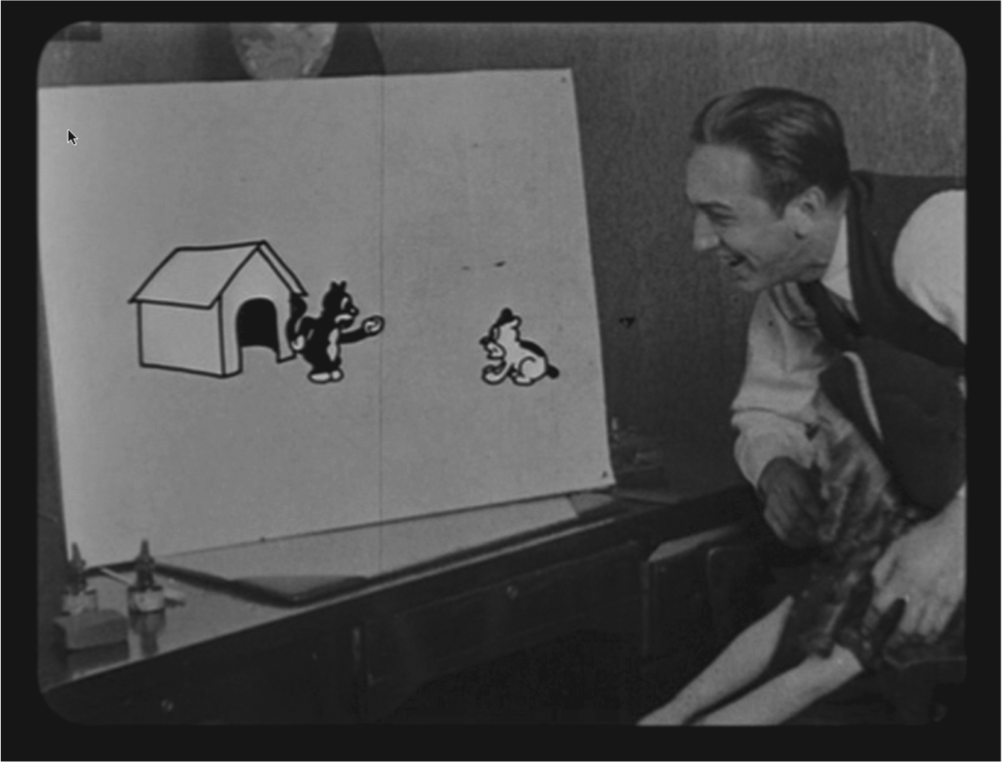
By referencing Lewis Carroll’s perpetually popular heroine, Disney drew a connection between his own work and the canon of children’s literature – especially children’s literature that described self-contained imaginary worlds in detail. First of all, Disney tied his Alice to her 19th-century counterpart in both name and appearance. As Crafton (1982: 284) writes: ‘First Virginia Davis, then Margie Gay, were groomed to resemble Tenniel’s illustrations.’ Indeed, Davis’s long blonde curls and short, full-skirted dress closely resembled the original Alice as Sir John Tenniel illustrated her (see Figure 1; although this Alice does not follow a white rabbit down a hole – instead, she arrives in Cartoonland via train – she does emerge through a door, as in the original book). 3 Secondly, like Carroll’s original story, Alice’s Wonderland used a framing device in the narrative to mark the entrance to and exit from Wonderland. Disney used both a dream frame and the common cartoon trope of an artist’s studio – a little girl visits a cartoon studio, where she sees animated characters cavorting on drawing boards, and when she falls asleep that night she enters ‘Cartoonland’, an animated dream sequence. Alice’s dream is clearly influenced by her studio tour, which depicts the animator’s studio as a kind of wonderland in itself, a place where another world of anthropomorphic characters and comedic action can be glimpsed through drawing board-portals (see Figure 2, in which Disney himself shows Alice the magic of the animator’s art). This reversal of the typical live-action/animation hybridity (exemplified by the Ko-Ko shorts, in which an animated figure crosses into the live-action world), privileges the idea of the animated world as something separate from reality, and less created than accessed by the animators on Disney’s payroll. Despite the framing story, though, the cartoon world Alice enters is represented as being from her own imagination.
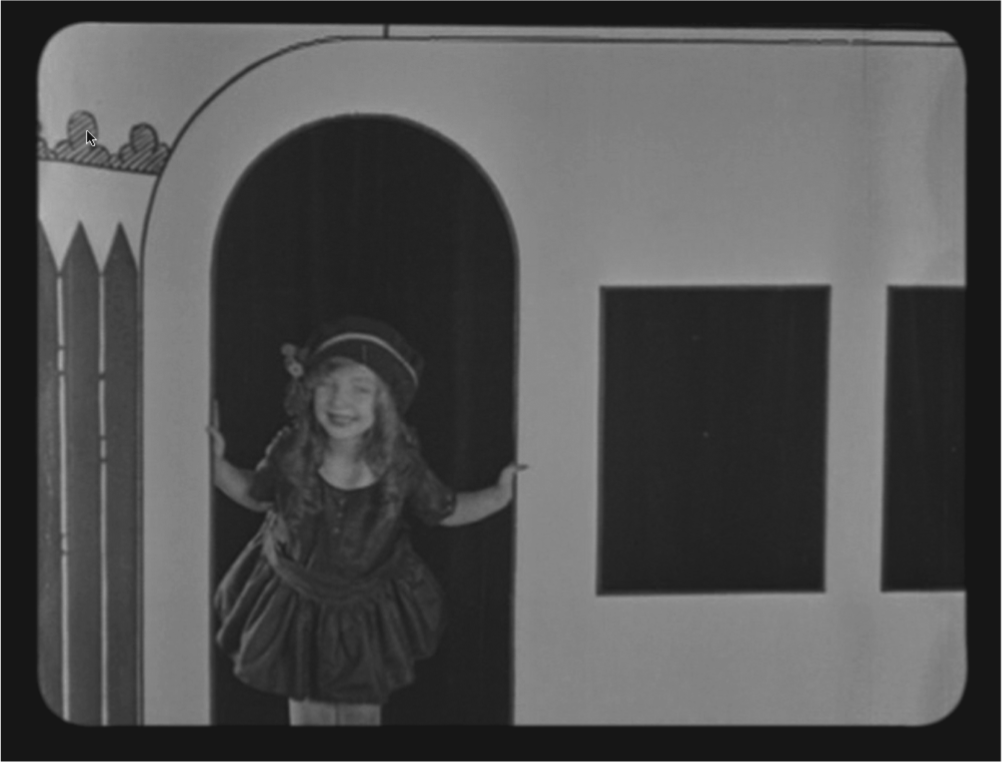
In Alice’s Wonderland (directed by Walt Disney, 1923), Alice (Virginia Davis) wears a full-skirted dress which, along with her long, curled hair, evokes Sir John Tenniel’s illustrations for Carroll’s original book. DVD frame grab from Walt Disney Treasures: Disney Rarities: Celebrated Shorts, 1920s–1960s (2005).
Walt Disney gives Alice a tour of his animation studio, in which various animated scenes appear on easels like portals to another world. Alice’s Wonderland (directed by Walt Disney, 1923). DVD frame grab from Walt Disney Treasures: Disney Rarities: Celebrated Shorts, 1920s–1960s (2005).
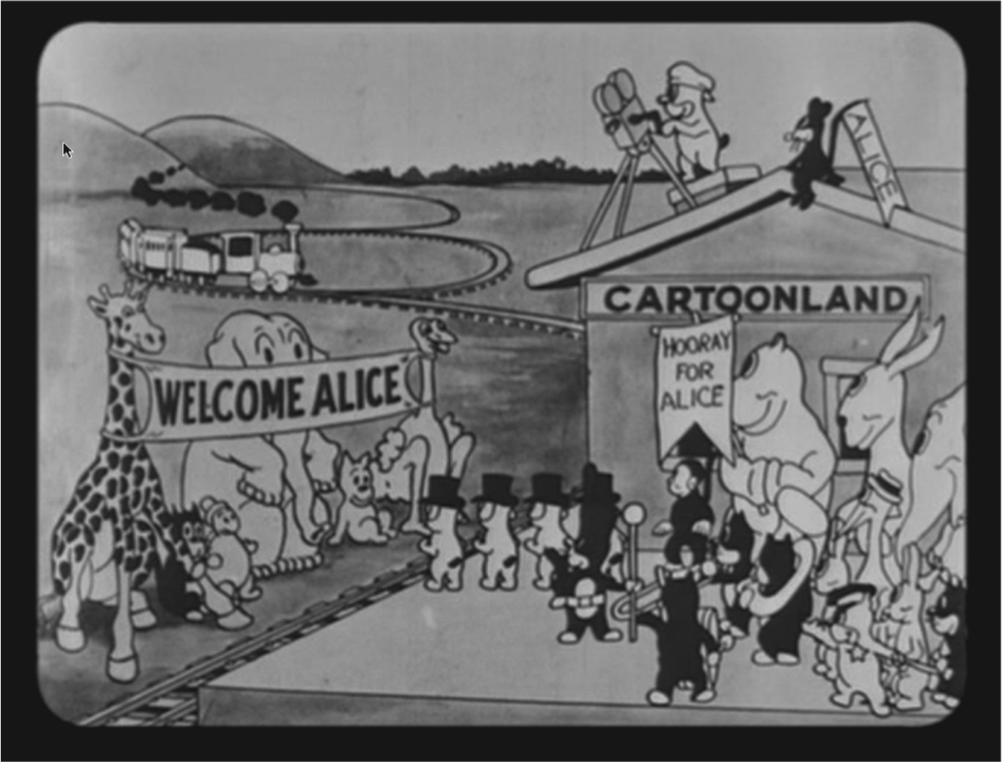
Finally, then, like the original Wonderland, which Carroll suggests was the magical product of the Liddell sisters’ imaginations and his storytelling, Cartoonland is supposed to be Alice’s world. She is clearly the most important character, both in terms of narrative and mise-en-scène. As depicted in Figure 3, she disembarks from her cartoon train like royalty, and a crowd of animals (complete with brass band) greets her with signs reading ‘Welcome Alice!’ and ‘Hooray for Alice’, and there’s even a dog in a director’s cap filming her with a movie camera. Shortly after a parade in her honor, Alice performs a dance for the cartoon animals on a stage, complete with a makeshift proscenium arch and curtains manned by mice (see Figure 4). Her position in the center of the frame, along with the presence of a literal stage, makes prominent the act of self-display, and seems to endorse a desire to perform, to be the center of attention. Later, when chased by lions, she corners them in a hollow tree and fights them barehanded. No one rescues Disney’s Alice; like Carroll’s Alice, she fights her own battles. When she jumps off a cliff at the end of the animated sequence and falls down a hole, she wakes up, eager to tell her mother about what she saw. Interestingly, this is the opposite of the original Alice narrative, where the character’s fall signifies a descent into dream-land and the beginning of the adventures. Disney’s inversion here seems to suggest, however subtly, that re-entering the waking world – boring old reality – actually involves a descent of some kind instead.
Alice enters Cartoonland on a train; the waiting crowd, complete with movie director on the roof of the station, emphasizes her centrality in the animated world. Alice’s Wonderland (directed by Walt Disney, 1923). DVD frame grab from Walt Disney Treasures: Disney Rarities: Celebrated Shorts, 1920s–1960s (2005).

Alice performs center-stage for an animal audience, as proto-Mickey mice hold back the curtain. Alice’s Wonderland (directed by Walt Disney, 1923). DVD frame grab from Walt Disney Treasures: Disney Rarities: Celebrated Shorts, 1920s–1960s (2005).
Although Alice’s Wonderland was only the latest, not the first, film to combine live-action and animation elements on the same plane, the reference to Carroll’s Alice introduced a different dynamic to the animator-animated relationship, and to the relationship between live-action and animated space: one that privileged the subjectivity of the protagonist, and the cultural value of her imaginary world. 4 When Alice, a live-action girl, enters an animated space, that space is implicated in the viewer’s conception of ‘other’ space, just as the presence of a live-action frame and figure inform the viewer’s mental construction of ‘reality’.
But a boundary-crossing figure like Alice also has a specialized ability to define and authenticate a given vision of ‘other’ space. Despite Alice’s live-action status, the animated world she enters becomes even more real by virtue of her presence – not only because of the familiarity of Carroll’s original figure, but also because of the associations between femininity, childhood, and domestic space in society of the time, particularly in the 19th and early 20th centuries. As an innocent, pre-adolescent girl, Alice (both Carroll’s Alice and Disney’s Alice alike) exemplifies a culturally specific set of expectations and ideals.
For one thing, the Romantic ideal of childhood as an almost sacred state of freedom and innocence, so prominent in Victorian culture, had an enduring impact on popular constructions of the child in the early 20th century. During this time, childhood was increasingly examined through a scientific and rational lens, and understood as a time in which mental and physical development were affected by complex external factors, from the tangible threats of streetcars, kidnappers, and crime in urban space to the more abstract dangers of commercialism, the influence of new technologies, and mass culture.
5
But despite the influence of modernity on the lives of children, the Rousseauian vision of childhood as a state of irrational ‘freedom’ continued to be raised as an ideal that might help counter the dehumanizing effects of modernity (see Robson, 2001: 7–8). Julia Mickenberg (2003: 229) writes that essays on progressive parenting in the 1920s, for instance, … suggested that parents trapped in the overmechanized grind of modern times could be liberated by their children, who could teach them a genuine feeling of selflessness and reconnect them with primal experiences so lacking in ‘civilized’ societies … Children, in other words, might hold the cure for ‘a sickness that threatens the spiritual life of the nation’.
6
Gender did factor into the equation, though. Boundary-crossing boys also appeared in popular culture at the time, though not quite as frequently, and not quite in the same way. Pre-adolescent boys who visit other worlds in late 19th- and early 20th-century popular culture typically learn to grow up and to take control of their surroundings and responsibility for their actions. 7 While little boys would eventually leave the nursery and become rational, socialized agents in the public sphere, little girls were expected to become wives and mothers, guardians of sacred, domestic space. Even in Barrie’s Peter Pan, John and Michael grow up in the end, while Wendy (as her mother did before her) again cedes control to Peter, the embodiment of an idealized world of childhood imagination, by allowing her own daughter to be whisked off to Neverland. Barrie, in keeping with prominent ideals of gender at the time, suggests that mothers and daughters maintain this link at least in part because of an inherent feminine connection to emotional and spiritual realms. Even more than that of a boy, the point of view of a little girl connoted a lack of guile, a devotion to the emotional and the imaginary, and a willingness to act as a conduit or guide to other realms.
The fact that Carroll depicts the original Wonderland as the product of a little girl’s reverie, then, allows him to present his own vision of a childhood world as if it came from an unimpeachable source. Likewise, Disney’s interest in nostalgia, in capturing the perspective of the child and a vision of utopia, meant that he didn’t want, exactly, to give independent life to a universe he himself was depicted as creating; instead, he wanted to first establish the authenticity, the authority of his universe as coming from a little girl’s imagination, then make it independent. To make this work, the ‘hand of the artist’ trope was largely absent from the Alice shorts. 8
Disney’s creation of a convincing animated world relied not just upon technological innovation, but upon the use of the Alice figure and narrative, which came pre-loaded with ideological and emotional significance. But these elements by themselves didn’t guarantee that viewers would accept his world. After the first Alice short, the relationship between the live-action world and Cartoonland in the series became even more complex, as the narrative moved farther away from a straightforward Alice in Wonderland retelling and integrated other elements of early 20th-century culture. First, Disney courted audience investment through nostalgic representations of childhood and gender that resonated with contemporary images and ideas about play, gender, consumerism, and the spaces of childhood. As the series continued, though, Disney established a model of performative play in which interacting with the animated world, the world of commodity fetishism and potential utopia, gradually gives way to an acceptance of its reality. In other words, Alice’s role over the course of the series changed as Disney’s confidence in his own implied imaginative authority (or, rather, the audience’s demonstration of their investment in it) overtook the need to use the point of view of a culturally significant little girl like Alice. As Disney refined the internal realism of his animated world and developed the personalities of his animated characters, Alice became nothing more than a figurehead, a reminder of Disney’s loyalty to images of the past, and their ability to temper the harsh, dehumanized present.
Childhood play onscreen
Although Disney certainly attempted to make films that would please children, his work, arguably, had a greater impact on adult audiences; David Forgacs (1992: 363) points out that early Disney cartoons ‘were made not for a children’s or family market – there was no such thing in that period – but for a general audience which included some children’. In addition to the healing power of children mentioned above, animation was often touted as a possible antidote to the over-mechanization of life in modernity. As Kristin Thompson and other scholars have noted, animation and socially constructed notions of childhood have been closely linked since the early days of cinema. Though Thompson (1980: 111) writes that the ultimate result of this connection between narratives traditionally associated with children and the aesthetic form of animation ‘was a trivialisation of the medium’, that very act of trivialization served to open up the genre of animation as a play-space, a place for ideological experimentation. Disney’s animated world, with its mechanical origins, seemed to offer a space of freedom and unpredictability that stood in opposition to the experience of life in modernity, and simultaneously imagined a space for the eventual harmony of human, nature, and machine.
Writing in the 1930s and early 1940s, both Walter Benjamin and Sergei Eisenstein were fascinated with Disney’s animated universe, and especially the idea that animation might offer a vision of a utopian dream-world where the dehumanizing, rationalizing effects of modernity are mitigated – a place where technology and humanity somehow get along. Disney’s efforts in the Alice comedies resonate in particular with the ideas of mimicry and performance that lie at the center of Benjamin’s concept of ‘room-for-play’, or Spielraum (see Hansen, 2004: 3). In one of her many important articles on Benjamin, Miriam Hansen (2004: 6) argues that Spiel, which in German means ‘play’, ‘game’, ‘performance’, and ‘gamble’, allows Benjamin to articulate an alternative mode of aesthetics on a par with modern, collective experience, an aesthetics that at the level of sense perception could counteract the political consequences of the failed – that is, capitalist and imperialist, destructive and self-destructive – reception of technology.
Here, play in the sense of Spiel means more than just entertaining oneself with consumer objects like toys; it also refers to the active, fanciful, creative construction of both space and self. 9 Performing different jobs, different personalities, testing out various identities and even pretending to be inanimate objects – these are fundamental components of childhood play, and Benjamin argues that they function, at least in part, to reinvest the materials of the modern world with the utopian potential we all forget about when we get older (see Benjamin, 1999a: 113–116, 1999b: 117–121). Spiel suggests an aesthetics that mimics the mimicry and performative flexibility of child’s play, and the Spielraum of cinema offered a way to recreate a realm of experience exempt from the strictures of modern life.
The utopian promise of animation also had to do with the freedom of form, or ‘plasmaticness’, as Eisenstein called it, produced through mechanized processes. Indeed, the animated forms in early Disney, and much of early drawn animation in general, can be characterized as ‘plasmatic’ – fluid, metamorphic, anthropomorphic, constantly in motion, and seemingly spontaneous. But the concept of the plasmatic didn’t just refer to the wanton violation of gravity, or the elasticity of animated figures; it hearkened back to a primal period, in which formless blobs of protoplasm could turn into anything. This flexibility of form in Disney’s animated drawings, for Eisenstein, visualized the revolutionary potential that also existed in the early stages of human development, which, according to child psychologists like G Stanley Hall, were reproduced in each and every one of us as we grew from tiny embryos to productive members of society (see Hall, 1904: 206). Following Eisenstein, children, too, could be considered plasmatic beings with limitless potential, ‘not yet shackled by logic, reason, or experience’ (see Eisenstein, 1986: 2).
Through the use of both animated and live-action representations of children and childhood spaces, Disney’s Alice series offered ways for viewers to revel in the nostalgic image of a simpler time. In the early Alice comedies, Disney places emphasis not only on the free-wheeling space of the animated world, but also on the way ‘real’ space could be transformed by children’s imaginations. These live-action sequences centered on particular play-spaces: in Alice’s Wild West Show, Alice and her friends put on a cowboy play on an elaborate stage that appears to be constructed by children out of materials in a shanty town, complete with comically misspelled signs and an orchestra playing pots and pans. Figure 5 shows the detail of the mise-en-scène that emphasizes the creativity and ingenuity of children’s play, and seems to echo Walter Benjamin’s (1996: 408) observation that children ‘produce their own small world of things within the greater one’, using whatever objects happen to be at hand. For both Yi Fu Tuan and Benjamin, children’s perception of space is active, fully in the present, and involves using available materials to convert the immediate environment into not just a facsimile of the world they imagine, but the world itself. 10 Similarly, in Alice and the Dog Catcher, the short begins in the gang’s secret clubhouse, which looks like a repurposed corner of somebody’s shed. Alice’s Day at the Sea depicts Alice with her dog at the beach; when they go and sit in an empty boat on the shore, she falls asleep and dreams that the boat is tossing and turning in a storm. And Alice’s Spooky Adventure takes place in an abandoned house that becomes ‘haunted’ when the children dare each other to enter. In each of these shorts, run-down adult settings are rehabilitated and reborn as imaginative wonderlands when taken over by Alice and her friends.
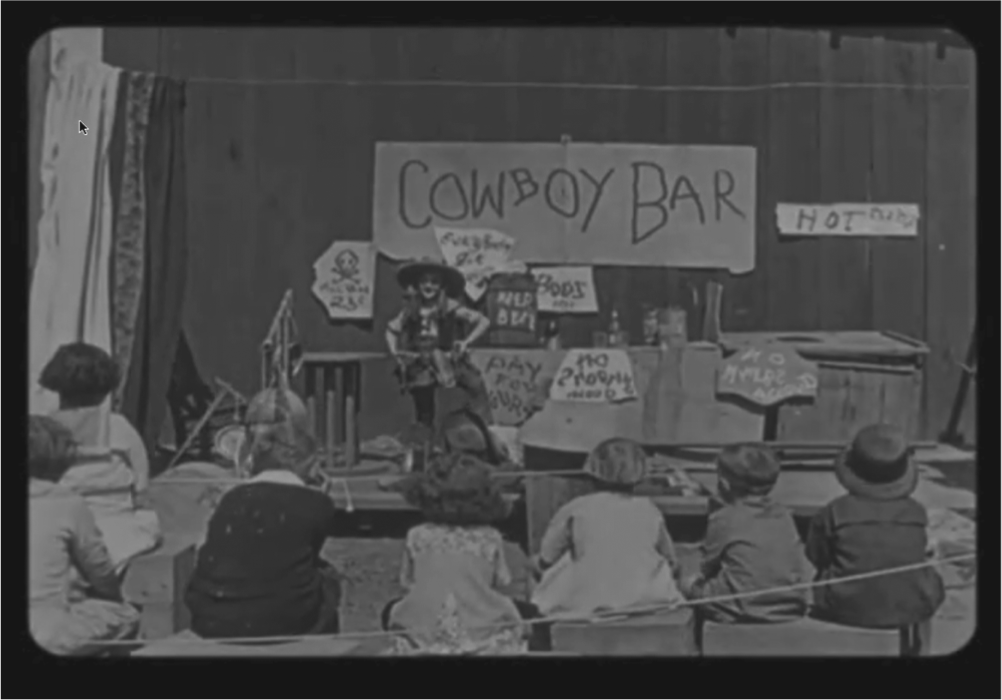
Alice and her friends use available materials to recreate a saloon in the wild west; here Alice poses as the victor of a shoot-out. Alice’s Wild West Show (directed by Walt Disney, 1924). DVD frame grab from Walt Disney Treasures: Disney Rarities: Celebrated Shorts, 1920s–1960s (2005).
Alice and her friends also frequently play outside, suggesting that children transform the natural space around them into something magical. 11 Notably, if the setting where the film begins is attached to adult-controlled institutions – home, school – the live-action and/or animated realm to which Alice escapes is usually associated with nature. For example, in Alice’s Fishy Story, Alice escapes her house, where she is being forced to practice the piano, and runs down to the river with the gang to go fishing. Alice’s cartoon world, too, most frequently consists of pastoral exteriors rather than stifling interiors. In Alice Gets in Dutch, when Alice gets in trouble at school and has to sit in the corner, she nods off and finds herself in an outdoor play-land, dancing with friendly animals. Even when Alice is physically trapped, her imagination is free to run wild.
The concept of oneness with nature as an attribute of childhood perception also manifests itself in the abundance of anthropomorphized animals in Disney animation, and in early cartoons more broadly. Eisenstein observes this, as does Richard deCordova (1994), who writes that tropes of anthropomorphism in children’s media, and especially in the work of Disney, speak to this perceived connection between ‘the child and the world of animals’ (p. 212). Certainly in the Alice cartoons animal characters abound; in general, Alice’s animated friends are animals with human characteristics, and her best friend Julius is a cat. But even in the live-action framing story, anthropomorphism evokes a child’s point of view: a number of live-action segments feature Peggy the German Shepherd, who drives a car (in Alice’s Day at Sea), plays the piano (as in Figure 6, a still from Alice’s Fishy Story; here, Alice has recruited Peggy to practice the piano so that her mother, listening from the next room, is not alerted to Alice’s absence), and wears a secret society mask (in Alice and the Dog Catchers). The dog is a member of the gang like any other; from Alice’s idealized childhood point of view, animals and children exist in the same world, and if a dog can drive a car, then certainly nature, humanity, and technology have all been reconciled.
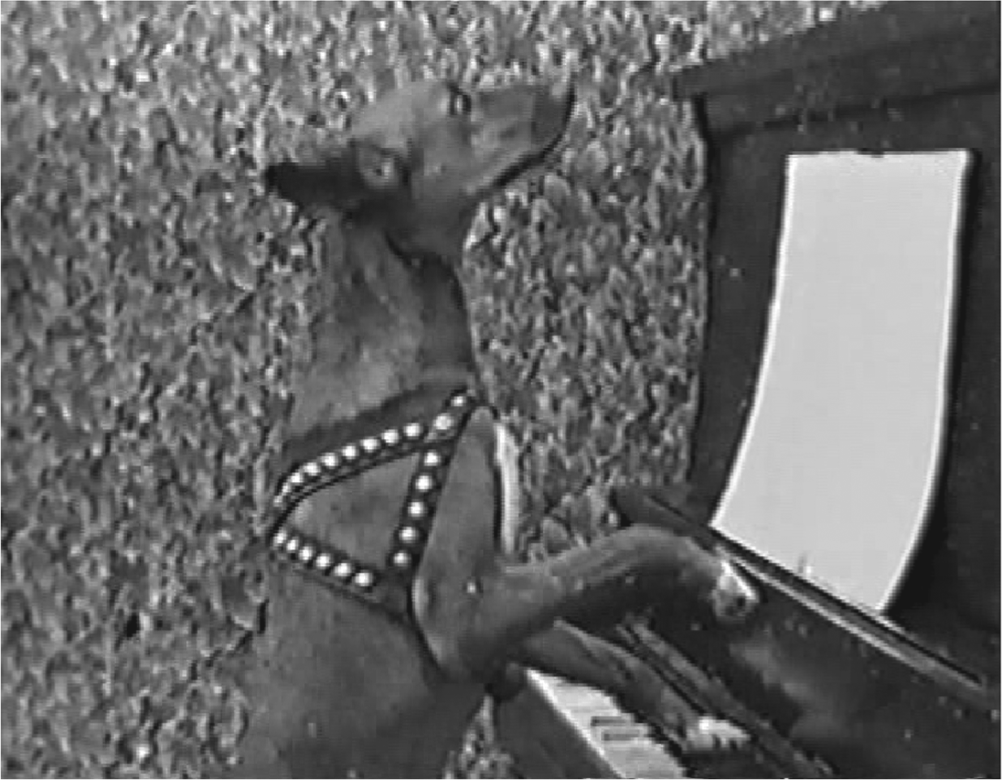
Peggy the German shepherd plays the piano in Alice’s Fishy Story (directed by Walt Disney, 1924) so that Alice and her friends can escape to the fishing hold. DVD frame grab from Disney’s Alice Comedies Vol. 1, Tom Stathes’ Cartoons on Film, 2005.
Pretending
Whether bucolic, built by hand, or otherwise enchanted, the live-action play-spaces represented in the first few Alice comedies offer audiences a reminder of how childhood play and imagination could imbue space with meaning, even if the activities of modern childhood were being increasingly regulated by organized activities, spatial boundaries, and the guidance of authorities and psychological and educational experts. The specific behaviors of play were significant as well, since children were future members of society; as Nicholas Sammond (2005: 361) writes: ‘The twentieth-century generic American child, created as actual children were removed from labor markets, had the new task of self-making, a personalized labor process in which even its leisure time was taken up by productive activity.’ Play was an active process of becoming, and just as Carroll sought to reproduce the ephemeral state of childhood in his original book, so too does Disney attempt to capture children’s exploration of self, image, and environment through media representations.
Alice and her friends’ transformation of everyday spaces into childhood wonderlands speaks to this idea, as do acts of pretending and performance, which are represented in the first few shorts as gateways to an aesthetically distinct world of idealized childhood freedom over which social conventions, even conventions surrounding gendered behavior, hold little sway. Notably, in the early 20th century, paradigms of early childhood development often allowed for gender-neutral play. Victoria Bissell Brown (1992: 244) writes in her study of childhood play in the early 20th century that during their pre-adolescent years, ‘girls were allowed to run and tumble. These were the years when tomboyism was acceptable, when, according to the then popular theory of child development, boys and girls were still basically alike.’ Throughout the teens and early 20s, this model of early childhood was still prevalent, with a catch; as long as girls recognized that eventually they would have to put their hair up and stop playing in the mud, a degree of free play was acceptable. This was reflected in popular cinema; for instance, as Gaylyn Studlar (2002: 350) points out, Mary Pickford often played spunky, tomboyish adolescents, though these characters typically grew more traditionally feminine over the course of each film.
This convention and its post-adolescence caveat came through clearly in the earlier Alice comedies, in which Alice bosses around a battalion of little male rascals. Her costume makes her gender clear, and yet she seems to be ‘one of the guys’, even tougher than the rest of them. Furthermore, much of Alice’s agency over the course of the series comes from living out fantasies of self during the act of imaginative childhood play. The titles of the shorts reveal the broad range of professions Alice tries out: Alice is a firefighter, a lumberjack, a hunter, a farmer, a toreador, a hot-air balloon pilot, a whaler, an army commander … each short allows her to step into a role, at least briefly. Before adolescence, Alice is permitted to explore different notions of agency in the context of play – and even more so in her own animated imagination.
Imagination, in Alice’s world, can also compensate for frustrating impotence in the face of authority: in Alice Gets in Dutch, the narrative revolves around the dream Alice has when she gets in trouble at school and has to go sit in the corner. When she nods off, her adventure in Cartoonland takes the shape of a revenge fantasy, in which she and several animal friends battle and defeat a cartoon version of her teacher (complete with horns) and her minions (three anthropomorphized books). This short, along with several others that include moments of escaping authoritative supervision (Alice climbs out her window; Alice escapes piano practice; Alice runs from the cops but gets caught), suggests a commentary not just on mechanized daily life, but also on mechanized childhood. After all, any good story needs a villain and, as many scholars have noted with regard to early Disney cartoons, Disney loved narratives of underlings triumphing over evil tyrants (Merritt and Kaufman, 1993: 22). Within the animated world, Alice lives out dreams of retribution and heroism, even if in the live-action framing story, she oscillates between enjoying free, unsupervised play with her buddies and experiencing the harsh reality of being a kid, subject to controlling authorities. An idealized world of childhood freedom is represented here as an animated realm to which children can escape – even if the regulation of childhood continues apace, these films seem to say, children will find a way to preserve the irrational spaces of imagination. But even further, Disney’s narrative trajectory implies, the world of animation might offer a visible approximation of this irrational space that everyone, not just children, can access.
Performance
As noted earlier, much of Alice’s agency over the course of the series comes from living out fantasies of self within her own world – both the live-action and the animated world – in the context of play. And above all, play here is associated with acts of pretending, performing, and storytelling. Alice performs in her cartoon world, in her live-action world, and connects the two by storytelling – she shares her imagination with others, performing a mediumistic function.
Naturally, since Cartoonland is supposed to be Alice’s imagination, she is the center of attention in the animated world, often dancing and singing for an audience of animal friends, but in the first few Alice shorts she seems to be master of her real-life circumstances as well. The central importance of Alice’s ability to perform becomes even more evident when watching these live-action segments, in which the gang, and especially Alice, addresses an audience. More specifically, Alice often acts as a storyteller, recalling or even acting out her experiences in the cartoon world for people in the live-action world. Whether figured as a dream, an actual experience she had, or a story she’s telling, her descriptions of Cartoonland motivate the narrative’s transition from live-action to animation, and establish her as a mediumistic figure who can use that power to influence others.
For example, Alice’s Wild West Show has an elaborate live-action framing story; her entry into Cartoonland occurs as a flashback while she tells a story to an assembled crowd of children. For this Annie Oakley-type show, Alice and her cohort perform an overture (Alice is the conductor) and a shoot-out in a cowboy saloon (Alice wins; see Figure 5), but she gets the stage to herself when a gang of bullies shows up. She smiles prettily as she figures out how to entertain the crowd, then as she begins telling her story, the short cuts to an animated chase between cowboys and Indians, with live-action Alice at the center of the action. The film ends with Alice back in the ‘real’ world, beating the head bully up for daring to boo her; in the last shot, she grins at the camera, displaying her missing two front teeth (see Figure 7). The medium close-up of her moment of triumph reinforces Alice’s role as the center of the action, as well as the presentational aesthetic – Alice performs for us as well as for the children depicted within the live-action frame. This is important – not only is the animated world a product of Alice’s imagination, but she also shares it with others, connecting viewers to an imaginary world through the process of storytelling.
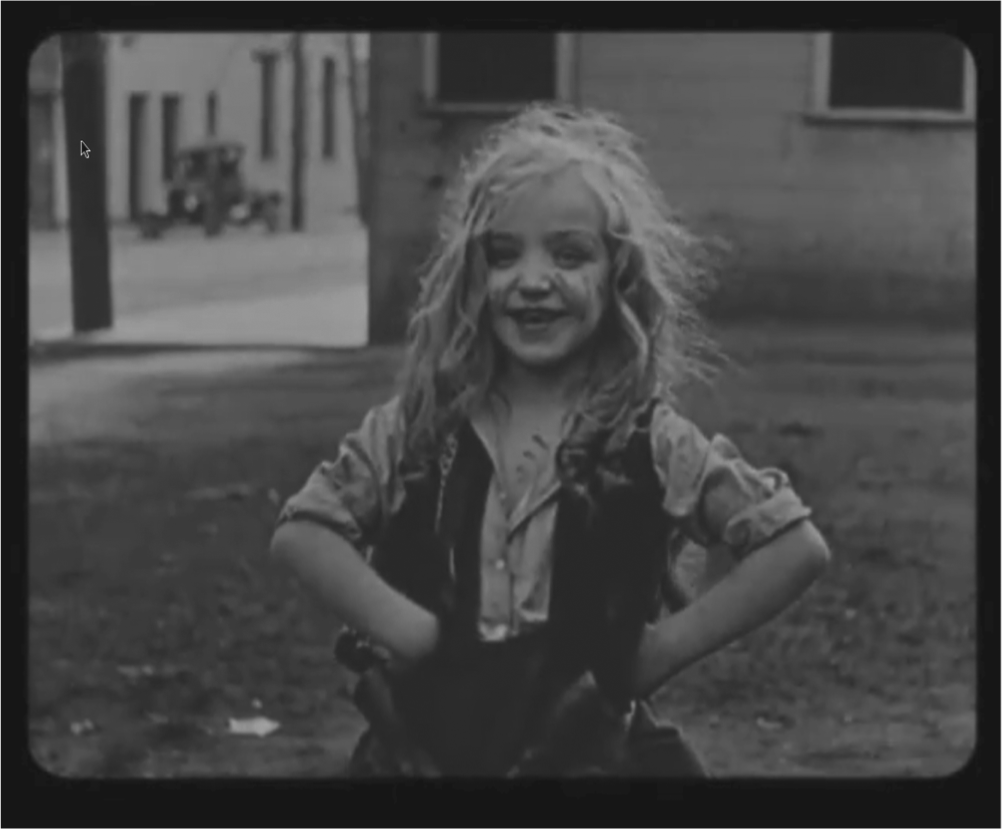
In the last shot of Alice’s Wild West Show (directed by Walt Disney, 1924), just after her successful defeat of a bully in a fistfight, Alice shows off her missing front teeth. DVD frame grab from Walt Disney Treasures: Disney Rarities: Celebrated Shorts, 1920s–1960s (2005).
Alice and the Dog Catchers also features a significant live-action framing story. The film opens on the ‘Sekret Klub of the Klik-Klaks’ (a circle of children with paper bags over their heads). 12 Alice sits regally on a platform, being fanned by two real-life minions, and calls the meeting to order. When one of her friends arrives with the news that dog catchers are on the prowl, Alice tells her friends about last night’s dream trip to Cartoonland, which involved those very villains. The rest of the short is live-action, but Alice’s act of storytelling – illustrated, as in earlier shorts, with an animated sequence – has been central to the narrative, as her descriptions of canine suffering motivate the children into acting in real life. Disney’s emphasis on Alice’s command of ritual, spectacle, and performance suggests that successful mediumship is all about presentation and savvy self-display.
This focus on performance and spectacle continued in altered ways throughout the course of the series. While the live-action framing stories largely disappear, the idea of display remains important within the animated world. For instance, in Alice’s Egg Plant (1925), Alice and Julius come up with a scheme to outwit their chickens, who are on strike (thanks to the propaganda of a communist hen) and refuse to produce eggs. 13 They decide to stage a prizefight between roosters, charging one egg apiece for admission. None the wiser, the hens all come and lay an egg each, allowing Alice to fill her order. Here, Alice plays a crucial role in providing the sort of entertainment (focusing on spectacles of the body) that will distract the workers from revolting. As a figure of social and technological adaptation, Alice demonstrates how popular culture can both pave the way for change (after all, this is a cartoon about a strike) and negotiate it in such a way that material production continues with nary a blip – not unlike Disney’s modus operandi in general.
Alice gets eclipsed
As the series continued, Alice’s role as the audience’s guide into a Spielraum of idealized childhood shifted in response to both popular images of femininity and Disney’s faith in the popularity and self-contained realism of his animated world. Her tomboyishness, at least as the series began, gradually gave way to a benign, vacant prettiness, and the scenes in which she presides over a group of children became fewer and farther between. So far, I have emphasized the earliest Alice cartoons, because, on the whole, they offer the most substantial live-action framing stories. There are exceptions: in Alice Is Stage Struck (1925), for example, Margie Gay and her friends put on a version of Uncle Tom’s Cabin in the first part of the short, and Alice’s entrance into Cartoonland is triggered by head trauma. But in general, the Alice comedies produced in 1924 take greater care in establishing a narrative connection between ‘reality’ and Cartoonland – the transition from live-action to animation is motivated by action in the real world.
In 1925, Davis (whose parents refused the renewal of Davis’s contract, since it greatly reduced her role and pay) was replaced first by Dawn O’Day (later known as Anne Shirley), who appeared in Alice’s Egg Plant (1925), and then Margie Gay, who starred in 31 shorts from 1925 to 1926. The last Alice, Lois Hardwick, appeared in only 10 cartoons. Crafton (1982) writes: These girls … might have looked somewhat like the original Alice in Wonderland, but there the similarity ended. Whereas Carroll’s little girl was the aggressive protagonist of the adventures, Disney’s Alice tended to watch the action in her animated wonderland, reacting with histrionic gestures. (pp. 284)
In contrast, Douglas Brode (2005: 11) sees Disney’s Alice as a feminist figure who ‘extricates herself from the latest difficulty … If anything, she emerges stronger as a result of solving its problems on her own’. In fact, both scholars accurately describe the series in different phases of its production. Like Carroll’s original Alice, whose wild, nonsensical adventures in the first book gave way to a prescribed, socially-ordered path (a giant chessboard) in Through the Looking Glass, Disney’s Alice starts off spunky and tapers off into flirty but ineffectual.
Early on, Alice saves the day repeatedly but, as the series progressed, she often has to be rescued herself, and/or she participates in the saving of others only by hailing Julius, who does the actual rescuing. An early turning point comes with Alice and the Three Bears in late 1924, the tenth episode of the series, and the second without a live-action frame. In this short, Disney spoofs The Perils of Pauline serial shorts (1914): the bears capture Alice, trap her in a bag, and tie her to a log on a conveyor belt in a classic damsel-in-distress scenario. Before the obligatory buzzsaw at the end of the line chops her in two, though, Julius comes to her rescue. In the last scene, Alice says, ‘My HERO’, then kisses him on the mouth as the film ends (see Figure 8), the heart that appears above their heads, in addition to the drops of sweat and/or tears emanating from their entwined forms, exemplifies Alice’s capitulation to a traditional gendered scenario, which contrasts her behavior in the earlier shorts.
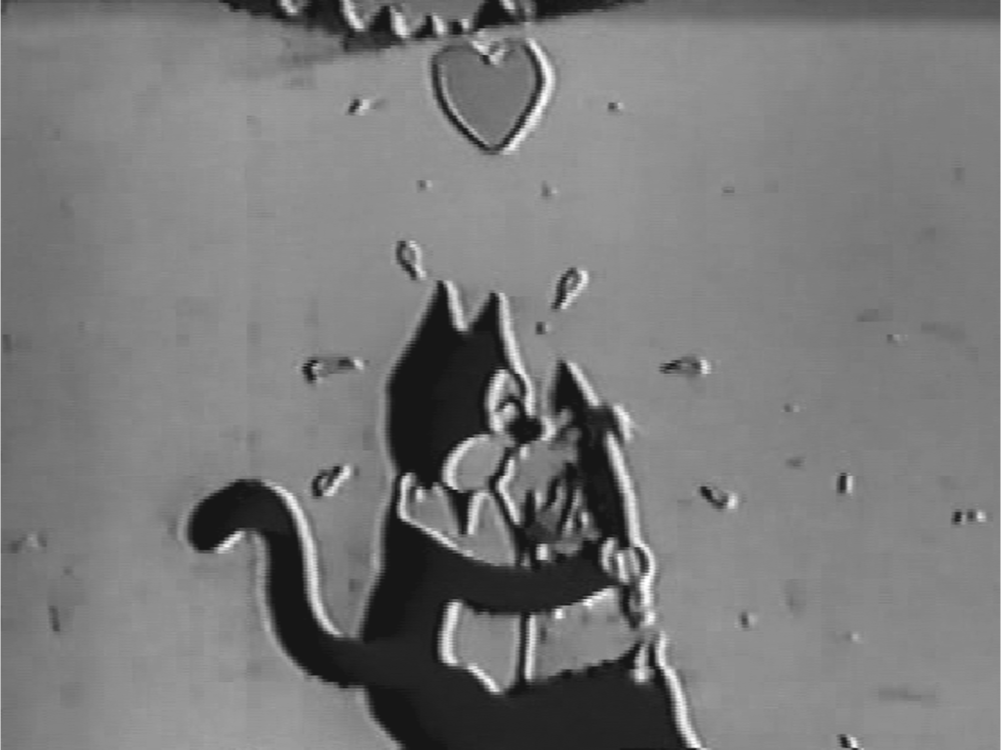
After Julius the Cat rescues her from the villainous bears in Alice and the Three Bears (directed by Walt Disney, 1924), Alice rewards him with a surprisingly romantic embrace. DVD frame grab from Disney’s Alice Comedies Vol. 1, Tom Stathes’ Cartoons on Film, 2005.
In the second series of the Alice comedies, after Margie Gay took over Davis’s role, even the live-action framing stories demote Alice to the role of damsel in distress: in Alice Gets Stage Struck, Alice’s role in Uncle Tom’s Cabin is a far cry from Davis’s tough sheriff in Alice’s Wild West Show. Instead, Margie Gay’s Alice plays Little Eva, the girl Tom rescues from drowning in the Mississippi. The animated story picks up in the same vein, with Julius defending Alice from an evil-looking, mustache-twirling bear. Alice escapes into a cabin, and for most of the rest of the short she stays there, allowing Disney’s animators to put the animated cabin in jeopardy without having to insert the live-action Alice into the frame (the animated bag in Alice and the Three Bears functions in much the same way).
The later Alice does far more primping and standing around looking pretty, and the implication seems to be that with ostensible ‘liberation’ of women comes a great deal of obsession with self-image. The 1920s brought a widespread enthusiasm for elements of consumption previously denied to women (alcohol, cigarettes), and fashion didn’t miss a beat in selling ‘liberated’ American women the tools to create their new self-images. Disney, whose target audience included not just morality-minded families but the young, trendy crowd as well, had his finger on the pulse of popular culture: if Davis embodied the spunky innocence of Mary Pickford, so popular at the outset of the 1920s, by the mid-1920s Pickford faced competition from new images of femininity. The new Alice, Margie Gay, whose dark bob and bloomer onesie connoted pint-sized flapper-dom (especially the actress Colleen Moore), embodied a newer, bolder, more fashionable femininity – a femininity that demonstrated the willingness for self-display and even self-marketing. Alice even wears a new one-piece bathing suit (according to Brode, she was the first American female to do so on film) in Alice Solves the Puzzle (1925). Figure 9 depicts her runway walk and Julius’s reaction; in the last moment of the sequence, Julius looks directly at the audience with an expression that verges on the wolfish. Brode (2005) spins this in more positive terms: he insists that the Alice shorts present a startling set of attractive possibilities for women in the brave new social landscape of post-World War I America. If the Fleischers suggested that inside every seemingly sophisticated flapper there beat the heart of an overgrown child [Betty Boop], Disney conversely implied that inside every supposed female child, there existed in embryo an intelligent and capable woman, eager to emerge. (p. 170)
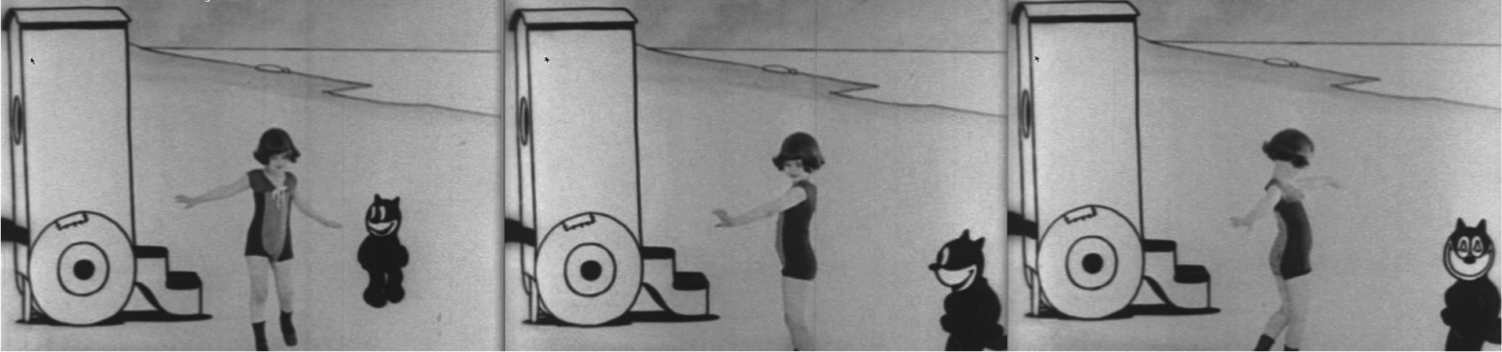
Alice (Margie Gay) shows off her one-piece bathing suit for the obvious admiration of Julius the Cat in Alice Solves the Puzzle (directed by Walt Disney, 1925). DVD frame grab from Alice in Cartoonland: 35mm Collector’s Set, Kit Parker Films, 2007.
And yet the later Alices, for the most part, lack the ability to effect change that characterized Davis’s Alice. She still seems bossy throughout the series; in the animated world, she stands in one place, points, and sometimes the all-caps intertitles denote that she’s yelling. But in later episodes, she acts more as a figurehead. Although the shorts’ titles continue to emphasize Alice’s stardom (it is Alice the Firefighter, Alice’s Tin Pony, and Alice in a balloon race, or as a general, or as a whaler), and she dresses up in the outfits to go along with each role, she doesn’t actually participate in much of the action. It is Julius who actually saves animals from the burning building, fights the bandits, or competes in the balloon race.
In other words, the live-action aesthetic – Alice – gradually became more subservient to the animated, rather than the other way around. For one thing, as the series progressed, Disney and his animators relied more and more on an animated image of Alice, rather than a photographic one, especially during chase scenes. In Alice’s Wonderland, Disney went to the trouble of animating the actual photograph of Virginia Davis, but in many of the later shorts, an extreme long shot is substituted – Alice’s tiny size in these shots makes her change into an actual animated figure less obvious. The live-action framing stories, which featured a sassy Alice demonstrating her mastery over her ‘real’ – in addition to animated – surroundings, largely disappeared after the first series of shorts. The abandonment of the live-action framing was a point of contention between Disney and Margaret Winkler, who wanted to keep it for the sake of product differentiation but, as Disney became more successful, he was able to hire enough animators to develop his animated characters in more detail, and render the live-action scenes unnecessary (Merritt and Kaufman, 1993: 68).
In a 1946 interview, Disney stated that Alice in Wonderland … fascinated me the first time I read it as a schoolboy and after I started making animated cartoons, I acquired the film rights to it. Carroll with his nonsense and fantasy furnished a balance between seriousness and enjoyment which everybody needed then and still needs today. (quoted in Korkis, 2010: 157)
Disney’s reference to balance suggests that he saw a reconciliation between the rational and irrational in Carroll’s writing – something a great number of Carroll scholars would likely agree with – which corresponded to the kind of imaginary worlds he wanted to create. Carroll’s Wonderland was an ideal template: plasmatic before the existence of animation, enchanted by the subjectivity of a pre-adolescent girl, and haunted by its creator’s nostalgia, Alice in Wonderland laid the groundwork for Disney’s own monumental impact on popular culture.
Over the course of the Alice comedies, Disney’s trust in the power and authority of his own imaginary world developed more clearly into the self-contained, realistic-unto-itself aesthetic that became a major hallmark of Disney animation. It seems strange to insist upon the plasmatic world of Cartoonland as a harbinger of Disney’s obsession with realism in animation, but his rejection of the ‘hand of the artist’ trope in favor of emphasizing Cartoonland as a world with its own, independent reality speaks to his desire to elevate his own imaginary world to a universal status, on par with reality.
Alice’s presence in the cartoon world is what accomplishes this; she begins as equal or even superior to the animated characters in terms of screen time and the ability to drive action but, as time goes on, they overtake her. As Disney’s interest in fleshing out animated characters in an animated world grew, his desire to contextualize animation, give it a legitimizing live-action frame, decreased. And without the framing story, it is difficult to see that this is Alice’s world: her dreams, her storytelling. What began as Alice’s own personal dream- or story-world, marked as such by the narrative of the live-action frame, morphed into a more universal imaginary world, in which Alice’s role was de-centered and her explicit authorship of the world was taken away. Though Virginia Davis’s Alice seems to control her own circumstances, Margie Gay’s Alice is a pawn in her own imaginary world. Alice became the main character in name only; this was now the Julius show.
As Alice was phased out of her own eponymous series, other, more trickster-like characters took center stage: Julius the Cat gave way to Oswald the Lucky Rabbit, then Mickey. In creating dream-worlds for mass consumption, Disney took responsibility, as did Carroll, Barrie, and Baum, for naming and describing ‘other’ worlds out of the hands of those to whom they’d previously given it – women, children, and primitives, who, as popular discourse had it, were closer to all things emotional, spiritual, or mystical. Instead, the naming and describing occurred on a mass scale, and, most importantly, happened in service of the marketplace. Alice’s presence in Disney’s first hit series encouraged audiences of all ages to invest in the hermetic reality of an animated world, and trust Disney’s creative authority as the producer of that world. But as the series continued, Alice’s role as the audience’s avatar in an imaginary world became less necessary. Disney’s animated world transcended the realness of a live-action girl: he achieved a synthesis between nature and technology, turning a technological world of his own making into a new nature. In other words, he naturalized his technologically produced landscape, teaching his audiences to accept his personal imaginary world as a common, universal one. And once Disney’s dominion was established, Alice was no longer needed.
Footnotes
Acknowledgements
This article grew out of my dissertation research in the Screen Cultures program at Northwestern University, as well as presentations I gave at the Chicago Film Seminar in 2010 and the Society for Cinema and Media Studies in 2013. I would like to thank Mimi White, Jeffrey Sconce, Scott Curtis, Susan Ohmer, Pamela Robertson Wojcik, Alla Gadassik, and Megan-Brady Viccellio for their insights and suggestions on this and my broader project.
Funding
This research received no specific grant from any funding agency in the public, commercial, or not-for-profit sectors.