



Abstract
Scalar travel documentaries and their adaptations in interactive media present animated models of the body’s interior and the physical worlds at a variety of scales. Featuring increasingly comprehensive animated images at microscopic and macroscopic scales, they help scientists better understand the structure of the universe. This article examines the poetics of scale and the diverse rhetorical mechanisms used in these documentaries. In Powers of Ten and Cosmic Voyage, for instance, the metronomic overview of the underlying organization of the natural world generates ideological discourses on the position of humankind in the universe. The mechanical gaze these films produce, it is argued, reveals the instrumentality of new modes of knowledge and the posthuman nature of our perception. Finally, comparing the various ways with which scalar documentaries animate scientific models, this article suggests that the visions of the natural world these films construct should be more reflexive of the limits of representation at the edge of the knowable.
Keywords
Introduction
The 20th and 21st centuries have witnessed the emergence of animated representations of life and the universe at a variety of scales. Early time-lapse microcinematography amazed cinemagoers with images of moving microbes and cellular development (Landecker, 2005). 1 Cel animations and computer visualizations have also been popular methods for teaching the biology of the human body and depicting scientific progress about the atom. The educational series Disneyland (1954–1958), for instance, travels through scales of magnitude to teach audiences about the evolution of life. In an animated sequence from the episode ‘Mars and Beyond’ (1957), the camera progressively zooms out from a carbon atom to reveal groups of cells arranged like planets in the cosmos. 2 Alternatively, the animated TV series Il était une fois… la vie (1987) 3 associates the exploration of biological processes occurring in the human body with space travel and tourism. Recent developments in 3D computer-generated animation and interactive media invite immersive engagements with animated models of biological processes and micro-organisms. 4 Animation technologies 5 in scalar documentaries, as I argue in this article, extend our reach and the boundaries of the body while enhancing knowledge of the limits of life and the universe.
The animated models of the body’s interior and the physical world featured in the hybrid documentaries Cosmic Zoom (Eva Szasz, 1968), Powers of Ten 6 (Charles and Ray Eames, 1977) and Cosmic Voyage (Bayley Silleck, 1996), zoom out to the edge of the universe, and then speedily return to the microscopic scale, traveling through cells and the sub-nuclear realm. 7 These scalar travel documentaries simulate movement in depth by using a range of animation techniques, including animated drawings in Cosmic Zoom and 3D computer-generated sequences in Cosmic Voyage.
This article specifically examines the rhetoric of scale in animated documentaries featuring animated models of the universe (and their adaptations in online interactive media) and in practices of nano-imaging. Scholars have suggested that visualizations of the gene in cinema (Stacey, 2010) and representations of cosmic landscapes in science fiction films (Bukatman, 1995) may reflect various reactions to technological changes in our society. As I argue, scalar documentaries not only produce increasingly wide-ranging information about the microscopic and the gigantic but also generate ideological discourses on the position of humankind in the universe and echo ever-changing speculations about the underlying organization of the natural world. An examination of the rhetorics and modes of production of scalar travel documentaries notably reveals the instrumentality of new modes of knowledge and the posthuman nature of our perception. This investigation also demonstrates that cutting-edge visualization techniques in these documentaries, including 3D computer-generated animation and computer simulations, produce more detailed representations of the structures of the universe. However, despite an enhancement at the level of form, these documentaries do not sufficiently inform viewers about the limits of the scientific models that they depict.
Models of the natural world
Ever since the appearance of the popular documentary The Sinking of the Lusitania, made by the animator Winsor McCay in 1918, and Dziga Vertov’s Man with a Movie Camera (1929), animation has frequently been used in documentaries of all kinds. 8 Animation plays ‘a role in the classic expository documentaries of Britain in the 1930s, in educational documentaries shown to many children in school throughout the years, in the impressive modern nature documentaries of BBC Bristol, and other contexts’ (Strøm, 2003: 49). In the scalar travel documentaries Powers of Ten and Cosmic Voyage, animation is a means to generate models of the motion of natural phenomena that cannot be photographed because of their extremely large or extremely small scales and to provide a dynamic vantage point over the multiple structures of the universe. 9
As with other types of models, an animated model represents properties ‘of the real or imaginary thing for which it stands’ (Black, 1962: 220). Philosopher Max Black (1962) separates models into different kinds, including scale models, analogue models and theoretical models. The animated models about the structure of the atom, the gene, the cell, the solar system, and galaxies found in Powers of Ten and Cosmic Voyage hybridize these different types of models. However, unlike models intended for specialized scientists, the properties of which are expected to conform to theory in terms of shape, structure, and behavior, animated models in scalar travel documentaries are less precise, in part because their function is to both entertain and provide scientific information to a general audience.
Compared with the schematic images in the animated film Cosmic Zoom, visualizations of the natural world and the body’s interior in Powers of Ten and Cosmic Voyage show an increased interest in minute details and tri-dimensional rendering (in the case of Cosmic Voyage). In Powers of Ten, images representing a white blood cell, inspired by those produced by a scanning electron microscope, notably provide detailed information about the texture of the cell’s surface (Morrison et al., 1982: 80) (see Figure 1). The emergence of new forms of design may be triggered not only by variations in the modes of production, here the advent of electron microscopy and photorealist computer imagery,
10
but also by changes in the preferred properties of a model and in the expectations of targeted audiences. Yet even models that conform to systems of scientific explanation are not exempt from aesthetic conventions.
11
In their exploration of the concept of objectivity in scientific representation, science historians Lorraine Daston and Peter Galison (2007) identify key epistemic virtues that emerged at distinct historical moments, including ‘truth-to-nature’, ‘mechanical objectivity’, and ‘trained judgment’. The drawings of plants made in the 17th and 18th centuries were examples of the ‘truth-to-nature’ approach; they reflected Romantic nature philosophy’s ‘pursuit of an unattainable ideal form’ (Ritterbush, 1968: 11). In contrast, the proponents of mechanical objectivity in the 19th century used images generated mechanically because such images were less prone to the errors introduced by the earlier image-makers. In the 20th century, as a reaction to the limitations of practices inspired by truth-to-nature philosophy and mechanical objectivity, a new epistemic value based on the trained judgment of scientists emerged. Instead of identifying a type for a class or mechanically capturing the empirical properties of a phenomenon, scientists in the 20th century used experienced judgment to determine family resemblances within series of scientific images that documented a particular phenomenon, such as brain scans of healthy brains or images of galaxy formations. These objective approaches to image-making all sought a faithful representation of nature. Yet, as Daston and Galison (2007: 363) argue: Although they may sometimes collide, epistemic virtues do not annihilate one another like rival armies. Rather, they accumulate: truth-to-nature, objectivity, and trained judgment are all still available as ways of image making and ways of life in the sciences today.

Image of a lymphocyte in Powers of Ten. Screenshot from the DVD of Powers of Ten (Charles and Ray Eames, 1977).
These various methods for modeling natural phenomena inform the scalar travel documentaries studied; they also help explain the rhetorical appeal of scientific models as well as their limitations.
Models, indeed, are not theories; they can only document certain properties of the original. As Charles Blilie (2007: 89) argues, models are at the crossroads between theory and experiment. Whereas a scientific theory attempts to ‘represent’ all aspects of the scientific system it defines, models are much more limited in scope. For example, ‘J.J. Thompson’s “plum pudding” model did not explain the atom; it only described certain observed features of it (i.e. the fact that it had electrons in it, bound together by some sort of positively charged field)’ (p. 93). 12 In other words, a scientific model uses a medium to represent certain aspects of general laws and thus communicate information about a theory.
When Powers of Ten depicts the DNA structure of a white blood cell and the structure of the carbon atoms within the cell, it only provides visual information about these structures. The panoply of chemical reactions involved between the cell and its environment is not part of the condensed information provided to viewers. Moreover, because these films do not provide information about their modes of production, the scientific validity of the images shown is relative. For instance, the images produced by a scanning electron microscope can be considered ‘scientific’ because there is a relation of cause and effect between object and image. In contrast, the pattern of colorful dots moving randomly inside a sphere standing for a proton can only convey an approximation of the dynamic properties of the particles composing it; because it is not deduced from theoretical formulas or empirical data, this representation is only ‘an abstract symbol of the physics we just begin to comprehend’ (Morrison et al., 1982: 101) (see Figure 2).
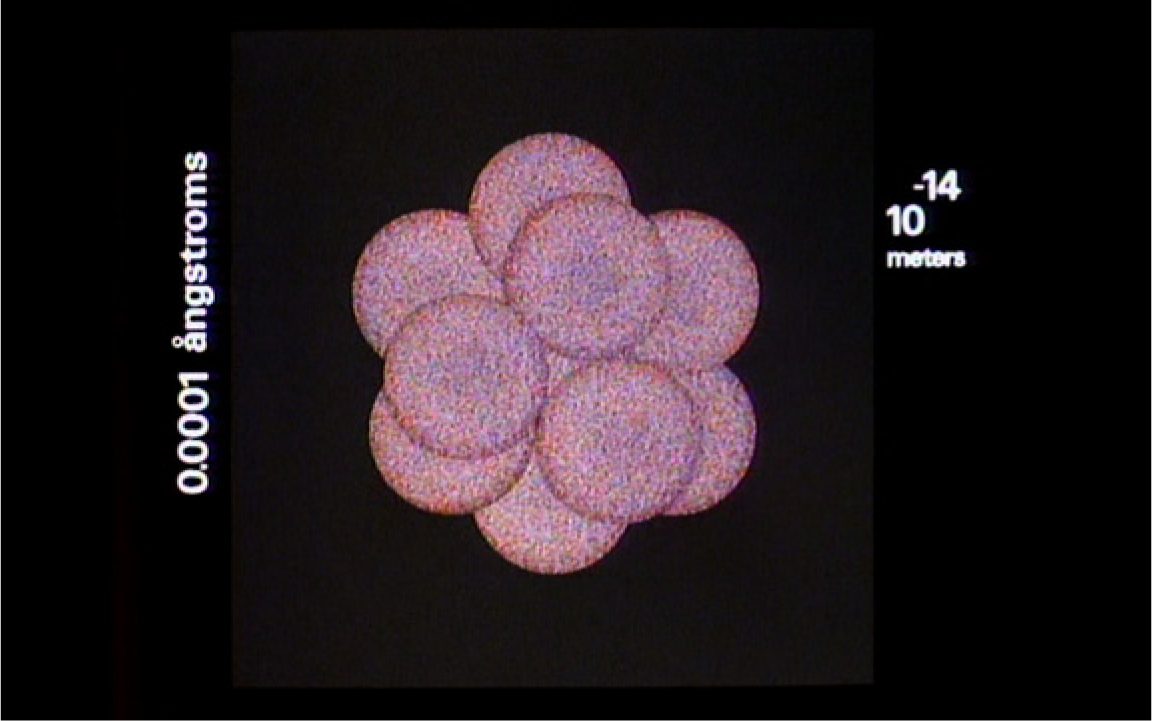
Animated model of the six protons and six neutrons found within the nucleus of a carbon atom in Powers of Ten. Screenshot from the DVD of Powers of Ten (Charles and Ray Eames, 1977).
The rhetoric of scale and animated models in scalar travel documentaries
Many authors and filmmakers have used scalar imagery to convey their worldviews (Hsu, 2010; Stewart, 1993). Among them, Kees Boeke, whose book Cosmic View: The Universe in 40 Jumps, published in 1957, provided inspiration for the films Cosmic Zoom, Powers of Ten, and Cosmic Voyage. The schematic rendering of the illustrations in this educational book, recalling the truth-to-nature approach, includes references and notes about microscopic life, atomic elements, and galaxy formations. Cosmic View also accompanies the images with textual rhetoric to promote a humanistic ethics. In its conclusion, Boeke invites his readers to ‘think in cosmic terms’ (p. 48). To behave responsibly, he claims, one has to ‘realize that man, if he is to become really human, must combine in his being the greatest humility with the most careful and considerate use of the cosmic powers that are at his disposal’ (p. 48).
Scalar travel documentaries
Various techniques in the scalar documentaries inspired by Boeke’s book contribute to the creation of models of the natural world and to the promotion of a particular worldview. Camera technique and image composition, for example, can influence the viewer’s interpretation of the scalar journey. 13 Rhetorical strategies can modulate spectators’ embodied responses and emphasize ideological discourses by drawing on their dispositions and their knowledge of filmic conventions. In brief, the formal conventions promoted by specific media and the affective patterns they trigger thus combine in ways that influence the viewer’s experience and understanding of the animated models.
The scalar travel documentaries discussed use different types of scientific modeling and modes of realism to convey their messages. They inform viewers with animated scientific models that are both objective and visually appealing. Because of their audio-visual natures, they can also guide the interpretation of the scientific models on display with an auditory commentary. Unlike the static images found in Boeke’s book, animated scalar models can provide information about the motion of objects ‘that are impossible to film in live action’ (Roe, 2011: 217). For instance, animation is well suited to choreograph complex camera movements, combine various perspectives within the same frame, and set colorful graphics in motion to reveal the essential features of a complex phenomenon.
The production of space at various scales in scalar documentaries also elicits a variety of affects from viewers. As Hsuan Hsu (2010: 19) argues, ‘spatial scales ground feelings such as nostalgia, love, patriotism, or cosmopolitan enthusiasm; conversely, these feelings shape people’s experiences and expectations of spaces such as the region, the home, and the globe.’ Literary accounts of the expanding frontier and photographs of the American West helped create an emotional attachment between the land and the people who were progressively being assimilated into the nation. Similarly, in the 1960s, the space race to the moon and plans for the conquest of outer space propelled other expansionist desires to redraw the frontiers of what was known about the earth, the solar system, and the universe. 14
In line with the educational goal of the space program, Cosmic Zoom and Powers of Ten offered new forms of knowledge-mapping that combined the microscopic, the local, the national, the global, and the intergalactic. In an era marked by rapid scientific discoveries on different fronts, the documentaries on scalar travels helped bring together sources of knowledge from biology, geography, astronomy, and physics. Instead of depicting discrete jumps between powers of ten, as Boeke’s book did, these scalar travel documentaries provided an uninterrupted guided tour of our universe in a few minutes, making a gigantic amount of information accessible at the human scale.
While scalar documentaries aspire to objectively represent natural phenomena in atlases in motion, they also present a highly constructed nature. Those discussed in this article feature animated images presented as detached 2D displays 15 that can create the illusion of movement and can be hybridized into layers of information, including recorded sounds, sound effects, animated drawings, computer-generated effects, and live-action images. These scalar documentaries also highlight the hybrid nature of the technology of animation, which combines modes of seeing. Through ‘the invocation of cinema’s automatism (seeing-by machines), Powers of Ten brings into dialogue modes and formulations of perception that are conventionally kept apart: lens-based entertainment, medical imaging, psychology and the imaginary prospect of space travel’ (Harbord, 2012: 111). As such, the posthuman perspective enabled by scalar travel documentaries is a hybrid of the automatisms 16 of animation and the human nervous system of the spectator, which produces particularly significant assemblages at key scales, including the planetary scale, the cellular scale, the molecular scale, and the atomic scale.
Unlike modes of realism that encourage the viewer’s eye to move freely around the frame and experience realistic spatio-temporal relations, scalar documentaries exert a high degree of control over the viewer’s vision. Whereas the spectacular voyage through the body’s interior and the accelerated zoom-outs across the starry cosmos arouse exhilarating sensations, these simulated camera movements also regiment one’s axis of vision and the pace at which one encounters the stations dividing the layered maps of the universe. According to Jonathan Crary’s (1992) model of vision, the contradiction between bodily effects of freedom on the one hand and control on the other is typical of emergent technologies of image production. Whereas emergent media technologies invite viewers to acknowledge the contribution of their body in the process of image consumption, dominant social processes of control ensure that their vision remains managed and homogenized. Following Foucault, whose model of vision is grounded in systems of surveillance and control, Crary considers that the observer’s body has become a component of these systems. Likewise, the technology of animation in scalar travel films, recalling tools of medical control and surveillance satellites, relocates ‘vision to a plane severed from a human observer’ (p. 1). As such, the new digital imagery produces visual ‘spaces’ that are ‘radically different from the mimetic capacity of film, photography and television’ (p. 1). While analogue media produce images that correspond to the optical wavelengths of the spectrum and provide a point of view that is located in real space, the same cannot be said for the stylized animated images and computer-generated images featured in today’s scalar documentaries.
Although scalar travel documentaries subjectify viewers by controlling their perspectives, they also provide the means of cognitive empowerment over the extensive knowledge that scientists have acquired about human biology and the cosmos. Yet, at first glance, the intricate images of DNA or the fuzzy shapes of galaxy formations may be disorienting. The overpowering effects of images of infinite spaces, such as the boundless starry sky, prompted philosopher Immanuel Kant (1914[1790]) to elucidate the causes of the sublime – something that usually evokes a mixture of awe and terror. While the spectacle of nature may underscore human limits and insignificance, Kant argued, it can also reveal the great power of human imagination to recontain it. In the context of scalar travel films, shots of cosmic landscapes seen from an omniscient point-of-view can re-empower viewers by suggesting a subjective position of mastery over the universe.
Animated images of the Earth in scalar travel films also highlight the conflicting experiences of powerlessness and cognitive mastery. In Cosmic Zoom and Cosmic Voyage, the half-lit receding Earth, hanging amidst the dark desolation of the cosmos, reveals the fragility of our ecosystem. Alternatively, in Powers of Ten, the fully illuminated Earth recalls Whole Earth, the only series of photographs representing full-phase Earth ever taken by an astronaut (see Figure 3). 17 After humans have traveled 28,000 miles into space and walked on the Moon, these photographs changed the way we imagined ourselves in relation to our planet. 18 Similarly, scalar travel documentaries not only call for humility before the amazing spectacle of human discovery, but also implicitly promote environmental awareness with images of the fragile blue Earth that progressively disappears, as the virtual camera continues its course toward the confines of the universe.
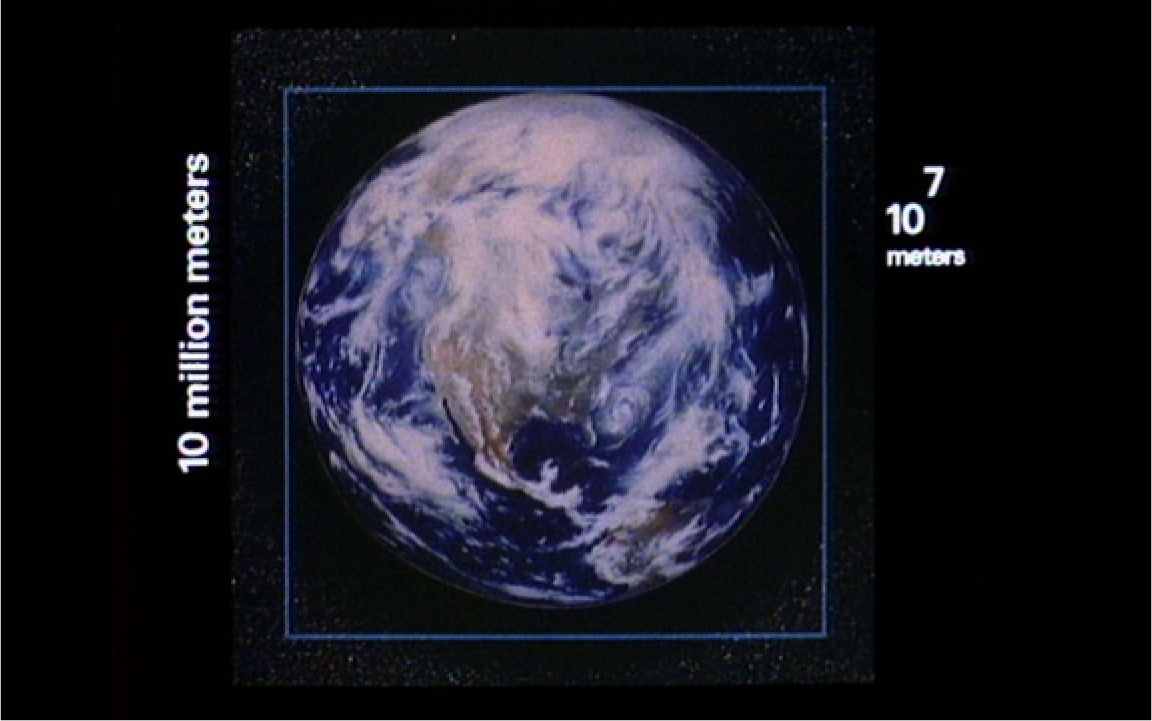
Image of the Earth in Powers of Ten. Screenshot from the DVD of Powers of Ten (Charles and Ray Eames, 1977).
The hybridization of the automatisms of animation and the human nervous system in scalar travel documentaries can also provide viewers with a sense of scopic mastery over the invisible. Functioning like microscopes, films that explore the body’s interior can turn the miniature into gigantic landscapes by magnifying cells and molecules up to the size of the screen. For example, viewers can take a ride through animated models of spiraling molecules of DNA found in the cell nucleus of single-cell paramecia in Cosmic Voyage (see Figure 4). This mediated form of tourism recalls 19th-century explorations of unknown territories at the microscopic scale (Stafford, 1991: 343). Media theorist Kim Sawchuk calls ‘biotourism’ (2000: 10) the process by which 20th- and 21st-century popular films and media give definable geographic contours to the inner body. Journeys through the body’s interior in fiction films explore the sublime feelings of awe and dread before the mysterious spectacle of life and marvel at science’s ability to master biological processes. Fantastic Voyage (Richard Fleischer, 1966) and Innerspace (Joe Dante, 1987), for instance, capitalized on their audiences’ fear of disease and their fascination for magnified anatomic landscapes that elicit feelings of estrangement.
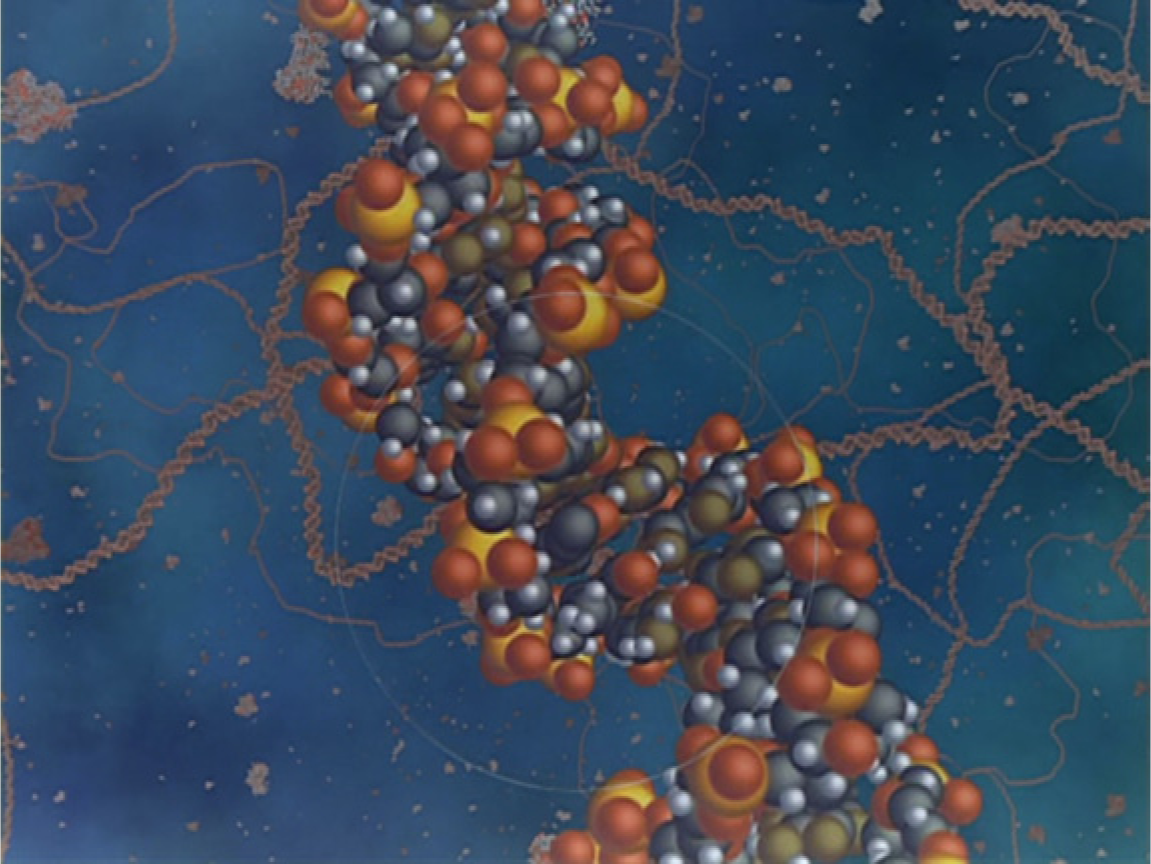
Spiraling molecules of DNA found in the cell nucleus of single-cell paramecia in Cosmic Voyage. Screenshot from the DVD of Cosmic Voyage (Bayley Silleck, 1996).
The automatisms of animation also enable viewers to explore slow living processes by accelerating minute temporal changes to human scale. For example, scientist Jean Comandon developed the process of time-lapse microcinematography to fragment sequences of events into thousands of singular frames in order to study cellular development (Landecker, 2005: 913). Comandon was able to film the movement of living microscopic organisms and blood cells by ‘integrating microscope, chronometers, motors, and film camera’ (p. 913). When Comandon changed the scale of observation of his cells through editing in his film Movement of Leukocytes, it was like flipping ‘between objective lenses on the microscope, from lesser to greater magnification’ (p. 914). The animation of space via time-lapse microcinematography functioned as a prosthetic device that enabled viewers to see living processes through the machinic processes of magnification and time manipulation.
The animated camera movements, functioning like a visual prosthesis, also channel a discourse of space conquest. The simulation of a weightless flight through orders of magnitude, supported by a celebratory voice-over commentary, parallels camera movements in various film narratives that suggest heroic journeys (Ross, 2012). Yet the message conveyed by panoramic tours in scalar documentaries is also one about the conquest of new tools that create spatio-temporal transformations for the simulation of scientific phenomena impossible to see with the naked eye. Nanoscientists, for instance, describe the conquest of the atomic space as the conquest of a new frontier, a process similar to the colonization of new territories (Milburn, 2008: 67). Animation not only makes the frontier possible to grasp visually, but also enables viewers to travel up to the limits of our knowledge. This form of body tourism at the microscopic scale invites a symbiotic assemblage with the animation machine, a cyborgean coupling, which achieves a visual and embodied extension of both space and knowledge.
As I demonstrate in the following sections, scalar travel documentaries promote a humanist view of science while they rely on a posthuman assemblage between the body and imaging technologies; by extending the viewer’s gaze, the zooming camera lens enables access to realms otherwise impossible to see at a human scale. Examining the films Powers of Ten and Cosmic Voyage and then a few interactive scalar documentaries, I argue that this posthuman assemblage has become necessary to parse, analyze, and understand what the massive amount of data accumulated on the human body and the cosmos can tell us.
Powers of Ten
The short documentary film Powers of Ten was written and directed by the architects, designers, and filmmakers Charles and Ray Eames for IBM (Harbord, 2012; Morrison et al., 1982). This exploration of 42 powers of ten is an expanded version of an earlier sketch made in 1968. 19 In his voice-over commentary, physicist Philip Morrison tells us that the film deals ‘with the relative size of things in the Universe’. Morrison explains that ‘every ten seconds, we will look ten times farther away and our field of view will be ten times wider’. In his attempt to involve viewers in the scalar journey, Morrison uses the pronoun ‘we’ while leaving ambiguous who is included in that category. Does this journey lead ‘us’ closer to a humanist conception of the universe or, instead, to a posthumanist one?
Posthumanists challenge the boundaries traditionally given to ‘the human’ and critique humanism’s tendency toward totalization. Disenchanted with the ahistorical concepts of ‘human’ and ‘man’, many scholars have expressed their concerns over ‘the notion of a core humanity or common essential feature in terms of which human beings can be defined and understood’ (Soper, 1986: 11–12). Yet posthumanism does not reject all aspects of humanism; instead, it suggests humanism’s inadequacy as an ideological system of control by underlining its failures and limitations. While, posthumanism responds to the legacies of humanism by breaking up, fracturing, distributing, and decentralizing the self-willing person, questioning its subjectival unity and epistemological conceits, like its humanist, Enlightenment, and Romantic progenitors, posthumanism is passionately concerned with creativity and freedom. (Weinstone, 2004: 10)
Closely linked with postmodernism, cultural posthumanism rejects the idea of progress and claims that there is a plurality of truths, of which scientific truth is only one. In contrast, Powers of Ten strives to unite the human ‘community’ behind a common journey of scientific progress without acknowledging areas of crisis and dissonance. With this approach, the film runs the risk of promoting relativism and totalization, two tendencies that Donna Haraway’s (1988: 584) situated know-ledges reject, as they are ‘both “god tricks” promising vision from everywhere and nowhere equally and fully, common myths in rhetorics surrounding Science’.
Powers of Ten, not only seeks to bridge elements of science that are studied apart; it also strives to bring all humans together in its scientific odyssey. Charles and Ray Eames use the stylistic possibilities of animation to join images from different spheres of science in order to bring a global unity to fragmented, heterogeneous elements. The scalar travel documentaries examined start their journey from an identifiable region of the Western world: Ottawa for Cosmic Zoom, Chicago for Powers of Ten, and Venice for Cosmic Voyage. Then, in a few jumps they suture images of neatly mapped regions into seamlessly glued nations that can be embraced in a single glance. Even though a local/national perspective is initially privileged over global unity, the particular lives of the people featured at the beginning of the scalar journeys are ignored. Those who participated in the making of these scientific journeys also do not appear on screen.
From its outset, Powers of Ten invites viewers to adopt a position of scopic mastery. The frame’s layout, organized like a control board, self-reflexively calls attention to its panoptic perspective. The camera ‘zooms out’ 20 from a couple sitting on a picnic cloth centred within the frame to a view of the Great Lakes. Continuing its ascension, the camera reveals a perfectly centered image of the Earth, 10 million meters away from the beginning of the journey (see Figure 3). As a long uninterrupted take, the ‘zoom out’ continues until the frame encompasses the totality of the solar system, again with the sun perfectly centred within the frame.
With its uninterrupted voyage through outer space and back to the molecular realm, this documentary reinforces a Hegelian system of representation that ensures that knowledge is transmitted and propelled onwards. The omniscient voice-of-God narrative style and the perfect symmetry of the image suggest an absolute control over the unfolding of the events. The metronomic timing as the camera ‘zooms out’ is also reminiscent of Newton’s clockwork universe. The controlled journey across the powers of ten associates scopic mastery with the idea that the human race, by virtue of its scientific knowledge, has achieved the colonization of the universe.
The mapping of geographical space and the fragmentation of the body follow a rigorous timeframe and maintain discipline amidst the chaos. This homogenizing practice puts all elements – human and nonhuman – on the same level of scrutiny. The grids formed by the parking lot and then the roads, followed by a wider perspective of the Earth, perfectly centred within the frame, evoke the imposition of a rational grid on the world. The viewer’s alignment with the traveling zoom may also suggest the perspective of the satellite-weapon, a dangerous combination of machinic vision and speed that could lead to the destruction of all that is human, according to Paul Virilio (1997 [1983]: 62). In Cosmic Voyage, which was financed by both the entertainment industry and the United States Department of Defense (National Research Council, 1997: 79), the merging of the satellite’s-eye view with the bomb’s-eye view is even more revealing.
The movement across scales in Powers of Ten also invites viewers to adopt the perspective of an avatar during the journey through virtual space. As in cyberspace, the ‘pure gaze’ defies gravity. Notions of space, scale, and time become ‘hyperreal’ and hyper-regulated entities. While train journeys in the 19th century can compare to the experience of being ‘shot’ through space, in Wolfgang Shivelbush’s (1977: 152) terms, the feeling of our embodied vision flowing boundlessly through space suggests information carried at the speed of light. No more viruses, horror, blood, and crashes; only the intoxication of pure speed in the void.
Although Powers of Ten encourages viewers to ‘observe’ scientific facts about the world, the depicted images are no longer associated with a human perspective; the human eye has been evacuated and replaced by a mediated process, a mechanical gaze that has reshaped and staged information for visual consumption. Yet the cyborgean instrumentation of perception is not sufficient to promote a posthumanist worldview. Despite the presence of self-reflexive strategies, such as the frame’s layout and the voice-over, this film fails to achieve a self-aware posthuman perception, as it reinforces a totalizing logic completely blind to its limitations, its paradoxes, and its failures.
Cosmic Voyage and digital animation
The IMAX movie Cosmic Voyage, which was made for the National Air and Space Museum of the Smithsonian Institution, takes viewers on a journey through 42 orders of magnitude, two more than Boeke’s book, since we have learned more about sub-atomic particles since the book’s publication. While humans in Powers of Ten appear as passive bodies that serve as frames of reference and media that the scientific gaze can penetrate, they play a more active role in Cosmic Voyage. Historical commentaries on the lives of physicist Galileo and Antonie van Leeuwenhoek, the latter commonly known as the father of microbiology, confirm that human labor has contributed to explain microscopic and cosmic phenomena.
Computer imaging in this film reshapes the world pixel by pixel and contributes to modeling a breathtaking vision of the universe and the body’s interior at the limits of the knowable. The ‘Cosmic Voyage’ segment of the film, which was nominated for an Academy Award in the documentary short subject category, was produced by ‘a global “Renaissance Team” of artists and scientists from two national centres for supercomputing, PIXAR Animation Studios, Princeton University, University of California at Santa Cruz and Santa Barbara Studios’ (Cox, 1998: 53). The camera choreography across the cosmos was created with a voice-driven CAVE 21 virtual reality choreographer, the Virtual Director, which was designed by the National Center for Supercomputing Applications (NCSA) located at the University of Illinois at Urbana-Champaign. The ‘CAVE is an [sic] 10-foot cube room with rear-screen projections that allows one to be totally immersed in a stereo projection of the scientific simulations while “performing” the camera motion through the data sets’ (Cox, 1998: 56–57) (see Figure 5). The Virtual Director is an example of a cyborgean interface that can enable real-time interactions between the human body and high-bandwidth astrophysical simulation data (National Research Council, 1997: 79). This form of posthuman perception translates matrices of numbers into visual imagery accessible at human scale. While the process of transforming the numerical into the visual certainly condenses time and abstracts detailed scientific parameters to replace them with animated networks of cosmic entities, it also makes these gigantic processes that occurred millions of years ago more accessible to a larger audience.

The camera choreography through the cosmos was created with the Virtual Director, an interactive software that can display stereo projections of astrophysical simulations in the CAVE. Screenshot from the making-of documentary found on the DVD of Cosmic Voyage (Bayley Silleck, 1996).
The Virtual Director is also an example of what Daston and Galison (2007: 382–383) call the ‘shift from image-as-representation to image-as-process’. While an image-as-representation mimics features of the natural world that we can recognize in a single glance, an image-as-process refers to ‘interactive atlases-in-the-making’ (p. 383). Daston and Galison provide examples of two kinds of interactive atlases: those that are based on digital archives, such as the Visible Human Project, and those ‘that are used to alter the physical world’ (p. 383). They call ‘navigation through given data sets virtual images and navigation through the image to modify physical objects in real time haptic images’ (p. 383). Unlike the static ‘image-as-representation’, the ‘image-as-process’ involves numerous steps to generate images ‘humanly’ graspable from multidimensional data sets. In the case of Cosmic Voyage, it was necessary to develop a special particle renderer, the Star Renderer, in order to produce galactic images that resemble those generated by Hubble. Developed by research scientist Loren Carpenter at Pixar Animation Studios, this software allows one to control various viewing parameters, including exposure, parsecs per unit, and star magnitude.
The shift from ‘representation’ to ‘presentation’ in scientific imaging reflects a recent tendency in scientific communication to cater to audiences’ taste for visual effects. 22 Spectacular displays of cosmic landscapes in science fiction films demonstrate the ongoing appeal of the technological sublime (Nye, 1996) in media entertainment (Bukatman, 1995). In scalar travel documentaries, the microscopic-turned-gigantic and the boundless journeys through galaxy formations displace the feelings of anxiety about the onrush of technology with astonishment at the virtuosity of scientific imaging. Indeed, the immersive voyages across layered maps of the universe seek to enchant viewers while downplaying the risks of outer space exploration, an aspect underscored by Universe (Roman Kroitor and Colin Low, 1960), a short documentary about a journey into outer space. Moreover, we marvel not only at the visual displays of technological mastery on screen but also at the underlying processes of production. As the associate producer for the scientific visualizations for the ‘Cosmic Voyage’ segment of Cosmic Voyage reported, the simulation of the condensation and formation of galaxy structures ‘required a supercomputer running all processors one solid month at NCSA’ (Cox, 1998: 55). Simulating phenomena that occurred over 2 billion years required 2 million particles per frame and the storage of 120 gigabytes of raw data, which were impressive figures at the time of the film’s creation.
The extensive effort and money invested in the production of the technology required to simulate the creation of galaxy clusters demonstrate an increased desire for ‘authentic’ visualizations (see Figure 6). Unlike the intuitive approach used to produce the random distribution of stars in the cosmos of Universe, algorithms ensured that each frame of this computer-generated sequence of Cosmic Voyage was scientifically accurate. Yet the animated models featured in the final version of the film were selected among many others, and the method for interpreting them was not communicated to the end-user. As specific conventions underlie truth-to-nature, mechanical objectivity, and trained judgment, only those trained in using this particular atlas-in-the-making can understand the complex relationships that exist between the content of each frame and a particular galaxy cluster.

A computer-generated sequence that features colliding galaxies in Cosmic Voyage. Screenshot from the DVD of Cosmic Voyage (Bayley Silleck, 1996).
While the reflexive excerpt about scale at the beginning of the film suggests that images can deceive, it is insufficient to incite a deeper reflection on the scientific method. Information about the limitations of scientific imaging could have been included in the ‘making-of’, which is available on the DVD version of the film, but instead it focuses on the wonders of computer simulation. The scientific advisors on the production team contend that the film presents scientifically accurate images without explaining how this is achieved. As Bayley Silleck, the film’s director, reminds us in the film’s making-of, his objective was to emphasize the ‘great order in the universe’ and to enable people ‘to see that they are a part of that’. In Hegelian terms, the documentary conveys the message that ‘we’, as members of the human race, have succeeded in the scientific enterprise of demonstrating the order of things.
While the films that Comandon produced at the beginning of the 20th century required a collaborative effort between scientists and artists, the size of his production team was nowhere near the size of the teams that contributed to the success of the galactic sequence of Cosmic Voyage. The technological sublime no longer is limited to images of cosmic landscape, but now encompasses the scale of the team of people, computer calculating power, and computer storage space. To explain the success of their approach, the designers of the ‘Cosmic Voyage’ segment of Cosmic Voyage mentioned their aspiration to model the Renaissance genius (Cox, 1998). Instead of promoting this vision, the posthumanities strive to provide a multidimensional perspective on the symbiotic relationships that the human has developed with its technological environment and argue for the necessity of drawing on various fields of knowledge, including the natural science, the arts, and the humanities (Badmington, 2006). Had the makers of Cosmic Voyage chosen to find inspiration in the latter view, the making-of documentary and the film could have stressed that the success of a scientific model is relative, since it can only partially meet the demands of all these fields. Instead of hiding the complexity of transdisciplinary endeavors, the posthumanities encourage interdisciplinary projects and highlight the challenges in bringing different voices together.
Interactive scalar travel documentaries
While many early scientific models were static representations, in the second half of the 20th century we saw the rise of procedural models or ‘images-as-process’ in interactive media. Charles Blilie (2007) distinguishes three types of models: physical models that look like or behave like natural phenomena; schematic models, such as images, symbols, or idealizations that model one state of a system; and conceptual models that model the multiple states of a system. For example, the algorithms used to simulate galaxy formations are ‘conceptual models translated into a computer program’ (p. 17). The animated models featured in Cosmic Voyage are different from the computer models used to calculate and render the animated images of a galaxy in formation. The computer model stores in algorithms the variables representing objects in the system and their properties, the rules establishing relations between the objects and phenomena under observation, and the flow of these objects from one state to the other. In contrast, an animated model only displays representative instances of this multidimensional array of dynamic information.
Although interactive scalar travel documentaries draw inspiration from scalar travel films, they organize information about the universe and the body differently. By storing this information in computer programs, interactive documentaries allow users to manipulate digital information about the universe at various scales and control aspects of the way that this information is displayed on the interface. These applications are also documentaries not because they provide a direct indexical link to an external reality, but because they aspire to model properties of the real world. Interactive scalar documentaries also reflect a new ‘participatory culture’ (Jenkins et al., 2006: 3) by affording users the possibility of choosing how they want to access existing information. They epitomize the emergence of tech-savvy users who enjoy copying existing information and reshaping it across different media platforms. These applications’ simplified development process is an alternative to the elaborate model of production utilized by the ‘Renaissance Team’ responsible for Cosmic Voyage.
Examples of interactive atlases, The Scale of the Universe 2 (Cary and Michael Huang, 2012), an interactive website featuring animated icons, and the application Cosmic Eye (Danail Obreschkow, 2012), available as iPhone/iPad/iPod apps, allow users to easily slide through various scales at their own pace. In both cases, the zooming feature and the smaller size of the display prevent the production of any sublime effect. For instance, the rapid sliding of the scrollbar in The Scale of the Universe 2 accentuates the playfulness of the zooming-in and zooming-out across various scales. While this application recalls the format of a children’s encyclopaedia, Cosmic Eye (2012) is a remake of Powers of Ten that uses state-of-the-art computer imagery. Despite their distinct aesthetics, these two applications show that computer technology can empower independent developers by enabling them to easily repackage an old formula and distribute it as an animated digital application over the internet or as an app.
Another feature of participatory culture is the use of hypertext as a means for greater participation and control over the viewing process. By clicking on one of the multiple icons found in The Scale of the Universe 2, the user can discover a detailed description about the object represented (see Figure 7). This hypermediated approach to accessing information enables a more participatory form of knowledge acquisition than that provided by animated documentaries, since the latter constantly controls the viewer’s gaze and the narrative development. Similarly, the CDROM Powers of Ten Interactive and the website dedicated to Powers of Ten 23 provide supplementary information on the images included in the film. For example, when selecting 10−5 on the graded bar on the website of Powers of Ten, one can obtain a magnified image of a white blood cell called ‘Ruffy Lymphocyte’. One can also access further information about this scale by choosing one of the additional strands available, such as Eames, Tools, Space, Patterns, People, and Time. Yet even though these interactive documentaries can provide additional information to users, the supplementary facts do not mention the limitations of the representations, the tools used to produce the images, and the processes followed to construct them. 24
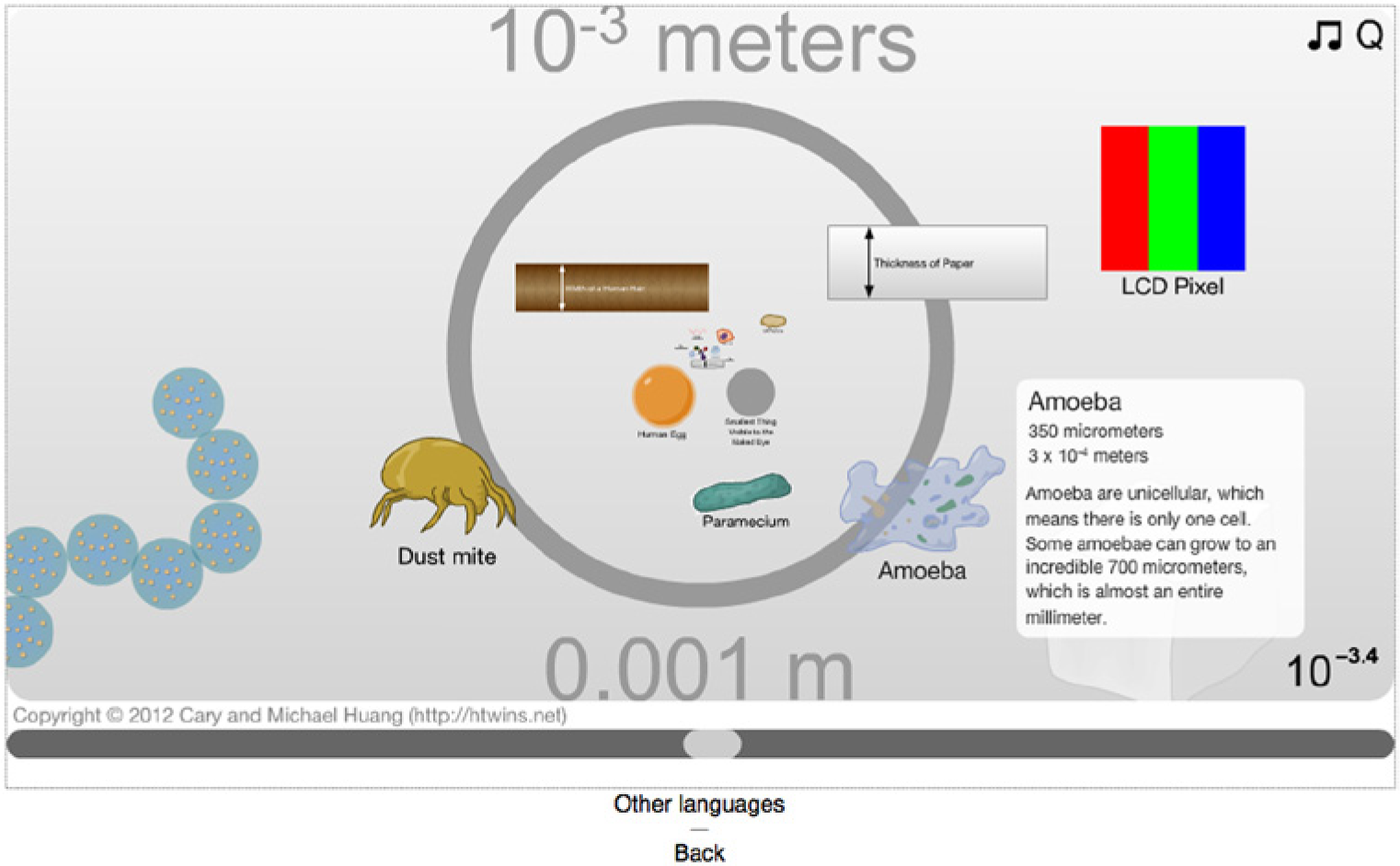
Clicking on one of the icons provided by the interactive program The Scale of the Universe 2 (Cary and Michael Huang, 2012) displays a box including information about the object selected, here an amoeba. Screenshot from the online interactive program The Scale of the Universe 2 (Cary and Michael Huang, 2012), available at: http://htwins.net/scale2/.
As alternatives to computer modeling for organizing information content interactively, special instruments have been invented to visualize atomic materials and produce ‘interactive documentaries’. Users of the scanning tunneling microscope (STM) not only document the atomic structure with real-time nano-images but also modify the material world. Moreover, the embodied method of documenting the atomic structure and animating it reveals a profound entanglement between the user’s body and the technology of animation. This form of perceptual extension ‘occurs at the cyborg interface of the human and the STM as something like a transhuman vision, a hybrid of the machinic and the human nervous system’ (Milburn, 2008: 87). As I argue, the Virtual Director, the interactive scalar travel documentaries and the STM offer users different cyborgean interfaces to interact with the many scales of knowledge available. These tools help users navigate massive amount of data and grasp in an embodied way the detailed information they find at each of these scales.
The limitations of animated models of science
Like scientific models, the scalar travel documentaries and their interactive counterparts studied here seek to communicate an objective truth about the structure and shape of natural phenomena. However, they present only limited facets of the multidimensional prisms that underpin theories of cellular biology, the atomic structure, and galaxy formations. While animated documentaries on scalar travels focus on visual imaging and sound, nano-imaging is another type of animated model that can translate information about atoms through visual and haptic channels.
One of the major problems associated with such animated models is the lack of instructions on how to interpret them and judge their accuracy. As art historian Ernst Gombrich acutely notes in Art and Illusion (1960), since pictures are not statements, they cannot be true or false. Similarly, although images of the atom are different in all the scalar travel documentaries studied, one mode of representation is not ‘truer’ than the other, since these films are imprecise about which of the properties of the atom they attempt to model. Yet the increased level of details provided by the combination of electron microscopes, interactive models of galaxy formations, and 3D imaging offers a multiscalar perspective on the universe that is richer than that presented by Boeke’s book, which inspired Powers of Ten and Cosmic Voyage.
Concerned with the lack of standardization in scientific imaging, scientists have drawn attention to the limitations of modeling techniques, and their critiques can apply to the microscopic representations found in scalar travel documentaries. In the field of nanotechnology, some scientists take issue with 3D computer images that pretend to reproduce the atomic structure with photographic realism (for a discussion, see Slaattelid and Wickson, 2011). To create one of the earliest examples of these ‘nano-images’, Donald M Eigler used the STM tip to arrange 35 xenon atoms and spell out the letters ‘IBM’. As with other scientific models, nano-images can be misleading for the uninitiated. According to philosopher of science Joseph Pitt (2005, np), the outputs produced by the STM are ‘heuristic imaginings’ or ‘extended metaphors’, but not images – that is, they are not ‘a genuine and realistic representation of what is really there’. From this perspective, nano-images are promotional rather than scientifically accurate, since they do not convey essential properties of matter. Adopting a more moderate standpoint, Birkeland and Strand (2009: np) argue that these visualizations are not different from earlier models of the atom that ‘served as simple illustrative tools that allowed the scientist to refer to some of the atomic properties more efficiently’. Yet because of the behavior of particles at the nano-scale, we cannot interpret the colorful nano-images that we see in magazines the same way that we interpret images produced by optical microscopes. As historian of science Colin Milburn (2008: 82) notes: STM images are algorithmic transformations of raw data, manipulated by the computational system and the investigators to isolate or amplify certain characteristics of a physical sample, imposing a reality principle on the data such that the image literally becomes a better rendition of reality than the data itself.
As such, nano-images are far from the mechanical objectivity of photography, which translates reality into isomorphic images.
Yet nano-images are not visual nor haptic nor audible; they are essentially transmodal (Loeve, 2011). Transmodality means ‘capturing what is given in one sense to express it into another: from sight to touch, from touch to audition, etc.’ (p. 212). Transmodal animated models can be used to convey sensory information about extremely large or extremely small scales. While the Virtual Director in Cosmic Voyage enabled its makers to travel through animated 3D renderings of cosmic data, scanning probe microscopy produces sensory rendering of the nano-scale.
In nanorealms, modeling is closely associated with desires of control over matter. As users activate the probe and move an atom, the system immediately provides them with visual, audible, and tactile feedback. STM practitioners use their instruments to communicate between scales, interact with the atoms and manipulate single atoms and thus learn about the atomic realm (p. 211). Users’ control over the mechanisms of representation also reflects aspirations of reanimation. STM imaging not only fragments the world but also re-pieces it atom by atom to create new animated models. The STM probe enabled researchers at an IBM lab to produce A Boy and his Atom (2013), the smallest stop-motion animated movie: a reflective narrative about a boy who can play with an atom (Anonymous, 2013) (see Figure 8).
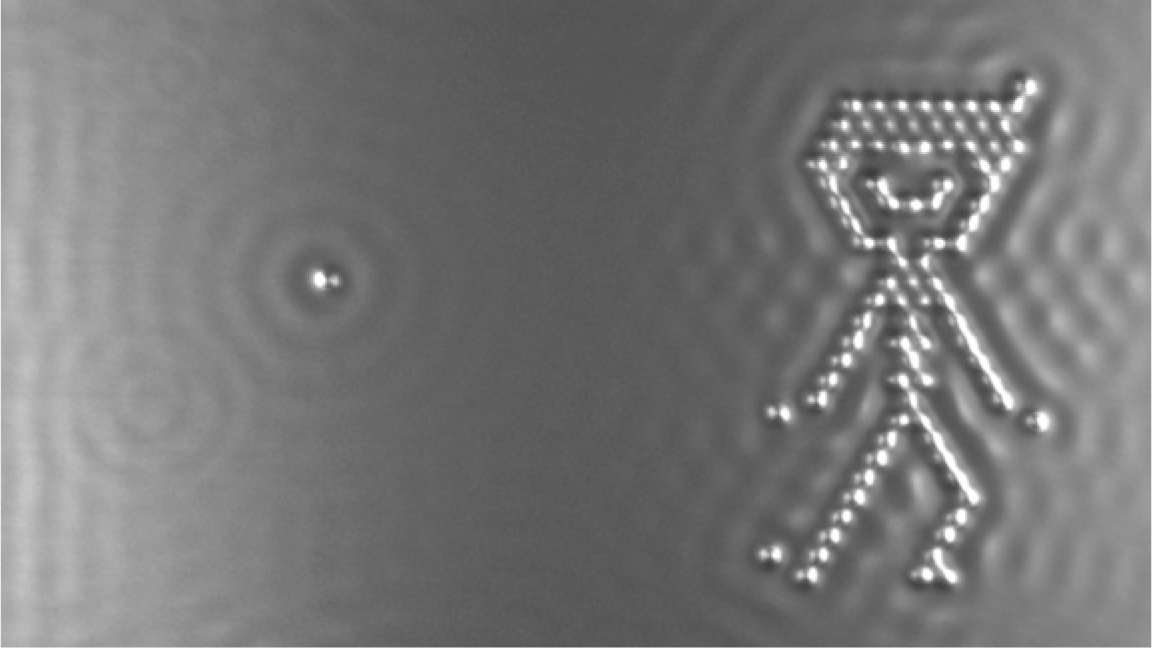
A boy playing with an atom in the animation A Boy and his Atom (2013) produced by IBM lab. As specified in the promotional materials for the film, IBM scientists precisely positioned almost 10,000 atoms into nearly 250 images to create the Guinness-certified ‘World’s Smallest Stop Motion Film’. The movie was created using the Nobel prize winning scanning tunneling microscope, weighing 2 tons and operating at a temperature of −268 degrees Celsius. Researchers use this tool to understand atomic properties for memory, data storage, and future technologies for big data. Film still from the video A Boy and his Atom (IBM, 2013), available at: http://www-03.ibm.com/press/us/en/pressrelease/40970.wss. Reprint Courtesy of International Business Machines Corporation © 2013 International Business Machines Corporation.
The quest for scopic mastery may incite scientists and the media to focus on winning the international race to dominate scientific arenas and thus forget about end users. Posthumanism questions the historical tendency of humanism to embrace patterns of conquest and promote teleological accounts of technological progress. It becomes necessary to achieve a self-reflective position on scientific representation that remains critical of blurred frontiers among ways of seeing. To do so, methods that help identify the limitations of a scientific system can be used, such as Haraway’s concept of situated knowledges, and complex thinking theories such as philosopher Edgar Morin’s (1982) approach to the ethics of science and system theory, which invites scientists to look at themselves looking in order to increase their self-awareness. Although the animated documentaries examined in this article confirm the necessity to adopt posthuman approaches to the documentation of science, they do not sufficiently reflect on their mechanisms of presentation, which could incite viewers to realize that animated models give only a partial view of reality. Lacking in self-reflexivity, these documentaries propose models of our universe that hide the operations of simplification underlying their production; unfortunately, this practice often promotes a passive consumption of animated images. While the information they provide by voice-over commentaries, making-of documentaries, and self-reflexive strategies helps viewers in understanding some of the limits of scientific representation, these techniques need to be more effectively exploited if scalar documentaries are to foreground the instrumentality of media in animating the limits of the body and the edges of our universe.
Conclusion
Hybrid scalar travel documentaries and interactive scalar documentaries reflect the necessity of achieving a posthuman perceptual entanglement with media technology in order to resize and reconfigure information about life and our universe. Thanks to animation’s ability to hybridize layers of information, these documentaries combine modes of seeing that not only regiment the viewers’ axes of vision across magnitudes of scale but also, by turning the miniature into fantastic playgrounds and the cosmic into new frontiers to conquer, provide them with a sense of scopic mastery over the invisible. This mediated form of tourism enables alternative methods of cognitive mapping that bring together scattered sources of knowledge on the microscopic and the macroscopic realms. Alternatively, interactive scalar documentaries enable participatory approaches to navigate through gigantic datasets or interact with animated encyclopaedic archives.
Despite scalar travel documentaries’ increasing acknowledgment of the instrumentality of new modes of knowledge, their intent to communicate an objective picture of our universe dissimulates beneath a humanistic discourse of heroic discovery. They too often downplay the limits of scientific representation, overlook the risks associated with scientific progress, and neglect situated perspectives. While both Cosmic Voyage and Powers of Ten use self-reflexive strategies to reveal their function as a construction of reality, they do not use these strategies to tackle the politics of scientific representation. Similarly, the critical possibilities of procedural rhetoric have not been explored in the interactive applications studied. Although the voice-over commentaries of Powers of Ten and Cosmic Voyage mention a limitation to our knowledge at the edge of the universe and at the centre of the atom, the various hindrances to scientific progress are not explored in any depth. In the future, scalar journeys that wish to further probe the limits of scientific truth might also mention the technical hurdles, political difficulties, and ethical dilemmas encountered along the way.
Footnotes
Acknowledgements
I am grateful to Colin Milburn for comments on an early version of this article, which was presented at the SLSA conference in 2008. I also wish to thank Suzanne Buchan, Mark Hoyer and the anonymous reviewers for their suggestions during the revision stage.
Funding
The author acknowledges having received financial support for this research from Fonds québécois de la recherche sur la société et la culture (FQRSC).