




Abstract
The US girl cartoon genre began in the 1980s with the Federal Communication Commission’s deregulation of television, allowing the programming of toy-based cartoons. The toy industry’s gender binary of girl toys vs boy toys was translated into the definitive split of girl cartoons and boy cartoons. This first wave of girl cartoons defined the gender normative parameters that would identifiably label a cartoon program as a girl cartoon: rainbow unicorns and star sparkles in friendship communities with motivational girl leaders that displayed confidence, determination and savvy while processing emotions and solving conflicts through communication. These characters were young girls, not teenagers or young adults with developed bodies. It is rarely addressed that these cartoon characters presented an empowered girl media product in popular culture a decade before the nomenclature ‘Girl Power’, and did so sans sexualization. In this article, the author discusses the second wave of girl cartoons that came about with US television’s cartoon renaissance in the 1990s. This research explores the ways that lead girl characters were newly portrayed and how they evolved from the girl cartoon representations in the first wave era. Along with the representation of empowered girl characters, this research identified a feminine triptych. In character settings with more than one girl lead, the feminine portrayals were represented in the triptych of the beauty, the brains and the brawns. This research also revealed a persistent glitch to the empowerment of girl cartoon protagonists in the form of secondary characters, identified as mean girls and misogyny boys or no-homo boys. Another shortcoming is identified as boobs and boyfriends, to demonstrate the compulsion to give characters above the age of 12 sexualized bodies and heteronormative relationships. Several cartoon episodes of The Powerpuff Girls, Maggie and the Ferocious Beast, Dora the Explorer, Ni Hao- Kai Lan, Franny’s Feet, Lilo and Stitch: The Series, Maya & Miguel, Word Girl and Mighty B! are textually analyzed to document both verbal and visual gender cues.
Keywords
Introduction
A decade prior to the term ‘Girl Power’ entering popular culture’s lexicon, the 1980s US toy-based girl cartoons created an empowered girl media genre and girl media product consumption. Though these cartoons, based on toy products, reinforced many gender defining attributes such as the excessive use of the color pink and girl characters’ emotive responses to crisis, they also playfully transgressed gender normative coding by displaying girl leaders who were heroic and self-assured (Perea, 2014). In the spirit of Virginia Woolf’s term ‘a room of one’s own’ as the identification of a space for women to retain a sense of their own identity in a patriarchal society, the introduction of girl cartoons in the 1980s created ‘a room of one’s own’ for girls in the cartoon media landscape. In this article, I discuss how the 1990s US cartoon renaissance entered girl cartoons into a new era, its second wave. Several episodes of The Powerpuff Girls, Maggie and the Ferocious Beast, Dora the Explorer, Ni Hao- Kai Lan, Franny’s Feet, Lilo and Stitch: The Series, Maya & Miguel, Word Girl and Mighty B! are textually analyzed to initiate a thematic coding scheme regarding gender display, both verbally and visually as well as gendered dynamics between characters. By coding and textually analyzing several episodes of various girl cartoons, this research demonstrates that cartoon girls were no longer limited to the roles of emotionally supportive leaders who lived in friendship communities. Girl characters were now portrayed as explorers, secret agents or super heroes. However, some of the original genre-defining aspects still remained, such as creating secondary characters that challenge the lead girl’s transgressive potential, and giving girls above the age of 12 boobs and boyfriends; this is a term I use to describe the breasts, curves, sexually suggestive clothing and, for the most part, heteronormative romantic interests which are compulsively given to girl characters above the age of 12 (Perea, 2014). This article discusses my findings on the expanded definition of girl identity in the form of a cartoon feminine triptych – the beauty, the brains and the brawn; a girl media representation that has since been replicated in several other cartoons. This article also discusses television’s compulsion on ‘innovation, imitation, saturation’ in regards to girl cartoon programming and how transgressive qualities are amiss in the copies of the original empowered girl. These findings are demonstrated through their appearance in the listed cartoons. By studying the girl protagonists of US television cartoons and their performance of gender, this research examines how cartoons are a media form that helps revise the gender-normative definitions in popular culture.
US girl cartoons first wave
A girl cartoon is a television cartoon program featuring a young girl as the main character; this means she is under 12 years old, not a teenager, not an adult. Because cartoons are phantasmagoric, the girl character can be a human, an elephant or an anthropomorphized toaster; the embodiment differs but her gender is marked as girl in a standardized feminine way with eyelashes, higher-pitched voice actors, and girl-gendered hairstyle and clothing. In the US, the girl cartoon genre took form in the 1980s with the introduction of toy-based cartoons. 1 Toy manufacturers financed the production of these ‘program-length commercials’ (Kunkel, 1988: 90) following the deregulation of television by the Federal Communication Commission (FCC). Entire series were created quickly by independent animation studios and sold as a packet to individual television stations in trade for advertising time or cash. The shows all proved to be a financial gain for the toys they were based upon.
The toy industry’s gender binary translated into identifiable girl cartoon and boy cartoon programs: He-Man, G.I. Joe, Transformers are boy cartoons and My Little Pony, Rainbow Brite, Strawberry Shortcake are girl cartoons, to name a few (see Figure 1). The toy-based boy cartoons featured plots of good vs evil with a hero battling a villain, whereas toy-based girl cartoons were about community building through verbal conflict resolution and motivational leadership. The introduction of these toy-based girl cartoons created a space for young girls on network cartoon television, albeit a commercially motivated one. Girls were leaders of the group, not side-kicks or secondary character. No boy was coming to rescue her – she did the rescuing. Prior to that era, with the exception of a handful of syndicated Little Lulu shorts in the 1950s, there had been no US television girl cartoons. 2 Full of rainbow unicorns, star sparkles and cute critters, these 1980s pink communal villages became demarcations of the girl cartoon genre. It is rarely addressed that before the 1990s nomenclature Girl Power, the US girl cartoon characters from the 1980s were representing an empowered girl media product in popular culture from within the parameters the genre had created. The 1980s toy-based girl cartoons, like Rainbow Brite, were the power girls that came before Girl Power (Perea. 2014).
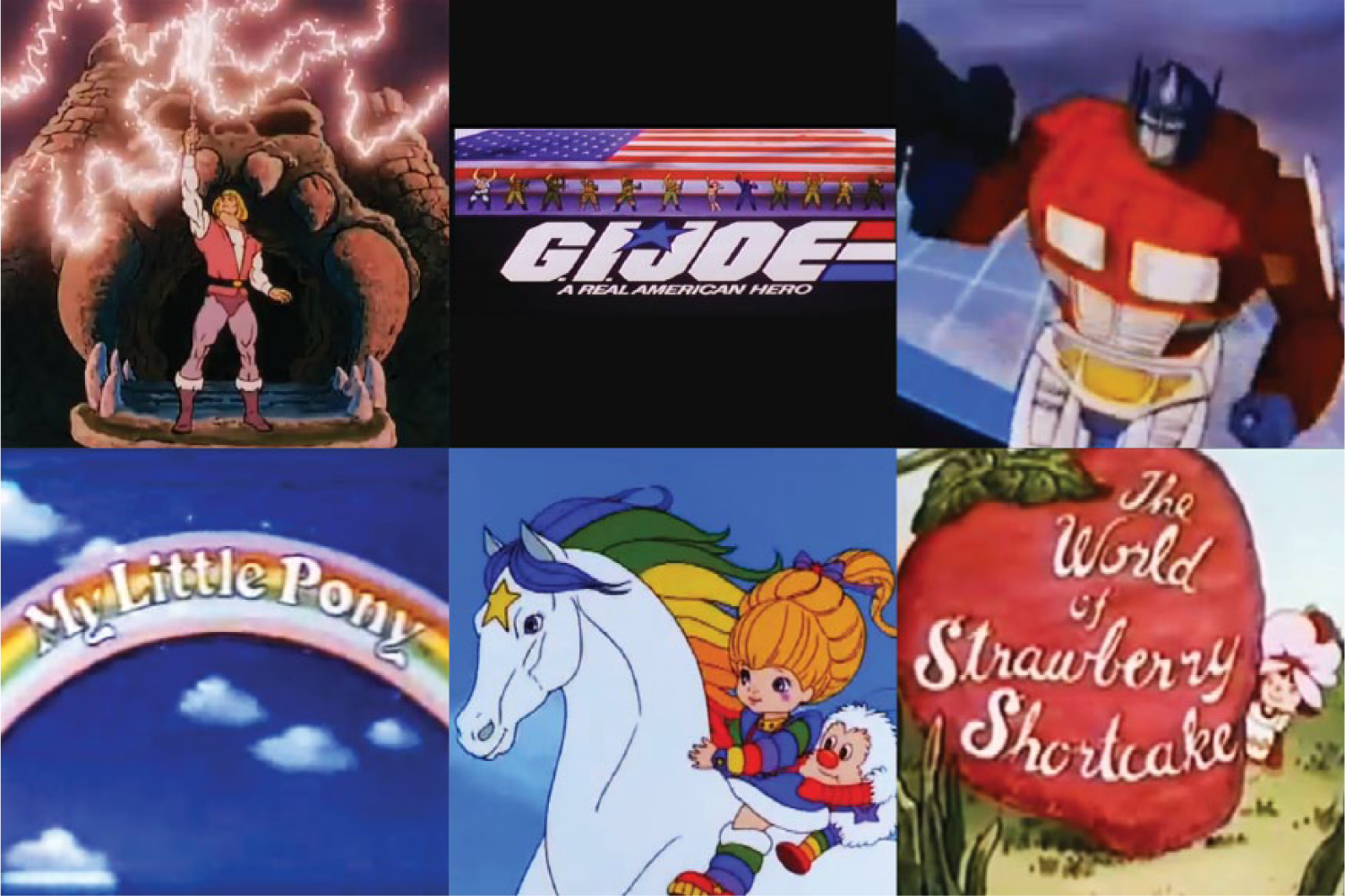
Left to right, top and bottom: He Man and Masters of the Universe (Gwen Wetzler, 1983), DVD grab; G.I. Joe: A Real American Hero (Dan Thompson, 1983), DVD grab; The Transformers: More Than Meets the Eye (John Walker, 1984), DVD grab; My Little Pony (Cherie Wilkerson, 1986), DVD grab; Rainbow Brite and the Star Stealer (Kimio Yabuki, 1983), DVD grab; The World of Strawberry Shortcake (Hal Silvermintz, 1981), DVD grab.
Findings throughout the genre
Industry standards divide younger audiences into primarily three age groups: 2–5 years old, 6–11 years old, and 12–17 years old, the category of children’s television is for the younger groups, essentially 2–11 years old (Alexander and Owens, 2007). Due to the often overly sexualized portrayal of the female body in cartoons, a focus on pre-pubescent characters results in cartoon girl bodies without boobs and boyfriends. It has been repeatedly proven that media representations are partly responsible for causing a plummet in girls’ academic achievement and self-esteem at approximately the age of 12 (Orenstein, 1994; Pipher, 1994). Though young girl bodies can indeed be sexualized (Goodin et al., 2011: 2), this research found that boobs and boyfriends were reserved for girls aged 12 years and up, thus qualifying an analysis of girl cartoon characters as different than that of teenagers and adult women characters. By referencing girl characters aged 11 and under, I address how young girls are represented in ways that subvert traditional norms of who girls are and what they do, sans sexualized objectification. Instead of the normative girly traits of self-deprecation and peer-rivalry, these cartoon girls demonstrate teamwork, savvies, and heroics. Dora the Explorer, 3 for example, clearly embodies the motto of the United States Marine Corps: Improvise, Adapt and Overcome.
As a feature commonly present throughout girl cartoons, this research revealed a persistent glitch to the empowerment of lead girl characters in the form of secondary girl or boy characters, a type of literary foil whose characteristics or actions contrast with the protagonist. The boy foils are identified here as misogyny boys or no-homo boys, terms created by the author. The girl foils are identified here as mean girls. These foils present a constructed boundary to the protagonist girl’s empowered transgressions. They are demonstrated in the analysis of the selected programs.
The mean girl is gendered with characteristics that are intentionally absent in the main character. She is superficial, snobby, bratty, manipulative – basically she is not nice though she is mostly popular. While girl cartoons are potentially transgressing gender normative coding by presenting lead girl characters as confident leaders, the portrayal of what is considered a normative girl, the mean girl – emotive, self-conscious and meddlesome – makes the protagonist an exception, an other.
The no-homo and misogyny boy is gendered with traditionally boy characteristics. He has short hair and wears pants or shorts in neutral or primary colors. The misogyny boy uses diminutive gender-based comments against the lead girl character like ‘girls can’t run fast’, ‘girls aren’t strong’, etc. While the no-homo boy may not openly dismiss the protagonist girl’s leadership qualities or physical abilities, he does openly act in disgust toward things that are girly or considered to be for girls like, ‘Gross, I can’t wear that. It’s pink!’ These anti-feminine gestures, both verbal and physical, are made to reinforce the boy character’s masculinity and, in turn, the perceived boy audience’s masculinity. Since the boy characters are not sexually objectifying the girl characters, a power tool by which to inflate and assure adult masculinity, this age group can reinforce masculinity by insulting the girls. In actuality, what these boy characters are insulting is gendered feminine behavior, promoting an anti-girl attitude – masculinity through normalized misogyny and compulsive division between the genders, allowing the boys to revel in gender separation and in turn gender superiority.
Adorno wrote that ‘Donald Duck, like the unfortunate in real life, gets a thrashing so that the viewer can get used to the same treatment’ in his reflections on capitalism’s inequalities that the people were experiencing (Adorno and Horkheimer, 1997[1972]: 138). Less metaphorical than Adorno’s use of Donald Duck, these boys are a girl’s reminder of the sexism and gender inequalities that she faces in daily life. However, since it is the lead girl who persistently triumphs in girl cartoons, it is also a reminder of how she can outsmart tireless social discriminations and succeed.
Girl cartoons second wave
When 1990s US FCC policy regulations restricted toy-based cartoons by identifying them as program-length commercials and reinstating policy that required them to pay commercial airtime rates (Owen, 1988: 175), girl cartoons were rendered too expensive to produce and all but disappeared from the television landscape. Since toy sales were no longer the motivation for cartoon production, the industry reverted to its old parlance that girls will watch boy cartoons but boys will not watch girl cartoons, despite the success of previously aired girl cartoons. Denise Walcott, a 1991 Associate Director of research for ABC, one of the women decision makers of 1990s children’s cartoons, states: ‘In order to rank near the top on Saturday morning, a show would have to appeal to boys.’ Even as she recognized the almost even gender population split of the Saturday morning cartoon audience (see Carter, 1991: 2). Jennie Trias, West Coast Vice President of ABC children’s programming also perpetuated the party line that boys will watch a male lead and not a female lead, but girls are willing to watch a male lead: ‘We don’t even think about girls’ (Banet-Weiser, 2007: 110). There was a dearth of girl cartoons in the 1990s (Carter, 1991) until cable television’s Cartoon Network introduced in 1998 the very first little girl super-hero cartoon, The Powerpuff Girls. The financial success of these kindergarten-aged super-heroes opened the industry gates for girl cartoons and expanded the genre definitions; girl cartoons entered a new era, its second wave.
While this second wave of girl cartoons had many similarities to the first wave, US toy-based girl cartoons of the 1980s in that the characters were resourceful, capable leaders, these new girl cartoons were no longer bound to rainbow friendship communities resolving conflict through verbal communication, and though some of the new girl cartoons still revolved around personal drama, self-doubt and didactic teachings, most of these second-wave girl cartoon characters were cunning, witty, logical and brave, and often used physical fighting skills to resolve conflicts. What follows is an analysis of second-wave US girl cartoon programs starting in 1998 with the release of The Powerpuff Girls (1998–2005).
The Powerpuff Girls was a cartoon program on Cartoon Network about three little girls, sisters Blossom, Bubbles and Buttercup. The intro narration in each episode describes their origin story: Professor Utonium had chosen the ingredients sugar, spice and everything nice to create the perfect little girls, but he accidentally added Chemical X to the concoction – thus The Powerpuff Girls were born. Using their ultimate superpowers, 5-year-old kindergarteners Blossom, Bubbles and Buttercup protected their home of Townsville by fighting crime and the forces of evil. In 1998, The Powerpuff Girls became a regularly scheduled primetime program and Cartoon Network made history by airing the first cartoon about little girl super heroes 4 and renewed discourse on girl cartoons 5 (Hains, 2004; Kirkland, 2010; Van Fuqua, 2003).
In US popular culture history, superhero shows were among the first genre to portray empowered women (Mitroff and Stephenson, 2007), yet there had never been a little girl in the US superhero cartoon genre. There had been teenage or post-adolescent superhero sidekicks, such as Batman’s Batgirl, Birdman’s Gravity Girl or Superman’s Supergirl as well as girl members of the Fantastic Four or Teen Titans (Lenburg, 2009), all who possessed superpowers along with cleavage and hips, yet these were more young women than they were girls. The female superhero’s heroic power is dominated by or presented as equally important as the overt sexualized physique; her sexiness overshadows her strengths (Coon, 2005: 3). The sexualization of the superhero undermines the essential power that is identifiable for the viewer, particularly if that viewer is a little girl. Creator Craig McCraken remarked that he was not making any feminist statements on gender politics or girl power. He made his characters girls because he thought it was ‘cool for all viewers’.
My friends all liked it … It’s the basic idea of these cute things being tough, beating up an evil monkey. When you step back, you say, ‘Wait a minute, I’m seeing little children beat up a monkey’ … there seems to be a misconception that it’s about girl power and done because I saw a gap in the marketplace, when it’s really about good, strong characters. (MacMillan, 2001: 45)
It is this lack of sexuality that separates the Powerpuff Girls as unique girl superheroes; in US popular culture history they were a first, and a very successful first with a cross-over audience of girls, boys, teens and adult viewers.
The feminine triptych: Beauty, brains, and brawn
The superhero sisters represent a triptych of girlhood identity. Bubbles is the beauty. Her blonde hair is in two ponytails and she speaks in a very high-pitched voice. She is shown as the sensitive one, more prone to crying than the others, and is also more juvenile, often seen coloring with crayons (‘Mime for a Change’, 1999). In fact, she is referred to as cute so often that the episode ‘Bubblevicious’ (1999) is dedicated to her going overboard with violence in an attempt to challenge her cute identity. Blossom is the brains, making her the de facto leader of the group. She calls out the names of attack formations as the girls fight their villains (‘Three Girls and a Monster’, 2000). She is sensible and less emotive than her sisters. Buttercup is the brawn; a no-nonsense, tomboy, fighting machine who prefers to punch first and ask questions later. The lyrics of the ending theme song by Scottish trio, Bis, describe these distinctions: ‘Blossom, commander and the leader, Bubbles, she is the joy and the laughter, Buttercup, she is the toughest fighter, Powerpuff save the day.’ This formulaic feminine triptych of the beauty, the brain and the brawn has since been replicated by various other girl cartoon programs such as the rebooted My Little Pony: Friendship Is Magic (HUB network, 2010) as well as Steven Universe (Cartoon Network, 2013). Though the Powerpuff Girls are critiqued in their normative representation of race and class by presenting most characters as white and middle class and minorities in stereotypical portrayals (Kirkland, 2010), their feminine triptych influenced the genre to allow for an expanded representation of feminine identity and what it means to be a girl.
Mean girls and misogyny boys as villains
The traditional presentation of girl characters, and its feminist critique, is that girl characters are represented as dependent on a boy character (Albiniak, 2001; Signorielli, 1990, 1993; Thompson and Zebrinos, 1995, 1997). By fighting powerful villains, the superhero sisters display strengths that are not traditionally attributed to girls. They are empowered girls with determination and leadership skills, and this representation of strength in a girl character can counter the traditional traits associated with little girls. However, along with fighting monsters and aliens, the superhero sisters also fight against mean girl and misogyny boy villains who can create coded boundaries for this empowerment. One such mean girl counterpart is the kindergarten-aged villain Princess Morebucks. Without powers of her own, Princess Morebucks relies on asking her daddy for money to buy weapons (‘Bought and Scold’, 2000). She barks orders at everyone around her (‘Mo Job’, 2000), and whines when Blossom admonishes her for being a spoiled brat (‘Stuck Up, Up and Away’, 1999). Princess is used as a representation of gender normativity for which the Powerpuff Girls can be comparatively identified as other. These cartoon superhero girls are displaying the potential of girl characters in countering the limitations that have been generalized by the gendered norms of complaining brats or fragile damsels in distress. The mean girl Princess keeps these identities current and thus limits the Powerpuff Girls’ potential in creating a new gender normative coding for girl identity.
An example of misogyny boys in The Powerpuff Girls is the episode ‘Rowdy Ruff Boys’ (2000): three superpowered villain boys created by arch-nemesis Mojo Jojo as a counter version to each of the Powerpuff Girls. Though the Powerpuff Girls’ superpowers have overcome countless monsters and villains, they are fully matched and consequently defeated by the Rowdy Ruff Boys, prompting the sisters to resign as Townsville’s patron heroes. The girls are called back by red-headed buxom beauty Ms. Sara Bellum, who explains to the girls that they can defeat the Rowdy Ruff Boys through their own feminization: ‘Girls, you’ve just been attacking the problem from the wrong angle … Girls, you have what boys fear most. Instead of fighting, try being nice.’
The perplexed girls respond with a resounding ‘Huh?’ Throughout her discussion, Ms. Bellum’s cleavage is placed center screen. Usually her cleavage is drawn with a single straight line, but in this episode, to drive the point home, it is drawn with two curved lines that accentuate the form of her large breasts (Figure 2). ‘You know, “Nice”’, she says as the camera focuses on her breasts; Blossom understands: ‘I get it! Come on girls, let’s go “Get” them.’ Aware of her message, Bubbles giggles as Buttercup says ‘Ew, gross.’ Blossom, the brains of the group, sees this as a tactical advantage, the ownership of sexuality as a means of power. Bubbles, the beauty, sees this feminization as something playful while tomboy Buttercup, the brawn, is grossed out but joins in the tactic.

The Powerpuff Girls (Genndy Tartakovsky and Craig McCraken, 1999), DVD grab.
When the girls fly off, the triptych is dissolved and they are uniformly portrayed with long, batting eyelashes, coy stances and sparkles and hearts floating around them, representing overt feminized girl cartoon gender traits that demonstrate the association between femininity and sexualization. The 1990s bass-heavy, techno music that regularly plays during Powerpuff Girls’ fight scenes is replayed by glissandi harp and violins, an audio demarcation of the girl cartoon genre established with the first-wave 1980s toy-based cartoons (Perea, 2014). The Powerpuff Girls fly over to the boys and give each a kiss, causing little hearts to float by (Figure 3). The boys yell out in anguish when kissed by the hyperfeminized Powerpuff Girls and explode back into their original parts of ‘snips, snails and puppy dog tails’. Afterwards, with the triptych distinctions reinstated, Blossom says she ‘kinda liked kissing’, a giggling Bubbles agrees as Buttercup gags and spits.

The Powerpuff Girls (Genndy Tartakovsky and Craig McCraken, 1999), DVD grab.
Unlike the traditionally critiqued sexual objectification that women are exposed to in patriarchal settings, this feminized attack is a sexualization owned by the girls and not one that is externally imposed. They are not objectified through the male gaze; instead, they actively choose to sexualize themselves, which allows them to annihilate the boys, blowing them to smithereens. However, the point still remains that the boys would have been unstoppable if it were not for the underhandedness of their feminine charms. Desire was needed to defeat masculinity, emblematic of the complexities in representing counter gender-normative strengths in a popular cultural context (Fritzsche, 2004).
Popular culture contextualizes female objectification as a marketable commodification, wherein an empowered female protagonist is made palatable to mass consumption through sexualization. This is particularly true of the superhero genre (Robbins, 1999). Cartoon Network had taken a risk in programming a cartoon about little girl super heroes; a risk, in part, because the kindergarteners could not be sexualized. Programmers play it safe by not offending what is believed to be the audience majority (Bourdieu, 1998), a majority which is a creation of the industry itself (Ang, 1991; Morley, 1980, 1992). This lack of risk is presumed to ensure profit (Simensky, 2007); however, the gamble of risk, like challenging gender norms, can pay off. By the year 2000, The Powerpuff Girls had generated over $350 million in retail sales. Unlike their 1980s toy-based girl cartoon predecessors, The Powerpuff Girls was not conceived in relation to a pre-existing product, its merchandising possibilities were unknown. The immense financial success of The Powerpuff Girls allowed the girl cartoon genre to be reborn.
In 1999, advances in US cartoon programming were everywhere. There was a new focus on children’s programming with names to emphasize their intended target: PBS-Kids, Kids-WB and FOX-Kids; Nickelodeon launched Nick Jr., its new channel aimed at preschoolers and the Disney Channel premiered Toon Disney. Children were once again an intended demographic and, like the toy-based cartoons of the 1980s, profit was the directive. This new focus on kids cartoon programming was also a new era for girl cartoons. The Powerpuff Girls’ success proved girl cartoons were profitable – even though it had already been proven several times over with the many girl cartoons of the 1980s.
Nicktoons had produced two cartoons with girl leads The Wild Thornberrys (1998–2004) and As Told by Ginger (2000–2003). The girls, however, are aged 12 at the start of the series and then proceed to get older, which inevitably leads to developing bodies and heteronormative romantic interests, young teenagers with boobs and boyfriends. Protagonist Ginger (As Told by Ginger) is especially involved in the ‘drama’ of boy crushes, how to wear make-up and concerns about popularity. The Wild Thornberrys’ protagonist Eliza is a girl who has friendships with boys until season five, at which point she gets a boyfriend and every episode in that season revolves around relationship drama and jealousy, perhaps ruining the cartoon because there is no sixth season. Both Eliza and Ginger are young teenagers, not young girls.
Innovation – imitation – saturation 6
In the summer of 2000, Nickelodeon aired Maggie and the Ferocious Beast (2000–2006), a Canadian cartoon program produced by Nevlana, DIC’s partner studio, featuring a young cartoon girl protagonist. Maggie’s Beast is neither ferocious nor beastly. For the most part he is either complaining, afraid, or at best, complacent, which prompts Maggie to be emotionally supportive, a girly trait common in the 1980s girl cartoons. There are no wild adventures, magical portals or super powers. Her adventures are typical child’s play: picnics, kite flying, magic shows, and lots of giggling, which are commonly portrayed in cartoons as girlish traits. Maggie is a regular little girl playing pretend with no special circumstances to distinguish her from a normal child’s day-to-day existence. Nicktoons’ gender-neutral programming now had a young girl lead; the girl, however, was a little boring.
Nickelodeon repeated the formula several months later with an in-house produced show targeting girl and boy preschoolers, this one was about a bilingual, brown skin, 7-year-old Mexican girl named Dora and her best friend Boots, a monkey, who go exploring together: Dora the Explorer (2000–present). Not since Fat Albert (1972–1984) had US television cartoons produced a popular, financially successful character that was not white. As an explorer, Dora is not boring. She uses logic to solve problems and, as an educational program, she constantly involves the viewer in helping her observe each situation. When Boots asks how will they cross a river infested with crocodiles, Dora replies, ‘I’ll tell each crocodile to close his mouth. Cocodrillo, sierra tu boca’ (‘Dora Saves the Prince’, 2000). The crocodiles close their mouths as Dora and Boots jump on each one and get safely across: a little girl with agency, motivation and action.
Each episode consists of Dora and Boots encountering a dilemma and Dora figuring out how to solve it, like returning a baby bird to its mother (‘Lost and Found’, 2000), helping a boy find his lost flute (‘We have to find the flute and give it back to Pablo’, ‘Pablo’s Flute’, 2001), or rescuing a young prince from a locked tower (‘Prince Ramon, we’ve come to save you’, ‘Dora Saves the Prince’, 2000); a very different gender narrative from Snow White’s ‘One day my prince will come.’ Each Dora the Explorer episode opens with the motivational ‘Come on, vamonos. I know that we can do it!’ She is a very self-assured leader who encourages Boots and the friends they encounter to explore. Dora uses basic Spanish phrases for the viewer to repeat, ‘Say ‘abre’ to open the door. You can do it, say “abre”’ (‘Treasure Island’, 2000), ‘Let’s count! Uno, dos, tres, quatro, cinco’ (‘Choo Choo’, 2000). The exploring is slow enough to eliminate a good portion of older viewers but Dora is not intended for everyone the way The Powerpuff Girls are. Dora is an educational show on Nick Jr. and, as such, for young viewers, and an incredibly successful one. The show was so successful with girls and boys that Nickelodeon created a spin-off show about Dora’s older boy cousin, Go Diego, Go! (2005–2011). Perhaps Diego was introduced in order to create boys’ merchandise. While Dora’s viewing audience was made up of boys and girls, its commercial merchandise featured Dora, hence classified as girls’ merchandise. While Nickelodeon openly promoted Dora the Explorer as a gender-neutral show, toy manufacturer Mattel could not seem to manage the inclusiveness; they needed a boy cartoon to make boys’ toys. On her essay regarding The Powerpuff Girls and consumer culture, Joy Van Fuqua remarks on an interview with Patti Buckner, Vice President of apparel at Warner Bros. Consumer Products where she claims that they had not developed a Powerpuff Girl product line for boys despite them being 50 per cent of the viewing audience (Van Fuqua, 2003). The toy industry seemed incapable of using a girl character for toys that would include the boys’ market, they remained in their gender-binary while the cartoons expanded upon and transgressed it. However, the introduction of Diego not only introduced boy gendered Diego toys, it also coincided with Dora being introduced into gender normative settings with episodes of Dora becoming a princess (‘Fairytale Adventure’, 2005), Dora becoming an older sister (‘Big Sister Dora’, 2005), and Dora’s babysitting skills (‘Catch the Babies’, 2005), allowing Dora merchandise to be specifically gendered with princess Dora and babysitting Dora toys.
Nickelodeon repeated the formula again with Ni Hao, Kai-Lan (2008–2011), a 6-year-old Chinese girl who peppers her dialogue with Chinese words the way Dora uses Spanish. Kai-Lan is gendered through her brightly colored outfit and has her hair in two buns with barrettes. Kai-Lan is also very emotive, a gendered girl cartoon trait, with lots of crying in most of the episodes. Kai-Lan has animal friends she talks to along with her grandfather; Dora has Boots and a grandmother. The similarities to Dora in format are many but the distinctions are in the character’s strengths. Though not quite an explorer, every episode has Kai-Lan complete a task or solve a problem. This is done with the motivational song, ‘We’ve got to, got to try to find the reason why’ – even the tone of the song has a more passive edge than Dora’s directly motivational, ‘Come on vamonos, everybody let’s go!’ In the episode ‘Safari Pals’, Kai-Lan’s friend Rintoo 7 has hurt feelings because he is jealous of being smaller than the elephant. Kai-Lan tries to console him by pointing out what makes him special, he is fast. Rintoo points out that Kai-Lan is special because she is such a good friend, and that is a notable difference from Dora; Kai-Lan is more of a friend than a leader. When there is a task or a problem, she is rarely the one to resolve the matter, and though she is emotionally supportive and focuses on conflict resolution she does not have the leadership qualities that Dora possesses.
Another imitation is 4-year-old Franny on the PBS-Kids show Franny’s Feet (2004–2011). Every time a customer leaves a pair of shoes in her grandfather’s shoe repair shop, Franny slips them on and goes on an adventure that corresponds to the style of shoe; flip-flops send her to the beach, moccasins send her to a pow-wow, fur boots send her to the Arctic, and so on. Once there, she usually makes a friend, boy or girl, human or animal, and together they resolve a problem and learn some cultural facts. Like Kai Lan, Franny always giggles and is very expressive.
Franny’s Feet, Maggie and the Ferocious Beast and Ni Hao, Kai-Lan are similar in character design: imaginative, nice little girls who are emotionally supportive to their friends, though at times it is unclear whether these friends are real or pretend-play. Dora the Explorer adventures are real, her friends are real and the challenges are real. The distinction between an imaginary land and a real adventure is relevant to the degree to which the characters’ strengths can be respected, whether they’re displaying real leadership or pretend. These mis-steps taken when imitating the innovative popular culture product exemplify the culture industry’s compulsion to diffuse dissidence. The commodifying imperative is such that it disregards the counter-normative coding, in this case the representation of girl leadership, as the product’s success and replicates it in a way that appears to still be present yet diffused of its empowering potential.
Another example of this was in Lilo & Stitch: The Series (2003–2006) when Disney did not know how to refunction itself to allow for boy fans to be consumers of a product representing a lead girl even though the boys were already active fans of the girl cartoon movie. 8 Much like the creation of Go, Diego, Go!, Disney attempted to underplay Lilo so as to attract the desired boy audience; its second film in the franchise was titled Stitch: The Movie (2003) and the third film was Leroy and Stitch (2006) with the name Lilo crossed out and Leroy written in its place. In 2003, now partnered with Disney, ABC aired the television cartoon program Lilo & Stitch: The Series as a plot continuation of the successful 2002 Disney film Lilo & Stitch. In the film, alien monster Stitch ‘experiment number 626’ escapes to Earth and lands at a dog pound in Kauai, Hawaii. He is adopted by a 7-year-old native Hawaiian girl named Lilo, who, after being chased, shot at and kidnapped, rehabilitates Stitch into a loyal family pet and best friend. Lilo & Stitch: The Series involves Lilo and Stitch rehabilitating the remaining 625 alien animals on Kauai. Like Dora, Lilo is also an explorer. She is heroic and brave as she traverses the island often engaging in perilous activity. Carried over from the movie is mean girl Mertle Edmunds who is constantly criticizing Lilo for not acting like a normal girl. Lilo is fond of non-traditional girly traits; she is an Elvis fan, as well as a fan of mummies, bugs and overeating, to name a few. Mertle calls Lilo a ‘loser’, ‘riff-raff’ (‘Yapper: Experiment 007’, 2003) or ‘Weirdlo’ (‘Swapper: Experiment 355’, 2004) and sabotages Lilo’s attempts to integrate into girls’ activities such as hula pageants or tea parties (‘Mr. Stenchy: Experiment 254’, 2003). Mertle reminds us that little girls are not supposed to be alien-fighting, Elvis fans while Disney reminds us that boys are supposed to be fans of Stitch not Lilo.
No-homo and misogyny boys as main characters
Scholastic Books’ educational series Maya & Miguel (2004–2010) offers clear examples on the use of the misogyny boy. The PBS cartoon is about 10-year-old Mexican-Puerto Rican American twins Maya and Miguel Santos. The show emphasizes their ethnicity with gratuitous Spanish words used randomly, like Maya’s catch phrase ‘Eso es’ which is a direct translation of the English ‘That’s it’ and not a natural Spanish idiom. Along with an overt, didactic emphasis on multiculturalism, the show is also conventional in its gender portrayals. Accentuating his boyness through the normative-masculinity of sports, Miguel and his friends are soccer players; Theo, an African-American boy and Andy, a blond boy who was born with one arm, which does not matter in soccer. Maya’s friends – Maggie, who is Chinese and Chrissy, who is Afro-Dominican – do not play any sports or have any particular hobby; the girls are mostly just hanging out and gossiping.
Maya is the cartoon’s deuteragonist. She is the older twin, but hardly the wiser. She is consistently portrayed as impulsive and unrealistic. In tradition with classic gendering, Maya’s outfits are tight, and often pink, with butterflies or flowers as accessories. Miguel wears loose fitting pants and shirts and mentions his love for sports several times in each episode. In contrast to his twin sister, Miguel thinks through his actions and prefers not to get involved in other people’s affairs. The episodes are usually centered on Maya’s meddling in her family’s and friends’ lives. ‘Oh no, you’re planning something, you’ve got that look in your eye’, Miguel gripes as he is episodically pulled in to help her in conflict resolution to a problem that usually did not initially exist until Maya tried to fix it. When Maya feels a rivalry with a classmate’s boasting about her grandmother’s accomplishments, she invents a lie about her own grandmother’s infamous movie career (‘Abuela Upmanship’, 2005). Miguel warns her about the perils of lying and encourages her to tell the truth. When she does not tell the truth and gets caught in the lie, she apologizes and Miguel feels vindicated. However, in a similar plot line where it is Miguel who tells a lie to his pen pal about his own family’s accomplishments, instead of chastising Miguel, the way she was by him, Maya schemes to help him keep the lie in place (‘Pen Pal’, 2005). Unlike Maya, Miguel confesses the lie and it is Maya who apologizes for her scheming. The cartoon’s storylines facilitate representing Miguel as an exemplary misogyny boy. Throughout the series, Miguel belittles feminine traits, often letting out a gagging ‘Bleeeack!’ reaction to Maya hugging her friends or acting annoyed when she is giggling with them (‘The Matchmaker’, 2004). In 1991, Judy Price, then CBS Vice President for children’s programs, said: ‘The boys certainly didn’t want to be seen liking the things the girls like’ (Carter, 1991: 2). Miguel’s actions are used to appease the perceived boy audience so that they will not be uncomfortable in watching a girl character, Maya, share the lead.
Since The Powerpuff Girls, there had not been any other cartoon superhero girls until Scholastic Books, producers of Maya & Miguel, created an educational cartoon for PBS with superhero girl lead, Word Girl (2007–2010). Intended to build viewers’ vocabulary, the heroine, Word Girl, is a superhero whose gallery of rogues is composed of vocabulary villains, such as Lady Redundant who uses three synonyms to make descriptions, or The Butcher who essentially butchers his sentences with malapropisms or mispronounced words. In superhero tradition, Word Girl has super strength, the power of flight and a secret identity – she lives daily life as middle-school student Becky Botsford. Becky’s younger brother TJ represents the program’s no-homo boy. When the ‘Pretty Princess and Magical Pony Hour’ television program is on, a mock version of the 1980s girl cartoon My Little Pony and Rainbow Brite, her younger brother feigns interest, though he is deeply enthusiastic about the show (‘Pretty Princess Premier’, 2009). The no-homo actions of TJ are an overt act to cover up his perceived feminine side, one that he should hide because boys are not allowed to be interested in ‘girly’ stuff such as ponies or girl superheroes. TJ’s no-homo boy actions differ from Miguel’s misogyny boy actions in that Miguel’s gestures are not an attempt to hide his feminine side. On the contrary, Miguel has no feminine side, he is simply disgusted by femininity. TJ is not disgusted by feminine things, he actually likes them, he just doesn’t want anyone to know that about him because it would denigrate him to be associated with girly traits. Empowered femininity is undercut by the no-homo boy’s reference that perceived girly traits are undesirable in a boy, or as Miguel shows us, in girls too. The no-homo and misogyny boy are active agents in blocking representations of gender equality; a safeguard to ensure that empowered femininity does not go too far.
Complexities of feminism and friendships
In 2008, Nickelodeon produced Mighty B! (2008–2011), a girl cartoon created by comedian Amy Poehler of Saturday Night Live fame. The cartoon stars Bessie Higgenbottom, an extremely enthusiastic 9¾-year-old Honeybee Scout with aspirations of becoming superhero Mighty B! once she attains each and every reward badge that the Honeybee Scouts have to offer; as of the first episode, she has 4,584 badges to go. Unlike Word Girl or the Powerpuffs, Bessie has no actual powers, just aspirations and a fierce loyalty towards her fellow Honeybee Scouts. In the meantime, she energetically pursues her goal of badge attainment with immeasurable self-assuredness and guidance from her dog, Happy. Though mostly she wears her Honeybee scouts’ dress she sometimes dons a moustache and dresses in gender non-conforming attire, such as in ‘YIPs’, 2011 where she is a cop, the ‘Bat Mitzvah Crashers’, 2008 episode, in which she crashed the pirate theme bat mitzvah party sporting a goatee, and ‘Woodward and Beesting’, 2008, an homage to the famed Watergate reporting duo Woodward and Bernstein, where she dons the personality of a 1950s ace reporter, wearing a tie and calling her friends ‘kid’. Bessie is extremely bright and unpretentious, which makes for a unique combination of naiveté and enthusiasm.
Bessie is not interested in romance, peer rivalry, or gendered self-deprecation, three of the themes historically used to construct female definitions. Creator Amy Poehler expressed in an interview the intention behind creating her girl character: We started to talk about the idea of doing a female-driven series where this girl is at that great age, you know nine and three-quarters, where you’re not boy-crazy and you’re not mean to other girls. You really believe you can be an astronaut, a physicist, a waitress, a singer, a dancer. The world is your oyster. So that enthusiasm I find fascinating. I just wish you could bottle it and take it like a pill. When no one’s told you no yet. No one’s told you you’re not good enough, or no boy has broken your heart yet. (Murray, 2008)
Craig McCraken, Powerpuff Girls creator, expressed a similar intention about his cartoon characters: We never treat the [Powerpuff] girls as girls. We just treat them as kids … I hope that [little girls] realize that they can do anything boys can do; that there’s no difference between genders. It’s all just life and we all experience the same thing. (MacMillan, 2001: 45)
However, girls and boys don’t experience life the same way because girls are at a sexist disadvantage – widespread discrimination in sports, 9 education, 10 safety and basic human rights. 11 McCraken’s sentiments of gender equality and girls as powerful, even dominant, represents a post-feminism perspective that is a central critique in the discourse of that era’s Girl Power media representations (Taft, 2004). An episode of The Powerpuff Girls demonstrated this perspective in episode ‘Equal Fights’ (2001) where villain Femme Fatale convinces the girls they are being oppressed by men and therefore should allow her to steal all the Susan B. Anthony dollars from the bank. The resolution is for the women of Townsville to convince the girls that Femme Fatale, or perhaps feminism’s misandry, is not taking into account all the help that men provide. Thus the Townsville women discourage the girls from seeing any gender inequality and from engaging in challenges to such inequalities.
Though there are at times anti-feminism messages, mean girls and misogyny boys, girl cartoons can playfully transgress this. An example of this can be seen in the Mighty B! mean girl character, fellow honeybee scout Portia Francis. ‘What’s up Honey Bee wannabees, welcome to my ultra-glam life! If you wanna know me, you’ve got to start with my closet’ (‘To Be or Not To Bee’, 2008). Portia is bossy, highly concerned with her appearance, and flirts with Rocky, the skateboarder who occasionally works at Bessie’s mom’s café (‘We Got the Bee’, 2008). While this character is emblematic of a mean girl, her negative impact has been neutralized not through didactic proclamations but through Bessie’s friendship. Unlike the way Lilo is hurt by Mertle’s putdowns, Bessie is oblivious to Portia’s insults; the mean girl foil is diffused by Bessie’s naiveté and enthusiasm. For Bessie, her Honeybee Scouts’ bond with Portia trumps any petty differences which she proclaims in episode ‘Batmitzvah Crashers’ (2008), ‘sisterhood, sisterhood, the most important thing, we’ve got the honey and the sting.’ Poehler’s Mighty B! character, Bessie Higgenbottom, is exactly how Poehler describes her: she is not interested in any boy’s attention, she is never mean to any of her fellow honeybee girl scouts, and her self-confidence allows her to be a happy, creative and adventurous girl. Though the second-wave girl cartoons are not centered around the emotional friendship situations and pink rainbow communities of the first wave, the characters do retain many of the same strengths laid out in the first wave as heroic, protective, and resourceful girls. After a decade-long hiatus off US television from 1988 to 1998, these cartoons reclaimed girl media culture identity.
Conclusion
The spread of cable television and technological advancements of computer graphic imagery in the 1990s allowed cartoon production to proliferate in the US with cable television channels Nickelodeon and Cartoon Network as leaders in this cartoon renaissance. As they expanded into successful original programming, Cartoon Network produced one of the first girl cartoons for the new era, The Powerpuff Girls. The financial success of these kindergarten-aged super-heroes opened the industry gates for girl cartoons and expanded the genre definitions.
In the opening sequence of The Powerpuff Girls, the narrator states that ‘sugar, spice, and everything nice’ were the ingredients chosen to create the three perfect little girls, but that an extra ingredient accidentally added to the formula, Chemical X, resulted in the creation of the kindergarten-aged super heroes. Chemical X is not an accidental variable, it is heroism, savvies and self-confidence, ingredients that are presumably not part of the original equation for little girl production but which, when added, allow little girls to act as strong leaders. Chemical X astutely symbolizes the playful transgression by which girl cartoons demonstrate an unconventional and marginal response to the social construct of gender normative coding. US television girl cartoons can counter the themes historically used to construct little girls’ identity, such as hetero-normative romance, peer rivalry, and gendered self-deprecation (Perea, 2014). Television girl cartoons are paving the way for a new representation of powerful female characters.
Footnotes
Funding
This research received no specific grant from any funding agency in the public, commercial, or not-for-profit sectors.