




Abstract
This article examines the use of animation for the purpose of peace-building. It does this by first examining key definitions of peace, and how these have been applied for matters of art. It appropriates these definitions for the specific context of animation, and uses case studies to illustrate how animation could be used in this context. The article concludes by supporting a participatory approach to animation for peace-building purposes. The values that drive the research derive from the paradigm of positive peace developed by Johan Galtung. These can be summarized as justice, equality, prosperity, non-violence, cooperation and solidarity.
Introduction
Even though I assume most readers of an animation journal would be familiar with and appreciate advantages of using animation, I will attempt to highlight some benefits relevant to peace-building. Animation has the capacity to amalgamate the arts of performance, music, sculpture, painting, architecture, poetry and dance in one single output. Therefore, it can provide a distinct platform for multiple ways of expression. Different people, with interests in separate aspects of the production, can potentially collaborate for this process over a significant amount of time. Animation can reach the masses through its broadcast on TV, in cinemas, or on the internet. As demonstrated by its extensive use as a tool for propaganda, it can be used to influence beliefs and behaviours, and can also be an excellent tool for instruction as it can communicate direction in a clear, precise way (see Wells, 1998). Despite contradictory research regarding its effectiveness in teaching and learning, animation has the ability to grab attention, and can be more entertaining than traditional pedagogical tools (Yong et al., 2003: 20). Moreover, it can act as a powerful means for visualization of the unrecorded past, or of future possibilities, and can demonstrate metamorphosis, which is useful in visualizing change in environments of conflict. There are undoubtedly many more attributes that can make animation a good peace-building tool, but the ones mentioned above should suffice to make my case.
The purpose of this article is to discuss and encourage the use of animation as a tool for peace-building. This ‘call for action’ does not stem from a standpoint that arrogantly and naively propagates this medium’s superiority over any other, or its distinctiveness in achieving certain results in comparison to other forms of art. It is also not declaring that the view of peace proclaimed here is singularly the correct point of view. It stems from an understanding that peace-building does not lie only in the hands of a few policy makers, or a handful of tools (such as negotiation, mediation and formal agreements) and can be claimed by particular ideologies, but is rather a complex and continuous task; one for which everyone is competent to affect change. Peace, a concept that aims to improve the human condition, is a complicated idea loaded with value judgments, and is open to critique and discussion. The ‘father’ of peace studies, Johan Galtung, describes peace as being identical to a respect of life in all its diversity, a respect for the basic human needs of survival, well-being, identity and freedom, and as the consequent absence of direct personal and hidden structural violence. Even though some philosophies and cultures might view violence as being compatible with peace, this article disagrees with that premise.
Key definitions in peace research
Before going into the particulars of animation, it is important to examine prevailing definitions of peace in the field of peace research. In 1969, social scientist Takeshi Ishida drew attention to the fluidity of the word peace and the paradox of fighting wars for the sake of them (p. 133). For example, the Iraq war and much of the war on terror was justified by the self-proclaimed ‘benevolent’ urge of the US, the UK, and others to assist humanity in establishing global peace (Rhodes, 2003: 132). In 2002, President Bush justified war with the following argument: ‘History will judge harshly those who saw this coming danger but failed to act. In the new world we have entered, the only path to peace and security is the path of action’ (p. 158).
To this, one could reply with lyrics taken from Colombia Pictures’ 1935 animation The Peace Conference, where Krazy Kat steps in to stop the world’s leaders from fighting:
Gentlemen please, all this fighting must cease! This is my gun, to bring you world peace!
A gun to bring world peace?
A gun to make war cease?
Stop you silly Krazy Kat you think that we’re all geese!
Peace, for Ishida (1969: 133), carries the advantage of a flux of important human desires, such as justice or wellbeing, and he argues that many wars might have been avoided if the word peace was more clearly defined. To find a more concrete definition of peace, Ishida studied the archetypal meanings of the word in different cultures. If one identifies the foundations of contemporary Western cultures in the ancient Greco-Roman as well as Jewish tradition, Ishida makes it clear that the (far) Eastern, Oriental definition of peace differs greatly from the Western, Occidental one. The Orient, on the one hand, emphasizes peace as an internal quality of being mentally and spiritually in balance and in harmony with oneself. The Occident, on the other hand, underlines a state governing the relations between people in society, as well as the will of God, that is generated outside the individual in a top-down hierarchy.
The English word peace derives from the Latin pax and means treaty, an agreement to abstain from war (Donald, 1867: 363). Therefore, the Western interpretation of the word peace is an absence of war, which is defined as organized violence among collectives, and of its threats (Galtung, 2010: 353). Galtung points out that the modern Occidental use of peace as ceasefire needs to be revised (p. 354). He emphasizes that peace should not only imply a lack of war and of direct visible violence, but should also include a culture of equality, justice and well-being. He argues that the word peace-building is unfortunately used ‘both by the naive, who confuse absence of direct violence with peace … and by the less naive, who know this and do not want that work to get started’ (Galtung, 2004). To highlight this outlook, Galtung (2010: 354) reports that four times more people die as a result of hidden structural violence such as elitism, classism or racism, than from direct violence or war. About one in nine people on the earth today starve or suffer from malnutrition, one in three people do not have adequate sanitation, while 900 children under 5 years of age die daily from preventable diseases (Wateraid.org, 2016; Wfp.org, 2016).
Galtung (1969: 185) also recognizes the strong connection between the word peace and mysticism in the Eastern cultures of China and India. He writes of the feelings of devotion and community that it invokes, which in former ages were connected with religious experiences. Peace denotes a state of universal love and brotherhood and, in the context of our secular world, he insists on using this specific word. Another word might be clearer, but it would be probably lacking in spirituality. However, he insists that the word peace needs to be clarified, modified and expanded from its Western meaning to include among others, a culture of harmony, creativity and collaboration. Galtung (1964: 2) is responsible for popularizing the two prevalent conceptions of ‘positive and negative peace’. Negative peace is described as the condition of a relationship between two or more actors where violence is absent; the relationship between the conflicting parties is of an indifferent, direct and structural state. It gained its name as it describes a condition that is in absence of something, for example of direct violence or war. Positive peace, on the other hand, is characterized by harmonious, direct and structural relations and was originally described as ‘the integration of human society’. To avoid misuse of the word peace, Galtung developed three principles or guidelines. The first principle calls for the term to be used for social goals that are at least orally agreed to by many, if not by most. The second principle states that peace should be something tangible, rather than an abstract idea or a utopian social state. Finally, Galtung (1969: 167) declares that peace is the absence of any type of violence, even if this is an invisible relationship quality.
Galtung’s demarcation of peace and the associated concepts are introduced into this article to assist readers in understanding the philosophical ground upon which it is built. Next, I will explain how Galtung’s theories have been translated to fit into the context of art, and will subsequently apply them to animation.
Peace-art, anti-war art and animation
Carol Rank (2008: 1) describes artwork that is mainly preoccupied with opposing war and taking a stance against violence by exposing, shocking or moralizing, as ‘anti-war art’. She writes about anti-war art as ‘negative imagery’: imagery that portrays the horrors of war and the absence of peace-related imagery. On the other hand, she characterizes artwork that is positive in its imagery or messages and that promotes peace and its related values as ‘peace-art’. This imagery is the portrayal of the positive values that describe peace, such as life, prosperity or equality, and which contrast the negative values of war, such as violence, deprivation or inequality. She understands art as either a means to testify, reflect, warn against, criticize and resist society’s current state, or as a vehicle that acts as vision, inspiration and transformation of the current reality into something better. I will expand Rank’s notions of anti-war and peace art by considering all forms of violence rather than war alone, as I believe the word ‘violence’ is more pertinent to the concepts examined above. This definition is less concerned with the meaning of peace in its Western understanding as the opposite of direct violence, and includes violence in both its visible and invisible nature. In consequence, anti-violence art is any artwork that warns against, witnesses, reflects or criticizes any visibly or invisibly violent behaviour. I will also appropriate Rank’s terms to better fit the scope of this article, by applying them to the art of animation. Anti-violence animation uses preventative measures against violence. Peace-animation instead, actively builds towards the attainment of a peaceful life.
Anti-violence animation and propaganda
To clarify the concept of anti-violence animation, I will analyse Hugh Harman’s 1939 Metro Goldwyn Mayer animated allegory Peace on Earth. This short tells the post-apocalyptic story of a world inhabited by anthropomorphized animals, as humans killed each other through war. It is an obvious example of anti-violence animation because it warns against the consequences of war. It alerts to the possibility of a future extinction, and it moralizes and reminds us of the will of God, and the consequences of disobedience. The divine call is also used to motivate the construction of a new violence-free world. The title ‘Peace on Earth’ is taken from the Bible in Luke 2:14, ‘Glory to God in the highest, and on earth peace, good will toward men’ (King James Bible, 2007: 1570). The plot itself is reminiscent of the story of Noah’s Ark, where God decides to wipe out humanity and start the world anew (Holy Bible: New International Version, 2011: 8). The short goes a step further though, and warns that, unlike Noah’s time when humans had another chance, this time humanity has lost the game. However, it not only uses negative tactics to oppose war but also presents a thriving peace-time and evokes the joys of life through portraying strong family ties and love that the animal-protagonists share, as well as their willingness to cooperate to re-build what is lost. It demonstrates how creatures that humans often describe as wild and uncivilized are actually more civil and peaceful than they are, and illustrates that this kind of behaviour will finally prevail. It also invites viewers to question their stereotypes of who is civilized and cultured.
A grandfather squirrel initiates a discussion on the nature of humans, the pointlessness of war and its destructive outcome. Following Harman’s usual style, the animals and their environments are of a very endearing, fairy-tale like character, and are anthropomorphized. During the description of people and war, Harman adopts an uncharacteristically grim rotoscoped style imagery. In a different scene, the animals are gathered around a Bible opened at the ‘Thou shall not kill’ commandment. An owl reads this text aloud, as well as the passage: ‘Ye shall rebuild the old wastes’ (Holy Bible: New International Version, 2011: 746–747). Afterwards, Harman returns to his ‘happy-go-lucky’ style, and depicts the animals taking the place of humans, as sole survivors and successors of their culture re-building their cities from war’s remains (Figure 1). Perhaps, through this anthropomorphism, Harman wanted to preserve some hope for humanity’s existence. The short ends with the title ‘Peace on Earth’, and the message that unless mankind’s self-destructive behaviour changes, there will be no man, and no reason to finish the verse and to wish ‘Good Will to Men’.
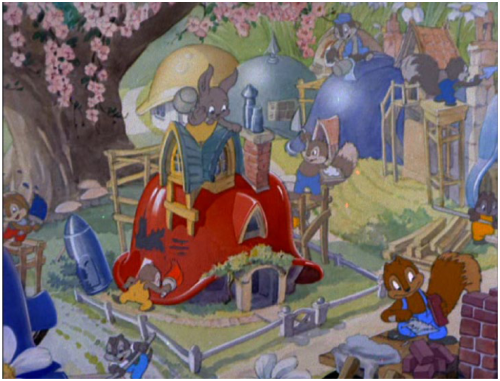
The animals rebuild the world from the remains of human war. Here we see them building houses out of military helmets. Peace on Earth (1939). Screen grabs from DVD (Hugh Harman, A Christmas Carol).
Michael Barrier (1999: 298) describes the seriousness in the tone of Peace on Earth as peculiar and unsuccessful. Despite Harman’s clear intention to warn against war, Barrier argues that his objective is undermined by the choice to portray unrealistic and cute animals. By depicting only military casualties and no civilian losses, and by contradicting the teleological implication with the positive sound of a Christmas carol, that acts as a reward to the viewers, rather than creating a more unmediated and grim ending, viewers are prevented from realizing the full negative effect of war. On the other hand, the absence of any trace of irony contributes further to distancing the piece from Harman’s intentions (p. 299). Still, despite its perceived shortcomings, Peace on Earth is one of the few cartoons that suggests in its vocabulary the idea of morality in the depiction of war, and removes the enacting of animated violence as an opportunity for entertainment (Lehman, 2006: 55).
After the end of WWII, a new film based on Peace on Earth’s storyline was released 16 years later, entitled Good Will to Men. It exchanges the squirrels for anthropomorphized mice and the family setting for a community choir, where a conductor stands in place of the grandfather squirrel. The end of mankind in this version is not caused by a direct fight between the last men standing, as happened in the 1939 version, but when ‘each one of them built [and dropped] the biggest, the most awfulest bomb ever …’ Furthermore, naivety, humour and a distance from the harsh reality of the war that did not yet involve the US in 1939, seem to be missing in the 1955 version, which is much more serious. Another important difference is that the newer short replaces the ‘Ye shall rebuild the old wastes’ with the instruction ‘Love thy Neighbour as Thyself’. Finally, the mice in the 1955 film sing ‘Hark the Herald Angels’ with the text, ‘Good Will to Men’ at the last scene, while the older animation ends with ‘Peace on Earth’. The greatest difference though lies in the message of the two versions. The 1939 version warns that humans will not exist, and adds humour with the rise of an animal culture. The 1955 short, however, addressing a society tired of war, emphasizes hope for peace through the song, the title and the ‘love thy neighbour as thyself’ message. In the newer version, the idea of extinction lies in a past and hypothetical space, since even the survivors, the mice, sing praises to peace and to humans. The latter film was made by people who had not witnessed WWII, who could play with subjects of war and human annihilation more easily than people who had just experienced war, and who knew that the threat of their extermination was not a distant possibility. One could argue, that because the main message of Good Will to Men concentrates on a celebration of peace and on the love-thy-neighbour message, rather than on merely condemning war by presenting its negative effects as anti-violence animation does, Good Will to Men qualifies as peace-animation and it is therefore, in my opinion, more potent in its effect on the viewers. It does not merely declare that war is bad and could result in catastrophic repercussions for humanity. It also does not restrict solutions to what one should ‘not do’ in order for war not to erupt. It actually presents viewers with a positive way forward in order to avoid unfortunate events and for peace to prevail. The solution presented is embodied in the ‘love thy neighbour’ message.
To better demonstrate what anti-violence animation is, I will now examine Victor Gromov’s Mr. Wolf (1949), and compare it to Peace on Earth (1939). Mr. Wolf is a short produced by Soyuzmultfilm (United Animation Studios), the Soviet Union’s main centralized animation production studio that was responsible for most of the animated propaganda produced in the USSR (Rfcmd.com, 2016). Soyozmultfilm was state controlled and its directors were paid by the centralized Soviet film academy (fristuti, 2015).
Mr. Wolf shows a wealthy but distressed capitalist, namely Mr. Wolf, who with his family leaves his current life behind for a deserted island as he is afraid of a new upcoming war. On his ‘genuine island of peace’, Mr. Wolf has everything necessary for a comfortable life, except weapons. While reading ‘Peace on Earth, Good Will to Men’ from the Bible, Mr. Wolf discovers oil. He immediately discards his Bible, and envisions this oil as money. His family engage in a race against each other to exploit it first, but they soon realize that others are threatening their newfound wealth. Mr. Wolf demands total obedience, and declares that he will be able to protect them with a hidden arsenal. He also appeals back home for help, and thus the island becomes an army base. A bird ends the short with the sarcastic comment: ‘Congratulations Mr. Wolf! Peace on Earth, Good Will to Men!’
Taking the point of view of the bird, Mr. Wolf could be read as a commentary on false peace declarations, where the benevolent urge for peace is hindered by other motives, such as greed. At the same time, it could be an effort to criticize the Soviet-perceived corrupting nature of capitalism since, as mentioned in the short, ‘human is in his nature good’, but even presumed pacifists such as Mr. Wolf have no choice in such a system but to take up arms. Mr. Wolf could also be read as an indirect means for the Soviet Union to justify the development of atomic weapons since 1949 is indeed the year it detonated its first atomic device (Genovese, 2010: 29). The animation could be sending the message that since disarmament and peace are unrealistic, and pacifism is nothing but an empty word, the further investment in arms of massive destruction by the USSR was a necessity. It appears that Mr. Wolf is propaganda.
Firstly, used in the context of spreading Christianity, the meaning of propaganda was understood as persuasion, preaching or education, and did not have any negative connotations (Ross, 2002: 16). If propaganda is understood along the lines of the word’s origins, then there is no doubt that both Mr. Wolf and Peace on Earth are propaganda as they are trying to convince their audiences to embrace a certain stance. Nevertheless, nowadays propaganda has come to mean more than mere persuasion, and it has developed pejorative connotations. It is these modern associations that accompany propaganda, which Peace on Earth does not contain, whereas Mr. Wolf does. In 2002, Sheryl Tuttle Ross developed a potent propaganda model, in which she argues that for something to be characterized as propaganda, all the following four aspects must be present:
It needs to be an epistemically defective message;
It needs to be used with the intention to persuade;
It needs to address the beliefs, opinions, desires and behaviours of a socially significant group of people; and
It needs to be done on behalf of a political organization, institution, or cause. (p. 25)
Based on this definition, animation that aims to improve the human condition and abide by the principles of peace could not be called propaganda. Therefore, it might be wise for artists creating animations for the purposes of peace-building to double check, possibly in collaboration with conflicting parties, the messages they transmit, in order for these messages not to be defective.
To examine whether Peace on Earth (1939) can qualify as propaganda, I will go through Ross’s parameters one by one. Peace on Earth’s main message of a potential human eradication through war and weapons of mass-destruction is a plausible and epistemically sound message (Spiers, 2000: 169; Zastrow and Kirst-Ashman, 2016: 560). Obviously, the animals taking over a human-like culture after a possible extinction of humans is a fallacy. Research suggests that weapons of mass destruction could trigger a global natural disaster that would detrimentally affect the entire ecosystem (see Dodds, 2008). It seems to be clear though that these super-natural elements are only there to support the development of the main story by adding interest to the narrative, and not to persuade the audience of a false premise. No one would argue that the anthropomorphism of animals in cartoons acts as a means to persuade us that animals can act like that. It is rather obvious that Peace on Earth was made with the intention of persuading people of its pacifist message, and was probably influenced by the isolationist policy the US was following during the years before the release of the short (see Manfred, 2002). But, by 1939, with the eruption of WWII, any pacifist support had drastically declined, and only represented a small group of people (Kazin et al., 2011: 377). Additionally, I could find no evidence that the animation was created as a formal representation of the views of a significant group of people, or that it was done formally on behalf of a political organization, institution or cause. On the contrary, as seen in the excerpt below of a 1973 interview with Harman by Michael Barrier, it seems that Harman had opposition to producing the film from within his own studio (Michaelbarrier.com, 2006):
… They tried to stop me from making that [referring to Peace on Earth].
What was their argument?
That it was too serious. It made more money than any picture we ever made. Fred Quimby, who was sort of a business manager at MGM tried to stop it.
It is harder to discern whether Mr. Wolf has an epistemologically defective message. Its primary message, which seems to be that greed for excessive riches can bring out the negative even in a peace-loving person and stand in the way of peace, is not an erroneous message. Warnings against greed seem to be present worldwide in different religions and folklore (see Bloch, 1984; Gundry, 2010; Ibn Emrullah et al., 2015; Kaza, 2005). If one takes into account the Soviet context in which the animation was created and the policies of the USSR, the animation also seems to be an indirect criticism against capitalism and Western peace declarations. Mr. Wolf seems to have internalized capitalist values and habits to such an extent that he allows them to stand in the way of peace. Even though he used his wealth and position to abandon his previous lifestyle and isolate himself, in the sight of even greater wealth, and in the threat of losing this new fortune to intruders, he immediately gives up his intentions of a life in peace and embraces arms. The film seems to suggest that the capitalist way of life will inevitably conclude in conflict and war. Having the drive for profit at its centre, capitalism has competition as one of its pillars (Jahan and Mahmud, 2015). One might also argue that, in its more extreme form, excessive drive for profit and competition could bring about greed and conflict.
The animation also seems to suggest that if others are armed and ready to take over your wealth, you also need to be armed and ready for war. This is a point which some could adhere to as being correct. Yet, suggesting that armament is the only realistic solution removes any option for non-violent conflict resolution. It should also be taken into account that the film was created by the centralized state animation studio of the USSR, disseminating the opinion of the governing communist party, which was labouring to justify the isolation of the Soviet people from the Western world, and gain their support in their armament project. Taking this into consideration, Mr. Wolf ticks every box of Ross’s propaganda preconditions.
After this short analysis of these animation examples, it is evident that while Mr. Wolf is indeed a piece of propaganda, Peace on Earth qualifies itself as anti-violence animation. Perhaps the downside to Peace on Earth is that the audience is only reminded of a message they knew before, that war brings death, rather than providing them with skills for a peaceful life.
Intellectual and activist Susan Sontag describes that when photography was a new-born medium, many held the view that depicting the calamities of war, i.e. creating anti-violence art, would encourage viewers to realize its pointlessness (Sontag, 2004: 12). However, she points out, despite the proliferation of historic images of such horrors, wars do not seem to have stopped happening (p. 14). Sontag herself does not dismiss the potential of images of atrocities to trigger responses, such as a call for peace, a cry for revenge, sympathy, or an invitation to challenge current affairs (p. 11). On the contrary, she argues that such imagery can intensify the condemnation of war and assist in the task of remembering the suffering that exists, and of what humans are capable of doing to each other (pp. 11, 102). But, she emphasizes, there is still enough injustice and pain in the world and, therefore, although our remembering of the other’s pain is a sign of our humanity, remembering too much would inevitably make one bitter (p. 103). In order for people involved in peace-building processes to be able to move on in the creation of an environment of positive peace, conflicting parties would need to, at least to some extent, learn to forgive. This does not mean that injustices should not be addressed or punished but, as Galtung (2016) proposes, the involved parties should not concentrate on hurt and the distribution of punitive justice as an end in itself, but on conciliation.
This article does not dismiss art that displays the negatives of violence or war, as in anti-violence art. It postulates, however, that in order to be effective, this exposure of calamities needs to be part of a larger plan for reconciliation, a means of collective actions to an end, rather than exposing evils with the hope that this alone will hinder the employment of violence. Work that promotes reconciliation, values that aim towards a peaceful living and act as a platform for communication, as seen in peace-art, is I believe, significantly more potent in terms of its ability to affect change. Following this logic, this article regards peace-art, and in this case peace-animation, as a more effective tool for the purpose of peace-building.
Peace-art and animation examples
Contrary to anti-violence art that passively hopes to deter war by a depiction of its calamities, peace-art can be strategically employed to assist peace-building through positive action. This is particularly appropriate in cases where intuition, emotional intelligence and creativity are needed (see Lederarch, 2005). These qualities, often inherent in the arts, are necessary to combat the absurdity and irrationality that exists in intractable conflicts (see Cohen, 2005). Psychologists William Long and Peter Brecke describe how ‘in the case of reconciliation following civil wars, an evolutionarily determined, emotionally driven pattern, not purposeful rationality, transforms aggression into empathy, and desire for revenge into desire for affiliation’ (Long and Brecke, 2003: 28). The arts have the capacity to transform the dynamics of conflicting parties, especially in cases where the power balance is of an unequal state (Shank and Schirch, 2008: 218), for example, by escalating the conflict’s intensity through public awareness, so it cannot be ignored by those in power. Despite limited research on the effect of the arts in conflict transformation, initiatives in this field have proven more successful than many standard conflict resolution tools (Gold, 2006). Furthermore, even though some researchers described from here on did not specifically employ the term peace-art themselves, it is clear from the context that what they are referring to is peace-art. That is, if these arts are described as a positive creative action to be strategically employed for peace-building processes, rather than a mere passive depiction of what can go wrong in war, then, when someone is writing about the arts they are automatically referring to the definition of peace-art explained above. Still, there are only a few efforts to formally contextualize the role of the arts, let alone animation, for practical purposes of peace-building.
A great proponent of the involvement of artistic processes in social change, John Paul Lederach (2005) takes the involvement of the arts on a different level. He writes about ‘moral imagination’, in the context of peace-building, as the capacity to imagine and create possibilities of change that transcend the cycle of violence, while rooted in reality. He argues that in all the essential processes, without which peace-building would not be possible, imagination is required, and calls peace-building practitioners to be more like artists, less like technicians and embrace aesthetics – here understood as the art of the senses (p. 73). He advocates the ‘aesthetics of social change’, described as the creation of adaptive and responsive processes which require a creative act, which he states is more an act of art than a technique. The knowledge of a conflict, he writes, does not take place only or primarily in the cognitive arena, but requires seeing the matter as a whole, something that he believes relies on intuition and imagination. Finally, he emphasizes that transformative peace-building has behind it the intuition of the artist, who is able to capture in a single image the complexity of human experience (p. 73).
Next to Lederarch’s arguments, Cynthia Cohen (2005) writes about how the actual involvement with the arts can assist peace. She notes that engagement with peace-art can generate qualities of attention and response, for example interest, committed participation, meta-cognitive alertness, receptivity, serenity, which in turn provide opportunities for learning, empathy, reflexivity, creativity, innovation and experimentation (p. 5). She argues that aesthetic experiences give rise to these qualities for several reasons. For example, they engage on both sensory and cognitive levels, which can cause a state of alertness and awareness. To understand someone’s suffering, knowledge is needed that is both cognitive and heartfelt, and one needs to be both engaged and detached so as to not be overwhelmed by the intensity of one’s own responses (p. 6). The arts employ symbols to refer to meaning on different levels simultaneously, and can make people aware of how they perceive the world and point towards the symbolic structures that help people create meaning (p. 5). This can assist former enemies to reassess the symbols embedded within a conflict. The arts can engage people in forms that are bounded in space and/or time, something that provides safe boundaries where people can concentrate intensively and open themselves to the depth of their feelings more easily than in unframed life (p. 6). Aesthetic forms, continues Cohen, acknowledge and mediate tensions, such as between innovation and tradition, randomness and rigidity, the individual and the collective. Finally, she notes that in art the awareness of the audience is anticipated in the creation itself. This reciprocity between creator, creation and audience involves an awareness of the ‘Other’, a sensitivity akin to respect. The arts can remind us what it is like to be acknowledged and respected, and in time to acknowledge and to respect (p. 8).
Cohen also identifies the following seven main elements of reconciliation, which are almost always involved in efforts to establish coexistence, and in which the arts can play a major role in their facilitation:
Appreciating each other’s humanity and respecting each other’s culture. The arts can lead towards a re-examination of the identification symbolic of the self and the Other and can provide a form of expression that expands beyond cultural differences.
Telling and listening to each other’s stories, and developing more complex narratives and a more nuanced understanding of identity.
Acknowledging harms, telling truths and mourning losses. Art can provide indirectness and abstraction that can be important in the mourning process.
Empathizing with each other’s suffering. The arts can assist towards a deep understanding of the Other, especially when violence has impaired people’s capacity for empathy.
Acknowledging and redressing injustices in a restorative framework, on which trust can be based.
Expressing remorse, repenting, apologizing, letting go of bitterness, forgiving. Art can help search for a common sense of humanity that may lead to the act of letting go of bitterness.
Imagining and substantiating a new future, including agreements about how future conflicts will be engaged in constructively. (pp. 10–11)
Utilizing these elements of reconciliation, peace-animation, as a form of art, should not only invest more in the use of the arts for peace-building purposes as Cohen proposes, nor solely use artistic skills to practise peace-building as Lederach (2005) advocates. Instead, it should move a step forward and, based on Joseph Beuys’ famous ‘every human being is an artist’ principle, in a grassroots effort to peace, it should also turn communities into artists’ collectives and those same artists into peace-builders. To demonstrate better what peace animation is, I will briefly describe three examples I consider successful. The classic animation examples, Peace on Earth and Good Will to Men, mentioned at the beginning of this article, were useful in establishing what anti-violence animation is. They were also chosen as they could be easily compared to the many propaganda pieces produced during WWII and the Cold War, such as Mr. Wolf, in order to highlight their differences. To showcase what peace-animation is, I will now use contemporary examples in order to emphasize the potency of animation as a peace-building tool in the world today and to make the issue to the animation community more relevant and urgent.
The 2002 animation Elbow Room, was created by the artist Diane Obomsawin of the National Film Board of Canada. The work belongs to a group of educational animations that provide useful skills for fostering a culture of peace. It is part of a UNESCO and Justice Canada supported series called Show Peace, which aims to act as a conflict resolution and peace tool, for all ages and cultures (National Film Board of Canada, 2009). It deals with conflict resolution skills on an interpersonal level, an invaluable aspect of societal recovery from a violent conflict, where the antagonistic sides need to learn to coexist peacefully. The animations of the Show Peace series address subjects such as managing anger, bullying, conflict styles and negotiation, diversity, tolerance and mediation (National Film Board of Canada, nd). Every short is also intended to act as learning material for classrooms, and is accompanied by extensive teaching guides.
Elbow Room clearly demonstrates the distinction between anti-violence and peace-animation. Even though it discusses conflict, it offers concrete non-violent tools to deal with it, such as employing imagination for a critical evaluation of the reaction options at hand. Elbow Room tells the story of two employees who work at the same office, but have completely different and conflicting needs. The narrative is designed to explore the different ways one can respond to conflict, and what one might gain or lose from each one. These conflict styles are denial, aggression, retreat and negotiation. The accompanying teaching guide explains that constructive conflict resolution means expanding one’s options to include cooperative conflict management (National Film Board of Canada, 2007: 1). This conflict management style regards both involved parties and goals as equally important. Through negotiation and collaboration, cooperative conflict management searches for solutions that aim at a win/win situation for both positions (National Film Board of Canada, 2007: 1).
In Elbow Room, animation is utilized to visualize the different possibilities in behaviour as well as their possible effects. The viewer can literally see the story rewind in time, up to the point where the character chooses to act differently. Then they can see the effects of each new behavioural choice in the story. Animation also gave Obomsawin the opportunity to tell the usually rather boring story of an office scene in a way that is non-offensive and humorous. Animation’s ability for simplification and exaggeration allowed her to use a caricature version of two different entities in conflict that, in my opinion, enabled some level of distance between the happenings and the experiences of the viewers, and achieved a less emotional and more objective reception of the message.
Following Obomsawin’s usual distinctive graphic style that fuses the hand-made and the machine-made, the animation uses a technique that involves drawings on paper with computer renderings. It combines the pure and bright colours of the artist’s character design, layered over a palette of greyish-brown images of office surroundings and objects. The seemingly child-like hand-drawn doodling of the characters is contrasted with the realistic textures and shapes of the office drawers, the desk, the window and the flowers. Despite its distinguished aesthetics, the artist is economizing on elements that are superfluous and that could visually distract the viewer from the main narrative. Instead of depicting, for example, a very realistic environment and detailing all the usual objects that can be found in an office scene or in a realistic character, the animator concentrates instead on a few abstract characters and some basic, indicative cut-outs of what seem to be photographs, all of which are aesthetically consistent with the artist’s characteristic style. The characters are simplified caricatures of real people: they have hands, feet, a head and other features that are human-like, but are nevertheless very stylized and stripped down to the necessary minimum. For example, they only have three fingers, and a few lines for hair, but accentuated feet. Obomsawin is employing animation’s capacity for abstraction, and created Elbow Room’s characters to symbolize any two humans in conflict, without realistically representing human beings as such (see Figure 2). These abstract representations of the entities allow simultaneously a broad identification and to some extent empathy, but also enough distance to enable a rational reception of the message. The movement and sound design of the short also filters out unnecessary information and is in line with the eccentric style of the artist. An example of this is the fact that the characters communicate through a language made up of vague sounds and visual signs, such as a laugh, a cry, or body language that indicate their feelings. Their movements are unrealistic and over-exaggerated, possibly to add a level of humour and interest to the story.
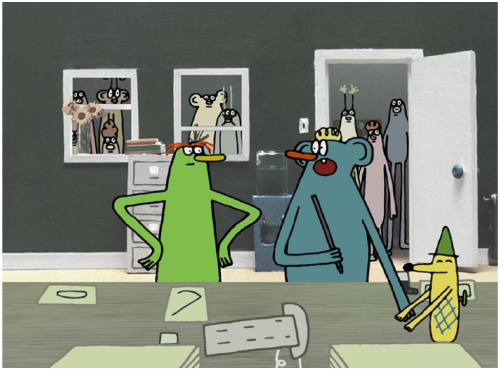
The main protagonists, designed to represent any human, engage with each other while their co-workers observe (Elbow Room, dir. Diane Obomsawin, 2002). Elbow Room © 2002 National Film Board of Canada. All rights reserved. Reproduced with permission.
The next example of peace-animation is the pre-schoolers television series Rechov Sumsum/Shara’a Simsim. This series is an adaptation of the puppet animation show Sesame Street, which addresses the Israel/Palestine conflict and aims at spreading a message of co-existence. Rechov Sumsum/Shara’a Simsim, as it became known in Hebrew and Arabic, is an amalgamation of educational material with entertainment. It uses a mixture of different types of animation, such as puppet animation, stop motion and digitally drawn animation, sometimes co-edited with live action sequences (Cole et al., 2003: 409). The series follows its North American prototype in overall context, ethos and aesthetics, but places an emphasis on promoting peace-related values. With the exception of a couple of characters that were directly taken from the original US show, this production has its own set of puppets and is set in two different, yet parallel and intersecting Israeli and Palestinian streets (Felsenburg, 2008).
Born during the mid-1990s, out of the optimism provided by the Olso Accords, Rechov Sumsum/Shara’a Simsim is a good example of peace-animation as it actively assists peace-building. It takes advantage of the medium’s popularity among children as an educational tool, questions stereotypes and presents messages of mutual respect and understanding between the two antagonistic communities (Cole and Lee, 2016: 155; Shochat, 2003: 79). The show takes advantage of animation’s capacity for abstraction, exaggeration and humour to portray people and locations from the different sides, or difficult subjects, such as teaching acceptance of difference, without being too specific and resorting to stereotyping. It is based on the pre-tested guidelines for success and the popularity and reputation of the original Sesame Street show as an educational and entertaining programme (see Morrow, 2006). All these factors must have played a role in making the message of co-existence physically and psychologically susceptible to pre-schoolers, who tend to require the permission of their parents to even watch a show.
The programme originally started out with idealism in its singular address of both communities but later on, due to the harsh reality of the conflict’s nature, it developed into two separately produced parallel programmes, which is the form it has today (Cole and Lee, 2016: 156). There were practical issues such as prohibitions in movement and psychological barriers that made a joint production during the escalation of the conflict impossible to maintain. Two streets, one Palestinian and one Israeli, were created as such a scenario was considered to be closer to reality than one multicultural street (Cole and Lee, 2016: 161). However, the characters are shown to cross streets and interact in different scenarios with people from the other community. Despite discrepancies and inequalities in different aspects of politics, life and animation production, the creative team was determined to keep their eye on the child viewers and not on politics, and through the programme to provide some pride in their own culture and respect for the other’s humanity. With an emphasis on anti-sectarianism, the programme’s curriculum takes an all-rounded educational approach and its content is categorized by the production team into the areas of mutual respect, the child’s world, and cognitive organization.
The programme also commissioned studies to discover the reach and educational impact of the series. These found that children exposed to the programme demonstrated pro-social behaviour regarding the conflict and in describing the other community (Cole et al., 2003: 409). Children exposed to the programme seemed to have developed a heightened sense of fairness and justice in different bi-communal scenarios regardless of a character’s ethnic origin (Cole and Lee, 2016). Moreover, improvement in attitudes about the conflicting community was demonstrated not only among children, but also among the adults who worked together as part of the production team. Even though this programme did not set out to exploit the positive effects of collaboration through animation, Israeli puppeteer Gilles Ben-David expressed how the Israelis and Palestinians started out as two distinct groups but, through the process of working together side by side and learning about each other, they ended up feeling part of one united production team (Schoffman, 2000, in Cole and Lee, 2016: 165).
This research that Charlotte Cole and her colleagues carried out on the effects of the series is one of the rare studies into the effects of peace-animation – and peace-art in general – on audiences, and fits into a more established body of work on the pro-social effects of screened media. Even though there is some limited research on how, when and why the arts can be employed to assist peace-building, serious inquiries into the evaluation of their impact are absent (Shank and Schirch, 2008). The majority of studies that do deal with the subject are often constrained within the limits of a single discipline, usually art history, and consequently bear scarce results for a real-world, peace-building application.
Another case study, this time from the island of Cyprus, started out by taking into account precisely these positive effects that can result from two antagonistic groups working together. Contrary to the Israeli/Palestinian production, this example from Cyprus did not produce highly polished animation results ready for TV broadcasting, but concentrated instead on the animation creation process itself. The programme, named Cyprus Artefact Treasure in Action, CAT, formed part of a greater framework that aimed to empower people through Media and Information Literacy.
The programme addressed the political conflict between the Greek and the Turkish communities on the island, and hoped to bring children from both communities closer together through a discovery and appreciation of their shared cultural heritage. It started in 2010, lasted for two years, and the participating 20 children were approximately 10–11 years old at the time (Christophini, 2016). The children came from polar opposite, peripheral and remote areas from both sides of the divided island, usually excluded from such bi-communal or media education activities (Icffcy-cat.com, 2013). Following common visits to museums and archaeological sites, the children, in small bi-communal groups, chose an archaeological artefact from a Cypriot collection. With the assistance of their bi-lingual teachers and facilitators, they developed short narratives and storyboards inspired by their chosen artefact and they consequently created short paper cut-out, stop motion animations.
Animation was chosen because children seemed to favour it, because they were mesmerized by the idea of drawings coming to life, and because some animation boxes were made available to them (Christophini, 2016). Additionally, in this initial phase of the project, the children could not communicate in a common language and animation played a significant role in creating a sense of community since it allowed creative immersion in an activity that was novel and not easily available. Animating allowed a great amount of non-verbal communication and inter-communal cooperation over a significant amount of time.
The team chose cut-out, stop motion animation because most children were computer novices (Christophini, 2011). It is also possible that stop motion was chosen as it was perceived to cater for greater interaction among children than, for example, digital animation, which usually requires work to be divided among many individuals and their computers. Hand-drawn animation, on the other hand, is notoriously time consuming. The team was convinced that, with stop motion, the children would produce work they would be proud of, in a shorter space of time. A different animation method or live action would have been either technically straining, or would have required a greater amount of isolated work division and a lesser amount of collaboration. Using stop motion animation, the children had the opportunity to take advantage of their skills in drawing, composition, craft making and storytelling in a joint effort that encouraged team work. With poor technical expertise, they could see their stories coming to life.
It is notable that, when the parents of the children saw the animations, they were so impressed with the basic shorts the children produced that they encouraged the facilitators to continue with similar projects (Christophini, 2016). Due to this enthusiasm, CAT ended up being the first scheme in which children were given an allowance to cross over to the other side of the island, unescorted by their parents. The children who began working on the project started out as separated entities, members from two estranged communities, but now are still working together as teenagers, on further projects as one community. In short, the project was successful in introducing children from conflicting communities to each other and, despite the difficulties, the time-consuming yet rewarding task of animation gave them a sense of a shared goal and achievement.
To summarize, all three of the aforementioned examples are successful peace animations as they employ the medium in an active effort to establish a culture of positive peace. Apart from using animation, the three examples examined here share another characteristic, which seems to be important in any grassroots peace-building effort; they involve the communities they wish to address. Animation provides a platform for such community participation on a prolonged creative project, with multiple input possibilities.
Conclusions
Animation, a popular art form for its entertaining qualities, its abstraction and representation of the ‘inaccessible’, the not yet and the imaginary, has been broadly used as a tool for war and propaganda. In line with research that propagates the importance of qualities inherent in the arts for peace-building, this article asserts that the application and research of the art of animation should also be encouraged in relation to its applications for positive societal change.
Following Galtung’s positive and negative peace categorizations, the distinction between anti-war and peace-art has been drawn. This article revises this classification to include invisible notions of violence, and then appropriates them for animation. Thus, the notions of anti-violence and of peace-animation are introduced. Anti-violence animation is work that merely exposes violence, while peace-animation contributes towards the skills and processes required for reconciliation and peace.
Alongside the benefits the arts can bring to the process of peace-building, animation has the capacity to provide an expression platform for people from different disciplines and skills. This can facilitate a prolonged creative collaboration of a broad range of people, with the ultimate goal being the rewarding completion of a unitary art-work. Participants in the production, as one team, in order to make this collaboration possible, could in time re-identify the ‘Self’ and the ‘Other’, develop teamwork and negotiation skills, and soften enmity and bitterness. Furthermore, animation has the benefit of being massively reproduced and disseminated, and notably through the internet, could escape possible censorship. In particular, alongside work done by individual artists, with the incorporation of the benefits of participation, animation can work well for the requirements of a bottom-up peace-building effort.
Finally, it should be noted that this article only highlights the assumption that the art of animation, especially due to its ability to provide a prolonged creative collaboration of people with different artistic skills, can have a positive effect in peace-building processes. The article does not claim that animation is superior to any other art or media form, or that it is unique in what it has to offer. Instead, it proposes that as a medium with great capacity for artistic expression and collaboration, animation can provide a pulpit for peace-building work, especially in cases where conventional conflict resolution tools seem stagnant and a grassroots change is needed. The article recognizes that further research needs to be conducted into both the effects of animation on conflict-ridden societies and the effects of public participation in animation creation from a peace-building perspective. With this invitation, I will conclude this article, anticipating that it will trigger further research into the subject.
Footnotes
Acknowledgements
I would like to thank Marios D Christophinis, Dr Laura Gonzalez, Professor Greg Philo, Professor Paul Wells, as well as Hannah Thorley.
Funding
This research received no specific grant from any funding agency in the commercial, public, or not-for-profit sectors.