



Abstract
Contemporary computer-animated films by the major American animation studios Pixar, Disney and DreamWorks are often described as evoking (extremely) emotional responses from their ever-growing audiences. Following Murray Smith’s assertion that characters are central to comprehending audiences’ engagement with narratives in Engaging Characters: Fiction, Emotion, and the Cinema (1995), this article points to a specific style of characterization as a possible reason for the overwhelming emotional response to and great success of these films, exemplified in contemporary examples including Inside Out (Pete Docter and Ronnie del Carmen, 2015), Big Hero 6 (Don Hall and Chris Williams, 2014) and How to Train Your Dragon (Chris Sanders and Dean DeBlois, 2010). Drawing on a variety of scholarly work including Stephen Prince’s ‘perceptual realism’, Scott McCloud’s model of ‘amplification through simplification’ and Masahiro Mori’s Uncanny Valley theory, this article will argue how a shared style of character design – defined as a paradoxical combination of lifelikeness and abstraction – plays a significant role in the empathetic potential of these films. This will result in the proposition of a new and reverse phenomenon to Mori’s Uncanny Valley, dubbed the Pixar Peak, where, as opposed to a steep drop, audiences reach a climactic height in empathy levels when presented with this specific type of characterization.
Keywords
Introduction
CBS News (22 April 2015) reported that, after an early screening of Pixar’s Inside Out (Pete Docter and Ronnie del Carmen, 2015), ‘there wasn’t a dry eye in the over 4,000-seat Colosseum theatre.’ This might sound like an exaggeration, yet for computer-animated films this type of unanimous emotional audience reception (crying especially) is frequently mentioned in news and film articles.
1
Pixar in particular is regarded as the leader in this field and an expert in creating engaging characters: the new revolutionary form of computer-animated film took off when Pixar’s John Lasseter presented the world’s first three-dimensional computer-animated feature film Toy Story (1995), to immense acclaim. Lasseter won an Academy Award for Special Achievement and Toy Story went on to become the highest grossing film of its year. Julia Zorthian (2015) wrote for Time Magazine: By the time the Toy Story credits started rolling that first day, the movies would never be the same. As the first full-length, 3D computer-animated movie, it was a milestone for animation, possibly the most significant since the introduction of color.
From that moment on, each new Pixar film was an instant success, with the studio breaking one box office record after another. Warren Buckland (2009: 30) describes Pixar’s overtaking of Disney’s years-long leading position in animation as ‘a paradigm shift of truly historic proportions’, especially since Pixar’s feature films, of which Toy Story was the first, were and still are financed and distributed by Disney itself. As Chris Pallant (2011: 127) notes, ‘not only was Disney’s place within animation challenged, but the industry itself was forced to reconsider its blinkered faith in traditional 2-D animation.’
One of the biggest differences between the theretofore dominant form of traditional two-dimensional animation and this new, three-dimensional form is that, instead of a sequence of ‘flat’ drawings creating the illusion of movement, computer-generated imagery (CGI) involves the creation of virtual 3-D objects by computer programs. These objects not only contain depth but can even be moved around and viewed from different sides using a virtual camera, while in two-dimensional animation, the angle is predetermined in the drawing itself. As Helen Haswell (2014: 4) notes, these new tools created by Pixar at the time have ‘become the industry standard for both animated and live-action filmmaking’. An example of this is Pixar’s own in-house software programme RenderMan, which was released in 1988 and is still updated and used today.
Disney’s purchase of Pixar in 2006 had a major impact on its creative output. By that point, Pixar had enjoyed massive successes with films such as Toy Story 2 (John Lasseter, 1999), Monsters, Inc. (Pete Docter, 2001), Finding Nemo (Andrew Stanton, 2003) and The Incredibles (Brad Bird, 2004), all released under the Walt Disney Pictures banner. Under Pixar’s creative guidance, Disney’s Animation Studios now enjoyed ‘a triumphant return . . . not just in terms of style but also narratively’ (Haswell, 2014: 12). Next to its first 3-D computer-animated film Chicken Little (Mark Dindal, 2005), created before the take-over and already indicating Disney’s effort to step away from its traditional output by presenting a quirky science-fiction feature, its more recent computer-animated films such as Wreck-It Ralph (Rich Moore, 2012), Zootropolis (Byron Howard and Rich Moore, 2016) and Moana (Ron Clements and John Musker, 2016) have shown a great thematic diversion from the more traditional content it is typically known for. Even its more recent 3-D princess features, including The Princess and the Frog (John Musker and Ron Clements, 2009), Tangled (Byron Howard and Nathan Greno, 2010) and Frozen (Jennifer Lee and Chris Buck, 2013), seem to be grounded in a new and more critical take on the conventional representations of gender and diversity observable in most of its former classic output.
DreamWorks Animation is the third studio included in this case study and, together with Pixar and Disney, is one of the biggest players in the field. 2 The studio has become typically known for its blockbuster Shrek (Andrew Adamson and Vicky Jenson, 2001), the greatly successful 3-D computer-animated feature turned major franchise. The success of Shrek was mainly due to the film’s direct parodies on well-known fairy tale characters from Disney’s hand-drawn features. The studio is also regarded to be Pixar’s biggest rival, and their ‘creative enmity’, as Christopher Holliday (2018: 6) describes it, has become particularly obvious through some of their almost simultaneously released and very similarly themed features, such as Antz (Eric Darnell and Tim Johnson, 1998) and A Bug’s Life (John Lasseter, 1998), and Shrek and Monsters, Inc..
Recent computer-animated films by these three major American studios are regarded as some of the ‘best work’ produced by mainstream Hollywood due to their gigantic commercial successes and their almost unanimously positive reception by audiences and critics alike, both within the US and internationally (Bordwell and Thompson, 2011: 159; Holliday, 2018: 2–3). Moreover, the billion-dollar industry built around their films in terms of marketing and merchandise indicates how these features have transcended their filmic status to become ‘a mass cultural phenomenon’ (Holliday, 2018: 6).
Examining contemporary computer-animated films created by these three highly influential studios, this article will argue how they share a more or less uniform style for characterization, carefully developed to generate maximum levels of empathy from audiences.
Although the aim of the article is to lay bare a generic formula shared by all three studios, making for a wider scope, it will also touch upon a few recent examples from each of them. In particular, it will discuss Pixar’s Inside Out (Pete Docter and Ronnie del Carmen, 2015), Disney’s Big Hero 6 (Don Hall and Chris Williams, 2014) and DreamWorks’s How to Train Your Dragon (Chris Sanders and Dean DeBlois, 2010), as these films all display some of the latest developments and choices in computer-animated character design. Even though How to Train Your Dragon is slightly older than the other examples, it represents one of DreamWorks’s most successful franchises (with the more recent releases of How to Train Your Dragon 2 in 2014 and How to Train Your Dragon: The Hidden World having followed just earlier this year). The film is also one of DreamWorks’s highest acclaimed features, and is generally regarded to be ‘on Pixar’s level’ in terms of narrative and characters, making it the best fit for a cross-studio comparison. 3
Characters and empathy
This article will draw on Murray Smith’s (1995) assertion that characters are fundamental to audiences’ emotional engagement with narratives. Contradicting structuralist narrative theorists’ belief that characters are of little or even no relevance and certainly not a priori (Branigan, 1984: 12), Smith states that, in fact, ‘characters are central to the rhetorical and aesthetic effects of narrative texts’ (p. 4). In other words, they are not only key to a narrative’s look and feel – or as Craig Batty (2014: 37–38) more eloquently puts it, its ‘visual and aural texture’ – but also function as the main ‘tool’ or medium through which the audience experiences the story. According to Smith, our enjoyment of fictional works is thus contingent on our ability to engage with these characters on an emotional level (p. 1).
In similar support of the importance of character, Batty states that ‘characters are used to populate a narrative and make it feel credible, as well as to guide us through the narrative so as to elicit meaning’ (pp. 37–38). We will come back to the perceived credibility or ‘reality’ of narrative texts in more detail later – the point here is that, besides evoking enjoyment, characters are fundamental to navigating the audience through the main action of the story, and therefore (implicitly) in presenting its underlying messages. As Smith (1995: 4) puts it, ‘character structures are perhaps the major way by which narrative texts solicit our assent for particular values, practices, and ideologies’. Following this line of thinking, characters, and the ways in which they are structured throughout the story, are vital instruments in communicating a narrative’s moral standpoint or ideology to the audience.
As the emphasis of this article will be on characterization and its particular effect on audience’s understanding of and connection to computer-animated films, this article will focus on the workings of empathy only in ‘measuring’ this specific emotional engagement, rather than diving into the endless complexities of broad and widely disputed terms such as ‘identification’. 4 Empathy, explained by Suzanne Keen (2007: 4–5) as feeling ‘what we believe to be the emotions of others’, does not imply the experience of a completely identical emotional state to the character: rather, the viewer believes he or she is feeling what the character feels by identifying and then simulating the identified emotion. In contrast to the working of sympathy (feeling a supportive emotion for another, requiring some sort of comprehension of what is going on in the narrative and, particularly, inside the head of the character) empathy can be ‘a spontaneous, responsive sharing of an appropriate feeling’ which could already occur by merely witnessing a character’s emotional state (Keen, 2007: 4). 5 ‘Spontaneous empathy’ can thus be a reason for young children’s emotional response to fictional characters, regardless of whether they fully understand the reasons for these feelings. In contrast with the more distanced feeling of sympathy, empathy also has the ability to enable a much more intense involvement in a character’s emotional state – causing stronger emotional reactions, such as crying – and is therefore key when examining the emotional relationship between fictional characters and the audience.
Discourses on realism
When exploring the empathetic potential of characters in contemporary computer-animated film, it is important to consider discourses on realism that have surrounded the form from its early stages. Critical re-thinking of reality in animation studies has continuously challenged traditional views of ‘photographic realism’ in cinema. Film theorists such as André Bazin (1967) and Stanley Cavell (1979) have used this term to argue for cinema’s ‘objective nature’ through its ‘transference of reality from the thing [what is being filmed or photographed] to its reproduction [the photographic image]’ (Bazin, 1967: 14). Cinema’s presumed aim for ‘the absolute reproduction of the world’ (Cavell, 1979: 147) can be linked to philosopher Charles Peirce’s (1974) theory on ‘photo-indexicality’, or the physical relationship between an ‘index’, a reactional sign or representation, and its object (pp. 50–51). Within this definition, ‘physical’ refers to the real world presented in the image, an actual place that is existent and touchable. Applying these theories to computer-animated film, its images are not a ‘physical capture’ of the real world but rather a digital creation, lacking this ‘indexical link’ (Pallant, 2015: 4).
It seems, therefore, that the biggest paradox of computer-animated film lies in its representation of a ‘reality’ through layers of (animated) constructedness. Its particular way of ‘film-making’ seems to be an accumulation of various micro-industries, merging together a rich variety of layers in the final, compounded product of the film. The paradox lies in the ultimate goal of this extensive ‘artificial’ construction, as it is made to look, sound and feel as natural and believable to the viewer as possible. For example, character voice-overs are often recorded before characters themselves are digitally created, which allows actors’ voices to be perfectly matched to their mouths at a later stage. Movement is now following sound – a complete reversal of the natural workings of these phenomena in daily life. On the other hand, with the far-reaching possibilities of computer animation today and its extensive application in live-action film – special effects, characters and even entire backgrounds are often digitally inserted – it becomes almost impossible for the viewer to distinguish ‘indexical’ from computer-generated imagery.
In order to understand the concept of ‘reality’ in contemporary computer-animated film then, it seems a more modern approach is needed. Stephen Prince (1996: 32) proposes the term ‘perceptual realism’: A perceptually realistic image is one which structurally corresponds to the viewer’s audiovisual experience of three-dimensional space. Perceptually realistic images correspond to this experience because film-makers build them to do so. Such images display a nested hierarchy of cues which organize the display of light, color, texture, movement, and sound in ways that correspond with the viewer’s own understanding of these phenomena in daily life. Perceptual realism, therefore, designates a relationship between the image or film and the spectator, and it can encompass both unreal images and those which are referentially realistic.
According to Prince’s theory, computer-animated images can feel completely real to a viewer’s perception despite the lack of a real-life referent. Taking Pixar’s Inside Out as an example, its alternate reality is placed inside protagonist Riley’s mind, beautifully represented as a magical landscape that includes physical representations of her emotions, memory and personality. In theory the setting is, in Prince’s terms, ‘referentially realistic’: it refers to actual processes of the human mind, such as the basic neurosystem, the five primary human emotions and the workings of short- and long-term memory. The visual representation of these processes, however, is clearly ‘unreal’: the basic neurosystem is a control room referred to as ‘Headquarters’, the five emotions are represented through anthropomorphic characters (named Joy, Sadness, Disgust, Anger and Fear) and memories are visualized as crystal balls, either thrown away or stored in the long-term memory labyrinth. Despite this fantastical representation, the world is still perceptually realistic within its own frame of reference due to the ‘perceptual correspondences’ mentioned by Prince: movement, light, colour, texture and sound. By including these phenomena in such a way that they correspond to the viewer’s understanding of them – such as lifelike movement, realistic lighting and shadows, detailed textures for objects and characters – the viewer is given a full audio-visual experience of a convincing three-dimensional space in which the characters ‘live’. The example of Inside Out also shows how computer animation as a form lends itself particularly well to visualizing ‘unimaginable psychological/physical/technical interiors’ (Wells, 2009: 81) which one would not be able to capture in real life.
Computer animation’s audio-visual experience and perceptual correspondences are facilitated by its use of both 3-D ‘sets’ and virtual cameras. Unlike hand-drawn animation where, as mentioned earlier, the angle is predetermined in the drawing itself, in computer animation, entire digital sets are built, with a virtual camera able to move freely around its objects. As opposed to real cameras, this computer-generated camera is free from the limitations of traditional cinematography or even the human eye (the very thing live-action cameras are based on). Instead, it can have an endless level of detail, perfect colours and resolution, and keep everything in focus simultaneously. As Lev Manovich (2002: 202) states: ‘From the point of view of human vision, it is hyperreal . . . And yet, it is completely realistic. The synthetic image is the result of a different, more perfect than human, vision.’
As Manovich argues, computer-animated imagery is actually better – ‘more perfect’ – than what both live-action cameras and human eyes can capture. Although there seems to be no reason for computer animation to then limit itself to the rules of cinematography, studios like Pixar do take inspiration from its workings in some way. The aim is not the mere replication, but instead a more refined reproduction of the cinematic lens and its effect on mise-en-scène elements. Ellen Scott (2014: 153) describes this process in relation to Pixar’s films specifically: The decision of Pixar to mirror the techniques of the cinema – to render things not in perfect focus but to invent in the realm of the digital blurry focus, shadow and darkness, is an important part of the emotional and philosophical make-up of these films, and links Pixar with ‘sophisticated’ cinema, making it a part of a cinematic canon in ways that marginalized [classic] animation has rarely been.
As Scott makes clear, this mirroring of cinematic techniques is a deliberate, artistic decision that animation studios can make in order to resemble conventions of live-action cinematography, and the workings of real camera lenses. This way, studios can add a certain level of realism and sophistication to their imagery, something that could never be reached in traditional hand-drawn animation.
For Inside Out, director of photography Patrick Lin comments that ‘everything is always so perfect [in Pixar’s films] because we are inside a computer’ (Khan Academy Labs, 2019). The filmmakers’ strategy was therefore to ‘purposefully miss some of the focus’ in scenes that followed Riley around in the ‘real’ world, in order to add an authentic feel to them. These deliberate camera ‘flaws’ thus function as a tool to add authenticity to the imagery and, in the case of Inside Out, create a visual representation of the tensions between the (within the film’s realm) ‘real’ human world in which Riley lives, and the visually imaginary world inside her mind (a fictional representation of her adolescent brain). Referring to Manovich’s (2002) earlier statement on the limitations of live-action cinematography and human vision, we can also regard this artificial reconstruction of the workings and flaws of a real camera as catering to the viewer’s eye. Audiences can (subconsciously) recognize conventional camera techniques as they are used to seeing these in live-action cinema. This can in turn stimulate emotional engagement since, rather than notice these subtle flaws, the audience can ‘feel’ the familiarity of the cinematic apparatus (Khan Academy Labs, 2019).
A shared expressive style
Moving on from computer-animated techniques to its imagery, it seems the exact replication of reality as the term ‘photographic realism’ suggests has never been the ultimate goal for studios such as Pixar. Focusing on characterization and, more specifically, the characterization of human figures, Pixar, Disney and DreamWorks seem to share a certain simplified, more expressive aesthetic. Their characters are clearly human, displaying all the basic physical indicators; however, their features are often caricatured. In general, they have disproportionally large heads for their bodies and large eyes for their faces, and they often seem to miss certain details such as small lines, hairs and blemishes.
This distinctive style was initially introduced by Pixar in its short film Tin Toy (John Lasseter, 1988), featuring an animated baby, and later in the highly successful Toy Story. According to Sahra Kunz (2015: 73), these early films ‘portrayed [human] characters based on simple geometric shapes, which inherently lent them a cartoon-like appearance’. At the time that Tin Toy and Toy Story were made, computer animation was still in development and animators were not yet capable of creating highly realistic human faces. Consequently, Pixar’s creation of rather stylized human characters was partly a technical decision, as was its focus on non-human characters for its first five films. 6 However, despite the increasing technological developments allowing for a more photorealistic human aesthetic to be explored, Pixar stuck to its already established, more expressive style, while continuing to improve on details such as texture, lighting and movement.
It seems Pixar’s great success set the precedent for character design, followed by other studios including Disney and DreamWorks. As mentioned earlier, Disney’s purchase of Pixar has greatly influenced the former’s creative direction, and one can assume this includes its specific style of 3-D character design. However, the fact that DreamWorks almost instantly adhered to roughly the same general rules of aesthetics and all three studios still follow this ‘visual regime’ (Holliday, 2018: 7) today requires further explanation.
One could point at technology and argue that the widespread use of the same programs and software, such as RenderMan and Maya, have prompted the development of a shared aesthetic. Although technology has certainly provided these studios with the right tools to create images of a comparable quality, this article suggests that it is actually a very deliberate and carefully developed stylistic success formula that drives this similarity – defined as a paradoxical combination of abstraction and lifelikeness. The following section will therefore go deeper into both of these concepts, to examine how certain degrees of each, and eventually the right combination of both, can influence the empathetic potential of these characters.
Amplification through simplification
Expressive characters can function as important vehicles of emotion and meaning. According to comics theorist Scott McCloud (1993: 30), the aesthetic simplification of images can focus our attention towards deeper meanings: the more an image is abstracted, the more important its meaning becomes. McCloud describes this theory as ‘amplification through simplification’: When we abstract an image through cartooning, we’re not so much eliminating details as we are focusing on specific details. By stripping down an image to its essential ‘meaning,’ an artist can amplify that meaning in a way that realistic art can’t. (p. 30)
Stylized images can emphasize meaning as they are ‘stripped down’ to certain key features or details on which the viewer can focus. Applying this theory to computer-animated characters, it becomes evident that these somewhat cartoonal figures, through the caricature that comes with the simplification, can embody meaning in a way that, say, real-life actors cannot. When creating a character, the creator can, to an extreme extent, amplify certain features, personality traits or emotions for the audience to recognize.
For example, in DreamWorks’s How to Train Your Dragon, the great divergence in Stoick and Hiccup’s bodies symbolizes the difference in personality between father and son: Chief of the village, Stoick is the embodiment of physical strength with his enormously broad and muscled physique, whereas Hiccup’s extremely skinny limbs emphasize his clumsiness and lack of fighting skills. While Stoick personifies the ongoing war between the Vikings and dragons, Hiccup symbolizes a new age of intelligence and peace over physical strength. By emphasizing the contrast in character through their appearance, Stoick and Hiccup’s bodies become vehicles of meaning, visualizing the tension between father and son, and the forthcoming conflict between them.
For live-action cinema, it is impossible to reach the same level of amplification in characters. Human individuals are extremely complex in their level of detail, and additional elements such as colour, composition and props are needed to draw attention to underlying symbolism. In computer-animated film, these mise-en-scène elements are frequently used as well yet, due to the limitless possibilities of digital animation, characters’ features can already be exaggerated and abstracted to the point where they become extremely powerful symbols on their own.
Taking this argument a step further, this article proposes that the right level of abstractness in the appearance of computer-animated characters can reinforce empathetic feelings from the audience. Pat Power (2009), connecting McCloud’s theory to VS Ramachandran’s (2004: 115) neuroesthetic concept of ‘isolation’, briefly touches upon this effect: ‘Realistic imagery has a poor signal-to-noise ratio that can distract attention . . . Emotion drives attention, and stylized or expressive imagery can isolate and accentuate rhetorically, guiding and focusing attention by amplifying the signal.’
Applying this to characterization specifically, we can argue that, besides real-life actors, animated characters designed according to a (photo)realist style, rather than stimulating the brain, seem to create further noise and distraction in their immaculate attention to detail. More expressive characters (such as Hiccup), on the other hand, can ‘isolate’ what is important and focus the viewer’s attention on their specific emotional states, making these much more obvious, and therefore easier to engage with.
A more extreme example of a stripped-down character is healthcare robot Baymax in Big Hero 6. His facial features consist of two dots connected by a straight line, providing him with little ability to convey emotions. Although Baymax’s very minimal design is an exception to the general rule of aesthetics described so far – which can partly be ascribed to his robot status, allowing for extremer abstraction in comparison to human characters – the fact that he resides at the very minimalistic end of the design scale makes for an interesting case study when examining the relationship between abstraction and empathy.
As Baymax’s look is completely stripped down, it not only emphasizes specific features, but can also present the viewer with a ‘blank slate’ onto which to project his or her own feelings (McCloud, 1993: 36). This theory can be backed up by the fact that most of the film’s critical reviews praise Baymax’s character as the main reason for the film’s emotional impact. Robbie Collin (19 February 2015) refers to Baymax when calling the film ‘Disney at its adorable, huggable best’ while Peter Travers (7 November 2014) describes the robot as ‘impossible not to love’, ‘irresistible’ and ‘the gentlest disposition a computer ever generated’. It might seem absurd that an almost abstract-faced character would evoke such an emotional response – expressed with words such as ‘adorable’ and ‘irresistible’. On the other hand, Baymax’s minimal look seems to open up a greater number of possible emotional states the viewer can empathize with as well as universal meanings (love, family, protection) they can recognize. Part of his endearing characterization is his ‘huggable’ shape and toddler-inspired movements, both facilitated and accentuated by his carefully simplified core design. Although his sober doctor-like voice might seem to be in contrast with his overall appearance, this is an intrinsic function of his anthropomorphic role as healthcare robot and enables him to communicate with protagonist Hiro and the other characters, something that is vital to the story. The disparity between his ‘irresistible’ appearance and his earnest, adult voice is also a great source of comedy, aided by his clumsy movements and obliviousness to social cues.
It is important to note that it is not just 3-D animation that can create meaning through stripped-down imagery: hand-drawn animation can be at least as expressive, and therefore shares the advantage of being able to accentuate meaning. However, this article argues that computer animation goes further in its emotive potential due to its ability to play both sides; as discussed in the previous section, it has the ability to create an almost tactile story world with characters that feel three-dimensional and real to the viewer – using perceptual cues, 3-D sets and a virtual camera, all unavailable to 2-D animation – and at the same time is able to give its characters the right amount of caricature in order to evoke empathy and amplify meaning. This paradoxical combination of computer animation’s own mediated form of realism/lifelikeness and its deliberately expressive character style is at the core of this article’s argument for the extremely emotional response to and great success of these films.
Human likeness and the Uncanny Valley
Another explanation for the aforementioned studios’ deliberately expressive character design can be found in the Uncanny Valley theory: robotics scholar Masahiro Mori (1970) coined the term to illustrate how, when a lifeless entity gets too close to a convincing representation of a human, yet still lacks perfect resemblance, it becomes creepy and ‘uncanny’ to us. Initially identifying a positive relationship between a robot’s degree of human likeness and the emotional response to it, Mori reasons this relationship only works up to a certain point. He compares it to climbing a mountain, explaining how the correlation between the distance and altitude is complicated due to the landscape’s hills and valleys: instead of going increasingly up, the climber must go up and down to get to the summit (p. 33). Similarly, when creating humanoid robots, our empathetic feelings toward them grow as they become more and more human-like, until they reach a tipping point after which our empathy quickly decreases to such an extent that it turns into a negative value: the Uncanny Valley. At this point, the robot has become so close to the human form that it feels eerie to us, turning empathetic feelings into aversion.
Mori and his translators use the words ‘affinity’, ‘familiarity’ and ‘empathy’ interchangeably when describing this relationship, although this article argues that these should not be regarded as identical terms. The Oxford Living Dictionaries defines ‘affinity’ as ‘a natural liking for and understanding of someone or something’ and ‘familiarity’ as a ‘close acquaintance with or knowledge of something’. These terms don’t seem to be specific enough to provide us with a clear view on the relationship between the audience and characters. Therefore, this article will employ the more precise description of ‘empathy’ – defined earlier as feeling ‘what we believe to be the emotions of others’ (Keen, 2007: 4–5).
As animators are becoming better and better at creating realistically looking humans, this theory has been widely applied to computer-animated film.
7
Films such as Final Fantasy: The Spirits Within (Hironobu Sakaguchi, 2001) and The Polar Express (Robert Zemeckis, 2004) are often named as examples of the phenomenon (Bestor, 2016; Butler and Joschko, 2009; Kunz, 2015) as they display the specific use of computer animation with the goal of creating as lifelike animated humans as possible. Both films were extremely expensive and ambitious projects, largely due to the filmmakers’ extensive use of ‘motion capture’. This technique entails the recording of live motion data of a real-life person (both body and face), which is then transferred onto a digital character to match its movement.
8
As Scott Balcerzak (2009: 196) points out, motion capture is ‘not about a digitisation of the human, but the humanisation of the digital through the addition of supposedly real movement’. In other words, the technique is used to add realism to digital imagery (by adding ‘real movement’), rather than adding digital effects to a real actor. It seems, however, that a perfect level of realism is ultimately never reached since motion capture can only facilitate ‘humanization’ to a certain extent. Human eyelids and eyeballs are particularly difficult to simulate, and often these features give away the lifelessness of a character. Therefore, despite the mixed reception for both films, their characters were often criticized as ‘dead-eyed’ (Freer, 28 July 2006), ‘soulless’ (Burr, 16 November 2007; Freer, 28 July 2006) and ‘eerie’ (Ebert, 11 July 2001b; Quinn, 2 August 2001). In their case study on Final Fantasy, Matthew Butler and Lucie Joschko (2009: 57) state: Although set in the future and in alien worlds, the filmmakers have achieved a frightening realism to the human characters . . . This achievement came at a significant cost, with a spectacular array of technology being required to bring the characters to life.
As Butler and Joschko point out, incredible effort and costs have gone into the filmmakers’ endeavour to create as lifelike human characters as possible, with ‘a spectacular array of technology being required’. The expression ‘frightening realism’, however, indicates how the characters’ closeness to real life is in this case regarded as something to be afraid of rather than to celebrate. And, as comments on the characters’ ‘soullessness’ have revealed, it seems that the filmmakers’ ultimate objective and biggest expense has become one of the most significant subjects of the film’s criticism (p. 58).
In the same period during which The Spirits Within and The Polar Express were released, computer-animated films presenting more expressive human characters – in particular DreamWorks’s Shrek (Andrew Adamson and Vicky Jenson, 2001), Shrek 2 (Andrew Adamson, Kelly Asbury and Conrad Vernon, 2004), Pixar’s Monsters, Inc. (Pete Docter, 2001) and The Incredibles (Brad Bird, 2004) – received almost unanimously positive critical acclaim.9,10 In his film review, Roger Ebert (18 May 2001a) comments on character design specifically when arguing how Shrek ‘unveils creatures who have been designed from the inside out, so that their skin, muscles and fat move upon their bones instead of seeming like a single unit’. By praising the computer-constructed anatomy of these characters, he acknowledges their ‘layered’ build as well as the craftsmanship of technical correspondences such as texture (their skin). He further touches upon the characters’ perceptual–realistic quality by continuing: ‘They aren’t “realistic,” but they’re curiously real.’ A similar comment is made by John Canemaker (3 October 2004) in his review of The Incredibles: ‘They are cartoonish, yet completely acceptable as living, breathing, flawed humans with a range of feelings and problems.’ Both comments affirm the ‘perceptually realistic’ and ‘authentic’ quality of these expressive characters. It is important to note that, instead of motion capture, these films use the more traditional ‘key framing’ – filmmakers at Pixar have notably described motion capture as a ‘shortcut’ rather than a valid technique. 11 , 12
Both Final Fantasy and The Polar Express underperformed in the box office, while the Pixar and DreamWorks blockbusters were all included in the top five highest grossing films of their year. 13 The disparity in performance between the two ‘camps’ indicates how the aforementioned difference in critical reception was shared by (prospective) audiences. Naturally, other reasons could be named for the difference in popularity, such as the quality of the scripts or directing. However, as there is such a clear distinction between the philosophies and techniques of their specific types of character design, and following the argument that characters are critical to engagement with film, it seems fair to state that the difference in success indicates a preference for more simplified animated human characters, as handled by Pixar, Disney and DreamWorks, rather than the (hyper-)realistic yet not completely lifelike humans presented in Final Fantasy and The Polar Express. 14
The ‘Pixar Peak’
Applying Mori’s Uncanny Valley theory to current computer-animated characterization, this article proposes there is a formula behind the distinctive and successful style of characters presented by Pixar, Disney and DreamWorks. The hypothesis is that, right before hitting Mori’s Uncanny Valley, the spectator reaches a climactic height in empathy levels that signifies the right amount of stylization and lifelikeness in a character’s design, which this article will call the ‘Pixar Peak’ (see Figure 1). It is named after Pixar since the studio was the first to introduce this trademark style in its early computer-animated films and, following its great success, has inspired other companies to aim for a similar type of character aesthetic.
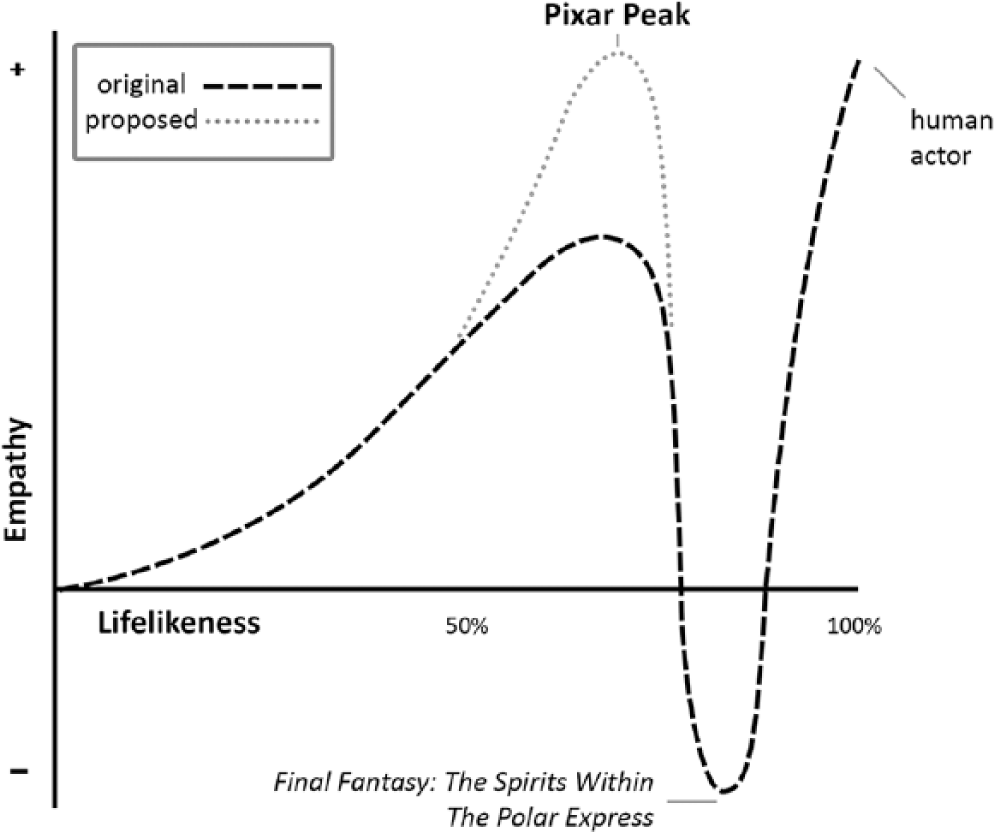
A simple visualization of the proposed Pixar Peak, in which computer-animated characters presented by Pixar, Disney and DreamWorks generate equally high levels of empathy as real human actors. © Malou van Rooij.
The graph is merely a simple visualization of this concept to illustrate the difference in empathetic response to the ‘photo-realist’ humans presented by Final Fantasy and The Polar Express and Pixar, Disney and DreamWorks’s more expressive characters. It is not the purpose of the article to claim that the latter three studios all present the exact same levels of lifelikeness and abstraction in all of their characters. Rather, they share a certain general rule of aesthetics which, regardless of minor differences between styles, all seem to be according to the same strategic blend of the two.
There are two arguments this article aims to put forward with the Pixar Peak theory: the first being that audiences can feel equally high levels of empathy for computer-animated characters as they can for real human actors. The second argument is that, by deliberately pursuing a more expressive character aesthetic, Pixar, Disney and DreamWorks present characters that paradoxically feel more believable to the audience than those according to a more realist characterization.
Empathy and lifelikeness
This article proposes that audiences can feel equally high levels of empathy for computer-animated characters as they can for real human actors. In this analysis, human actors are the film equivalent of Mori’s ‘healthy human’, and are therefore supposed to evoke maximum levels of empathy from an audience. As illustrated in the graph, the proposed peak is placed at the same point on the empathy axis as the human actor, despite the gap between their levels of lifelikeness.
Mori never provides us with a definition of ‘human likeness’, although one can suspect that for an anthropomorphic robot a human ‘look’, voice and motion are the central features. Just like robots, computer-animated characters are artificial constructions that need to be ‘brought to life’ in order for the viewer to be able to empathize with them. This article will be using the more general term of ‘lifelikeness’ over Mori’s ‘human likeness’ to accommodate inclusion of both human and non-human characters. Although the emphasis is mainly on the aesthetic function of ‘lifelikeness’, it is important to note that for computer-animated characters, who represent living beings with emotions and thoughts within their film’s story world, the definition should equally include behavioural traits. By attributing a certain emotional intelligence to a character’s behaviour, filmmakers enable the viewer to understand and respond to their emotions more easily.
The Pixar Peak is roughly placed on 65–70 percent of the lifelikeness scale, indicating the aforementioned calculated levels of realism and stylization in character design. 15 This challenges Mori’s theory, according to which only a creature with 100 percent human resemblance can presumably evoke maximum levels of empathy. However, it must be noted that, according to Mori’s own analysis, the relationship between the two phenomena is warped, with higher levels of lifelikeness not necessarily amounting to higher levels of empathy. It therefore seems inconsistent to suggest that only complete lifelikeness would generate maximum levels of empathy, which is why this article proposes a second peak. By deliberately pursuing a more expressive style of character design – treading the fine balance between realism and caricature – studios such as Pixar have found a metaphorical golden section of character aesthetics. By isolating what is important and focusing the viewer’s attention on a character’s specific traits, or emotional states, these are amplified and therefore much easier to recognize and empathize with. This argument can be backed up by the extremely positive critical acclaim and box office results these studios have achieved.
The above applies to human characters as much as it does to non-human characters. Examining the latter specifically, expressive non-human characters typically present a stylized version of the denoted animal or object they signify. For example, Zootropolis’s Judy Hopps is not designed according to any sort of realist aesthetic of a rabbit; rather, she has exaggerated features such as disproportionately large eyes and ears. She is a cartoonal yet anthropomorphic creature in the same way that human characters such as Riley and Hiccup are. As for non-human characters of which we have no real-life referents, such as Baymax, or the dragon Toothless (How to Train Your Dragon), it is still clear that they are stylized and exaggerated versions of what they aim to represent, usually with purposely striking eyes as their most prominent feature (even Baymax’s plain eyes are, as a result of his almost completely blank design, the focus of attention). Toothless, for example, can be regarded as a simplified version of some of the more detailed depictions of what dragons were originally imagined to look like.
The realism paradox
The second argument put forward by the Pixar Peak theory is that, by deliberately pursuing a caricatured human aesthetic, Pixar, Disney and DreamWorks present characters that paradoxically feel more believable to the audience than those according to a realist characterization. As noted already, the animated image is constructed in such a way that it corresponds to the spectator’s perception of a ‘real’ three-dimensional world (whether it has a real-life referent or not). These perceptually realistic characters and their worlds are built using ‘a nested hierarchy of cues’ which replicate the natural workings of phenomena such as light, texture and movement. As shown in the commentary on Shrek and The Incredibles, the ‘authentic’ quality of their characterization seems to have a great emotional impact, providing the characters with a certain aliveness that is accepted by the viewer.
Even though anthropomorphic characters have been a key element of animation since the traditional hand-drawn era, the possibilities of computer animation today have enabled them to become extremely realistic within their own setting. Pixar, Disney and DreamWorks push the boundaries of their own style by constantly improving on animation techniques and technical details, while staying far away from uncanny realist appearances. This, together with the continuous perfecting of perceptual correspondences within the layered construction of the film, contributes to the audience’s engagement with these characters as if they, and their emotions, are real.
Chris Pallant (2011: 133) has interestingly coined the term ‘hyper-realism’ for this expressive style of animation, describing it as ‘a self-regulated mediation of the “real”’. Similar to the argument this article has been constructing, his point is that, rather than using animation to its full photorealistic potential, studios like Pixar regulate their imagery to be more expressive, in order to avoid the Uncanny Valley. Although Pallant briefly notes that, ‘given the success of Pixar’s films, viewers evidently enjoy seeing this particular brand of stylised realism’ (p. 135), he doesn’t further explore the emotive potential of the style, nor does he challenge Mori’s theory as this article aims to do. However, similar to Manovich’s (2002: 202) point on computer animation’s ‘more perfect than human’ quality, Pallant’s dubbing of the phenomenon does point at how this ‘brand’ of aesthetics presents its own form of realism, which, as the term ‘hyper-realism’ suggests, can be regarded as even better than reality.
As mentioned earlier in this article, it must be noted that hand-drawn animation too combines mediated levels of abstraction, anthropomorphism and lifelikeness, and therefore surely also does a fantastic job in evoking emotions from its audiences – exemplified in major worldwide classics such as Dumbo (Ben Sharpsteen, 1941) and Bambi (David Hand, 1942), notorious for eliciting tears from adult and child audiences alike. However, this article argues that computer animation, by using certain elements of live-action filmmaking to its own advantage (including perceptual cues, camera techniques and 3-D sets), further strengthens the believability of its story worlds, distilling its characters with a certain ‘aliveness’ that is simply not attainable in 2-D. That is not to say these characters cannot feel real to audiences, but part of the charm of hand-drawn animation is its overt showcasing of the technique intrinsic to the form – drawing. Computer-generated imagery, in its proximity to and subtle reproduction of live photography, can be much harder to distinguish from actual live-action film, and so blurs the lines of what is and feels ‘real’ to the viewer. It therefore seems that the very thing that puts its characters at the risk of tumbling down the Uncanny Valley is, when correctly regulated, actually one of computer-animated film’s most powerful affordances.
Conclusion
This article proposes that computer-animated characters presented by major American animation studios Pixar, Disney and DreamWorks are designed according to a stylistic success formula, hitting a sweet spot on a scale of lifelikeness and abstraction, while generating the highest levels of empathy from the audience. Using digital sets, virtual cameras and perceptual cues to create a believable, three-dimensional world in which they ‘live’, these studios’ more expressive characters seem to be accepted by the audiences as real and authentic, evoking empathy and amplifying meaning. The proposed theory of the Pixar Peak challenges the scholarly application of the Uncanny Valley to computer-animated film to date by skewing the original peak in Mori’s original graph, in an attempt to explain the overwhelming emotional response to and great success of contemporary computer-animated films made by these studios.
Footnotes
Acknowledgements
I would like to express my deepest gratitude to Dr Trev Broughton for her supervision of my MA dissertation and her inspiration and help in re-writing it. Her thorough and thoughtful feedback greatly benefited the final result. I also wish to thank the anonymous reviewers of this article for their detailed notes, which were invaluable in finalizing this article. Finally, I owe special thanks to Jurre de Baare for his continued contribution and endless patience throughout this project – it wouldn’t have been possible without him.
Funding
This research received no specific grant from any funding agency in the public, commercial, or not-for-profit sectors and there is no conflict of interest.