



Abstract
Before 1940, the influence of foreign films, filmmakers and film networks on film culture in the Netherlands was substantial. This article investigates how various Dutch professionals within the fields of film production, distribution, exhibition and reception referred to animation film, in a period when this term was not part of the Dutch language. From early on, animation film was recognized as being ‘intrinsically different’ from live-action film and, along with the gradual emergence of this new artistic form, a corresponding language to support it evolved, influenced by language contacts in various contexts in the multilingual landscape in Europe. From the first singular appearances in 1913, a more form-specific terminology had gradually developed by 1940. During the same time, animation film steadily proceeded to occupy its permanent place in Dutch film culture.
Keywords
Introduction
Before 1940, the development of film production and a cinema market in the Netherlands was restrained compared to neighbouring countries in Europe, and the influence of foreign films, filmmakers and film networks on Dutch cinema culture was substantial (Dibbets and Van der Maden, 1986; Dittrich, 1987; Sedgwick et al., 2012; Thissen, 2013). This article focuses on animation film and the role of these transnational contexts in the period roughly between 1913 and 1940. 1 While the concept ‘animation film’ is used here to define the research corpus from this early period, there was no comprehensive term in the Dutch language to define this specific group of films and designate the emerging new artistic form. In her book on the evolution of 15 centuries of the Dutch language, linguist Nicoline van der Sijs notes that other languages have always influenced Dutch, especially Latin and the neighbouring languages French, German and English (Van der Sijs, 2019: 14–15). She sees different forms of language contact – contact with speakers of foreign languages – as one of the important factors of language change, which is noticeable, for example, in the introduction of loanwords. This article investigates how various Dutch professionals referred to animation film in a period when this term was not part of Dutch common language and asks how the terminology that was used was in itself informed by language contacts in the fields of film production, distribution, exhibition and reception. What can a closer look at language reveal about the national and transnational cultural and intermedial contexts in which animation film emerged in the Netherlands?
Charting the diverse field of animation studies, Lilly Husbands and Caroline Ruddell (2019: 6) argue that the multifarious techniques and practices of animation present particular challenges in terms of agreeing on a single definition. They name two key differences between live-action and animation that are at the heart of attempts to define animation: the frame-by-frame production process and the notion that animation is an entirely constructed form. In this text, the argument will be developed around two distinguishing characteristics of animation film which derive from these differences, focusing on the capacity of what animation can do visually: first, the illusion of movement created in animation, often called ‘the illusion of life’; and, second, the materiality of the production process, in which a variety of fine art materials, techniques and practices are used. When discussing early 20th-century animation, Paul Wells (1998: 15) acknowledges how the perception of live-action and animation differed: The illusion of life in animation was profoundly more challenging than the seemingly unmediated and recognisable representation of reality in live-action films, despite their novelty as an emergent popular form. As such, the animated film was soon perceived as something intrinsically different from the kind of films that began to constitute popular cinema. The animated film thus became defined by its distinctive technical and aesthetic qualities, in both two- and three-dimensional forms.
This article investigates how the perception and experience of animation as being ‘intrinsically different’ can be traced back to the way different stakeholders who were active in the Netherlands in this early period used distinct terminology and its meanings to describe animation film.
Contemporary terminology
In the Netherlands, the definition and interpretation of the term animation or animation film is continuously being challenged, but still many independent artists and studios refer to themselves as animation filmmakers or animation film studios. Today, the Netherlands has a vibrant animation culture, and ‘animatiefilm’ (‘animation film’), or the abbreviation ‘animatie’ (‘animation’), are widely used terms to identify this specific form of filmmaking. Various specialized events, festivals, organizations and courses in higher education use the term ‘animation’.
With the digitization of many archival sources in recent years, it has become possible to execute full-text searches in extensive collections of historical Dutch newspapers and magazines. A full-text search, shown as a graph in Figure 1, suggests that the word ‘animatiefilm’ was gradually introduced in the early 1960s as the term surfaces in Dutch newspapers from 1960 onwards. 2 During this period, more and more Dutch filmmakers made short ‘independent’ or ‘artistic’ films, and the use of the term ‘animatiefilm’ was probably instrumental in distinguishing them from commercial and applied forms of animation, which hitherto had enjoyed higher presentation profiles in the Netherlands. This development also coincided with the increasing self-awareness and professionalization of the international community of independent animation filmmakers and the establishment of organizations such as the International Animated Film Association (ASIFA) and the Annecy International Animation Film Festival in 1960. 3 The choice of words in three book publications illustrates this gradual transition in terminology. In 1974, the Stedelijk Museum in Amsterdam organized an exhibition on Dutch animation called ‘Beeldje voor Beeldje, een Tentoonstelling over Nederlandse Animatiefilms’ (‘Frame-by-Frame, an exhibition of Dutch animation films’) (Stroeve et al., 1974). The title suggests that the term was well established by then. In 1963, some 10 years earlier, a technical handbook for amateur filmmakers was published in which the term ‘animatiefilm’ was not used. Instead, in the subtitle of the book, the English term ‘animation’ is used and put in quotation marks (Brons, 1963). A 1958 Dutch Encyclopedie voor Fotografie en Cinematografie (Encyclopaedia of Photography and Film) does not include the term ‘animatiefilm’, but instead has an entry for the English word ‘cartoon’. This entry on cartoon, interestingly, problematizes expressing the essential nature of the word: ‘cartoon: “levende tekeningen”, moeilijk te definiëren soort film’ (‘cartoon: “living drawings”, a kind of film that is difficult to define’) (Heyse and Craeybeckx, 1958: 246). 4

Graph depicting how often the word ‘animatiefilm’ is found in Dutch newspapers between 1895–1994. Available at Delpher (accessed 28 January 2022).
To trace the development of Dutch terminology on animation film in the pre-Second World War period, a set of historical data was analysed, which was gathered through extensive research into contemporary analogue and digitized sources from the Netherlands. 5 This ranges from contemporary reference books, such as dictionaries (in which a uniform standard language is laid down) and encyclopaedias, to books on film, film magazines, newspapers, documents from personal archives and original film prints. The collected data set contains textual references with various terminology referring to animation film as found in film credits, articles, advertisements and correspondence. In this article, the diversity of the terms used, their context, provenance and subsequent meanings will be discussed in greater detail. Before that, however, I will introduce the different ‘types of text producers’, which consist of three groups of professional stakeholders, and their language contacts. The first group of stakeholders are the film distributors and cinema exhibitors who programme, advertise and promote screenings in which animation films are included; second, the filmmakers who made animation films in the Netherlands in this period; and third, the journalists, film critics and publicists writing about animation film in newspapers, trade magazines and other publications.
Cinema exhibitors and film distributors
In the period from 1913 to 1940, animation film gradually became a common feature in Dutch cinemas. The vast majority of films, which dominated distribution and exhibition practices, were theatrical shorts of foreign origin. The many cinema advertisements in the daily newspapers testify to the fact that animated shorts were generally shown before the feature film. In film trade magazines for cinema exhibitors, distributors advertised animated shorts as special features of the ‘side-programme’, in Dutch called ‘voorprogramma’ or ‘bijprogramma’ (see Figure 3).
6
More research needs to be done to get a better insight into exhibition strategies of Dutch cinemas for animated shorts and advertising films before 1940. It seems plausible that they developed along the same lines as those that Paul Ward (2000: np) described as the ‘modern film bill’: . . . changes in production, distribution and exhibition contributed to the emergence of distinct categories of film, which were then developed on a film bill which was distinguished by its ‘ranking’ of films in a hierarchy. These shifts resulted in the prioritising of fictional narratives – increasing in duration to ‘feature’ length – and the subordination of other material such as cartoons and newsreels to a supporting role . . . The particular characteristics of this form of exhibition required a variety of products, and the animated film developed in such a way as to fit this institutional bill.
In the period up to 1940, the majority of animation films that were screened in Dutch cinema programmes were short films produced in the United States and to a lesser extent in other European countries, such as the Swedish films of Victor Bergdahl or the French films of Robert Lortac and Benjamin Rabier. The earliest sources I found referring to animation film are cinema advertisements in newspapers, going back as far as 1913. For example, Ladislas Starevich’s puppet film De Krekel en de Mier (The Grasshopper and the Ant, 1913) was shown in many Dutch cities in the summer of 1913 and, years later, was commemorated by film critic Leo Jordaan as a ‘sensation’ of that time (Jordaan, 1939: 9). 7 By 1912, film screenings in the Netherlands had developed from projections at travelling fairgrounds to a more stable and established form of entertainment: cinemas (Blom, 2003: 345). After the First World War, American animated shorts with a series protagonist became a regular feature in cinema programmes and the introduction of synchronized sound in the late 1920s seems to have boosted their popularity. In advertisements, the accurate film title is often not mentioned, but instead just an announcement of the protagonists’ names, for example Felix the Cat or Mutt and Jeff. From 1934 onwards, animation films, such as the shorts from the Fleischer Studio and the Disney Studio, found a permanent place in the programming of the Cineac news cinemas, which contained a recurring mix of short subjects: newsreels, documentaries, comedies and animation.
Apart from the publicity discourse in the advertisements, animation film terminology can be found in original film prints from the period. Distributors often made translations of the intertitles of foreign films before they were distributed on the Dutch market. In the opening credits, beside the given Dutch film title, sometimes terminology can be found that gives an indication of the type of film, such as a ‘teekening film’ (‘drawing film’) or a ‘poppenfilm’ (‘puppet film’) (see Figures 2 and 5). How the original titles are translated into Dutch for usage in film prints and advertisements is a complicating factor when identifying these films. Sometimes translations are quite literal but, at other times, titles are translated more freely. Furthermore, film prints were used over and over again, sometimes for decades, and it is not impossible that original film titles were damaged, removed and replaced by others. However, characteristics such as the production date of the film stock, the outdated spelling, design and typography of the titles can help with identification. And sometimes, combining different sources can help to complete the picture, for example if the film title is highlighted in both the press advertisements and the film print (see Figures 2 and 3).

Still from Charlie’s Turksche Droom (Charlie in Turkey, Sullivan, 1919). Collection Eye Filmmuseum.
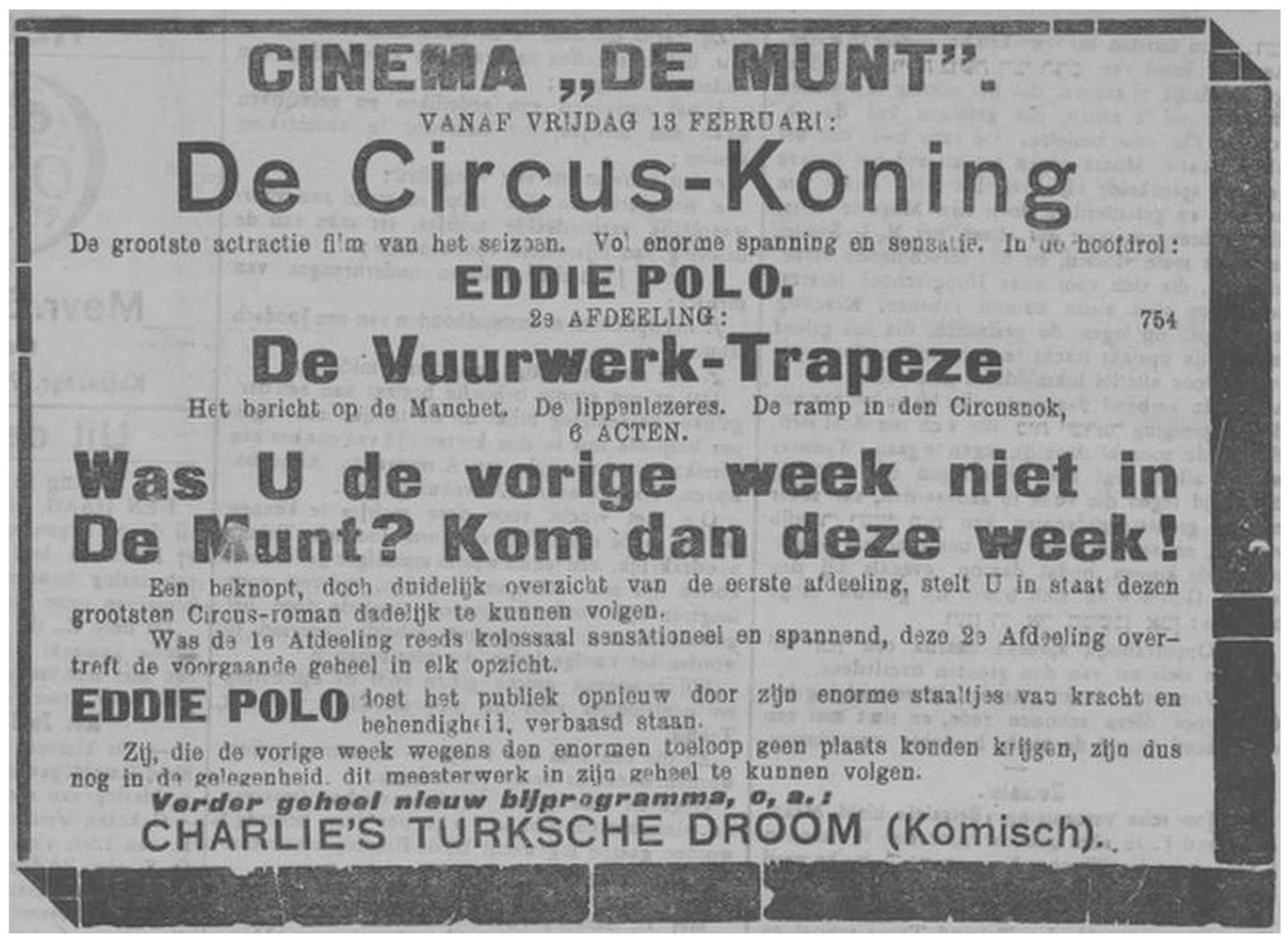
A ‘completely new side-programme’ including the ‘comical’ animation film Charlie in Turkey is announced at the bottom of this advertisement for a cinema in Amsterdam. Centraal blad voor Israëlieten in Nederland, 13 February 1920. Available at Delpher http://resolver.kb.nl/resolve?urn=MMKB19:000572116:mpeg21:p00006 (accessed 6 April 2021).
Filmmakers and producers
The late 1910s witnessed the beginning of animation film production in the Netherlands. Up to 1940, most animation films produced in the Netherlands were advertising films. However, several producers and filmmakers made animation films, but most of them produced only one or a limited number of films. Examples of independent animated shorts are the films De Moord van Raamsdonk (Murder in Raamsdonk) (Ter Gast and Van Neijenhoff, 1936) and Diepte (Depth) (Dupont, 1933), but the vast majority of animation films produced in the Netherlands were advertising shorts. This is probably the reason why, in contemporary publications, little is written about Dutch animation film productions and why they are rarely mentioned in cinema advertisements. Unlike independent shorts, advertising films were considered of lesser importance, and they played a different role in distribution practices.
The two most productive animation filmmakers in the Netherlands, George Debels and George Pal, were both of foreign descent. George Debels, born in Belgium and educated in a French-speaking area, can be considered the pioneer of animation in the Netherlands. He settled in Amsterdam in the 1910s and stayed there for the rest of his life. His film Een Avontuurtje in ‘t Luchtruim (An Adventure in the Atmosphere) (1919) is the oldest Dutch animation of which a film print has survived. 8 The film can be dated with some certainty because it is a promotional film for the Eerste Luchtverkeer Tentoonstelling Amsterdam (ELTA), an aviation event that took place in Amsterdam in 1919. George Debels mostly made drawn animated advertising films for products such as milk, cigarettes, stoves and bicycles, which were distributed on local or national markets. Although he probably made more than 75 short films up to the late 1930s, his name was rarely mentioned by publicists. George Debels seemed to have worked in relative anonymity, with small scale production facilities and only one or two assistants. Sometimes he collaborated with professional partners, such as the filmmakers Alex Benno and Otto Neijenhoff, and for a couple of years (c. 1928–1933), when he worked under the company name Mac-Djorski-Films, he used the postal address of the luxurious cinema Theater Tuschinki in Amsterdam (see Figure 4). 9
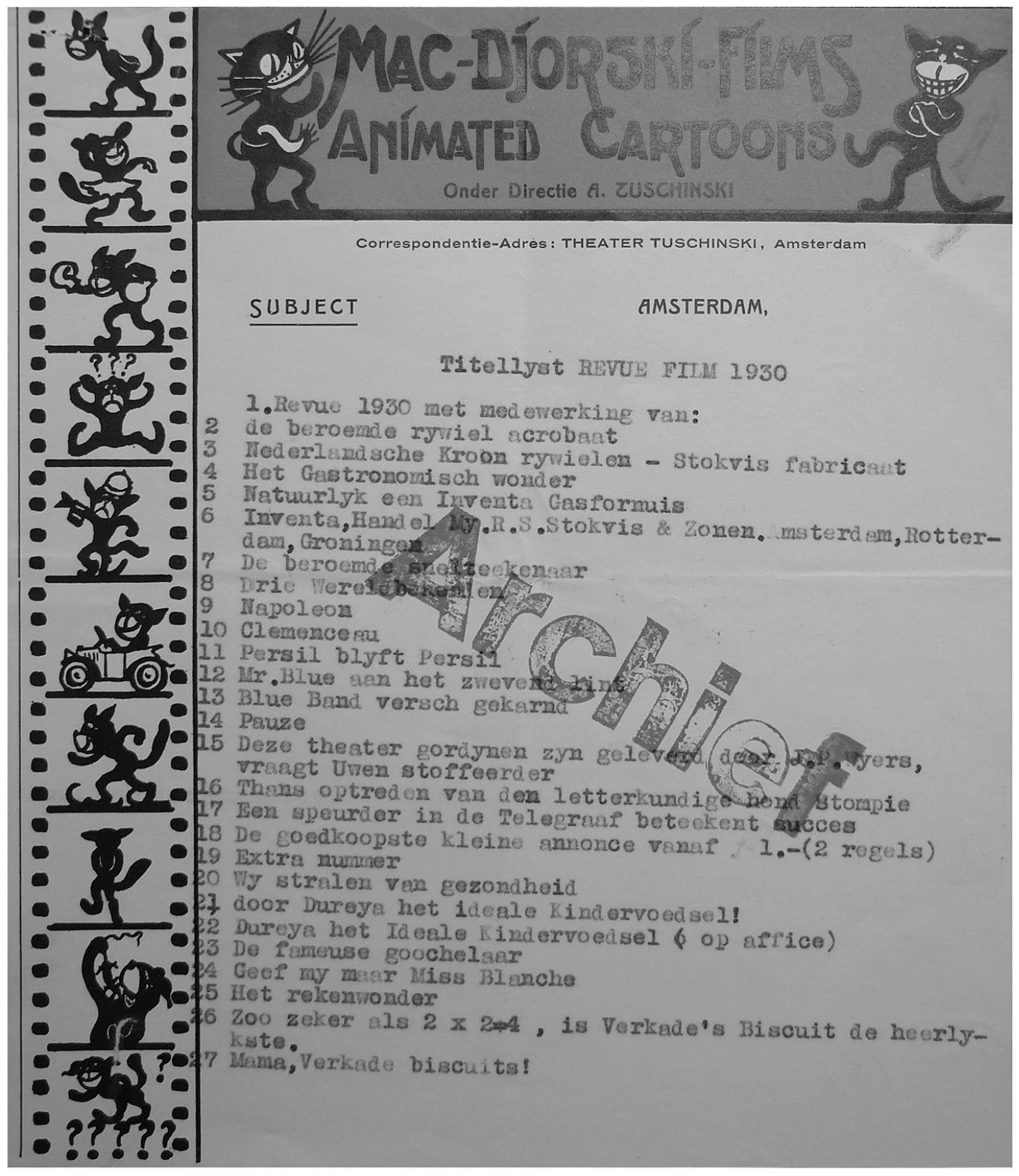
Stationery of Mac-Djorski-Films used by George Debels to correspond with the Film Censorship Board. This letter contains a list with the 27 intertitles included in the film Revue 1930 (Debels, 1929). The film was approved for screening on 28 December 1929. Nationaal Archief, Den Haag.
In contrast to George Debels, the Hungarian-born filmmaker George Pal gained some fame, at least amongst the Dutch film critics, after he established a film studio in the Netherlands in 1934. He had been working at the German UFA film studio for some years, and later founded his own studio in Berlin. So, when George Pal arrived in the Netherlands, he was an experienced professional and had some reputation within the film industry. He spent six years in Eindhoven, where his fame continued to grow. During this time, he made around 25 short commercials for several commissioners from the Netherlands and abroad using both two-dimensional drawn animation and three-dimensional puppet animation. The advertising departments of his major commissioners, the British company Horlicks and the Dutch company Philips, probably had a strong say in the narrative strategies of the films and the publicity campaigns in which these advertising films were used. In particular, the advertising films he produced for Philips were distributed internationally and film copies were made in many different language versions (Peters, 2019). In the Dutch press, his advertising films were often compared with American animation shorts, for example: ‘Pal’s puppet films have become world-famous, they are now widely equated with Fleischer’s and Disney’s drawn animations’ (De Maasbode, 1938). 10 Although this jubilant quote may be an example of journalistic exaggeration, the fact remains that, after George Pal had left the Netherlands in 1939, he became a successful filmmaker in Hollywood, directing and producing award-wining science-fiction and fantasy movies.
Publicists and writers
The writings on animation by journalists and other publicists represent the third category of discourse identified in this research. A typical review from the 1920s would rarely entail more than an enthusiastic retelling of the plot of the film. Animation films are mentioned only occasionally, such as in short announcements of the film programme, and do not pass any judgement on their quality or content. In the mid-1920s, journalists of several newspapers developed a more critical approach towards writing about the films screened in the cinemas. A special interest for more experimental films and the European avant-garde film arose within the visual arts avant-garde. For example, Theo van Doesburg, one of the leading figures of the art movement De Stijl, met Hans Richter and Viking Eggeling in person and wrote about their abstract films as early as 1921 (Van Doesburg, 1921: 71–75). Although he was never involved in filmmaking himself, ‘film served Theo van Doesburg’s purpose to embed the factor time in his dynamic ideas on modern art’ (Van Beusekom, 2007: 63). From 1927 onwards, a critical and more theoretical approach towards predominantly Russian, French and German avant-garde films takes shape within the Filmliga movement, and a special film magazine called Filmliga was founded. The Filmliga resented the ‘escapist’ entertainment films produced by the Hollywood industry and believed in the uplifting mission of the art film and experiments of the avant-garde (Van den Oever, 2015: 183). The Filmliga organized special screenings with films produced by the European avant-garde, such as Sergei Eisenstein, Dziga Vertov, Fernand Léger and Walter Ruttmann, and filmmakers were invited to introduce and discuss their work.
One prominent film critic who was involved in the Filmliga movement was Leo Jordaan. In addition to being an author, he was an illustrator and was well known for his political cartoons published in national newspapers and magazines. In some of his cartoons, he used American animation characters such as Mickey Mouse, Felix the Cat and Popeye as sources of inspiration for his political commentary. For a full understanding of the references in these cartoons, these animation characters must have been known to the readers of the newspapers in which they were published. From the 1930s onwards, Leo Jordaan also occasionally wrote about animation film and, in 1932, he was one of the editors of a special issue of Filmliga dedicated to animation film. As a trained draughtsman, he had a critical eye for the aesthetic qualities of the films and technical skills of animators from the Sullivan, Fleischer and Disney Studios and, in his texts, he often expressed admiration or disapproval for these films.
Between 1928 and 1935, the attention to animation film increased gradually, as several books on film were published in which animation is recognized as a separate category of film, with whole chapters being dedicated to animation film. 11 This increasing interest was probably influenced by the popularity of the American animated shorts that were screened in the cinemas. In her research into the reception of the medium film in the Netherlands, Ansje van Beusekom suggests that, in the 1930s, American cartoons played an important role for a ‘renewed’ interest in American films. When Walt Disney’s animated feature-length film Sneeuwwitje en de Zeven Dwergen (Snow White and the Seven Dwarfs, Hand, 1937) premiered in the Netherlands, it was a huge event, considered the thrill of the film season of 1939 (Van Beusekom, 2001: 252). It was the first time that an animation film received widespread media coverage both in the local and national press and in specialized film magazines.
Animare, the Latin root
Following the introduction of data collected from three different types of stakeholders in the discourses on animation film in the Netherlands, the next step is to turn to a closer reading of recurring Dutch terminology to describe animation film and to see how this relates to transnational language contacts and other cultural practices. In the many definitions of ‘animation film’ in contemporary literature, the Latin root of the word is often mentioned: . . . the word has two ordinary meanings, both serendipitous for animation cinema: one referring simply to movement, and the other to becoming alive. This double sense arose in Romance languages such as French from the verb animer and its Latin root animare, which means to breathe or to blow, and the noun form, animation, from anima, life or breath, and animationem, that which is blown upon. (Crafton, 2011: 97)
‘Animation film’ includes all possible techniques and makes no reference to a specific materiality but refers to the illusion of motion made possible with the frame-by-frame technique. The Dutch verb ‘animeren’ is used as in the sense of ‘to liven up’ or ‘to encourage’, and is derived from the French word ‘animer’, but in the period under scrutiny here, there was no Dutch noun that relates to ‘animate’ in the filmic sense (Etymologiebank, 2020a). The aspects of ‘movement’ or ‘becoming alive’ can be found in Dutch translations of the French compound term ‘dessin animé’, and especially the past participle ‘animé’. In advertisements of the French distributor Pathé Frères in the Dutch press and trade magazines, animation films such as the Overste Leugenzak films (Colonel Heeza Liar films, Bray, 1913–1924) are described as ‘levende teekeningen’ (‘living drawings’) and as ‘beweeglijke teekeningen’ (‘moving drawings’). 12 These descriptions also distinguish animation film from live-action film in reference to materiality, in this case images captured in ‘drawings’ that are being made to move instead of ‘photographic images’. Also, the term contrasts a widely used compound term to describe live-action films in the Dutch language in the early period, i.e. ‘levende photographiën’ (‘living photographs’), referring to photography and its ability to capture life-like images (Briels, 1971: 5). In English, ‘animated pictures’, ‘animated photographs’ etc. were terms that referred to live-action films in general in the early period of film, and not to animation (Cook, 2018: 8). An example of a link between tactile drawings and the notion of ‘becoming alive’ is also used in a 1925 advertisement for the drawn animation film Een Toovernacht (A Magic Night) (Kreveld, 1925). The film is based on the adventures of two famous Dutch comic strip characters, ‘Bulletje en Boonestaak’, which appeared in the De Notenkraker, a satirical weekly supplement of the socialist newspaper Het Volk. The film is being advertised as a ‘living’ Notenkraker and is thus being positioned as a material version of the comic that has become alive for the reader of the newspaper to wonder at. 13
It is interesting to note here that filmmaker George Debels used the English phrase ‘animated cartoons’ in combination with his company name Mac-Djorski-Films, Animated Cartoons. The phrase can be found in both the logo used in the title cards of film prints and in the letterhead of his company writing paper (see Figure 4). George Debels is also responsible for the very exceptional use of the Dutch past participle used as an adjective in ‘geanimeerde’ (‘animated’). In the letterhead of his stationery dated 1936, he uses the combined phrase ‘geanimeerde teekeningen’ (‘animated drawings’). Maybe his French-speaking background made him use these terms in relation to his own film practice, as it is closely related to the French compound term ‘dessins animés’. 14
Cartoons and caricature
The English compound term ‘animated cartoon’ references the Latin root in the same way as the French ‘dessins animés’. Donald Crafton (2011: 104) suggests that in Anglophone countries from 1913 onwards ‘animated films using drawings became compounded as animated cartoons and, by the 1920s, just cartoons’ (emphasis in original). The term ‘cartoon’ also occurs in the data collected from Dutch sources. It is mainly used in advertisements by distributors and exhibitors who refer to American animation series, such as the Mickey Mouse cartoons. 15 In reviews, ‘cartoon’ and ‘animated cartoon’ are often put in quotation marks, indicating that the terminology used here is closely related to that used by the country of origin, and probably often repeats readymade press information.
‘Cartoon’ also relates to the other meaning of the term in the Dutch language, which is the same as in Anglophone countries. In the early 20th century, and still today, ‘cartoon’ is used in the sense of a humorous or satirical political drawing (Etymologiebank, 2020b, 2020c). In the period up to 1925, also the Dutch term ‘caricatuur’, or in different spelling ‘karikatuur’ (‘caricature’) is used to refer to animation film with this meaning. It is used in various compound terms such as ‘caricatuur-beeldje’ (‘caricature image’), ‘karikatuurteekening’ (‘caricature drawing’) or ‘karikatuur trucfilm’ (‘caricature trick film’). These compound terms describe animation films, predominantly those that were adaptations of comic strips, such as the Bud Fisher films with the characters Mutt and Jeff. 16
The usage of the English compound ‘animated cartoons’ by filmmaker George Debels may be attributed to his admiration for American animation films. For several of his advertising films, he drew figures who show great resemblance to American animation characters such as Felix the Cat or Koko the Clown. It is my educated guess that he may have been familiar with the book Animated Cartoons by Lutz, an American book published in 1920 and one of the few manuals on the making of drawn animation. The book was certainly known by film critic Leo Jordaan because he quotes extensively from it in the aforementioned special issue of Filmliga, calling it ‘Lutz’ handboek voor de teekenfilm’ (‘Lutz’ manual for drawn animation film’), but he does not use the terms ‘animated’ or ‘cartoon’ (Jordaan, 1932: 174). This seems to confirm the widespread use of the term ‘teekenfilm’ by the early 1930s, as the dominant Dutch term for this specific type of animation film.
Avant-garde: Absolute film and abstract film
As discussed earlier, the European avant-garde art movements found solid ground in the Netherlands in the 1920s and 1930s, and in this context the Dutch term ‘absolute film’, spelled the same way as in English, was used. In the writings of newspaper journalists and the critics of the Filmliga movement, the term ‘absolute film’ is used in relation to abstract films by artists such as Walter Ruttmann, Oskar Fischinger and Hans Richter. This term is directly linked to the German term ‘Absoluter Film’, used by these filmmakers themselves (Scheugl and Schmidt, 1974: 29). In 1931, Menno ter Braak, one of the first Dutch film theorists, published the book De Absolute Film, in which he unfolded his theoretical approach to the subject. He used the term not only in the German sense, meaning abstract films, but more broadly as in the sense of the French ‘cinéma pur’, which also refers to films with live-action footage and documentary films, such as those by Carl Dreyer, Sergei Eisenstein and Fernand Léger. ‘Here the term “absolute” refers to the fact that the cinematic resources that are deployed (image, sound, rhythm, and colour) are used as purely autonomous entities’ (Eye Filmmuseum, 2017). Dutch filmmaker Frans Dupont made a film called Diepte (1933), in which he combines drawn abstract and figurative images with live-action footage, and, in the credits, the film is described as ‘een absolute film’ and a short explanation follows: ‘this film only wants to be harmony, it is not a representation of a specific subject.’ 17
In his book De Absolute Film (1931), Menno ter Braak acknowledges that it will be difficult to distinguish exactly which filmmakers and films belong to the ‘absolute film’ category. He also states that he does not see much future for the abstract film. But, while Menno ter Braak is proofreading the text of the book, he adds a remarkable footnote undermining his own argument, when he says that the work of Oskar Fischinger seems to announce a new phase in the development of the absolute film (Ter Braak, 1931: 47–48). 18 Leo Jordaan (1932: 171) even calls ‘absolute film’ a controversial word, but sees drawn animation as its appearance in the simplest and healthiest sense of it. 19 While the interpretation of the term ‘absolute film’ was being debated, it remained a term often used for abstract films even after the Filmliga movement ceased to exist. It is used in cinema advertisements and articles in the late 1930s, for example in relation to the screenings of Oskar Fischinger’s films (De Tijd, 1931).
Trick film
The earliest sources with Dutch terminology, in relation to animation film I found, use the term ‘trucfilm’ or ‘trick film’, and this continues from the mid-1910s throughout the 1920s and 1930s. The term ‘trucfilm’ includes both two- and three-dimensional forms of animation and is often used in combination with adjectives referring to drawings and plasticity. The term ‘trucfilm’ reflects the unique frame-by-frame production method, by which seemingly inanimate objects are set in motion, as a kind of conjuring trick. At the same time, when an animation film is projected, this process becomes invisible, which brings about its mystification and the art of the impossible. As film critic Leo Jordaan observed in the early 1930s, the knowledge about the production process of animated films was not widespread (Jordaan, 1932: 169). The ‘mystification’ of the production process was used in the promotion of these films, as illustrated by an advertisement from 1921, in which the screening of a Koko the Clown film (Max Fleischer) is announced as follows: ‘The Clown, a miracle in the art of drawing, of which only the maker knows the technique.’ 20 When the Dutch term ‘trucfilm’ is used in the context of animation film, it refers to the fact that animation was recognized as being ‘different’ from live-action filmmaking. An early and rare example of an article focusing solely on one drawn animation film is titled ‘An interesting trick film’ (1919), focusing on an advertising film made by George Debels for a plants and flower exhibition. 21 To clarify the process of the drawn transformations that were animated in this film, the article is richly illustrated with successive images from a film print.
In the Dutch language, the meaning of the word ‘truc’ is related to ‘trick’ and originates from the French word ‘truc’.
22
The English equivalent of ‘trucfilm’ is ‘trick film’.
23
Donald Crafton (2011: 103) also finds that Anglophone and Francophone writers regard early animation films (before 1915) as ‘trick pictures’ or ‘scènes à truc’. The term ‘trick film’ was not exclusively reserved for animation film, though. The term was used to refer to films in which substitution splice techniques were used, such as the films by George Méliès (c. 1896–1913), in which, for example, actors or objects could mysteriously disappear. This technique is very closely related to the frame-by-frame technique. Philippe Philippe Gauthier (2011: 165) describes the difference as follows: While the disappearing trick was the result of stopping the camera to make an isolated substitution on the film strip, the frame-by-frame trick was more of a serial substitution, a systematic repetition of stops in order to carry out substitutions throughout the film strip, one frame after another. (emphasis in original)
So, while all animation films according to this line of reasoning can be considered ‘trucfilms’, not all ‘trucfilms’ are animation films. This is also illustrated in the German book Der Trickfilm in seinen grundsätzlichen Möglichkeiten by Guido Seeber, published in 1927. The book has chapters on different categories of film tricks, varying from what nowadays might be called visual effects, such as the disappearing trick, but also the use of ‘masks’, ‘double-exposures’ or ‘filming with projections’. Guido Seeber noticed the trend that in German ‘Trickfilm’ was becoming a generic term to describe animation film. This can still be seen today, as one of the largest present-day animation film festivals in Stuttgart, Germany, calls itself Internationales Trickfilm-Festival. 24 Guido Seeber criticized this way of using the term ‘Trickfilm’ and suggested that drawn animation film should once and for all be called ‘Gezeichnete Filme’ (‘drawn films’) (p. 178). In the 1920s and 1930s, the German term ‘Zeichenfilm’ (‘drawing film’) can also be found, and this term is more closely related to the Dutch ‘getekende film’ or ‘teekenfilm’, which I will come back to later in this text.
In the early 20th century, the Dutch term ‘trucfilm’ was used for both live-action films using tricks and films made with various animation techniques, drawn animation and puppet films. But with the introduction of the animation specific term ‘teekenfilm’, ‘drawn film’, in the 1920s, and especially in the 1930s, ‘trucfilm’ seems to have become more exclusively used for animation films using three-dimensional objects. This coincides with the period when George Pal set up an animation studio in the Netherlands. In particular, the puppet films he made for the electronics company Philips were well received and got noticed by the publicists. The innovative Philips advertising department was committed to organizing press meetings, visits to the Pal Studio and interviews with Pal. In articles, the German word ‘Trickfilm’, the Dutch word ‘trucfilm’ and the compound ‘plastische trucfilm’ (‘plastic trick film’) were often used. In Dutch, the adjective ‘plastisch’ is related to shaping forms out of a shapeless mass such as clay and, when talking about art, to modelling and sculpting (Koenen, 1935: 780). Considering George Pal’s work experience in a German-speaking context, he probably used the German terms himself. In 1933, George Pal is listed in the multilingual reference book called Universal Filmlexikon – Universal Film Lexicon – Lexique Universel du Film 1933 in which it is noted that he speaks ‘German, Hungarian, slight English’ (Arnau, 1933: D131). Included in the book is a text about George Pal’s drawn animation process: in the English part, these film productions are called ‘animated cartoons’, in the German part ‘Trickfilme’ and in the French part ‘dessins animés’. A few years later, he writes a letter to an American agent, in which he describes how he developed ideas for a puppet film technique: ‘because I felt, that with the enormous resources the American trick film production could put behind their films, I would never be able to successfully compete with such productions’. He uses the term ‘trick film’ here for drawn animation films from the Disney Studios and continues: ‘Plans, therefore, ripened in my mind to produce cartoons in the third dimension. Being an architect and interior decorator, it was not difficult for me to design suitable décors and figures for such a film.’ 25
Puppet film and silhouette film
In relation to puppet film, the element of plasticity and three-dimensionality of the animated objects is often recognized by the use of compounds in combination with the previously mentioned terms ‘trucfilm’ or ‘trickfilm’. Around the mid-1920s, the Dutch term ‘poppenfilm’ (‘puppet film’) appears. In reviews and advertisements, the technical ingenuity of making puppet films and the materials employed are often emphasized. Ladislas Starevich’s puppet films were regularly shown in Dutch cinemas and when, in December 1913, the Albert Frères announced another screening of Ladislas Starevich’s film De Kerstnacht-idylle onder dieren (The Insects’ Christmas, 1912), they phrased it like this: ‘Last night the public was full of admiration. It is a wonder for the visitors and a big mystery . . . for the professional.’ 26 In 1936, the Russian (partly) animated feature film De Nieuwe Gulliver (The New Gulliver, Ptushko, 1935) is advertised as ‘something very special . . . 1500 marionettes in a fine satirical story with good humour. A wonder of technique, of beauty and artistry’. 27
Paul Wells (1998: 90) uses the term ‘fabrication’ as a specific narrative strategy in the context of three-dimensional animation, which is ‘directly concerned with the expression of materiality, and as such, the creation of a certain meta-reality which has the same physical property as the real world’. The characters in, for example, the films of George Pal, Ladislas Starevich and Alexandre Ptushko, are described as ‘poppen’ (‘puppets’) or ‘marionetten’ (‘marionettes’), terms which refer to the materiality, tactility and essentially three-dimensional characteristics of these characters. The Dutch term ‘pop’ is used to describe a doll, but also a figure used in various theatrical forms. In the period under scrutiny, several more or less professional performers were active using marionettes, hand or stick puppets or silhouettes and these forms of puppet theatre were widely known in the Netherlands (Bulthuis, 1966). When film critic Leo Jordaan wrote an article to reflect on George Pal’s five-year stay in the Netherlands, he quite literally linked the marionette theatre to puppet film, when he compares the films of the Pal Studio with a specific form of Flemish puppet theatre, called the ‘Poesjenellenkelder’ (Jordaan, 1939: 9). In both the stationery of the Pal studio and the credits of his advertising films the term ‘poppenfilm’ was used (see Figure 5). 28 George Pal became increasingly oriented towards Anglophone countries during his stay in the Netherlands. Then, in 1939, he emigrated to the United States, a few months before the German army invaded the Netherlands. By the end of the 1930s, he had started to use the term ‘puppetoon’, a combination of ‘puppet-film’ and ‘cartoon’ (see Figure 6). The first press reports, where the term, initially spelled as ‘puppet-toon’, was used, appear in the context of a visit to the United States in March 1938. Variety writes: ‘Pal’s “puppet-toons” are a current European sensation’ (Variety, 1938: 8). The search for a fitting terminology for his puppet films is reflected in the English language credits of the advertising films he produced in the Netherlands, varying from ‘pantomime’, ‘doll-film’, ‘puppet film’ to ‘puppetoon’. 29 Later he would use the latter term for the American shorts he produced for Paramount.
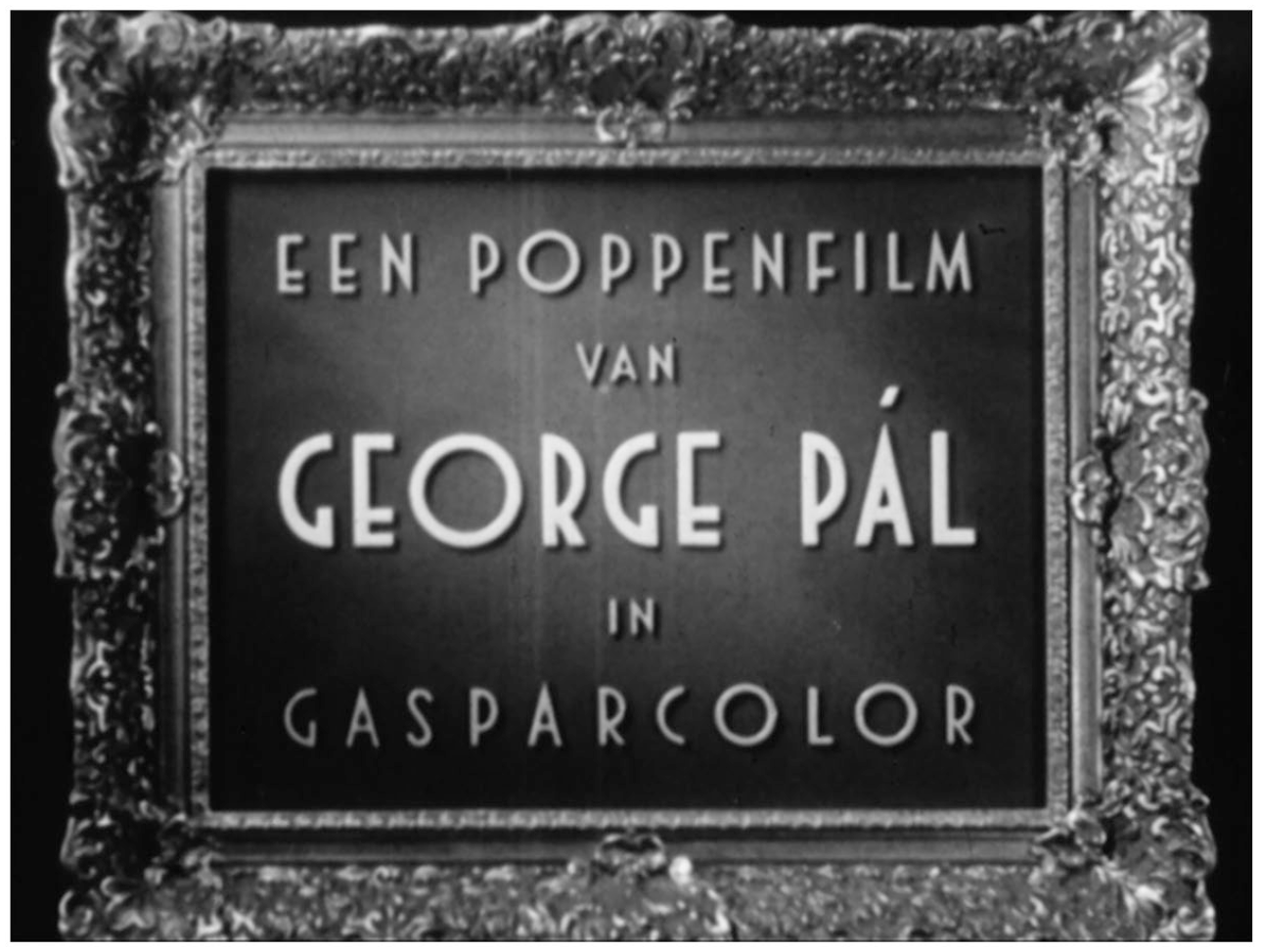
Still from opening credits of the advertising film De Reddingbrigade (The Rescue Brigade) (Pal, 1937). Collection Eye Filmmuseum.
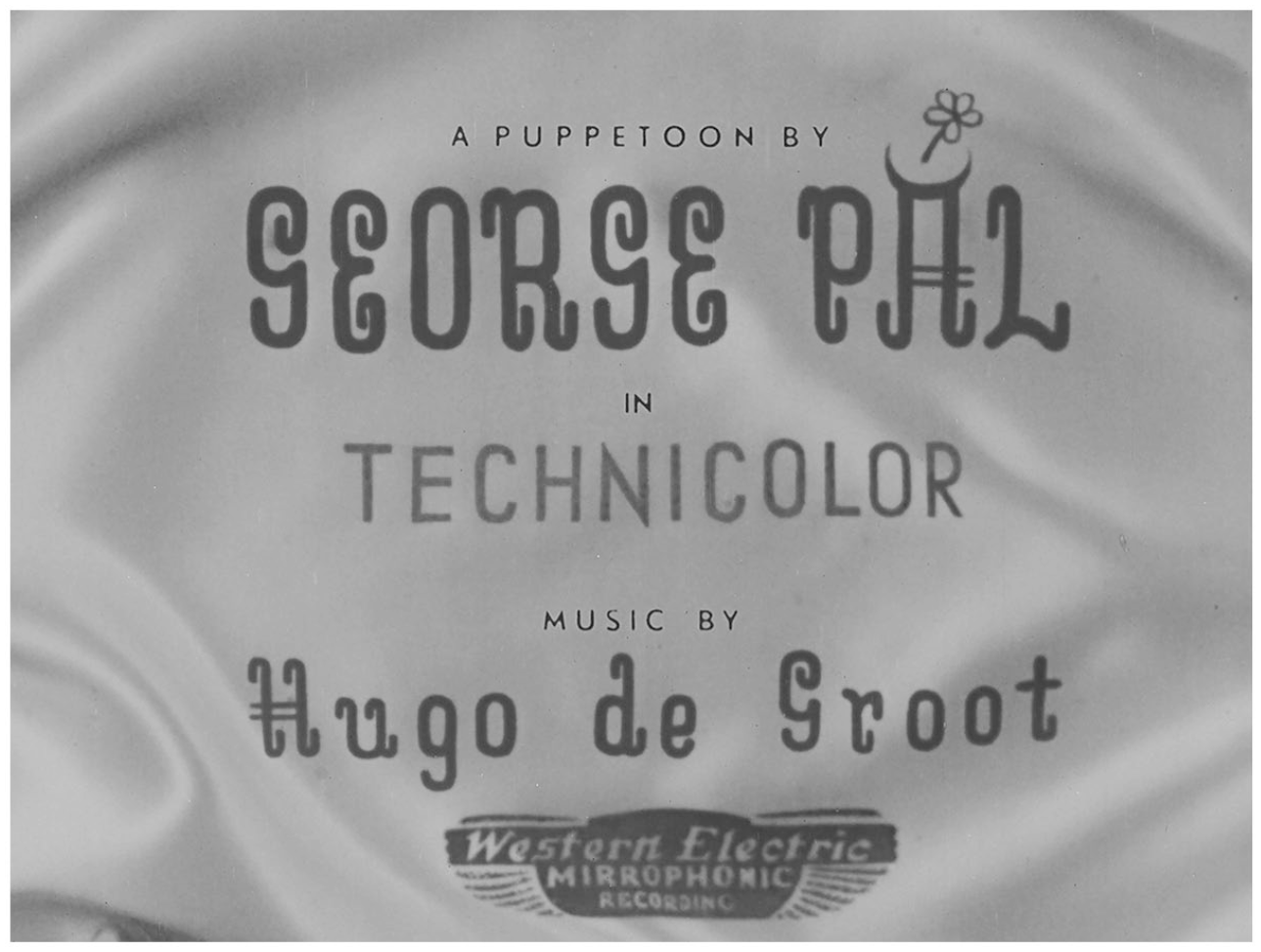
Still from opening credits of the advertising film Aladdin and the Magic Lamp (Pal, 1939). Collection Eye Filmmuseum.
Lotte Reiniger’s silhouette films were shown in the Netherlands in avant-garde film programmes, but also in side-programmes of regular cinemas. In writings about silhouette films, often a link is made with another form of puppet theatre, the silhouette theatre shows, in Dutch called ‘schimmenspel’, a popular form of entertainment in the 1920s and 1930s (Bulthuis, 1966). Frans ter Gast was a well-known Dutch puppeteer, who regularly performed silhouette shows. He used the puppets and sceneries of the silhouette theatre show De Moord van Raamsdonk for animation and, together with filmmaker Otto van Neijenhoff, made a silhouette film. The film premiered in 1936 and, although widely shown, it remained a one-off project (Peters, 1998). Just like Lotte Reiniger, Frans ter Gast was very adept at making his own figures and scenery and, in the publicity for his shows, materiality and technical skills are related to the arts and crafts tradition of paper cutting and making portrait silhouettes (Het Vaderland, 1930; Het Volk, 1933). Probably because of the flatness of the paper or cardboard cut-out figures and silhouette cuttings used in these live shows, the silhouette films are more often categorized as a form of drawn animation than puppet film. For example, in the animation special of Filmliga (1932), the cover features a still from a Lotte Reiniger film and the caption refers to this film as drawn animation film.
Drawn animation
As mentioned before, the majority of animation films screened in Dutch cinemas were drawn animations. 30 It is not surprising that the most widely used term to describe animation film, ‘teekenfilm’, is quite literally related to ‘tekenen’, that is, the verb ‘to draw’, the act of making a drawing, or ‘tekening’, that is, the noun referring to the physical object, a hand-drawn image. As can be seen in the graph (Figure 7), from the early 1920s onwards, the term ‘teekenfilm’ or ‘tekenfilm’ (the second ‘e’ was dropped after a spelling reform in 1934) was widely used in reviews in the press, but also in advertisements published by cinema owners and distributors. This indicates that general cinema audiences were familiar with the term and that it was used to refer to a specific category of films. Another indication is that the term ‘teekenfilm’ is mentioned in a 1935 dictionary as a subdivision of the entry ‘Teekenen’ (Koenen, 1935: 1018).

Chart depicting how often the words ‘teekenfilm’ and ‘tekenfilm’ are found in Dutch newspapers in the period 1913–1940. Delpher (accessed 28 January 2022).
The act of drawing is present in the widely used past participle ‘getekend’, ‘drawn’, or compounded with film as ‘geteekende film’. Publications from the 1920s applied the term ‘geteekende film’ to designate animation film and it was used until the end of the 1930s, when the first animated feature-length films were shown in Dutch cinemas. Both Walt Disney’s Snow White and the Seven Dwarfs and Max Fleischer’s Gulliver’s Reizen (Gulliver’s Travels, Fleischer, 1939) were described as ‘geteekende hoofdfilms’ (‘drawn feature films’). The makers of these films are often referred to as draughtsmen, rather than filmmakers. In the article ‘Teekenfilmkunst en teekenkunst’ (‘The art of drawn animation and the art of drawing’), Leo Jordaan (1932) elaborates on the differences between drawing techniques for film and for illustration, between a drawing for animation film and an illustration. He explains how these differences took him by surprise and only fully became clear to him when he wanted to draw the characters Mickey Mouse and Felix the Cat and use them in a political cartoon (p. 169).
Moreover, variations such as ‘teekeningen film’, meaning ‘drawings film’, can be found, which refers to the material object of a drawing on paper. In the context of cinema reviews or programme advertisements, a variety of compounds with the noun ‘teekening’ is used, even without mentioning the term ‘film’: such as ‘leevende teekeningen’ (‘living drawings’), ‘tructeekening’ (‘trick drawings’), ‘caricatuur teekening’ (‘caricature drawing’) or ‘penteekening’ (‘pen drawing’). Examples are the title card of a Koko the Clown film (see Figure 8) or a newspaper advertisement for a cinema programme announcing the screening of a ‘geestige penteekening van Felix de Kat’, meaning ‘a funny pen drawing of Felix the Cat’. 31 The term ‘penteekening’ also specifies the pen, the artistic utensil used for writing and drawing with ink in those days.
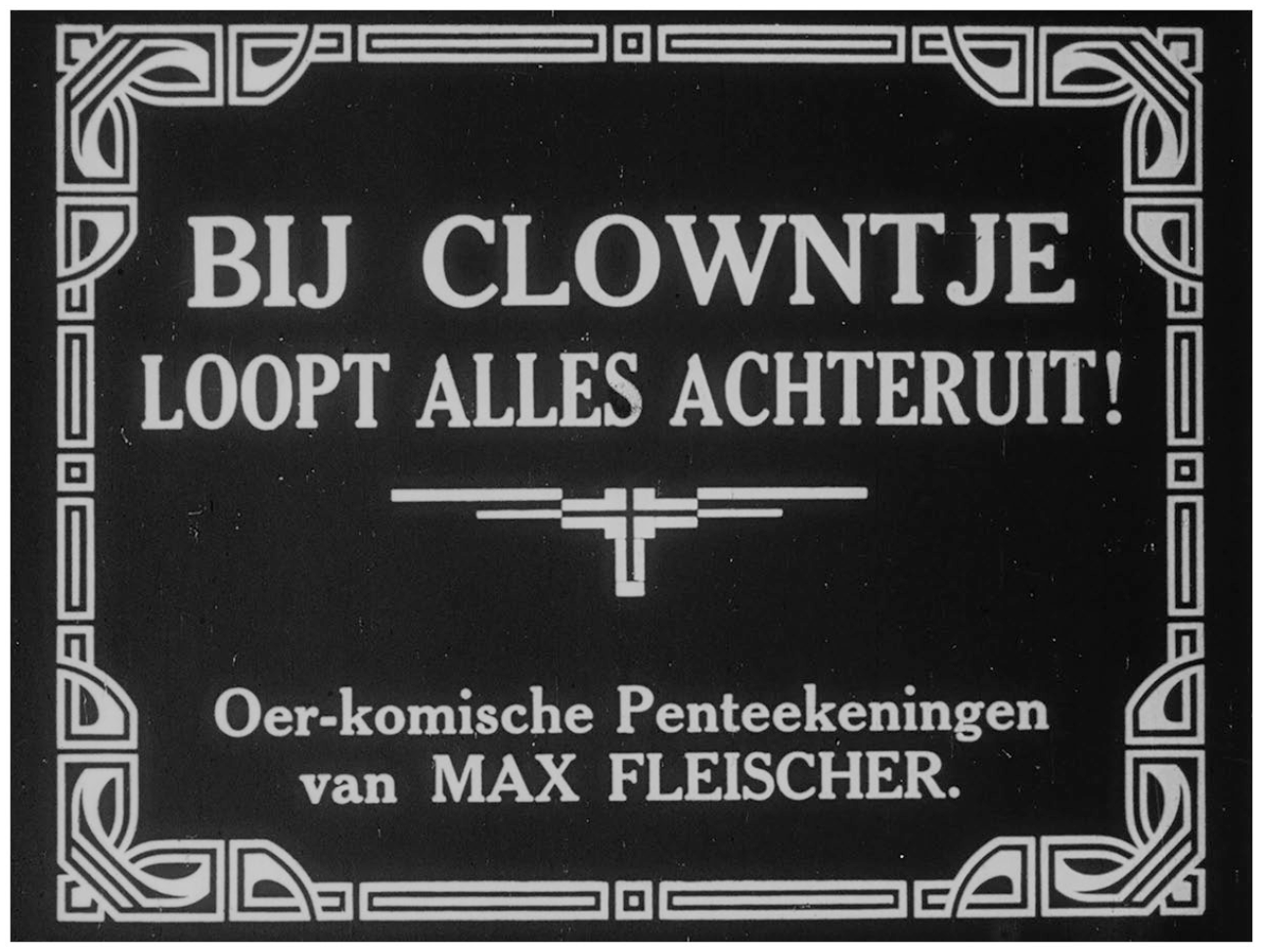
Still from opening credits of Bij Clowntje Loopt Alles Achteruit! (Koko Back Tracks, Fleischer, 1927) stating: ‘Very comical pen drawings by Max Fleischer’. Collection Eye Filmmuseum.
The ‘hand of the artist’ motif relates to a visual feature, which Crafton has described as one of the characteristics of early animation film. It is a process of ‘self-figuration, the tendency of the filmmaker to interject himself into his film’ (Crafton, 1993: 11). Instances of this can be viewed in the ‘Out of the Inkwell’ series featuring Koko the Clown. These short films were distributed in the Netherlands and the Dutch press refers to Max Fleischer as ‘caricaturist’ and to Koko the Clown as ‘inktclowntje’ (‘ink clown’) (Het Vaderland, 1925). This self-figuration motif can also be found in Dutch animation films by George Debels, for example in his gas cooker commercial Eind Goed, Al Goed (All’s Well that Ends Well) (1929) or the bicycle commercial Een Reisje naar de Maan (A Trip to the Moon) (1928). These advertising films contain a clear link to the performative meaning of the ‘act of drawing’ as the actual process of making a drawing, the hand of the artist and his artistic utensil are visible in the frame. In one scene in Eind Goed, Al Goed, the filmmaker’s hand holds a cut-out paper of one of the characters and turns it over, after this character is flattened by a steamroller in the street (Peters, 2012: 119). Donald Crafton (1993: 48–57) has also suggested that the development of early animation was related to the live stage performance of lightning sketchers, or ‘snelteekenaars’ in Dutch. This connection is represented in the work of Dutch variety artist Rodi Roeters. He practised many disciplines in his working life, and used his drawing talent for both lightning sketching, illustrating and animated filmmaking, and therefore was referred to, in the media, as a caricaturist, draughtsman and lightning sketcher (Peters, 2012: 109–110, 115).
By the end of the 1930s, the predominant Dutch term in relation to animation film was ‘tekenfilm’ and, to a lesser extent, ‘poppenfilm’. The Pal Studio, the major producer of animation films in the Netherlands, uses both terms in its letterhead. The terms ‘tekenfilm’ and ‘poppenfilm’ show a direct link to the tactile materials visible in the film image and maybe that is one of the reasons why these terms are still very much alive in the Dutch language, and have co-existed with the more comprehensive term ‘animatiefilm’ since its appearance in the 1960s.
Conclusion
The use of a specific terminology to describe animation film can often be traced back to language contacts between professionals, who worked in various contexts of film production, distribution, exhibition and reception. Some words can be traced to individual multilingual filmmakers such as George Pal and George Debels, and how they used them in their personal correspondence, and, more indirectly, in published interviews and the choice of wording for film credits. Other foreign language terms were quite literally adopted by specific groups, such as the critics who introduced the term ‘absolute film’ in the context of the international avant-garde movement, or the exhibitors and distributors of foreign language films, who did, or did not, translate original texts for publicity materials and (inter)titles for distribution prints. While a large part of the archival research for this text was done using analogue sources, the digitization of contemporary sources such as film prints, publicity materials, newspapers and film magazines, offered new research methods. Full-text searches into animation-related terminology allowed finding very specific information that would have been very laborious to find manually, for example, a specific name of a filmmaker, a film title or a specific animation term. These searches made it possible to gather information about divergent terminology used by a variety of stakeholders in specific contexts, but also to gain insights into more general trends, for example, in what period specific terms appear in the press. The exponential growth of the use of the term ‘teekenfilm’ is related to the advent and popularity of the animated American sound shorts and accordingly is linked to international developments.
From 1913 onwards, animation film has been described in the Dutch language as a particular mode of filmmaking with terms that distinguish it from, or that juxtapose it with, ‘non-animated’ types of film focusing on both the materials visible in the projected film image and the production process involved in the making of these images. References are made to the act of making, such as drawing and sculpting, and to the specific utensils and materials used in the making process, such as pen, ink and paint. The makers are often called draughtsman or caricaturists, referring to their professional drawing skills. Furthermore, the two- and three-dimensional material characteristics of the animated object such as the silhouette, the drawing or the puppet, are being recognized. Especially in more extensive articles on animation film and filmmakers, the animation film production process is related to other media and arts practices, and the terminology used reflects these intermedial relationships. Talking about puppet films, the modelling and three-dimensionality of the animated objects is related to the plastic arts. The inanimate objects used to convey artistic expression in puppet and silhouette film are linked to performative arts such as the puppet and silhouette theatre, while drawn animation is related to the drawing act of the lightning sketching, to political or satirical caricatures, but first and foremost to the art of making illustrations and drawings.
From early on, animation film was recognized as being ‘intrinsically different’ from live-action films and, along with the gradual emergence of this new artistic form, a corresponding language to support it evolved, influenced by language contacts in various contexts in the multilingual landscape in Europe. From the first singular appearances in 1913, a more form-specific terminology had gradually developed by 1940. Simultaneously, animation film steadily proceeded to occupy its permanent place within Dutch film culture.
Footnotes
Acknowledgements
An earlier version of this article was presented at the 18th Interdisciplinary Conference on Netherlandic Studies, organized by the American Association of Netherlandic Studies at the University of Michigan, Ann Arbor, June 2016. Special thanks to Ton Broos, Colin Nawrot, Frank Kessler, Ann-Sophie Lehmann, Erwin Feyersinger and Rada Bieberstein for their encouragement and helpful suggestions.
Funding
The author received no financial support for the research, authorship and publication of this article, and there is no conflict of interest.