




Abstract
Following the dissolution of the Soviet Union in 1991, 15 newly independent states sought to establish national policy systems distinct from their shared past. Yet, many features of governance in these post-Soviet contexts continue to mirror the bureaucratic traditions of the former regime. This paper examines the governance of research ethics as a lens to understand the persistence and transformation of bureaucratic culture in three Central Asian countries—Kazakhstan, Kyrgyzstan, and Uzbekistan. While these states have articulated ambitions to modernise and internationalise their research sectors, the study finds that deeply embedded bureaucratic norms continue to shape institutional practices, constraining genuine reform and innovation. The analysis highlights how Soviet-era administrative legacies endure within contemporary research governance, limiting the development of autonomous and ethically robust research environments.
Introduction
Following the collapse of the Soviet Union in 1991, universities became crucial tools for modernisation, as Central Asian countries sought to transition to market-based economies. Rapid educational reforms in Central Asia, especially in Kazakhstan and Kyrgyzstan, have even outpaced those in other former Soviet republics (Osipian, 2009). New universities were established, and foreign universities opened branch campuses, creating opportunities for educational advancement. However, the legacy of totalitarianism continues to challenge the discourse on academic freedom in the region. For many, academic freedom is perceived as disruptive, creating uncertainty and undermining the stability of bureaucratic structures (Oleksiyenko, 2021).
The legacy of Soviet practice may be more significant in the university bureaucracy than in teaching or research because the personnel involved experience more directly the imprimatur of state ministries and the pervasive influence of external auditing. Some sources also suggest that corruption is a significant element in the relationship between universities and the state manifested “in numerous forms, including research misconduct, cheating, and plagiarism” (Osipian, 2009: 183). The complex regulatory frameworks for higher education are generally complicated, and, despite suggests of corruption, audits seek to ensure that universities comply with these regulations. Nevertheless, the process ensures very literal compliance rather than encouraging a focus on broader policy objectives as observed by Gregory (1990) that Soviet managers usually comply with what is tasked by their superiors which also points to the top-down hierarchical structure in Soviet-style bureaucracies that is reflected in many public sector institutions. In universities, as Oleksiyenko (2016) observed, the hierarchical system demotivates the sense of collegiality in academic circles.
Among the performance indicators coming down the chain are those related to the various rankings to which universities aspire. It is clear that central to this policy goal is increasing publications which implies vibrant research activity that meets the ethical conditions of leading academic journals. Ethics administration is, therefore, a core task and one that has to be seen as working efficiently to “restore eroding trust in science, scientists and their publications” (Teixeira da Silva et al., 2019: 110). This is particularly important in the context of Central Asia perceived as “closed contexts” (Ahram and Goode, 2016; Sordi, 2016), characterised by high levels of bureaucracy, surveillance, and censorship and excessive distrust. Thus, while university administrations are often formally described as autonomous or, in some cases, even as privately or internationally governed, in the post-Soviet context their development has largely mirrored that of public bureaucracies. The legacy of centralised state control has left universities firmly embedded within the broader administrative culture of the region (Heyneman, 2010; Silova, 2011). As a result, administrative practices at universities often exhibit the same characteristics as those in public bureaucracies: rigid hierarchies, excessive formalism, and limited transparency (Tomusk, 2004). These features are particularly evident in ethics supervision, where procedures can become overly risk-averse and compliance-oriented, rather than collegial or dialogical in nature. At the same time, important exceptions exist. Universities with strong international partnerships, donor dependence, or participation in global accreditation schemes may experience alternative governance pressures (De Boer et al., 2002), which encourage more flexible and participatory approaches. Comparative studies of higher education governance also suggest that increased autonomy does not necessarily eliminate bureaucratic tendencies; instead, universities often import or reproduce the organisational logics of the public sector (Christensen, 2011; De Boer et al., 2007). This pattern suggests that, while post-Soviet higher education administration often reproduces bureaucratic logics familiar from the public sector, variation does occur, particularly where international norms exert influence.
This article investigates how Soviet-era bureaucratic legacies continue to shape the governance of research ethics in Central Asian universities. Drawing on 100 qualitative interviews with social science faculty across Kazakhstan, Kyrgyzstan, and Uzbekistan, we ask: How do Soviet inherited bureaucratic norms continue to shape the governance and functioning of university research ethics committees in Central Asia? At the national level, we examine the presence or absence of formal regulation and at the institutional level, we assess the organisation and function of ethics committees.
This study also contributes to broader debates around the bureaucratisation of research ethics globally. Haggerty (2004) argued that formal oversight systems, though necessary, can evolve into restrictive bureaucracies that stifle academic freedom, especially in qualitative or critical social science research. In this light, we consider how ethics enforcement mechanisms in Central Asia reflect Soviet, adapted, or imported models of bureaucratic culture. A Soviet-type culture is characterised by strict central control, procedural rigidity, and limited responsiveness to individual researchers. Adapted models involve selectively modifying international frameworks to fit local conditions. Imported models adopt external practices wholesale, often without regard for local institutional realities.
The article proceeds with a theoretical discussion on bureaucratisation of research ethics in post-Soviet Central Asia, followed by an overview of research ethics policies in the three case countries. Section 3 outlines the methodology; Section 4 presents the findings, with the discussion and conclusion to follow.
Bureaucratisation of research ethics in post-Soviet Central Asia: Extending and contextualising western debates
Public administration systems vary widely across national contexts, shaped by distinct historical, cultural, and political trajectories (Claver et al., 1999). Despite these differences, many share enduring structural features such as hierarchical decision-making and rule-based authority. Bureaucratic culture is often defined by formalism, procedural consistency, and specialisation, characteristics that ensure order and predictability but can also hinder innovation and adaptability. Weber’s classic model of bureaucracy remains foundational for understanding such structures, emphasising rational-legal authority and the rule-bound nature of organisational life (Jakobs, 2023a, 2023b; Weber, 2023). More recent studies of public administration have highlighted that, while bureaucratic routines provide institutional stability, they also generate rigidity and risk aversion, particularly in highly centralised systems (Kelman, 2021; Palmi et al., 2021).
Scholars of organisational behaviour note that bureaucratic systems tend to prioritise risk avoidance and uniformity, discouraging experimentation and flexibility. Moreover, personnel turnover rarely alters institutional culture, since newcomers internalise existing norms and routines (Sihite et al., 2020). In post-Soviet states, this inertia has been extensively documented. Knox and Janenova (2019) argue that even the introduction of digital governance tools, such as e-government, has not produced cultural transformation but rather path-dependent outcomes that reinforce inherited Soviet features. The persistence of bureaucratic legacies thus shapes how reform is received and reinterpreted across public institutions.
Within this context, the bureaucratic legacy of the Soviet Union remains particularly visible in higher education. Soviet universities operated as extensions of the state apparatus, centrally managed, hierarchically organised, and tightly bound to ideological and political imperatives (Silova, 2011). Academic and research activities were governed through top-down directives, and universities were expected to serve state objectives rather than pursue autonomous inquiry (Monobayeva and Howard, 2015). This system cultivated administrative dependence, procedural compliance, and the normalisation of extensive paperwork, all of which have persisted, albeit in modified form, in the post-Soviet era.
Much of the recent literature on higher education in Central Asia emphasises reform and internationalisation, focussing on how curricula, degree structures, and quality assurance mechanisms have been reshaped through external funding, donor influence, and the Bologna Process (Bridges, 2014; Silova, 2011). These studies often treat universities as sites of convergence with global standards. However, this perspective underplays the continued power of bureaucratic habitus in shaping the implementation of reform, especially within administrative domains such as research governance. As Heyneman (2010) and DeYoung (2011) note, while academic content may evolve, administrative systems in the region remain structurally dependent on state ministries and oversight bodies, reproducing hierarchical routines and ritualised auditing practices.
Policy transfer, borrowing, and adaptation
Policy transfer theory provides one way to conceptualise how global governance models, including frameworks for research ethics, are adopted in post-Soviet settings. Dolowitz and Marsh (2000) and Stone (2012) argue that institutional models are rarely transplanted wholesale; instead, they are selectively adapted to fit local political, cultural, and bureaucratic conditions. In Central Asia, such adaptation often entails formal adoption without substantive change, a pattern sometimes described as “symbolic compliance.” Silova’s (2005) concept of “hijacked travelling policies” offers a particularly useful lens: imported reforms are not merely localised but actively repurposed by domestic actors, including state ministries and university administrators, to serve existing bureaucratic routines and political goals. In this process, new institutional forms, such as ethics committees, may acquire the outward appearance of international best practice while functioning primarily as extensions of traditional administrative control.
A key contribution of this paper is to extend debates on the bureaucratisation of research ethics, a topic largely examined within Western contexts (Haggerty, 2004; Heimer and Petty, 2010), to the semi-authoritarian and post-Soviet environments of Central Asia. In North America and Western Europe, critics argue that research ethics committees (RECs) have become overly procedural and risk-averse, producing what Haggerty (2004) terms “ethics creep,” the expansion of bureaucratic oversight that constrains academic freedom. These critiques generally view bureaucratisation as an unintended outcome of managerial reforms and audit cultures.
In contrast, in post-Soviet contexts, bureaucratisation is not an accidental byproduct but an enduring mode of governance. Compliance with external directives, exhaustive documentation, and hierarchical oversight have been normalised through decades of Soviet administrative culture (Heyneman, 2010). Thus, when international models of ethics review are introduced, they are absorbed into an already bureaucratised environment rather than generating it anew. Ethics governance in this context becomes a continuation of entrenched administrative practices rather than a deviation from collegial norms. The bureaucratisation of research ethics here reflects both the influence of global standards and the resilience of local governance legacies.
From a neo-institutional perspective (DiMaggio and Powell, 1983; Meyer and Rowan, 1977), the establishment of ethics committees in Central Asia can be understood through processes of institutional isomorphism and decoupling. Universities adopt the form of Western-style RECs to signal alignment with international norms and gain legitimacy, but these structures are often decoupled from everyday research practice. Committees may meet procedural expectations, such as ethical clearance or performing plagiarism checks, without functioning as spaces for deliberation about participant welfare, consent, or justice. In this way, bureaucratic formalism substitutes for ethical reasoning. This symbolic compliance produces what Pritchett et al. (2013) call “isomorphic mimicry,” where institutions imitate external models for legitimacy while maintaining internal continuity.
These theoretical insights can be operationalised through a typology of bureaucratic modus operandi observable in Central Asian research ethics governance:
This typology illustrates how international reforms interact with path-dependent bureaucratic structures to produce hybrid outcomes. In public universities, ethics oversight typically reflects the adapted model, in which ethics is framed as compliance and regulation rather than reflection or researcher accountability.
Although the concept of bureaucratisation has often been applied to Western ethics systems (Heimer and Petty, 2010), in Central Asia it carries an additional layer of meaning. Bureaucratic procedures are not new administrative intrusions but long-standing techniques of governance. The persistence of paperwork, audit routines, and hierarchical reporting reflects an inherited logic of control that outlasts political transition. As Smolentseva (2017) notes, managerial imperatives in post-Soviet universities continue to emphasise compliance and accountability to ministries rather than autonomy or collegial decision-making. Consequently, ethics committees in these settings often function as extensions of administrative oversight rather than as forums for ethical deliberation.
Recognising this bureaucratic continuity is crucial for understanding the nature of research ethics governance in Central Asia. Whereas Western analyses portray the bureaucratisation of ethics as a managerial distortion of academic freedom, in post-Soviet states it represents the persistence of an entrenched administrative order reframed through the language of international reform. Extending the insights of Haggerty (2004) as well as Heimer and Petty (2010), this study argues that the bureaucratisation of ethics in Central Asia is both a global and local phenomenon: globally shaped by the diffusion of audit-oriented ethics regimes, and locally sustained by the enduring habits of Soviet bureaucratic culture. Ethics governance in this region, therefore, exemplifies how imported standards are reinterpreted through historically embedded modes of control, producing systems that prioritise procedural compliance over substantive ethical reflection.
Policy background and ethics regulations
Kazakhstan
Kazakhstan displays attributes commonly associated with bureaucracies heavily influenced by political factors. The state machinery comprises politicians and senior bureaucrats interconnected by informal clanship/tribal links. Furthermore, the advancement of bureaucrats within the public service of Kazakhstan relies heavily on their personal allegiance to politicians. The presence of loyalty enables high-ranking officials to partake in corrupt activities and engage in informal behaviours while enjoying a shield of protection (Knox and Janenova, 2023). The Kazakhstani system can be characterised as a “hybrid model” due to the presence of bureaucrats with varying degrees of autonomy. The notion of loyalty was prominently addressed in the strategic plan titled “Kazakhstan 2030.” It held particular significance in regulating the conduct of regional elites, as it aimed to furnish them with a somewhat ideological agenda. Additionally, it sought to reconstruct the framework of the regime to cultivate a public administration apparatus that demonstrated loyalty.
Recent policy initiatives in Kazakhstan recognise the current under-development in research and knowledge production. Despite the continuous increase in funding of R&D, engagement in global knowledge production remains low with both the number and quality of publications in high-quality scholarly international journals limited (Lovakov and Yudkevich, 2021). The first steps towards acknowledging the importance of ethical research can be noted in the launch of the Kazakhstan Education Research Association (KERA), which issued a national code of ethics for educational research in 2020. However, such attempts are not system-wide.
Kyrgyzstan
According to Knox and Janenova (2023), the public sector bureaucracy in Kyrgyzstan demonstrates two primary characteristics. The law on civil service establishes a discernible difference between political and administrative roles. However, as early as 2005, individuals appointed for political purposes initiated changes in key civil service positions. Furthermore, it is worth noting that the involvement of international donors significantly shaped the process of public sector reform in Kyrgyzstan. Specifically, these donors played a crucial role in facilitating the downsizing of the extensive bureaucracies inherited from the Soviet era. Additionally, the political elite possesses the ability to assign a significant majority of public positions, indicating a civil service that is highly influenced by political factors. Research also highlights that both political appointees and civil service personnel have become instrumental in influencing election outcomes, as well as being utilised as a means to secure loyalty and, in certain instances, financial benefits (Knox and Janenova, 2023).
Although there are policies that provide guidance on provision of the research activities in Kyrgyzstan, no common state-level ethical document on research activities has yet been developed (Isaeva et al., 2023). Nevertheless, the government representatives recognise the need for the introduction of international research ethics principles. The Law on Science and the Foundations of State Scientific and Technical Policy (2017) also makes clear that research organisations as well as researchers have the right to self-regulate and carry the responsibility for the direction, methods and reliability of scientific research and their results (Article 17.1) as well as the responsibility for the violation of the norms of professional ethics and moral rules (Isaeva et al., 2023).
Uzbekistan
Uzbekistan currently hosts over 200 universities, encompassing state, private, and international institutions. Despite the increase in private universities and quantitative growth, academic freedom is still constrained in specific sensitive or undervalued areas, such as political science and related disciplines. (Mirakilov and Saida, 2025). The governance of the higher education sector remains characterised by a top-down, hierarchical, and centralised structure. Rectors frequently originate from a state-sector background, indicative of a path-dependent continuation of the Soviet legacy of “nomenklatura” positions. In 2024, the higher education minister stated that the issue of electing rectors is part of the 2030 strategy and is currently under review. Appointments of executive heads and rectors remain centralised under ministerial control and characterised by frequent reshuffles. In February 2020, the Cabinet dismissed or relocated 10 rectors in 1 day. (Mirakilov and Saida, 2025).
Over the past decade, the Uzbekistan government has endeavoured to boost research and development by enacting pertinent legal frameworks to regulate distinct areas of scientific pursuits. Despite comprehensive reforms that have resulted in an updated regulatory structure for research administration and a heightened emphasis on globalising higher education, a noticeable policy void exists concerning ethical practices in social science research in Uzbekistan.
Current ethical regulations in three countries
Research ethics policies in Central Asia initially emerged in the context of biomedical research and remain underdeveloped in the social sciences (Collins et al., 2024). In Kazakhstan, biomedical research ethics have been regulated since 2005 (Ministry of Health of the Republic of Kazakhstan [MoHRK], 2005, 2007), with the establishment of a National Ethics Committee in 2008 (MoHRK, 2008). Institutions must have a clinical research ethics commission in place to qualify for national accreditation (Ramazanova et al., 2014); however, no comparable regulatory requirements exist for research involving human participants in other fields. The situation is similar in Kyrgyzstan and Uzbekistan, where national laws and regulations govern biomedical research, but social science research remains largely unregulated (Collins et al., 2022; Zurdinov et al., 2007).
In social sciences, only a limited number of higher education institutions in Kazakhstan have established institutional ethics review procedures (Sharplin et al., 2025). In Kyrgyzstan, the government has acknowledged the importance of adopting international standards for research ethics (Government of Kyrgyz Republic, 2017). Nonetheless, despite the existence of national research policies, the country lacks a unified national guideline on research ethics. In Uzbekistan, while there is the absence of clearly defined ethical guidelines for social science studies at both the national and institutional levels (Collins et al., 2022), some ethical benchmarks can be found institutionally potentially emanating from practices borrowed and adapted from Western models (Mirkasimov et al., 2021; Ubaydullaeva, 2020; Uralov, 2020).
At the time of the research, most higher education institutions in all three countries, both public and private, have ethics committees that address a broad range of ethics-related concerns, including matters of professional conduct (Gafu et al., 2025). These committees typically review graduate students’ dissertations after completion, focussing on plagiarism and whether the methodology aligns with the original proposal. In the Table 1 below, we compiled data from our previous policy and country background analysis, showing institutional hierarchies and ethics governance structures in the universities in three Central Asian countries.
University hierarchies and research ethics oversight in Central Asia.
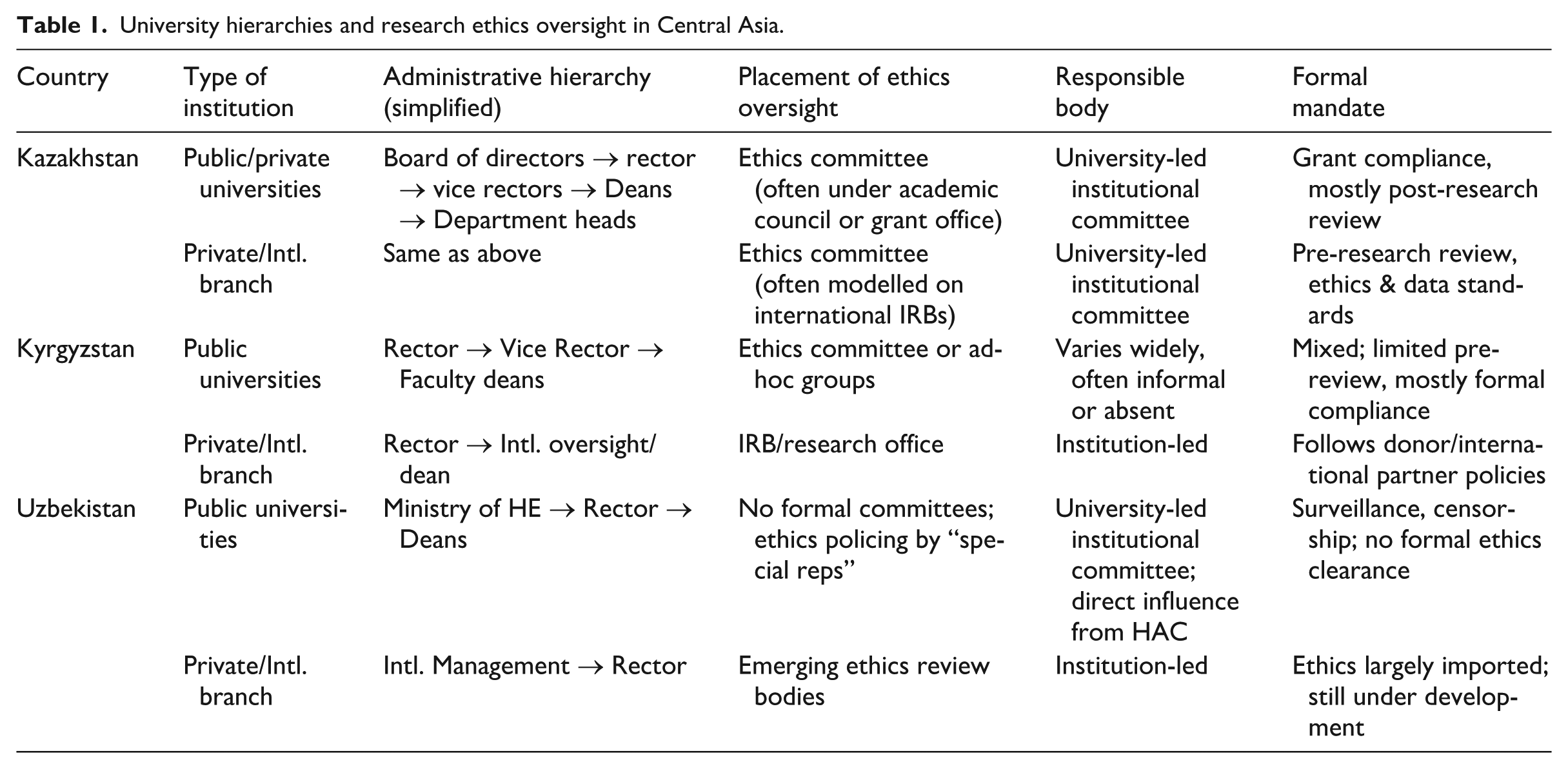
In the absence of robust institutional or national research ethics procedures, social science researchers frequently conduct their studies without undergoing any formal ethics approval process. As a result, ethical responsibility falls primarily on individual researchers, though they may draw on existing Codes of Professional Conduct, which offer frameworks for accountability and ethical standards in research.
Methodology
A total of 100 qualitative interviews were held with faculty members specialising in social science across three nations, namely Kazakhstan (48), Kyrgyzstan (22), and Uzbekistan (30). Interviews were conducted both online and in person, using Kazakh (14), Uzbek (8), Russian (66), and English (12), depending on each participant’s language preference. Interviews lasted up to 60 minutes. Given the vast geographic spread and limited resources, it was not feasible to travel to every region across the three countries. As a result, the majority of interviews were conducted online. The interview protocol included nine primary questions, along with possible follow-up questions, addressing participants’ backgrounds, their understanding of research ethics, the institutional procedures for regulating research ethics, their awareness of international research ethics standards, their personal ethical approaches in their own research, and their views on the future of research ethics in Central Asia.
Participants were selected purposefully, focussing on social science researchers from higher education institutions in the three target countries, as they could offer relevant insights into the study’s research question regarding ethical practices and procedures in their institutions. Researchers in biomedical and STEM fields were excluded, as their experiences did not align with the focus of this study. Snowball sampling was also used to broaden recruitment, especially in Kyrgyzstan and Uzbekistan, where the research team initially had fewer contacts.
To anonymise respondents, codes were used where 001 stands for Kazakhstan, 002 for Kyrgyzstan and 003 for Uzbekistan. The codes also include letter codes for their initials and organisation. The interviews were duly recorded, with the explicit consent of the participants, and were transcribed and subsequently translated into English. The data underwent analysis using Nvivo software, facilitating the creation of a dynamic codebook. The codes were consolidated into several categories, from which many themes emerged. The codes, categories, and topics were derived through an ongoing reflective discourse with the country teams over 3 months, from February to May 2023. Some key topics that emerged from the data analysis included:
Research context: cultural, geopolitics, Soviet legacy, IRB approval, internationalisation.
Research challenges: bureaucracy, methodology-related, ethics-related, funding.
Purpose of research ethics: bureaucratic compliance, quality control, ethical clearance.
Although the dataset encompassed comprehensive and detailed information about the study’s primary objective, this paper concentrates explicitly on bureaucratic culture. This research received ethical approval from the Institutional Research Ethics Committee at Nazarbayev University.
Findings
Despite reforms and policy updates across all three Central Asian countries aimed at aligning with international trends, particularly in prioritising research for economic gains, interviews reveal that bureaucracy remains deeply embedded in both state and institutional structures. As one interviewee reflected, bureaucracy seems to be characteristic of the majority of post-Soviet nations with issues like corruption and bureaucracy seem inevitable (001EUJA). Along with this line, participants frequently expressed frustration with the rigid hierarchical structure within university administration, describing how these organisational setups perpetuate institutional bureaucracy, impacting areas such as research governance. One interviewee shared that there are so many different departments which often do not communicate effectively, resulting in, for example, “sending the same information to multiple departments, which causes frustration as it’s redundant and inefficient” (001KUSI).
Bureaucratic practices are particularly evident in state-funded research, where government control over grants imposes specific demands, such as detailed reporting on research activities along with tight deadlines that the bureaucratic units do not re-consider. For example, an interviewee described how, in the post-Soviet context, researchers are often required to document trivial details, like the number of houses visited during surveys, despite the impracticality of such reporting. “You have to report on how many houses you visited, but this doesn’t capture that people may not have been home or refused to answer. It’s just a formality” (001GUKA).
Notably, all three countries have established university-level ethical committees. In Kazakhstan, this development is predominantly related with the introduction of grant funding system from the government.
They started talking about the ethics commission when the grant system was massively introduced, when people began to massively apply for the conclusions of the ethics commission for grants, then all the universities and institutes of Kazakhstan began to run around to find out what to write there in general, where these paper forms are (001IIBA).
So, while these committees are there to tick the box in grant application forms, it is important to clarify that they address a wide range of any ethical issues, encompassing behavioural ethics for both staff and students and not exclusively research ethics. While they serve a critical role in upholding ethical standards within universities, their responsibilities extend beyond the realm of research ethics alone. For example, in Uzbekistan, while no specific ethics committees exist, special representatives control publications and public policy related discourse generated by scientists at the universities. Often, according to an interviewee, these officials are not specialists in ethics, noting that “unfortunately, no one specifically oversees ethical standards” (003NAZK).
This outlook leads to another specific aspect of the understanding of research ethics among administrative staff and academics, which is primarily associated with anti-plagiarism and data falsification rather than principles such as autonomy, honesty, justice and beneficence when conducting human participant research (Berekeyeva et al., 2024). Consequently, the procedures in place in universities aim to ensure that the research work of students and staff is compliant with anti-plagiarism rules set institutionally. Interview data clarified that current ethical clearance procedures are conducted post-research to ensure that the topic chosen and methodology are sound and that the person obtained clearance from the anti-plagiarism check.
. . .the process which is called “arrangement”. It is when scientific research work is put into practice before it is defended, so they would see it. This is a very bad process that troubles a lot of researchers. For example, I am doing research work and before the defence process, I go on TV. I will announce to the public that I am doing this kind of research work. Then I should bring a document that proves it. This is bureaucracy. Bureaucracy must be eliminated (003BUNA).
Another concern is bureaucratic control over technical aspects of research output rather than content quality. One respondent mentioned that they are given “control standards” but are not informed about their significance, suggesting that the process is more about compliance than understanding (001ENSS). Such a culture is deemed to be continuing from the long-established Soviet legacy which does not seem to have disappeared over the years of Independence. An interviewee studying the Soviet period highlighted the restrictive bureaucracy that affected historical research integrity, stating that “not all information was reliable” (003NAZK). While respondents from all three countries highlighted the persistence of bureaucracy, it seems more observable in Uzbekistan. This might be due to a more sedentary lifestyle and more Islamic influence in comparison with Kazakhstan and Kyrgyzstan which have a nomadic history. One participant indicated that they still have systems and procedures in place that were established during Soviet period such as HAC (High Attestation Commission) that oversee the whole science system in the country. The bureaucratic nature of this system entails overseeing all research defence be it student or faculty at that state level (003NAZK).
Often this bureaucratic culture referred to is still cultivated and practiced by government-related institutions like akimat in Kazakhstan and Kyrgyzstan or hakimat in Uzbekistan (mayor’s office) which usually fund research in their localities and manage their research projects by their own established regulations that often lack research ethics guidelines. In Uzbekistan, the community-based Mahalla structure adds an additional bureaucratic layer. A researcher described difficulties accessing Mahalla committees during fieldwork, despite making repeated attempts and using various contacts: “It was very challenging to reach these committees. Even after extensive communication, access remained limited” (003SIDY). Another respondent from Kyrgyzstan agreed, stating that Mahalla representatives might compel participation in research, casting doubt on voluntary involvement (002IRKZ).
When discussing potential improvements, participants consistently suggested eliminating bureaucratic obstacles. One emphasised, “Bureaucracy must be eliminated from research. A clear definition of bureaucracy and guidelines against it are essential” (003BUNA). Another expressed a desire to move away from the Soviet legacy in research governance, advocating for increased autonomy and alignment with international standards (003NAZK).
However, while there is sympathy for international practices, there is also a fear of bureaucracy if the research ethics regulation is implemented as per procedures practiced internationally. This fear might be coming from the previous reforms borrowed from international practices but did not successfully adapted to the context creating more complexity. As one participant noted, these international standards lose their intended purpose and meaning becoming just “a bureaucratic procedure, nothing else” (001KTRT).
While the centralised system heavily regulates the HE system in all three countries, there are private universities and branches of international HEIs that have institutional autonomy to some extent. Thus, they have adopted internationally accepted research ethics procedures. The participants from such HEIs have expressed their concerns over some of these procedures, such as the informed consent form that, according to them, only sometimes works in the context of Central Asia with its heavy bureaucratic legacy and persistent culture of no trust. Some participants reveal that people feel uneasy about bureaucratic processes, such as filling out official forms, because they worry about how their information might be used or misused. This distrust is rooted in past experiences with government corruption and opaque practices, leading people to doubt the intentions behind seemingly routine bureaucratic tasks. A respondent observed, “When people see these forms, they worry about privacy, which undermines trust instead of building it” (003SIDY). Such distrust, rooted in a complex legacy of corruption and bureaucratic opacity, highlights the broader need for transparent governance reforms that prioritise research ethics and integrity across Central Asia.
To summarise, the interview data largely supports the argument that, despite national governments’ efforts to align with international standards in research, the bureaucratic nature of policies and procedures of research governance including the way how research ethics is regulated is still observable in the Central Asian countries of Kazakhstan, Kyrgyzstan and Uzbekistan.
Discussion
Although countries in Central Asia faced comparable challenges in implementing educational reforms following their independence in 1991, they exhibited varying developmental paths contingent on their economic stability (Ozawa et al., 2024). In the last decade or so, along with the intensified agenda for the knowledge economy and push for internationalisation, universities have been urged by the national governments to prioritise their research mission. This is a marked change because in the Soviet system, research was carried out mostly in specific institutes with universities predominantly in charge of teaching only (Chankseliani et al., 2022), has been creating a range of challenges for the academia in all three countries, both in knowledge production and research governance systems. The attempts to delink from the Soviet traditions and move towards Western neoliberal principles, highlighted by Chankseliani (2017) as multi-layered colonialism regarding knowledge creation, can also be understood as policies and procedures prevalent in research governance. As such, despite the ongoing reforms to internationalise HE and research in three countries, what seems to be still evident within the public policy system is an element of continuity of the Soviet-established bureaucratic nature of governance.
While the governments have established objectives for their national research and knowledge-creation efforts, along with limited support systems to encourage research, the findings in this paper determined that a hindering factor is the culture of bureaucracy remaining from the Soviet past. This pattern contributes to an ongoing discussion about the insufficient development of research cultures. The challenges of aligning with international standards of research ethics regulation are further exacerbated by the absence of established protocols for conducting research involving human subjects, presenting challenges for Central Asian researchers to effectively participate in the global knowledge generation system (Jonbekova, 2020).
The analysis of the data in three countries demonstrated both similarities and differences in approaches to research ethics and governance. These efforts also converge and diverge depending on the institutional and organisational system, whether public or private, local or internationalised. The Ministries of Education and Science centrally govern higher education in all three countries. A recent chain of reforms in Kazakhstan suggests a shift towards decentralisation, providing HEIs more institutional autonomy in organisational, financial, and academic matters (Sagintayeva et al., 2017). This reality implies that, in all three countries, public universities are highly centralised, with extensive central planning and a detailed system of norms.
In contrast, private, internationalised or branch institutions are more autonomous in implementing imported policies and procedures with requirements to follow the bare minimum of state standards. What is convergent in all three countries is that research ethics procedures in public universities are much more bureaucratised, often having a formalised tick-the-box approach. In private and more internationalised institutions, the procedures are usually internationally adapted. Often, the cause for this is their capacity to recruit internationally educated staff who implement those policies and practices in their institution. On the contrary, for public universities, the traditionally established culture is a norm.
Kazakhstan, in comparison with Kyrgyzstan and Uzbekistan, has been advocating for international practices in HE and research, more prominently setting up international benchmarking for research indicators for institutions. The establishment of Nazarbayev University to become a global research university was also aimed at translating international best practices to other national universities, including in research governance. However, as per the data, the culture in public institutions regulated by the Ministry of Education prevalently consists of Soviet governance elements with centralised control and hierarchy with little individual autonomy. With enhanced Westernised approaches in educational policy, practice and reforms, the system seeking positive changes by mirroring the practices of developed systems elsewhere (Sagintayeva et al., 2017), Kazakhstan can be typified as more imported and less Soviet.
In post-independent Kyrgyzstan, the strategies to “westernise” science, along with multiple (neo)liberal approaches to research and development, have dissolved the centralised and planned science system. However, despite the proclaimed collapse of the system, its effects are still persistent. Similar to Kazakhstan, the state of social science research in today’s Kyrgyzstan can be described as lost between two peripheries – “Soviet periphery” and “global periphery” (Silova, 2011); but in Kyrgyz case, the country is in a state of academic and financial dependency on transnational donor organisations and research centres. While one can observe more Westernised practices in Kyrgyz research due to its greater exposure to international donor organisations, the data also indicates that the culture of bureaucracy remains in research policies and procedures, making Kyrgyzstan more adapted and less inherited.
Compared with the other two, data from Uzbekistan indicates that the processes and procedures are highly centralised and strictly regulated. The bureaucracy of research management in Uzbekistan is embedded within practices, from choosing research topics for graduate students to their defence. For example, research topics for graduate students’ theses or dissertations must be approved by the HAC under the Ministry of Education and Science, leaving little autonomy and academic freedom for researchers. Out of three countries, respondents from Uzbekistan have expressed their concerns over further bureaucracy if the country implements international practices of research ethics clearance. Thus, Uzbekistan can be categorised as having inherited as a dominant culture.
Table 2 below summarises the research findings.
Research ethics committee pattern.
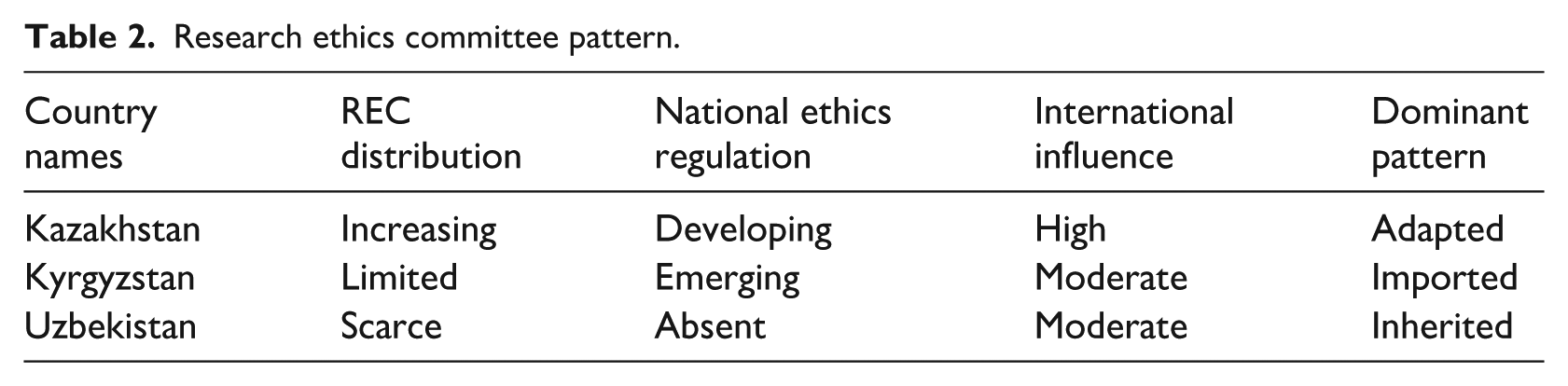
This typology of imported, adapted, and inherited models operationalises the interaction between policy transfer and institutional persistence. The “inherited” model reflects the endurance of path-dependent bureaucratic norms; the “adapted” model illustrates hybridisation between imported and local practices; and the “imported” model exemplifies selective policy transfer where formal international procedures coexist with informal bureaucratic routines. Hence, these patterns demonstrate how institutional forms travel but are reshaped by entrenched administrative cultures.
Due to active reforms underway in all three countries, this categorisation is not fixed but describes the current state of university administration, particularly in relation to research ethics monitoring. For substantial change to occur, the dominant approach of “restructuring” must evolve into “reculturing” (Sagintayeva et al., 2017: 26).
The findings demonstrate that, despite ongoing reforms and the formal adoption of international frameworks, bureaucratic norms remain deeply ingrained in institutional practices. The persistence of hierarchical control, excessive documentation, and formalistic oversight across the three countries shows that these are not isolated administrative issues but enduring organisational habits shaped by historical legacies. Rather than transforming governance, new policies have largely been absorbed into existing bureaucratic routines, sustaining structures that prioritise compliance and appearance over substantive change. This pattern reflects what neo-institutional scholars describe as the endurance of organisational myths maintained for legitimacy rather than efficiency (Knox and Janenova, 2019; Meyer and Rowan, 1977). Similarly, the partial adoption of Western-style research ethics frameworks suggests that policy borrowing has taken a symbolic rather than transformative form, aligning with observations from policy transfer theory that imported models are often locally reshaped to fit entrenched administrative logics (Dolowitz and Marsh, 2000).
A key contribution of this paper is to extend debates on the bureaucratisation of research ethics, largely developed in Western contexts (Haggerty, 2004), to semi-authoritarian, post-Soviet states. While in North America and Western Europe, researchers often critique ethics committees for being overly rigid or risk-averse, in Central Asia these critiques must be situated within the longer history of Soviet-style governance, where compliance with external directives, excessive paperwork, and hierarchical oversight were deeply institutionalised (Heyneman, 2010). Thus, ethics governance here is not merely an unintended consequence of administrative overreach but a continuation of entrenched bureaucratic practices that have proven resilient to reform. In this sense, the bureaucratisation of ethics governance in Central Asia demonstrates a form of contextualised decoupling (Meyer and Rowan, 1977), where international standards are adopted to signal modernity but are operationalised through inherited Soviet logics of control and compliance.
At the same time, the absence of systematic research ethics policies, institutional guidelines, and accessible ethics education for researchers has also contributed to the persistence of inherited governance logics across public institutions in Kazakhstan, Kyrgyzstan, and Uzbekistan. As Sharplin et al. (2025) note, the lack of clear frameworks for research ethics constitutes a significant barrier for these countries in achieving their strategic objectives of producing globally impactful knowledge. Without established guidelines and codes, access to international funding and publication opportunities becomes more limited. For emerging research systems, aligning with international standards is essential; however, as Sharplin et al. (2025) argue, this process need not mean uncritical adoption. Instead, policy migration can be managed in ways that “internationalise” research ethics frameworks while tailoring them to fit local socio-cultural and institutional contexts.
Conclusion
This study highlights how post-Soviet bureaucratic inertia uniquely shapes the superficial adoption of research ethics procedures in higher education, contributing to under-theorised discussions on institutional reform and ethics governance beyond Western contexts. All three share a Soviet past but have experienced diverse patterns of development and shared many characteristics of the Global South where semi-authoritarian or hybrid regimes facilitate varying degrees of academic freedom. While there are no particular social science research ethics regulations at the national level, institutionally, there are fragmented attempts to implement ethics committees characterised by either ineffective or emerging ethics procedures. Existing practices focus mainly on academic integrity and professional conduct. They are said to serve the compliance purpose or exist because it is mandatory, but they usually do not review research with human subjects. The underlying factor for such an approach in setting up ethical procedures is due to a persistent bureaucratic culture that continues throughout the system both at macro and mezzo levels.
The practice of enforcing public policy in newly-established states frequently mirrors the principal characteristics of the former colonial or dominant authority. This pattern is especially evident for the state, which maintained virtually the same workforce despite switching masters. The main explanation can be knowledge and habit. The pattern is particularly marked in areas with little nationalist symbolic significance. Establishing research ethics practices is just such a function, and the imperative for change is generally related to practical interactions with foreign educational agencies.
This paper makes fourfold contributions to the literature. First, it extends the concept of bureaucratic culture to university governance in the post-Soviet, semi-authoritarian contexts. Second, it introduces a typology of ethics regulation models (inherited, adapted, imported) based on case study evidence. Third, it challenges assumptions that institutional autonomy and internationalisation automatically reduce bureaucratic inertia. Finally, it complements existing debates calling for broader theorisation of research ethics governance beyond biomedical and Global North–oriented frameworks.
Footnotes

Ethical Consideration
The research process was approved by the Nazarbayev University Institutional Research Ethics Committee (No. 577/26052022).
Funding
The authors disclosed receipt of the following financial support for the research, authorship, and/or publication of this article: This study was financed by Nazarbayev University Collaborative Research Grant No. 021220CRP0922 for which the authors are grateful.
Declaration of conflicting interests
The author declared no potential conflicts of interest with respect to the research, authorship, and/or publication of this article.