




Abstract
Subject-verb agreement provides insight into how grammatical and semantic features interact during sentence production, and prior studies have found attraction errors when an intervening local noun is grammatically part of the subject. Two major types of theories have emerged from these studies: control based and competition-based. The current study used an subject-object-verb language with optional subject-verb agreement, Persian, to test the competition-based hypothesis that intervening object nouns may also cause attraction effects, even though objects are not part of the syntactic relationship between the subject and verb. Our results, which did not require speakers to make grammatical errors, show that objects can be attractors for agreement, but this effect appears to be dependent on the type of plural marker on the object. These results support competition-based theories of agreement production, in which agreement may be influenced by attractors that are outside the scope of the subject-verb relationship.
Keywords
A majority of world’s languages exhibit agreement, in which the features of one word influence the form of another, syntactically related word. In subject-verb number agreement, the form of the verb changes depending on the plurality of the subject noun, as shown in (1) below:
(1) The key is/*are (seems/*seem) heavy.
(2) The key to the cabinets is/*are (seems/*seem) heavy.
In (1), the singular form of the subject noun, key, requires that the verb “to be” take the form “is” rather than “are” (and requires the verb seem to have a suffix “-s”) and in (2) we see that this is true even when the subject noun phrase is complex, and there is an intervening “local” noun (cabinets) that is plural. However, Bock and Miller (1991) found attraction effects in which the number value of a local noun can lure speakers into incorrectly marking the verb with the number of the local noun instead of the head noun (e.g., key), especially when the local noun is plural. Such attraction effects have since been reported in a number of studies in English (Bock & Cutting, 1992; Bock & Eberhard, 1993; Eberhard, 1997; Vigliocco, Butterworth, & Garrett, 1996a), Dutch and French (Vigliocco, Hartsuiker, Jarema, & Kolk, 1996b), Spanish (Vigliocco et al., 1996a) and Italian (Vigliocco, Butterworth, & Semenza, 1995), and work has also shown that attraction effects persist into sentence processing: readers are less likely to detect ungrammatical subject-verb agreement under attraction conditions (Clifton, Frazier, & Deevy, 1999; Pearlmutter, Garnsey, & Bock, 1999; Häussler & Bader, 2009).
Many theories have been proposed to account for these effects, and can be divided into two major types. In control-based approaches, e.g., Marking-and-Morphing (e.g., Eberhard, Cutting, & Bock, 2005), agreement occurs via feature transfer from the subject to the verb. Crucially, in this type of approach, attractors must be part of the syntactic relationship between the subject and verb. In the alternative type of approach, which is competition-based (e.g., Haskell & MacDonald, 2003; Thornton & MacDonald, 2003), agreement arises independently, at least in part, on both the subject and verb based on multiple factors, including non-syntactic ones. According to these theories, it is possible for other nouns, either those linearly intervening between the subject phrase and the verb or conceptually part of the message, to interfere with the agreement process and influence the final number marking on the verb. Another similar approach involving competition is the controller misidentification account (e.g., Badecker & Kuminiak, 2007), which emphasises the role of memory encoding and retrieval in agreement processing. In this account, the subject of the sentence is the controller of the agreement and the morpho-syntactic features of the verb depend on the features of the subject.
In the research presented here, we test the hypothesis, based on competition-based theories, that intervening local nouns that are not part of the grammatical subject-verb relationship can still cause attraction effects. Prior work (Hartsuiker, Antón-Méndez, & van Zee, 2001; Santesteban, Pickering, & Branigan, 2013) has reported such attraction effects in Dutch complement clauses and in Basque, using error elicitation. In our study, we tested speakers in a language that has several features that are different from the languages where attraction effects have previously been found: Persian (also known as Farsi). Like Basque, Persian is a language in which the object naturally falls between the subject and verb (an subject-object-verb [SOV] language), however unlike Basque, Persian is not an ergative-absolutive language, and verbs form agreement with their objects only in certain circumstances. Crucially, unlike in other previously tested languages, Persian subject-verb number agreement is optional when the subject is both inanimate and plural. Thus, we were able to test the hypothesis that grammatical objects cause attraction effects, using simple sentences and without requiring the production system to make errors: all of our data come from fully grammatical structures with unmarked, canonical word orders and simple noun phrases.
Background
Linguistic theories have generally treated agreement as a core part of syntax (e.g., Gazdar, Kleen, Pullum, & Sag, 1985; Pollard & Sag, 1994). Within psycholinguistics, there is some disagreement about to what extent agreement processes are controlled by syntactic features alone vs. how much other types of information influence the agreement process (e.g., Vigliocco & Franck (1999, 2001). Theories of subject-verb agreement may be divided into control- and competition-based (e.g., Mirković & MacDonald, 2013; Bock & Middleton, 2011). Both types of theories agree that the origin of notional number is the speaker’s message. However, control accounts crucially involve the transmission of features within syntactic structures, and in particular propose that the transmission of features is unidirectional—from the subject to its verb (Bock, Eberhard, Cutting, Meyer, & Schriefers, 2001; Eberhard et al., 2005; Gillespie & Pearlmutter, 2011). These accounts assume that the subject alone receives the number from the message level and then the number feature (i.e., the agreement controller) is transmitted to the verb (the agreement target). In other words, the subject number controls verb number via hierarchical feature passing, in which grammatical features are transmitted through a hierarchical syntactic structure. Marking and Morphing is an example of this type of approach (e.g., Eberhard et al., 2005), in which the notional number of the noun phrase is evaluated and then passed to the root of the subject noun phrase (Marking) and then during Morphing, the features from Marking are reconciled with number specifications of the morphemes in the lexicon. In this account, any effect of conceptual information on number information in the noun phrase occurs during the Marking step.
Evidence in favour of this type of account comes from several studies that show specific effects for structural factors but not for non-structural. For example, Bock and Miller (1991) found no significant effects of animacy or length of local noun phrase on attraction rates, while Bock and Cutting (1992) and Nicol (1995) found that a local noun interferes more when it is in the same clause as the head noun compared when it is in a separate clause. Bock and Cutting (1992) and Solomon and Pearlmutter (2004) both showed that local plurals embedded in a relative clause (e.g., “the editor who rejected the books”) do not induce attraction as strongly as local plurals in a prepositional phrase modifier. Finally, Franck, Vigliocco, and Nicol (2002) and Solomon and Pearlmutter (2004) found that the relationship of the local noun to the subject noun was important to agreement. For example, Franck et al. (2002) showed that subject noun phrases like the computer with the programmes of the experiment caused a higher proportion of plural (e.g., are) responses than the computer with the programme of the experiments, leading them to propose that it is the syntactic depth of the local noun (and not its linear distance) that matters for agreement. Such hierarchical distance effects (Eberhard et al., 2005; Franck et al., 2002; Nicol, Forster, & Veres, 1997; Vigliocco & Nicol, 1998) have been taken as support for control accounts of agreement, in which attraction is a result of feature movement or “percolation” within a syntactic representation.
In contrast, competition approaches propose that agreement arises by coordinating number features on both noun and verb instead of coming uni-directionally from the subject to the verb, and involves competition between different phonological forms as part of the mapping between the message level and phonological encoding (Haskell, Thornton, & MacDonald, 2010; Mirković & MacDonald, 2013). This type of approach stresses the importance of meaning and notional number as factors that interact with the grammar and is consistent with linguistic treatments of agreement that emphasise the influence of semantic factors (e.g., Corbett, 2000; Pollard & Sag, 1988). Following Pollard and Sag (1988), Mirković and MacDonald (2013) and others argue that all the agreeing elements (e.g., subject and verb) have a direct connection to the notional number in the message and encode (inflect) their number based on that notional number: subject number and verb number are parallel products of the same kind of information. Crucially, verb number is not copied or transferred from the subject to its verb, but instead the retrieval and inflection of subject number and verb number happen in a coordinated but independent fashion, and thus are subject to influences from multiple sources of information (e.g., Haskell & MacDonald, 2003). Unlike in Marking and Morphing, conceptual and grammatical information influence agreement at the same time and any conflicting information may increase processing difficulty (Haskell & MacDonald, 2003). In a different type of competition-based approach (Badecker and Kuminiak (2007), the coordination of these features is subject to interference in working memory during utterance planning, such that an element with similar features could be incorrectly assigned as the source of subject number.
All of these approaches crucially differ with respect to which non-syntactic information influences the agreement process and prior work has focused on this area, with mixed results. On the one hand, there appear to be a number of different sources of non-syntactic interference in subject-verb agreement, including the linear order (as opposed to the structural relationship) of nouns and verbs (Gillespie & Pearlmutter, 2011; Haskell & MacDonald, 2005), semantic integration between nouns (Solomon & Pearlmutter, 2004), and the plausibility of the relationship between a local noun and the verb (Thornton & MacDonald, 2003).
Among non-syntactic factors, distributivity and morphophonological ambiguity have been shown to have large effects in several studies; Vigliocco and colleagues (Vigliocco et al., 1995, 1996a, 1996b) found an effect of distributivity of subject head nouns on agreement. Vigliocco et al. (1995) found that more plural verbs were produced following distributive phrases (e.g., the name of the children) than following non-distributive phrases (e.g., the road to the lakes) in Italian. Vigliocco et al. (1996a) found more error rate for multiple token items (e.g., the uniform of the soldiers) than for single token items (e.g., the teacher for the girls) in Spanish. Vigliocco et al. (1996b) found more agreement errors for multiple token preambles (e.g., the picture on the mugs) than for single token ones (e.g., the strike on the ministers) in Dutch and French. Eberhard (1999) also demonstrated the effects of distributivity in English sentences when the subject head noun and the local nouns are imageable/concrete nouns. Bock et al. (1999) found effects of collectivity on subject–pronoun agreement. Vigliocco et al. (1995) showed an effect of morpho-phonological influences on agreement processing in Italian in which more errors occurred with invariant nouns than with ordinary nouns. As the examples below show, unlike for the ordinary plural, the singular and plural forms of the invariant nouns are the same and morphophonology do not show number; citta remains unchanged. However, the number-marked determiner, la vs. le, does show number:
3. Ordinary plural:
il gatto sui tetti i gatti sul tetto
the cat on the roofs the cats on the roof
4. invariant plural:
la citta sulle colline le citta sulla collina
the
Haskell and MacDonald (2003) also found an effect of morpho-phonological influences on agreement processing in English in which more plural verbs were used in preambles with regular plural local nouns (e.g., the family of rates) than with irregular ones (e.g., the family of mice).
While the majority of prior work has focused on languages with obligatory subject-verb agreement (e.g., Spanish), using the elicitation of errors and agreement error data, Mirković and MacDonald (2013) examined optional subject verb agreement in Serbian, in which optional subject-verb agreement is available in sentences with a quantified subject noun phrase that contains a genitive noun and either a number that is higher than four or a quantified expression (e.g., /mnogo/ “many” or /nekoliko/ “several”). Subject-verb agreement is obligatory if the subject number is 4 or below; when the subject number is singular, its case is nominative and the verb is always singular, and when the subject number is 2, 3, or 4, then its case is genitive and the verb must be plural. Mirković and MacDonald (2013) used such quantified noun phrases to investigate agreement and also found effects of non-syntactic factors, including morpho-phonological properties of the head nouns and quantifier type: More singular verbs were produced with the feminine plural genitive nouns (as they are homophonous with their singular nominative ones), and there were fewer cases of singular grammatical agreement produced with the quantifier “several” compared to other quantifiers (e.g., some). In this case, the quantifier “several” conveys the individuated reading of the noun phrase and not an undifferentiated whole. In addition, fewer singular verbs were produced with agentive verbs (used for animate nouns, e.g., jump and read) compared with existential verbs (e.g., be).
Relatively fewer studies have shown an effect of gender on agreement, although Vigliocco and Zilli (1999)’s study in Italian showed that gender agreement errors were more common with nouns carrying ambiguous gender marking. Vigliocco and Franck (1999, 2001) also reported the effect of conceptual information on gender agreement in Italian and French. However, it is important to note that not all studies have found non-syntactic effects (e.g., Bock & Eberhard, 1993), and as noted by Ferreira and Slevc (2007), non-syntactic effects are modest compared to syntactic factors. Thus, the influence of non-syntactic factors in subject-verb agreement is still not entirely clear.
Most relevantly for the current study, competition theories predict that agreement attractors are not limited to local nouns within the subject phrase, but instead may arise from other sources. In this study, we were particularly interested in the hypothesis that direct object nouns could serve as agreement attractors, even though objects are not part of the subject phrase. Prior work has partially addressed this in Spanish, Dutch, and Basque (Hartsuiker et al., 2001; Santesteban et al., 2013; Antón-Méndez, 1996), but by testing for attraction effects of direct object nouns on optional subject-verb agreement in Persian, our results provide converging evidence from grammatical attraction effects on whether local nouns need to be higher in a hierarchical relationship with the verb, and also whether effects of other factors, such as the type of plural morpheme (Haskell & MacDonald, 2003; Vigliocco et al., 1995) have been masked by ungrammatical agreement production tasks.
Object attraction in Spanish and Dutch has been studied by using intermediary object pronouns (Antón-Méndez, 1996; Hartsuiker, Antón-Méndez, & van Zee, 2001). Antón-Méndez (1996) tested attraction effects of preverbal, pronominal direct objects in Spanish and found no evidence of an attraction effect. This finding is consistent with a minimalist, control-based view: the object is not part of the controlling subject phrase and thus cannot affect subject-verb agreement. However, these results crucially involve object pronouns, and so it could also be the case that the lack of attraction is due to the particular nature of this construction rather than extending to objects more generally. Supporting this second view, Hartsuiker et al. (2001) tested the attraction effect of intermediary full object nouns (i.e., not pronouns) in complement clauses and compared it to attraction effects for subject modifier phrases. As the following example shows, in Dutch, the object of the complement clause is preverbal:
5. Karin zegt dat het meisje de krans en WIN
Karen says that the girl the garland s WIN
“Karen says that the girl WIN the garlands.”
Their results showed an attraction effect for the object in the embedded clause, but the effect was smaller than the attraction effect for subject modifier phrases. This result indicates that information from non-subject phrases may also influence subject–verb agreement, although perhaps to a lesser extent. The authors further tested the effect of object pronouns in an embedded clause in two conditions: case ambiguous pronouns and unambiguous pronouns. Their results showed more attraction effect for embedded clause object pronouns when case was ambiguous compared to when it was unambiguous. Hartsuiker et al. (2001) concluded that the subject phrase is not encapsulated from mismatching information in the sentence. Number feature can be transmitted from any part of the syntactic tree before the implication of subject-verb agreement. So the authors argue for a two-step process of agreement computation. First, the syntactic tree is formed and the number feature can migrate to any part of the tree. In this step, the number feature of the subject phrase can be influenced by the plural number feature of other nouns (e.g., local noun which could be an object). In the second step, the number on the subject is copied to the verb.
Further complicating the matter, a series of writing-to-dictation task experiments by Chanquoy and Negro (1996) and Fayol, Largy, and Lemaire (1994) found attraction effects for pronominal direct objects in French. These results conflict with Hartsuiker et al. (2001) because the object pronouns (“le,” “la,” and “les”) have accusative case and are morphophonologically different from nominative pronouns. Hartsuiker et al. (2001) argued that the difference in results could be due to linguistic differences in the languages: In French, there is grammatical agreement between past participle and object pronouns (not subject) which precedes the verb and the auxiliary “avoir.”
Santesteban et al. (2013) also used elicitation of errors to test the subject-verb and object-verb agreement in Basque (an Ergative-Absolutive language in which the verb agrees both with subject and object). The results in the canonical SOV order sentences showed an attraction effect for the object noun in the subject-verb agreement, meaning that speakers produced a verb that incorrectly agreed with the intervening object (and not with subject). It is noteworthy that in the non-canonical object-subject-verb (OSV) order, speakers produced more subject-verb errors in which the verb incorrectly agreed with the object even though the object was not located linearly between the subject and verb. This is particularly interesting because in this case, the object is not a local noun intervening between the subject and verb, suggesting that objects may cause attraction effects. However, the processing of subject-verb agreement in this case could be influenced by the fact that Basque has both subject-verb and object-verb agreement in the same sentence, that is, the form of the verb is influenced by features of both its subject and object, and this grammatical relationship could exert an additional influence. Thus, an experiment with a canonical SOV order and grammatical optional subject-verb agreement in Persian is useful to test attraction effects of an intervening object noun in subject-verb agreement.
Experiment
In this study, we used Persian preambles to test the hypothesis that direct objects in canonical sentence positions can cause attraction effects in subject-verb agreement, and that non-structural factors such as the type of plural morpheme and animacy of the object may modulate these effects. In addition to being an SOV language, Persian is a pro-drop language (in which overt subjects are optional) and exhibits person and number agreement between the subject and the verb. The obligatory verb-ending shows the number and person of the subject noun. Thus, the subject of the sentence can be omitted, and the obligatory verb-ending indicates the subject of the sentence. Persian also has an independent object marker (OM)/ra/ (often produced as /ro/or/o/ in spoken language) that follows and clearly marks definite direct object nouns, as can be seen in examples (6) and (7) below: 1
6. qul-ha æsb-ha ro hæml kærd-æn (*kærd)
giant-PL horse-Pl OM carrying did-3PL (*did.3SG)
“the giants carried the horses.”
7. qul æsb-ha ro hæml kærd (*kærd-æn)
giant-SG horse-Pl OM carrying did.3SG (*did-3PL)
“the giant carried the horses.”
As mentioned above, there are two particular features of Persian that are most relevant for our study: First, unlike most other languages (but see, for example, Mirković & MacDonald, 2013), subject-verb agreement is optional when the subject is both plural and inanimate (e.g., Mahootian & Gebhardt, 1997). Thus, if the subject is an inanimate plural noun, then the verb can be marked with either 3SG or 3PL endings; both forms are grammatical, as can be seen below in (8) with the verbal part 2 “to do,” which is grammatical in either the singular or plural form when the subject (e.g., sprinklers) is plural and inanimate:
8. abpash-ha ræhgozær-ha ro xis kærd / kærd-æn.
sprinkler-Pl passerby-Pl OM wet did.3SG /did-3PL
“the sprinklers made the passers-by wet.”
Some theoretical linguistic work has examined the features that may influence or determine optional agreement in Persian and its origins in the language. Saadat (1996) argued that optional agreement has arisen since classical Persian, which had inanimate subjects that were not considered to be real agents, as they did not have control over their actions, and in which the verbs of the inanimate nouns in classic texts were only singular. According to Saadat, the reason for the acceptable mismatched form of the verb is that the inanimate nouns were considered collectively as a unit and not individuals. Taking a psycholinguistic approach, Feizmohammadpour (2013) reported five experiments investigating the effects of factors such as verb-tense, verb-type, thematic role of the subject nouns, concreteness vs. abstractness of subject nouns, and unity vs. individuality conceptualization of subject nouns in the production of optional subject-verb agreement in Persian. Her results showed that speakers produced the singular (mismatched) form of the verb more often with plural inanimate subject nouns when the verb tense was past rather than present. The mismatched verbs were produced more often with unaccusative (e.g., the roofs collapsed. the boats sunk.), passive (e.g., the plates were washed. the suitcases were sold.), or stative (e.g., the tables are wooden. the apples were crisp.) rather than verbs of emission (e.g., the windows rattled. the lights flickered.) and instruments (e.g., the cameras flashed. the elevators rose.). Almost no mismatched form was used with verbs of agency (e.g., the perfumes cried. the brooms walked.). More mismatched verbs were produced in sentences with plural abstract subject nouns (e.g., the thoughts) rather than with concrete ones (e.g., the lights). Also, more mismatched verbs were used with plural subject nouns conceptualised as a unit (e.g., the cups near the saucers) rather than with those conceptualised as individuals (e.g., the cups on the saucers).
The second feature of Persian language which is relevant to our study is that plural nouns in Persian may have different plural morphemes depending on the animacy of the noun: /-ha/or/-an/ (e.g., Mahootian & Gebhardt, 1997). The suffix /-ha/ can be used for all plural nouns, animate or inanimate, but the suffix /-an/ may only be used with animate nouns. So, for example, while women may be expressed as /zæn-ha/ or /zæn-an/, umbrellas may only be expressed as /chætr-ha/; /*chætr-an/ is not well-formed.
Thus, the main question tested in this study was whether object attraction effects would be found for full, non-pronominal objects in simple, canonical SOV sentences, with a secondary question of whether animacy and type of plural morpheme would modulate this object attraction effect (if present). Hartsuiker et al. (2001) reported an attraction effect for intermediary object nouns in embedded clauses and accounted for the effect using a control approach. Our secondary question is whether there are non-structural effects arising from factors such as the type of plural morpheme and animacy of the object. Such effects would arise from semantics and morphology and could be explained by a competition-based account. Because subject-verb agreement for animate subjects is obligatory in Persian but not for inanimate plural subjects, the animacy of the object may influence the strength of any attraction effect, with strongest effects occurring for animate objects (the obligatory case for subject agreement). The predictions for the different types of plural morpheme were less clear, but given that the plural morpheme /-ha/ is the unmarked suffix used for all animate and inanimate nouns while the plural morpheme /-an/ is specifically used for animate nouns, we could expect that speakers will produce more plural forms with an animate plural objects that are suffixed with /-an/ compared to /-ha/.
Methods
Participants
Forty-six Iranian native speakers of Persian (29 males and 17 females; 22-43years old, mean age 28) participated voluntarily in this study. They were members of the University of Florida community and late learners of English who had learned English for the purpose of education. They did not have significant knowledge of any other language and had normal or corrected vision and no reported cognitive or neurological impairment.
Materials
Forty target and 40 filler items were constructed. The target items consisted of a sentence preamble with an inanimate plural subject noun, a definite direct object noun, the definite direct object marker /ro/ and the nonverbal part of a transitive combined compound verb. Based on the results of a pilot study testing 22 native Persian speakers, we decided to use the spoken form of the object marker (/ro/) and to instruct the participants to complete the sentences using the spoken form of the language as if they were talking to a friend. This is because when using a more formal register, in which the form of /ro/ becomes /ra/, participants produced fewer agreement mismatches. This suggests an interaction with sociolinguist factors, which we will discuss below, and which future work may examine further.
The thematic role of the subject was “intermediary instrument,” i.e., inanimate nouns used to accomplish a job. To avoid effects of subject concreteness/abstractness, only concrete nouns were selected as subject of the sentence. By systematically varying the animacy, number, and plural suffix type of the object nouns, five conditions of preambles were created, as shown in Table 1.
Example preambles, broken down by object type.
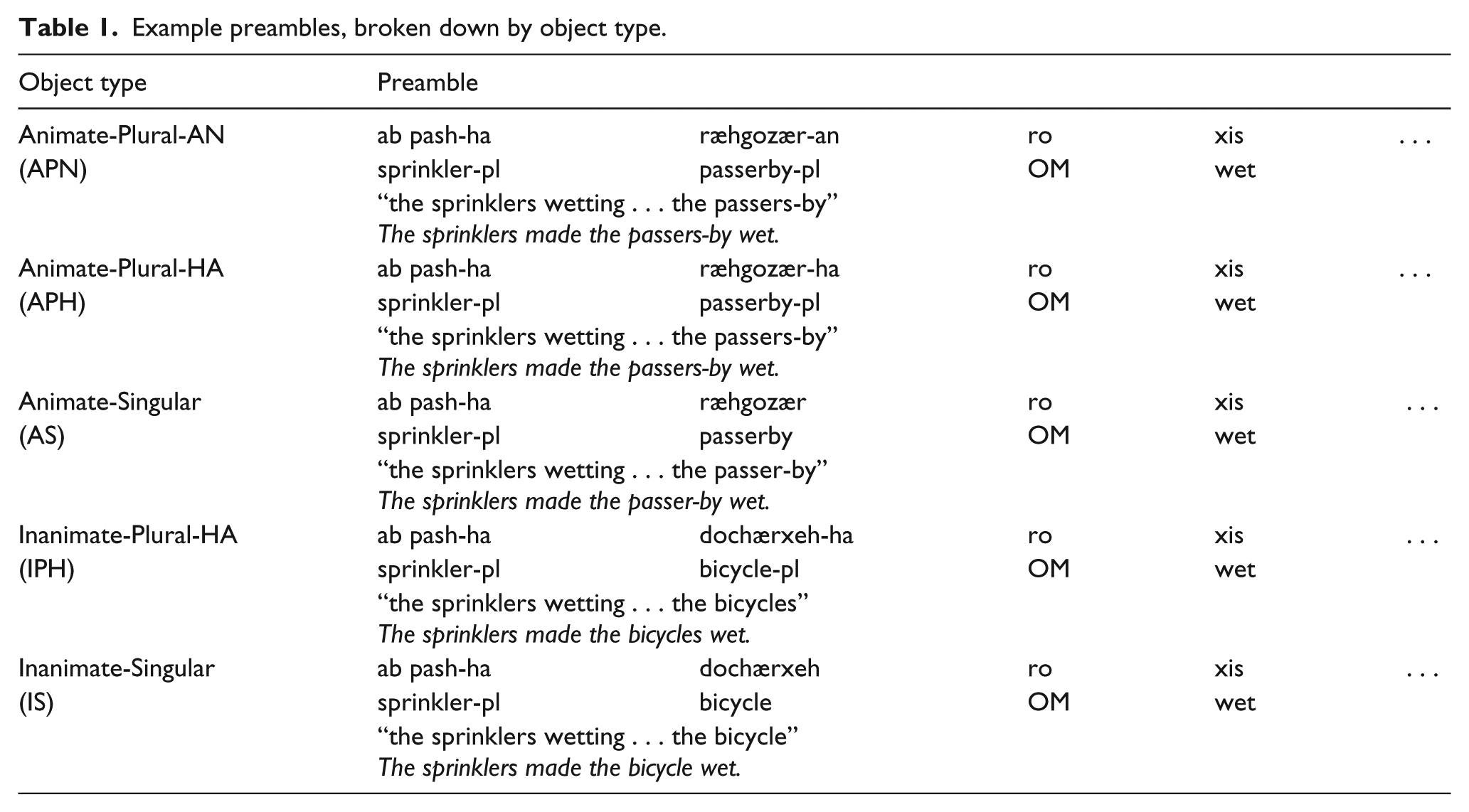
All the verbs used in this experiment were combined compound verbs (see Note 2) (Dabir-Moghaddam, 1997) consisting of a non-verbal constituent (a noun, adjective, past participle, prepositional phrase, or adverb) plus a verbal constituent. The verbal and non-verbal constituents of the compound verbs in Persian language are independent. So, using combined compound verbs gave us the opportunity to provide the preambles with the non-verbal part of the verbs, and as such, participants were instructed to read the preambles out loud and then create a complete sentence using informal, spoken Persian. By providing the nonverbal part of the compound verbs in the preamble, participants were limited to completing the sentence only with the verbal part of the compound verb. This helped ensure a greater amount of useable data, compared to a more open elicitation task. For example, to complete the preamble in Table 1, participants would end with either /kærd/ (“did”—showing singular marking) or /kærd-æn/ (“did”—showing plural marking). The verb /kærd(æn)/ was used for 29 of the items, /dad(æn)/ (gave) was used in five, /bord(æn)/ (took) in three, /dasht(æn)/ (had) in two, and /gereft(æn)/ (got) in one. In order to control for any effects of verb tense, participants were told to imagine that all the events in the sentences happened the day before, which allowed them to naturally use the past tense.
The filler preambles looked superficially like the target preambles, but included different kinds of structures. These filler preambles consisted of a singular or plural subject noun, singular/plural (in)animate definite object noun, the direct object marker /ro/, and the nonverbal part of a combined compound verb. The purpose of these filler items was to prevent participants from developing specific expectations or predictions about the critical items.
Using a Latin square design, the target items were divided into five compatible experimental lists. In each list, there were eight items of each condition, with animate plural with suffix /-an/ (APN), animate plural with suffix /-ha/ (APH), animate singular (AS), inanimate plural with suffix /-ha/ (IPH), and inanimate singular (IS) objects, with no item repeated within a list, so that for each list, each participant saw every item exactly once, and across all the lists, each item appeared once in each condition. The 40 filler items were the same in all the five lists. The order of the trials was arranged pseudo-randomly so that target sentences from the same condition did not appear next to each other in the list. In total, each list was read by nine participants.
Procedure
Participants were tested individually. After giving informed consent, participants sat in front of an Apple MacBook Pro computer equipped with a microphone and running Psyscope X. The experiment started with a training session including instructions and seven trials. The participants were instructed to complete the sentences with their own words out loud, as if they were talking to one of their friends. As mentioned above, to avoid an effect of tense, the participants were told to imagine that all the events of the sentences happened the day before. When participants indicated that they were ready, the experiment began.
In each trial, the preamble appeared in black text at the centre of the computer screen on a white background. The participants were instructed to repeat the preamble and then complete the sentence out loud. The preamble appeared on the screen until the participants pressed a key to continue to the following screen, which displayed a signal (++++++) indicating that participants could pause on this screen until pressing a key to continue to the next trial. After pressing the key, there was a one-second delay that allowed the investigator to note the participants’ responses on a log sheet. Throughout the experiment, the participant’s voice was recorded in a separate file in the computer. This recording was consulted whenever the investigator was not able to note the participant’s response during the trial itself.
Design and data analysis
One participant’s data were excluded from analysis because the participant had difficulty performing the task. All of the remaining 45 participants’ data were used in the analysis; there were no failures to respond, selection of a different verb than was intended, or any other type of responses. As noted earlier, all of the verbs used in this experiment were combined compound verbs consisting of a non-verbal constituent plus a verbal constituent, and participants were provided with the non-verbal part of the compound verbs in the preamble and instructed to complete the sentences with their own words. This design allowed participants to provide usable data in all of the trials as the participants (unknowingly) were limited to complete the sentence with the specific verbal part of the compound verb.
The verbs produced by the participants were coded for singularity (1) and plurality (0), with singularity (1) reflecting grammatical but mismatching singular verb use. In one analysis, the dependent variable was the use of singular verbs, with two independent, within-subject factors: Number (with two levels, plural with the suffix /-ha/ vs. singular) and Animacy (with two levels, animate vs. inanimate). In a second analysis, the effect of Type of Plural Morpheme, relevant only for animate objects, was tested. The dependent variable was once again the use of singular verbs, but this time with one independent, within-subject factor: Number, with three levels, animate plural object with the suffix /-an/ (e.g., /ræhgozær-an/, “passers-by”), animate plural object with the suffix /-ha/ (e.g., /ræhgozær-ha/, “passers-by”), vs. AS object (e.g., /ræhgozær, “passer-by”).
The use of singular verbs with each of the five conditions of the object nouns: APN (e.g., /ræhgozær-an/, “passers-by”), APH (e.g., /ræhgozær-ha/, “passers-by”), AS (e.g., /ræhgozær/, “passer-by”), IPH (e.g., /dochærxeh-ha/, “bicycles”), and IS (e.g., /dochærxeh/, “bicycle”) were compared using a logistic mixed effects model and the lme4 and afex packages in R to calculate statistical measures for condition (Bates, Maechler, Bolker, & Walker, 2015; Singmann, Bolker, & Westfall, 2015). For the post hoc analyses, lsmeans was used with a Tukey’s correction (Lenth, 2016). For the mixed effects models, the maximal random effects structure supported by the data was used for both items and subjects (Barr, Levy, Scheepers, & Tily, 2013).
Results
Mean proportions of singular verb usage with different object conditions are shown in Table 2.
Mean proportion of singular verb usage with different object types.
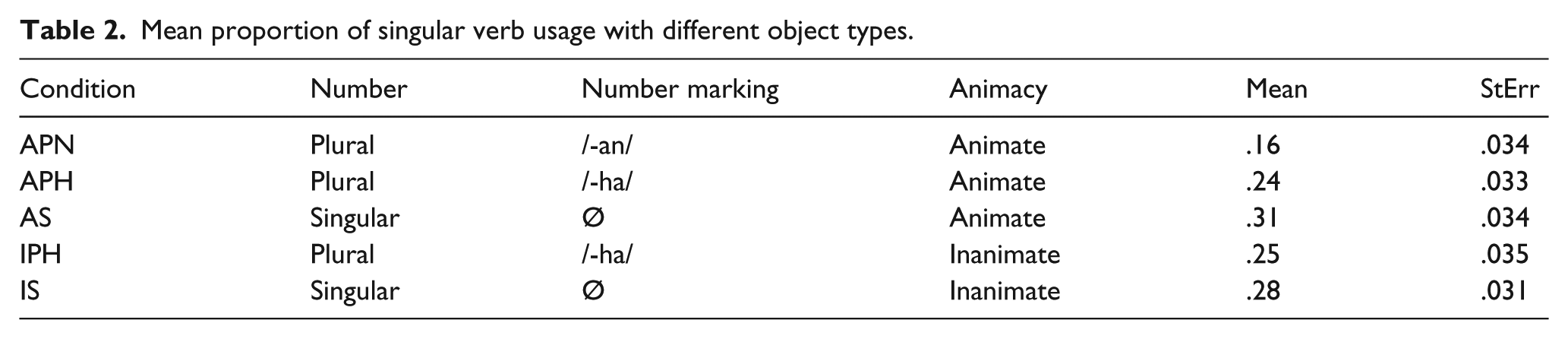
The first statistical model tested the effect of animacy and plurality (with the APN condition set aside). The main effects of animacy, F(1, 152.18) = .47, p = .49, and plurality, F(1, 152.18) = 1.17, p = .28, and their interaction, F(1, 152.18) = .35, p = .56, were not selected as statistically significant using a logistic mixed effects model 3 (Singmann et al., 2015). This result indicates that animacy and number of the object noun did not have attraction effect in the production of subject-verb agreement.
Next, we examined the APN with respect to both the AS and APH conditions in the model, with the reference level of AS. 4 Condition obtains statistical significance in this model, F(2, 72.97) = 4.38, p = .02. A post hoc test was conducted with this model on the three levels of condition using a Tukey’s correction. Only one comparison in the post hoc test obtains statistical significance, AS versus APN, estimated log-odds difference = 1.13 (SE = 0.36), Z = 3.095, p = .006. The participants produced more singular form of the verbs in AS condition, compared to APN condition.
With respect to morphology, one can ask whether participants produced significantly more singular verbs in APH condition, compared to APN condition. While the direction of the effect in a direct comparison of /-ha/ and /-an/ (APH vs. APN) is in the predicted direction, it only approached statistical significance, estimated log-odds diff = 0.68 (SE = 0.35), Z = 1.91, p = .13.
Discussion
Excluding the APN condition, the results did not show an attraction effect for animacy nor number of the object noun in the production of subject-verb agreement. These results show that while the animacy of the subject is important for subject-verb agreement in Persian, the animacy of the object overall does not appear to matter. For the effect of object number, the result of the above analysis showed no effect either. These results were obtained when singular animate and inanimate object nouns were compared to plural ones with suffix /ha/ (AS, IS, APH, IPH). This suggests that the participants’ production of singular verbs was not significantly different in sentences with animate and inanimate singular/plural object nouns with suffix /-ha/ that is the non-specific plural marker.
But, the comparison of animate plural /-an/ (APN) with AS showed a statistically significant difference. Participants produced fewer singular verbs with animate plural /-an/ (APN) condition compared to the AS condition. This means that the number of object noun could have an attraction effect on subject-verb agreement when the plural marker is /-an/, the specific one used only for animate nouns, and not the unmarked one /-ha/.
These results show that only animate plural object nouns with specifically animate plural marker /-an/ (and not all object nouns) may serve as attractors in subject-verb agreement when placed linearly between the subject phrase and the verb. This demonstrates that while the structural relationship between the subject and verb is important for subject-verb agreement, attraction effects are not limited to nouns that are part of the subject noun phrase; other intervening constituents can exert an attraction effect. No effect of animacy and number was obtained comparing animate and inanimate singular or plural object nouns with template suffix /-ha/.
Our results, similar to Mirković & MacDonald (2013) and Corbett (2000) but unlike most other studies of agreement, show attraction effects for singular-marked attractors, which are usually less robust attractors as they are the unmarked form. The participants produced the singular form of the verb more often in the AS condition, compared to the APN condition. Most prior work (e.g., Hartsuiker et al., 2001) has argued for the influence of plural (not singular) features of local nouns on the subject-verb agreement.
It is important to note the difference between the two plural morphemes /-ha/ and /-an/. The plural object nouns marked with /-an/ show attraction effects: singular verbs were used less frequently with them compared to singular object nouns. However, this attraction effect for plural object nouns is not reliable when /-ha/ is used. Since animate plural object nouns with the suffixes /-ha/ and /-an/ are syntactically the same but morphologically different, this suggests an interesting difference in attraction effects that is driven by morphology; these effects are not purely syntactic. Recall that the suffix /-ha/ is the unmarked plural and used for all types of plural nouns, while the plural suffix /-an/ is used only for animate nouns. One reason why speakers in this study have used plural-marked verbs more often with /-an/ is because of its limited usage—/-an/ is suffixed only to animate nouns and subject-verb agreement is not optional with animate subjects, and so /-an/ may serve as a stronger attractor for plural marking, even when it is on a local noun that is not in a syntactically higher position. It means that the suffix /-an/ may have influenced the strength of any attraction effect occurring for the plural animate object nouns.
To our knowledge, there is no prior work that could definitively explain what it is about these two plural markers that could cause the differences seen in the production of singular agreement. However, based on our pilot data regarding differences in agreement stemming from formal vs. informal register, we conducted a small, more informal study to examine whether such register differences might arise in the use of plural morphemes /-an/ vs. /-ha/. In the first part of the study, 14 native speakers of Persian were presented with 20 target plural animate nouns (10 with plural suffix /-ha/ and 10 other with /-an/) and 20 singular nouns and for each noun were instructed to choose between either producing a written formal sentence (as if they were reading a text) or producing a spoken informal sentence (as if they were talking to a friend). The participants produced fewer informal spoken sentences using /-an/ plural nouns compared to /-ha/ plural nouns.
In the second part of the study, 14 different native speakers of Persian saw the same nouns and were instructed for each noun to make up a sentence using it, to indicate whether they would prefer to say the sentence to an intimate person in the same ranking position (e.g., a friend, a sibling) or to a non-intimate person and in a superior position (e.g., a professor, the head of department), and then to produce the sentence out loud. The results showed that participants preferred to use plural nouns with suffix /-an/ in sentences for speaking formally (78%) to people in superior position rather than speaking informally (22%) to people in the same ranking position. The results of this pilot study showed that the plural nouns with the suffix /-an/ were used preferably in written sentences as well as formal spoken sentences when speaking to non-intimate people and/or people in superior social positions. These results may shed light on the results of the main experiment, in which the participants produced the singular form of optional agreement less frequently in sentences with plural object nouns with the suffix /-an/ and not with compared to with the suffix /-ha/. The reason seems to be that the participants might prefer not to use singular agreement to complete spoken informal sentences when the intervening plural object nouns had the suffix /-an/ rather than /-ha/.
These results are compatible with Haskell et al. (2010) and Mirković and MacDonald (2013), indicating that the participants used singular agreement less frequently in sentences with plural object nouns with plural marker /-an/ rather than /-ha/ because of the co-occurrence statistics in which plural subject nouns with /-an/ always have plural verbs. So, the sentences with the local plural object nouns with /-an/ have a higher frequency of co-occurrence with plural verbs.
Now the question is whether the results are compatible with any of the agreement accounts. These results are most consistent with symmetrical, competition-based accounts (e.g., Haskell & MacDonald, 2003; Thornton & MacDonald, 2003) in which agreement arises on both subject and verb in a coordinated and yet independent fashion, and additional, non-syntactic factors like animacy and patterns of co-occurrence with animacy (such as the case of /-an/) may influence agreement. In this approach, canonical agreement occurs when semantic and grammatical constraints happen to agree, based on the meaning, structural distances, and morphological cues. Variations like attraction effects occur when there are conflicting cues. Based on this type of approach, features are unified (they are not copied or transported from one element to another) and, as a result, they can be shared by elements of different branches of the tree structure. According to some competition-based linguistic models, number features are simultaneously assigned from the conceptual level to the subject and the verb (e.g., Pollard & Sag, 1994). Such an account was also implemented in a “feature-copying and unification” model proposed by Vigliocco and colleagues (e.g., Vigliocco, Butterworth, & Garrett, 1996a). This point is relevant for our results because the attraction effect for the plural object with /-an/ can be explained by having plural feature be the one chosen to unify with compare to singular object condition. For the specific effect of /-an/, because this plural marker is limited to nouns that do not allow optional agreement, and so may provide a particularly strong influence (or constraint) towards plural verb morphology, even though the singular form would still be grammatical.
Conversely, these results are not consistent with Control accounts because in these approaches agreement crucially involves the transmission of features within syntactic structures—subject is the agreement controller and the verb is the agreement target. Because, originally, these approaches encapsulate the subject from other syntactic features of the sentence, it is difficult to explain the attraction effect of object phrases that are local but not part of the hierarchical chain between the subject and verb. However, it is worth considering Hartsuiker et al. (2001) here. They, too, found an attraction effect for intervening objects (in an embedded clause). Using a Control-based approach, they argued for a two-step process of agreement computation in which during the first step the syntactic tree is constructed and number features are transmitted from the local noun (which is inside or outside the subject phrase) to the subject head noun, and then during the second step, the number feature on the subject is copied to the verb. However, this approach does not seem to account for our results easily, particularly the non-syntactic effect of morphology with different plural markers (/-ha/ vs. /-an/). While it may be possible that the number feature of the object is transmitted in the way that Marking and Morphing proposes, this would still not readily explain why there are differences in attraction effects for /-ha/ vs. /-an/.
This result also presents a challenge for models that attribute variation in agreement patterns to the memory interference (e.g., Badecker & Kuminiak, 2007). In this method, similar to control accounts, the subject of the sentence is the controller of the agreement. The morpho-syntactic features involved in identifying the sentence subject serve as its retrieval cues during utterance planning in working memory. The elements with similar features in the message can interfere with each other and cause the retrieval of an incorrect element leading to a misidentification of the subject. The local noun with similar features with the subject of the sentence (e.g., nominative case) can be misidentified as the agreement controller. If we want to apply this approach to our study, it means that the object has been retrieved as the subject of the sentence. But, in our study, the intervening object (i.e., local) nouns are followed by the definite direct object (accusative) marker /ro/, which distinguishes them from the subject of the sentence and so thus prevents them from being misidentified as the subject of the sentence.
Reporting the low attraction effect of unambiguous object pronouns compared to ambiguous ones, Hartsuiker et al. (2001) argued for the role of morpho-phonological ambiguity of case. The results of this study showed the significant attraction effect of plural object nouns with plural marker /-an/ (followed by definite direct object marker /ro/). Further study testing the attraction effect of indefinite object nouns (without the marker /ro/) is planned. Observing more attraction effect of the indefinite object nouns would be consistent with Hartsuiker et al. (2001) argument.
Conclusion
In this study, we found attraction effects for grammatical objects in optional subject-verb agreement in Persian, that was modulated by the type of plural morpheme used—showing that subject-verb agreement can be affected by the plurality of full (not pronominal) object nouns with plural marker /-an/ that are not part of the syntactic relationship between subject and verb. These results provide converging evidence from a very different language context that supports models of agreement production in which semantic, morphological, and syntactic information all influence agreement during grammatical encoding.
Footnotes
Acknowledgements
We thank Joseph Roy for his assistance on the statistical analyses. This article was prepared while Wind Cowles was employed at the University of Florida. The opinions expressed in this article are the authors’ own and do not reflect the view of the National Institutes of Health, the Department of Health and Human Services, or the United States government.
Declaration of conflicting interests
The author(s) declared no potential conflicts of interest with respect to the research, authorship, and/or publication of this article.
Funding
The author(s) received no financial support for the research, authorship, and/or publication of this article.