




Abstract
Conflict between task-relevant and task-irrelevant stimulus information leads to impairment in response speed and accuracy. For instance, in the colour-word Stroop paradigm, participants respond slower and less accurately to the print colour of incongruent colour words (e.g., “red” printed in green) than to congruent colour words (e.g., “green” in green). Importantly, this congruency effect is diminished when the trials in an experiment are mostly incongruent, relative to mostly congruent, termed a proportion congruent effect. When distracting stimuli are mostly congruent in one context (e.g., location or font) but mostly incongruent in another context (e.g., another location or font), the congruency effect is still diminished in the mostly incongruent context, termed a context-specific proportion congruent (CSPC) effect. Both the standard proportion congruent and CSPC effects are typically interpreted in terms of conflict-driven attentional control, frequently termed conflict adaptation or conflict monitoring. However, in two experiments, we investigated contingency learning confounds in context-specific proportion congruent effects. In particular, two variants of a dissociation procedure are presented with the font variant of the CSPC procedure. In both, robust contingency learning effects were observed. No evidence for context-specific control was observed. In fact, results trended in the wrong direction. In all, the results suggest that CSPC effects may not be a useful way of studying attentional control.
Keywords
Introduction
How the cognitive system controls itself to successfully implement a task is one of the major questions of experimental psychology. One particular question is how the system deals with conflict between task-relevant (target) information and task-irrelevant (distracter) information. In the attentional control domain, one particularly influential theory is the conflict adaptation or conflict monitoring account (Botvinick, Braver, Barch, Carter, & Cohen, 2001). According to this view, conflict is directly monitored. When conflict is detected, this triggers a top-down attentional shift towards task-relevant information and/or away from task-irrelevant information. Though influential, the conflict adaptation view has been heavily criticised (e.g., Atalay & Misirlisoy, 2012; Grinband et al., 2011a, 2011b; Hazeltine & Mordkoff, 2014; Hommel, Proctor, & Vu, 2004; Mayr, Awh, & Laurey, 2003; Mordkoff, 2012; Schmidt & Besner, 2008; Schmidt & De Houwer, 2011; for reviews, see Schmidt, 2013b; Schmidt, Notebaert, & Van den Bussche, 2015). Along these lines, the current work will aim to demonstrate that one of the seemingly most compelling lines of evidence for conflict adaptation (viz. context-specific proportion congruent effects) can actually be more coherently explained by references to simpler learning processes, unrelated to attention or cognitive control.
Perhaps the most typical approach to studying conflict is the Stroop task (Stroop, 1935; for a review, see MacLeod, 1991; see also, Eriksen & Eriksen, 1974; Simon & Rudell, 1967). In the Stroop task, participants are asked to identify the print colour of colour words, and the congruency effect is the observation that participants are slower and less accurate when the colour and word are incongruent (e.g., “red” printed in green) rather than congruent (e.g., “green” printed in green). Most importantly for present purposes, this congruency effect is reduced when trials are mostly incongruent (e.g., 80% incongruent, 20% congruent) relative to when they are mostly congruent (e.g., 80% congruent, 20% incongruent; Logan & Zbrodoff, 1979; Logan, Zbrodoff, & Williamson, 1984). This proportion congruent effect is very large and robust, and is typically considered to be one of the key pillars of evidence in support of the conflict adaptation notion (Botvinick et al., 2001; Lindsay & Jacoby, 1994; Lowe & Mitterer, 1982). In particular, it has been argued that the congruency effect is smaller in the mostly incongruent condition because conflict is very frequent. As such, participants direct attention away from the task-irrelevant word and/or towards the task-relevant colour. As a result, the word has a smaller effect on colour-identification performance, shrinking the congruency effect. In contrast, there is much less conflict in the mostly congruent condition, and attentional control is therefore weaker.
The conflict adaptation interpretation of the proportion congruent effect has, however, been strongly opposed by some (for a review, see Schmidt, 2013b). One particularly large concern, the main focus of the current article, are contingency learning biases (Schmidt & Besner, 2008; for related work, see Logan et al., 1984; Melara & Algom, 2003; Mordkoff, 1996). For instance, Schmidt and Besner (2008) pointed out that when most of the trials are congruent, then it follows that each word is presented most often in the congruent colour, and is thus strongly predictive of the correct response on congruent trials (e.g., seeing the word “green” indicates with a strong likelihood that the correct response is probably green). This speeds congruent trials, thereby increasing the congruency effect in the mostly congruent condition. In contrast, the word is (depending on the manipulation) either unpredictive or strongly predictive of a particular incongruent colour in the mostly incongruent condition (e.g., if “green” is presented most often in red). This will speed incongruent trials (i.e., because seeing the word “green” indicates that a red response can be predicted), thereby decreasing the congruency effect. In several reports, it has been shown that these contingency biases explain all or most of the proportion congruent effect (e.g., Atalay & Misirlisoy, 2012; Grandjean et al., 2013; Hazeltine & Mordkoff, 2014; Schmidt, 2013a). Other confounds may exist, such as feature integration (Risko, Blais, Stolz, & Besner, 2008) and temporal learning biases (Schmidt, 2013c, 2014, 2017), but for the present report we restrict the discussion to contingency learning.
Another sub-line of evidence for conflict adaptation comes from work on context-specific proportion congruent (CSPC) effects (Bugg, Jacoby, & Toth, 2008; Corballis & Gratton, 2003; Crump, Gong, & Milliken, 2006; Crump, Vaquero, & Milliken, 2008; Heinemann, Kunde, & Kiesel, 2009; Lehle & Hubner, 2008; Wendt & Kiesel, 2011). A CSPC procedure typically involves two contexts, such as two stimulus display locations (e.g., above or below fixation) or fonts. The same (randomly intermixed) stimuli are mostly congruent in one context (e.g., above fixation) and most incongruent in the other context (e.g., below fixation). The CSPC effect is the observation that the congruency effect is smaller in the latter context relative to the former. One thing that is particularly interesting about CSPC effects (and item-specific proportion congruent effects; see Jacoby, Lindsay, & Hessels, 2003) is that mostly congruent and mostly incongruent stimuli are randomly intermixed. Thus, at the start of the trial, the participant has no knowledge of whether the upcoming stimulus will be mostly congruent or mostly incongruent. Thus, if attention is really being controlled, then the control signal cannot, by definition, be triggered until the stimulus context (e.g., location) has already been observed. Given that the target stimulus is presented concurrently with the context, this means that there is zero advanced preparation time to adjust attention. It has nevertheless been proposed that attentional control is quickly engaged from stimulus onset, with an upregulation of attentional control for the mostly incongruent context and a downregulation for the mostly congruent context.
An alternative view is that CSPC effects, in whole or in part, are due to contingency learning, just like with the normal proportion congruent effect. An example CSPC design is illustrated in Table 1. What will be noted is that, task-wide, words are only moderately predictive of the congruent colour. Also, as each word is presented in both the mostly congruent and mostly incongruent contexts, the word-colour contingencies alone cannot explain CSPC effects. However, if we make the reasonable assumption that participants can combine location and word information together to anticipate the likely response (e.g., see Mordkoff & Halterman, 2008; see also Holland, 1992 for a background on occasion setting), then the word + location is, in fact, strongly predictive of the congruent response in the mostly congruent condition (e.g., “green” + up indicates a likely green response), and unpredictive in the mostly incongruent condition (e.g., “green” + down is uninformative about the likely colour response). Thus, compound-stimulus contingency learning can explain the CSPC effect.
Example context-specific proportion congruent manipulation.

Note, however, that while compound-stimulus (or “context-specific”) contingency learning is theoretically just as viable an account of the CSPC as context-specific attentional control, the typical designs do not allow any way to dissociate between these two viewpoints. There has, however, been some work to suggest that, at least in part, CSPC effects can be observed even for frequency-unbiased items. In particular, Crump and Milliken (2009) manipulated two colours to be mostly congruent in one location and mostly incongruent in another location, then intermixed with these contingency-biased items two other contingency-unbiased words. The proportion congruent effect transferred to the contingency-unbiased items. Hutcheon and Spieler (2017) did fail to replicate this effect after several attempts, but the original authors managed to replicate this transfer effect again (Crump, Brosowsky, & Milliken, 2017), albeit with much smaller effect sizes. Though independent replications from other labs are still wanting (other related findings will be considered in the General Discussion), even if we assume transfer effects do occur, other results raise questions about what such effects might actually mean. For instance, Schmidt, Lemercier, and De Houwer (2014) argued that rhythmic responding biases might be responsible for the CSPC transfer effect, and demonstrated that CSPC-like effects can be observed even when there is no conflict manipulation (see also, Schmidt, 2016). Diffusion modelling results also seem to indicate that CSPC effects are consistent with a threshold adjustment across contexts, rather than a drift rate adjustment (King, Donkin, Korb, & Egner, 2012), completely inconsistent with the conflict adaptation view (though potentially consistent with a temporal learning account, discussed later, or response caution).
The transfer effect aside, a key question that has yet to be answered is whether contingency learning biases do exist at all in the CSPC effect. This is not clear for two reasons. First, even if the CSPC effect is larger for contingency-biased items than for contingency-unbiased transfer items (Crump & Milliken, 2009), it is possible that this is due to item-specific learning. For instance, it could be that the normal CSPC effect is due to conflict adaptation, but that this conflict adaptation effect is larger for the items that are actually manipulated for conflict proportions than those that are not (indeed, this prediction even seems necessary from an item-specific control view; Jacoby et al., 2003). Second, no dissociation procedure has been used to directly separate contingency learning and conflict adaptation influences, despite the fact that such dissociation procedures exist for other versions of the proportion congruency procedure (e.g., Hazeltine & Mordkoff, 2014; Schmidt, 2013a). In that vein, the goal of the present series of experiments is to directly dissociate contingency learning and conflict adaptation biases in a CSPC procedure to see both (a) whether evidence for context-specific contingency learning can be observed and (b) whether there is additional evidence for context-specific attentional control independent of any contingency learning biases.
Experiment 1
In the current experiment, we explored directly to what extent CSPC effects might be due to context-specific contingency learning. In order to accomplish this aim, we made use of the font version of the CSPC paradigm. This is identical to the location-based CSPC design described above, except that the font in which coloured colour words were presented served as the contextual cue (Bugg et al., 2008). In order to dissociate between contingency and attentional control biases, we used a slightly modified stimulus matrix, illustrated in Table 2. As you will notice, two words are mostly congruent (MC) in one font, and mostly incongruent (MI) in the other font. For the remaining two words, this was reversed. Most importantly, high contingency (HC) and low contingency (LC) trials are not, however, completely confounded with proportion congruency in this novel design, at least for incongruent items.
Experiment 1 contingency manipulation.
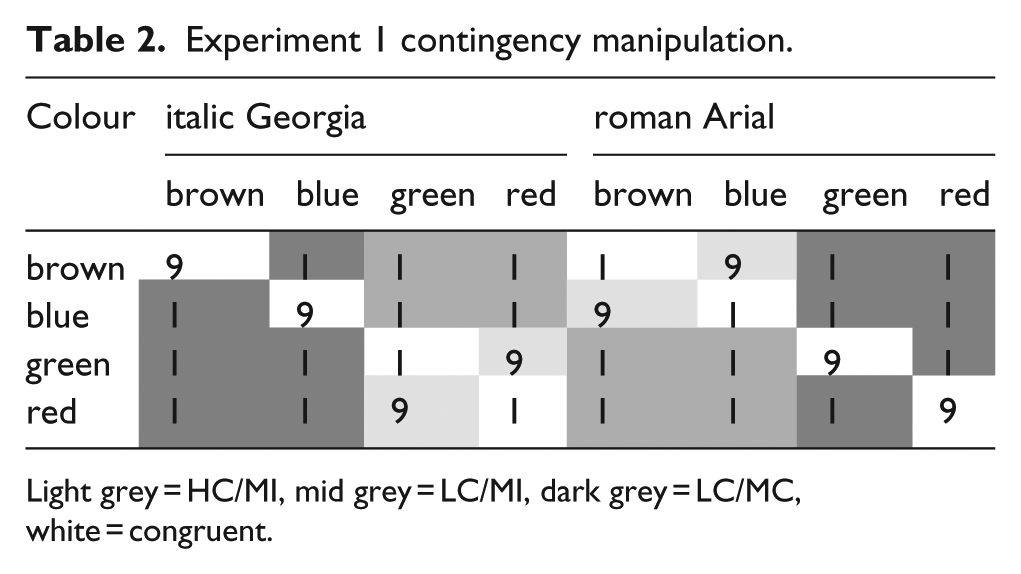
Light grey = HC/MI, mid grey = LC/MI, dark grey = LC/MC, white = congruent.
Most critical to this design is that it produces three types of incongruent trials (with a further subdivision to be described later), as illustrated in Figure 1. First, there are high contingency, mostly incongruent (HC/MI) trials (e.g., “brown” in blue in Arial font; light grey in Table 2), which have a strong contingency bias towards the correct response. Next, there are low contingency, mostly incongruent (LC/MI) trials (e.g., “red” in blue in Georgia font; mid grey in Table 2), which are also mostly incongruent, but low contingency. Thus, a difference between HC/MI and LC/MI trials cannot indicate conflict adaptation (as the words are equally mostly incongruent), and must therefore indicate a contingency learning effect (i.e., high contingency < low contingency). Finally, there are low contingency, mostly congruent (LC/MC) trials (e.g., “green” in blue in Arial font; dark grey in Table 2). Like the LC/MI trials, these are also low contingency, but are mostly congruent. As such, a difference in performance between LC/MI and LC/MC conditions cannot indicate a contingency learning bias, but could indicate an attentional control effect (mostly incongruent < mostly congruent). As a supplementary test, LC/MC items can also be further subdivided into trials with a colour that is mostly congruent (e.g., “brown” in blue, Georgia font) versus mostly incongruent (e.g., “green” in blue, Arial font). Because some have proposed, somewhat unintuitively, that the identity of the target stimulus might trigger attentional control to the distracting stimulus (Bugg & Chanani, 2011; Bugg & Hutchison, 2013), it could be that responding will be faster to mostly incongruent colours (i.e., less interference) relative to mostly congruent.

Illustration of the trial types in Experiment 1. For simplicity, all example stimuli are presented in blue.
Note that within this design, congruent trials are more inherently confounded by contingencies. That is, increasing the proportion of congruent trials inherently increases the contingency, as well. Thus, it is not possible to compare congruent trials of the same level of proportion congruency, but with a different level of contingency (or vice versa) within this design (or any other that we can imagine). We will return to this point in the General Discussion. Given that the contingency learning and conflict monitoring accounts predict an effect in the same direction for congruent trials, then, refined analyses of congruent trials are not possible or informative.
It is also important to point out that the design of Experiment 1 departs in an important (and interesting) way from typical CSPC procedures. In particular, each font context is not consistently associated to one level of proportion congruency. For instance, Georgia font is mostly congruent for “brown” and “blue,” but mostly incongruent for “green” and “red,” in the Table 2 example. According to the compound-stimulus contingency learning view, this design feature is irrelevant, as participants only learn word-font-colour correspondences. According to the attentional control view, however, it might be proposed that no CSPC effect should be observed at all if learning about conflict is fully specific to the font (i.e., both fonts have the same number of congruent and incongruent trials, averaged across the four words). However, it might also be proposed that there is item-specific control within contexts. As we will see later in Experiment 2 with a more “traditional” CSPC setup, this unique design characteristic is not critical.
Method
Participants
In all, 30 Ghent University undergraduates participated in exchange for €5. This sample size was selected because it was similar or larger (in some cases, much larger) than most prior CSPC studies (e.g., Bugg et al., 2008; Corballis & Gratton, 2003; Crump et al., 2006; Crump & Milliken, 2009; Crump et al., 2008; Heinemann et al., 2009; Lehle & Hubner, 2008; Wendt & Kiesel, 2011). Our sample size gave us high power (1 – β = .8; α = .05, one-tailed) to detect moderately sized effects (η2 ⩾ .18), which is a smaller effect size than has been previously reported for the font-specific CSPC effect (Bugg et al., 2008).
Apparatus
The experiment was programmed in E-Prime 2 (Psychology Software Tools, Pittsburgh, PA) and run on a PC. Responses were made on an AZERTY keyboard using the D, F, J, and K keys for brown, blue, green, and red, respectively.
Design
Stimulus words consisted of the Dutch colour words “bruin” (brown), “blauw” (blue), “groen” (green), and “rood” (red). Colour words were printed in brown (139,69,19), blue (0,0,205), green (0,100,0), and red (255,0,0) print colour (“SaddleBrown,” “MediumBlue,” “DarkGreen,” and “Red,” respectively, in the standard E-Prime colour palette). On each trial, the colour word was presented in either italic Georgia or roman (upright) Arial font, both 16 pt. There were 240 test trials, consisting of 5 blocks of 96 trials each. In each block (see Table 2), two words were presented mostly congruently in one font and mostly incongruently in the other font. The other two words were mostly congruent in the second font and mostly incongruent in the first. In particular, in the MC font, the word was presented most often (9/12 presentations) in the congruent colour, and once each in the remaining three colours. In the MI font, the word was presented most often (9/12 presentations) in a specific incongruent colour, and once each in the remaining congruent and incongruent colours. As in Table 1, brown and blue were always MC in one font and the high contingency incongruent colour of the other in the MI font. The same was true of green and red. Which font was the MC font for blue and brown, and which font was the MC font for green and red was, however, counterbalanced across participants.
Procedure
Stimuli were presented on a white (255,255,255) background. Each trial began with a black (0,0,0) fixation “+” in bold, 24 pt. Courier New font for 150 ms, followed by a blank screen for 350 ms. After this, the stimulus was presented until a response was made or 2000 ms elapsed. The next trial started immediately after a correct response. After an incorrect response or a failure to respond in 2000 ms, the error message “XXX” appeared in black, bold, 16 pt. Courier New font for 1000 ms prior to the next trial.
Data analysis
Mean correct response times and percentage errors were analysed. Trials on which participants failed to respond before the 2000 ms time limit were excluded from analysis.
Results
Response times
The response time and error results for the simple CSPC analysis are presented in Figure 2. First, we analyse the response time results in the typical manner using a 2 congruency (congruent vs. incongruent) x 2 proportion congruent (mostly congruent vs. mostly incongruent) analysis of variance (ANOVA). This revealed a robust main effect of congruency, F(1, 29) = 53.552, mean square error (MSE) = 2029, p < .001,
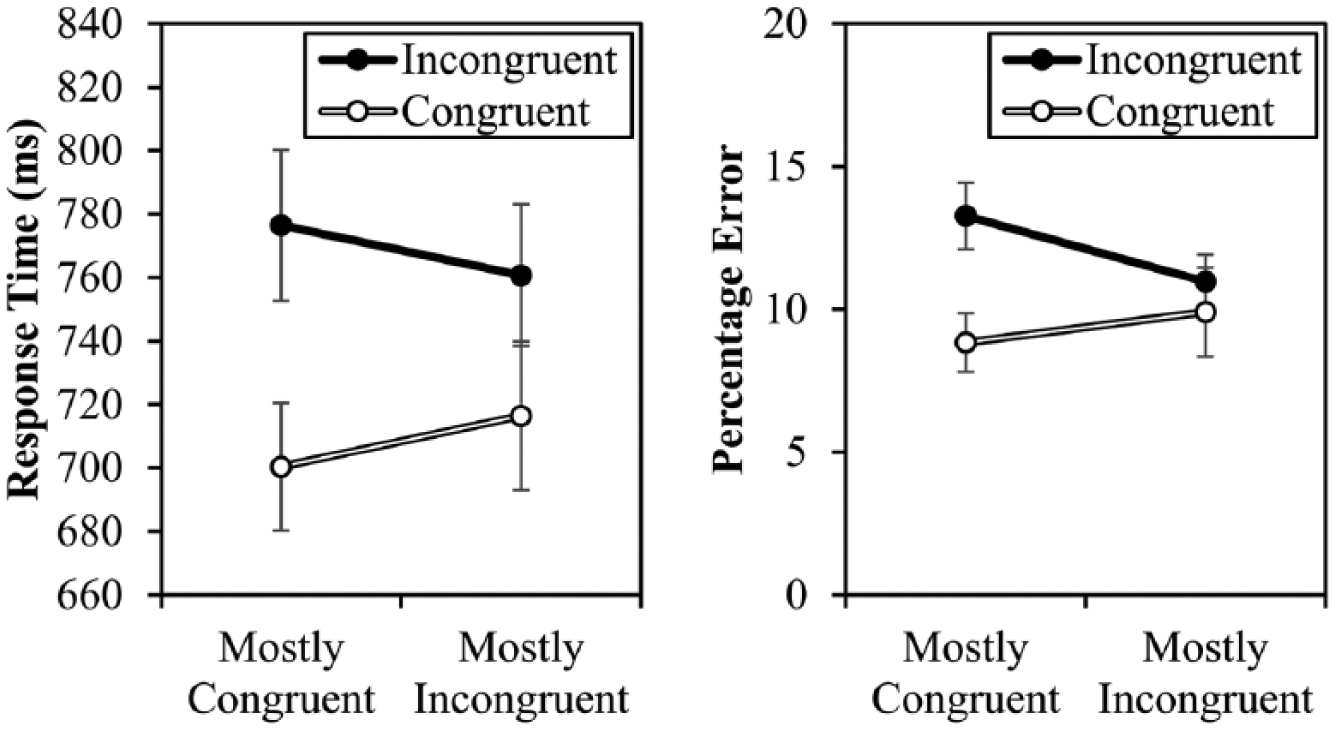
Experiment 1 context-specific proportion congruent effect (with contingency confound) for response times (left) and percentage errors (right), including standard error bars.
Next, however, we compare the three critical types of incongruent trials, presented in Figure 3 for both response times and percentage errors. As can be observed, HC/MI items were responded to significantly faster (752 ms) than LC/MI items (802 ms), t(29) = 4.527, SEdiff = 11, p < .001, η2 = .41. This indicates clear evidence for a contingency learning bias in the CSPC. Also interesting, there was no evidence for context-specific attentional control. In fact, LC/MC items were responded to significantly faster (776 ms) than LC/MI items, t(29) = 2.189, SEdiff = 12, p = .037, η2 = .14. This is, of course, exactly the opposite of what the attentional control account should predict and will be discussed in more detail in the General Discussion. Similarly, if we compare LC/MC items with a mostly congruent versus mostly incongruent colour (not shown in Figure 3), the attentional control account again fell short with the former items being responded to significantly faster (758 ms, SE = 23) than the latter (787 ms, SE = 26), t(29) = 2.048, SEdiff = 14, p = .0497, η2 = .13. This latter finding will also be discussed in the General Discussion. Because power for detecting a true attentional control effect might be a concern (Crump et al., 2017), we computed Bayes factors (using an online calculator; Dienes, 2014) using a half normal distribution with the sample CSPC effect (32 ms) as the prior standard deviation. The half-normal is particularly conservative for drawing conclusions about the null (or, in this case, a non-positive attentional control effect), as it gives particularly high likelihood to outcomes smaller than the prior. For both of these latter two contrasts, Bayesian evidence favoured the null, BF01 = 8 and BF01 = 6.6, respectively.
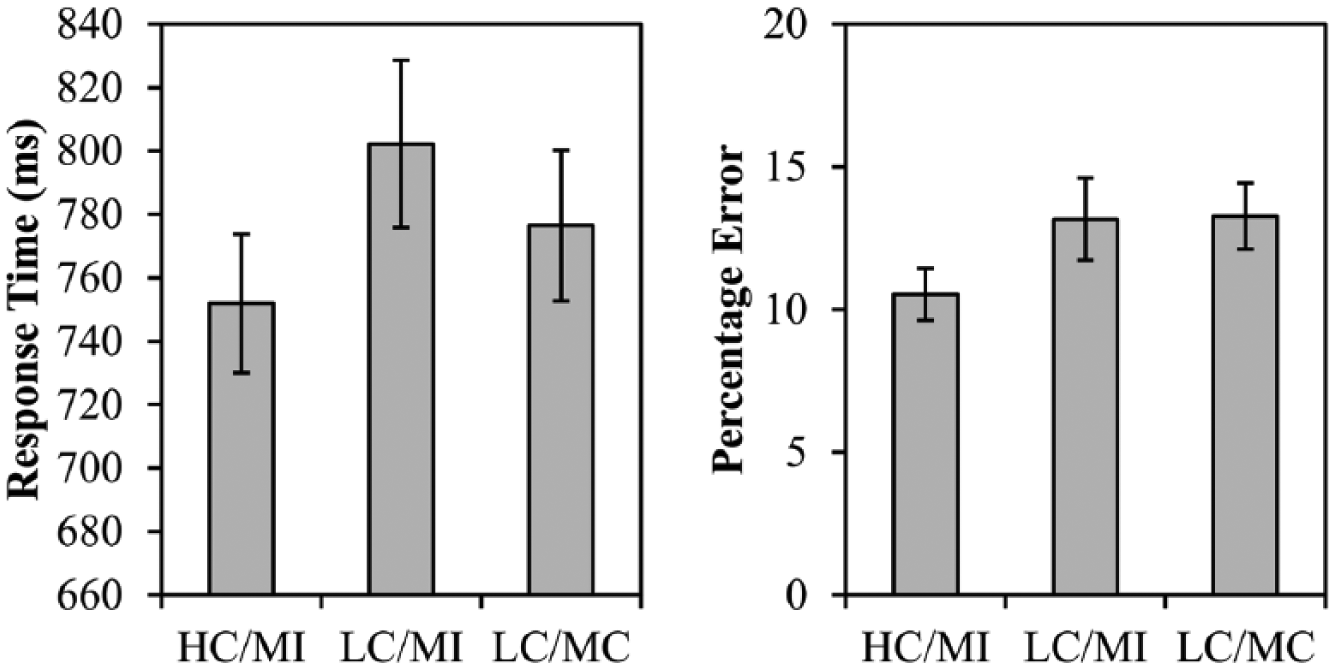
Experiment 1 contingency dissociation analysis for response times (left) and percentage errors (right), including standard error bars.
Percentage errors
The percentage error data were first analysed with a 2 congruency (congruent vs. incongruent) x 2 proportion congruent (mostly congruent vs. mostly incongruent) ANOVA. This revealed a robust main effect of congruency, F(1, 29) = 8.579, MSE = 26.4, p = .007,
As with response times, we next compare the three critical types of incongruent trials. As can be observed, errors were significantly less frequent to HC/MI items (10.5%) than LC/MI items (13.2%), t(29) = 2.701, SEdiff = 1.0, p = .011, η2 = .20, again indicating a robust contingency learning effect. There was again no evidence for context-specific attentional control, with no difference in errors between LC/MC items (13.3%) and LC/MI items, t(29) = 0.129, SEdiff = 0.8, p = .899, η2 < .01. Similarly, if we compare LC/MC items with a mostly congruent versus mostly incongruent colour (not shown), the former items produced marginally fewer errors (11.3%, SE = 1.1) than the latter (14.3%, SE = 1.4), t(29) = 2.042, SEdiff = 1.5, p = .0504, η2 = .13. Bayesian evidence again favoured the null hypothesis over the attentional control alternative hypothesis for both of these contrasts, BF01 = 4 and BF01 = 7, respectively.
Discussion
Experiment 1 revealed robust CSPC effects in both response times and errors. Two things were interesting about this particular design, however. First, each font context did not have a fixed level of proportion congruency. That is, two words were mostly congruent in one font and two other words were mostly congruent in the other font. A context-specific (or perhaps word + font-specific) proportion congruency effect was nevertheless observed. This might suggest that whatever is being learned in a CSPC experiment is not actually merely specific to the context itself, but to the items in each context (i.e., word-font-colour compounds). Second and most importantly, the current design allowed us to dissociate between contingency learning and attentional control biases for the incongruent items. These analyses revealed very robust compound-contingency learning effects, as predicted. However, no remaining evidence was left for context-specific attentional control when eliminating this contingency bias. In fact, results were in the wrong direction (see General Discussion). As a preliminary study, these results seem highly problematic for the conflict monitoring perspective.
Experiment 2
The results of Experiment 1 are intriguing in that they both (a) produced robust evidence for a context-specific contingency learning confound and (b) provided no support at all for context-specific attentional control, whether on the basis of the proportion congruency of the word or of the colour. One possible limitation with Experiment 1, however, is that the design was atypical for a CSPC experiment. In particular, each context (font) was not uniquely associated with a particular level of proportion congruency. That is, half of the words were mostly congruent and half were mostly incongruent for each context. It could be that context-specific attentional control is only observable when each context is consistently associated with a particular level of proportion congruency. In order to address this possible problem, Experiment 2 was conducted. Experiment 2 was closer to a typical CSPC experiment, with one font exclusively mostly congruent for all words and the other font exclusively mostly incongruent for all words. This is illustrated in Table 3. This design no longer allows a contrast of mostly congruent versus mostly incongruent colours (i.e., controlling for word proportion congruency and contingencies). However, the design does still allow (a) comparison of high contingency (light grey in Table 3) and low contingency (mid grey in Table 3) trials that are (equally) mostly incongruent (i.e., HC/MI and LC/MI), and (b) mostly congruent (dark grey in Table 3) and mostly incongruent (mid grey) trials of (equal) low contingencies (i.e., LC/MC and LC/MI). Thus, both contingency and attentional control effects can be assessed separately. As in Experiment 1, congruent trials are more inherently confounded (i.e., as increasing the proportion of congruent trials inherently increases the congruent-trial contingencies), so congruent trials are not analysed in detail. We also assess to what extent CSPC effects might be larger with fixed proportion congruent contexts (Experiment 2) relative to non-fixed contexts (Experiment 1).
Experiment 2 contingency manipulation.
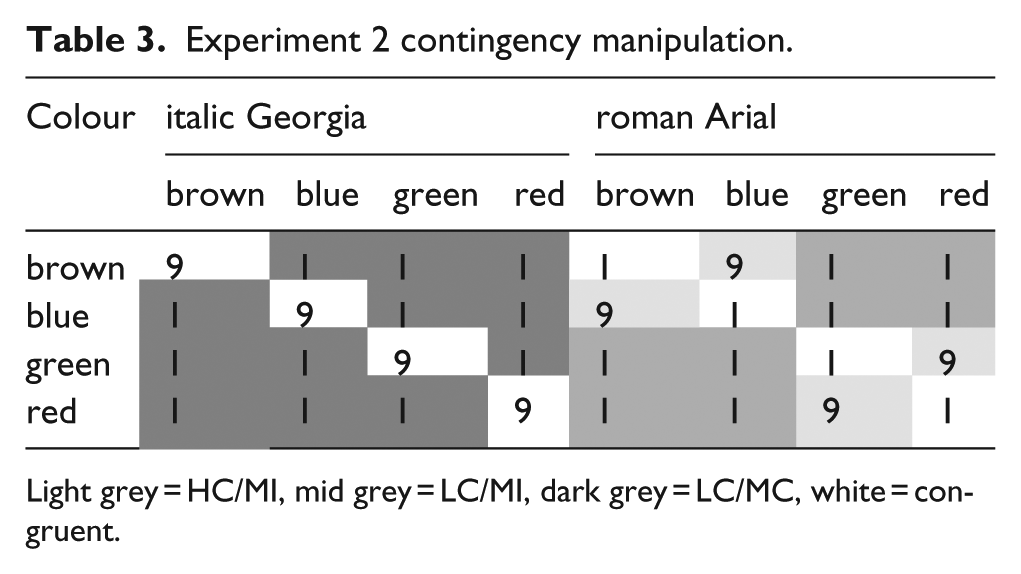
Light grey = HC/MI, mid grey = LC/MI, dark grey = LC/MC, white = congruent.
Method
Participants
In all, 31 Ghent University undergraduates participated in exchange for €5. None had participated in Experiment 1.
Apparatus, design, procedure, and data analysis
The apparatus, design, procedure, and data analysis of Experiment 2 were identical in all respects to Experiment 1 with one exception. Instead of blue and brown being mostly congruent in one font and red and green being mostly congruent in the other font, all four words were mostly congruent in one font and mostly incongruent in the other (see stimulus matrix in Table 3). Which font was the mostly congruent font and which was the mostly incongruent font was counterbalanced across participants.
Results
Response times
The response time and error results for the simple CSPC analysis are presented in Figure 4. First, we analyse the response time results in the typical manner using a 2 congruency (congruent vs. incongruent) x 2 proportion congruent (mostly congruent vs. mostly incongruent) ANOVA. This revealed a robust main effect of congruency, F(1, 30) = 68.793, MSE = 3,317, p < .001,
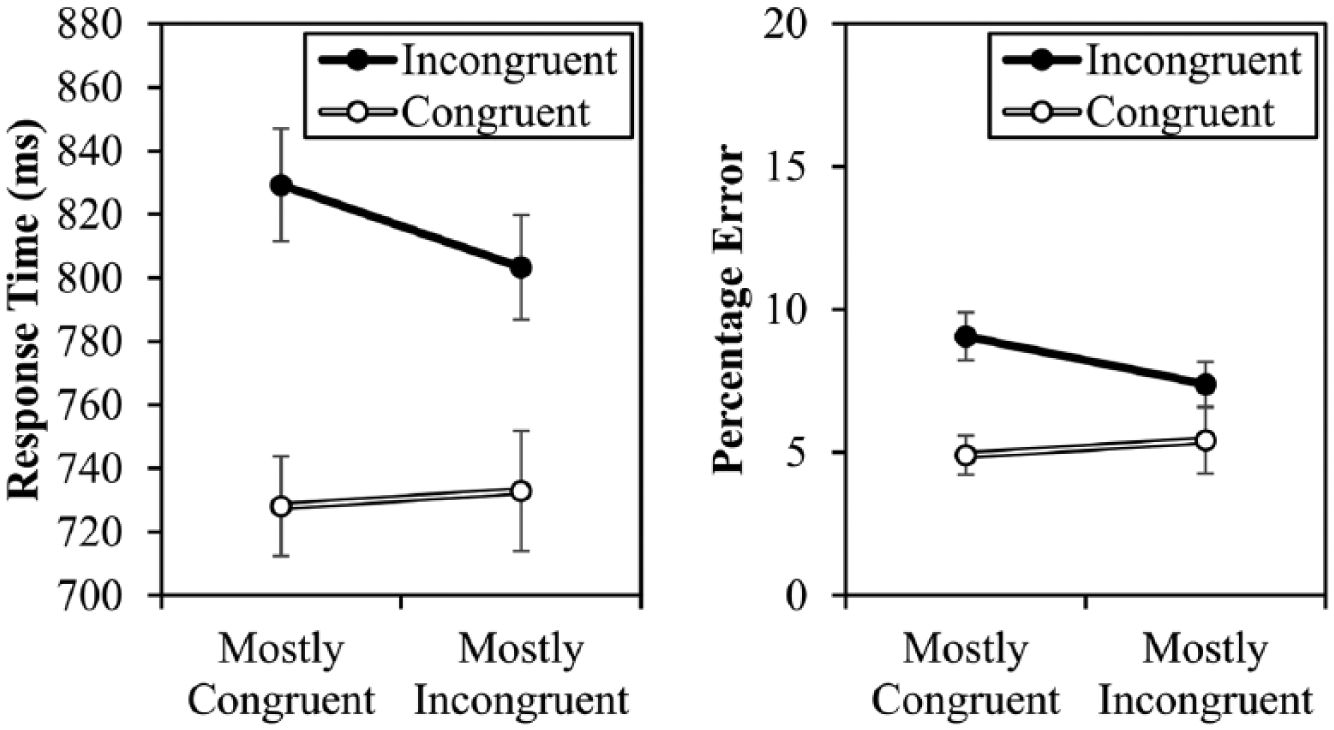
Experiment 2 context-specific proportion congruent effect (with contingency confound) for response times (left) and percentage errors (right), including standard error bars.
Next, however, we compare the three critical types of incongruent trials, presented in Figure 5 for both response times and percentage errors. As can be observed, HC/MI items were responded to significantly faster (794 ms) than LC/MI items (846 ms), t(30) = 6.804, SEdiff = 8, p < .001, η2 = .61. This indicates clear evidence for a contingency learning bias in the CSPC. Also interesting, there was no evidence for context-specific attentional control. In fact, LC/MC items were responded to marginally faster (829 ms) than LC/MI items, t(30) = 2.034, SEdiff = 8, p = .051, η2 = .12. This is, again, the opposite of what the attentional control account should predict (see General Discussion). Bayesian evidence again strongly favoured the null hypothesis over the attentional control alternative hypothesis, BF01 = 13.
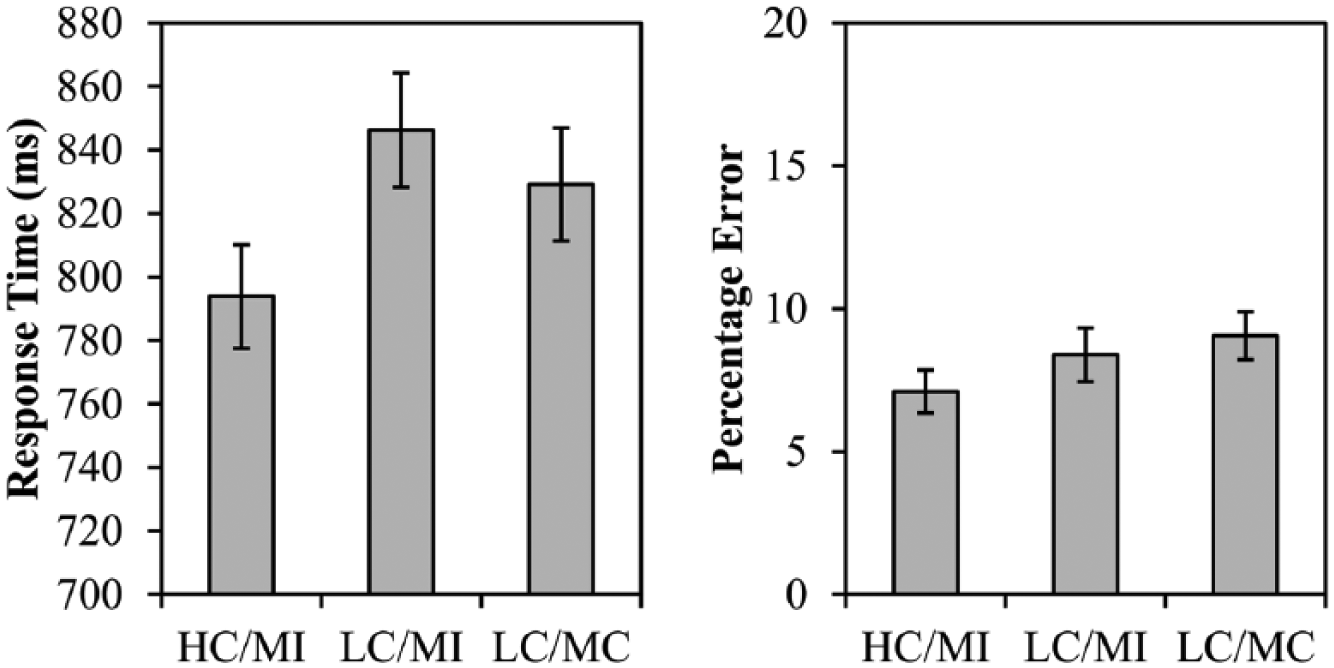
Experiment 2 contingency dissociation analysis for response times (left) and percentage errors (right), including standard error bars.
Percentage errors
The percentage error data were first analysed with a 2 congruency (congruent vs. incongruent) x 2 proportion congruent (mostly congruent vs. mostly incongruent) ANOVA. This revealed a robust main effect of congruency, F(1, 30) = 25.773, MSE = 11.3, p < .001,
As with response times, we next compare the three critical types of incongruent trials. As can be observed, errors were significantly less frequent to HC/MI items (7.1%) than LC/MI items (8.4%), t(30) = 2.278, SEdiff = 0.6, p = .030, η2 = .15, again indicating a robust contingency learning effect. There was again no evidence for context-specific attentional control, with no difference in errors between LC/MC items (9.1%) and LC/MI items, t(30) = 0.812, SEdiff = 0.8, p = .432, η2 = .02. Bayesian evidence was numerically in favour of the null hypothesis over the alternative attentional control hypothesis, but the Bayes factor was indeterminate, BF01 = 1.3 (perhaps related to the weak effects in errors to start out with; e.g., a non-significant CSPC).
Between experiment comparison
Because Experiment 1 used an atypical CSPC design without fixed font contexts, whereas the present Experiment 2 used a more typical design with fixed font contexts, we additionally tested to see whether there was any evidence for larger CSPC effects in Experiment 2 (i.e., as the attentional control view might predict) using a 2 experiment (Experiment 1 vs. Experiment 2) x 2 congruency (congruent vs. incongruent) x 2 proportion congruent (mostly congruent vs. mostly incongruent) ANOVA for each dependent measure. Numerically, the CSPC effect was actually smaller in Experiment 2 in both response times and errors, but not significantly, F(1, 59) = 0.003, MSE = 1361, p = .958,
Discussion
As in the previous experiment, Experiment 2 revealed clear evidence for context-specific contingency learning biases in the CSPC. As before, high contingency items were responded to significantly faster than low contingency items when equating proportion congruency. Also like the previous experiment, no evidence for context-specific attentional control was observed after controlling for the contingency learning bias. Given that each context was consistently associated with one level of proportion congruency in Experiment 2, this rules out the possibility that the lack of evidence for context-specific attentional control in Experiment 1 was due to the (atypical) stimulus matrix in the first experiment. Indeed, there was no clear evidence that fixing the contexts increases the CSPC effect, as the attentional control view might predict (i.e., depending on how interpreted).
General discussion
CSPC effects are a major source of evidence offered in favour of the conflict monitoring (or conflict adaptation) account (for a review, see Bugg & Crump, 2012). Further, CSPC effects are presented as evidence that conflict monitoring and attentional control can be sensitive to contextual factors. However, concerns with both of these positions are validated with the current results. In two experiments, there was very robust evidence for a context-specific contingency learning confound, with HC/MI incongruent trials being responded to significantly faster and more accurately than LC/MI incongruent trials. That is, after equating for proportion congruency, a huge confounding influence of (context-specific) contingency learning was clearly observed in both response times and errors.
To make things even worse for the mainstream viewpoint, there was no evidence at all for context-specific attentional control. LC/MC and LC/MI incongruent trials (which were equated in contingencies, but differed in proportion congruency) did not show the expected pattern. In fact, LC/MC incongruent trials were responded to significantly faster than LC/MI incongruent trials in Experiment 1. This is in the opposite direction to what the conflict adaptation account should predict. The same pattern was marginal in Experiment 2. Thus, it is not only the case that a contingency learning bias does exist in a CSPC procedure, but the current results suggest that attentional control plays no role at all in the observed pattern of results. Relatedly, there was also no evidence that attentional control was greater for mostly incongruent colours than for mostly congruent colours in Experiment 1, with the effect again in the wrong direction.
It is curious, of course, that some of the attentional control measures seemed to produce significant (or trending) results in the wrong direction. One reason for such “reversed” effects might be that there is generalisation of contingencies across contexts. That is, a contingency between a word and a colour in one font might (partially) influence the same word in the other font. Stated differently, while a distracting word might predict one colour (e.g., brown) in one font context, but another colour (e.g., blue) in another font context, the overall (across-context) contingency between a word and a colour may also influence performance. This is not a concern for the contingency contrast (i.e., HC/MI vs. LC/MC), as any such bias would only work against finding evidence for a contingency effect. For the attentional control contrasts, however, some of the LC/MC items contain word-colour combinations that are high frequency in the other font. For instance, in Table 2, “blue” printed in brown in Georgia font is low contingency, but “blue” in brown in Arial is a high contingency stimulus (i.e., HC/MI). This might therefore explain both (a) why, in Experiment 1, the LC/MC items with a mostly congruent colour were faster (i.e., exactly these items might have a contingency generalisation bias) relative to those with a mostly incongruent colour, and (b) why LC/MC items were significantly faster than LC/MI items (i.e., as only the former includes some items with a possible contingency generalisation bias). If true, it might be proposed that a true conflict adaptation effect was concealed.
Given the above-mentioned potential caveat we removed the (potentially) biased items and compared the remaining LC/MC items with LC/MI items. Analysed this way, the LC/MC and LC/MI means were still in the wrong direction numerically in the response times of Experiment 1, but not significantly, t(29) = 1.149, SEdiff = 13, p = .260, η2 = .04. Similarly, there was no significant difference in errors, t(29) = 1.368, SEdiff = 0.8, p = .182, η2 = .06. Comparable corrections to the Experiment 2 data (where there were no significant reversals to start with) did not produce significant differences between LC/MC and LC/MI items in the response times, t(30) = 1.527, SEdiff = 10, p = .218, η2 = .07, or errors, t(30) = 1.171, SEdiff = 0.8, p = .251, η2 = .04. Thus, results still argue against the attentional control account, but the reversals may have been an artefact.
As mentioned in the Introduction, some results have suggested that CSPC effects might be observable independent of contingency biases. Most notable are the experiments of Crump and Milliken (2009) that manipulated CSPC with some items and tested for transfer with contingency-unbiased items. As also mentioned, there are some concerns about the replicability (Hutcheon & Spieler, 2017) or at least magnitude of such effects (Crump et al., 2017). In two conceptually similar experiments, Reuss, Desender, Kiesel, and Kunde (2014, Experiments 3 and 4) observed transfer from one set of digits/number words (e.g., 1, 4, 6, 9, and the corresponding number words) to a contingency-unbiased set (e.g., 2, 3, 7, and 8) on the basis of a stimulus format (digits vs. words). One potential problem with this design, however, is the categorical decision of digits as greater or less than five. A compound contingency presumably still exists in this experiment between the category (e.g., > 5) and format (e.g., digit) that can generalise across individual stimuli. Indeed, contingency learning can occur at a categorical level even in non-conflict tasks (see esp., Schmidt, Augustinova, & De Houwer, 2018, for a task very similar to a colour-word Stroop task). Associative priming may also be a problem as transfer stimuli are closer on the mental number line to the corresponding manipulated stimuli (e.g., 2 and 3 are closer to 1 and 4 than to 6 and 9). Relatedly, a pair of experiments by Cañadas, Rodríguez-Bailón, Milliken, and Lupiáñez (2013) showed transfer effects from trained faces (male or female) to novel or reverse-mapped faces (e.g., a mostly incongruent female face, where most other female faces are mostly congruent). Again, this finding only indicates that whatever is being learned is category-specific, which does not necessarily help to dissociate between an attentional control or contingency learning view. In addition, the very stimulus features that define what makes a face recognisable as female versus male will be shared by manipulated and transfer faces of the same proportion congruency (i.e., gender).
Other findings are also relevant. For instance, Weidler and Bugg (2016; see also, Weidler, Dey, & Bugg, in press) found that when proportion congruency was manipulated for two locations, the CSPC effect transferred to nearby locations. However, the same stimuli were used for all locations. Thus, these results (contrary to the arguments of the authors) only show that whatever mechanism (attentional control, contingency learning, etc.) produces the CSPC effect is not completely specific to exact coordinates on the screen, but is instead specific to conceptual spaces. This finding, while interesting, is not relevant to the distinction between context-specific attentional control versus context-specific contingency learning. There are still other (more distantly related) findings that have been used to argue the case for context-specific control (e.g., Bugg & Hutchison, 2013; Crump, Milliken, Leboe-McGowan, Leboe-McGowan, & Gao, in press), however, and we therefore do not argue that the current story is the final word on the subject.
As another caveat, the current investigation made use of only one variant of the CSPC procedure. In place of fonts, locations (Corballis & Gratton, 2003), colours (Lehle & Hubner, 2008), and even temporal presentation windows (Wendt & Kiesel, 2011) have been used as contextual stimuli, and different types of stimuli have been used (e.g., flankers, rather than Stroop stimuli). Thus, it remains possible that one or more of these other preparations would produce different results than that observed in the current report. Thus, independent replications with one or more of the remaining CSPC procedures would be a worthwhile endeavour. Such investigations might reveal that at least one of the CSPC preparations can be used to study attentional control in a contingency-unbiased way.
If some variant of the CSPC procedure does produce a remaining CSPC effect after eliminating the contingency confound, further care needs to be made to consider other potential mechanistic accounts. For instance, Schmidt and colleagues (2014) demonstrated that a CSPC-like effect can be observed even when the task does not contain conflict. In particular, they presented participants with a digit identification task that did not include any conflicting distracters. One location was “mostly easy” with a high proportion of high contrast digits, whereas the other location was “mostly hard” with a high proportion of low contrast digits. The stimulus contrast effect (low—high contrast) was reduced in the mostly hard context. This was interpreted as evidence for context-specific temporal learning. That is, participants are prepared to respond at the expected time (i.e., rhythmic responding), which might be modulated by context. Contexts with mostly easy items promote especially fast responding to easy items, whereas contexts with mostly hard items provide a benefit to hard items. The net result is a CSPC-like interaction. That such an interaction might result from rhythmic responding alone is problematic for attentional control accounts of the CSPC, where any such temporal learning would represent a confound. Notably, however, the current results are equally inconsistent with a context-specific temporal learning account as a context-specific attentional control account, but further consideration of this potential confound is warranted if further investigation does reveal evidence for a CSPC effect after a control for contingency biases.
As another caveat, the present design allows only for refined analyses of incongruent items. That is, items of equal contingencies but different proportion congruency (or vice versa) can be realised for incongruent items. Congruent items, however, contain a more inherent confound between contingencies and proportion congruency. Whether this is a major limitation, however, is unclear, as conflict effects are primarily driven by incongruent-trial interference (for a review, see MacLeod, 1991), and there is therefore general agreement that attentional control to the word should presumably be most pronounced in the incongruent items.
An anonymous reviewer suggested another possible caveat. According to the reviewer, previous investigations with two-choice CSPC procedures (e.g., Cañadas et al., 2013; Corballis & Gratton, 2003; King, Korb, & Egner, 2012) provide evidence of conflict adaptation independent of contingency biases. An example of such a two-choice study would be one in which the word “blue” is presented most often in blue in one location and most often in red in the other location (with a similar manipulation for “red”). Apparently, the suggestion is that because distracters (e.g., words) are presented equally often with each of the two responses (task wide), no contingency exists. This is, of course, incorrect. No task-wide contingency may exist in such an experiment, but task-wide contingencies do not provide an account of the CSPC effect, anyway. The compound distracter-context (e.g., word + location) contingencies are still strongly predictive. Indeed, two-choice tasks are generally the most confounded task variants, which also do not allow for any possibility of contingency controls (e.g., the dissociation procedure in the current investigation would be impossible in a two-choice task).
Caveats aside, the present results suggest that the CSPC paradigm might be a very poor index of attentional control. At least primarily, the effect seems to be dominated by contingency learning biases. If context-specific attentional control does contribute to the CSPC effect, at least, the true attentional effect does not seem to be particularly large or robust (for a similar conclusion with an entirely different design, see Crump et al., 2017). The contingency bias, on the other hand, was substantial. Thus, either way, the grounds for using CSPC effects as an index of attentional control seem shaky, at best (see also, Hutcheon & Spieler, 2017). What seems particularly clear from the current investigation is that any attempts to study context-specific attentional control should control for contingency biases, either with the novel approach presented in the current report or with a conceptually similar manipulation. The results from Experiment 1 further suggest that whatever is being learned in a CSPC procedure might not be exactly “context” specific, but instead specific to the stimulus compounds (i.e., word + location + colour). Following the typical context-specific attentional control logic, it is not clear whether a CSPC effect should have been predicted in the first experiment to start out with. Yet, the Experiment 1 CSPC effect was no smaller than that observed with the more traditional design in Experiment 2.
Supplemental Material
Supplementary Material
Open Practices Disclosure form
Footnotes
Acknowledgements

Declaration of conflicting interests
The author(s) declared no potential conflicts of interest with respect to the research, authorship, and/or publication of this article.
Funding
This research was supported by Grant BOF16/MET_V/002 of Ghent University.