




Abstract
This study investigated effects of healthy ageing and of non-verbal attentional control on speech production. Young and older speakers participated in a picture-word interference (PWI) task with compound targets. To increase the processing load, the two pictures of the compounds’ constituents were presented side-by-side for spoken naming (e.g., a picture of a
Keywords
Introduction
Problems in word-finding increase with age, but the underlying source is still a matter of debate (e.g., for a review, see Mortensen, Meyer, & Humphreys, 2006). Empirical evidence suggests that non-verbal attentional control declines with age (e.g., van der Lubbe & Verleger, 2002). Given the complexity of the processes underlying speech production, a decline in non-verbal cognitive functions might be one of the main reasons for word-finding difficulties in older speakers (for an alternative explanation, see Ramscar, Hendrix, Shaoul, Milin, & Baayen, 2014). While semantic-conceptual, lexical, and phonological representations themselves seem to be preserved in the elderly, the transmission of information between these representations seems to be particularly affected by age (Burke, MacKay, Worthley, & Wade, 1991; see also Burke & MacKay, 1997; Burke, MacKay, & James, 2000; Burke & Shafto, 2004; Lorenz, Regel, Zwitserlood, & Abdel Rahman, in press; Rastle & Burke, 1996; Taylor & Burke, 2002). This might explain why word-finding difficulties, including tip-of-the-tongue states in connected speech (e.g., Meyer & Bock, 1992), increase with age (Burke et al., 1991). In contrast to the evidence obtained from connected speech, older and young speakers often do not differ when naming single pictures (e.g., Belke & Meyer, 2007; Bowles, 1994; Feyereisen, Demaeght, & Samson, 1998; but see Verhaegen & Poncelet, 2013), and effects of semantically or phonologically related distractor words in single-picture naming are often not affected by age (e.g., Belke & Meyer, 2007; Mortensen, Meyer, & Humphreys, 2008; but see Taylor & Burke, 2002). This might be different with compound targets, which require access to, and combination of, multiple lexical morpheme representations, and thus are likely to put greater demands on word-form retrieval and morpho-phonological encoding than simple nouns (Lorenz et al., in press; for converging data from aphasia, see Blanken, 2000; Lorenz, Heide, & Burchert, 2014; Lorenz & Zwitserlood, 2014; but see Fiorentino & Poeppel, 2007). Some studies indicate that word-finding problems in the elderly especially occur when demands on cognitive load are high, for example, when two or more object pictures are simultaneously presented for spoken naming (e.g., Belke & Meyer, 2007; Mortensen et al., 2008; see also Meyer, 1997; Meyer, Sleiderink, & Levelt, 1998; Wagner, Jescheniak, & Schriefers, 2010).
In the current study, we presented pictures of two objects side-by-side (“double-object pictures”) for spoken naming with familiar (lexicalised) noun–noun compounds (e.g., gold + fish →
In what follows, we review age-related effects in cognitive control and their potential impact on speech processing. In addition, we provide details about our precursor study that used single pictures to elicit compound names in young and older adult speakers, and subsequently address potential differences between the single- and the double-picture variant for compound production.
Age-related effects on word finding and attentional control
There is evidence for a decline of attentional control processes and/or of working memory in older adults without neurological impairment (e.g., Belke & Meyer, 2007; but see Salthouse & Mandell, 2013; see also Burke & MacKay, 1997; Hasher, Stoltzfus, Zacks, & Rypma, 1991; Hasher & Zacks, 1988). Van der Lubbe and Verleger (2002) provided evidence for a general decline in attentional control processes in the elderly. They tested young and older adults in a visual-spatial version of the Simon task (Simon & Small, 1969; for a review, see Lu & Proctor, 1995). In this task, two different geometrical forms (e.g., triangle vs. square) are presented and a manual response by either the right or left hand is required. The congruency between the spatial position of target and response hand is manipulated, and participants are usually slower in responding to stimuli when response hand and target are on different sides (incongruent) than when they are on the same side (congruent). The difference between reaction times in incongruent and congruent conditions is known as the Simon effect. Van der Lubbe and Verleger reported a larger Simon effect for older than for young adult participants, reflecting a decline of attentional control processes with age (van der Lubbe and Verleger, 2002; see also Bialystok, Craik, Klein, & Viswanathan, 2004; Campbell, Grady, Ng, & Hasher, 2012; Lorenz et al., in press). Furthermore, Piai, Roelofs, Acheson, and Takashima (2013) provided evidence for domain-general attentional control in verbal and non-verbal tasks. Testing young participants, they used the Simon task as a measure of non-verbal attentional control, and two language production tasks as measures of verbal control (picture-word interference [PWI] task with semantic distractors, Stroop task). The results showed overlap of activation in the dorsal anterior cingulate cortex (ACC) in all three tasks (see also Peterson et al., 2002; Roelofs & Hagoort, 2002). Inhibitory control, response monitoring and action regulation are discussed as underlying this overlapping activation (Fan, Flombaum, McCandliss, Thomas, & Posner, 2003; Nozari, Dell, & Schwartz, 2011; Paap & Greenberg, 2013; Roelofs, van Turennout, & Coles, 2006; see for a review, see Roelofs & Piai, 2011). Thus, a decline in these processes might alter speech production in the elderly (but see Branzi, Calabria, Boscarino, & Costa, 2016; Calabria, Branzi, Marne, Hernandez, & Costa, 2015, for evidence from bilingual speakers indicating partially independent verbal and non-verbal control processes in speech production).
In line with the hypothesis that a decline in attentional control affects speech production in the elderly, Belke and Meyer (2007) showed that ageing effects in speech production can be affected by the complexity of the picture-naming task. They used a cyclic blocked picture naming task, in which targets from the same (homogeneous) or different (heterogeneous) categories are presented successively. Target pictures were either presented sequentially (Exp. 1a), or simultaneously (Exp. 1b) for spoken naming. Interestingly, ageing effects in terms of longer speech and gaze durations were only obtained when four pictures were presented simultaneously, not when pictures were presented sequentially. Interference by semantic blocking was observed with both presentation formats, but more pronounced effects in older than in young speakers were only present in the multiple-picture naming task. Thus, lexical retrieval in the elderly can be influenced by attentional control demands, suggesting that word-finding difficulties in the elderly might directly result from deficient attentional control (but see Branzi et al., 2016).
Production of compound nouns in the elderly: a study with single-object pictures
We previously conducted a PWI study very similar to the one reported here, with young and elderly participants, with compound naming and with distractors in the same conditions as in the present study (Lorenz et al., in press). But unlike the present study, participants named single pictures (e.g., of a sunflower or a toadstool) with compound names.
1
The written distractors overlapped with the picture name in the first or second constituent (sun or flower for the target
Specific differences between multiple- and single-picture presentation
It is likely that the use of two separate pictures instead of one for the production of a compound induces stronger processing costs (see also Belke & Meyer, 2007). The semantic interference observed in PWI studies is often explained in terms of lexical competition at the lemma level (e.g., Abdel Rahman & Aristei, 2010; Abdel Rahman & Melinger, 2009; Lüttmann et al., 2011; Roelofs, 1992 but see Mahon, Costa, Peterson, Vargas, & Caramazza, 2007). In our earlier study with single pictures for compound naming (Lorenz et al., in press), we observed semantic interference from distractors related to the compound (e.g., tulip →
Outline of experiment and predictions
To examine ageing effects in speech production under higher demands on cognitive control and speech planning, double-object pictures were presented for spoken picture naming in a PWI task with young and older speakers. In addition, all participants were enrolled in a non-verbal attentional control task (Simon task; Simon & Small, 1969; van der Lubbe & Verleger, 2002). Double-picture targets corresponded to existing German noun–noun compounds, with the first constituent serving as modifier (sun, in
Distractor conditions of experiment.
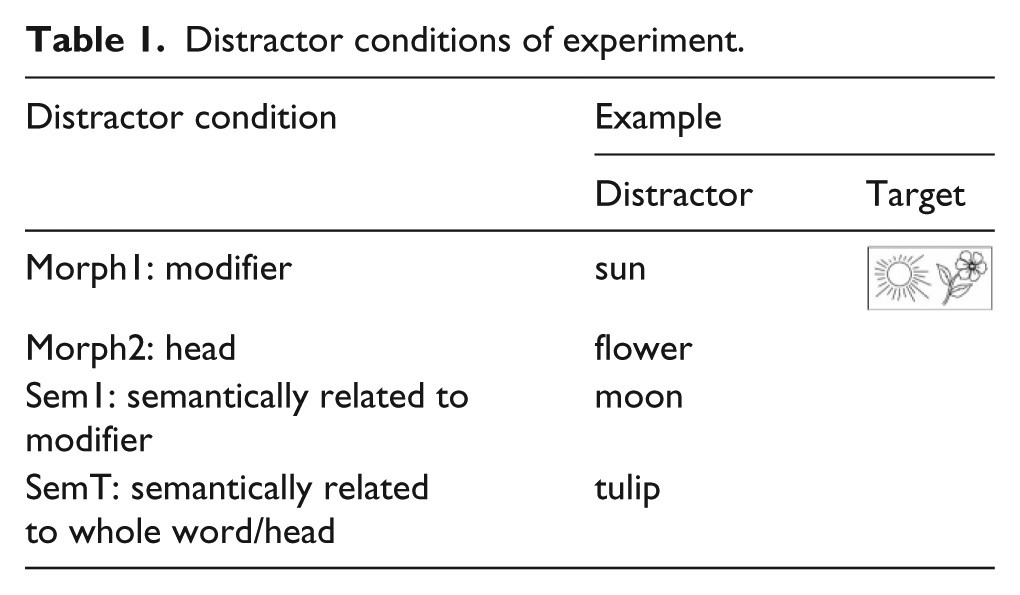
Given that two objects are presented that are related to two concepts (e.g.,
Methods
Participants
Adult native speakers of German were tested, including 32 young and 32 older participants (overall, n = 64). Two of the older participants were replaced due to high error rates (overall < 80% correct). The final sample included 32 young participants (mean age: 27.3 years, 4.8, range: 18-34; 11 men), and 32 older participants (mean age 71.2 years, standard deviation [SD] 3.5; range: 65-77 years; 10 men). All participants were right-handed, had normal or corrected-to-normal vision, and no history of neurological disorders. All participants gave written informed consent prior to participation. They were either paid for their participation or received university course credit. Mean years of school was M = 12.5 years for the young participants (range: 10-14, SD = 0.9), and M = 11.0 years for the older subjects (range: 8-13, SD = 1.7; young versus older: t(62) = 4.391, p < .001). The Mini-Mental Status Examination Test (MMST; Folstein, Folstein, & McHugh, 1975) was used to exclude dementia in the older participants (MMST score: M = 31.9, range: 30-36, SD = 1.6).
Furthermore, 24 of the older and 19 of the young subjects participated in a spot-a-word task (Mehrfachwahl-Wortschatztest, MWT-B, Lehrl, 2005). In this task, participants receive a list of existing and non-existing words and they are instructed to tag the existing words. The existing words include high-frequency, middle frequency, and very low frequency words. The results confirmed higher scores for the older than the young participants (MWT-B, older speakers: M = 32.3, range: 30-37, SD = 1.9; percentile rank: 42-100, M = 69; young speakers: M = 27.4, range: 22-34, SD = 3.2, percentile rank: 18-96, M = 54; young vs. old: t(41) = −6.351, p < .001; Russ, 2009). The MWT scores thus confirmed a higher crystallised intelligence for our older participants (Baddeley, Emslie, & Nimmo-Smith, 1993).
Materials
Forty noun–noun compounds with depictable constituents and the corresponding constituent pictures (coloured photographs) were obtained from various sources (e.g., Hemera Photo Objects). Most compound targets were semantically fully transparent (i.e., the meanings of both constituents were preserved in the compound’s meaning, e.g.,
Written distractors were superimposed on the pictures, and each compound was presented in four distractor conditions: Two morphologically related and two semantically related conditions (see Table 1). All distractors were monomorphemic German nouns. Unrelated distractors were morphologically, phonologically, and semantically unrelated to the target; they were recycled from the related distractor conditions.
Word frequency (lemma based) and number of letters of target compounds and distractors were taken from the dlex database (Heister et al., 2011). Mean full-form frequency of our compound targets was low (M = 0.93 per million, SD = 1.02, range: 0.01-4.61). The compounds’ constituents were more frequent than the compound targets, but first and second constituents did not differ in frequency or number of letters (modifier: M = 48.9 per million, SD = 91.1, range: 0.8-528.5; head: M = 36.4 per million, SD = 68.0, range: 2.0-409.2; modifier vs. compound: t(39) = 3.351, p = .002; head vs. compound: t(39) = 3.291, p = .002; modifier vs. head t(39) = .684, p = .498). Furthermore, the distractors of the two semantic conditions (Sem1, SemT) were matched in frequency and word length, t(39) = −.812, p = .422.
In addition, semantic similarity values were collected in a rating study with 19 students who received course credit for their participation (M = 23 years, SD = 5.1; range: 18-39 years, 1 man). They were instructed to rate the semantic similarity of word pairs (distractor–compound and distractor–constituent pairs) with regard to semantic-feature overlap of the words’ referents. For condition SemT (compound-related distractor), the rating confirmed a high semantic similarity of distractor and compound (M = 4.42, SD = .58) and of distractor and head (M = 4.50, SD = 1.09). In contrast, in condition Sem1 (modifier-related distractor), the similarity between distractor and compound (M = 1.96, SD = 0.58) and between distractor and head (M = 1.70, SD = 0.51) was low, whereas distractors and first constituents were highly related (M = 4.39, SD = 0.81). The similarity of distractor and compound in condition SemT, and of distractor and first constituent in condition Sem1 were matched, t(39) = .188, p = .852; see Table A2, Supplementary Material.
Procedure
All pictures were adjusted to a height of 207 x 207 pixel (corresponding to 5 x 5 cm). Two pictures each were arranged side-by-side with a small interspace between them. They were combined to a single bitmap (417 x 207 pixel, each; see Figure 1).
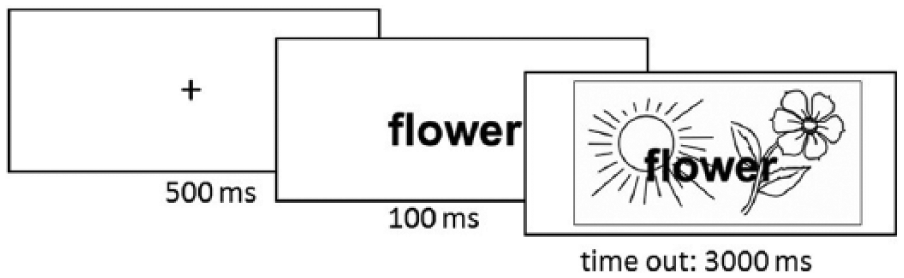
Picture-word interference paradigm with double-object pictures; Example “
Written distractors were presented in red, font Arial size 36, overlapping with both target pictures. Distractors were superimposed on the picture pairs in two different positions above or below the centre of the picture pair. Care was taken that the written distractors overlapped with both target pictures. Pictures and distractors were presented against a grey background. The experiment included 320 target-distractor pairs, and the trials were distributed across four blocks using a Latin-square design. Each target appeared only once per block with a different distractor on each block. In addition, three filler items were included at the beginning of each block. Other than this, the targets were fully randomised within the blocks, and each participant received a different order. The whole experiment was repeated once. Thus, overall, 640 target–distractor pairs were presented per participant. Overall, eight short breaks were included and the whole experiment lasted for approximately 45 min.
In a familiarisation phase prior to the experiment, participants saw all picture pairs with their written names. They were instructed to use these words when naming the pictures in the experiment. In a practice phase prior to the start of the experiment, participants named all targets once, and they were corrected by the experimenter in the case of incorrect responses. They were instructed to produce compounds in response to the picture pairs, and to avoid naming just two object pictures sequentially. This also required to add linking elements, if necessary (e.g., -n in Sonne
Each trial started with a fixation cross for 500 ms, followed by the presentation of the written distractor noun and the picture pair. The distractor was presented 100 ms before the target picture pair (stimulus onset asynchrony [SOA] of -100 ms; for a similar procedure, see Lorenz et al., in press; Lorenz & Zwitserlood, 2016). Distractor and target pictures remained on the screen until the spoken response was given or until a time out of 3,000 ms was reached. The inter-stimulus-interval (ISI) was 1500 ms. The participants were instructed to name the picture pairs as quickly and accurately as possible, and to ignore the distractors. The Presentation® software package was used to run the experiment (www.neurobs.com), and naming latencies were measured by a voice key. Naming errors were registered online by the experimenter.
Simon task
A visual-spatial version of the Simon task was used to assess the participants’ non-verbal attentional control (for a similar procedure, see Piai et al., 2013; van der Lubbe & Verleger, 2002). Visual objects (line drawings of triangles and squares) were presented either left- or right-sided on the computer screen, and a button box was used with two response keys, which had to be pressed with the right or left hand. The participants were instructed to press one key for triangles and another key for squares.
The visual stimuli were presented on a grey background, subtending about 3° of participants’ horizontal visual angle. Half of the participants were asked to press the left button for triangles and the right button for squares. This was reversed for the other half. Each object was presented 33 times to the left and to the right of the screen’s centre, resulting in 66 position-congruent (target and response button on the same side) and 66 position-incongruent trials (target and response button on different sides). Trials were presented in randomised order, with a different order for each participant.
A trial sequence started with the presentation of a fixation cross in the centre of the screen for 500 ms, followed by the stimulus for 1000 ms. After the response, the screen went blank for 1000 ms, after which the next trial started. Stimuli were presented in three blocks (44 trials per block), which were divided by short breaks. Participants were instructed to respond as fast and accurately as possible and both reaction times and accuracy rates were measured. Fourteen practice items were included before the start of the first block. The experiment lasted about 8 min, and the Presentation® software package was used to run the experiment (www.neurobs.com).
Statistical data analysis
For both experiments (PWI- and Simon Task), linear mixed models (LMMs) were applied to analyse the reaction time data. The BoxCox procedure confirmed that for the Simon Task log-transformation of the reaction time data was the best way to normalise the residuals. The best procedure to normalise the residuals for the PWI task was inverse transformation of reaction times.
For accuracies, logit mixed-effects models were used (generalised LMMs, binominal family; Jaeger, 2008). The lme4 package in R was applied (version 1.1-6; Bates, Maechler, Bolker, & Walker, 2014; see also Baayen, 2008; Baayen, Davidson, & Bates, 2008). P-values were computed with the lmerTest package.
Results, Simon task
For the Simon Task, congruency (congruent vs. incongruent) and age group (young vs. old) were included as fixed factors, sliding difference contrasts were set for both factors and subjects were included as random intercepts. For the analysis of response latencies, erroneous responses and reaction times above and below two standard deviations from the participants’ mean were deleted (7.9% of all trials of the young participants, and 6.6% of all trials of the elderly; see Table 2).
Simon task: Mean reaction times (ms) and response accuracies (standard deviation) as a function of congruency (congruent vs. incongruent) and age group.
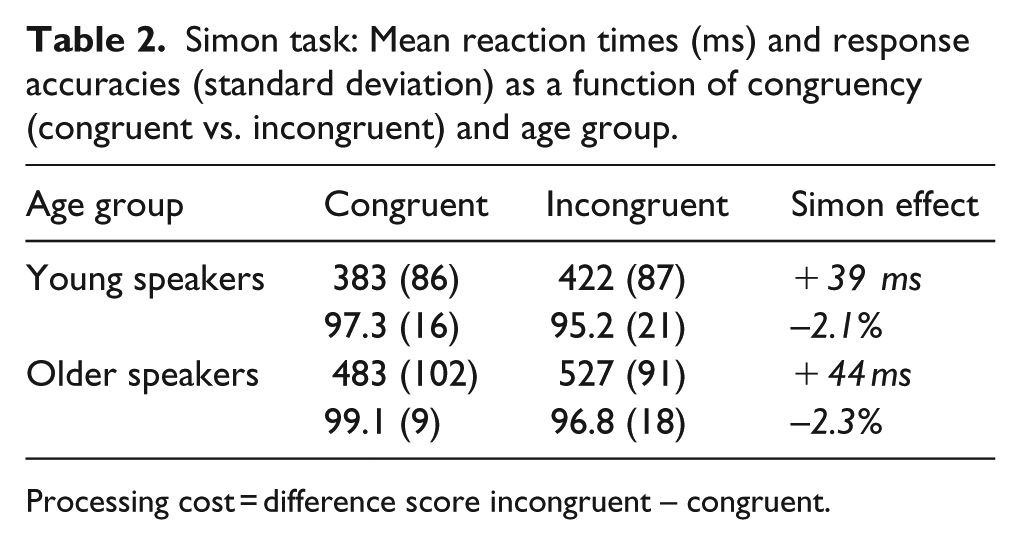
Processing cost = difference score incongruent – congruent.
In the response accuracies, main effects of congruency (b = −0.959, standard error [SE] = 0.153, z = −6.255, p < .001) and of age group were obtained (b = 0.781, SE = 0.236, z = 3.303, p < .001), as well as an interaction (b =-0.673, SE = 0.307, z = −2.195, p = .028). Older participants responded with a higher accuracy than young participants and both groups showed a Simon effect (worse performance in incongruent than congruent trials). This effect was more pronounced in the older participants (young: b = −0.623, SE = 0.168, z = −3.712, p < .001; old: b = −1.296, SE = 0.257, z = −5.047, p < .0001; see also Table A3, online Supplementary Material).
The reaction times revealed significant main effects of congruency (b = 0.096, SE = 0.004, t = 27.31, p < .001) and age group (b = 0.230, SE = 0.032, t = 7.171, p < .001). The interaction of congruency and age group was not significant (t < 1) (see also Table A4, online Supplementary Material). Participants were slower in the incongruent than the congruent condition, and older participants were overall slower than young participants. To sum up, a main effect of age group in the Simon task was confirmed both in response accuracies and the reaction-time data. However, a larger Simon effect in older than young speakers was only obtained in accuracies but not in reaction times (for contrasting results, see Lorenz et al., in press; van der Lubbe & Verleger, 2002).
Results, PWI task
Data from 40 compound targets and 64 participants were analysed. Mean naming latencies and accuracies, as well as the condition effects (difference score, unrelated vs. related) are presented in Table 3. (G)LMMs with subjects and items as random intercepts were applied. Distractor condition (Morph2, Morph1, Sem1, SemT, see Table 1), relatedness (related vs. unrelated distractor-target pair), age group (young vs. older), and repetition (block 1 vs. 2) were included as fixed factors. In the LMM, the individuals’ Simon score (difference score of incongruent and congruent latencies) was included as covariate. Sliding difference contrasts were set for distractor condition, relatedness, age group, and repetition. Thus, for each condition, two factor levels were compared directly (also called ‘backward difference coding’; see also Lorenz et al., in press). Direct comparisons were included for the two morphological conditions (Morph2—Morph1), for one morphological and one semantic condition, contrasting semantic and morphological effects, which are related to the same (first) constituent (Morph1 vs. Sem1), as well as the two semantic conditions (Sem1, SemT). For the Simon score logarithmically transformed values were used, which were centred. Nested post hoc models were run, if necessary (for estimates, standard errors, z- or t- values, and p-values, and random effects of the final models, see the online Supplementary Material, Tables A5a to A6b).
PWI task: Mean naming latencies (in milliseconds) and error rates (in %) as a function of age group, distractor condition, and relatedness.

Standard errors of the mean are given in parentheses. Effect size = difference score unrelated – related; Morph1 = first-constituent distractor; Morph2 = second-constituent distractor; Sem1 = first-constituent related semantic distractor; SemT = second-constituent/compound-related semantic distractor.
Naming accuracies
Main effects of age group and repetition were confirmed: Older participants produced more errors than young participants (z = −3.81), and all participants produced fewer errors in the second run of the experiment than in the first run (z = 8.846, see Table A5a for details of final GLMM, and Table A5b for chisq-values for each factor and interaction in the model). Overall, Sem1 differed significantly from Morph1 (z = −3.195), and SemT differed from Sem1 (z = −2.595). The difference between Morph1 and Morph2 was marginally significant (z = −1.695). An interaction with relatedness was obtained for the comparison of Sem1 vs. Morph1 (Sem1-Morph1*Relatedness: z = 4.184). For the interaction of SemT vs. Sem1 and relatedness, a trend was obtained (SemT-Sem1*Relatedness: z = 1.744). Relatedness effects of Morph1 and Morph2 were comparable (Morph1-Morph2*Relatedness: z = 1.015).
Nested post hoc models confirmed significant facilitation effects for the two morphological distractor conditions (Morph1, Morph2), and interference for the semantic whole-word condition (SemT); fewer errors occurred in the morphologically related conditions (Morph1: b = −0.518, SE = 0.123, z = −4.206, p < .001; Morph2: b = −0.703, SE = 0.134, z = −5.254, p < .001), whereas more errors occurred in the semantic whole-word condition (SemT: b = 0.426, SE = 0.101, z = 4.234, p < .001). No significant effect was present for the semantic first-constituent condition (Sem1: b = 0.17, SE = 0.108, z = 1.551, p = .121).
Neither age group nor repetition interacted with any of these factors. Following this, interactions with age group and repetition were excluded from the model in a step-wise process, confirmed by chi-square test comparisons (all p > .1; see Tables A5a and A5b for details of final model, online Supplementary Material).
Naming latencies
Errors, disfluencies, and naming latencies shorter than 300 ms were discarded. Furthermore, latencies deviating from a participant’s and an item’s mean by more than 2 SD (per condition, relatedness, block, and age group) were considered as outliers and excluded from the reaction time (RT) analysis. This resulted in a loss of 1,022 trials for the young speakers (5%), and 1,414 trials for the elderly (6.9%; see Table A6a, online Supplementary Material, for details of the LMM).
A first LMM included up to 5-way interactions, which did not contribute significantly to the goodness of fit of the model. Thus, a model with up to 4-way interactions was applied, confirmed by chi-square model comparisons (p > .1).
A significant main effect of age group was obtained (t = 6.545), but Simon score did not contribute significantly (Simon score: t < 1), nor was the interaction of age group and Simon score significant (t < 1). Older participants were overall slower than young participants in both tasks. Simon performance, however, contributed differently to the morphological distractor effects (Morph1 vs. Morph2) for young and older speakers (Morph1-Morph2*Relatedness*Age group*Simon score: t = −3.321; see below). In contrast, it did not affect semantic effects, neither overall (SemT-Sem1*Relatedness*Simon score: t < 1), nor differentially for the two age groups (SemT-Sem1*Relatedness*Age group*Simon score: t = −1.251).
Furthermore, participants were overall faster in the second than the first run of the experiment, due to repetition priming (t = −26.238). Repetition interacted with age group because repetition effects were twice as strong for the elderly (t = −5.346; about 61 ms for the older speakers, and 28 ms for the young speakers).
Morph1 differed from Morph2 (t = 2.412), and Sem1 differed from Morph1 (t = 28.079); SemT and Sem1 did not differ significantly, overall (t = −1.242). Interactions with relatedness indicated different effects of Morph1 vs. Morph2 (152 vs. 123 ms; t = 7.613), of Sem1 vs. Morph1 (-26 vs. 152 ms; t = −42.186), and of SemT vs. Sem1 (3 vs. -26 ms; t = 5.675). Participants’ compound naming was facilitated by first- and second constituent distractors (post hoc model1: Morph1*Relatedness: b = 0.21, SE = 0.004, t = 53.616, p < .001; Morph2*Relatedness: b = 0.168, SE = 0.004, t = 42.924, p < .001), and compound naming was slowed by distractors semantically related to the first constituent of the target (Sem1*Relatedness: b = −0.024, SE = 0.004, t = −6.140, p < .001). A trend was obtained for the semantic whole-word condition, indicating a small facilitation effect of distractors semantically related to the compound—and thus to its second constituent (SemT*Relatedness: b = 0.007, SE = 0.004, t = 1.893, p = .058).
Morph1 produced stronger facilitation than Morph2, and this was more pronounced in the elderly (Morph2-Morph1*Relatedness*Age group: t = 3.218; post hoc model2: young speakers: Morph2-Morph1*Relatedness: b = 0.024, SE = 0.008, t = 3.116, p = .002; older speakers: Morph2-Morph1*Relatedness: b = 0.06, SE = 0.008, t = 7.630, p < .001). Similarly, the difference between Morph1 and Sem1 effects was more pronounced in the older speakers (Sem1-Morph1*Relatedness*Age group: t = −2.351). In contrast, the two semantic conditions produced comparable effects in young vs. older speakers (SemT-Sem1*Relatedness*Age group: t < 1).
Morph1-distractor effects were stronger in older than young speakers (post hoc model1: Morph1*Relatedness*Age group: b = 0.033, SE = 0.008, t = 4.191, p < .001), whereas neither effects of second-constituent distractors, nor of semantic distractors were affected by age group (Morph2*Relatedness*Age group: t < 1; Sem1*Relatedness*Age group: t < 1; SemT*Relatedness*Age group: b = 0.011, SE = 0.008, t = 1.403, p = .161). Importantly, these interactions were not affected by repetition of the experiment. Thus, older speakers showed stronger effects of Morph1 compared to Morph2 or Sem1 distractors throughout the experiment (Morph1-Morph2*Relatedness*Age group*Repetition t < 1; Sem1-Morph1*Relatedness*Age group*Repetition: t < 1; see Table A6a, online Supplementary Material).
Furthermore, morphological distractor effects were differently modulated by the Simon performance of young and older speakers (Morph1-Morph2*Relatedness*Age group*Simon score: t = −3.321; see Figure 2a and b). A nested post hoc model confirmed an interaction for the elderly, but not for young speakers (older speakers: Morph1-Morph2*Relatedness*Simon: b = −1.105, SE = 0.34, t = −3.251, p = .001; young speakers: Morph1-Morph2*Relatedness*Simon: b = 0.424, SE = 0.309, t = 1.372, p = .17). Older participants with relatively good Simon performance profited more from Morph1 than Morph2 distractors, whereas older speakers with worse Simon performance showed slightly stronger Morph2 than Morph1 effects (see Figure 2b). When the morphological distractor effects were analysed separately for the older speakers, a contribution of Simon performance was confirmed for Morph2, and a trend was obtained for Morph1. Older speakers with relatively bad Simon performance showed significantly stronger Morph2 effects than older speakers with better Simon performance (older speakers: Morph2*Relatedness*Simon: b = 0.706, SE = 0.241, t = 2.927, p = .003). In contrast, older speakers with relatively good Simon performance tended to show stronger Morph1 effects (older speakers: Morph1*Relatedness*Simon: b = −0.428, SE = 0.240, t = −1.662, p = .097; see Figure 2b).
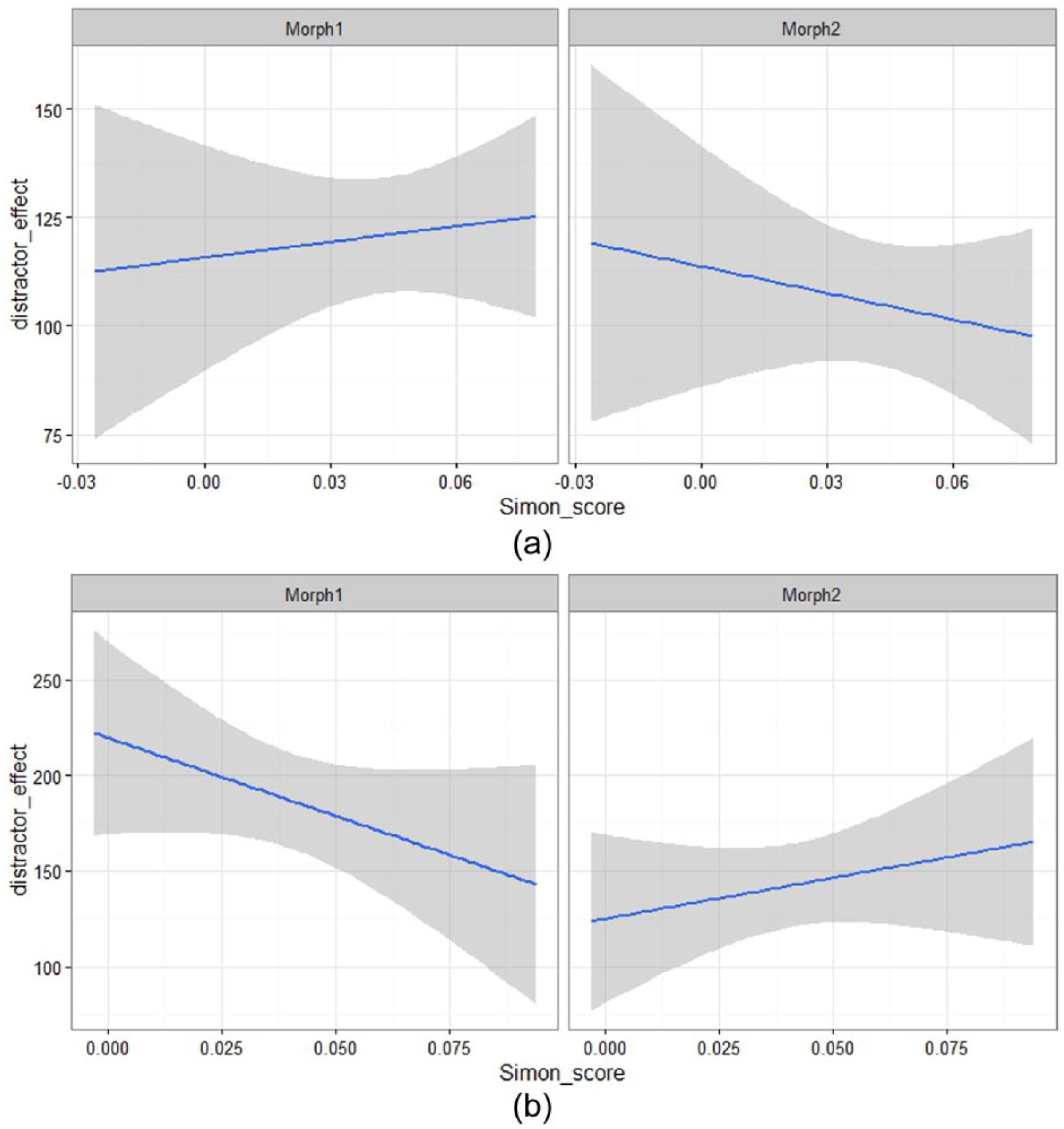
Interaction of Simon score (difference score: incongruent – congruent) with morphological distractor effects (in ms) and age group; left: Morph1, right: Morph2; (a) young speakers and (b) older speakers.
General discussion
To examine the processes underlying speech production across the life span, young and older speakers participated in a PWI experiment with compound nouns as targets. Pictures of two objects, one for each compound constituent, were presented next to each other to elicit noun–noun compound targets (e.g., sun + flower →
Strong morphological facilitation was obtained, that is, naming latencies were vastly reduced when either the first or the second constituent of compound targets was presented as distractor, relative to unrelated distractors. Furthermore, semantic interference was confirmed for distractors from the same semantic category as the first constituent of the target (Sem1), but not for semantic distractors related to the second constituent/compound target (SemT). For SemT distractors, a trend was obtained indicating semantic facilitation.
As expected, age affected picture naming: Older participants took longer and produced more errors when naming double-object pictures than young participants (for converging evidence from a PWI task with single-compound pictures, see Lorenz et al., in press; for contrasting results, see Belke & Meyer, 2007). Furthermore, older speakers showed stronger morphological facilitation (Morph1) than young speakers. In contrast, age did not interact with semantic effects in picture naming.
The older participants were also slower in the non-verbal attentional control task (Simon task). A stronger Simon effect (difference score, incongruent-congruent) was only obtained in accuracies, not in reaction times for the elderly, which points to largely preserved attentional control processes of the older participants in this study (for contrasting data, see Lorenz et al., in press; van der Lubbe & Verleger, 2002). Similar to our precursor study with single-object pictures, the participants’ Simon performance did not contribute to their overall picture-naming latencies nor to the strengths of semantic effects in the PWI task. However, it specifically contributed to morphological facilitation effects in the elderly (see also Lorenz et al., in press). Thus, morpho-phonological encoding—but not lexical-semantic processing—is modulated by non-verbal attentional control (see below for further discussion).
In the following, the processes involved in double-picture naming are discussed. Next, specific ageing effects in the double-object naming task and their relation to non-verbal attentional control are discussed.
Naming of double pictures to elicit compound nouns
Our paradigm is similar to other multiple-picture naming tasks, presenting two or more pictures of objects for spoken naming simultaneously (e.g., Levelt & Meyer, 2000). However, in contrast to other multiple-picture naming studies, existing compound nouns were produced in response to two object pictures. Our participants were instructed to fluently produce compound words and to refrain from just naming two separate object pictures sequentially. This seemed to have worked well. Participants produced the compound targets fluently and without hesitations, including linking elements where necessary, which indicates compound activation and retrieval from the mental lexicon (Libben, Broniecki, Mittermann, Korecky-Kröll, & Dressler, 2009; Wiese, 2000). Linking elements are frequently used in German noun–noun compounds (e.g., Sonne-
When naming two objects presented simultaneously, the corresponding picture names can usually be activated in parallel. However, when processing costs of the task are increased, participants can only activate one picture name at a time, that is, processing switches from parallel to sequential (e.g., Malpass & Meyer, 2010). Wagner et al. (2010) reported data from double-object picture naming in a PWI paradigm that confirmed the parallel activation of two object names. Participants showed semantic interference for both noun responses when produced in a simple phrase, such as “the frog and the mug” (see also Meyer, 1996). Interestingly, the semantic interference for the second object name vanished when the cognitive load was enhanced, by including more complex phrases and an additional manipulation that forced the participants to switch between two response formats (Wagner et al., 2010). The scope of advance planning in speech production seems to be wider with less cognitive load, and can be narrowed with higher cognitive load (see also Malpass & Meyer, 2010; Meyer, 1997; Meyer, Quellet, & Häcker, 2008). The latter seems to apply to the double-object naming task used in our study. In response to two object pictures, participants were instructed to fluently produce compounds and not just two separate nouns (see Figure 1). The observed pattern of effects, especially for the semantic distractor conditions, clearly suggests a sequential processing strategy. While first-constituent related semantic distractors produced semantic interference, whole-word (and second constituent) related distractors produced no interference but some semantic facilitation. This implies that the first constituent’s concept and lemma were activated before the second-constituent and compound representations. Thus, while semantic distractors tapped into lexical (lemma) selection for the first picture name (Sem1), they tapped into semantic-conceptual processing for the second picture name/whole word (SemT) and thus tended to produce semantic facilitation (see also Glaser & Düngelhoff, 1984, and Roelofs, 2003, for modulation of the polarity of semantic effects by stimulus-onset asynchrony).
Age-related effects in the naming of double-object pictures
While double-picture naming clearly puts greater demands on attentional control and speech planning than single-picture naming, our older participants were remarkably unaffected by the higher complexity of the task. The overall pattern of age-related effects looked very similar for double- and single-picture naming and, again, no main effect of the participants’ Simon performance on picture naming latencies was obtained (Lorenz et al., in press). Note that different participant groups were tested in the two studies, which makes it difficult to compare the studies directly. Nevertheless, we observed strong facilitation by morphologically overlapping distractors in both studies, with stronger morphological effects in the elderly for first-constituent distractors. Furthermore, semantic effects clearly deviated between the two presentation formats but similar effects were obtained for young and older speakers. With single-object pictures, semantic interference was obtained for distractors from the same semantic category as the whole word (tulip →
A main effect of age group was present in both studies. Older speakers were slower and produced more picture-naming errors than young speakers. Age did not interact with semantic-distractor effects, and specific ageing effects were only visible in the morphological distractor conditions. In both studies, sizable morphological facilitation was obtained for both age groups but morphological facilitation was stronger in the elderly. Furthermore, morphological distractor effects in the elderly were modulated by non-verbal inhibitory control, as measured by the Simon task.
Semantic interference and morphological facilitation in speech production are likely to originate at different levels. Semantic interference in the picture-word task is assumed to originate at the lemma level (Damian & Bowers, 2003; Roelofs, 1992 but see Mahon et al., 2007), whereas morpho-phonological priming is localised at the word-form level (Levelt et al., 1999; Roelofs, 1996). There is empirical evidence indicating that the links between lexical (lemma level) and phonological units (form level) are particularly deficient in the elderly, resulting in more tip-of-the tongue states and increased word-finding difficulties in speech production (e.g., Burke et al., 1991; Rastle & Burke, 1996). When lexical-semantic information and processing remains intact but links to phonological information are damaged, there should be no age-related deterioration in the strength of semantic effects, but there might be specific ageing effects in the strength of morpho-phonological priming. This is what our data show.
Similar to our data, others also failed to obtain stronger semantic interference effects in the elderly (e.g., Belke & Meyer, 2007; Bowles, 1994; Feyereisen et al., 1998; Gordon & Cheimariou, 2013; Mulatti, Calia, De Caro, & Della Sala, 2014 but see Taylor & Burke, 2002). In addition, we observed a trend towards semantic facilitation for compound-related distractors (SemT). This was unaffected by age group and thus indicates that semantic-conceptual processing was generally good in our older speakers (but see Verhaegen & Poncelet, 2013). Overall, the distractor effects are likely to reflect an intact lexical-semantic system in the elderly, including preserved representations at lemma and word-form level (see also Ramscar et al., 2014). Note that our older speakers were generally slower than the young speakers. However, a significant interaction with age group was obtained for Morph1 distractors exclusively but not for the other distractor conditions. Thus, general slowing in our older participants is unlikely to explain the stronger Morph1 effects observed here.
While first-constituent distractors are usually assumed to result in facilitation of picture naming due to the morpho-phonological overlap with the first constituent of the target (e.g., Lorenz & Zwitserlood, 2016), this effect might—alternatively or additionally—have resulted from inhibition in the unrelated condition. Note that no neutral (non-verbal) control condition was included here. Thus, it is not clear whether related distractors facilitated or unrelated distractors inhibited picture naming. When the mean naming latencies in response to unrelated distractors are compared for Morph1 und Morph2, it becomes clear that part of the Morph1 effect stems from inhibition in the unrelated condition (see Table 3). The mean naming latencies of the elderly were 37 ms longer with unrelated Morph1 distractors than with unrelated Morph2 distractors (see Table 3, Morph1 vs. Morph2, unrelated; t = 5.422; p < .001), whereas the mean response latencies to related distractors did not differ significantly between Morph1 and Morph2 (t = −1.192, p = .233). A less pronounced pattern was obtained for the young speakers, with a 15 ms difference for the unrelated condition of Morph1 and Morph2, but no difference for related distractors between Morph1 and Morph2 (Morph1 vs. Morph2, unrelated: t = 2.799, p = .005; related: t < 1). Because the unrelated conditions were formed by re-combining distractors and targets, the participants saw each target repeatedly throughout the experiment. In other words, the unrelated distractors of Morph1 included the first constituents of other targets in the experiment (e.g., sun for the target
Thus, our data suggest that the effects of Morph1 distractors result from a combination of facilitation due to the formal overlap of distractor and target in the related condition and of inhibition due to formal overlap with other targets of the same set in the unrelated condition. Especially Morph1 distractors were stronger in the elderly, probably due to slightly deficient inhibitory control processes and thus stronger inhibition of unrelated Morph1 distractors in the elderly. We used the Simon task as a measure for inhibitory control and analysed its contribution on performance in the PWI task. However, older participants with relatively good Simon performance tended to show stronger Morph1 effects, whereas older speakers with relatively bad Simon performance showed stronger Morph2 effects (see below).
Effects of non-verbal attentional control (Simon task)
As in our precursor study, Simon performance did not modulate overall picture naming latencies nor the main effect of age group in the picture-naming task. Our data thus indicate that inhibitory control and picture naming are partially independent (see also Lorenz et al., in press). However, Simon performance contributed to morphological effects in the elderly, but not in the young speakers. In addition, it did not modulate semantic effects. A different pattern was obtained for Morph1 and Morph2 effects: While older speakers with relatively good Simon performance tended to show stronger Morph1 effects than those with worse Simon scores, the opposite was observed for Morph2 effects. Stronger Morph2 effects were obtained for older speakers with relatively bad Simon performance. A similar but less pronounced pattern (stronger relatedness effects with weaker Simon performance) was reported for the older speakers in our study with single-object pictures (Lorenz et al., in press). As outlined above, the Morph1 effects in the double-picture naming task are likely to rely on inhibition of unrelated distractors in addition to facilitation by related distractors. Similarly, inhibitory control might have been important for Morph2 distractors to facilitate a response because they were related to non-initial elements of the target (flower →
Note that our young speakers showed no impact of Simon performance on morphological facilitation effects, and any contribution of Simon performance was restricted to the older speakers. This was different in our precursor study, where we obtained a significant interaction of Simon performance and Morph1 effects in young speakers: Speakers with better Simon performance showed stronger Morph1 effects than speakers with worse Simon performance (Lorenz et al., in press). Further research is necessary to fully explain the contribution of Simon performance on morphological distractor effects with age.
Conclusion
We reported data from a non-verbal attentional control task and a picture naming task with double-object pictures, in which two age groups were tested. Older participants needed more time and produced more picture-naming errors than young speakers, indicating increased word-finding difficulties with age. Similarly, older speakers also showed slower reactions in the Simon task. However, the Simon effect in reaction times was not larger in older than young speakers. Furthermore, overall picture naming was not affected by the participants’ Simon performance, indicating that non-verbal attentional control and picture naming are relatively independent. Furthermore, the data from morphological and semantic effects in compound naming point to robust conceptual-semantic, lexical-semantic (lemma) and phonological representations in the elderly. Slower picture naming in the elderly seems to result from specific difficulties in accessing morpho-phonological information in speech production, and from prolonged morpho-phonological encoding.
Supplemental Material
QJE-STD_17-202.R2-Supplementary_Material – Supplemental material for Age-related effects in compound production: Evidence from a double-object picture naming task
Supplemental material, QJE-STD_17-202.R2-Supplementary_Material for Age-related effects in compound production: Evidence from a double-object picture naming task by Antje Lorenz, Pienie Zwitserlood, Stefanie Regel and Rasha Abdel Rahman in Quarterly Journal of Experimental Psychology
Footnotes
Acknowledgements
We thank Asne Senberg and Anna Eiserbeck for their assistance in data collection. Guido Kiecker programmed the experiment, and Betty Mousikou provided her statistical advice. We also thank the reviewers for helpful comments.
Declaration of conflicting interests
The author(s) declared no potential conflicts of interest with respect to the research, authorship, and/or publication of this article.
Funding
Our research was funded by the German Research Council (DFG LO 2182/1-1 and 1-2).

Notes
References
Supplementary Material
Please find the following supplemental material available below.
For Open Access articles published under a Creative Commons License, all supplemental material carries the same license as the article it is associated with.
For non-Open Access articles published, all supplemental material carries a non-exclusive license, and permission requests for re-use of supplemental material or any part of supplemental material shall be sent directly to the copyright owner as specified in the copyright notice associated with the article.
