



Abstract
The nature of the facilitation occurring when sentences share a verb and syntactic structure (i.e., lexically-mediated syntactic priming) has not been adequately addressed in comprehension. In four eye-tracking experiments, we investigated the degree to which lexical, syntactic, thematic, and verb form repetition contribute to facilitated target sentence processing. Lexically-mediated syntactic priming was observed when primes and targets shared a verb and abstract syntactic structure, regardless of the ambiguity of the prime. In addition, repeated thematic role assignment resulted in syntactic priming (to a lesser degree), and verb form repetition facilitated lexical rather than structural processing. We conclude that priming in comprehension involves lexically associated abstract syntactic representations, and facilitation of verb and thematic role processes. The results also indicate that syntactic computation errors during prime processing are not necessary for lexically-mediated priming to occur during target processing. This result is inconsistent with an error-driven learning account of lexically-mediated syntactic priming effects.
During comprehension, processing even a very challenging target sentence can be facilitated when a previously comprehended sentence shares aspects of syntactic form with the target (Arai, van Gompel, & Scheepers, 2007; Branigan, Pickering, & McLean, 2005; Traxler, 2008a, 2008b; Thothathiri & Snedeker, 2008a, 2008b; see Bock, 1986; Bock & Loebell, 1990 for comparable effects in sentence production). Because these effects depend on syntactic repetition, rather than semantic repetition (Tooley, Traxler, & Swaab, 2009), repetition of function words (Carminati, van Gompel, Scheepers, & Arai, 2008) or processing strategies (Traxler & Tooley, 2008), they are classified as syntactic priming effects. When aspects of structure, but no content words are shared between prime and target sentences, the resulting facilitation is referred to as abstract syntactic priming. When prime and target sentences share a content word and syntactic structure, the observed syntactic priming effects tend to be larger/easier to detect (Arai et al., 2007; Cleland & Pickering, 2003; Ledoux, Traxler, & Swaab, 2007 see Hartsuiker, Bernolet, Schoonbaert, Speybroeck, & Vanderelst, 2008; Pickering & Branigan, 1998 for analogous effects in sentence production). Thus, this lexically-mediated form of syntactic priming is sometimes called the “lexical boost” and is the focus of this study. Specifically, we seek to establish the sources of facilitation that underlie lexically-meditated syntactic priming during online sentence comprehension.
Current explanations of syntactic priming effects revolve around two compatible principles. The first principle relates to the way experience influences syntactic representations and/or procedures in long-term memory—i.e., adaptively (Chang, Dell, & Bock, 2006; Chang, Janciauskas, & Fitz (2012); Fine & Jaeger, 2013; Fitz, Chang, & Christiansen, 2011). This principle is supported by growing evidence that abstract syntactic priming effects in production (Bock, Dell, Chang, & Onishi, 2007; Bock & Griffin, 2000; Branigan & McLean, 2016; Hartsuiker et al., 2008) and comprehension (Fine, Jaeger, Farmer, & Qian, 2013; Tooley & Traxler, 2018) are driven by a long-lived learning mechanism. This learning mechanism is suggested to be error-driven, such that learning is a consequence of a given structural experience deviating from the expected/predicted structure (based on encountered structural distributions). Thus, abstract priming is affected by the error-signal generated during processing of the prime, with greater priming following a larger error signal (Chang, Janciauskas, & Fitz, 2012; Jaeger & Snider, 2013). This mechanism accurately predicts findings of greater priming for less frequent structures (the inverse frequency effect) (Fine & Jaeger, 2013), and differential priming based on specific verb-structure biases (Bernolet & Hartsuiker, 2010).
The second principle relates to the way lexical and syntactic information is represented and deployed—i.e., interdependently (Boland & Boehm-Jernigan, 1998; Branigan, Pickering, & Cleland, 2000; MacDonald, Pearlmutter, & Seidenberg, 1994; Vosse & Kempen, 2000, 2009). This principle has received less attention as it relates to syntactic priming. However, it offers insights into the nature of the facilitation underlying the lexical boost. Language production studies have shown that the lexical boost rarely persists across unrelated, intervening sentences (Branigan & McLean, 2016; Hartsuiker et al., 2008). Thus, some have argued that the lexical boost is likely produced by a short-lived (i.e., non-learning-based) mechanism (Bernolet, Collina, & Hartsuiker, 2016; Branigan & McLean, 2016; Hartsuiker et al., 2008; Tooley & Traxler, 2012). This could be a residual activation mechanism (similar to that proposed by Pickering & Branigan, 1998), where links between structural and verb nodes activated during prime processing, retain activation, and facilitate processing of a target with that same verb and structure pairing (see Tooley & Traxler, 2012). Another mechanistic account suggests that structural information from the prime sentence (stored in long-term memory) is temporarily linked to the individual words in the prime sentence (stored in working memory; e.g., Reitter, Keller, & Moore, 2011; see also Chang et al., 2006; Chang, Janciauskas, & Fitz, 2012). According to this account, when a content word from the prime is re-encountered during target processing, the associated structural information is activated. This information influences structural formulation/interpretation of the target, causing target facilitation.
Findings from comprehension, however, have shown that lexically-mediated syntactic priming effects can persist across one to three filler sentences (Pickering, McLean, & Branigan, 2013; Tooley, Swaab, Boudewyn, Zirnstein, & Traxler, 2014). This may indicate that the lexical boost and abstract syntactic priming effects share a common mechanism. Learning models that rely on prediction error (e.g., Jaeger & Snider, 2013) can accommodate a lexical boost effect if they assume that better structural predictions can be made about sentences that utilise the same verb. If this prediction advantage (based on lexical similarity between sentences) is also assumed to decay more quickly than error associated with overall structural predictions, then this account would likewise predict a lexical boost that is more short-lived than abstract priming effects. Importantly, this account does not rely on a short-term/working memory system, which makes it consistent with recent findings that individuals with profound short-term memory deficits produce lexical boost effects that are on par with matched controls (Yan, Martin, & Slevc, 2018).
Another important question about the lexical boost is the nature of the syntactic representation being facilitated. It is unclear whether the syntactic representation being facilitated is highly abstract, reflecting a global constituent structure (but not lexical features within constituent phrases), or one that is based more so on the specific lexical content within constituent phrases. For example, a reduced-relative clause (such as The boy pushed by the girl cried) and a full relative clause (such as The boy who was pushed by the girl cried) have identical global abstract structures (noun phrase-relative clause-verb phrase). Yet, they differ within the constituent relative clause phrase in that the full relative contains a relativiser (“who was”), but the reduced-relative does not. It is important to note that all of the major mechanistic accounts of syntactic priming assume priming effects reflect facilitation of an abstract structural representation (Chang et al., 2006; Pickering & Branigan, 1998; Reitter et al., 2011). This assumption is consistent with findings from Bock (1989), who found that priming for prepositional object datives is unaffected by the preposition (to vs for) used in the prepositional phrase of this structure. It is also consistent with findings from Hsieh (2017) who found evidence for cross-linguistic syntactic priming across Chinese and English sentences that had the same abstract structures but different word orders (and different content words).
However, this assumption may be inconsistent with findings that participants can be primed to produce (or not produce) the word “that” as part of an internal complement clause of a sentence (Ferreira, 2003). Furthermore, this issue has never been investigated specifically for the lexical boost. It may be the case that the lexical boost, which is triggered by word-level information, is sensitive to changes in precise lexical/syntactic matching within constituent phrases. If such lexically-boosted/lexically-mediated syntactic priming effects do reflect facilitation of an abstract structural representation, then one would predict that priming effects will be observed for sentences that have matching abstract structures, even if the prime and target sentences differ in the specific lexical/syntactic content within their respective constituent phrases.
A related question is the degree to which other sources of facilitation (e.g., thematic role assignment) contribute to the observed lexically-mediated syntactic priming effects in comprehension. Intuitively, this seems likely given that sentences that share both structure and a content word may be more similar in meaning than sentences that share only abstract structure. Importantly, such additional sources of facilitation have been investigated with respect to abstract priming effects, specifically in production. For instance, Bock and Loebell (1990) found abstract syntactic priming effects without repetition of thematic roles for the active/passive alternation in production, but there are many studies showing that the order of thematic roles in production can be primed (e.g., Chang, Bock, & Goldberg, 2003; Ziegler & Snedeker, 2018). Analogous investigations for lexically-mediated syntactic priming effects in comprehension are currently lacking. These investigations are necessary given the mechanisms that produce abstract and lexically-mediated syntactic priming effects may differ, and so may be differentially influenced by non-syntactic sources of information.
To this end, the experiments reported in this article provide further evidence regarding the sources of facilitation that contribute to lexically-mediated syntactic priming effects in comprehension. The main goal of the study is to identify how aspects of structural, thematic, and lexical form repetition affect lexically-mediated priming. Clarifying what kinds of repeated features affect this type of priming will help to establish the type of syntactic representation that is being facilitated, identify other (non-syntactic) sources of facilitation that co-occur with syntactic effects, and lead to a better understanding of the mechanism that produces lexically-mediated syntactic priming effects.
For our purposes, the term “lexically-mediated syntactic priming” is preferred over the term “lexical boost” for two reasons. For one, it more accurately reflects the design of these studies which are not intended to compare situations where prime and target share only syntactic structure to situations where they share both structure and a content word (allowing identification of a boost in effect size). Second, the term “lexical boost” could imply an increase in the magnitude of the abstract priming effect, rather than a lexically driven effect in addition to an abstract effect. We feel that characterising these syntactic priming effects as “lexically-mediated” is more objective in that it only implies what we know: a lexical cue leads to some sort of facilitation in syntactic processing.
Overview of the experiments
Four experiments investigated the manipulated relationship between reading prime and target expressions. These manipulations allowed us to test the following hypotheses:
Does a prime sentence need to be syntactically ambiguous for lexically-mediated syntactic priming in comprehension to occur? Importantly, an error-driven learning mechanism, which has been found to account for abstract structural priming effects, would predict priming only when the prime structure involved a structural error signal. This is unlikely to be the case for unambiguous relative clause prime sentences. Thus, priming in prior studies involving reduced relatives may have occurred solely because syntactic reanalysis processes took place when readers processed the prime sentence. If syntactic reanalysis processes are necessary for syntactic priming effects during target processing, then little or no priming should occur when the prime sentence is syntactically unambiguous. Experiment 1 contrasted the magnitude of priming for target sentences (2) following temporarily ambiguous sentences, such as (1a), and unambiguous sentences, such as (1b) below.
(Target sentence): the contestant selected by the judge did not deserve to win. 1a. (Ambiguous prime): the customer selected by the security guard was not a thief. 1b. (Unambiguous prime): the customer who was selected by the security guard was not a thief.
Equivalent priming caused by 1a and 1b would indicate that syntactic misanalysis and reanalysis during processing of the prime sentence is not required for priming during processing of the target.
2. Is exact repetition of lexical elements within constituents required for lexically-mediated priming to occur? Or, does lexically-mediated syntactic priming reflect facilitation for an abstract structural representation, like abstract priming effects (Bock, 1989)? At an abstract level of representation, sentences (1a) and (1b) have the same structure such that the initial noun phrase (NP) is made up of the noun and a relative clause (RC), which specifies something about that noun (NP => NP + RC). At a less abstract level of representation where the string of lexical items within the relative clause is taken into account, the two sentences have different structures. This is because the internal structures of the relative clauses are different: the relative clause in sentence (1a) contains no relativiser (relative pronoun who in who was), but the relative clause in (1b) does, which unambiguously marks it as a relative clause (Relative Clause in sentence [1a] = Verb + Prepositional Phrase vs Relative Clause in sentence [1b] = Relativiser + Auxiliary Verb + Verb + Prepositional Phrase). If we consider the relationship between a passive voice sentence and a sentence with a reduced relative clause, parts of both types of sentence can have identical sequences of syntactic elements at a less abstract level, while having very different overall abstract structures. Experiments 1-3 manipulate syntactic repetition at greater and lesser degrees of abstractness. If precise matching for the string of lexical elements is a necessary condition for lexically-mediated priming, then only those conditions with exact matching within constituents should produce priming. If, instead, the repeated lexical item cues syntactic information/structure-building processes in comprehension at a globally abstract level of representation, then equivalent priming should occur whether there is exact matching within constituents or not (e.g., [1b] should prime readers’ response to [2] just as much as 1a does). Likewise, short relatives such as (1c) should be effective primes: 1c. (Short relative prime): The customer who was selected was not a thief.
3. Does facilitation of non-syntactic information account for, or contribute to, the observed lexically-mediated priming effects? Facilitation of a reduced-relative target sentence when it follows a reduced-relative prime sentence containing the same verb may reflect greater ease in syntactic processing. However, it is also possible that the observed priming reflects facilitation of thematic role assignment, or interpretation of a past-tense verb. In the reduced relative structure, the by-phrase in the relative clause introduces an agent other than the subject. It is possible that this object of the prepositional phrase, which takes on an agent role, facilitates processing of the reduced-relative target, which also contains a prepositional phrase-object in an agent role. Experiment 3 addresses this possibility by including a prime condition that also refers to an agent in prepositional-object position. If repetition of role assignment contributes to lexically-mediated priming effects then passive sentences such as 1d should prime processing of reduced-relative target sentences: 1d. (Passive prime): The customer was selected by the security guard but was not a thief.
If passive sentences are not found to prime reduced-relatives, then this would imply that thematic role assignment is not a source of facilitation of lexically-mediated syntactic priming effects.
Experiment 4 tests the additional possibility that lexical interpretation of the verb may contribute to lexically-mediated syntactic priming effects. The local ambiguity inherent to the reduced-relative structure stems from the initial verb in these sentences (e.g., selected in 1a) being ambiguous between a past-tense verb and a past participle. It is therefore possible that there is persistence of assigning this word as a past participle, rather than any sort of structural facilitation. If this is true, then pluperfect sentences like (1e) should be effective primes for reduced-relative clause sentences, because the first verb is a past participle but the overall structure is more similar to a main clause sentence:
1e. (Pluperfect prime): the customer had selected the jacket but was not a thief.
However, if pluperfect sentences (like 1e) are not found to prime reduced-relative clause sentences, then this would imply that lexical interpretation processes are not a source of facilitation that contribute to observed lexically-mediated priming effects in comprehension.
Experiment 1
Experiment 1 investigated whether the processing of reduced relatives can be facilitated by prior comprehension of full (or unreduced) relatives, such as The defendant who was examined by the lawyer was unreliable. Note that The defendant who was examined does not contain a local syntactic ambiguity, because the relativiser (who was) unambiguously indicates the presence of a relative clause and thereby rules out a main clause interpretation. As the full relatives do not require syntactic reanalysis, priming should not occur if syntactic reanalysis during prime processing causes all of the observed facilitation. However, if syntactic structure information/structure-building processes are being facilitated, then we would expect full relative primes to facilitate processing of reduced-relative targets due to their shared syntactic elements.
Experiment 1 also offers some initial insight into the representation of syntactic information that is being facilitated when there is structural and lexical overlap between primes and targets. Full relatives include the words who was, and therefore differ within their respective relative clauses from reduced relatives. While both full and reduced relatives have a relative clause, only full relatives have a relativiser and auxiliary verb. Thus, Experiment 1 can suggest whether abstract syntactic matching is sufficient to produce priming, or whether exact lexical matching within the relative clause is necessary for priming to occur.
Experiment 1 used four types of primes. One condition involved a main-clause prime sentence with the same verb as the target sentence; a second condition involved a reduced-relative prime sentence with the same verb as the target sentence. The third condition was the full-relative clause, same verb condition. The fourth condition involved a reduced-relative prime with a different verb from the target sentence. This final condition serves as a manipulation check to verify our assumption that priming is larger with lexical repetition.
As our concern was with effects of different types of primes on the processing of reduced-relative sentences, the targets were always reduced-relatives. In our analyses, we treat the reduced-relative prime condition with the same verb (as the target) as the baseline condition, as previous online comprehension studies have done (Tooley et al., 2009; Tooley et al., 2014). This is warranted because the set of prime sentences in this condition were the same as the set of target sentences (and of course these sentences were preceded by filler sentences which did not have the same verb or structure as the prime).
Method
Participants
A total of 37 participants from UC Davis took part in return for credit towards a course requirement. All participants who signed up to participate were allowed to do so, though this led to a slight deviation from the planned participant sample size (32). Data were not excluded on the basis of maintaining the planned sample size.
Stimuli
Each participant read 24 reduced relative target sentences (such as 3). Each target sentence was yoked to four different prime sentences to create four different types of prime-target pairs. The prime sentences (3a-d) consisted of sentences containing a reduced relative with the same verb as the target (RR-same condition, 3a), a full (unreduced) relative with the same verb as the target (FR-same condition, 3b), a reduced relative with a different verb from the target (RR-different condition, 3c), and a main-clause construction with the same verb as the target (MC-same condition, 3d). The target sentences were all reduced relatives, such as (3). The prime and target sentences appeared one at a time on the screen, and were immediately adjacent to one another.
The stimuli were rotated across eight lists of items such that an equal number of each type of trial appeared on each list, so that no participant saw more than one version of each item, and that every reduced-relative prime sentence (from one list) served as a target sentence (on a different list). Each participant was randomly assigned to one stimuli list. Critically, this counterbalancing of items across sentence position (prime vs target) allows us to use processing behaviours associated with the prime sentences as our baseline to which we compare processing behaviours on the targets. Essentially, we are comparing the same set of sentences to each other, the only difference being whether the sentences were processed as a prime (not primed by a previous sentence) or a target (primed by a previous sentence).
The experimental sentences were presented along with 72 fillers of various types. At least one filler sentence appeared between each prime-target pair.
3. The contestant selected by the judge did not deserve to win. (RRC target) 3a. The customer selected by the security guard was not a thief. (RRC-same prime) 3b. The customer who was selected by the security guard was not a thief. (FRC-same prime) 3c. The personal trainer wanted by the athlete was very busy. (RRC-different prime) 3d. The customer selected the jacket but was not a thief. (MC-same prime)
Procedure
A Fourward Technologies Gen 6.6 Dual Purkinje Image Eye Tracker monitored participants’ eye movements while they read the experimental stimuli. The tracker has angular resolution of 10’ of arc. It monitored only the right eye’s gaze location. A PC displayed materials on a VDU 70 cm from participants’ eyes. The display consisted of Borland C default font with approximately four characters per degree of visual angle. The location of participants’ gaze was sampled every millisecond and the software recorded the tracker’s output to establish the sequence of eye fixations and their start and finish times. At the beginning of the experiment, the experimenter seated the participant at the tracker and used a bite plate and head rests to minimise head movements. After the tracker was aligned and calibrated, the experiment began. After reading each sentence, the participant pressed a key. Between each trial, a pattern of boxes appeared on the computer screen along with a cursor that indicated the participant’s current gaze location. If the tracker was out of alignment, the experimenter recalibrated it before proceeding with the next trial.
The participant responded to a comprehension question after some of the filler sentences and did not receive feedback on their responses. All of the participants in the analyses reported below were at least 90% accurate.
We report results for three regions of the target sentences. The verb region consists of the initial verb or past participle (e.g., selected in sentence 3e). The disambiguating region consists of the prepositional phrase that followed the verb (e.g., by the judge). The post-disambiguating region consists of the two words immediately following the disambiguating region. 1 The disambiguating region is the most critical, because it is the earliest point at which there is reliable information about whether the initial choice of analysis was correct or not, and is the point at which previous studies have shown differences between ambiguous and unambiguous sentences (e.g., Clifton et al., 2003; Trueswell, Tanenhaus, & Garnsey, 1994).
We report four standard dependent measures. First-pass time is the sum of fixations in a region until the reader fixates outside the region. Total time is the sum of all fixations in a region. For these measures, trials on which the region was initially skipped were excluded. First-pass regressions (expressed as a percentage) include any eye movement that crossed a region’s left-hand boundary immediately following a first-pass fixation. Regression-path time includes all of the fixations within a region as well as refixations of previous regions starting with the first fixation and ending when the reader’s gaze crosses the region’s right-hand boundary. All fixation times less than 80 ms or greater than 3,000 ms were excluded (e.g., Rayner & Pollatsek, 1989), thereby eliminating 6.2% of the data. Means for all four measures across all three scoring regions are presented in the online Supplementary Material.
Statistical analyses
Each of the four dependent measures were analysed at each of the three sentence locations using linear mixed-effects models (for the duration measures) or logit mixed models (for the first-pass regressions measure; Baayen, Davidson, & Bates, 2008; Jaeger, 2008). Analyses were carried out in R (R Development Core Team, 2008) using the lmer function (lme4 package), and the four different prime types were included as fixed effects (compared with the prime sentence baseline via dummy coding). These models estimated crossed random effects for participants and items, and the fully maximal version of each model (based on design) was used. If this resulted in non-convergence, random effects were removed based on the size of their variance components (smaller effects were removed first) until the model reached convergence. All effects were considered significant at α = 0.05.
Results and discussion
Figure 1 presents mean values of the four dependent measures by region and condition for the reduced relative prime sentence that had the same critical verb as the target (the baseline condition; e.g., 3a), and for target sentences following each of the four prime types. Results from the multi-level models are presented in Table 1.
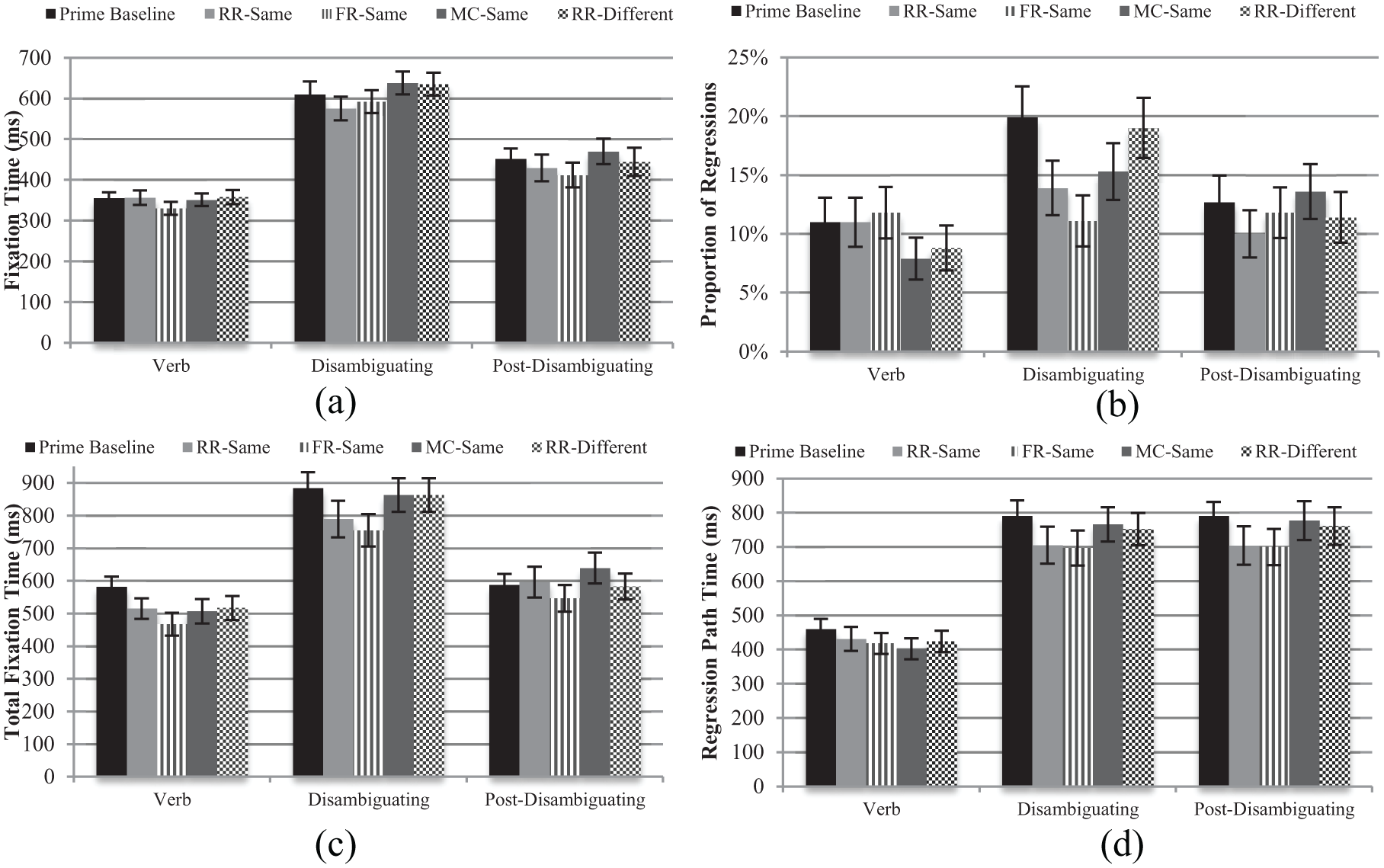
Experiment 1, mean reading time measures. (a) First-pass time, (b) first-pass regressions, (c) total time, and (d) regression path time) for the verb, disambiguating (past-participle), and post-disambiguating (spillover) regions. Error bars represent standard errors.
Analyses of the four eye-tracking dependent measures at each of the three sentence regions.

RC: relative clause; MC: main clause; RR: reduced relative.
The models include fixed effects of the four priming conditions (full relative clause-same verb, main clause-same verb, reduced-relative clause-same verb, and reduced-relative clause-different verb) relative to the reduced-relative clause prime sentence baseline condition (Intercept). Modifications to the fully maximal random-effects structure (allowing for convergence) are reported for each model.
Indicates t > 2.
Verb region
Model results revealed a significant difference between the baseline condition and the full relative clause condition in the total time measure (p < .05). Participants spent less total time fixating the verb region of the reduced-relative clause target sentences that were preceded by primes having the same verb (as the prime) and the full relative clause structure, than they did fixating the verb region of the prime reduced-relative clause sentences.
Disambiguating region
Significant differences between the baseline condition and the full relative clause condition were observed in models of the total time measure and first-pass regressions (p’s < 0.05). Participants spent less total time fixating, and produced proportionately fewer first-pass regressions from the disambiguating region of the reduced-relative targets that followed full relative clause prime sentences, compared with that of prime reduced-relative clause sentences.
Post-disambiguating region
Model results also revealed a significant difference between the baseline and reduced-relative clause-same conditions in first-pass regressions (p < .05). Participants made proportionately fewer first-pass regressions from the post-disambiguating region of the reduced-relative target sentences that followed reduced-relative prime sentences with the same verb, compared with these measures while reading the reduced-relative clause prime sentences.
The results of Experiment 1 replicate past findings that reduced-relative target processing is facilitated following reading of a reduced-relative prime sentence with the same verb (Ledoux et al., 2007; Tooley & Traxler, 2018; Tooley et al., 2009). Interestingly, this effect was reliably observed only in first-pass regression behaviour, whereas previous studies have observed this effect in the total time measure (Tooley & Traxler, 2018; Tooley et al., 2009). We include the reduced-relative clause-same verb condition and larger sample sizes in Experiments 2-4, which will allow us to address whether the lack of effect in total time was a failure of detection in Experiment 1.
In Experiment 1, we found no evidence that the processing of reduced-relative sentences was facilitated by prior comprehension of a reduced-relative sentence with a different verb, or by a main clause sentence with the same verb. Repeating a verb, in and of itself, did not result in detectably faster processing of the disambiguating region of the target sentences in this study. Nor was repetition of syntax alone sufficient to produce observable structural facilitation effects. These null results should be interpreted with caution. However, failure to show structural facilitation with only lexical overlap (in the absence of structural overlap) has been reported in several previous studies (Ledoux et al., 2007; Tooley et al., 2009; Traxler, 2008a), which makes a lack of detectability less plausible for this effect. Furthermore, this condition is included in Experiments 2-4, which will shed light on the replicability of this null result.
The absence of an abstract priming effect is much more difficult to interpret. The current result is consistent with some previous studies that have failed to detect abstract priming effects in comprehension (e.g., Arai et al., 2007; Carminati et al., 2008; Tooley et al., 2009) and inconsistent with others that have observed these effects (Kim, Carbary, & Tanenhaus, 2014; Pickering et al., 2013; Thothathiri & Snedeker, 2008a, 2008b; Tooley & Bock, 2014; Traxler, 2008a). As abstract priming effects are not the focus of this study, we do not examine this issue extensively. Suffice it to say that facilitation effects in Experiment 1 were observable when there was both structural and verb overlap (as predicted), and methodological differences across studies such as depth of processing inherent to the task demands and lexical biases associated with the tested structure likely affect the detectability of abstract syntactic priming effects in comprehension.
Experiment 1 is the first study to demonstrate that processing of reduced-relative clause sentences can be facilitated by prior reading of full relative clause sentences with the same verb. Compared with the prime baseline, targets following full relative clause primes had decreased total fixation times at the verb and disambiguating regions as well as few first-pass regressions from the disambiguating region. This finding suggests that lexically-mediated priming does not depend on a locally ambiguous prime sentence. Facilitation in this condition cannot be explained by participants improving at recovering from a garden-path effect. Rather, our results suggest that lexically-mediated priming observed for locally ambiguous structures reflect facilitated structural processing. This structural facilitation is unlikely to be produced by an error-driven learning mechanism, as this mechanistic account is difficult to reconcile with finding priming with little to no error signal generated during prime sentence processing.
Reduced- and full-relative sentences are syntactically quite similar at an abstract level of representation (though they differ in explicit lexical elements within the relative clause). They both involve the use of a relative clause to modify a noun, with the full relative including additional nodes that dominate the words who was. Note that some accounts do assume qualitative differences between full- and reduced relative sentences (e.g., McKoon & Ratcliff, 2003). The fact that both reduced-relatives and full relatives led to speeded processing of reduced relative targets may suggest that the two types of sentences share some components of form representation. However, the fact that facilitation effects did not emerge in all the same regions/measures for these two different types of primes could also point to representational differences. The next experiment also includes a full relative clause condition to address this discrepancy, and includes a short relative clause condition to further test the hypotheses that lexically-mediated syntactic priming survives changes in relative clause wording/structure.
Experiment 2
Experiment 2 included the main-clause, reduced-relative, and full-relative conditions in which prime and target involved the same initial verb. These conditions allow for a replication of those conditions of Experiment 1. Experiment 2 also included a new short relative condition in which there was no by-phrase, as in The customer who was selected was not a thief. This condition is further removed from the reduced-relative target sentence in terms of precise constituent form overlap, as it involves the extra words who was and does not include the by-phrase. Assuming that the representation of the relative clause structure is abstract enough to include variants that differ in such cues, the absence of the by-phrase should not matter. Priming should occur based on facilitated computation of or access to the abstract relative clause structure (e.g., NP => NP + RC), even though the prime does not explicitly mention an agent that belongs to the relative-clause verb. In addition, since the short relative has an overt relative pronoun relativiser (who), syntactic misanalysis should not occur during prime processing. Hence, any priming effects observed in the target sentence would not be attributable to error correction.
Method
Participants
A total of 51 participants from UC Davis took part under the same terms as in Experiment 1. All participants who signed up to participate were allowed to do so, though this led to a slight deviation from the planned participant sample size (48). Data were not excluded on the basis of maintaining the planned sample size.
Stimuli
These consisted of 24 sets of items comprising a prime and target sentence (such as 4, below). All prime sentences involved the same verb as the target sentence (hence, we do not include same in the condition names). The prime sentences (4a-d) consisted of sentences containing a reduced relative (RR condition, 4a), a full (unreduced) relative (FR condition, 4b), a short (full) relative without the prepositional phrase (SR condition, 4c), and a main-clause construction (MC condition, 4d). The target sentences were all reduced relatives, such as (4). The stimuli were rotated across eight lists of items such that an equal number of each type appeared on each list, so that no participant saw more than one version of each item, and, most critically, so that every reduced-relative prime sentence (from one list) served as a target sentence (on a different list). Each participant was randomly assigned to one stimuli list.
4. The contestant selected by the judge did not deserve to win. (RRC target) 4a. The customer selected by the security guard was not a thief. (RRC prime) 4b. The customer who was selected by the security guard was not a thief. (FRC prime). 4c. The customer who was selected was not a thief. (SRC prime) 4d. The customer selected the jacket but was not a thief. (MC prime)
Procedure and analyses
The procedure and analyses were identical to those used in Experiment 1.
Results and discussion
Figure 2 presents mean values of the four dependent measures by region and condition for the reduced relative prime sentence that had the same critical verb as the target (the baseline condition), and for target sentences following each of the four prime types. In all, 6.0% of the data were excluded based on the same outlier criteria used in Experiment 1. Results from the multi-level models are presented in Table 2.

Experiment 2, mean reading time measures. (a) First-pass time, (b) first-pass regressions, (c) total time, and (d) regression path time, for the verb, disambiguating (past-participle), and post-disambiguating (spillover) regions. Error bars represent standard errors.
Analyses of the four eye-tracking dependent measures at each of the three sentence regions.

RC: relative clause; MC: main clause; RR: reduced relative.
The models include fixed effects of the four priming conditions (full relative clause-same verb, main clause-same verb, reduced-relative clause-same verb, and short-relative clause-same verb) relative to the reduced-relative clause prime sentence baseline condition (intercept). Modifications to the fully maximal random-effects structure (allowing for convergence) are reported for each model.
Indicates t > 2.
Verb region
Model results revealed a significant difference between the baseline condition and the short relative clause and reduced-relative clause conditions in the total time measure (p’s < 0.05). The full RC was also marginally different from the baseline condition in the total time measure. Participants spent less total time fixating the verb region of the reduced-relative clause target sentences that were preceded by primes having the same verb (as the prime) and any type of relative clause structure, compared with processing of the reduced-relative clause prime sentences.
Disambiguating region
Data from the disambiguating region showed that all of the prime types except for main clause primes led to facilitated processing of the reduced-relative clause target sentences. Proportions of first-pass fixations were significantly decreased relative to the baseline condition for the short relative clause, reduced-relative clause, and full relative clause conditions (all p’s < 0.05). Regression path times were also decreased relative to the baseline condition for the full relative clause, short relative clause, and reduced-relative clause conditions (all p’s < 0.05). Analyses of total reading times revealed significant differences from baseline for the short relative clause and reduced-relative clause conditions (p’s < 0.05). Participants spent less time reading and had fewer first-pass regressions for target reduced-relative clause sentences that were preceded by prime sentences with one of the three types of relative clause (full, short, or reduced) structures, compared with processing of the reduced-relative clause prime sentences.
Post-disambiguating region
Analyses of the four dependent measures from the post-disambiguating region failed to reveal any significant effects (all p’s > 0.05).
Experiment 2 showed significant priming effects in the short, full, and reduced relative clause conditions, while no priming effects were observed for the main clause condition, even though it contained the same initial verb as the target. These findings replicate those from the previous experiment, and reveal priming effects for the reduced-relative clause condition in total time as well as regression measures. Also consistent with findings from Experiment 1, priming effects in Experiment 2 were reliable following unambiguous primes (full and short relatives) as well as temporarily ambiguous primes (reduced relatives). This reinforces our previous conclusions that error correction during prime processing is not necessary for facilitated target structure processing due to structure and verb overlap.
In addition to replicating findings from Experiment 1, Experiment 2 revealed that the short relative clause condition produced priming, despite substantial differences in precise lexical elements present in the relative clauses of short and reduced relative sentences. These results indicate further that lexically-mediated syntactic priming reflects facilitation of abstract syntactic structures. Target sentences were primed even when the prime lacked an overt by-phrase (in the short relative clause condition). Hence, facilitated processing of the disambiguating region in the target sentence does not require function word repetition. Overall, lexically-mediated syntactic priming effects do not emerge with verb repetition alone and likely reflect facilitation for abstract syntactic representations, rather than from parallelism between the string of explicit lexical elements within constituents, or function word repetition.
Experiment 3
Full relatives and short relatives both involve relative clauses, just as reduced relatives do, so similarity at this level of abstract structure may be driving the priming effects. However, it is possible that other types of prime-target relationships may also contribute to priming. For example, the by-phrase in the relative clauses introduces an agent (and short relatives have an implied agent; Mauner, Tanenhaus, & Carlson, 1995). It may be the presence of this prepositional object in an agent role that facilitates processing and interpretation of the reduced relative target sentences, which also contain a prepositional-object as an agent. To test this hypothesis, we included prime sentences that also mentioned an agent in prepositional-object position. These primes were passive-voice sentences like (5b), below. Because the abstract syntactic form of the passives is very different from that of the reduced relative, and does not entail any major syntactic ambiguity, finding facilitation of reduced relatives from passives would indicate that aspects of the prime sentence beyond strictly abstract syntactic repetition can produce priming.
Method
Participants
A total of 69 further participants from UC Davis took part. All participants who signed up to participate were allowed to do so, though this led to a slight deviation from the planned participant sample size (66). Data were not excluded on the basis of maintaining the planned sample size.
Stimuli
Items consisted of 48 sets of sentences (such as 5, below). All of the target sentences were reduced relatives (5). In addition to reduced relative primes (5a), there were passive primes, as in (5b), and main clause primes, as in (5c).
5. The contestant selected by the judge did not deserve to win. (RRC target) 5a. The customer selected by the security guard was not a thief. (RRC prime) 5b. The customer was selected by the security guard but was not a thief. (Passive prime) 5c. The customer selected the jacket but was not a thief. (MC prime)
Test sentences were randomly assigned to one of six lists, such that each participant saw only one version of each sentence, so that they read an equal number of prime-target pairs from each condition, and so that each target sentence (on one list) served as a prime sentence (on another list). Each participant was randomly assigned to one stimuli list. We used the same scoring regions as the preceding experiments. We computed the same four dependent measures for each scoring region.
Procedure and analyses
The procedure and analyses were the same as in the previous two experiments.
Results and discussion
Mean first pass, first-pass regressions, regression-path time, and total time by region and condition are presented in Figure 3. In all, 5.5% of the data were excluded based on the same outlier criteria as in the preceding experiments. Model output results from the analyses of these regions and measures are presented in Table 3.

Experiment 3, mean reading time measures. (a) First-pass time, (b) first-pass regressions, (c) total time, and (d) regression path time) for the verb, disambiguating (past-participle), and post-disambiguating (spillover) regions. Error bars represent standard errors.
Analyses of the four eye-tracking dependent measures at each of the three sentence regions.

RR: reduced-relative; MC: main clause.
The models include fixed effects of the three priming conditions (passive-same verb, main clause-same verb, reduced-relative clause-same verb) relative to the reduced-relative clause prime sentence baseline condition (intercept). Modifications to the fully maximal random-effects structure (allowing for convergence) are reported for each model.
Indicates t > 2.
Verb region
Analyses revealed significant decreases in first-pass, regression path, and total target fixation times for the reduced-relative clause condition compared with the prime baseline condition (all p’s < 0.05). A significant decrease in the proportion of first-pass fixations for the passive condition relative to the baseline condition was also observed (p < .05). Participants spent less time reading the verb region of the reduced-relative clause targets when they were preceded by reduced-relative clause primes with the same verb than when reading a reduced-relative prime. Participants also made fewer first-pass regressions from this region after reading a passive prime with the same verb than when reading a reduced-relative prime sentence.
Disambiguating region
Results in the disambiguating region indicated that priming effects occurred when the prime sentences were reduced relatives and when the prime sentences were passives. Model results revealed significant decreases in all four dependent measures for the reduced-relative clause condition relative to the baseline condition (all p’s < 0.05). These models also revealed significant decreases in regression path and total time measures for the passive condition relative to the baseline condition (p’s < 0.05). Follow-up comparisons between the reduced-relative clause and passive conditions at this region yielded a marginally significant difference in regression path time (t > 1.9) and a non-significant difference in total time. This suggests there was marginally greater facilitation in regression path time (and numerically greater facilitation in total time) for the reduced-relative clause condition compared with the passive condition. Participants spent less time reading and had fewer first-pass regressions from the disambiguating region of targets sentences that were preceded by reduced-relative primes than when reading reduced-relative primes. This advantage was also observed for targets following passive primes, but to a lesser degree and in fewer reading time measures.
Post-disambiguating region
Model results revealed significant decreases in regression path and total time measures for the reduced-relative clause condition relative to the baseline condition (p’s < 0.05). Participants tended to spend less time reading the post-disambiguating region of target sentences that were preceded by reduced-relative prime sentences with the same verb than when reading reduced relative prime sentences.
Experiment 3 again revealed that participants found reduced relatives easier to process following other reduced relatives with the same verb. There was also evidence that participants found reduced relatives easier to process following passive sentences, though this facilitation was less robust than that observed for the reduced relative primes (in that evidence for priming emerged later and was marginally smaller in the passive prime condition compared to the reduced relative condition). Priming in the passive condition would seem to indicate that a non-syntactic source of priming contributes to observed lexically-mediated syntactic priming effects. One possibility is that the presence of a prepositional-object agent in the prime facilitated mapping of the same surface element (pp-object) to the same thematic role during target sentence processing. Passive primes may also have facilitated mapping of the subject of the sentence to thematic patient/experiencer/theme roles. Effects in targets following passive primes might also reflect facilitated construction of a “local” syntactic constituent. In this case, that would be a verb-prepositional phrase combination.
Experiment 4
Experiment 4 evaluated an alternative hypothesis explaining facilitated target processing. Preceding experiments support connections between lexical entries and abstract syntactic structure representations. However, the results are in fact compatible with an alternative account, in which priming results from a tendency to interpret words in the same way rather than having anything to do with syntactic structure. The form examined is ambiguous between the simple past tense (or preterite) and the past participle. Indeed, many irregular verbs in English distinguish these two forms of the verb (e.g., chose vs chosen). Rather than prime people to adopt the reduced relative analysis of sentences, we may have primed people to interpret ambiguous verb forms as past participles.
It is, however, possible to distinguish this word-form account from the syntactic account. Pluperfect sentences such as The defendant had examined the glove use the past-participle form (cf. The defendant had chosen the glove) but are actives, so that the first noun phrase (The defendant) is the agent and the second noun phrase (the glove) is the patient. On the verb-form account, pluperfect sentences should prime participants to adopt the reduced-relative analysis of an ambiguous target sentence (so long as the verb is repeated). They should therefore have similar effects as reduced-relative prime sentences. Moreover, they should differ from main-clause prime sentences such as The defendant examined the glove, because examined is a simple past-tense verb form (cf. The defendant chose the glove). In contrast, the syntactic account predicts that pluperfect sentences should not prime participants to adopt the reduced-relative analysis of an ambiguous target sentence, because main clause and reduced relative syntactic structures differ. Instead, they should behave like main-clause prime sentences.
Method
Participants
Fifty further participants from UC Davis took part. All participants who signed up to participate were allowed to do so, though this led to a slight deviation from the planned participant sample size (48). Data were not excluded on the basis of maintaining the planned sample size.
Stimuli
The items were adapted from the previous experiment. We generated 24 sets of items such as (6) below. The prime sentences consisted of sentences containing reduced relatives (RR prime, 6a), pluperfect verbs (pluperfect prime, 6b), and main clauses (MC prime, 6c). The target sentences (6) were always reduced relatives and always had the same past participle as the preceding prime sentence (or verb, in the case of sentences in the main clause and pluperfect conditions). The stimuli were rotated across six lists of items such that an equal number of each type appeared on each list, so that no participant saw more than one version of each item, and, most critically, so that every reduced-relative prime sentence (from one list) served as a target sentence (on a different list). Each participant was randomly assigned to one stimuli list.
6. The contestant selected by the judge did not deserve to win. (RRC target) 6a. The customer selected by the security guard was not a thief. (RR prime) 6b. The customer had selected the jacket during the shopping trip. (Pluperfect prime) 6c. The customer selected the jacket but was not a thief. (MC prime)
Procedure and analyses
The procedure and analyses were identical to those used in the previous three experiments.
Results and discussion
Figure 4 presents mean values for the four dependent variables by region and condition for Experiment 4. 4.9% of the data were removed as outliers based on the same criteria used in the preceding experiments. As in the previous experiments, we analysed data from the verb, disambiguating, and post-disambiguating regions. Model output results from the analyses of these regions and measures are presented in Table 4.

Experiment 4, mean reading time measures. (a) First-pass time, (b) first-pass regressions, (c) total time, and (d) regression path time, for the verb, disambiguating (past-participle), and post-disambiguating (spillover) regions. Error bars represent standard errors.
Analyses of the four eye-tracking dependent measures at each of the three sentence regions.

RR: reduced-relative; MC: main clause.
The models include fixed effects of the three priming conditions (pluperfect- same verb, main clause-same verb, reduced-relative clause-same verb) relative to the reduced-relative clause prime sentence baseline condition (intercept). Modifications to the fully maximal random-effects structure (allowing for convergence) are reported for each model.
Indicates t > 2.
Verb region
Analyses revealed a significant decrease in first-pass and total fixation times for the pluperfect condition relative to the baseline condition (p’s < 0.05). In addition, there was a significant decrease in first-pass fixations for the main clause condition relative to the baseline condition (p < .05). Participants tended to spend less time reading the verb region of target sentences that were preceded by pluperfect primes and made fewer first-pass regressions for targets preceded by main clause primes than when reading reduced-relative prime sentences.
Disambiguating region
Model results revealed a significant decrease in total fixation time for the reduced-relative clause condition relative to the baseline condition (p < .05). Participants spent less time reading the disambiguating region of target sentences that were preceded by reduced-relative prime sentences with the same verb than when reading reduced-relative prime sentences.
Post-disambiguating region
Model results revealed a significant decrease in first-pass regressions for the reduced-relative clause and pluperfect conditions relative to the baseline (p’s < 0.05). Participants were less likely to reread a previous region after a first-pass fixation in the post-disambiguating region for targets following reduced-relative or pluperfect primes compared with reduced-relative primes.
Experiment 4 showed that reduced relative structural processing is facilitated following previous exposure to a reduced relative with the same verb, thus replicating the lexically-mediated priming effects observed in the previous three experiments. The pluperfect condition was also found to affect reduced-relative target processing, but these effects were restricted to the verb and the post-disambiguating regions. In the post-disambiguating region, reductions in first-pass regressions should be associated with a decrease in total fixation times on an earlier sentence region (as there were fewer eye movements back to those regions). For the pluperfect condition, the verb region is the most likely candidate for this decrease in re-fixations, as total fixation times on this region were found to be significantly decreased relative to baseline. In contrast, the disambiguating region of targets following reduced-relative clause primes showed significant reductions in total fixation times relative to baseline. This likely indicates that structural processing was receiving the bulk of the facilitation in the Reduced-Relative Clause condition, whereas lexical processing was receiving the majority of the facilitation in the Pluperfect condition. These findings are easily interpretable insofar as the reduced-relative and pluperfect structures share word-form interpretation of the verb, but not global aspects of abstract structure. Therefore, the most parsimonious explanation is that repetition of verb form facilitates interpretation of the verb, whereas repetition of structure and verb-form facilitate syntactic processing.
General discussion
In four experiments, we used eye-tracking to investigate the conditions under which fixation times and regressions can be affected by the form and verb of an immediately preceding sentence. The overall pattern of results from four experiments demonstrate that a single instance of repetition of an initial verb and abstract syntactic form can facilitate comprehension processes, which replicates previous findings (Tooley & Traxler, 2018; Tooley et al., 2009). Importantly, this facilitation was not contingent on ambiguity resolution processes of the prime sentence, which would be predicted by an error-driven learning mechanism. In addition to these lexically-mediated syntactic priming effects, we also found evidence for non-syntactic sources of facilitation, such as thematic role assignment and word-form interpretation. This suggests that multiple sources of facilitation affect interpretive processing when verb and structure are constant across prime and target sentences. However, repetition of the verb within an unrelated main clause structure never resulted in facilitation of the reduced-relative structure, suggesting simple lexical repetition contributes little to lexically-mediated syntactic priming.
What mechanism produces lexically-mediated syntactic priming?
Abstract syntactic priming effects have been attributed to an error-driven learning mechanism whereby the degree of priming at the target can be predicted by the degree of error experienced during processing of the prime (Fine & Jaeger, 2013; Fine et al., 2013; Jaeger & Snider, 2013). If lexically-mediated priming effects are likewise modulated by an error-signal during reanalysis processing of the prime, then they should appear only when the prime sentences themselves required syntactic reanalysis (or be notably larger in these instances). Since Experiment 2 yielded observable priming across a range of reading measures for both ambiguous primes (reduced relatives) and unambiguous primes (full relatives and short relatives), which involve different degrees of syntactic revision (with reduced relative primes triggering the greatest amount of syntactic revision), it is unlikely that facilitated target processing is based on repeating the same syntactic reanalysis, or based on an error signal. Relatedly, if the observed priming effects reflected only facilitated syntactic revision processes, then one would expect them to appear only in measures of “late” processing, such as total time. Instead, robust priming effects were observed in first pass and first-pass regressions measures.
Our results are therefore most consistent with an account where prime sentences temporarily activate an abstract relative clause structure, NP => NP + RC; RC => Participle + PP(NP), in long-term memory, to which constituents from the target can be readily mapped or bound. This structural representation may be activated via a working memory mechanism (e.g., Reitter et al., 2011; see also Chang et al., 2006; Chang et al., 2012). Under this type of account, the words from the prime are stored in working memory and are temporarily bound to a given structural representation in long-term memory. When the verb is re-encountered in the target sentence, this cues retrieval of structural information from long-term memory. However, this account is challenged by recent evidence that individuals with severe short-term memory impairments nevertheless show lexically-mediated syntactic priming effects in production (Yan et al., 2018).
It therefore seems more likely that the structural representation is primed via residual activation for a link between a specific verb node and structural node within a lexicalist framework in long-term memory (see Tooley & Traxler, 2012). This is similar to the residual activation mechanism proposed by Pickering and Branigan (1998), but it lacks shared structural nodes for different verbs and does not assume that residual activation at the structural node itself is the source of abstract syntactic priming effects. This dual mechanism account posits that error-based learning produces abstract syntactic priming effects while the residual activation mechanism yields lexically-mediated priming effects. Such an account can most straightforwardly account for the lexically-mediated priming effects observed in this study as well as abstract syntactic priming effects, including cumulative priming effects, observed in previous comprehension studies (e.g., Fine & Jaeger, 2013; Tooley & Traxler, 2018).
What comprehension processes are facilitated during lexically-mediated priming?
Conceptually, there are two kinds of processing that prime sentences could influence. Prime sentence-processing could weaken comprehenders’ tendency to adopt the simpler, more frequent (main clause) interpretation of a temporarily ambiguous reduced relative. In addition, and perhaps separately, prime sentence processing could influence the ease with which participants recover an alternative syntactic and thematic analysis of these “garden-path” sentences. These effects could emerge during the initial construction of a syntactic analysis of the target sentence; or the effects could emerge during syntactic reanalysis (i.e., during “garden-path recovery”). The pattern of effects across the experiments that we report here indicates that both processes may have contributed.
For instance, many of the priming effects showed up relatively quickly during target sentence processing, appearing in first-pass reading of the disambiguating region or first-pass regressions. This may indicate that reading the prime sentence affected the likelihood that readers considered the reduced relative analysis during early syntactic processing, thus eliminating the garden-path effect common to this structure. However, because we did not test unambiguous (e.g., full relative) target sentences, we do not have a direct comparison that would allow us to determine if processing a primed reduced-relative target was still more difficult than a full relative clause target. Furthermore, it is possible that prime sentences eliminated “garden-path” effects on some proportion of trials, but not on all of them. This would reduce mean fixation times for the targets, without making responses to the reduced relative targets equivalent to unambiguous relative clause sentences.
Two of the results point towards a separate thematic contribution to the observed comprehension priming effects, which is consistent with findings in production that thematic roles can be primed separately from syntactic structure (Chang et al., 2003; Ziegler & Snedeker, 2018). First, passive prime sentences led to facilitated target processing. Passive prime sentences do not share syntactic form with the reduced relative targets apart from having a by-phrase following the initial verb. Nonetheless, reduced relatives appeared to be primed following passive sentences. This is less likely to reflect priming from the by-phrase (by phrases did not prime reduced relatives in the different verb condition in Experiment 1) and more likely to reflect facilitated mapping of the by-phrase object as agent and the subject of the sentence as patient or experiencer. However, having a by-phrase agent explicitly represented in the prime sentence is not necessary for facilitated target processing, as shown in the conditions involving short relatives (The defendant who was examined was guilty). It is possible that reading a short relative prime causes comprehenders to insert an implicit agent (Mauner et al., 1995), which might be sufficient for thematic priming to occur. Further experimentation will be required to establish abstract thematic roles, or perhaps the surface ordering of thematic roles, as a major contributor to priming effects in comprehension.
Finally, there was also evidence that repetition of verb form across primes and targets led to facilitated lexical processing at the verb. Participants spent less time fixating and had fewer first-pass regressions back to the verb region of the reduced relative target sentences following pluperfect prime sentences, relative to processing of reduced-relative baseline sentences. Interestingly, there was scant evidence that the pluperfect primes affected processing at the critical disambiguating sentence region, which would indicate facilitated syntactic processing. This result is easily interpreted in light of the common features shared between the reduced-relative and pluperfect structures. Namely, these structures share verb-form interpretation but not syntactic form. It therefore appears that when adjacent sentences share a common verb form interpretation there is facilitated lexical processing at the verb, but this facilitation is manifestly different from the syntactic facilitation that occurs when they share a verb and abstract syntactic structure.
Limitations
While priming for the reduced-relative prime condition (with the same verb) was observed in all four experiments, it was noticeably less robust in Experiment 1 (and somewhat less so in Experiment 4). While this does not change the overall conclusions that can be drawn from this set of experiments, it does point to some potential limitations of this type of comprehension research. Most obviously, that these effects vary across participant samples, and so planned sample sizes may need to be sufficiently large to detect small overall effect sizes. This is supported by our greater ability to detect priming effects in Experiments 2-4 which had larger sample sizes than Experiment 1. Our ability to detect trial-to-trial (prime-to-target) priming effects may also be hindered by overall implicit learning of structure that can take place throughout the course of an experimental session (Fine et al., 2013; Tooley & Traxler, 2018). If participants are gradually learning the reduced-relative structure, then trial-to-trial priming effects may appear weaker in the latter parts of experiment, thus decreasing the overall, experiment-wide size of effects. This implies that future studies of trial-to-trial priming effects in comprehension may be better served by using larger sample sizes, rather than adding more items/trials to increase the number of observations from each individual participant, as this may lead to greater overall learning of the investigated structure and a decreased ability to detect trial-to-trial priming. Whenever possible, researchers should take these considerations into account before data collection, and endeavour to determine appropriate sample sizes a priori.
A further limitation on the interpretation of the current results is that this study does not speak directly of the precise nature of lexical versus syntactic representations. A full treatment of this issue is beyond the scope of this article (for book-length treatments see, e.g., Carnie, Siddiqi, & Sato, 2014; Jackendoff, 2000). We have assumed a distinction between syntactic representation (qua phrase structure) and lexical/semantic representations (qua thematic roles), and have hypothesised that repeated syntactic form can have effects that are independent of lexical (word) repetition or thematic role (agent, patient, instrument, etc.) repetition. In truth, because the expressed forms that go with different thematic role configurations may also differ in form within constituent phrases, further work may be required before strong conclusions can be drawn about the degree to which “pure” syntactic form repetition effects can be separated from “pure” thematic role repetition in comprehension. However, in language production, syntactic structure can be primed in the absence of thematic role repetition (Bock & Loebell, 1990), thematic roles can be primed separately from syntactic structure (Chang et al., 2003), and a specific thematic role can be primed (e.g., recipient) while another thematic role (e.g., destination) that shares a syntactic position with the former is not primed (Ziegler & Snedeker, 2018). Assuming a shared-representational account between comprehension and production (e.g., Branigan & Pickering, 2017), there is good reason to expect similar distinctions between syntactic structure and thematic roles to be present during comprehension processes.
Conclusion
The experiments reported here indicate that lexically-mediated syntactic priming in comprehension is the result of lexical and abstract structural repetition across sentences. This type of facilitation likely does not derive from an error-signal generated during prime reanalysis, nor is it solely a reflection of facilitated reanalysis processing. In addition, repetition of verb and structure across sentences also leads to facilitated lexical and thematic processing. Hence, we favour an account under which repeated lexical and syntactic forms ease verb form interpretation and thematic role assignment while also cueing abstract syntactic representations in long-term memory. Together, these processing outcomes make the dis-preferred analyses of a sentence more salient or accessible, leading to the observed priming effects.
Supplemental Material
QJE-STD-18-121.R2-Supplementary_Material – Supplemental material for Lexically-mediated syntactic priming effects in comprehension: Sources of facilitation
Supplemental material, QJE-STD-18-121.R2-Supplementary_Material for Lexically-mediated syntactic priming effects in comprehension: Sources of facilitation by Kristen M Tooley, Martin J Pickering and Matthew J Traxler in Quarterly Journal of Experimental Psychology
Footnotes
Acknowledgements
The authors wish to thank Jason Golubock and Lori Miyasato for assistance in data collection.
Declaration of conflicting interests
The author(s) declared no potential conflicts of interest with respect to the research, authorship, and/or publication of this article.
Funding
This work was supported in part by awards from the National Institutes of Health (#1R01HD073948; R21-11601946) and by the National Science Foundation (#1024003), awarded to the third author.

Notes
References
Supplementary Material
Please find the following supplemental material available below.
For Open Access articles published under a Creative Commons License, all supplemental material carries the same license as the article it is associated with.
For non-Open Access articles published, all supplemental material carries a non-exclusive license, and permission requests for re-use of supplemental material or any part of supplemental material shall be sent directly to the copyright owner as specified in the copyright notice associated with the article.
