



Abstract
In a single experiment, we investigate the Ranschburg effect for tactile stimuli. Employing an immediate serial recall (ISR) procedure, participants recalled sequences of six rapidly presented finger stimulations by lifting their fingers in the order of original stimulation. Within-sequence repetition of an item separated by two intervening items resulted in impaired recall for the repeated item (the Ranschburg effect), thus replicating the findings of Roe et al. Importantly, this impairment persisted with concurrent articulation, suggesting that the Ranschburg effect is not reliant upon verbal recoding. These data illustrate that the Ranschburg effect is evident beyond verbal memory and further suggest commonality in process for both tactile and verbal order memory.
Keywords
Introduction
Immediate serial recall (ISR) requires participants to recall an earlier presented sequence in its order of original presentation. The Ranschburg effect is an ISR phenomenon characterised by the disinclination to recall repeated items from the previously presented sequence (e.g., Crowder, 1968; Henson, 1998a; Jahnke, 1969). Thus, when an item is repeated during the presentation phase of an ISR trial, and that repetition is spaced (i.e., non-adjacent), participants are disinclined to recall the second presentation of the repeated item (e.g., Armstrong & Mewhort, 1995; Crowder, 1968; Duncan & Lewandowsky, 2005; Henson, 1998a; Jahnke, 1969; Maylor & Henson, 2000). The Ranschburg effect has been attributed to a response suppression mechanism acting at test (Armstrong & Mewhort, 1995; Vousden & Brown, 1998), such that, following recall of the first presentation of the repeated item, that item is then suppressed, thereby inhibiting recall of its second presentation. When sequences do not contain a repetition, a response suppression mechanism is of utility because it discourages perseveration at recall, as evidenced by the low proportion of erroneous within-trial repetitions (estimated at between 2% and 5% of all responses; Henson, Norris, Page, & Baddeley, 1996; Vousden & Brown, 1998). In contrast, when an item is repeated in the sequence, response suppression acts to inhibit recall of its second presentation. That the effect reflects the operation of an output suppression process is evidenced by those studies showing an absence of the Ranschburg effect for either probed or partial recall tasks (e.g., Armstrong & Mewhort, 1995; Jahnke, 1970). That is, when a partial recall task requires recall only of the second presentation of the repeated item (and not the first), recall for the second presentation is not impaired (Armstrong & Mewhort, 1995).
Response suppression (from which the Ranschburg effect is thought to be epiphenomenal) is a feature common to several models of order memory (e.g., Burgess & Hitch, 2006; Henson, 1998b; Page & Norris, 1998). This is of particular importance for ordinal models of serial order in which activation along an exponentially declining primacy gradient is used uniquely to determine the sequence recall (e.g., the Primacy Model; Page & Norris, 1998). For such ordinal accounts, in the absence of response suppression, early list items (possessing high activation levels) will be retrieved repeatedly (perseveration), thus preventing retrieval of later list items (possessing lower activation levels). Although such ordinal models were developed within the context of verbal memory, as noted by Hurlstone, Hitch and Baddeley (2014), experimental evidence examining the extent to which these models are applicable to non-verbal stimuli is absent. While a number of order memory phenomena, for example, serial position curves (e.g., Avons, 1998; Guérard & Tremblay, 2008; Parmentier & Jones, 2000; Ward, Avons, & Melling, 2005), error distributions (e.g., Guérard & Tremblay, 2008; Smyth, Hay, Hitch, & Horton, 2005), and the Hebb repetition effect (e.g., Couture & Tremblay, 2006; Horton, Hay, & Smyth, 2008; Johnson, Cauchi, & Miles, 2013; Johnson, Shaw, & Miles, 2016; Page, Cumming, Norris, Hitch, & McNeil, 2006), demonstrate comparable functioning across both verbal and non-verbal stimuli, evidence for a cross-modal Ranschburg effect is limited. Given that the operation of a response suppression mechanism is central to accounts of serial order memory, it is, therefore, of theoretical importance to test for its presence with ISR of non-verbal stimuli.
A recent study (Johnson, Hawley, & Miles, 2018) examined the Ranschburg effect for ISR of visually presented consonant sequences under conditions of both quiet and concurrent articulation (CA). Under the CA condition, the phonological similarity effect (PSE) was abolished—a finding taken to reflect disruption to the process of phonological recoding of the visually presented consonant sequences (e.g., Baddeley, Lewis, & Vallar, 1984). Importantly, despite the purportedly degraded phonological representations of the consonant sequences, Johnson et al. (2018) demonstrated a Ranschburg effect of comparable magnitude under conditions of both quiet and CA.
Notwithstanding the use of CA, and the resilience of the Ranschburg effect in Johnson et al. (2018), their to-be-remembered sequences comprised verbal stimuli. In an attempt to minimise further the probability for verbal recoding of the to-be-remembered sequences, Roe, Miles, and Johnson (2017) tested ISR for tactile sequences. Here, for the presentation phase, visually obfuscated participants received sequences of six-individual stimulations to each of six fingers. For the test phase, participants were required to recall the sequence by lifting individual fingers in the order of original presentation. A Ranschburg effect was evident such that for sequences containing spaced repetitions (i.e., the item in Position 5 was a repeat of that in Position 2), recall for the second presentation of the repeated item was adversely affected. This epiphenomenal evidence for response suppression in tactile memory is supported further by earlier data showing low levels of erroneous within-trial repetitions in tactile order memory (4.2% of responses; Johnson et al., 2016). Moreover, on those infrequent trials in which an erroneous repetition did occur, the interval between repetitions was large (mean interval = 3.34 items)—a finding consistent with attenuation of item suppression.
Roe et al. (2017) argued that their finding reflected processes within non-verbal memory and was, therefore, evidence in support of a cross-modal Ranschburg effect. However, one caveat to their argument is the possibility that their pattern of data merely reflected a process in which the tactile sequences were recoded into verbal representations (as originally supposed by Mahrer & Miles, 2002). Against this verbal recoding interpretation, Roe et al. (2017) point to earlier data from Mahrer and Miles (1999) demonstrating robust tactile ISR under conditions of both backward counting and CA. However, the Mahrer and Miles (1999, 2002) studies were not designed explicitly to examine the Ranschburg effect, and thus, the possibility remains that participants in Roe et al. (2017) were supplementing sequence recall via verbal recoding strategies and that the reported Ranschburg effect was (at least, partially) a product of verbal recoding.
In the light of the above, the current experiment was designed to test directly the possibility that the tactile Ranschburg effect reported by Roe et al. (2017) was a product of verbal recoding. Participants completed two 20-trial blocks, with each trial comprising a sequence of six tactile stimulations, under conditions of both quiet and CA. CA was employed to minimise the possibility for verbal recoding of the tactile stimuli (e.g., Baddeley et al., 1984; Saito, Logie, Morita, & Law, 2008). Each block comprised an equivalent number of repetition trials, containing a repetition (at Positions 2 and 5), and matched non-repetition control trials. To the extent that the tactile Ranschburg effect manifests independently of those processes controlling verbal recoding and rehearsal, then a reduction in correct recall for the second presentation of the repeated item is predicted under conditions of both quiet and CA. In addition, and in response to a suggestion during the reviewing process, we analyse the pattern of error responses to further our understanding of the processes underpinning the Ranschburg effect. First, given the proposal that both the Ranschburg effect and the associated low frequency of erroneous within-trial repetitions are direct products of response suppression (e.g., Vousden & Brown, 1998), we predict a significant correlation between these two effects. That is, to the extent that a participant exhibits high response suppression, then this should be reflected by both a strong Ranschburg effect and a reduction in the number of within-trial repetition errors. Second, we examine the pattern of responses for those trials in which the participant fails to recall the repeated item within a Ranschburg sequence. As response suppression should reduce the likelihood of recalling an item that has already been outputted, we predict that participants will exhibit an increased probability of recalling the item from the stimulus set omitted from that particular sequence. That is, when failing to recall the repeated item, that item will be replaced at recall by retrieval of the finger not used in that specific trial.
Method
Participants
Twenty Bournemouth University Psychology undergraduates (M age = 19.90 years; four males, 15 females, and one non-binary) participated in exchange for research participation credits or an honorarium. Ethical approval was obtained from the Bournemouth University Psychology Ethics Committee.
Materials
Throughout the experiment, a wooden obfuscation screen was used to prevent participants from viewing the tactile stimulations. Each sequence item comprised a single tactile stimulation administered to the intermediary phalange of the digitus secundus, digitus tertius, and digitus quartus on the dorsal aspect of both the right and left hands, via a plastic pen probe. A video camera (Panasonic V750, Panasonic Corporation, Osaka, Japan) recorded the participants’ motor responses.
Design
A 2 × 2 × 6 within-participants design was employed with the factors: concurrent task (quiet and CA), trial type (control vs. repetition), and serial position (1-6). Participants undertook two blocks of 20 trials, with one block undertaken in each of the quiet and CA conditions during the presentation phase. The order of block presentation was counterbalanced across participants.
For each block, 10 unique control sequences were determined via the random generation of the numbers 1 to 6 (with these numbers corresponding to the left hand digitus quartus, the left hand digitus tertius, the left hand digitus secundus, the right hand digitus secundus, the right hand digitus tertius, and the right hand digitus quartus, respectively). Sequences comprising three or more adjacent fingers were excluded. Each repetition (Ranschburg) sequence was generated by changing the number in Serial Position 5 for each control sequence to match (and therefore repeat) the number in Serial Position 2. Within each block, the order of control and repetition trials was randomised for each participant.
As described previously (e.g., Armstrong & Mewhort, 1995; Duncan & Lewandowsky, 2005; Henson, 1998a; Johnson et al., 2018; Roe et al., 2017), the dependent variable for the repetition analysis was delta. This is calculated by computing the proportion of trials for which the two repeated items were recalled in their correct serial positions [P(r)] and subtracting the proportion of trials for which the corresponding items in the control trials were correctly recalled in their correct serial positions [P(c)]. In addition, as described by Henson (1998a), critical items in the control trials were scored as correct if they exchanged serial positions at recall.
Procedure
Participants were tested individually in a quiet laboratory booth and sat facing the experimenter across a table with each hand placed palm down on the table. Participants positioned their forearms beneath a wooden obfuscation screen to obscure visual presentation of the tactile sequences. Participants completed two blocks of 20 experimental trials, with each block preceded by 10 practice trials. Practice trials were employed to mitigate the possibility that atypical tactile memory scores can result from unfamiliarity with such tasks (Bliss & Hämäläinen, 2005). Each trial was initiated by a verbal signal from the experimenter and comprised the experimenter individually stimulating the intermediary phalange of the dorsal aspect of each hand. Tactile stimulations were presented at an approximate rate of 1 per second aided by a digital clock on the table. Following presentation of the sixth tactile stimulation, participants were required to immediately reconstruct the preceding sequence by lifting each finger in the order of original stimulation. There was an approximate 5-s inter-trial interval. The participants’ finger movements were video-recorded throughout the experiment and coded offline.
In the CA condition, participants were instructed to repeat aloud and continuously the digits “1, 2, 3, 4” (at a rate of 2-3 digits per second) during the presentation phase of each trial. In the quiet condition, participants were instructed to remain silent during the presentation phase.
There was a 5-min interval between block presentation, and the total experiment lasted approximately 30 min.
Results
Serial position analysis
For the serial position analysis, a strict scoring criterion was adopted such that a response was only recorded as correct if the correct finger was moved at the correct serial position.
Figure 1a and b shows the serial position functions for the control and Ranschburg trials under conditions of both quiet (Figure 1a) and CA (Figure 1b). The functions demonstrate both primacy and recency together with a reduction in recall accuracy for the repeated item (i.e., Serial Position 5) under both conditions.
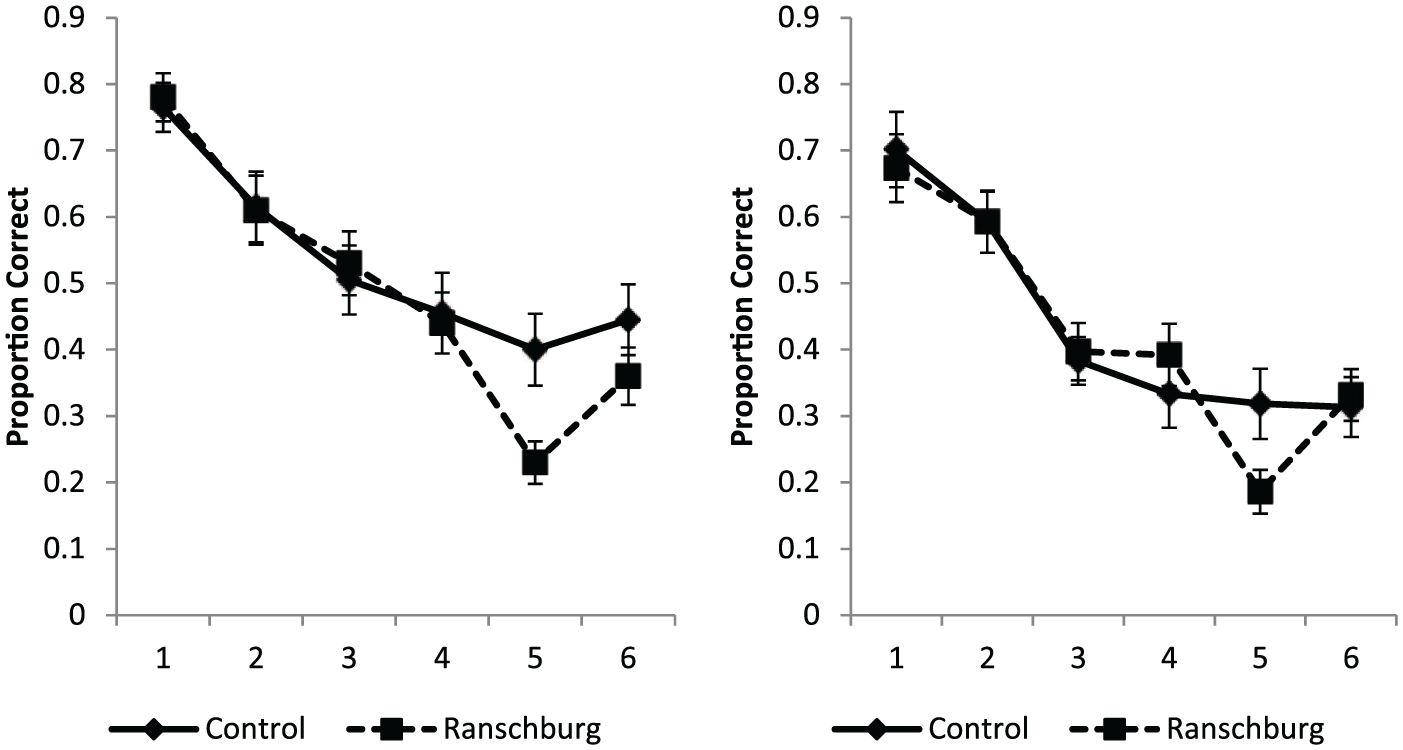
Mean proportion correct for the control and Ranschburg trials as a function of serial position under conditions of (a) quiet and (b) CA.
A three-factor (2 × 2 × 6) within-participants analysis of variance (ANOVA) was computed with the factors: concurrent task (quiet and CA), trial type (control and Ranschburg), and serial position (1-6). The main effect of concurrent task was significant, F(1, 19) = 6.938, mean square error (MSE) = .102, p = .016,
Repetition analysis
The dependent variable ‘delta’ reflects the difference between the proportion of trials in which both repeated items [P(r)] and both matched critical items in the control trials [P(c)] are recalled in the correct serial position. That is, the analysis focuses on recall of Serial Positions 2 and 5 only. Scoring criterion was more liberal than that employed for the serial position analysis because critical items in the control trials were considered as correct if they exchanged serial positions (see Henson, 1998a).
Delta was calculated by P(r) – P(c). Negative delta scores demonstrate inhibition as a result of the repetition, whereas positive delta scores demonstrate facilitation as a result of the repetition. We report single sample t-tests comparing delta with the null hypothesis of 0 and report Bayes factors for these comparisons. For the quiet condition, delta = –.130 (95% CI = [–.232, –.028]) and was significantly different to 0, t(19) = –2.668, p = .015, d = –.597, BF10 = 3.623. For the CA condition, delta = –.152 (95% CI = [–.251, –.051]) and was significantly different to 0, t(19) = –3.164, p = .005, d = –.707, BF10 = 8.998. Importantly, delta did not differ significantly between the quiet and CA conditions, t < 1 (BF10 = 0.246), thus demonstrating equivalent inhibition for both.
Error analysis
Given that the Ranschburg effect has been linked to a response suppression mechanism (Armstrong & Mewhort, 1995; Vousden & Brown, 1998), we conducted additional analyses on the pattern of errors to examine evidence in support of this mechanism. First, erroneous within-trial repetitions were computed. Erroneous within-trial repetitions have previously been shown to be relatively infrequent (Henson et al., 1996; Johnson et al., 2016; Vousden & Brown, 1998), purportedly due to response suppression (Vousden & Brown, 1998). For the control (non-repetition) trials, the proportion of all responses that were incorrect within-trial repetitions was 9.0% and 10.5% for the quiet and CA conditions, respectively, and these proportions did not differ significantly, t(19) = –1.110, p = .281, d = –.248, BF10 = 0.399. To test whether there is an association between the Ranschburg effect and erroneous within-sequence repetitions, the average delta value for each participant was correlated to their average number of erroneous within-trial repetitions for the control trials, and revealed a significant positive correlation, r(20) = .449, p = .047, BF10 = 1.743 (although Bayes’s factor provides only anecdotal evidence for the relationship). That is, the stronger the Ranschburg effect, the fewer erroneous within-trial repetitions that were evident in the control trials. This provides tentative evidence in support of a similar mechanism underpinning response inhibition (i.e., the Ranschburg effect) and the low levels of erroneous within-trial repetitions.
Second, we examine how participants respond when they fail to recall the repeated item at Serial Position 5 for the Ranschburg trials. As highlighted during the review process, one might expect participants to replace this item with either a response omission or the retrieval of an item not used in this sequence, because response suppression should limit erroneous repetitions of items already recalled in the trial. We find that a substantial proportion of the increase in errors for the repeated item can be accounted for by participants lifting (therefore, retrieving) the finger that was omitted from the sequence (this response was observed on 25.7% of all Serial Position 5 Ranschburg trial errors). Such a finding is consistent with response suppression, limiting erroneous within-trial repetitions. However, it is worth noting that the most common response for this error was recall of Serial Position 6 (this response was observed on 28.4% of all Serial Position 5 errors, compared with 13.5%, 15.4%, and 17.2% of errors in which participants responded with Positions 1, 3, and 4, respectively). An adjacent transposition error, in this instance between Serial Positions 5 and 6, is a common error (e.g., Farrell & Lewandowsky, 2004; Guérard & Tremblay, 2008; Johnson et al., 2016); however, as noted during the review process, such an error creates an issue as to what participants then recall as the sixth item in the list. Specifically, response suppression should prevent participants from repeating Serial Position 6, as that item has just been recalled. Indeed, when we examine the trials in which Serial Position 6 is erroneously recalled as the fifth item in the Ranschburg trial, that item is immediately repeated on only 2.2% of those trials (consistent with response suppression for that item). In contrast, on 48.9% of these trials, participants either recall the finger that was not included in this trial or omit a response for the sixth item in the list (indeed, more generally, there was a non-significant trend towards more response omissions for the Ranschburg trials compared with control trials, occurring in 9% and 6% of all trials, respectively; Z = 12, p = .061, BF10 = 1.285). While erroneous within-sequence repetitions clearly occur when participants fail to recall the repeated item in the Ranschburg trial, these data illustrate some disinclination to repeat items at output through the employment of both response omissions and retrieval of the item not presented in the current sequence.
Discussion
Two important findings are signalled from this experiment. First, it has replicated the only previous demonstration of the Ranschburg effect (i.e., the inhibitive effect of spaced within-sequence repetitions) for recall of non-verbal sequences (Roe et al., 2017). Specifically, using a tactile ISR task, we have demonstrated recall inhibition for a repeated item when that item is separated by two intervening items (the Ranschburg effect). This finding is consistent with a number of studies showing the effect for recall of verbal sequences (e.g., Crowder, 1968; Duncan & Lewandowsky, 2005; Henson, 1998a; Jahnke, 1969; Johnson et al., 2018; Maylor & Henson, 2000). Second, we have reported a Ranschburg effect of equivalent magnitude under conditions of both quiet and CA. The latter finding is important as we argue that, for CA, verbal recoding of the tactile stimulations is disrupted, and, despite such disruption, the Ranschburg effect persisted. Survival of the effect points to the conclusion that the tactile Ranschburg effect cannot be regarded as merely reflecting those processes underpinning verbal memory; rather, we argue, our finding to be bona fide evidence for a non-verbal Ranschburg effect. Moreover, as the present Ranschburg effect matches that found for verbal materials, parsimony would suggest, therefore, that a mechanism common to both tactile and verbal memory underpins these data.
An additional contribution of the current study is the analysis of both response errors and response omissions, and how this informs our understanding of processes underpinning the Ranschburg effect. It has been suggested that both the low frequency of erroneous within-sequence repetitions and the Ranschburg effect reflect the action of a common process (e.g., Vousden & Brown, 1998). Specifically, they are each a function of a response suppression mechanism for which inhibition of an item post-retrieval reduces the likelihood of subsequent recall of that item within a trial. To test this proposal, we correlated the average proportion of erroneous within-sequence repetitions for the control sequences with the average delta score (our measure of the Ranschburg effect). We report a significant positive correlation between these two variables, providing tentative support for supposing that both effects are determined by a common “suppression” mechanism (notwithstanding the finding that the evidence from the Bayes factor was anecdotal). We note, in addition, that the proportion of within-sequence repetitions in the control condition was somewhat greater (9.0% and 10.5% for the quiet and CA conditions, respectively) than that which we reported previously for ISR of tactile sequences (4.2% of all responses; see Johnson et al., 2016). Of course, the current experiment included Ranschburg trials (i.e., the trials containing within-sequence repetitions) which Johnson et al. (2016) did not. It is plausible to suggest that the current inclusion of within-sequence repetitions acted to “prime” participants to output a greater proportion of repetitions at test.
A second error analysis examined what it is that participants recall when there is a failure to recall the repeated item in the Ranschburg trial. We find that for 25.7% of the erroneous responses, participants recall the item (i.e., finger) not included in the sequence. That is, given that we employ a set size of 6 to create all the sequences in the present experiment (i.e., the same six fingers), a Ranschburg trial utilises only five of the fingers (because a repetition is included in those trials). Thus, for those occasions when participants erroneously fail to recall the repeated item, they recall the finger omitted from the sequence in over a quarter of trials. However, as highlighted in the error analysis, the most common response error for the repeated item was erroneous retrieval of Serial Position 6 (28.4% of all Serial Position 5 errors in the Ranschburg trials). Importantly, this recall error was rarely followed by correct (and therefore repeated) recall of Serial Position 6 (on 2.2% of these trials), consistent with response suppression of Serial Position 6. Instead, on 48.9% of these trials, this recall error was followed by either a response omission or retrieval of the item not included in the sequence, that is, a response that was not an erroneous within-sequence repetition. There are a number of reasons why these findings are of consequence with regard to the control processes underpinning the Ranschburg effect. First, if the elevated proportion of errors at Serial Position 5 for the Ranschburg trials was entirely due to participants erroneously repeating another sequence item, then this would contradict the response suppression explanation simply because logic dictates that those erroneous repetitions should also have been suppressed post-retrieval. Our analysis demonstrates that for a substantial proportion of trials, participants recall a non-repeated item (i.e., an item that was not suppressed). In addition, we report that participants failed to recall the entire sequence (i.e., outputting < 6 items) to a greater extent in the Ranschburg trials (9% of trials) compared with the control trials (6% of trials). Although this difference did not reach statistical significance (p = .061), it does plausibly provide another route by which participants avoided repeating items when making an error in recalling the Ranschburg sequence. In summary, while participants do produce erroneous within-sequence repetitions following errors in the Ranschburg trials, there is evidence for some disinclination in the outputting of such repetitions.
Second, a tendency to recall the omitted finger rather than the repeated finger in the Ranschburg trial does lend some support for the guessing account of the Ranschburg effect. Greene (1991) suggested that, rather than reflecting a memory phenomenon, the Ranschburg effect reflects the strategies that participants employ when guessing. Specifically, the idea here is that when a participant is uncertain of the correct response, and, therefore, their response constitutes a guess, that guess tends not to be the recall of an already outputted item, but rather recall of a yet-to-be recalled item from the stimulus set. This strategy acts to greatly reduce the likelihood of recalling the repeated item by chance, and explains why recall of that repeated item is impaired (although see Henson, 1998a, who demonstrated that guessing cannot fully account for the effect).
Third, a tendency to recall the omitted finger rather than the repeated finger in the Ranschburg trial might be taken as evidence for “transfer of learning” of the matched control sequence to the Ranschburg trial. As noted during the review process, for 50% of the trials, the matched control trial precedes the Ranschburg trial (these two trials are identical but for the repetitions at Serial Positions 2 and 5). It is possible that some initial learning of the control sequence occurs following that single presentation (i.e., the tactile Hebb effect, as reported by Johnson et al., 2016), and therefore when outputting the Ranschburg trial, the failure to recall the repeated item is a result of participants falsely identifying the Ranschburg trial as the initial control trial and attempting to recall that sequence. We argue against this explanation for the following reason. In the 50% of trials where the Ranschburg trial precedes the control trial, we would also predict a drop in accuracy for Serial Position 5 due to learning of the Ranschburg sequence. These reciprocal effects should therefore even out any difference between the control and Ranschburg trials at Serial Position 5; however, this difference persists. Moreover, when we look at the errors for the matched control trials that follow the corresponding Ranschburg trial, there is not a single trial in which participants erroneously repeat the Serial Position 2 item at Serial Position 5. This contradicts “transfer of learning” from the Ranschburg list to the matched control list.
That ISR for tactile sequences exhibits a Ranschburg effect mirroring that found for ISR of verbal sequences is consistent with a range of data reflecting functional similarity for verbal and tactile memory processes. First, the serial position function for ISR of tactile stimuli (Johnson et al., 2016; Mahrer & Miles, 1999; Watkins & Watkins, 1974; see also the present experiment) matches closely that reported for verbal sequences (e.g., Bhatarah, Ward, & Tan, 2008; Drewnowski & Murdock, 1980; Grenfell-Essam & Ward, 2012; Spurgeon, Ward, & Matthews, 2014; Tan & Ward, 2007, 2008; Ward, Tan, & Grenfell-Essam, 2010). Second, the distribution of transposition errors in tactile ISR (Johnson et al., 2016) matches closely that observed for verbal and spatial sequences (Guèrard & Tremblay, 2008). Third, both the serial position function and the list-length-related changes in recall strategy for immediate free recall of tactile sequences match closely those observed for verbal sequences (Cortis, Dent, Kennett, & Ward, 2015). Fourth, the Hebb repetition effect is observed for ISR of tactile sequences, mirroring that observed for verbal sequences (Johnson et al., 2016). Taken together, we argue that these findings add to that body of work (Cortis et al., 2015; Johnson et al., 2016; Roe et al., 2017) consistent with the thesis that order memory for tactile stimuli is functionally equivalent to that for verbal memory.
The present data, combined with that of Roe et al. (2017) and Johnson et al. (2018), support the notion that the Ranschburg effect is not confined to phonological memory. As an effect purportedly epiphenomenal to response suppression, demonstrating the Ranschburg effect cross-modally is an important step in testing the applicability of models of order memory beyond the verbal domain. Indeed, Hurlstone et al. (2014) suggest that common sequencing principles operate across different domains of memory, particularly with respect to competitive queuing and response suppression. Notwithstanding the present findings, it is, therefore, important to examine evidence for the Ranschburg effect in other non-verbal domains (e.g., visual/visuospatial memory). Such work provides methodological challenges because non-verbal visual stimuli cannot be applied to ISR, with serial order reconstruction (SOR) used as an alternative (e.g., Avons, 1998; Guérard & Tremblay, 2008; Ward et al., 2005). In SOR, all list items are re-presented at test, and plausibly, such re-presentation may act to prime participant awareness of the repetition based upon the number of items re-presented in the testing array. In addition, item generation is not required at test in SOR, because participants are only required to reconstruct order by selecting the items in the order of original presentation. It remains an empirically testable question the extent to which response suppression only follows item generation/recall at test (as is required in ISR), or whether SOR can induce response suppression for an item.
In summary, the present study shows the Ranschburg effect with non-verbal stimuli. Specifically, we have demonstrated that this response inhibition effect is not an artefact of verbal recoding, and add to a body of work suggesting functional equivalence across verbal and tactile order memory.
Footnotes
Acknowledgements
We thank Martin Tomkins for his technical support and both Dr. Mike Page and Prof. Geoff Ward for their helpful and insightful comments during the review process.
Declaration of conflicting interests
The author(s) declared no potential conflicts of interest with respect to the research, authorship, and/or publication of this article.
Funding
The author(s) received no financial support for the research, authorship, and/or publication of this article.
