



Abstract
Tucker and Ellis found that when participants made left/right button-presses to indicate whether objects were upright or inverted, responses were faster when the response hand aligned with the task-irrelevant handle orientation of the object. The effect of handle orientation on response times has been interpreted as evidence that individuals perceive grasp affordances when viewing briefly presented objects, which in turn activate grasp-related motor systems. Although the effect of handle alignment has since been replicated, there remains doubt regarding the extent to which the effect is indeed driven by affordance perception. Objects that feature in affordance-compatibility paradigms are asymmetrical and have laterally protruding handles (e.g., mugs) and thus confound spatial and affordance properties. Research has attempted to disentangle spatial compatibility and affordance effects with varying results. In this study, we present a novel paradigm with which to study affordance perception while sidestepping spatial confounds. We use the Bimanual Affordance Task (BMAT) to test whether object affordances in symmetrical objects facilitate response times. Participants (N = 36) used one of three (left unimanual/right unimanual/bimanual) responses to indicate the colour of presented objects. Objects afforded either a unimanual (e.g., handbag) or a bimanual (e.g., laundry hamper) grasp. Responses were faster when the afforded grasp corresponded with the response type (unimanual vs. bimanual), suggesting that affordance effects exist independent of spatial compatibility.
Keywords
Gibson’s (1979) theory of affordances describes object perception as a top-down process in which observers perceive properties of objects directly, 1 rather than through an inferential process. Specifically, Gibson proposed that we directly perceive the actions that the environment makes available, or affords, to us. Evidence from object-based stimulus–response compatibility tasks appears to support the claim that we automatically perceive affordances when viewing objects. Tucker and Ellis (1998) asked participants to make left or right button-press responses to indicate whether unilaterally graspable objects (e.g., a mug) were upright or inverted. Although the horizontal orientations of objects’ handles were irrelevant to the task, response times (RTs) were faster when the responding hand aligned with the target object’s handle—a pattern since described as the object-based correspondence effect (CE). Tucker and Ellis concluded that this facilitation of RTs showed that merely viewing graspable objects automatically elicited motor activation indicative of affordances.
Tucker and Ellis’ (1998) results are also consistent with evidence from neuroimaging affordance research. Neurophysiological data provide support for Gibson’s (1979) affordances, showing that visually attending to graspable objects activates motor-related brain regions (Grèzes & Decety, 2002), even when attending to object properties that are unrelated to grasping (Proverbio, Adorni, & D’Aniello, 2011). Furthermore, Cardellicchio, Sinigaglia, and Costantini (2011) showed that viewing graspable objects in the peri-personal space elicits motor activation (in the form of motor-evoked potentials) in the grasp-compatible hand. Taken together, these studies corroborate Tucker and Ellis’ account of the object-based CE; objects in their experiment may have similarly elicited motor activation in the grasp-compatible hand which, in turn, facilitated RTs.
Dissociating affordance and Simon effects
Although some attempts to replicate the object-based CE have been successful (Ambrosecchia, Marino, Gawryszewski, & Riggio, 2015; Iani, Baroni, Pellicano, & Nicoletti, 2011; Proctor, Lien, & Thompson, 2017), there remains ambiguity about whether this effect is, in fact, driven by affordance perception. It is possible that the object-based CE is instead an instance of a broader class of spatial compatibility, or Simon, effects (Simon, Sly, & Vilapakkam, 1981). In a typical Simon task, participants respond to properties of target stimuli (e.g., colour), using left or right button-press responses, while the targets appear in either the left or the right half of the presentation screen. The task-irrelevant spatial location of the target facilitates RTs when the target location is correspondent with the responding hand (see Lu & Proctor, 1995, for a review of the Simon effect). Since stimuli in the affordance literature predominately feature asymmetrical objects with protruding handles, these handles might act as spatial cues that draw attention away from the object’s body, facilitating RTs in a manner similar to non-object targets in the Simon task.
In their seminal study, Tucker and Ellis (1998) attempted to distinguish between affordance and Simon effects by conducting a second study in which participants responded using two adjacent fingers of the same hand, rather than the index fingers of both hands. Tucker and Ellis did not find a CE, concluding that if the original effect were attributable to spatial asymmetry, they would find a finger-handle CE when participants responded with two fingers within the same hand. It is worth noting that Tucker and Ellis did, however, find a within-hand CE when analysing median rather than mean RTs. Following up on this discrepancy, Cho and Proctor (2010) found that CEs did not differ for within- and between-hand responses when participants made either colour or upright/inverted judgements about frying pan stimuli. In addition, Cho and Proctor (2011) show within- and between-hand CEs of the same magnitude when participants made colour and upright/inverted judgements in response to images of teapots. Cho and Proctor’s (2010, 2011) within-hand CEs are inconsistent with an affordance account of the object-based CE and thus highlight the impact of spatial confounds when using asymmetrical, unimanually graspable objects.
While Cho and Proctor’s (2010, 2011) attempts to disentangle affordance and Simon effects appear to contradict affordance accounts of object-based CEs, the inconsistency of their findings with Tucker and Ellis (1998) could be due to methodological differences. Instead of using photographs as targets, Cho and Proctor presented participants with grey, silhouette-like images on a black background. Pappas (2014) notes that silhouettes lack information about the depth and the material of the object, arguing that they do not represent objects in enough detail to elicit affordances. In his study, Pappas used both photographs and silhouettes of frying pans, in response to which participants made upright/inverted judgements. For silhouette stimuli, results were consistent with those of Cho and Proctor—within- and between-hand CEs did not differ. However, consistent with affordance accounts, photographs of frying pans elicited a between-hand CE, but not a within-hand effect. When taken with evidence indicating that judgements relating to the functional properties of objects elicit larger effects (Pellicano, Iani, Borghi, Rubichi, & Nicoletti, 2010), Pappas’ findings suggest that object affordances are at least in part responsible for object-based CEs.
Although Pappas (2014) demonstrated both spatial compatibility and affordance effects for frying pan stimuli, the relative contributions of each of these processes might vary across stimuli. While frying pans have long, protruding handles, objects such as mugs and kettles have handles that do not protrude to the same extent, relative to their bodies, and might, therefore, elicit weaker component spatial compatibility processes. Furthermore, for objects that have protrusions on the side opposing the handle, spatial compatibility processes could drive an overall incompatibility effect relative to the handle orientation (Cho & Proctor, 2011). The effect of asymmetry might also interact with subtle variations in stimulus presentation. Proctor et al. (2017) presented participants with images of frying pans that were either object centred (centred relative to the width of the entire pan, including the handle) or base centred (centred relative to the width of the base only). While base-centred targets elicited a CE, object-centred targets elicited the opposite effect. Taken together, Cho and Proctor and Proctor et al. show that stimuli with protrusions of different lengths, shapes, and sizes might elicit confounding spatial compatibility effects of different magnitudes. Despite much work attempting to disentangle affordance and Simon effects, reliance on asymmetrical objects has generated conflicting accounts of the roles of spatial and affordance processes in the object-based CE. One way of avoiding spatial confounds is through the use of symmetrical objects as stimuli. If symmetrical objects prime responses compatible with their afforded grasp, we can more clearly conclude that object-based CEs are at least in part driven by affordance perception.
One extant paradigm—the micro-affordance paradigm—has provided a way in which to study affordances while circumventing spatial confounds (Ellis & Tucker, 2000). Ellis and Tucker’s (2000) study involved participants using either precision (using the thumb and index finger) or power (using the entire hand) grasps to categorise objects. Participants made faster power-grasp responses when viewing objects that afford a power (e.g., a can) grasp while making faster precision grasp when the viewed object afforded a precision grip (e.g., a pen). Although micro-affordance studies provide evidence for affordances while circumventing spatial confounds, they remain silent on critical questions about the object-based CE. First, whether traditional object-based CEs exist independent of spatial compatibility remains unclear. Second, while the micro-affordance literature shows that viewed objects facilitate compatible grasp responses, whether viewed objects potentiate grasp affordances even in the absence of a grasp response is better studied using traditional affordance-compatibility paradigms.
This study
In this study, we propose the Bimanual Affordance Task (BMAT) as a paradigm to study affordances that sidesteps the spatial confounds inherent in traditional affordance tasks. The BMAT differs from affordance-compatibility paradigms such as Tucker and Ellis’ (1998) in three main aspects. First, to sidestep Simon effects induced by object asymmetry, all objects in the BMAT are vertically symmetrical. Second, while objects in traditional affordance-compatibility paradigms typically afford either a left- or a right-handed grasp, objects in the BMAT afford either a unimanual (e.g., bucket) or a bimanual (e.g., laundry hamper) grasp. Third, the BMAT is a three-choice task, in which participants make one of three keystroke responses—left hand, right hand, or a bimanual response consisting of simultaneous left and right keystrokes—based on object colour.
We expect that object affordances potentiate compatible responses by activating grasp-relevant motor systems, despite grasp affordance being irrelevant to the completion of the task. Thus, we predict that viewing objects that afford a unimanual (vs. bimanual) grasp will potentiate unimanual responses. Although objects that afford a bimanual grasp can technically be grasped with one hand, a unimanual grasp is not consistent with the typical use of these objects. Additionally, we predict that objects that afford a bimanual (vs. unimanual) grasp will potentiate bimanual responses. While unimanual grasp-affording objects might facilitate responding in one of the two hands used in making a bimanual response, we expect that bimanual grasp-affording objects will elicit motor activation in both hands, thus facilitating bimanual responses.
Overall, we predict an affordance by response CE such that (1) unimanual responses will be faster to objects that afford a unimanual grasp, and (2) bimanual responses will be faster to objects that afford a bimanual grasp. We also predict a nested simple interaction, such that for unimanual responses facilitation by unimanual affording objects (over bimanual affording objects) should only appear for the dominant hand. For unimanual affording objects to facilitate a unimanual response (relative to a bimanual response), individuals must perceive an affordance for only one of their two hands. Gibson (1979) suggests that affordances are a relationship between the observer and an object, in that they are dependent on the observer’s abilities and propensities. Hence, although unimanual affording objects do not inherently prefer either a left- or a right-handed grasp, we expect that participants will perceive unimanual affordances for their dominant hand only.
Material and methods
Participants
Participants were undergraduate students from the University of Melbourne and individuals from the local community, who participated for either course credit or AUD 10 (N = 36). For this study, we recruited only Caucasian participants. All participants provided written informed consent. 2 We excluded one participant from our analyses for responding erroneously on more than 15% of trials, leaving a final sample of 35 participants (26 females, five left-handed, Mage = 21.3 years, SDage = 9.00). To obtain handedness data, we asked participants to respond to the item “Please indicate your handedness” by selecting either “left” or “right.”
Statistical power
We conducted an a priori power analysis in G*Power 3.1 (Faul, Erdfelder, Lang, & Buchner, 2007) to determine the sample size required to detect a moderate CE (i.e., the interaction between response and affordance) of
Materials and procedure
Stimuli
Stimuli were 10 photographs (512 × 384 pixels) of household objects. The original image set contained five objects that afforded a unimanual grasp (bucket, tote bag, handbag, briefcase, picnic hamper) and five objects that afforded a bimanual grasp (toolbox, two laundry baskets, two laundry hampers). All objects were positioned such that their left- and rightmost points were equidistant to fixation, i.e., the display was vertically symmetrical about fixation. Objects that afforded a unimanual grasp were positioned such that the object’s handle protruded upwards from its body. We adjusted the hue and saturation of each image to create yellow, red, and blue versions of each stimulus, resulting in a total of 30 images. 4
BMAT
Participants sat approximately 55 cm from the computer screen; we did not control participants’ head or hand positions. We administered the BMAT and recorded responses, using The Psychophysics Toolbox (Brainard, 1997) for MATLAB (version R2016B; MathWorks, Inc., 2016). The task began with the following introduction: “In this experiment, you will be making decisions about the colour of household objects using keystroke responses. In this task, the objects presented can be carried from one place to another.” We provided this introduction to ensure that participants were aware of the graspable nature of the objects. Evidence from the affordance literature indicates that colour judgements yield smaller CEs than the more commonly used orientation (upright vs. inverted) judgements, likely due to reduced processing of function-relevant properties required for decisions. To account for this, we made the objects’ function salient in the task introduction (Saccone, Churches, & Nicholls, 2016; Tipper, Paul, & Hayes, 2006).
Following the introduction, participants proceeded to the task instructions, which outlined the three response options (Figure 1(a)): (1) a left-handed Q keystroke, (2) a right-handed 9 (number-pad) keystroke, and (3) simultaneous keystrokes of the Q and 9 keys (bimanual response). To register a successful bimanual response, participants had to have both keys pressed within 400 ms of the first of the two keystrokes. Failure to do so would register a unimanual, and therefore an incorrect, response to trials requiring a bimanual keypress. Each of the three response options corresponded to one of the three stimulus colours (red, blue, and yellow), and this mapping remained the same throughout the task. We counterbalanced colour–response mappings across participants.
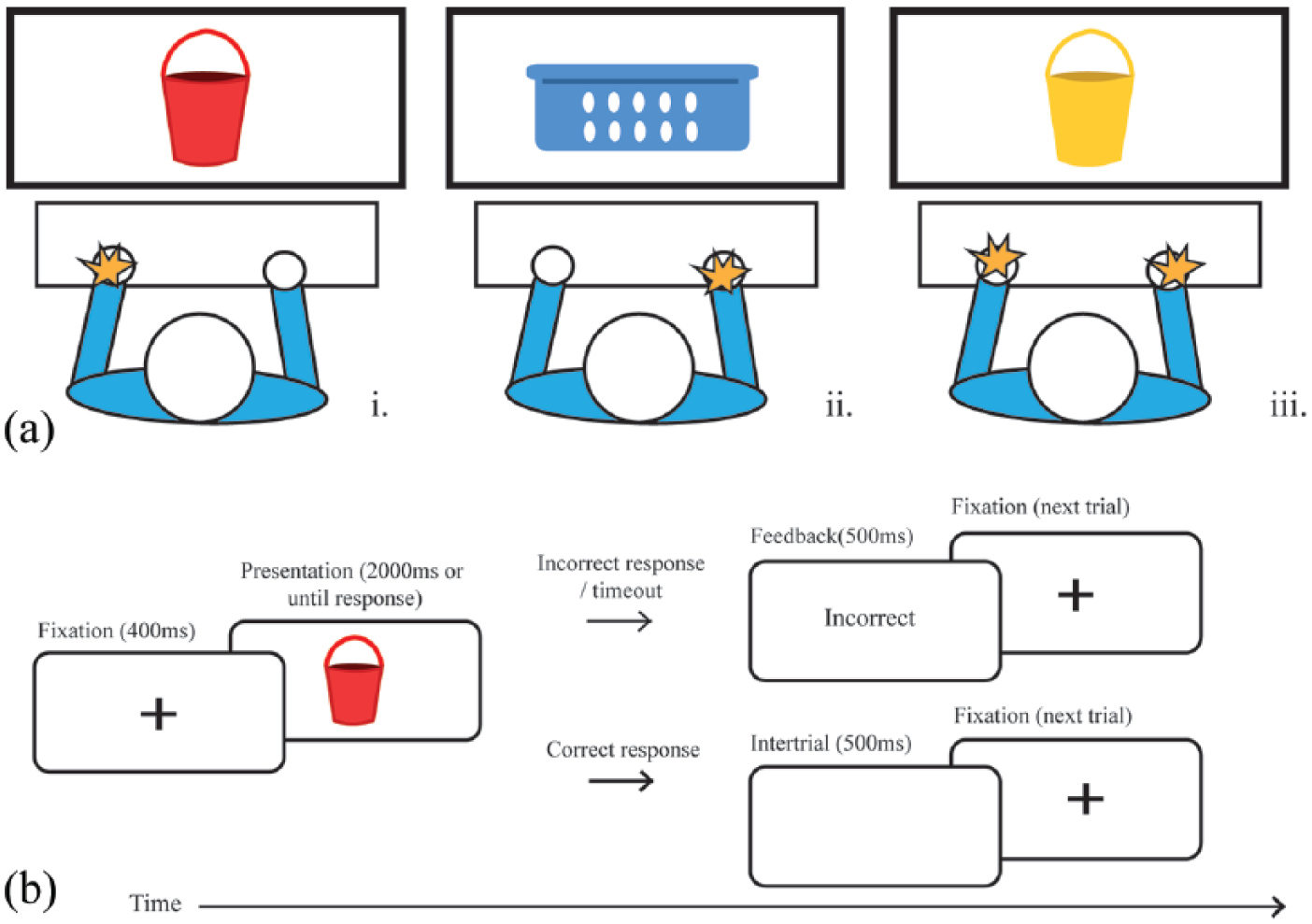
(a) Three response options: (i) left-hand unimanual, (ii) right-handed unimanual, and (iii) bimanual; (b) the trial structure.
Participants first completed a block of 30 practice trials, proceeding to the experimental blocks after responding correctly to more than 70% of trials; otherwise, they repeated the practice block until achieving 70% accuracy. All participants met the accuracy requirement on their first attempt.
After completing the practice block, participants responded to 10 blocks of 30 experimental trials for a total of 300 experimental trials. Each of the 30 stimuli appeared 10 times during the task, in random order. Since the BMAT is a three-choice task, we predicted that it would yield more errors than the previously used affordance tasks. We thus made the task longer than typical affordance tasks to ensure that we obtained enough correct responses for analysis. Trials commenced with a fixation cross presented for 400 ms, followed by stimulus presentation of 2,000 ms or until participants made a response. Feedback (500 ms) appeared for incorrect responses or if the participant did not respond within 2,000 ms. When participants responded accurately, a 500-ms interval preceded the next trial (Figure 1(b) for trial structure).
Results
We excluded RTs for incorrect responses, as well as those faster than 200 ms (anticipatory responses) or slower than 1,500 ms (timeouts), from analyses. We use a larger cutoff than the 1,000 ms value used by Ratcliff (1993) in analysing two-choice decision data, as we anticipated longer RTs in our three-choice task. Errors and RTs excluded due to cutoffs accounted for 5.04% of the data, falling within the acceptable range outlined by Ratcliff. 5 We analysed RT and error data using 2 × 2 within-subject ANOVAs. Shapiro–Wilk (Shapiro & Wilk, 1965) tests for normality revealed that RT data, in some conditions, was not normally distributed (ps < .05). Since ANOVAs are robust to mild non-normality (Glass, Peckham, & Sanders, 1972), we conducted analyses as usual for RTs, but also footnote results based on log-transformed data. Shapiro–Wilk tests on error data, however, indicated non-normality in every condition (ps < .05); we therefore conducted all error analyses on log-transformed means.
RTs
RTs were submitted to a 2 (Response: unimanual vs. bimanual) × 2 (Affordance: unimanual vs. bimanual) within-participant ANOVA (see Figure 2). Results revealed a significant main effect for response: Unimanual responses were faster than bimanual responses, F(1,34) = 15.0, p = .001,
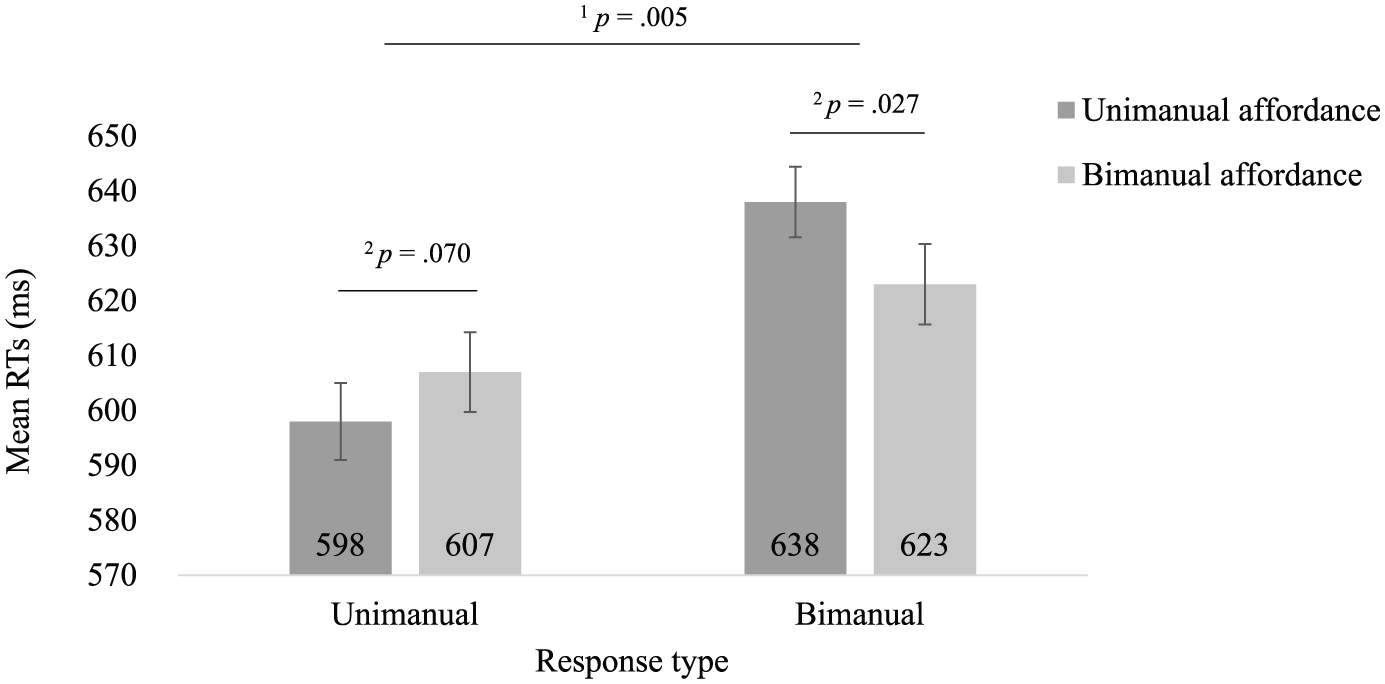
Affordance × Response type interaction on RTs in the BMAT. Error bars represent one standard error.
To test for the role of handedness in unimanual responses, we conducted a 2 (Hand: dominant vs. non-dominant) × 2 (Affordance: unimanual vs. bimanual) ANOVA on RTs for unimanual responses. The interaction between handedness and affordance was significant, F(1,34) = 8.31, p = .007,
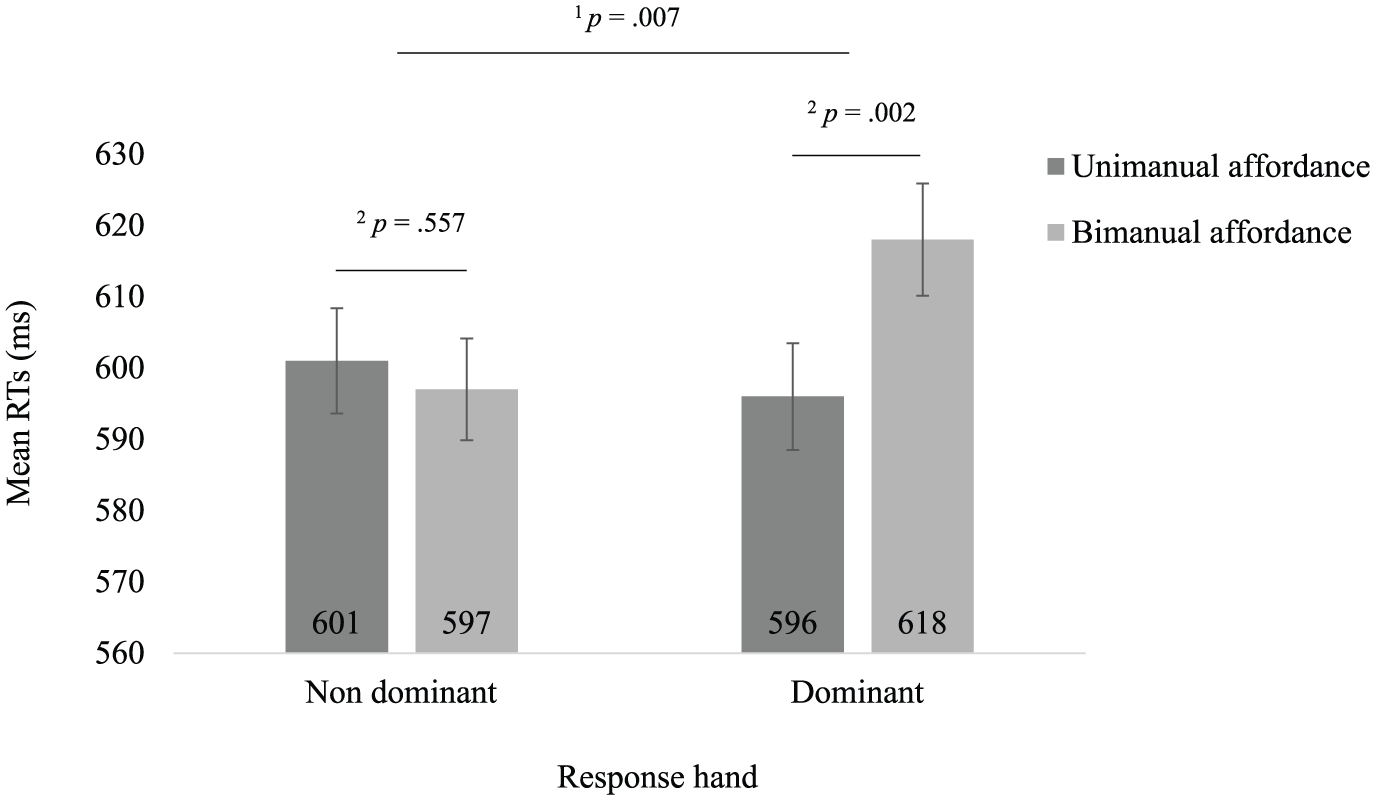
Affordance × Response hand interaction on unimanual response RTs in the BMAT. Error bars represent one standard error.
Percentage errors
To test whether errors were also subject to compatibility effects, we conducted a 2 (Response: unimanual vs. bimanual) × 2 (Affordance: unimanual vs. bimanual) ANOVA on the log-transformed percentage of trials on which participants made errors (i.e., log percentage errors; log PEs). Analysis of PEs did not reveal a compatibility effect, F(1,34) = .878, p = .355,
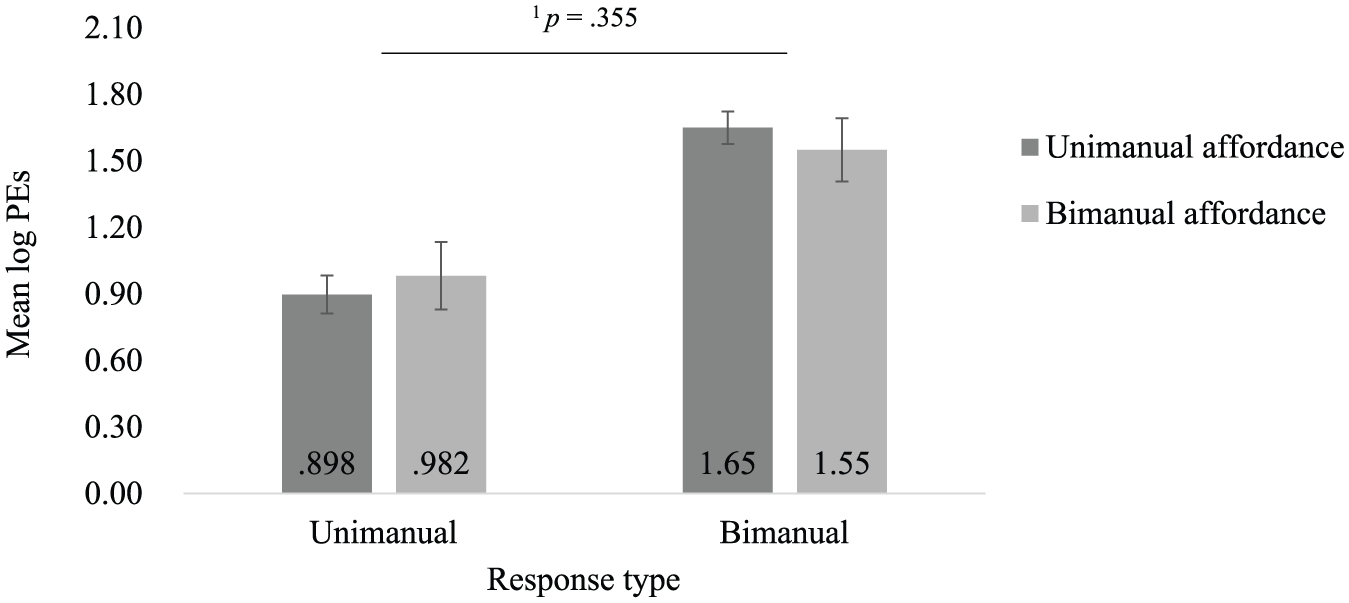
Affordance × Response type interaction on log PEs in the BMAT. Error bars represent one standard error.
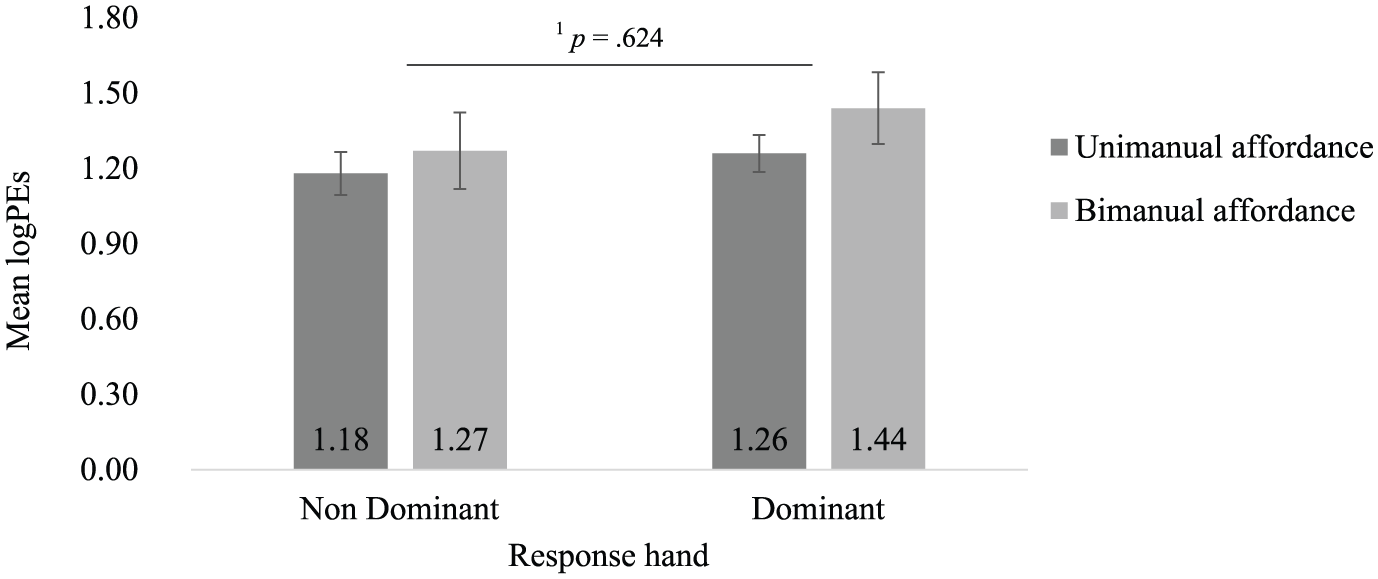
Affordance × Response hand interaction on log unimanual PEs in the BMAT. Error bars represent one standard error.
Discussion
Studies demonstrating object-based CEs typically feature asymmetrical graspable objects and thus confound spatial and affordance-compatibility effects (Cho & Proctor, 2010). In addition, the relative locations on the object’s body and its handle on-screen (Proctor et al., 2017), as well as any other protruding components (Cho & Proctor, 2011), also moderate CEs. In this study, we use the novel BMAT which circumvents spatial confounds using symmetrical objects as stimuli.
As predicted, RT data showed that participants responded faster to objects that afforded a grasp that was correspondent with the response, i.e., an affordance-compatibility effect. Results indicate that the affordance effect in our study is driven (marginally) by unimanual affordances facilitating unimanual responses, and (significantly) by bimanual affordances facilitating bimanual responses. Furthermore, unimanual grasp-affording objects facilitated unimanual responses made with the dominant, but not the non-dominant, hand. Given that the effect of affordance on unimanual RTs in the overall analysis aggregates across both dominant and non-dominant-hand responses, the interaction between hand dominance and affordance in unimanual responses explains why the overall effect of affordance on unimanual responses was only marginally significant.
In contrast to previous research showing compatibility effects for PEs (Pappas, 2014), affordance-compatibility did not affect errors made using bimanual, dominant, or non-dominant-hand responses. This discrepancy could be explained by the fact that unimanual response options are nested within bimanual responses. We did, however, find a higher mean PE for bimanual versus unimanual responses, potentially due to participants being unable to make the second keystroke in a bimanual response within the 400-ms response window.
Our results distinguish between the major theoretical accounts of Tucker and Ellis’ (1998) object-based CE. So far, attempts to test between Simon and affordance accounts of Tucker and Ellis’ findings have produced conflicting results (Cho & Proctor, 2010; Pappas, 2014; Proctor et al., 2017) as to whether the object-based CE is an example of Simon effects brought about by the protruding handle, or whether the graspable nature of presented objects elicits motor activation in the corresponding hand, thereby facilitating RTs. Research designed to clarify the nature of object-based CEs is further complicated by stimulus properties—such as the way in which objects are centred on screen—moderating CEs (Proctor et al., 2017).
Using symmetrical objects, we sidestep the spatial confound inherent in asymmetric objects. In finding an affordance-response CE, we provide evidence that the object-based CE is, at least in part, driven by motor activation indicative of affordances. Although micro-affordance paradigms in which participants make grasp responses to categorise objects (Ellis & Tucker, 2000) also successfully dissociate affordance and Simon effects, the BMAT does so while removing the requirement for a grasp response. Since responses in our study were keypresses, as opposed to grasps, our results also show that briefly viewed objects potentiate the associated action even when the observer does not intend to perform the afforded action. Thus, results from this study test—and indeed support—accounts of affordances that propose affordances are perceived even when an action is not required (i.e., automatically).
In addition, our results provide evidence that affordances might be attuned to higher-level, goal-directed actions as opposed to more concrete, lower-level actions. We found that dominant-hand unimanual responses were faster to unimanual (vs. bimanual) grasp-affording objects, suggesting that we perceive only those affordances that are congruent with an object’s function, as opposed to all actions that one can perform on an object. Although the bimanual grasp-affording objects in our study are typically held or lifted bimanually, they all technically afforded a unimanual grasp. That is, an opportunity for a unimanual grasp was present for each trial. The past research has demonstrated that objects in their “active state” (e.g., a switched-on flashlight) yield larger CEs (Pellicano et al., 2010; Tipper et al., 2006), perhaps indicating that affordance perception is sensitive to an object’s function as well as structural properties that allow grasping. Taken together with data from studies on the role of object states, the present results corroborate theoretical accounts of affordances that emphasise the role of an object’s function in affordance perception (Tipper et al., 2006).
Moreover, we show that affordances requiring complex, coordinated actions are also perceived in the absence of an action goal. So far, the object-based CE has been demonstrated using simple, unimanual button-presses or grasps (e.g., Ellis & Tucker, 2000; Tucker & Ellis, 1998). Nevertheless, the broader affordance research contains evidence for bimanual affordances. For instance, Richardson, Marsh, and Baron (2007) asked participants to judge when they would switch from one-handed, to two-handed, and then tool-assisted, lifting if they were to lift planks of different lengths. Participants made ratings of the plank lengths at which they would transition such that the ratio between the plank length and their hand or arm-span (depending on whether they were transitioning from one-handed or two-handed lifting) did not exceed 1, i.e., their ratings were accurate with respect to their ability to lift planks of varying lengths. While Richardson, Marsh, and Baron’s study indeed shows that individuals can perceive bimanual affordances, it is ambiguous as to whether such affordances are also perceived automatically. In contrast, since participants in this study made judgements that were unrelated to their ability to grasp the viewed objects, our results offer first evidence of automatic affordance perception for complex actions such as bimanual grasps.
Although our study avoids the spatial confounds found in much of the affordance literature, it does present other limitations. Our categorical measure of handedness may have obscured the interaction between response hand (dominant vs. non-dominant) and affordance on unimanual RTs. In using a binary, categorical, measure of handedness, we failed to capture the variability in hand laterality that is observed when using continuous, multi-item, measures (Williams, 1991). Hence, it is possible that the handedness groups in our study contained individuals who only slightly favoured their indicated dominant hand. Consequently, the observed response hand × affordance interaction on unimanual RTs, although quite clear, may have underestimated the effect of hand dominance on grasp affordances. Future research would, therefore, benefit from including a continuous, multi-item, handedness scale to (1) obtain a more precise measure of handedness and (2) test whether the degree to which participants prefer one hand predicts the size of the response hand × affordance interaction.
An additional limitation is that we did not strictly control participants’ head and hand positions. Research on the role of object distance in affordances suggests that we do not perceive affordances for objects outside our reachable space (Cardellicchio et al., 2011). Although the keyboard and screen in our study were placed in approximately the same position for all experimental sessions, participants were free to sit as they felt comfortable. If variation in seating distance altered the perceived reachability of the viewed objects, participants that sat further from the screen might not have exhibited affordance effects. However, since participants had to sit within reach of the response keys, any variation in head and hand position would have been minor. Therefore, it is unlikely that the perceived reachability of objects varied between participants. Moreover, since trials in our study did not feature any cues that indicated object distance (cf. Cardellicchio et al. in which objects appeared on a table), object reachability would have been ambiguous in any seating position.
Conclusion
In sum, the results show that RTs to objects were faster when the response type (bimanual or unimanual) corresponded with the afforded grasp. Since objects in our study were symmetrical, we can conclude that object-based CEs are, at least in part, driven by object affordances rather than mere spatial compatibility. Moreover, we provide a novel task with which to investigate affordances, that avoids spatial confounds inherent in traditional affordance paradigms.
Footnotes
Declaration of conflicting interests
The author(s) declared no potential conflicts of interest with respect to the research, authorship, and/or publication of this article.
Funding
The author(s) received no financial support for the research, authorship, and/or publication of this article.
