



Abstract
Attribute-framing bias (AFB) refers to bias in evaluating positively framed objects more favourably than the same objects framed negatively. In most AFB studies, framing is manipulated by contrasting the positive and negative outcomes, using the corresponding positive (success) or negative (failure) labels as descriptors. This study examined the unique contributions of the outcomes of the scenario and the labels describing these outcomes by manipulating them orthogonally. In three experiments, framing scenarios were presented to participants with either positive outcomes rendered with positive (65% passed) or negative (65% didn’t fail) descriptors, or negative outcomes rendered with positive (35% didn’t pass) or negative (35% failed) descriptors. All experiments revealed a strong effect for the outcome with a weaker effect for the descriptor valence, suggesting that outcomes have a stronger influence on AFB than do descriptors. We discuss the results within a theoretical framework that maps the outcome effects onto attention mechanisms and descriptor effects onto association-activation mechanisms.
Introduction
Over the last decades, behavioural and experimental economists and psychologists demonstrated that judgement and decision making (JDM) often differs from the classical model of rational thinking. Although accumulating research has shown that biased JDM occurs in very different contexts and JDM types, most of the research in this field has offered situation-specific psychological processes to account for specific biases (Marchiori & Aharon, 2015). Less attention has been paid to the underlying cognitive mechanisms that can potentially account for a variety of biases in different contexts (Keren, 2011). Here, we focus on two theoretical accounts that seem to offer such cognitive mechanisms. The first is Kahneman’s (2011) What You See Is All There Is (WYSIATI) principle that can be conceptualised as an attention mechanism. The second is Levin, Schneider, and Gaeth’s (1998) association account that focused on the activation of valence associated with the labels used in framing description. Most previous studies considered these accounts as post hoc theoretical explanations, and only few examined empirically the contribution of attention processes (e.g., Kreiner & Gamliel, 2018; Mandel, 2008; Yechiam & Hochman, 2013, 2014) and association mechanisms (e.g., McElroy & Conrad, 2009) to JDM biases. In this article, we aim to evaluate the joint contribution of association valence and of attention mechanisms focusing on attribute-framing bias (AFB).
Framing descriptions may be conceptualised as logically equivalent complementary descriptions inducing two ways of viewing the same object (Schul, 2011). For example, a basketball player may be described as one that has 25% miss rate, or 75% hit rate. Nevertheless, accumulating evidence indicates that the basketball player will be evaluated more favourably when described in the positive compared with the negative framing (e.g., Levin, 1987). This effect, termed the AFB, was repeatedly demonstrated in many studies. Several meta-analyses concluded that positive framing scenarios elicit more positive evaluations than negative framing scenarios (Levin et al., 1998; Piñon & Gambara, 2005), and this bias has a medium effect size of about half a standard deviation, as reflected in Cohen’s d (Freling, Vincent, & Henard, 2014).
The role of attention in AFB
When applied to AFB, Kahneman’s (2011) WYSIATI principle may be interpreted as an attention bias mechanism. According to this interpretation, whereas the respondent’s attention is focused on the frame that was explicitly described, the other frame is neglected though it is logically implied. Consequently, the explicitly presented frame modulates JDM in an unbalanced way as if “what you see is all there is.” This interpretation is consistent with Keren’s (2011) view that “the most prevailing facet of framing is to direct attention to some aspects (while suppressing others)” (p. 21). Keren argued that attentional processes operate to focus selectively on some aspects of the information while neglecting others so as to reduce the cognitive load and cope with the capacity limitations of the cognitive system.
Only few recent studies have empirically tested the role of attention in different JDM types (e.g., Hayes, Hawkins, & Newell, 2016; Mandel, 2008; Yechiam & Hochman, 2013, 2014). For example, Yechiam and Hochman (2013, 2014) examined the contribution of attention to the framing bias in risky-choice scenarios. They referred to Tversky and Kahneman’s (1981) explanation of risky-choice framing bias in terms of loss aversion, hypothesising that the mechanism underlying loss aversion is attention. To test this hypothesis, they conducted several experiments that examined how manipulating attention in dual-task settings affected loss aversion as reflected in task performance. They found that in single-task conditions, in which there were no attentional constraints, performance was not moderated by losses. By contrast, in dual-task conditions, particularly in the secondary task in which attention resources were limited, losses had a substantial effect on performance. Their findings suggest that losses have a stronger effect on JDM compared with gains because they draw more attention (Yechiam & Hochman, 2014).
Whereas Yechiam and Hochman (2013, 2014) studied the effect of divided attention on framing bias, other studies examined manipulations that shifted the focus of attention (e.g., Kreiner & Gamliel, 2018; Mandel, 2008). For example, Mandel (2008) found that the shift from occurrence to a non-occurrence frame led to biased judgements. He interpreted these findings as suggesting that framing the probabilities of events in terms of occurrence or non-occurrence focused the message recipients’ attention on one aspect of the event, thus biasing its representation and the ensuing evaluation. This conclusion is echoed in (Moxey, 2006; Sanford & Moxey, 2003) proposal that an important role of quantifiers in discourse is to focus the recipient’s attention on a particular aspect of the relevant object or event.
Preliminary support for the hypothesis that attention mechanisms play an important role in eliciting the AFB can be found in a study that investigated the moderating effect of graphical presentation on AFB (Gamliel & Kreiner, 2013). The findings revealed that manipulating the perceptual salience of the positive and negative information yielded a significant AFB. The effect of perceptual salience suggests that attention mechanisms are involved in the AFB when information is presented graphically. More relevant to this article is a recent study that examined the contribution of attention to verbally presented AFB scenarios (Kreiner & Gamliel, 2018). In this study, participants were asked to rate objects presented in framing scenarios, following a manipulation question that shifted their attention to the complementary frame. The manipulation question was either directly related or unrelated to the target scenario that participants later rated. The findings showed that unrelated attention manipulation that shifted attention to the complementary frame moderated the AFB, and direct attention manipulation eliminated it. These findings highlight the role of attention mechanisms in AFB, suggesting that focusing attention on the frame explicitly described in the scenario, consequently neglecting the complementary frame, leads to biased evaluations.
The contribution of association valence to AFB
In view of the presented evidence, we can assume that attention mechanisms play an important role in AFB. Nevertheless, associative thinking processes and the emotions they evoke have been suggested to contribute to AFB as well (Levin et al., 1998; Morewedge & Kahneman, 2010). According to the association account, positive or negative framing activates the corresponding positive or negative associations that bias evaluations (Levin et al., 1998). Schul (2011) argued that although the dictionary definition of complementary terms such as “saving” and “losing” lives might be complementary, the network of associations which accompany “life” and “death” makes the two concepts more than mere complementary antonyms. He argued that individuals probed directly about the meaning of two complementary words or phrases used in framing scenarios may describe them as exact opposites. However, each of the frames contains information that allows decision makers to translate the logically complementary scenarios into psychologically non-equivalent ones (cf. Sher & McKenzie, 2006).
Teigen (2015) further proposed that the association account could be compared with a priming mechanism. Teigen held that positive or negative labels operate as priming cues that trigger the activation of the corresponding positive or negative associations, subsequently leading to biased evaluations. This view has been supported by studies in which participants were exposed to either positive or negative framing stimuli prior to an evaluation task. For example, McElroy and Conrad (2009, Experiment 3) subliminally primed participants with labels similar to those used in attribute frames (e.g., fat, lean) and then asked them to evaluate such scenarios. Their findings indicate that the valence of the prime affected participants’ evaluations, eliciting a valence bias comparable to the AFB demonstrated in typical attribute-framing experiments. To explain the effect of priming, these authors proposed that, by automatically activating either positive or negative valence, the prime exerts its valence on an otherwise ambiguous target, consequently biasing recipients’ evaluations (see also Bargh, Chaiken, Govender, & Pratto, 1992). Note, however, that in this study only the labels were manipulated (e.g., fat/lean), unlike typical framing scenarios in which the frame is manipulated in a way that implies the complementary, and logically equivalent, frame (e.g., 20% fat implies 80% lean). Thus, although the findings revealed evaluation bias, it is not clear whether this bias was driven by the same mechanism as AFB, as the bias is the result of valence priming rather than attribute framing. In this research, we will use attribute-framing manipulations to examine the effect of positive and negative labels aiming to evaluate the contribution of association mechanisms to AFB, beyond the effect of attention.
This research
This research follows the conceptualisation proposed by the explicated valence account (EVA; Mandel, 2001; Tombu & Mandel, 2015) that distinguishes between the outcome of the framing scenario and the descriptor used to label this outcome. Mandel (2001; Tombu & Mandel, 2015) used isomorphic versions of the Asian disease problem that presented positive outcomes, described in terms of either positive (saved) or negative (not die) descriptors, and negative outcomes, described in terms of either negative (die) or positive (not saved) descriptors. Note, however, that the EVA was examined in risky-choice framing, in which participants’ responses reflect not only their positive–negative bias, but also their bias towards the certain versus probabilistic option. In this research, we apply the outcome–descriptor distinction to AFB, as suggested by Tombu and Mandel (2015). The attribute-framing paradigm is focused on a single outcome and does not involve a choice between a probabilistic and a certain option, rather it requires an evaluation of a simple positive or negative scenario. Hence, it enables a simple and direct disentangling of the effects of the outcome and the descriptor.
Furthermore, we build on the distinction between outcome and descriptor as a way to examine the relative contribution of attention and associations to the AFB. Specifically, the explicit presentation of negative or positive outcome seems to bias attention to that outcome, whereas the implied complementary outcome is only implicit and does not have the same effect on evaluations as demonstrated in previous studies (Kreiner & Gamliel, 2018). Hence, to the extent that the outcomes explicitly described in the scenarios bias evaluations, this bias can be assumed to be driven mainly by attention mechanisms. In addition, positive and negative labels have been argued to activate the corresponding positive or negative associations (e.g., Levin et al., 1998; McElroy & Conrad, 2009). Hence, to the extent that the labels used as descriptors in the framing scenarios bias evaluations, this bias can be assumed to reflect mainly the contribution of the association mechanism. Thus, we propose that the distinction between outcome and descriptor manipulations can be mapped onto the distinction between attention and association mechanisms in their contribution to AFB.
To examine this proposal in this study, we formulated object descriptions that manipulated both outcomes and descriptors in an orthogonal design, yielding four experimental conditions representing positive or negative outcomes, described in terms of either positive or negative descriptors. For example, the positive outcome is described as either 80% passed (positive descriptor) or 80% didn’t fail (negative descriptor), whereas the negative outcome is described as either 20% failed (negative descriptor) or 20% didn’t pass (positive descriptor). Three experiments used the outcome–descriptor distinction to examine the contribution of continuous (Experiment 1) and dichotomous (Experiments 2 and 3) descriptors.
Previous attribute-framing studies have not employed the outcome–descriptor distinction; consequently, the outcome and the descriptors were correlated, such that negative outcomes were described with negative descriptors (20% failed the test) and positive outcomes with positive descriptors (80% passed the test). The novelty of the EVA conceptualisation is that it offered a way to disentangle the effects of the outcome and the descriptor, and enabled us to examine the contributions of the association mechanisms beyond the effect of attention bias. We hypothesised that both outcome and descriptor manipulations would have unique effects on the evaluations of the target object. Specifically, we expected that in both positive and negative outcome conditions, positive descriptors would yield higher evaluations than negative descriptors, and in both positive and negative descriptor conditions, positive outcome would yield higher evaluations than the negative outcome. Differing from previous studies, the design of this study allows us to compare the incongruent conditions in which the outcome and the descriptor have opposing valence. Thus, to the extent that descriptors contribute to the bias more than outcomes, we would expect higher evaluations in the negative outcome when it is labelled with a positive descriptor compared with a positive outcome labelled with a negative descriptor. In contrast, to the extent that outcomes contribute to the bias more than do descriptors, we would expect higher evaluations in the positive outcome when it is labelled with a negative descriptor compared with a negative outcome labelled with a positive descriptor. Finally, if the two incongruent conditions yield comparable evaluations, this would suggest a comparable contribution of the outcomes and descriptors. Thus, independent manipulation of outcomes and descriptors would shed light on the relative contribution of the attention and association mechanisms.
Experiment 1
The pilot study
The pilot study was designed to validate our intuitive assumptions regarding positive and negative descriptors. A list of 12 characteristics of a hotel was composed in Hebrew, with each characteristic described in four different versions representing the four experimental conditions of Experiment 1: (a) a positive descriptor with a positive outcome; (b) a positive descriptor with a negative outcome; (c) a negative descriptor with a positive outcome; and (d) a negative descriptor with a negative outcome (the full list is presented in Table 1).
List of descriptors (translated from Hebrew) examined in the pilot study representing the four experimental conditions (outcome: positive/negative × descriptor: positive/negative).
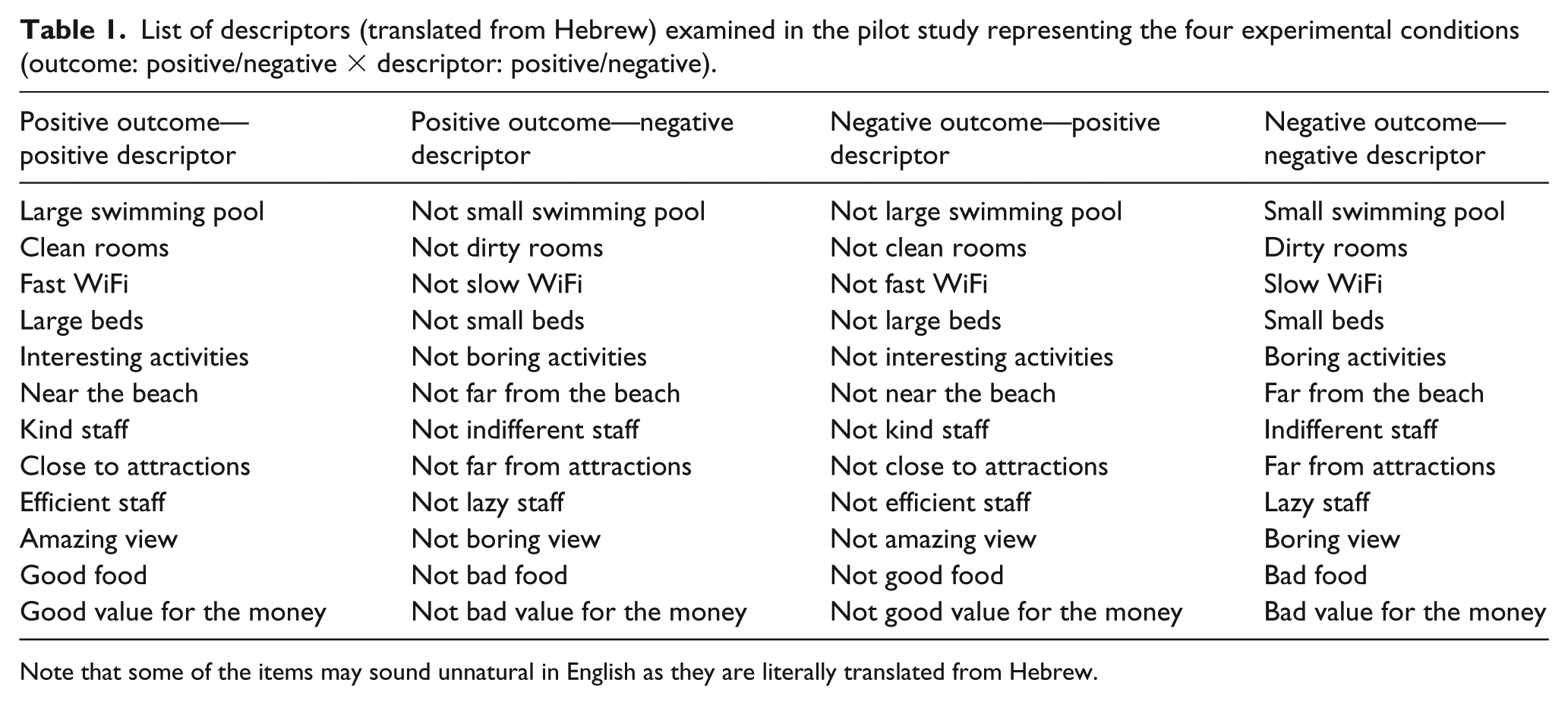
Note that some of the items may sound unnatural in English as they are literally translated from Hebrew.
In total, 75 undergraduate students (87% women; Mage = 23.6; SDage = 2.7), proficient Hebrew speakers, who participated in this study as a partial fulfilment of course requirements were asked to rate the characteristics on a 21-point scale, ranging from –10 to 10. Each participant was presented with a list of 48 characteristics presented in semi-random order based on randomising the order of presentation while constraining the randomisation such that items representing different versions of the same characteristic were separated by at least five items of different characteristics. Figure 1 presents the average responses of 75 participants to each of the 48 items. In general, descriptors that were intuitively classified as positive were indeed rated as positive, and descriptors classified as negative were indeed rated as negative. Moreover, the ratings appeared to similarly reflect the outcomes, such that positive outcomes rendered with negative descriptors were rated as positive, and negative outcomes rendered with positive descriptors were rated as negative.
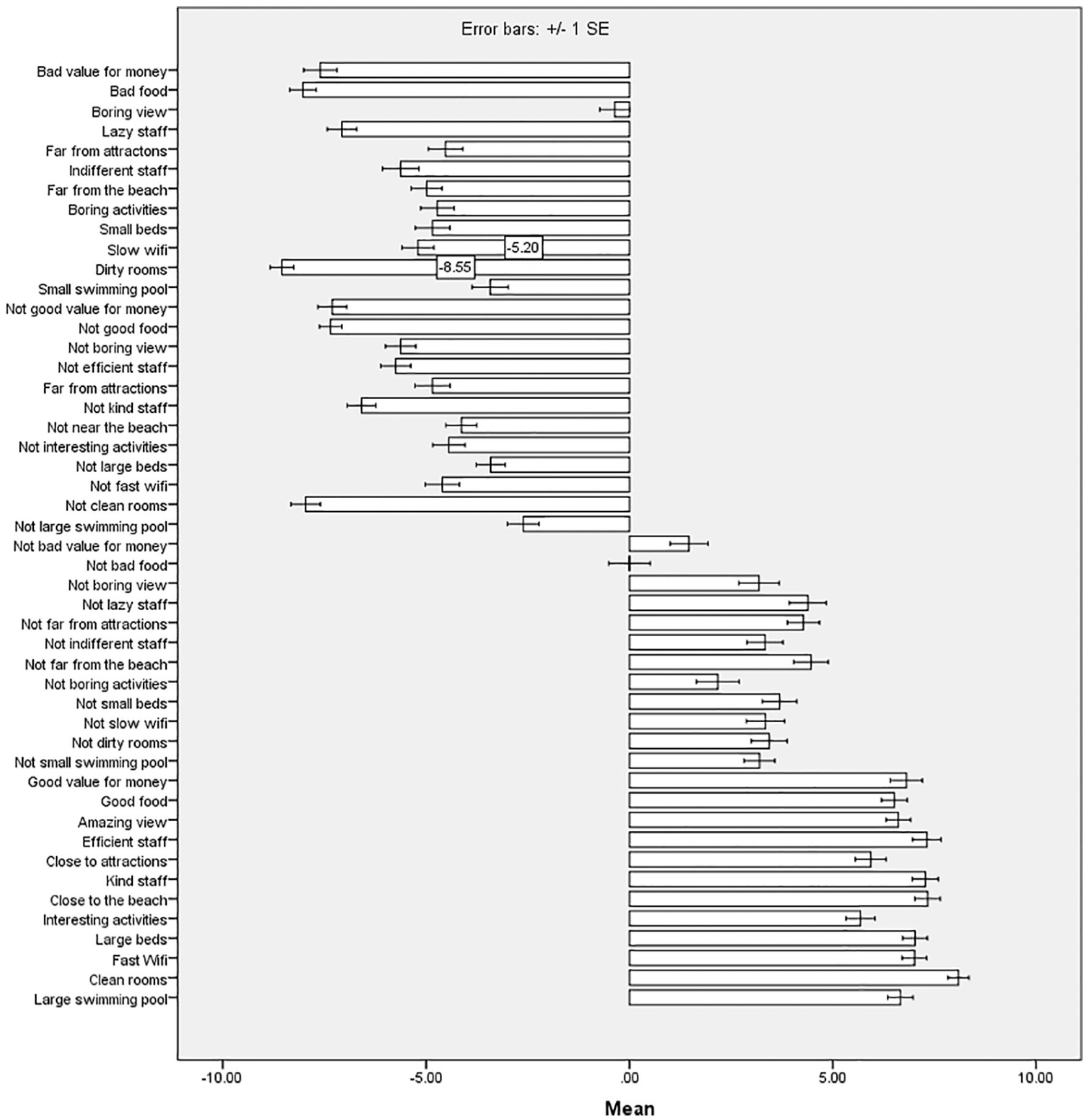
Average responses (error bars represent ±1 standard error) of 75 participants to each of the 48 items examined in the pilot study representing the four experimental conditions (outcome: positive/negative × descriptor: positive/negative).
Critically, two items deviated considerably from this general pattern (food, view). Hence, these items were excluded from Experiment 1, with the remaining 10 characteristics used for the experiment’s evaluation task. In addition, note that the groups are not symmetric. The descriptions comprising similar valence for both descriptor and outcome (i.e., either both positive or both negative) elicited more polarised ratings (Mpositive,positive = 6.92, SD = 1.87; Mnegative,negative = −5.65, SD = 2.10) than the descriptors comprising different valence for the descriptor and the outcome (Mpositive,negative = 3.38, SD = 2.75; Mnegative,positive = −5.16, SD = 2.05). We will discuss this observation in relation to the findings of Experiment 1.
Method
Participants
A total, 90 undergraduate students (73% women; Mage = 23.5; SDage = 2.9) who were proficient Hebrew speakers participated in this experiment. Participation comprised a partial fulfilment of course requirements.
Design
The experiment consisted of a 2 (outcomes) × 2 (descriptors) mixed factorial design that generated four experimental conditions, as presented in Table 2. The outcome factor comprised positive and negative outcomes manipulated between participants, and the descriptor factor comprised positive and negative descriptors manipulated within participants. Participants’ ratings were analysed as the dependent variable.
Sample item with the four versions representing four experimental conditions.

Materials
A total of 10 items were generated, such that each item had four versions representing the four experimental conditions. Table 2 presents the four versions of a sample item. Thus, each experimental condition was represented by 10 items. The 10 items were created using the characteristics pre-examined in the pilot study (excluding the two deviant items, as noted).
Procedure
Participants were recruited in an Israeli academic institution. They were invited for a judgements and evaluations experiment in the lab and were randomly assigned to either the positive or the negative outcome questionnaire. The experiment was self-administered as a computerised questionnaire. Participants were informed that they will be asked to read short descriptions and respond candidly, as their personal opinion is important in this study, there being no correct or incorrect answers to the questions. The experiment began with a scenario requesting participants to imagine that they were planning a vacation at an attractive destination and that they found several hotels that suit their budget with available rooms on the dates of their planned vacation. They were told that they would be presented with 10 summaries of reviewers’ comments about different characteristics of each hotel and that they would need to rate the hotel based on these comments. Following this general overview, a 10-item questionnaire was presented. Each item began with a short introduction, and then the framing sentence was presented. The 10 items presented to each participant described either positive or negative outcomes. However, five items used positive descriptors to describe the outcome, and the remaining five used negative descriptors to describe the outcome. Descriptors were counterbalanced across all participants, such that each participant was presented with only a single version of each descriptor; across all participants, all descriptors were presented the same number of times. Two questions were presented below the description: the first question asked for an evaluation of the object described in the scenario (e.g., What is your evaluation of the swimming pool in the hotel?) on a seven-point Likert-type scale, ranging from 1 (very low) to 7 (very high); the second question asked about the respondent’s intention to use it (e.g., Would you use the swimming pool in the hotel?) on a scale, ranging from 1 (definitely not) to 7 (definitely yes).
Results and discussion
The analysis reported below is based on an averaged response index, calculated for each participant across the two rating scales of each item, and the five items representing each condition. We posed no predictions regarding each of the rating scales, and we were not interested in each item per se; these were included to achieve better generalisation and higher statistical power. Hence, we examined the internal reliability of the 10 responses (two rating scales × five items) in each of the four experimental conditions. As reliability values ranged between .54 and .88, with a median of .76, the response consistencies allowed us to use an averaged response index. Figure 2 presents the averaged response index for each experimental condition.
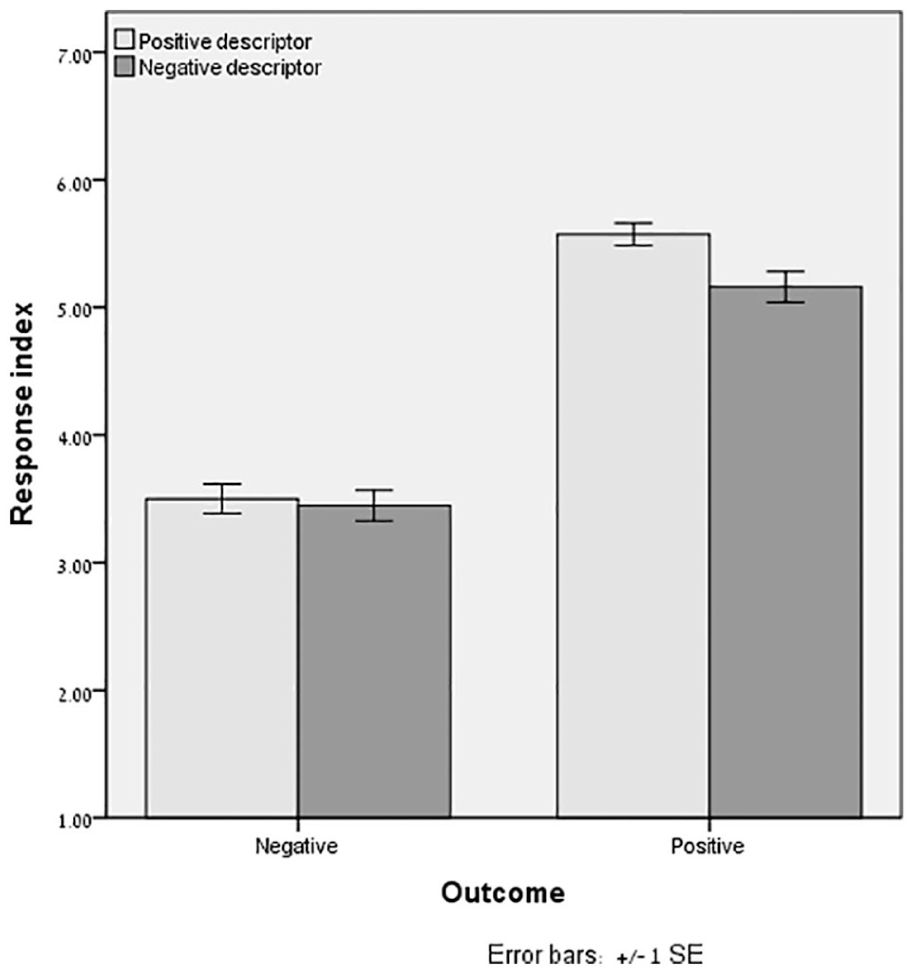
Means (error bars represent ±1 standard errors) of the response index as a function of the four experimental conditions in Experiment 1.
Figure 2 shows the effect of the framing outcome in both positive and negative descriptor conditions, including a relatively small effect of the descriptor valence only for the positive outcome condition. To test the statistical significance of these observations, a mixed two-way analysis of variance (ANOVA) was conducted with the outcome as a between-participant factor and the descriptor as a within-participant factor. The effect of the outcome was significant, F(1,88) = 198.04, p < .01, partial eta-squared
These findings are consistent with the attention account and only partially support the valence account. However, it is possible that the specific features of Experiment 1 could account for the limited effect of the description valence. One such feature is the use of continuous, rather than dichotomous, descriptors to label the attributes. As the negativity and positivity of such continuous descriptors are not always maximal, this feature might have qualified the descriptors’ effect. For example, one could reasonably argue that a not small does not necessarily imply large, but rather it might imply a mid-point in the continuum between small and large. To examine this explanation and test the effect of descriptors in a more polarised manipulation, we used dichotomous rather than continuous characteristics in Experiment 2.
Interestingly, the outcome-framing effects in Experiment 1 were substantially larger than the effect size typically reported in the literature. For positive descriptors, the outcome effect was 3.02 standard deviations, and for negative descriptors it was 2.13 standard deviations (see Figure 4), compared with the typical framing effects averaging around 0.5 standard deviations, according to Freling et al.’s (2014) meta-analysis. This exceptionally large effect may be explained by the large number of items referring to related attributes of similar target objects evaluated by each participant. Typically, AFB experiments do not use such item-repetition designs, but rather employ unrelated scenarios with different target objects to be evaluated. In Experiment 2, we used two unrelated objects as the target objects for evaluation to further examine the relative contribution of the outcome and the descriptor in a design similar to the typical AFB design.
Experiment 2
Method
Participants
A total of 76 undergraduate students who were proficient Hebrew speakers (87% women; Mage = 23.7; SDage = 2.6) participated in this experiment. Participation served as a partial fulfilment of course requirements.
Design
The design of Experiment 2 was similar to that of Experiment 1, comprising a 2 (outcomes) × 2 (descriptors) mixed factorial design, generating four experimental conditions, as presented in Table 3. The outcome factor comprised positive and negative outcomes manipulated between participants, and the descriptor factor comprised positive and negative descriptors manipulated within participants. Participants’ ratings were analysed as the dependent variable.
An example of one item with the four versions representing four experimental conditions.

Materials
Differing from Experiment 1, Experiment 2 presented six short scenarios unrelated to one another, involving dichotomous attributes. Two of the scenarios described failing to pass tests (adapted from Gamliel & Kreiner, 2013), two scenarios related to sports and involved missing or making free throws in basketball and winning or losing a tennis game (adapted from Levin, 1987), and two scenarios related to medical judgements and involved surviving or dying and becoming sick or remaining healthy (see the complete scenarios in the Supplementary Material). As in Experiment 1, four versions representing the four experimental conditions were generated for each scenario. Table 3 presents the four versions of a sample scenario.
Procedure
The procedure resembled that of Experiment 1 in most aspects. Participants were invited to the lab for a study about judgements and evaluations. They were randomly assigned to either the positive or the negative outcome questionnaire. Each participant was presented with six scenarios that described either positive or negative outcomes: three scenarios employed positive descriptors to describe the outcome and the three remaining scenarios used negative descriptors to describe the outcome. Descriptors were counterbalanced across all participants, such that each participant was presented with only one version of each scenario; across all participants, all scenarios were presented the same number of times. Two questions were presented below the scenarios: the first question requested an evaluation of the object described in the scenario (e.g., What is your evaluation of the driving instructor?) on a scale ranging from 1 (very low) to 7 (very high); the second question asked about participants’ recommendations (e.g., Would you recommend this instructor to your friend?) on a scale ranging from 1 (definitely not) to 7 (definitely yes).
Results and discussion
Data analysis is based on an averaged response index, calculated for each participant across the two rating scales of each scenario, and the three scenarios representing each condition. Again, as we had no predictions relating to each of the various scenarios or rating scales, we use an averaged response index, after examining the internal reliability of the six responses (two rating scales × three scenarios) in each of the four experimental conditions (reliability values ranged from .66 to .77, with a median of .71). Figure 3 presents the averaged response index for each experimental condition.

Means (error bars represent ±1 standard errors) of the response index as a function of the four experimental conditions in Experiment 2.
Figure 3 shows the effect of the framing outcome in both positive and negative descriptor conditions, with a relatively small effect of the descriptor valence in both outcome conditions. To test the statistical significance of these observations, a mixed two-way ANOVA was conducted, with the outcome as a between-participant factor and the descriptor as a within-participant factor. The effect of the outcome achieved significance, F(1,74) = 26.61, p < .01,
Thus, the general pattern of findings revealed in Experiment 2 resembles that of Experiment 1: a significant effect both for the descriptor valence and for the outcome, with a larger effect for the outcome (Cohen’s d = 1.10 for positive descriptors and 0.88 for negative descriptors), compared with the descriptor (Cohen’s d = 0.49 for positive outcomes and 0.23 for the negative ones). Note that in this experiment effect sizes were within the range reported in the literature (Freling et al., 2014). Whereas most AFB studies manipulate framing between participants, in both Experiment 1 and Experiment 2, the descriptor was manipulated within participants. This design may have yielded a confounding effect because the descriptor was consistently manipulated within participants, whereas the outcome was manipulated between participants. As within-participant designs tend to yield framing effects of a smaller magnitude, the smaller effect of the descriptor compared to the outcome could be an artefact of this design. Experiment 3 was designed to replicate Experiment 2, using a full between-participant factorial design. For this aim, we needed a larger sample, so we recruited participants through Amazon Mechanical Turk (MTurk). This further allowed us to examine the generalisability of our previous findings by extending the population sampled from Israeli college students to the more general population sampled by MTurk in the United States.
Experiment 3
Method
Participants
A total of 280 native English-speaking participants recruited through MTurk (Mage = 34.6; SDage = 10.9; 59% male) completed the study for US$0.50. Participants were US residents, aged 18 or above, pre-screened to have completed at least 500 previous tasks on MTurk with a success rate of at least 95%. The instructions resembled the ones detailed in Experiment 2.
Design and materials
The experiment consisted of a 2 (outcomes) × 2 (descriptors) between-participant design with two framing outcome conditions (positive, negative) and two descriptor valence conditions (positive, negative). The vaccination and the basketball player scenarios used in Experiment 2 were translated to English and used in Experiment 3. They were presented with a positive or a negative outcome, using dichotomous positive or negative descriptors (missing vs. making free throws in basketball, remaining healthy vs. becoming sick following vaccination).
Procedure
The procedure was similar to that of Experiment 2, but unlike Experiment 2 in this experiment participants were randomly assigned to one of the four experimental conditions to generate a full-factorial between-participant design. Each participant was presented with two scenarios and was asked to rate them on two different scales similar to those used in Experiment 2. Participants’ ratings were analysed as the dependent variable.
Results and discussion
Data analysis is based on calculating an averaged response index for each participant across the two rating scales of each of the scenarios (the internal reliability of the four questions was .68). Figure 4 presents the averaged response index in each experimental condition.

Means (error bars represent ±1 standard errors) of the response index as a function of the four experimental conditions in Experiment 3.
Figure 4 shows the effect of the framing outcome in both positive and negative descriptor conditions, with a relatively small effect of the descriptor valence only for the negative outcome condition. To test the significance of these observations, a two-way ANOVA was conducted with the outcome and descriptor as the between-participant factors. The analysis revealed a significant effect for the outcome, F(1,276) = 56.06, p < .01,
The findings of Experiment 3 indicate that the effect of the outcome framing is larger than that of the descriptor. Critically, these findings are consistent with the findings of Experiment 2, and they reveal that even when both the outcome and the descriptor are manipulated between participants, the outcome has a substantial and significant framing effect, whereas the effect of the descriptor is very small and does not achieve significance.
Integrating the findings of the three experiments
To examine the general pattern revealed across the experiments, Figure 5 presents the effect sizes (Cohen’s d) of the outcome effect within each descriptor (left) and of the descriptor effect within each outcome (right) for each of the three experiments. It can be seen from Figure 5 that, in all three experiments, the outcome framing has a substantial effect on evaluations, both when continuous descriptors were used (Experiment 1) and when dichotomous descriptors were used (Experiments 2 and 3). In contrast, the effect of the descriptor valence was neither as substantial nor as reliable. In particular, the descriptor effect was substantial only when manipulated as a within-participant factor (Experiments 1 and 2), but not when it was manipulated as a between-participant factor. Interestingly, in all experiments, the descriptor effect was larger for negative outcomes compared with positive outcomes.
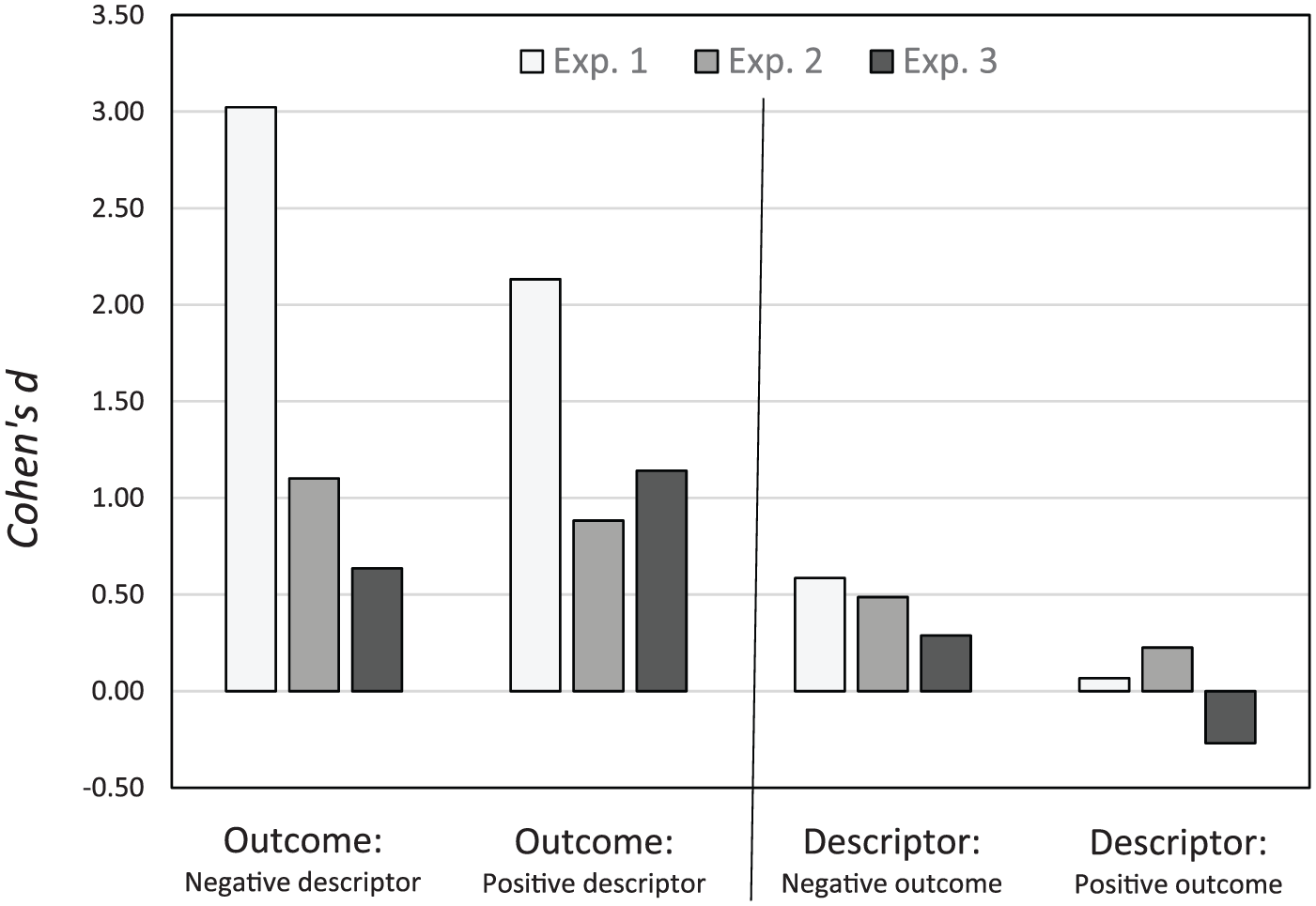
Effect sizes (Cohen’s d) of the outcome within each descriptor (left) and of the descriptors within each outcome (right) in the three different experiments.
General discussion
In three experiments, we showed that outcome framing affects evaluations when using either continuous or dichotomous descriptors, and when manipulating the descriptor either within or between participants. In Experiment 1, we used continuous descriptors, finding a very strong effect for the outcome valence and a substantially smaller though significant effect of the descriptor. These main effects were qualified by an interaction showing that the descriptor effect was significant only in the negative, but not in the positive outcome. In Experiment 2, we used dichotomous descriptors, finding a comparable pattern showing that the outcome valence had a stronger effect on responses than did the descriptor.
In Experiments 1 and 2, the descriptor was manipulated within participants and the outcome between participants; hence, the different effect sizes observed in these factors may have been due to a methodological artefact. Experiment 3 was a partial replication of Experiment 2, designed to address this possible confound by employing a between-participant design for both outcomes and descriptors. The results were consistent with those of Experiment 2, showing larger framing effects for the outcome and smaller effects for the descriptor. Thus, the general pattern of results emerging from the three experiments reveals a large and robust effect for the outcome manipulation and a relatively small, variable, and not so robust effect for the descriptor valence. Importantly, this pattern emerged consistently in the three experiments, despite the population differences in the experiments, the differences between continuous and dichotomous descriptors, and the different experimental designs.
Distinguishing between outcomes and descriptors enabled us to examine their relative contribution to the AFB. Moreover, in this study, we employed this distinction for the purpose of empirically examining two different mechanisms proposed by two theoretical accounts of AFB. The WYSIATI account highlights the role of the attention mechanism, proposing that framing bias is caused by shift of attention to either the positive or the negative outcome presented explicitly in the message. The association account highlights the role of the spreading-activation mechanism, proposing that positive and negative labelling activates a corresponding association valence that biases evaluations. We regard these accounts as complementary rather than conflicting accounts, assuming that both mechanisms contribute to framing bias. Using the outcome–descriptor distinction (Mandel, 2001; Tombu & Mandel, 2015) allowed us to examine the relative contribution of attention and associations to AFB. The results of the three experiments show that associations have a limited contribution. Specifically, descriptors moderate AFB when the outcome is negative but not when the outcome is positive (see Figure 4). In contrast, the outcome-framing manipulation had a consistent and large effect size in all three experiments and when using either positive or negative descriptors.
The size of the outcome effect in Experiment 1 was extremely high, exceeding the values reported in meta-analyses (Freling et al., 2014; Levin et al., 1998; Piñon & Gambara, 2005). We speculate that this relatively large effect size may be explained by the large number of items depicting related attributes of similar target objects (hotels) evaluated by each participant. This may have generated an accumulating effect that enhanced the bias yielded by the outcome manipulation. Critically, however, Experiments 2 and 3 yielded effect sizes within the range reported in the literature (SD = 0.5–1.0). Hence, the results in general suggest that the relative contribution of the attention mechanism is larger than the association account’s contribution. This conclusion is consistent with previous studies that used different methodologies to examine the contribution of attention mechanisms to AFB (Kreiner & Gamliel, 2018; Yechiam & Hochman, 2014).
In this article, the conceptualisation of the outcome–descriptor distinction was based on mapping the effect of descriptors onto the association mechanism and the effects of the outcome onto the attention mechanism. However, an alternative view may suggest that the positive or negative outcomes may also activate positive or negative associations, regardless of the descriptors used for labelling the outcome. The current experiment was not designed to examine this interpretation, which awaits future research.
Previous research used priming to show the effect of association valence on evaluations (McElroy & Conrad, 2009). Our findings are partially consistent with this finding, with the differences seemingly deriving from methodological differences. McElroy and Conrad (2009) used a priming paradigm, presenting participants with positive and negative descriptive words. However, they did not use a framing manipulation to present logically equivalent attributes using complementary frames. Hence, although their findings show a direct effect of associations on evaluation, it is not clear whether the framing effect is driven by this association mechanism. In fact, our findings suggest that the contribution of the descriptor that is assumed to activate the association valence according to Levin et al.’s (1998) account is fairly limited.
Critically, however, the findings indicate that, under certain conditions, the descriptors indeed contribute to AFB. This fragile effect suggests that the contribution of descriptors to AFB may depend on different moderators, such as the polarisation of the descriptor itself, the valence of context (in positive outcome messages, the descriptors’ contribution seems to be larger than in the negative ones), and previous information (e.g., priming). These findings suggest that, under some conditions, descriptors may have more prominent effects, but this study did not allow us to examine what conditions may enhance the effects of descriptors. Future research may shed more light on conditions that could enhance the effects of descriptors, for example, by encouraging associative thinking.
An alternative explanation may be related to the literal differences between the conditions. In the descriptor condition, the framing manipulation is based solely on different wording while the numbers do not change, i.e., 65% pass versus 65% not fail or 35% not pass versus 35% fail. By contrast, in the outcome conditions, the framing manipulation is based on different wording as well as different percentages, i.e., 65% pass versus 35% not pass or 65% not fail versus 35% fail. Further research is required to examine the alternative explanation that the larger framing effect associated with the outcome compared to the descriptor manipulations may be explained by the larger difference used to generate the outcome manipulation compared to the descriptor manipulation.
Conclusion
This study has important theoretical and applied implications. At the theoretical level, this study highlights the important relative contribution of association valence compared with attention shift in generating AFB. Future research may examine the generalisation of this conclusion to other framing types.
Importantly, these conclusions may have applied implications for contexts in which it is important to avoid potential biasing of people’s JDM for ethical or other considerations. For example, medical authorities are expected to provide unbiased information to patients and their families about the success and failure rates of medical interventions to enable them to take informed and unbiased decisions. The findings of this study call for special caution in presenting the information in terms of positive or negative outcomes. Caution is needed when presenting negative outcome using positive or negative descriptors. In these cases, a balanced presentation of both positive and negative framing is recommended. In addition, the findings suggest that trying to moderate the message conveyed by the outcome framing with descriptive words is not very helpful: an intervention would not be evaluated much differently if 20% of the patients are expected to die or not to stay alive. However, the same outcome may be evaluated more favourably if 80% of the patients are expected to stay alive or not to die.
Supplemental Material
Supplementary_Material – Supplemental material for “Alive” or “not dead”: The contribution of descriptors to attribute-framing bias
Supplemental material, Supplementary_Material for “Alive” or “not dead”: The contribution of descriptors to attribute-framing bias by Hamutal Kreiner and Eyal Gamliel in Quarterly Journal of Experimental Psychology
Footnotes
Acknowledgements
The authors wish to thank Liat Keren and Tomer Savir for their assistance in collecting the data used in this research.
Declaration of conflicting interests
The author(s) declared no potential conflicts of interest with respect to the research, authorship, and/or publication of this article.
Funding
The author(s) disclosed receipt of the following financial support for the research, authorship, and/or publication of this article: This research was partly supported by an internal grant of Ruppin Academic Centre.

References
Supplementary Material
Please find the following supplemental material available below.
For Open Access articles published under a Creative Commons License, all supplemental material carries the same license as the article it is associated with.
For non-Open Access articles published, all supplemental material carries a non-exclusive license, and permission requests for re-use of supplemental material or any part of supplemental material shall be sent directly to the copyright owner as specified in the copyright notice associated with the article.
