



Abstract
Previous research has shown that giving an instruction to forget part of a studied list of items impairs the subsequent retrieval of these items compared with those not cued to be forgotten. This selective directed forgetting (SDF) effect has been found with slightly different procedures and in adolescents and young adults. While recent research has suggested that executive control might underlie SDF, alternative explanations that rely on procedural issues still have not been investigated. Specifically, SDF might essentially reflect output interference from the items cued to be remembered, so that the earlier recalled items interfere with the later recalled items. The effect could also result from demand characteristics: Participants might withhold the to-be-forgotten items to comply with the experimenter’s implicit goals or might not be willing to engage in the effort of retrieving all studied information. The results from two experiments showed that (1) the to-be-forgotten items were less accessible and were not influenced by output interference from to-be-remembered items (Experiment 1), and (2) SDF was still present when participants were offered monetary reward for retrieving as many items as possible (Experiment 2). Hence, the findings do not provide support to explanations of SDF based on output interference and demand characteristics.
Keywords
Recent studies have shown that people can intentionally forget part of previously presented information when instructed to do so (Aguirre et al., 2014, 2017; Delaney et al., 2009; Gómez-Ariza et al., 2013; see also Kliegl et al., 2013, 2018). This experimentally induced selective directed forgetting (SDF) might mimic daily-life situations in which we might be motivated to partially update our long-term memory. In real life, we are sometimes motivated to forget all about a specific event (i.e., an unhappy trip to Madrid), but at other times we may want to forget only part of the event (i.e., an unpleasant encounter in an otherwise satisfactory trip to Madrid). Hence, the latter case could require selective control mechanisms to make the unwanted part of the episode less retrievable.
In the SDF procedure introduced by Delaney et al. (2009), participants first learn a list of sentences about two characters. Then, half of the participants are asked to forget the learned sentences about one of the characters (to-be-forgotten items) because they are no longer relevant, and to learn instead a new set of sentences about a third character. The other half of the participants, in contrast, are asked to study the additional list of sentences about the third character without any mention of forgetting one of the characters. After learning the additional list of sentences, all participants are asked to recall the first list of sentences. In their study, Delaney et al. (2009) also manipulated whether the sentences about the same character were thematically related. While the instruction to selectively forget failed to have an effect on recall in the thematic condition, Delaney et al. did find selective directed forgetting in the non-thematic condition. Specifically, the participants cued to forget the facts regarding one of the characters in List 1 showed a specific memory deficit for those facts, relative to the group cued to remember. Since then, this effect has been replicated by other studies using similar procedures (Aguirre et al., 2014, 2017; Gómez-Ariza et al., 2013; Kliegl et al., 2013, 2018; but see Akan & Sahakyan, 2017; Storm et al., 2013, for failures to replicate the effect). For example, Gómez-Ariza et al. (2013) observed SDF in a group of healthy adolescents (but the effect was absent in an age-matched group with social anxiety disorder). Aguirre et al. (2014) compared college students and older adults, and observed the effect only with the younger participants. Selective motivated forgetting was also observed with a related paradigm by Kliegl and colleagues (Kliegl et al., 2013, 2018). Thus, for example, in their Experiment 1, Kliegl et al. (2013) had participants study three short lists of unrelated words. After studying List 2, some participants were cued to forget List 2 but to remember List 1, whereas the remaining participants were cued to keep remembering both lists. Poorer retention for List 2 was observed only in the forget group. With a related procedure in which participants are asked to forget List 2 but retain List 1, Racsmány et al. (2018, Experiments 2 and 3) found selective forgetting of List 2.
Some studies have been directed to test explanations of the SDF effect based on selective rehearsal or inhibitory control. For example, the selective rehearsal explanation (Delaney et al., 2009; Storm et al., 2013) proposes that, after receiving the instruction to forget, participants might instead rehearse the previously presented to-be-remembered (TBR) information and that this selective rehearsal results in better recall for the rehearsed items. From this view, poorer memory for the to-be-forgotten (TBF) items at test will be a consequence of selective rehearsal of the TBR items at study. Hence, if selective rehearsal is contingent on the instructions to forget, one would expect to observe better recall of the TBR items in the forget group than in the remember group. However, no evidence of such a benefit has been shown so far (Aguirre et al., 2014, 2017; Delaney et al., 2009; Gómez-Ariza et al., 2013; Kliegl et al., 2013). Moreover, selective rehearsal seems difficult to implement because, after being told either to remember or to forget, participants engage in distractor tasks (math operations: (Aguirre et al., 2014; Delaney et al., 2009; Gómez-Ariza et al., 2013; Storm et al., 2013; working memory updating: Aguirre et al., 2017) that would preclude rehearsal. Aguirre et al. (2017, Experiment 1) more directly tested the rehearsal hypothesis by introducing an articulatory suppression task in the SDF procedure. In this experiment, participants were asked to repeat a syllable during the time in which they might be rehearsing the TBR information (after List 1 and during List 2 presentation). Articulatory suppression (continuous verbalization of a syllable) has been demonstrated to prevent information from being rehearsed in working memory without overloading cognitive control (Baddeley, 1986; Baddeley & Larsen, 2007; Murray, 1968). Hence, if selective rehearsal is the mechanism that underlies SDF, the effect should have disappeared or been reduced with articulatory suppression. However, Aguirre et al. (2017) observed a reliable SDF effect, which speaks against the role of selective rehearsal in directed selective forgetting.
SDF has also been proposed to result from inhibitory control. In this line, Gómez-Ariza et al. (2013) reported data indicating that people with social anxiety disorder might not be able to selectively forget. In their experiment, they asked two groups of adolescents to perform the SDF task. One group was diagnosed with social anxiety disorder, while the other was a healthy age-matched group. The results showed that while the non-anxiety group exhibited SDF, the effect was not present in the group diagnosed with anxiety disorder. Because anxiety is thought to impair cognitive control (i.e., Bishop, 2009), the results were interpreted as supporting an inhibitory account. In a similar vein, Aguirre et al. (2014) reported SDF differences between younger and healthy older adults who, according to the inhibitory deficit hypothesis (Hasher et al., 1999; Hasher & Zacks, 1988; for a review, see Lustig et al., 2007), are also less able to engage in inhibitory control. Thus, in their experiments they found SDF in younger but not in older adults (Experiments 1a and 1b). Hence, these findings suggest that selective voluntary forgetting may depend on (inhibitory-like) control mechanisms that might be impaired in older people and in people with anxiety disorders.
More recently, Aguirre et al. (2017) explored the role of attentional control (Experiment 2) and the demands for selectivity (Experiment 3) in SDF. Attentional control was manipulated by introducing a concurrent updating task after List 1 presentation and during List 2 learning. The updating task required participants to constantly update information in working memory and was expected to deplete executive control (Ortega et al., 2012; Román et al., 2009). Results showed that while there was a reliable SDF effect in the condition without a secondary task, the presence of the secondary task led to non-selective forgetting of List 1 items. This suggests that the dual-tasking eliminated selective forgetting. In Experiment 3, the proportion of TBF/TBR material was varied as a way of manipulating the demands for selectivity. Previous studies on visual search (Reijnen et al., 2013) had suggested that it is harder to search for a smaller number of items among a large set than to search for a larger number among a smaller set of items. Thus, in Experiment 3, participants were asked to forget either 1/3 of List 1 (high demand for selectivity) or 2/3 of List 1 (lower demand for selectivity). Results showed a reliable SDF effect only in the less demanding condition, suggesting that under conditions that render selectivity harder, participants may not be able to selectively forget.
Whereas previous findings fit with an inhibitory account of selective motivated forgetting (Aguirre et al., 2014, 2017; Gómez-Ariza et al., 2013; see also Kliegl et al., 2018; for a review on motivated forgetting, see Anderson & Hanslmayr, 2014), there are still two simpler additional accounts of SDF that have not been examined so far. First, it is possible that forgetting of the TBF items could be due to output interference from TBR items, rather than to active downregulation of the TBF items. Second, SDF could be due to effects of demand characteristics (i.e., participants either withhold the TBF items or they do not do their best to recall them). Output interference refers to the recall impairment for some items because of the prior retrieval of other items from the same learned set (Malmberg et al., 2014; Raaijmakers & Shiffrin, 1981; Roediger & Schmidt, 1980; Smith, 1971). Thus, output interference in the context of the SDF procedure may result from the attempts to recall the TBR items first. It is possible that, at test, participants initially try to retrieve as many TBR items as possible; this, in turn, would interfere with the retrieval of the remaining items, diminishing the likelihood of coming up with the TBF items. The role of output interference has been explored ad hoc in previous research (see Aguirre et al., 2014, 2017; Delaney et al., 2009) by analysing participants’ output positions. While these analyses have failed to provide significant output differences between TBF and TBR items, we aimed to directly test this hypothesis by manipulating the order of retrieval of the TBF information.
In addition, we wanted to explore whether SDF could result from demand characteristics (Orne, 1959, 1962). It is possible that the observed forgetting effects might be due to participants withholding information because they try to comply with the implicit goals of the experimenter (“as the experimenter told me to forget some information, he/she expects me not to remember it”). Related to this, participants might not be motivated enough to do their best to retrieve the TBF items or might not be aware of the possible importance of retrieving the information (Orne, 1959, 1962). A way to overcome possible demand characteristics in motivated forgetting studies has been to implement monetary payoff systems to reward participants for their results in the memory tests. While demand characteristics have been demonstrated not to be relevant in non-selective directed forgetting studies (Bjork & Woodward, 1973; Geiselman et al., 1985, Experiment 4; MacLeod, 1999; Woodward & Bjork, 1971; see also Anderson & Green, 2001), their possible role in producing selective directed forgetting is still to be investigated.
Therefore, the aims of the present studies are (1) to test the hypothesis that the SDF effect may result from output interference, and (2) to investigate whether demand characteristics can explain the SDF effect. In Experiment 1, we aimed to evaluate the possible role of output interference by asking participants to recall the TBF items in the first place to preclude any interference from items cued to remember. If SDF is the result of retrieving TBR items prior to TBF items, this testing condition should lead to reduced or even null SDF. In Experiment 2, we explored the idea that participants either withhold information or are not motivated to retrieve all the items when told to do so. Specifically, at test we explicitly told participants that they would be rewarded 0.25 euros per each correct item (either TBR or TBF) that they could remember. If participants’ motivation to recall or write down TBF items had some influence on the SDF effect, one would expect monetary reward to lead to a reduced or null SDF effect.
Experiment 1
Method
Participants and design
In this and the next experiment, the sample size was estimated (80% power) with G*Power software (Faul et al., 2007) from the effect size of a previous experiment (interaction Instruction × Character, η2p = .123; Aguirre et al., 2014, Experiment 1, young sample). The software provided a sample size of 30 per group. Hence, 60 participants (mean age = 19.91 years; SD = 1.15; 32 women) were randomly assigned, half to each of the two experimental groups. Participants were undergraduate students from the Universities of Granada and Jaén, and received 6 euros for their participation. Importantly, to avoid previous knowledge about the procedure influencing participants’ behaviour, only naïve first-course psychology students or students enrolled in degrees other than psychology were eligible to participate in this and the next experiment. In both experiments, all participants gave written informed consent in accordance with the Declaration of Helsinki (World Medical Association, 2013). The mixed experimental design involved four conditions obtained by factorially crossing instruction (remember and forget) with List 1 character (Tom and Alex), with the latter being the within-participants factor.
Materials and procedure
The procedure and materials used here closely followed those employed by Aguirre et al. (2014, 2017). List 1 consisted of 18 thematically unrelated sentences about two characters: nine for Alex and nine for Tom (“Tom/Alex ate a sandwich”). List 2 consisted of 14 sentences about a third character named Joe (“Joe played tennis”) (see Supplemental Appendix). List 1 contained 18 sentences that have already been used in previous studies (Aguirre et al., 2014, 2017). Similarly, List 2 consisted of 14 sentences used in the original study by Delaney et al. (2009). We did not increment List 2 to 18 items as we had no predictions about List 2 and our experimental design was not suitable to properly assess performance on List 2 (we asked participants to recall L2 after L1, Pastötter et al., 2012). The sentences were presented in Spanish. The order of the character and the subject (Tom/Alex)-action assignation were both counterbalanced across participants, with approximately the same number of participants in each condition (ranging from 14 to 16). The sentences of each character were presented in alternating order. Upon arrival, participants were told that they were going to take part in a memory study. During the whole session, they were asked to do their best to follow the instructions of the experimenter. First, they were asked to learn List 1. Each sentence in the list was presented on the screen for 8 s. Participants were asked to study each sentence as well as they could. After studying of List 1, half of the participants received the instruction to study the next list (the remember group) and the other half were asked to forget the sentences regarding one of the characters (Tom sentences). This forget group received the following instructions: From now on you will not be asked to recall the sentences about Tom. These sentences were just fillers to make your study task harder at the beginning, but now just forget about them. We are only going to ask you about Alex sentences. Forgetting Tom will help you recall better the sentences related to Alex, so just try to forget the sentences about Tom.
After the remember/forget instructions, participants performed a distractor task for 90 s. To minimise the possibility of selective rehearsal of the TBR items after receiving instructions to forget, we introduced a working memory (WM) updating task as a distractor after presentation of List 1 (see Aguirre et al., 2017). For this task, participants were asked to listen to a series of random digits from 1 to 9 and to press a key whenever they heard three odd digits in a row. This task lasted 90 s, and then participants were presented with List 2. We included the distractor tasks for both the Forget and Remember groups and for List 1 and List 2. Thus, after studying List 2, participants performed the distractor task for 90 s, and then they were provided with a blank sheet where they had to recall as much as they could from List 1. Importantly, and unlike previous studies on SDF, in the present experiment the order of recall was fixed and the same for all participants. Thus, they were required to recall TBF items first, so that they were instructed to recall and write down everything they could about Tom (TBF, List 1). After 2 min, they were asked to recall TBR List 1 items (Alex), and they received instructions not to go back and fill in more sentences about Tom. After another 2 min, they were presented a different sheet and asked to recall List 2 items.
Participants in the forget group were also asked whether they believed the experimenter when they were told to forget about Tom sentences and believed that Tom sentences were no longer to be remembered. As in previous studies (Aguirre et al., 2014, 2017), in this and the next experiment, participants who reported not having believed the forget instructions were replaced. This was the case for six participants in Experiment 1.
Results
In this and the next experiment, recalled sentences were marked as correct if they kept the gist of the original sentence and contained the studied character–action association. Importantly, in Experiment 1 TBF, items (Tom sentences) were only counted as correct if they were recalled in the first part of the recall test. Thus, if a TBF item appeared in the second part of the test, when participants were to recall TBR items (Alex sentences), this item was not counted as correct. The same criterion was followed with TBR items if they were recalled in the first part of the test. Furthermore, and for both experiments, only sentences from List 1 retrieved during the memory test for this list were counted as correct (the same criterion was used with List 2 sentences). The recall performance was first scored by two coders who were blind to the experimental conditions. The inter-rater agreement was over 95%. A third independent coder scored the sentences on which agreement had not been reached to break ties. Below, we first report 1 analyses and results for List 1 recall, as these are the analyses concerning SDF effects. However, for completeness, we also report analyses on List 2 recall (see Figure 1).
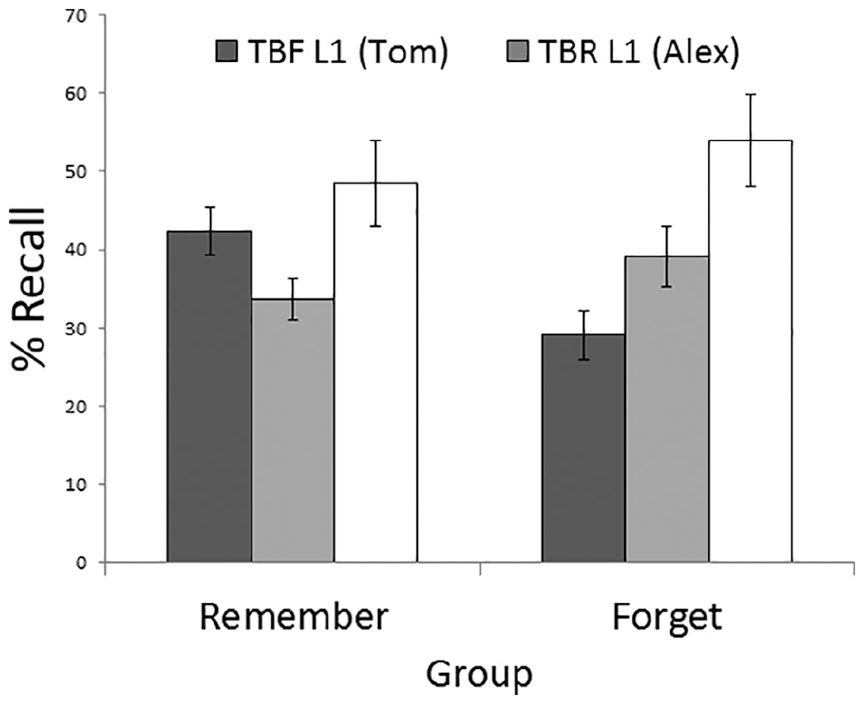
Mean percentage of correct recall as a function of instruction and character in Experiment 1. Error bars represent standard errors of the mean.
List 1 recall: selective directed forgetting
We carried out a mixed factorial analysis of variance (ANOVA) on recall percentages with instruction (remember vs. forget) as the between-participant factor and character (TBF vs. TBR) as the within-participant variable. The main effects of instruction and character did not reach statistical significance (both Fs < 1), but the ANOVA revealed a reliable interaction, F (1,58) = 15.91, mean square error (MSE) = 168.20, p < .001, η2G = .06. We further analysed the significant Instruction × Character interaction by performing planned comparisons. The forget group recalled fewer TBF items than the remember group, M = 29.07; SD = 17.36; and M = 42.40; SD = 16.91, respectively, F (1, 58) = 9.07, MSE = 293.91, p = .003, d = .77. In contrast, analyses on the TBR items showed similar recall in the forget and remember groups, M = 39.07; SD = 21.41; and M = 33.51; SD = 14.47, respectively, F (1, 58) = 1.38, MSE = 334.15, p = .24, d = .30.
We also examined the interaction by comparing recall of TBR and TBF items within each group. Note that for the remember group all the items were to be recalled and that TBR and TBF refer only to the status of the items for the forget group. Planned comparisons in the forget group showed that participants recalled more TBR than TBF items, TBF: M = 29.07; SD = 17.36 and TBR: M = 39.07; SD = 29.41, F (1, 58) = 8.92, MSE = 168.16, p = .004, d = .51. The pattern of recall in the remember group was the opposite: These participants recalled more items about Tom (the TBF character in the forget group) than about Alex (the TBR character in the forget group), M = 42.40; SD = 16.91, and M = 33.51; SD = 14.47, respectively, F (1, 58) = 7.04, MSE = 168.16, p = .01, d = .56. Hence, there was a reliable output order effect in the remember group that was reversed in the forget group.
List 2 recall
A one-way ANOVA on recall percentages showed no effect of group (F < 1).
Discussion
The results of Experiment 2 showed a reliable SDF effect, which was in line with previous research (Aguirre et al., 2014, 2017; Delaney et al., 2009; Gómez-Ariza et al., 2013; Kliegl et al., 2013). This finding rules out an explanation based on output interference. If SDF was due to output interference of TBR items over TBF items, then asking participants to retrieve TBF items first should have increased the recall of TBF items and the SDF effect should have been smaller or even null. However, the results of Experiment 1 showed that the first-recalled (TBF) items were not retrieved better than the (TBR) items that were to be recalled later. Rather TBF items were less recallable even when they were to be recalled first.
Importantly, the results also revealed an output order effect in the remember group by which the items asked to be recalled first (those related to the TBF character in the forget group) were better recalled than the items to be recalled second (those related to the TBR character in the forget group). Hence, the usual output order effect was present in the control group when participants were not told to forget information about any of the characters. By contrast, no evidence of output interference was observed in the forget group, wherein the instructions to forget overshadowed the recall order. This suggests that the TBF items were indeed less accessible at test and rules out possible explanations of the SDF effect based on output interference.
Experiment 2
The present experiment aimed to understand whether participants’ expectations influence their recall. A major concern of motivated forgetting research has been to know whether participants withhold information from the experimenter when they are finally required to retrieve as much information as they can. This could be due to participants wanting to comply with what they might think are the experimenter’s wishes, or to participants not trying hard enough to retrieve TBF information because they do not understand how important it is for the experiment that they retrieve everything they can. In directed forgetting studies (item-method procedure: Bjork & Woodward, 1973; Geiselman et al., 1985, Experiment 4; Woodward & Bjork, 1971; list-method procedure: MacLeod, 1999; for a related procedure, see also Anderson & Green, 2001), the demand characteristics problem has been addressed by offering participants a monetary reward for each retrieved item. The rationale is that if participants are withholding information or not making enough effort to retrieve all of the items, offering the reward should change the way that they engage in the memory test, enhancing their efforts to retrieve all the items. If this were the case, the forgetting effect would disappear.
Previous studies have shown that monetary rewards do not modulate forgetting effects as observed in standard directed forgetting procedures (Bjork & Woodward, 1973; Geiselman et al., 1985; MacLeod, 1999; Woodward & Bjork, 1971) or in related motivated forgetting procedures such as the Think/No Think task (Anderson & Green, 2001). For example, Woodward and Bjork (1971) manipulated payoff (0.1 dollars) both during study and test phases and showed that the monetary reward did not improve TBF item recall (Experiment 1), whereas making the TBF and TBR be semantically related did. Similarly, MacLeod (1999) examined the effects of a payoff on the participants’ recall by giving them a second chance to recall all the items (TBR and TBF) after finishing a first recall test. Unlike for their first recall attempt, for this second recall attempt participants were offered payment for every additional TBF item they could retrieve. If participants were withholding information or were not willing to do their best on the first memory test, this new instruction should make them retrieve a significant number of TBF items in the second memory test. However, results showed no recall improvement for the TBF items in the second memory test.
Overall, then, forgetting effects in non-selective motivated forgetting procedures seem not to be affected by demand characteristics (Bjork & Woodward, 1973; Geiselman et al., 1985, Experiment 4; MacLeod, 1999; Woodward & Bjork, 1971). However, this potential influence has not been investigated so far in selective directed forgetting. Although both non-selective DF and SDF involve motivated forgetting, SDF entails an additional memory selection process that could potentially be affected by demand characteristics. Previous research has shown a dissociation between the processes of selection and forgetting in SDF (Aguirre et al., 2017, Experiments 2 and 3) and, therefore, there might be factors that differentially influence them.
The aim of the present study was to test the demand characteristics hypothesis by introducing a monetary payoff system during the free recall test, and by instructing participants to put all their effort into trying to retrieve as many items as they could. If the SDF effect is due to withholding information or not making enough effort to retrieve studied items, then offering participants a monetary reward for correct items should reduce or eliminate the effect.
Method
Participants and design
Sixty new college students (mean age = 20.56 years; SD = 2.6; 39 women) participated in the experiment and were randomly assigned to the two experimental groups. All of them were undergraduates from the Universities of Granada and Jaén and received 6 euros for their participation. In addition, participants could earn up to 7.5 euros extra as they were paid 0.25 euros for each correct item that they came up with. The experimental design was the same as in Experiment 1.
Materials and procedure
The procedure in this experiment mimicked the one used in Experiment 1 except for two important changes concerning the testing phase. First, similar to most SDF experiments and differently from Experiment 1, participants were asked to recall as many items from List 1 as possible, without any instruction on output order. Second, the instructions at test emphasised that 0.25 euros would be paid per each correct item being recalled. Specifically, participants were told, You are expected to recall everything you can from List 1, and we are going to give you 0.25 euros for each correct item you can remember. Even information about Tom, on which I previously asked you to forget, is now relevant and I would like you to do your best to recall as much as possible.
They were also given 0.25 euros in exchange for correctly retrieving items from List 2.
Results
List 1 recall: selective directed forgetting
The mixed factorial ANOVA (Instruction × List 1 Character) on recall percentages revealed a reliable main effect of character, F(1,58) = 11.12, MSE = 113.30, p < .001, η2G = .03, and a marginally significant effect of instruction, F(1,58) = 3.37, MSE = 511.90, p = .07, η2G = .04. More relevant, the interaction reached statistical significance, F(1,58) = 9.89, MSE = 113.30, p = .002, η2G = .02. Planned comparisons indicated that both groups recalled a similar number of items on Alex (TBR items in all cases; remember group: M = 41.11; SD = 20.24; forget group: M = 39.62; SD = 18.14, F < 1), whereas Tom items (TBF in the forget group) were more poorly recalled in the forget group than in the remember group (M = 27.03; SD = 13.89; and M = 40.74; SD = 17.82, respectively), F (1, 58) = 11.02, MSE = 255.49, p < .001, d = .85 (see Figure 2). As in Experiment 1, we also performed within-group comparisons. These analyses showed that the group cued to remember recalled items on both characters to the same extent (Tom: M = 40.74; SD = 17.82; Alex: M = 41.11; SD = 20.24; F < 1), whereas the group cued to forget remembered fewer TBF items (Tom) than TBR item, Tom: TBF items: M = 27.03; SD = 13.89; Alex: TBR items: M = 39.62; SD = 18.14, F(1,58) = 20.99, MSE = 113.27, p < .001, d = .78.
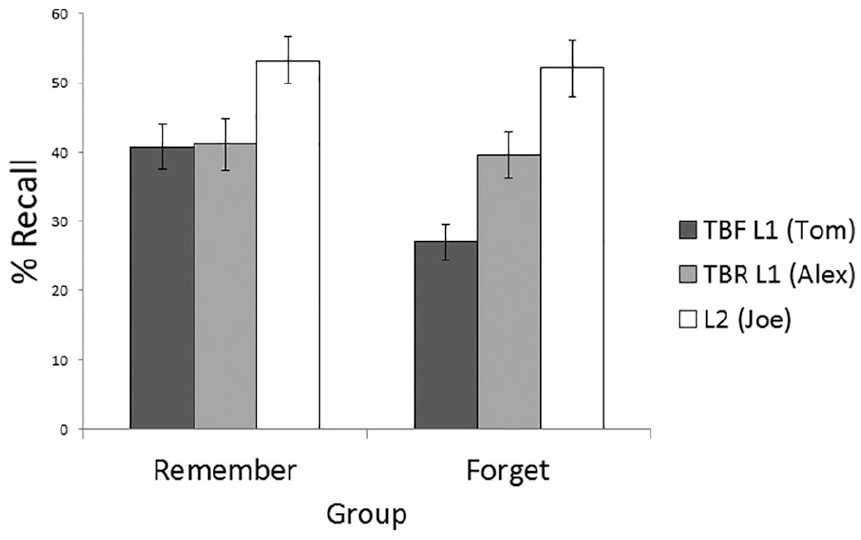
Mean percentage of correct recall as a function of instruction and character in Experiment 2. Error bars represent standard errors of the mean.
List 2 recall
The one-way ANOVA on List 2 revealed no significant effects of group (F < 1).
Discussion
Although there is evidence showing that some motivated forgetting effects do not depend on demand characteristics (Anderson & Green, 2001; Bjork & Woodward, 1973; Geiselman et al., 1985; MacLeod, 1999; Woodward & Bjork, 1971), no previous study had examined the influence of demand characteristics on SDF. In the present experiment, we addressed this issue by offering participants 0.25 euros for every correct studied (either TBR or TBF) item that they could recall. If demand characteristics played a role in accounting for SDF, one would expect the effect to be reduced or eliminated when recall is encouraged by monetary rewards. However, the results revealed that the SDF effect was still present when participants were paid for retrieving as much information as they could retrieve, and therefore, demand characteristics alone are unlikely to explain the SDF effect.
General discussion
Over the last decade, research has shown that directed forgetting can be selective (Aguirre et al., 2014, 2017; Delaney et al., 2009; Gómez-Ariza et al., 2013; Kliegl et al., 2013). This line of research has also started to address the conditions underpinning SDF as well as its possible underlying mechanisms (Aguirre et al., 2014, 2017; Delaney et al., 2009; Gómez-Ariza et al., 2013; Kliegl et al., 2013, 2018; but see Akan & Sahakyan, 2017; Storm et al., 2013, for failures to replicate). One of the explanations proposed to account for this forgetting phenomenon relies on differential encoding for TBR and TBF items. This hypothesis assumes that, after receiving the forget instruction, participants selectively rehearse the TBR items instead, so that the subsequent poorer level of recall for TBF items would be a by-product of this rehearsal (Delaney et al., 2009; Storm et al., 2013). As previously mentioned, however, the experimental evidence does not support this explanation (Aguirre et al., 2014, 2017; Delaney et al., 2009; Gómez-Ariza et al., 2013; Storm et al., 2013). The hypothesis that SDF relies on executive control has been more successfully supported by the data (Aguirre et al., 2014, 2017; Gómez-Ariza et al., 2013; see also Kliegl et al., 2018). However, some simpler alternative explanations had not previously been addressed. These additional hypotheses do not rely on genuine motivational forgetting processes, but they both could account for SDF effects. The aim of the present study was to directly address them.
First, it could be argued that SDF results from interference at test that is caused by the earlier retrieval of the items originally cued to be remembered (Malmberg et al., 2014; Raaijmakers & Shiffrin, 1981; Roediger & Schmidt, 1980; Smith, 1971). If, during the free recall test, participants retrieve the TBR items first, TBF items could suffer from output interference, which could in turn lead to their incidental forgetting. Previous studies had already provided some evidence that this might not be the case (Aguirre et al., 2014, 2017; Delaney et al., 2009), as analyses of the output order positions for TBR and TBF items showed no differences between the two types of items (Aguirre et al., 2014, 2017; Delaney et al., 2009). In Experiment 1, we directly examined this issue by instructing participants to retrieve TBF items first. In this way, we were deliberately trying to favour the recall of the TBF items at the expense of the recall of the TBR material. If SDF is due to output interference, the usual memory impairment for the TBF items should have been eliminated or reduced under these conditions. Moreover, one could even expect worse memory performance for TBR than for TBF items (as output order would hinder the retrieval of the items that were cued to remember). Contrary to what would be expected from an output interference account, however, there was a reliable SDF effect. The group cued to forget showed poorer recall of Tom sentences (those cued to be forgotten in this group) than did the remember group. Interestingly, the remember group that also was asked to recall items about Tom first exhibited a typical output interference effect. Hence, the fact that the forget group showed poorer memory for TBF-Tom items than the remember group did, does not seem compatible with the hypothesis that the SDF effect results from output interference. We acknowledge, however, that it would be still possible to argue that the participants covertly recalled the TBR items first but refrained from saying them aloud, as performance on the recall test is blind to the internal retrieval dynamics beyond observable behavioural effects. However, and in agreement with previous results (see Aguirre et al., 2014, 2017; Delaney et al., 2009), ad hoc analyses 2 of output order in Experiment 2 failed to show reliable differences between the sentences associated with Tom and the sentences associated with Alex in both the remember and the forget groups. This replicates previous findings and suggests that output interference does not play a pivotal role in producing SDF.
The second explanation that we explored relates to demand characteristics of the experimental situation (Orne, 1959, 1962). It could be argued that either participants do not output everything that they actually remember or that they do not try hard enough to retrieve everything they can. While it has already been shown that these factors do not modulate non-selective directed forgetting effects (Bjork & Woodward, 1973; Geiselman et al., 1985, Experiment 4; MacLeod, 1999; Woodward & Bjork, 1971; see also Anderson & Green, 2001 for a related procedure), they could affect SDF as previous research has shown that there are differences not only in the experimental procedures used to investigate motivated forgetting (i.e., instructions, materials), but also in the processes involved (SDF involves additional memory selection processes that are not required in other motivated forgetting procedures; see Aguirre et al., 2014). Hence, in Experiment 2, we tested this hypothesis by implementing a monetary reward at test. If participants were withholding information or not trying to do their best to retrieve as many items as they could, a payoff system should encourage them to do their best. Results showed a reliable SDF effect, indicating that TBF items were still less accessible than TBR items. Thus, the poorer recall of TBF items as observed with the SDF procedure does not seem to be biased by demand characteristics.
A point that deserves attention is the robustness of the SDF effects. Recently, Akan and Sahakyan (2017) cast some doubt on the replicability of the effects (see also Storm et al., 2013, for failures to replicate SDF). Although the reasons for these replication failures are not evident to us, as Kliegl et al. (2013) pointed out, the question might not be whether SDF is possible, but rather under which situations it appears. Because selective motivated forgetting has been linked to executive control (Aguirre et al., 2014, 2017; Gómez-Ariza et al., 2013; see also Kliegl et al., 2018), factors that affect how control is exerted can also hinder either the capacity to select the information cued to forget or the capacity to selectively forget it (Aguirre et al., 2017; see also Kliegl et al., 2018). In addition, contextual factors (such as the way that the instructions are provided to the participants, or the extent to which participants are really naïve to the experimental conditions; note that psychology students are often experts in psychology experiments) may also be affecting the results in unknown and unexpected ways. Further research should specify the conditions that constrain SDF effects.
In sum, the present results have implications for our understanding and interpretation of the SDF phenomenon. While it is still unclear which specific mechanisms underlie selective directed forgetting, the present experiments downplay the relevance of accounts of SDF based on output interference and demand characteristics. In contrast, cumulative evidence points to executive control mechanisms playing a role in selectively downregulating memories (Aguirre et al., 2014, 2017: Gómez-Ariza et al., 2013; see also Kliegl et al., 2018). Future research should be conducted to investigate whether the lateral prefrontal activity that has been identified in other motivated forgetting phenomena relates to the SDF effect (Anderson & Hanslmayr, 2014).
Supplemental Material
QJE-STD-19-272.R2-Supplementary_Material – Supplemental material for Selective directed forgetting: Eliminating output order and demand characteristics explanations
Supplemental material, QJE-STD-19-272.R2-Supplementary_Material for Selective directed forgetting: Eliminating output order and demand characteristics explanations by Carmen Aguirre, Carlos J Gómez-Ariza and María Teresa Bajo in Quarterly Journal of Experimental Psychology
Footnotes
Declaration of conflicting interests
The author(s) declared no potential conflicts of interest with respect to the research, authorship, and/or publication of this article.
Funding
The author(s) disclosed receipt of the following financial support for the research, authorship, and/or publication of this article: This work was supported by a grant from the Ministry of Economy and Competitiveness to C. J. Gómez-Ariza (grant number PSI2015-65502-C2-2-P) and M. T. Bajo (PSI2015-65502-C2-1-P, PGC2018-093786-B-I00).

Notes
References
Supplementary Material
Please find the following supplemental material available below.
For Open Access articles published under a Creative Commons License, all supplemental material carries the same license as the article it is associated with.
For non-Open Access articles published, all supplemental material carries a non-exclusive license, and permission requests for re-use of supplemental material or any part of supplemental material shall be sent directly to the copyright owner as specified in the copyright notice associated with the article.
