



Abstract
A vast amount of research has been carried out to understand how humans visually search for targets in their environment. However, this research has typically involved search for one unique target among several distractors. Although this line of research has yielded important insights into the basic characteristics of how humans explore their visual environment, this may not be a very realistic model for everyday visual orientation. Recently, researchers have used multi-target displays to assess orienting in the visual field. Eye movements in such tasks are, however, less well understood. Here, we investigated oculomotor dynamics during four visual foraging tasks differing in target crypticity (feature-based foraging vs. conjunction-based foraging) and the effector type being used for target selection (mouse foraging vs. gaze foraging). Our results show that both target crypticity and effector type affect foraging strategies. These changes are reflected in oculomotor dynamics, feature foraging being associated with focal exploration (long fixations and short-amplitude saccades), and conjunction foraging with ambient exploration (short fixations and high-amplitude saccades). These results provide important new information for existing accounts of visual attention and oculomotor control and emphasise the usefulness of foraging tasks for a better understanding of how humans orient in the visual environment.
Introduction
Visual search is a commonly used task for measuring visual attention (see Á. Kristjánsson, 2015 and Wolfe & Horowitz, 2017, for recent reviews). A large part of the visual search literature is based on behavioural results, where manual reaction time and accuracy are commonly used to measure attentional orienting (e.g., Moran et al., 2016). In covert visual search tasks, a distinction is typically made between parallel processing of items composed of individual features and serial processing of complex items, involving the binding of several features (Feature Integration Theory; Treisman & Gelade, 1980). Overt visual search, where participants make eye movements to find the target in the display, has been considered to proceed serially because only one saccade is executed at a time. Hence, models of eye movement programming propose that each saccade is programmed separately during the preceding fixation (e.g., Findlay & Walker, 1999). This research has, however, often involved sparse displays composed of a single target and a few distractors, where only one saccade per trial is executed (for reviews, see Eckstein, 2011; Rayner, 2009). In more complex displays requiring the execution of several saccades to identify the target, the dissociation between serial and parallel search instead concerns the time at which the second or third saccade is planned. Does the oculomotor system plan the sequence of saccades in advance, before the execution of the first saccade, or does it plan one saccade at a time in a serial manner, just before their execution? The first evidence for parallel programming of sequences of saccades comes from the double-step paradigm (McLaughlin, 1967), in which two saccadic targets are presented when the eyes are still at fixation and where participants are asked to make two successive saccades to these targets. Becker and Jürgens (1979) showed that secondary saccades in such paradigms can have very short latencies of less than 100 ms so that little or no visual processing can take place in such short fixation periods. The authors, therefore, proposed that these saccades must have been planned in advance, before the execution of the preceding saccade.
From sequences of saccades to scanpaths
A large literature has subsequently emerged on the temporal and spatial dynamics of sequences of saccades, providing insights into the serial or parallel planning of eye movements during visual search (for a review, see Liversedge & Findlay, 2000). Zelinsky et al. (1997) interestingly reported a dissociation between manual and oculomotor data obtained from visual search tasks, showing that even though manual reaction times increased with stimulus set size, favouring the serial processing hypothesis; analysis of eye movements during the task suggested parallel processing of visual stimuli. The authors showed that the first saccades did not land on the target position, but rather on the “centre of gravity” of the visual scene (global effect; Coren & Hoenig, 1972; Findlay, 1982; He & Kowler, 1989). They argued that this behaviour reflected parallel processing of the entire display, not just the target. Subsequently, it was only the second or the third saccade that reached the target, suggesting that the search evolves from a global/parallel mode to a local/serial mode during the eye movement sequence.
Noton and Stark (1971) were the first to propose that the sequence of eye movements leading to target selection during visual search tasks could provide important information about the dynamics of visual attention. They proposed a “scanpath theory,” claiming that the sequence of eye movements generated to a given picture would be the same both within and between individuals. Although this theory has raised great interest and inspired many studies, it has subsequently been criticised. Groner et al. (1984) showed, for example, that individuals could explore faces using either “global” or “local” scanpaths. Global scanpaths are composed of numerous high-amplitude saccades, whereas local scanpaths are mostly composed of short-amplitude saccades (see also Zangemeister et al., 1995). Unema et al. (2005) then modelled oculomotor behaviour during visual scene exploration by examining the relationship between the duration of a given fixation and the amplitude of the subsequent saccade. They proposed that exploration in an ambient mode is characterised by short-duration fixations followed by high-amplitude saccades, whereas exploration in a focal mode is characterised by long-duration fixations followed by short-amplitude saccades. The ambient mode is considered to be related to bottom-up processing in the dorsal visual stream, whereas the focal mode is thought to be related to top-down processing in the ventral visual stream. Some authors have subsequently suggested that indices for the visual exploration mode being used can be calculated from the relationship between fixation duration and saccade amplitude (Goldberg & Kotval, 1999; Krejtz et al., 2016; Velichkovsky et al., 2002). Over et al. (2007) have shown that during visual search tasks, exploration gradually evolves from an ambient to a focal mode.
Visual foraging
So far, investigations of eye movement properties during visual search tasks have yielded important insights into how humans explore the visual world to find the object of interest. In everyday life, however, the visual world is rarely so simple as to involve only one target, and we often search for several targets simultaneously or for several instances of several target types simultaneously, among several instances of several distractor types. This is, for example, the case in a football match, where there are many targets (players on your team) and distractors (the members of the other team and the referee), or when we simultaneously look for several items from a shopping list in a supermarket while avoiding many other products on the shelves. Obviously, foraging behaviours in such complex visual environments are not captured by standard visual search tasks where one unique target is presented among a few distractors.
Multi-target foraging tasks have mainly been examined in animal research (e.g., Dukas, 2002; Dukas & Ellner, 1993; Tinbergen, 1960). When foraging for food and when food sources are conspicuous, predators frequently switch between different prey types, but when prey are hard to find, predators change their strategy and focus on a single prey type and exhaust the entire category before switching to another prey type (Dawkins, 1971; Dukas, 2002; Dukas & Ellner, 1993; Tinbergen, 1960). A line of research on human visual foraging has subsequently emerged (Cain & Mitroff, 2013; Hills et al., 2013; Á. Kristjánsson et al., 2014; T. Kristjánsson et al., 2018; T. Kristjánsson & Kristjánsson, 2018; Wolfe, 2013). Á. Kristjánsson et al. (2014) addressed whether humans foraged in the same way as animals, adjusting their foraging strategies depending on target crypticity. Human participants performed a foraging task on an iPad. Their task was to select 40 targets from two different categories by tapping on them with their forefinger, without selecting any of the 40 distractors. In a feature-based foraging task, targets were conspicuous (e.g., red and green dots among yellow and blue distractor dots), whereas in a conjunction-based foraging task, targets were more cryptic (e.g., red dots and green squares among green dots and red squares). The main findings were that humans did indeed forage like animals do and adapted their strategy to target crypticity. They frequently switched between the two target types during feature foraging, but had difficulties doing so during more cryptic conjunction foraging. Instead, they focused on a single target type (e.g., red dots) until the entire category was exhausted before turning to the second target type (e.g., green squares). Importantly, however, in the work by Á. Kristjánsson et al. (2014), a subset of participants did not change their strategy and continued to frequently switch between target types during conjunction foraging. The authors called these individuals “super foragers.” Follow-up studies have shown that although these individual differences in foraging behaviour are linked to cognitive abilities in children (Ólafsdóttir et al., 2016, 2019), such correlations have not been observed in adults (Jóhannesson et al., 2017), suggesting that other factors are involved. In the end, although these findings revealed that animal and human foraging are driven by similar mechanisms and proceed in a similar way, the individual differences arising in human behaviour are still poorly understood, highlighting that many mechanisms guiding visual foraging are still unknown. As has been the case for single-target visual search, we propose that investigating eye movement dynamics during visual foraging tasks may provide important additional information regarding foraging strategies, and more generally regarding visual orienting in the visual field. While exploring a visual scene, each individual exhibits specific oculomotor dynamics that vary between observers but are stable for individuals (Bargary et al., 2017; Foulsham et al., 2018; Tagu et al., 2018a, 2018b). Differences that have previously been found between “normal” and “super” foragers during finger foraging may, therefore, be reflected in individual differences in oculomotor behaviour. We, therefore, expect feature foraging and conjunction foraging to be associated with different eye movement dynamics. We notably expect individuals to explore the scene with a bottom-up ambient mode of visual exploration during feature foraging, while during conjunction foraging we expect them to explore the scene with a more top-down focal mode of visual exploration. Furthermore, these dynamics should vary according to individuals’ foraging strategy, that is., between normal and super foragers.
Jóhannesson et al. (2016) investigated gaze foraging, where participants had to select the targets with their eyes instead of their fingers. The same participants also performed the finger foraging task from Á. Kristjánsson et al. (2014). Note, however, that eye movement dynamics were not assessed during finger foraging. During this task, the authors replicated the results of Á. Kristjánsson et al. (2014), reinforcing the idea that foraging behaviour is similar between animals and humans. Importantly, this study again revealed a subset of super foragers who continued to frequently switch between the two target categories during conjunction foraging. During gaze foraging, however, participants mostly switched frequently between the two target categories, irrespective of target crypticity (i.e., most of them foraged like super foragers when foraging with eye gaze). However, several methodological factors could have led to the observed differences between finger foraging and gaze foraging. For example, trials contained 80 stimuli during finger foraging against only 32 for gaze foraging. The fewer stimuli in the display may have rendered the task easier, and although these initial results suggest that different mechanisms may be involved when we use fingers and eye gaze to forage, drawing clear conclusions was difficult since the methodological differences complicated any comparisons. In this study, we examined eye movement dynamics during multi-target foraging more thoroughly, where observers foraged both using a computer mouse and eye gaze. Eye movements were recorded in both tasks, and we displayed an equal number of stimuli in both the gaze-foraging tasks and the mouse-foraging tasks so that the visual appearance of the stimuli in both cases was identical, allowing full comparison between tasks. During mouse foraging, we expected to replicate the findings of Á. Kristjánsson et al. (2014) with frequent switches between target categories during feature foraging and few switches during conjunction foraging. Based on the study of Jóhannesson et al. (2016), this dynamic would probably be modified when foraging with eye gaze, where we expected smaller differences between feature and conjunction foraging.
Methods
Participants
Twenty-four individuals (21 naïve undergraduate students, two naïve graduate students, and one non-naïve member of the laboratory) participated in this study. They were aged from 20 to 29 years (mean age = 24, SD = 2.5) and included 18 females. All participants were right handed (Edinburgh Handedness Inventory, Oldfield, 1971, mean laterality score = 77%, SD = 20%) and 16 of them were right-eye-dominant (hole-in-card test, Durand & Gould, 1910). The undergraduate students received course credits in exchange for their participation, whereas the two graduate students and the lab member participated without compensation. Prior to their inclusion in the study, participants received clear explanations about the procedure and gave their written informed consent. The study was completed in accordance with the requirements of the ethics committee at the University of Iceland and conformed with the ethical guidelines set out by the 1964 Declaration of Helsinki and its later amendments.
Instruments and materials
Stimuli were presented on a BenQ XL2411Z monitor (BenQ, Taipei, Taiwan) with a refresh rate of 144 Hz and a resolution of 1920 × 1080 pixels. The experiment took place in a dimly lit and soundproof room. Participants were seated 57 cm away from the monitor and their heads were kept stable with a chin and forehead rest. In all tasks, eye movements were binocularly recorded using an EyeLink 1000 Plus (SR Research, Ontario, Canada) sampled at 1000 Hz and with an average spatial accuracy of 0.15°. The online saccade detection corresponded to an above-threshold velocity (30°/s) and acceleration (>8,000°/s²).
Each trial involved 80 stimuli (40 targets and 40 distractors) equalised in size (0.5° diameter) and luminance (14 cd/m2) that were presented on a dark grey background with a luminance of 7 cd/m2. As shown in Figure 1, stimuli were randomly distributed across a non-visible 10 × 8 grid occupying 24°×19° of the visual field. The rows/columns of the grid were separated by an empty space of about 2.5°. The position of the stimuli within the grid was, however, slightly jittered (±0.48°) to create a less uniform appearance, and the initial 2.5° inter-stimuli distance changed accordingly. The overall spatial layout and location of targets and distractors was generated independently on every trial.
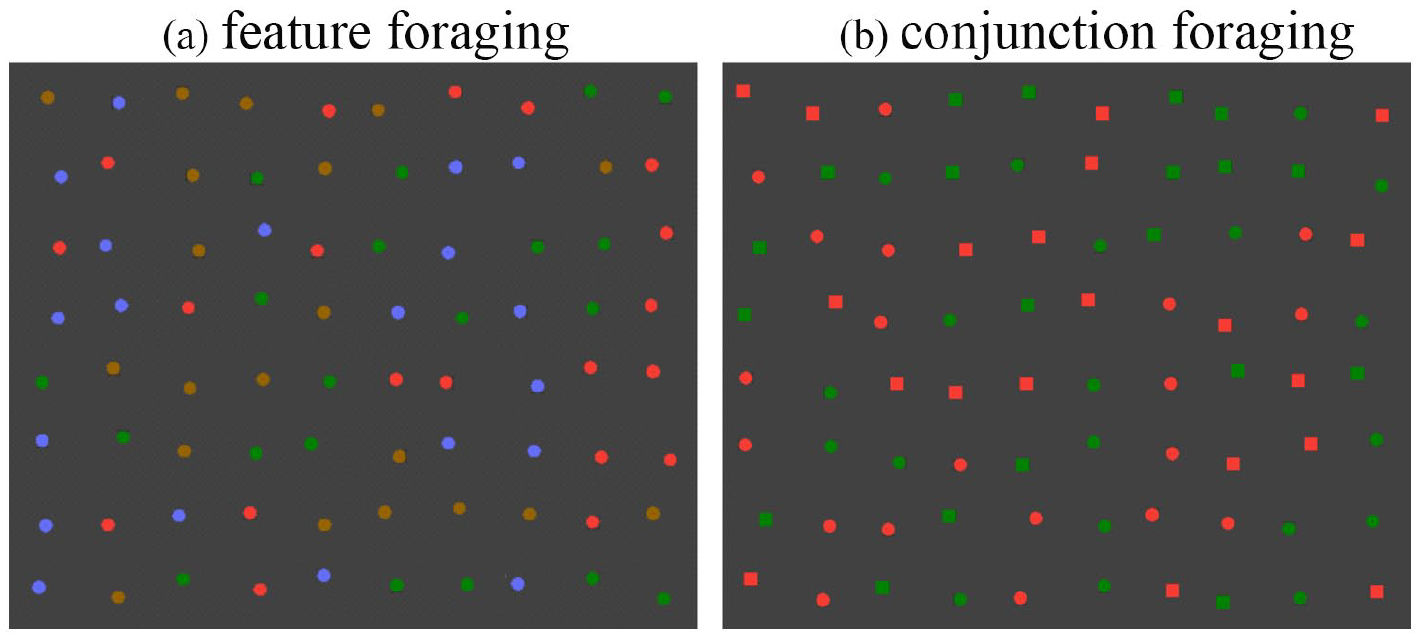
Foraging tasks. Panel (a) shows the feature-foraging condition, where observers had to select the red and green dots while ignoring the blue and yellow ones, or vice versa. Panel (b) shows the conjunction-foraging condition, where observers had to select the red squares and green dots while ignoring the green squares and red dots, or vice versa. Participants performed these conditions both using a computer mouse and their eye gaze to select the targets.
Procedure
Participants had to perform four foraging tasks, differing in target crypticity (feature-based foraging or conjunction-based foraging) and by the effector type used to select the targets (computer mouse or eye gaze). Examples of feature-foraging and conjunction-foraging displays are presented in Figure 1a and b, respectively. All tasks were composed of two training trials and 16 test trials and were all completed in one single session of about 1 hr 30 min.
There were two target types and two distractor types, differing by their colour in the feature-foraging tasks (i.e., red dot and green dot targets among yellow dot and blue dot distractors, or the reverse) or by the combination of their colour and shape in the conjunction-foraging tasks (i.e., red square and green dot targets among red dot and green square distractors, or the reverse). On each trial, participants were instructed to select all the targets in the display as fast as possible, without selecting any distractor. When a target was selected, it disappeared, whereas distractor selection led to an error-message screen and to the renewal of the trial until successful completion. In other words, if participants selected a distractor, the entire foraging array with the 80 stimuli was presented again (with new randomly assigned stimulus locations), until all 40 targets had been successfully selected. When the trial was completed, a feedback screen appeared, indicating the progression in the experiment and the trial response time.
In the mouse-foraging tasks, participants were asked to select the targets by clicking on them with the left button of a computer mouse. In the gaze-foraging tasks, they had to do so by fixating the targets with their eyes. In both tasks, the stimuli were surrounded by a 1.5° interest area, and the stimulus selection was triggered when a mouse click or an eye fixation was detected in that area. The inter-target distance and spatial jitter applied to stimuli locations were chosen so that the interest areas never overlapped. During gaze foraging, target selection was triggered when an eye fixation from the dominant eye lasting longer than 200 ms was detected in the interest area. To avoid erroneous selection of the distractors when the participants were exploring the visual field in search for other targets, the fixation duration needed for distractor selection (and for displaying the error message) was increased to 350 ms. These fixation times were chosen based on pre-tests run on two well-trained participants, where 200 ms was the optimal timing to prevent from false detections of target selections during visual exploration without affecting the distribution of fixation durations, and 350 ms was the optimal timing to prevent omissions of distractor selections while allowing individuals to quickly identify the stimuli as distractors and continue exploring the scene (especially at the end of the trials, when only one target remained in the display, together with the 40 distractors).
The order of the tasks was counterbalanced so that half of the participants started with the mouse-foraging tasks, while half performed feature foraging before conjunction foraging. The target identities were counterbalanced as well so that during feature foraging, half of the participants saw red and green targets among yellow and blue distractors, whereas others saw the reverse; during conjunction foraging, half of the participants saw red square and green dot targets among red dot and green square distractors, whereas others saw the reverse. For a given observer, target and distractor identities were held constant between mouse- and gaze-foraging tasks.
Data analysis
In line with previous studies (Jóhannesson et al., 2016; Á. Kristjánsson et al., 2014), our primary behavioural dependent variable was the number of “runs” on a given trial. A “run” refers to the sequential selection of targets of the same category. As such, with 40 targets divided into two categories, the number of runs could vary between 2 and 40. The number of runs is inversely related to run length (i.e., the number of elements selected in a run, ranging from 1 to 20) so that constantly switching between the two target categories would result in 40 runs composed of one element, whereas selecting all the occurrences of one target type before turning to the second type would result in two runs, each composed of 20 elements. If we assume equal weights between the two target categories, then selection by chance would yield an average of 21 runs composed of 1.9 elements (due to the sampling without replacement). Research on animals has shown that run behaviour is typically random when targets are conspicuous, while animals tend to select the same target type when they are cryptic (for reviews, see Bond, 2007; Punzalan et al., 2005). To statistically determine whether the run behaviour of individuals was random, we used the One-Sample Runs Tests separately for each trial and each individual (for examples of similar usage, see Jóhannesson et al., 2016; Á. Kristjánsson et al., 2014). This allowed quantifying the proportion of trials that were nonrandom at p < .05 level (adjusted using Bonferroni correction for multiple tests) for each individual and each of the four conditions (mouse-feature, mouse-conjunction, gaze-feature, and gaze-conjunction). The proportion of nonrandom trials was then used to identify potential normal and super foragers. Other behavioural dependent variables were the average number of errors (i.e., average number of distractor selections), inter-target times (the time that elapses between two successive target selections), switch costs (subtraction of the average inter-target times within runs from the average inter-target times between runs), and inter-target distances (distance in degrees of visual angle between two successive target selections).
The main oculomotor dependent variables were fixation duration and saccade amplitude, and especially the relationship between a given eye fixation duration and the amplitude of the subsequent saccade, which allow distinguishing between the ambient and focal modes of visual exploration (Unema et al., 2005). This relationship was assessed by calculating the “K coefficient” proposed by Krejtz et al. (2016), which involves the subtraction of each saccade amplitude (
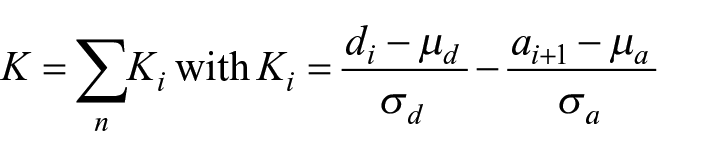
where µd and µa represent fixation duration and saccade amplitude means, respectively, and σd and σa represent their respective standard deviations over the total n number of fixations. As such, positive K coefficients reflect long fixation durations followed by small saccades, characteristic of focal visual exploration, whereas negative K coefficients reflect the reverse, indicating visual exploration in an ambient mode. A K coefficient close to zero is supposed to reflect exploration between the ambient and focal modes, or frequent switching between the two processing modes during the task (see Milisavljevic et al., 2019). As it is based on z-scores, K is expressed in standard deviations (e.g., K = 1 means that the fixation duration is 1 SD higher than the amplitude of the subsequent saccade).
We also measured the total number of fixations within a trial and the eye–target distance, which corresponds to the average distance in degrees of visual angle between the location of gaze and the location of the target being selected. Notably, this measure was previously used to distinguish between parallel search, involving saccade averaging with high eye–target distances, and serial search, involving accurate saccades with low eye–target distances (Zelinsky et al., 1997).
All the dependent variables were analysed using a 2 (target crypticity: feature foraging, conjunction foraging) × 2 (effector type: computer mouse, eye gaze) repeated measures analysis of variance (ANOVA). Participants were furthermore divided into different subgroups according to the foraging strategy they used (i.e., random or nonrandom run types) in the four tested conditions, adding a between-subject factor to the analysis. Finally, the spatio-temporal dynamics of the foraging were assessed by analysing the evolution of the obtained measures throughout the successive target selections within a trial, by adding the target index (from 1 to 40) to the design.
Results
Behavioural results on foraging measures
An effect of target crypticity on the number of runs, F(1, 23) = 93.1, p < .0001,

Summary of the results obtained on behavioural foraging measures. Error bars represent the 95% confidence interval. (a) Data from all the 24 observers, (b) data from the 11 normal foragers, (c) data from the nine intermediate foragers, and (d) data from the four super foragers.
Proportion of trials classified as nonrandom by the One-Sample Runs Tests as a function of participant and condition.

Participants s01 to s11 are classified as normal foragers, Participants s12 to s20 as intermediate foragers, and Participants s21 to s24 as super foragers.
Figure 2b to d presents the behavioural foraging measures separately for normal, intermediate, and super foragers, respectively. The previously described average pattern on the number of runs (Figure 2a) actually corresponds only to the behaviour of the 11 normal foragers (Figure 2b). The three-way interaction between effector type (mouse and gaze), target crypticity (feature and conjunction), and subgroup (normal foragers, intermediate foragers, and super foragers) is indeed highly significant, F(2, 21) = 42.6, p < .0005,
The analysis of the average number of errors (Figure 2a) showed an interaction between target crypticity and effector type, with a higher number of errors during gaze-conjunction foraging than in all other conditions, F(1, 23) = 33.0, p < .0001,
Finally, conjunction foraging led to higher inter-target times, F(1, 23) = 153.2, p < .0001,
When analysing inter-target times across the successive target selections within a trial, other differences between the four foraging tasks emerged. This analysis is presented in Figure 3 (given the high range of inter-target times, we use a log-scaled y-axis in the figure to make the differences between conditions more easily observable). The first main result is that the target selected last within a trial is on average associated with higher selection times than the previously selected targets, especially in the conjunction conditions (see Figure 3a). An ANOVA run only on the data from the target selected last showed higher inter-target times for conjunction (M = 2,007 ms, SD = 581 ms) than feature (M = 875 ms, SD = 379 ms) foraging, F(1, 23) = 125.3, p < .0001,
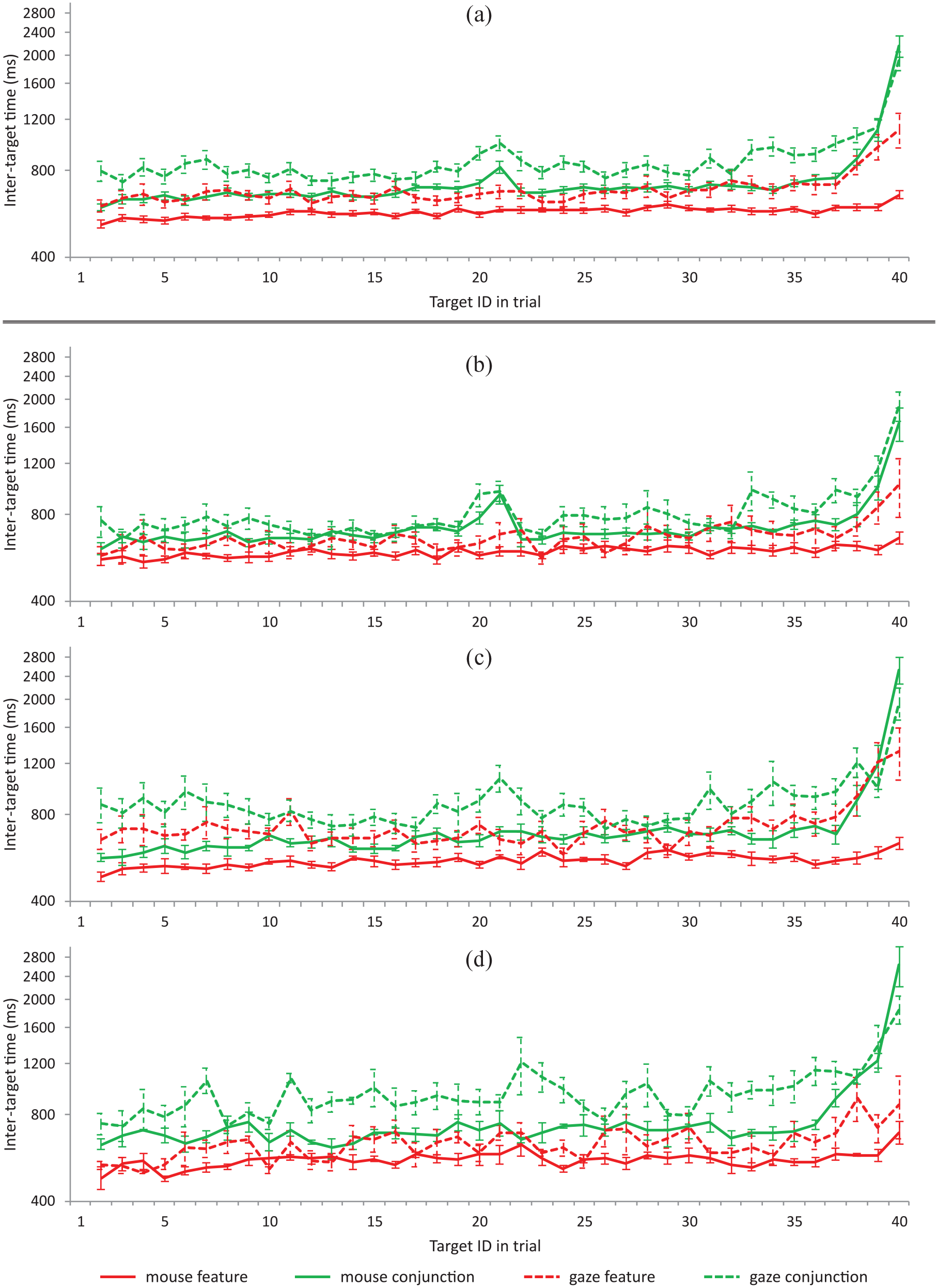
Time course of inter-target times within foraging trials (in milliseconds, log-scaled). Error bars represent standard errors of the mean. (a) Data from all the 24 observers, (b) data from the 11 normal foragers, (c) data from the nine intermediate foragers, and (d) data from the four super foragers.
The analysis of inter-target distances over the successive target selections is presented in Figure 4a. As for inter-target times, the analysis showed higher inter-target distances for the target selected last than for previous selections. Moreover, during conjunction foraging, inter-target distances gradually increased to form a “peak” at the 21st selection, decreased abruptly at the 22nd one, and then gradually increased again over the next target selections. As for inter-target times, this pattern of results seemed to mimic the foraging strategy used by normal foragers, that is, exhausting one entire target category before turning to the second one. The separate analyses of normal, intermediate, and super foragers confirmed the link with foraging strategies, as this pattern was only found for normal foragers (Figure 4b), who showed higher inter-target distance at the 21st target selection than at 24 out of the 37 other target selections (ps < .05 at Tukey’s HSD post hoc tests). The intermediate foragers showed this pattern during gaze foraging only (with 23 out of the 37 comparisons being significant at p < .05 at Tukey’s HSD post hoc tests, see Figure 4c), and the super foragers did not show any peaks in inter-target distance at the 21st target selection (all ps > .05, see Figure 4d). Notably, even though this last subgroup included only four observers, the data were less variable than for inter-target times, suggesting that inter-target distance could be a more suitable measure than inter-target times for assessing the evolution of the foraging strategy used by observers over the successive target selections.
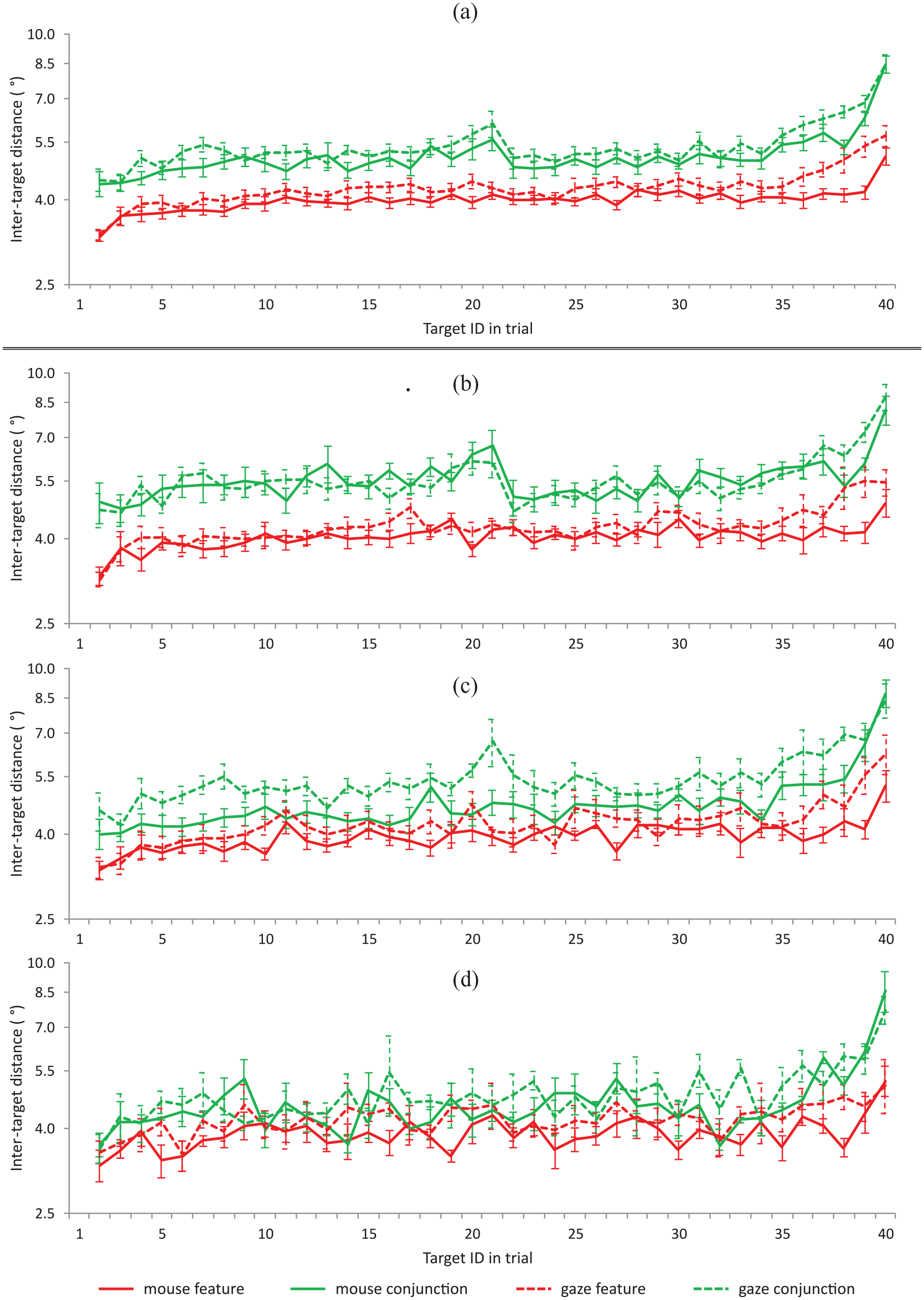
Time course of inter-target distance within foraging trials (in degrees of visual angle, log-scaled). Error bars represent the standard errors of the mean. (a) Data from all the 24 observers, (b) data from the 11 normal foragers, (c) data from the nine intermediate foragers, and (d) data from the four super foragers.
Eye movement dynamics during foraging
Figure 5a presents the average results for eye movement dynamics during the foraging tasks. Conjunction foraging was associated with a higher number of eye fixations, F(1, 23) = 349.7, p < .0001,
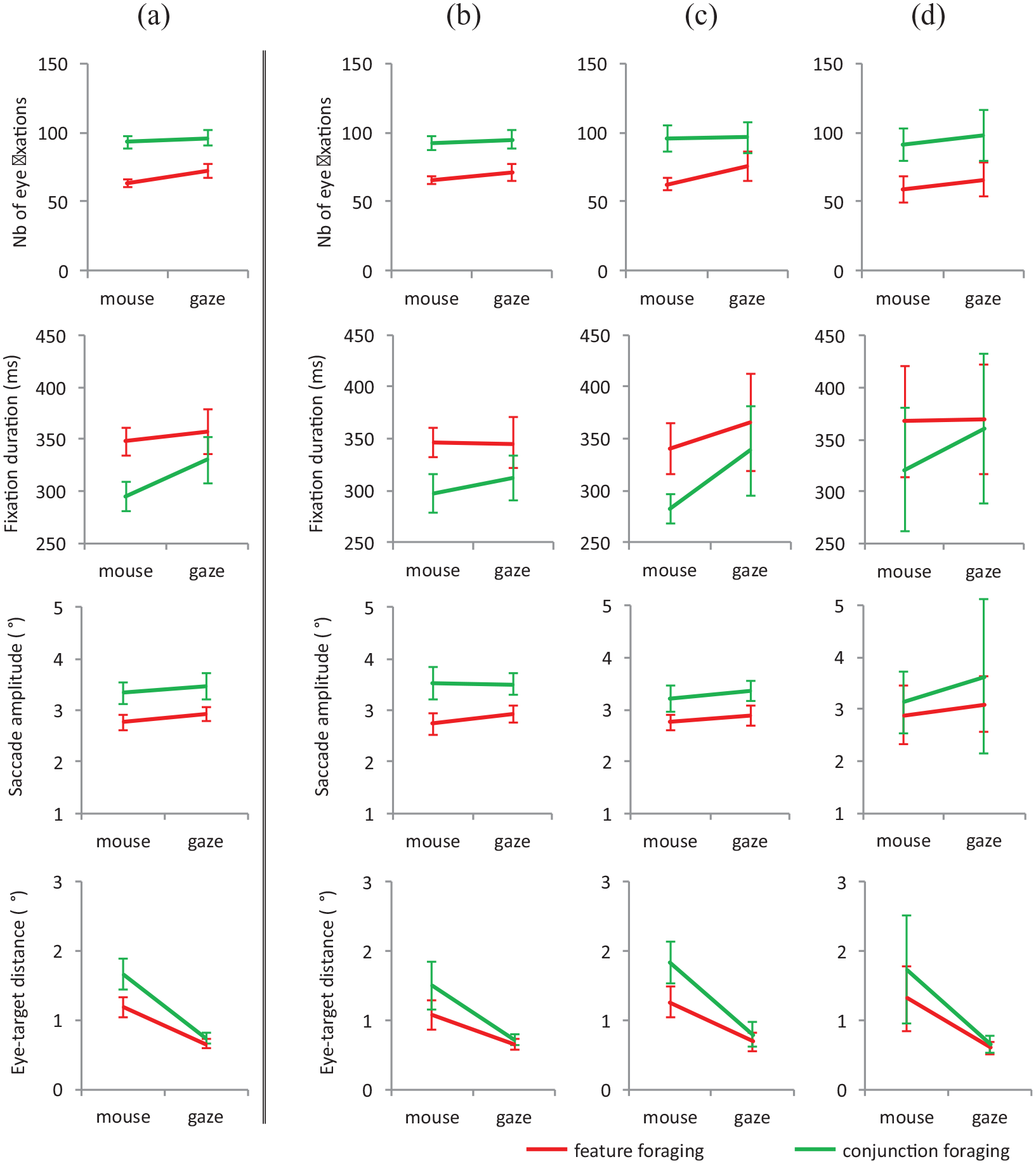
Summary of the results obtained on oculomotor measures. Error bars represent the 95% confidence intervals. (a) Data from all the 24 observers, (b) data from the 11 normal foragers, (c) data from the nine intermediate foragers, and (d) data from the four super foragers.
Based on these results, we calculated the K coefficient (Krejtz et al., 2016; see the Data Analysis section for more details) that represents the relationship between each fixation duration and the amplitude of the subsequent saccade. This analysis is presented in Figure 6a. The K coefficients on the average data from all the 24 observers were different from zero in all four conditions (all ps < .05 at one-sample Student’s t tests), and the ANOVA revealed an effect of target crypticity, F(1, 23) = 189.8, p < .0001,
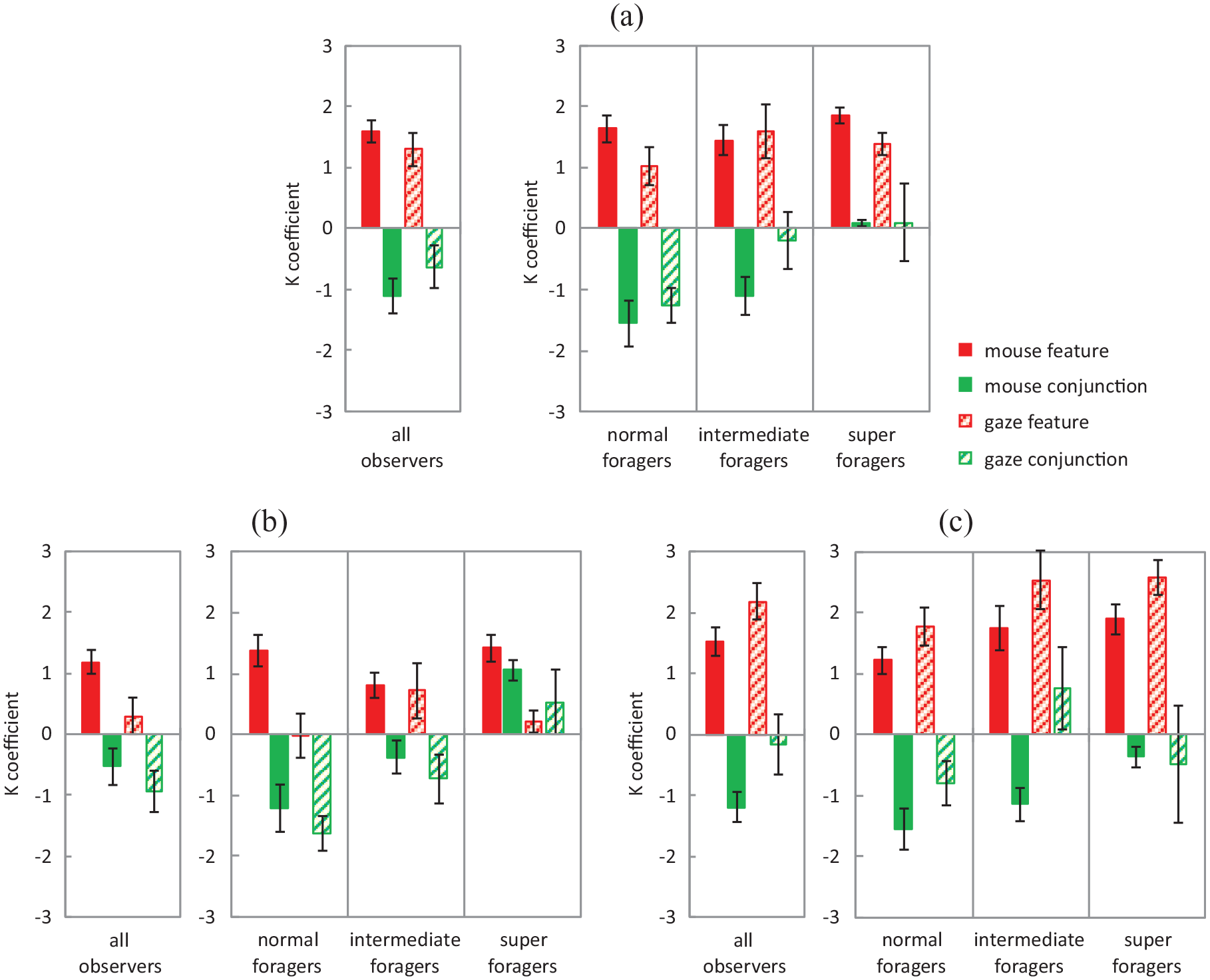
K coefficients reflecting the visual exploration mode used by observers. Panel (a) represents the K coefficients for all the eye fixations and saccades that have been executed during the tasks, whereas Panels (b) and (c) show the K coefficients only for the 40 eye fixations associated with target selections and the ones that are not associated with target selections, respectively. In all panels, the first column shows average data for all the 24 observers, whereas the three other columns show the same analysis separately for each subgroup. The error bars represent the standard errors of the mean.
Note, however, that fixation duration and saccade amplitude were here computed for all the eye movements made during the task. As can be seen in the first row of Figure 5, participants sometimes made many eye fixations, especially during the conjunction-foraging tasks. Only 40 of these eye fixations, however, correspond to target selections. When restricting the analysis of the K coefficient to the 40 “critical” fixations and their subsequent saccades, there were interestingly even larger differences between subgroups. This analysis, presented in Figure 6b, shows that during conjunction foraging, super foragers turn to a focal processing mode (positive K coefficient) right after each target selection. During mouse foraging, super foragers are also the only subgroup changing their foraging strategy between the 40 fixations corresponding to target selection (Figure 6b) and other eye fixations within a trial (Figure 6a). Note that these results on critical fixations are found irrespective of the landing position of the subsequent saccades (i.e., the differences in fixation duration and saccade amplitude between normal, intermediate, and super foragers are found for both the critical fixations followed by saccades landing on another target and for the critical fixations followed by saccades landing on a distractor or an empty area). Conversely, Figure 6c presents the K coefficient only for the fixations that are not associated with target selection (i.e., “non-critical” fixations). Overall, this analysis replicates the results obtained for the entire dataset (Figure 6a). Feature and conjunction foraging are associated with the focal and ambient modes of visual exploration, respectively, but when comparing normal, intermediate, and super foragers, we see that switching between target categories is associated more with a focal visual exploration mode.
Finally, the analysis of the distance between target location and eye fixation location associated with target selection (last row in Figure 5) showed higher eye-target distance during mouse than gaze foraging, F(1, 23) = 77.4, p < .0001,
Discussion
Our study confirmed previous findings of Á. Kristjánsson et al. (2014) that like animal foragers, humans adapt their strategy to target crypticity. During conspicuous feature foraging, they select targets in numerous short runs, whereas during cryptic conjunction foraging, they select targets in much fewer and longer runs. But one novel finding here is that this behaviour was observed during both mouse and gaze foraging, suggesting that the effector type used to perform the task does not influence the overall foraging strategy (see also Thornton, de’Sperati, & Kristjánsson, 2019). This result is in contrast with previous findings of Jóhannesson et al. (2016) who observed more numerous short runs when observers foraged with eye gaze than with their fingers. Remember, however, that this previous study involved fewer visual stimuli during gaze foraging than during finger foraging, and that the observed difference could be due to the difference in task difficulty induced by the differing number of targets and distractors. As the targets were fewer on the screen, they were, most likely, more conspicuous than in the finger-foraging task, both during feature and conjunction foraging. In our study, gaze and mouse foraging involved the same number of stimuli and were visually identical, allowing full comparison between tasks. The analysis of the individual profiles in foraging strategy actually suggested that gaze foraging is a more difficult task than mouse foraging. Indeed, although some “super foragers” were identified during mouse foraging, such performance was much rarer during gaze foraging. Critically, the comparison between feature and conjunction foraging during mouse and gaze foraging revealed a third group of individuals, who we call “intermediate foragers,” behaving like super foragers during mouse foraging (i.e., switching frequently between the two target categories irrespective of target crypticity) but acting as normal foragers during gaze foraging (i.e., changing their foraging strategy depending on target crypticity). Obviously, these individuals were able to switch between two cryptic target categories during mouse-conjunction foraging, but they chose not to do so when foraging with eye gaze. Moreover, they made more errors during this condition, reinforcing the idea that gaze-conjunction foraging was a more difficult task than mouse-conjunction foraging. Gaze foraging was also associated with higher inter-target times than mouse foraging. Importantly, additional analyses on “fixation-based” inter-target times (i.e., the difference between the ending time of the eye fixation associated with target i and the starting time of the eye fixation associated with target i + 1) show that this difference is not driven by the fixation time needed for target selection during gaze foraging. Moreover, eye fixation duration was only higher during gaze foraging than mouse foraging for intermediate foragers and only in the conjunction condition. It is, therefore, likely that this difference in fixation duration between effector types was linked to the change in foraging strategy made by intermediate foragers, rather than to methodological factors such as the fixation time needed for target selection during gaze foraging.
Are super foragers superb?
Notably, our results suggest that the “super foragers” may not be as “superb” as has been thought. Super and intermediate foragers made numerous errors, especially during gaze-conjunction foraging, while normal foragers made very few errors in all conditions. The optimal strategy for efficient foraging might, therefore, be to not switch between cryptic target types and to adapt the foraging strategy to target crypticity. Note that we used the term “super foragers” with reference to terminology that has been used in previous studies (e.g., Clarke et al., 2018; Jóhannesson et al., 2016, 2017; Á. Kristjánsson et al., 2014), but in light of our findings, a more appropriate term could be “suboptimal foragers.” One could indeed argue that the four super—or suboptimal—foragers, who never changed their foraging strategy between tasks, were actually persevering with the same behaviour, maybe reflecting weak attentional flexibility. This would moreover be consistent with the studies of children that have shown that foraging behaviour correlates with attentional flexibility capacity (Ólafsdóttir et al., 2016, 2019). Jóhannesson et al. (2017) did not find correlations between foraging behaviour and cognitive abilities in adults, but their study did not involve any measurement of attentional flexibility. Their measures only involved working memory and inhibition capacities, which did not correlate well with foraging strategies. Moreover, Jóhannesson et al.’s (2017) study only involved a finger-foraging task, and the intermediate foragers could, therefore, not be distinguished from the super/suboptimal foragers. Intermediate foragers might have higher attentional flexibility than super/suboptimal foragers, as they adapted their strategy to target crypticity during gaze foraging, and having them in the same group as super/suboptimal foragers might have weakened the observed correlations between finger-foraging behaviour and cognitive ability capacities. Further studies are needed to investigate the links between foraging behaviour and attentional flexibility in adults, by varying target crypticity and contrasting different effector types.
Within-trial performance
Apart from the number of runs and the number of errors, the other traditional behavioural foraging measures did not vary very much by foraging strategy. When we analysed the evolution of these measures over successive target selections within a trial, however, differences emerged between the three subgroups of participants. Individuals proceeding in two long runs during conjunction foraging (normal foragers and intermediate foragers when foraging with eye gaze) showed peaks in inter-target times and distances at the 21st target selection, reflecting the transition from the first run to the second, whereas individuals foraging randomly (super foragers and intermediate foragers during mouse foraging) showed constant inter-target times and distances over the successive target selections. Hence, the evolution of these measures within trials accurately captures the foraging strategy being used. Note that these analyses could not be performed with standard single-target visual search tasks, as trials would only include one target selection. These analyses clearly highlight the usefulness of foraging tasks compared with traditional visual search tasks, which do not enable such analyses over time, as there is only one target. Moreover, these analyses showed that the target selected last was associated with much higher inter-target time and distance than the previous ones. Recent research (T. Kristjánsson et al., 2020) has revealed that the well-known set-size effects during feature and conjunction search are actually only found for the last target selection of foraging tasks, suggesting that traditional single-target visual search experiments only reflect the last target selection of foraging behaviours. In single-target visual search, researchers may only have access to this last target selection, which captures only a very specific aspect of search behaviour that is probably not very representative of the overall search dynamics in natural environments.
Oculomotor measures
We also assessed oculomotor dynamics during foraging tasks. Oculomotor dynamics did not vary much from the second to the 39th target selection, conjunction foraging being associated with lower fixation duration and higher saccade amplitude than feature foraging. This suggests that foraging through cryptic targets is associated with ambient visual exploration, whereas foraging through conspicuous targets is associated with focal visual exploration. This is surprising, as ambient exploration has been proposed to be linked to bottom-up processes and focal exploration to top-down processes (Unema et al., 2005). We expected ambient exploration to be involved during conspicuous/feature foraging, not during cryptic/conjunction foraging. But the study of Unema et al. (2005) was based on visual explorations of natural visual scenes and did not involve any visual search or foraging. The mechanisms involved might, therefore, have been different. During feature foraging, observers mainly located the nearest target and progressed gradually through the visual scene. It, therefore, makes sense that their visual exploration would be organised in a focal mode, as they only made small jumps from one target to another. In contrast, during conjunction foraging, most observers exhausted one entire target category before turning to the other. As such, while they proceeded through the visual scene, the remaining targets from the category being selected became more and more sparse, and participants had to make larger saccades to reach the remaining targets. This behaviour is, therefore, reflected in ambient visual exploration. But in our study, ambient exploration does not seem to be associated with bottom-up processing. In contrast, it seems that observers’ strategy during conjunction foraging is goal-driven, especially when participants are still searching for the sparse remaining targets from the category selected first while plenty of targets from the second category are available in the display. In conclusion, our study shows that ambient exploration is not always associated with bottom-up processes, and that the involvement of high-level processes depends more on the task and strategy used by observers than on the mode in which they explore the visual scene. Overall, this may suggest that the ambient/focal distinction may need some revision (see also Milisavljevic et al., 2019).
Finally, the analysis of oculomotor dynamics revealed that during mouse foraging, the eye-target distance was higher during conjunction than during feature foraging. In this case, higher inter-target distance might be related to saccade averaging (Zelinsky et al., 1997). Our paradigm did indeed involve the presentation of many stimuli at the same time, and proximal stimuli are known to influence the saccade landing position, that is directed to the “centre of gravity” of the visual scene instead of landing on the exact target position (Coren & Hoenig, 1972; Findlay, 1982). During sequences of saccades, this phenomenon has been proposed to reflect parallel processing of differing visual stimulations (Zelinsky et al., 1997). In this study, this would mean that mouse-conjunction foraging was associated with more parallel processing than mouse-feature foraging. This is in accordance with the observation that the ambient mode of visual exploration was used during conjunction foraging. Note that, however, a higher inter-target distance could also be due to higher anticipation of the next target, the eyes being allowed to move before the target has been selected with the mouse. This could also explain why gaze foraging was more difficult than mouse foraging. Indeed, during gaze foraging, observers had to accurately fixate the target to select it. They, therefore, could not anticipate the next target, which may have increased task difficulty compared with mouse foraging, where participants were free to move their eyes whenever they wanted.
Foraging strategies
Our suggestion that the ambient and focal distinction may require modification is consistent with the separate analysis of the visual exploration mode for the three different subgroups (Figure 6). During conjunction foraging, the normal foragers stayed in an ambient mode throughout the trial, while super (or suboptimal) foragers seemed to employ visual exploration in between the ambient and focal modes or to frequently switch between the two. Note that the ambient/focal distinction is here assumed to be a continuum on which performance can vary according to time, tasks, and individuals. This switching might actually reflect attentional fluctuations, where the super/suboptimal foragers briefly changed to more focal exploration (here assumed to be related to bottom-up processes) before turning back to a more ambient mode (here assumed to be related to top-down processes) allowing the successful completion of the task. These supposed attentional fluctuations are moreover consistent with the higher number of distractor selections observed for super/suboptimal foragers than the other participants.
Interestingly, Boot et al. (2009) showed that when the task is not too demanding, observers usually tend to prefer a given “default” strategy, even if it is not the most relevant one; but that when the task becomes too demanding, participants modify their strategy and adopt one that is more adaptive to the task. Hence, intermediate foragers may by default favour the “super foraging” strategy, that is, locate the nearest target and gradually proceed in the visual field. But during gaze-conjunction foraging, the task may have become too demanding, making them change their strategy to a “normal” one, more adaptive to the task. The analysis of the visual exploration mode actually showed that the super/suboptimal foragers also seemed to modify their strategy during gaze-conjunction foraging. After each target selection, they turned to more focal visual exploration, allowing them to locate the nearest target (see Figure 6b). They, therefore, seemed to have noticed that their “default” strategy was maladaptive to the task, but they unfortunately turned to another maladaptive strategy, leading to numerous errors. Note that although these participants modified their visual exploration mode, they did not change their overall behaviour. In contrast, they changed their visual exploration mode so as to keep their “by default” behavioural foraging strategy in all tasks.
Conclusion
The analysis of oculomotor dynamics during both mouse and gaze foraging provides new insights into the optimal behaviour for efficient human foraging. We showed that what has been called “normal foraging” may be an efficient way of exploring complex environments, especially when the task is demanding. We moreover have shown that the foraging strategies used by observers are associated with different oculomotor dynamics. Individuals explore the visual scene in a focal mode when foraging through conspicuous targets, whereas they use more ambient visual exploration for foraging through cryptic targets. Our results might, therefore, lead to the updating of the theories of visual attention and visual exploration that have been based on results from traditional single-target visual search tasks (see, for example, Á. Kristjánsson et al., 2019). Critically, we showed that these traditional tasks only consider the last target selection in a trial, but do not reflect overall search behaviour (see also T. Kristjánsson et al., 2020). Multi-target foraging tasks appear, overall, to be a very efficient way of measuring the dynamics of attentional and oculomotor behaviours.
Footnotes
Declaration of conflicting interests
The author(s) declared no potential conflicts of interest with respect to the research, authorship, and/or publication of this article.
Funding
The author(s) received no financial support for the research, authorship, and/or publication of this article.
