




Abstract
The extent to which processing of abstract numerical concepts depends on perceptual representations is still an open question. In four experiments, we examined the association between contrast polarity and mental arithmetic, as well as its possible source. Undergraduate psychology students verified the correctness of single-digit arithmetic problems such as 2 + 5 = 7 or 9 − 6 = 5. Problems appeared either in white or black on a grey background, thus creating positive or negative contrast polarity, respectively. When the correct response was Yes (No), participants were faster (slower) in verifying positive than negative addition problems and in verifying negative than positive subtraction problems. Experiment 2 confirmed that the same result also held for written word problems (e.g., SEVEN + SIX = THIRTEEN). However, Experiment 3 found that the effect of contrast polarity observed in Experiments 1 and 2 disappeared in a blocked design where arithmetic operation was a between-participant factor. In addition, Experiment 4 revealed that the effect of contrast polarity does not generalise to multiplication and division. Overall, available evidence suggests that participants spontaneously associate the abstract relation between addition and subtraction (more-less) with a similar relation between contrast polarities (bright-dark).
Keywords
Introduction
Mental arithmetic is often viewed as an application of abstract rules on numbers to arrive at a correct answer. However, evidence suggests that task-irrelevant, perceptual variables affect mental calculation (reviewed in Campbell, 2015; Fischer & Shaki, 2018). For example, Landy and Goldstone (2007, 2010) 1 found that the perceptual grouping of operands with an operation sign affects the application of the precedence rule. This basic arithmetic rule states that multiplication/division should be computed before addition/subtraction when they appear together in the same problem. Landy and Goldstone manipulated the physical distance between digits and operation signs and found that participants made more errors when the digits were positioned closer to + or − signs relative to * and /. Another bias in mental arithmetic was revealed when participants were asked to produce the sum of two operands by bi-directionally adjusting the length of a horizontally extended line, using radially arranged buttons. Participants produced longer lines when the first operand was smaller than the second operand, as in 1 + 2, in comparison with the opposite arrangement of operands, such as 2 + 1 (Shaki et al., 2015).
When asked to produce approximate answers, participants tend to overestimate the result of addition and underestimate the result of subtraction. This is known as the operational momentum (OM) effect, and it was demonstrated in both non-symbolic and symbolic arithmetic (Knops, Viarouge, & Dehaene, 2009; McCrink et al., 2007). Similar patterns of overestimation and underestimation have been observed when participants pointed out the answer on a visually presented horizontal line (Pinhas & Fischer, 2008). The OM effect was also observed in multiplication and division (Katz & Knops, 2014), and it is already present in 6- to 7 year old children (Knops et al., 2013). Moreover, a recent developmental study found that the size of the OM effect increased monotonically with age and that it was accompanied by an increase in overall accuracy in arithmetic (Pinheiro-Chagas et al., 2019).
The OM effect is often interpreted as evidence that mental calculation involves attentional movements on the spatially organised mental representation of a numerical magnitude akin to a mental number line where smaller numbers are located on the left side and larger numbers on the right side of a space (Fischer & Shaki, 2014). From this view, addition induces a rightward shift, while subtraction induces a leftward shift of attention on the mental number line. Such shifts generate overshoots in the direction associated with the arithmetic operation, as physical movements in space would do (Knops et al., 2014). Support for this account comes from studies demonstrating an association between the size of the OM and attentional control measures (Knops et al., 2013) and between the OM and eye movements (Klein et al., 2014; Zhu et al., 2019), and from a functional magnetic resonance imaging (fMRI) study showing that common cortical structures are activated in mental calculation and in the control of eye movements (Knops, Thirion, et al., 2009). Evidence also suggests that operation signs (i.e., plus and minus signs) may also induce spatial bias (Pinhas et al., 2014). However, it should be noted that it is possible to reverse the OM effect by task demands (Pinhas et al., 2015; Shaki & Fischer, 2017). These studies point to the involvement of non-spatial representations in generating the OM effect. For example, participants may semantically associate addition with more and subtraction with less as their respective outcomes and use these associations as a heuristic that guides their responses. McCrinck and Wynn (2009) suggested that even 9-month-old infants may employ such more/less strategy when they are watching events involving the addition or subtraction of objects with different types of outcomes. Another possibility is that participants use the first operand as an anchor that guides further quantitative reasoning (Shaki & Fischer, 2017).
The mental number line also plays a role in representing the magnitude of individual numbers (Fischer & Shaki, 2014). Moreover, according to a theory of magnitude (ATOM), all quantitative dimensions (space, time, brightness, and pitch, along with numbers) share a common magnitude representation located in the parietal cortex (Walsh, 2003). Much behavioural, developmental, and brain imaging evidence supports this claim (reviewed in Bonn & Cantlon, 2012; Buetti & Walsh, 2009; Cohen Kadosh et al., 2008). For example, the physical size of digits interacts with their semantic size in magnitude comparisons (Henik & Tzelgov, 1982). Another example of the interaction between space and numbers is the Spatial–Numerical Association of Response Codes (SNARC) effect whereby a faster response is observed with the left hand for small numbers and with the right hand for large numbers (Dehaene et al., 1993; see Wood et al., 2008, for a review and meta-analysis). A similar association was observed between pitch height and vertical space whereby higher tones are associated with a higher position in space compared with lower tones (Rusconi et al., 2006).
There is also evidence for an interaction between brightness and numbers. Cohen Kadosh et al. (2008) asked participants to perform a magnitude comparison of numbers while the luminance of the font in which the numeral appeared was varied. An analysis of reaction times revealed, on the one hand, a faster response to small numbers when they appeared in a darker font and a slower response when they appeared in a lighter font. On the other hand, a faster response to larger numbers was observed when they appeared in brighter compared with darker fonts. In parallel, the authors measured brain activity using fMRI and found evidence for overlapping cortical representations of brightness and numbers (see also Pinel et al., 2004). In contrast, Gebuis and van der Smagt (2011) failed to find a congruency effect between variations in brightness and number magnitude. However, small–dark and large–bright associations are consistent with the recent results of Fumarola et al. (2014), who observed the SNARC-like effect of brightness on the side of response execution. They found that participants were faster with the left hand for dark stimuli and with the right hand for bright stimuli. This association remains even when participants performed the indirect task of hue discrimination.
In the current study, we attempt to unify the two separate lines of work reviewed above. On the one hand, studies on the OM effect suggest that addition is associated with a rightward shift and subtraction with a leftward shift of attention on a spatial representation of magnitude (Knops et al., 2014; Knops, Thirion, et al., 2009). On the other hand, studies on single-digit processing inspired by the ATOM suggest that smaller numbers are associated with darker and larger numbers with brighter shades of grey (Cohen Kadosh et al., 2008; Fumarola et al., 2014). When put together, reviewed findings support the hypothesis that mental calculation proceeds by making attentional jumps on a spatial representation of magnitude shared by numbers and brightness. A shared magnitude would thus predict that addition will be verified faster in white because the result of addition will move attention to the right side of a space associated with brighter shades, and vice versa for subtraction.
However, an association between brightness and mental arithmetic may also arise through an indirect or non-spatial route. One such possibility is metaphorical mental representation. Based on this view, the understanding of abstract concepts relies on metaphorical mappings from concrete domains that are directly grounded in sensorimotor experiences (Lakoff & Johnson, 1980). Such a process exploits relational similarities between abstract and concrete experiential domains to structure abstract concepts. For example, people routinely use spatial relations to understand time (Boroditsky, 2000; Casasanto & Boroditsky, 2008). In the same manner, Lakoff and Núñez (2000) demonstrated how metaphorical mappings may contribute to the understanding of a wide range of mathematical concepts, from simple arithmetic to the most abstract such as infinity or imaginary numbers. They suggested that the arithmetic operations of addition and subtraction are grounded in the everyday experience of manipulation with collections of objects. Adding is associated with putting objects together, while subtracting is associated with removing a smaller set of objects from a larger one. We further hypothesise that an abstract semantic relation more–less associated with the results of arithmetic operations is structured via mapping from the perceptual domain of contrast polarity: positive–negative. Positive (negative) contrast polarity refers to a higher (lower) surface luminance relative to its immediate background—that is, a white (black) surface on a grey background.
We employed an arithmetic verification task where participants decide whether the left-hand side of the equation equals the right-hand side. In this type of task, there is another non-spatial route to associate contrast polarity and mental arithmetic. According to the polarity correspondence principle (Proctor & Cho, 2006; Proctor & Xiong, 2015), performance in all binary decision tasks is influenced by the structural alignment of stimulus and response dimensions. Polarity correspondence assumes that each pole of the bipolar dimension is coded as a + or − alternative, and if the polarities of the stimuli and response dimensions matched in sign, then a response advantage should be observed. According to this view, there is no need to invoke metaphoric mapping as a process that establishes a relation between stimulus dimensions (Lakens, 2012). Instead, the speed of verification is determined by counting how many stimulus dimensions are aligned along the same polarity as the response dimension. In the current design, such polarity correspondence should be revealed in the interaction between contrast polarity, arithmetic operation, and the response labels Yes vs. No.
In the current study, four experiments examined the association between contrast polarity and mental arithmetic, as well as the potential underlying representations and processes. Experiment 1 was designed to establish the existence of such an association. It revealed a complex three-way interaction between contrast polarity, arithmetic operation, and response. Next, Experiment 2 provided a conceptual replication of Experiment 1 by revealing that the three-way interaction generalises to the verification of arithmetic problems in written word format. As noted above, there are at least three distinct routes that may generate such an interaction. However, Experiments 1 and 2 cannot rule out any of them. To disentangle the contribution of shared magnitude account from non-spatial accounts, we ran Experiment 3 where arithmetic problems were presented in separate blocks of trials. The idea behind this manipulation was the prediction that shared magnitude should survive the blocking of arithmetic operations because it depends on the direct association between levels of brightness and numerical magnitudes. In contrast, non-spatial accounts require activation of relational codes, that is, opposing polarities of addition and subtraction. Such activation may occur only when addition and subtraction were mixed in the same block of trials. Non-spatial accounts thus predict a lack of interaction in Experiment 3, which was indeed the case.
Finally, Experiment 4 was designed to tease apart metaphoric mapping from polarity correspondence as they made opposite predictions regarding generalisation to multiplication and division. In particular, polarity correspondence predicts the existence of the same three-way interaction as observed in Experiments 1 and 2 because + and − polarity codes are assigned to multiplication and division in the same way as to addition and subtraction, respectively. On the other hand, metaphoric mapping predicts a lack of such interaction because the comprehension of multiplication and division requires a more complex cognitive representation that cannot be mapped onto a simple more-less magnitude relation (Lakoff & Núñez, 2000). A lack of the three-way interaction in Experiment 4 supports metaphoric mapping as a general mechanism that associates structural relations between abstract numerical concepts, such as addition and subtraction, with the concrete experiential domain of brightness.
Experiment 1
We sought to establish whether contrast polarity modulates the speed and efficiency of verification of single-digit addition and subtraction problems. The existence of such a relationship would complement previous findings on spatial biases in mental arithmetic (Fischer & Shaki, 2014) by showing that numbers and brightness share a common representation of magnitude as predicted by ATOM (Walsh, 2003). Such an effect would provide further support for the claim that mental arithmetic is not abstracted away from the perceptual context in which it is embedded (Campbell, 2015; Fischer & Shaki, 2018).
Method
Participants
Thirty-one undergraduate psychology students (27 female and 4 male; age range 19–26; all right-handed) from the University of Rijeka participated in the study in exchange for course credits. The observed power to detect a three-way interaction between contrast polarity, arithmetic operation, and response was 98% in Experiment 1. Power was computed using MorePower 6.0.4, a statistical calculator for factorial analysis of variance (ANOVA) designs (Campbell & Thompson, 2012).
Apparatus
The stimulus presentation was controlled by E-Prime software (Schneider et al., 2002) running on a PC with a 19-inch monitor. The responses were collected using the PST Serial Response Box with millisecond accuracy.
Stimuli and procedure
Each problem involved two operands in the range 2–9 and yielded results in the ranges of 4–18 for addition and 0–7 for subtraction problems. To avoid negative numbers as results in subtraction problems, the left operand was always chosen to be larger than or equal to the right operand. Moreover, in false problems, the result was chosen pseudo-randomly to be in the range of ±3 from the true answer. The exceptions to this rule were subtraction problems that should result in negative numbers. In these cases, the result was bounded to a false but non-negative value. There is a concern that such a constraint may speed up the verification of subtraction in comparison with addition problems. However, we were specifically interested in the possible difference between positive and negative contrast polarity within each operation. In this regard, the relative speed of verification of addition and subtraction problems is not an issue, because it will affect only the main effect of arithmetic operation, not its interaction with contrast polarity.
In each operation, 18 addition and 18 subtraction equations, including “tie” problems with repeated operands (e.g., 3 + 3 = 6), appeared twice as a true problem (once in black and once in white on a mid-grey background) and twice as a false problem (again, once in black and once in white), resulting in a total of 144 trials. Two presentations of the same problem were separated by at least 18 trials. List of all arithmetic problems is provided in Table S1 in the supplemental material.
Every trial began with a yellow fixation string (“XXXXX”) presented in the centre of the screen. Participants were instructed to press both response keys simultaneously, at which point the fixation string appeared in a larger Arial font (size 24) for 500 ms, immediately followed by the presentation of the arithmetic problem in either black (Munsell scale value N1.5) or white (Munsell scale value N9.5) using the same font and size. The problem remained on the screen until a response was made, and the background was mid-grey for the duration of the trial (Munsell scale value N5.5). The task was to verify whether the right-hand side of the equation is equal to the left-hand side. Half of the participants responded Yes with their left index finger, and the other half responded with their right index finger. The left index finger was positioned over the leftmost button (internally labelled as Button 1) and right index finger over the rightmost button (internally labelled as a Button 5) on a response box. The distance between the buttons was approximately 3 cm.
Feedback was provided with the red word “NO” (RGB values: 255, 0, 0) when an error was made or the green word “YES” (RGB values: 0, 255, 0) when the correct answer was given. Furthermore, the feedback duration was 500 ms. There were 12 practice trials with problems not used in an experimental block, involving 0 or 1 as operands (e.g., 7 + 0 = 7). Following the practice block, there were two blocks of 72 experimental trials separated by a short break. The order of the presentation of problems within each block was randomised across the participants, who were tested individually in a quiet, dimly lit room.
Results
In all analyses, the significance level was set at .05. Statistically significant main effects were not interpreted in the presence of a significant interaction. We submitted mean reaction times on correct trials (RTs), accuracy rates, and efficiency scores to three separate 2 × 2 × 2 ANOVAs, with contrast polarity (positive vs. negative), arithmetic operation (addition vs. subtraction), and response (Yes vs. No) as repeated-measure factors.
RTs
Error trials were removed from the analysis (9.6% of data). Moreover, the latencies that fell below 400 ms or above 5,000 ms were treated as outliers and removed from the analysis (0.2% of correct responses). The ANOVA on RTs revealed that the main effect of contrast polarity was not significant, F(1, 30) < 1, p > .20, but there was a significant main effect of arithmetic operation, F(1, 30) = 7.41, p = .011, partial η2 = .20, and a main effect of response, F(1, 30) = 42.02, p < .001, partial η2 = .58. All two-way interactions were not significant: contrast polarity × arithmetic operation, F(1, 30) = 3.06, p = .090, partial η2 = .09; contrast polarity × response, F(1, 30) = 1.77, p = .193, partial η2 = .06; and arithmetic operation × response, F(1, 30) = 4.10, p = .052, partial η2 = .12.
Importantly, three-way interaction contrast polarity x arithmetic operation x response was significant, F(1, 30) = 17.80, p < .001, partial η2 = .37. To investigate the source of this interaction, we performed an analysis of simple main effects using the multivariate Pillai test with Holm correction for multiple comparisons. Of particular interest was the difference in performance between positive and negative contrast polarity across levels of arithmetic operation and response codes. When the correct response was Yes, participants were 120 ms faster in verifying positive than negative addition problems, F(1, 30) = 32.93, p < .001, partial η2 = .52, but 106 ms slower in verifying positive than negative subtraction problems, F(1, 30) = 12.10, p = .005, partial η2 = .29. The opposite pattern emerged when the correct response was No. In this condition, participants were 96 ms slower in verifying positive than negative addition problems, F(1, 30) = 9.07, p = .010, partial η2 = .23, but 64 ms faster in verifying positive than negative subtraction problems, F(1, 30) = 4.68, p = .039, partial η2 = .13. The means and 95% confidence intervals for a three-way interaction observed in Experiment 1 are displayed in Figure 1.
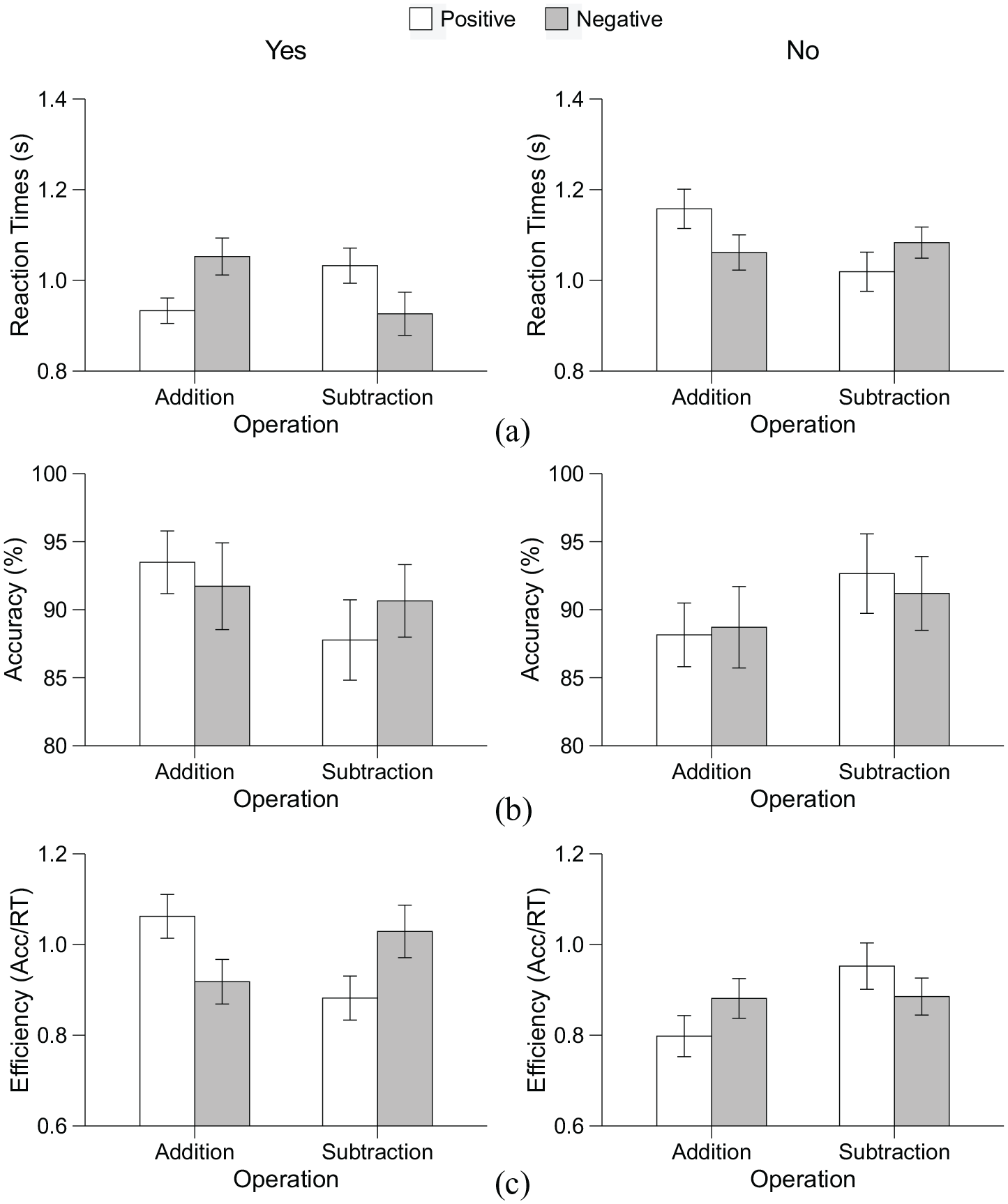
Mean reaction times in seconds (a), untransformed accuracy rates in percentages (b), and efficiency scores (c) observed in Experiment 1 are shown as a function of response (Yes in left column, No in right column), arithmetic operation (addition vs. subtraction), and contrast polarity (positive vs. negative). Error bars represent 95% confidence intervals for within-participants design, following Cousineau (2005) and Morey (2008).
Accuracy rates
Proportions of correct responses were logit transformed to stabilise their variances. Proportions equal to 1.00 were replaced by .999 to avoid infinity as the outcome. The ANOVA on transformed accuracy rates revealed no significant main effects of contrast polarity, arithmetic operation, or response, all Fs < 1, ps > .250. There was also no significant contrast polarity × arithmetic operation and contrast polarity × response interaction, both Fs < 1, ps > .250. However, a significant arithmetic operation × response interaction was observed, F(1, 30) = 14.99, p < .001, partial η2 = .33, along with a significant three-way interaction between contrast polarity, arithmetic operation, and response, F(1, 30) = 6.48, p = .016, partial η2 = .18. An analysis of the simple main effects revealed no difference in accuracy between positive and negative polarity when the correct response was Yes in addition problems (effect size [ES] = 1.8%), F < 1, p > .250, or subtraction problems (ES = −2.9%), F(1, 30) < 1.5, p > .250. Moreover, there was no difference in accuracy between positive and negative polarity when the correct response was No in addition problems (ES = −0.6%), F(1, 30) = 2.10, p > .250, partial η2 = .07, or subtraction problems (ES = 1.5%), F(1, 30) = 2.29, p > .250, partial η2 = .03.
Efficiency scores
In addition to separate analyses of RTs and accuracy rates, we also computed efficiency scores. They integrate two performance indices into a single measure by dividing the untransformed accuracy rate by response time in seconds. In this way, we were able to control for a possible trade-off between the speed and accuracy of responding or different strategies of the participant—that is, a shift in emphasis on speed or accuracy depending on the experimental condition. The ANOVA on efficiency scores revealed no significant main effect of contrast polarity, F(1, 30) < 1, p > .250, or arithmetic operation, F(1, 30) = 1.61, p = .214, partial η2 = .05; however, there was a significant main effect of response, F(1, 30) = 26.91, p < .001, partial η2 = .47. There was also a significant contrast polarity × arithmetic operation interaction, F(1, 30) = 8.10, p = .008, partial η2 = .21, and arithmetic operation × response interaction, F(1, 30) = 12.14, p = .002, partial η2 = .29. On the other hand, the contrast polarity × response interaction was not significant, F < 1, p > .250.
Importantly, the three-way interaction contrast polarity × arithmetic operation × response was significant, F(1, 30) = 21.31, p < .001, partial η2 = .42. An analysis of the simple main effects corroborated the findings on RTs and demonstrated that when the correct response was Yes, participants were more efficient in verifying positive than negative addition problems (ES = 0.144), F(1, 30) = 26.39, p < .001, partial η2 = .47, but less efficient in verifying positive than negative subtraction problems (ES = −0.147), F(1, 30) = 18.63, p < .001, partial η2 = .38. In contrast, when the correct response was No, participants were less efficient in verifying positive than negative addition problems (ES = −0.083), F(1, 30) = 5.97, p = .041, partial η2 = .17. However, they were more efficient in verifying positive than negative subtraction problems, although this effect was at the border of significance (ES = 0.067), F(1, 30) = 3.97, p = .056, partial η2 = .12.
Follow-up analyses
To check whether the observed three-way interaction was further modulated by the hand of response or by the problem size, we performed additional analyses that are presented in the supplemental material. No evidence of a SNARC-like effect was found because the assignment of a Yes (or No) response to the left or right hand did not affect the results. Moreover, there was no consistent modulation by the problem size, suggesting that the effect of contrast polarity on mental arithmetic does not occur at the calculation stage (Campbell & Epp, 2005; Zbrodoff & Logan, 2005). In addition, we checked that the observed interaction was not driven by tie problems.
Discussion
In Experiment 1, we found a cross-over interaction between contrast polarity, arithmetic operation, and response. This is a more complex pattern of results than what would be expected from movements along shared magnitude representation. Such direct mapping between brightness and numbers should generalise across response codes because the same part of the magnitude representation is accessed during calculation irrespective of the final outcome of verification (whether the problem is true of false). The shared magnitude account thus predicts a simpler two-way interaction between contrast polarity and mental arithmetic. In addition, follow-up analyses revealed that the observed three-way interaction was not modulated by the hand of response, nor by the problem size. Such a pattern of results is more in line with non-spatial accounts rather than with shared magnitude representation. However, the contribution of a shared magnitude account cannot be completely ruled out because its predictions matched well with the direction of the effect of contrast polarity when the correct response was Yes.
It should be noted that single-digit arithmetic is a highly practised skill. Participants may choose to retrieve the answer directly from memory instead of engaging in a costly calculation of the answer. It thus remains possible that the involvement of shared magnitude representation is partially obscured by memory retrieval and that it could be detected if participants are encouraged to calculate the answer. To address this issue, in Experiment 2, we presented arithmetic problems in a written word format instead of Arabic digits. A word format is an unusual, less practised mode of solving arithmetic problems. Evidence suggests that familiarity with the problem influences the strategy choice, and when faced with the less familiar word format, participants more often choose to calculate the answer in comparison to the digit format (Schunn et al., 1997). In addition, memory retrieval is a less efficient route by which to arrive at the correct result in solving problems in word format because of less practice with it (Siegler & Shipley, 1995). Consistent with these results, Campbell and Fugelsang (2001) found that calculation was used more often with a word (41%) than a digit format (26%) in the verification of addition problems. Moreover, the reported use of calculation increased for numerically larger problems.
Experiment 2
To examine the replicability and generalisability of the findings from Experiment 1, we ran another experiment using the same design, but with problem operands presented as written number words instead of Arabic digits. Previous studies have found that solving arithmetic problems in written word format is much more difficult than with digits. Moreover, word format affects strategy choice by increasing the likelihood of using calculation (Campbell & Epp, 2005). Decisions to calculate the answer may further increase the reliance on shared magnitude representation. This should be detected in the simpler two-way interaction between contrast polarity and mental arithmetic. Or, even if the three-way interaction remains significant, the effect of contrast polarity on mental arithmetic should point in the same direction across response codes.
Method
Participants
A different group of 30 undergraduate psychology students (21 female and 9 male, age range 19–23) from the University of Rijeka participated in the study in exchange for course credits. An a priori power analysis, based on the significant three-way interaction between contrast polarity, arithmetic operation, and response (partial η2 = .37) observed in Experiment 1 (with power set to .90, a large effect size or f of .77, and an α of .05), indicated that the required sample size was 20. However, we aimed to collect data from more participants than required, in case the data from some participants needed to be excluded from the analysis. The same guideline was followed in Experiments 3 and 4. The observed power to detect the three-way interaction was 100% in Experiment 2.
Procedure
The procedure was the same as that in Experiment 1, except that arithmetic problems appeared in word format (FIVE + TWO = SEVEN). Croatian number words were presented in upper-case letters (Arial font, size 24). All problems fitted on a single line in the centre of the computer screen.
Results
We followed the same approach as in Experiment 1. We submitted mean RTs on correct trials, accuracy rates, and efficiency scores to three separate 2 × 2 × 2 ANOVAs with contrast polarity (positive vs. negative), arithmetic operation (addition vs. subtraction), and response (Yes vs. No) as repeated-measure factors.
RTs
Error trials were removed from the analysis (6.8% of data), and the latencies that fell below 400 ms or above 5,000 ms were also treated as errors and removed from the analysis (0.5% of correct responses). The ANOVA on RTs revealed that the main effect of contrast polarity was not significant, F(1, 29) < 1, p > .250, but there was a significant main effect of arithmetic operation, F(1, 29) = 49.73, p < .001, partial η2 = .63, and a main effect of response, F(1, 29) = 52.22, p < .001, partial η2 = .64. Furthermore, there was no significant contrast polarity × arithmetic operation, F(1, 29) = 2.69, p = .112, partial η2 = .08, nor an arithmetic operation × response interaction, F(1, 29) < 1, p > .250. However, a significant contrast polarity × response interaction was observed: F(1, 29) = 5.56, p = .025, partial η2 = .16.
Importantly, replicating the major finding from Experiment 1, a significant three-way interaction was found for contrast polarity × arithmetic operation × response, F(1, 29) = 52.84, p < .001, partial η2 = .65. An analysis of the simple main effects revealed that when the correct response was Yes, participants were 204 ms faster in verifying positive than negative addition problems, F(1, 29) = 34.69, p < .001, partial η2 = .54, but 140 ms slower in verifying positive than negative subtraction problems, F(1, 29) = 38.36, p < .001, partial η2 = .57. When the correct response was No, participants were 156 ms slower in verifying positive than negative addition problems, F(1, 29) = 27.36, p < .001, partial η2 = .49, but 92 ms faster in verifying positive than negative subtraction problems, F(1, 29) = 5.21, p = .030, partial η2 = .15. The means and 95% confidence intervals depicting the three-way interaction found in Experiment 2 are displayed in Figure 2.

Mean reaction times in seconds (a), untransformed accuracy rates in percentages (b), and efficiency scores (c) observed in Experiment 2 are shown as a function of response (Yes in left column, No in right column), arithmetic operation (addition vs. subtraction), and contrast polarity (positive vs. negative). Error bars represent 95% confidence intervals for within-participants design, following Cousineau (2005) and Morey (2008).
Accuracy rates
The ANOVA on logit-transformed accuracy rates revealed that there was no significant main effect of contrast polarity, F(1, 29) < 1, p > .250, and arithmetic operation, F(1, 29) = 1.51, p = .229, partial η2 = .05. However, there was a significant main effect of response, F(1, 29) = 11.56, p = .002, partial η2 = .28, and a significant contrast polarity × response interaction, F(1, 29) = 8.03, p = .008, partial η2 = .22. An analysis of the simple main effects revealed no significant difference in accuracy between positive and negative contrast polarity when the correct answer was Yes (ES = 0.3%), F(1, 29) = 2.67, p = .113, partial η2 = .08, or when it was No (ES = -2.1%), F(1, 29) = 3.98, p = .111, partial η2 = .12. All other effects were non-significant: all Fs < 1.5, ps > .250.
Efficiency scores
The ANOVA on efficiency scores revealed that the main effect of contrast polarity was not significant, F < 1, p > .250, but there was a significant main effect of arithmetic operation, F(1, 29) = 34.32, p < .001, partial η2 = .54, as well as a main effect of response, F(1, 29) = 11.71, p = .002, partial η2 = .29. Furthermore, there was a significant contrast polarity × arithmetic operation, F(1, 29) = 7.19, p = .012, partial η2 = .20, and no arithmetic operation × response interaction, F < 1, p > .250. However, a significant contrast polarity × response interaction was observed, F(1, 29) = 8.65, p = .006, partial η2 = .23.
Replicating the major finding from Experiment 1, there was a significant three-way interaction for contrast polarity × arithmetic operation × response, F(1, 29) = 64.81, p < .001, partial η2 = .69. The simple main effects revealed that when the correct response was Yes, participants were more efficient in verifying positive than negative addition problems (ES = 0.092), F(1, 29) = 44.44, p < .001, partial η2 = .61, but less efficient in verifying positive than negative subtraction problems (ES = -0.072), F(1, 29) = 34.11, p < .001, partial η2 = .54. When the correct response was No, participants were less efficient in verifying positive than negative addition problems (ES = -0.065), F(1, 29) = 36.26, p < .001, partial η2 = .5. Moreover, participants were more efficient in verifying positive than negative subtraction problems, but this effect was at the border of significance (ES = 0.032), F(1, 29) = 3.71, p = .064, partial η2 = .11.
Follow-up analyses
As in Experiment 1, we performed additional analyses that are presented in the supplemental material. These analyses revealed that the observed three-way interaction was not modulated by the hand of response, nor by the problem size. Furthermore, the three-way interaction remained significant after tie problems were removed from the dataset.
Discussion
Experiment 2 essentially replicated the findings from Experiment 1, revealing that the association between contrast polarity, arithmetic operation, and response extends to the written word format. Again, we found that the effect of contrast polarity on mental arithmetic switches in opposite directions depending on the response being made. Although the written word format increases the chance that participants will calculate the answer, as previous studies suggest (Campbell & Fugelsang, 2001; Schunn et al., 1997), this potential shift in strategy did not affect the relationship between the factors of interest. We did not ask participants to explicitly report the strategy they used in solving each arithmetic problem. However, the similarity between the results observed in Experiments 1 and 2 suggest that the strategy choice is less relevant for the current findings.
As noted in the Discussion of Experiment 1, the three-way interaction involving response codes is not consistent with the shared magnitude account. In addition, follow-up analyses revealed that the three-way interaction is not further modulated by the problem size, suggesting that it does not occur during calculation (Campbell & Epp, 2005). Moreover, it is not modulated by the hand of response, further highlighting that its origin is non-spatial.
Although suggestive of non-spatial accounts (either metaphorical mapping or polarity correspondence), the results of Experiments 1 and 2 cannot definitively rule out the contribution of shared magnitude representation because its predictions are aligned with the results observed with a Yes response. A more direct test would be to manipulate the availability of stimulus dimensions in the experiment (Lakens et al., 2012). To do this, in Experiment 3, we tested addition and subtraction problems in separate blocks of trials. In this condition, shared magnitude and non-spatial accounts make opposite predictions, as explained below.
Experiment 3
The shared magnitude account assumes a stable, direct association between brightness and numbers that should be activated even when it is probed by a single arithmetic operation alone. This account thus predicts that a three-way interaction between contrast polarity, arithmetic operation, and response should survive the blocking of arithmetic in between-participant groups. In contrast, non-spatial accounts require co-activation of polar opposites on relevant bipolar dimensions (positive–negative output of the arithmetic operation, positive–negative contrast polarity, and positive–negative answer). When one pole of one dimension is absent, forming metaphorical mapping or structural alignment between poles is no longer possible. Therefore, non-spatial accounts predict the lack of a three-way interaction in the blocked presentation of arithmetic operation. To test these predictions, we ran Experiment 3 where arithmetic operation was treated as a between-participant factor. Participants were divided into two groups: one group was exposed to addition problems only, and another group was exposed to subtraction problems only. In both groups, problems were presented in positive or negative contrast polarity.
Methods
Participants
Thirty participants (25 female and 5 male, age range 19–23) were assigned to the addition group, and 26 (22 female and 4 male, age range 18–24) were assigned to the subtraction group. They were all undergraduate psychology students from the University of Rijeka and participated in the study in exchange for course credits.
Procedure and stimuli
The procedure was identical to Experiments 1 and 2, expect that addition and subtract problems were separated into between-participant blocks. We adopted the same set of problems as in Experiment 1 and added new problems to reach a total of 36 addition and 36 subtraction problems. New problems were created using the same set of restrictions described in the “Methods” section of Experiment 1. Each problem appeared twice with a true result (once in black and once in white contrast polarity) and twice with a false result (once in black and once in white contrast polarity), resulting in a total of 144 trials in both experimental groups. The order of presentation of problems was randomised across participants, with the restriction that the repetitions of the same problem were separated by at least 18 trials.
Results
We followed the same approach as in Experiments 1 and 2. We submitted mean RTs on correct trials, accuracy rates, and efficiency scores to three separate 2 × 2 × 2 ANOVAs with contrast polarity (positive vs. negative) and response (Yes vs. No) as repeated-measure factors and arithmetic operation (addition vs. subtraction) as a between-participant factor. Descriptive data are given in Figure S1 in the supplemental material.
RTs
Error trials were removed from the analysis (6.9% of data), as were latencies that fell below 400 ms or above 5,000 ms (0.04% of correct responses). The ANOVA on RTs revealed a significant main effect of contrast polarity, F(1, 54) = 20.65, p < .001, partial η2 = .28; arithmetic operation, F(1, 54) = 5.34, p = .025, partial η2 = .09; and response, F(1, 54) = 8.37, p = .005, partial η2 = .13. Furthermore, there was a significant contrast polarity × response, F(1, 54) = 9.11, p = .004, partial η2 = .14, and arithmetic operation × response interaction, F(1, 54) = 82.21, p < .001, partial η2 = .60. In contrast to Experiments 1 and 2, no significant two-way interaction was observed between contrast polarity and arithmetic operation, F(1, 54) < 1, p > .250, and no significant three-way interaction was observed between contrast polarity, arithmetic operation, and response, F < 1, p > .250.
An analysis of the simple main effects for the contrast polarity × response interaction revealed that when the correct answer was Yes, there was no latency difference (ES = 5 ms) between positive (M = 1,068 ms, SE = 34.53) and negative contrast polarity (M = 1,063 ms, SE = 34.09), F < 1, p > .250, partial η2 = .01. When the correct answer was No, participants were 48 ms slower in verifying problems that appeared in positive contrast polarity (M = 1,119 ms, SE = 37.55) than in negative contrast polarity (M = 1,071 ms, SE = 36.06), F(1, 54) = 20.99, p < .001, partial η2 = .28. This finding suggests that there is a general tendency to associate the negative outcome of subtraction with negative contrast polarity and with a No response. Therefore, negative valence may underlie the formation of polarity correspondence between negative contrast, subtraction, and a No response, thus speeding up responses even when positive valence was not co-activated. Consistent with this claim, Lakens et al. (2012) reported that participants spontaneously associate black with negative valence irrespective of whether its polar opposite was activated or not.
An analysis of the simple main effects for the arithmetic operation × response interaction revealed that when the correct answer was Yes, participants were 254 ms faster in verifying addition (M = 938 ms, SE = 46.46) relative to subtraction (M = 1,192 ms, SE = 49.90), F(1, 54) = 13.92, p < .001, partial η2 = .20. On the other hand, when the correct answer was No, participants were 68 ms faster in verifying addition (M = 1,061 ms, SE = 49.64) relative to subtraction (M = 1,129 ms, SE = 53.33); however, this difference was not statistically reliable, F < 1, p > .250, partial η2 = .02.
Accuracy rates
The ANOVA on logit-transformed accuracy rates revealed a significant contrast polarity × response interaction, F(1, 54) = 8.27, p = .006, partial η2 = .13. An analysis of the simple main effects revealed that when the correct answer was Yes, there was no difference in accuracy (ES = 0.3%) between positive contrast polarity (M = 93.3%, SE = 0.788) and negative contrast polarity (M = 93.0%, SE = 0.778), F(1, 54) = 1.44, p = .236, partial η2 = .03. When the correct answer was No, participants were less accurate (ES = -2.0%) in verifying positive contrast polarity (M = 92.3%, SE = 0.774) relative to negative contrast polarity (M = 94.3%, SE = 0.702), F(1, 54) = 5.37, p = .049, partial η2 = .09. All other effects were non-significant (all Fs < 1, ps > .250).
Efficiency scores
The ANOVA on efficiency scores revealed that there was a significant main effect of contrast polarity, F(1, 54) = 23.94, p < .001, partial η2 = .31; arithmetic operation, F(1, 54) = 6.48, p = .014, partial η2 = .11; and response, F(1, 54) = 6.97, p = .011, partial η2 = .11. There were also significant interactions for contrast polarity × response, F(1, 54) = 21.26, p < .001, partial η2 = .28, and arithmetic operation × response F(1, 54) = 66.88, p < .001, partial η2 = .55. In contrast to Experiments 1 and 2, no significant two-way interaction was observed between contrast polarity and arithmetic operation, F(1, 54) < 1, p > .250, and no significant three-way interaction was found between contrast polarity, arithmetic operation, and response: F(1, 54) < 1, p > .250.
An analysis of the simple main effects revealed that when the correct answer was Yes, there was no latency difference (ES = −.004) between positive contrast polarity (M = 0.931, SE = 0.027) and negative contrast polarity (M = 0.935, SE = 0.028), F(1, 54) < 1, p > .250. When the correct answer was No, participants were less efficient (ES = −0.059) with positive contrast polarity (M = 0.872, SE = 0.027) relative to negative contrast polarity (M = 0.931, SE = 0.029), F(1, 54) = 46.18, p < .001, partial η2 = .46. Furthermore, when the correct answer was Yes, participants were more efficient (ES = 0.233) in verifying addition (M = 1.049, SE = 0.037) relative to subtraction (M = 0.816, SE = 0.040), F(1, 54) = 18.58, p < .001, partial η2 = .26. In contrast, when the correct answer was No, participants were equally efficient (ES = 0.039) in verifying addition (M = 0.921, SE = 0.038) and subtraction (M = 0.882, SE = 0.040) problems, F(1, 54) < 1, p > .250.
Discussion
Experiment 3 revealed no interaction between contrast polarity, arithmetic operation, and response when operation was treated as a between-participant factor. This speaks against shared magnitude representation as an explanation of the results of Experiments 1 and 2. Taken together, the results of three experiments support the non-spatial accounts. However, there are two distinct non-spatial routes that may establish a relationship between contrast polarity and arithmetic operation: metaphorical mappings (Boroditsky, 2000; Casasanto & Boroditsky, 2008; Lakoff & Núñez, 2000) and polarity correspondence or stimulus-response compatibility (Lakens, 2012; Proctor & Cho, 2006; Proctor & Xiong, 2015).
Experiment 4
Multiplication and division cannot be metaphorically mapped onto contrast polarity because their understanding requires more complex cognitive mechanisms involving multiple numerical representations. Such representations do not have structural equivalence in opposition between positive and negative contrast polarity (Lakoff & Núñez, 2000, p. 60). On the other hand, polarity correspondence predicts the existence of the same three-way interaction as observed in Experiments 1 and 2. This is because multiplication and division are abstract stimulus dimensions to which opposite poles could be assigned in the same way as between addition and subtraction. Thus, metaphoric mapping and polarity correspondence makes opposite predictions regarding the effect of contrast polarity on multiplication and division. To test these predictions, we ran Experiment 4 where we employed the verification of multiplication and division problems presented in black and white on a grey background.
Methods
Participants
A group of 24 undergraduate psychology students (23 female and 1 male, age range 19–26) from the Catholic University of Croatia participated in the study in exchange for course credits.
Procedure and stimuli
The procedure was identical to that in Experiments 1 and 2. The stimuli were 18 multiplication and 18 division problems, such as 2 × 3 = 6 or 9 / 3 = 2, including operands between 2 and 9. Problems with repeated operands, such as 3 / 3 = 1, were also included. Operands of the division problems were chosen so that the correct result was always the integer. This means that the first operand was always larger than or equal to the second operand. Furthermore, in multiplication problems, the order of operands with respect to their respective size was chosen pseudo-randomly. In false problems, the result was chosen pseudo-randomly to lie in the interval of ±4 of the correct result. Each problem appeared twice with a true result (once in positive and once in negative contrast polarity) and twice with a false result (once in positive and once in negative contrast polarity), resulting in a total of 144 trials. Finally, the order of presentation of problems was randomised across participants, with the restriction that the repetitions of the same problem were separated by at least 18 trials.
Results
We followed the same approach as in previous experiments. We submitted mean RTs on correct trials, accuracy rates, and efficiency scores to three separate 2 × 2 × 2 ANOVAs with contrast polarity (positive vs. negative), arithmetic operation (multiplication vs. division), and response (Yes vs. No) as repeated-measure factors. Descriptive data are given in Figure S2 in the supplemental material.
RTs
Error trials (9.6% of data) and latencies that fell below 400 ms or above 5,000 ms (0.3% of correct responses) were removed from the analysis. The ANOVA on RTs revealed no significant main effect of contrast polarity, F(1, 23) < 1, p > .250. However, there was a significant main effect of arithmetic operation, F(1, 23) = 23.87, p < .001, partial η2 = .51, displaying a 115 ms faster verification of multiplication problems (M = 1,132 ms, SE = 58.98) than division problems (M = 1,247 ms, SE = 68.36). Furthermore, there was a significant main effect of response, F(1, 23) = 30.51, p < .001, partial η2 = .57, showing 86 ms faster Yes responses (M = 1,146 ms, SE = 59.20) than No responses (M = 1,232 ms, SE = 67.02). There was neither a significant contrast polarity × response, F(1, 23) < 1, p > .250, partial η2 < .01, nor a significant arithmetic operation × response interaction, F(1, 23) = 4.02, p = .057, partial η2 = .15. Importantly, in contrast to Experiments 1 and 2, no significant two-way interaction was observed between contrast polarity and arithmetic operation, F(1, 23) = 3.26, p = .084, partial η2 = .12, nor was a significant three-way interaction observed between contrast polarity, arithmetic operation, and response, F(1, 23) = 1.55, p = .225, partial η2 = .06.
Accuracy rates
The ANOVA on logit-transformed accuracy rates revealed no significant main effect of contrast polarity, F(1, 23) = 2.59, p = .250, partial η2 = .10 and no main effect of arithmetic operation, F(1, 23) = 4.07, p = .055, partial η2 = .15, and response, F(1, 23) = 4.07, p = .055, partial η2 = .15. Furthermore, while there was also no significant contrast polarity × response, F(1, 23) < 1, p > .250, a significant arithmetic operation × response interaction, F(1, 23) = 8.27, p = .009, partial η2 = .26, was found. An analysis of the simple main effects revealed that when the correct answer was Yes, participants were more accurate (ES = 5.3%) in verifying multiplication (M = 94.5%, SE = 0.970) than division (M = 89.2%, SE = 1.244) problems, F(1, 23) = 15.17, p = .001, partial η2 = .40. When the correct answer was No, there was no difference in accuracy (ES = −0.9%) between multiplication (M = 88.6%, SE = 1.547) and division (M = 89.5%, SE = 1.768), F(1, 23) < 1, p > .250. As in the RT analysis, no significant two-way interaction was observed between contrast polarity and arithmetic operation, F(1, 23) < 1, p > .250, and no significant three-way interaction was observed between contrast polarity, arithmetic operation, and response, F(1, 23) < 1.5, p > .250.
Efficiency scores
The ANOVA on efficiency scores revealed no significant main effect of contrast polarity, F(1, 23) = 1.31, p > .250. However, there was a significant main effect of arithmetic operation, F(1, 23) = 59.91, p < .001, partial η2 = .72, and a main effect of response, F(1, 23) = 35.18, p < .001, partial η2 = .60. Moreover, there was a significant operation × response interaction, F(1, 23) = 14.37, p < .001, partial η2 = .38. An analysis of the simple main effects revealed that, in general, participants were more efficient in solving multiplication than division problems. However, this effect was much larger with Yes responses (ES = 0.144; multiplication: M = 0.923, SE = 0.038; division: M = 0.779, SE = 0.037), F(1, 23) = 62.57, p < .001, partial η2 = .73, than with No responses (ES = 0.050; multiplication: M = 0.791, SE = 0.037; division: M = 0.741, SE = 0.032), F(1, 23) = 8.89, p = .007, partial η2 = .28. All interactions involving contrast polarity were not significant (all Fs < 1, ps > .250).
Discussion
Experiment 4 revealed no evidence of a three-way interaction between contrast polarity, operation, and response. This suggests that participants do not treat opposition between multiplication and division in the same way as the opposition between addition and subtraction. Such a result argues against a polarity correspondence account, which predicts that the same interaction effect should occur in all instances involving bipolar dimensions. Taken together, the results of the four experiments are most consistent with the metaphoric mapping between concrete and abstract domains (Boroditsky, 2000; Casasanto & Boroditsky, 2008; Lakoff & Núñez, 2000).
Bayes factors
We supplemented previous analyses with Bayes factors because they offer the opportunity to determine whether non-significant results observed in Experiments 3 and 4 support a null hypothesis over a theory, or whether the data are just insensitive. Bayes factor (BF10) indicates the relative strength of evidence in favour of an alternative over a null hypothesis (Dienes, 2014; Dienes & McLatchie, 2018). Bayes factors were calculated using the Bayes factor package (Morey & Rouder, 2019) available in the R statistical environment (R Core Team, 2019) with the default non-informative Jeffreys-Zellner-Siow prior. In the Bayes ANOVA, we treated contrast polarity, arithmetic operation, response, and all their interactions as fixed factors and participants as a random factor. The Bayes factors for three-way interaction computed across all performance measures in all four experiments are listed in Table 1. The Bayes factors yielded strong evidence of a three-way interaction in Experiments 1 and 2 and substantial support against it in Experiments 3 and 4. In addition, the Bayes factors provide substantial support against two-way interaction between contrast polarity and arithmetic operation both in Experiment 3 (RTs: BF10 = 0.21; accuracy rates: BF10 = 0.24; efficiency scores: BF10 = 0.27) and in Experiment 4 (RTs: BF10 = 0.49; accuracy rates: BF10 = 0.29; efficiency scores: BF10 = 0.29).
Bayes factors computed for contrast polarity × arithmetic operation × response interaction across all four experiments.
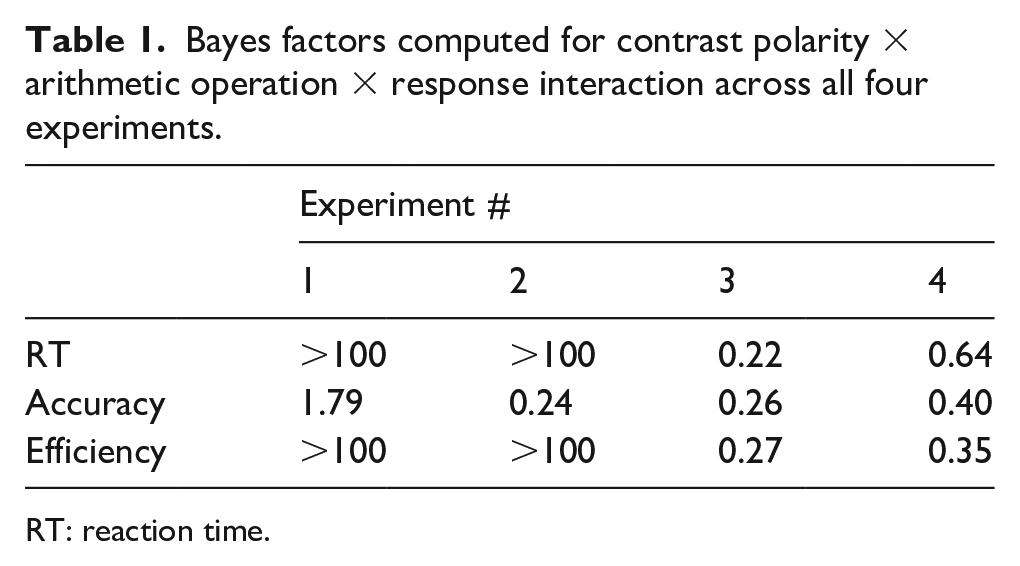
RT: reaction time.
General discussion
In Experiments 1 and 2, we found a three-way interaction between contrast polarity, mental arithmetic, and response. When the correct response was Yes, addition was verified faster and more efficiently when presented in positive than in negative contrast polarity, and subtraction was verified faster and more efficiently in negative than in positive contrast polarity. Conversely, when the correct response was No, faster and more efficient verification was observed for addition problems in negative than in positive contrast polarity, and for subtraction problems in positive rather than negative contrast polarity. To further examine the source of the observed three-way interaction, we ran Experiment 3 where arithmetic operation was treated as a between-participant factor. Such a manipulation distinguishes between shared magnitude representation that is activated independent of the stimulus context and non-spatial representations that require coactivation of opposite poles of the same dimension (Lakens et al., 2012). The lack of three-way interaction in Experiment 3 suggests that the non-spatial accounts related to encoding relevant dimensions provide a better account of data observed in Experiments 1 and 2. However, two distinct types of non-spatial accounts could be distinguished: polarity correspondence (Lakens, 2012; Proctor & Cho, 2006; Proctor & Xiong, 2015) and metaphoric mapping (Boroditsky, 2000; Casasanto & Boroditsky, 2008; Lakoff & Núñez, 2000).
Table 2 summarises the predictions of the polarity correspondence between dimensions involved in Experiments 1 and 2. These predictions were derived from Seymour’s model of polarity coding in a word–picture verification task (Seymour, 1973, 1974, pp. 423–425 in Proctor & Cho, 2006). According to this view, structural alignment between dimensions is operationalised as a sum of dimensions sharing the same pole. The central assumption here is that each response alternative accumulates evidence of the same polarity until one of them reaches a threshold for response execution. The rate of evidence accumulation is higher when the sum of polarities is higher because the correspondence between dimensions is better. Higher polarity correspondence further translates into faster response (Seymour, 1973). Another possibility is that polarity correspondence leads to the adjustment of response criteria by making the response associated with higher correspondence more readily available for execution (Seymour, 1974). Based on Seymour’s model, Proctor and Cho (2006, p. 425, principle 7) formulated a version of the polarity correspondence principle that specifically deals with multiple stimulus dimensions. It states that the aggregate correspondences of stimulus polarity codes and response polarity codes make up the critical factor producing the pattern of advantages and disadvantages in response times.
Polarity correspondence between three binary dimensions (arithmetic operation, contrast polarity and response) according to Proctor and Cho (2006).

A: addition; S: subtraction; P: positive; N: negative.
If we assume that addition is mapped onto the + pole on the arithmetic operation dimension, that positive contrast is mapped onto the + pole on the contrast polarity dimension, and that Yes is mapped onto the + pole on the response dimension, then the presentation of an addition problem in positive contrast will result in compatibility with a Yes response. However, this explanation cannot be extended to subtraction problems, because subtraction (− polarity) and negative contrast (− polarity) are not compatible with a Yes response. Polarity correspondence would predict slower Yes responses when subtraction appears in negative than in positive contrast, contrary to what was observed in Experiments 1 and 2 (see Figures 1 and 2). Next, when the correct response is No, polarity correspondence incorrectly predicts faster verification of subtraction problems in negative than in positive contrast. Polarity correspondence also predicts that the three-way interaction observed in Experiments 1 and 2 should generalise to Experiment 4 because the opposition between multiplication and division shares the same polarity assignments as the opposition between addition and subtraction. Contrary to this prediction, Experiment 4 revealed no such effect.
However, a simple modification of the polarity assignments can account for the present findings. If we assume that the match between contrast polarity and mental arithmetic forms compound codes for conceptual combinations prior to the response selection, then it is possible to align the polarity of dimensions as presented in Table 3. Under this hypothesis, compatible conceptual combinations (positive–addition and negative–subtraction) represent the + pole of the compound contrast–arithmetic dimension. On the other hand, incompatible conceptual combinations (negative–addition and positive–subtraction) represent the opposite − pole on the same compound stimulus dimension. When the response polarity is added to these codes, structural correspondence between a Yes response and positive–addition and negative–subtraction should produce faster verification latency compared with their conceptual opposition, that is, negative–addition and positive–subtraction. At the same time, a No response should produce faster verification latency for negative–addition than for positive–addition and for positive–subtraction than for negative–subtraction. This accounts for the fact that Yes and No responses produce opposite effects for the same contrast–arithmetic pairs.
Modified polarity assignments consistent with data observed in Experiments 1 and 2.

PA: positive addition; NA: negative addition; PS: positive subtraction; NS: negative subtraction.
It should be noted, however, that the difference between the No response to negative and positive contrast polarity in subtraction problems is rather weak in Experiments 1 and 2. A possible reason for the lack of predicted slow No responses to negative relative to positive contrast is provided by Experiment 3 where we observed a faster No response to negative than to positive subtraction problems. This tendency may arise from perceived negative valence associated with the outcome of subtraction. In a similar vein, negative contrast is associated with negative valence (Lakens et al., 2012). This effect is independent of manipulations over the availability of their opposite poles, that is, positive valence or positive contrast polarity. Therefore, negativity of subtraction may then enter into structural correspondence with negativity of contrast and of No responses, further leading to faster responses in comparison to positive subtraction problems. Importantly, this effect was observed in Experiment 3 where no polar opposition between addition and subtraction existed and where no compound code could be established. Therefore, it seems that two conflicting polar correspondences are at work in parallel in the condition of a No response to subtraction in Experiments 1 and 2. One is related to negativity of subtraction, which speeds up its verification in negative contrast. On the other hand, the compound code created by the mismatch between poles of negative–subtraction (+) and No responses (−) suggests an opposite tendency of slowing down the verification of negative subtraction problems. These two opposing forces cancel each other out, resulting in a weak or non-existent difference in the No responses between negative and positive subtraction problems.
We hypothesise that compound codes are formed because of metaphoric or analogical mapping between the abstract domain of arithmetic and the concrete experiential dimension of brightness perception (Boroditsky, 2000; Casasanto & Boroditsky, 2008; Lakoff & Núñez, 2000). According to this view, addition and positive contrast share the same magnitude relation (more magnitude ↔ more luminance). In the same way, subtraction and negative contrast share the same magnitude relation (less magnitude ↔ less luminance) that stands in opposition to the relation between addition and positive contrast. Such opposing relations between poles of bipolar dimensions enable the establishment of metaphorical mappings between two otherwise unrelated domains. This is consistent with the non-spatial account of OM that assumes that addition and subtraction are semantically associated with more and less, respectively (McCrink & Wynn, 2009).
Furthermore, metaphoric mapping correctly predicts the absence of a three-way interaction in Experiment 4. The reason is that the conceptual understanding of multiplication and division requires more complex cognitive representation involving multiple additions or subtractions over the same collection of elements (Lakoff & Núñez, 2000). On the other hand, Katz and Knops (2014) argued that the result of multiplication (division) is simply conceptualised as much more (or much less) than the result of addition (or subtraction). Multiplication and division in Experiment 4 should thus produce similar effects as addition and subtraction in Experiments 1 and 2. However, the conceptualisation of multiplication as repeated addition requires two distinct magnitude representations. The magnitude of the first operand could be represented on the mental number line. Another representation is required to keep track of the number of jumps that should be performed to reach the answer, that is, to represent the amount of action of the second operand. Therefore, it is not possible to map an essentially two-dimensional conceptual structure onto a simpler unidimensional construct such as variations in brightness. In addition, multiplication and division rely much more on rote memorisation of facts and activation of the verbal system, which are independent of magnitude representation (Dehaene et al., 2003).
The analysis presented above suggests that polarity correspondence and metaphoric mapping jointly operate at different stages of processing. During stimulus encoding, metaphoric mapping captures the shared relational structure (more vs. less) between contrast polarity and arithmetic. This process may occur in parallel to and independent of the process of calculating an answer and/or retrieving arithmetic facts from long-term memory (Campbell, 2015). Later, during response preparation, the output of metaphoric mapping (match or mismatch between the abstract and concrete domains) enters the structural alignment with response codes. Metaphoric mapping and polarity correspondence consequently yield the same predictions for Experiments 1 and 2. However, when their predictions are disentangled, as illustrated by Experiment 4, metaphoric mapping provides a better account of the data. Several recent studies on the conceptual mappings between space, time, and numbers have reached the same conclusion (Bottini & Casasanto, 2013; Dolscheid & Casasanto, 2015; Santiago & Lakens, 2015).
Present findings support the encoding-complex model of mental arithmetic (Campbell, 1994; Campbell & Clark, 1988, 1992). The model assumes that arithmetic knowledge is not abstracted away from the context in which it is encountered. According to this view, encoding of the problem initiates activity spreading in the large associative network that contains both relevant and irrelevant information pertaining to the task at hand. The components of numerical processing (visual Arabic encoding, written numeral encoding, magnitude encoding, and verbal arithmetic facts) thus interact with one another and with other semantic representations when a participant attempts to solve the problem. For example, the surface form (digits vs. words) in which problems are presented interacts with calculation (Campbell, 1999; Campbell & Fugelsang, 2001). The current study suggests that contrast polarity is another surface property that may affect mental arithmetic. However, a lack of consistent interaction with problem size, as observed in Experiments 1 and 2, suggests that the effect of contrast polarity is peripheral to calculation. Rather, it engages processes involved in understanding abstract concepts that probably take place during problem encoding.
Further research is required to examine which cognitive processes underlie the formation of metaphorical mappings. One possibility is that they are created on the fly in working memory as stimulus dimensions become available during task execution. Alternatively, they might also be stored in long-term memory and retrieved when component dimensions are jointly presented in the task.
Next, we employed the arithmetic verification task only. Another major task used in mental arithmetic is a production task where operands are presented without answers and where the participant is asked to produce the answer usually by uttering it aloud. In the production task, there are no binary responses, so there is no opportunity to form structural alignment with the compound codes established through metaphorical mappings. It would be interesting to explore whether other tasks exist that are capable of revealing the operation of metaphorical mappings in numerical cognition. In addition, we tested psychology students only. It would be interesting for future studies to explore whether the observed effect would generalise to participants who are more fluent in solving arithmetic tasks, such as students in mathematics and engineering departments.
To conclude, we observed a new kind of bias in mental arithmetic whereby the verification of addition and subtraction problems is modulated by the contrast polarity in which the problem appears. However, the effect is not intrinsic to mental calculation per se, nor is it related to the attentional jumps on the spatial representation of magnitude (Fischer & Shaki, 2014; Knops et al., 2014). Rather, it reveals the operation of a general cognitive mechanism dedicated to the comprehension of abstract concepts (Boroditsky, 2000; Casasanto & Boroditsky, 2008; Lakoff & Núñez, 2000), where abstract opposition more–less as a result of applying arithmetic operations of addition and subtraction is mapped onto perceptual opposition positive–negative contrast polarity.
Supplemental Material
Supplemental_Material – Supplemental material for Contrast polarity affects verification of addition and subtraction problems via conceptual mapping
Supplemental material, Supplemental_Material for Contrast polarity affects verification of addition and subtraction problems via conceptual mapping by Mia Šetić Beg, Dragan Glavaš and Dražen Domijan in Quarterly Journal of Experimental Psychology
Footnotes
Declaration of conflicting interests
The author(s) declared no potential conflicts of interest with respect to the research, authorship, and/or publication of this article.
Funding
The author(s) disclosed receipt of the following financial support for the research, authorship, and/or publication of this article: This research was supported by the Catholic University of Croatia under the Grant HKS-2018-5: Cognitive processes in numerical and tactical decision-making tasks, and the University of Rijeka under the Grant uniri-drustv-18-177.

Data accessibility statement
Notes
References
Supplementary Material
Please find the following supplemental material available below.
For Open Access articles published under a Creative Commons License, all supplemental material carries the same license as the article it is associated with.
For non-Open Access articles published, all supplemental material carries a non-exclusive license, and permission requests for re-use of supplemental material or any part of supplemental material shall be sent directly to the copyright owner as specified in the copyright notice associated with the article.
