



Abstract
Although causal Bayes networks are applicable to examining causal inferences about different static objects and about a changing object with different states, previous studies investigated the former, but not the latter. We propose a situation-modulated minimal change account for causal inferences. It predicts that dynamic situations are more likely to elicit minimal revisions on causal networks and adherence to the Markov assumption than static situations. Two experiments were conducted to investigate qualitative causal inferences about causal networks with binary and numerical variables, respectively. It was found that qualitative causal inferences were more likely to adhere to the Markov assumption in dynamic situations than in static situations. This finding supports the situation-modulated minimal change account rather than the other alternative accounts. We conclude that dynamic situations are more likely to elicit minimal revisions on causal networks and adherence to the Markov assumption than static situations. This conclusion is beyond the previous predominant view that causal inferences are apt to violate the Markov assumption.
Keywords
Causal inferences are pervasive in everyday life and scientific contexts. Causal inferences are based on causal knowledge. A current main representation of causal knowledge is the Causal Bayes network that represents probabilistic causal dependencies and functional relations between causes and effects. Causal Bayes networks (henceforth referred to as “causal networks”) provide normative calculations for inferences on causal networks (Glymour, 2001; Gopnik et al., 2004; Holyoak & Cheng, 2011; Lucas & Griffiths, 2010; Pearl, 2000; Rottman & Hastie, 2014). Causal networks represent the world as a probability distribution over all relevant variables by using a directed acyclic graph. A directed acyclic graph consists of a set of nodes and directed edges. A node represents a variable. A directed edge represents a direct causal relationship from a cause to an effect.
Causal networks have three main assumptions. The causal sufficiency assumption states that graphs must include all variables responsible for observed statistical information. The minimality assumption defines the simplest causal graphs as those with the fewest arrows while capturing all the dependencies in the data (Pearl, 2000). The Markov assumption is the core assumption of normative inferences about causal networks. It states that a given node, conditional on all its direct causes, is statistically independent of all other nodes except its direct or indirect effects (Glymour, 2001; Hausman & Woodward, 1999; Pearl, 2000; Spirtes et al., 2001; Rottman & Hastie, 2014). This means that when its direct causes are certain, the given node is probabilistically independent of all other nodes except its direct or indirect effects. A certain state of the direct causes of the given node screens off their direct effects from other variables. Such conditional independence is also known as the screening-off rule. The direct causes are screening-off variables. When its direct causes vary, the given node is no longer probabilistically independent of all the other nodes except its direct or indirect effects. The Markov assumption is based on a basic assumption that an effect variable is the function of its direct cause variables such that when the direct cause variables remain constant, the probability of the state of the effect variable accordingly remains unchanged regardless of the other variables. Thus, the Markov assumption also implies the qualitative prediction that when the direct cause variables remain constant, the state of the effect variable also remains unchanged regardless of the states of the other variables, that is, it is independent of the states of the other variables.
The Markov assumption is typically illustrated by the chain and common cause networks that are shown in Figure 1. In the chain network, when the state of middle node M (the screening-off variable) is certain, the state of node E is independent of the state of node C. Thus, for inferences from causes to effects, P(E|M, C), the probability of E being present given that M and C are present, should be equal to P(E|M,﹁C), the probability of E being present given that M is present but C is absent. In short, the state of node E is independent of the state of node C, conditional on the state of node M. In the common cause network, when the state of node C (the screening-off variable) is certain, nodes E and F are independent of each other. Thus, P(F|C, E), the probability of F being present given that C and E are present, should be equal to P(F|C,﹁E), the probability of F being present given that C is present but E is absent. In short, the state of node E is independent of the state of node F, conditional on the state of node C.
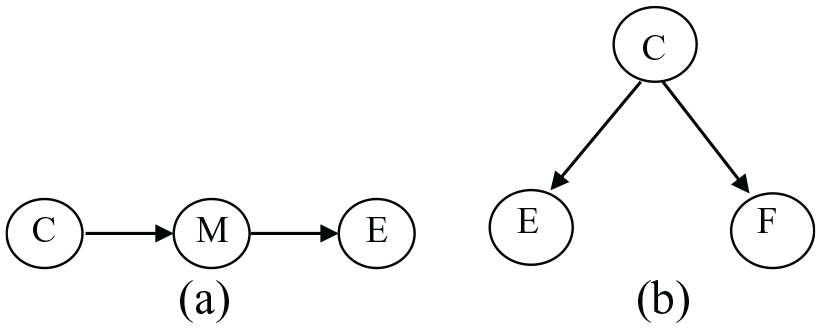
Two typical causal networks used to test the Markov assumption: (a) a chain network and (b) a common cause network.
Empirical studies on the Markov assumption
For empirical tests of the Markov assumption, the same causal network is applicable to examining causal inferences about different objects in a static situation and causal inferences about a changing object in a dynamic situation. Previous studies investigated the former, but not the latter.
Most previous studies used binary variables as nodes in causal networks and demonstrated that people’s causal inferences about different objects are apt to violate the Markov assumption (Burnett, 2004; Chaigneau et al., 2004; Mayrhofer et al., 2010; Park & Sloman, 2013; Rehder, 2014, 2018; Rehder & Burnett, 2005; Rottman & Hastie, 2014, 2016; Waldmann & Hagmayer, 2005; Walsh & Sloman, 2004). In the common cause network, when the state of cause node C is certain, the presence of one known effect elicits higher likelihood judgements for the unknown collateral effect occurring than its absence. In the chain network, when the state of middle node M is certain, the presence of cause C elicits higher likelihood judgements for the unknown effect E occurring than its absence. When the direct cause of a given effect is absent, some studies found violations of the Markov assumption, whereas some other studies did not. When the direct cause of a given effect node is present, most studies found violations of the Markov assumption (Mayrhofer et al., 2010; Mayrhofer & Waldmann, 2015; Park & Sloman, 2013; Rehder, 2014, 2018). Moreover, Rehder and Waldmann (2017) found that participants showed stronger deviations from the normative predictions of the Markov assumption in the description conditions that qualitatively described the instructed causal model (via verbal statements of the causal relations) than in the experience conditions that presented quantitative data (via trial-by-trial experience) that manifest the intervariable correlations implied by the causal relations. This suggests that the qualitative description of a causal network can produce stronger reasoning bias than the quantitative data with trial-by-trial experience.
Previous studies used the task paradigm of comparing quantitative causal inferences about different static objects under a given causal network. For example, given a common cause network that low interest rates cause small trade deficits and low interest rates cause high retirement savings, and two economies: one economy with high interest rates, large trade deficits, and retirement savings are unknown, and the other economy with high interest rates, small trade deficits, and retirement savings are unknown, participants were asked to judge how likely each economy has high retirement savings (Rehder, 2014; Rehder & Waldmann, 2017). Although the vignette presents the same causal network as the premise, in real situations, each economy is particular and no two economies have the same causal mechanism. People readily imagine that the two independent economies (for example, Britain and France) may differ in many aspects except the given difference in trade deficits. Thus, the difference in likelihood judgements for the two economies may result from differences in some underlying unknown factors or mechanisms rather than the heuristic cue of whether small trade deficits occur. The above analysis suggests that there is some ambiguity in explaining the results from the previous task paradigm that compares quantitative causal inferences about different objects in static situations. Moreover, in static situations, quantitative causal inferences about different objects are more likely to induce the heuristic strategy that the positive (or negative) state of other causally related variables is the diagnostic cue of the positive (or negative) state of the inferred variable regardless of the state of screening-off variables, and so more positive (or negative) cues imply higher (or lower) likelihood judgements for the positive (or negative) state of the inferred variable (Hastie & Dawes, 2010; Park & Sloman, 2013; Rehder, 2014, 2018; Rottman & Hastie, 2016).
To avoid the above limitations of the previous task paradigm in static situations, current research used a comparison task, in which people need to make qualitative judgements about a changing object in the dynamic situation or different objects in the static situation. We call it the comparison paradigm. We illustrate it with the economy example. Given that a causal network is identical to the above causal network, and one economy changes from an initial state to an end state (the initial state with low interest rates, small trade deficits, and low retirement savings, and the end state with low interest rates, large trade deficits, and retirement savings are unknown), people are asked to predict whether in the end state low retirement savings will remain unchanged or change to high retirement savings. The Markov assumption predicts the former, whereas the heuristic account predicts the latter. In the comparison task, people need to compare two different states of a changing object and to infer the state of the unknown node in the end state. It can test whether human qualitative judgements about a changing object adhere to the Markov assumption. In many cases, people often need to make qualitative causal inferences about a changing object. However, no previous studies have investigated whether such causal inferences adhere to the Markov assumption. Current research aims to investigate this question.
Likewise, in static situations, we can use a comparison task, in which people are asked to infer whether the positive (or negative) state of one unknown node is equally likely to occur for two different static objects. For the economy example, there are two economies: one economy with high interest rates, large trade deficits, and retirement savings are unknown, and the other economy with high interest rates, small trade deficits, and retirement savings are unknown, a qualitative question asks people to judge whether the likelihood that the first economy has high retirement savings is equal to the likelihood that the second economy has high retirement savings. The comparison task can test whether in static situations human qualitative judgements about different objects adhere to the Markov assumption.
Current research used the comparison paradigm to investigate whether qualitative judgements are more likely to adhere to the Markov assumption in dynamic situations than in static situations. This question is associated with belief revisions.
Causal inferences and belief revisions
Causal inferences about a changing object concern belief revision in dynamic situations. In belief revision research, there are two major accounts: the minimal change assumption and the explanatory hypothesis (Khemlani & Johnson-Laird, 2013, 2015; Walsh & Johnson-Laird, 2009). The minimal change assumption states that individuals tend to minimally revise or adjust their existing beliefs and so they should not change more beliefs than is necessary to accommodate the conflicting belief (Gärdenfors, 1988; Harman, 1986; Lucas & Kemp, 2015; Park & Sloman, 2014; Walsh & Sloman, 2008). As William James (1907) wrote, “[The new fact] preserves the older stock of truths with a minimum of modification, stretching them just enough to make them admit the novelty” (p. 59). The explanatory hypothesis states that individuals construct an explanation to resolve the inconsistency in a description, and the explanation entails a revision of the description. Revisions may or may not be minimal, depending on the construction of an explanation (Khemlani & Johnson-Laird, 2013, 2015; Walsh & Johnson-Laird, 2009). The two accounts make different predictions for the changing economy. According to the minimal change assumption, the change of trade deficits is local and implies only the change of the link between interest rates and trade deficits, but the link between interest rates and retirement savings should remain unchanged such that retirement savings will remain unchanged as interest rates remains unchanged. Thus, the minimal change assumption predicts that causal inferences should adhere to the Markov assumption. According to the explanatory hypothesis, the change of trade deficits implies that in the end state the state of trade deficits is no longer consistent with the state of interest rate, and this will trigger some underlying mechanism explanation for the inconsistency. This underlying mechanism may change only trade deficits, showing the minimal change. It may also change both trade deficits and retirement savings, showing the maximal change. Whether the change produced by the underlying mechanism is minimal or maximal depends on whether the two collateral effects have the same underlying mechanism. The same underlying mechanism will produce the maximal change, whereas different underlying mechanisms will produce the minimal change. This is suggested by the underlying mechanism account proposed by Park and Sloman (2013). Thus, the explanatory hypothesis has the same prediction as the underlying mechanism account. When individuals are unable to access some underlying mechanism, the explanatory hypothesis is no longer applicable.
Overall, for the question of whether causal inferences in dynamic situations adhere to the Markov assumption, the minimal change assumption predicts adherence to the Markov assumption. The heuristic account predicts violating the Markov assumption. The explanatory hypothesis and the underlying mechanism account have the same prediction. For these two accounts, whether causal inferences adhere to the Markov assumption depends on what underlying mechanisms individuals can access to. When underlying mechanisms are unknown, the two accounts are not applicable.
The minimal change assumption may be modulated by general background knowledge. Previous studies found that temporal dependency information is conducive to causal learning (Rottman et al., 2014; Rottman & Keil, 2012; White, 2015). In particular, it was found that when observing variables over time, people believe that when a cause changes state, its effects likely change state, but an effect may change state due to an exogenous influence in which case its observed cause may not change state at the same time (Rottman & Keil, 2012). According to these findings, in the common cause network, we can predict that for a changing object with temporal dependency, when the cause nodes remain stable and an effect node changes due to an exogenous influence, the other effect nodes will also remain stable; and that for two different static objects without temporal dependency, the difference in one effect node between the two objects less likely implies that the other effect nodes will also remain stable, because there may be more exogenous variables that can influence all the effect nodes. For the economy example, the changing economy involves temporal dependency (i.e., autocorrelated) between its two different states, but the two different economies do not. Thus, there are fewer unknown differences between the two different states of the changing economy with temporal dependency than between the two different economies without temporal dependency. Thus, the comparison task in the dynamic situation implies fewer differences than that in the static situation. For the present question of whether qualitative judgements are more likely to adhere to the Markov assumption in dynamic situations than in static situations, general background knowledge is that there are fewer unknown differences between the two different states of the changing economy with temporal dependency than between the two different economies without temporal dependency. Therefore, we can assume that in the comparison task, people are more likely to make minimal change responses and to adhere to the Markov assumption in dynamic situations than in static situations. We refer to this assumption as the situation-modulated minimal change account. This assumption is congruent with the previous finding that temporal dependency information is conducive to causal learning.
Our current studies used the comparison task paradigm to test the above assumption in typical natural questions. The Markov assumption is applicable to causal networks with binary or numerical variables. The two kinds of variables are the representative variables in causal networks. However, most previous studies investigated causal networks with binary variables but neglected causal networks with numerical variables. Thus, we conducted two experiments to investigate these two kinds of causal networks respectively. Because most previous studies used description conditions to test the Markov assumption, the present studies also used description conditions to compare with these studies.
Experiment 1
Method
Participants
A total of 120 college students (55 males) from Shaanxi Normal University in China participated in Experiment 1.
Design and materials
Experiment 1 was a paper-and-pencil questionnaire study that investigated causal inferences about causal networks with binary variables. We used a between-subjects design where the dynamic and static condition had a similar design of questions (shown in Table 1). In the dynamic condition, a typical natural question was to infer whether the state of the unknown node in the end state will change or remain unchanged given that an object changes from an initial state to an end state. In the static condition, a typical natural question was to judge whether the likelihood of the positive (or negative) state of an unknown node in one object is equal to the likelihood of the positive (or negative) state of the corresponding unknown node in another object. The questionnaires in the two conditions contained the same four scenarios that were the four combinations of two causal networks (the chain and common cause networks) and two kinds of domains (machine and biology). The four scenarios were counterbalanced. The complete questionnaires are presented in the online Supplementary Material A (translated from the original Chinese version).
The design of questions in Experiment 1.
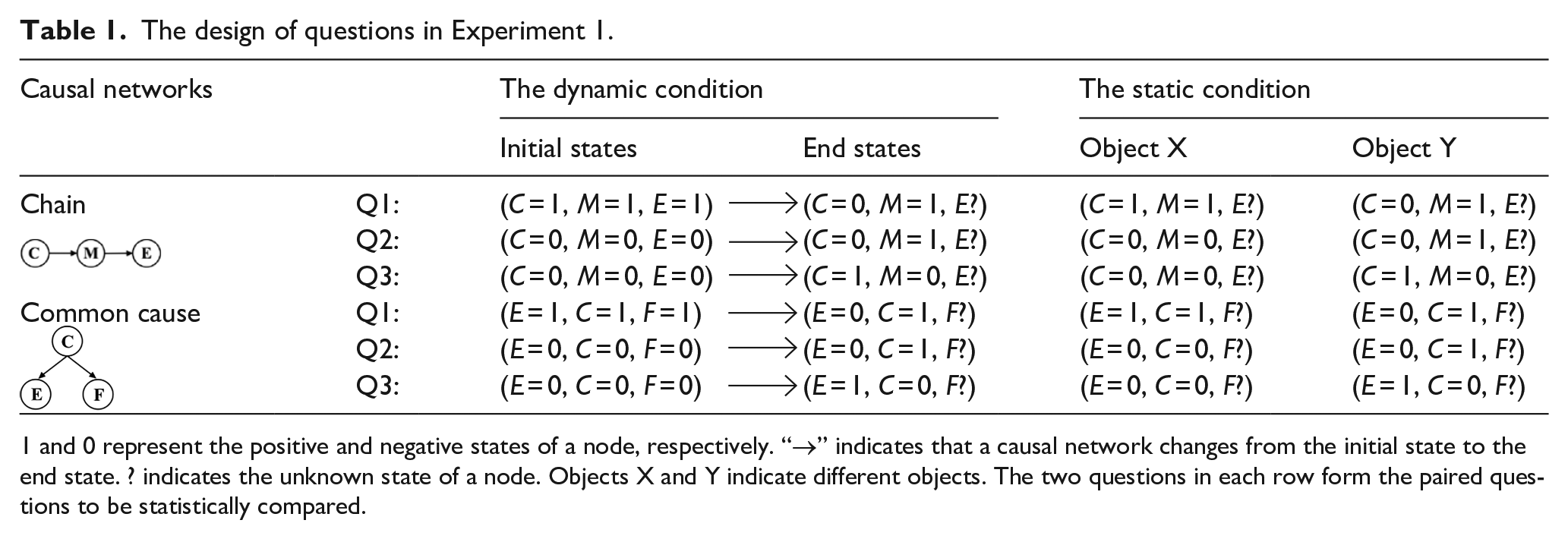
1 and 0 represent the positive and negative states of a node, respectively. “⟶” indicates that a causal network changes from the initial state to the end state. ? indicates the unknown state of a node. Objects X and Y indicate different objects. The two questions in each row form the paired questions to be statistically compared.
In each condition, each scenario involved three questions. Questions 1 and 3 were the target questions to test the Markov assumption, in which the screening-off node (the middle node or the common cause node) remains unchanged. Question 2 was the non-target question in which the screening-off node changes. The presentation order of the three questions was counterbalanced.
In each condition, for the target questions the minimal change assumption predicted adherence to the Markov assumption, that is, the state of the unknown node would remain unchanged as the screening-off node remains unchanged. In contrast, the heuristic account predicted the violation of the Markov assumption, that is, the state of the unknown node would vary with the other known node. The underlying mechanism account and the explanatory hypothesis were unable to make definite predictions, because underlying mechanisms were unknown. The above accounts all predicted no differences between the dynamic and static condition. However, according to the situation-modulated minimal change account, it was expected that participants would be more likely to adhere to the Markov assumption in the dynamic condition than in the static condition. In particular, the proportion of “remain unchanged” judgements for each target question in the dynamic condition would be higher than the proportion of “equal” judgements for the corresponding target question in the static condition.
Procedure
We conducted the experiment in a quiet classroom. Every participant received a questionnaire and a pen to fill it out. They took about 15 min to complete the task.
Results
The percentages of causal inferences are presented in Table 2. In the dynamic condition, for each scenario, most participants (70%–83%) predicted “will remain unchanged” for the two target questions; but “will change” for the non-target question (Q2). For the target questions, they adhered to the Markov assumption. In the static condition, for each scenario, about half participants (43%–65%) made “unequal” judgements for the two target questions, and most participants made “unequal” judgements for the non-target question (Q2). For the target questions, participants were more likely to base their judgements on the heuristic strategy.
The percentages of causal inferences and the results of the χ2 tests in Experiment 1.
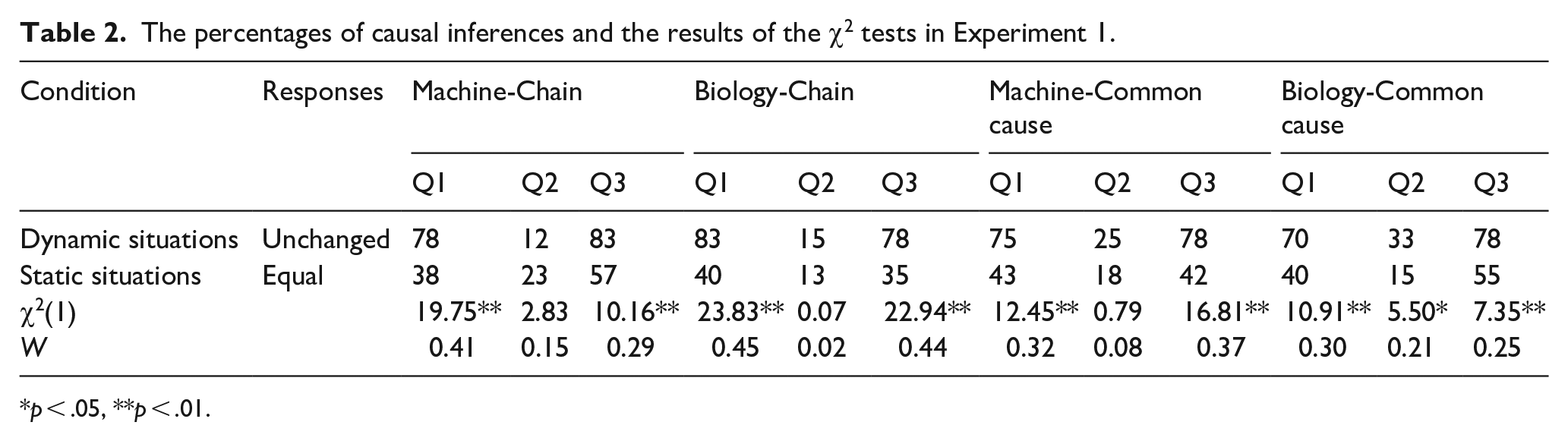
p < .05, **p < .01.
We compared the paired questions in each column in Table 2. For each pair, we performed a χ2 test of independence between the two conditions to compare the proportion of “remain unchanged” judgements in the dynamic condition and the proportion of “equal” judgements in the static condition. The results of the χ2 tests are shown in the bottom of Table 2. For each pair of the target questions, the proportion of “remain unchanged” judgements in the dynamic condition was higher than the proportion of “equal” judgements in the static condition. Thus, participants more often adhered to the Markov assumption in the dynamic condition than in the static condition. This finding is consistent with the prediction of the situation-modulated minimal change account rather than the other accounts.
Experiment 2
Method
Participants
A total of 120 college students (51 males) from Shaanxi Normal University in China participated in Experiment 2.
Design and materials
Experiment 2 was a paper-and-pencil questionnaire study that investigated causal inferences about causal networks with numerical variables. We used a between-subjects design where a dynamic and static condition had a similar design of questions (shown in Table 3). The two conditions had the same scenarios: two scenarios (geography and biology) with the chain network, and two scenarios (machine and biology) with the common cause network. In each scenario of each condition, the design of questions was similar to that in Experiment 1, except that the numerical variables were used and the states of nodes were represented as quantitative values. The complete questionnaires in the two conditions are presented in the online Supplementary Material B. The four scenarios were counterbalanced. For the static condition, we illustrated the questions as follows. For example, for a chain network with a scenario where in a geographical area, an increase in the humidity of the air results in an increase in annual rainfall, which in turn results in an increase in the water level of the river in the area, given Question 1 where Areas 1 and 2 have the same annual rainfall (0.6 m), but Areas 1 and 2 have the humidity of 50% and the humidity of 80% respectively, participants were asked to judge whether the water level of the river in Area 1 is equal to that in Area 2.
The design for the scenarios in Experiment 2.
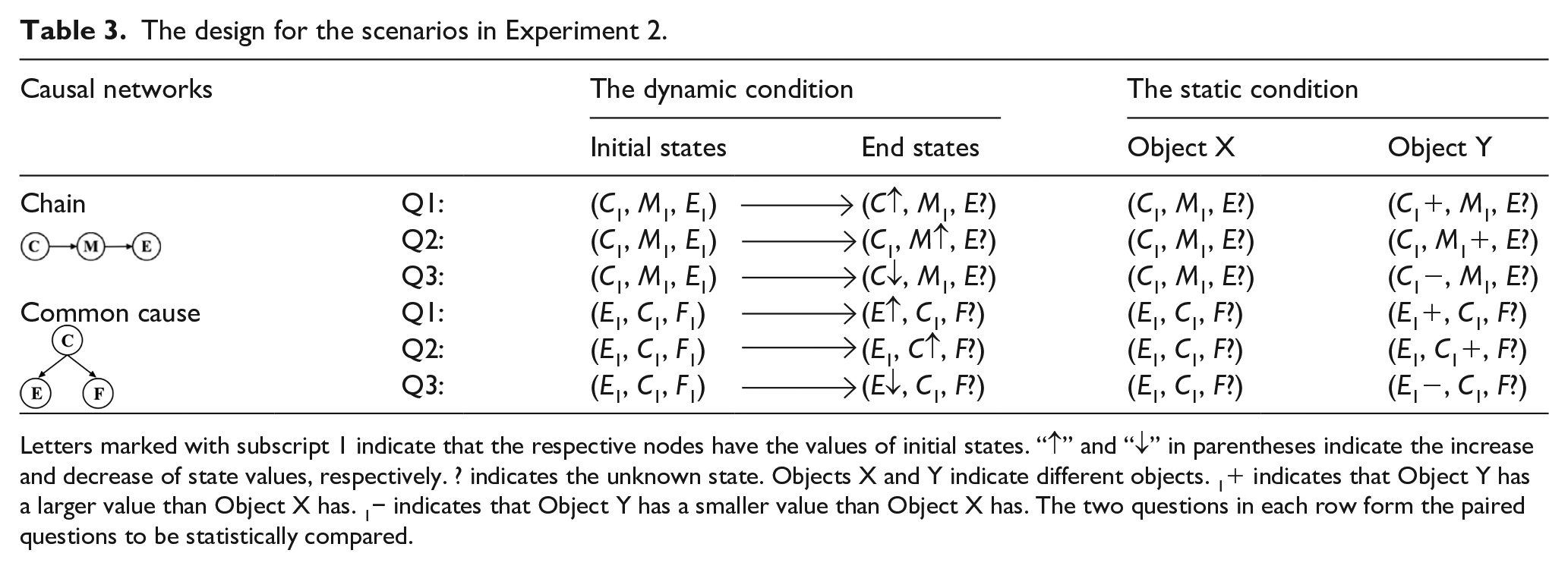
Letters marked with subscript 1 indicate that the respective nodes have the values of initial states. “↑” and “↓” in parentheses indicate the increase and decrease of state values, respectively. ? indicates the unknown state. Objects X and Y indicate different objects. 1+ indicates that Object Y has a larger value than Object X has. 1− indicates that Object Y has a smaller value than Object X has. The two questions in each row form the paired questions to be statistically compared.
In each scenario, there were three questions with the design similar to that in Experiment 1. Questions 1 and 3 were the two target questions, and Questions 2 was the non-target question. The presentation order of three questions was counterbalanced. For the target questions, the theoretical predictions were similar to those in Experiment 1.
Procedure
The procedure was identical to that in Experiment 1.
Results
The results of causal inferences are presented in Table 4. In the dynamic condition, for each scenario, most participants (75%–85%) predicted “will remain unchanged” for the two target questions; but “will change” for the non-target question (Q2). For the target questions, they adhered to the Markov assumption. In the static condition, for each scenario, about half participants (42%–68%) made “unequal” judgements for the two target questions; and most participants made “unequal” judgements for the non-target question (Q2). For the target questions, participants were more likely to base their judgements on the heuristic strategy.
The percentages of causal inferences and the results of the χ2 tests in Experiment 2.
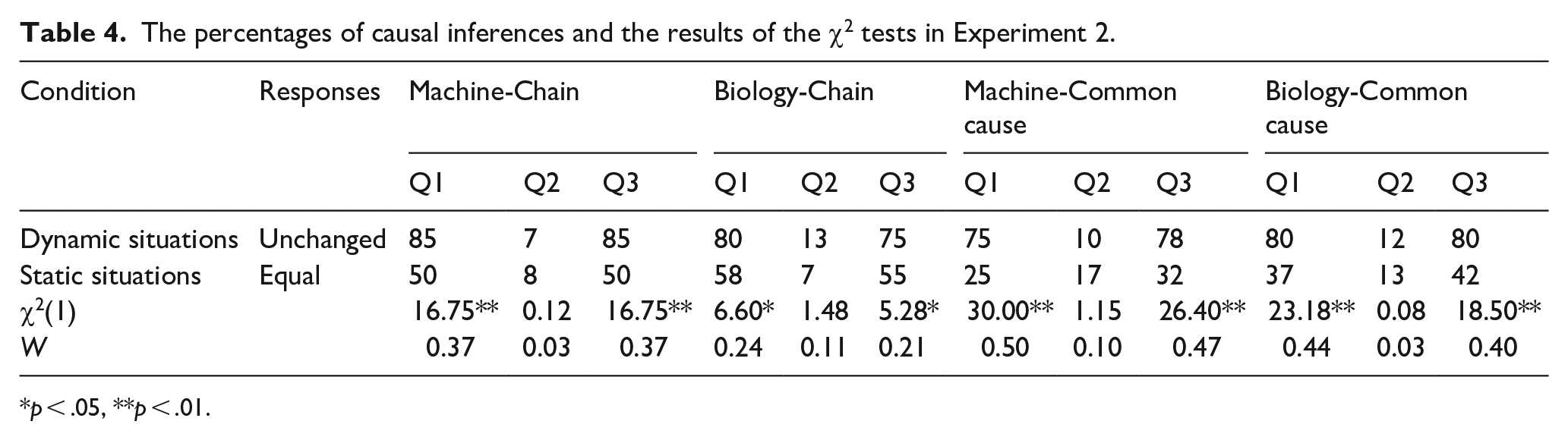
p < .05, **p < .01.
We compared the paired target questions in each column in Table 4. For each pair, we performed a χ2 test of independence between the two conditions to compare the proportion of “remain unchanged” judgements in the dynamic condition and the proportion of “equal” judgements in the static condition. The results of the χ2 tests are shown in the bottom of Table 4. For each pair of the target questions, the proportion of “remain unchanged” judgements in the dynamic condition was higher than the proportion of “equal” judgements in the static condition. Thus, participants more often adhered to the Markov assumption in the dynamic condition than in the static condition. This finding is consistent with the prediction of the situation-modulated minimal change account rather than the other accounts.
General discussion
Summary of the present findings
Experiments 1 and 2 examined qualitative causal inferences about causal networks with binary and numerical variables, respectively. The two experiments showed a similar response pattern. For typical natural questions, qualitative judgements were more likely to adhere to the Markov assumption in dynamic situations than in static situations. The effects of situations on causal inferences were significant. In dynamic situations, most participants predicted “will remain unchanged” for the target questions, showing minimal revisions on the causal networks and adherences to the Markov assumption. The overall response pattern is consistent with the prediction of the situation-modulated minimal change account rather than the other accounts.
Theoretical exploration
The present finding revealed that for causal networks, qualitative judgements were more likely to show minimal changes and adhere to the Markov assumption in dynamic situations than in static situations. Minimal changes more often occurred in dynamic situations than in static situations. Minimal changes were modulated by whether situations are dynamic or static. This confirms our assumption that a changing object implies fewer differences than different static objects. Thus, dynamic situations are more likely to elicit minimal revisions on causal networks and adherences to the Markov assumption than static situations. The present finding clearly supports the situation-modulated minimal change account rather than the other accounts. The heuristic account, the underlying mechanism account, and the explanatory hypothesis may be able to explain violating the Markov assumption in static situations, but they cannot explain why participants more often adhered to the Markov assumption in dynamic situations than in static situations.
In dynamic situations, qualitative judgements generally adhere to the Markov assumption. In the chain network such as Figure (a), when the state of middle node M (the screening-off variable) is certain, the state of node E is independent of the state of node C. In the common cause network such as Figure (b), when the state of node C (the screening-off variable) is certain, nodes E and F are independent of each other. The general response pattern demonstrates that causal inferences show minimal revision on the causal network, without changing the dependence of the effect variable on the direct cause variable. When the direct cause (screening-off) variable of the effect variable remains constant and the other non-screening-off variable changes, people expect the effect variable to remain unchanged, respecting the causal dependence and independence. In the chain network such as Figure (a), when the CM link changes, people expect the ME link to remain unchanged. In the common cause network such as Figure (b), when the CE link changes, people expect the CF link to remain unchanged. In each causal network, people regard the two links as being independent of each other, and need not consider some underlying mechanism. Thus, causal inferences adhering to the Markov assumption embody the minimal revision assumption in belief revision research (Gärdenfors, 1988; Harman, 1986; James, 1907; Lucas & Kemp, 2015 Walsh & Sloman, 2008). In dynamic situations under a given causal network, the minimal revision reflects causal dependence and independence in the network, without additionally considering some unknown underlying mechanism. Overall, in dynamic situations people tend to make minimal changes to causal networks, adhering to the minimal change assumption.
The response pattern in dynamic situations is beyond the heuristic account, the underlying mechanism account, and the explanatory hypothesis. The heuristic account predicts violating the Markov assumption. The underlying mechanism account and the explanatory hypothesis require considering underlying mechanisms, although underlying mechanisms may be unavailable. Compared to these two accounts, the minimal change assumption is simpler and more economical. Moreover, according to Bayesian Occam’s razor—the idea that all else being equal, people should pick the simpler hypothesis (Blanchard et al., 2018), people should prefer the minimal change assumption over the other accounts. Thus, the minimal change assumption is the best explanation for the response pattern in dynamic situations. It is the minimal revision on a causal network that results in adherence to the Markov assumption. The finding of minimal revisions in dynamic situations is consistent with the minimal change assumption in counterfactual reasoning (Lucas & Kemp, 2015; Rips, 2010; Rips & Edwards, 2013). Its basic idea is that people consider only counterfactual worlds that do not unnecessarily alter or “break” any causal relationships, and thereby are minimally different from the actual world. Overall, we can conclude that in dynamic situations causal inferences tend to be based on minimal revisions on causal networks and so adhere to the Markov assumption.
In static situations, qualitative judgements were more likely to violate the minimal change assumption and the Markov assumption. This was due to that there were more differences between two different static objects than between two different states of a changing object. In static situations, participants were more likely to base their qualitative judgements on the heuristic strategy and so to violate the Markov assumption.
Relations to existing research
The present finding that in static situations qualitative judgements tend to violate the Markov assumption is similar to the previous finding that in static situations quantitative likelihood judgements are apt to violate the Markov assumption (Burnett, 2004; Chaigneau et al., 2004; Mayrhofer et al., 2010; Mayrhofer & Waldmann, 2015; Park & Sloman, 2013; Rehder, 2014, 2018; Rehder & Burnett, 2005; Rottman & Hastie, 2014, 2016; Waldmann & Hagmayer, 2005; Walsh & Sloman, 2004). This similarity suggests that static situations are ready to elicit violating the Markov assumption regardless of whether causal inferences are qualitative judgements or quantitative likelihood judgements.
The present finding that qualitative judgements tend to adhere to the Markov assumption in descriptive dynamic situations parallels the previous finding that in trial-by-trial learning quantitative likelihood judgements are more sensitive to the Markov assumption in the interventional learning condition than in the observational learning condition (Lagnado & Sloman, 2002). Dynamic situations with observational learning are similar to the interventional learning condition because objects change over time in both. This similarity suggests that dynamic situations can elicit adherence to the Markov assumption regardless of whether causal learning is observational or interventional. The present finding of adhering to the Markov assumption in dynamic situations with observational learning implies that observational learning could also elicit adherence to the Markov assumption if it involves changing objects. Thus, whether causal learning involves changing objects influences whether people adhere to the Markov assumption. This influence resonates with the previous finding that dynamic temporal information is conducive to causal learning in both observational and interventional learning (Rottman et al., 2014; Rottman & Keil, 2012; Soo & Rottman, 2018; White, 2015). Current research demonstrates such influences in causal learning about descriptive situations. Future work should investigate such possible influences in trial-by-trial learning.
Current research does not invalidate the previous studies. It is complementary to the previous studies. The previous studies did not investigate causal inferences in dynamic situations. Current research integrates the Markov assumption and the minimal change assumption in belief revision research. It demonstrates that dynamic situations are more likely to elicit minimal revisions on causal networks and adherence to the Markov assumption than static situations, and so, belief revisions on causal networks are modulated by whether situations are dynamic or static. This finding extends existing causal reasoning research about causal networks.
The limitations of the present experiments
In the present experiments, we compared the unchanged/changed judgements about the dynamic items and the equal/unequal judgements about the static items. The two sets of response options can indicate whether causal judgements adhere to the Markov assumption in the dynamic and static conditions, respectively. Thus, the two formats of dynamic and static items are qualitatively comparable. It could be argued that the two formats of dynamic and static items are not directly comparable because they are based on different amounts of information—two unknown effect values in the static case; one unknown effect value in the dynamic case. This question is based on the strict requirement of the experimental method. However, for the sake of ecological validity, current research aims to investigate whether causal judgements adhere to the Markov assumption in typical natural questions. A typical natural dynamic question is to predict whether there will be change relative to a known initial state rather than an unknown initial state. Alternatively, a dynamic question, in which the initial state of a node is unknown, will make it difficult to predict the direction of change (e.g., “will change to not running” or “will change to running”), and so may confuse people. A typical natural static question is to judge whether the likelihood of the positive (or negative) state of an unknown node in one object is equal to the likelihood of the positive (or negative) state of the corresponding unknown node in another object, but not to compare the likelihood of an unknown node in one object with the likelihood of the corresponding known node in another object. The latter is very difficult to understand. Thus, the present formats of the two conditions are ecologically natural and valid. Moreover, the consistency between the present and previous findings in both dynamic and static situations also suggests that the format difference between the two conditions should make no difference to the essential aspect of question, and so, the present conclusion is valid and reliable. Future work could investigate causal inferences in artificially controlling formats of dynamic and static questions (that is, both questions are equal in terms of the number of unknown effect values).
Supplemental Material
QJE-STD-20-094.R2-Supplementary_Material_A_and_B – Supplemental material for A situation-modulated minimal change account for causal inferences about causal networks
Supplemental material, QJE-STD-20-094.R2-Supplementary_Material_A_and_B for A situation-modulated minimal change account for causal inferences about causal networks by Moyun Wang and Jinrui Sun in Quarterly Journal of Experimental Psychology
Footnotes
Declaration of conflicting interests
The author(s) declared no potential conflicts of interest with respect to the research, authorship, and/or publication of this article.
Funding
The author(s) disclosed receipt of the following financial support for the research, authorship, and/or publication of this article: National Natural Science Foundation of China under General Grant (30170901)

References
Supplementary Material
Please find the following supplemental material available below.
For Open Access articles published under a Creative Commons License, all supplemental material carries the same license as the article it is associated with.
For non-Open Access articles published, all supplemental material carries a non-exclusive license, and permission requests for re-use of supplemental material or any part of supplemental material shall be sent directly to the copyright owner as specified in the copyright notice associated with the article.
