



Abstract
Although it is understood that our experience of time is fluid and subjective, the cognitive mechanisms underlying this phenomenon are not well described. Based on event segmentation theory, we tested the hypothesis that changes in the context, particularly the spatial context, of an experience impact how an individual perceives (encodes) and remembers the length of that event. A group of participants viewed short videos of scenes from movies that either contained shifts in spatial context (e.g., characters moving through doorways) or did not contain any shifts in spatial context. In one task, participants estimated a randomly selected time duration (between 10 and 23 s) when encoding these videos. In a second task, the same participants estimated the duration of the videos after viewing them. We found that even though the presence of spatial shifts impacted how time was perceived, the nature of this effect differed as a function of task. Specifically, when time was estimated at encoding, these estimates were longer for videos that did not contain spatial shifts compared with those with spatial shifts. However, when these estimates were made at retrieval, durations were reported as longer for videos with spatial context shifts than those without. A second experiment replicated these main findings in a new sample. We interpret these results as providing new evidence for theories on how context changes, particularly those in spatial information, distort the experience of time differently during the encoding and retrieval phases of memory.
Introduction
Our ability to judge the duration of events from our lives is critical for many everyday activities (e.g., we use it to plan and organise our daily lives), yet these judgements are not always made accurately. Sometimes, events can feel like they drag on and other times events can feel like they pass by very quickly. To understand this subjective and changing experience of time, early work considered time estimation to emerge from an internal pacemaker or a clock, yet more contemporary models have suggested that time perception also results from how we process non-temporal information in our environment (Eagleman, 2008). Spatial information is a critical element of our experiences and one that is thought to alter the way we experience time. In this study, we focused on testing the hypothesis that changes to spatial information within an event will alter time perception. Based on the understanding that this effect is a memory-based phenomenon, we compared the impact of spatial change on how time is perceived when an experience is occurring—as it is being encoded into memory—versus when time is estimated at retrieval, from a memory representation of an event. We focused on making this comparison using naturalistic stimuli to understand the way shifts in spatial information that are prominent in our everyday lives affect the way we experience time.
Traditional psychophysical work on time perception views time as emerging from an internal clock or pacemaker (Treisman, 1963; Zakay & Block, 1996). According to this view, time estimations are based on the number of pulses coded by a pacemaker. The number of pulses accumulated over a given interval are used to represent the subjective duration of that interval’s length. Research testing this view investigated how people estimate the duration of short intervals, ranging from 100 to 1,000 ms (Kanai et al., 2006) and of simplistic stimuli (e.g., flashing lights; Schiffman & Bobko, 1974 or dot arrays; Xuan et al., 2007) that contain varying amounts of information within a given time interval. A common finding from these reports is a positive relationship between the amount of information in an interval and subjective estimates of time—in that, events with more information are remembered to be longer than their actual length.
However, research conducted under this pacemaker view under-appreciates the role of non-temporal factors in influencing time estimates. The contextual change hypothesis states that estimated event durations are also affected by the amount of new non-temporal information being processed in a given interval (Block & Reed, 1978). The general notion underlying this hypothesis is that there is a positive relationship between time estimates and the amount of information retrieved from memory (Block & Reed, 1978; also see Zauberman et al., 2010). Paralleling these ideas, recent research has shown that changes in context during an experience will affect the ability to recall the temporal order of events from that experience (Clewett & Davachi, 2017; Clewett et al., 2019; Davachi & DuBrow, 2015; DuBrow & Davachi, 2013; Ezzyat & Davachi, 2014). For example, Ezzyat and Davachi (2014) had participants study a series of items that were paired with the same or a different spatial context than the preceding item. Later, when participants made temporal proximity judgements for those items by indicating how close in time the two stimuli appeared during encoding, those that appeared in different contexts were judged as appearing “farther apart” in time than ones that appeared in the same spatial context. Thus, the presence of changes in spatial context is thought to lengthen the remembered duration of an event when it is retrieved from memory (also see Brunec et al., 2018).
The above findings and formulations support the idea that time perception is a memory phenomenon and they focused on the way time estimates are affected by information retrieved from long-term memory. However, time estimates are also made as a person is experiencing or encoding an event, and there is evidence to suggest that estimates made during encoding are also affected by the amount of information contained in an experience. Accordingly, event segmentation theory (EST; Kurby & Zacks, 2008; Zacks et al., 2007, 2009) proposed that perceptual changes during an experience act as boundaries that segment the experience into sub-events. These boundaries are also used as temporal markers, which serve to estimate and experience time (Boltz, 1992; Hanson & Hirst, 1989; Newtson & Engquist, 1976; Swallow et al., 2009). Interestingly, researchers have found that the number of changes within an experience affects how one feels time passing online in an opposite manner to which it affects time estimates from memory (Block & Gruber, 2014). For example, assessing time estimates during encoding, a recent study manipulated the number of event boundaries or sub-events contained in videos that participants studied and found that increasing the number of these boundaries decreased the subjective duration of the associated events (Bangert et al., 2019). Interpreting this finding with EST, informational changes during the experience act as indicators of passing time, and these are processed automatically, which speeds up the experienced duration of the event.
Even though there is evidence to suggest that non-temporal information influences the subjective experience of time during encoding and retrieval of events, to our knowledge, no study has directly compared how time is experienced at these two stages of memory processing within one experiment. To address this gap in the literature, we focused on testing the specific role of spatial context changes in influencing the experience of time using naturalistic stimuli. Although changes in events can occur in many forms, from changes in perceptual characteristics to actions, one prominent shift experienced in everyday events is that related to space. There is behavioural evidence to show a pivotal role of spatial context shifts in forming event boundaries within episodic memories, which we hypothesise will affect how time is perceived. A particularly noteworthy evidence is that information is forgotten when a person moves from one spatial environment to another (i.e., stepping through a doorway; Radvansky & Copeland, 2006). In addition, a recent study used perceptual classification networks and quantified the perceptual changes in videos of real-world events with (e.g., walking through a city) or without spatial shifts (e.g., sitting in a café; Roseboom et al., 2019). Their model produced longer duration estimates for videos with spatial shifts in them (i.e., city) compared with those without (i.e., office/café). An important element of this work, and of the literature reviewed above, is that time experience does not exist in a vacuum and is not simply the result of the workings of an inner pacemaker. To understand how time perception occurs in the real world, it is imperative to study it with naturalistic stimuli that represent the complexity of everyday experiences.
Current study
Based on EST and the above reviewed findings, we tested the hypothesis that if spatial shifts in the environment are used to segment an experience into temporally organised sub-events, then their presence will shorten duration estimates during encoding but increase duration estimates for the memory of that experience. We tested these hypotheses with two tasks in which participants estimated the length of videos while concurrently watching them (i.e., encoding) or after watching the entire video (i.e., retrieval). Crucially, the stimuli either contained or did not contain spatial shifts. We aimed to replicate any significant results in a second experiment with an independent sample.
Experiment 1
Methods
Participants
Thirty-six young healthy undergraduate students (F = 21, Mage = 22 years, with an average of 15 years of education) participated in the study. None of the participants had any pre-existing neurological or psychiatric conditions, and all participants had normal or corrected-to-normal vision, and were fluent in English. The participants received monetary compensation for participation and provided informed consent prior to the study in accordance with the McGill University Research Ethics Board. All participants completed the Duration Encoding Task first, followed by the Duration Retrieval Task in a single experimental session (see Figure 1 for an overview of the experimental procedure) on a 21-inch Dell PC computer using E-Prime 2.0 software (Psychology Software Tools, Pittsburgh, PA).
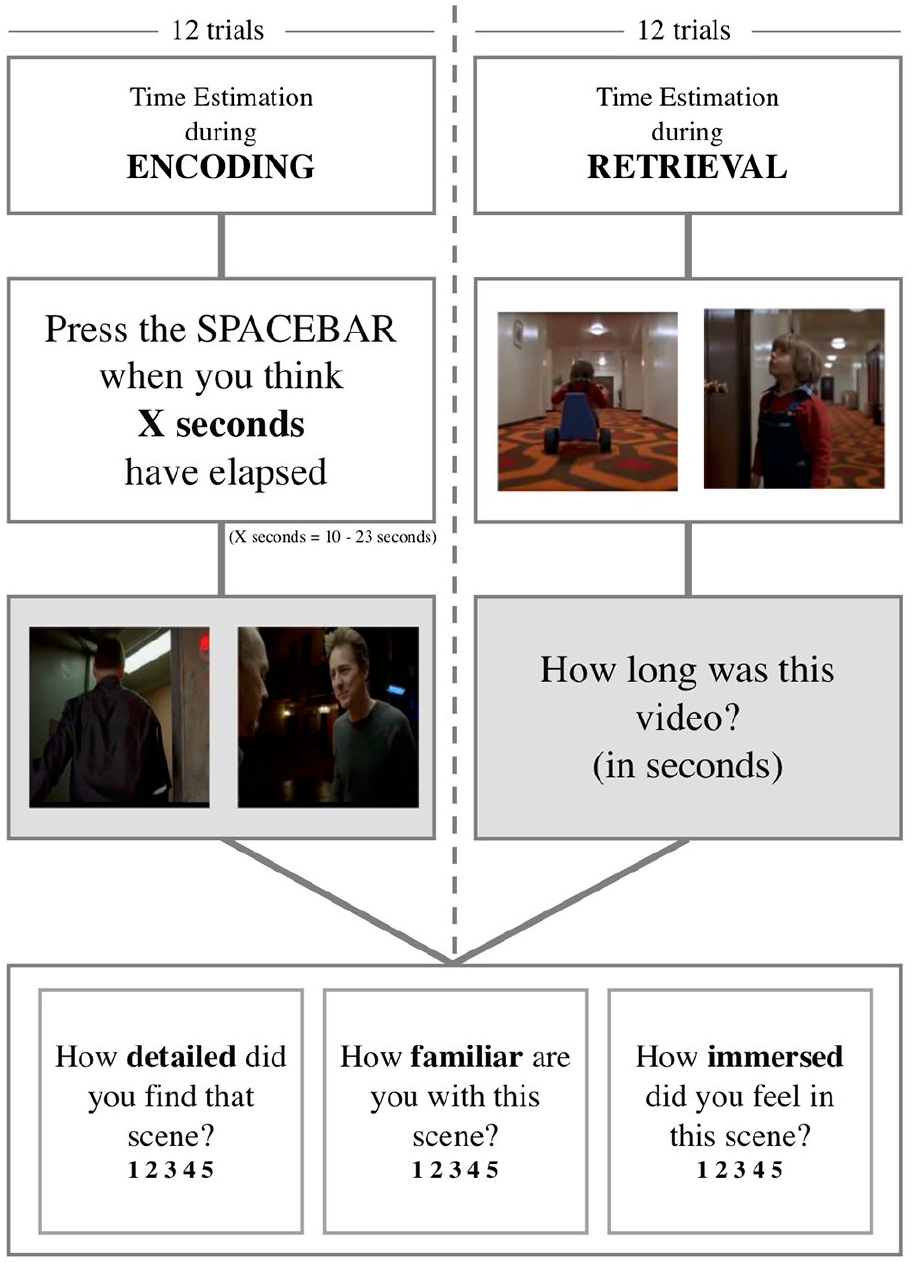
Schematic depicting the experimental tasks (i.e., duration encoding and retrieval tasks) that participants completed. In the duration encoding task, participants viewed video clips with or without spatial shifts and were given a randomly selected time duration to estimate (e.g., 15 s). Participants indicated via button-press when they felt the given duration has elapsed. In the time retrieval task, participants viewed the entire video clip (with or without spatial shifts) and they specified (in seconds) how long they thought the video clip was. After both tasks, participants viewed the first 5 s of each clip in a random order and rated each clip for immersion, detail, and familiarity. The parts of the tasks where the time estimates were collected are highlighted in grey.
Stimuli
Twelve pairs (total of 24) of video clips (M = 28 s, SD = 5 s, min = 21 s, max = 37 s) were selected from different films or television shows. The pairs were of equal length and contained one video clip that involved a main character moving through different spatial contexts that was achieved via steady-cam shot (i.e., characters were followed as they moved through space), which were used in “Spatial Shift” condition, and another video clip that contained the same character involved in a scene without any changes to the spatial environment, which were used in the “No-Spatial Shift” condition (see Figure 2 for examples).
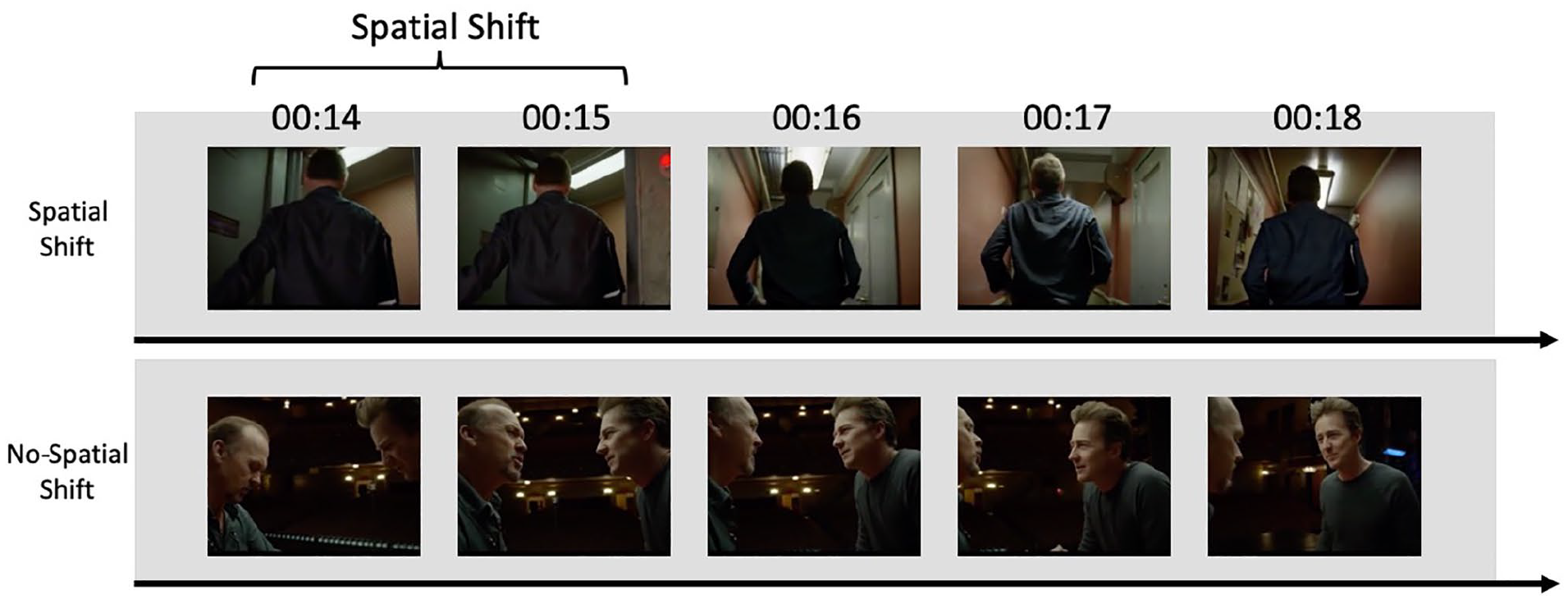
Schematic depicting the stimuli in the spatial and no-spatial conditions. The video pairs contained one clip that involved a main character moving through different spatial contexts and another video clip that contained the same character involved in a scene without changes to the spatial environment.
To better describe how spatial and no-spatial versions of each video pair compared with one another, we recruited an independent sample (N = 32, F = 16, Mage = 33 years, range = 22–63 years) through Amazon Mechanical Turk (MTURK) to view the videos in both conditions and indicate via button-press when they felt a meaningful event ended and another began (based on the event segmentation approach; see Kurby & Zacks, 2011). Confirming our hypothesis that the videos with spatial shifts would be perceived as more eventful, participants identified more segments in videos with spatial shifts (M = 2.68, SE = 0.17) than those without (M = 1.56, SE = 0.10); t(32) = 7.96, p < .001. To establish that spatial context shifts were used to create event boundaries within these videos, we tested whether the event boundaries identified in the videos with spatial shifts corresponded to moments in time when a character changed spatial contexts. To do this, we identified the moments in time when a spatial shift occurred in each movie and compared the proportion of agreement among the raters that an event shift occurred at these moments (±2.5 s). We found greater agreement during time points when there was a spatial shift (M = 0.25, SE = 0.04), compared to other time periods in which there were no changes in spatial context (M = 0.14, SE = 0.02); t(11) = −2.78, p = .02. Finally, to ensure that any effects we find are not due to differences extraneous to our spatial shift manipulation across the video pairs, we explored other distinctions between them by comparing the actions, the consistency of characters, and dialogue (even though presented without sound) within each clip. From this investigation, we noted that the central character was different in one pair and thus, we removed it from our analyses (see Table 1 for a list of movies/TV shows in each set of videos and their characteristics).
The movies or television shows the videos were taken from, their associated lengths and characteristics.

As the central character was different across the spatial and no-spatial pairs for this movie, we removed it from our analyses.
Procedure
For the duration encoding task, participants viewed a series of video clips and indicated when an estimated time duration had elapsed. Prior to the beginning of this task, they were instructed not to count to establish the duration, but rather to pay attention to the details in the clip to obtain a sense of duration (NB, this was to ensure that the participants were not counting to establish the duration of the clips and instead paying attention to the content of the videos; hence, these data were not collected). For all 12 trials, participants were first presented with a randomly selected time duration that ranged from 10 to 23 s. This duration remained on the screen until they were ready to view the associated clip. Next, a randomly selected clip was played with the target duration presented at the bottom of the screen. Participants pressed the spacebar once they felt the given duration has elapsed. The clips were played without sound to reduce any extraneous influences on time duration estimates (e.g., the presence of emotional music, the content of the conversations; Angrilli et al., 1997). Following this, participants were shown all 12 video clips again in a random order and asked to make ratings about the clips. Here, we showed participants only the first 5 s of each clip, and they rated these clips for their level of subjective immersion (“How much did you feel immersed in that scene?” 1 = not at all to 5 = completely), the level of detail contained in the clip (“How detailed did you find that scene?” 1 = not at all to 5 = completely) and their familiarity with the associated movie/TV show (“How familiar are you with the movie or TV show this scene is from?” 1 = not at all to 5 = very well).
For the duration retrieval task, participants were told that they were going to see a series of video clips from movies. Similar to the duration encoding task, they were instructed to view the entire clip and pay close attention to the details contained in these clips as they would be asked questions about them later to ensure that the participants were not counting to establish the duration and instead paying attention to the content of the videos (NB, data for this were not collected). Upon viewing each clip, participants were asked to specify their subjective estimate of the clip’s duration, in seconds. After providing the duration estimate for all 12 clips, participants reviewed 5 s from each clip in a random order and rated the video clip on the same scales used for the duration encoding task.
Scoring and planned statistical analyses
Prior to analyses, participants who were missing more than eight trials for each experimental task were removed from the to-be-analysed data set. This resulted in 30 participants (F = 17, M = 22 years) for the duration encoding and 34 participants (F = 16, M = 22 years) for the duration retrieval tasks. For each task, we calculated a reproduction ratio score by dividing the estimated time duration by the target duration (similar to Bangert et al., 2019). For the duration encoding task, the estimated duration is the reaction time to indicate that the given duration had elapsed, and the target duration is the requested time to be estimated. For the duration retrieval task, the estimated duration is the reported length of the video in seconds, and the target duration is the duration of the video that was played to the participants. A reproduction ratio score of “1” indicates perfect time estimation, scores lower than “1” indicate shorter time estimates (i.e., time compression), and scores greater than “1” indicate longer time estimates (i.e., elongated experience of time). First, we ran a linear mixed model, fit by restricted maximum likelihood (REML), for both tasks (Duration Encoding and Retrieval), with the reproduction ratio scores as the dependent variable and the interaction between spatial condition (Spatial Shift vs. No-Spatial Shift) and the task (Duration Encoding vs. Retrieval) as well as the z-scored subjective ratings of detail, immersion, and familiarity as fixed effects. We included random intercepts of participant and movie (from which the clips were chosen from) as well as by-participant random slope of condition in the model to account for participant and stimuli differences in the reproduction scores. Next, we investigated the effect of condition on reproduction scores in each task separately using the same model structure. Finally, we used multivariate analysis of covariance (MANCOVA) to explore potential differences in the subjective ratings across conditions for each task while controlling for target durations and movies. All analyses were conducted using R programming language (version 3.2.2; R Core Team, 2017) and the linear mixed models using the lme4 package (version 1.1-15; Bates et al., 2014). Finally, we used the lmerTest package to test the statistical significance of the main effects (i.e., to obtain p-values), using Satterthwaite’s approximation for degrees of freedom (version 3.0-1; Kuznetsova et al., 2017).
Results
We first compared the effect of condition on reproduction ratio scores across our two tasks (duration encoding vs. retrieval). The linear mixed model with the reproduction ratio scores from both tasks as the dependent variable revealed a significant interaction between the task and condition, F(1, 529.64) = 19.15, p < .001—such that the effect of condition on reproduction ratios differed as a function of task. Specifically, the difference between the reproduction ratios across the conditions (Spatial–No-spatial) were larger and negative for the duration encoding task compared with the duration retrieval task, β = −0.13; SE = 0.03; t(529.64) = −4.38, p < .001. This significant interaction suggests that although the presence of spatial shifts impacts the way time is estimated both during encoding and retrieval, mechanisms by which these estimates are made might differ across these two stages of memory processing. Model estimates for each predictor are presented in Supplementary Material Table 1. To probe this interaction further and investigate the direction of condition effects on time estimates, we ran separate linear mixed models for each task.
Duration encoding task
First, to ensure that any reported differences in the reproduction ratios were not due to variations in the given time estimates, we compared the average requested time duration between the spatial shift (M = 17.2 s, SE = 4.66) and no-spatial shift conditions (M = 17 s, SE = 4.63), and these were not significantly different, t(350.97) = 0.45, p = .65. The constructed linear mixed model with the reproduction scores as the dependent variable revealed a significant main effect of the spatial condition, F(1, 28.61) = 14.17, p = .001. The reproduction scores were higher and above a value of 1 in the no-spatial shift condition (M = 1.05, SD = 0.24), indicating an elongated experience of time, and were lower and below a value of 1 in the spatial shift condition, suggesting that time was experienced as shorter than the target duration (M = 0.98, SD = 0.21); β = 0.07; SE = 0.02; t(28.61) = 3.76, p = .001 (Figure 3, left panel). No other main effects were significant—Familiarity: F(1, 147.50) = 0.63, p = .43; Detail: F(1, 303.05) = 0.15, p = .90; Immersion: F(1, 322.3) = 0.004, p = .95 (for more information on the parameter estimates for each fixed factor, see Supplementary Material Table 2).
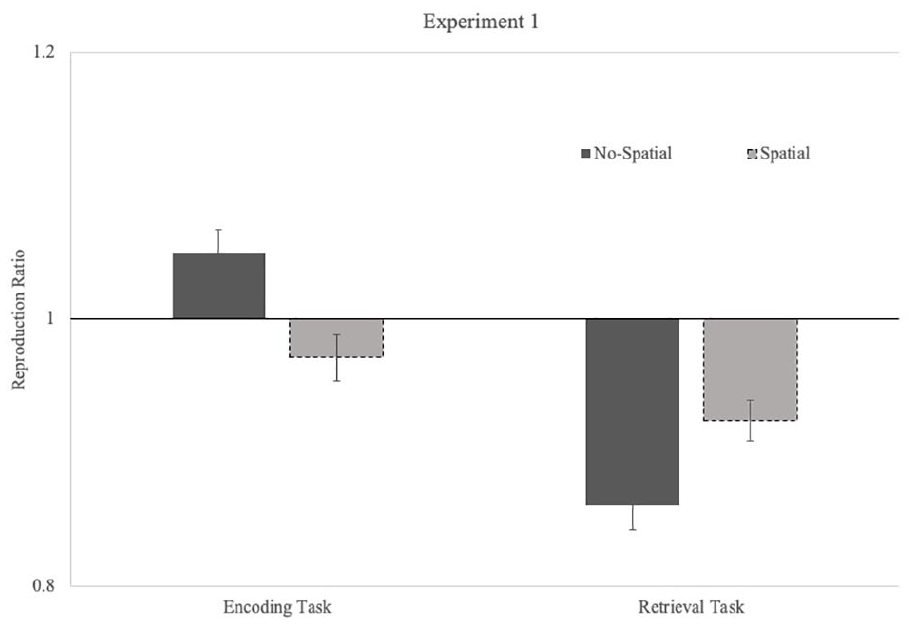
Reproduction ratio scores as a function of spatial condition (spatial vs. no-spatial) for the duration encoding (on the left) and duration retrieval (on the right) tasks in Experiment 1 (reproduction ratio = estimated duration/target duration). Error bars represent standard error of the mean.
Finally, we explored differences in the collected subjective ratings (i.e., Immersion, Detail, and Familiarity) across conditions (spatial vs. no-spatial) using a MANCOVA, and we found that the multivariate tests did not reveal an effect of condition on subjective ratings—Wilks’ Λ = 0.99, F(3, 337) = 0.46, p = .71 (for descriptive information on these ratings, see Table 2).
Mean and standard error of the mean for subjective video ratings (detail, immersion, and familiarity) across different conditions (spatial shift vs. no-spatial shift) for the two tasks (duration encoding and retrieval) for Experiment 1.
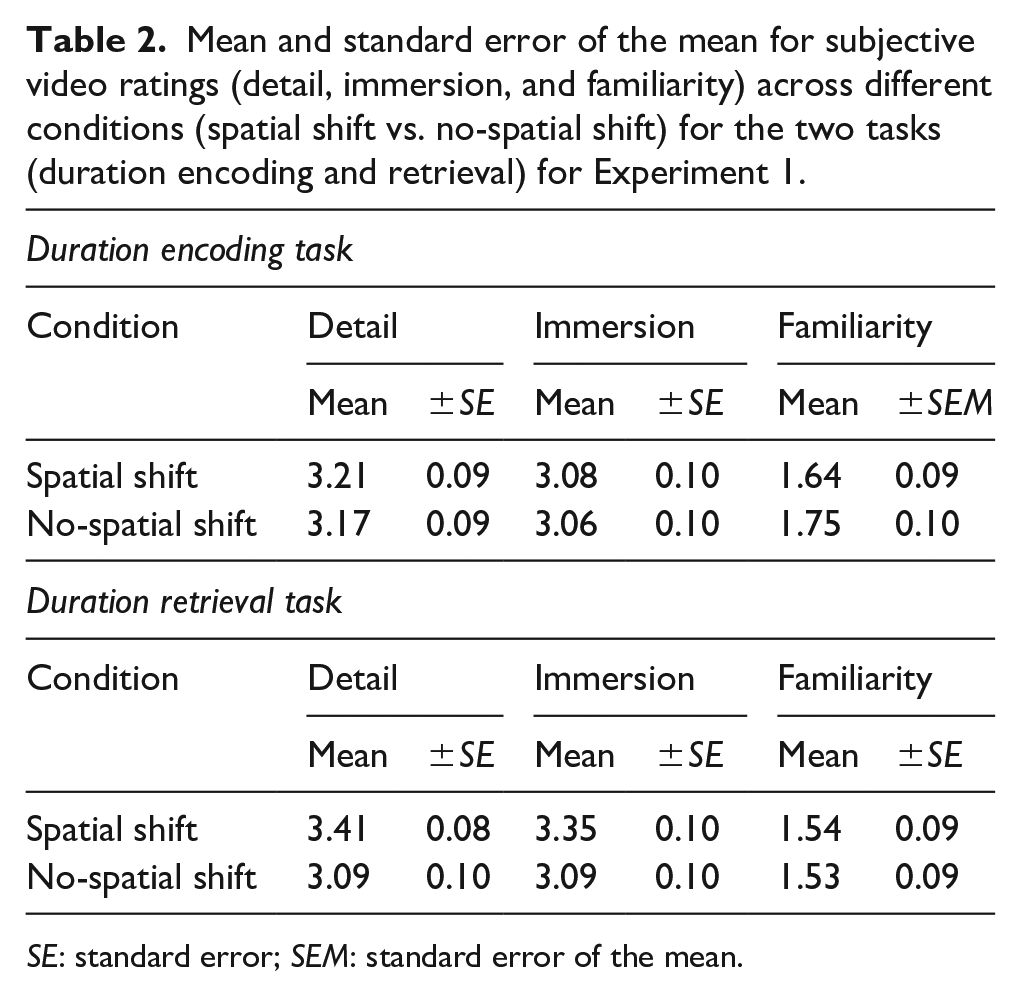
SE: standard error; SEM: standard error of the mean.
Duration retrieval task
The linear mixed model with the reproduction scores as the dependent variable revealed a significant main effect of spatial condition, F(1, 33.89) = 5.68, p = .02. These reproduction ratio scores were below a value of 1 for both conditions, indicating a general compression of time in memory, but were closer to 1 in the spatial shift (M = 0.93, SD = 0.22) compared with the no-spatial shift condition (M = 0.87, SD = 0.20); β = −0.06; SE = 0.02; t(33.89) = −2.38, p = .02 (Figure 3, right panel). This finding indicates that videos that contained spatial shifts were remembered as occurring over a longer period of time than those without spatial shifts. No other main effects were significant—Familiarity: F(1, 267.84) = 0.13, p = .71; Detail: F(1, 293.85) = 1.61, p = .20; Immersion: F(1, 299.77) = 0.12, p = .73 (for more information on the parameter estimates for each model parameter, see Supplementary Material Table 2).
To confirm that the effect of condition on reproduction ratios was not merely due to the number of event segments (i.e., a general metric of a video’s “eventfulness”), we ran linear mixed models similar to those described above for the spatial and no-spatial conditions separately, but we included the average number of event segments contained in each video (identified by the MTURK sample) as fixed effects. These models revealed that the number of segments did not predict reproduction ratios for either condition—Spatial, F(1, 123.05) = 0.03, p = .86; No-Spatial, F(1, 122.72) = 0.38, p = .54.
Finally, the MANCOVA exploring the differences in the subjective ratings as a function of condition (spatial vs. no-spatial) yielded multivariate tests that illustrated a trending effect of condition on the subjective ratings—Wilks’ Λ = 0.02, F(3, 300) = 2.51, p = .06. The follow-up univariate tests revealed that ratings of detail, F(1, 300) = 6.65, p = .01, were different across the two spatial conditions—in that videos that contained spatial shifts were rated as more detailed (M = 3.41, SD = 1.05) than those without spatial shifts (M = 3.09, SD = 1.21; for descriptive information on these collected subjective ratings, see Table 2).
Experiment 2
A methodological concern in Experiment 1 was that the order of the duration encoding and retrieval tasks was not counterbalanced (i.e., participants always completed the duration encoding task first and the duration retrieval task second), which could have influenced the reported effects. Thus, to verify that these findings were not due to order effects, we ran a second experiment in which we counterbalanced the order of the two experimental tasks and tested the influence of spatial shifts on subjective time in an independent sample.
Methods
Participants
Using the same recruitment method as Experiment 1, 32 undergraduate students from McGill University (F = 25; M = 21 years, with an average of 15 years of education) participated in the study for extra course credit.
Procedure and analytic approach
The stimuli set, procedure, and statistical analysis approach were as outlined in Experiment 1 with a few differences. First, the order in which participants performed the duration encoding and retrieval tasks was counterbalanced, and stimulus presentation and response recording were completed using the PsychToolbox for MATLAB (MathWorks, Inc., Natick, MA).
Results
Replicating our results from Experiment 1, the linear mixed model with reproduction ratio scores from both duration encoding and retrieval tasks as the dependent variable revealed a significant interaction between the task and condition, F(1, 648.93) = 9.12, p = .003. The difference between the reproduction ratios across the two conditions (Spatial–No-Spatial) were larger and negative for the duration encoding task, whereas it was smaller and positive for the duration retrieval task, β = −0.11; SE = 0.04; t(648.93) = −3.02, p = .003. In addition to this interaction effect, different from Experiment 1, there was also a significant main effect of detail, F(1, 633.46) = 9.59, p = .002. Here, higher ratings of detail led to an increase in the reproduction ratio scores, β = 0.04; SE = 0.01; t(633.46) = 3.10, p = .002, across both conditions and tasks. Model estimates for each predictor are presented in Supplementary Material Table 1.
Duration encoding task
In line with our findings from Experiment 1, the linear mixed model revealed a significant main effect of condition on reproduction ratio scores, F(1, 265.14) = 5.41, p = .02. These reproduction ratio scores were higher in the no-spatial shift condition (M = 1.06, SD = 0.29) compared with the spatial shift condition (M = 1.02, SD = 0.29); β = 0.05; SE = 0.02; t(265.14) = 2.32, p = .02 (Figure 4, left panel). No other main effects were significant—Familiarity: F(1, 340.86) = 1.36, p = .24; Detail: F(1, 357.44) = 1.04, p = .31; Immersion: F(1, 356.83) = 0.01, p = 0. 90 (for more information on the parameter estimates for each model parameter, see Supplementary Material Table 3).
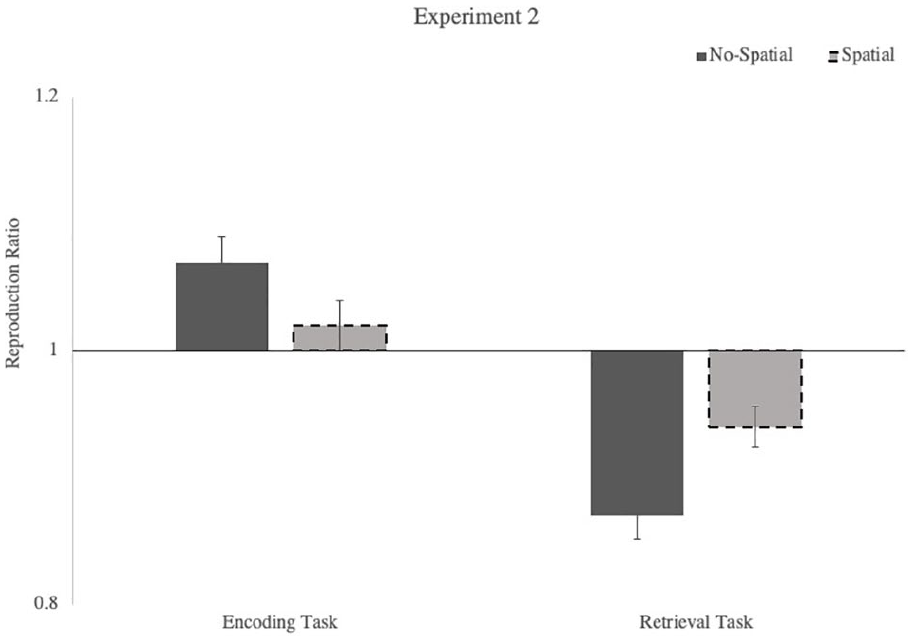
Reproduction ratio scores as a function of spatial condition (spatial vs. no-spatial) for the duration encoding (on the left) and duration retrieval (on the right) tasks in Experiment 2 (reproduction ratio = estimated duration/target duration). Error bars represent standard error of the mean.
The MANCOVA, exploring whether there were differences in the subjective ratings of the videos as a function of condition, revealed a significant multivariate test for condition–Wilks’ Λ = 0.08, F(3, 369) = 10.57, p < .001. The follow-up univariate tests revealed that ratings of detail, F(1, 369) = 25.33, p < .001, were higher in the spatial shift condition (M = 3.14, SD = 1.09) compared with the no-spatial shift condition (M = 2.64, SD = 1.06; for descriptive information collected on these ratings, see Table 3).
Mean and standard error of the mean for subjective video ratings (detail, immersion, and familiarity) across different conditions (spatial shift vs. no-spatial shift) for the two tasks (duration encoding and retrieval) for Experiment 2.
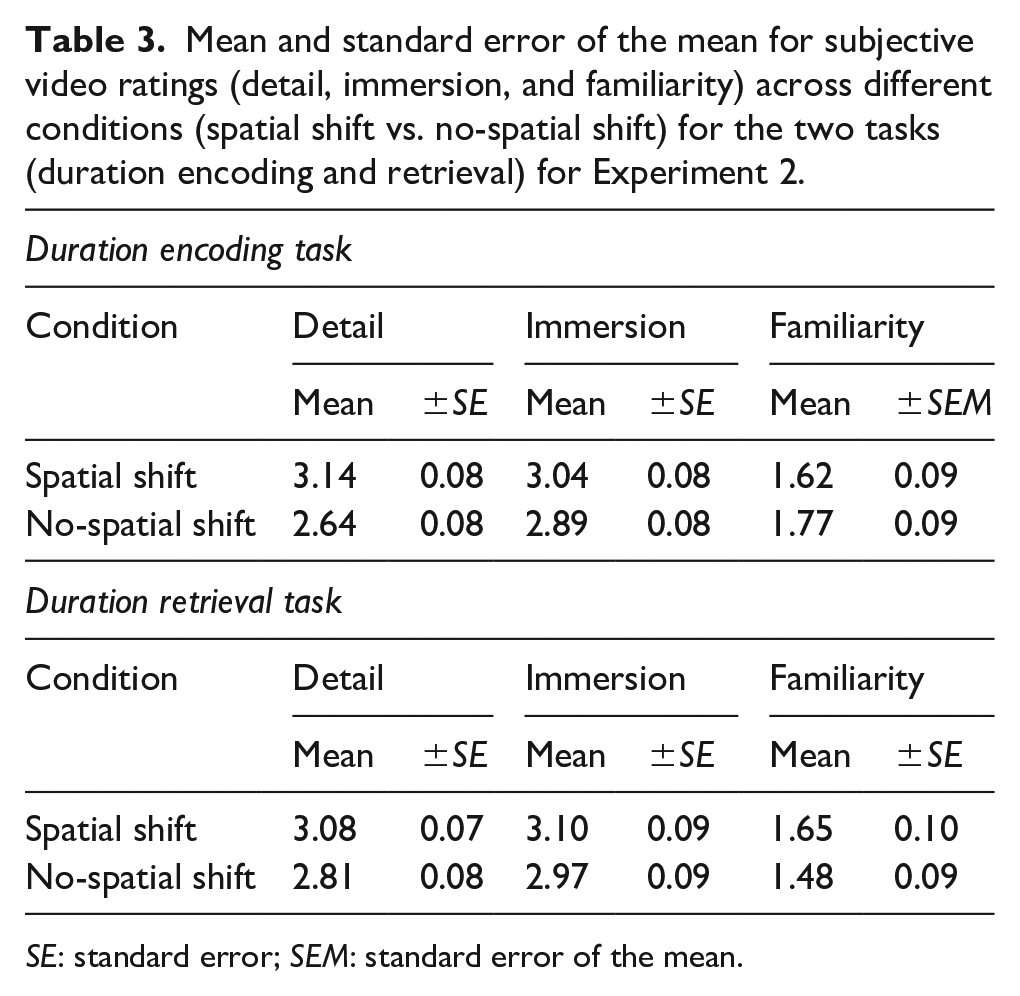
SE: standard error; SEM: standard error of the mean.
Duration retrieval task
Aligning with our findings from Experiment 1, the linear mixed model revealed a significant main effect of spatial condition on reproduction ratio scores, F(1, 239.78) = 5.63, p = .02. Replicating the general time compression effect we found in Experiment 1, the reproduction scores in both conditions were below a value of 1. Again, these scores were higher in the spatial shift condition compared with the no-spatial shift condition, β = −0.06, SE = 0.02; t(33.89) = −2.38, p = .02 (Figure 4, right panel). However, different from Experiment 1, a significant main effect of detail emerged, F(1, 165.29) = 5.16, p = .02—in that higher detail ratings were associated with higher reproduction scores across the conditions, suggesting that the level of detail in the videos lessened the time compression effect. The main effects of Familiarity and Immersion were not significant, F(1, 194.28) = 1.12, p = .29; F(1, 240.36) = 0.40, p = .54, for Familiarity and Immersion, respectively. As before, the model estimates for each predictor are presented in Supplementary Material Table 3.
Following a similar analytic approach to Experiment 1, we created separate linear mixed models for spatial and no-spatial shift conditions and investigated whether the average number of event segments in the movies predicted participants’ reproduction scores. As before, the number of event segments did not predict reproduction ratios for either condition—Spatial, F(1, 124.68) = 0.01, p = .90; No-Spatial, F(1, 126.64) = 0.73, p = .39.
Similar to Experiment 1, multivariate tests from MANCOVA revealed a significant difference between the conditions in the subjective ratings—Wilks’ Λ = 0.97, F(3, 298) = 3.25, p = .02. The follow-up univariate tests revealed that only ratings of detail, F(1, 298) = 7.59, p = .006, were higher in the spatial shift condition (M = 3.08, SD = 0.93) compared with the no-spatial shift condition (M = 2.81, SD = 1.05; descriptive information for these collected ratings is presented in Table 3).
General discussion
In this study, we explored whether changes in spatial context during an event impact how the duration of that event is experienced and remembered using naturalistic stimuli that capture the complexity of everyday events. Across two experiments, participants made duration estimates for videos that did or did not contain spatial shifts (i.e., crossing a boundary between two distinct spatial contexts) either during encoding (i.e., when watching the videos) or from memory, at retrieval (i.e., after they watched the videos). We found that videos that contained spatial shifts were perceived as shorter but remembered as longer compared with the videos without spatial shifts. Resting on the assumption that the spatial context changes were the predominant difference between the spatial and no-spatial videos, we interpret our results as evidence that alterations to spatial information in the environment are used to code time, and this differently affects the processes used to estimate time online and when events are retrieved from memory. Below, we use EST to consider the potential mechanisms underlying time estimations made during different stages of memory processing, discuss whether there is a central role of spatial information in perceiving time and present future questions to reinvigorate this line of research.
Time perception during memory encoding and retrieval
In general, fitting with prior work, we find evidence that the reproduction ratios were different when time estimations were made during encoding and retrieval (Zakay & Block, 1997). In addition, we found that the reproduction ratios were significantly different from one another across tasks in both experiments, and more importantly that our experimental manipulation (i.e., shifts in spatial context) affected time estimates during both encoding and retrieval. Specifically, time estimates made during encoding led to reproduction ratios that were generally positive—and significantly more so for the no-spatial videos, indicating that time was judged as longer under this condition. One interpretation of this finding is rooted in the attentional gate model of time perception—such that when there is change in spatial context, attention is pulled away from the time judgement task, which alters the way time is perceived (Zakay & Block, 1995). However, this theory would predict that attending to non-temporal aspects of an event would lead to time experienced as passing more slowly (and in our case it would lead to reproduction ratios that are above a value of 1 when there are spatial shifts) because temporal pulses are being missed, which is not what we found. Our finding that spatial context shifts shorten the passage of time as it is experienced fits with interpretations made under the EST. Again, according to this theory, we segment continuous experiences into distinct sub-events using salient changes in our environment to mark the passage of time online and in memory (Kurby & Zacks, 2008; Zacks et al., 2009; Zacks & Swallow, 2007). When people are making duration estimates online, there is an automatic processing of these shifts in context (i.e., temporal markers), which in return heightens our experience of time. Without these markers of time, a duration will feel longer because there is no signal change to be leveraged as an index of passing time (see Bangert et al., 2019, for a similar finding and interpretation).
Interestingly, we found that when time estimates were made from memory, during the duration retrieval task, there was a general compression effect, whereby time estimates in both conditions were below a value of 1. This finding is in line with previous work that has indicated that past events are often replayed at a compressed rate when they are retrieved (Bonasia et al., 2016; Jeunehomme & D’Argembeau, 2018). Importantly, we found that estimates for events that contained spatial shifts—salient changes—were remembered as longer than events without these shifts. Turning to the EST, this effect can be explained in the following way. When accessing a memory representation, the temporal markers within that memory facilitate the estimation of time as one can move from marker to marker in their mind to gauge the duration of the event. This leads to time being experienced as less compressed for events that contain more of these temporal markers (also see Block, 1990). In considering the effect we found at retrieval, it is important to note that for this task, participants rated videos viewed in the spatial shift condition as more detailed compared with those in the no-spatial shift condition, which we also found when the video durations were judged at encoding in Experiment 2. Importantly, including the detail ratings in our models to predict reproduction ratios did not remove the condition effect, suggesting that our spatial shift manipulation had an effect above and beyond participants’ subjective experience of how detailed the videos were. Finally, we found that the subjective ratings of detail influenced the experience of time only when time estimates were made during retrieval, underlying the different mechanisms that are at play for estimating time during encoding and retrieval.
The link between space and time, future research questions, and conclusion
In our study, we consider spatial shifts to play a critical role in timing. The reason for this focus comes from a large body of research indicating that spatial and temporal elements of events are co-organised in long-term memory (Delogu et al., 2012; Dutta & Nairne, 1993; Konkel et al., 2008; Kumaran & Maguire, 2006; Macar, 1996; Rondina & Ryan, 2017). This research includes animal models that have reported common hippocampal cells for learning how an event unfolds over time as well as in space (Howard & Eichenbaum, 2015) and human neuroimaging work that showed spatial and temporal information is processed by partially overlapping brain networks (Rondina & Ryan, 2017). Importantly, the relationship between processing spatial and temporal information from events is asymmetrical, in that spatial features of events influence individuals’ temporal estimates, but not the other way around (Casasanto & Boroditsky, 2008).
Motivated by this line of work, we wanted to test the impact of spatial information on temporal information with naturalistic stimuli, mimicking how we experience it in our daily life. Although we did our best to control for factors other than spatial changes between the videos used in our experimental conditions (see Table 1), it is entirely possible that other factors could have influenced the reported pattern. Moreover, one might think the task of time estimation differs in cognitive demand across the conditions; however, prior work has shown that time estimation is not influenced by the cognitive demands of the task (Marmaras et al., 1995). It could also be argued that the videos with spatial shifts represented more complex events than those without these shifts. With our own data, we examined to see whether variability in the number of event segments in a video, a metric of complexity, could predict time estimates within each condition for the duration retrieval task. Across the two experiments, we found that these segments did not predict participants’ time estimations for either condition. This null result provides us with confidence that what is driving our reported effect across the two conditions is spatial changes and not event complexity (i.e., eventfulness). To disentangle the unique contributions of spatial shifts and spatial information to the lengthened experience of time, one could design a follow-up study to test duration estimates using videos of characters either moving within a single spatial context (e.g., moving within a room) or across spatial contexts (e.g., changing rooms in a house). This design would have to take caution to tease apart spatial changes from changes in video complexity.
Perhaps another important future investigation is to consider how other types of context shifts, such as changes in the goals and emotions of the protagonist, affect time perception. Our work is guided by EST, which is not a theory focused on spatial information, and suggests that any salient change in an experience can act as a boundary between sub-events, and presumably a temporal marker. Comparing and contrasting the influence of other forms of contextual shifts such as shifts in the goals or intentions of agents or the overall emotional context during an experience on subjective duration estimates would be a fruitful avenue of future research.
In sum, our study provides new evidence for how experience of time is influenced by the spatial information present in an event, both when constructing that event during encoding and reconstructing it during retrieval. Our design enabled us to test this effect within the same experiment using naturalistic stimuli that mimic the complexity of everyday experiences. From a general perspective, the presented results fit with a collection of theoretical formulations and empirical findings and indicate that factors within our environment affect and distort our experience of time (Angrilli et al., 1997; Faber & Gennari, 2015, 2017; Pariyadath & Eagleman, 2012).
Supplemental Material
QJE-STD-19-343_Supplemental_Tables – Supplemental material for Changes in the experience of time: The impact of spatial information on the perception and memory of duration
Supplemental material, QJE-STD-19-343_Supplemental_Tables for Changes in the experience of time: The impact of spatial information on the perception and memory of duration by Can Fenerci, Kevin da Silva Castanheira, Myles LoParco and Signy Sheldon in Quarterly Journal of Experimental Psychology
Footnotes
Acknowledgements
We thank Alan Sukonnik and Janice Chung for their assistance with stimuli creation as well as Kelly Cool, Brenna Hello, Oliwia Zaborowsko, and Lisa-Marie Giorgio for data collection.
Declaration of conflicting interests
The author(s) declared no potential conflicts of interest with respect to the research, authorship, and/or publication of this article.
Funding
The author(s) disclosed receipt of the following financial support for the research, authorship, and/or publication of this article: The study was funded by an NSERC Discovery Grant (#RGPIN-04241) awarded to S. Sheldon.

References
Supplementary Material
Please find the following supplemental material available below.
For Open Access articles published under a Creative Commons License, all supplemental material carries the same license as the article it is associated with.
For non-Open Access articles published, all supplemental material carries a non-exclusive license, and permission requests for re-use of supplemental material or any part of supplemental material shall be sent directly to the copyright owner as specified in the copyright notice associated with the article.
