



Abstract
The attentional boost effect (ABE) is a phenomenon in which in some dual tasks, increased attention to target detection causes an increase in memory performance related to items paired with the target. However, in previous studies concerning the ABE, the detection task objects usually reflected perceptual information. Whether the ABE could be observed if the task involves detecting semantic information is unclear. To answer this question, the present study adopted the classic dual-task paradigm of the ABE. Arabic numerals were used as semantic information stimuli in the detection tasks, and the degree of semantic processing in the detection task gradually increased over three experiments. The results showed that target detection with semantic information (i.e., digits) triggered the ABE (Experiment 1) and that the ABE was also generated under the semantic judgement-based detection task (i.e., odd–even detection task) regardless of whether the detection task used a single-target stimulus (Experiment 2) or a multi-target stimulus (Experiment 3). These findings indicate that an increased semantic load before the target decision in the detection task does not affect the ABE, and both perceptual detection and semantic detection can trigger the ABE.
Introduction
Our lives are filled with various activities similar to target-detection tasks. For example, when driving, we must detect a red traffic light or a road traffic sign while other street lights or street advertisements are present. During such tasks, we need to reject distractors (i.e., street lights or street advertisements) to better detect targets (i.e., a red traffic light or a road traffic sign). Usually, detecting a target is expected to require greater attention demand than rejecting a distractor (Duncan, 1980; Dux & Marois, 2009; Kinchla, 1992). When we must perform two tasks simultaneously, the interference of target detection to another task should be greater than distractor rejection given that attention is limited in capacity (Kinchla, 1992; Lavie, 2005). However, recent research found the following surprising variation: under certain dual-task conditions, in contrast to distractor rejection, target detection did not interfere with the processing of other information that appeared simultaneously and even boosted the memory performance of that information. This phenomenon is called the attentional boost effect (ABE).
Swallow and Jiang (2010) first published this unusual finding. Under the divided-attention (DA) condition, the participants were asked to encode a series of briefly presented images (500 ms/image) into memory while simultaneously performing a target-detection task. The target-detection task was to monitor a stream of squares superimposed at the centre of images and press a key when an infrequent target square occurred (e.g., infrequent white squares among frequent black squares, 100 ms/square). Then, a four-alternative forced-choice recognition task was presented to test the participants’ memory of the images. Although detecting a target required greater attention demand than rejecting a distractor (Dux & Marois, 2009), the images that were presented with the target squares were more accurately recognised than the images presented with the distractor squares. This result was still replicated when the visual target detection was changed to auditory target detection. However, under the full-attention (FA) condition in which the participants only performed the memory task without performing the target-detection task, there was no difference in memory performance between the target-paired pictures and distractor-paired pictures. This phenomenon seems to indicate that increased attention to target detection can boost performance in another task presented simultaneously. Thus, Swallow and Jiang (2010) named this phenomenon the ABE.
Subsequent research further observed this phenomenon under various target-detection conditions as follows: when the targets were defined by the conjunction of two perceptual features (Swallow & Jiang, 2010), when the targets were not infrequent (Swallow & Jiang, 2012), when the targets were orally reported (Leclercq & Seitz, 2012; Swallow & Jiang, 2012), when the targets did not overlap spatially with the memory stimuli (Swallow & Jiang, 2014b), and when the targets were randomly presented (Fan, 2015). These data indicate that the ABE is unlikely caused by the spread of visual attention, attentional cuing, reinforcement learning, perceptual grouping, arousal, task engagement, motivation, the distinctive effect, or a motor response to the targets (Makovski et al., 2011; Swallow & Jiang, 2010, 2011, 2012, 2013). Furthermore, the ABE appears to occur primarily during early perceptual encoding. Spataro et al. (2013) first extended ABE research to verbal materials and implicit memory tests. The ABE was only observed in the later perceptual implicit tasks, lexical decision and word fragment completion but not the conceptual implicit tests, such as the semantic classification task (Spataro et al., 2013) and the category exemplar generation task (Spataro et al., 2017). In addition, the ABE was more obvious when the presentation time of the background stimulus was shorter (300 ms) and did not increase with the prolongation of the study time (Mulligan & Spataro, 2015). Moreover, when the memory stimulation presentation time was extended to 4000 ms, the ABE disappeared (Mulligan & Spataro, 2015; Spataro et al., 2017). These results seem to further indicate that the ABE is mediated by the enhanced perceptual encoding of the visual stimuli that accompany the targets during early-phase encoding (mainly related to the initial processes of word perception and comprehension) but not later-phase encoding (mainly related to elaborative rehearsal; the early-phase promotion hypothesis, Mulligan & Spataro, 2015).
To explain these data, Swallow and Jiang (2013) proposed a dual-task interaction model. This model states that the ABE essentially reflects a dynamic trade-off between attentional interference and attentional boost. First, target detection produces dual-task interference at the central and perceptual processing stages (i.e., perceptual processing occurs concurrently in two tasks, information regarding the detection item accumulates until the item can be classified as a target or distractor, and central control processes are used to maintain and accomplish the task goals). Second, target detection triggers temporal selective attention, which coincides with a transient increase in the release of norepinephrine from the locus coeruleus (LC-NE; Nieuwenhuis et al., 2005). Therefore, temporal selective attention broadly enhances the perceptual processing of all information involving the target and information that appears with the target simultaneously, which is selective for moments in time but not modally or spatially selective (Swallow et al., 2012; Swallow & Jiang, 2013). When a boost to perceptual processing occurs along with and sometimes exceeds dual-task interference, the ABE appears. Thus, memory for target-paired stimuli under DA could achieve the same level observed under FA (called the relative boost, Mulligan et al., 2014; Swallow & Jiang, 2013) and even could exceed the level observed under FA in some cases (called the absolute boost, Mulligan & Spataro, 2015; Prull, 2019; Spataro et al., 2013).
In ABE studies, the target detection tasks usually involve detecting the surface perceptual feature of an object, such as the colour of a square or the pitch of a sound. However, in our daily lives, we must detect not only the perceptual features of objects (i.e., a red traffic light) but also the semantic features of objects (i.e., a road traffic sign). Therefore, the following question emerges: if the target detection task is to detect the semantic feature of an object, will a similar effect be observed? Studies have shown that perceptual processing and conceptual processing have different effects on the same task with meaningful information (Brandimonte & Passolunghi, 1994; Konkle et al., 2010), that is, processing semantic information interferes with simultaneous meaningful information more than processing perceptual information. For example, the processing of unrelated semantic information (words) interferes with colour naming more than unrelated perceptual information (a sequence of 3, 4 or 5 Xs) (Dalrymple-Alford, 1972). Moreover, semantic information processing requires more attention resources than perceptual processing and is more likely to be affected by divided attention (Bireta & Mazzei, 2015; Mulligan, 1998). These differences seem to imply that if the target detection task involves the semantic information of the detection stimulus, the task consumes more attention resources and causes more interference in the simultaneous memory tasks under the DA condition. According to the dual-task interaction model, the ABE essentially reflects a dynamic trade-off between attentional interference and attentional boost. If the increased interference of semantic detection outweighs the boost effect of the target detection, the ABE might not be observed when a semantic detection task is used. In addition, many studies have argued that perceptual representation is usually activated preferentially over semantic representation (Posner, 1978). The representation of perceptual information is achieved during the pre-150 ms after the presentation of the information, and the addition of semantic information provides a better account of object representations up to 400 ms (Bruffaerts et al., 2019; Clarke et al., 2013, 2015). As previously mentioned, the ABE appears to occur primarily during the early phase of memory encoding. If semantic information needs to be processed in the detection task, it takes longer to categorise an item as a target. Thus, the early perceptual processing of background information might be perfectly missed, and accordingly, the ABE might not be observed.
To answer this question, the verbal paradigm of the ABE introduced by Spataro et al. (2013) and Mulligan et al. (2014) was adopted, and Arabic numerals were used as the semantic information stimuli in the detection task. There are three reasons to use Arabic numerals as semantic information. First, a single letter is considered a grapheme and is often combined into graphemes in a principled fashion, whereas single digits are complete semantic information, and each digit combination is equally acceptable (James et al., 2005). We usually see letters among other letters, whereas digits are seen in many contexts (e.g., alone, with letters, and with other digits; Polk & Farah, 1995). Second, Arabic numerals are used due to cultural differences. A letter is a grapheme to native English speakers but not native Chinese speakers; in contrast, Arabic numerals represent more intercultural semantic information. Third, given that most detection stimuli used in previous studies involve simple perceptual patterns (squares or circles), digits happen to be a kind of semantic information with simple perceptual features. Research concerning digital cognition has shown that Arabic numerals constitute effective semantic stimuli. The input and output of digits must be realised through semantic representation systems (Cappelletti & Cipolotti, 2006; Dehaene & Akhavein, 1995; Koechlin et al., 1999; Naccache & Dehaene, 2001), and the semantic processing of digits is not affected by symbolic forms (Cohen et al., 1994; Ischebeck, 2003; Shen et al., 2004); the Arabic numerals and Chinese numeral words activate numerical abstract representation in a similar way (Ischebeck, 2003; Shen et al., 2004).
Experiment 1
Experiment 1 adopted the classic dual-task paradigm of the ABE with verbal materials (Mulligan et al., 2014; Spataro et al., 2013, 2015). During encoding, a study word was presented above a briefly presented stimulus belonging to the detection task; the participants were asked to read the word aloud and try to remember the word while monitoring the predefined target stimulus and press the spacebar when they detected an infrequent target while making no response to frequent distractors. During the test phase, the participants recognised the presented words in an old/new recognition test. The ABE is defined as the recognition advantage of target-paired words over distractor-paired words under the DA condition (Prull, 2019).
The following two target detection tasks were adopted in Experiment 1: a circle detection task and a digit detection task. If detecting semantic information affects the ABE, the ABE may be absent under a digit detection condition or its size may differ between the two conditions.
Methods
Participants
Thirty college students (19 females, 11 males, mean age = 21.47, SD = 3.44) completed Experiment 1 in exchange for monetary compensation. All participants reported being in good health with normal or corrected-to-normal vision and no history of neurological illness. All participants provided informed consent.
Design and materials
The attention type (target vs distractor) and detection type (circle detection vs digit detection) were manipulated within subjects.
A set of 496 two-character Chinese words of a high frequency (0.0023 to 0.1102, mean frequency = 0.0097, SD = 0.012) was obtained from the Modern Chinese Frequency Dictionary (1986). The words were randomly divided into two sets that were used under the circle detection condition (mean frequency = 0.0104, SD = 0.014) and digit detection condition (mean frequency = 0.0100, SD = 0.012), and these sets were matched in terms of frequency, paired t(1, 247) = 1.428, p = .155. Each set was randomly divided into 32 distractor words, 32 target words, 32 new words, 128 filler words, and 24 practice words, and the sets of words were fixed. All distractor, target and filler words were presented during the encoding phase, and the new words were presented during the recognition phase mixed with the distractor and target words. In addition, the practice words were used to familiarise the participants with the experimental procedure before the formal experiment began.
Procedures
The experiment included the following two conditions: the circle detection condition and the digit detection condition. Each condition consisted of a dual-task encoding phase, a distractor task, and a recognition phase. All participants completed both conditions, and the order of the two conditions was counterbalanced across the participants.
During the dual-task encoding phase, 32 blocks of five words, including 1 target word, 1 distractor word, and 3 filler words, were presented. The target word was accompanied by a red circle (under the circle detection condition) or the digit “3” (under the digit detection condition). The distractor word and filler words were accompanied by green circles or the digits “1,” “2,” “4,” or “5.” The target word was always located in the third position, and the remaining four words were randomly located in the remaining four positions. Moreover, 0 to 2 additional filler words always presented with a green circle or the digits “1,” “2,” “4,” or “5” were randomly located between the blocks to reduce the temporal regularity of the target trials. In each trial, a word (black bold, 60 font size) and a circle (red or green; 1 cm in diameter) or a digit (black bold, 60 font size) appeared simultaneously at the centre of the screen for 100 ms with a vertical distance of 1 cm between them; then, only the word remained visible for an additional 400 ms. There was a 1,400–1,800 ms inter-stimulus interval (ISI) between successive trials. The participants were asked to perform two unrelated tasks simultaneously. One task was to read aloud and try to remember each word for a later memory test. The other task was to detect the target items (circle or digit “3”) and press the space bar as soon as possible when they observed the target. After the encoding phase, a 1 min arithmetic distractor task was performed, followed by a recognition test (see Figure 1).

Encoding phase under different conditions in Experiments 1–3.
During the recognition phase, the participants performed an untimed old/new recognition test on the words, which comprised 32 target items, 32 distractor items, and 32 new items. In each trial, a single word was presented at the centre of the screen, and the participants pressed one of the two keys to report whether they had seen the word during the encoding phase.
The experimental programme was created with Presentation software, version 1.0, and operated on a Dell Dimension 8200 computer. All stimuli were presented centrally on a white pane that was 7.8 × 9 cm in size and displayed in the central visual field on the computer monitor against a black background. All lexical stimuli were shown in white. The participants sat on a sofa in a sound-insulated, electromagnetically shielded room, and the monitor was placed approximately 80 cm from the participants.
Results and discussion
Dual-task encoding phase
The participants made few and similar false alarms in response to the distractors under the circle detection condition (M = .4%, SD = .01) and digit detection condition (M = .2%, SD = .01), t(29) = 1, p = .326. In addition, the participants correctly detected 99.69% (SD = .01) of the targets under the circle detection condition, which was better than the detection rate of 96.35% (SD = .04) under the digit detection condition, t(29) = 4.287, p < .001, Cohen’s dav = 0.78. Moreover, the response time of the circle detection (M = 354 ms) was faster than that of the digit detection (M = 434 ms), t(29) = −8.888, p < .001, Cohen’s dav = −1.62.
Recognition task performance
The mean percentage of reporting that a word was old is depicted in Table 1, including the correct response to old words and false-alarm rate of the new words. There was no difference in the false-alarm rates between the circle detection condition and the digit detection condition, t(29) = −0.620, p = .54. One-sample t-tests were conducted to examine whether the recognition performance of the old words was above chance. The results showed that the hit rates of the target words were significantly greater than 0.5 under both the circle detection condition, t(29) = 3.689, p = .001, Cohen’s dav = 0.67, and the digit detection condition, t(29) = 2.674, p = .012, Cohen’s dav = 0.49. However, the performance in response to the distractor words remained at a chance level under both conditions, |t|s < 1, ps > .5. To adjust for response biases, the recognition accuracy was assessed based on corrected hit rates (see Figure 2) in which the appropriate false-alarm rate was subtracted from the hit rate.
Means and standard deviations of the proportion of correctly recognised words in Experiment 1 a .
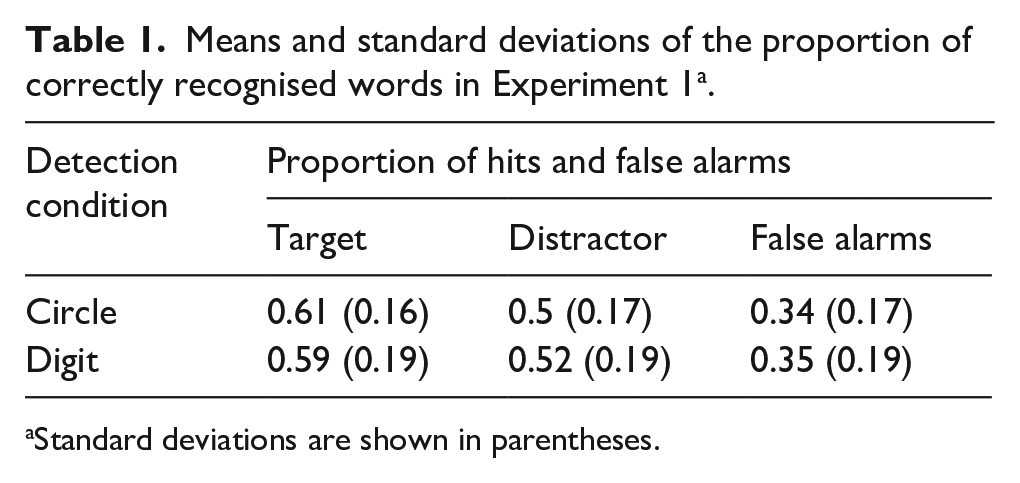
Standard deviations are shown in parentheses.
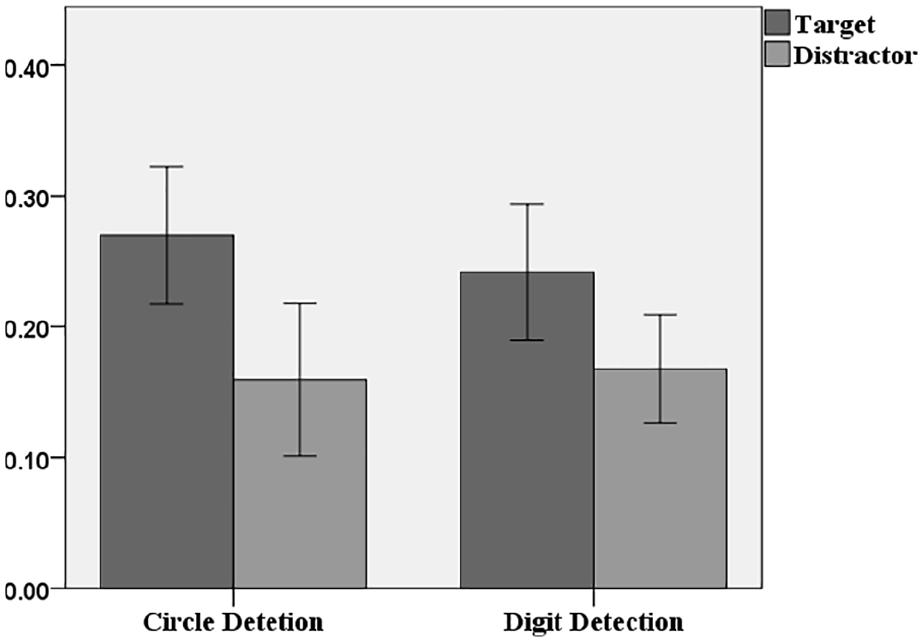
Results of Experiment 1. Mean-corrected hits (±SD) as a function of attention type (target vs. distractor) × detection type (circle vs. digits).
The corrected hit rates were subjected to a repeated-measures analysis of variance (ANOVA) with attention type (Target vs. Distractor) and detection type (Circle vs. Digit) as factors. The results revealed a significant main effect of attention type, F(1, 29) = 46.399, p < .001,
Based on the data of Experiment 1, the ABE was observed under both the circle detection condition and digit detection condition, suggesting that detecting semantic information can also produce the ABE. However, notably, there was no ABE difference between these two conditions. Could this result be because the two tasks are essentially the same? However, detecting the digits consumed a longer response time, and the digit detection rate was lower than the circle detection rate. These differences indicate that detecting digit targets requires more attentional resources than detecting circle targets. There may be another possibility. Under the circle detection condition, the participants need to distinguish between two circle colours, while under the digit detection condition, the participants need to distinguish between “3” and four other digits. Although the semantic representation of digits could be automatically activated to some extent (Cappelletti & Cipolotti, 2006; Koechlin et al., 1999; Naccache & Dehaene, 2001), the automatic processing of semantic information is not compulsory (Didino et al., 2019; Kunde et al., 2003; Maxfield, 1997). Therefore, the difference between these two detection tasks might stem from the increased difficulty of perceptual discrimination as the participants were only requested to detect “3” under the digit detection condition without the need to judge the semantic information of the digits. To avoid this possibility, Experiment 2 used a digit detection task that required the participants to judge whether the digit was odd or even. Odd–even judgement is generally considered to be an abstract semantic level that requires more cognitive effort and deeper semantic processing than digit recognition (Didino et al., 2019; Naccache & Dehaene, 2001; Patro & Huckauf, 2019). In addition, in contrast to the discrimination task used in previous ABE studies (i.e., only need to identify the target), odd–even judgement is a semantic judgement task that requires participants to classify the target into a semantic category (Patro & Huckauf, 2019). Experiment 2 further explored whether the ABE can be generalised as a target detection task involving semantic judgements of the target.
Experiment 2
Experiment 2 included the following two DA conditions: the digit detection condition and the odd–even detection condition. The digit detection task was identical to that in Experiment 1, while the odd–even detection task required the participants to judge the parity of the digits and press the key when odd digits appeared. Because the odd–even detection task required the participants to classify the target into a semantic category, we can further explore whether a semantic detection task can trigger the ABE. In addition, previous studies investigated whether the ABE reflected the boost effect of target detection or the inhibition of distractor rejection by comparing the DA with the FA. These studies found that the target-paired stimulus under the DA condition reaches or even exceeds that under the FA condition, whereas the distractor-paired stimulus under the DA condition is lower than that under the FA condition (Mulligan et al., 2014; Prull, 2019; Spataro et al., 2013; Swallow & Jiang, 2013). Therefore, Experiment 2 also added FA conditions to further analyse the role of target detection and distractor rejection in the semantic information detection task and demonstrate that the mere presence of targets and distractors is insufficient (i.e., DA is necessary) for the ABE to occur.
Methods
Participants
Thirty college students (22 females, 7 males, mean age = 20.06, SD = 2.32) completed Experiment 2 in exchange for monetary compensation. All participants reported being in good health with normal or corrected-to-normal vision and no history of neurological illness. All participants provided informed consent.
Design and materials
The attention type (Target vs. Distractor) and detection type (Odd–even detection vs. Digit detection vs. FA) were manipulated within subjects.
In total, 248 additional two-character Chinese words (mean frequency = .0088, SD = .01) were added to the Chinese words used in Experiment 1, yielding a total of 744 distinct words. The words were randomly divided into three sets, which were used under the digit detection, odd–even detection, and FA conditions, and these sets were matched in terms of frequency (a one-factor ANOVA, F(2, 741) = 1.192, p = .304). The arrangement of the materials was identical to that in Experiment 1.
Procedures
The experiment included the following three conditions: the digit detection condition, the odd–even detection condition, and the FA condition. The digit detection condition was identical to that in Experiment 1. The odd–even detection condition was similar to the digit detection condition, except for the distractors were all even digits, that is, “2,” “4,” “6,” or “8,” and the targets were always fixed to the odd digit “3.” The participants were required to press a button as quickly as possible when an odd digit was presented (detection task) while reading aloud and trying to remember each word (memory task). In addition, the participants were not informed of the target design, and the odd–digit target during the practice phase was set to “1,” “3,” “5,” or “7” to prevent the participants from becoming aware of the fixed target under the odd–even detection condition. The FA condition was similar to the odd–even detection condition, except for the participants were asked to perform only the memory tasks and ignore the digits (see Figure 1).
Results and discussion
Dual-task encoding phase
The participants correctly detected 96.56% (SD = .04) of the targets under the digit condition, which was better than the detection rate of 93.23% (SD = .09) under the odd–even condition, t(29) = 2.386, p = .024, Cohen’s dav = 0.44. Moreover, the response time of digit detection (M = 427 ms) was faster than that of odd–digit detection (M = 452 ms), t(29) = −3.389, p = .002, Cohen’s dav = −0.62. The false alarms of the distractors under the odd–even condition (M = .21%, SD = .027) were higher than those under the digit condition (M = 2.2%, SD = .008), t(29) = 3.739, p = .001, Cohen’s dav = 0.68.
Recognition task performance
The test results are presented in Table 2. Under the FA condition, the recognition of the target-paired words seemed to be equivalent to that of the distractor-paired words, and both did not differ from the chance of .5, ts < 1, ps > .1. However, the correct response rates of the new words under all conditions (Ms = 0.72) were significantly above chance, ts > 6.8, ps < .001, Cohen’s davs > 1.2, and there was no difference in the false-alarm rate among the three conditions, F(2, 87) < 1, p = 1. Under both DA conditions, the recognition of the target-paired words was significantly greater than a chance performance of .5 (the odd–even detection condition: t(29) = 2.358, p = .025, Cohen’s dav = 0.43; the digit detection condition, t(29) = 3.605, p = .001, Cohen’s dav = 0.66). In addition, regarding the recognition of the distractor-paired words, there were no differences for the chance of recognition under the odd–even detection condition, t(29) = −1.467, p = .153), whereas the hit rates of the distractor-paired words under the digit detection condition were significantly lower than a chance performance of .5, t(29) = −2.1, p = .045, Cohen’s dav = −0.38).
Means and standard deviations of the proportion of correctly recognised words in Experiment 2 a .
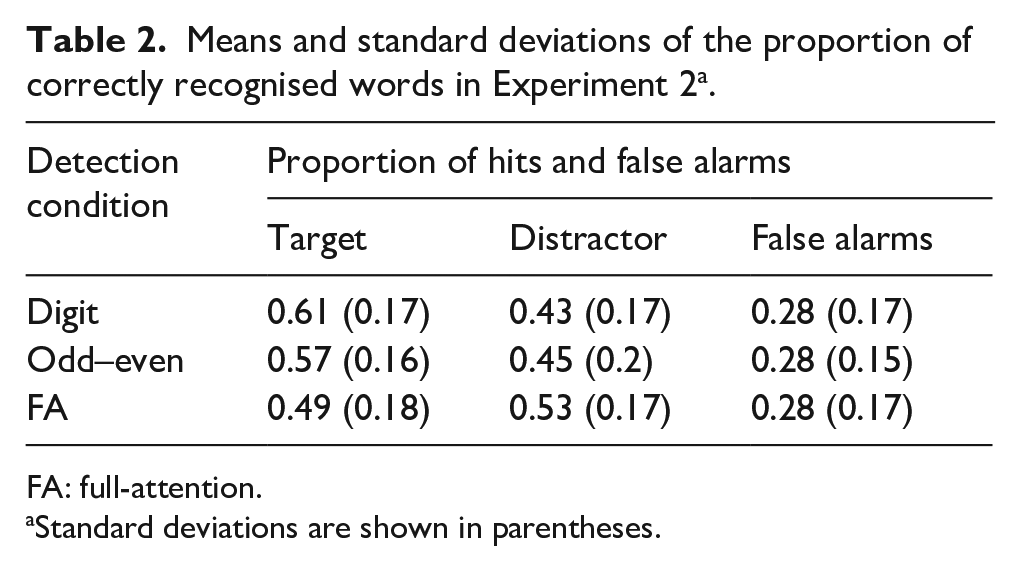
FA: full-attention.
Standard deviations are shown in parentheses.
The corrected hit rates were used to evaluate the recognition accuracy (see Figure 3) and subjected to a 2 × 3 ANOVA with attention type (Target vs Distractor) and detection type (Digit vs Odd–even vs. FA) as factors, revealing a significant main effect of attention type, F(1, 29) = 26.385, p < .001,

Results of Experiment 2. Mean-corrected hits (±SD) as a function of attention type (target vs. distractor) × detection type (digit vs. odd–even vs. FA).
Follow-up simple effect analyses via a Bonferroni adjustment were separately executed for the three detection conditions and revealed that the target-paired words were better recognised than the distractor-paired words under both the digit detection condition, F(1, 29) = 24.361, p < .001,
Therefore, in Experiment 2, the ABE was observed under both the digit detection condition and odd–even detection condition, and there was no difference between these two conditions. Similar to Experiment 1, there was a significant difference between the two detection tasks, that is, detecting odd digits required a higher response time, and the odd-digits detection rate was lower than the pure-digits detection rate. However, this difference can no longer be attributed to the difference in perceptual difficulty because the perceptual difficulty of the two detection tasks was exactly the same. Therefore, the difference between the two detection tasks actually indicates that the odd–even judgement of digits required more attentional resources. However, this increase in cognitive resources does not seem to affect the production and size of the ABE. Given these results, we again further seriously considered the experimental design. The target in Experiment 2 was fixed to the digit “3.” We speculated that if the participants stumble upon the target design rules, they might adopt the strategy of saving principle to detect the target; in this case, the participants would still exhibit a higher reaction time than that performing the digit detection task, but the demand for attention resources may still be less than that required for pure odd–even judgement, resulting in less impact on the background stimuli than expected. Accordingly, Experiment 3 involved conducting further experiments to rule out the possibility of this speculation.
In addition, the FA condition was added in Experiment 2 to further analyse the role of target detection and distractor rejection. Similar to previous studies, Experiment 2 found no ABE under the FA condition such that there was no difference in recognition performance between the target-paired words and distractor-paired words. The recognition of old words in FA seemed to be near chance, although correct responses to the new words were significantly above chance. However, by comparing with the FA, we found some interesting distinctions between the two DA conditions. First, although the correct responses to the target-paired words were above chance under both DA conditions, only performance in response to the target-paired words under the digit detection condition exceeded that under the FA condition, whereas the performance in response to the target-paired words under the odd–even detection condition was comparable to that under the FA condition. However, the performance in response to the distractor-paired words under the DA condition was significantly worse than that under the FA condition, illustrating a significant interference effect.
Experiment 3
The target in Experiment 2 was fixed to the digit “3,” which might weaken the processing of the semantic information of the target. Therefore, in Experiment 3, multiple targets (i.e., four odd digits) were used in the odd–even detection task to prevent the participants from adopting the saving principle to detect the targets. In addition, similar to Experiment 2, Experiment 3 added an FA condition to further analyse the role of target detection and distractor rejection.
Methods
Participants
Thirty college students (17 females, 13 males, mean age = 21.5, SD = 2.89) completed Experiment 3 in exchange for monetary compensation. All participants reported being in good health with normal or corrected-to-normal vision and no history of neurological illness. All participants provided informed consent.
Design and materials
The attention type (Target vs. Distractor) and detection type (multi-target odd–even detection vs. FA attention) were manipulated within subjects.
This experiment used the materials and apparatus described in Experiment 2. The arrangement of the materials under the multi-target odd–even detection condition was identical to that under the single-target odd–even detection condition in Experiment 2, except for the odd digits presented with the target words ranged from one (“3”) to four (“1,” “3,” “5,” or “7”) to ensure that the participants adopted the semantic-based judgement strategy to perform the detection task. The digits that accompanied the words under the FA condition were the same as those under the multi-target odd–even detection condition, but there was no need to detect digits.
Procedures
The experiment included the following two conditions: a multi-target odd–even detection condition and an FA condition. The procedures were identical to those described in Experiment 2 (see Figure 1).
Results and discussion
Dual-task encoding phase
During the dual-task encoding phase, the participants made few and similar false alarms to the distractors under the multi-target odd–even condition in Experiment 3 (M = 1.5%, SD = .02) and the single-target odd–even condition in Experiment 2 (M = 2.2%, SD = .03), t(58) = 1.151, p = .255. In addition, the participants correctly detected 90.42% (SD = .14) of the targets under the multi-target odd–even detection condition; this rate was lower than that under the single-target odd–even detection condition (M = 93.23%, SD = .09), and the response time to the targets under the multi-target odd–even condition (M = 459 ms) was slower than that under the single-target odd–even condition (M = 452 ms). However, none of these differences reached significance, t(58) = 0.919, p = .362; t(58) = −0.392, p = .696.
Recognition task performance
The test results are presented in Table 3. Under the DA condition, although the target hit rate was greater than a chance performance of .5, the difference was not statistically significant, t(29) = 1.448, p = .158. The distractor hit rate was worse than a chance performance of .5, t(29) = −2.028, p = .052, Cohen’s dav = −.37. Under the FA condition, there was no difference between the FA condition and a chance performance of .5 in both the target hit rates, t(29) = −0.035, p = .158, and the distractor hit rates, t(29) = −0.867, p = .393. However, the correct rejection rates of new words under both the DA condition, M = 0.73, and FA condition, M = 0.75, were significantly above chance, ts > 6.7, ps < .001, Cohen’s davs > 1.2, and there was no difference in the false-alarm rate between these two conditions, t(29) = 0.955, p = .348.
Means and standard deviations of the proportion of correctly recognised words in Experiment 3 a .
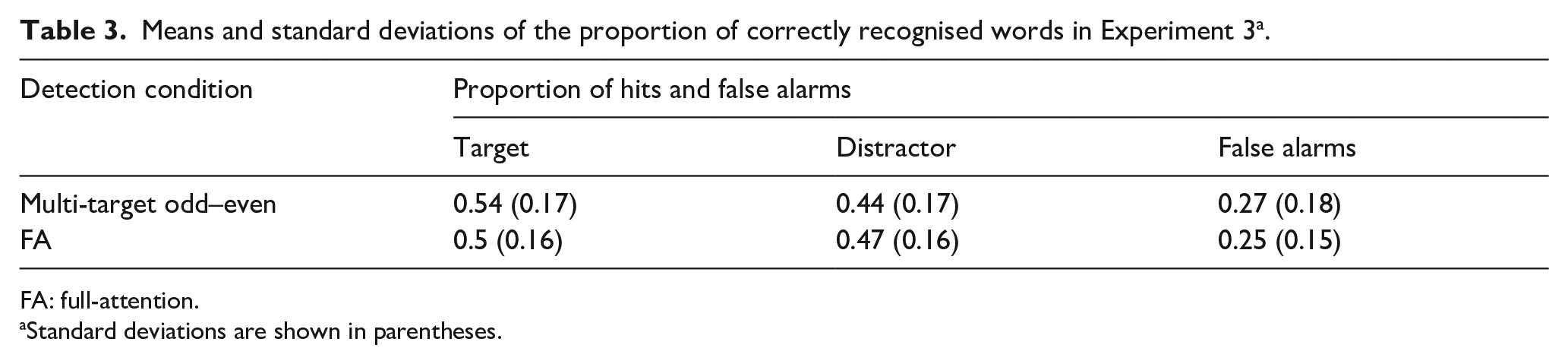
FA: full-attention.
Standard deviations are shown in parentheses.
The recognition accuracy was assessed based on the corrected hit rates (see Figure 4) and subjected to a 2 (attention type: Target vs. Distractor) × 2 (detection type: Multi-target odd–even vs. FA) ANOVA. The results revealed a significant main effect of attention type, F(1, 29) = 28.595, p < .001,
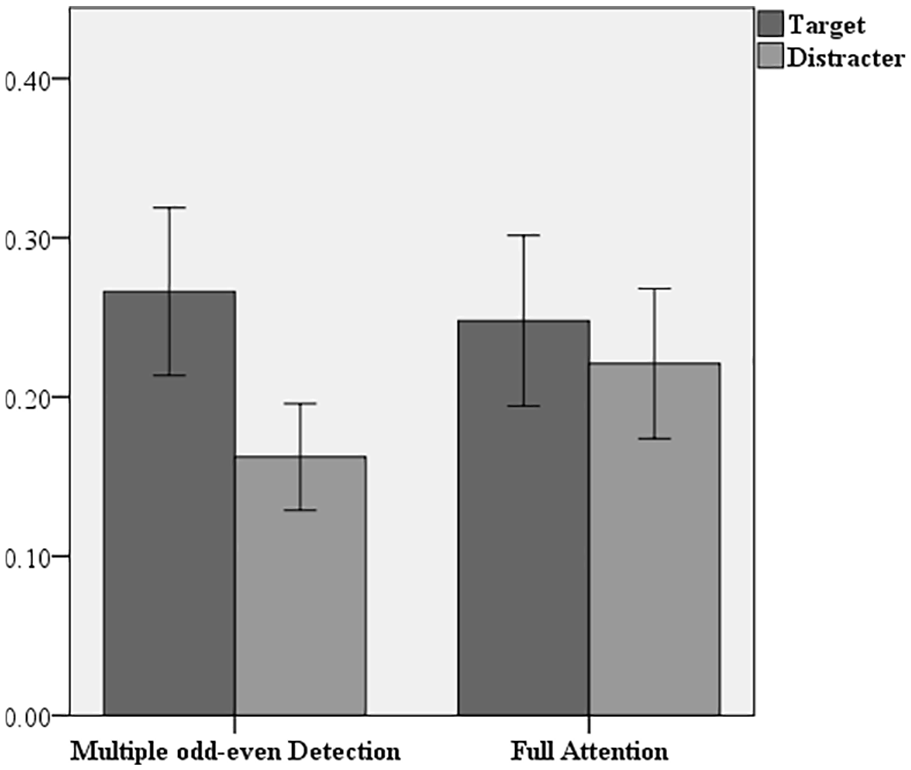
Results of Experiment 3. Mean-corrected hits (±SD) as a function of attention type (target vs. distractor) × detection type (multi-target odd–even vs. FA).
Follow-up simple effect analyses via a Bonferroni adjustment showed that the target-paired words were better recognised than the distractor-paired words under the multi-target odd–even detection condition, F(1,29) = 30.982, p < .001,
Combined analysis of Experiments 2 and 3
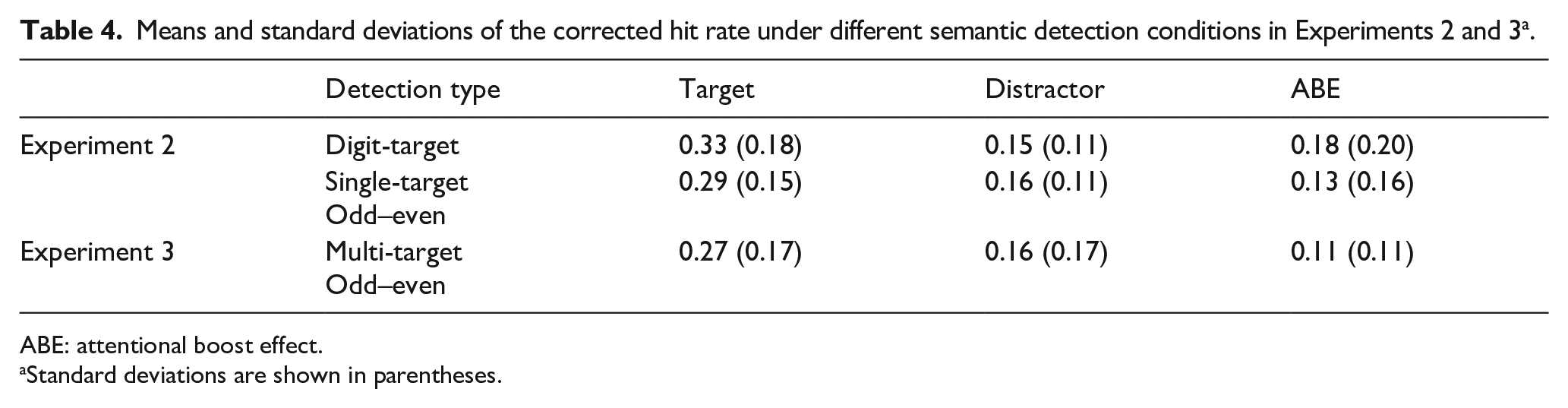
To further explore the influence of the growing attentional resources due to the difficulty of semantic processing on the ABE, a one-factor (three detection types) ANOVA was conducted with the ABE from Experiments 2 and 3 (see Table 4). No main effect of detection type was observed, F(2, 87) = 1.555, p = .217. This result suggested that the increase in the semantic load of the detection task does not adjust the magnitude of the ABE.
Means and standard deviations of the corrected hit rate under different semantic detection conditions in Experiments 2 and 3 a .
ABE: attentional boost effect.
Standard deviations are shown in parentheses.
The results of Experiment 3 suggest that the ABE existed under the multi-target odd–even detection condition. In addition, the comparison with Experiment 2 showed that the ABE was similar under the different semantic detection conditions, although there were differences in the cognitive resources consumed by the detection tasks. These results show that the judgement of the semantic information of digits did not seem to have any effect on the ABE even when the number of targets increased.
In addition, similar to Experiment 2, no ABE phenomenon was found under the FA condition in Experiment 3, and the recognition performance of the old words was near chance. By comparing with the FA, such as Experiment 2, we also found that there was no difference in the memory performance of the target-paired words between the DA condition and FA condition, whereas the performance of the distractor-paired words under the DA condition was worse than that under the FA condition.
Discussion
The ABE is a phenomenon in which in some dual tasks, increased attention to target detection causes an increase in memory performance in response to items paired with the targets (Spataro et al., 2013; Swallow & Jiang, 2013). However, the target-detection tasks in previous ABE studies usually involved the detection of surface perceptual features of a stimulus, and whether the ABE could be observed in detection tasks involving the detection of semantic information is unclear. To explore this question, the present study adopted the verbal paradigm of the ABE (Mulligan et al., 2014; Spataro et al., 2013, 2015), used Arabic numerals as semantic information in the detection tasks, and gradually increased the degree of semantic processing in the detection task over three experiments. The results showed that the target detection with semantic information (i.e., digits) also triggered the ABE (Experiment 1) and that the ABE could be extended to a more complex semantic judgement-based detection task (i.e., odd–even detection task) regardless of whether the detection task used a single-target stimulus (Experiment 2) or a multi-target stimulus (Experiment 3). In addition, there is no difference in the ABE size among the three semantic tasks, although the reaction time of target detection was prolonged as the semantic load increased. These results confirm that semantic information detection tasks can also trigger the ABE and that its size does not differ from that in perceptual detection tasks and does not differ as the semantic detection task difficulty increases.
The boost effect of ABE occurs at the time of the target decision
In the “Introduction” section, we speculated that semantic judgement consumes more cognitive resources than perceptual judgement, which may lead to more interference and be more time-consuming. As the ABE is generated from the attention boost of the early phase of memory encoding, semantic detection might miss the early phase of encoding and could not boost the early perceptual encoding of the background information appearing simultaneously. However, the results of our experiments show that although it took more time and more resources to detect semantic information than detect perceptual information, this difference did not affect the generation and size of the ABE. In addition, the ABE was not affected by the increasing difficulty of the semantic detection task. These results not only show that semantic information detection tasks can induce the ABE but also verify the stability of the ABE.
How can semantic target detection, which consumes more resources, still induce the ABE? According to the dual-task interaction model, target detection triggers temporal selective attention, which coincides with a transient increase in the release of norepinephrine from the LC-NE system. Therefore, temporal selective attention broadly enhances the perceptual processing of all information involving the target and information that appears simultaneously, resulting in the ABE (Swallow & Jiang, 2013). Notably, LC phasic activity is highly plastic. Phasic LC-NE activity is similar in response to easy and difficult targets and consistently occurs 100–200 ms before the manual response is executed (Aston-Jones & Cohen, 2005; Rajkowski et al., 2004; Swallow & Jiang, 2013). Thus, LC phasic activity is more closely related to the behavioural response of the detection task than the processing feature of the stimulus (semantic processing or perceptual processing). In addition, some studies have found that an increase in the difficulty of perceptual detection tasks does not affect the ABE. For example, Swallow and Jiang (2014a) increased the difficulty of the target detection task by using a red Z as a distractor, a red 2 as a difficult target (matched with the distractor features, high perceptual load) and a green 2 as an easy target (not matched with the distractor features, low perceptual load). The participants were asked to remember the pictures while detecting these two types of targets among a series of rapidly presented distraction stimuli. The authors found that increasing the difficulty of the target detection task does not affect the ABE, even if the difficult targets required more attention demand in perceptual processing. Swallow and Jiang (2014a) believed that the ABE is caused by the target decision; thus, an increase in the perceptual load before the target decision does not affect the generation of the ABE. These findings may also explain why semantic target detection, which is more resource-consuming, can still induce the ABE. In a semantic target detection task, the participants need to make a semantic judgement regarding the stimulus and confirm whether it is the target. When the stimulus is identified as the target, the target decision triggers phasic LC-NE activity, resulting in the ABE. Resource consumption in semantic judgement occurs before the target decision; thus, even if the difficulty of the semantic judgement task increases, it has no effect on the generation of the ABE. Combining the results of the present study with the results of previous studies seems to indicate that the increased interference that occurs before the target decision (regardless of whether it is semantic or perceptual) does not hinder the boost effect triggered by the target decision and, thus, does not inhibit the attention promotion in the dynamic trade-off reflected by the ABE.
In addition, the results of the present study seem to indicate that semantic target detection facilitates more than only the perceptual processing of background information during the early encoding phase. Under the ABE paradigm, the sensory information of the two task-relevant stimuli is selected to undergo perceptual processing (early selection). According to the dual-task interaction model, the two stimuli compete for representation in perceptual processing areas, resulting in dual-task interference. In previous studies involving perceptual target detection tasks, perceptual evidence that a stimulus is a target or distractor is accumulated, and when the square is categorised as a target, temporal selective attention is triggered, which, in turn, induces the ABE (Swallow & Jiang, 2013). However, perceptual representation is usually activated preferentially over semantic representation (Posner, 1978). The representation of perceptual information was observed during the pre-150 ms after the presentation of the information, and the addition of semantic information provides a better account of object representations up to 400 ms (Bruffaerts et al., 2019; Clarke et al., 2013, 2015). Therefore, the semantic judgement of a target might occur later than the perceptual processing of the background information. Based on this logic, it is unlikely that the detection of semantic stimuli promotes the early perceptual processing of background information, that is, the early-phase promotion hypothesis does not fully explain the results of the present study. Several studies have questioned the hypothesis of the early perceptual processing promotion of background information. For example, Meng et al. (2018) adopted an R/K judgement task with the ABE paradigm and found that the advantage of the memory performance of target-paired words was only observed in the “Remember” response but not the “Know” response. As the “Remember” response is based on more elaboration processing of background information, which occurred during the later phase of encoding (Meng et al., 2014), the promotion of early perceptual encoding is not enough to observe the “Remember” response in a subsequent recognition task. The results seem to indicate that the early-phase promotion hypothesis does not fully explain the existence of the ABE. Therefore, we speculated that semantic target detection may boost not only the perceptual processing of background information. Notably, future research needs to further verify this speculation and explore the processing of background information promoted by the ABE under semantic detection.
Finally, we ought to discuss the difference between the semantic detection task used in the present study and the perceptual detection task used in the previous study. The present study did not find any difference in the ABE between the semantic detection task and the perceptual detection task; however, these results do not dismiss the need to explore the differences between these two detection tasks. These differences include not only the judgement of the perceptual or semantic information of the target but also, more importantly, the meaning of the target. In previous studies, the target is set as a specific stimulus, even if it increases the difficulty of target judgements, such as increasing the perceptual load in the above study, but it is also specific in a certain letter or digits. However, in the present study, the target is defined as a certain type of stimulus with the same conceptual attributes, even if the target stimulus is only fixed at 3 in Experiment 2, but it is required to respond to odd digits; thus, the target is still a certain type of stimulus with a certain attribute. Previous studies have shown that there is a significant difference between category or relationship processing and item-specific processing (Huff & Bodner, 2019; Hunt & Einstein, 1981; Hunt & Seta, 1984; Mulligan, 1999), relationship processing emphasises the distinctive features of perceptual and surface details, while item-specific processing highlights similarities in item meanings (Hunt & Einstein, 1981; Mulligan, 1999). However, in the present study, we did not find that such processing differences could have a different impact on the ABE. Therefore, this study seems to expand the definition of targets in the field of the ABE as follows: the target can be either a fixed perceptual stimulus or a dynamic stimulus with the same conceptual attributes, and different targets, once detected correctly, can produce corresponding boost effects, leading to the emergence of the ABE.
The ABE is derived from a trade-off between boost and inhibition
According to the dual-task interaction model, the ABE mainly reflects a trade-off between attention promotion and attention competition. The results of the present study further confirm this hypothesis. The recognition performance of the distractor-paired words under the DA condition was worse than that under the FA condition, suggesting that DA has a standard negative effect. In addition, the performance of the target-paired words under the DA condition could achieve the same level observed under the FA condition (single-target odd–even detection in Experiment 2 and odd–even detection in Experiment 3) and even exceed the level observed under the FA condition (digit detection in Experiment 2).
First, regarding the target-paired words, although all three semantic detection tasks in the present study revealed a target boost effect on the background words, there were still some differences. The memory performance of the target-paired words under the DA condition exceeds the FA levels under the digit detection task (Experiment 2); this phenomenon has been called the absolute boost of the ABE in previous studies (Mulligan & Spataro, 2015; Prull, 2019; Spataro et al., 2013). In contrast, another phenomenon in which the performance of target-paired words under DA is as good as that under FA has been called the relative boost of the ABE (Mulligan et al., 2014; Swallow & Jiang, 2013). In addition, the single-target odd–even detection and the multi-target odd–even detection showed the relative boost of the ABE (Experiments 2 and 3). As proposed by the dual-task interaction model, the memory advantage of target-paired words is actually the result of a trade-off between the target boost effect and the dual–task interference effect. It is speculated that when the target boost effect is sufficient to counteract the dual-task interference effect, the target-paired word in the DA could reach the FA level, and if the target boost effect exceeds the dual-task interference effect, the memory performance of the target-paired word in the DA could even be better than the FA level. As speculated above, regardless of the difficulty of the target judgement, once detected, the target triggers temporal selection attention and phasic LC-NE activity, resulting in a similar boost effect. Therefore, we speculate that the cause of the relative or absolute boost effect of the target-paired words may be more related to the difference in the dual-task interference effect caused by the detection task. As the behavioural results of detection tasks show, odd–even detection is more difficult than digit detection, which may render the dual-task interference effect greater, thus causing in the boost effect finally reflected in the target-paired word to appear smaller after the trade-off. Of course, this speculation also needs to be further verified.
Second, regarding the distractor-paired words, the present study found that the memory performance under the DA conditions was worse than that under the FA conditions, illustrating the typical negative effect of DA on memory encoding. However, many studies suggest that the ABE does not necessarily originate from distractor inhibition and that memory performance under distractor rejection is not necessarily worse than the FA level. For example, Lin et al. (2010) asked participants to perform a target detection task while encoding a series of scene pictures presented quickly. The results showed that the short-term memory performance of the picture was significantly higher than a random-guess level only when the picture was paired with the target (0.5), but when the picture is presented alone or when it is paired with a distractor, the recognition performance is near the chance level. The present study also compared the memory performance of background information with the chance level but found that the performance of all distracted-paired words was significantly lower than the random-guess level, showing a very typical distractor interference effect. The greater interference of the distractor-paired words may be due to the greater inhibition due to semantic distractor rejection. Some studies have used Go-NoGo tasks to show that higher level semantic processing influences inhibitory responses on a neural level (Maguire et al., 2009), and the response should be a global inhibition signal in NoGo trials (Aron & Verbruggen, 2008; Lenartowicz et al., 2011). However, the Boost and Bounce Theory proposed by Olivers and Meeter (2008), which is similar to the dual-task interaction model and uses temporal attention and phasic LC-NE activity as the basis for target detection (Jiang & Swallow, 2014; Swallow & Jiang, 2013), holds that distractor rejection can activate inhibitory feedback mappings and close the gate to working memory, thereby reducing the likelihood that distractor-paired items enter working memory and, thus, affect behaviour. Therefore, we believe that in the semantic detection task, the ABE originates not only from the boost effect of the targets but also from the inhibition of distractor rejection.
Conclusion
Overall, the present study found that the ABE can be extended not only to target detection tasks involving semantic information but also to semantic judgement-based detection tasks and that the memory performance of the target-paired words in semantic detection tasks can reach or even exceed the FA level. The research results once again verify the dual-task interaction model, which shows that the boost effect of the ABE originates from the target decision and that an increase in the semantic load before the target decision does not interfere with the generation of the ABE.
Footnotes
Declaration of conflicting interests
The author(s) declared no potential conflicts of interest with respect to the research, authorship, and/or publication of this article.
Funding
The author(s) received no financial support for the research, authorship, and/or publication of this article.
