




Abstract
We investigated how people balance cognitive constraints (switch costs) against environmental constraints (stimulus availabilities) to optimise their voluntary task switching performance and explored individual differences in their switching behaviour. Specifically, in a self-organised task-switching environment, the stimulus needed for a task repetition was delayed by a stimulus-onset asynchrony (SOA) that increased with each consecutive repetition until a task switch reset the SOA. As predicted, participants switched tasks when the SOA in task switches approximately matched their individual switch costs and thus they optimised local task performance. Interestingly, self-reports (confirmed by behavioural switching patterns) revealed two individual strategies: some participants (N = 34) indicated to guide their task selection behaviour based on preplanned task sequences over several trials, whereas others (N = 42) indicated to primarily decide on a trial-by-trial basis whether to switch or to repeat tasks. Exploration of switching behaviour based on the two strategy groups revealed additional insights into how people achieved adaptive task selection behaviour in this task environment. Overall, the present findings suggest that individuals select tasks with the aim of improving task performance when dealing with multiple task requirements, but they differ in their preferred individual task selection strategies.
In our daily life, multiple task requirements have become increasingly prevalent. We are constantly required to select and process task-relevant information in environments overloaded with potentially distracting information. To reach a currently relevant task goal, information processing has to be shielded against these distracting sources of information (e.g., Fischer et al., 2014). Yet, we also have to monitor the environment for changes in information availabilities that indicate that a switch of the current task goal is potentially beneficial (e.g., Dreisbach & Fröber, 2019; Goschke, 2000; Kushleyeva et al., 2005)—despite the time-consuming cognitive operations involved when switching tasks (e.g., Jersild, 1927; for a review, see, for example, Kiesel et al., 2010; Koch et al., 2018). The purpose of this study was to get further insights into how people trade off environmental task processing constraints (e.g., stimulus availabilities) against their internal (cognitive) task processing constraints (as reflected in switch costs) when voluntarily selecting tasks. Specifically, we tested whether participants can equally balance these task-processing constraints into their task selection behaviour to improve task performance by using a recently introduced self-organised task-switching paradigm (Mittelstädt, Miller, & Kiesel, 2018, 2019). Furthermore, we aimed to illuminate potential self-reported task-selection strategies in this paradigm to see whether and how individuals differ in their voluntary task switching (VTS) behaviour. This is an important endeavour because the exploration of how individuals differ in unconstrained task environments helps to shed further light on the mechanisms underlying voluntary adaptive behaviour (e.g., Clarke et al., 2020; Irons & Leber, 2016; Reissland & Manzey, 2016).
Voluntary task selection and performance in task-switching paradigms
In VTS experiments, participants can decide which of two tasks to perform in a given trial with each task mapped to one hand (e.g., indicating whether a letter is a consonant or vowel with the left index and middle finger or whether a number is odd or even with the right index and middle finger; for example, Arrington & Logan, 2004, 2005; Frick et al., 2019; Jurczyk et al., 2019; Kessler et al., 2009). The stimulus display in each trial contains information associated with each of the two tasks (e.g., a letter A and a number 6), and the hand used in a given trial reveals which task participants selected in this ambiguous situation. The most typical finding of VTS studies is the repetition bias: Participants usually show a tendency to select the same task in trial n that they performed in trial n – 1 (e.g., Arrington & Logan, 2004; Jurczyk et al., 2019; Kessler et al., 2009). This repetition bias persists when using the common version of the VTS paradigm in which participants are instructed to randomly choose the tasks in each trial (e.g., Arrington & Logan, 2004; Arrington & Weaver, 2015; Demanet et al., 2010). The additional finding of switch costs (i.e., slower reaction times [RTs] and increased error rates when switching compared to repeating tasks) in these studies suggests that the cognitive costs that incurred when switching tasks are reflected in both task selection and task performance.
Interestingly, task selection is also influenced by the specific characteristics of stimuli presented in a current trial (e.g., Arrington, 2008; Mayr & Bell, 2006). For example, when the stimulus-onset asynchrony (SOA) of two task stimuli is randomly manipulated (e.g., either the letter or the number stimulus is presented first), participants are biased to select the tasks associated with the first stimulus (e.g., Arrington, 2008). Such environmental biases in participants’ task selection behaviour can be seen as hints of adaptive attempts to improve overall task performance in light of environmental constraints (e.g., for similar reasoning, see Braun & Arrington, 2018). However, this interpretation can only be made indirectly in most VTS experiments: Participants actually fail to comply with the instructions to select a task randomly when they systematically incorporate any environmental or cognitive factors into their task selection behaviour (e.g., Mittelstädt, Dignath, et al., 2018).
The self-organised task-switching paradigm
Recently, we introduced a novel VTS paradigm to directly test the idea of adaptive task selection behaviour. Specifically, in this so-called self-organised task-switching paradigm, the stimulus availability for two tasks was dynamically adjusted so that the stimulus of the chosen task subsequently appeared with an SOA which linearly increased with the number of task repetitions until a task switch reset it (e.g., SOA step size = 50 ms; Mittelstädt, Miller & Kiesel, 2018; Mittelstädt et al., 2019). Across several experiments, we observed that participants’ switching behaviour was sensitive to both the external processing constraints imposed by having to wait for the stimulus associated with the repeated task and the internal processing constraints reflected in costs associated with processing the potential switch stimulus. For example, participants switched tasks more often in a context with large compared to small SOA step sizes while switch costs remained stable, and they also switched tasks more often with long compared to short intervals between trials—a context which facilitates task switching and consequently reduces switch costs. Overall, these findings demonstrate flexible adaptive task selection behaviour by showing that participants select tasks to improve task performance while taking into account constraints on stimulus availability.
Probably, the most interesting finding for performance-oriented adaptive task selection behaviour becomes evident when considering at which SOA participants decided to switch tasks (i.e., switch SOA). Specifically, this switch SOA was approximately equal to the size of switch costs when preparatory task selection processes could only operate minimally in advance of trials. For example, when the response-stimulus interval (RSI) is short, there is little or no time to use for selecting and preparing a task switch in advance of the trial. As a result, these processes must happen during the trial after RT measurement has started—thereby producing a systematic influence on task performance (as measured in switch costs) and task selection (as measured in switch SOA). From a functional perspective, this switch cost-SOA match would suggest that participants aim to minimise the response time in each trial. Thus, this strategy would be in line with findings observed in other non-VTS paradigms in which task selection is inherently biased to minimise temporal environmental or internal costs to achieve a task goal (here: to respond to one of the two tasks; Anderson, 1990; Carlson & Stevenson, 2002.
The first major goal of this study was to provide a strong test of such locally optimal voluntary task selection behaviour when people are required to balance external and internal task processing constraints in the self-organised task-switching paradigm. For this purpose, we used a version of this paradigm in which the RSI between trials was always short. As mentioned above, this was the common denominator to observe a switch-cost SOA match in our previous study (Mittelstädt et al., 2019), so we naturally focused on this condition in this study. Thus, a switch cost-SOA match should also generalise to this modified task environment if participants’ task selection behaviour is inherently driven to minimise the RT in a current trial. In addition, we also compared the main dependent measures between experimental halves. These analyses allowed us in particular to explore the stability of the link between task selection and task performance over the course of an experiment. For example, substantial practice may be needed to trade off switch costs versus SOA equally.
Task selection strategies in the self-organised task-switching paradigm
The second major goal of this study was to investigate how participants actually trade off their switch costs against the gradually increasing switch stimulus availabilities. Based on interviews with participants in the previous studies, it seems that there are two main ways in which participants adapt to the self-organised task-switching environment. Some participants reported that they decided on a trial-by-trial basis whether to switch or repeat tasks—presumably because they continuously monitored their task performance and the increasing SOA delays. Other participants reported that they used pre-planned task sequences to guide their task-switching behaviour. Given the predictability of the SOA increase over repetitions, participants were able to preplan their behaviour over several trials, such as always switching after a fixed number of trials. To shed more light on this issue, in the current experiment we specifically asked participants whether they had primarily preplanned their task selection across several trials or whether they had primarily decided spontaneously in each trial which task to select. This allowed us to see how many participants consciously rely on (and report) preplanning of task sequences when self-organising their behaviour. As we will see, we then also investigate whether and how these subjective reports fit with the behavioural evidence of switching obtained from the present experiment. However, it should also be emphasised that the classification of participants based on their self-reported strategy may be influenced by their responses to the predictable SOA manipulation (i.e., we did not assess strategy in advance of the study or in another task environment; see also Ericsson & Simon, 1980, for more details about verbal reports of cognitive processes).
The possible identification of a self-reported preplanning strategy in our paradigm would extend the findings obtained from previous studies using the standard version of the VTS paradigm (i.e., participants were instructed to randomly select tasks in each trial). Specifically, these studies have revealed that participants at least partially guide their task selection behaviour based on task sequences retrieved from long-term memory (e.g., Vandierendonck et al., 2012). Note, however, that these task sequences were created based on the requirement to select tasks randomly. Thus, the use of a self-reported preplanning strategy in the current paradigm would provide further evidence that switching tasks in predictable sequences is also a strategy used when people are required to improve overall task performance without randomness instructions.
Intuitively, one would expect that most (if not all) participants will preplan their behaviour in the current experiments because the changes in task availabilities are fully predictable. Critically, however, there is also growing evidence suggesting that individuals differ in their voluntary task selection behaviour in unconstrained task environments (e.g., Brüning & Manzey, 2018; 2020; Irons & Leber, 2018; Janssen & Brumby, 2015; Reissland & Manzey, 2016). Thus, we suspect that some participants might have a natural preference for a rigid, preplanned switching strategy, whereas others prefer a spontaneous switching strategy. Consequently, we expected to observe both switching strategies in this study.
If these two self-reported strategies are indeed at play, we will also use the subjective reports to explore whether and how these two types of task selection behaviour modulate our main dependent measures. It is not clear how the use of these two potential task selection strategies modulates task performance, nor how it modulates the relation between selection and performance as operationalised by the switch cost-SOA trade-off.
Method
Participants
A total of 76 1 German speakers (51 female, 25 male) were individually tested at the University of Freiburg, Germany, and they ranged in age from 18 to 33 years (M = 23.42). All participants had normal or corrected-to-normal vision, gave informed consent before testing, and received either course credit or money for participation. Four additional subjects were also tested but data of these participants were excluded for the following reasons: questionnaire data of one participant was missing, one participant had very long RTs (>1,500 ms), and two participants had fewer than 10 valid switch and/or repeat trials (cf. Mittelstädt et al., 2019, for the same exclusion criterion).
Apparatus and stimuli
The experiment took place in individual testing rooms. Stimulus presentation and data collection were controlled by E-Prime software running on a Fujitsu Esprimo P920-0 computer with a 24-in monitor. All stimuli were presented on the black background of the computer monitor. Stimuli were the numbers 2–9 for the number task (i.e., even/odd) and the uppercase letters A, E, G, I, K, M, R, and U for the letter task (i.e., consonant/vowel). The stimuli of the two tasks appeared one above the other at the centre of the screen with letter/digit stimulus location constant across the experiment but counterbalanced across participants. All stimuli were presented in white and they were 6 mm in height and 5 mm in width. The specific identities of the two stimuli were selected randomly in each trial. Responses for each task were made with the index and middle finger of the same hand on a QWERTZ keyboard with the “y,” “x,” “,” and “.” keys. The task-hand mapping was counterbalanced across participants, and the specific finger-response mappings were randomly selected for each participant.
Procedure
Overall, each participant was tested in 15 blocks. The first block was a practice block and this block was not analysed. Participants were then tested in four blocks (“manipulation check blocks”) which served to explore participants’ task selection sensitivity to the increasing switch SOA manipulation without receiving explicit instructions about this manipulation. Specifically, for two consecutive blocks the potential repetition switch stimulus appeared increasingly delayed (SOA step size = 50 ms) as described in more detail within the experimental trial procedure. For the other two consecutive blocks, the potential repetition stimulus was also presented with a delay, but with a constant (non-increasing) SOA of 50 ms, and block order was counterbalanced across participants. Critically, the change between the constant versus increasing SOA block types was implemented without any additional instructions and participants were not informed about the stimulus delays in advance of these blocks. After participants had performed all four manipulation check blocks, the experimenter asked participants whether they had recognised the increasing SOA manipulation before they were then informed about this manipulation for the following experimental blocks.
In each experimental block, participants had to perform 50 trials in the letter task and 50 trials in the number task. Participants were instructed that one of the tasks appeared later than the other and that they should select the tasks to minimise overall time in each block while attaining high accuracy. Specifically, participants received a German version of the following central instructions which were paraphrased by the experimenter if needed: You have to respond to 50 letters and 50 numbers in each block. Try to perform all of these 100 tasks as quickly and accurately as possible: Overall time and error measurements for each block start at the beginning of a block and end after you have completed every task in this block. After you have responded to a task in a trial, the next trial starts immediately and you should respond again as quickly and accurately as possible. However, one of the tasks (i.e., letter or number) appears earlier than the other task. You can decide whether to respond to the task presented first or to wait for the other task. If a #-sign appears instead of one task, you always have to wait for the other task.
Stimuli of the two tasks were only presented simultaneously in the first trial of a block, whereas in the remaining trials only the stimulus needed for a task switch was presented immediately. The stimulus needed for a task repetition was presented with an SOA that depended on the number of consecutive task repetitions. Specifically, as can be seen in a typical trial sequence in Figure 1, the SOA linearly increased by an additional 50 ms with each task repetition until it was reset by a task switch (i.e., SOA step size = 50 ms).
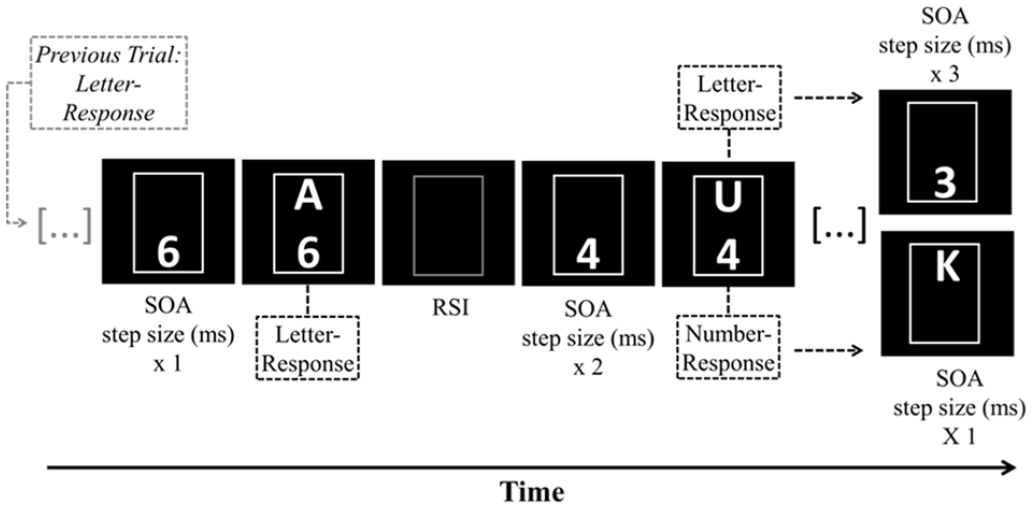
Typical trial sequences of the adaptive SOA blocks. Stimuli were always centrally presented, but only the stimulus needed for a task switch was presented immediately at the end of the response stimulus interval (RSI). The stimulus needed for a task repetition was presented with a stimulus-onset asynchrony (SOA) step size (50 ms) that depended on the previous task selection history (i.e., how often this task was selected before).
After the necessary number of tasks of the same type was completed, a placeholder (i.e., “#”-sign) was presented at the corresponding position and key presses for this task were not recognised anymore. 2 After each trial, participants received auditory feedback via headphones. Following correct responses, participants received a low-pitched sound and the stimulus display of the next trial was presented after a blank screen (RSI) of 150 ms. Following incorrect responses, participants received a high-pitched sound and the next trial was presented after an RSI of 650 ms. Breaks between blocks were self-paced and participants received performance feedback after each block (i.e., total block duration in seconds and number of errors). In case of more than 10 block errors, participants were presented with an additional screen for a fixed period of 60 s indicating that there were too many errors in this block as well as the correct stimulus-response mappings. After completing these blocks, participants were asked whether they had primarily followed a specific strategy when selecting tasks. If they answered affirmatively, this strategy was noted by the experimenter, and participants were later categorised into the preplanned switching group when they reported they had switched after a fixed task sequence for most of the trials/blocks. Participants who reported no use of a strategy or participants who gave an ambiguous answer were also directly asked whether they had switched after a fixed trial sequence or whether they had primarily decided spontaneously which task to select (see data including all verbal responses on the Open Science Framework (OSF)).
Results
The practice block and the first trial of each block were excluded from any analyses. Following Mittelstädt et al. (2019), we then excluded any trials without the possibility of choosing between the two tasks (11.6%), trials in which a response was given prior to stimulus onset (<0.1%) and post-error trials (5.3%) for all analyses. For RT and task selection analyses, 5.3% error trials were additionally excluded as well as trials with RTs less than 200 ms (0.1%) and greater than 3,000 ms (0.2%).
Manipulation check blocks
The mean switch rate was 11% smaller in the constant (M = 0.05) compared to increasing (M = .16) SOA blocks and this difference was significant, t(1, 75) = 8.38, p < .001,
Overall task selection and task performance in the experimental blocks
The first column of Table 1 displays switch rates, mean median RT switch costs (as well as task switch and repetition RTs), and mean (interpolated) median switch SOA (i.e., when switches occurred without considering how many switch and repetition trials there were in total, for more details, see Mittelstädt et al., 2019).
3
A paired t-test between repetition and switch median RT yielded significant switch costs, t(1, 75) = 12.25, p < .001,
Mean switch rates, mean median reaction time (RT) as a function of trial transition (i.e., task switch vs task repetition), as well as mean median switch costs (i.e., task switch RT–task repetition RT) and mean median switch stimulus-onset-asynchrony (SOA) overall (i.e., for all experimental adaptive SOA blocks) and separately for the first and second half of the 10 experimental blocks.
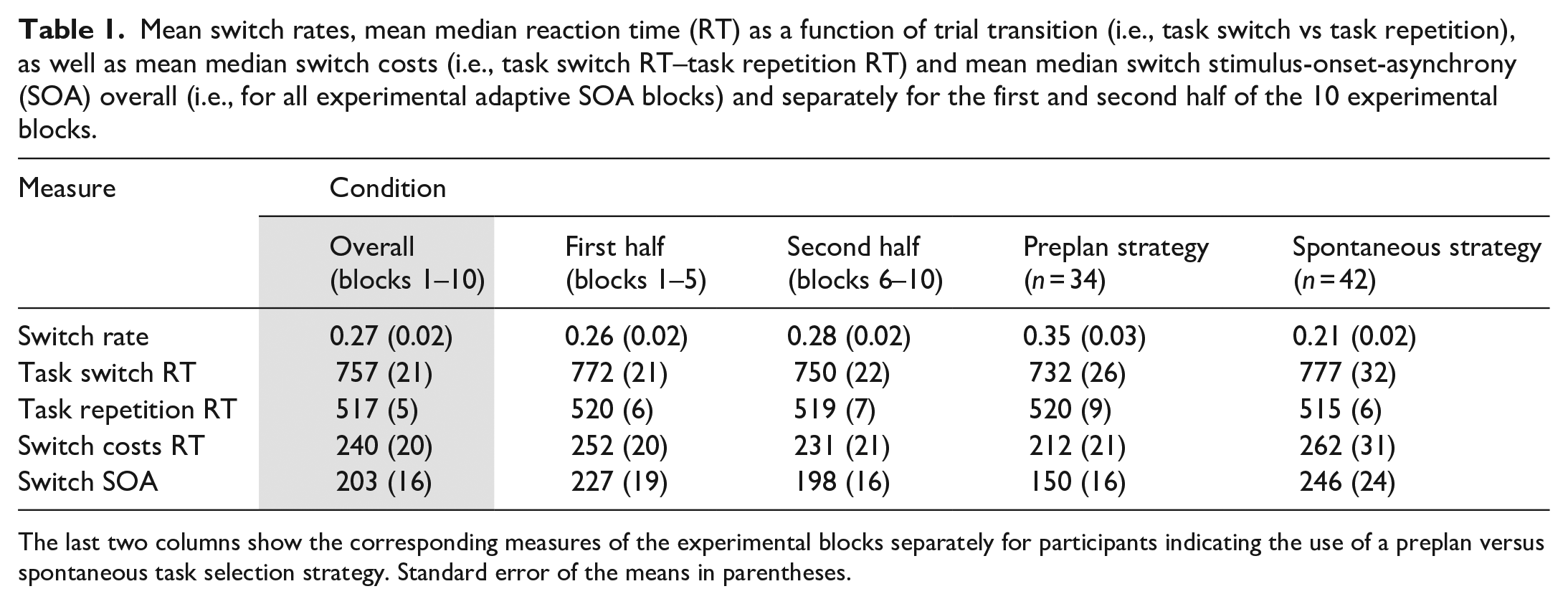
The last two columns show the corresponding measures of the experimental blocks separately for participants indicating the use of a preplan versus spontaneous task selection strategy. Standard error of the means in parentheses.
Overall, mean percentage error (PE) was low (5.1%) with numerically higher mean PEs in repetition (5.3%) compared to switch trials (4.9%), t(75) = 1.11, p = .272,
Task selection and task performance in the first and second half of experimental blocks
The second and third columns of Table 1 show the corresponding measures calculated separately for blocks in the first and second halves of the experiment. There was a significant increase in switch rates from the first half to the second half, t(75) = 2.18, p = .032,
An analysis of variance (ANOVA) with the factors of transition (switch vs repetition) and half (first vs second) on median RTs revealed significant main effects of transition (i.e., switch costs of 241 ms), F(1, 75) = 145.37, p < .001,
As can be seen in Table 1, switch SOA was only slightly smaller than switch costs in both the first and second halves of the experiment, and this difference was not significant within either half, with t(1, 75) = 1.27, p = .207,
PEs were slightly higher for the switch compared to repetition trials in the first half of the experiment (5.7% vs 5.3%), whereas PEs were lower for switch compared to repetition trials in the second half of the experiment (4.3% vs 5.3%). An ANOVA with the factors of transition and half on mean PEs revealed a significant main effect of half (first: 5.5%; second: 4.8%), F(1, 75) = 7.23, p = .009,
Exploring the impact of self-reported strategies
In the post-experiment interview, 32 participants reported that they primarily pre-planned their task selections in advance of trials (i.e., “preplanned-strategy group”), whereas the remaining 44 participants reported they primarily decided spontaneously when to switch tasks (“spontaneous-strategy group”). To check the validity of these self-reports, we compared the distribution of switch SOAs separately for participants of the preplanned to those of the spontaneous strategy group. We reasoned that switch SOAs should be less widely spread out for participants of the preplanned group (vs spontaneous group) because these participants reported that they primarily switched after a fixed number of trials. The mean SDs of switch SOAs were smaller for participants of the preplanned group (48 ms) compared to spontaneous strategy group (121 ms) and this difference was significant, t(74) = 7.17, p < .001,
To see whether individuals consistently apply their strategies across the two halves of the experiment, we also computed the SDs of the first and second experimental half for each participant. We then computed the correlation of first- and second-half mean SDs across participants. There was a substantial positive relation between these measures, r(76) = .79, p < .001. Thus, this analysis suggests that the preferred strategies were consistently used over the course of the experiment.
Table 1 summarises the central measures separately for these two groups of participants. Interestingly, mean switch rates were significantly higher for the preplanned compared to spontaneous-strategy group (.35 vs .21), t(74) = 3.71, p < .001,
To examine in more detail switching behaviour as a function of SOA, we plotted the corresponding cumulative distribution function (CDF) of switch SOA averaged over participants for each strategy group (see Figure 2).
7
Thus, these CDFs show the distribution of switches out of the trials in which switches did occur so that these CDFs naturally also display the corresponding average median switch SOA values mentioned above (i.e., points when the CDFs crosses the .50 values). Interestingly, as can be seen in Figure 2, the mean proportion of switches for the first SOA level was descriptively very similar between the two groups (with switch proportion of .14 and .13 for the preplanned and spontaneously switching group, respectively) and there was no significant difference when comparing these values (p = .880,

Cumulative distribution functions (CDF) of switch SOAs separately for participants indicating the use of a preplanned versus spontaneous task selection strategy.
Median RT switch costs were numerically lower for participants of the preplanned compared to spontaneous-strategy group (212 ms vs 262 ms), but a mixed ANOVA with the factors of strategy group and transition on median RTs revealed only a main effect of switch costs, F(1, 74) = 146.49, p < .009,
We then checked how switch SOAs were related to switch costs for the two groups. To do so, we first plotted the individual median switch costs against the individual median switch SOAs while considering the reported strategies. As can be seen from Figure 3, there was a positive correlation between these measures for participants of the preplanned (r(34) = .41, p = .015) as well as the spontaneous (r(42) = .48, p < .001) switching group. Although we can of course not infer the direction of causality from these correlational analyses, the relations between these two measures at least suggest a link between task selection (as measured by switch SOA) and task performance (as measured by switch costs) for both strategy groups. However, the scatter plots also demonstrate considerable individual variability concerning the question of locally optimal behaviour (i.e., to minimise current RTs) which has been observed on an average level by showing that switch SOAs were substantially larger than switch costs for some individuals but substantially smaller for others.

Scatterplots of individual median switch costs (x-axis) against individual median switch SOAs separately for participants indicating the use of a preplanned versus spontaneous task selection strategy.
We then explored the switch cost-SOA matches separately for participants of the two self-reported strategy groups. As can be seen in Table 1, switch SOAs were smaller than switch costs for both groups. Separate switch cost-SOA comparisons for each strategy group revealed that this difference was significant for the preplanned- (t(1, 33) = 3.02, p = .005,
Discussion
In this study, we explored how people balance cognitive processing constraints against environmental constraints in their VTS behaviour. For this purpose, we investigated both task performance and task selection using a version of the recently introduced self-organised task-switching paradigm. Specifically, in our experiment (N = 76), the stimulus needed for a task repetition was delayed by an SOA that increased with each consecutive repetition until a task switch reset it. Overall, we observed that the SOA in task switches approximately matched switch costs, which indicates that participants equally balanced the cognitive and environmental constraints on task processing in adjusting their task selection behaviour to improve performance. Critically, post-experiment questionnaire data indicated that some participants (N = 34) guided their task selection behaviour based on task sequences over several trials, whereas others (N = 42) primarily decided on a trial-by-trial basis whether to switch or to repeat tasks. These self-reported strategies were confirmed by examining specific behavioural patterns, which were themselves stable over the course of the experiment. After we have discussed our findings on an overall level, we discuss the implications of our study concerning the use of these individual strategies and relate our findings to recent observations of individual differences in other voluntary task selection paradigms (e.g., Irons & Leber, 2018; Reissland & Manzey, 2016).
Interactive behaviour based on temporal cost–benefit trade-offs
The finding that participants tended to switch tasks when the size of the SOA corresponded approximately to their switch costs indicates that tasks were selected in such a way as to minimise RT in the current trial. Thus, this study fits well with our recent suggestion that participants equally balance the internal and external task processing constraints in a given trial to improve task performance (Mittelstädt et al., 2019). Another interesting finding was that switch cost-SOA matches were observed for both the first and second half of the experiment, which suggests that extensive practice is not needed to achieve such temporally balanced task selection behaviour. Such flexible adaptive selection behaviour 8 attempting to optimise task performance has also been observed across different voluntary multitasking settings (i.e., if anything switch SOAs were less than switch costs, but see section “Speculations about local versus global optimization criteria”). For example, participants adapt their dual task selection strategies to maximise their overall performance in response to changes in task difficulty (e.g., Howes et al., 2009; Janssen & Brumby, 2015; Leonhard et al., 2011). In general, therefore, self-organised multitasking involves flexible adaptive task selection behaviour subject to the interactive temporal constraints imposed by the cognitive system and the local task environment (e.g., Anderson, 1990; Chater & Oaksfoard, 1999; Grey et al., 2006).
An important open issue is how the underlying processes operate to achieve this temporally balanced task selection behaviour. Inspired by others (e.g., Dreisbach & Fröber, 2019; Jiang et al., 2018; Schumacher & Hazeltine, 2016), we have recently proposed that the competition between multiple active task sets is regulated based on the contextual processing requirements to influence task selection behaviour (Mittelstädt et al., 2019): specifically, task selection behaviour is guided by the most-active task set and the activity of task sets is biased by the interactive influences of the predictive internal and external task processing demands. Thus, with short RSIs like those used in this study, time-consuming cognitive processes to update the switch task set fall into the slack created by the stimulus availability manipulation. Clearly, there is abundant room for further specifying such task set competition accounts. For example, it remains to be seen whether task selection processes during a trial act as a bottleneck during which perceptual processing is not possible.
Individual differences in self-organised multitasking
Importantly, this study has revealed that individuals differ in their preferred self-reported task selection strategies. Specifically, 34 individuals reported they had guided their task selection behaviour based on task sequences created in advance of several trials whereas 42 participants stated they did not preplan their task selections. By comparing the distribution of switch SOAs, we could also show that these self-reported strategies were highly consistent with the behavioural pattern (i.e., switch SOAs were less widespread for the preplanned compared to spontaneous switching group). In addition, the strong correlations of the distribution of switch SOAs between the first and second half of the experiment suggest stable switching preferences. Such individual differences in voluntary switching strategies fit well with similar observations made in the context of other, unconstrained task environments (e.g., Irons & Leber, 2016, 2018; Reissland & Manzey, 2016).
Nevertheless, it is actually somewhat surprising that so many participants decided to spontaneously switch task, because changes in task availabilities were entirely predictable. We conjecture that random variation in task-set activations could also produce random variability in the size of switch costs and hence make it difficult to anticipate processing requirements in advance of several trials. Fluctuations of task-set activations influencing task selection behaviour could also explain an interesting finding of the preplanned switching group. Specifically, more fine-grained exploration of switching behaviour revealed that participants of this group showed no differences in the frequency of switches at the first SOA level when compared to the switch frequencies at this level of participants of the spontaneous switching group. From an intuitive point of view and based on the self-reports of this group (e.g., “I primarily switched after three trials”), it would be plausible to observe smaller switch proportions for the smallest SOA. Instead, the observed pattern suggests that environmental factors (here: switch stimuli) can sometimes override task selection guided from pre-planned task-sequences—presumably because these stimuli sometimes automatically prime the switch task-set. This interpretation would be in line with suggestions made in the context of VTS studies with randomness instructions (and hence random task sequences; for example, Vandierendonck et al., 2012).
Clearly, further research is needed to tackle the intriguing question of which factors actually influence individuals to apply one strategy over the other. Considering the findings of previous studies, subjective mental effort could be one likely candidate that has influenced individual strategy selection (e.g., Inzlicht et al., 2018; Irons & Leber, 2018; Vandierendonck et al., 2012). For example, one might speculate that some participants avoided trial-by-trial task selection processes because these processes were perceived as effortful (e.g., Frick et al., 2019), whereas others might actually even seek to engage in such effortful mental processes because they consider these processes as intrinsically rewarding (e.g., Inzlicht et al., 2018). Relatedly, findings from studies using the VTS paradigm with randomness instruction have revealed that switching behaviour is reduced when task switching and not just hand switching is required—presumably because of the effort involved when switching tasks (e.g., task-set reconfiguration) (Vandierendonck et al., 2012). Thus, the considerably overall larger switch rates for the preplanned compared to spontaneous switching group could indicate that some participants might find the mental effort needed to implement task switches less aversive than others.
Regardless of why one strategy is preferred over the other by individuals, it would be quite interesting to investigate whether participants need to follow their preferred task selection strategy to improve task performance or whether adaptive task selection behaviour can also be achieved when they adopt the opposite strategy. Specifically, the present findings suggest that not only trial-by-trial but also preplanned task selection strategies helped participants to improve overall task performance. In fact, individuals of both strategy groups apparently incorporated the cognitive and environmental constraints equally to improve task performance. This suggests that individuals in the preplanned group were able to create task sequences sensitive to both the internal temporal and external task processing constraints. Against the background of the above-mentioned task-set activation competition account, it is possible that the modulation of task-set activations within task sequences may involve hierarchical control processes (Schneider & Logan, 2006), which are also sensitive to the processing demands.
Speculations about local versus global optimization criteria
To improve task performance in the self-organised task-switching environment, participants can minimise RTs in a current trial by equally trading the trial-specific size of switch costs against the trial-specific task availabilities (i.e., switch cost = switch SOA, local optimization account). In principle, however, participants might also improve task performance by proactively switching tasks when the switch SOAs were still smaller than switch costs to reset the SOA because this would lead to lower SOA on the following (potential) repetition trials (i.e., switch SOA < switch costs, global optimization account). Thus, global optimization would in fact help participants to minimise mean RT (or block RT as was instructed) more than local optimization which minimises only current (local) RTs.
Although the overall switch SOA match is in line with the idea that participants often strive for local optimization at the expense of suboptimal global task performance (Anderson, 1990; Fu & Gray, 2006), the exploration of individual differences revealed some interesting though speculative findings: specifically, switch SOAs were descriptively smaller than switch costs for both the spontaneous (difference of 16 ms) and the preplanned switching group (difference of 62 ms), and this difference was significant for the latter strategy group. Although the comparison of trade-offs between groups was not significant, the interpretation of null findings is of course always problematic and the lack of a significant interaction might be due to low power. Therefore, we explored whether a global optimization account can explain the chosen switch SOAs by computing for each participant the switch SOAglobal predicted by a global optimization account. As is described in more detail in the online Supplementary Material, the optimal switch SOAglobal depends on both the switch SOA step size (i.e., here: 50 ms) and the individual switch costs. This procedure revealed average switch SOAsglobal values which were considerably lower (i.e., preplanned group: 72 ms; spontaneous group: 85 ms) than the observed switch SOAs displayed in Table 1. Separate switch SOA-SOAglobal comparisons for each strategy group revealed that this difference was significant for both the preplanned- (p < .001,
Relations to other paradigms showing individual differences in voluntary task selection
Finally, as mentioned above, individual differences in voluntary task selection behaviour have been also observed across two other novel paradigms (Irons & Leber, 2016; Reissland & Manzey, 2016). Considering that we are not aware of any other studies that have explicitly shown that individuals differ in their task selection behaviour when voluntarily selecting tasks, it seems important to us to illuminate these paradigms and findings in more detail. First, Reissland and Manzey (2016) developed a VTS paradigm with preview somewhat similar to the one used in this study. More precisely, in their task environment, participants could select between processing one of two task stimuli in a current trial, but the stimulus associated with the non-chosen task was repeated in the following trial(s) until it was processed. Consistent with the present findings, a series of studies have revealed that VTS behaviour in their task environment is influenced by individual preferences in task organisation strategies (Brüning & Manzey, 2018; Brüning et al., 2020; Reissland and Manzey, 2016). For example, some participants mainly repeated tasks (“blockers”), whereas other participants mainly switched tasks (“switchers”).
Second, Irons and Leber (2016) developed an adaptive choice visual search paradigm that also shares some characteristics with the paradigm used in this study. In their task environment, participants could select between searching for one of two targets (i.e., a small blue square and a small red square) among coloured distractors. More precisely, the colour of distractors changed predictably over a certain amount of trials from red to blue and vice versa thereby varying the efficiency for searching for either of the two targets. 9 Consistent with the present findings, they identified (by self-reports among others) in particular two individual search strategies that were stable over sessions (Irons & Leber, 2018). Specifically, some participants updated their search settings based on the environment (“updating strategy”), whereas other participants used a search strategy that was unaffected by the changing environment (“consistent strategy”). Future studies could investigate whether there is a common ground for the observed individual differences found in our and their studies or not. For example, blocker participants of the VTS paradigm by Reissland and Manzey (2016) and participants using a consistent strategy in the voluntary search paradigm by Irons and Leber (2018) may prefer a preplan task selection strategy in the self-organised task-switching environment. From a broader perspective, our results are in line with other studies suggesting that considering individual differences in cognitive psychology may be helpful to further constrain theories of the cognitive mechanisms underlying behaviour (cf. Clarke et al., 2020; Vogel & Awh, 2008).
Supplemental Material
QJE-STD-20-081.R2-Supplementary_Materials – Supplemental material for Balancing cognitive and environmental constraints when deciding to switch tasks: Exploring self-reported task-selection strategies in self-organised multitasking
Supplemental material, QJE-STD-20-081.R2-Supplementary_Materials for Balancing cognitive and environmental constraints when deciding to switch tasks: Exploring self-reported task-selection strategies in self-organised multitasking by Victor Mittelstädt, Insa Schaffernak, Jeff Miller and Andrea Kiesel in Quarterly Journal of Experimental Psychology
Footnotes
Acknowledgements

Compliance with ethical standards
All procedures performed in studies involving human participants were in accordance with the ethical standards of the institutional and/or national research committee and with the 1964 Helsinki declaration and its later amendments or comparable ethical standards. Informed consent was obtained from all individual participants included in the study.
Declaration of conflicting interests
The author(s) declared no potential conflicts of interest with respect to the research, authorship, and/or publication of this article.
Funding
The author(s) disclosed receipt of the following financial support for the research, authorship, and/or publication of this article: This research was supported by a grant within the Priority Program, SPP 1772 from the German Research Foundation (Deutsche Forschungsgemeinschaft, DFG), grant no KI1388/8-1.
Data accessibility statement
Notes
References
Supplementary Material
Please find the following supplemental material available below.
For Open Access articles published under a Creative Commons License, all supplemental material carries the same license as the article it is associated with.
For non-Open Access articles published, all supplemental material carries a non-exclusive license, and permission requests for re-use of supplemental material or any part of supplemental material shall be sent directly to the copyright owner as specified in the copyright notice associated with the article.
