



Abstract
The inverse base-rate effect is a tendency to predict the rarer of two outcomes when presented with cues that make conflicting predictions. Attention-based accounts of the effect appeal to prioritised attention to predictors of rare outcomes. Changes in the processing of these cues are predicted to increase the rate at which they are learned about in the future (i.e., their associability). Our previous work has shown that the development of the inverse base-rate effect is accompanied by greater overt attention to the rare predictor while participants made predictions, and during feedback, and these biases change in different ways depending on the stage of training and global base-rate differences. It is unknown whether these gaze patterns reflect the manner in which cues are prioritised for learning or are merely a consequence of learning what the cues predict. This study tested whether the associability of common and rare predictors differed, and if so, how this difference changed as a function of training length and the presence of base-rate differences in the outcomes. Experiment 1 tested cue associability using a second learning task presented after either short or long training. The results suggest an associability advantage for rare predictors that weakens with extended training and is not strongly affected by the presence of global base-rate differences. However, Experiment 2 showed a clear effect of base-rate differences on choice after very brief training, indicating that attention biases as measured by associability change are not sufficient to produce the inverse base-rate effect.
A wealth of evidence has accumulated over the last 15 years on the way predictive learning influences attention. One of the most consistent findings is that, as a consequence of learning, more predictive cues—those which are particularly useful for predicting a task-relevant outcome—come to command more attention than less predictive cues (Mackintosh, 1975), a phenomenon that is known as the learned predictiveness effect (Le Pelley & McLaren, 2003; Lochmann & Wills, 2003). While this relationship has been shown using a range of attentional measures (see Le Pelley et al., 2016, for a review), one of the most frequently used and arguably the most directly relevant for the study of learning is cue associability. Cue associability refers to the ease with which a cue can be associated with an outcome in subsequent learning, especially de novo learning about a novel cue–outcome relationship. Demonstrations of transfer show that previously predictive cues are learned about more readily than previously non-predictive cues in a new training phase, an effect that has been replicated many times (e.g., Don & Livesey, 2015; Easdale et al., 2019; Le Pelley et al., 2011; Le Pelley & McLaren, 2003; Livesey et al., 2011, 2019; Livesey & McLaren, 2007; Mitchell et al., 2012; Shone et al., 2015). Such is the strength and ubiquity of this learned predictiveness associability effect that progress in honing attention-based theories of learning will arguably require designs that go beyond comparing the associability of a predictive and non-predictive cue. In this respect, Le Pelley et al. (2016) singled out the inverse base-rate effect as a potentially important phenomenon for distinguishing between different models that all anticipate the learned predictiveness effect. The associability changes that accompany the inverse base-rate effect are the focus of the current study.
The inverse base-rate effect refers to a seemingly irrational bias in human decision-making (Medin & Edelson, 1988). In demonstrations of this effect, a compound of two cues, AB, predicts outcome 1 (O1), and compound AC predicts outcome 2 (O2); however AB-O1 occurs more frequently than AC-O2. Thus, Cue A is an imperfect predictor, as it is paired with both outcomes. Cue B (the common predictor) is a perfect predictor of the common outcome, O1, and Cue C (the rare predictor) is a perfect predictor of the rare outcome, O2. After learning these contingencies, participants are given a test phase in which they are presented with several new combinations of cues and asked to predict which outcome is most likely. When participants are shown the imperfect predictor (A) alone, participants tend to predict the common outcome. Although Symptom A is associated with both outcomes, this response is consistent with the base rates of the two outcomes. However, when presented with the conflicting cue combination, BC, participants tend to predict the rare outcome, predicted by Cue C. In this case, both cues are equally predictive of their respective outcomes, such that the specific cues do not provide evidence in favour of one outcome over the other. However, O1 occurs much more frequently than O2, and thus an arguably rational response, considering the differing base rates, would be to predict O1 (Shanks, 1992). It is this choice of the rare outcome given conflicting predictive information that is referred to as the inverse base-rate effect, which has been reliably replicated across different tasks (Dennis & Kruschke, 1998; Johansen et al., 2010; Kalish, 2001; Kalish & Kruschke, 2000; Kruschke et al., 2005; Lamberts & Kent, 2007; Sherman et al., 2009; Wills et al., 2014).
Typical explanations of the inverse base-rate effect rely on prioritised attention to Cue C during training (Kruschke, 1996, 2001a). There are of course competing explanations for the effect (e.g., O’Bryan et al., 2018); however, the current article will focus primarily on these attentional accounts. Due to the relative frequency of AB-O1 trials, the association between both cues and O1 is learned well. On rare AC trials, A elicits an incorrect prediction of O1. To reduce error and preserve learning about AB-O1 trials, attention shifts away from the imperfect predictor towards the more predictive Cue C. Due to this increase in attention, the association between C and O2 is stronger than the association between B and O1, such that BC trials elicit an O2 response as a result of simple associative strength. In addition, prioritised attention to C may transfer to BC trials, such that C is more likely to control responding. This account has been formalised in Kruschke’s (2001b) extended ADIT (EXIT) model, which is based on learned predictiveness principles like those proposed by Mackintosh (1975). Yet, the EXIT model and variants of Mackintosh’s model have been shown to make different predictions regarding attention to cues in the inverse base-rate effect (Don et al., 2019). Although EXIT is a relatively complex model containing several mechanisms, Paskewitz and Jones (2020) have shown that the EXIT model only requires rapid attentional shifts or attentional competition components to explain most experimental effects. 1
Patterns of gaze biases support the idea that greater relative attention is paid to Cue C on AC trials than to Cue B on AB trials, under typical base-rate designs (e.g., the inverse base-rate effect: Don et al., 2019; and the highlighting effect 2 : Kruschke et al., 2005). Don et al. (2019) measured gaze biases to cues both prior to making a prediction and during feedback, and assessed how gaze patterns differed based on the global base rates of the outcomes. Manipulation of the global base rates should affect the associations between the context and the prevailing common outcomes, where the context comprises the incidental cues related to features of the experimental trials and participating in the experiment more generally.
We will describe the design of Don et al. (2019; see Table 1) in detail because it is highly relevant to the current study. In our standard condition, one outcome was always paired with common compounds, while another was always paired with rare compounds, such that overall, the context will be more strongly associated with the common outcome. This was compared with a balanced outcome condition, where each outcome was paired with one common compound, and one rare compound, such that each outcome was experienced equally across the course of the experiment, and the context will not be strongly associated with either outcome. This condition has been shown to reduce the strength of the inverse base-rate effect (Don et al., 2019; Don & Livesey, 2017). In the standard condition, we found gaze biases towards C on AC trials both prior to making a prediction and during feedback. In the balanced condition, there was an equivalent bias to B on AB trials as there was to C on AC trials, prior to making a decision. However, attention during feedback did not differ from that in the standard condition (both conditions showed a bias towards C). These patterns of attention changed differently across training for each stage of the trial. While preferential attention to C (and to B in the balanced condition) prior to making a prediction increased across the course of training, attention to C during feedback was high early in training and decreased as training progressed.
Design of Don et al. (2019) and Experiment 2.

These results highlight two attention-based processes that may contribute to the inverse base-rate effect. In the standard condition, although both B and C are perfectly predictive cues, B is trained in combination with other cues that also predict the same outcome (A and the context are both more predictive of the common outcome), whereas C is trained with cues that predict a different outcome. As such, C may be considered a more useful predictor than B, as it provides a greater informational advantage over the other cues present. We would expect this predictive advantage for C to grow as learning improves over training. We would also expect a greater informational advantage for B if the context were less predictive of the common outcome (as is the case in the balanced condition). These patterns are borne out in gaze while participants make predictions, and therefore this attention bias may reflect learning cue predictiveness. In addition, there is a large amount of prediction error that occurs on AC trials. As a surprising outcome occurs on these trials, attention may be driven particularly strongly away from any discrete cue that generates the prediction error (i.e., the imperfect predictor A) and thus towards the rare predictor C even though the association between C and the rare outcome may still be developing. Thus, attention to C might be enhanced by the larger prediction error that is experienced on rare trials. We would expect this effect, to the extent that it correlates with the magnitude of prediction error, to diminish across training as accuracy improves. This pattern is largely borne out in gaze patterns during the feedback period of the trial. Learned predictiveness and prediction error will of course be linked, as prediction error will decrease as participants learn the predictive relationships across training.
The gaze data reported by Don et al. (2019) demonstrate that overt attention biases have a complex relationship to learning, potentially reflecting several functional properties of competitive learning as the inverse base-rate effect is acquired. However, a question remains as to whether gaze in this instance even reflects attentional changes that are relevant to ongoing selective learning and, if so, which pattern of gaze is more indicative of changes in the selective prioritising of cues during learning. The aim of the current study was to test the relative associability of common and rare predictors. Given the results of Don et al. (2019), we also wanted to test (1) how the relative cue associability changed over the course of training, and (2) whether cue associability differences depend on the use of a context that was more strongly associated with the common outcome. Thus, we tested associability of cues after either short or long training, with training in either standard or balanced conditions. Experiment 1 used a three-stage design similar to that used to assess learned predictiveness effects (e.g., Le Pelley & McLaren, 2003). Following base-rate training, this experiment included a new training phase that paired a previously common predictor (B) with a previously rare predictor (C), followed by a novel outcome in a novel context. If, for example, greater attention is paid to rare predictors than common predictors throughout base-rate training, then rare predictors should be more strongly associated with the novel outcomes than are the common predictors. If cue associability reflects learned attention due to learned predictiveness, we would expect weaker differences in the associability of rare versus common predictors in the balanced condition compared with the standard condition, and stronger biases after long training than short training (similar to eye gaze biases during the decision period). If, on the other hand, cue associability follows the attention bias produced in response to current prediction error – or the extent to which the outcome was surprising on the trial just experienced – we should expect minimal differences between standard and balanced conditions (possibly no difference at all, going by the eye gaze results during feedback), and weaker biases after long training than short training. Our previous demonstrations of the inverse base-rate effect and the effect of using a balanced design have all used relatively long training in which prediction accuracy is high for all trial types by the end of training. However, one of our competing hypotheses about the source of enhanced attention to C assumes that the presence of prediction error (i.e., earlier in training) is important. To establish whether, after short training, there is an inverse base-rate effect and whether it is affected by the predictive status of the context, Experiment 2 compared the inverse base-rate effect in standard and balanced conditions after short training.
Experiment 1
Experiment 1 compared the associability of common and rare predictors in standard and balanced conditions after short and long training. The cues that receive greater attention during base-rate training should be learned about more readily in a new learning phase. The design of the experiment is shown in Table 2. In Phase 1, participants were trained with either the standard or balanced design as in Don et al. (2019). Then, in Phase 2, all participants completed a second training phase in which they were presented with new compounds comprising one previously rare predictor and one previously common predictor, paired with a novel outcome, in a novel context. Importantly, in this new learning phase, all compounds were trained in equal base rates, and each cue was equally predictive of its respective outcome. Thus, any differences in learning about cue–outcome associations in Phase 2 would be attributable to changes in their associability as a result of previous base-rate training. It is worth noting that this design does not include the typical test phase to assess the inverse base-rate effect. Kruschke et al. (2005) included test trials before the transfer phase; however, this could potentially disrupt the transfer of associability between phases. Instead, learning in Phase 2 was tested using two different kinds of test trial, summation and negation compounds, to provide converging evidence of associability biases (e.g., Livesey et al., 2011). On summation trials (e.g., BE), two cues of the same type in Phase 1 (e.g., previously common predictors) that were paired with the same outcome in Phase 2 were presented together. Thus, the critical comparison is prediction accuracy for the summation compounds composed of previously common predictors compared with the compounds composed of previously rare predictors. On negation trials (e.g., BC), two cues of different types in Phase 1 (e.g., one previously common predictor, one previously rare predictor) that were paired with different outcomes in Phase 2 were presented together. The critical comparison here is the proportion of choice of the outcome that was paired with the previously common predictor compared with choice of the outcome that was paired with the previously rare predictor. Note that these negation trials are the same as the conflicting trials, but here they do not provide a test of the inverse base-rate effect but assess learning of the contingencies with the new outcomes in Phase 2. If there is a significant attention bias to rare cues in Phase 1 which influences associability in Phase 2, then participants should have greater accuracy on the rare summation trials than common summation trials, and show a greater proportion of choice of the outcome paired with the previously rare predictor in the negation trials.
Experimental design used in Experiment 1.

Note: Letters refer to individual food cues, O1-O4 refer to different allergic reaction outcomes
To determine how associability changes across training, there were two training length conditions, where participants either received 42 repetitions of each common compound, and 14 repetitions of each rare compound in Phase 1 (Experiment 1A), or a shorter training phase with 18 repetitions of each common compound, and six repetitions of each rare compound (Experiment 1B).
Method
Participants
In total, 110 first-year psychology students at the University of Sydney participated in return for partial course credit. One participant was excluded for not reaching the training criterion during Phase 1. This left 109 participants (70 female, M age = 19.4, SD = 3.2) randomly allocated to standard and balanced conditions. Recruitment for the short training conditions (Experiment 1B) occurred after completing recruitment for the long training conditions (Experiment 1A). The final sample included 27 participants in each of the long-standard, long-balanced, and short-standard conditions, and 28 in the short-balanced condition.
Design
The design is shown in Table 2. In Phase 1, participants received either standard or balanced base-rate training. In Phase 2, new compounds comprising one previously common predictor and one previously rare predictor were paired with one of two novel outcomes, for example, BI-O3. The test phase assessed learning of the contingencies in Phase 2 using the summation and negation test trials described above.
Apparatus and stimuli
The experiment was programmed using PsychToolbox for MATLAB (Kleiner et al., 2007) and was presented using Apple Mac Mini computers attached to 17-inch displays. Experimental stimuli included 300 × 300 pixel images of Coffee, Fish, Lemon, Cheese, Eggs, Garlic, Bread, Peanuts, Avocado, Banana, Bacon, Peas, Apple, Mushrooms, Strawberries, Broccoli, Cherries, Butter, Olive Oil, Chocolate, Carrots, Peach, Milk, and Prawns, with accompanying labels in blue text. Foods were randomly allocated to Cues A-L. The four allergic reaction outcomes were randomly allocated from Headache, Nausea, Rash, and Fever.
Procedure
Participants were instructed to assume the role of a doctor whose task was to determine which foods were causing which allergic reactions in their fictitious patients. On each training trial, two cues appeared on the upper half of the screen. After 500 ms, the outcome options were presented in boxes on the lower half of the screen, and participants used the mouse to make an outcome prediction. Once an outcome was selected, the selected box turned blue. The outcomes then disappeared and corrective feedback was provided for 2 s. The correct outcome was shown, accompanied by the word “correct” in green, or “incorrect” in red, depending on the accuracy of the prediction.
The position of cues on screen was counterbalanced within each block, and the position of outcomes was counterbalanced across participants. Participants received training in either the standard design, where each outcome was consistently paired with either common or rare compounds, or the balanced design, where each outcome was paired with both a common compound and a rare compound.
Two versions of the experiment were run consecutively. In Experiment 1A, there were seven blocks of training each containing six repetitions of each common compound and two repetitions of each rare compound. In Experiment 1B, there were three blocks of training, again with six repetitions of each common compound and two of each rare compound. In Phase 1, participants predicted allergic reaction outcomes for their patient, Mr X. At the beginning of Phase 2, participants were instructed that they would now see a new patient, Miss Y, and were to continue predicting which foods would lead to which allergic reaction. They were informed that Miss Y ate many of the same foods as Mr X, but suffered from different allergic reactions. The Phase 2 compounds contained one previously common predictor and one previously rare predictor from Phase 1, and each compound was paired with one of two novel outcomes. Trials continued in a similar manner as Phase 1; however, each cue compound was presented with equal frequency, and each cue was equally predictive of the outcome with which it was paired. There were three blocks of Phase 2 training in all groups. Each cue compound was presented twice per block, with counterbalanced cue position on the screen. In the test phase, participants were asked to predict which allergic reaction Miss Y was most likely to suffer from, given the presented foods, and to rate their confidence. They were informed they would no longer receive feedback for their responses. On each trial, one of the summation or negation test compounds was presented on the top half of the screen. Participants selected the outcome they thought was most likely by clicking an option, which then turned blue. After selecting an outcome, a linear analogue scale appeared beneath the outcome options, accompanied by the question, “How confident are you that this is the correct choice?” Participants rated their confidence on the scale, which ranged from “not at all confident” to “very confident.” Responding was self-paced, and participants were able to modify both responses before pressing the space bar to move to the next trial. Each test trial was presented once and in random order. The position of cues on screen was randomised for each trial.
Results
Training Phase 1
Experiment 1A
Training data are presented in Figure 1. For analysis of Phase 1, a 2 × (2) × (7) mixed-measures analysis of variance (ANOVA) was run with global base-rate group (standard vs. balanced) as the between-subjects factor and trial type (common trials vs. rare trials) and block (1–7) as within-subjects factors. This revealed a main effect of block, F(6, 312) = 147.46, p < .001,

Accuracy in training Phase 1 of (a) Experiment 1A and (b) Experiment 1B, and (c) Phase 2 for all participants. Error bars indicate standard error of the mean.
Experiment 1B
Experiment 1B showed a similar pattern of results to Experiment 1A. There was a main effect of block, F(2, 106) = 166.91, p < .001,
Training Phase 2
To assess the influence of training length on subsequent learning, accuracy in Phase 2 learning was analysed for Experiments 1A and 1B together. A 2 × 2 × (3) mixed-measures ANOVA was run with training length and group as between-subjects factors, and block as a within-subjects factor, which showed a main effect of block, F(2, 210) = 130.33, p < .001,
Test
For analyses of the test phase, we include both frequentist and Bayesian tests, which can be interpreted as the odds in favour of the alternative hypothesis (Wagenmakers et al., 2018). The Bayesian tests were run in JASP using Bayesian ANOVAs or t tests with default priors. Bayes factors for the main effects indicate the likelihood of the data given the main effects model relative to a null model (BF10). Bayes factors on interaction effects indicate evidence for the interaction by comparing models including the interaction effect with models excluding the effect (BFincl; Rouder et al., 2017).
Summation trials
Accuracy on summation trials is shown in Figure 2a. A 2 × 2 × (2) ANOVA with training length (long vs. short) and global base-rate group (standard vs. balanced) as between-subjects factors, and cue type (previously common vs. rare predictors) as a within-subjects factor revealed a significant main effect of cue type, F(1, 105) = 11.43, p = .001,

(a) Accuracy in recalling the correct outcome paired with previously common and previously rare predictors in each group. (b) Choice of the outcome paired with the previously common or previously rare predictor in each group (note that common and rare choice proportions on negation trials are complementary and thus sum to 1). Error bars indicate standard error of the mean.
Negation trials
The proportion of choice of each outcome is shown in Figure 2b. As these proportions are complementary, analyses focused on the proportion of choice of the outcome paired with the previously rare predictor. Overall, participants’ choices were significantly biased towards the outcome paired with the previously rare predictor (i.e., the proportion of choice of the outcome paired with the previously rare predictor was greater than .5), t(108) = 4.18, p < .001, d = 0.40, BF10 = 285.97. In a 2 × 2 between-subjects ANOVA, there were no significant main effects of training length, F(1, 105) = 2.39, p = .125,
Confidence ratings for summation and negation trials in Experiment 1.

Discussion
Experiment 1 demonstrates greater associability for rare predictors than common predictors overall. Accuracy was better on summation test trials comprising previously rare predictors compared with those comprising previously common predictors. On negation trials, there was a significant bias in choice favouring the outcome paired with the previously rare predictor over the outcome paired with the previously common predictor. These findings suggest that participants pay greater attention to rare predictors during training, which facilitates subsequent learning about those cues.
Although the bias for rare predictors appeared to be weaker in the balanced group than the standard group in several conditions, this difference did not reach significance, and Bayes factors provided more evidence for the null hypothesis. There was an effect of training length on associability effects as measured by the summation test trials, where the advantage for previously rare predictors was greater following short training than following long training. Although this effect was not significant in the negation trials, outcome choice followed a similar numerical pattern, and neither group showed a significant effect after long training.
We will reserve further theoretical interpretation of these results for the general discussion. For now, we note that the presence of particularly strong associability biases after short training (evident regardless of the predictive status of the context) warrants a test for the presence of choice biases after short training. This was therefore the aim of Experiment 2.
Experiment 2
We have reliably observed an inverse base-rate effect, as well as a difference in the strength of the effect between standard and balanced groups, after longer training used in Experiment 1 (Don et al., 2019; Don & Livesey, 2017). While the inverse base-rate effect has been demonstrated after various amounts of training across studies, we have not determined whether the inverse base-rate effect, or the difference in the effect as a result of global outcome base-rate differences, occurs after a short amount of training in this particular design and procedure. In Experiment 1, we observed an associability bias for rare predictors after short training, and this effect did not differ between groups. Thus, the aim of Experiment 2 was to compare the inverse base-rate effect in standard and balanced conditions after the same relatively short training phase used in Experiment 1. This will allow us to determine whether associability effects relate to the strength of the inverse base-rate effect and whether associability effects in training precede the emergence of the effect.
Method
Participants
In total, 49 undergraduate students from the University of Sydney participated in return for partial course credit (29 female, M age = 23.6, SD = 7.0), and were randomly allocated to standard (n = 24) and balanced (n = 25) groups.
Apparatus and stimuli
Apparatus and stimuli were identical to those used in Experiment 1.
Procedure
The training phase was identical to Phase 1 in the short training condition of Experiment 1. The test phase followed immediately after training, and proceeded in a manner similar to Experiment 1, but using the test trials shown in Table 1. Participants were instructed to use the knowledge that they had gained so far to respond to trials without feedback. On each trial, one, two, or three cues appeared on the upper half of the screen, and participants selected the outcome they thought was most likely, and rated their confidence. Participants were able to modify their responses before proceeding to the next trial.
Results
Training
Response accuracy during training is shown in Figure 3. A 2 × 2 × (3) mixed-measures ANOVA was run with global base-rate group (standard vs. balanced) as the between-subjects factor and trial type (common vs. rare) and block (1–3) as within-subjects factors. This revealed a significant main effect of block, indicating an increase in accuracy across training, F(2, 94) = 110.10, p < .001,

Response accuracy during training for each trial type in the standard and balanced groups.
Test
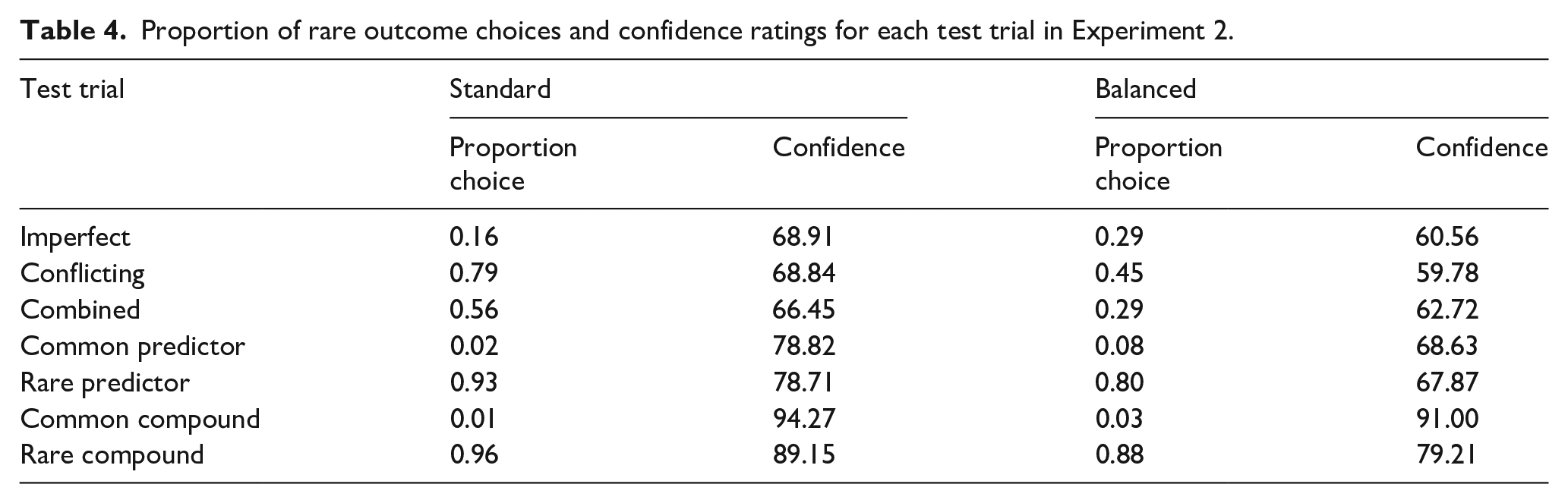
The proportion of rare outcome choice on each of the critical trial types is shown in Figure 4. Analyses focused on these trials, but the proportion of rare outcome choice and mean confidence ratings for each test trial type is shown in Table 4. The proportion of rare outcome choices for each trial type was compared against a chance level of 0.5 using a one-sample t test. An inverse base-rate effect is present if rare outcome choices are significantly above chance. There was a significant inverse base-rate effect in the standard group, t(23) = 5.06, p < .001, d = 1.03, BF10 = 615.99, but not in the balanced group, t(24) = 0.89, p = .38, d = 0.18, BF10 = 0.30. An independent-samples t test indicated that this group difference was significant, t(47) = 4.26, p < .001, d = 1.22, BF10 = 222.67. On imperfect trials, choices were significantly common-biased in both groups, lowest t(24) = 4.09, p < .001, d = 0.82, BF10 = 74.0, and there was no significant group difference, t(47) = 1.7, p = .096, d = 0.49, BF10 = 0.92. On combined trials, choice did not differ from chance in the standard group, t(23) = 0.81, p = .426, d = 0.17, BF10 = 0.29, but was significantly common biased in the balanced group, t(24) = 4.94, p < .001, d = 0.99, BF10 = 514.68. The group difference was significant, t(47) = 3.13, p = .003, d = 0.89, BF10 = 12.59.

Proportion of rare choice on imperfect, conflicting, and combined test trials in standard and balanced groups following three blocks of base-rate training.
Proportion of rare outcome choices and confidence ratings for each test trial in Experiment 2.
Discussion
On the critical conflicting (BC) trials, the difference in choice between standard and balanced conditions after short training appears to be as pronounced, if not more so, than what we have previously observed after longer training (d = 1.22 in the current study compared with d = 0.55 in Don & Livesey, 2017, and d = 0.62 in Don et al., 2019). The inverse base-rate effect was relatively strong in the standard group (d = 1.03, compared with d = 0.89 in Don & Livesey, 2017, and d = 0.78 in Don & Livesey, 2019). Choice was numerically biased towards the common outcome in the balanced group, although this did not significantly differ from chance. This differs from previous studies where we have typically observed a small rare bias in the balanced group (d = 0.20 in Don & Livesey, 2017, and d = 0.22 in Don et al., 2019). This result may be due to the difference in accuracy for AC trials by the end of training—accuracy was near asymptote in the standard group, but not the balanced group. In any case, the clear effect in the standard group suggests that the strong cue associability effect observed in Experiment 1 does not precede the inverse base-rate effect, and the difference between groups suggests that the associability differences observed in Experiment 1 after short training are not fully sufficient to produce an inverse base-rate effect, because there is no such effect in the balanced condition despite there being evidence of associability biases in this condition in Experiment 1.
General discussion
Experiment 1 showed better learning about cues that were previously rare predictors than previously common predictors in a new learning phase with novel outcomes. This change in associability indicates that greater attention was paid to rare predictors than common predictors during the first phase of training, and is therefore consistent in this respect with the attentional account of the inverse base-rate effect offered by Kruschke (1996, 2001a), and previous evidence of greater attention to rare predictors (Don et al., 2019; Wills et al., 2014). This result complements a similar finding in the highlighting effect, in which AB-O1 trials are trained prior to the introduction of AC-O2 trials, and a similar preference for O2 on BC trials is observed at test. Kruschke (2005) found a negative transfer effect, where learning was poorer for new predictive cues when they were paired with previously late predictor (C) than previously early predictors (B), suggesting continued attention to C in new learning. The current study demonstrates the associability of C is increased when AB and AC trials are trained concurrently.
The length of training appeared to have some effect on cue associability; a substantial associability bias towards C over B was present on both summation and negation tests after short training, whereas neither test trial yielded strong evidence for this effect after longer training, and a significant effect of training length was evident for summation test trials. This is consistent with the idea that there is an attention advantage for C while AC trials are associated with relatively high prediction error early in training. In the EXIT model, for instance, on experiencing prediction error, attention is quickly shifted towards the cue that will minimise that error and away from the predictive cues that contribute to it. It should also be noted that although these results suggest little benefit for rare predictors after seven blocks of training, the inverse base-rate effect is reliably demonstrated following training of this length or greater. This general finding is not necessarily incompatible with the results of the current experiment because attention biases early in training may be sufficient to develop stronger learning for the rare predictor, which might be maintained throughout extended training even if the attentional bias itself is not. Studies that have reversed or altered the base rates of contingencies throughout training tend to show a preference for the early rare over the early common outcome on conflicting trials, indicating the importance of early relative frequencies for the effect (Kruschke, 2009; Medin & Bettger, 1991).
We assessed the effect of context associations on attention transfer by comparing the standard condition, in which the context will be strongly associated with the common outcome, with a balanced condition, where the context will not be strongly associated with either outcome. Our previous work (Don et al., 2019; Don & Livesey, 2017) has indicated that this manipulation has a strong effect on the magnitude of the inverse base-rate effect. Although the transfer effect in Experiment 1 appeared numerically weaker in the balanced group on some tests, group differences between standard and balanced conditions were not significant either overall or for individual training lengths, on either summation or negation tests. Experiment 2 demonstrated a robust inverse base-rate effect after short training in the standard condition, suggesting that this attentional bias after short training should not necessarily be considered a precursor of the rare choice bias, but possibly something that emerges with it. In addition, the inverse base-rate effect was strongly affected by balancing the global frequency of the outcomes, such that choice proportions favoured neither rare nor common outcomes, but the attention bias was still present at short training in the balanced condition and was not affected by the standard versus balanced manipulation. This suggests that the associability bias alone is not sufficient to produce the inverse base-rate effect, though it is possibly one of its necessary conditions. This may add to a list of conditions that appear to be necessary but not sufficient for the effect to occur, including prediction error during training (Kruschke, 2001a; Medin & Edelson, 1988; Wills et al., 2014), and the presence of global outcome base-rate differences (Don & Livesey, 2017). Granted, we did not assess the magnitude of the inverse base-rate effect and cue associability within the same experiment and therefore cannot directly assess associations between the two on a participant level. This was done to avoid potential interference between separate test phases; however, future research could measure both within the same experiment with counterbalanced test orders.
Given past evidence of associability in the learned predictiveness effect, it would be fair to expect that the kind of attention that influences future learning would be best reflected by long-term learned attention to cues. Yet the change in transfer effects across training does not reflect this. Transfer effects instead appear to follow a similar pattern to eye gaze during feedback seen in Don et al. (2019). That is, attention biases to C were stronger earlier in training than later in training, and there was little difference between standard and balanced conditions. We have speculated that this pattern of attention reflects the current state of prediction error, rather than learned attention based on predictiveness. This would leave the current results seemingly at odds with a wealth of literature on associability and attention in the learned predictiveness effect. In the learned predictiveness effect, Phase 1 training usually proceeds to a point where participant predictions are highly accurate (i.e., there is very little prediction error, at least in the participants’ overt predictions), and there are highly replicable transfer effects where previously predictive cues are learned about more readily than previously non-predictive cues (Don & Livesey, 2015; Le Pelley et al., 2010; Le Pelley & McLaren, 2003; Shone et al., 2015). These effects are also associated with changes in pre-decision gaze biases (e.g., Le Pelley et al., 2011). Thus, in this literature, there is a strong link between transferred attention and learned predictiveness (and not current prediction error). However, the notion that attention might reflect current prediction error is consistent with recent findings that suggest uncertainty about the outcome is associated with sustained attention to cues (Beesley et al., 2015).
The most obvious reason why our results may differ is because we pitted two perfect predictors against each other. Arguably, this might nullify any associability transfer effects attributable to learned predictiveness. Despite the large body of research on the effect, the precise operations of the learned predictiveness effect are still not well known. Some results suggest, for instance, that competition among cues with different predictive validity (i.e., relative predictiveness) is completely unnecessary for the effect (Kattner, 2015; Le Pelley et al., 2010; Livesey et al., 2011), suggesting that the absolute predictiveness of each cue determines their attention in new learning. If this were true, then it would be reasonable to assume that B and C cues receive the same benefits from learned predictiveness effects in new learning and any bias towards C is attributable to other differences, such as those driven by its relative utility in resolving prediction error on the most recent trials. Although we have not focused on the comparison of formal models here, we have previously shown that Mackintosh’s (1975) model predicts greater attention to B than C, and that overt attention does not follow this pattern. However, in developing his model, Mackintosh (1975) outlined formal assumptions about cue processing changes as a consequence of learning (cue associability, specifically) but remained agnostic about how these changes will manifest in patterns of overt attention or orienting, which he noted were outside the scope of his formal analysis. Here, we confirm the same general pattern of prioritised attention to C for associability. Thus, this is again more consistent with the predictions of the EXIT model than the Mackintosh model. The results will inform any discussion of which theoretical mechanisms are necessary in more complex mechanisms like EXIT (e.g., see Paskewitz & Jones, 2020).
Notwithstanding the hypothesised processes discussed above, it must be acknowledged that the common and rare cues (by their very nature) differ in their frequency of exposure and this by itself can have an effect on cue salience. Cues that are presented without any consequences appear to lose associability when they are later paired with a meaningful outcome (the latent inhibition effect; see Holmes & Harris, 2010, for a review). It is possible that this process still occurs even when cues are presented with reliable consequences (e.g., Jones & Haselgrove, 2013; Kaye & Pearce, 1984). Latent inhibition effects have been notoriously difficult to demonstrate in humans (see Byrom et al., 2018), but if they were to have a substantial impact on cue associability in this type of explicit learning task, then they could contribute to greater attention being paid to the rarer of two predictive cues. This would not be sufficient to explain the inverse base-rate effect itself (it does not explain the difference between standard and balanced conditions, for instance), but it might be sufficient to explain why one would attend to C more than B, that is, on the basis of relative novelty alone. Future research may be needed to tease apart contributions of prediction error and mere novelty on this associability effect.
In summary, we have demonstrated an attention bias to rare predictors that persists into new learning. This bias was stronger following short training than following longer training, and was unaffected by differences in global outcome base rates. However, global base rates have a clear effect on choice biases that constitute the inverse base-rate effect, even after short training. Thus, it appears that the kind of attention bias we have observed here is not sufficient for producing the inverse base-rate effect. In addition, the pattern of associability effects closely matched the pattern of eye gaze observed during feedback in Don et al. (2019) and may be a reflection of current prediction error. While prior research has shown relationships between associability and overt attention prior to making a decision, the current results suggest that the relationship between associability and attention is still not well understood and will require further research to make meaningful progress towards theory development.
Footnotes

Declaration of conflicting interests
The author(s) declared no potential conflicts of interest with respect to the research, authorship, and/or publication of this article.
Funding
The author(s) disclosed receipt of the following financial support for the research, authorship, and/or publication of this article: The study was funded by an Australian Postgraduate Award granted to HJD.