




Abstract
A state-dependent learning paradigm was studied in which healthy adult volunteers studied/encoded and recalled information from short passages, neutral in their content, in one of the following conditions: (1) Pain during study-Pain during both recall sessions; (2) Pain during study-No Pain during both recall sessions; (3) No Pain during study-Pain during both recall sessions; and (4) No Pain during study-No Pain during both recall sessions. Pain was experimentally induced using the cold pressor technique. In this study, we looked at evidence for state-dependent learning when the context of learning is not emotionally driven, but neutral. The memory task consisted of encoding detailed information about short stories, then recalling as many details as possible 20 min and 48 hr later. The results indicated no occurrence of a state-dependent learning and retrieval effect in this sample: Participants in the pain-no pain and no pain-pain conditions did not significantly perform differently than participants in the pain-pain and no pain-no pain conditions. However, a main effect of the state during study/encoding was significant, suggesting that being in pain during study had a detrimental effect on performance on the memory tests regardless of the state at retrieval. These results oppose previous studies’ findings and shed new light on possible implications in various research areas.
State-dependent learning is a phenomenon in which memory performance in retrieving information is stronger when retrieval happens while in the same state as when the memory was formed. Unlike context-dependent learning which depends on the external environment, state-dependent learning relies on a person’s internal state, which can be emotional and/or physiological (for reviews of state and context-dependent learning, see S. M. Smith & Vela, 2001; Ucros, 1989).
Physiological states for learning and retrieval
Multiple studies have investigated different physiological states in relation to memory consolidation and retrieval. Researchers have studied the existence of state-dependent learning with diverse psychoactive substances: alcohol (Crow & Ball, 1975; Goodwin et al., 1969; Lowe, 1983; Weingartner et al., 1976), marijuana (Darley et al., 1974; Eich et al., 1975), nicotine (Warburton et al., 1986), and caffeine (Kelemen & Creeley, 2003). All these studies followed a 2 × 2 design where participants performed encoding and retrieval tasks either while under the influence of a substance for both tasks, under no substance for both, or under the influence of a substance for only one of the tasks. All these studies revealed a physiological state-dependency effect on learning and memory. Different kinds of memory tasks (word association recall, free recall, and recognition tasks), all seemed to indicate that retrieving information while in the same state helps to retrieve the previously learned information. A moderate dosage of the tested substances led to stronger memory performance when the same physiological state was present during acquisition and retrieval; however, high doses of these same substances showed retention deficits effects (Birnbaum & Parker, 1977).
Pain-dependent learning
Despite the large amount of research on substance and mood-dependent learning, pain-dependent learning has been relatively understudied. Only a few studies have looked at how pain moderates the state-dependent learning/retrieval experience (Kuhajda et al., 1998, 2002; Pearce et al., 1990; Seltzer & Yarczower, 1991). These previous studies had a focus on how memory for emotional content (positive or negative words) was affected by induced pain. Pearce and colleagues (1990) looked at both state-dependent learning and mood-congruity effects in healthy volunteers using the cold pressor test. The results demonstrated evidence for the state-dependent learning hypothesis as a significant interaction was found between state at encoding and state at recall, but no significant results demonstrated a mood-congruity effect (participants did not recall more pain-related words than neutral or negative ones). These results suggest that pain-dependent learning could be achieved even when no emotion-related items are used. However, a similarly designed study failed to replicate the evidence of a pain-dependent learning effect (Seltzer & Yarczower, 1991). In their experiment, participants were visually presented with 30 words (positive, neutral, or negative in nature) and asked to study and then freely recall as many words a possible, while being induced or not with pain for both study and recall tasks (cold pressor test). Word lists consisted of positive words such as “sincere” or “honest,” negative words such as “liar” or “phony,” and neutral words such as “ordinary” or “unsystematic” (as found in Anderson, 1968). The researchers found that even though pain inhibited encoding of positive words compared with negative ones, individuals who encoded and recalled words in the same conditions did not retrieve more words than individuals in different conditions. In a replication and extension, Kuhajda and colleagues (1998) integrated a recognition task in their design. Both recall and recognition tasks, when analysed for positive vs. negative words remembered correctly, led to non-significant results concerning a state-dependency effect. Also, for both memory tasks, a mood-congruity effect was not found: Neither positive nor negative words were remembered to a greater extent. Put together, these mixed findings do not suggest a clear state-dependency effect when it relates to pain and affective content.
Most of the past literature on pain and its effect on memory has focused on memory for emotional words only (Kuhajda et al., 1998, 2002; Pearce et al., 1990). Few studies have investigated the effect of pain for non-emotional learning, or when the memory tasks consist of learning information that has a situation that could mimic real-life learning experiences. Not all pain patients are faced with learning or retrieval experiences that are emotionally laden. On the contrary, in chronic pain, patients often experience daily and constant pain, potentially impacting not only emotional learning, but all memory processes. In a real-world situation, individuals are less likely to learn a list of words than they are to learn information encountered in educational or everyday settings. Indeed, individuals experiencing pain are not always going to be only learning about emotional facts, but are subject to learn about very different sets of topics, unrelated to pain and its affects. Thus, it seems of importance to study the effects of pain-dependent learning in more ecologically valid ways, so as to be able to generalise findings of laboratory experiments for real-life situations: through neutral in content and articulated memory tasks. Our study is a step in that direction.
Sex differences
When considering pain perception, sex differences have been well documented (see reviews by Bartley & Fillingim, 2013; Wiesenfeld-Hallin, 2005). Sex differences in pain sensitivity have been found in both acute and chronic pain studies (Bartley & Fillingim, 2013). It has been predominantly found that women have lower pain threshold and tolerance to pain stimulus than men (Riley et al., 1998), even though findings are somewhat inconsistent (Mogil, 2012). The state-dependent learning literature has largely failed to take into consideration the potential effect of sex differences, not only related to pain perception, but also in the context of other physiological states. Considering the growing body of evidence relating biological, social, and cultural differences between men and women, it seems important to account for this possible effect and to create knowledge on this issue. In the present study, sex of participants was considered a covariate to account for sex differences often found in pain research.
The present study
The purpose of the present research is to study pain-dependent learning when to-be-learned items are not emotion laden; in this case, memory from a reading comprehension task. We aimed to determine whether the few past findings on pain-dependent learning generalise to emotionally neutral material. We hypothesised that pain-dependent learning would be demonstrated when using emotion-neutral memory tests. Because chronic pain patients do not only study material that is emotionally valanced, the results of the present study could be of importance in bringing new insights on the pain-dependent learning phenomenon.
Method
This study was reviewed and approved by New Mexico State University’s Institutional Review Board (IRB). All participants consented to participate in this study and signed a written informed consent form.
Participants
A total of 107 participants ranging in age from 18 to 40 years participated in this study (M = 18.9). Seventeen participants’ data were dismissed from further analysis because they did not come back for the second session of the study. Three more participants’ data were dismissed because they spent less than 1 min studying the information pertaining to the memory task. We considered that no learning occurred in such a short period. These participants did in fact score a 0 on both memory tasks. To address any concerns about possible differential participant attrition, we conducted a logistic regression analysis in which returning/non-returning status for the second session of the study was not predicted by condition, gender, or day-one performance. After entirely removing these 20 participants from analysis, we analysed data for 87 participants (N = 87) of which 66 were women (76%) and 21 were men.
Materials
The stimulus used to induce pain in participants was created using the cold pressor method. The ice water bath was maintained at 4°C–6°C, (39°F–42°F) in the cold water or pain condition. For the warm water or no-pain condition, water was maintained at 29°C–31°C, (85°F–88°F).
The to-be-learned materials consisted of two short passages containing details about either the sun or otters as used by Roediger and Karpicke (2006). The short passages were printed in black, each on a single piece of white paper. After memorization, participants wrote down the details they could remember on a blank piece of paper. Grading followed guidelines as outlined by Roediger and Karpicke (2006). Each passage was divided into 30 “ideas” or pieces of information (i.e., “Sea otters dwell in the North Pacific” or “The sun today is a yellow dwarf star”), where each idea was worth one point if correctly and fully recalled, or zero point if participants provided incomplete pieces of information, or did not recall any pieces at all. The same researcher graded all tests.
Perceived pain was measured using an 11-point Number Rating Scale (McCaffery & Beebe, 1989), where 0 meant “no pain at all” and 10 meant “worst pain imaginable.”
Procedure
The study had the following design: a 2 (Pain or No Pain during study) × 2 (Pain or No Pain during first recall) × 2 (Pain or No Pain during second recall) mixed measures ANOVA. Participants were randomly assigned to one of four groups: (1) Pain during study-Pain during both recall sessions; (2) Pain during study-No Pain during both recall sessions; (3) No Pain during study-Pain during both recall sessions; and (4) No Pain during study-No Pain during both recall sessions. The study was divided into two sessions: The first session consisted of a study and a recall period; the second session occurred approximately 48 hr later and consisted only of a recall period.
After taking a demographic questionnaire, participants sat next to a bucket of either cold or warm water. Participants immersed their non-dominant hand in the water and were given 30 s to acclimate to the water temperature. After this acclimation period, participants had 5 min to read and learn as many details as they could about the short passages (topics were counterbalanced). During the study phase, no learning measure was taken; participants only studied details about a short passage by reading. A 5-min limit was set to avoid numbness of the hand in the cold water condition. The same time limit was used for the warm water condition for consistency. After 5 min of study (i.e., five and half minutes after immersion), participants stopped studying and removed their hand from the water bath. They took a 20 min break period where they were asked to complete an unrelated simple task: to make as much progress as they could on a 400-piece jigsaw puzzle.
After the distraction task, the first recall session occurred. Participants once again immersed their non-dominant hand in either cold or warm water for five an half minutes and were instructed to write down as many details as they could from the passage they read. Immediately after each immersion in the water, participants were asked to rate their pain/discomfort feelings on the Numerical Rating Scale.
During the second testing session, 48 hr later, the procedure echoed the testing/recall part of the first session in every detail.
Results
Analyses of results were conducted using SPSS version 26, JASP version 0.14.1, and G*Power 3.1.9.
A priori analysis
An a priori power analysis using the G*Power software package (Faul et al., 2007) was performed to estimate the needed sample size based on data from a similarly designed study (Kuhajda et al., 2002). The effect size in this study was d = 0.22, which is considered to be a small to medium effect using Cohen’s (1988) interpretation. With parameters set to be α = 0.05 and power (1 − β) = 0.80, the required sample size was estimated at N = 104 participants. Our initial sample size (N = 107) would have been adequate for the main objective of this study. However, after removal of 20 participants’ data, our smaller sample size might have played a role in limiting the significance of some of our statistical comparisons. 1
Effect of pain manipulation
Table 1 presents the mean pain ratings for the four different groups at the three instances participants were presented with the cold pressor test or the control warm water.
Means and standard deviations for pain ratings during the study and both recall tasks.
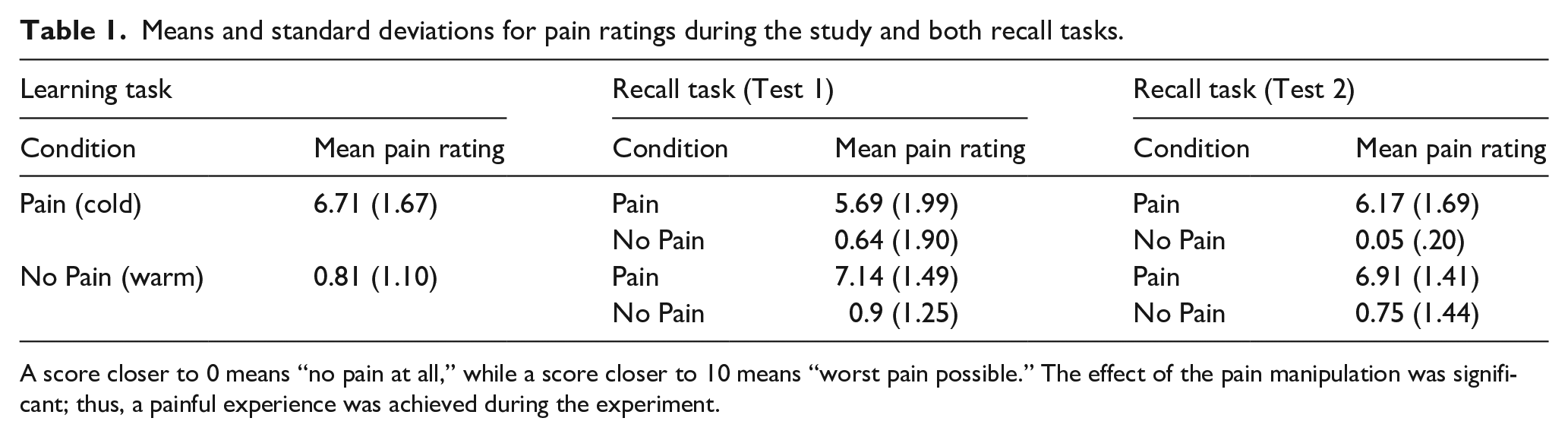
A score closer to 0 means “no pain at all,” while a score closer to 10 means “worst pain possible.” The effect of the pain manipulation was significant; thus, a painful experience was achieved during the experiment.
To evaluate if the pain manipulation was successful and pain was actually achieved during the experiment, a 2 (Pain or No pain during study) × 2 (Pain or No pain during recall 1) × 2 (Pain or No pain during recall 2) repeated measures ANOVA was performed on pain ratings. Analysis revealed a significant difference in pain ratings between individuals in the Pain condition and individuals in the No pain condition during study: F(1, 83) = 320.913, p < .001,
Recall accuracy
To test the effect of being induced or not with pain on memory recall, tests scores were analysed using a 2 × 2 × 2 repeated measures ANOVA, where the between subject factor was participants’ study and recall conditions (pain or no pain), the within-subject factor was participants’ test scores, and sex of participants was used as a covariate. Table 2 provides a summary of these results. Analysis revealed a significant difference between recall accuracy for the first test (20 min after study) and the second test (48 hr after study). Bonferroni post hoc testing demonstrated a small but significant decrease in recall from the first to the second memory test (mean difference = 0.58, p < .001), as expected by the delay between the first and second test.
Means, standard deviations, and sample sizes for recall accuracy depending on participants’ states and groups.
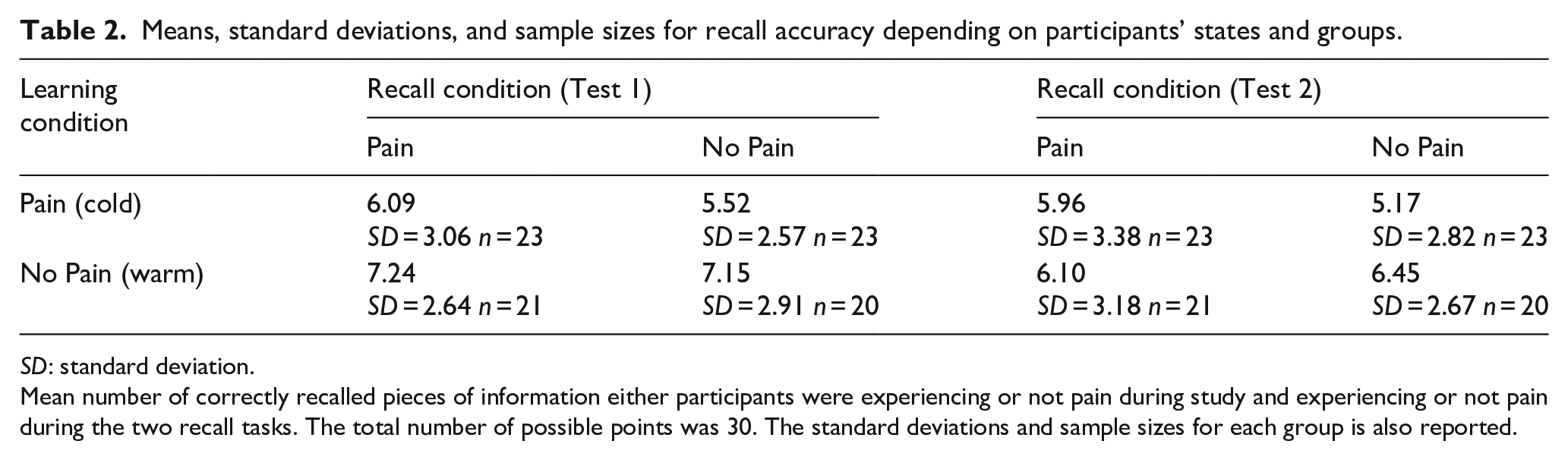
SD: standard deviation.
Mean number of correctly recalled pieces of information either participants were experiencing or not pain during study and experiencing or not pain during the two recall tasks. The total number of possible points was 30. The standard deviations and sample sizes for each group is also reported.
Analysis revealed no interaction between state (Pain or No pain) during study and state during recall (Pain or No pain): F(1, 82) = .229, p = .634,
However, a significant main effect of the state during the study condition was observed: F(1, 82) = 4.904, p = .034,
To supplement these results and confirm the null effect of state-dependency, an additional Bayesian analysis was performed using the JASP software package (JASP Team, 2020). The default JASP priors were used. Comparing all possible models of variables, a repeated measures ANOVA was performed and corroborated our previous findings. The null effect found for the interaction between state at study and state at retrieval was confirmed: The Bayes Factor indicated that the data are 34 times more likely under the null hypothesis than the one containing the interaction. In addition, the best model against the null hypothesis to explain our data was identified to be the model containing the main effect of the state at study (pain or no pain): the Bayes Factor (BF10 = 75.208) indicated that the data are 75 times more likely under the model including the main effect of the state at study only, compared with the null model.
Finally, a main effect of the covariate “sex” (male and female) was found: F(1, 82) = 4.599, p = .035,
Pain intensity ratings and memory
Pain intensity ratings were also explored in relation to recall performance. Pearson’s correlations were performed on each measure of pain intensity (during study, first and second recall tests) and recall tests. A significant negative correlation was found between pain intensity ratings during encoding/study and correctly recalled items during the first test (retrieval): r = −.263, p = .014, suggesting that as pain ratings at encoding increased, the number of correctly recalled items decreased. However, no such correlation was found between pain ratings during both recall tasks and correctly recalled items, corroborating our previous finding that pain during encoding might have a stronger adverse effect on recall performance than pain during retrieval.
Discussion
The results of the present study do not support the hypothesis that a pain-dependent memory phenomenon happens when using emotion-neutral and relatively complex memory tests. However, consistent with past literature, pain had an adverse effect on memory retrieval. Our data suggested that pain at the time of study/encoding had a stronger adverse effect on memory than pain during retrieval: that is, being in pain during encoding significantly impacted later retrieval, both 20 min and 48 hr after learning, regardless of the condition at recall.
Past studies on the effect of induced pain on a state-dependent learning and retrieval effect have investigated emotion-related or mood-related effects and have found mixed results (Pearce et al., 1990; Seltzer & Yarczower, 1991). It suggests that pain might not be a physiological state that is suitable for state-dependent learning to happen, when memory tests are not linked to a pain-related experience (use of pain-related words). A previous study showed that chronic pain patients are more likely than healthy subjects to remember pain-related and negative words (Pearce et al., 1990). Another study investigating the effect of mood on encoding and recall, without the interference of pain, also found a mood-congruent effect on encoding: A selective learning paradigm emerged in which participants in a certain mood (positive or negative) would remember stories better when their affective content was similar to the induced mood (Bower et al., 1981). The neutral aspect of the memory test used in the present study might not have had the necessary negative affective content to trigger state-dependent learning while in pain.
Also, the associative network theory suggests that state-dependent learning might occur when an “emotional node” is reactivated for information that is similar in its affective content to the information previously learned in the same state (Bower, 1981). It is possible that experimentally induced pain is not sufficient to activate this emotional network because induced pain is not as tied to an affective experience as encountered by chronic pain patients or encountered in studies with a mood-dependent criterion. Also, several studies found that while in pain, participants were more likely to remember negative words (Bower, 1981; Pearce et al., 1990), emphasising again that previous studies might have found a mood-congruity effect instead of a state-dependent learning effect. The neutral information that was learned in this study might have lacked the negative affective component needed. Pain is a nociceptive stimulus that is often remembered as being a negative experience. It might be easier for state-dependency to occur when the experience of being in pain matches the content being learned in its affective aspect.
These results can also be explained by the fact that pain has often been found to impair cognition in both clinical patients and healthy volunteers (Buhle & Wager, 2010; Torkamani et al., 2015). Theories of attention suggest that people have a limited capacity of attention (Kahneman, 1973). When several tasks are performed at the same time, less attention can be allocated to each task, leading to poorer performance (concept of divided attention). It has been found that pain impairs the processing of several cues, as well as control over attentional allocation (Moore et al., 2012). It might be that pain has such aversive impacts on cognition that it prevents state-dependent learning from occurring altogether by impairing encoding. We suggest that having to handle pain sensations from the cold pressor test, while attempting to encode precise and detailed information from the short stories overloaded our participants’ attentional pool, which led to participants in the pain condition for study to have lower recall scores, regardless of the timing of pain. It also seems like the difficulty of the memory tasks presented to participants matters. Indeed, there seems to be a trend in the results of studies measuring recall memory versus recognition memory, where recognition tasks lead to stronger evidence of a state-dependent effect (Kuhajda et al., 1998) and recall tasks often lead to failure in detecting this phenomenon (Pearce et al., 1990; Seltzer & Yarczower, 1991). It is possible that because the experience of pain is already taking attentional resources away, adding difficulty to the task hampers the encoding of new information.
Interestingly, our results showed that even though no state-dependency in memory was present, state at study did have a significant effect on later retrieval. Regardless of whether participants were induced with pain or not during retrieval, the data showed that participants who were not in pain during study scored higher on the memory task. It seems like encoding while pain-free is a facilitator to memory formation and on the contrary, encoding while in pain weakens memory formation. These results could have possible implications in various areas. First, the present findings could inform the literature on standardised testing and students testing in general. Considering the impact of a state of pain when studying before a test could benefit students. For example, it has been found that elementary school students who reported chronic pain symptoms had lower reading scores than pain-free students (Kosola et al., 2017). Being aware of this particular issue could lead to a better understanding about how pain can significantly interfere with memory formation and in turn with successful test completion. Second, the results could have implications for the eyewitness testimony literature. Being in pain during the encoding period of a particular event could lead to impaired recall thereafter. Pain could in this case be a variable of interest for forensic researchers.
Several studies over the past few decades have looked at the effect of chronic and acute pain on general cognition, and also, more specifically on learning and retention. It is generally believed that chronic pain impairs a variety of cognitive functions, such as visual and spatial learning (Roldán-Tapia et al., 2007), working memory (Berryman et al., 2013), retention (A. Smith & Ayres, 2016), attention (Veldhuijzen et al., 2006), implicit memory (Duschek et al., 2013), verbal fluency (Park et al., 2001), storage and manipulation of information (Reyes del Paso et al., 2012). However, these studies did not look at when in the learning and memory formation and retrieval process pain had the greatest impact. The present findings could shed new light on the timing of this cognitive impairment due to pain and could help in the therapeutic rehabilitation of chronic pain patients. If the finding that pain interferes with the acquisition of new information but does not adversely affect the retrieval of said information can be replicated for chronic pain, rehabilitation for chronic pain patients could focus on developing coping mechanisms emphasising strategies for better encoding rather than retrieval for which there may be less cause for concern.
When considering the impact of pain on memory, it might be of interest to look at how different levels of the pain stimulus can modulate performance. When looking at a state-dependent learning effect when using different substances (alcohol, caffeine, drugs), the literature has often highlighted how different doses of these substances can have a lesser or greater impact on encoding and retrieval capacities. We investigated the relationship between subjective pain ratings and the number of correctly recalled items. The results showed a weak negative correlation: As pain ratings during encoding/study increased, the number of correctly recalled items during the first recall task decreased. However, it was not found that pain ratings during retrieval were negatively correlated to memory performance. In a similarly designed experiment, Kuhajda and colleagues (2002) also found no relationship between pain ratings and memory performance, and discussed how “pain may operate at a threshold level rather than in a dose–response fashion” (p. 220). Our present results tend to agree with this hypothesis. A pain stimulus can have strong aversive effect on memory, regardless of the intensity, as long as the stimulus reaches the threshold differentiating pain from mere discomfort. Threshold levels vary from individual to individual, and it remains to be studied how different stimuli and tasks might affect this threshold point. Future studies should look closer at the effects of pain intensity on various cognitive tasks, and if possible, confirm the threshold level hypothesis.
Similar to past literature, this study adds to mixed findings on a state-dependent memory effect of pain. Future studies should look at the effect of induced pain on both neutral and affective content to assess memory performance on the same sample. Also, studying this phenomenon using emotion-related material that is of higher difficulty than words (such as short stories) might lead to new results on state-dependency when related to mood. It might also be of interest to study state-dependent learning for neutral content on chronic pain patients, as it has been shown that clinical and healthy populations differ on their respective performance depending on the task they are presented with (Pearce et al., 1990). Furthermore, in light of our finding that men and women significantly differ in terms of memory performance, sex differences should become a covariate of interest in future research relating to pain perception.
Footnotes
Acknowledgements
The authors thank Asia La Torra, Martin Lopez, and Manuel Franco for helping with data collection.
Declaration of conflicting interests
The author(s) declared no potential conflicts of interest with respect to the research, authorship, and/or publication of this article.
Funding
The author(s) received no financial support for the research, authorship, and/or publication of this article.
