



Abstract
The Deese–Roediger–McDermott (DRM) paradigm is widely used to study false memory in the laboratory. It tests memory for lists of semantically related words (correct list item memories) and their non-presented associates (false lure memories). Evidence suggests that early items in DRM lists could make an especially significant contribution to false memories of lures, as they may critically influence the underlying associative activation and/or gist extraction processes. The present study tested this suggestion by using two manipulations that were intended to affect processing of early DRM list items. The first was interpolation of a semantically unrelated distractor item among the list items (Experiments 1 and 2). The second was arranging for these items to be either the strongest or weakest associates of the lure (Experiment 2). In Experiment 1, a distractor item reduced both list item and lure recall when presented early in a DRM list, but selectively disrupted list item recall when presented late in the list. In Experiment 2, arranging for the early list items to be the weakest associates of the lure reduced false recall of the lure but had no effect on list item recall. The findings are discussed with respect to theories that explain false memory in the DRM protocol, including fuzzy trace theory (FTT) and activation–monitoring theory (AMT). They are also discussed with respect to general theories of memory and the potential role of category/context information in generating false memories.
The past 25 years have witnessed major advances in our understanding of false or illusory memories and the circumstances under which they occur (Gallo, 2006; Howe & Derbish, 2010; Huff & Bodner, 2013; Knott et al., 2012; Meade et al., 2007). The most widely used protocol to induce such memories was initially developed by Deese (1959) and subsequently modified by Roediger and McDermott (1995). What has come to be known as the Deese–Roediger–McDermott (DRM) paradigm involves two stages. In the first, participants study lists of associate words that converge upon a single non-presented critical lure. In the second stage, participants are tested for recall and/or recognition of the presented words, during which they typically report having seen or heard the lure. This false memory of the lure, or DRM illusion, is robust and can persist for weeks to months (Seamon et al., 2002). It is also difficult, if not impossible, to eliminate. For example, warnings that a lure may be present and instructions that encourage distinctive processing reduce but do not eliminate the illusion (McCabe & Smith, 2002; for review, see Huff et al., 2015). The goal of the present experiments was to examine whether another type of manipulation, the presence of a distractor item within the study lists, can reduce or eliminate the DRM illusion.
Although several theories have been developed to explain the DRM illusion (see Gallo, 2006, for review), the most prominent of these are fuzzy-trace theory (FTT; Brainerd & Reyna, 1990) and activation–monitoring theory (AMT; Gallo, 2006; Roediger et al., 2001). According to FTT, during study of a DRM list in stage 1, participants extract two separate memory traces: verbatim traces of specific list items and a gist trace of the theme of the list, the latter of which is responsible for the DRM illusion. According to AMT, the semantically related items presented in stage 1 implicitly activate a representation of their common associate through a spreading activation process (Collins & Loftus, 1975) and this associative activation fails to be appropriately rejected at test (i.e., source monitoring misattribution), leading participants to report that the lure had been presented. Importantly, under standard list conditions, FTT and AMT accounts of the DRM illusion cannot be discriminated from each other as the strength of item–lure associations is confounded with thematic consistency of list items (Huff & Hutchison, 2011). That is, list items that are strongly associated with the lure (high backward associative strength; BAS) also tend to have a shared meaning. For example, the words “loaf” and “toast” have high BAS with the lure “BREAD” and have a shared gist. It is therefore difficult to determine the separate effects that item–lure associations and thematic consistency have in generating the DRM illusion (Gallo, 2006; Hutchison & Balota, 2005). FTT and AMT have, however, been discriminated in studies that used specialised word lists which do not confound the strength of item–lure associations with thematic consistency (e.g., homograph lists; Hutchison & Balota, 2005, and so-called mediated lists; Coane et al., 2016; Huff et al., 2012), with the results favouring AMT over FTT. However, the combination of studies has led to the view that both activation and gist representational processes can contribute to the DRM illusion. For instance, consistent with AMT, the DRM illusion increases with the strength of item–lure associations but is independent of the number of list themes (Hutchison & Balota, 2005; Roediger et al., 2001), and consistent with FTT, gist-based processing emerges with an increase in the retention interval between study and testing (Huff et al., 2015; Seamon et al., 2002).
While AMT and FTT both explain the DRM illusion, questions remain regarding how implicit associative activation spreads to the lure in the case of AMT, or how gist information relating to the lure is extracted in the case of FTT. While it is generally assumed that both processes operate relatively automatically (Brainerd & Reyna, 2005; Roediger et al., 2001), both processes may be sensitive to the magnitude of the associations or consistency of the list theme early in the list presentation. One way of evaluating this possibility is to examine how variations in list structure, including different orderings of list items, affect the illusion. Studies that have examined the impact of item ordering generally show that it does not matter. For example, the DRM illusion is unaffected by whether list items are presented in ascending or descending order of their BAS, or randomly ordered with respect to their BAS (Brainerd et al., 2001; McEvoy et al., 1999).
In contrast, however, there are circumstances under which list order may matter. McDermott (1996) found that if several DRM lists are integrated into a single list, the illusion is stronger when same-list items are blocked together versus presented intermixed, suggesting that the false memory had been weakened when the relations among the items had been disrupted in the intermixed condition. In addition, Meade et al. (2010) found that when examining semantic priming of the critical lure following study of a DRM list, priming was found to persist long-term (i.e., over several intervening items), but only when the first seven list items were the strongest related associates. Such list-order effects suggest that (1) the consistency of the relations among items is critical for producing associative/thematic strength that contributes to the DRM illusion; and (2) the DRM illusion will be especially potent when the strongest associative/thematic items appear early in the study list.
In addition to the demonstration that the DRM illusion is sensitive to list item-order effects, studies have shown that the DRM illusion can also be disrupted by certain encoding tasks. For instance, presenting DRM study items in different fonts versus the same font (Arndt & Reder, 2003), having participants generate study words from anagrams (Gunter et al., 2007; McCabe & Smith, 2006), and having participants rate individual words for pleasantness (Huff & Bodner, 2013, 2019) all produce a reduction in the DRM illusion. However, in each of these studies, the encoding manipulations were implemented for the entire list, and it is unclear what contribution the encoding of list items at the beginning versus end of the list has for the disruption in DRM illusion.
The present study sought to examine list consistency effects as well as differential contribution of early versus late list items in the DRM paradigm. We hypothesised that disrupting the thematic consistency of list items would reduce the DRM illusion, and we tested this by disrupting the associative/thematic consistency of DRM with an unrelated distractor study item. Critically, the unrelated distractor word occurred either early or late, thereby assessing whether early versus late items were more important for the DRM illusion. Based on previous findings demonstrating that early list items produced strong semantic priming of the critical lure (Meade et al., 2010), we expected that a distractor placed early in a DRM list would be more disruptive to the DRM illusion than a distractor placed late in the list. We further hypothesised that in the presence of a distractor in an early position, the strength of list items that precede the distractor would influence the potency of the DRM illusion. Specifically, we expected that the illusion would be reduced when list items that preceded the distractor were the weakest associates of the lure but enhanced when preceding list items were the strongest associates of the lure.
Our hypotheses were tested in two ways. The first was by presenting a semantically unrelated distractor word either early or late in a 12-word DRM list (Experiment 1), and the second was by organising DRM study lists such that the early list items were either the weakest or strongest individual associates of the lure (Experiment 2). In Experiment 1, the distractor word was either neutral or emotive. Emotionally valenced distractors have been shown to be particularly effective at disrupting aspects of working memory (Hadley & MacKay, 2006; Hurlemann et al., 2005; Mather & Sutherland, 2011), and therefore, we predicted that emotive distractors would be more likely to disrupt the DRM illusion. In Experiment 2, we expected a reduction in the DRM illusion when early list items were weakly associated with the lure compared with when these items were strongly associated with the lure.
Experiment 1
Methods
Participants
Participants were 297 undergraduate students (mean age = 20.3 years) who undertook the experiment as part of a course requirement in psychology. All participants provided informed consent prior to commencement of the experiment. All procedures were approved by, and carried out in accordance with, the guidelines provided by the University of New South Wales Human Research Ethics Committee. The experiment was conducted in groups of 15 to 22 participants, where each group was randomly assigned to a between-subject condition of Early or Late (n = 165, n = 132, respectively). A mixed factorial design was used in which the distractor position (Early vs. Late) was the between-subject factor and the distractor type (Emotive vs. Neutral vs. Blank) was the within-subject factor.
Materials
Nine DRM lists were modified from Roediger and McDermott (1995) and served as study materials, where each list contained 12 list items. Roediger and McDermott (1995) used 15 words for each list, but in the present study, the 12 words that were most neutral in valence were selected. In six of the lists, a single distractor word was inserted. This word was not semantically related to the other list items. The word was emotive in three lists, neutral in three lists, or a blank space was inserted in the distractor space for three lists (i.e., control lists). These distractors were selected using the Affective Norms for English Words (ANEW; Bradley & Lang, 1999). Emotive distractors were words which had negative valence, while neutral distractors had little or no valence. Each emotive distractor was paired with a neutral distractor such that pairs were matched for word frequency and normative arousal ratings, differing only in valence (ANEW; Bradley & Lang, 1999). The difference in valence between neutral and emotive distractors was statistically significant, Emotive M = 5.13 Neutral M = 1.5; t(16) = 21.85, p < .001, while the difference in arousal and word frequency was not, Emotive arousal M = 6.29, Neutral arousal M = 5.71, t(16) = 1.54, p = .14; Emotive frequency M = 12.89, Neutral frequency M = 8.44, t(16) = 1.05, p = .31. Distractors occurred either early (fourth word) or late (tenth word) in the list. Since blank lists did not contain a distractor, they were shorter than the other lists overall (12 vs. 13 words in total); however, all lists contained 12 related study items. All other list items were randomly ordered, and all lists were counterbalanced across participants with respect to which were allocated to Blank, Neutral, or Emotive conditions. All list items, lures, and distractors are shown in Tables S1 and S2 in the Supplementary Materials.
Procedure
All participants were tested using standard computer monitors and keyboards using programmes written in Matlab (The Math Works, Inc.) with the Psychtoolbox extensions. List items (and a distractor) were presented serially. The presentation duration of each item was 250 ms with a 32 ms interval. These durations were selected as they have been shown to be optimal for producing the DRM illusion (McDermott & Watson, 2001). After each list was presented, participants engaged in a math filler task for 30 s followed by a free-recall test for 1 min, where they were instructed to write down as many words as they could remember from the list just presented in no particular order. After the free-recall test, participants were instructed to place the paper aside face-down so that it was no longer in view for the remainder of the experiment. Recall tests for subsequent lists used fresh blank sheets of paper. This procedure was repeated for all nine lists.
Analysis
Recall of presented items and non-presented lures was taken as an index of correct item memory and the false lure memory (DRM illusion), respectively. All analyses were carried out using Matlab and SPSS (IBM statistics). Data were analysed using contrasts in a mixed model analysis of variance (ANOVA) that included a between-subjects factor of group (Early vs. Late) and within-subject factors of distractor type (contrast 1 = Blank vs. Neutral and Emotive; contrast 2 = Neutral vs. Emotive) and memory type (correct memory for list items vs. false memory for lures). A sensitivity analysis run using G*Power 3 (Faul et al., 2007) indicated that our sample size had excellent power (.95) to detect small-to-medium effect sizes for main effects and interactions (Cohen’s d > 0.15). The criterion for rejection of the null hypothesis was set at α = .05 (two-tailed) and effect size estimates are reported as partial eta squared (
Results
Figure 1a shows the effects of emotive and neutral distractors on recall of list items and lures (see also Table 1). The data are shown separately for participants exposed to the distractor either early (left panel) or late in the list (right panel). The figure suggests that the distractors had dissociable effects on items and lures depending on their position in the list; and that the distractor effects were independent of their valence. These suggestions were confirmed by the statistical analysis. ANOVA with repeated measures revealed a significant main effect of word type, F(1, 294) = 138.16, p < .01,
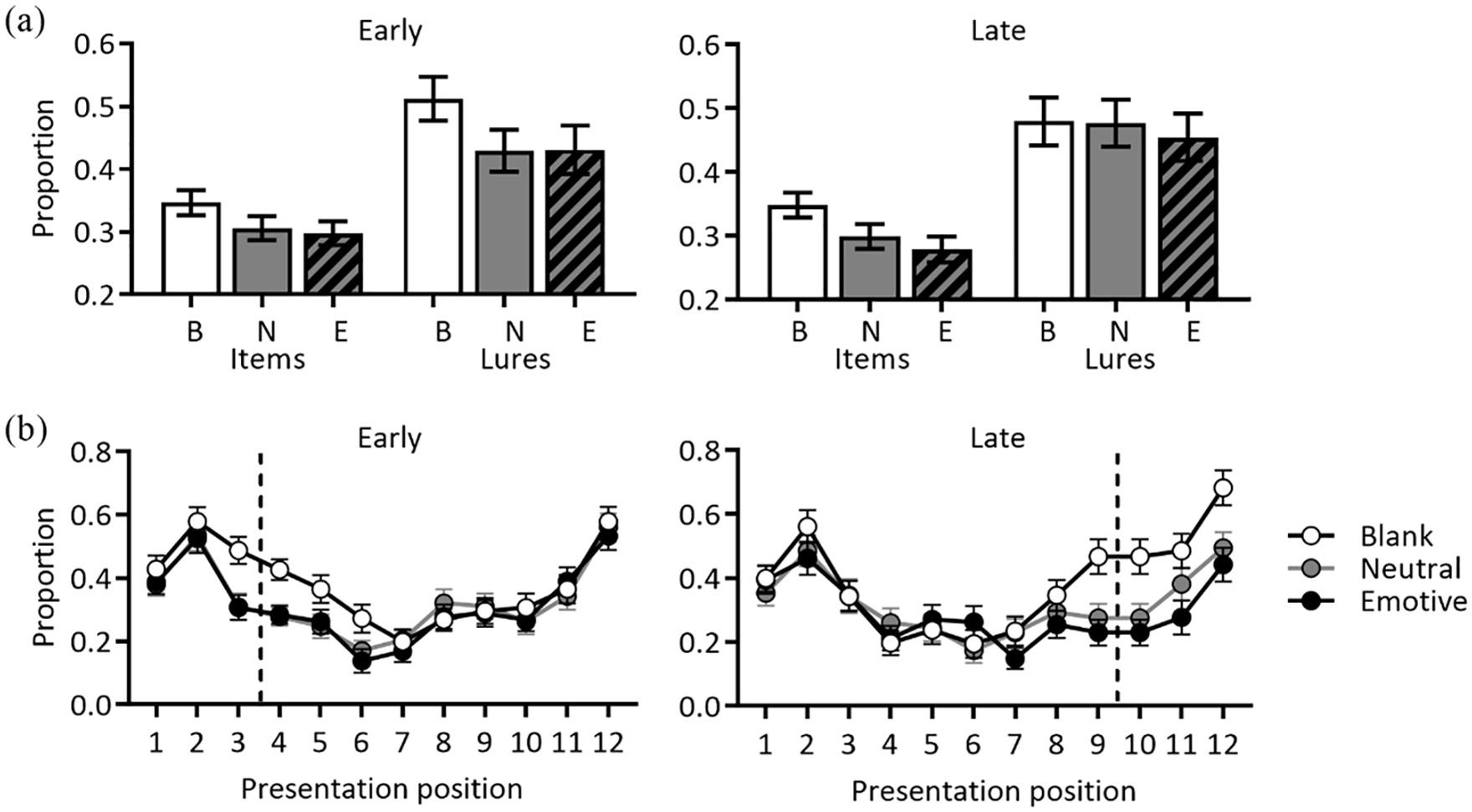
Experiment 1 item and lure recall. (a) Mean proportion of list items and lures reported for Experiment 1, shown separately for Early (left) and Late (right). Condition names are abbreviated on the x-axis: B = blank; E = emotive, N = neutral. (b). Mean proportion of list items recalled for each of the 12 presentation positions, shown separately for Early (left) and Late (right). Dashed vertical lines indicate when distractors occurred. All error bars indicate 95% within-subject confidence intervals.
Mean and 95% within-subject confidence intervals for proportion of list items and lures recalled in Experiment 1.

CI: confidence interval.
To determine whether there were more localised effects of distractors on item recall, we examined whether serial recall of items varied as a function of their distance from the distractor by analysing serial position of list items recalled (Figure 1b). A significant three-way interaction between distractor type (Blank vs. Emotive and Neutral), presentation position and group, F(2, 22) = 8.561, p < .01,
Mean and 95% within-subject confidence intervals for proportion of items recalled for each presentation position for Experiment 1.

CI: confidence interval.
Discussion
The primary finding of Experiment 1 was that embedding an unrelated distractor word in a list of DRM items produced dissociable effects on correct recall of list items and false recall of the lure depending on its location in the word list. When located early in the list, the distractor disrupted recall of its adjacent list items and reduced false recall of the lure. When located late in the list, the distractor again disrupted recall of its adjacent list items but had no effect on false recall of the lure. There was no difference between emotive and neutral distractors in affecting recall of list items or lures, as both types of distractors would have been equally inconsistent with the list category, regardless of the valence of the word. This highlights the importance of consistency in semantic meaning among list items for list category formation, and consequently, for the DRM illusion. Hence, the dissociable effects of the distractor were independent of the distractor’s valence and imply that words presented early in the list play an especially critical role in creating the false memory in the DRM paradigm. Early list items may be important for establishing a category or associative context for processing of the list items that remain to be encountered, and it is this category/context that generates the DRM illusion. Thus, disrupting the consistency in semantic meaning of early list items by using an un-related distractor word prevents the formation of list category. By contrast, when late list items are similarly disrupted by late distractors, there is no impact on the list category as it had already been established by the early list items, leaving the DRM illusion intact.
Experiment 2
Experiment 2 was designed to further examine the effects of early list items on false recall of lures. There were two aims. The first was to replicate the disruptive effect of an early distractor on recall of its adjacent list items and false recall of the lure. The second was to examine whether the BAS of early list items affects false recall of lures. To address these aims, participants were exposed to DRM lists, some of which contained a distractor (as in Experiment 1). We arranged for the first three items in each list to be either the items with the lowest BAS to the lure (Weak condition), the items with the highest BAS to the lure (Strong condition), or presented all list items in random order, as was the case in Experiment 1 (Random condition). We expected that the early distractor would disrupt recall of its adjacent list items as well as false recall of the lure, thereby replicating the findings in Experiment 1. The new question examined here was the effects of early list strength on recall of list items and the lure. We expected that the manipulation of early list strength would not affect list item recall. However, if processing of early list items is critical for activation of lures, and thus, the DRM illusion, then the three conditions would produce different levels of false recall. Specifically, we hypothesised that false recall would be lower in the Weak condition than the Strong and Random conditions and higher in the Strong than Random condition.
Method
Participants
Participants were 240 undergraduate students (mean age = 21.6 years) enrolled at the University of New South Wales. They undertook the experiment as part of a course requirement in psychology and provided informed consent prior to commencement of the experiment. All procedures were approved by, and carried out in accordance, with the guidelines provided by the University of New South Wales Human Research Ethics Committee. Testing occurred in groups of 15 to 22 participants. We used a full factorial within-subject design. The first factor was list type (Strong, Weak and Random) and the second factor was distractor presence, where half of the lists for each type contained an emotive distractor as the fourth word.
Materials and procedure
Items and lures
Participants were presented with 18 lists which were taken from Roediger and McDermott (1995), the ANEW (Bradley & Lang, 1999), or constructed using The University of South Florida Free Association Norms (Nelson et al., 1998). The lists were evenly distributed across three types of lists, Strong, Weak, and Random (six lists for each type), which varied with respect to the strength of association between the first three list items and the lure word. For Strong lists, the first three list items had the highest strength of association with the lure (presented in descending order), while for Weak lists, the first three list items had the lowest strength of association with the lure (presented in ascending order). Apart from the first three items, all other items were randomly ordered for Strong and Weak lists. For Random lists, all items were randomly ordered. For each type of list, half of the lists contained an emotive distractor. All lists and lure words were counterbalanced across participants with respect to those designated as Strong, Weak, and Random and are shown in Tables S3 in Supplementary Materials. There were nine emotive distractors which were identical to the emotive distractors used in Experiment 1. All distractors were presented as the fourth word. The procedure was similar to Experiment 1, except for the free-recall test where participants typed out their responses on a computer screen. These responses were submitted at the end of each recall test (1 min), and once submitted, not visible for the remainder of the experiment.
Analysis
This was similar to Experiment 1. Data were analysed using contrasts in a repeated measures ANOVA that included within-subject factors of distractor condition (present vs. absent), list type (contrast 1 = Weak vs. Random and Strong; contrast 2 = Random vs. Strong) and memory type (correct item recall vs. false lure recall). The large sample size in this experiment (N = 240) again ensures that the effect size estimates (again reported as
Results
Figure 2a plots list item and lure recall as a function of distractor and list type (see also Table 3). Inspection of the figure suggests that distractors disrupted recall of list items and reduced false recall of the lure, as in Experiment 1. In contrast, list type differentially affected recall of list items and the lure. Specifically, the weak list had no effect on item recall but reduced false recall of the lure. These impressions were confirmed by the statistical analysis. Overall, the proportion of recalled lures was significantly greater than the proportion of recalled list items, F(1, 238) = 121.76, p < .01,

Experiment 2 item and lure recall. (a) Mean proportion of list items (left panel) and lures (right panel) reported during the free-recall test for Experiment 2. (b) Mean proportion of list items recalled for each of the 12 presentation positions. Dashed vertical lines indicate when distractors occurred. All error bars indicate 95% within-subject confidence intervals.
Mean and 95% within-subject confidence intervals for proportion of list items and lures recalled in Experiment 2.

CI: confidence interval.
As in the previous experiment, we next examined whether the effects of the distractor and early list strength affected serial recall of list items (Figure 2b). A significant position × distractor quadratic interaction confirmed that the distractor selectively disrupted recall of items presented in the middle list positions, F(11, 2618) = 4.93, p < .01,
Mean and 95% within-subject confidence intervals for the proportion of items recalled for each presentation position for Experiment 2.

CI: confidence interval.
Discussion
Experiment 2 provided evidence that early list items play a critical role in generating the false recall of lures in the DRM paradigm. Two sources of evidence emerged. First, we replicated our previous result that the presentation of a distractor early in the list disrupts recall of its adjacent list items and reduces false recall of the lure. Second, we found that recall of items and the lure can be dissociated by manipulating the strength of early list items. Specifically, early list items that were the weakest associates of the lure reduced false recall of the lure but had no effect on recall of list items relative to strong and random item orderings. Two other aspects of the present results are worth noting. First, false recall of the lure was not enhanced when the early list items were the strongest associates of the lure relative to random lists. This is likely because the durations of word presentation and the interval between presentations were selected to maximise the false memory effect (McDermott & Watson, 2001). Second, whereas the distractor disrupted recall of both preceding and subsequently presented list items in Experiment 1, it only disrupted recall of subsequently presented items in the current experiment. This difference is likely due to the fact that, in the current experiment, the items presented immediately before the distractor were manipulated to be either the weakest or strongest associates of the lure (or random).
General discussion
We found that distractor words disrupted recall of adjacent list items, regardless of whether they were positioned early or late in the list, but only early distractors disrupted the DRM illusion (Experiments 1 and 2). When lists were constructed such that the list items that preceded the distractor were the weakest associates of the lure (Experiment 2), the DRM illusion was again disrupted, but recall of list items was unaffected. By contrast, when lists were constructed such that the early list items were strongly associated with the lure, no effect on recall of either list items or lures was found. Thus, the disruption in the DRM illusion occurs independently of recall for words in the list. This pattern of results shows that the thematic consistency of list items and/or associations between each item and the lure do not simply summate to generate the DRM illusion, as these DRM list items were the same items used in both the early and late distractor conditions in Experiment 1 and the conditions of Weak, Strong, and Random presentations in Experiment 2. Instead, the present findings show that early list items make a particularly significant contribution to the DRM illusion, which requires a foundation of activation/gist for its occurrence.
FTT and AMT can explain most of the present findings. However, the differential contribution of early versus late list items to the DRM illusion, beyond a summation of BAS, is currently not featured in either AMT or FTT. In terms of FTT, our data suggest that disrupted processing of early list items interferes with the extraction of gist-level information across exposures to remaining list items thereby disrupting false memory of the lure. Relatedly, in terms of AMT, our manipulations may have interfered with the implicit spread of activation from list items to the representation of the lure across exposures to remaining list items. One way that early list manipulations could achieve such a prolonged effect across list exposures is by supposing that early list items establish a category or context for the processing of remaining list items, and that false lure memories increase with the degree of match between remaining list items and this context. Manipulations that interfere with processing of early list items impair processing of initial category/context information, and thereby, reduce the incidence of false memories. This suggestion establishes a point of contact between the DRM illusion and theories of category/context learning. In support of such process, the DRM illusion is correlated with the ability to identify words that share a common category (Hunt & Chittka, 2014); and manipulations like those used in the present study influence context learning in animals. For example, just as early list manipulations in the DRM protocol appear to reduce false lure memories by interfering with formation of the list category or context, exposure to an aversive event immediately upon placement in a distinctive chamber interferes with formation of a context representation in animal studies (Bae et al., 2015; Fanselow, 1986; Kiernan & Westbrook, 1993; Landeira-Fernandez et al., 2006; Lingawi et al., 2018, for evidence that a distractor can disrupt the semantic priming effect, see Dannenbring & Briand, 1982; Davelaar & Coltheart, 1975; Foss, 1982; Joordens & Besner, 1992; Masson, 1991; McNamara, 1992; Ratcliff & McKoon, 1988).
Although list item order is generally thought to have no effect on the DRM illusion (Brainerd et al., 2001; McEvoy et al., 1999), studies have shown that item order does affect false memory if it impacts on the consistency in meaning across items (McDermott, 1996; Meade et al., 2010). The present findings from Experiment 2 are in line with these studies: we found that the DRM illusion was disrupted when the weakest BAS items preceded the distractor, indicating that BAS may be particularly important for activation of the lure when an unrelated distractor disrupts the consistency of the relations among items. Furthermore, our findings demonstrate that this consistency among items is particularly important for early list items.
The impact of early list manipulations on processing of the list category or context is consistent with the notion that category/context information is processed rapidly and plays a critical role in the organisation of memory (Kim & Cabeza, 2007; Morris et al., 1982; Nadel et al., 2007; Tse et al., 2007). This organisation has been formalised in many ways, such as the formation of a schema (Bartlett, 1932; Morris et al., 2003); however, it essentially involves the integration of new information within existing memory networks, as well as the retrieval of stored information to guide expectancies and inferences about the world. Thus, there are two ways in which the activation of category/context information might contribute to false memories. First, in regulating the integration of new information into the memory system, category/context information may lead the system to “infer” relationships between events that have not been experienced together: that is, so-called “mediated” associations may form between events that share physical features or common associates (Lin & Honey, 2016). Second, in regulating the retrieval of information from memory, activation of categorical/contextual information may create the impression that the contents of the category/context have been recently experienced. The latter mechanism captures the characteristics of the false lure memories observed in the present study.
Finally, in the present study, emotional and neutral distractors each reduced the DRM illusion when presented early in the word lists, and the size of the reduction was equivalent in the two cases. One reason we may have failed to find any difference between the two distractors in their effects on the DRM illusion is that, although the two word-types differed in their valence, they were perfectly matched in terms of their normative arousal ratings (Bradley & Lang, 1999), which may be the more critical determinant of a distractor’s effects. This is consistent with evidence that pharmacological treatments that reduce arousal also block the effects of emotional distractors on memory for words presented in non-DRM lists (Strange et al., 2003): that is, words presented immediately before or after an emotional distractor are less likely to be recalled during a subsequent test, but this effect of an emotional distractor is absent among subjects treated with low doses of the beta-adrenergic receptor antagonist, propranolol. Future work should examine whether distractors that differ in arousal (but not valence) affect the DRM illusion, and whether the effect of an arousing distractor on false memory can be dissociated from its effects on memory for list items.
In summary, the present study has shown that DRM lists can be manipulated to dissociate false memories of lures from memories of list items. It has specifically revealed two types of dissociation. First, when a distractor was presented late in a list, it disrupted the recall of its adjacent list items but had no effect on false recall of the lure. Second, when the early list items were arranged to be the weakest associates of the lure, false recall of the lure was reduced, but correct recall of list items was unaffected. These dissociations are anticipated by theories which permit early list items to prime the semantic, associative, or gist-like representation that underlies false memories in the DRM protocol; as well as by theories that attribute these memories to the use of the list category or context, and hold that early list items are critical to this use. More generally, they are consistent with the notion that context regulates the organisation of memory: the activation of context information guides memory retrieval processes, and imbues the retrieved information with the quality of having been experienced, even when it has not.
Supplemental Material
sj-docx-1-qjp-10.1177_17470218211012620 – Supplemental material for The effect of early list manipulations on the DRM illusion
Supplemental material, sj-docx-1-qjp-10.1177_17470218211012620 for The effect of early list manipulations on the DRM illusion by Justine Fam, Mark J Huff, R Fred Westbrook and Nathan M Holmes in Quarterly Journal of Experimental Psychology
Footnotes
Author contributions
N.M.H. and R.F.W. developed the study concept. All authors contributed to the study design. Testing and data collection were performed by J.F. J.F. and N.M.H. performed the data analysis. J.F. and M.H. drafted the manuscript, and N.M.H. and R.F.W. provided critical revisions. All authors approved of the final version of the manuscript for submission.
Declaration of conflicting interests
The author(s) declared no potential conflicts of interest with respect to the research, authorship, and/or publication of this article.
Funding
The author(s) received no financial support for the research, authorship, and/or publication of this article.

References
Supplementary Material
Please find the following supplemental material available below.
For Open Access articles published under a Creative Commons License, all supplemental material carries the same license as the article it is associated with.
For non-Open Access articles published, all supplemental material carries a non-exclusive license, and permission requests for re-use of supplemental material or any part of supplemental material shall be sent directly to the copyright owner as specified in the copyright notice associated with the article.
