




Abstract
Although it has been well established that emotional content influences language comprehension, the effects of emotionality on L2 (second language: English) word processing require further clarification. Notably, most previous studies unsystematically mixed words of different lexical categories, although they often showed processing differences. Here, using the same set of tightly matched negative, positive, and neutral words across three lexical categories (i.e., nouns, verbs, adjectives), we examined the effects of emotionality and lexical category on L2 word processing by conducting three experiments. In these experiments, three groups of late Chinese–English bilinguals performed three tasks: the emotional Stroop task (Experiment 1), the lexical decision task (Experiment 2), and the emotional categorisation task (Experiment 3), respectively. Overall, our data suggested that emotionality and lexical category exerted no influence on L2 word processing in the emotional Stroop task, but acted interactively to influence it in the other two tasks. The results evidenced that the processing of L2 emotional words was sensitive to task type. Therefore, we conclude that future research on L2 word processing should fully consider the emotionality, lexical category, and task type.
Introduction
Emotion and language are basic constituents of human experience (Hinojosa et al., 2020). The relationship between emotion and language has attracted researchers’ attention in cognitive psychology, linguistics, and cognitive neuroscience. To date, researchers have frequently focused on the influences of emotional information on language comprehension at different levels, especially at the word level. Most explorations on emotional word processing have been framed within dimensional models that consider emotional valence (pleasant or unpleasant) and arousal (low or high degrees of activation) as dimensions defining the affective space of current emotional states (Hinojosa et al., 2020; Russell, 1980). Researchers in this field have made joint efforts to disentangle the effects of emotionality on word processing, while failing to secure a clear-cut answer. The mixed findings partially resulted from methodological defects. For example, despite the effects of lexical category on word processing, most studies intermixed words of different lexical categories. Noteworthily, the research on the emotional effects in word processing has extended from monolinguals to bilinguals (Grabovac & Pléh, 2014). However, a debate on the emotional effects in L2 word processing is still ongoing. The current study attempts to circumvent the limitations of previous studies and investigates the effects of emotionality 1 and lexical category on L2 (second language: English) word processing in three different tasks, including the emotional Stroop task (EST), the lexical decision task (LDT), and the emotional categorisation task (ECT). To this end, we conducted three experiments, in which three groups of late Chinese–English bilinguals performed the three tasks: the EST (Experiment 1), LDT (Experiment 2), and ECT (Experiment 3), respectively. In the following section, we briefly review prior work on the effects of emotionality and lexical category on L2 word processing.
The effects of emotionality in L2 word processing
On the whole, emotional word processing in bilinguals presents a more complex picture than that in monolinguals. Most previous studies have glimpsed the emotional effects in L2 by focusing on the differences of emotional effects between L2 and L1 (first language: Chinese) words. Some found that the emotional effect in word processing was different between L2 and L1 (Colbeck & Bowers, 2012; Conrad et al., 2011). Specifically, L2 showed a weaker emotional effect than did L1. By contrast, a list of studies failed to find the differences between L2 and L1 (e.g., Ayçiçegi-Dinn & Caldwell-Harris, 2009; Eilola et al., 2007; Ferré et al., 2010, 2013; Grabovac & Pléh, 2014; Ponari et al., 2015; Sutton et al., 2007). The specific pattern of emotional effects in L2 word processing is still a contentious issue. Different reasons contribute to the inconsistencies of results yielded in this field. Here, it is worthwhile to note four points.
First, different studies recruited participants with different language profiles, and such variables of participants (e.g., L2 proficiency, the type of context, and the age of acquisition) may modulate the results from L2 emotional word processing. For instance, some studies employing the EST found comparable L1 and L2 emotional effects in highly proficient bilinguals (Eilola et al., 2007; Sutton et al., 2007). Specifically, negative words and taboo words were responded to more slowly than neutral words, while there was no difference between positive and neutral words. Furthermore, some research using different tasks (e.g., LDT and a free word recall task) also found that the emotion effects were of comparable magnitude in L1 and L2, irrespective of such factors as language dominance, language immersion, or age and context of language acquisition (Ferré et al., 2010; Ponari et al., 2015). It seems that L2 proficiency outweighs other variables on participants, playing a determining role in the emotional effects on L2 processing. However, some empirical work reported that late unbalanced bilinguals show attenuated or even null emotional effects (Colbeck & Bowers, 2012; Conrad et al., 2011; Pavlenko, 2012; Winskel, 2013). According to “emotional contexts of learning hypothesis” (Harris et al., 2006), the context of L2 acquisition plays a vital role in the emotional effects of L2 processing. As we know, L1 is acquired in naturalistic contexts and therefore becomes associated with numerous emotional events, while L2 is often learnt and used in school or a professional environment where emotional control is emphasised (Eilola & Havelka, 2010).
Furthermore, the potential polarity effect of emotion (i.e., positive vs. negative words) fuels the ongoing debate over the processing of L2 emotional words. It is noteworthy that most L2 studies have compared negative words with neutral words, with relatively little attention directed at the differences between negative words and positive words. Some L2 studies (e.g., Ferré et al., 2013; Ponari et al., 2015) found that emotional words, irrespective of their polarity, have a processing advantage over neutral counterparts, which was consistent with the findings obtained from L1 studies (e.g., Citron et al., 2013; Goh et al., 2016; Kauschke et al., 2019, for a review; Kousta et al., 2009; Vinson et al., 2014; Yap & Seow, 2014). This emotionality facilitation effect was supported by the model of motivated attention (Lang et al., 1997), according to which emotional stimuli, with greater motivational relevance, are more likely to capture individuals’ attention when compared with neutral ones, thus presenting a processing advantage over neutral counterparts. However, other studies have provided evidence for the differences between positive and negative stimuli (Ferré et al., 2013, 2018). In extant L1 studies, there is also evidence for the polarity effect of emotion, but there is no clear-cut answer to the question of which kind of emotionality has a processing advantage. Some found the positivity bias (i.e., a behavioural advantage indexed by faster or more accurate performance towards positive stimuli; e.g., Bayer & Schacht, 2014; Goh et al., 2016; Hofmann et al., 2009; Sylvester et al., 2016), while others observed the negativity bias (i.e., a behavioural advantage towards negative stimuli; e.g., Estes & Verges, 2008; Nasrallah & Carmel, 2009). The two biases have been supported by different theoretical accounts. In terms of the positivity bias, the informational density hypothesis, for instance, posits that positive verbal stimuli have a processing advantage, as they are better elaborated and interconnected in memory than negative stimuli (Kauschke et al., 2019; Sylvester et al., 2016; Unkelbach et al., 2008). The negativity bias has usually been explained by the evolutionary adaptation that it is vital for survival to quickly detect, attend to, and avoid negative, aversive stimuli (Baumeister et al., 2001; Vaish et al., 2008). Notably, some researchers even claimed that negative words might be treated in an unemotional manner in L2, as they found no difference between negative and neutral words (e.g., Sheikh & Titone, 2016).
In addition, when investigating emotional word processing in L2, researchers employed different experimental tasks, and the heterogeneity of tasks likely results in the inconsistencies of previous findings. Notably, although a variety of tasks were employed in previous studies, few L2 studies to date have used different tasks sharing the same set of stimuli (Ferré et al., 2018, for a review). Winskel (2013) explored the processing of emotional words in late Thai–English bilinguals by employing the EST and the emotionality-rating task. They found an emotional Stroop effect in L1, but not in L2. Negative L1 words were responded to more slowly than neutral L1 words. However, in the emotionality-rating task, similar results were found in both L1 and L2. The inconsistent results from the two tasks may be due to the task differences. The emotional Stroop effect in L1 may reflect unconscious, automatic, and early lexical processing. However, both L1 and L2 emotional words may be processed at a deeper and more conscious level in the emotionality-rating task. In a recent study, Ferré et al. (2018) conducted three experiments to explore whether the emotional content of words elicits the same effect in L1 (Catalan) and L2 (Spanish) by testing the effects of word concreteness, task type, and language status. In Experiments 1 and 2, a group of early immersed bilinguals, who acquired L2 in a naturalistic context, were required to perform an affective decision task and an LDT, respectively; in Experiment 3, a different sample of late Catalan–Spanish bilinguals, who were also adept at English and acquired it in an instructed classroom context, were asked to perform an LDT in both Spanish and English. A free recall task was also included in the three experiments. The results showed that the emotional effect existed in all three tasks. Specifically, the negativity bias was observed in the affective decision task and the LDT, and the positivity bias was detected in the LDT and the free call tasks. Therefore, the processing of L2 emotional words was also sensitive to the task type.
Among these tasks, some involve explicit processing of the emotional content of verbal stimuli, such as the affective judgement task (AJT) and the emotionality-rating task (ERT), while others require implicit processing, such as the LDT and EST. These tasks differ in many ways. First, distinct from implicit tasks (i.e., the EST and LDT), the emotionality-rating task, an explicit task, asks participants to explicitly rate the emotionality (negative, neutral, or positive), which results in more top-down attention resources allocated to emotional processing. As such, the explicit tasks often enhance emotional processing relative to the implicit tasks (Hajcak et al., 2006). Second, in the EST, participants are presented with a neutral or an emotional word in each trial, and they are asked to ignore the word meaning to accurately and quickly name the physical colour of the printed word. However, this is not the case with the LDT in which participants are presented with a string of letters, and they are required to just decide whether it is a word or not. Therefore, the two explicit tasks are somewhat different, and the EST may operate at a shallower level of processing than does the LDT. This consideration may provide implications for the absence of the Stroop effect in some studies on emotional word processing. In fact, it has been found that the emotional Stroop effect results from lexical differences between the emotion and control words used in a body of studies (Larsen et al., 2006). Distinct from the two tasks, the ERT requires participants to identify the stimulus’s emotionality explicitly. Hence, it operates at the deepest level of processing than does the EST and LDT. Finally, the emotional content of the words is task-relevant in some tasks (e.g., ERT and AJT), but task-irrelevant in others (e.g., LDT, EST). Hence, they differ in the degree of attention to emotional words (González-Villar et al., 2014). In a seminal L1 study, Estes and Verges (2008) reported the differential results in the LDT and the valence judgement task. Specifically, compared with positive words, negative words elicited slower lexical decisions but faster emotional valence judgements, which suggests that negative stimuli do not cause a generalised motor suppression. Their results are inconsistent with the predictions of the motor suppression hypothesis that negative stimuli may elicit a general suppression of motor activity, akin to the freezing response exhibited by animals under threat (Fox et al., 2001). To justify their findings, Estes and Verges (2008) proposed the response-relevance hypothesis, according to which although the sudden appearance of a threatening stimulus does sometimes cause the immediate cessation of movement, at other times it causes immediate defensive movement. Contrary to the motor suppression hypothesis, the response-relevance hypothesis claims that negative stimuli only elicit a slower response on tasks for which the emotionality of the stimulus is irrelevant for responding (Estes & Verges, 2008). Unfortunately, Estes and Verges’s (2008) study did not include neutral words, thereby making it impossible to directly compare emotional words with neutral words.
Finally, the emotional effects in L2 word processing may be modulated by other factors that were found to affect the emotional effects of L1 word processing. In L1 studies, mixed findings can be partially attributed to various methodological factors. First, some empirical work failed to fully control lexico-semantics variables possibly affecting word processing, such as word length, frequency, and concreteness (e.g., Bayer et al., 2010; Herbert et al., 2008; Imbir et al., 2020; Kanske & Kotz, 2007; Larsen et al., 2006, for review; Soares et al., 2019; Wu et al., 2020; Yao et al., 2019; Zhang et al., 2017). Second, arousal was not well-matched across conditions in some studies, such as the arousal between negative words and positive words (e.g., Palazova et al., 2011). Last but not least, previous studies on emotional word processing mixed words with different lexical categories. The effects of lexical categories on word processing will be mentioned in the following section.
Taken together, research on L2 emotional word processing involves a variety of subjective factors and objective factors, which makes it become a field fraught with uncertainties. Therefore, we would better fully consider these factors in the exploration of L2 emotional word processing.
The effects of lexical category in L2 word processing
In the past few decades, researchers have found that words of different lexical categories (e.g., nouns and verbs) are processed differently at both the behavioural and neural levels, providing compelling evidence for the verb–noun dissociation. The behavioural evidence from various visual word recognition and word production tasks generally favoured a noun advantage over a verb in L1 (Cordier et al., 2013; Deutsch et al., 1998; Kauschke & Stenneken, 2008; Kwong, 2016, for a review; Laudanna et al., 2002; Szekely et al., 2005; Vigliocco et al., 2008), and this advantage was also found in L2 word processing (e.g., Chan et al., 2008; Willms et al., 2011). For example, by employing functional magnetic resonance imaging (fMRI) and an LDT paradigm, Chan et al. (2008) investigated the neural correlates of nouns and verbs in Chinese–English bilinguals. They found that Chinese nouns and verbs involved activation of common brain areas, while the processing of English verbs engaged many more regions than did the processing of English nouns, which is consistent with the findings from Willms et al.’s (2011) study focusing on Spanish–English bilinguals in a morphophonological alternation task. The noun advantage can be explained in many ways. First, nouns project no argument structure while verbs do, and this fundamental syntactic difference between them may partially result in their processing differences. Second, verbs are more complex than nouns morphologically. For example, in English, verbs have more morphologically inflected forms than nouns (four vs. two) (Vigliocco et al., 2011). Third, nouns often denote concepts of physical objects, and verbs often refer to action concepts. The former has higher imageability (i.e., the ease to evoke a mental picture) than the latter (Kwong, 2016). Finally, verbs may be more complex than nouns phonetically. Studies on language acquisition have demonstrated that the stress patterns of verbs in English are unpredictable, and the duration of verbs in sentences is shorter than that of nouns, which leads to more cognitive resources for the acquisition of verbs (Black & Chiat, 2000; Kelly, 1992).
On the whole, when investigating the effects of lexical category on L2 word processing, researchers have so far discussed nouns and verbs, while seldom focusing on the third major lexical category: adjectives. The idea that adjectives are not of the same ilk as nouns and verbs has long existed as a sort of tacit understanding in a body of studies (Baker, 2003; Panagiotidis, 2015), while only a handful of empirical L1 studies explored the processing differences among nouns, verbs, and adjectives (Kostić & Katz, 1987; Kwong, 2016). Syntactically, adjectives are simpler than verbs, but more complex than nouns, as adjectives often take one argument, whereas nouns project no argument structure and verbs may take one or two arguments depending on transitivity; semantically, adjectives are the least imaginable, as prototypical images are less readily available than most nouns and verbs (Kwong, 2016; Panagiotidis, 2015). Apart from the structural linguistic differences, adjectives differ from nouns and verbs in other properties. For instance, adjectives prototypically describe personality traits or mood states, thus presumably having a more direct relationship with emotions when compared with nouns and verbs (Palazova et al., 2011). Moreover, it has been suggested that adjectives are easier to invoke self-referential processing than nouns and verbs (Herbert et al., 2008). Therefore, adjectives are likely to be processed differently from verbs and nouns, at least when emotionality is considered.
Notably, studies on L2 word processing failed to fully consider lexical categories in the investigation of the processing of a special type of word: emotional words. They either ignored the lexical categories, unsystematically mixing words with different lexical categories (e.g., Ayçiçegi-Dinn & Caldwell-Harris, 2009; Eilola & Havelka, 2010; Ferré et al., 2018; Ponari et al., 2015; Winskel, 2013; Zhang et al., 2020), or turned their attention towards only one lexical category (e.g., Ferré et al., 2010, 2013). To our knowledge, only one L1 event-related potentials (ERPs) study has to date addressed the effects of lexical category on emotional word processing (Palazova et al., 2011), recording behavioural performance and ERPs in an LDT with written adjectives, verbs, and nouns of positive, negative, and neutral emotional valence. The results suggested that nouns have a preferential processing over verbs and adjectives. Moreover, lexical categories also modulated the latency of the early posterior negativity (EPN) component. Especially, the EPN effect for verbs started later than for adjectives and nouns. Therefore, the processing of emotional words may be modulated by their lexical category.
The studies outlined above enlighten us that it is necessary to consider both emotionality and lexical category in the exploration of L2 word processing. However, to the best of our knowledge, no study to date has investigated the effects of lexical categories on the processing of L2 emotional words. Furthermore, it is worthwhile to address how emotionality and lexical category influence L2 word processing in different tasks. We mainly focused on three tasks: the EST, LDT, and ECT. By resorting to these tasks, our study would present a panorama of emotional word processing. Specifically, comparing the three different tasks may better our understanding of the task effects on the processing of emotional words because of the heterogeneity among them.
Aim of the present study and hypotheses
The present study aims to investigate the effects of emotionality and lexical category on L2 word processing in different tasks. To this end, we conducted three experiments in which three groups of late Chinese–English bilinguals performed the three tasks: the EST (Experiment 1), LDT (Experiment 2), and ECT (Experiment 3), respectively.
In terms of the expected results, we first hypothesise that emotionality would modulate L2 word processing in the LDT and ECT but not in EST, as the EST operates at a shallower level of processing relative to the other two tasks. As mentioned before, in EST participants are asked to simply name the physical colour of the printed word while ignoring its meaning. This process may hinder their access to the meaning of words, thus resulting in the absence of the emotional Stroop effect, as also observed in previous studies (e.g., Winskel, 2013). Furthermore, according to the model of motivated attention (Lang et al., 1997), we predict emotional words would be responded to faster than neutral ones in the LDT and ECT, as emotional stimuli, with greater motivational relevance, are more likely to capture individuals’ attention when compared with neutral ones. In light of the motor suppression hypothesis (Fox et al., 2001), we expect that negative words would be responded to more slowly than positive and neutral words in the ECT and LDT because of a generalised motor suppression evoked by negative stimuli. It is hypothesised that positive words, with greater motivational relevance, would be responded to faster than neutral words in the two tasks. However, according to the response-relevance hypothesis (Estes & Verges, 2008), we hypothesise that negative words would be responded to more slowly than positive and neutral words, as participants have to disengage attention from the emotionality of the stimulus to respond appropriately in the LDT and it is more difficult for them to disengage attention from negative stimuli. Again, we expect that positive words would be responded to faster than neutral words. By contrast, we predict that emotional words would be responded to faster than neutral words in the ECT, because the stimulus emotionality is relevant and disengagement of attention from the emotional content is not necessary. Therefore, we expect that negative words would be responded to faster than positive words as it may be more important to categorise negative stimuli than positive ones because of the greater biological relevance of aversive than of appetitive stimuli (Estes & Verges, 2008).
In addition, given the differences among nouns, verbs, and adjectives, we hypothesise that lexical categories would also affect L2 word processing in the LDT and ECT. Specifically, nouns would have a processing advantage over verbs, as nouns are less complex than verbs in many ways, as mentioned in the “Introduction” section. Syntactically, adjectives are simpler than verbs but more complex than nouns; semantically, adjectives are the least imaginable, as prototypical images are less readily available for adjectives than for most nouns and verbs (Kwong, 2016; Panagiotidis, 2015). Therefore, when comparing nouns, verbs, and adjectives, we expect nouns to be responded to faster than adjectives, and adjectives faster than verbs if syntactic factors are mainly responsible for their response time (RT). However, we would observe that adjectives are responded to more slowly than both nouns and verbs when semantic factors outweigh other linguistic properties. Also, it is hypothesised that positive adjectives would present an advantage over other types of words, especially in the ECT which operates at a deep level of processing, as they are easier to evoke a self-reference processing. Ultimately, we hypothesise that emotionality and lexical category would interactively affect the processing of L2 words in both the LDT and ECT.
Experiment 1
Method
Participants
A total of 49 right-handed Chinese–English bilinguals (Mage: 23.57, range: 22–27, females: 28) participated in this study. All had acquired English in an instructional setting. They started learning English at around 10 years of age, with an average age of acquisition (AoA) of 9.67. Therefore, the participants could be categorised into late or unbalanced bilinguals based on the criteria proposed by Harris et al. (2006). They reported normal or corrected-to-normal vision. Furthermore, to ensure their normal capacity for differentiating colours, we asked the participants to view six plates from Ishihara’s (1939) test of colour blindness, and all participants passed this test. As this study mainly focused on the lexical level, we tested participants’ English Proficiency by LexTALE (Lemhöfer & Broersma, 2012), a practical and valid measure of one’s English vocabulary knowledge. The LexTALE showed that their mean score was 74.96, suggesting their intermediate-level English proficiency. Each participant gave written informed consent, and was reimbursed for participation.
Design and materials
The experiment adopted a 3 (lexical category: nouns, verbs, adjectives) × 3 (emotionality: positive, neutral, negative) within-subject design. Considering that nouns in English can also be used as verbs, we excluded such ambiguities based on the information on lexical category retrieved from the English Lexicon Project (Balota et al., 2007). The complete stimulus set consisted of 270 English words (30 for each sub-condition), as shown in the Online Appendix. Notably, our study mainly used abstract words as experimental stimuli, and the reasons for this were twofold. First, it would be impossible to counterbalance the concreteness across conditions if a large proportion of concrete words were used, as prototypical nouns and verbs were more concrete than adjectives. Second, abstract words, containing richer emotional information, were suitable for being used as stimuli to investigate emotional word processing. All the words were selected from an extensive English affective norm database (Warriner et al., 2013), and they were matched for the following emotional and linguistic variables: emotional valence, arousal, concreteness, familiarity, letters, syllables, log frequency, and mean bigram frequency (ps > .1; for details, see Table 1).
Mean and standard deviation in brackets for the control and manipulation variables across conditions.
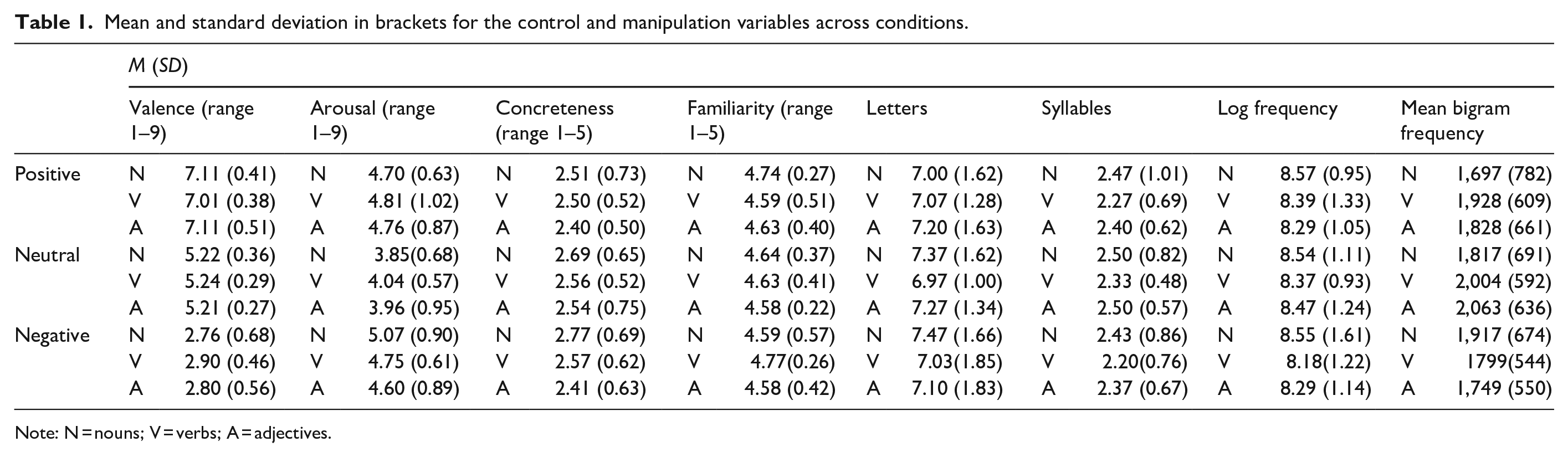
Note: N = nouns; V = verbs; A = adjectives.
Rating data for the emotional dimensions (i.e., emotional valence and arousal) were retrieved from Warriner et al. (2013). Specifically, the statistic analysis revealed only a main effect of emotional valence: negative words had significantly lower ratings than neutral words which, in turn, had significantly lower ratings than positive ones, ps < .001. The ratings for arousal showed that positive and negative words were more arousing than neutral words, ps < .001, and negative and positive words showed no difference, ps > .1. The difference between both arousal and valence was insignificant among nouns, verbs, and adjectives, ps > .1. The data of linguistic variables (i.e., concreteness, letters, syllables, log frequency, and mean bigram frequency) were retrieved from the English Lexicon Project. Finally, word familiarity was rated on a 5-point Likert-type scale (1 = very unfamiliar; 5 = highly familiar) by 32 participants who did not participate in the experiment.
Procedure
The experiment employed a typical emotional Stroop paradigm, as in previous studies (e.g., Sutton et al., 2007; Winskel, 2013). Each trial began with a red fixation point for 300 ms, followed by a word that appeared in the centre of the screen for 1,700 ms, regardless of whether the participants responded or not. Participants were asked to press the “B” key on the keyboard with their left index finger if the ink colour of the word was red, the “N” key with their right index finger if green, and the “M” key with their right middle finger if blue. They were instructed to respond as quickly and accurately as possible. The three kinds of answers were counterbalanced. As it was found that the emotional interference was more significant in blocked designs than in intermixed ones (Waters et al., 2005), the experiment adopted the block design, namely words with the same emotionality appeared in the same block, as in González-Villar et al. (2014). The order of the blocks and the ink colour of words were randomly distributed. Before the formal experiment, a practice session with 18 trials was arranged for participants to familiarise themselves with the experimental procedure. The whole experiment, including the practice session, took an average of 15 min.
Data analysis
In Experiment 1, we applied linear mixed-effects modelling using the lme4 package (Bates et al., 2014) in R (R Development Core Team, 2014) to analyse the effects of experimental factors. Specifically, a logistic model was employed to analyse binomial accuracies, and linear models were used for analysing RTs. Predictor variables consisted of the within-subjects factors emotionality (positive words, neutral words, and negative words) and lexical category (nouns, verbs, and adjectives), and the interaction between the two factors. RTs shorter than 200 ms and longer than 1,700 ms were removed. In addition, the remaining items greater or less than 2 SD of the mean for participants were excluded from the analyses. And RTs only for words with correct responses to their ink colour were included for further analyses. Together, a total of 6.60% of the data were deleted.
Results and discussion
Accuracies
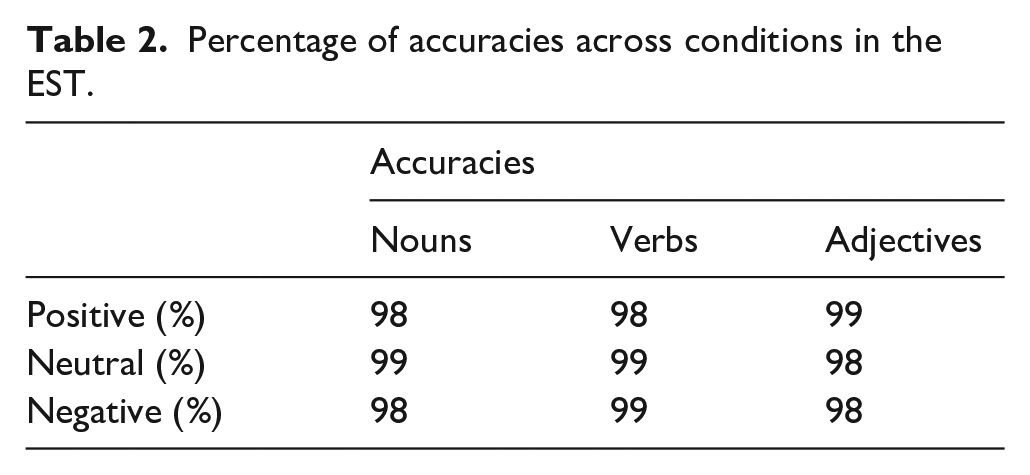
Accuracies in the nine sub-conditions were no less than 98% (see Table 2). The results of logistic mixed-effects modelling for the accuracies are presented in Table 3, indicating that the effect of emotionality was significant, β = −0.273, SE = 0.129, z = −2.228, p < .05, and the effect of lexical category was not significant, β = −0.148, SE = 0.135, z = −1.009, p > .1. There was an interaction between emotionality and lexical category, β = 0.210, SE = 0.102, z = 2.062, p < .05. Pairwise comparison revealed no significant difference between condition pairs, ps > .1.
Percentage of accuracies across conditions in the EST.
The output of linear mixed-effects model for the accuracies in the EST.
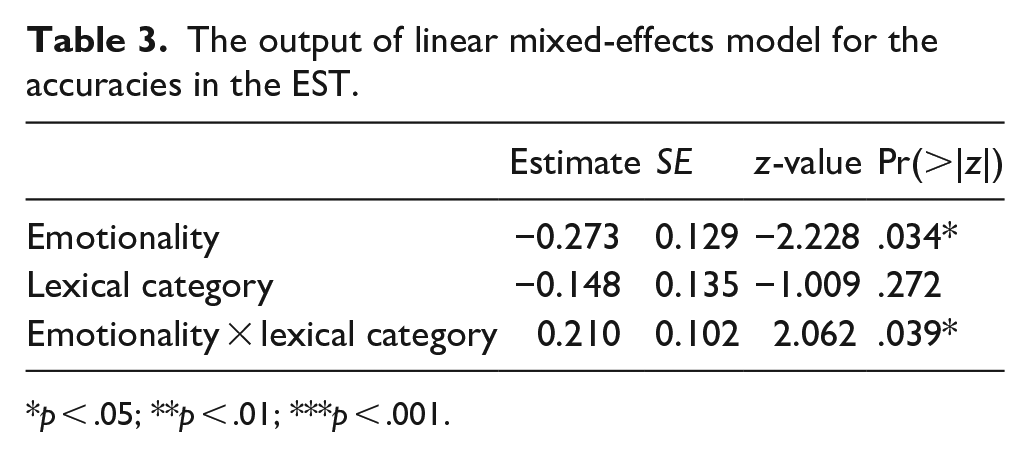
p < .05; **p < .01; ***p < .001.
RTs
The mean RTs for the nine conditions in the EST are shown in Figure 1. According to Table 4, the results of linear mixed-effects model for RTs revealed neither significant main effect of emotionality (β = 2.624, SE = 2.210, t = 1.188, p > .1), nor significant effect of lexical category (β = 4.082, SE = 2.210, t = 1.847, p > .05). There was no interaction between emotionality and lexical category, β = −2.600, SE = 1.711, t = −1.519, p > .1.

Mean RTs for the sub-conditions in the EST.
The output of linear mixed-effects model for the RTs in the EST.
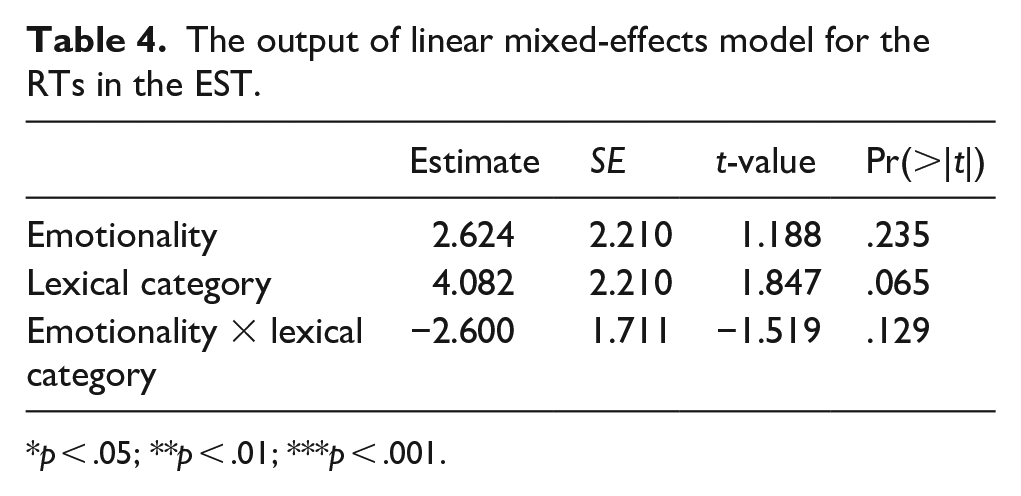
p < .05; **p < .01; ***p < .001.
In Experiment 1, we found no effects of emotionality and lexical category on the colour naming of L2 words, which suggests that neither emotionality nor lexical categories influence L2 word processing in the EST. Regarding the null effect of lexical categories in L2 word processing, it can be explained by the assumption that participants failed to activate the information of lexical categories in the EST operating at a shallow processing. The null emotional Stroop effect is consistent with the findings from Winskel’s (2013) study focusing on late Thai–English bilinguals. As mentioned in the “Introduction” section, the emotional Stroop effect possibly reflects unconscious, automatic, and early lexical processing. In other words, this effect appears only when the word meaning was accessed automatically. Therefore, the reason for the null emotional Stroop effect may result from participants’ failure to access the meaning of words automatically in the EST.
If a shallow level of processing evoked by the EST should be responsible for the null effects of emotionality and lexical category, it can be expected that these effects would probably be detected in tasks that involve a deeper level of processing, such as the LDT. Aiming to clarify this issue, we conducted a second experiment by using the LDT.
Experiment 2
Methods
Participants
A sample of 50 right-handed Chinese-English bilinguals (Mage: 23.80, range: 22–29, females: 31) took part in Experiment 2. All had acquired English in an instructional setting. They started learning English at around 10 years of age, with an average age of acquisition (AoA) of 9.60. Again, the participants could be categorised into late or unbalanced bilinguals. All of them reported normal or corrected-to-normal vision. Likewise, we tested their English Proficiency by LexTALE (Lemhöfer & Broersma, 2012). It showed that their mean score was 75.28, suggesting their intermediate-level English proficiency. Each participant gave written informed consent, and was reimbursed for participation.
Design and materials
The design and experimental materials resembled those in Experiment 1, and the only difference lies in that this experiment added 270 pseudowords which are pronounceable and orthographically legal. They were derived from the ARC Nonword Database (Rastle et al., 2002), and matched to the correct words in terms of word length and phonemes, ps > .05.
Procedure
In Experiment 2, participants performed the LDT. Each trial began with a red fixation point that appeared for 400 ms, followed by a word that was presented for 2,000 ms or until a response was given, as in Ferré et al.’s (2018) study. Participants were instructed to respond as quickly and accurately as possible about whether each string of letters was a word. They were asked to press the “F” key with their left index finger for “YES,” and the “J” key with their right index finger for “NO.” The answers (YES/NO) were counterbalanced. After each response or time-out, there was a blank inter-trial of 1,000 ms. The stimuli were randomly presented by E-prime 2.0. Again, a practice session with 18 trials was arranged for participants to familiarise themselves with the experimental procedure. The whole experiment, including the practice session, took an average of 25 min.
Data analysis
The data analysis methods were the same as in Experiment 1. RTs shorter than 200 ms and longer than 1,800 ms were removed. In addition, the remaining items greater or less than 2 SD of the mean for participants were excluded from the analyses. RTs only for words with correct responses were included for further analyses. Together, a total of 7.8% of the data were deleted.
Results and discussion
Accuracies
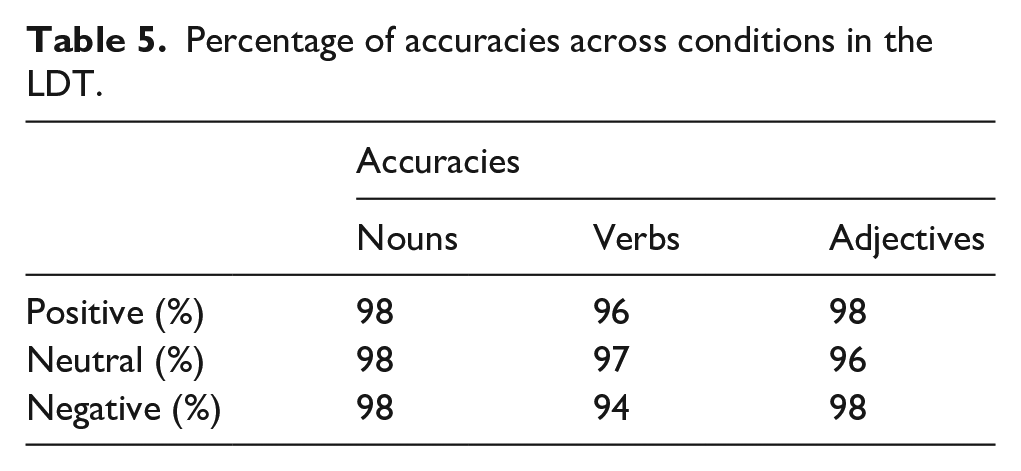
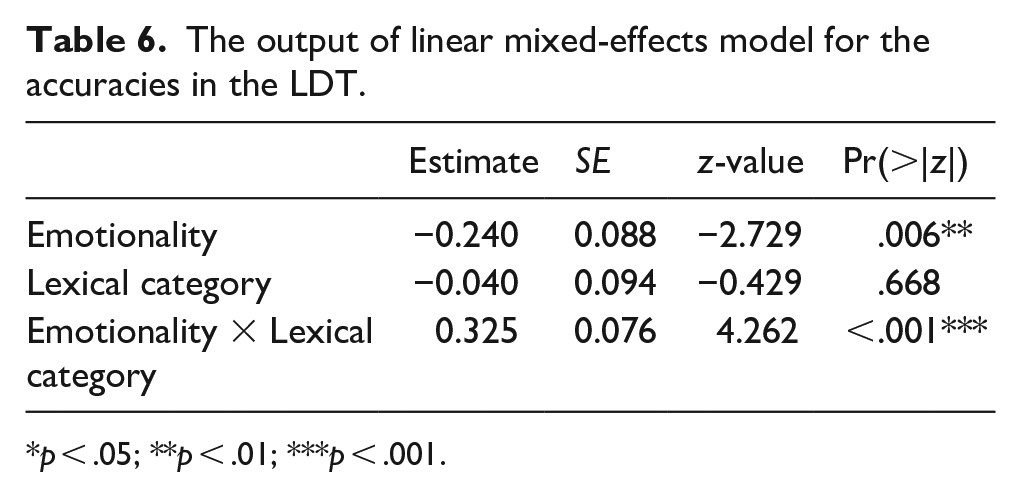
The mean accuracy for pseudowords was 89%. Accuracies for words were ⩾94% (see Table 5). Table 6 presents the results of logistic mixed-effects modelling for the accuracies. There was a significant main effect of emotionality, β = −0.240, SE = 0.088, z = −2.729, p < .01, and a significant interaction between emotionality and lexical category, β = 0.210, SE = 0.102, z = 2.062, p < .05. Pairwise comparison suggested that (a) when words were negative, participants responded less accurately to verbs than to nouns (β = −0.937, SE = 0.197, z = −4.750, p < .0001) and adjectives (β = 0.995, SE = 0.201, z = 4.951, p < .0001), and there was no significant difference between adjectives and nouns, ps > .1; when words were neutral, participants made more errors in adjectives than in nouns (β = −0.636, SE = 0.221, z = −2.883, p < .05), and there was no difference between adjectives and verbs, or between nouns and verbs, ps > .1; and when words are positive, the pattern was the same as negative words; (b) about adjectives, emotional ones, regardless of the polarity, were responded to more accurately than neutral ones, ps < .05, and there was no difference between negative and positive ones, p > .1; as for verbs, participants made more errors in negative ones than in neutral (β = −0.857, SE = 0.192, z = −4.455, p < .0001) and positive ones (β = −0.398, SE = 0.168, z = −2.366, p < .05), and there was no difference between negative and positive ones, p > .05; in regard to nouns, not any difference was found, p > .1.
Percentage of accuracies across conditions in the LDT.
The output of linear mixed-effects model for the accuracies in the LDT.
p < .05; **p < .01; ***p < .001.
RTs
The mean RTs for the nine conditions in the LDT are shown in Figure 2. As shown in Table 7, the results of linear mixed-effects model for RTs revealed a significant main effects of emotionality, β = −4.276, SE = 8.881, t = 2.026, p < .05. The effect of lexical category was not significant, β = −2.647, SE = 2.110, t = −1.251, p > .1. There was an interaction between emotionality and lexical category, β = −7.774, SE = 1.634, t = −4.757, p < .001. Pairwise comparison showed that: (a) when words were negative, verbs were responded to more slowly than nouns (β = 24.625, SE = 4.64, t = 5.305, p < .0001) and adjectives (β = −23.796, SE = 4.64, t = −5.132, p < .0001), and there was no significant difference between adjectives and nouns, ps > .1; when words were neutral, nouns were responded to faster than adjectives (β = 26.155, SE = 4.620, t = 5.667, p < .0001) and verbs (β = 30.102, SE = 4.600, t = 6.548, p < .0001), and there was no significant difference between adjectives and verbs, p > .1; when words were positive, the pattern was the same as negative words; (b) regarding adjectives, positive ones were responded to faster than both negative (β = 26.760, SE = 4.580, t = 5.839, p < .0001) and neutral ones (β = 43.650, SE = 4.600, t = 9.482, p < .0001), and negative ones were responded to faster than neutral ones (β = −16.890, SE = 4.610, t = −3.661, p < .001); concerning verbs, positive ones were responded to faster than both negative (β = 15.370, SE = 4.650, t = 3.304, p < .01) and neutral ones (β = 12.410, SE = 4.610, t = 2.692, p < .05), and there was no difference between negative and neutral ones, p > .1; in regard to nouns, the pattern was the same as verbs.

Mean RTs for the nine sub-conditions in the LDT.
The output of linear mixed-effects model for the RTs in the LDT.

p < .05; **p < .01; ***p < .001.
In this experiment, despite slight inconsistencies, the results of accuracies were generally compatible with those of RTs. Some effects were obtained from RTs but not from accuracies, which may result from the interruption brought about by the ceiling effect. As suggested in our results, the accuracies across conditions were too high (no less than 94%) in LDT. Therefore, our discussion mainly focuses on RTs. Overall, our data suggested that emotionality and lexical category interactively influence the L2 word processing in late Chinese–English bilinguals. With respect to emotionality, the results from the LDT showed an emotionality facilitation effect in adjectives, but not in nouns and verbs. Therefore, our results were partly coherent with the model of motivated attention (Lang et al., 1997). The reason for the emotionality facilitation effect that only emerged in adjectives may be that adjectives prototypically describe personality traits or mood states, thus presumably having a more direct relationship with emotions when compared with nouns and verbs (Palazova et al., 2011). More importantly, we observed the advantage of positive words over negative and neutral words, irrespective of lexical categories, which supports the information density hypothesis (Unkelbach et al., 2008) and the motor suppression hypothesis (Fox et al., 2001). As for the lexical category, we found that emotional verbs present a disadvantage over emotional nouns and adjectives, and emotional nouns and adjectives showed no difference. When the words were neutral, nouns have a processing advantage over adjectives and verbs, and there was no difference between verbs and adjectives. Arguably, the linguistic properties of the three lexical categories per se should be responsible for these differences among them.
Apparently, the findings from Experiment 2 are different from those from Experiment 1, and this inconsistency may be invoked by the heterogeneity of tasks employed in the two experiments. Despite the distinction between the two, both of them belong to implicit tasks in which stimulus emotionality is response-irrelevant. It was argued that implicit and explicit tasks differ in many ways. Therefore, what picture will the explicit tasks (e.g., the ECT) present in terms of the emotionality and the lexical category effects? To answer this question, we conducted a third experiment using the ECT.
Experiment 3
Method
Participants
A total of 43 right-handed Chinese–English bilinguals (Mage: 24.01, range: 22–30, females: 25) participated in the experiment. All had acquired English in an instructional setting. They started learning English (L2) at around 10 years of age, with an AoA of 9.56. Again, the participants could be categorised into late or unbalanced bilinguals. All of them reported normal or corrected-to-normal vision. Likewise, we tested the participants’ English Proficiency by LexTALE (Lemhöfer & Broersma, 2012). Their mean score was 74.97, which also suggested their intermediate-level English proficiency. Each participant gave written informed consent, and was reimbursed for participation.
Design and materials
The design and experimental materials were the same as in Experiment 1.
Procedure
The procedure in Experiment 3 bore great resemblance to that in Experiment 1, and the only difference was that participants were required to perform the ECT, instead of EST. Accordingly, they had to classify the emotionality of the word as quickly and accurately as possible. They were told to press the “H” key on the keyboard with their left index finger if it was a negative word, the “J” key with their right index finger if it was neutral, and the “K” key with their right middle finger if it was a positive one. The three kinds of answers were counterbalanced. The whole experiment, including the practice session, took an average of 18 min.
Data analysis
The data analysis methods were almost the same as those used in Experiment 2. RTs shorter than 200 ms and longer than 1,800 ms were removed. In addition, the remaining items greater or less than 2 SD of the mean for participants were excluded from the analyses. Together, a total of 6.12% of the data were deleted. In this experiment, only RTs were analysed, given that the ECT, like the affective decision task, involves a subjective assessment, as in Ferré et al. (2018).
Results and discussion
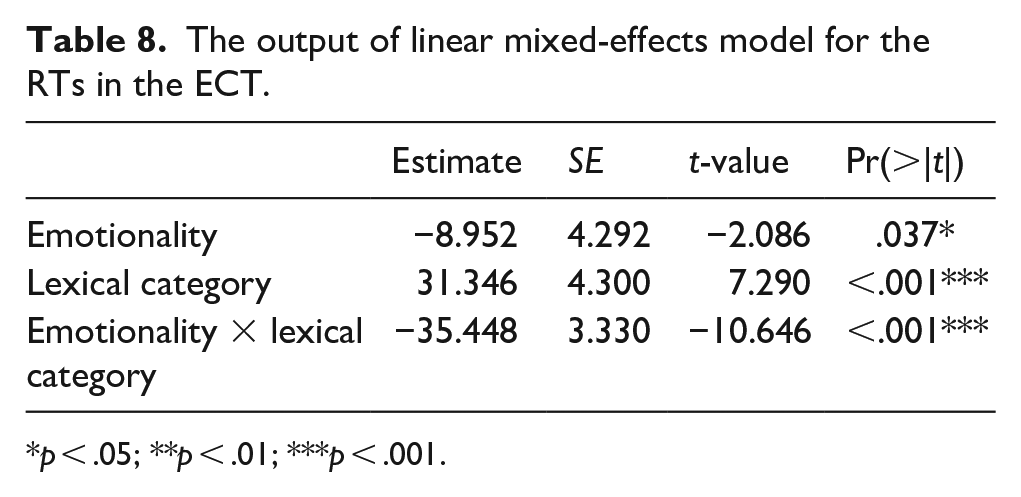
The mean RTs for the nine conditions in the ECT are shown in Figure 3. Table 8 summarises the results of linear mixed-effects model for RTs in ECT. The results revealed significant main effects of emotionality (β = −8.952, SE = 4.292, t = −2.086, p < .05) and of lexical category (β = 31.346, SE = 4.300, t = 7.290 p < .001). The interaction between emotionality and lexical category was significant, β = −35.448, SE = 3.330, t = −10.646, p < .001. Pairwise comparison showed that: (a) when words were negative, there was no significant difference among the three lexical categories, ps > 0.1; when words were neutral, adjectives were responded to more slowly than nouns (β = 64.16, SE = 9.380, t = 6.839, p < .0001) and verbs (β = 44.75, SE = 9.42, t = 4.752, p < .0001), and nouns were responded to faster than verbs, although the difference between them did not reach significance, β = −19.41, SE = 9.39, t = −2.067, p = .09; when words were positive, adjectives were responded to faster than nouns (β = −77.88, SE = 9.370, t = −8.309, p < .0001) and verbs (β = −13.66, SE = 9.390, t = −9.744, p < .0001), and there was no difference between nouns and verbs, p > .1; (b) as for adjectives, positive ones were responded to faster than both neutral (β = 181.53, SE = 9.400, t = 19.308, p < .0001) and negative ones (β = 58.44, SE = 9.380, t = 6.230, p < .0001), and negative ones were responded to faster than neutral ones (β = −123.09, SE = 9.390, t = −13.106, p < .0001); with regard to nouns, neutral ones were responded to slower than positive ones (β = 39.48, SE = 9.350, t = 4.221, p < .001) and negative ones (β = −48.23, SE = 9.370, t = −5.150, p < .0001), negative ones were responded to faster than positive ones, but the difference did not reach significance; in terms of verbs, the pattern was the same as nouns.

Mean RTs for the nine sub-conditions in the ECT.
The output of linear mixed-effects model for the RTs in the ECT.
p < .05; **p < .01; ***p < .001.
In this experiment, we innovatively found that both emotionality and lexical category interactively influence the L2 word processing in late Chinese–English bilinguals. In terms of emotionality, the results of the ECT suggest an emotionality facilitation effect in the three lexical categories, namely the emotional content facilitates the categorisation of L2 words’ emotionality, and this observation is bolstered by the model of motivated attention (Lang et al., 1997). In nouns and verbs, it seems that negative ones show an advantage over positive ones, while failing to reach significance. This finding is at odds with that in Experiment 2, which may result from the differences between the two tasks. The emotional content of the words is task-irrelevant in Experiment 2, but task-relevant in Experiment 3. Here, our finding in this experiment is almost in line with the predictions of the relevant hypothesis (Estes & Verges, 2008), but does not support the motor suppression hypothesis (Fox et al., 2001). In terms of the advantage of positive emotionality over negative and neutral emotionality in adjectives, it can be explained by the fact that positive adjectives readily evoke participants’ self-referential processing (i.e., attributing some information to themselves), thus capturing their attention more effectively and further contributing to their responses to the positive stimuli (Savostyanov et al., 2020; see also Herbert et al., 2008). As for lexical category, we observed that it exerts no influence on the processing of negative words. However, it was demonstrated that adjectives display a processing disadvantage over nouns and verbs when their emotionality is neutral, whereas showing a processing advantage when their emotionality is positive. The effects of lexical categories can be explained by the differences among verbs, nouns, and adjectives.
General discussion
The present study aimed to scrutinise the effects of emotionality and lexical category on L2 word processing in different tasks: the EST, LDT, and ECT. To accomplish our objective, we conducted three behavioural experiments with the same set of stimuli, in which three groups of late Chinese–English bilinguals performed the three tasks: the EST (Experiment 1), LDT (Experiment 2), and ECT (Experiment 3), respectively. To ensure the comparability of the results from the three tasks, we minimised the heterogeneity among the three groups of participants. In our study, all participants had acquired English in an instructional setting, and therefore they had the common context of L2 acquisition. Moreover, the age, L2 proficiency, and age of L2 acquisition were all matched across the three groups, ps > .1. We obtained some general findings. In Experiment 1, emotionality and lexical category exerted no influence on L2 word processing, while interactively influencing L2 word processing in Experiments 2 and 3. In Experiment 2, we found that (a) emotional adjectives were responded to faster than neutral adjectives, and positive words were responded to faster than negative words, across the three lexical categories; (b) emotional verbs presented a processing disadvantage over emotional nouns and adjectives, and neutral nouns displayed an advantage over neutral adjectives and verbs. In Experiment 3, the results showed that emotional words had a processing advantage over neutral words, across the three lexical categories, and that negative words were categorised faster than positive words when they were nouns or verbs, while positive adjectives were categorised faster than negative adjectives. Furthermore, neutral verbs displayed a processing disadvantage over neutral nouns and adjectives, whereas positive adjectives showed an advantage over positive nouns and verbs. These general findings and their implications will be discussed in this section.
The effect of emotionality in L2 word processing
Coherent with Winskel (2013), our study (Experiment 1) did not find the emotional Stroop effect (i.e., the interference effect of emotionality on the colour naming of words) in L2, although some empirical studies have documented this effect in L1 (Frings et al., 2010; González-Villar et al., 2014; see also Jończyk et al., 2016; Sutton & Altarriba, 2008) and L2 (Eilola & Havelka, 2010; Eilola et al., 2007; Grabovac & Pléh, 2014; Sutton et al., 2007). Our observation may indicate that late Chinese–English bilinguals fail to access L2 words’ meaning automatically in the EST. Of course, the null emotional Stroop effect in Experiment 1 may have something to do with the arousal level of the emotional words. In our study, the emotional words had an average of arousal of less than 5, a moderate level on a 1–9 scale. Moreover, the arousal of experimental words was retrieved from an L1 database, and it was found that the level of arousal produced by the negative words for native English speakers was greater than that for non-native speakers (Eilola & Havelka, 2010). Indeed, the emotional Stroop effects in L2 have been detected in negative words or taboo words, while failing to be observed in positive words (e.g., Eilola et al., 2007; Sutton et al., 2007). Although some studies did not report the arousal of the experimental words, it is generally believed that taboo words are often highly arousing, and that negative stimuli are frequently more arousing than positive ones. There is also evidence that negative and positive words that were both high in arousal elicited emotional interference (e.g., Ashley & Swick, 2009; Dresler et al., 2009; Feng et al., 2011; González-Villar et al., 2014). In the investigation of the influence of arousal on the emotional Stroop effect, Feng et al. (2011) found that the arousal level played an important role in the EST, and the interference effect was only observed in the stimuli with high arousal (an average of arousal of 6.6, in a 1–9 scale). Taken together, it is conceivable that the results from the EST may present a different picture if the emotional words were highly arousing.
Different from the EST, LDT and ECT showed effects of emotionality on L2 word processing. Notably, although both the EST and LDT are implicit and task-irrelevant, there is another difference between them. The former requires participants to ignore the content of the words to properly perform the task, but this is not the case with the latter. Therefore, the EST may operate at a shallower level of processing than does the LDT, which may provide implications for the absence of the Stroop effect in our studies as well as other empirical research on emotional word processing. In terms of the LDT and ECT, it was found that they were differentially modulated by the emotionality. In the ECT, irrespective of the lexical category, emotional words were responded to faster than their neutral counterparts, which suggests that the emotional content facilitates the processing of L2 words, thus speeding up the categorisation of emotionality. This observation echoes the findings from a body of studies on emotional L1 word processing in different tasks, such as the LDT (e.g., Citron et al., 2013; Goh et al., 2016; Kousta et al., 2009; Vinson et al., 2014; Yap & Seow, 2014) and ECT (González-Villar et al., 2014). Also, such an emotionality effect was detected in studies on L2 word processing with different tasks (e.g., the LDT, Ponari et al., 2015; the recalling task, Ferré et al., 2010). The advantage of L2 emotional words over neutral words in the ECT is harmonious with the prediction of the model of motivated attention (Lang et al., 1997) that emotional stimuli, with greater motivational relevance, are more likely to capture individuals’ attention when compared with neutral ones, thus presenting a processing advantage over neutral counterparts.
However, in the LDT, the advantage of positive and negative words over neutral words appeared only in adjectives, not in nouns and verbs, and the results show no difference between neutral and negative nouns, or between neutral and negative verbs. This is inconsistent with the LDT results from the field of L1 word processing (e.g., Citron et al., 2013; Goh et al., 2016; Kousta et al., 2009; Vinson et al., 2014; Yap & Seow, 2014). Despite this, it is noteworthy that the emotional effect in negative word processing also failed to be observed in some other L2 studies (e.g., Sheikh & Titone, 2016). It was posited that access to L2 negative information was suppressed at the very early stages of processing or processed very superficially—as if it was deprived of affective value (Jończyk, 2016; Jończyk et al., 2016). Importantly, the emotional effect of L2 negative words was restricted to adjectives in the LDT, but detected in the three lexical categories in the ECT. This finding can be tentatively interpreted from two aspects. First, compared with nouns and verbs, adjectives bear a more direct relationship with emotion as they often describe personality traits or mood states (Palazova et al., 2011). Second, the ECT is an explicit task that operates at a deeper and more conscious level processing when compared with the LDT. The two points may account for why the L2 negative information was still accessed in some specific cases even though it may be suppressed at the very early stages of processing or processed very superficially.
The effects of emotionality are also suggested in the processing asymmetry between negative words and positive words (i.e., positivity bias or negative bias) in the LDT and ECT. Interestingly, it seems that the bias was modulated by the task type. In the LDT, positive words, irrespective of their lexical categories, present a processing advantage over negative words. In terms of this positivity bias, it can be explained from the motor suppression hypothesis that negative stimuli may elicit a general suppression of motor activity, akin to the freezing response exhibited by animals under threat, thus presenting a delay of response (Fox et al., 2001). This is compatible with Estes and Verges’s (2008) view that negative stimuli elicit selective responding, with slower responses on tasks for which stimulus emotionality is response-irrelevant, but with faster responses on tasks for which stimulus emotionality is response-relevant. Also, the alternative explanation for the positivity bias was offered by the informational density hypothesis, according to which positive verbal stimuli are better elaborated and interconnected in memory than negative stimuli (Sylvester et al., 2016; Unkelbach et al., 2008), thus presenting a processing advantage. In the ECT, the difference between negative and positive words did not reach significance, while the mean RT for the former is shorter than that for the latter. Therefore, this observation suggests that negative stimuli may elicit a faster response to tasks in which the emotional content of the words is task-relevant, which is contrary to the predictions of the motor suppression hypothesis. In the ECT, it is unnecessary to disengage attention from the emotional content, and it may be of greater importance to categorise negative stimuli than positive ones because of the greater biological relevance of aversive than of appetitive stimuli (Estes & Verges, 2008). As noted before, despite the fact that a threatening stimulus appearing suddenly does sometimes cause the immediate cessation of movement, at other times it triggers an immediate defensive movement. These considerations provide explanations for the advantage of negative words over positive and neutral words in the ECT.
Interestingly, we found that adjectives, distinct from nouns and verbs, display an advantage of positive words over negative and neutral words in the ECT, which runs counter to the assumption of the response-relevance hypothesis. This effect observed in adjectives can be interpreted from the properties of the adjectives per se. As for the stimulus used in our study, most adjectives (positive adjectives, in particular) describe personality traits or states, such as handsome, diligent, youthful, reliable, elegant, confident, clever, creative, witty, and healthy. It has been demonstrated that this type of adjectives is more apt to evoke participants’ self-referential processing (i.e., attributing some information to themselves), thus capturing their attention more effectively and further contributing to their responses to the positive stimuli (Savostyanov et al., 2020; see also Herbert et al., 2008). To testify to this assumption, we conducted a norming study focusing on the degree to which the stimuli adopted in our study could describe personality traits or states and to what extent these words were relevant for themselves, as in Herbert et al. (2008). A sample of 25 Chinese–English bilinguals (Mage: 24.1; range: 22–27; females: 13) were asked to rate on two 9-point scales. The results showed that neutral adjectives were rated as less descriptive of personal traits and states than positive adjectives, F(1, 29), t = 8.648; p < .001, and negative adjectives, F(1, 29), t = 5.970; p < .001, and that positive adjectives were rated more self-relevant than negative adjectives, F(1, 29), t = 9.405; p < .001, and neutral negatives, F(1, 29), t = 5.539; p < .001. Our observations reconciled with those obtained by Herbert et al.’s (2008) study. As mentioned before, we found that neutral adjectives display a processing disadvantage over neutral nouns and verbs, while positive adjectives present an inverse pattern. We tentatively conclude that the self-referential processing elicited by positive adjectives plays an important role in facilitating the categorisation of their emotionality, which can also partly explain positive adjectives’ processing advantage over nouns and verbs in the ECT. The specific effects of lexical category will be discussed in the following subsection.
The effects of lexical category in L2 word processing
As for the lexical category, we did not find its influences on L2 word processing in the EST. It is conceivable that participants fail to activate the information about L2 lexical category in the EST which operates at a shallow processing. Different from the EST, the LDT and ECT showed effects of emotionality and lexical category on L2 word processing. Of course, the two tasks were differentially modulated by the lexical category.
The effects of lexical category also caused the advantage of nouns over verbs in the LDT, which is coherent with the findings from previous L1 studies without considering emotional information (Cordier et al., 2013; Deutsch et al., 1998; Kauschke & Stenneken, 2008; Kwong, 2016, for a review; Laudanna et al., 2002; Szekely et al., 2005; Vigliocco et al., 2008). The mean RTs also suggest the noun advantage in the ECT, although the difference between them was not quite significant. We can interpret this finding from the differences between nouns and verbs. In the first place, verbs are more complex than nouns in syntax, for verbs may take one or two arguments depending on transitivity but nouns take no argument (Kwong, 2016). Furthermore, verbs are more complex than nouns in morphology. In English, verbs have more morphologically inflected forms than nouns (four vs. two) (Vigliocco et al., 2011). Finally, verbs may be more complex than nouns in phonetics, as mentioned in the “Introduction” section. All these aspects possibly result in the processing advantage of nouns over verbs.
However, the results of the ECT and LDT suggest that adjectives present a more complex picture than nouns and verbs. In the ECT, neutral adjectives have a disadvantage over neutral nouns and verbs, while positive adjectives show an advantage over positive nouns and verbs. In the LDT, emotional verbs present a disadvantage over emotional nouns and adjectives, and neutral nouns display an advantage over neutral verbs and adjectives. Arguably, the complex picture of adjectives may result from their particularity per se. Syntactically, adjectives are simpler than verbs but more complex than nouns, as adjectives often take one argument while nouns project no argument structure and verbs may take one or two arguments depending on transitivity; semantically, adjectives are the least imaginable, as prototypical images are less readily available than most nouns and verbs (Kwong, 2016; Panagiotidis, 2015). As such, when deprived of the effects of emotionality, neutral adjectives present a disadvantage over nouns and verbs in the ECT and also display a disadvantage over neutral nouns in the LDT. Possibly, semantic factors, especially imageability, are mainly responsible for the differences between adjectives and the other two lexical categories in the ECT, while syntactic factors play a more important role in the processing differences between adjectives and nouns in the LDT.
Conclusion
To sum up, the present study collected the first evidence for the effects of emotionality and lexical category on L2 word processing in three different tasks. Our data suggest that emotionality and lexical category act interactively to influence L2 word processing in the LDT and ECT. As such, both emotionality and lexical category should be considered in future studies on word processing. Furthermore, it seems that the processing of L2 emotional words is sensitive to task type. Hence, the present findings would better our understanding of L2 word processing and provide new insight into the relationship between language and cognition in bilinguals.
Nevertheless, there are still some limitations in our study. First, following a body of previous studies on emotional word processing, we only focused on the two dimensions of emotion (i.e., valence and arousal), but the world of emotion is not necessarily two-dimensional. Indeed, the dimension of dominance has also captured a lot of attention. Therefore, further research should consider other possible factors in the paradigm. Second, the information on emotional and linguistic variables was mostly retrieved from the L1 databases. Nevertheless, the ratings of these variables (e.g., arousal and valence) are possibly modulated by the individual or cultural differences (Jończyk, 2016). Future research should obtain stimuli properties from specific L2 databases to be developed. Incidentally, it may be worth delving deeper into the influences of other factors on the processing of L2 words, such as arousal and L2 proficiency.
Supplemental Material
sj-docx-1-qjp-10.1177_17470218211041833 – Supplemental material for The effects of emotionality and lexical category on L2 word processing in different tasks: Evidence from late Chinese–English bilinguals
Supplemental material, sj-docx-1-qjp-10.1177_17470218211041833 for The effects of emotionality and lexical category on L2 word processing in different tasks: Evidence from late Chinese–English bilinguals by Xiaogen Liao and Chuanbin Ni in Quarterly Journal of Experimental Psychology
Footnotes
Declaration of conflicting interests
The author(s) declared no potential conflicts of interest with respect to the research, authorship, and/or publication of this article.
Funding
The author(s) received no financial support for the research, authorship, and/or publication of this article.

Notes
References
Supplementary Material
Please find the following supplemental material available below.
For Open Access articles published under a Creative Commons License, all supplemental material carries the same license as the article it is associated with.
For non-Open Access articles published, all supplemental material carries a non-exclusive license, and permission requests for re-use of supplemental material or any part of supplemental material shall be sent directly to the copyright owner as specified in the copyright notice associated with the article.
