



Abstract
Chinese character recognition is based on a limited set of recurrent stroke patterns. Most Chinese characters are a combination of two or more of these components. To test whether readers are sensitive to combinations of components (or multi-component units [MCUs]) within a character, we conducted two probe detection tasks where participants had to detect the presence of a component in a target character. Critically, some targets contained an MCU that can stand as a character on its own, with its own meaning and sound, while other targets contained an MCU that only exists embedded within other characters (no associated meaning and sound). Participants had more difficulty detecting component probes that were a part of an existing MCU, compared to component probes that belonged to a non-existing MCU. These findings suggest that existing MCUs are a perceptual unit in Chinese character recognition.
To date, models of visual word recognition have been predominantly shaped by research using alphabetic scripts. Studies and models on alphabetic word recognition have demonstrated a crucial role for letters as perceptual units of reading (McClelland & Rumelhart, 1981). Properties of letter combinations within a word, such as bigrams (Seidenberg, 1987), open bigrams (Grainger & Van Heuven, 2003), orthographic syllables (Prinzmetal, Treiman, & Rho, 1986), and consonant-vowel patterns (Chetail & Content, 2014) have also been shown to affect perceptual processing. Many influential models of visual word recognition, therefore, postulate a hierarchical configuration, where activation flows from visual features to letter representations, letter groupings, and finally to word representations (Dehaene, Cohen, Sigman, & Vinckier, 2005; Grainger & Van Heuven, 2003; Whitney, 2001).
It is unclear to what extent these models apply to other languages. Indeed, some scripts such as Chinese and Japanese have properties that are fundamentally different from alphabetic scripts. In this study, we examined the nature of the perceptual hierarchy in Chinese. In particular, we tried to single out the perceptual units that contribute to character recognition. Before we dive into a review of previous studies that have been conducted on this subject, we will first discuss relevant characteristics of written Chinese.
Characteristics of the Chinese script
A distinction should be made between two types of characters in written Chinese. Simplified characters are used in mainland China, while traditional characters are used in Hong Kong, Macau, and Taiwan. This study focuses on simplified characters, but we will also discuss studies based on traditional characters.
The majority of Chinese words consist of one or two characters, with each character corresponding to a morpheme. Knowledge of an estimated 3,000 characters is needed to be able to read a newspaper (Wong, Li, Xu, & Zhang, 2010). To a novice, a Chinese character might seem like a bunch of lines randomly thrown together, rendering it very difficult to learn such a large-scale set of characters by heart. Nevertheless, there are regularities within the characters that can aid Chinese readers in this task. Approximately 80% to 90% of Chinese characters consist of multiple components that can be thought of as a limited set of building blocks, and 10% to 20% are simple characters, comprising a single component. These components are recurrent stroke patterns (Y.-P. Chen, Allport, & Marshall, 1996), where a stroke is a dot or line written in one continuous movement (Yin & McBride, 2015). Some examples of components are 讠, 又, 几, and 木. Most components have their own meaning and phonology and can often be used as separate simple characters. For instance, the character 好 (hǎo, good) is composed of two components, namely 女 (nǚ, woman) and 子 (zǐ, child). According to the Chinese Radical Position Frequency Dictionary (1984, as cited in Taft & Zhu, 1997), there are 541 components or bùjiàn, although the exact set of components is still a matter of debate (see the study by Myers, 2019, section 1.2.2.3). Some of these components have a special function within a character. In particular, each character has a special component called the semantic radical. 1 The semantic radical often holds some clue to the meaning of the character, and it is used to look up the character in the dictionary. In the above example, the semantic radical is 女. The most common structural configuration in Chinese is a left-right configuration. In characters with a left–right configuration, the left part is usually the semantic radical, and the right part (referred to as the phonetic radical) often hints at the pronunciation of the character. For instance, in the character 摆 (bǎi, to place), the component on the left, 扌(shǒu, hand), provides a semantic clue, whereas the right part 罢 (bà, to cease) provides phonological information. However, on average, these clues are far from reliable. Semantic radicals are not always consistent with the meaning of the entire character. For instance, only 65% of the characters that contain the semantic radical for silk (纟) have a meaning that is (in part) consistent with the aspect of silk (Fan, 1986). Even more strikingly, phonetic radicals are only consistent with the exact pronunciation of the whole character 26.3% of the time (Fan, Gao, & Ao, 1984). Therefore, it is unlikely that readers rely solely on the semantic and phonetic radical to recognise Chinese characters.
On many occasions, the phonetic radical is a combination of multiple components.
For instance, in the previous example, the phonetic radical 罢 can be further divided into three components: 罒, 土, and 厶. It is worth noting that there currently is no real consensus in the literature about the terminology to use when talking about the components of Chinese characters. In studies with traditional characters, these components have been called logographemes (J.-Y. Chen & Cherng, 2013), whereas in studies with simplified characters, different terms have been used, such as components (Anderson et al., 2013; Shu, Chen, Anderson, Wu, & Xuan, 2003), orthographic constituents, stroke patterns (Y.-P. Chen et al., 1996), or radicals (McBride, 2015; Taft & Zhu, 1997). Henceforth, we use the term component instead of radical to denote those constituents, to avoid confusion with the semantic and the phonetic radical.
Orthographic units in models of Chinese character recognition
Currently, the two most influential models of Chinese character recognition are the Lexical Constituency Model (Perfetti, Liu, & Tan, 2005) and the Multilevel Interactive Activation (IA) Framework (Taft & Zhu, 1997), although other models and extensions have been put forward (see Reichle & Yu, 2017, for a review). The Multilevel IA Framework (Taft & Zhu, 1997) provides a conceptual extension of the Interactive Activation (IA) model by McClelland and Rumelhart (1981), with a focus on Chinese instead of alphabetic scripts. In the hierarchical framework by Taft and Zhu (1997), character recognition is achieved in a hierarchical way, where the activation of strokes feeds forward to the activation of character units through positional component units. The Lexical Constituency Model (Perfetti et al., 2005), in turn, is a formal adaptation of the IA model to Chinese. The model was devised to simulate the time course of graphic, phonological, and semantic priming effects, hence it also includes the interplay between orthography, semantics, and phonology. Both models incorporate a component level as they consider the activation of component representations as a necessary step for character recognition. However, one remaining issue is the possible existence of an additional layer of processing between the component level and the character level. Indeed, certain combinations of components are recurrent and can sometimes form an existing character on their own. Taft and Zhu (1997) use the example of the character 扮, which contains three basic components: 扌, 八, 刀. Importantly, the two components on the right form a character that can stand on its own, 分, with its own meaning and phonology. The authors argue that an additional level of representation is possibly required for this type of orthographic constituent. However, they did not add this level to their model because of a lack of direct evidence. The aim of the present contribution is to assess whether or not models should integrate an intermediate level of units for such combinations of components, which we call multi-component units (MCUs).
Evidence for the role of orthographic constituents in Chinese character recognition
Some accounts of Chinese character recognition propose a holistic hypothesis according to which identification occurs without activation of the character’s orthographic constituents (Mo et al., 2015). In contrast, a substantial number of studies showed that orthographic constituents are implicated in character reading.
As assumed in most current character recognition models, it seems likely that even the smallest constituents of characters, namely the strokes, are represented as discrete functional units. Indeed, a recent study revealed that the removal of whole strokes was more disruptive for character recognition than the removal of an equivalent amount of visual information (Yu et al., 2019).
In addition, a number of studies converged in showing that semantic and phonetic radicals influence character recognition (Y.-P. Chen & Allport, 1995; Y.-C. Chen & Yeh, 2015; Tsang, Wu, Ng, & Chen, 2017; Wang, Pei, Wu, & Su, 2017; Zhou & Marslen-Wilson, 1999). In a same–different paradigm, Y.-P. Chen and Allport (1995) showed that skilled readers of Chinese exhibit a selective attentional bias towards either the semantic or phonetic radical depending on task demands. When participants were asked to compare the pronunciation of the stimuli, their attention was directed to the phonetic radicals, whereas in a semantic judgement task, their attention was allocated to the semantic radicals. Y.-C. Chen and Yeh (2015) adopted a repetition blindness paradigm to examine the role of radical position and function in Chinese character recognition and concluded that radical representation is necessary between the stroke and character levels. In a series of priming tasks, Zhou and Marslen-Wilson (1999) demonstrated that the meaning of phonetic radicals affects character recognition. In particular, the naming of a complex character was enhanced when it was preceded by a prime character that contains a phonetic radical semantically related to the target. Tsang et al. (2017) showed the same pattern of results in a semantic categorisation task. Finally, using both behavioural and event-related potential (ERP) measurements, Wang et al. (2017) demonstrated that complex characters that are related to their semantic radicals in meaning were recognised faster and more accurately and elicited a smaller P200 and a larger N400 compared with characters not semantically related to their semantic radical. However, in this study, phonetic radicals did not seem to exert the same influence on character recognition.
Fewer studies have looked directly at the influence of stroke patterns that do not necessarily provide semantic or phonetic information. Yet evidence from both patient studies and adult readers suggests that these components also play an important role in character recognition. Law and Leung (2000) examined the writing errors of a brain-damaged person with acquired aphasia. Most of her errors in a delayed copying task involved substitution, deletion, insertion, and transposition of components that were not semantic or phonetic radicals. Han, Zhang, Shu, & Bi (2007) found the same pattern of errors in another patient with acquired dysgraphia. Both patients also made some errors with strokes and radicals, which led the researchers to believe that orthographic units of different sizes are involved in character recognition in a hierarchical way. In a character decision task, Taft and Zhu (1997) showed that character recognition speed and accuracy are influenced by the frequency of the character’s components for adult Chinese readers. In addition, Y.-P. Chen et al. (1996) revealed that performance in a same–different task was affected by the number of components. Overall, reaction times were longer for characters with three components compared to characters with two components. Also, the reaction times for “different” trials were influenced by the number of components that both characters shared. When they shared more components, it took longer for the participants to decide that the characters were different. In another study, J.-Y. Chen and Cherng (2013) instructed participants to learn two-character words. Subsequently, they were shown the first character of a pair and they had to write down the corresponding second character. When target characters within a block shared one or two strokes, for instance, when the second character always started with the same two strokes, performance was not affected. In contrast, better performance was observed when the target characters shared a component. This led the authors to conclude that components play a central role in Chinese character recognition. Damian and Qu (2017) replicated this effect with simplified characters, although the component priming effects were smaller and less consistent in their study. Finally, Anderson et al. (2013) examined the role of visual-orthographic processes in children’s literacy development. Based on their analysis, they concluded that components function as units of character perception, even components that are not semantic or phonetic radicals. According to Anderson et al. (2013), the ability to see characters in terms of components is acquired gradually over the years and is correlated with reading comprehension, vocabulary, and the teacher’s rating of reading level.
Nearly all of the aforementioned studies used characters with a maximum of three components. However, a substantial number of Chinese characters have even more than three components, adding another complexity to character recognition. In our earlier example, we saw that the phonetic radical of the character 摆 is also a character on its own, 罢 (bà, to cease). In addition, 罢 contains another constituent with its own meaning and sound, namely 去 (qù, to leave), an MCU that is the combination of the components 土 and 厶. A schematic representation of the full decomposition of the character 摆 can be found in Figure 1.
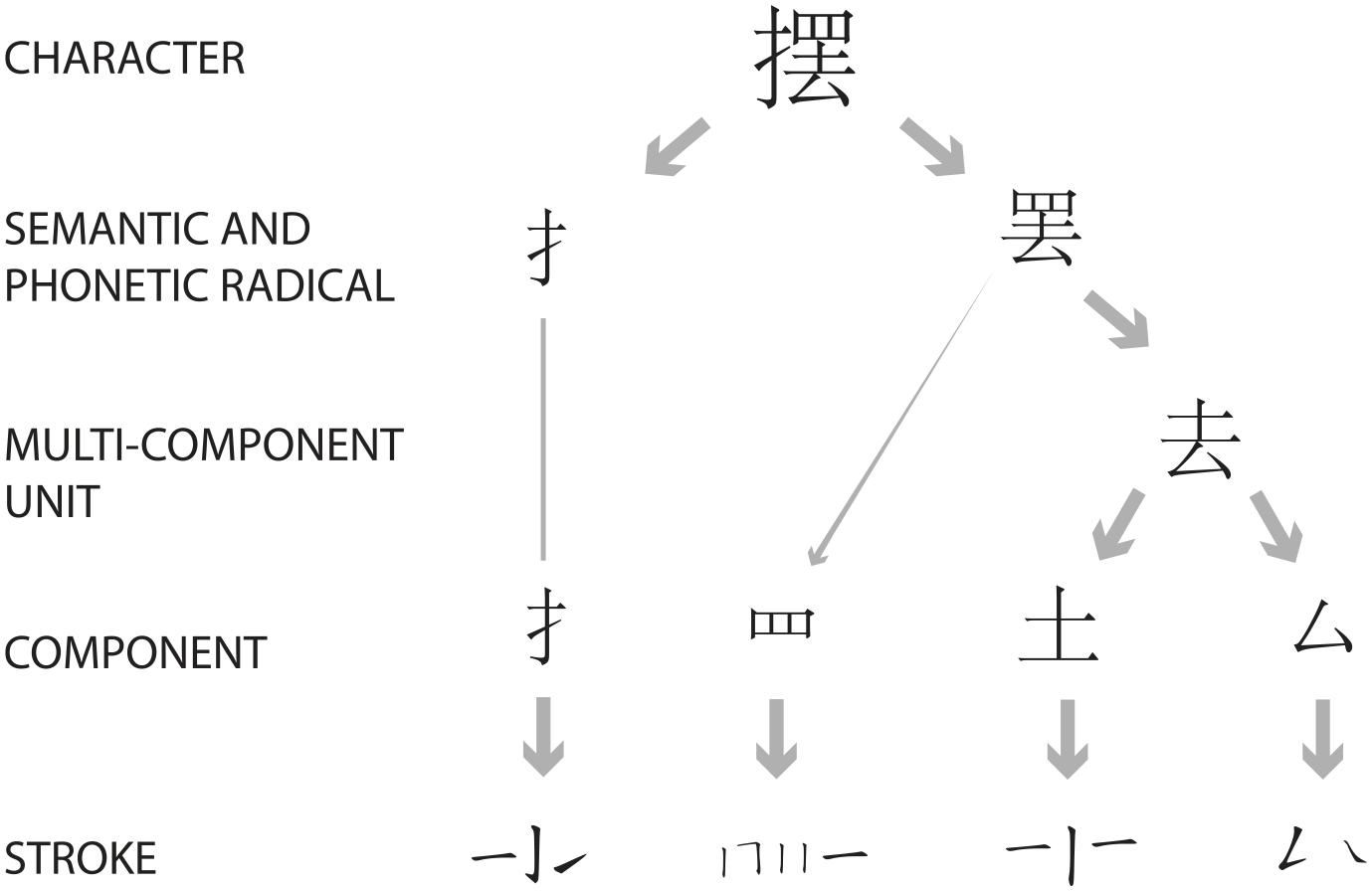
Decomposition of a left–right character with four components.
It is currently unclear whether an MCU such as 去 in the character 摆 also serves as a functional unit in the orthographic processing of the character, or whether only the components are implicated but not their combinations. As noted by Ding, Peng, & Taft (2004), a further level may need to be added to the hierarchy of character recognition models for this type of character. In this case, the representation of the MCU would be activated by its components, taking positional information into account. Taft and Zhu (1997) directly addressed this question in a character decision task. The authors found no effect of the frequency of MCUs on character recognition, while the frequency of their components did influence performance. Despite this null result, the authors did not exclude the possibility that MCUs might represent a distinct level in the hierarchy of Chinese character recognition and concluded that more research is needed to resolve this question. It should be noted that the authors did not systematically control for whether the MCUs and single components also existed as separate characters. In addition, the stimuli in their study were all three-component characters with a semantic radical on the left, and a phonetic radical composed of two components on the right. Hence in this experiment, the MCUs also served as the phonetic radical, and its phonetic consistency could also have influenced performance. In this study, we investigate whether MCUs could serve as a functional unit in character recognition, by using MCUs that are not identical to the phonetic radicals.
This study
Models of word recognition in Chinese acknowledge the special role of components in character recognition, but do not specify a representational level for orthographic combinations of those components within a character (Taft & Zhu, 1997). However, in characters with more than two components, such combinations, called MCUs, are often present. In this study, we used a probe detection task to examine whether MCUs are a perceptual unit in character recognition. In the past, detection tasks have been used in alphabetic languages to designate the functional units of the reading system (Drewnowski & Healy, 1977; Healy, 1994; Rey et al., 2000). Drewnowski and Healy (1977) found that it is more difficult to detect an A in the word AND than to detect an A in a less frequent word with the same number of letters, such as ANT. The authors argued that highly frequent function words such as AND and THE are processed as a whole unit, making it more difficult to process them at the letter level. To account for this finding, Drewnowski and Healy (1977) proposed a mechanism that they referred to as the unitisation hypothesis. According to this hypothesis, the perceptual process can identify supraletter units, such as orthographic syllables and words without necessarily having to complete letter identification (Healy, 1994). The more familiar we are with a certain syllable or word, the more easily we can identify it. Once this unit is identified, the processing of its component letter units is interrupted, even if the letters themselves have not yet reached full identification. This is why readers often fail to detect letters in highly frequent function words such as AND and THE. The reader processes these letter groups as a whole, making it harder to detect the presence of its components (i.e., a single letter). Participants will need to first split the unit into its components to perform the task. This additional operation will lead to longer reaction times and possibly more errors. It should be noted that this explanation was contested by Greenberg and Koriat (1991; Koriat, Greenberg, & Goldshmid, 1991). These authors argue that letters are more often missed in frequent function words because these words do not provide much information to the reader. They proposed an alternative hypothesis based on top–down mechanisms where word function and not word frequency is the mediating factor of the missing letter effect. However, further studies revealed that both mechanisms are at play (Saint-Aubin & Klein, 2001). This led the authors of both standpoints to propose a unified proposal, incorporating both hypotheses (Greenberg, Healy, Koriat, & Kreiner, 2004).
In line with the unitisation hypothesis, Rey, Ziegler, & Jacobs (2000) showed that it is more difficult to detect a letter in a word when the target letter is embedded in a multi-letter grapheme (e.g., A in BEACH) than when it corresponds to a single-letter grapheme (e.g., A in PLACE). The authors took this as proof that graphemes function as a unit in reading. It would be necessary to split the multi-letter grapheme unit into its constituent letters to perform the task, thus resulting in longer reaction times (see Chetail, 2020, for a phonological explanation).
In an analogous manner, we used a probe detection task to investigate whether MCUs are perceptual units in Chinese. Previous studies used a vast range of tasks to study orthographic constituents in Chinese, such as priming tasks (Zhou & Marslen-Wilson, 1999), same–different comparison tasks (Y.-P. Chen & Allport, 1995), and Stroop tasks (Luo, Proctor, & Weng, 2014, 2015; Yeh, Chou, & Ho, 2017). Instead, we opted to use the probe detection task for a number of reasons. First, this task has been used extensively in alphabetic languages to investigate the orthographic units of words. In addition, by using a task that purely taps into orthographic knowledge, we were able to minimise the effects of phonological and semantic processes. Finally, because the probe detection task does not require the processing of phonological and semantic information, we were able to use it with a control group of adults without prior knowledge of Chinese, to disentangle linguistic effects from visual confounds.
In our probe detection task, we asked proficient Chinese readers to detect components in target characters. These components were either a part of an MCU that can stand as a character on its own, with its own associated meaning and sound, or a part of an MCU that does not exist as a separate character. We only used target characters consisting of four components, because this type of character contains an MCU that does not coincide with the phonetic radical. The main prediction was based on the trials where a single component had to be detected in a target character. We predicted that participants would have more difficulty detecting a component that is a part of an existing MCU, because the MCU will be automatically activated during character recognition, making it more difficult to detect its components.
In addition, we examined the detection of entire MCUs in a target character. Indeed, it could be the case that MCUs existing as characters on their own (with their own meaning and pronunciation) will be detected more easily in a target character compared to MCUs that do not form a character on their own. This could occur because the latter are regarded as two separate units, thus taking more time to process. In contrast, an existing MCU may be treated as a whole unit, speeding up its detection. Note, however, that finding such results would provide less convincing evidence for the existence of MCUs as perceptual units of reading, compared to confirmatory data for our primary prediction. This is because existing and non-existing MCUs also differ in a number of other ways. Most notably, existing MCUs have an associated meaning and sound, which could aid their detection. It would be difficult to dissociate the existence of the unit from the fact that it has semantic and phonological information.
Aside from participants who are fluent in Chinese (experimental group), we tested subjects without prior knowledge of Chinese (control group). For the control group, we predicted no difference in performance based on whether an MCU exists as a separate character or not. The control group was included in the study to ensure that the results for Chinese-speaking subjects are not due to purely visual, non-linguistic confounds in the stimulus sets.
Experiment 1
Method
Participants
Eighty university students participated in the study. Forty students were native Chinese speakers from Shaanxi Normal University in Xi’an (35 females, mean age = 20 years, 6 months). The other 40 students were native French speakers from Université Libre de Bruxelles (36 females, mean age = 20 years, 1 month). The latter group was added as a control group. All participants gave verbal informed consent and were debriefed after completing the study.
Stimuli
An overview of the selected stimuli can be found in the online Supplementary Material 1. In total, we selected 64 simplified Chinese characters that each consisted of four components.
The characters were divided into components based on the UNIHAN database included in the python package Cjklib 0.3.2 (2012). Half of the characters contained an MCU (a combination of two components) that exists as a character on its own (existing MCU condition), while the other half contained an MCU that does not exist as an independent character (non-existing MCU condition). The two groups were matched on configuration type. We chose characters with four components where the MCUs of interest did not coincide with the phonetic radical. Seven different configuration types were used (Figure 2). For each character in the existing MCU condition of a certain configuration type, a character with the corresponding configuration type was selected in the non-existing MCU condition.
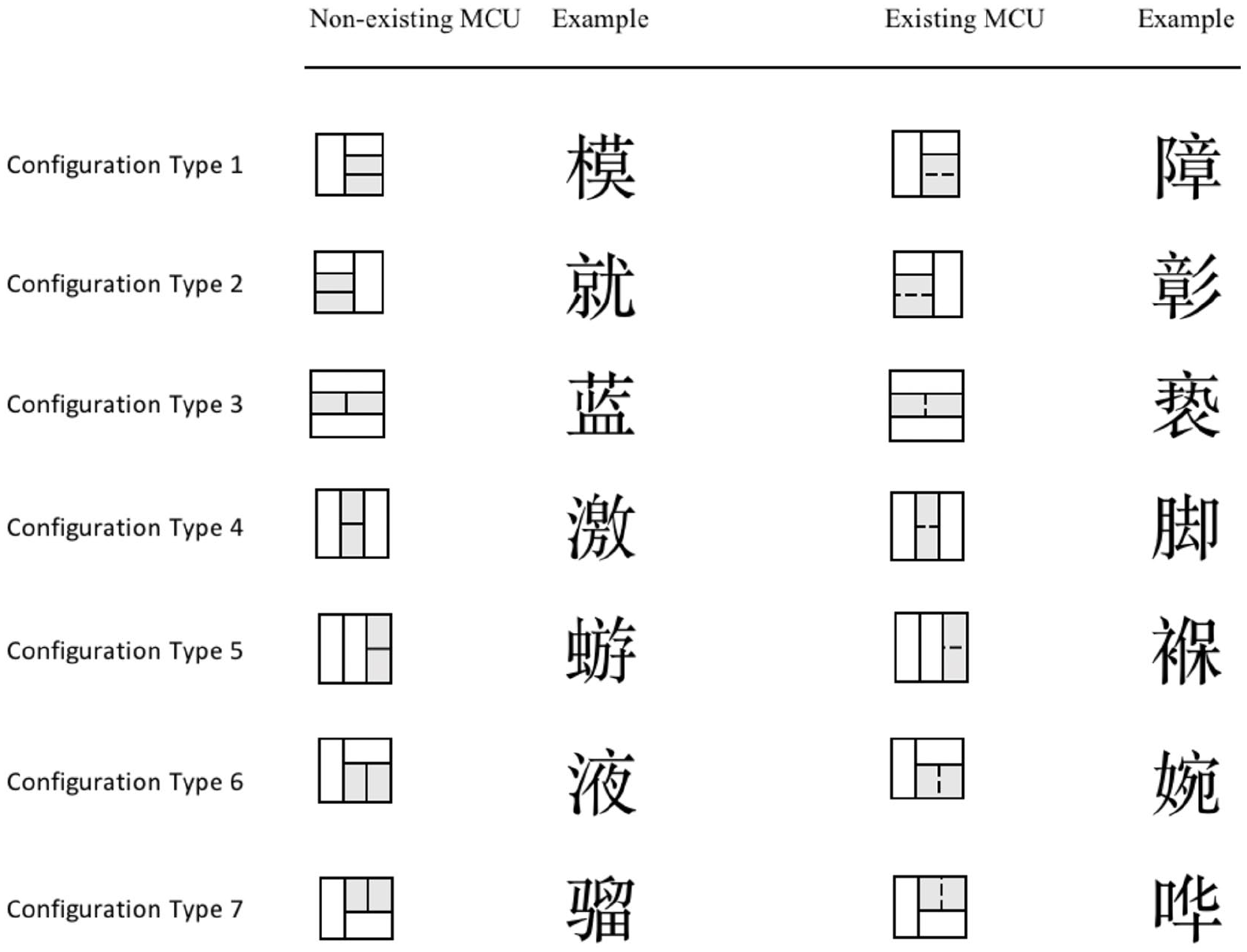
The seven configuration types that were included in the study.
In addition to configuration type, the two groups of stimuli were matched on frequency, family size, and the number of strokes (Table 1). All of these measures originated from the Chinese Lexical Database (Sun, Hendrix, Ma, & Baayen, 2018). Furthermore, the MCUs of the two groups were matched on the mean number of strokes, the mean summed frequency of all characters in which the MCU occurs, the percentage of square-shaped components such as 口 and 田, and the percentage of MCUs for which the two subcomponents visually touched each other (e.g., in the MCU 兄, the components 口 and 儿 touch; but in the MCU 只, the components 口 and 八 do not). These last two measures were included because a pilot study indicated that they represent visually salient features that influence detection performance for non-Chinese speaking participants. We also controlled for the number of strokes of the single components, the percentage of square-shaped single components, and whether the components exist on their own or not.
Characteristics of the stimulus sets.
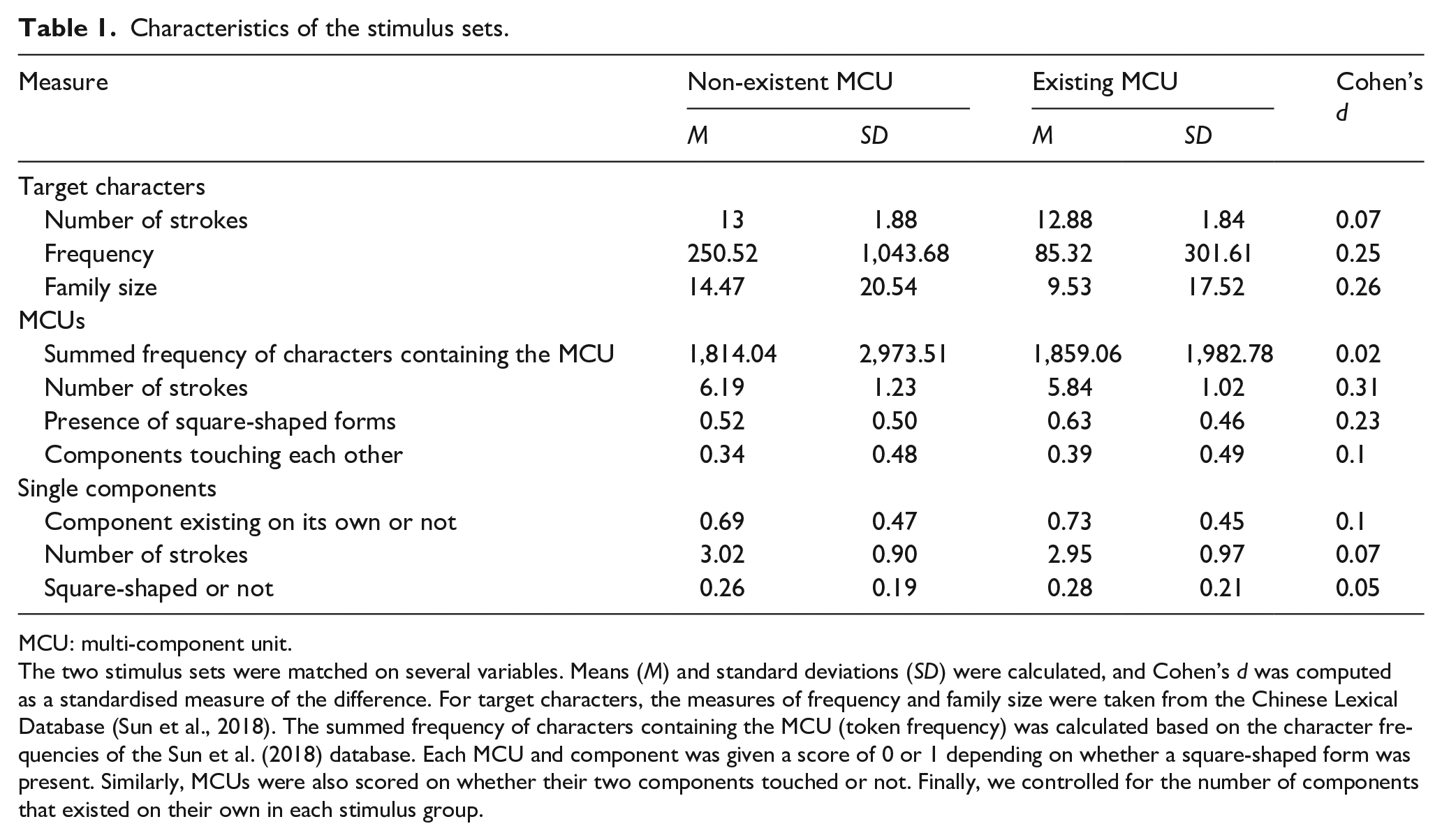
MCU: multi-component unit.
The two stimulus sets were matched on several variables. Means (M) and standard deviations (SD) were calculated, and Cohen’s d was computed as a standardised measure of the difference. For target characters, the measures of frequency and family size were taken from the Chinese Lexical Database (Sun et al., 2018). The summed frequency of characters containing the MCU (token frequency) was calculated based on the character frequencies of the Sun et al. (2018) database. Each MCU and component was given a score of 0 or 1 depending on whether a square-shaped form was present. Similarly, MCUs were also scored on whether their two components touched or not. Finally, we controlled for the number of components that existed on their own in each stimulus group.
Procedure
A schematic representation of a trial can be found in Figure 3. The participants were seated at a comfortable distance from a computer screen. They performed a probe detection task, where target stimuli were 24pt Songti font characters, presented as BMP-files of 48 × 48 pixels. The stimuli were displayed centrally on the screen, in white against a black background. Stimulus presentation, response latency, and accuracy were controlled in PsychoPy 3.0.3 (Peirce et al., 2019). Each trial started with the presentation of a fixation cross for 300 ms, followed by a component probe for 200 ms. Subsequently, there was an interstimulus interval of 200 ms, followed by the presentation of the target. Once the target was visible on the screen, participants decided whether the previously seen probe was present in the target or not, by pressing the corresponding keyboard key that coded for “yes” or “no.” After a response was given, the target disappeared. Finally, there was a blank screen for 500 ms, after which the next trial began.
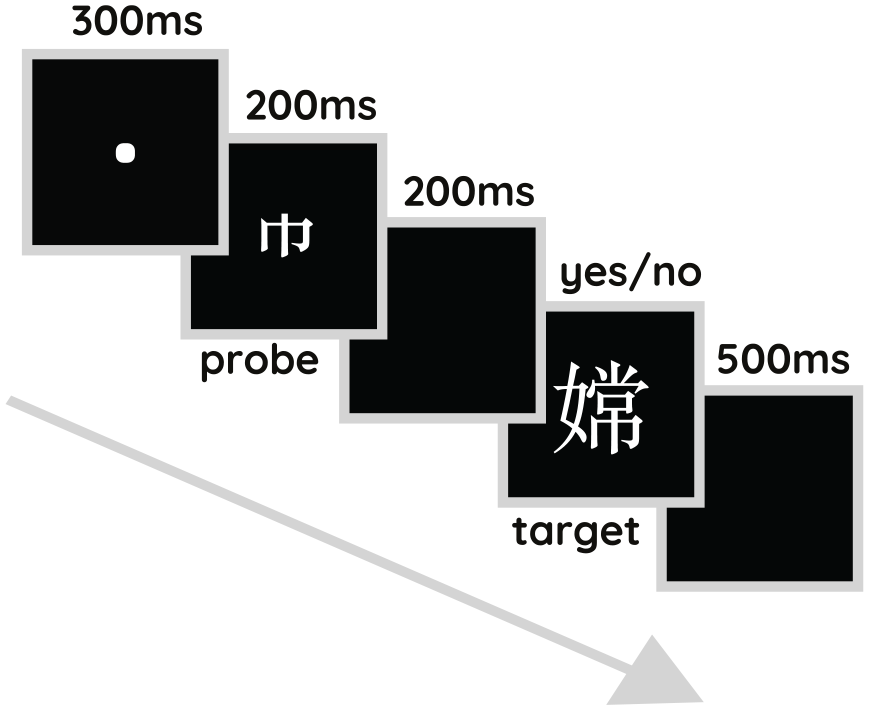
Schematic representation of a trial in Experiment 1.
To create the probes, we divided each target character into its constituent components. In addition, we also used the MCU as a probe (see Supplementary Material 1). Thus, for “yes” trials, a target could be preceded either by one of its four components or by the MCU. For “no” trials, we randomly assigned a comparable probe that belonged to a different character of the same configuration type. So, each of the 64 target characters appeared in 10 trials in total: 5 “yes” trials and 5 “no” trials. This resulted in a total of 640 trials, which were divided into 10 blocks of 64 trials each. In between blocks, the participants were able to take a small break. In total, the task lasted approximately 25 min.
Results
We analysed our data in R (version 3.6.2; R Core Team, 2019) under the RStudio environment (RStudio Team, 2019), with the packages lme4 (version 1.1-21) and lmerTest (version 3.1-1). Raw data and analysis scripts are available here: https://osf.io/x7dvb/. One participant from the French-speaking group was excluded from the analysis because this participant failed to follow instructions. We only examined data for probes that were either an MCU or a part of an MCU (single components). Filler trials with components that did not belong to an MCU were not included in the analysis. Before fitting models, we deleted trials with reaction times below 150 ms or above 3,000 ms, leading us to exclude 0.3% of the trials in total.
Single component probes
The primary analysis focused on single component probes. We considered only “yes” trials for which the participants provided the correct answer. The results are presented in Figure 4. As is typically the case for reaction time data, the distribution of the reaction times was positively skewed. Therefore, we performed a log transformation of the reaction times (Baayen, 2008). We constructed linear mixed-effects models to analyse the reaction time data. For each participant group, we fitted a model with a fixed effect of MCU type (existing/non-existing), as well as random intercepts for subjects and items. In the experimental group, there was a significant effect of MCU type (β = −0.04, SE = 0.02, t = −2.27, p = .027). Single component probes that belong to an existing MCU were detected significantly more slowly (M = 712 ms, SD = 114 ms) than single component probes that belong to a non-existing MCU (M = 682 ms, SD = 114 ms). The effect of MCU type was not significant for the control group (β = 0.0009, SE = 0.02, t = 0.04, p = .97). Given the binary nature of error data, we used Generalised Linear Mixed Models for the analysis of the error rates. Each model contained a fixed effect of MCU type (existing/non-existing) and random intercepts by subjects and items. The effect of MCU type failed to reach significance in the experimental group (β = −0.37, SE = 0.23, z = −1.64, p = .10). In the control group, there was no effect of MCU type (β = 0.05, SE = 0.17, z = 0.28, p = .78).
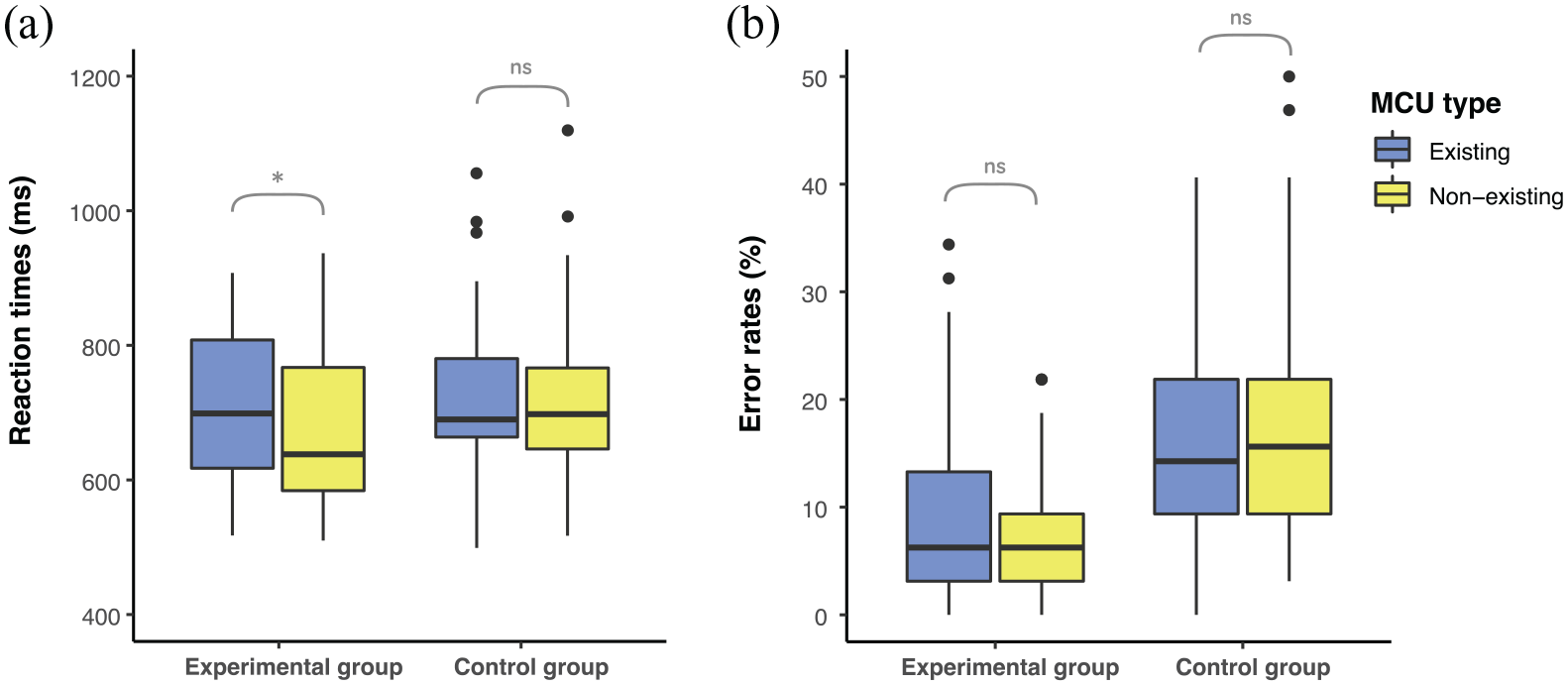
Mean reaction times and error rates for single component probes in Experiment 1. (a) Boxplots showing the mean reaction times by participant (in milliseconds) for the experimental group (left) and the control group (right). Reaction times are compared for single components that are a part of an existing MCU (in blue) and single components that are a part of a non-existing MCU (in yellow). (b) Boxplots showing the mean error rates by participant (in percentage) for the experimental group (left) and the control group (right). Error rates are compared for single components that are a part of an existing MCU (in blue) and single components that are a part of a non-existing MCU (in yellow). The bold black horizontal line represents the median, and the outer horizontal lines represent the 25th and 75th percentiles. The whiskers mark the limits of 1.5 times the interquartile range (IQR).
MCU probes
We also looked at the results for trials in which the probe was an MCU. Results for MCU probes are presented in Figure 5. In the experimental group, there was no effect of MCU type (β = −0.003, SE = 0.02, t = 0.16, p = .87). Similarly, no effect of MCU Type was present in the control group (β = 0.01, SE = 0.02, t = 0.50, p = .62). Concerning the error rates, there was no effect of MCU type in the experimental group (β = −0.06, SE = 0.40, z = −1.60, p = .11) nor in the control group (β = −0.002, SE = 0.12, z = −0.02, p = .99).
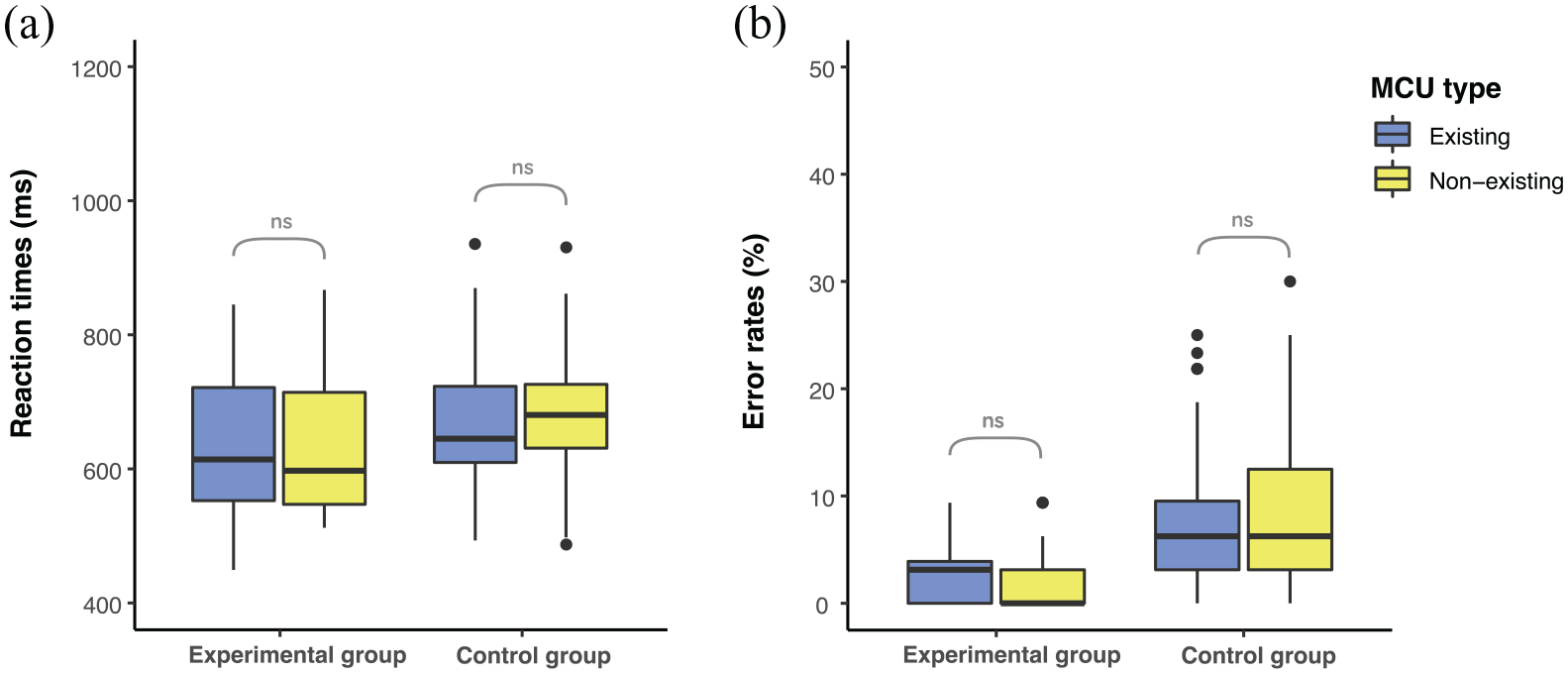
Mean reaction times and error rates for MCU probes in Experiment 1. (a
Discussion
The Chinese-speaking participants of the experimental group took significantly longer to detect single component probes that were a part of an existing MCU, compared with single component probes that were a part of a non-existing MCU. This suggests that single components are indeed more difficult to detect when they are a part of an existing MCU, an observation in line with our prediction. There was no such effect for the control group, which indicates that the observed differences in the experimental group were not driven by purely visual non-orthographic properties of the stimulus groups. Concerning our secondary analysis, we did not find the anticipated effect. For trials with MCU probes, the effect of MCU type was not significant in the experimental group. MCU probes that exist on their own were not better detected than MCUs that do not exist on their own.
Experiment 2
Because of the way Experiment 1 was designed, it is possible that memory processes influenced performance. In that case, the task was not a pure visual detection task. Indeed, after the probe had been presented, participants needed to keep it in their short-term memory storage until the target arrived. Probes that were easier to keep in memory could then have a detection advantage. In Experiment 2, probes and targets were, therefore, shown simultaneously on the screen rather than sequentially, to reduce the possible influence of memory on performance. By eliminating effects that are due to memory encoding, we can provide a more direct test of the hypothesis that MCUs are perceptual units of reading in Chinese.
Method
Participants
One hundred and seven adults participated in Experiment 2. Fifty participants were recruited for the experimental group (mean age = 29.1, SD = 9.2). All of them reported that their first language was Mandarin Chinese. Furthermore, a control group of 57 participants was tested (mean age = 26.41, SD = 7.68). None of the control subjects had experience in reading Chinese characters. None of the participants reported having any language impairments. All subjects were recruited using Prolific (http://www.prolific.co). They were paid for their participation. All participants gave written informed consent before launching the study.
Stimuli
The stimuli were identical to those used in Experiment 1.
Procedure
Experiment 2 was programmed in PsychoPy 3.0.3 (Peirce et al., 2019) and was run online through Psychopy’s online platform Pavlovia (https://pavlovia.org). The trial procedure was very similar to that of Experiment 1, albeit that probe and target now appeared simultaneously on the screen until a response was given by the participant. The probe (component or MCU) always appeared in the upper half of the screen, and the target (whole character) always appeared in the bottom half. The distance between each item and the centre of the screen was calculated based on the total height of the screen, with each item appearing at a vertical midline distance of 10% of the height. Probe and target stimuli remained on the screen until a response was given, after which the next trial began.
Results
As for Experiment 1, we had planned to test 40 participants per group. For the control group, 17 participants were discarded because their accuracy was around chance level. For the experimental group, nine participants were residents of Taiwan or Hong Kong, where traditional characters are in use, thus leaving 40 control and 41 experimental participants for the analysis. Trials with extremely short (
Single component probes
Our primary analysis was based on trials with single component probes. Boxplots for reaction times and error rates for single component probes are shown in Figure 6. For each participant group, we fitted a model with a fixed effect of MCU type (existing/non-existing), as well as random intercepts by participants and items. In the experimental group, the results went in the expected direction, namely longer reaction times for single component probes that were a part of an existing MCU, but the effect failed to reach significance (β = 0.02, SE = 0.02, t = −1.78, p = .08). In the control group, there was no difference (β = −0.001, SE = 0.02, t = −0.05, p = .96). Error rates for single component probes are presented in the right-hand part of Figure 6. In the experimental group, there was a significant effect of MCU type (β = 0.53, SE = 0.19, z = 2.88, p = .004). Participants more often failed to detect single component probes that were a part of an existing MCU (11.0% errors) than single component probes that were a part of a non-existing MCU (7.05% errors). In contrast, the effect of MCU type was not significant in the control group (β = 0.14, SE = 0.17, z = 0.82, p = .41).
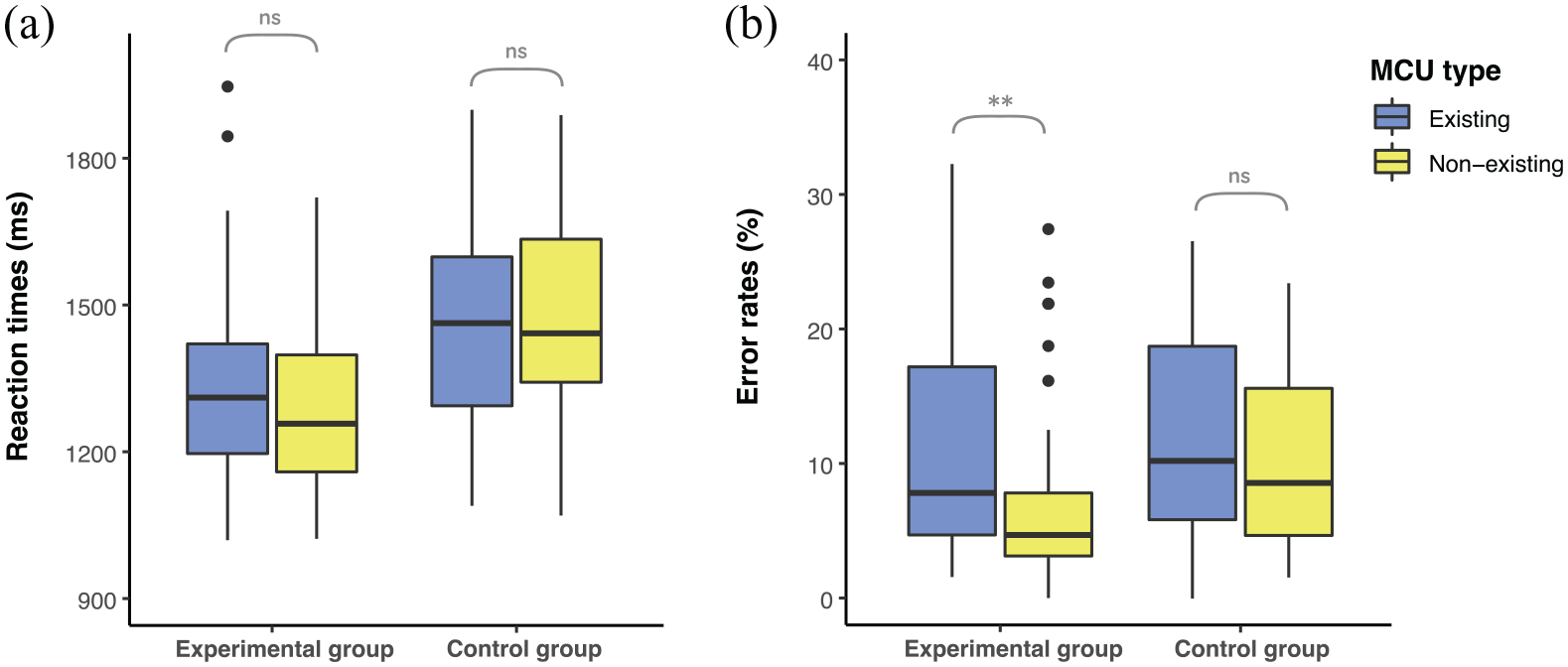
Mean reaction times and error rates for single component probes in Experiment 2. (a) Boxplots showing the mean reaction times by participant (in milliseconds) for the experimental group (left) and the control group (right). Reaction times are compared for single components that are a part of an existing MCU (in blue) and single components that are a part of a non-existing MCU (in yellow). (b) Boxplots showing the mean error rates by participant (in percentage) for the experimental group (left) and the control group (right). Error rates are compared for single components that are a part of an existing MCU (in blue) and single components that are a part of a non-existing MCU (in yellow). The bold black horizontal line represents the median, and the outer horizontal lines represent the 25th and 75th percentiles. The whiskers mark the limits of 1.5 times the interquartile range (IQR).
MCU probes
Reaction times and error rates for the MCU probes are presented in Figure 7. In the experimental group, there was a significant effect of MCU type (β = 0.07, SE = 0.02, t = 3.65, p < .001). MCU probes that exist on their own were detected faster (M = 1,200 ms, SD = 181 ms, median = 1,171 ms) than MCU probes that do not exist on their own (M = 1,300 ms, SD = 229 ms, median = 1,251 ms). In contrast, for the control group, the effect of MCU type was not significant (β = 0.04, SE = 0.03, t = 1.44, p = .16). Error rates for MCU probes are presented in the right-hand part of Figure 7. In the experimental group, the effect of MCU type was not significant (β = 0.30, SE = 0.31, z = 0.96, p = .34). Similarly, the effect of MCU type was not significant in the control group (β = 0.006, SE = 0.32, z = 0.02, p = .99).

Mean reaction times and error rates for MCU probes in Experiment 2. (a) Boxplots showing the mean reaction times by participant (in milliseconds) for the experimental group (left) and the control group (right). Reaction times are compared for existing MCU probes (in blue) and MCU probes that do not exist as a separate character (in yellow). (b) Boxplots showing the mean error rates by participant (in percentage) for the experimental group (left) and the control group (right). Error rates are compared for existing MCU probes (in blue) and MCU probes that do not exist as a separate character (in yellow). The bold black horizontal line represents the median, and the outer horizontal lines represent the 25th and 75th percentiles. The whiskers mark the limits of 1.5 times the interquartile range (IQR).
Discussion
The absence of significant effects for the control group once again confirms that effects in the experimental group could not be due to purely visual non-linguistic confounds. Our main prediction concerned single component probes. We predicted that Chinese-speaking participants would have more difficulty detecting a single component in an MCU that could stand on its own (with its own meaning and sound), than in an MCU that does not exist on its own. The results of Experiment 2 are in line with this prediction. Participants made significantly more errors in the detection of single component probes that were a part of an existing MCU, compared to single component probes that were a part of a non-existing MCU. Moreover, there was a non-significant trend for single component probes in the reaction times. For MCU probes, the detection was faster for MCU probes that exist on their own compared to MCU probes that do not exist on their own. No effect was found in the error rates.
General discussion
In the past decades, the field of visual word recognition saw a tremendous development of models of orthographic processing in alphabetical scripts (see Norris, 2013, for a review). In contrast, orthographic processing in languages such as Chinese is still less well understood. We conducted two probe detection experiments to examine which orthographic units are implicated in character recognition in Chinese. Probes were single components or combinations of two components (i.e., MCUs) that had to be detected in target characters. The target characters either contained an MCU that could also stand on its own, or an MCU that did not exist on its own, and did not have an associated meaning and sound. The results showed that single components were more difficult to detect when they were a part of an existing MCU, compared to when they were a part of a non-existing MCU. To make sure there was no visual bias in our stimulus sets, we also tested a control group consisting of participants without prior knowledge of the Chinese script. In both experiments, there was no significant effect for the control group. The absence of effect in this group confirmed that the significant results in the Chinese-speaking group were not due to purely visual characteristics of the two groups of stimuli.
According to the unitisation hypothesis (Healy, 1994), our findings suggest that MCUs are a perceptual unit of character recognition. Detection of components in perceptual units is harder because these units first have to be divided into their constituents to do so. To our knowledge, our study is the first to demonstrate the implication of MCUs in Chinese character recognition, even when these MCUs are not related to the entire character in meaning or pronunciation. Although there is some evidence for the automatic activation of phonetic radicals during visual word recognition (Yeh et al., 2017), this study used MCUs that were not phonetic radicals themselves. The results show that MCUs are implicated in character recognition, even when they do not function as phonetic radicals. Current models of visual word recognition in Chinese do not provide a special role for MCUs (Perfetti et al., 2005; Taft & Zhu, 1997). This study reveals, however, that their implication in character recognition should not be overlooked. Even though characters containing MCUs that are not phonetic radicals represent only a relatively small proportion of the Chinese script, a better understanding of this subgroup can aid to refine future computational models, to better explain and predict character reading in Chinese. As stated by Ding et al. (2004), a further level may need to be added to the hierarchy of the models for this type of character, because the MCU must be activated by its components taking positional information into account.
Although both of our experiments lead to the same overall conclusion, there are some differences in the results of Experiment 1 and Experiment 2 that should be discussed. If we compare the results of both experiments, we see that in Experiment 1, the effect for single component probes was significant only for the reaction times; whereas in Experiment 2, the effect for single component probes was significant only for the error rates. The main difference between the two experiments is the fact that probe and target were presented sequentially in Experiment 1 and simultaneously in Experiment 2. In Experiment 1, participants had time to encode the probe into memory before the onset of reaction time measurements. In Experiment 2, the overall reaction times were much longer, and variability was larger, which could explain why the reaction time difference did not reach statistical significance. It should also be noted that the results that did not reach significance were always in the anticipated direction, reflecting a tendency for slower and more error-prone detection of single components in an existing MCU versus a non-existing MCU in both experiments.
Regarding MCU probes, detection was faster for MCU probes that exist on their own compared to MCU probes that do not exist on their own in Experiment 2. In Experiment 1, there was no significant effect for MCU probes on reaction times. A comparison of the task properties could shed some light on why the effect was present in Experiment 2 but not in Experiment 1. In Experiment 1, probes and targets were presented in succession, whereas they appeared simultaneously on the screen in Experiment 2. It could be argued that non-existing MCU probes are more difficult to encode in memory than existing MCU probes, as the former do not have an associated meaning and sound. In Experiment 1, however, participants had time to encode these MCU probes before the onset of reaction time measurement. It is possible that this way, they were able to attenuate the differences in reaction times between existing and non-existing MCUs in the subsequent detection phase. On the contrary, in Experiment 2, reaction times started being measured at the moment the probe and target appeared simultaneously on the screen. Participants then had to encode the MCU probes, which we expect to be more time-consuming for non-existing MCU probes.
Some particularities of the stimulus sets should be addressed. It could be argued that the characters that were used in our experiment are rather uncommon. We selected characters with four components so we could use MCUs that were not identical to the phonetic radical. Many Chinese characters indeed have only two or three components. However, we calculated that 39% of characters that are present in the Chinese Lexical Database (Sun et al., 2018) have four or more components. If we look at the summed frequency of the characters with four or more components, we find that they account for 24% of the total frequency of all characters. Thus, although characters with four or more components are not the most common ones, they do represent a considerable proportion of the written language. A second particularity of our stimulus set is that it almost exclusively contained characters with a left–right configuration. However, characters with left–right configurations are by far the most common ones in the Chinese language. In the Chinese Lexical Database by Sun et al. (2018), left–right structured characters account for more than 60% of all characters, with top–down structured characters being the second most prevalent configuration (over 20%). Furthermore, although the present data provide no direct evidence for other character configurations, we envisage no theoretical reason why the conclusion would not generalise to these as well.
In the original stimulus selection process, we did not control for the type and token frequencies of components, because this information was not available to us at that time. We were, however, able to check for these measures a posteriori. By type frequency, we mean the total number of times a component occurs in characters of the Chinese language. Token frequency reflects the summed frequency of occurrence of these characters. Our additional calculations revealed that components in our stimulus sets that belonged to an existing MCU had significantly higher type and token frequencies than components that belonged to a non-existing MCU. Our results show that components belonging to an existing MCU are more difficult to detect. Their higher type and token frequencies would predict the opposite pattern. Thus, the differences in type and token frequency are not detrimental for our conclusions. If anything, they reveal that our effects might even be underestimated in the current experiments.
Although the current research focuses on proficient readers of Chinese, it is important to also consider how perceptual units change with experience. As Anderson et al. (2013) state, the ability to see characters in terms of components is acquired gradually during early elementary school. More and more models of reading incorporate some form of learning. Indeed, understanding the development of reading is crucial to fully grasp what happens at a more advanced stage. Moreover, even an experienced reader can learn new words and will have better representations of familiar words compared to less familiar words.
In conclusion, the results of our experiments suggest that combinations of components (MCUs) are perceptual units in Chinese character recognition. These findings imply that models of orthographic processing in Chinese should take into consideration the role of MCUs in the perception of Chinese characters. It is clear that visual word recognition in Chinese is a complex issue. Hence, a thorough understanding of the interplay between strokes, components, MCUs, and radicals is needed to fully grasp the specifics of character recognition in Chinese.
Supplemental Material
sj-docx-1-qjp-10.1177_17470218211056895 – Supplemental material for The nature of perceptual units in Chinese character recognition
Supplemental material, sj-docx-1-qjp-10.1177_17470218211056895 for The nature of perceptual units in Chinese character recognition by Joanna Isselé, Fabienne Chetail and Alain Content in Quarterly Journal of Experimental Psychology
Footnotes
Acknowledgements
We would like to thank Jianfeng Yang and Rui Zhang for collecting the data for the experimental group in Experiment 1.
Declaration of conflicting interests
The author(s) declared no potential conflicts of interest with respect to the research, authorship, and/or publication of this article.
Funding
The author(s) disclosed receipt of the following financial support for the research, authorship, and/or publication of this article: This work was partly supported by the Belgian National Fund for Scientific Research (F.R.S. FNRS), Belgium, under a Research Fellow (ASP) grant.

Data accessibility statement
Notes
References
Supplementary Material
Please find the following supplemental material available below.
For Open Access articles published under a Creative Commons License, all supplemental material carries the same license as the article it is associated with.
For non-Open Access articles published, all supplemental material carries a non-exclusive license, and permission requests for re-use of supplemental material or any part of supplemental material shall be sent directly to the copyright owner as specified in the copyright notice associated with the article.
